




GATE Robotics and Automation Syllabus 2027 has been released by IIT Madras on their official website, gate2027.iitm.ac.in. The syllabus has three common sections in Part A and two optional sections in Part B.
Robotics and Automation is a brand new paper with the code RA, introduced from GATE 2027. Students must note that the RA paper has a common Part A and an optional Part B.
- RA is a new GATE paper introduced by IIT Madras from the 2027 cycle.
- Part A covers Engineering Mathematics, Basics of Mechatronics, and Principles of Robotics and Automation.
- Part B1 covers Electrical Engineering and Part B2 covers Mechanical Engineering.
- Students can select the Part B section during the examination itself.
- General Aptitude carries 15 marks, while the Robotics & Automation subject section carries 85 marks.
Related Links:
- GATE 2027 Exam Pattern, Subject-wise Question Paper Pattern, Marking Scheme, Total Marks
- GATE 2027 Preparation: GATE 2026 Last Minute Preparation Strategy, Timetable, Free Resources, Books, Previous Year Question Papers
- GATE 2027 New Test Papers Introduced: Full List and Syllabus Changes
Key Summary
- Robotics and Automation (RA) is a new GATE paper from 2027.
- The paper carries 100 marks across General Aptitude, Part A and Part B.
- Part A has three compulsory sections worth 60 marks.
- Part B lets you pick Electrical Engineering or Mechanical Engineering for 25 marks.
- The official syllabus PDF is available at gate2027.iitm.ac.in.
- Registration opens on August 14, 2026 and closes on September 21, 2026.
GATE Robotics and Automation Syllabus 2027 Overview
IIT Madras introduced the Robotics and Automation paper to match current industry demand.
- The paper draws from mechanical engineering, electronics, control systems, and programming.
- The syllabus is interdisciplinary by design.
| Particular | Details |
|---|---|
| Exam Name | Graduate Aptitude Test in Engineering (GATE) 2027 |
| Paper Code | RA |
| Structure | General Aptitude + Part A (common) + Part B (B1 or B2) |
| Part A Sections | Engineering Mathematics, Basics of Mechatronics, Principles of Robotics and Automation |
| Part B Options | B1: Electrical Engineering, B2: Mechanical Engineering |
| Total Marks | 100 marks |
| Total Questions | 65 questions |
| Exam Duration | 3 hours (180 minutes) |
| Question Types | MCQ, MSQ, and NAT |
GATE Robotics & Automation Syllabus 2027: New Paper Addition
The GATE 2027 Robotics and Automation (RA) paper is a newly introduced exam paper.
- It tests students' understanding of robotics, automation, mechatronics, and intelligent systems.
- It integrates essential topics such as robot kinematics and dynamics, sensors and actuators, control systems, embedded programming, and industrial automation.
- Students should review the syllabus before starting the preparation so that they can prioritize important subjects and avoid missing any topics.
Also Check: GATE 2027 Introduces New Robotics and Automation Paper; Check Exam Dates
GATE Robotics & Automation Syllabus 2027: 2-Paper Combination
GATE 2027 allows candidates to appear for one or two papers from the approved combinations. The new Robotics & Automation (RA) paper is well-suited with several related subjects.
| Primary Paper | Paper Code | Allowed Second Papers |
|---|---|---|
| Robotics & Automation | RA | EE, ME, DA, CS |
| Computer Science & IT | CS | DA, EC, GE, MA, PH, RA, ST, ME |
| Data Science & AI | DA | CS, EC, EE, MA, ME, PH, RA, ST, XE |
| Electrical Engineering | EE | DA, EC, IN, PH, RA |
| Mechanical Engineering | ME | AE, DA, IN, NM, PI, XE, RA, CS |
- RA + ME → Best for candidates with a mechanical background (strong overlap in Part B2).
- RA + EE → Ideal for Electrical/Electronics background (strong overlap in Part B1).
- RA + DA → Excellent choice due to shared Engineering Mathematics, Python programming, and Data Structures.
- RA + CS → Good for those interested in AI, programming, and intelligent robotics.
Also Check: GATE 2027 Two Paper Combination: Which Papers Can Be Attempted Together
How to Download GATE Robotics & Automation Syllabus 2027 PDF?
Follow these steps to download the official Robotics and Automation syllabus from IIT Madras.
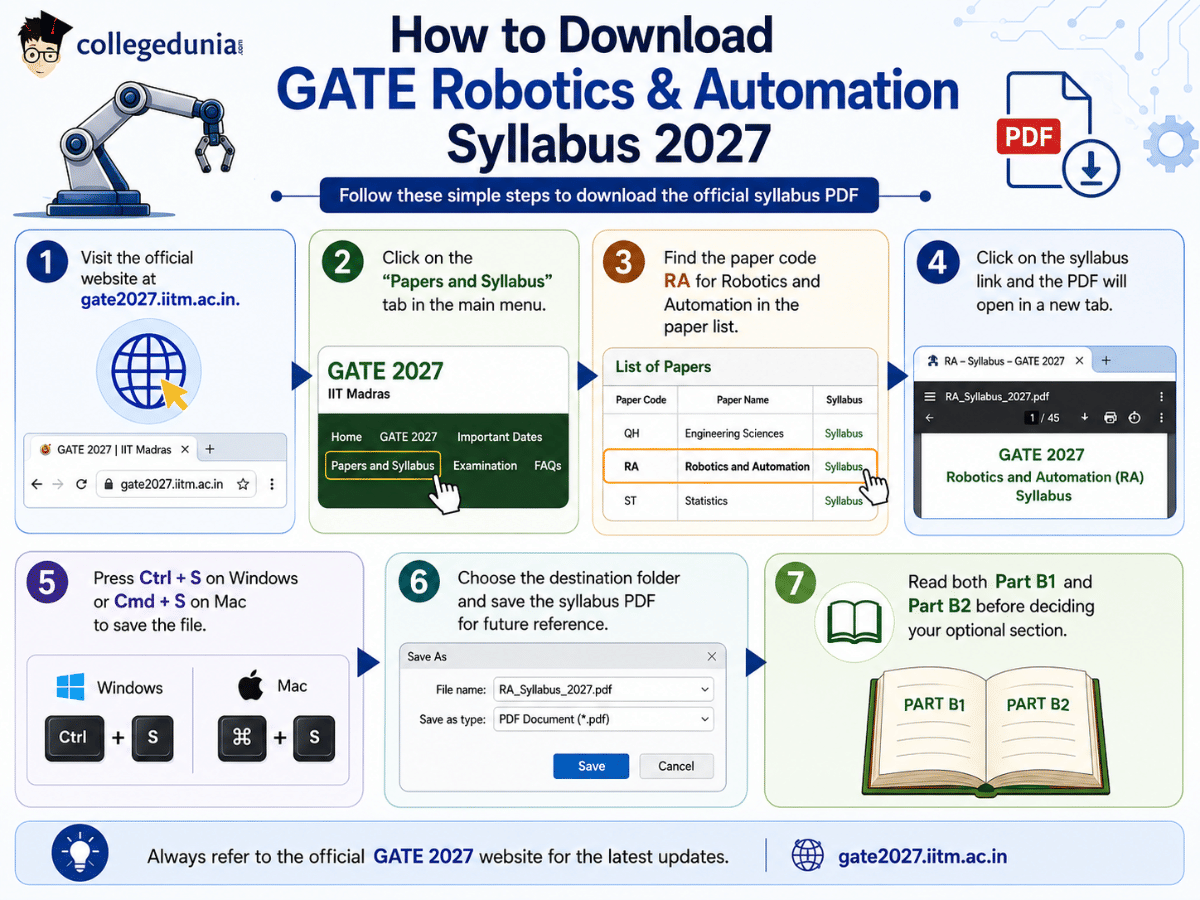
Note: Download the syllabus only from the official IIT Madras website.
GATE Robotics and Automation Syllabus 2027: Paper Structure
The Robotics & Automation syllabus 2027 follows a three-block structure. Knowing the marking scheme split helps students divide preparation time correctly.
- Part A alone carries 60 marks, so it decides your score more than the optional section.
- Students should build the common core first and treat Part B as the last layer.
- Electrical, electronics and instrumentation graduates usually find Part B1 easier.
- Mechanical, production and mechatronics graduates are better placed for Part B2.
| Block | Sections Covered | Marks | Status |
|---|---|---|---|
| General Aptitude | Verbal, Quantitative, Analytical and Spatial Aptitude | 15 | Compulsory |
| Part A | A1 Engineering Mathematics, A2 Basics of Mechatronics, A3 Principles of Robotics and Automation | 60 | Compulsory |
| Part B | B1 Electrical Engineering or B2 Mechanical Engineering | 25 | Choose one |
GATE Robotics and Automation Syllabus 2027: Engineering Mathematics Syllabus 2027 (Section A1)
Section A1 builds the mathematical base for the entire paper.
- The topics overlap heavily with other GATE engineering papers.
- Students should finish Engineering Mathematics early because the same concepts return in Control Systems and Kinematics.
| Unit | Topics Covered |
|---|---|
| Linear Algebra | Matrices, transpose, determinant, rank, trace, adjoint, eigenvalues and eigenvectors, solution of linear equations |
| Calculus | Limits, continuity, differentiability, mean value theorems, definite and improper integrals, partial derivatives, Taylor series, maxima and minima, gradient, divergence and curl |
| Differential Equations | First and higher order equations, Euler-Cauchy equation, Laplace transforms, heat equation, wave equation, Laplace equation, Fourier series |
| Probability and Statistics | Probability axioms, mean, median, mode, standard deviation, binomial, Poisson and normal distributions, PDF and CDF, hypothesis testing |
| Numerical Methods | Solution of linear and non-linear equations, trapezoidal rule, Simpson's rule, finite differences |
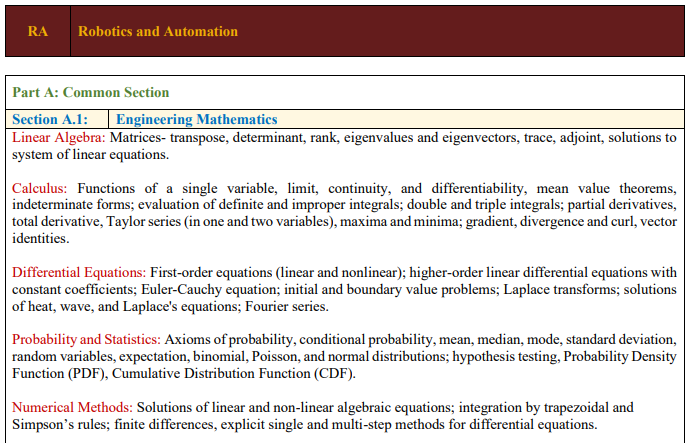
Source: GATE Syllabus 2027
GATE Robotics and Automation Syllabus 2027: GATE RA Basics of Mechatronics Syllabus 2027 (Section A2)
- Section A2 blends circuits, sensors, actuators, mechanics, and programming.
- This is the section that makes RA different from every other GATE paper.
- You should practise Python coding logic on paper because the exam tests output tracing and recursion.
- Data structures here stay at the introductory level.
| Topic Area | Key Concepts |
|---|---|
| Network Elements | Voltage and current sources, R, L, C, and M elements, Kirchhoff's laws, Thevenin's and Norton's theorems |
| Digital Circuits | Boolean algebra, multiplexers, encoders, decoders, flip-flops, counters |
| Sensors and Transducers | Resistive, capacitive, inductive, piezoelectric and Hall effect sensors |
| Actuators | Hydraulic and pneumatic actuators, DC motors, stepper motors, servo motors |
| Engineering Mechanics | Free body diagrams, friction, trusses, kinematics and dynamics of rigid bodies |
| Programming | Python basics, data types, loops, functions, recursion |
| Data Structures | Stack, queue, linked list, binary search tree, binary heap, graph |
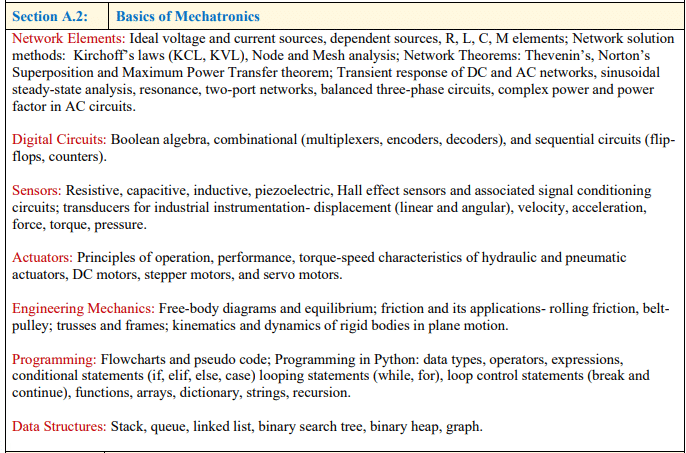
Source: GATE Syllabus 2027
GATE Robotics and Automation Syllabus 2027: Principles of Robotics and Automation Syllabus 2027 (Section A3)
Section A3 is the heart of the paper.
- It covers manipulator theory, robot motion, and factory automation.
- Rotation matrices and homogeneous transformations are the most question-heavy topics in this section.
- Practise numerical transformation problems until the matrix steps feel automatic.
Robot Classification and Structure
| Category | Classification / Element | Key Features & Structural Arrangement |
|---|---|---|
| Architectural Topology | Serial Manipulator | Open-loop kinematic chain. Links connected end-to-end in series. High reach/workspace, lower payload capacity and dynamic stiffness. |
| Parallel Manipulator | Closed-loop kinematic chain. End-effector supported by multiple end-to-end kinematic chains working in parallel. High stiffness and payload capacity, smaller workspace. | |
| Geometrical Configuration | Cartesian (PPP) | 3 prismatic joints ($X, Y, Z$). Creates a rectangular/box-shaped workspace. High accuracy and rigidity. |
| Cylindrical (RPP) | 1 revolute, 2 prismatic joints. Creates a cylindrical workspace ($R, \theta, Z$). Good for assembly and pick-and-place. | |
| Spherical / Polar (RRP) | 2 revolute, 1 prismatic joint. Creates a polar/spherical workspace. | |
| SCARA (RRP) | 2 parallel revolute joints (horizontal motion) + 1 prismatic joint (vertical). High speed and compliance in the XY plane. | |
| Articulated / Jointed-Arm (RRR) | 3 revolute joints (typically 6 total for 6-DOF). Emulates human arm flexibility; large, complex spherical workspace. | |
| Structural Elements | Links | Rigid members connecting adjacent joints. Maintain fixed spatial relationships between joints. |
| Joints (Pair Types) | Revolute (R): Rotational motion around an axis (1-DOF). Prismatic (P): Linear sliding motion along an axis (1-DOF). | |
| Arrangement & Kinematics | Lower-order joints connect adjacent links to form kinematic chains. Joint order determines overall Degrees of Freedom (DOF), Degrees of Freedom (DOF), where ∑joint DOFs – constraints |
Kinematics and Coordinate Systems
| Topic | Key Concepts Covered |
|---|---|
| Coordinate Systems and Degrees of Freedom | Coordinate systems used in robotics and the concept of degrees of freedom (DOF). |
| Rotation Matrices | Rotation matrices in two-dimensional (2D) and three-dimensional (3D) space. |
| Homogeneous Transformations | Representation of combined rotation and translation using homogeneous transformation matrices. |
| Forward Kinematics of Manipulators | Determining the position and orientation of a robot's end-effector from given joint parameters. |
Robot Applications and Performance
| Topic | Key Concepts Covered |
|---|---|
| Point-to-Point and Continuous Path Control | Difference between point-to-point (PTP) control and continuous path (CP) control in robotic motion. |
| End-Effectors and Grippers | Types, functions, and applications of robotic end-effectors and grippers. |
| Robot Performance | Concepts of robot accuracy, precision, and repeatability, and their role in robotic operations. |
Computer Integrated Manufacturing
| Topic | Key Concepts Covered |
|---|---|
| Automation in Manufacturing Systems | Principles, benefits, and applications of automation in manufacturing processes. |
| Programmable Logic Controllers (PLCs) | PLC architecture, programming, and industrial control applications. |
| Automated Material Handling and Storage Systems | Systems used for automated movement, storage, and retrieval of materials in manufacturing facilities. |
| Automated Identification and Detection Systems | Technologies such as barcode, RFID, and sensors used for identification and monitoring. |
| Computer Numerical Control (CNC) | CNC machine operations, programming basics, and applications in automated manufacturing. |


Source: GATE Syllabus 2027
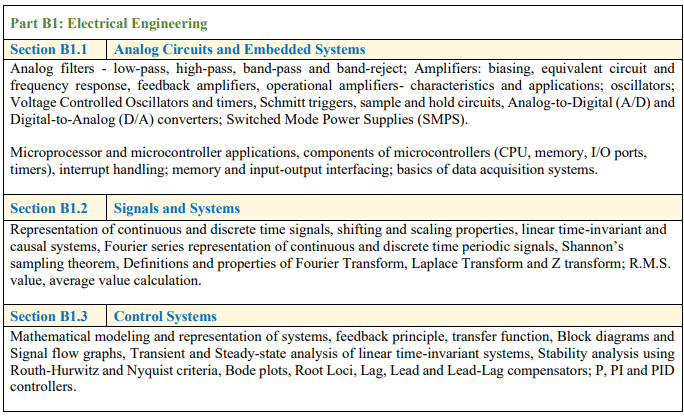
GATE Robotics and Automation Syllabus 2027: Electrical Engineering Syllabus 2027 (Part B1)
Part B1 suits students from Electrical, Electronics, Instrumentation, and allied branches. It carries 25 marks.
| Section | Topics Covered |
|---|---|
| Analog Circuits and Embedded Systems | Analog filters, amplifiers, operational amplifiers, oscillators, A/D and D/A converters, SMPS, microprocessors and microcontrollers |
| Signals and Systems | Continuous and discrete time signals, Fourier series, Shannon's sampling theorem, Fourier transform, Laplace transform, Z-transform |
| Control Systems | Mathematical modelling, transfer functions, block diagrams, signal flow graphs, Routh-Hurwitz and Nyquist stability criteria, Bode plots, root locus, PID controllers |
Source: GATE Syllabus 2027
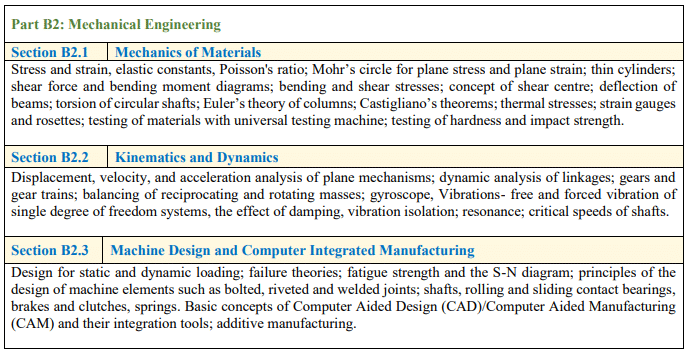
GATE Robotics and Automation Syllabus 2027: Mechanical Engineering Syllabus 2027 (Part B2)
Part B2 suits students from Mechanical, Production, Industrial, and Mechatronics branches.
- It also carries 25 marks.
- You should decide your Part B section before starting preparation, not on exam day.
- The option is selectable during the exam, but switching late wastes months of study.
| Section | Topics Covered |
|---|---|
| Mechanics of Materials | Stress and strain, Mohr's circle, bending and shear stresses, torsion, Euler's theory of columns, thermal stresses |
| Kinematics and Dynamics | Displacement, velocity and acceleration analysis, gears and gear trains, balancing of masses, gyroscope, vibrations, critical speed of shafts |
| Machine Design and CIM | Design for static and dynamic loading, failure theories, fatigue strength, joints, bearings, brakes, clutches, springs, CAD and CAM basics, additive manufacturing |
Source: GATE Syllabus 2027
Also Check:
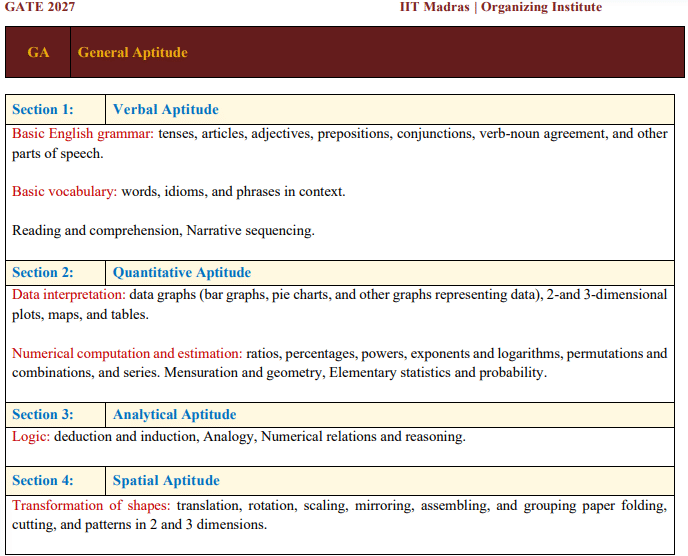
GATE Robotics and Automation Syllabus 2027: General Aptitude Syllabus 2027
General Aptitude carries 15 marks and is common across all 30 GATE papers. It has 10 questions.
| Unit | Topics Covered |
|---|---|
| Verbal Aptitude | Basic English grammar, tenses, articles, prepositions, word groups, verbal analogies, sentence completion, reading comprehension |
| Quantitative Aptitude | Data interpretation, charts and graphs, ratios, percentages, mensuration, geometry, elementary statistics and probability |
| Analytical Aptitude | Logic, deduction and induction, analogy, numerical relations, reasoning |
| Spatial Aptitude | Transformation of shapes, rotation, scaling, mirroring, assembling and grouping, paper folding and cutting |
Source: GATE Syllabus 2027
Also Check:
GATE Robotics & Automation Syllabus 2027: Handwritten Notes
| GATE RA Handwritten Notes | Download PDF |
|---|---|
| GATE Robotics Handwritten Notes PDF 2026 Free Download | Click here |
| GATE Robotics Sensors and Sensor Fusion Handwritten Notes PDF | Click here |
| GATE Robotics Robot Perception Handwritten Notes PDF | Click here |
| GATE Robotics Robot Dynamics Handwritten Notes PDF | Click here |
| GATE Robotics Programming & Algorithms Handwritten Notes PDF | Click here |
| GATE Robotics Motion Planning Handwritten Notes PDF | Click here |
| GATE Robotics Mobile Robotics and SLAM Handwritten Notes PDF | Click here |
| GATE Robotics Manipulator Kinematics Handwritten Notes PDF | Click here |
| GATE Robotics Industrial Robotics Handwritten Notes PDF | Click here |
| GATE Robotics Engineering Mechanics Handwritten Notes PDF | Click here |
| GATE Robotics Engineering Mathematics Handwritten Notes PDF | Click here |
| GATE Robotics Digital Electronics and Interfacing Notes | Click here |
| GATE Robotics Coordinate Frames Handwritten Notes PDF | Click here |
| GATE Robotics AI and Machine Learning Handwritten Notes PDF | Click here |
| GATE Robotics Actuators and Drives Handwritten Notes PDF | Click here |
How to Prepare GATE Robotics & Automation Syllabus 2027?
Since GATE Robotics and Automation (RA) is a newly introduced paper, there are no previous year question papers available yet.
- Focus your preparation on the official syllabus, standard reference books, and practice questions from related GATE subjects to build strong conceptual understanding.
- Students appearing in the first RA cycle should expect conceptual questions rather than deep numerical ones.
| Month | Timeline | Focus Area | Preparation Strategy |
|---|---|---|---|
| Month 1 | August 2026 | Engineering Mathematics & Mechatronics | Complete Engineering Mathematics, basic electrical circuits, sensors, actuators, and Python fundamentals. Prepare short notes and formula sheets. |
| Month 2 | September 2026 | Robotics & Automation Fundamentals | Study coordinate systems, rotation matrices, homogeneous transformations, forward kinematics, robot dynamics, and basic control concepts. Solve topic-wise numericals daily. |
| Month 3 | October 2026 | Manufacturing & Industrial Automation | Cover PLCs, CNC, Computer Integrated Manufacturing (CIM), automated material handling systems, robot applications, end-effectors, and performance measures. Revise completed topics every week. |
| Month 4 | November 2026 | Part B Preparation (EE or ME) | Focus entirely on your chosen optional section—Electrical Engineering or Mechanical Engineering. Strengthen concepts and solve topic-wise practice questions. |
| Month 5 | December 2026 | Revision & Practice | Revise all completed topics, solve questions from related GATE papers (ME, EE, EC), and take sectional mock tests to improve speed and accuracy. |
| Month 6 | January 2027 | Mock Tests & Final Revision | Attempt 2–3 full-length mock tests every week, analyze mistakes, revise formulas and short notes, and focus on weak areas before the exam. |
GATE Robotics & Automation Syllabus 2027: Section-wise Preparation Tips
A structured study plan for every section helps you complete the syllabus on time and revise with confidence. The tips below highlight the best way to prepare each part of the GATE RA syllabus.
Part A: Mathematics and Mechatronics
| Task | Preparation Strategy |
|---|---|
| Complete Engineering Mathematics | Finish the entire Engineering Mathematics syllabus within the first six weeks. |
| Practice Previous GATE Questions | Solve Engineering Mathematics questions from GATE ME, EE, and EC papers of the last ten years. |
| Revise Sensors | Prepare a one-page summary covering different sensor types and their working principles. |
| Strengthen Network Theory | Practice Kirchhoff's Law and Thevenin's Theorem problems using a standard Network Theory book. |
| Improve Python Skills | Write short Python programs by hand regularly to increase coding speed and output tracing ability. |
Part A: Robotics and Automation
| Task | Preparation Strategy |
|---|---|
| Study Robot Kinematics | Learn rotation matrices thoroughly before moving on to homogeneous transformations. |
| Practice Forward Kinematics | Solve at least 30 forward kinematics problems on serial manipulators. |
| Draw Robot Configurations | Practice drawing joint and link diagrams for common robot configurations. |
| Revise Industrial Automation | Review PLC ladder logic basics and CNC programming fundamentals. |
| Understand Robot Performance | Compare accuracy, precision, and repeatability with practical examples for quick revision. |
Part B1: Electrical Engineering
| Task | Preparation Strategy |
|---|---|
| Revise Basic Circuit Theory | Strengthen concepts of circuit analysis, network theorems, and AC/DC circuits through regular practice. |
| Practice Electrical Machines | Study the working principles, characteristics, and applications of transformers, DC machines, and AC machines. |
| Master Control Systems | Solve numerical problems on transfer functions, block diagrams, stability analysis, and controllers. |
| Focus on Power Systems | Revise generation, transmission, distribution, and power system protection concepts with numerical practice. |
| Solve Previous GATE Questions | Practice Electrical Engineering questions from previous GATE EE papers to improve accuracy and speed. |
Part B2: Mechanical Engineering
| Task | Preparation Strategy |
|---|---|
| Revise Engineering Mechanics | Practice free-body diagrams, equilibrium, friction, and force analysis regularly. |
| Strengthen Strength of Materials | Solve numerical problems on stress, strain, bending, torsion, and deflection of beams. |
| Master Theory of Machines | Study mechanisms, gear trains, cams, governors, and kinematics of machines with diagrams. |
| Practice Manufacturing Processes | Revise machining, casting, welding, forming, and metrology concepts along with common numerical questions. |
| Solve Previous GATE Questions | Practice Mechanical Engineering questions from previous GATE ME papers to improve problem-solving speed and accuracy. |
Also Check:
- How to Score 60+ in GATE 2027: Paper-Wise Study Plan
- GATE 2027: Score 70+ Marks in 6 Months — Subject-Wise Strategy

The student on Reddit shared that they have a background in Mechatronics and feel the new GATE Robotics & Automation (RA) syllabus closely matches what they studied in college. They are currently preparing for GATE ECE but are considering switching to RA because they want to pursue M.Tech in Robotics.
Choose GATE RA if you plan to build a career in Robotics or Automation.
- The syllabus is more relevant to your Mechatronics background and future goals.
- Before switching, compare the admission opportunities, participating institutes, and cut-offs for both GATE RA and GATE ECE.
- Ensure the paper you choose supports your plans.
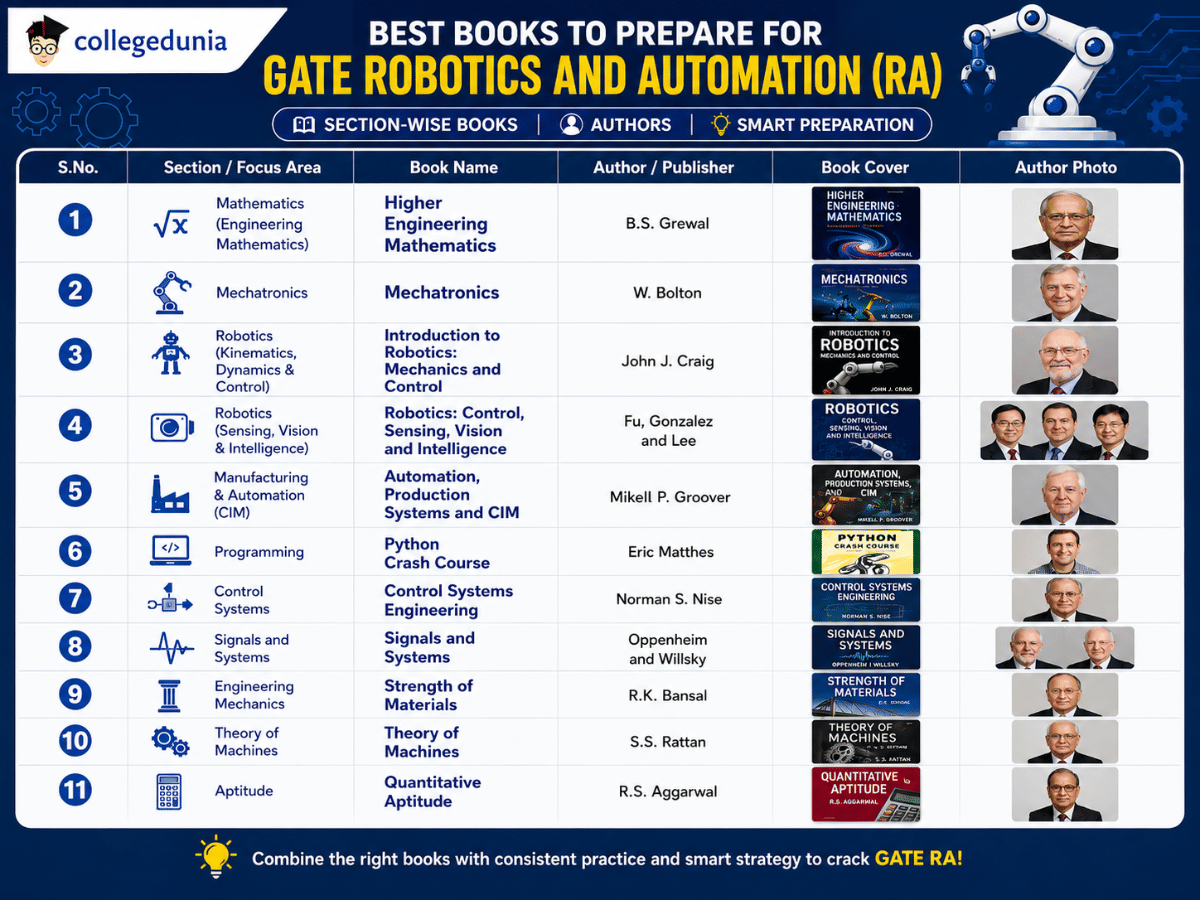
Best Books to cover GATE Robotics and Automation Syllabus 2027
Since GATE Robotics and Automation (RA) is a relatively new paper, no single book covers the entire syllabus.
Instead, prepare using a combination of subject-specific books and resources that align with each section of the syllabus for more complete and effective coverage.
| Section | Book Name | Author / Publisher | Why This Book |
|---|---|---|---|
| Engineering Mathematics | Higher Engineering Mathematics | B.S. Grewal | Covers every unit of Section A1 with solved examples |
| Mechatronics | Mechatronics | W. Bolton | Best single source for sensors, actuators and system integration |
| Robotics | Introduction to Robotics: Mechanics and Control | John J. Craig | Standard text for rotation matrices and forward kinematics |
| Robotics | Robotics: Control, Sensing, Vision and Intelligence | Fu, Gonzalez and Lee | Strong on manipulator classification and control |
| CIM and Automation | Automation, Production Systems and CIM | Mikell P. Groover | Covers PLCs, material handling, and CNC clearly |
| Programming | Python Crash Course | Eric Matthes | Enough for the Python and data structure basics tested |
| Control Systems (B1) | Control Systems Engineering | Norman S. Nise | Detailed treatment of stability and PID controllers |
| Signals and Systems (B1) | Signals and Systems | Oppenheim and Willsky | Standard reference for transforms and sampling |
| Mechanics of Materials (B2) | Strength of Materials | R.K. Bansal | Simple problem sets on stress, strain and torsion |
| Theory of Machines (B2) | Theory of Machines | S.S. Rattan | Covers gears, balancing and vibration well |
| General Aptitude | Quantitative Aptitude | R.S. Aggarwal | Wide question bank for numerical and reasoning practice |
Also Check:
GATE Robotics & Automation Exam Pattern 2027
The RA paper follows the standard GATE structure with a Part A and Part B split.
- RA can also be taken as a second paper with the two-paper combination model.
- Students choosing CS, DA, EE, or ME as the primary paper can pair RA with it.
| Particular | Details |
|---|---|
| Mode | Computer-based test |
| Duration | 3 hours |
| Total Questions | 65 |
| Total Marks | 100 |
| Marks Split | GA 15 + Part A 60 + Part B 25 |
| Question Types | MCQ, MSQ, NAT |
| Negative Marking (MCQ) | 1/3 mark for 1 mark questions, 2/3 mark for 2 mark questions |
| Negative Marking (MSQ and NAT) | No negative marking |
| Calculator | On-screen virtual calculator only |
| Medium | English only |
Source: GATE 2027, IIT Madras
GATE Robotics and Automation Syllabus 2027 FAQs
Ques. Is Robotics and Automation a new paper in GATE 2027?
Ans. Yes, IIT Madras introduced Robotics and Automation with the paper code RA for GATE 2027. It is one of the 30 test papers offered this year.
Ques. What is the structure of the GATE RA syllabus 2027?
Ans. The syllabus has General Aptitude, a compulsory Part A, and an optional Part B. Part A has three sections and Part B has two options.
Ques. How many marks does Part A carry in GATE RA 2027?
Ans. Part A carries 60 marks. General Aptitude carries 15 marks, and Part B carries the remaining 25 marks.
Ques. Which sections are covered in Part A of the GATE RA syllabus?
Ans. Part A covers Engineering Mathematics, Basics of Mechatronics, and Principles of Robotics and Automation. All three sections are compulsory.
Ques. Can I choose between Electrical and Mechanical Engineering in Part B?
Ans. Yes, you can select Part B1 for Electrical Engineering or Part B2 for Mechanical Engineering. The choice can be made during the examination.
Ques. Is programming part of the GATE RA syllabus 2027?
Ans. Yes, Section A2 covers Python basics, data types, loops, functions, and recursion. It also covers data structures such as stack, queue, linked list, and graph.
Ques. Where can I download the GATE RA syllabus 2027 PDF?
Ans. You can download it from gate2027.iitm.ac.in under the Papers and Syllabus tab. Select the paper code RA to open the correct file.
Ques. Who should apply for the GATE Robotics and Automation paper?
Ans. Students from Mechatronics, Robotics, Mechanical, Electrical, Electronics, Instrumentation, and Automation backgrounds are the best fit for this paper.
Ques. Can RA be taken as a second paper in GATE 2027?
Ans. Yes, students choosing CS, DA, EE, or ME as the primary paper can pair RA as the second paper.
Ques. Are previous year question papers available for GATE RA?
Ans. No. GATE 2027 is the first cycle for this paper. You should practise from GATE ME, EE, EC and IN papers on overlapping topics.
Ques. Does GATE RA 2027 have negative marking?
Ans. Yes, for MCQs only. You lose 1/3 mark for a wrong 1-mark MCQ and 2/3 mark for a wrong 2-mark MCQ. MSQ and NAT questions carry no negative marking.
Ques. Which are the most important topics in the GATE RA syllabus 2027?
Ans. Rotation matrices, homogeneous transformations, forward kinematics, sensors and actuators, PLCs and control systems carry the highest expected value.



Comments