




GATE CSE Exam Pattern 2027 follows the established structure of the GATE Computer Science paper, comprising 65 questions and totaling 100 marks. The paper is divided into General Aptitude (for 15 marks), Engineering Mathematics (13 marks) and Core Computer Science (72 marks), with Core CSE carrying the largest share of marks.
- Core Computer Science contributes the largest share of the paper, covering GATE subjects for CSE such as Programming & Data Structures (12%), Algorithms (9%), Computer Networks (8%), Operating Systems (9%), COA (8%), and Compiler Design (6%).
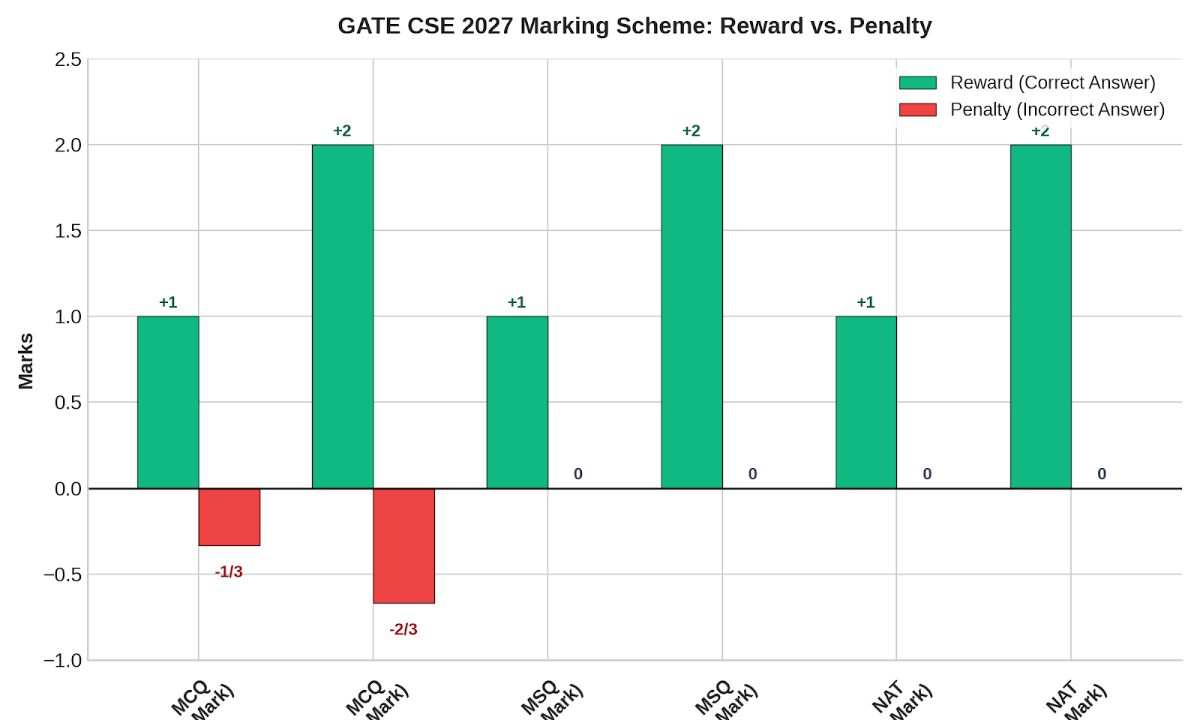
- The GATE CSE paper includes MCQs, MSQs, and NATs, with questions carrying 1 or 2 marks. Negative marking applies only to MCQs, while MSQs and NATs have no negative marking.
- The exam is conducted as a 3-hour Computer-Based Test (CBT) with 65 questions and 100 marks.
Also Read:
- Safe Marks in GATE
- GATE Previous Year Paper Analysis
- GATE CSE Syllabus 2027: Subject-Wise Topics, Weightage and PDF Download

Key Summary
- GATE CSE 2027 consists of 65 questions carrying 100 marks, with a total exam duration of 3 hours.
- The CSE GATE Syllabus covers General Aptitude (15 marks), Engineering Mathematics (around 13 marks), and Core Computer Science (around 72 marks).
- Questions are asked as MCQs, MSQs, and NATs, with both 1-mark and 2-mark questions.
- Negative marking applies only to MCQs: ⅓ mark for a wrong 1-mark MCQ and ⅔ mark for a wrong 2-mark MCQ; MSQs and NATs have no negative marking.
What is the GATE CSE Exam Pattern 2027: Overview
Yes, the GATE CSE exam pattern has evolved over the years, although the core structure has remained largely stable since the mid-2010s.
- Last 5–6 years: The GATE Computer Science exam pattern has remained almost unchanged in terms of marks distribution, number of questions, and question types.
- The pattern helps candidates understand the GATE exam syllabus for CSE, question types, marking scheme, and overall structure before starting their GATE preparation for Computer Science.
| Particulars | Details |
|---|---|
| Exam Mode | Computer-Based Test (CBT) |
| Duration | 3 Hours (180 Minutes) |
| Total Questions | 65 |
| Total Marks | 100 |
| Medium of Exam | English |
| What are the Sections in the GATE CSE Exam Pattern? | 3 (General Aptitude + Engineering Mathematics + CSE Core) |
| What are the Question Types in GATE CSE? | Multiple Choice Questions (MCQ), Multiple Select Questions (MSQ), Numerical Answer Type (NAT) |
| Marking Scheme | Questions carry 1 mark or 2 marks |
| Negative Marking | Only for MCQs:
|
Ques. How many questions are there in GATE CSE 2027?
Ans. Exactly 65 questions are asked in the GATE CSE exam, for a total of 100 marks.
Also Check:
GATE CSE Exam Pattern Over the Years: Any Changes in Difficulty Level?
The GATE CSE syllabus broadly covers General Aptitude, Engineering Mathematics, and core Computer Science subjects. This structure has remained the foundation of the GATE Computer Science syllabus for several years.
- Before 2014: The GATE CSE exam primarily included 65 MCQs for 100 marks and descriptive-type questions.
- In 2014: Numerical Answer Type (NAT) questions were introduced, adding a numerical-solving component to the GATE CSE exam pattern.
- In 2021: Multiple Select Questions (MSQs) were introduced in the GATE exam. These questions assess deeper conceptual understanding and carry no negative marking.
- In 2027: A few topics in the GATE CSE syllabus are removed with minor additions. Topics such as the OSI Model stack, Framing, Ethernet bridging (now just “Ethernet”), Shortest path & Flooding routing, IP support protocols: ARP, DHCP, ICMP, etc are removed.
| Year/Period | Major Changes in GATE CSE Exam Pattern |
|---|---|
| 2021 |
|
| 2021–2026/2027 |
|
| Current Pattern |
|
| Overall Focus |
|
Ques. What are the different types of questions asked in GATE CSE?
Ans. Three types: Multiple Choice Questions (MCQs), Multiple Select Questions (MSQs), and Numerical Answer Type (NAT) questions.
Also Check:
| Exam Year | GATE Previous Year Question Papers with Solutions |
|---|---|
| GATE 2025 | Download GATE Question Paper |
| GATE 2024 | Download GATE Question Paper |
| GATE 2023 | Download GATE Question Paper |
| GATE 2022 | Download GATE Question Paper |
| GATE 2021 | Download GATE Question Paper |
| GATE 2020 | Download GATE Question Paper |
| GATE 2019 | Download GATE Question Paper |
| GATE 2018 | Download GATE Question Paper |
| GATE 2017 | Download GATE Question Paper |
GATE CSE 2027 Exam Pattern: Marking Scheme
GATE CSE exam has 2 main blocks: General Aptitude (GA) and Engineering, asking a total of 65 questions. Engineering section asks Engineering Mathematics questions and Core Computer Science questions in form of MCQs, MSQs and NATs.
- General Aptitude is fixed at 15 marks, with 10 questions asked in the form of MCQs:
- Five 1-mark and
- Five 2-mark questions.
- The remaining 55 questions carry 85 marks and combine Engineering Mathematics and core Computer Science topics.
- In the 85-mark portion, MCQs, MSQs and NATs can appear in both 1-mark and 2-mark formats. Marks Distribution across the paper varies as:
- 25 questions of 1 mark (total 25 marks)
- 30 questions of 2 marks (total 60 marks)
- Therefore, a candidate preparing for the GATE CSE syllabus should not expect all MCQs, MSQs or NATs to appear in a particular sequence.
- MCQs carry negative marking, while MSQs and NATs do not.
| Question Type | Question Format | Marking Scheme | Negative Marking |
|---|---|---|---|
| MCQ | Single correct option |
|
|
| MSQ | One or more correct options | Full marks only when all correct options are selected | No negative marking |
| NAT | Numerical answer; no options | Marks awarded for the correct numerical answer | No negative marking |

Source: GATE Information Brochure 2027
Ques. Is there negative marking for MSQ and NAT questions?
Ans. No. There is zero negative marking for MSQs and NATs, though MSQs require selecting all correct options to receive credit (no partial marks).
Also Check:
GATE CSE Exam Pattern: Section-Wise Weightage 2027
The GATE CS paper is divided into three distinct academic sections that every candidate must attempt. The scores for each of the 3 sections are fixed.
- General Aptitude (GA): 15 marks (10 questions). This section tests basic verbal, numerical, and spatial reasoning.
- Engineering Mathematics: 13 marks. This section covers discrete mathematics, linear algebra, calculus, and probability.
- Core Computer Science: 72 marks. This makes up the bulk of the paper, testing core subjects like programming, algorithms, operating systems, and databases.
| Component | Approx. Weightage | Role in GATE CSE Syllabus |
|---|---|---|
| General Aptitude | 15 marks | Tests verbal, quantitative, analytical and spatial aptitude |
| Engineering Mathematics | 13 marks | Covers mathematical concepts relevant to Computer Science and engineering |
| Core Computer Science | 72 marks | Covers subjects such as Programming & Data Structures, Algorithms, OS, DBMS, Computer Networks, COA, TOC, Compiler Design and Digital Logic |
| Total | 100 marks | Complete GATE Computer Science paper |
Ques. What is the difference between MCQ, MSQ and NAT questions in GATE CSE?
Ans. MCQs have 4 options with 1 correct answer (negative marking applies). MSQs have 4 options with 1 or more correct answers (no negative marking). NATs have no options; you must type a precise numerical value using an on-screen keyboard (no negative marking).
Also Check:
GATE CSE Syllabus 2027
GATE CSE syllabus covers General Aptitude, Engineering Mathematics and core Computer Science subjects such as Programming & Data Structures, Algorithms, COA, OS, DBMS, Computer Networks, TOC, Compiler Design and Digital Logic.
In 2027, the core GATE CSE syllabus has been revised with the following changes:
- Digital Logic: Minimization techniques such as K-maps, algebraic and Quine-McCluskey methods are more explicitly covered.
- COA: Hardwired and microprogrammed control, memory interfacing, cache mapping and hierarchy performance are emphasized, while the focus has shifted away from detailed main-memory/secondary-storage topics.
- Computer Networks: This topic has been largely streamlined, with several protocols and detailed subtopics removed or de-emphasized. Greater focus is placed on switching, MAC/Ethernet, routing, IPv4, TCP, socket API, DNS and HTTP.
- The syllabus has mostly remained consistent over the years, with the last major revision in syllabus made in 2021. The revised 2021 syllabus was optimised for the exam sessions until 2026.
| 1. General Aptitude (GA) | |
|---|---|
| Verbal Aptitude | English grammar, vocabulary, reading comprehension |
| Quantitative Aptitude | Data interpretation, percentages, ratios, powers, permutations, combinations, series |
| Analytical Aptitude | Logic, induction, deduction, analogy, numerical relations |
| Spatial Aptitude | Shape transformation, paper folding, assembling, grouping |
| 2. Engineering Mathematics | |
| Discrete Mathematics | Logic, sets, relations, functions, partial orders, lattice, groups, graphs, combinatorics |
| Linear Algebra | Matrices, determinants, linear equations, eigenvalues, eigenvectors, LU decomposition |
| Calculus | Limits, continuity, differentiability, maxima and minima, mean value theorems, integration |
| Probability & Statistics | Random variables, distributions, mean, median, mode, standard deviation, conditional probability, Bayes' theorem |
| 3. Digital Logic | |
| Boolean Algebra | Boolean algebra, logic operations, minimization |
| Circuits | Combinational and sequential circuits |
| Number Systems & Arithmetic | Number representations, fixed-point and floating-point arithmetic |
| 4. Computer Organization & Architecture (COA) | |
| Processor Organization | Machine instructions, addressing modes, ALU, datapath, control unit |
| Pipelining | Instruction pipelining, pipeline hazards |
| Memory | Cache, main memory, virtual memory |
| I/O | I/O interface, interrupts, DMA |
| 5. Programming & Data Structures | |
| Programming | C programming, recursion |
| Linear Data Structures | Arrays, stacks, queues, linked lists |
| Non-Linear Data Structures | Trees, binary search trees, binary heaps, graphs |
| 6. Algorithms | |
| Fundamental Algorithms | Searching, sorting, hashing |
| Complexity | Asymptotic worst-case time and space complexity |
| Design Techniques | Greedy, dynamic programming, divide-and-conquer |
| Graph Algorithms | Graph traversal, minimum spanning trees, shortest paths |
| 7. Theory of Computation (TOC) | |
| Automata & Languages | Regular expressions, finite automata, regular languages |
| Context-Free Languages | Context-free grammars, push-down automata, pumping lemma |
| Computability | Turing machines, undecidability |
| 8. Compiler Design | |
| Front End | Lexical analysis, parsing, syntax-directed translation |
| Code Generation & Optimization | Runtime environments, intermediate code generation, local optimization |
| Data Flow Analysis | Live variable analysis, available expressions |
| 9. Operating Systems (OS) | |
| Processes & Scheduling | System calls, processes, threads, CPU scheduling |
| Concurrency | Inter-process communication, concurrency, synchronization, deadlocks |
| Memory & Storage | Memory management, virtual memory, file systems, disk scheduling |
| 10. Databases (DBMS) | |
| Database Models | ER model, relational model |
| Query Languages | Relational algebra, tuple calculus, SQL |
| Database Design | Integrity constraints, normal forms |
| Storage & Transactions | File organization, B/B+ trees, indexing, transactions, concurrency control |
| 11. Computer Networks (CN) | |
| Network Architecture | Layering, OSI and TCP/IP protocol stacks |
| Switching & Data Link Layer | Packet, circuit and virtual circuit switching, framing, error detection, MAC, Ethernet bridging |
| Network Layer | Routing, shortest path, flooding, distance vector, link state, IPv4, IPv6, fragmentation |
| Transport Layer | Flow control, error control, UDP, TCP, congestion control |
| Application Layer | HTTP, DNS, SMTP, POP, FTP, HTTPS |

Source: GATE 2027 CSE Syllabus pdf
Ques. Which subjects carry the highest weightage in GATE CSE 2027?
Ans. General Aptitude (15 marks), Discrete & Engineering Mathematics (~13–15 marks), and Programming & Data Structures + Algorithms (~22–26 marks) yield the highest concentrations.
Also Check: GATE Books 2026 PDF Download for CSE, DA, Civil, Mechanical, ECE, EE
This video describes the GATE CSE syllabus changes made in 2027 as per the official information brochure published by IIT Madras.
GATE CS Handwritten Notes
| GATE CS Handwritten Notes | Link |
|---|---|
| GATE CS Operating Systems Handwritten Notes | Download PDF |
| GATE CS Programming in C Handwritten Notes | Download PDF |
| GATE CS Engineering Mathematics Handwritten Notes | Download PDF |
| GATE CS Digital Logic Handwritten Notes | Download PDF |
| GATE EC Analog and Digital Electronics Handwritten Notes | Download PDF |
| GATE CS Compiler Design Handwritten Notes | Download PDF |
| GATE CS Data Structures Handwritten Notes | Download PDF |
| GATE CS Algorithms Handwritten Notes | Download PDF |
| GATE CS Computer Networks Handwritten Notes | Download PDF |
GATE CSE 2027 Important Topics with Weightage
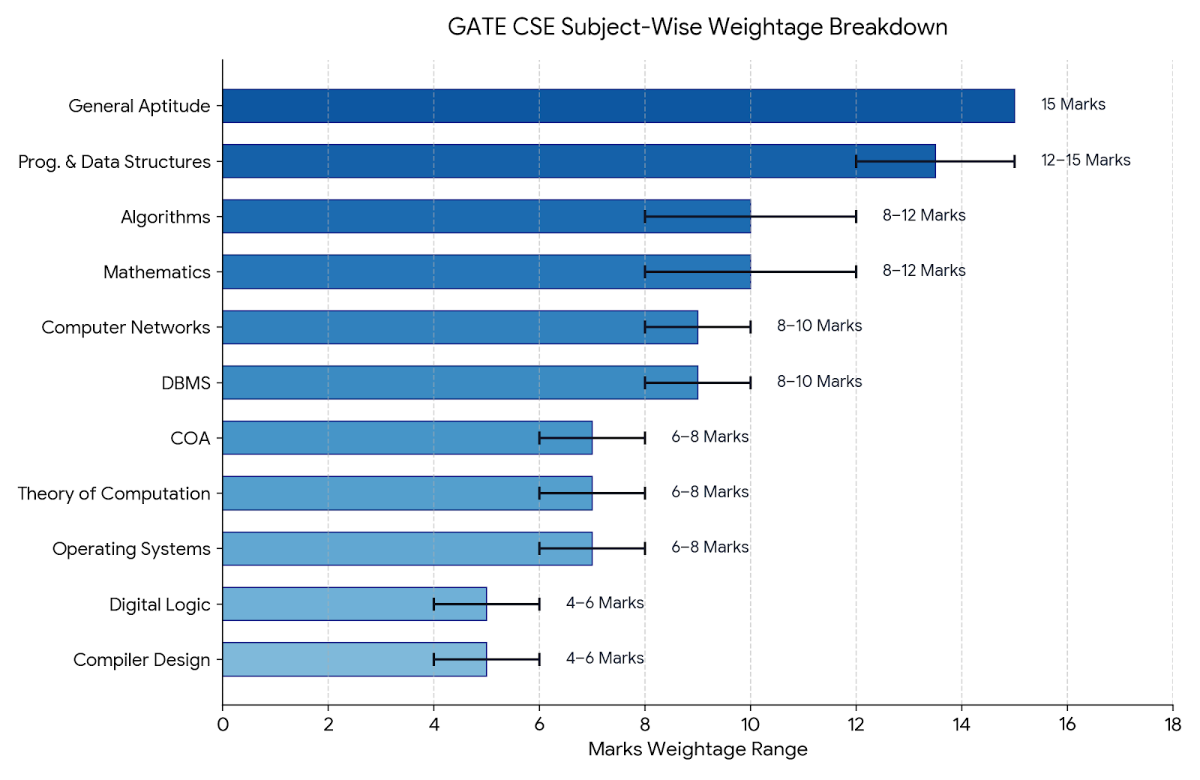
General Aptitude, Programming & Data Structures, Algorithms, and Mathematics together account for roughly 50 marks on average in the GATE CSE exam.
- Over the last 4 years, the topics below yielded the highest scores in CSE:
- GA remains fixed at 15 marks across GATE 2024–2026, making it one of the most reliable scoring areas.
- Discrete & Engineering Mathematics gained importance, rising from 14 marks in 2024 to 16.4 marks in 2026.
- Programming, Data Structures & Algorithms remains a high-weightage block; its weightage fluctuated from 15 marks in 2024 to 16.5 in 2025 and 14.3 in 2026.
| Subject | Weightage (Approx.) | Important Questions / Topics to Practice |
|---|---|---|
| General Aptitude | 15 marks | Quantitative aptitude, logical reasoning, verbal aptitude, data interpretation |
| Mathematics | 8–12 marks | Probability, conditional probability, Bayes' theorem, probability distributions, linear algebra, eigenvalues/eigenvectors, calculus |
| Programming & Data Structures | 12–15 marks | C programming, arrays, stacks, queues, linked lists, trees, BSTs, heaps, graphs, recursion |
| Algorithms | 8–12 marks | Sorting, searching, time complexity, space complexity, Big-O/Ω/Θ, recurrence relations, greedy algorithms, dynamic programming, MST, shortest paths |
| DBMS | 8–10 marks | SQL queries, relational algebra, normalization, functional dependencies, indexing, transactions, concurrency control |
| Computer Networks | 8–10 marks | IP addressing, subnetting, routing, distance-vector routing, link-state routing, error detection, TCP, congestion control, application-layer protocols |
| Operating Systems | 6–8 marks | CPU scheduling, process management, page replacement, virtual memory, deadlocks, memory management |
| Theory of Computation | 6–8 marks | Regular expressions, finite automata, regular languages, CFG, PDA, Turing machines, decidability |
| COA | 6–8 marks | Addressing modes, cache memory, memory hierarchy, pipelining, pipeline hazards, CPU organization |
| Compiler Design | 4–6 marks | Lexical analysis, grammar, parsing, LL/LR concepts, syntax-directed translation, intermediate code generation |
| Digital Logic | 4–6 marks | Boolean algebra, logic minimization, K-maps, number systems, combinational circuits, sequential circuits |
Ques. How many marks are allotted to General Aptitude in GATE CSE?
Ans. 15 marks are allotted to GA section in the GATE CSE exam.
Ques. Is there negative marking in GATE CSE 2027?
Ans. Yes, but strictly for MCQs only. There is a 1/3 penalty for 1-mark MCQs and a 2/3 penalty for 2-mark MCQs.
Also Check:
Exam Pattern: GATE 2027 vs IIT JAM 2027
GATE 2027 and IIT JAM 2027 follow completely different exam structures. GATE focuses on core engineering disciplines and splits its marks using fixed sections, whereas IIT JAM focuses strictly on pure science subjects with fixed question-type sections.
- GATE exam CSE is conducted specifically for master's in engineering majors, while the IIT JAM exam is conducted for admission to master's in science programs.
- The total score of 100 remains the same in both GATE and IIT JAM exams, with same types of questions asked: MCQs, MSQs, and NATs.
- The questions in the two exams differ in format as follows:
- GATE 2027 – Mixed Layout: MCQs, MSQs, and NATs are mixed sequentially within the 1-mark and 2-mark blocks of the Core tab.
- IIT JAM 2027 – Segregated Layout: Questions are divided into Section A (MCQs), Section B (MSQs), and Section C (NATs).
| Parameter | GATE 2027 (CSE) | IIT JAM 2027 (Pure Sciences) |
|---|---|---|
| Total Marks | 100 | 100 |
| Total Questions | 65 | 60 |
| Section A / GA | General Aptitude: 15 Marks / 10 Questions | MCQ: 50 Marks / 30 Questions |
| Section B | Engineering Mathematics: 13 Marks / 8–9 Questions | MSQ: 20 Marks / 10 Questions |
| Section C / Core | Core Computer Science: 72 Marks / 45–47 Questions | NAT: 30 Marks / 20 Questions |
| Question Type | MCQ, MSQ & NAT | MCQ, MSQ & NAT |
| Section Structure | GA and Core Subject tabs; Mathematics and CS questions are mixed within the Core Subject tab | Three separate sections based on question type |
Ques. Has the GATE CSE exam pattern changed for 2027?
Ans. No, the structural format is unchanged. Only specific syllabus topics inside Computer Networks, COA, and Digital Logic have been altered or deleted by IIT Madras for 2027.
GATE CSE 2027 Preparation Tips
Below are some tips that toppers share about their GATE CSE preparation:
- Since NAT questions have no options, focus on calculation accuracy. Practice regularly with the GATE virtual calculator and maintain an error log for calculation and typing mistakes.
- While attempting the GATE CSE exam, keep the following in mind:
- Pass 1 (First 90 Mins): Solve all 10 General Aptitude questions, followed by every 1-mark technical question you know instantly. Skip any question that requires more than 3 lines of calculation.
- Pass 2 (Remaining 90 Mins): Dive calmly into the heavy 2-mark design problems, knowing you have already locked in a safe foundational score.
| Target CSE Subjects | Difficult Topic | Easy Execution Tip |
|---|---|---|
| Theory of Computation (TOC) | Students try to memorize closure property tables without understanding why a language is regular or context-free. |
|
| Programming & Data Structures | C programming questions involving recursion, pointers, and double pointers can cause silly mistakes under exam pressure. |
|
| Algorithms | Graph algorithms like Dijkstra's and Prim's, and Dynamic Programming (DP), can look easy in lectures but become difficult when solving questions yourself. |
|
| Computer Organization (COA) | Cache memory calculations and pipeline hazard questions can seem confusing and lead to low scores in mocks. |
|
| Operating Systems (OS) | Process Synchronization and Semaphores can be confusing because of race conditions and deadlocks. |
|

Source: Reddit
FAQs for GATE Exam Pattern
Ques. What is the GATE CSE exam pattern 2027?
Ans. It is a three-hour, online Computer-Based Test (CBT) worth 100 marks, consisting of 65 questions split across General Aptitude, Engineering Mathematics, and Core Computer Science.
Ques. How many 1-mark and 2-mark questions are asked in GATE CSE exam?
Ans. There are 30 questions of 1-mark (30 marks total) and 35 questions of 2-mark (70 marks total), making up the 65 questions.
Ques. How should I attempt the GATE CSE paper within 3 hours?
Ans. Use a Two-Pass Strategy: Spend the first 90 minutes clearing General Aptitude and every easy 1-mark technical question to lock in basic marks. Spend the remaining 90 minutes handling heavy, multi-step 2-mark design questions, MSQs, and NATs.



Comments