




The GATE Chemical Engineering Exam Pattern 2027 has been updated by IIT Madras on its official website gate2027.iitm.ac.in. The GATE CH Exam Pattern 2027 will comprise 65 questions carrying a total of 100 marks, with a combination of MCQ, MSQ, and NAT questions.
- The CH paper follows the standard GATE pattern of 15 marks for General Aptitude, 13 marks for Engineering Mathematics and 72 marks for the subject.
- Questions will be asked in MCQ, MSQ and NAT formats, with questions carrying either 1 or 2 marks.
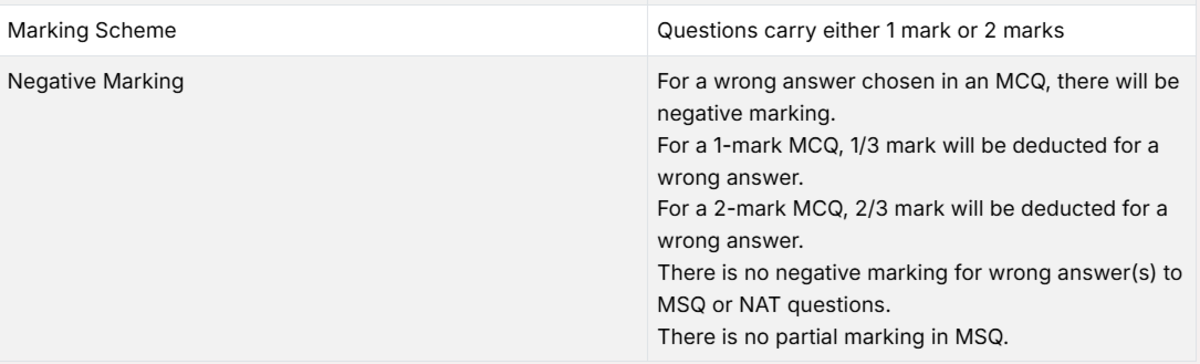
- Negative marking applies only to incorrect MCQs; there is no negative marking for MSQ and NAT questions.
- The Chemical Engineering syllabus covers core areas such as Process Calculations, Fluid Mechanics, Heat Transfer, Mass Transfer, Thermodynamics, Chemical Reaction Engineering, Process Control, Plant Design and Economics, and Chemical Technology.
- Based on the 2021–2026 trend, the highest-weightage areas are General Aptitude (15.38%), Engineering Mathematics (14.10%), Mass Transfer (12.05%), and Process Calculations & Thermodynamics (11.28%).
- Among core Chemical Engineering subjects, Instrumentation & Process Control (10.25%), Chemical Reaction Engineering (10.51%), Fluid Mechanics & Mechanical Operations (10%), and Heat Transfer (8.46%) also carry significant weightage.
- Fluid Mechanics & Mechanical Operations ranged from 4 to 11 marks, while Mass Transfer ranged from 6 to 10 marks. This suggests candidates should use weightage to prioritise topics rather than skip lower-weightage chapters.
- Instrumentation & Process Control (10.25%) and Fluid Mechanics & Mechanical Operations (10%) have also contributed around one-tenth of the paper each on average over the last six years.
Related Links:
- GATE Syllabus 2027: Download Paper-wise PDF for 30 Papers, Weightage, Sample Papers & Sample Questions
- GATE Chemical Engineering Sample Paper 2027: 10 Practice Papers PDF Download and Section-wise Weightage
- GATE Previous Year Paper Analysis: Check Difficulty Level, Branch-wise Question Paper Analysis, Weightage of Topics
GATE Chemical Engineering Exam Pattern 2027: Overview
The GATE Chemical Engineering (CH) paper is a 3-hour CBT designed to test both general problem-solving ability and undergraduate-level Chemical Engineering concepts. For context, GATE was first introduced in 1983 and has since evolved into a major national-level examination used for postgraduate admissions and recruitment by several PSUs.
| Particulars | GATE CH Exam Pattern 2027 |
|---|---|
| Exam Name | Graduate Aptitude Test in Engineering (GATE) |
| Paper Code | CH – Chemical Engineering |
| Conducting Body | IIT Madras |
| Exam Mode | Computer-Based Test (CBT) |
| Language | English |
| Total Questions | 65 |
| Total Marks | 100 |
| Exam Duration | 3 Hours (180 minutes) |
| Sessions | Two sessions per day (Forenoon & Afternoon) |
| Sectional Time Limit | None — candidates may attempt sections in any order |
| Compensatory Time (PwD) | Extra time per official guidelines (typically 1 hour) |
| Question Types | MCQ, MSQ, NAT |
| General Aptitude | 15 Marks |
| Engineering Mathematics | 13 Marks |
| Chemical Engineering | 72 Marks |
| Negative Marking | Applicable to MCQs only |
| Paper Level | Undergraduate-level Chemical Engineering |
You can refer to this video by GATE Wallah - ME, CE, XE, CH, PI & ES, where the mentor helps aspiring students understand the nature of GATE Chemical Engineering & the Exam Pattern. The YouTuber highlights that Chemical Engineering offers opportunities in oil & gas, pharmaceuticals, green hydrogen, batteries, semiconductors and environmental technologies, with India’s growing investments creating new avenues. He expects steady, long-term career growth, with fresh graduates earning around ₹8–15 LPA, PSU roles up to ₹20–25 LPA, and some international opportunities reaching ₹40 LPA.
GATE Chemical Engineering Exam Pattern 2027: Types of Questions
The GATE 2027 Chemical Engineering paper contains 3 types of questions. These question types are the same across all GATE papers and test different skills: recall, comprehension, application, analysis, and synthesis.
| Question Type | Full Form | Description | Options / Input Method | Marks | Negative Marking |
|---|---|---|---|---|---|
| MCQ | Multiple Choice Question | One correct answer out of four options | Four options (A, B, C, D) | 1 or 2 marks | Yes (−1/3 for 1-mark, −2/3 for 2-mark) |
| MSQ | Multiple Select Question | One or more correct answers out of four options | Four options (select all that apply) | 1 or 2 marks | No (and no partial marking) |
| NAT | Numerical Answer Type | Enter a numerical value (integer or decimal) using the virtual keypad | No options (type the answer) | 1 or 2 marks | No |
GATE Chemical Engineering Exam Pattern 2027: Marking Scheme
The marking scheme for GATE 2027 Chemical Engineering is the same as the standard GATE pattern followed for most engineering papers. The paper carries a total of 100 marks with 65 questions.
| Question Type | Marks | Correct Answer | Wrong Answer | Unattempted |
|---|---|---|---|---|
| MCQ | 1 mark | +1 | −1/3 (−0.33) | 0 |
| MCQ | 2 marks | +2 | −2/3 (−0.67) | 0 |
| MSQ | 1 mark | +1 | 0 | 0 |
| MSQ | 2 marks | +2 | 0 | 0 |
| NAT | 1 mark | +1 | 0 | 0 |
| NAT | 2 marks | +2 | 0 | 0 |
Important Points
- MCQ (Multiple Choice Questions): Only one option is correct. Wrong answers attract negative marking.
- MSQ (Multiple Select Questions): One or more options may be correct. You must select all correct options to get full marks. There is no partial marking and no negative marking.
- NAT (Numerical Answer Type): You enter the numerical value using the virtual keypad. No options are given. There is no negative marking.
Is there negative marking in the GATE Chemical Engineering Exam Pattern 2027?
Yes, negative marking applies to MCQ questions in the GATE Chemical Engineering (CH) 2027 exam.
- For a 1-mark MCQ, 1/3 mark is deducted for an incorrect answer, while for a 2-mark MCQ, 2/3 mark is deducted.
- There is no negative marking for MSQ and NAT questions.
GATE Chemical Engineering Exam Pattern 2027: Subject-wise Details
Chemical Engineering core subjects carry the highest weightage by a wide margin, making them the priority area for scoring high. But General Aptitude and Engineering Mathematics together still account for 28% of the paper and are often the fastest marks to secure with consistent practice.
| Section | Marks | Key Areas Covered |
|---|---|---|
| General Aptitude (GA) | 15 Marks | Verbal Aptitude, Quantitative Aptitude, Analytical Aptitude, and Spatial Aptitude |
| Engineering Mathematics | Part of 85 Marks | Mathematical concepts relevant to Chemical Engineering |
| Chemical Engineering | Part of 85 Marks | Core Chemical Engineering subjects and topics |
| Total | 100 Marks | GA + Chemical Engineering syllabus |
Also Read:
GATE Chemical Engineering Subject-wise Weightage
The GATE CH 2027 paper carries 100 marks, of which 15 marks are allotted to General Aptitude.
- General Aptitude remained fixed at 15 marks across GATE 2024–2026.
- Engineering Mathematics contributed approximately 8–10 marks during the same period.
- Mass Transfer averaged around 8.7 marks across GATE 2024–2026.
- Chemical Reaction Engineering averaged around 7.7 marks, making both consistent high-weightage areas.
| Section | Marks | Weightage |
|---|---|---|
| General Aptitude | 15 | 15% |
| Engineering Mathematics | 13 | 13% |
| Chemical Engineering Subjects | 72 | 72% |
| Total | 100 | 100% |
GATE Chemical Engineering Exam Pattern 2027: Topic-wise Weightage (2026–2021)
General Aptitude carries 15 marks, while Engineering Mathematics and core subjects like CRE, Mass Transfer and Fluid Mechanics have high weightage.
- Chemical Reaction Engineering consistently carried around 8–12 marks across GATE CH 2021–2026.
- Mass Transfer contributed approximately 8–11 marks, making it another high-priority topic.
- General Aptitude remained fixed at 15 marks in all six years, while Engineering Mathematics contributed around 11–15 marks.
- These recurring high-weightage areas together account for a substantial portion of the 100-mark paper, making them important for score improvement.
| Topic | GATE 2026 | GATE 2025 | GATE 2024 | GATE 2023 | GATE 2022 | GATE 2021 |
|---|---|---|---|---|---|---|
| General Aptitude | 15 | 15 | 15 | 15 | 15 | 15 |
| Engineering Mathematics | 13–15 | 13–15 | 12–14 | 11–15 | 13.2 | 11 |
| Chemical Reaction Engineering | 10–12 | 10–12 | 9–11 | 8–11 | 12.1 | 12.4 |
| Mass Transfer | 8–10 | 8–10 | 8–10 | 8 | 10.6 | 10.6 |
| Thermodynamics | 8–10 | 3–6 | 3–6 | — | 3.6 | 3.6 |
| Fluid Mechanics & Mechanical Operations | 7–9 | 8–10 | 8–10 | 8–10 | 7.4 | 11.8 |
| Heat Transfer | 8 | 8 | 8 | 8 | 8.8 | 8.8 |
| Instrumentation & Process Control | 6–8 | 6–8 | 6–8 | 6–8 | 7.8 | 7.8 |
| Chemical Technology | — | 4–6 | 4–6 | 4–6 | 4.4 | 4.4 |
| Plant Design and Economics | — | 4 | 4 | 4 | 3.8 | 3.8 |
GATE Chemical Engineering Exam Pattern 2027: General Aptitude Section
The General Aptitude (GA) section is common to all GATE papers, including Chemical Engineering (CH). It carries 15 marks out of the total 100 and plays an important role in boosting the overall score.
| Parameter | Details |
|---|---|
| Section Name | General Aptitude (GA) |
| Total Marks | 15 |
| Number of Questions | 10 |
| Marks Distribution | 5 questions × 1 mark + 5 questions × 2 marks |
| Question Types | MCQ, MSQ, and NAT |
| Negative Marking | Applicable only to MCQs |
| Nature | Common for all 30 GATE papers |
Topics Covered in General Aptitude
| Sub-section | Topics Covered |
|---|---|
| Verbal Aptitude | English grammar, sentence completion, vocabulary, verbal analogies, reading comprehension, narrative sequencing |
| Quantitative Aptitude | Numerical computation, numerical estimation, numerical reasoning, data interpretation |
| Analytical Aptitude | Logic, deduction, induction, analogy, number series, patterns |
| Spatial Aptitude | Transformation of shapes, paper folding, 2D/3D figures, spatial visualisation |
Marking Scheme for GA Section
| Question Type | Marks | Correct Answer | Wrong Answer | Unattempted |
|---|---|---|---|---|
| MCQ | 1 mark | +1 | −1/3 | 0 |
| MCQ | 2 marks | +2 | −2/3 | 0 |
| MSQ | 1 or 2 | Full marks | 0 | 0 |
| NAT | 1 or 2 | Full marks | 0 | 0 |
Also Read:
GATE Chemical Engineering Exam Pattern 2027: Engineering Mathematics
| Particulars | Details |
|---|---|
| Section | Engineering Mathematics |
| Marks | 13 Marks |
| Weightage | 13% of the total paper |
| Question Type | MCQ, MSQ and NAT |
| Question Marks | 1-mark and 2-mark questions |
| Syllabus Coverage | Mathematical concepts relevant to Chemical Engineering |
| Negative Marking | Applicable to MCQs; no negative marking for MSQs and NATs |
| Role in GATE CH | Forms part of the 100-mark GATE Chemical Engineering paper |
Also Read:
GATE Chemical Engineering Exam Pattern 2027: Chemical Engineering
The Chemical Engineering section forms the core of the GATE CH 2027 paper and carries the largest share of the total marks.
It covers major areas such as process calculations, thermodynamics, fluid mechanics, heat transfer, mass transfer, reaction engineering, process control, and plant design and economics.
| Particulars | Details |
|---|---|
| Section | Chemical Engineering |
| Marks | 72 Marks |
| Weightage | 72% of the total paper |
| Question Types | MCQ, MSQ and NAT |
| Question Marks | 1-mark and 2-mark questions |
| Major Topics | Process Calculations, Thermodynamics, Fluid Mechanics, Heat Transfer, Mass Transfer, Reaction Engineering, Process Control, Plant Design & Economics |
| Negative Marking | Applicable to MCQs only |
| Importance | Highest-weightage component of the GATE CH paper |
How to prepare based on the GATE Chemical Engineering Exam Pattern 2027?
Aim to complete the syllabus by November, use December for PYQs and first revision, and dedicate January primarily to mock tests and intensive revision. This leaves the final weeks before the February exam for consolidation rather than learning new topics.
| Month | Primary Focus | Study Plan |
|---|---|---|
| August 2026 | Build Fundamentals | Start Engineering Mathematics and General Aptitude. Cover Process Calculations, Thermodynamics, and basic concepts. |
| September 2026 | Core Subjects I | Complete Fluid Mechanics, Mechanical Operations and Heat Transfer. Practise topic-wise questions alongside each subject. |
| October 2026 | Core Subjects II | Cover Mass Transfer, Chemical Reaction Engineering and Process Control. Solve relevant PYQs after completing each topic. |
| November 2026 | Complete Syllabus | Finish Plant Design & Economics, Chemical Technology and any remaining topics. Start your first full-syllabus revision. |
| December 2026 | PYQs + Revision | Solve previous-year GATE CH papers, revise formulas and concepts, and identify weak areas. Begin full-length mock tests. |
| January 2027 | Intensive Revision | Take regular full-length mocks, analyse mistakes, revise short notes and strengthen weak topics. Focus heavily on time management and accuracy. |
| February 2027 | Final Preparation | Revise formulas, important concepts and previously attempted questions. Avoid starting new topics and keep the final days focused on light revision and confidence-building. |
You can also refer to this video by GATE Wallah - ME, CE, XE, CH, PI & ES for a proper preparation plan to score good marks in the GATE Chemical Engineering Exam

Source: Quora
An aspirant on Quora was asking, “What should be one’s strategy for clearing the GATE with a high score (chemical engineering)?”
Here we have curated a strategy for a high score in GATE Chemical Engineering:
- Prioritize Chemical Engineering core subjects first: They carry 72% of the paper (72 out of 100 marks), so strength here has the biggest impact on your overall score. Don't let GA or Maths prep eat into core-subject time.
- Don't skip General Aptitude and Engineering Mathematics: Together they're 28 marks (28%), often easier to master quickly than a tough core-subject numerical, and a reliable way to lock in points fast on exam day.
- Attempt MSQs and NATs with more confidence than MCQs: They carry zero negative marking, so an educated attempt costs you nothing, while a wrong MCQ guess can cost −1/3 or −2/3 mark. Know this distinction cold before exam day.
- Solve at least 8-10 years of previous year papers: GATE CH repeats question patterns and topic emphasis year to year, even when exact questions change. PYQs reveal where the real weightage lies better than any syllabus list.
- Build in a dedicated mock-test + revision phase, not just syllabus completion: Aim to finish the syllabus a full 2 months before the exam so December-January can go entirely into full-length mocks and error analysis. Score jumps usually come from fixing repeated mistakes, not from learning new topics late.
Also Read:
GATE Chemical Engineering Exam Pattern 2027 FAQs
Ques. How many marks are allotted to the General Aptitude section in GATE 2027?
Ans. The General Aptitude (GA) section carries 15 marks (10 questions) and is common to all papers.
Ques. Is Engineering Mathematics compulsory in all GATE engineering papers?
Ans. Engineering Mathematics (≈13 marks) is included in most engineering papers (AE, AG, BM, BT, CE, CH, CS, EC, EE, ES, IN, ME, MN, MT, NM, PE, PI, etc.). Some papers, such as DA, CY, MA, and PH, do not have a separate Engineering Mathematics section.
Ques. Can I appear for two papers in GATE 2027?
Ans. Yes, candidates can appear for one or two papers, but only from the officially allowed two-paper combinations listed in the GATE 2027 Information Brochure.
Ques. Has the GATE exam pattern changed in 2027?
Ans. The core pattern (65 questions, 100 marks, 3 hours, MCQ + MSQ + NAT) remains the same. Key updates include a new Robotics and Automation (RA) paper and syllabus revisions for several subjects.
Ques. What is the difficulty level of the GATE CH Paper?
Ans. The GATE Chemical Engineering (CH) paper is generally rated as moderate to difficult, with a strong emphasis on conceptual clarity, numerical accuracy, and application-based problem-solving. While standard core subjects (like Thermodynamics and Reaction Engineering) are scoring, multi-concept and NAT (Numerical Answer Type) questions often elevate the overall challenge.
Ques. Is a virtual calculator provided in the GATE 2027 exam?
Ans. Yes, an on-screen virtual scientific calculator is provided. Physical calculators are not allowed.



Comments