




The GATE Aerospace Engineering (AE) 2027 examination is a competitive entrance exam for students planning to pursue M.Tech, secure PSU opportunities, or build a career in aerospace engineering, research, and design. The paper tests your understanding of Engineering Mathematics and core Aerospace Engineering subjects such as Flight Mechanics, Aerodynamics, Structures, and Propulsion.
- According to the official GATE 2027 website (gate2027.iitm.ac.in), the GATE AE paper consists of 65 questions carrying a total of 100 marks and is divided into three sections: General Aptitude, Engineering Mathematics, and Core Aerospace Engineering.
- General Aptitude carries 15 marks, Engineering Mathematics accounts for 13 marks, and the remaining 72 marks are dedicated to the core Aerospace Engineering subjects.
GATE Aerospace Engineering Sample Paper 2027 helps you become familiar with the latest exam pattern, marking scheme, and section-wise weightage. Practising these papers regularly strengthens your conceptual understanding, improves problem-solving skills, and builds the speed and accuracy needed to perform well in GATE Aerospace Engineering 2027.
GATE Aerospace Engineering Sample Papers 2027
GATE Aerospace Engineering Sample Paper 1

GATE Aerospace Engineering Sample Paper 2
GATE Aerospace Engineering Sample Paper 3
GATE Aerospace Engineering Sample Paper 4
GATE Aerospace Engineering Sample Paper 5
GATE Aerospace Engineering Sample Paper 6
GATE Aerospace Engineering Sample Paper 7
GATE Aerospace Engineering Sample Paper 8
GATE Aerospace Engineering Sample Paper 9
GATE Aerospace Engineering Sample Paper 10
Download any of the GATE Aerospace Engineering (AE) sample papers above and solve them in one timed session of about 128 minutes. Each paper contains 46 questions worth 72 marks—20 questions of 1 mark and 26 questions of 2 marks—just like the core technical section of the actual GATE AE exam.
You can download these sample papers on Collegedunia to start your preparation. Before planning your practice, visit the official GATE 2027 website, gate2027.iitm.ac.in, for the latest information brochure, syllabus, important dates, and exam schedule. Since the organising IIT changes every year, the official GATE website also changes accordingly.
- GATE Aerospace Engineering Sample Papers 2027
- GATE Aerospace Engineering Exam Pattern and Marks Distribution 2027
- GATE Aerospace Engineering Sample Papers - Why Recent Papers Matter Most
- GATE Aerospace Engineering Chapter Wise Weightage - High Scoring Topics to Focus in Sample Papers
- GATE Aerospace Engineering Sample Paper Video Solutions 2027 - Watch Before You Start Solving
- How to Use GATE Aerospace Engineering Sample Papers to Clear in First Attempt
- GATE Aerospace Engineering Negative Marking and Attempt Strategy
- GATE Aerospace Engineering 4 Week Preparation Plan Using Sample Papers
- FAQs on GATE Aerospace Engineering Sample Papers 2027
- Core questions: 46 questions worth 72 marks, split as 20 questions of 1 mark and 26 questions of 2 marks. This is the Aerospace Engineering core only, without General Aptitude or Engineering Mathematics.
- Time budget: The full paper allows 180 minutes for 65 questions, which is about 2.77 minutes per question, so the AE core earns roughly 128 minutes.
- Marking scheme: Negative marking applies only to MCQs, at one third of the marks allotted. A wrong 1 mark MCQ costs 0.33 and a wrong 2 mark MCQ costs 0.67. MSQ and NAT questions carry no negative marking.
- Paper format: 65 questions worth 100 marks in 180 minutes. General Aptitude is 15 marks and the Aerospace Engineering subject is the other 85, of which about 72 marks are the technical core.
- Mode: Computer based test, with an on-screen calculator. Your own calculator is not allowed.
- Conducting body: The IITs and IISc by rotation. Aerospace Engineering (AE) is one of 30 GATE papers.
- Syllabus base: Aerodynamics, Flight Mechanics, Space Dynamics, Aerospace Structures and Propulsion. No General Aptitude or Engineering Mathematics in these papers.
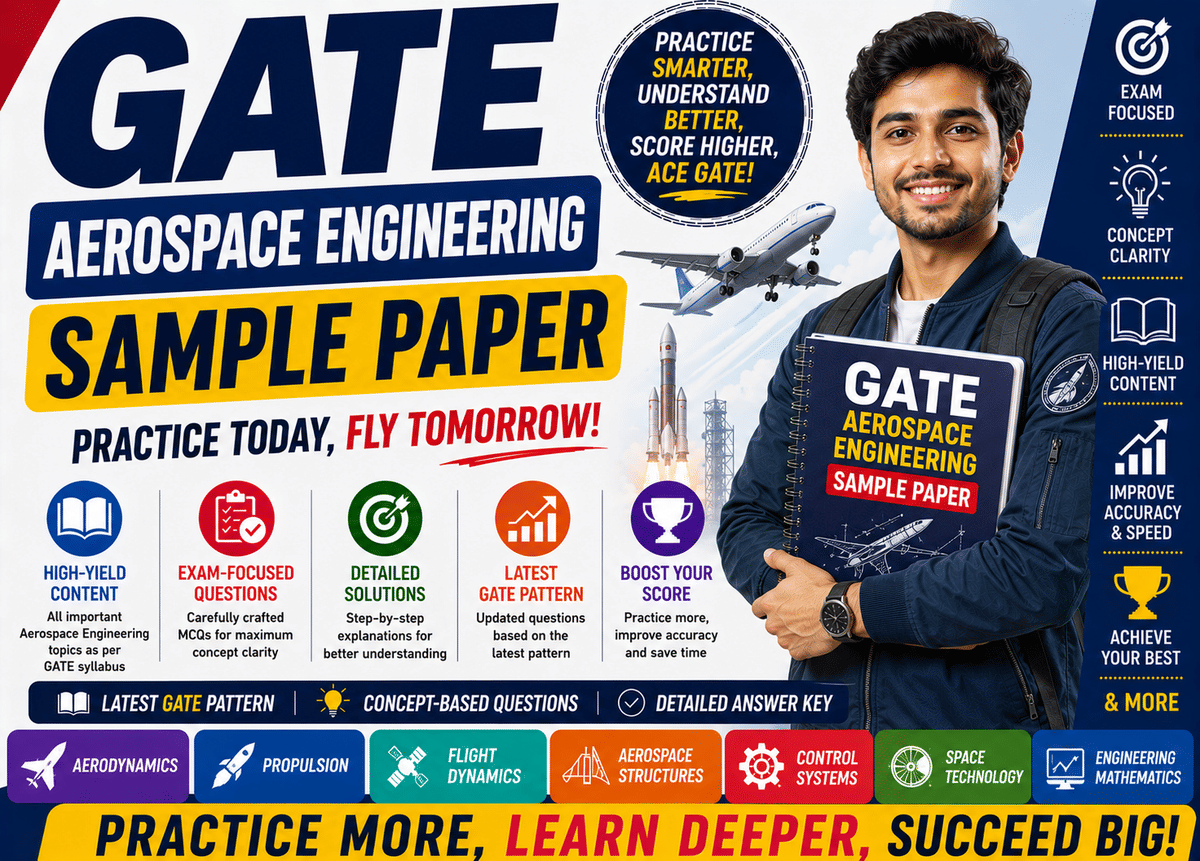
GATE Aerospace Engineering Exam Pattern and Marks Distribution 2027
The GATE Aerospace Engineering paper carries the same overall shape as every branch, but the technical core is what these sample papers train you for. The structure below has held steady for years, so you can plan around it.
- Total paper: 65 questions worth 100 marks in 180 minutes, computer based, in English.
- Section split: General Aptitude 10 questions and 15 marks, and the Aerospace Engineering subject 55 questions and 85 marks, which includes Engineering Mathematics of about 13 marks and the AE technical core of about 72 marks.
- Core covered here: 46 questions and 72 marks, split as 20 questions of 1 mark and 26 questions of 2 marks. These sample papers deliberately leave out General Aptitude and Engineering Mathematics so you can focus on the Aerospace core.
- Question types: MCQ with four options, MSQ where more than one option can be right, and NAT where you type a number.
- Marking: Only MCQs are penalised, at one third of the question's marks. MSQ and NAT carry no penalty at all, so an unsure NAT is always worth a guess.
- Conducting body: The IITs and IISc by rotation, announced each year on the official website gate2027.iitm.ac.in. Aerospace Engineering is one of 30 papers.
Key advice: The Aerospace core is 72 marks and it is broad, running from compressible aerodynamics to orbital mechanics to gas-turbine propulsion. You cannot afford blind spots. A GATE Aerospace Engineering sample paper forces you across all five branches in one sitting, which is the only honest test of whether your revision is even.
GATE Aerospace Engineering Sample Papers - Why Recent Papers Matter Most
GATE does release its question papers, which puts you in a better position than most exams. But the Aerospace paper has drifted in emphasis, and older sets do not reflect where the marks now sit.
- NAT questions dominate the core: A large share of the 2 mark Aerospace questions are Numerical Answer Type, where you solve fully and type a value. Isentropic flow, normal shock and orbital velocity numericals carry no negative marking, so recent practice teaches you to attempt every one rather than skip.
- Compressible flow and propulsion weight has grown: Shock relations, nozzle flow and gas-turbine cycle analysis now carry steady marks every year. Older papers under-represent them, so you can drill for weeks and still be light on high-speed aerodynamics.
- The branches stay fixed, the emphasis rotates: Aerodynamics, Flight Mechanics, Space Dynamics, Aerospace Structures and Propulsion are always present, but the split between them shifts year to year. Solving a spread of recent GATE Aerospace Engineering sample papers is the only way to feel that balance.
GATE Aerospace Engineering Chapter Wise Weightage - High Scoring Topics to Focus in Sample Papers
The GATE AE syllabus is divided into five major subject areas. The 46 core questions are distributed across these topics, with Aerodynamics carrying the highest weightage, followed by Structures and Propulsion. The table below shows how these topics are covered in our GATE Aerospace Engineering Sample Papers 2027.
| Branch | Questions | Difficulty | What to Watch For |
|---|---|---|---|
| Aerodynamics | 13 | Moderate to Hard | Fluid mechanics basics, airfoils and wings, lift and drag, viscous flow, compressible flow, shocks and wind tunnel testing. The largest block, so weak compressible flow costs you the most. |
| Aerospace Structures | 10 | Moderate to Hard | Stress and strain, beams and torsion, flight-vehicle structures and structural dynamics. Bending stress, shear flow and natural frequency questions repeat every year. |
| Propulsion | 10 | Moderate to Hard | Thermodynamics of aircraft gas-turbine engines, turbomachinery, nozzles, rockets and combustion. Brayton cycle, thrust and specific impulse are frequent NAT sources. |
| Flight Mechanics | 8 | Moderate | Standard atmosphere, airplane performance, range and endurance, and static and dynamic stability. Steady climb, glide angle and neutral point numericals are common. |
| Space Dynamics | 5 | Easy to Moderate | Orbital mechanics, Kepler's laws and orbit transfer. Circular and escape velocity and Hohmann transfer questions are direct and worth banking. |
Note: Don't overlook Flight Mechanics and Space Dynamics while focusing on Aerodynamics, Structures, and Propulsion. Together, these topics contribute around 13 questions and more than 20 marks in many papers. The numericals are often straightforward and can be solved quickly with good practice. In a GATE Aerospace Engineering Sample Paper 2027, these are the topics where well-prepared candidates can score easy and reliable marks.
GATE Aerospace Engineering Sample Paper Video Solutions 2027 - Watch Before You Start Solving
Aerospace core questions look routine and still cost people marks, usually through a wrong stagnation relation, a missed unit conversion, or a formula applied to the wrong flow regime. Watching a set solved shows you where the time and the errors actually go.
The walkthrough below works through GATE Aerospace Engineering previous year questions across the main branches. Watch it once, then start on Sample Paper 1 and see how many of the same patterns you recognise.
Watch:
Source: GATE 2027 Aerospace Engineering : Syllabus, High Weightage Subjects & Study Plan (YouTube)
How to Use GATE Aerospace Engineering Sample Papers to Clear in First Attempt
The Aerospace core rewards two things, breadth and clean numerical work. Your preparation should push you across all five branches while cutting the small slips that cost you sure marks.
- Time every paper at 128 minutes. That is the pace the AE core earns inside the full 180. If you routinely take 160, you are borrowing the time General Aptitude and Engineering Maths will need on exam day.
- Attempt every NAT. A large part of the 2 mark load is Numerical Answer Type with no negative marking, so a solved value or even a careful estimate is always better than a blank.
- Log why you got it wrong, not just what. Wrong stagnation relation, missed unit conversion, or genuinely did not know the concept. Those three need three different fixes.
- Balance your revision by branch. A steady 60 percent can hide the fact that every miss is Propulsion or Structural dynamics. Track score per branch, not just the total.
- Do not skip the 1 mark questions. Twenty of them carry 20 marks between them and take the least time per mark in the paper.
- Rework each paper's aerodynamics section. Aerodynamics is 13 questions and the heaviest single block, so a second pass there moves your score more than anywhere else.
GATE Aerospace Engineering Negative Marking and Attempt Strategy
GATE's marking scheme is more forgiving than most students assume, but only if you know which question type you are looking at. Getting this wrong costs marks that nothing else will win back.
- Only MCQs are penalised. The deduction is one third of the marks allotted, so a wrong 1 mark MCQ costs 0.33 and a wrong 2 mark MCQ costs 0.67.
- Never leave a NAT blank. Numerical Answer Type questions carry no negative marking, and they make up a big share of the Aerospace core. An unsure value is free, and a blank is a guaranteed zero.
- MSQ needs all or nothing. Multiple Select Questions carry no penalty either, but partial ticks earn nothing. Only mark the options you are sure of, and remember there may be just one.
- On MCQs, eliminate before you guess. A blind guess across four options is a losing trade at one third negative. Once two options are gone, on a 2 mark aerodynamics or propulsion MCQ, it turns clearly in your favour.
GATE Aerospace Engineering 4 Week Preparation Plan Using Sample Papers
- Week 1: Revise Aerodynamics, covering fluid mechanics basics, airfoils and wings, lift and drag, then viscous and compressible flow with shocks. Solve Sample Papers 1 and 2 at 128 minutes each and start your error log.
- Week 2: Work through Aerospace Structures and Propulsion, especially stress and strain, beams, structural dynamics, gas-turbine cycles and nozzles. Solve Sample Papers 3, 4 and 5.
- Week 3: Cover Flight Mechanics and Space Dynamics, including standard atmosphere, airplane performance, stability, orbital mechanics and orbit transfer. Solve Sample Papers 6, 7 and 8.
- Week 4: Solve Sample Papers 9 and 10 back to back to check your pace holds across all five branches, then revise only your error log. Keep the last 2 days light, with no new topics.
FAQs on GATE Aerospace Engineering Sample Papers 2027
Ques.How many questions and marks does the GATE Aerospace Engineering core carry in these sample papers?
Ans.Each GATE Aerospace Engineering sample paper carries 46 questions worth 72 marks, made up of 20 questions of 1 mark and 26 questions of 2 marks. This is the Aerospace core only, so it leaves out General Aptitude and Engineering Mathematics, which are separate papers. In the real exam the full paper is 65 questions and 100 marks, with General Aptitude taking 15 marks.
Ques.Is there negative marking in the GATE Aerospace Engineering paper?
Ans.Only on MCQs, and the deduction is one third of the marks allotted to that question. So a wrong 1 mark MCQ costs you 0.33 and a wrong 2 mark MCQ costs 0.67. Multiple Select Questions and Numerical Answer Type questions carry no negative marking at all, which matters a lot in Aerospace because so much of the core is NAT. Never leave a NAT question blank.
Ques.How much time should I spend on the Aerospace Engineering core in the real exam?
Ans.Budget about 128 minutes for the 46 core questions. The paper gives 180 minutes for 65 questions, which is roughly 2.77 minutes per question, so 46 AE core questions earn about 128 minutes. That leaves the remaining time for General Aptitude and Engineering Mathematics. Practising a full GATE Aerospace Engineering sample paper at this pace is the best way to keep that balance under real pressure.
Ques.Which branches carry the most weight in the GATE Aerospace Engineering paper?
Ans.Aerodynamics is the single largest block, covering fluid mechanics basics, airfoils and wings, lift and drag, viscous flow and compressible flow with shocks. Aerospace Structures and Propulsion come next, followed by Flight Mechanics and Space Dynamics. Our sample papers spread the 46 questions across all five so you are never blindsided by a branch you skipped.
Ques.Do these sample papers include General Aptitude and Engineering Mathematics?
Ans.No. These GATE Aerospace Engineering sample papers cover only the Aerospace technical core of 46 questions and 72 marks. General Aptitude and Engineering Mathematics are shared or common parts of the full paper and are provided separately, so you can drill the AE core on its own without diluting your practice.
Ques.Are these GATE Aerospace Engineering sample papers the same as previous year papers?
Ans.No. GATE does publish its past papers, and you should solve those too. These are original questions written to the current pattern, with 46 core questions in 128 minutes and the 20 plus 26 mark split, so you get fresh practice once you have exhausted the official sets. They also weight NAT questions, compressible flow and propulsion the way recent Aerospace papers do, which older past papers under-represent.



Comments