




The GATE 2026 Aerospace Engineering (AE) question paper is now available with detailed solutions for free download. GATE 2026 was conducted by IIT Guwahati on February 7, 2026 in the afternoon session (2:30 PM to 5:30 PM), and the AE paper carried 65 questions for 100 marks in 3 hours.
| GATE 2026 Aerospace Engineering Question Paper with Solutions | Download PDF | Check Solutions |
GATE 2026 Aerospace Engineering Questions with Solutions
"He often _____ the numbers. False claims are not going to help. Honesty _____ trust", said the manager.
Choose the option with the correct order of words to fill the blanks.
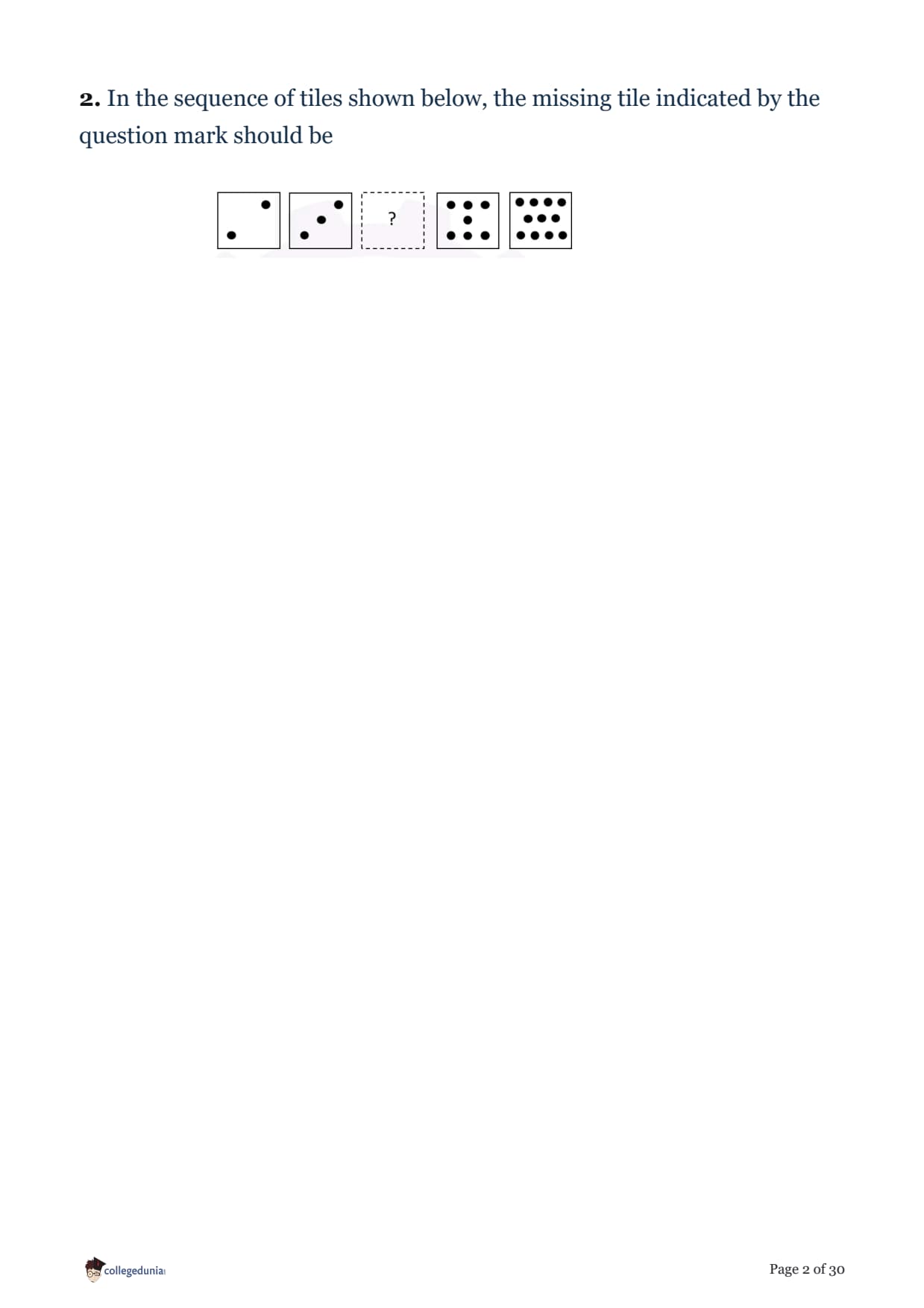
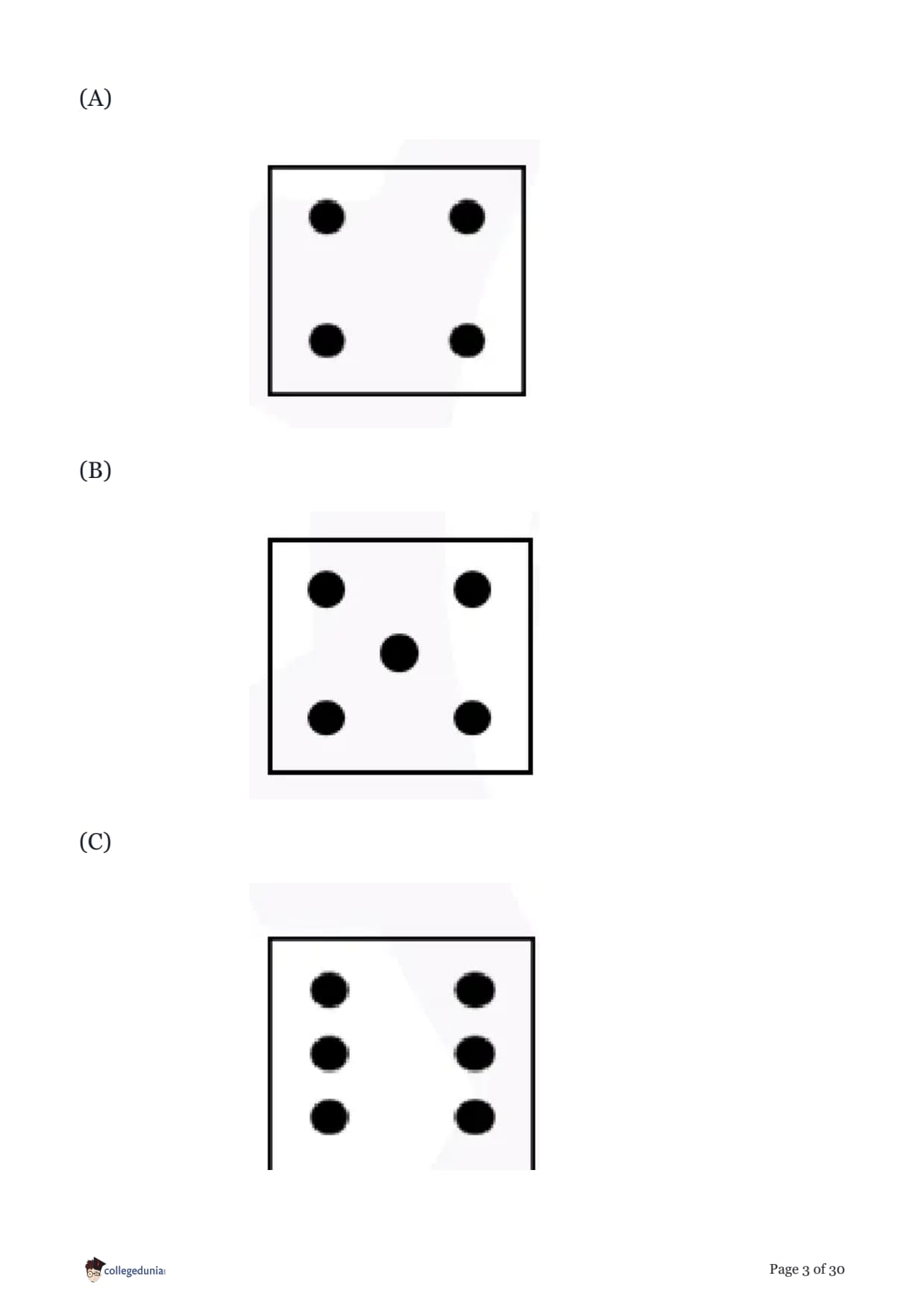
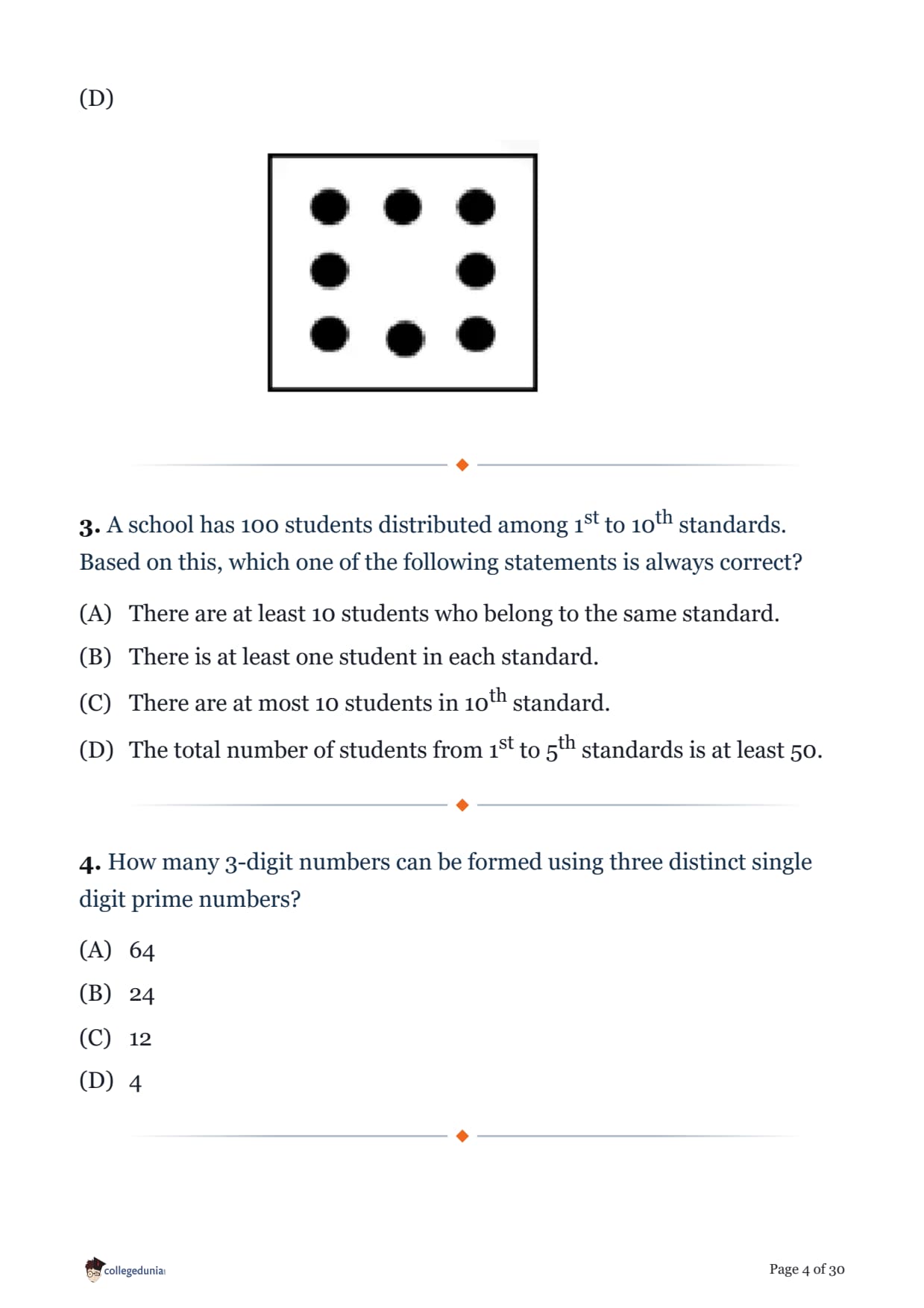
In the sequence of tiles shown below, the missing tile indicated by the question mark should be

- (A)
![]()
- (B)
![]()
- (C)
![]()
- (D)
![]()


A school has 100 students distributed among 1st to 10th standards.
Based on this, which one of the following statements is always correct?
How many 3-digit numbers can be formed using three distinct single digit prime numbers?
In a group of students, 10 students like Mathematics, 12 students like English, 4 students like both Mathematics and English, and 6 students like neither Mathematics nor English. The number of students in the group is
Charity : P :: Retaliation : Q
Choose the appropriate pair of words P and Q that fit the analogy.
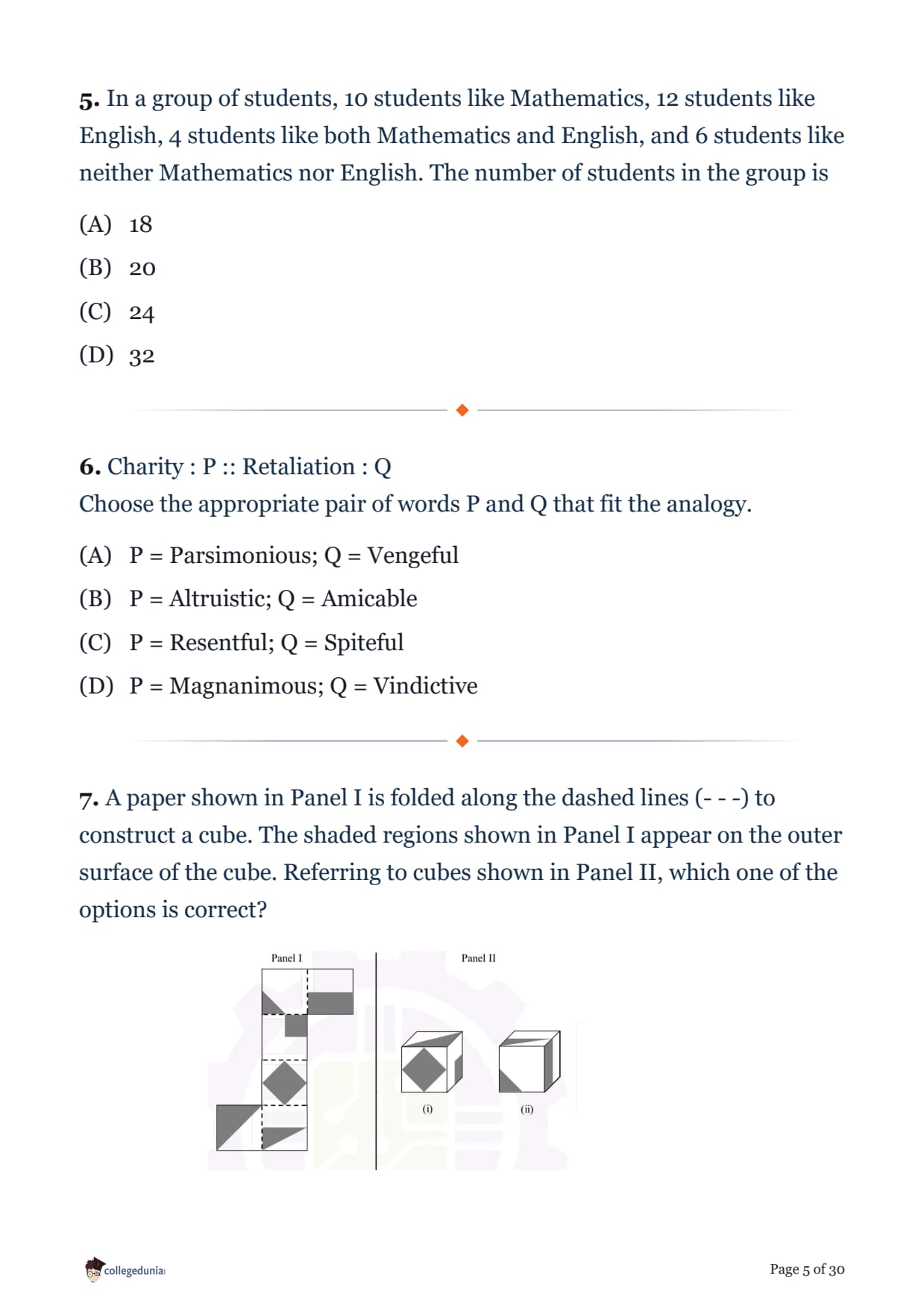
A paper shown in Panel I is folded along the dashed lines (- - -) to construct a cube. The shaded regions shown in Panel I appear on the outer surface of the cube. Referring to cubes shown in Panel II, which one of the options is correct?

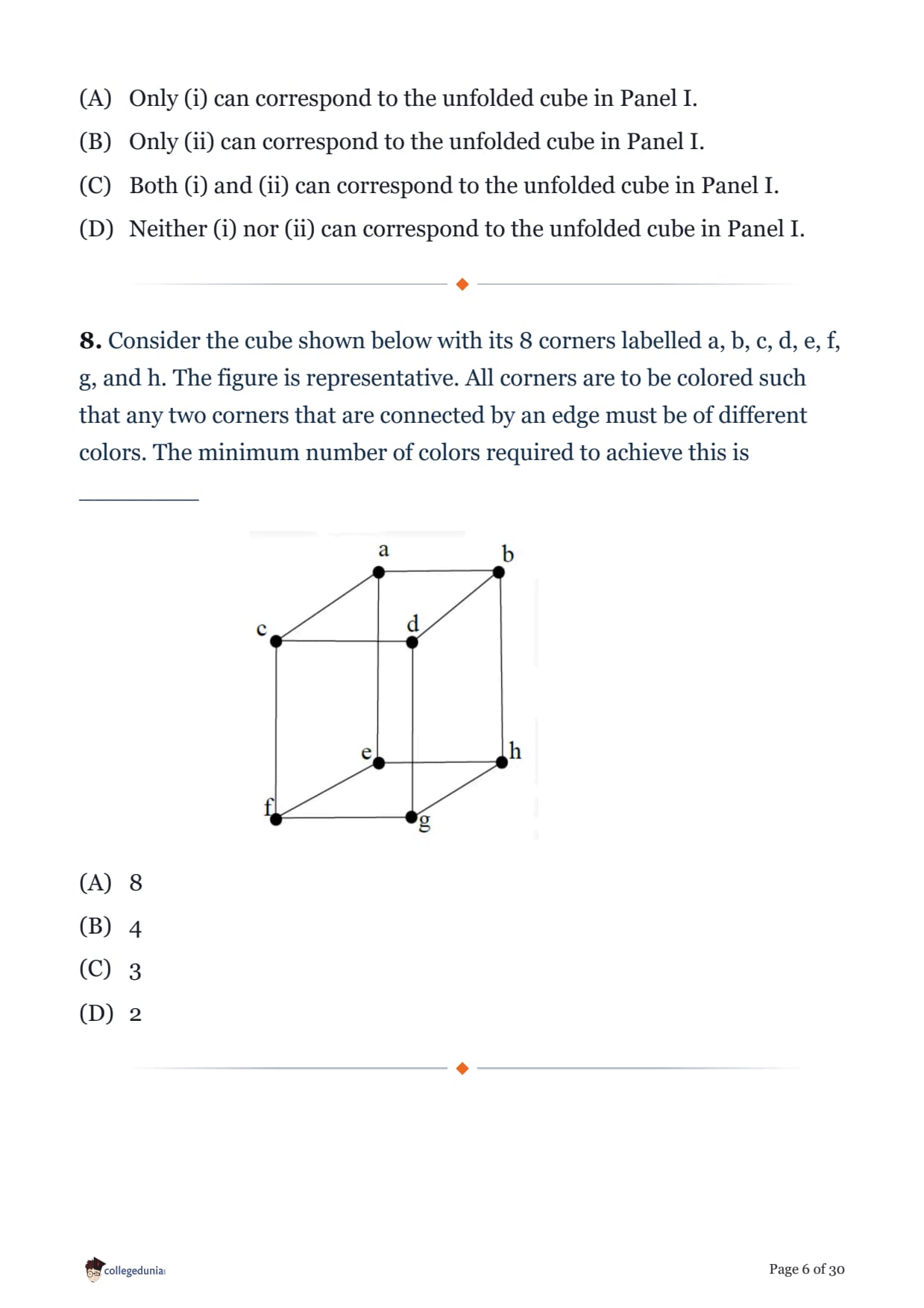
Consider the cube shown below with its 8 corners labelled a, b, c, d, e, f, g, and h. The figure is representative. All corners are to be colored such that any two corners that are connected by an edge must be of different colors. The minimum number of colors required to achieve this is ________

Four hills H1, H2, H3, and H4 are present in an area. The following observations are made about them:
i. Neither H2 nor H3 is the easternmost hill.
ii. Neither H2 nor H3 is the westernmost hill.
iii. Neither the easternmost hill nor the westernmost hill is the southernmost hill.
iv. Two hills are located to the west of H2.
v. The southernmost hill has at least two hills to its east.
The southernmost hill is ________.
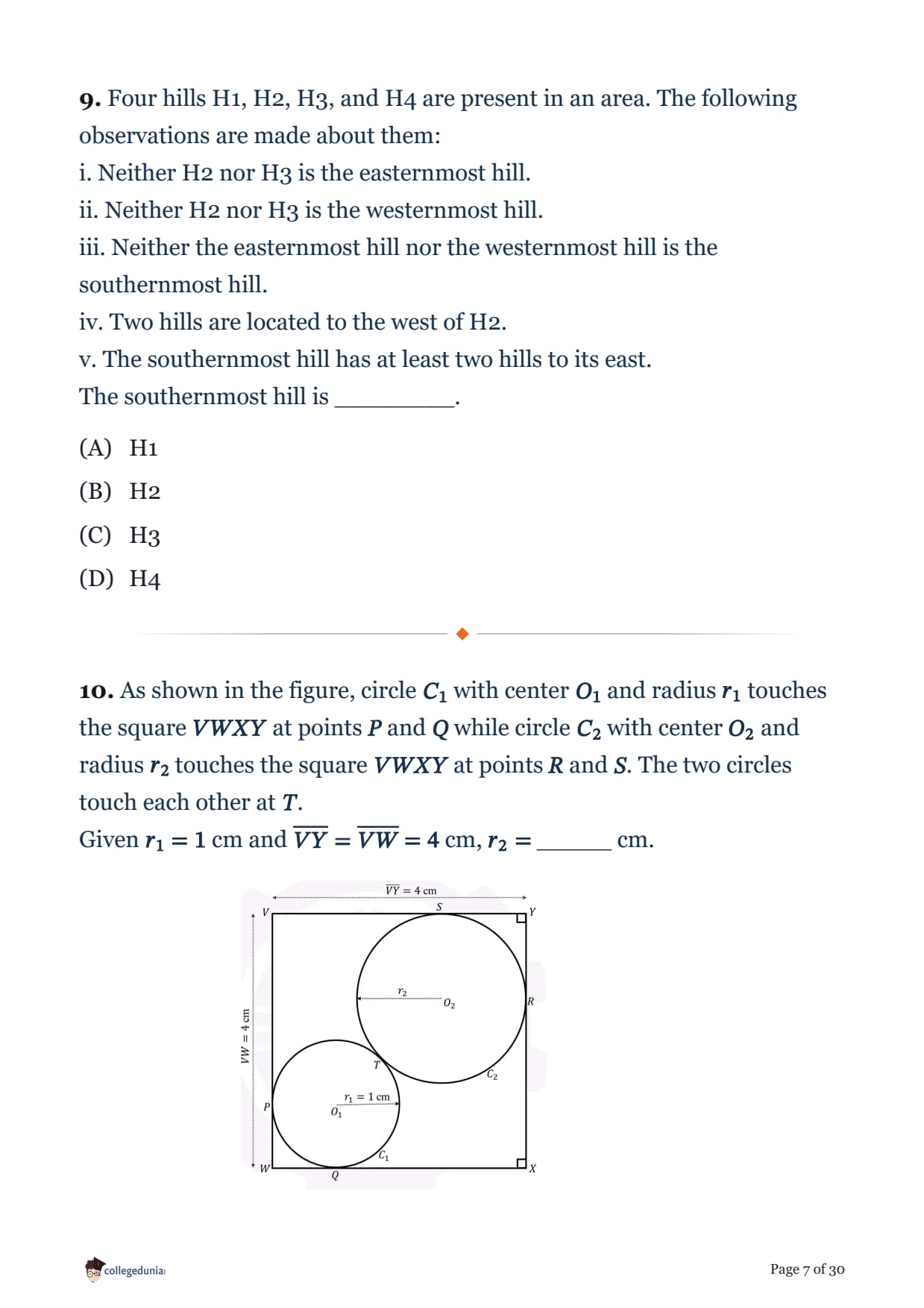
As shown in the figure, circle \(C_1\) with center \(O_1\) and radius \(r_1\) touches the square \(VWXY\) at points \(P\) and \(Q\) while circle \(C_2\) with center \(O_2\) and radius \(r_2\) touches the square \(VWXY\) at points \(R\) and \(S\). The two circles touch each other at \(T\).
Given \(r_1 = 1\) cm and \(\overline{VY} = \overline{VW} = 4\) cm, \(r_2 =\) _____ cm.

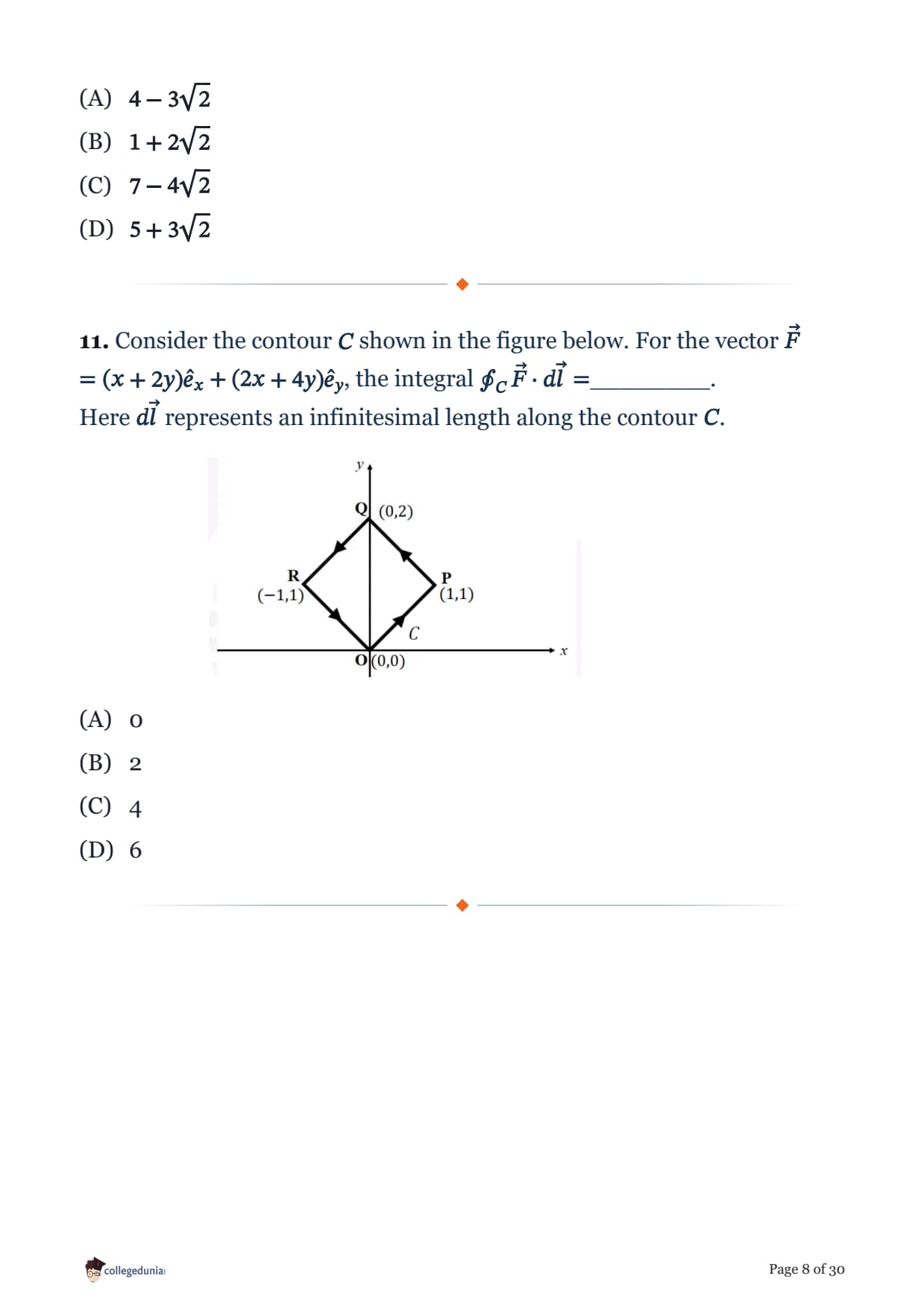
Consider the contour \(C\) shown in the figure below. For the vector \(\vec{F} = (x+2y)\hat{e}_x + (2x+4y)\hat{e}_y\), the integral \(\oint_C \vec{F}\cdot d\vec{l} =\)________.
Here \(d\vec{l}\) represents an infinitesimal length along the contour \(C\).

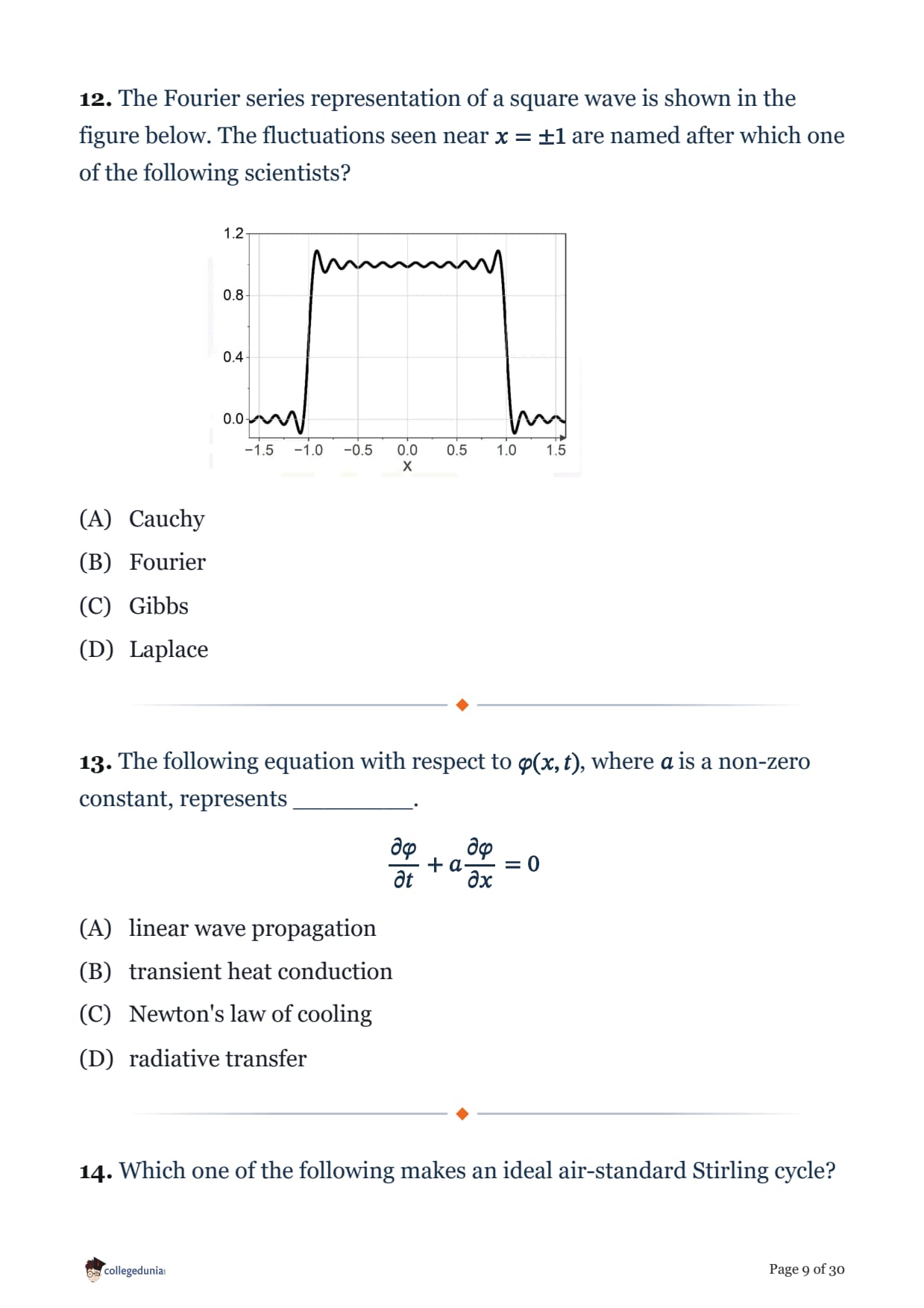
The Fourier series representation of a square wave is shown in the figure below. The fluctuations seen near \(x = \pm 1\) are named after which one of the following scientists?

The following equation with respect to \(\varphi(x,t)\), where \(a\) is a non-zero constant, represents ________.
\[ \frac{\partial \varphi}{\partial t} + a\frac{\partial \varphi}{\partial x} = 0 \]
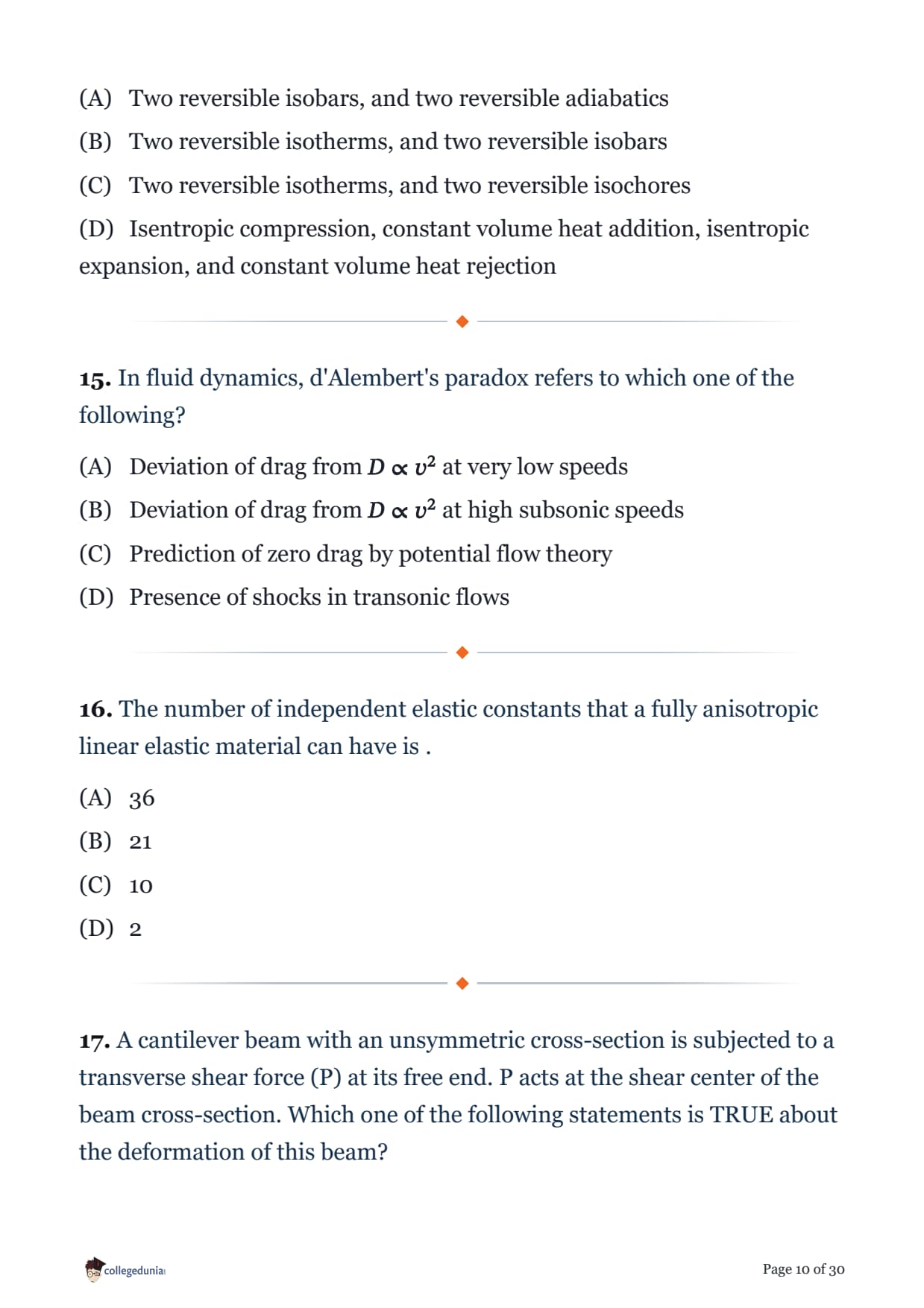
Which one of the following makes an ideal air-standard Stirling cycle?
In fluid dynamics, d'Alembert's paradox refers to which one of the following?
The number of independent elastic constants that a fully anisotropic linear elastic material can have is .
A cantilever beam with an unsymmetric cross-section is subjected to a transverse shear force (P) at its free end. P acts at the shear center of the beam cross-section. Which one of the following statements is TRUE about the deformation of this beam?
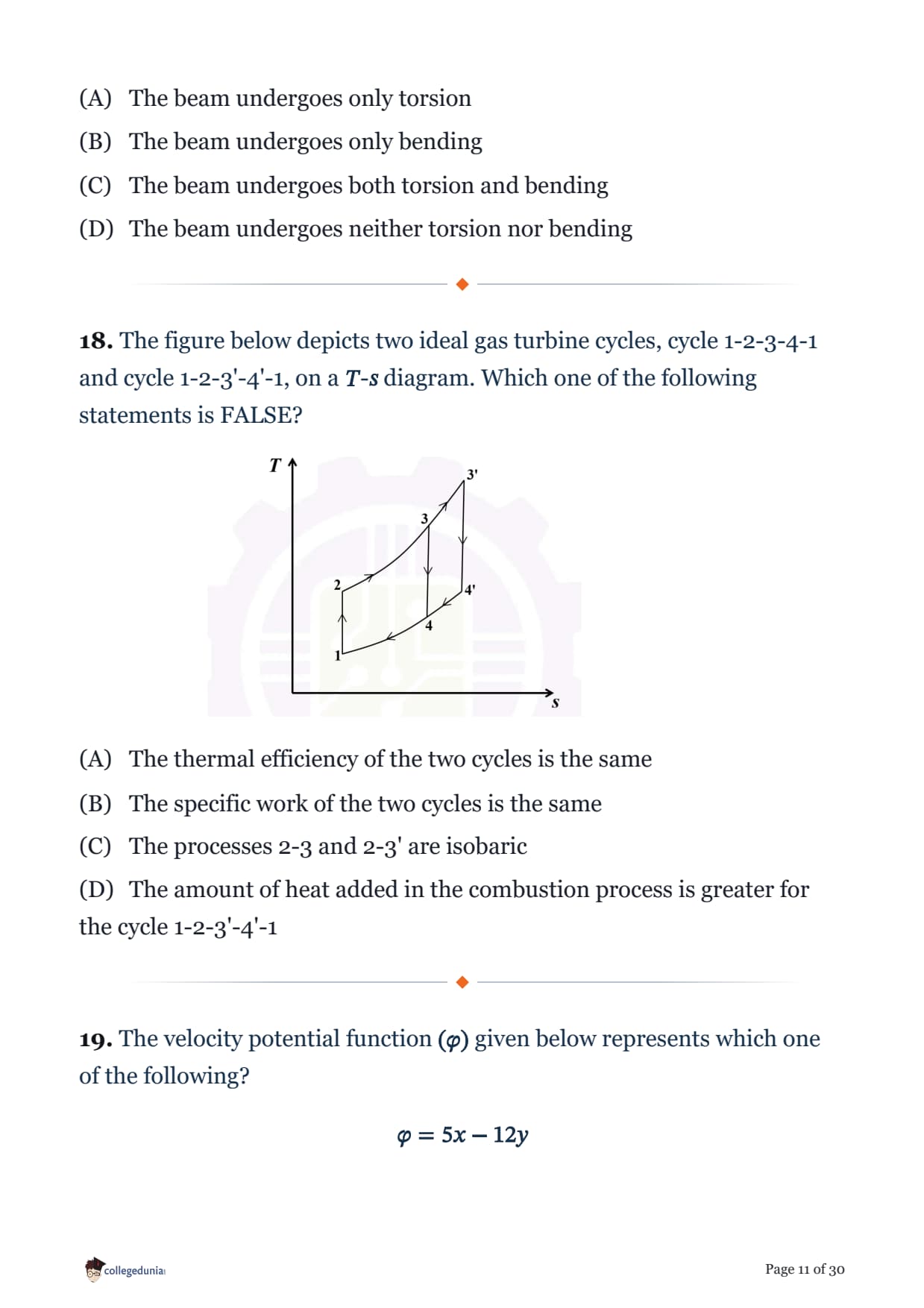
The figure below depicts two ideal gas turbine cycles, cycle 1-2-3-4-1 and cycle 1-2-3'-4'-1, on a \(T\)-\(s\) diagram. Which one of the following statements is FALSE?

The velocity potential function \((\varphi)\) given below represents which one of the following? \[ \varphi = 5x - 12y \]
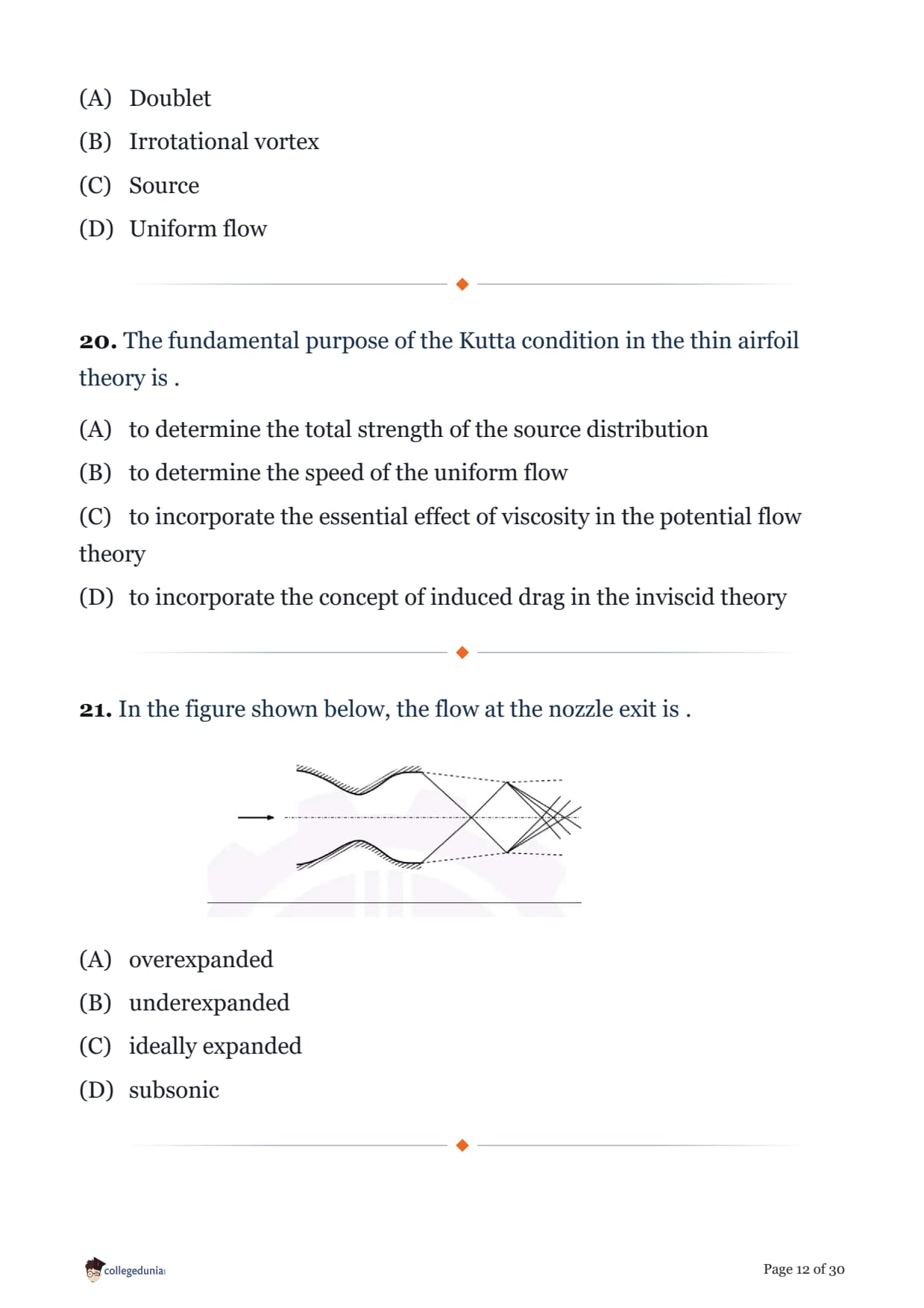
The fundamental purpose of the Kutta condition in the thin airfoil theory is .

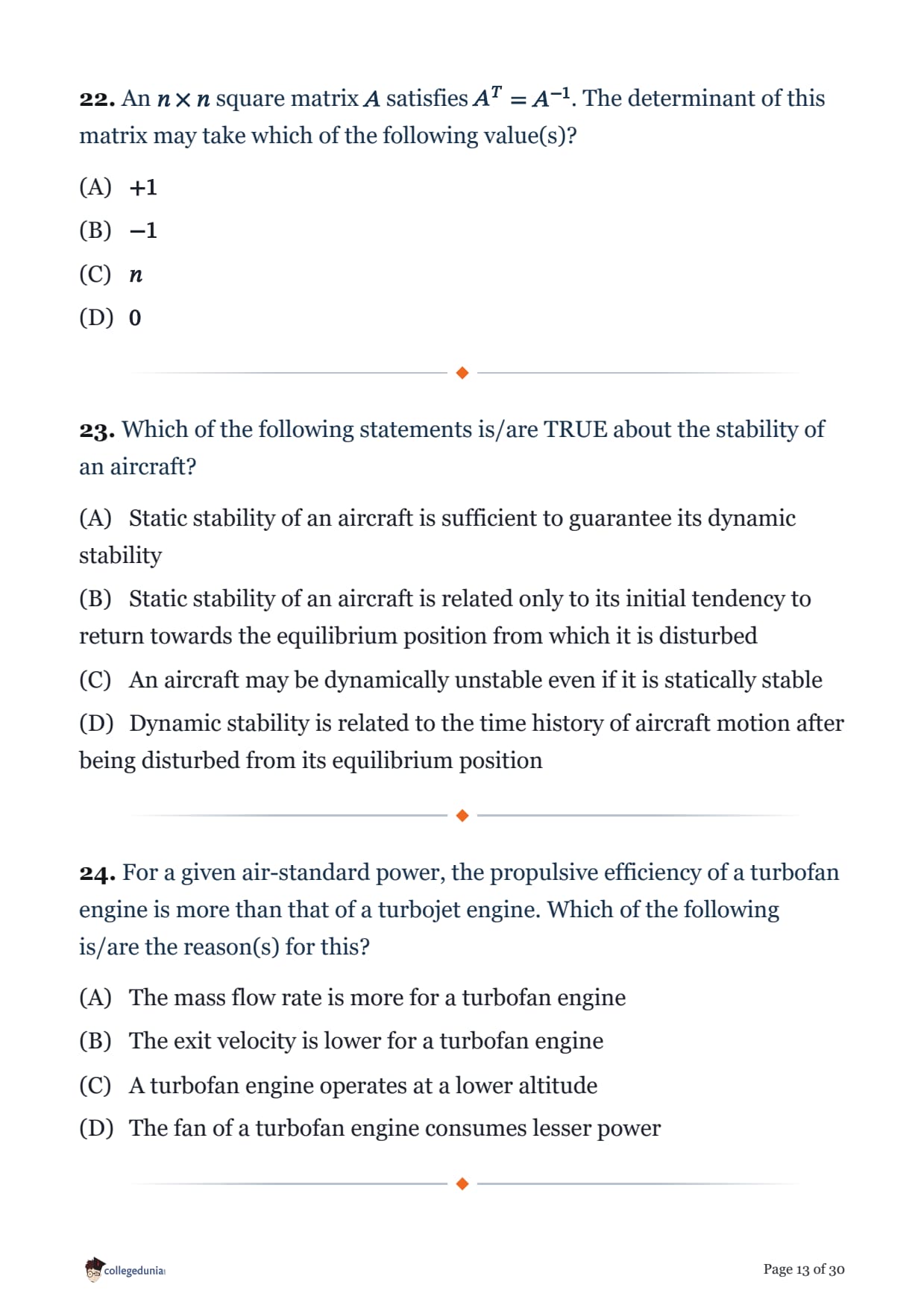
An \(n \times n\) square matrix \(A\) satisfies \(A^{T} = A^{-1}\). The determinant of this matrix may take which of the following value(s)?
Which of the following statements is/are TRUE about the stability of an aircraft?
For a given air-standard power, the propulsive efficiency of a turbofan engine is more than that of a turbojet engine. Which of the following is/are the reason(s) for this?
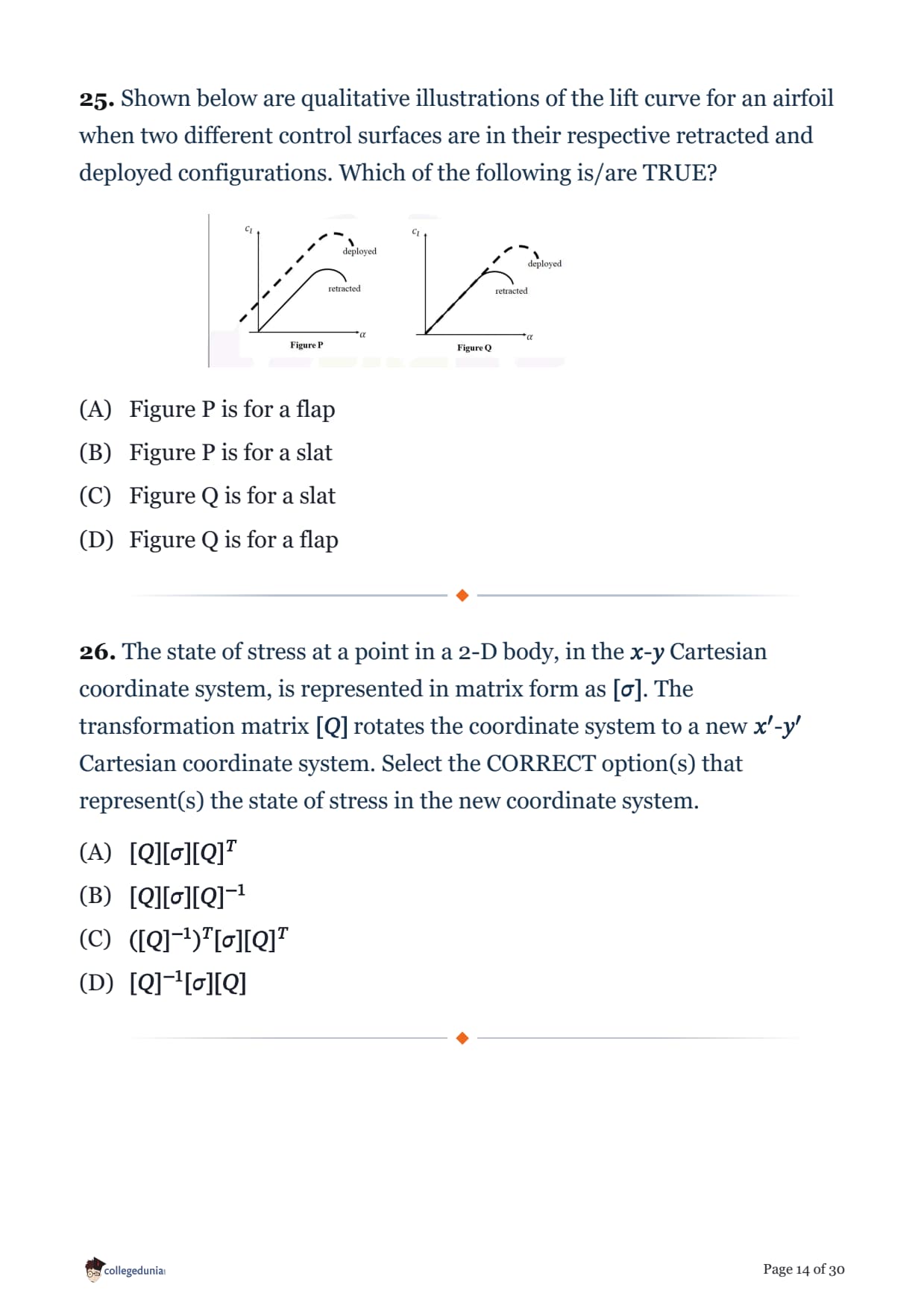
Shown below are qualitative illustrations of the lift curve for an airfoil when two different control surfaces are in their respective retracted and deployed configurations. Which of the following is/are TRUE?

The state of stress at a point in a 2-D body, in the \(x\)-\(y\) Cartesian coordinate system, is represented in matrix form as \([\sigma]\). The transformation matrix \([Q]\) rotates the coordinate system to a new \(x'\)-\(y'\) Cartesian coordinate system. Select the CORRECT option(s) that represent(s) the state of stress in the new coordinate system.
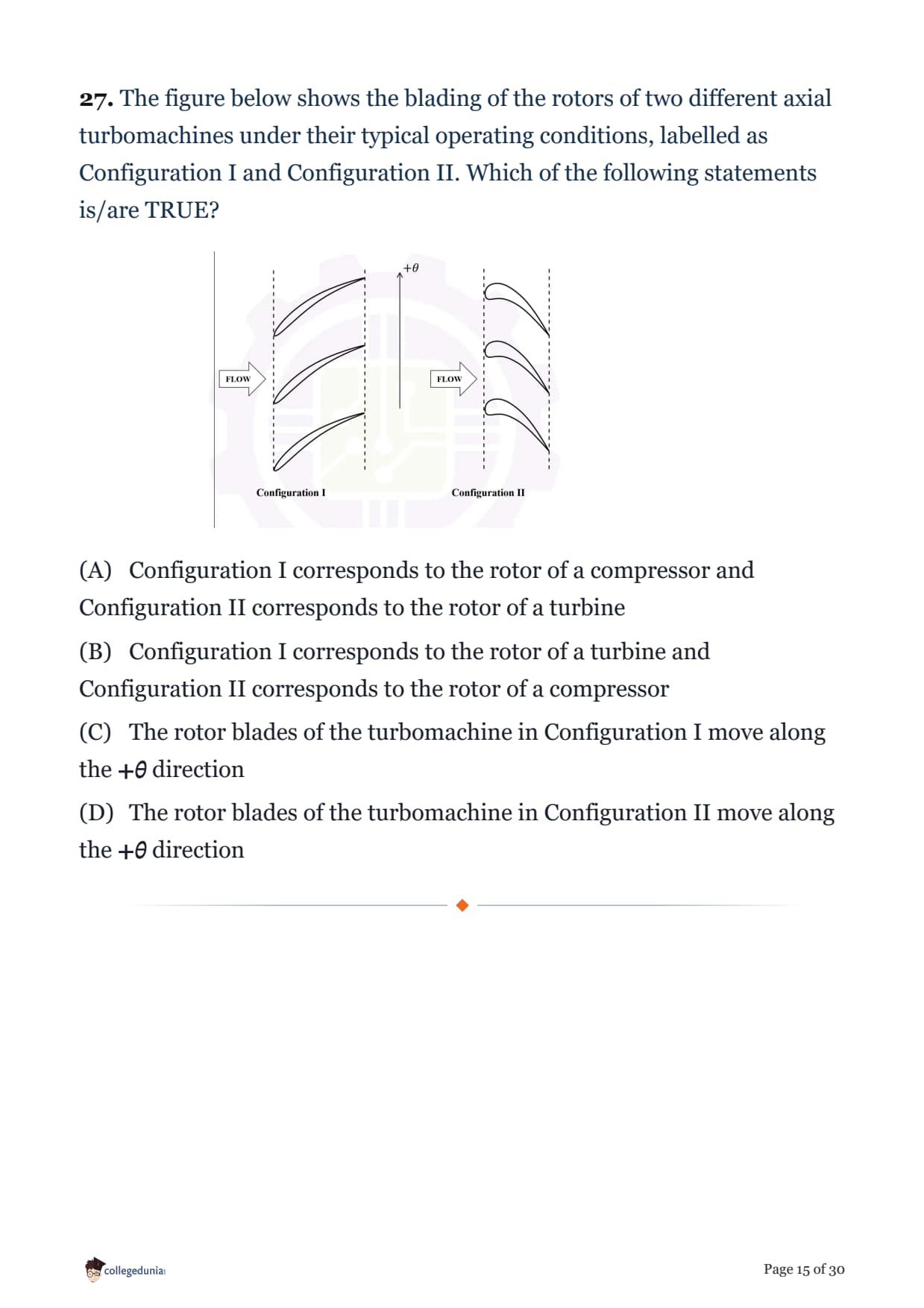
The figure below shows the blading of the rotors of two different axial turbomachines under their typical operating conditions, labelled as Configuration I and Configuration II. Which of the following statements is/are TRUE?

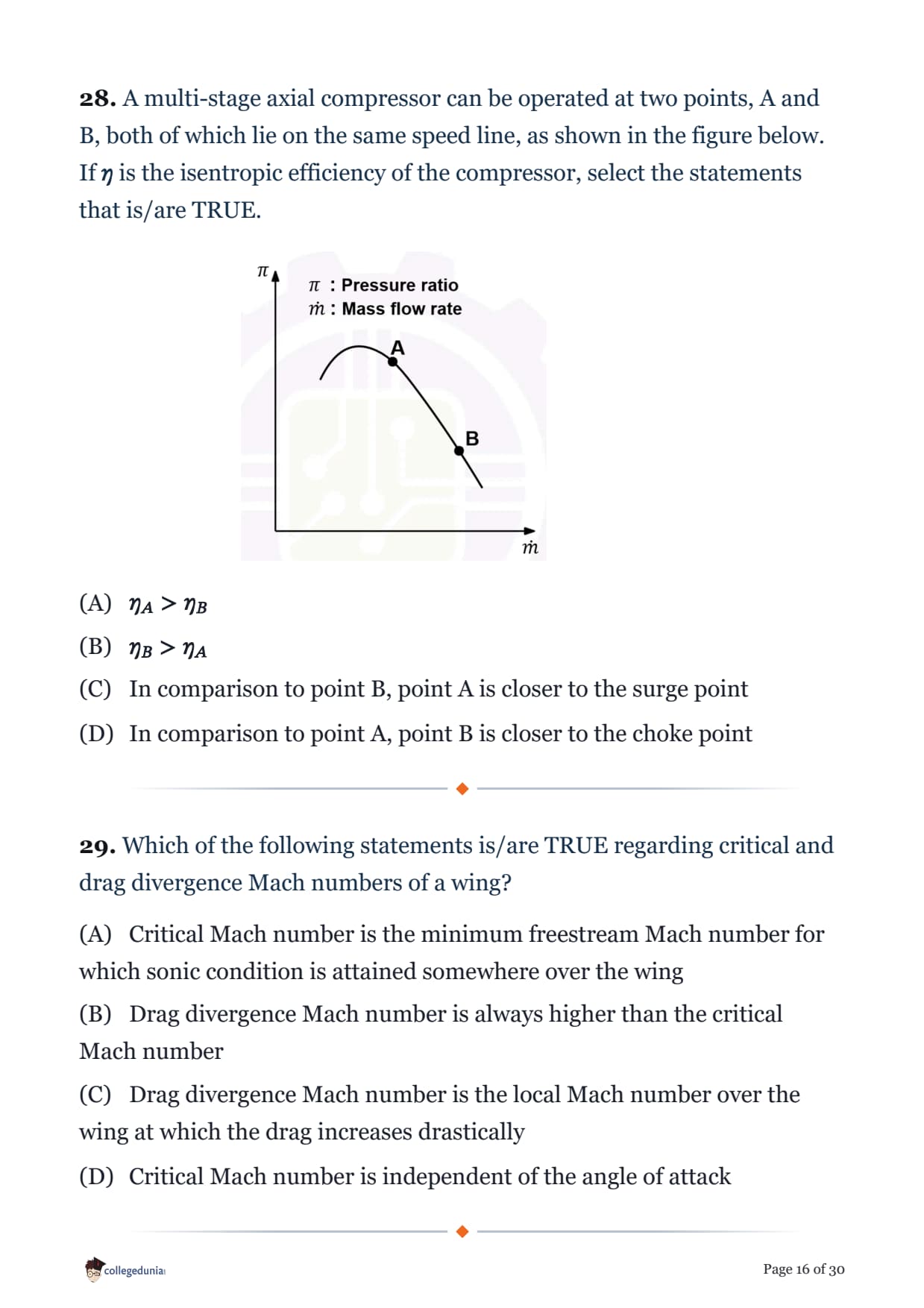
A multi-stage axial compressor can be operated at two points, A and B, both of which lie on the same speed line, as shown in the figure below. If \(\eta\) is the isentropic efficiency of the compressor, select the statements that is/are TRUE.

Which of the following statements is/are TRUE regarding critical and drag divergence Mach numbers of a wing?
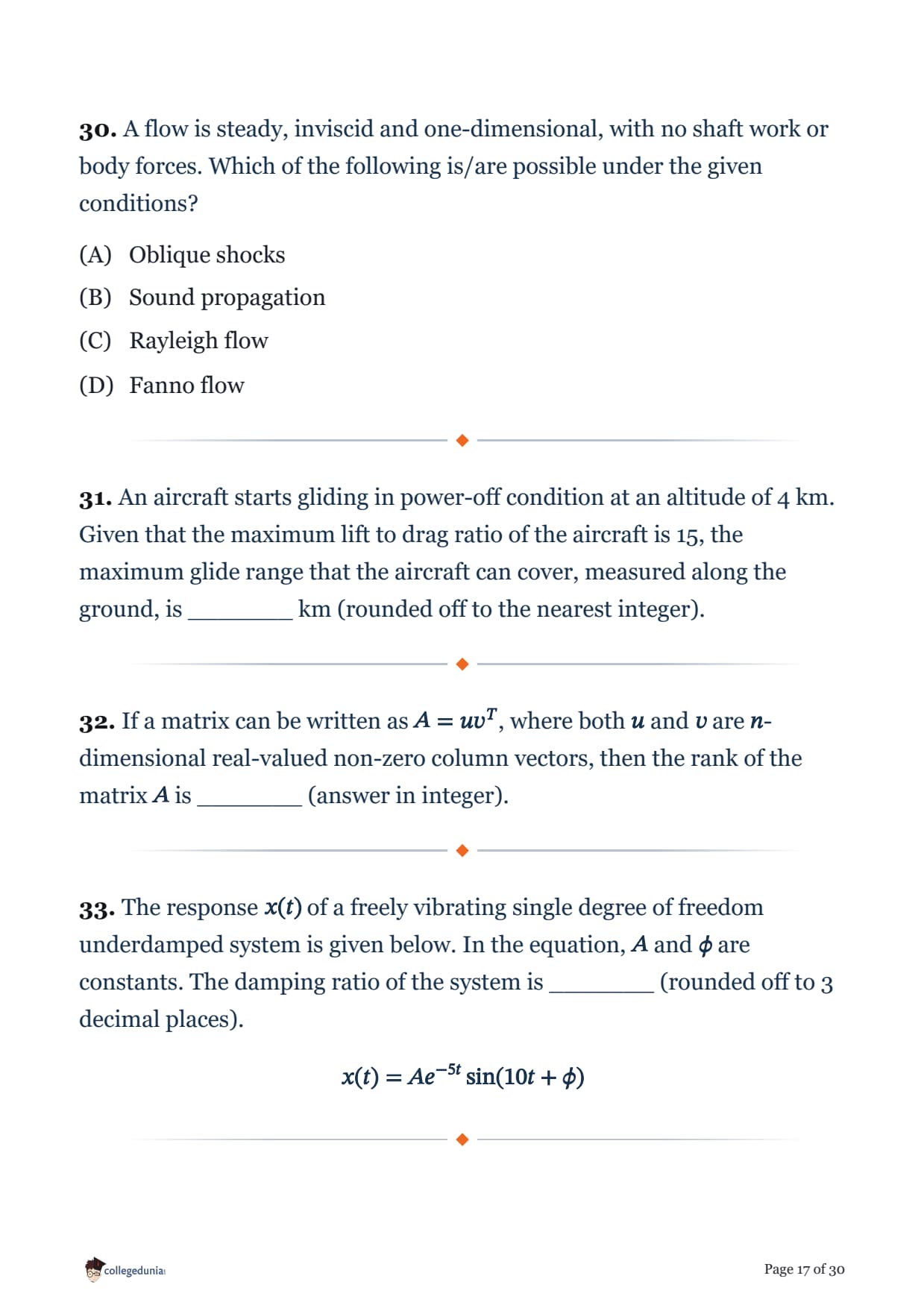
A flow is steady, inviscid and one-dimensional, with no shaft work or body forces. Which of the following is/are possible under the given conditions?
An aircraft starts gliding in power-off condition at an altitude of 4 km. Given that the maximum lift to drag ratio of the aircraft is 15, the maximum glide range that the aircraft can cover, measured along the ground, is _______ km (rounded off to the nearest integer).
If a matrix can be written as \(A=uv^{T}\), where both \(u\) and \(v\) are \(n\)-dimensional real-valued non-zero column vectors, then the rank of the matrix \(A\) is _______ (answer in integer).
The response \(x(t)\) of a freely vibrating single degree of freedom underdamped system is given below. In the equation, \(A\) and \(\phi\) are constants. The damping ratio of the system is _______ (rounded off to 3 decimal places). \[ x(t) = A e^{-5t}\sin(10t+\phi) \]
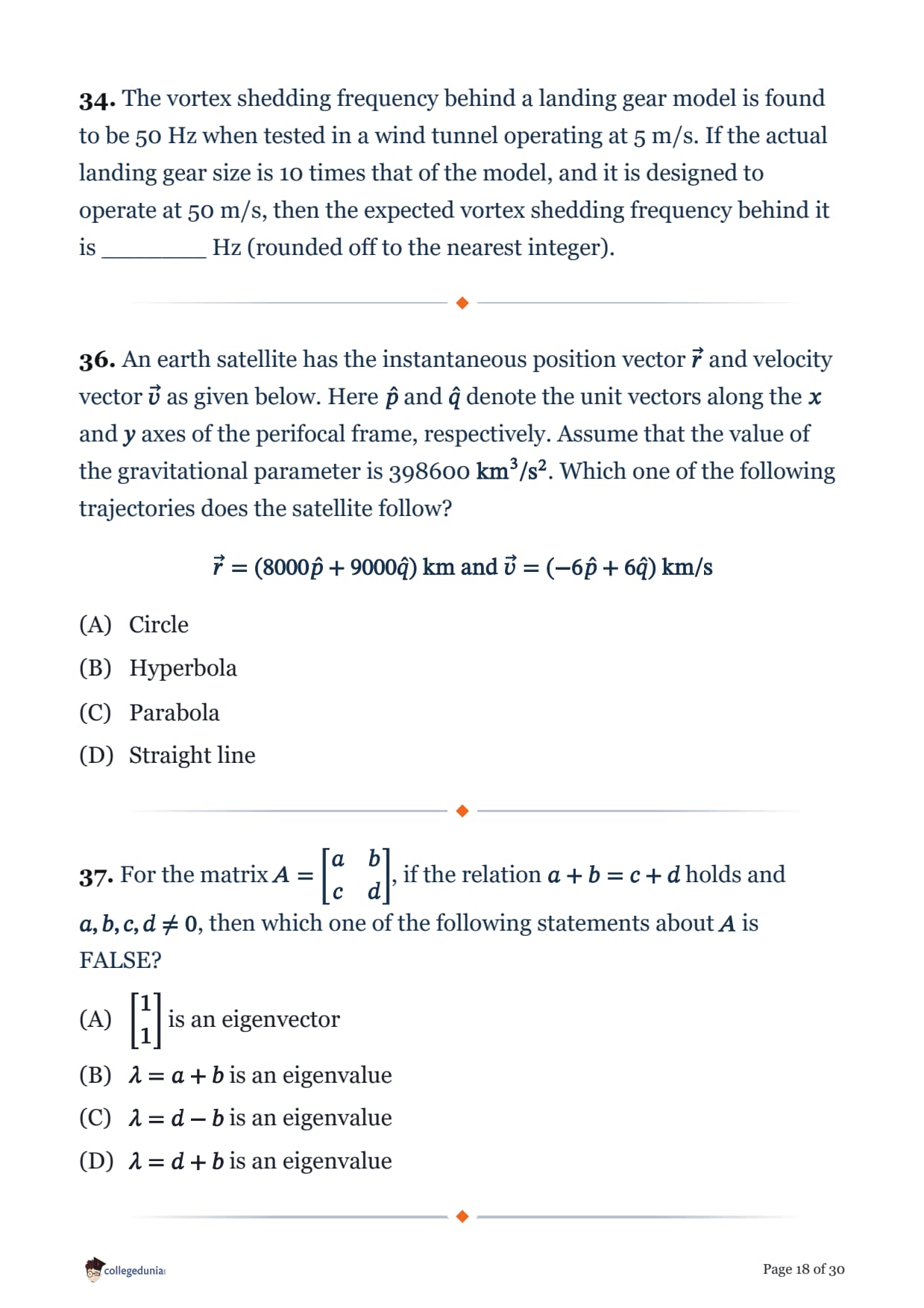
The vortex shedding frequency behind a landing gear model is found to be 50 Hz when tested in a wind tunnel operating at 5 m/s. If the actual landing gear size is 10 times that of the model, and it is designed to operate at 50 m/s, then the expected vortex shedding frequency behind it is _______ Hz (rounded off to the nearest integer).
An earth satellite has the instantaneous position vector \(\vec{r}\) and velocity vector \(\vec{v}\) as given below. Here \(\hat{p}\) and \(\hat{q}\) denote the unit vectors along the \(x\) and \(y\) axes of the perifocal frame, respectively. Assume that the value of the gravitational parameter is 398600 \(\text{km}^3/\text{s}^2\). Which one of the following trajectories does the satellite follow?
\[ \vec{r} = (8000\hat{p} + 9000\hat{q}) \text{ km and } \vec{v} = (-6\hat{p} + 6\hat{q}) \text{ km/s} \]
For the matrix \(A = \begin{bmatrix} a & b \\ c & d \end{bmatrix}\), if the relation \(a+b=c+d\) holds and \(a,b,c,d \neq 0\), then which one of the following statements about \(A\) is FALSE?
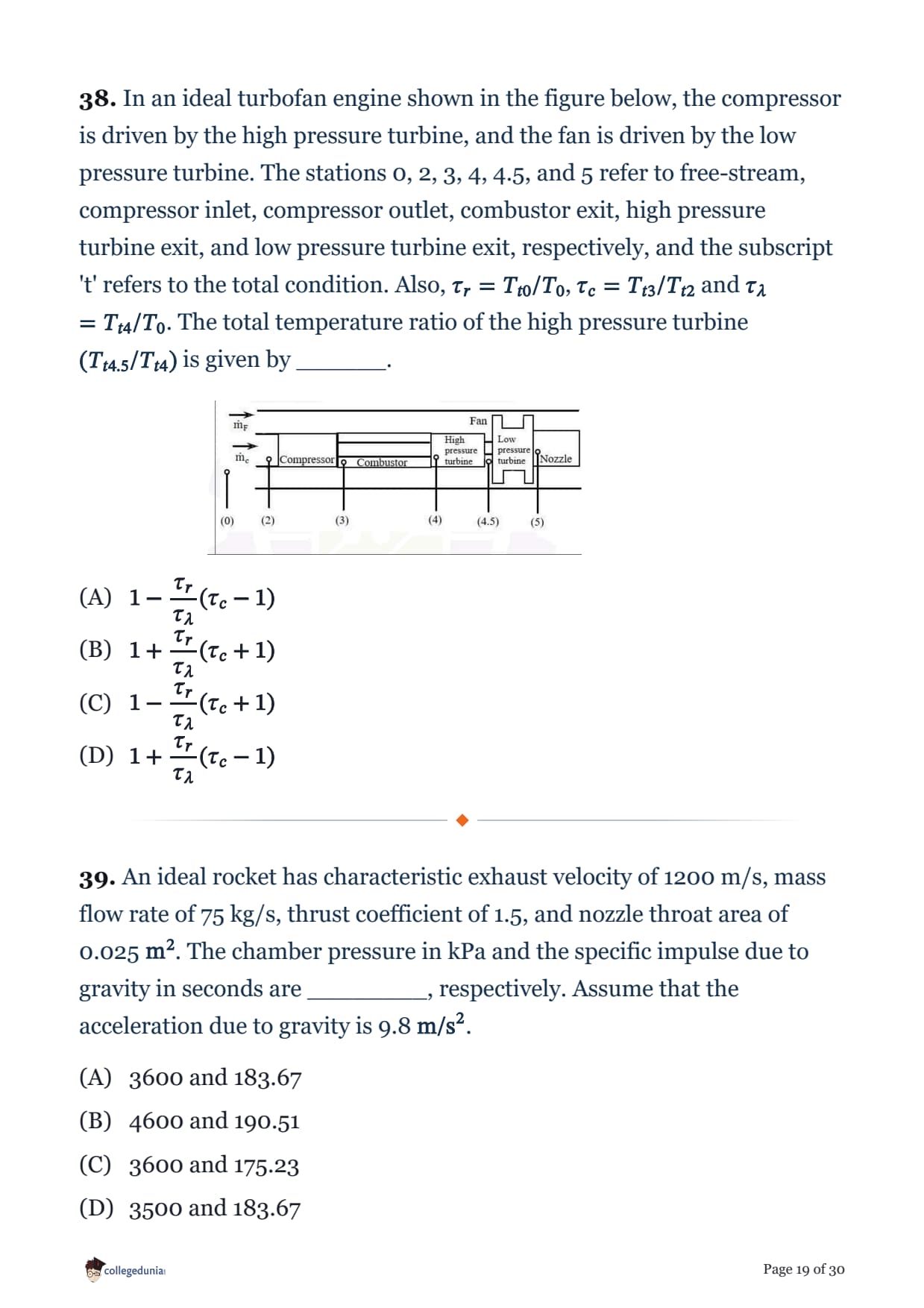
In an ideal turbofan engine shown in the figure below, the compressor is driven by the high pressure turbine, and the fan is driven by the low pressure turbine. The stations 0, 2, 3, 4, 4.5, and 5 refer to free-stream, compressor inlet, compressor outlet, combustor exit, high pressure turbine exit, and low pressure turbine exit, respectively, and the subscript 't' refers to the total condition. Also, \(\tau_r = T_{t0}/T_0\), \(\tau_c = T_{t3}/T_{t2}\) and \(\tau_\lambda = T_{t4}/T_0\). The total temperature ratio of the high pressure turbine \((T_{t4.5}/T_{t4})\) is given by ______.

An ideal rocket has characteristic exhaust velocity of 1200 m/s, mass flow rate of 75 kg/s, thrust coefficient of 1.5, and nozzle throat area of 0.025 \(\text{m}^2\). The chamber pressure in kPa and the specific impulse due to gravity in seconds are ________, respectively. Assume that the acceleration due to gravity is 9.8 \(\text{m/s}^2\).
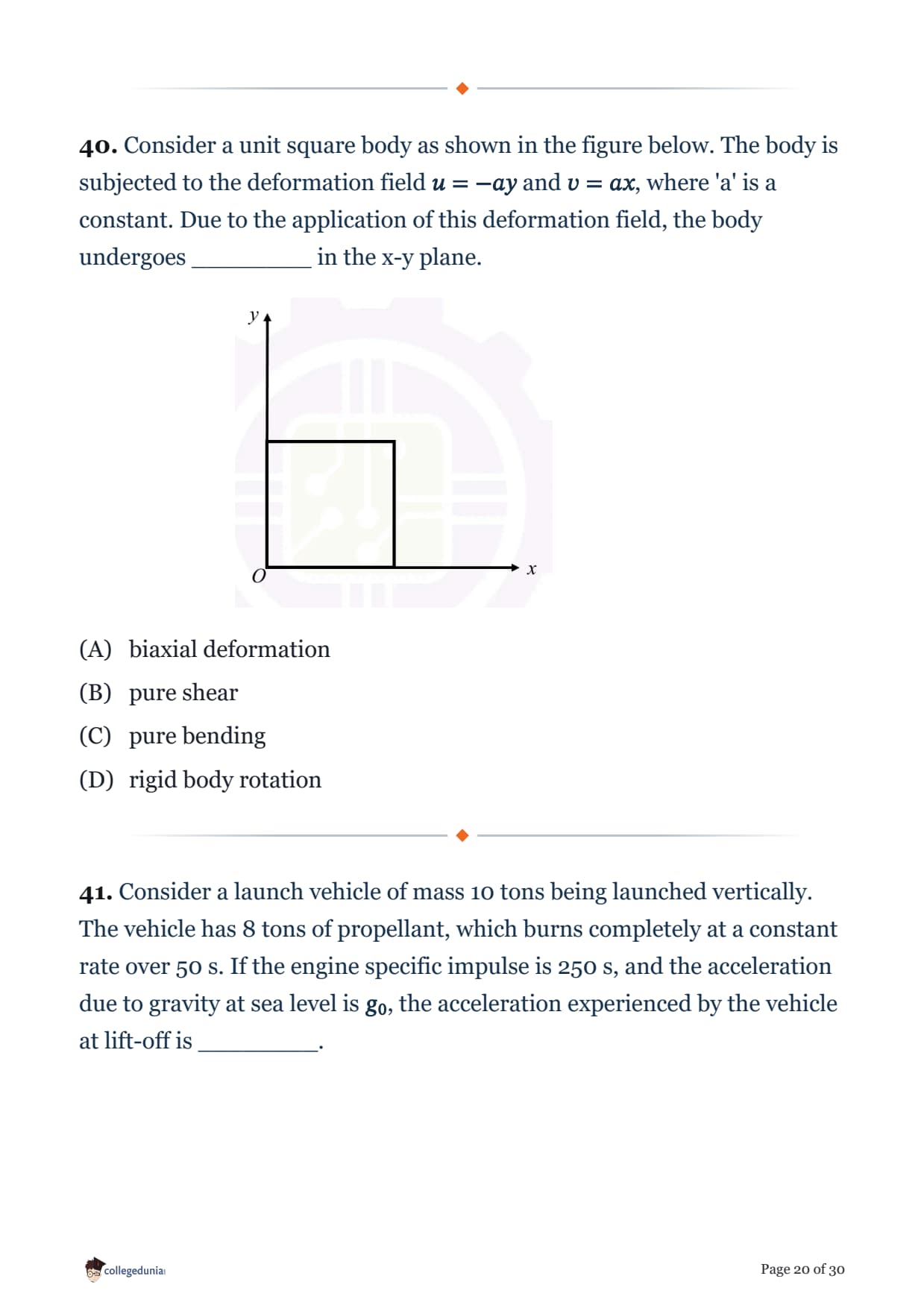
Consider a unit square body as shown in the figure below. The body is subjected to the deformation field \(u = -ay\) and \(v = ax\), where 'a' is a constant. Due to the application of this deformation field, the body undergoes ________ in the x-y plane.

Consider a launch vehicle of mass 10 tons being launched vertically. The vehicle has 8 tons of propellant, which burns completely at a constant rate over 50 s. If the engine specific impulse is 250 s, and the acceleration due to gravity at sea level is \(g_0\), the acceleration experienced by the vehicle at lift-off is ________.
The figure below shows a compressor stage with station numbers 1, 2, and 3 as indicated. If \(p_{0i}\), \(T_{0i}\), and \(C_i\) refer to the average values of total pressure, total temperature, and absolute flow speed, respectively, at the \(i^{th}\) station, select the CORRECT option considering losses.

An experimental study is planned to map out the low-Reynolds number incompressible steady two-dimensional aerodynamic characteristics of a promising novel airfoil. The operational parameters of the problem are the speed, density and viscosity of the freestream, the chord of the airfoil and its angle of attack. If the objective is to achieve this with the minimum number of test runs \(N_{min}\) while taking 10 equally-spaced test values of each independent parameter of the problem in a suitable range, then \(N_{min}\) is ________.
Which of the following process(es) is/are involved in the compression of air in an ideal ramjet engine?
The deformation of an open-section bar subjected to pure torsion can be solved by choosing an appropriate Prandtl stress function. Which of the following statements is/are true about the Prandtl stress function?
Consider the flow over an oval modeled using the elementary potential flows as shown below. \(U\) represents uniform flow velocity and \(\Gamma\) represents circulation around an irrotational line vortex.

Which of the following statements is/are TRUE for this model?
What is/are the use(s) of the single horseshoe vortex model of finite wing aerodynamic theory?
Consider the differential equation with the initial conditions given below. If \(y(x)\) is the solution of the equation, the value of the slope, \(\frac{dy}{dx}\), at \(x=\ln(2)\) is ________ (rounded off to three decimal places).
\[ \frac{d^2y}{dx^2}+2\frac{dy}{dx}+y=0 \quad \text{with} \quad y|_{x=0}=0 \text{ and } \left.\frac{dy}{dx}\right|_{x=0}=1 \]
An object of mass 1 kg is launched with an initial speed of \(v_o\) into a large tank filled with a viscous liquid. The liquid exerts a resistive force (drag) of the form \(D = \alpha v\) on any object that is moving inside it, where \(v\) is the instantaneous speed of the object and \(\alpha = 1\) kg/s. If the effect of gravity is ignored, the time taken by the object to slow down to the speed \(v_o/2\) is ________ s (rounded off to 2 decimal places). Assume that the tank is sufficiently large for the above deceleration to happen inside the tank.
The minimum value of the function \(f(x) = |x| + |2x+3|\) for real \(x\) is ________ (rounded off to 1 decimal place).
Isobutane (\(C_4H_{10}\)) is burnt completely in pure oxygen as per the reaction given below. Given that the standard heats of formation (in kcal/mole) of isobutane, carbon dioxide, and water vapour are -31.489, -94.052, and -60.150, respectively, the heat of reaction is ________ kcal (rounded off to 2 decimal places).
\[ C_4H_{10} + 6.5\,O_2 \to 4\,CO_2 + 5\,H_2O \]
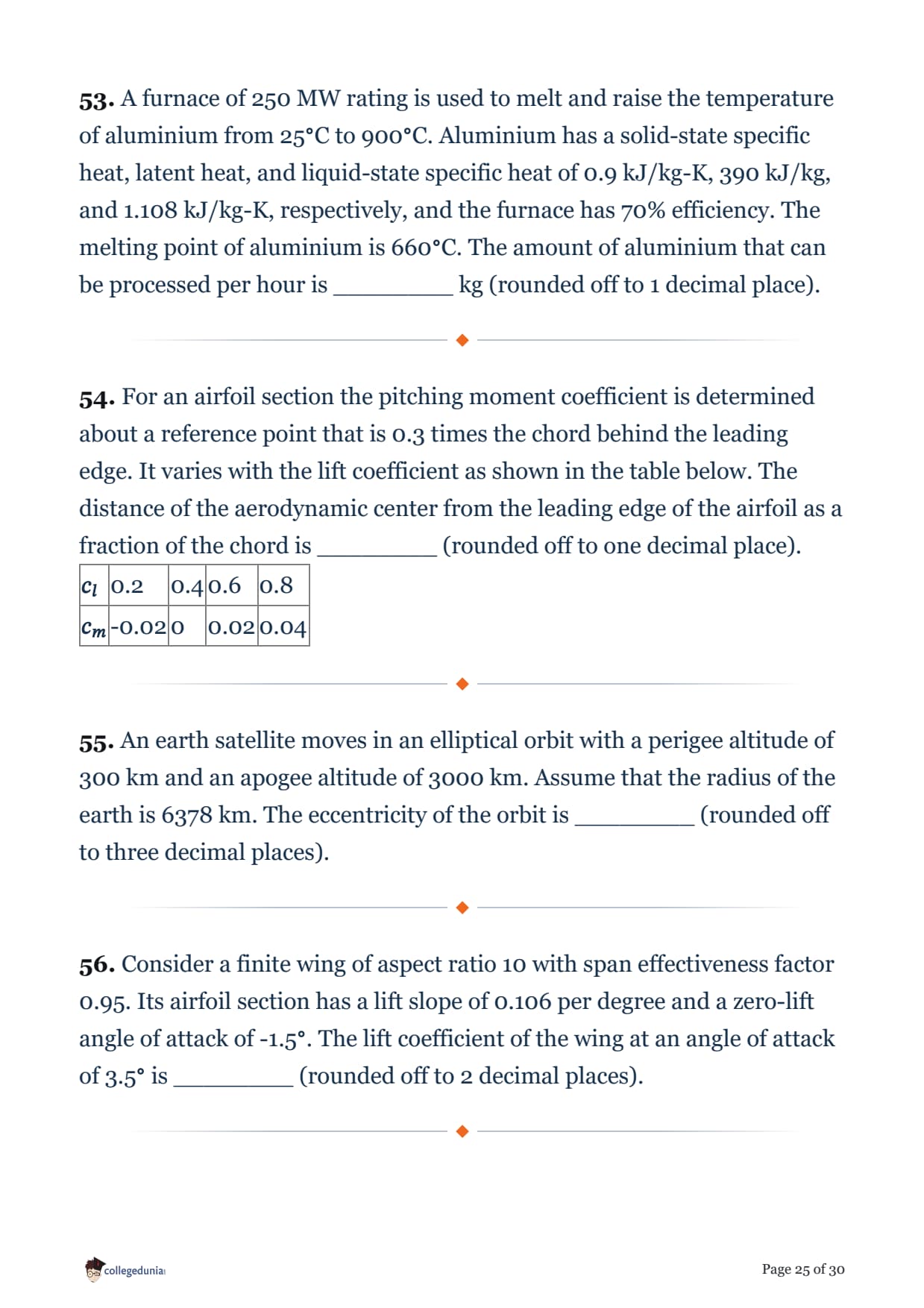
A furnace of 250 MW rating is used to melt and raise the temperature of aluminium from 25\(^{\circ}\)C to 900\(^{\circ}\)C. Aluminium has a solid-state specific heat, latent heat, and liquid-state specific heat of 0.9 kJ/kg-K, 390 kJ/kg, and 1.108 kJ/kg-K, respectively, and the furnace has 70% efficiency. The melting point of aluminium is 660\(^{\circ}\)C. The amount of aluminium that can be processed per hour is ________ kg (rounded off to 1 decimal place).
For an airfoil section the pitching moment coefficient is determined about a reference point that is 0.3 times the chord behind the leading edge. It varies with the lift coefficient as shown in the table below. The distance of the aerodynamic center from the leading edge of the airfoil as a fraction of the chord is ________ (rounded off to one decimal place).
| \(c_l\) | 0.2 | 0.4 | 0.6 | 0.8 |
| \(c_m\) | -0.02 | 0 | 0.02 | 0.04 |
An earth satellite moves in an elliptical orbit with a perigee altitude of 300 km and an apogee altitude of 3000 km. Assume that the radius of the earth is 6378 km. The eccentricity of the orbit is ________ (rounded off to three decimal places).
Consider a finite wing of aspect ratio 10 with span effectiveness factor 0.95. Its airfoil section has a lift slope of 0.106 per degree and a zero-lift angle of attack of -1.5\(^{\circ}\). The lift coefficient of the wing at an angle of attack of 3.5\(^{\circ}\) is ________ (rounded off to 2 decimal places).
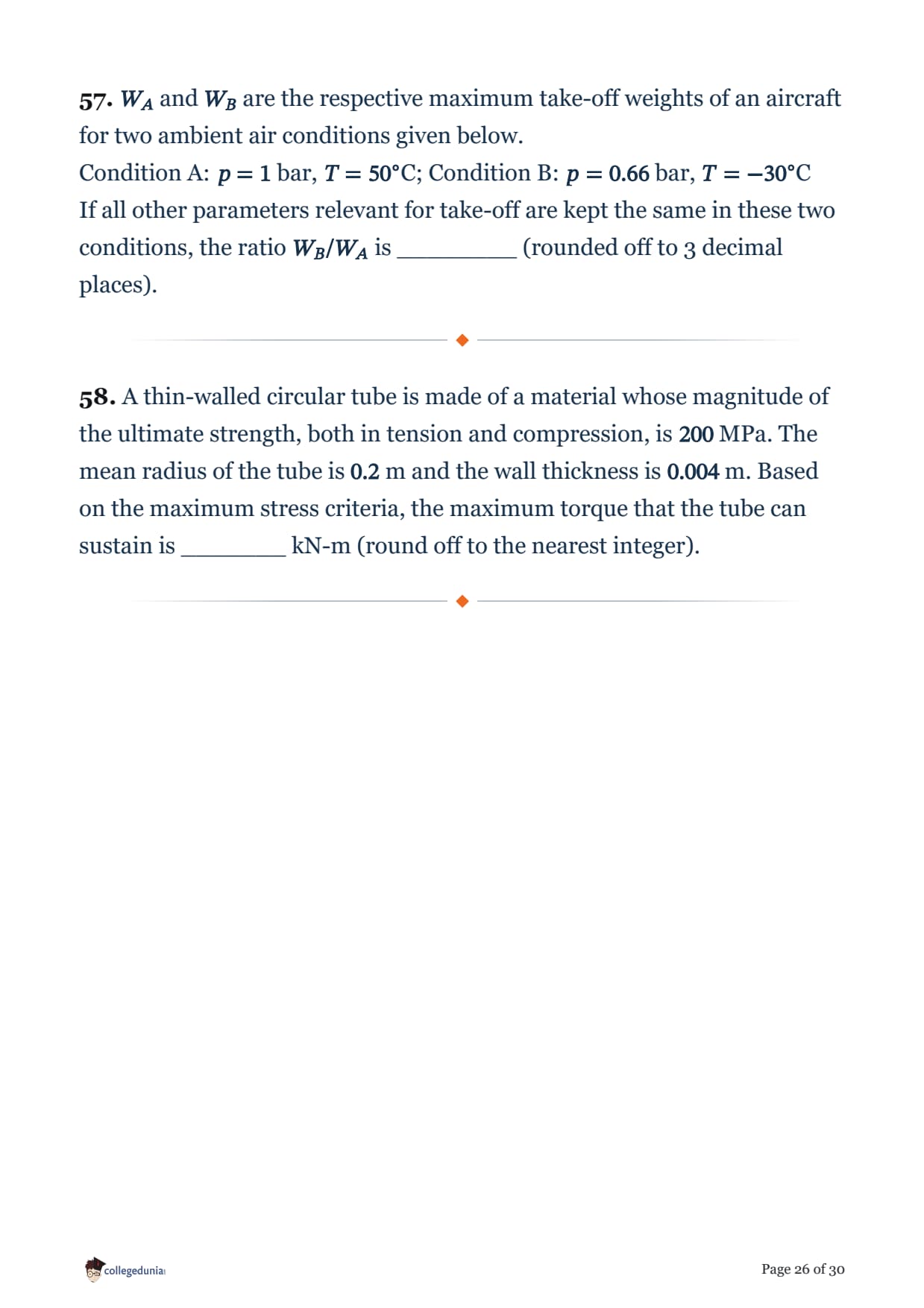
\(W_A\) and \(W_B\) are the respective maximum take-off weights of an aircraft for two ambient air conditions given below.
Condition A: \(p = 1\) bar, \(T = 50^{\circ}\)C; Condition B: \(p = 0.66\) bar, \(T = -30^{\circ}\)C
If all other parameters relevant for take-off are kept the same in these two conditions, the ratio \(W_B/W_A\) is ________ (rounded off to 3 decimal places).
A thin-walled circular tube is made of a material whose magnitude of the ultimate strength, both in tension and compression, is \(200\) MPa. The mean radius of the tube is \(0.2\) m and the wall thickness is \(0.004\) m. Based on the maximum stress criteria, the maximum torque that the tube can sustain is _______ kN-m (round off to the nearest integer).
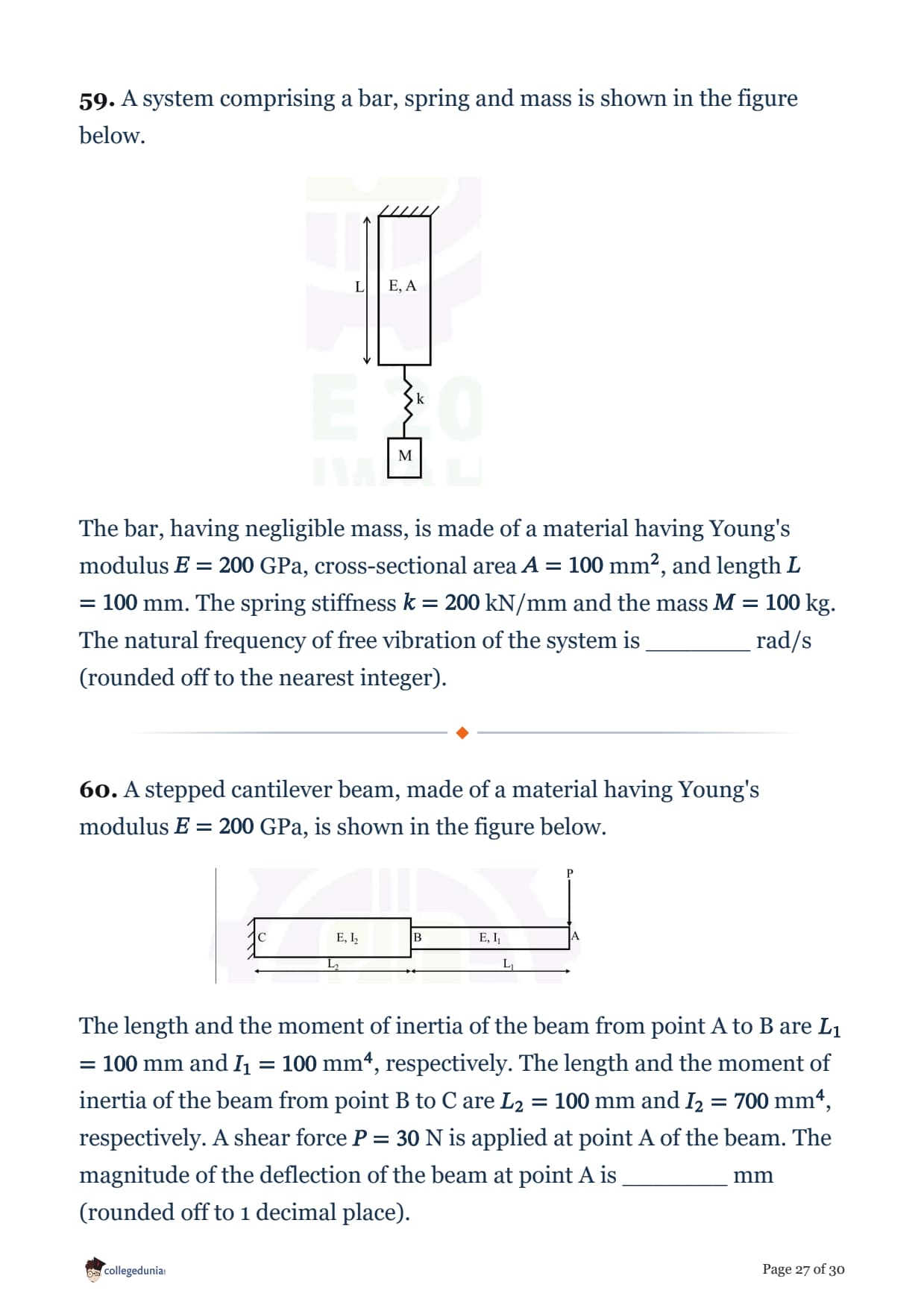
A system comprising a bar, spring and mass is shown in the figure below.

A stepped cantilever beam, made of a material having Young's modulus \(E = 200\) GPa, is shown in the figure below.

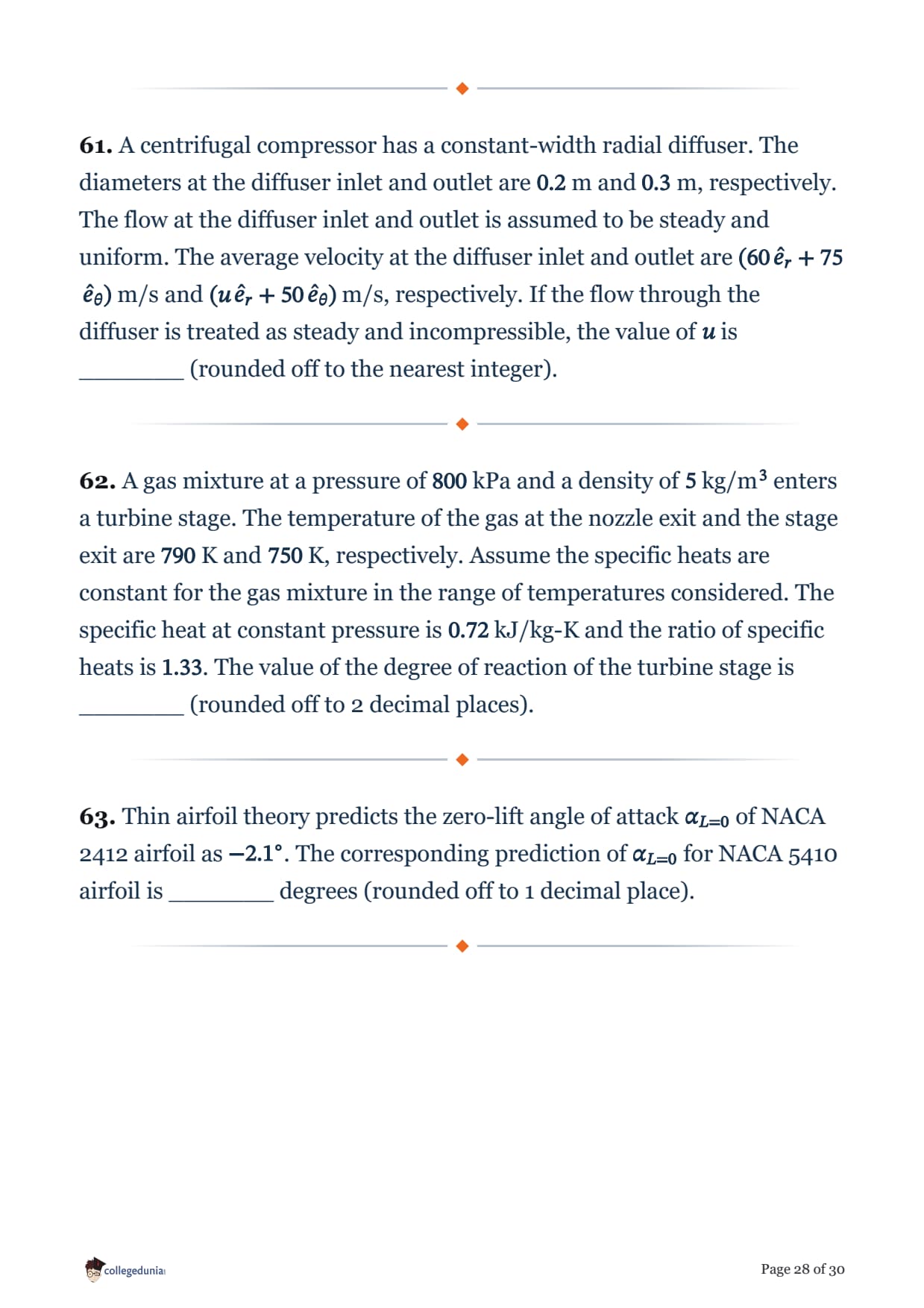
A centrifugal compressor has a constant-width radial diffuser. The diameters at the diffuser inlet and outlet are \(0.2\) m and \(0.3\) m, respectively. The flow at the diffuser inlet and outlet is assumed to be steady and uniform. The average velocity at the diffuser inlet and outlet are \((60\,\hat{e}_r + 75\,\hat{e}_{\theta})\) m/s and \((u\,\hat{e}_r + 50\,\hat{e}_{\theta})\) m/s, respectively. If the flow through the diffuser is treated as steady and incompressible, the value of \(u\) is _______ (rounded off to the nearest integer).
A gas mixture at a pressure of \(800\) kPa and a density of \(5\) kg/m\(^3\) enters a turbine stage. The temperature of the gas at the nozzle exit and the stage exit are \(790\) K and \(750\) K, respectively. Assume the specific heats are constant for the gas mixture in the range of temperatures considered. The specific heat at constant pressure is \(0.72\) kJ/kg-K and the ratio of specific heats is \(1.33\). The value of the degree of reaction of the turbine stage is _______ (rounded off to 2 decimal places).
Thin airfoil theory predicts the zero-lift angle of attack \(\alpha_{L=0}\) of NACA 2412 airfoil as \(-2.1^{\circ}\). The corresponding prediction of \(\alpha_{L=0}\) for NACA 5410 airfoil is _______ degrees (rounded off to 1 decimal place).
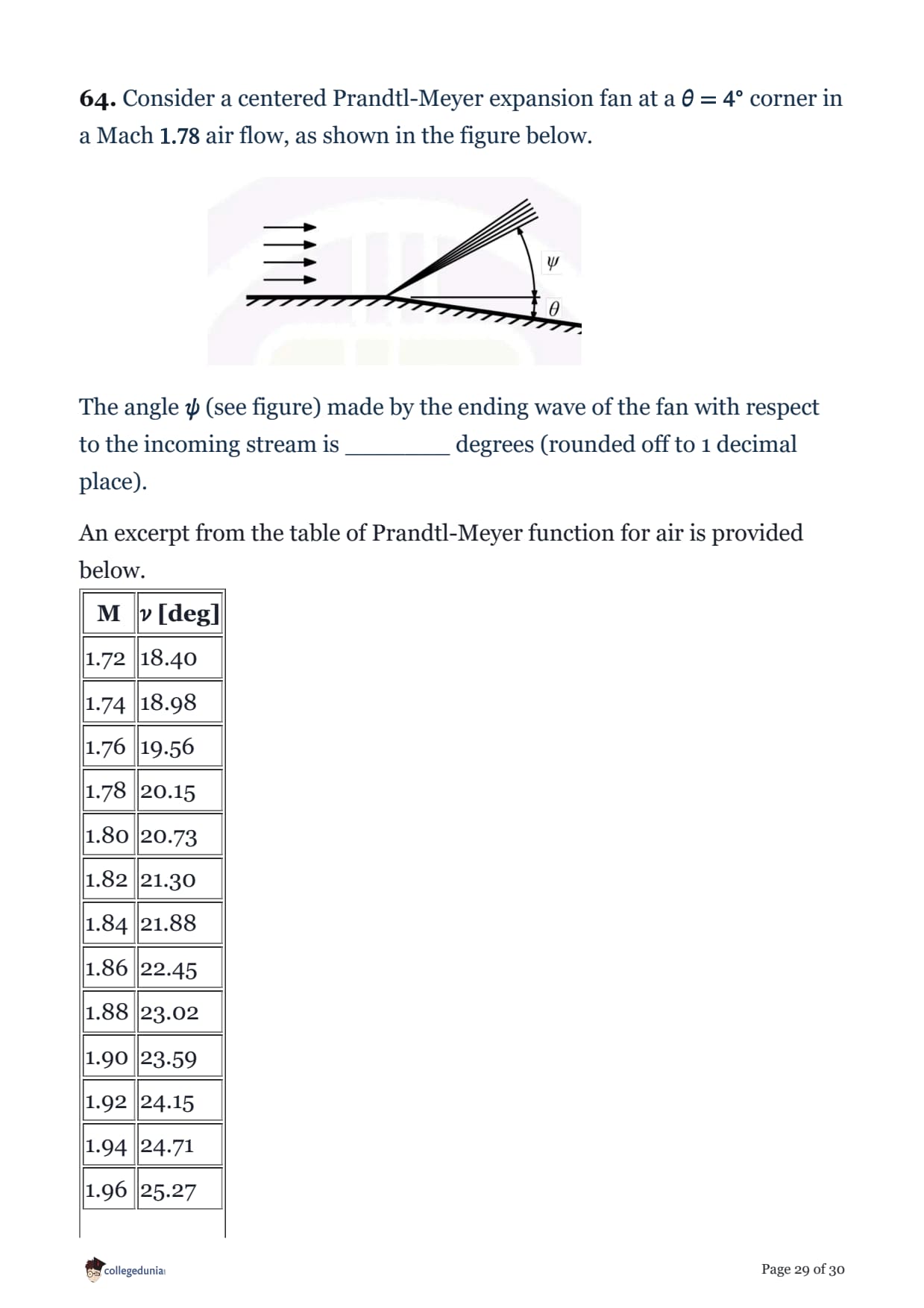
Consider a centered Prandtl-Meyer expansion fan at a \(\theta = 4^{\circ}\) corner in a Mach \(1.78\) air flow, as shown in the figure below.

| M | \(\nu\) [deg] |
|---|---|
| 1.72 | 18.40 |
| 1.74 | 18.98 |
| 1.76 | 19.56 |
| 1.78 | 20.15 |
| 1.80 | 20.73 |
| 1.82 | 21.30 |
| 1.84 | 21.88 |
| 1.86 | 22.45 |
| 1.88 | 23.02 |
| 1.90 | 23.59 |
| 1.92 | 24.15 |
| 1.94 | 24.71 |
| 1.96 | 25.27 |
| 1.98 | 25.83 |
| 2.00 | 26.38 |
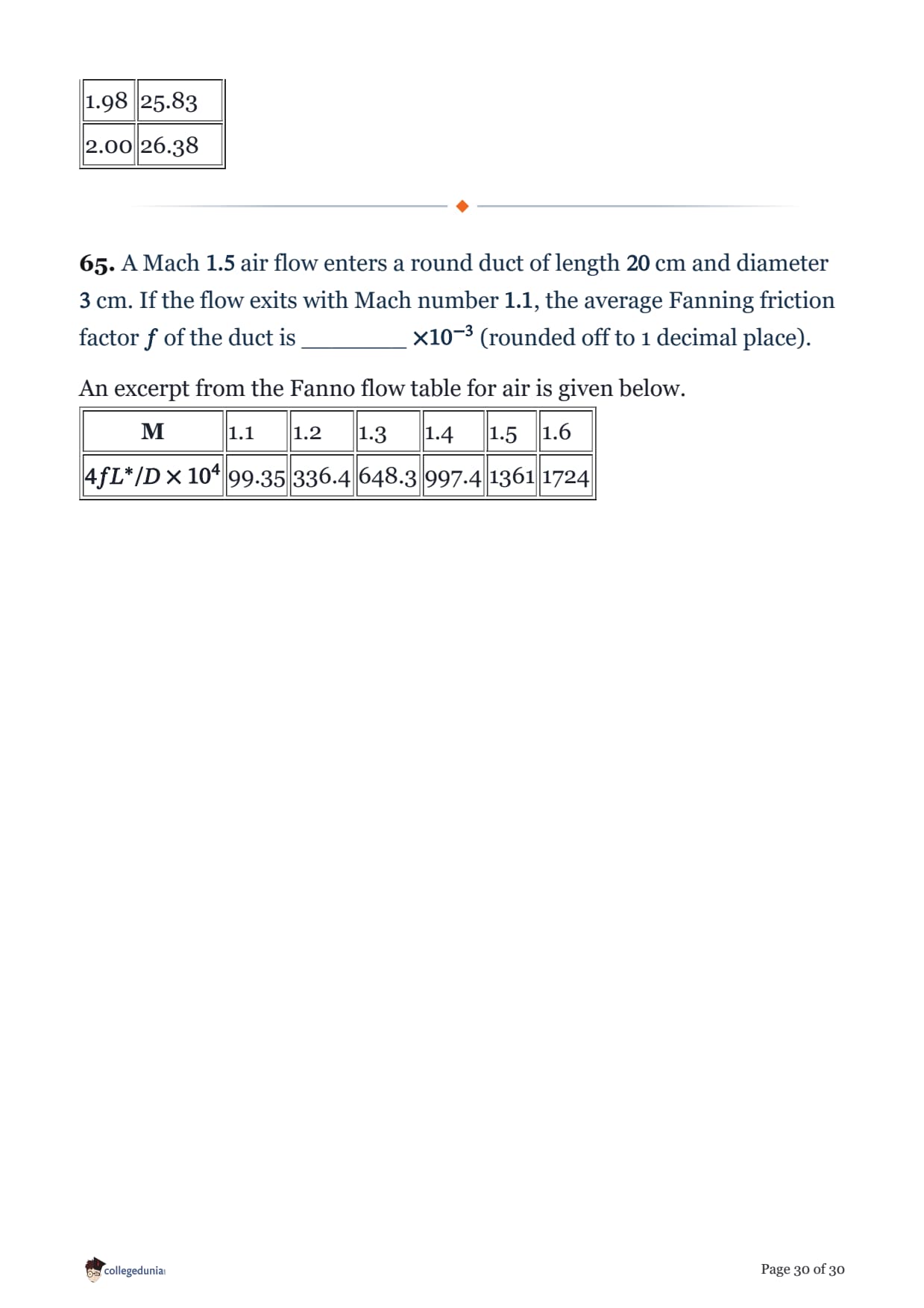
A Mach \(1.5\) air flow enters a round duct of length \(20\) cm and diameter \(3\) cm. If the flow exits with Mach number \(1.1\), the average Fanning friction factor \(f\) of the duct is _______ \(\times 10^{-3}\) (rounded off to 1 decimal place).
| M | 1.1 | 1.2 | 1.3 | 1.4 | 1.5 | 1.6 |
|---|---|---|---|---|---|---|
| \(4fL^*/D \times 10^4\) | 99.35 | 336.4 | 648.3 | 997.4 | 1361 | 1724 |
GATE 2026 Aerospace Engineering Exam Pattern and Marking Scheme Explained
The GATE 2026 AE paper followed the standard GATE structure, mixing General Aptitude with the core Aerospace syllabus and Engineering Mathematics across three question types.
- Total questions: 65 questions (10 General Aptitude + 55 from Engineering Mathematics and Aerospace core)
- Duration: 3 hours (180 minutes)
- Total marks: 100 (General Aptitude 15 marks, the rest 85 marks)
- Marking scheme: negative marking on MCQ only, 1/3 mark off for a wrong 1-mark MCQ and 2/3 off for a wrong 2-mark MCQ; no negative marking on MSQ or NAT
- Question types: MCQ (single correct), MSQ (multiple select), and NAT (numerical answer type)
High-Weightage Subjects in GATE 2026 Aerospace Engineering to Focus On First
The core Aerospace subjects carried about 70 marks across roughly 46 questions, and this paper leaned hard on Aerodynamics and Flight Mechanics.
- Aerodynamics: the single heaviest area at about 20 to 25 marks, with shocks, potential flow and airfoil questions
- Flight Mechanics: roughly 17 marks and rated among the tougher, application-heavy sections this year
- Aerospace Structures: about 15 to 20 marks on bending, buckling and vibration of beams
- Propulsion: around 8 to 10 marks and considered one of the more scoring areas
- Space Dynamics: a smaller 6 to 8 marks on orbital mechanics and launch dynamics
- Engineering Mathematics and General Aptitude: about 13 and 15 marks, a reliable 28 marks if you are quick and accurate
GATE 2026 Aerospace Engineering Question Paper Analysis Video
Source: NPTEL
How to Use the GATE 2026 Aerospace Engineering Question Paper for Practice
Treat this paper as a full timed mock before you open the solution PDF, since the AE paper rewards clean concept application over plugging into formulas.
- Solve all 65 questions in one 3-hour sitting to build exam stamina and pacing
- Review every question with the solutions PDF, especially the NAT numericals where a small slip costs the whole mark
- Redo the Aerodynamics and Flight Mechanics sets first, since together they carried close to 40 marks
- Log the MSQ questions separately, because one wrong pick there means zero even without negative marking
GATE Aerospace Good Attempts and Qualifying Score Benchmark
- Around 50 to 57 attempts with high accuracy was the working benchmark across the February 7 GATE sessions
- The GATE 2025 AE qualifying cutoff was 28.9 for General, 26 for OBC-NCL/EWS and 19.2 for SC/ST, so target well above the qualifying line for admissions
- Use these as weekly goals when you redo the paper and track your score each time
GATE 2026 Aerospace Engineering Question Paper FAQs
Ques. Was the GATE 2026 Aerospace Engineering paper tough?
Ans. The overall paper was moderate to difficult. Flight Mechanics and Aerodynamics were the tough, application-heavy parts, while Structures and Propulsion were relatively easier and more scoring. The General Aptitude section was moderate but lengthy.
Ques. Which subjects had the highest weightage in GATE 2026 Aerospace Engineering?
Ans. Aerodynamics led with about 20 to 25 marks, followed by Flight Mechanics near 17 marks and Aerospace Structures at 15 to 20 marks. Propulsion and Space Dynamics were lighter at 8 to 10 and 6 to 8 marks.
Ques. How many questions should I attempt in GATE AE to qualify?
Ans. Around 50 to 57 accurate attempts was a solid target across the February 7 sessions. The GATE 2025 AE qualifying cutoff was 28.9 for the General category, so aim to clear that comfortably and higher for IIT admissions.
Ques. Is there negative marking in GATE Aerospace Engineering NAT and MSQ questions?
Ans. No. NAT (numerical answer type) and MSQ (multiple select) questions carry no negative marking. Only single-correct MCQs are penalised, losing 1/3 mark for a 1-mark question and 2/3 mark for a 2-mark question.
Ques. Where can I download the GATE 2026 Aerospace Engineering question paper with solutions PDF for free?
Ans. You can download it from the table at the top of this page on Collegedunia, both the question paper and the full solutions PDF. The official master question paper and answer key are also available on the IIT Guwahati GATE 2026 portal at gate2026.iitg.ac.in.
Ques. How many questions are there in the GATE Aerospace Engineering paper?
Ans. The GATE AE paper has 65 questions for 100 marks in 3 hours. This splits into 10 General Aptitude questions worth 15 marks and 55 questions worth 85 marks from Engineering Mathematics and the core Aerospace syllabus.



Comments