




GATE ECE topic wise weightage 2027 is prepared from previous years' question papers and gives you an idea of high priority topics to be studied to score maximum marks. The GATE ECE 2027 is of 100 marks, split into 72 marks for core ECE topics, 13 marks for Engineering Mathematics and 15 marks for General Aptitude.
The core GATE ECE has 8 sections, among which the highest weightage topics are:
- The communication system has the highest weightage, around 13% among the 8 sections, and almost 8 questions are expected from this section.
- Signal and System is followed by the communication system, which has a weightage of around 9 to 12% from the core ECE.
- The Network Theory is expected to have a weightage of around 8 to 12 %, and 7 questions will be covered from this subject.
Apart from core ECE, candidates should cover general aptitude, which carries 15% weightage and 13% weightage for Engineering Mathematics.
The following article covers the GATE ECE topic wise weightage 2027 in detail, along with handwritten notes and a preparation strategy to score well.
Related Article:
- GATE ECE Syllabus 2026- Check Subject-Wise Weightage, Important Topics, Books and Preparation Tips
- GATE Paper Analysis 2026: Check Difficulty Level, Branch-wise Question Paper Analysis, Weightage of Topics
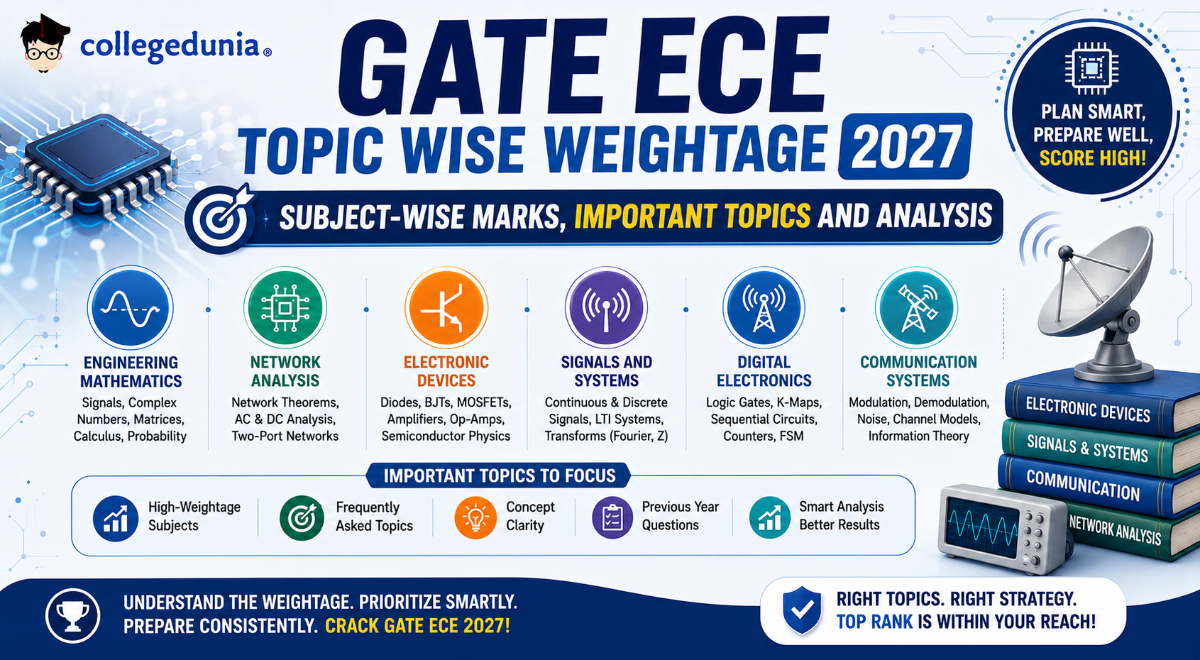
Key Summary
- IIT Madras will likely conduct the GATE 2027 around February 2027.
- The GATE ECE is a CBT mode paper with 3 hours duration.
- Communication Systems, Engineering Mathematics, Network Theory and Signals and Systems are the highest-yield areas.
- Analogue Circuits, Digital Circuits and Electromagnetics is likely to have a 7 to 11 mark band.
- Candidates are advised not to skip any of the core sections as weightage may change slightly.
GATE ECE Topic Wise Weightage 2027: Overview
Electronics and Communication Engineering is one of the most crowded papers in GATE. You should treat this topic-wise weightage as a study-priority guide, not a guarantee, as it is derived from previous year question papers.
| Particular | Details |
|---|---|
| Exam Name | Graduate Aptitude Test in Engineering (GATE) 2027 |
| Paper Code | EC (Electronics and Communication Engineering) |
| Organising Institute | IIT Madras (expected) |
| Expected Exam Dates | February 6, 7, 13 and 14, 2027 |
| Total Marks | 100 |
| Total Questions | 65 |
| Sections | General Aptitude, Engineering Mathematics, 8 Core ECE Subjects |
| Mode | Computer Based Test (CBT) |
Related Article: GATE 2027: Notification, Registration, Exam Date, Eligibility, Syllabus & Exam Pattern
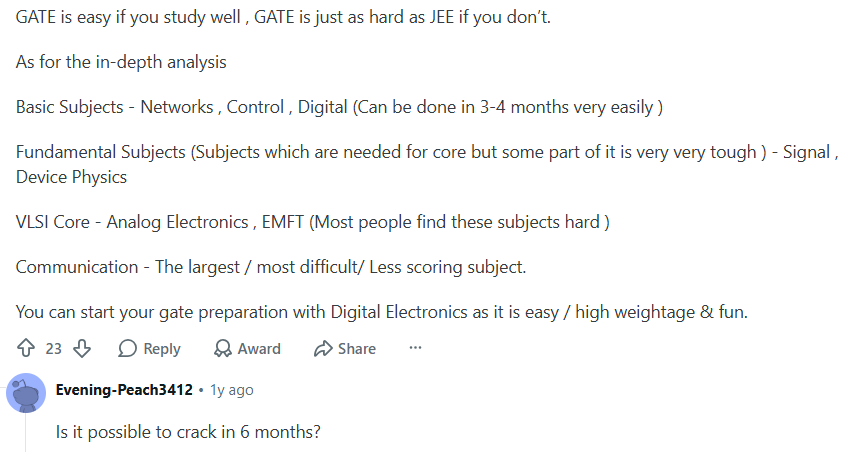
According to a Reddit post, a user shared that GATE is easy if candidates study well. He/she has a shared GATE ECE preparation strategy, which is as follows:
- Start with basic subjects such as networks, control and digital, which can be done within 3- 4 months.
- Signal and Device physics need to be studied well, as some parts are tough.
- VLSI Core, which includes Analog Electronics and EMFT, is found hard by many, so need a proper focus.
- Communication is the largest section and is less scoring.
Start your preparation with Digital Electronics as it is easy and has high weightage.
Source: Reddit
Ques. What is the subject wise weightage for GATE ECE 2027?
Ans. The expected split is 15 percent General Aptitude, around 13 percent Engineering Mathematics and 72 percent core ECE subjects. Within the core, Communication Systems, Network Theory and Signals and Systems carry the most marks.
GATE ECE Topic Wise Weightage 2027 Exam Pattern and Marks Distribution
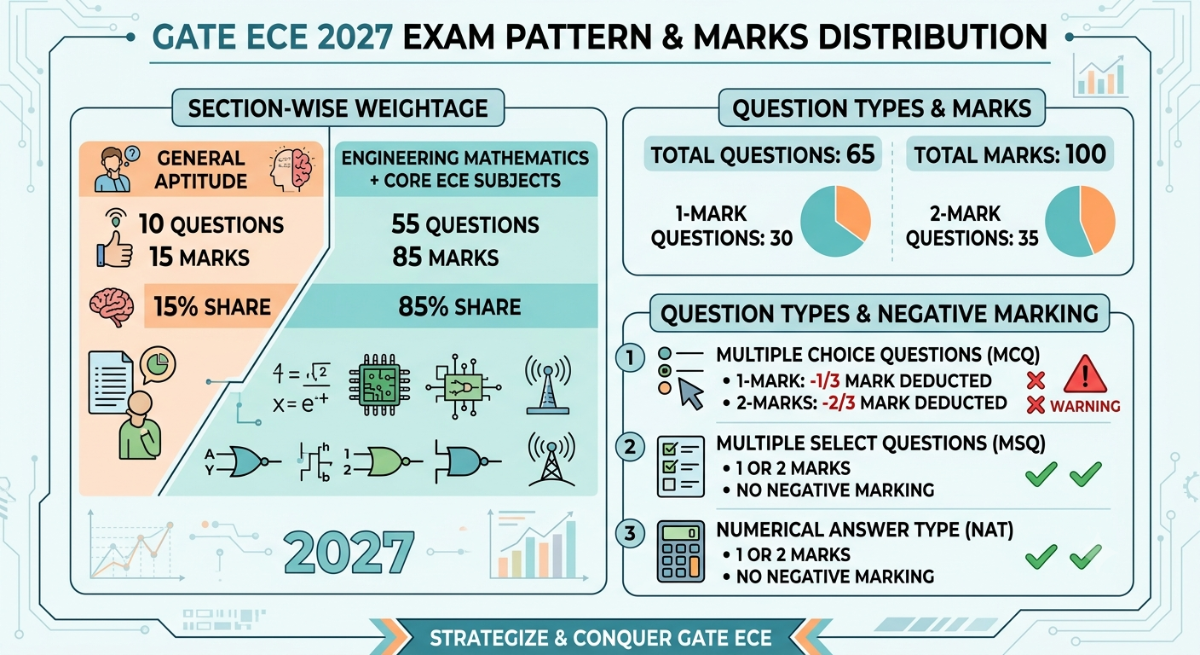
The GATE ECE paper mixes 1-mark and 2-mark questions across three question types.
| Section | Questions | Marks | Share of Paper |
|---|---|---|---|
| General Aptitude | 10 | 15 | 15% |
| Engineering Mathematics + Core ECE Subjects | 55 | 85 | 85% |
| Total | 65 | 100 | 100% |
The paper carries 30 questions of 1 mark and 35 questions of 2 marks. Negative marking applies only to Multiple Choice Questions.
| Question Type | Marks | Negative Marking |
|---|---|---|
| MCQ (1 mark) | 1 | 1/3 mark deducted |
| MCQ (2 marks) | 2 | 2/3 mark deducted |
| MSQ | 1 or 2 | None |
| NAT | 1 or 2 | None |
Note: You should never leave a NAT or MSQ blank because there is no negative marking.
Related Article: GATE ECE Exam Pattern 2026: Check Marking Scheme, Types of Questions, Negative Marking, Weightage
Ques. Which subject has the highest weightage in GATE ECE?
Ans. General Aptitude carries a fixed 15 marks, the highest single block. Among technical subjects, Engineering Mathematics and Communication Systems carry the highest marks.
GATE ECE Topic Wise Weightage 2027 (Expected)
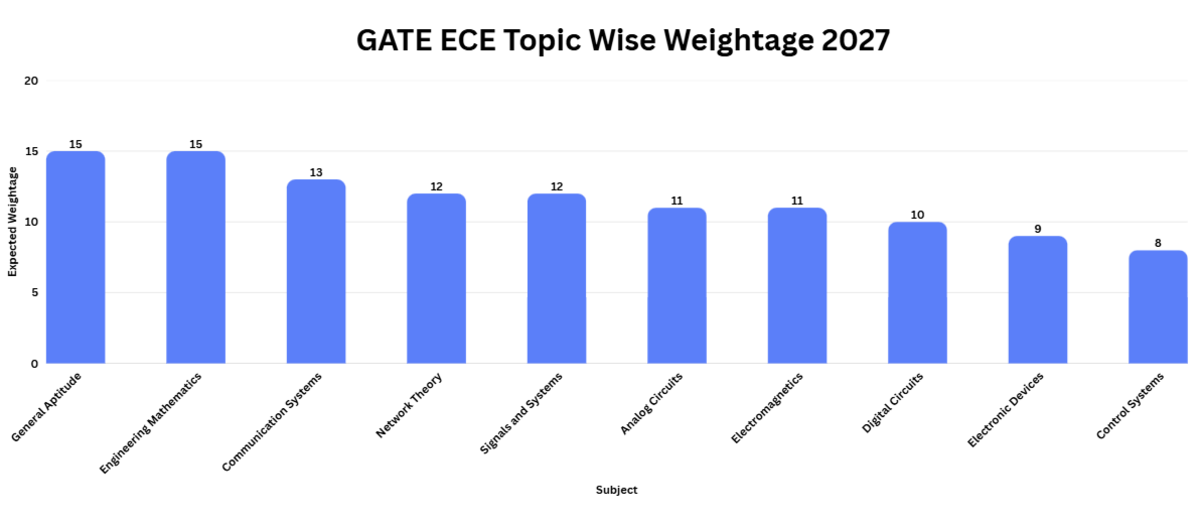
The table below gives the expected mark range for each ECE subject in GATE 2027. It is prepared from the mark distribution of ECE papers held between 2020 and 2025.
| Subject | Expected Marks (out of 100) | Expected Weightage | Priority |
|---|---|---|---|
| General Aptitude | 15 | 15% | Very High |
| Engineering Mathematics | 11 to 15 | 11 to 15% | Very High |
| Communication Systems | 10 to 13 | 10 to 13% | Very High |
| Network Theory | 8 to 12 | 8 to 12% | High |
| Signals and Systems | 9 to 12 | 9 to 12% | High |
| Analog Circuits | 8 to 11 | 8 to 11% | High |
| Electromagnetics | 8 to 11 | 8 to 11% | High |
| Digital Circuits | 8 to 10 | 8 to 10% | High |
| Electronic Devices | 6 to 9 | 6 to 9% | Moderate |
| Control Systems | 5 to 8 | 5 to 8% | Moderate |
Also Check:
Ques. Is the GATE ECE topic wise weightage officially released?
Ans. No, the organising IIT publishes only the syllabus and the exam pattern. All weightage tables are derived from previous year question papers.
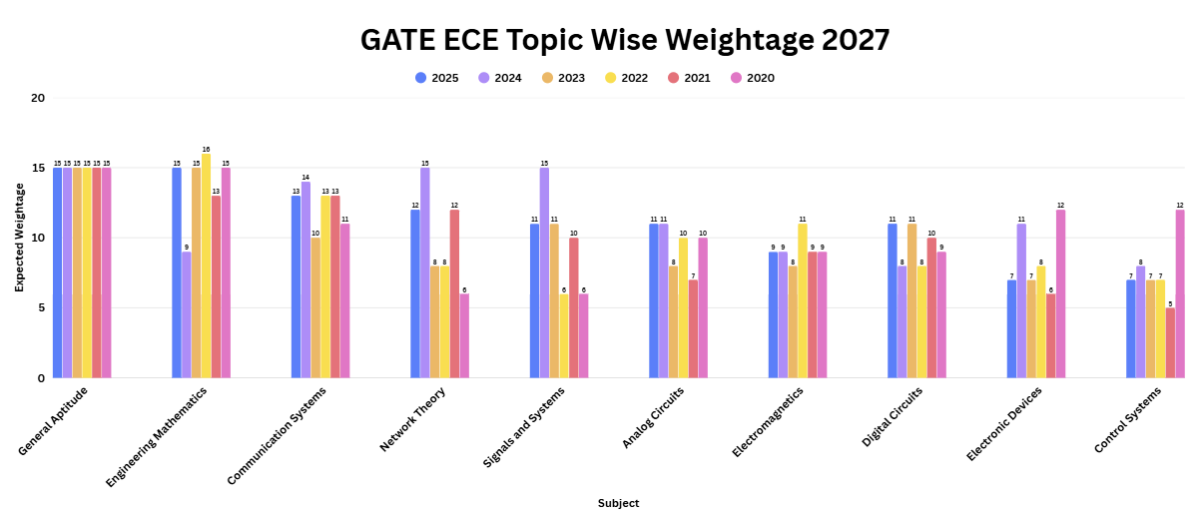
GATE ECE Weightage Previous Year Analysis
Use this table as a reference to decide where a weak topic will actually cost you marks.
What the Trend Data Shows:
- General Aptitude has stayed exactly at 15 marks in every single year.
- Engineering Mathematics has been the strongest technical block, peaking at 16 marks in 2022.
- Communication Systems has never dropped below 10 marks in six years.
- Control Systems fell from 12 marks in 2020 to the 5 to 8 mark band afterwards.
- Network Theory and Signals and Systems jumped to 15 marks each in 2024 after several quiet years.
- Electronic Devices is the most volatile core subject, ranging from 6 to 12 marks.
| Sections | 2025 | 2024 | 2023 | 2022 | 2021 | 2020 |
|---|---|---|---|---|---|---|
| General Aptitude | 15 | 15 | 15 | 15 | 15 | 15 |
| Engineering Mathematics | 13 to 15 | 9 | 15 | 16 | 13 | 15 |
| Communication Systems | 10 to 13 | 13 to 14 | 10 | 13 | 13 | 11 |
| Network Theory | 8 to 12 | 15 | 8 | 8 | 12 | 6 |
| Signals and Systems | 10 to 11 | 15 | 11 | 6 | 10 | 6 |
| Analog Circuits | 7 to 11 | 10 to 11 | 8 | 10 | 7 | 10 |
| Digital Circuits | 8 to 9 | 9 | 8 | 11 | 9 | 9 |
| Electromagnetics | 8 to 11 | 7 to 8 | 11 | 8 | 10 | 9 |
| Electronic Devices | 6 to 7 | 10 to 11 | 7 | 8 | 6 | 12 |
| Control Systems | 5 to 7 | 7 to 8 | 7 | 7 | 5 | 12 |
Related Article: GATE Question Paper 2025 (Available): Check GATE Previous Year Question Paper with Solution PDF
Ques. Can I skip Control Systems in GATE ECE 2027?
Ans. No, Control Systems carried 12 marks in 2020, so the weightage can rise in any year. The syllabus is short, and skipping it risks 5 to 8 easy marks.
GATE ECE Topic Wise Weightage 2027: Subject-Wise Important Topics
The breakdown below lists the repeat-heavy topics from recent ECE papers, which will help you to strategise your GATE ECE preparation 2027.
GATE ECE Topic Wise Weightage 2027 in Network Theory (8 to 12 Marks)
GATE Network theory frequently asked topics are tabulated below:
| Topic | Frequency |
|---|---|
| Transient and steady state analysis of RLC circuits | Very High |
| Thevenin, Norton and Superposition theorems | Very High |
| Sinusoidal steady state analysis and phasors | High |
| Two-port network parameters | High |
| Nodal and mesh analysis | Moderate |
GATE ECE Topic Wise Weightage 2027 in Signals and Systems (9 to 12 Marks)
GATE Signal and System frequently asked topics are tabulated below:
| Topic | Frequency |
|---|---|
| Fourier series and Fourier transform | Very High |
| LTI system properties, convolution and impulse response | Very High |
| Laplace transform and Z-transform | High |
| Sampling theorem and aliasing | High |
| DFT and discrete-time systems | Moderate |
GATE ECE Topic Wise Weightage 2027 in Communication Systems (10 to 13 Marks)
GATE Communication System frequently asked topics are tabulated below:
| Topic | Frequency |
|---|---|
| Random processes, noise and SNR | Very High |
| Digital modulation: ASK, FSK, PSK, QAM | Very High |
| Amplitude and angle modulation | High |
| Information theory, entropy and channel capacity | High |
| Matched filter and probability of error | Moderate |
GATE ECE Topic Wise Weightage 2027 in Analog Circuits (8 to 11 Marks)
GATE Analog circuits frequently asked topics are tabulated below:
| Topic | Frequency |
|---|---|
| Operational amplifier circuits | Very High |
| BJT and MOSFET small signal amplifiers | Very High |
| Feedback and oscillators | High |
| Diode circuits, clippers and clampers | Moderate |
| Biasing and frequency response | Moderate |
GATE ECE Topic Wise Weightage 2027 in Digital Circuits (8 to 10 Marks)
GATE Digital circuits frequently asked topics are tabulated below:
| Topic | Frequency |
|---|---|
| Sequential circuits, flip-flops and counters | Very High |
| Combinational circuits, MUX and decoders | High |
| Number systems and Boolean algebra | High |
| ADC and DAC | Moderate |
| Semiconductor memories | Low |
GATE ECE Weightage in Electronic Devices (6 to 9 Marks)
GATE Electronic Device frequently asked topics are tabulated below:
| Topic | Frequency |
|---|---|
| MOS capacitor and MOSFET characteristics | Very High |
| PN junction, diode and BJT physics | High |
| Carrier transport, drift and diffusion | High |
| Photodiodes, LEDs and solar cells | Moderate |
GATE ECE Weightage in Electromagnetics (8 to 11 Marks)
GATE Electromagnetism frequently asked topics are tabulated below:
| Topic | Frequency |
|---|---|
| Transmission lines and Smith chart | Very High |
| Plane waves, reflection and refraction | High |
| Maxwell equations and wave propagation | High |
| Waveguides | Moderate |
| Antennas and radiation pattern | Moderate |
GATE ECE Weightage in Control Systems (5 to 8 Marks)
GATE Control Syatem frequently asked topics are tabulated below:
| Topic | Frequency |
|---|---|
| Stability, Routh-Hurwitz and Nyquist criteria | Very High |
| Root locus and Bode plot | High |
| Transfer function and block diagram reduction | High |
| Time domain response and steady state error | Moderate |
| State space analysis | Moderate |
GATE General Aptitude (15 Marks, Fixed)
The General Aptitude has 15 marks and has remained consistent over the years. The syllabus includes:
- Verbal ability: grammar, sentence completion, word groups, critical reasoning
- Numerical ability: numerical computation, estimation, data interpretation
- Analytical aptitude: logic, deduction, induction, analogy
- Spatial aptitude: transformation of shapes, paper folding, patterns
The GA section has 5 questions of 1 mark and 5 questions of 2 marks.
GATE Engineering Mathematics (11 to 15 Marks)
The table below shows the high frequency topics in Engineering mathematics:
| Topic | Frequency |
|---|---|
| Linear Algebra: matrices, eigenvalues, rank | Very High |
| Probability and Statistics: random variables, distributions | Very High |
| Calculus: limits, maxima and minima, multiple integrals | High |
| Differential Equations | High |
| Complex Analysis: residues, Cauchy theorem | Moderate |
| Vector Analysis | Moderate |
Source: YouTube
Related Article: GATE 2026 Preparation: GATE 2026 Last Minute Preparation Strategy, Timetable, Free Resources, Books
Ques. Which are the lowest weightage subjects in GATE ECE?
Ans. Control Systems and Electronic Devices have carried the lowest marks in recent years, usually 5 to 9 marks each. Both have short syllabi, so aspirants should still cover them fully.
GATE ECE High Scoring Subjects and Preparation Priority
The GATE ECE high scoring subject and preparation priority is tabulated below based on marks earned per hour invested.
| Tier | Subjects | Why |
|---|---|---|
| Tier 1 | General Aptitude, Engineering Mathematics | Around 28 to 30 marks combined with the lowest conceptual load |
| Tier 2 | Communication Systems, Signals and Systems, Network Theory | High and consistent weightage, heavy formula reuse across topics |
| Tier 3 | Analog Circuits, Digital Circuits, Electromagnetics | Stable 8 to 11 mark band, high question predictability |
| Tier 4 | Electronic Devices, Control Systems | Lower average weightage but short syllabus, so cheap to cover |
GATE ECE Handwritten Notes PDF
| Subject | Download PDF Link |
|---|---|
| GATE EC Complete Syllabus Handwritten Notes PDF | Check Here |
| GATE EC Formula and Exam Checks Handwritten Notes PDF | Check Here |
| GATE EC Analog and Digital Electronics Handwritten Notes PDF | Check Here |
| GATE EC Control and Analog Communication Handwritten Notes PDF | Check Here |
| GATE EC Digital Comm and Electromagnetics Handwritten Notes PDF | Check Here |
| GATE EC Engineering Maths and Circuits Handwritten Notes PDF | Check Here |
| GATE EC Signals and Semiconductor Devices Handwritten Notes PDF | Check Here |
| GATE General Aptitude Handwritten Notes PDF | Check Here |
| GATE EC Handwritten Notes PDF 2026 Free Download | Check Here |
Related Article: GATE EC Mock Test- Attempt free online Chapter wise and Subject wise Mock Test Series
Ques. How should I plan my GATE ECE preparation using weightage?
Ans. Start with Engineering Mathematics and General Aptitude. Then move through Network Theory, Signals and Systems, Communication Systems, Analog and Digital Circuits, and finish with Control Systems.
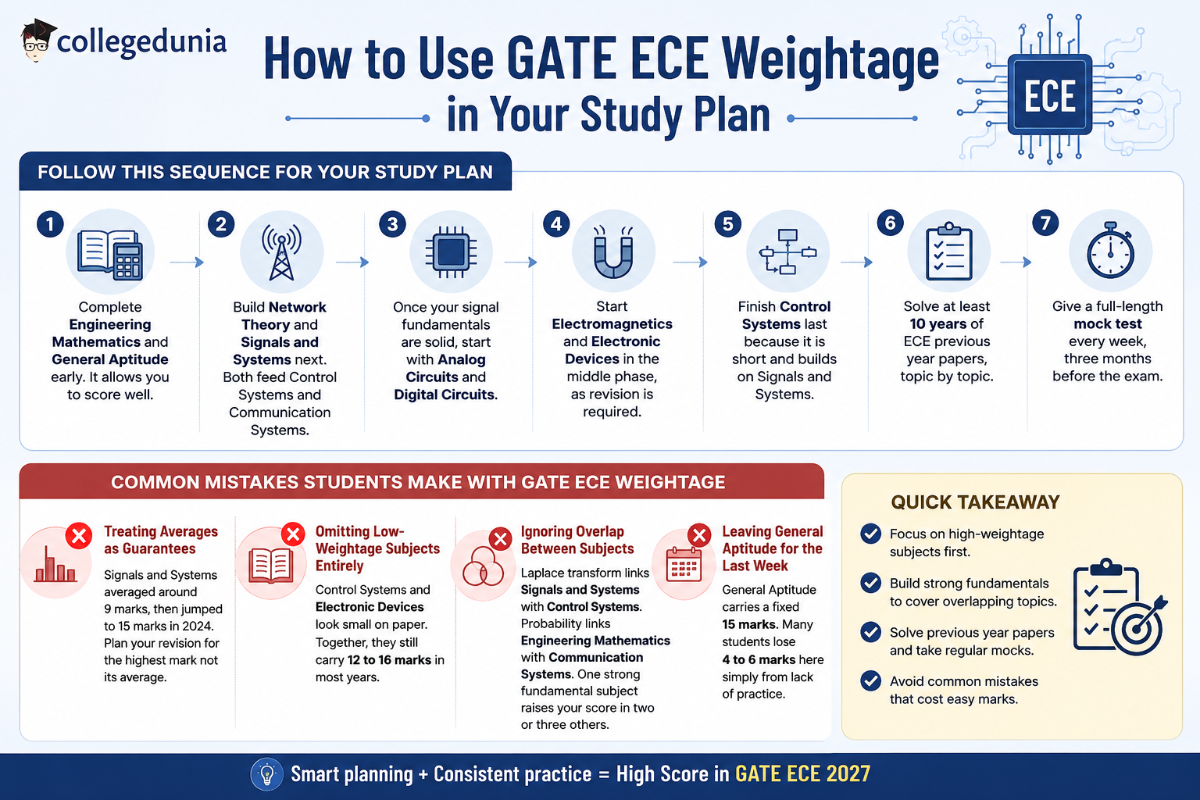
How to Use GATE ECE Weightage in Your Study Plan
Follow the sequence below for your study plan based on GATE ECE Topic wise weightage 2027:
- Complete Engineering Mathematics and General Aptitude early. It allows you to score well.
- Build Network Theory and Signals and Systems next. Both feed Control Systems and Communication Systems.
- Once your signal fundamentals are solid, start with Analog Circuits and Digital Circuits
- Start Electromagnetics and Electronic Devices in the middle phase, as revision is required.
- Finish Control Systems last because it is short and builds on Signals and Systems.
- Solve at least 10 years of ECE previous year papers, topic by topic.
- Give a full-length mock test every week, three months before the exam.
Common Mistakes Students Make With GATE ECE Weightage
These are the errors that cost marks in the ECE paper every year.
- Treating Averages as Guarantees- Signals and Systems averaged around 9 marks, then jumped to 15 marks in 2024. Plan your revision for the highest mark not its average.
- Omitting Low-Weightage Subjects Entirely- Control Systems and Electronic Devices look small on paper. Together, they still carry 12 to 16 marks in most years.
- Ignoring Overlap Between Subjects- Laplace transform links Signals and Systems with Control Systems. Probability links Engineering Mathematics with Communication Systems. One strong fundamental subject raises your score in two or three others.
- Leaving General Aptitude for the Last Week- General Aptitude carries a fixed 15 marks. Many students lose 4 to 6 marks here simply from lack of practice.
- Not Tracking Weightage Against Your Own Mocks- Analysing mock tests helps you know your strengths and weaknesses.
Related Article: GATE Score Calculation Formula, Calculation Method, Normalization, Marks vs Score vs Rank
Ques. Which topics repeat the most in GATE ECE?
Ans. Network transient analysis, Fourier and Laplace transforms, op-amp circuits, MOSFET characteristics, digital modulation, transmission lines and stability criteria repeat most often.
Best Books for GATE ECE 2027
The list of books for ECE is tabulated below.
| Subject | Book Name | Author / Publisher |
|---|---|---|
| Network Theory | Engineering Circuit Analysis | Hayt, Kemmerly and Durbin |
| Signals and Systems | Signals and Systems | Oppenheim and Willsky |
| Communication Systems | Communication Systems | Simon Haykin |
| Analog Circuits | Microelectronic Circuits | Sedra and Smith |
| Digital Circuits | Digital Design | M. Morris Mano |
| Electronic Devices | Semiconductor Physics and Devices | Donald A. Neamen |
| Electromagnetics | Elements of Electromagnetics | Matthew N. O. Sadiku |
| Control Systems | Control Systems Engineering | Norman S. Nise |
| Engineering Mathematics | Higher Engineering Mathematics | B. S. Grewal |
Related Article: GATE Books PDF Download for CSE, DA, Civil, Mechanical, ECE, EE
Ques. Will the GATE 2027 ECE syllabus change?
Ans. The syllabus is expected to stay largely the same. Any change will be listed in the GATE 2027 information brochure released by IIT Madras.
How to Download GATE 2027 ECE Syllabus PDF
The GATE 2027 syllabus PDF will go live once IIT Madras publishes the notification. Follow these steps.
- Step 1: Visit the official GATE 2027 website released by IIT Madras.
- Step 2: Open the Syllabus or Information Brochure link on the homepage.
- Step 3: Select EC: Electronics and Communication Engineering from the paper list.
- Step 4: The syllabus PDF opens in a new tab.
Note: The GATE 2027 syllabus is expected to stay close to the GATE 2026 syllabus. Start preparing with the current syllabus and check for changes after the notification.
Related Article: GATE 2027 Information Bulletin: How to Download and Key Highlights
GATE ECE Topic Wise Weightage 2027: FAQs
Ques. How many questions are asked in GATE ECE?
Ans. The GATE ECE paper has 65 questions worth 100 marks. Ten questions come from General Aptitude and 55 from Engineering Mathematics and core ECE subjects.
Ques. Is Engineering Mathematics enough to qualify GATE ECE?
Ans. No, Engineering Mathematics and General Aptitude together give about 28 to 30 marks. You need core subject marks to cross the cutoff comfortably.
Ques. How many marks are needed to qualify GATE ECE?
Ans. The general category qualifying cutoff for ECE has generally stayed between 25 and 30 marks out of 100. Aim for 40 plus marks for a safe qualification.
Ques. Which IIT will conduct GATE 2027?
Ans. IIT Madras is expected to conduct GATE 2027 as per the rotation cycle. The official confirmation will come with the notification, expected around July or August 2026.



Comments