




The GATE 2026 CS-1 question paper with solutions PDF is available here for free download. GATE 2026 Computer Science and Information Technology was conducted by IIT Guwahati on February 8, 2026, and GATE 2026 CS-1 ran in the forenoon session from 9:30 AM to 12:30 PM with 65 questions in 3 hours.
| GATE 2026 CS-1 Question Paper with Solutions | Download PDF | Check Solutions |
GATE 2026 CS-1 Questions with Solutions
The figure shows two 4-tile patterns.
Either one or both of the patterns can be used any number of times and in any
orientation to construct a new pattern. Which one of the options below cannot be
constructed by using only these two 4-tile patterns assuming there are no overlaps
among them?

Consider a knock-out women’s badminton singles tournament where there are no
ties. The loser in each game is eliminated from the tournament. Every player
plays until she is defeated or remains the last undefeated player. The last
undefeated player is declared the winner of the tournament. If there are 64 players
in the beginning of the tournament, how many games should be played in total to
declare the winner of the tournament?
A student needs to enroll for a minimum of 60 credits. A student cannot enroll for
more than 70 credits. The credits are divided amongst project and three distinct
sets of courses namely, core courses, specialization courses, and elective courses.
It is compulsory for a student to enroll for exactly 15 credits of core courses and
exactly 20 credits of project. In addition, a student has to enroll for a minimum of
10 credits of specialization courses. The maximum credits of elective courses that
a student can enroll for is ______
‘When the teacher is in the room, all students stand silently.’
If the above statement is true, which one of the following statements is not
necessarily true?
Combinatorics deals with problems involving counting. For example, “How many
distinct arrangements of N distinct objects in M spaces on a circle are possible?”
is a typical problem in combinatorics. This kind of counting is sometimes used in
the modeling of several physical phenomena. Often, in such models, the different
combinatorial possibilities are assigned probability values. Assigning probabilities
enables the computation of the average values of physical quantities.
Consider the following statements:
P: Combinatorics is always invoked in the modeling of physical phenomena.
Q: Modeling some physical phenomena involves assigning probabilities to
combinatorial possibilities in order to compute average values of physical
quantities.
Based on the passage above, what can be inferred about statements P and Q?
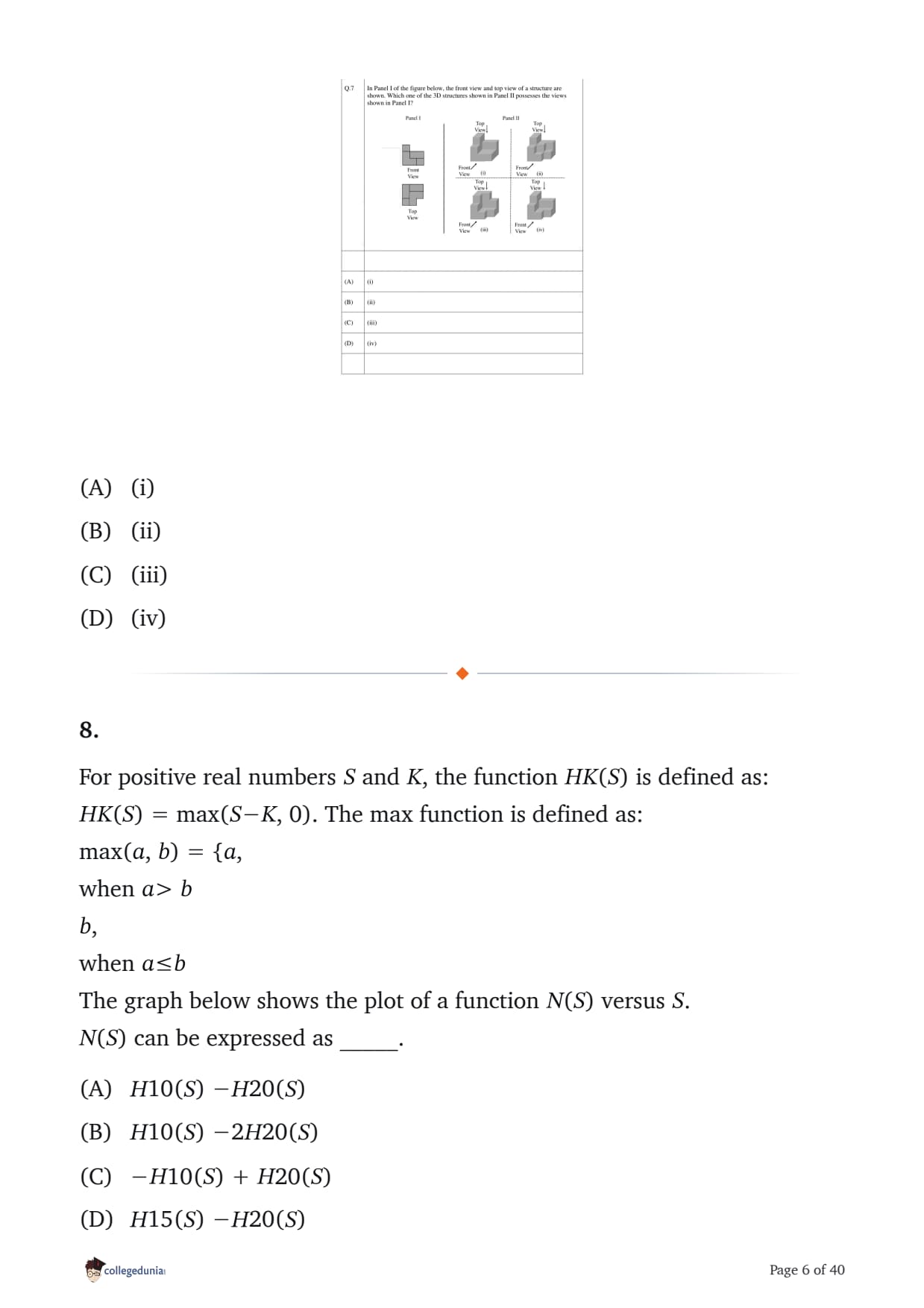
In Panel I of the figure below, the front view and top view of a structure are
shown. Which one of the 3D structures shown in Panel II possesses the views
shown in Panel I?

For positive real numbers ???? and ????, the function ????????(????) is defined as:
????????(????) = max(????−????, 0). The max function is defined as:
max(????, ????) = {????,
when ????> ????
????,
when ????≤????
The graph below shows the plot of a function ????(????) versus ????.
????(????) can be expressed as _____.
In the 2020 summer Olympics’ Javelin throw finals, Neeraj Chopra exhibited a
spectacular performance to win the gold medal. The silver medal was won by
Jakub Vadlejch and the bronze medal was won by Vitezlav Vesely. There were
six rounds of throws with each athlete having one throw per round. The best of
all the throws of each athlete is considered for the medal. Following were the
observations about the throws:
i.
The first and second rounds were dominated by Neeraj Chopra with a gold
medal performance in his second throw, while the other two athletes did
not have any medal winning throws in these rounds.
ii.
The throws in the last round by both Jakub Vadlejch and Vitezlav Vesely
were fouls and were not considered for scoring.
iii.
After four rounds, Vitezlav Vesely was in the second position and could
not improve upon his best throw in the succeeding rounds.
iv.
In the fourth round, the throw by Jakub Vadlejch was the best in that
round.
In which round did Vitezlav Vesely have his best throw?
An unbiased six-faced dice whose faces are marked with numbers 1, 2, 3, 4, 5,
and 6 is rolled twice in succession and the number on the top face is recorded
each time. The probability that the number appearing in the second roll is an
integer multiple of the number appearing in the first roll is __________
An urn contains one red ball and one blue ball. At each step, a ball is picked
uniformly at random from the urn, and this ball together with another ball of the
same color is put back in the urn. The probability that there are equal number of red
and blue balls after two steps is
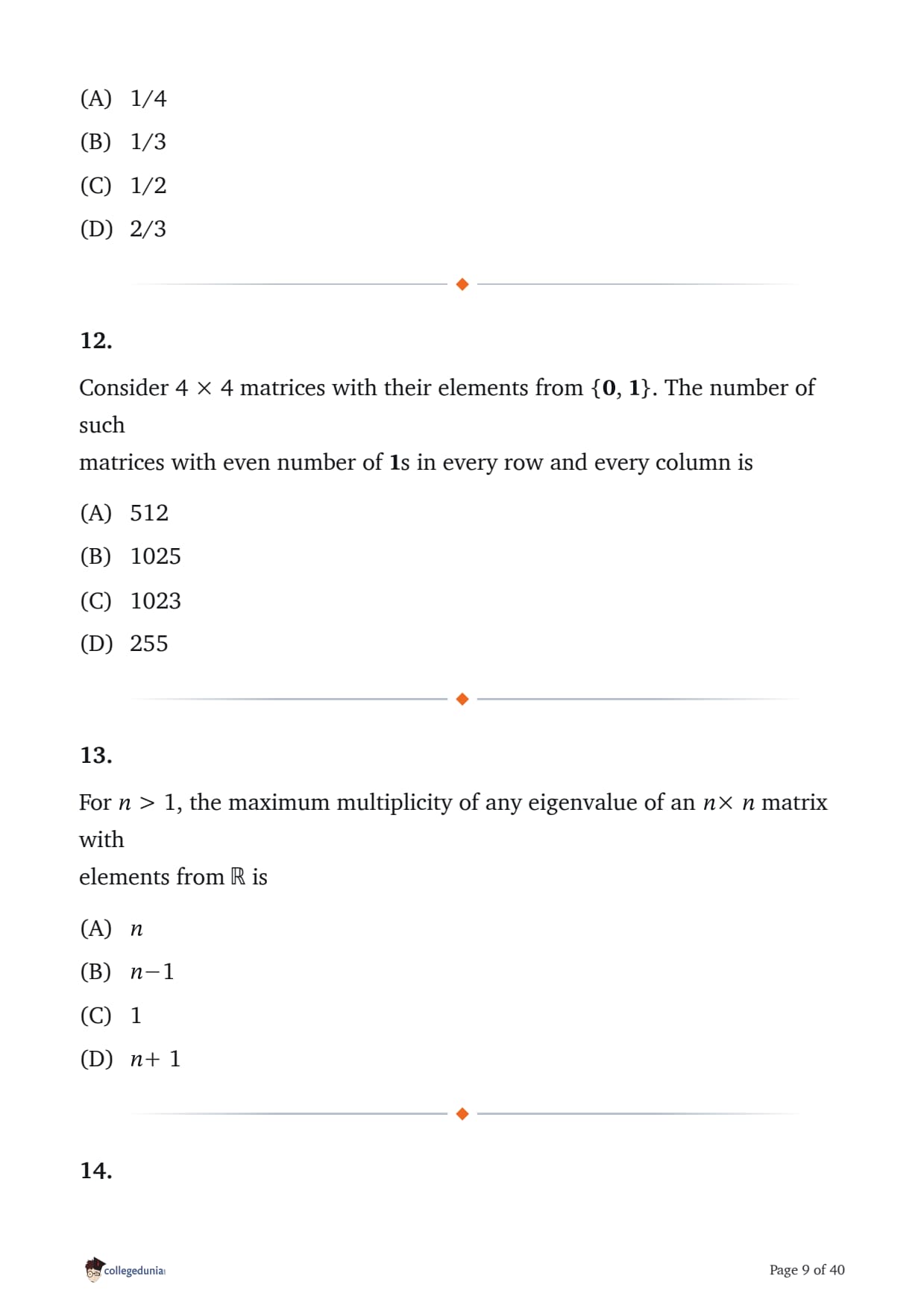
Consider 4 × 4 matrices with their elements from {????, ????}. The number of such
matrices with even number of ????s in every row and every column is
For ???? > 1, the maximum multiplicity of any eigenvalue of an ????× ???? matrix with
elements from ℝ is
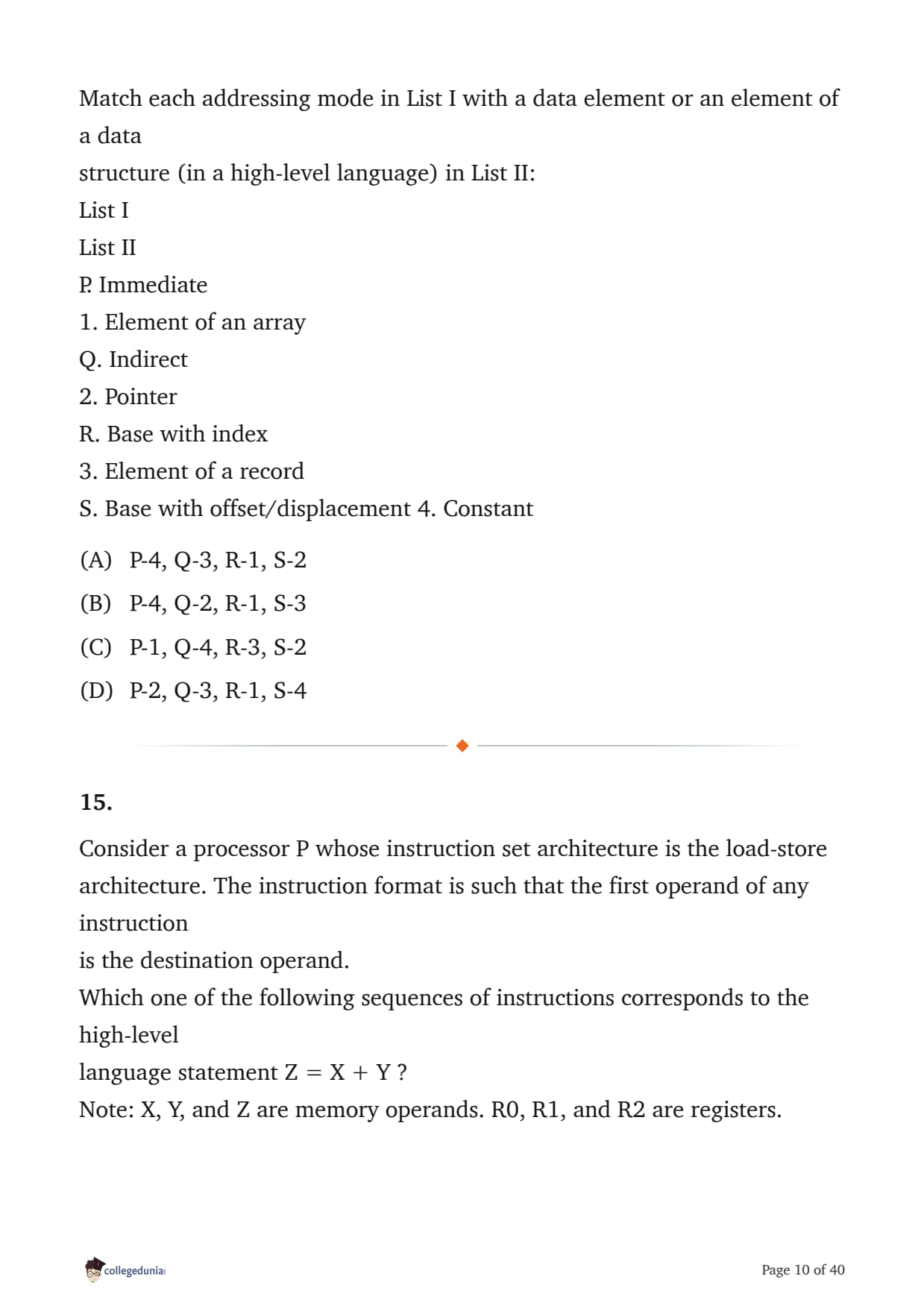
Match each addressing mode in List I with a data element or an element of a data
structure (in a high-level language) in List II:
List I
List II
P. Immediate
1. Element of an array
Q. Indirect
2. Pointer
R. Base with index
3. Element of a record
S. Base with offset/displacement 4. Constant
Consider a processor P whose instruction set architecture is the load-store
architecture. The instruction format is such that the first operand of any instruction
is the destination operand.
Which one of the following sequences of instructions corresponds to the high-level
language statement Z = X + Y ?
Note: X, Y, and Z are memory operands. R0, R1, and R2 are registers.
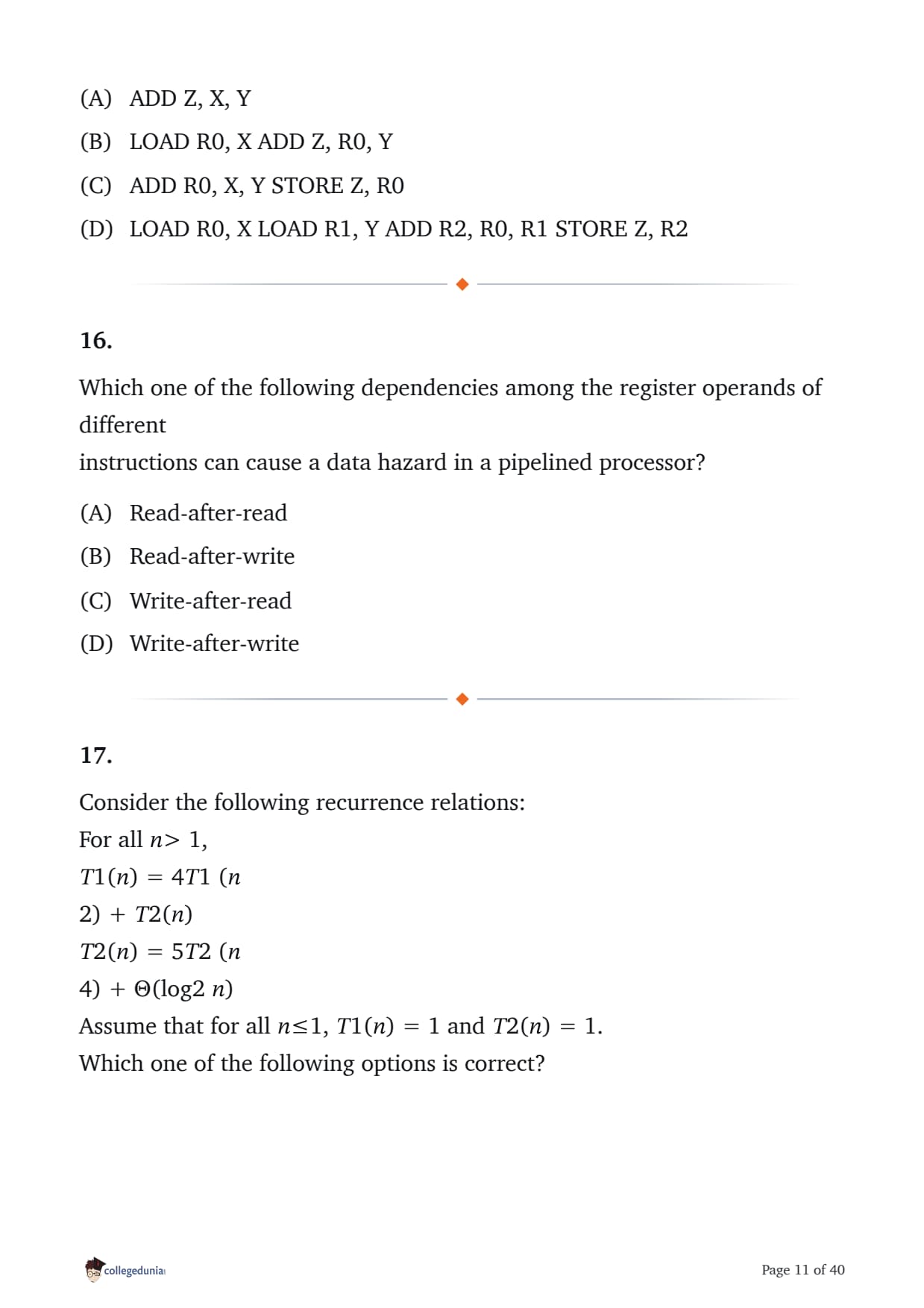
Which one of the following dependencies among the register operands of different
instructions can cause a data hazard in a pipelined processor?
Consider the following recurrence relations:
For all ????> 1,
????1(????) = 4????1 (????
2) + ????2(????)
????2(????) = 5????2 (????
4) + Θ(log2 ????)
Assume that for all ????≤1, ????1(????) = 1 and ????2(????) = 1.
Which one of the following options is correct?
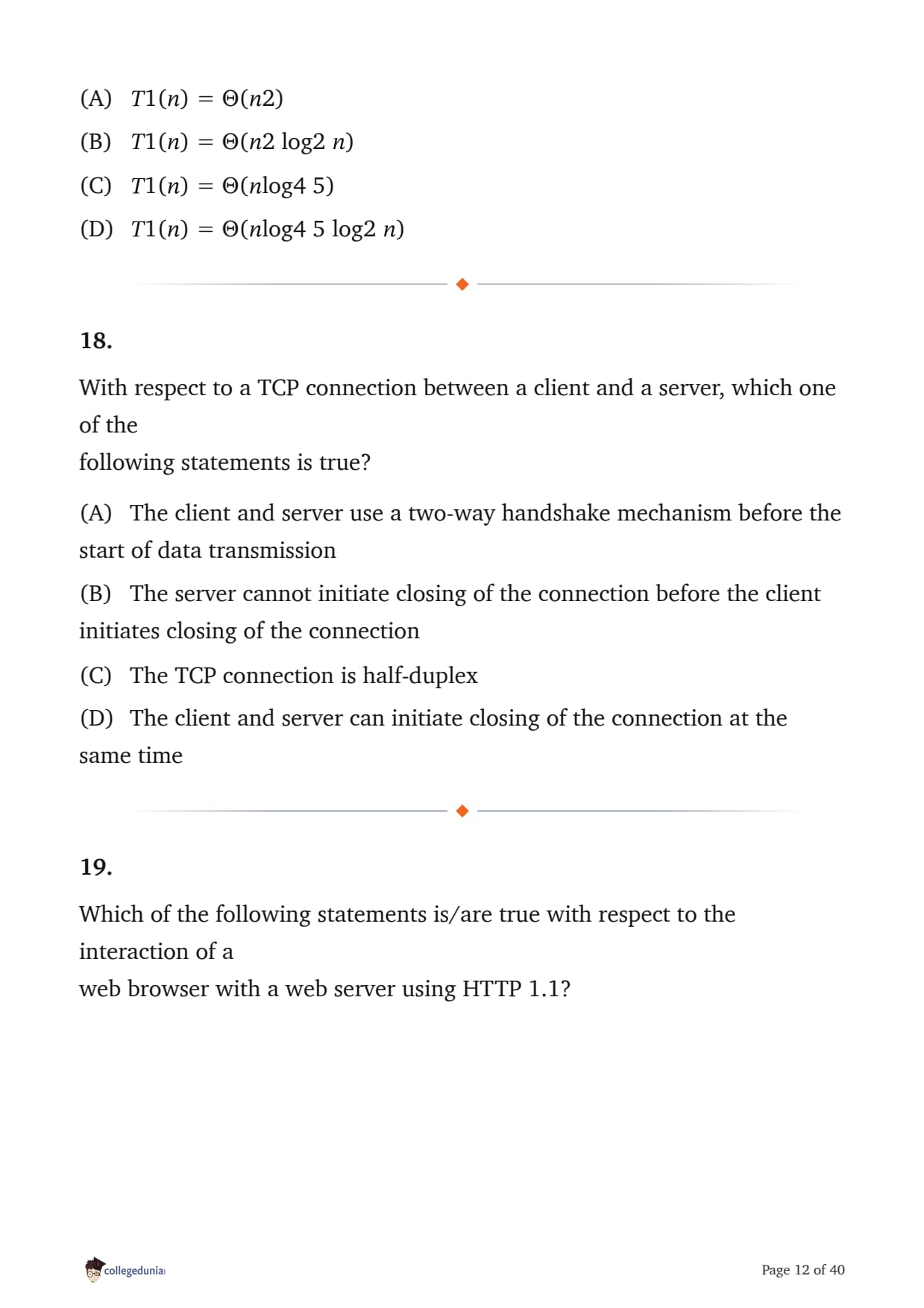
With respect to a TCP connection between a client and a server, which one of the
following statements is true?
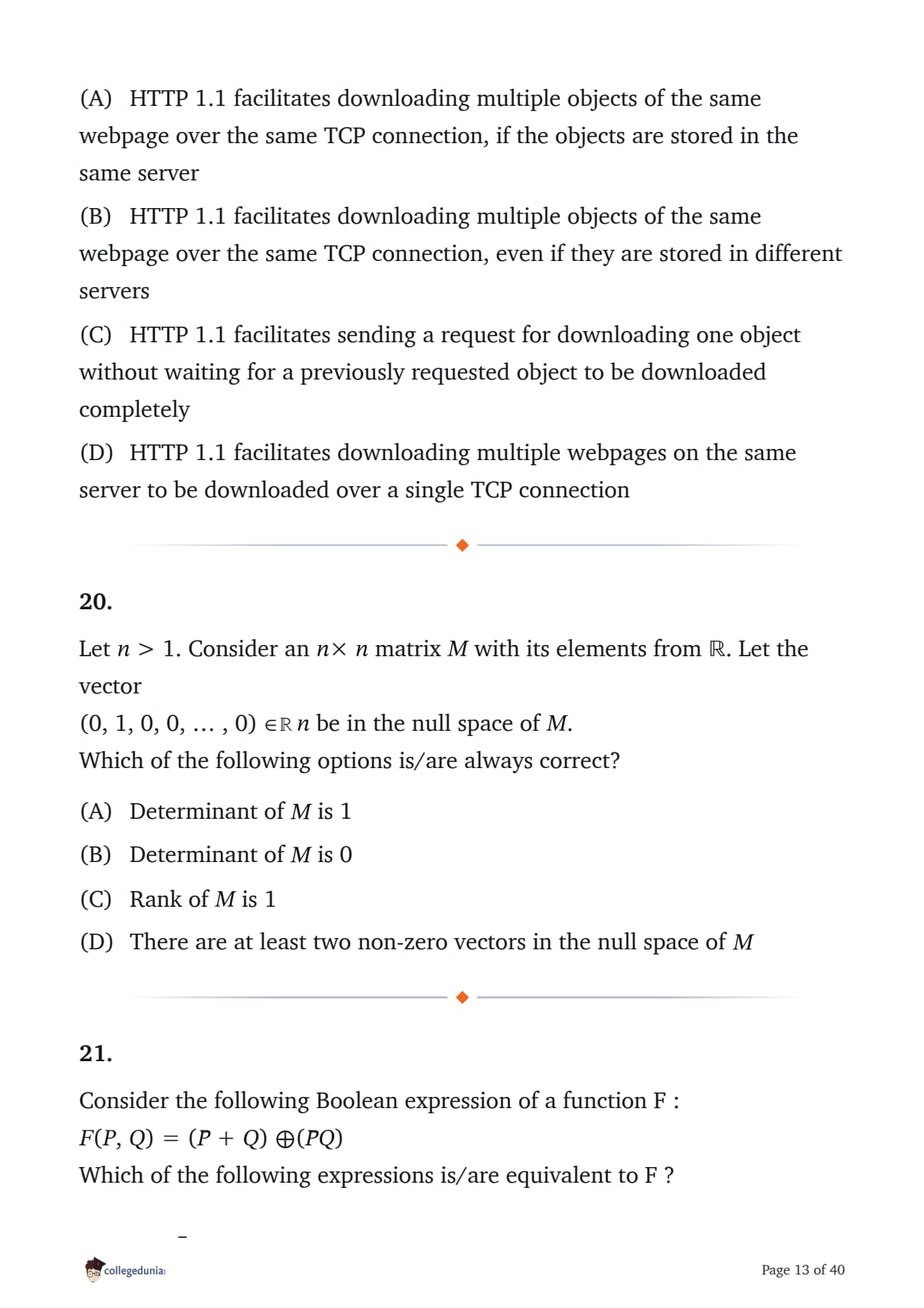
Which of the following statements is/are true with respect to the interaction of a
web browser with a web server using HTTP 1.1?
Let ???? > 1. Consider an ????× ???? matrix ???? with its elements from ℝ. Let the vector
(0, 1, 0, 0, … , 0) ∈ℝ???? be in the null space of ????.
Which of the following options is/are always correct?
Consider the following Boolean expression of a function F :
????(????, ????) = (????̅ + ????) ⊕(????̅????)
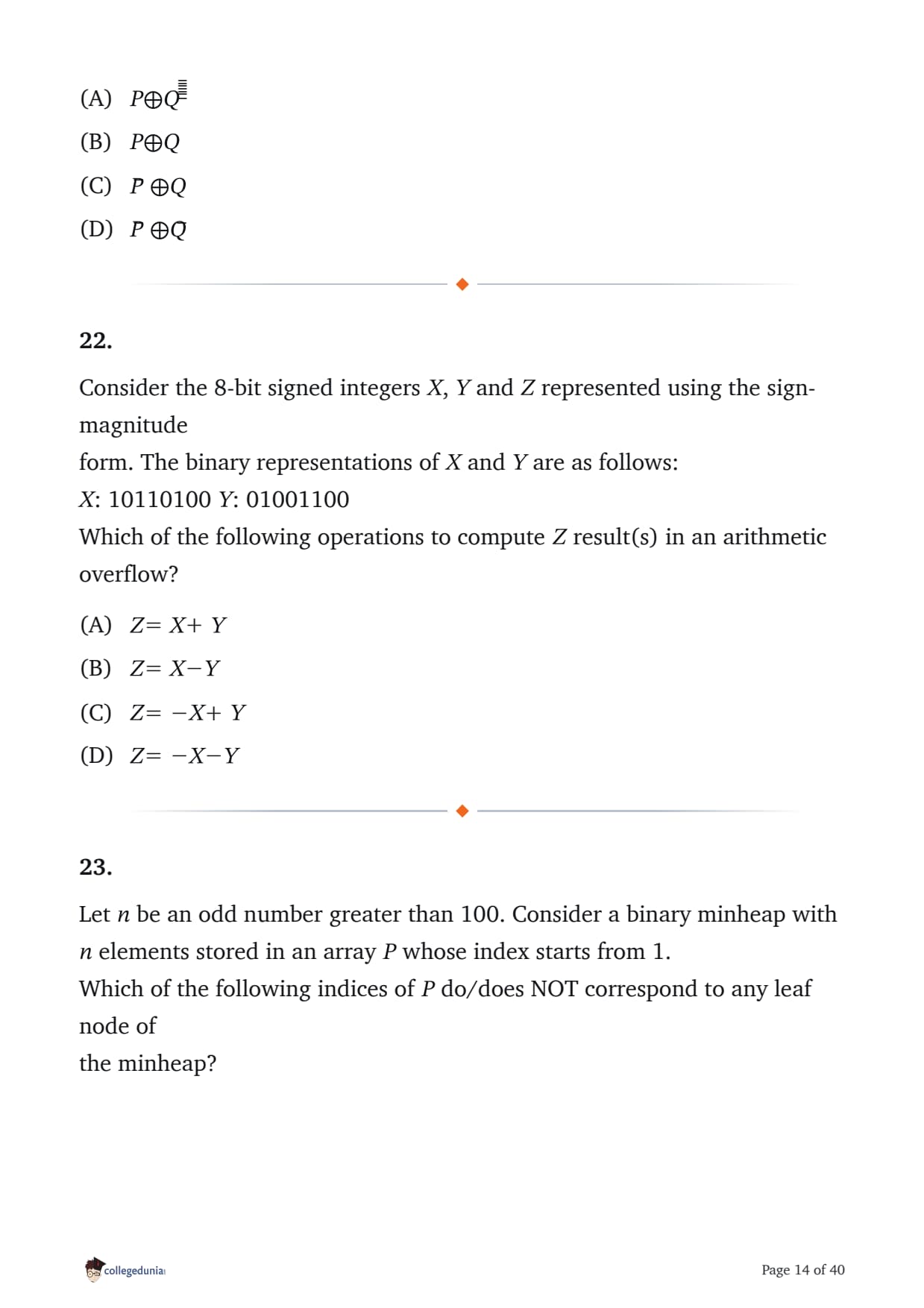
Which of the following expressions is/are equivalent to F ?
Consider the 8-bit signed integers ????, ???? and ???? represented using the sign-magnitude
form. The binary representations of ???? and ???? are as follows:
????: 10110100 ????: 01001100
Which of the following operations to compute ???? result(s) in an arithmetic
overflow?
Let ???? be an odd number greater than 100. Consider a binary minheap with
???? elements stored in an array ???? whose index starts from 1.
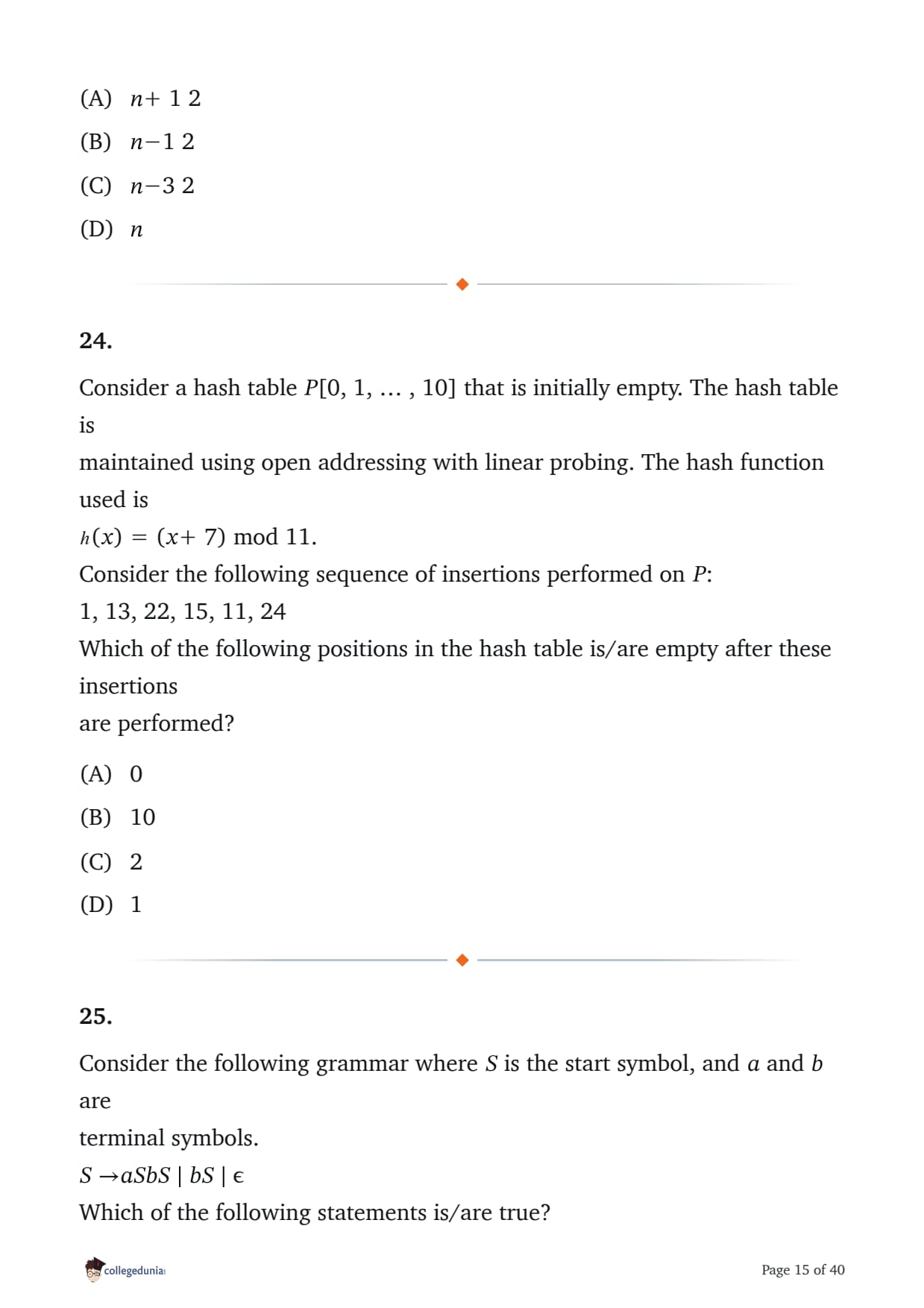
Which of the following indices of ???? do/does NOT correspond to any leaf node of
the minheap?
Consider a hash table ????[0, 1, … , 10] that is initially empty. The hash table is
maintained using open addressing with linear probing. The hash function used is
ℎ(????) = (????+ 7) mod 11.
Consider the following sequence of insertions performed on ????:
1, 13, 22, 15, 11, 24
Which of the following positions in the hash table is/are empty after these insertions
are performed?
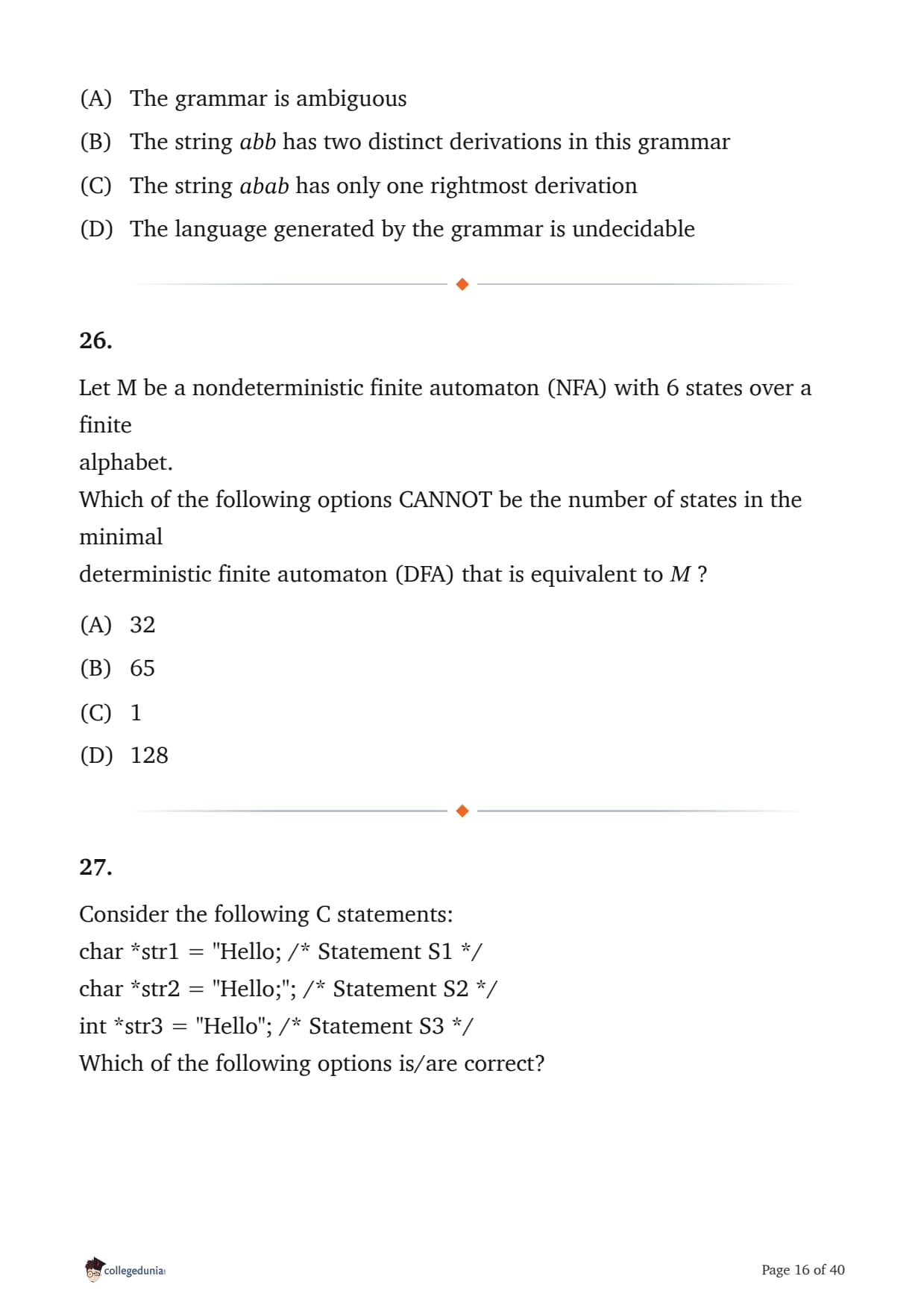
Consider the following grammar where ???? is the start symbol, and ???? and ???? are
terminal symbols.
???? →???????????????? ∣ ???????? ∣ ϵ
Which of the following statements is/are true?
Let M be a nondeterministic finite automaton (NFA) with 6 states over a finite
alphabet.
Which of the following options CANNOT be the number of states in the minimal
deterministic finite automaton (DFA) that is equivalent to ???? ?
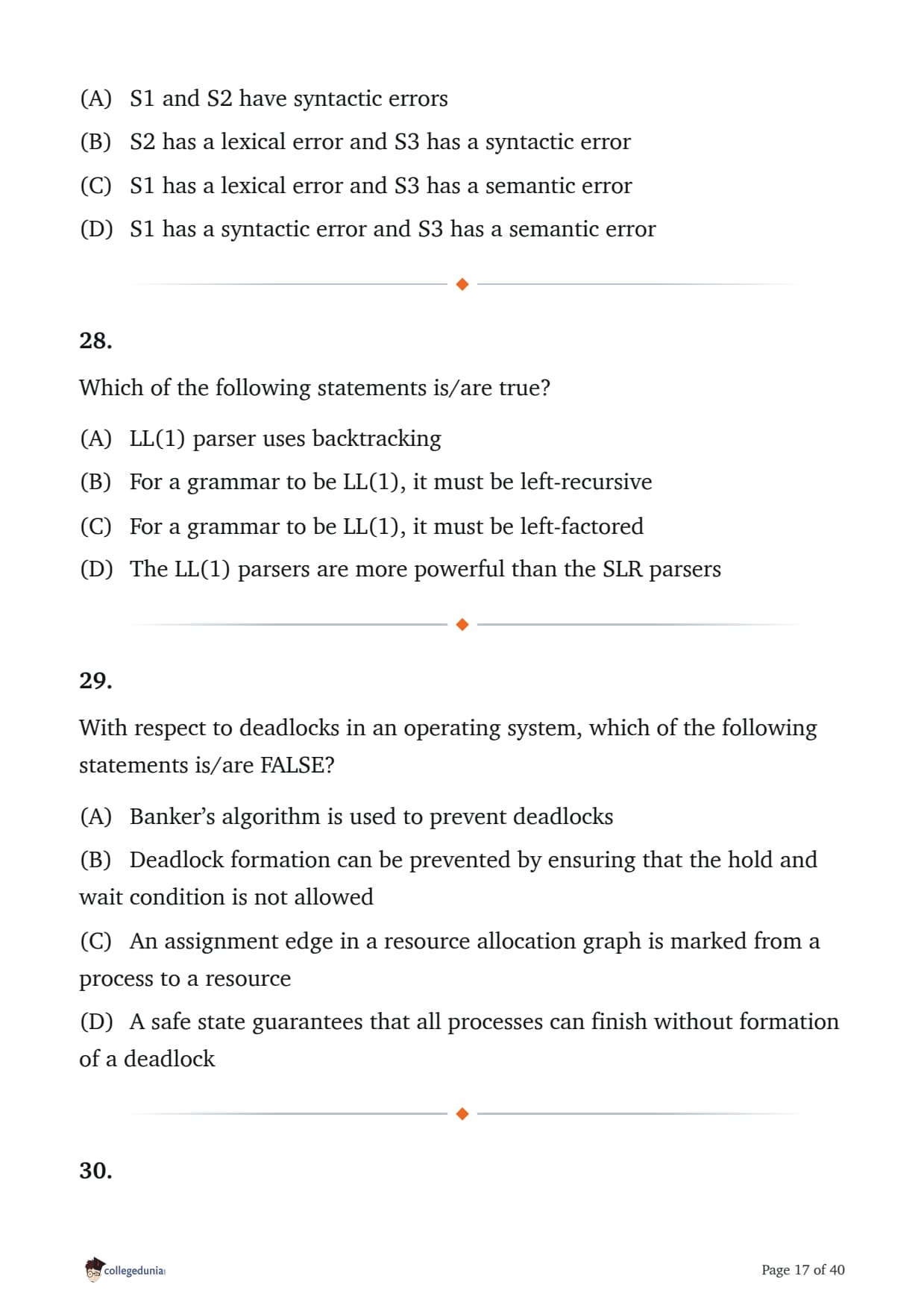
Consider the following C statements:
char *str1 = "Hello; /* Statement S1 */
char *str2 = "Hello;"; /* Statement S2 */
int *str3 = "Hello"; /* Statement S3 */
Which of the following options is/are correct?
With respect to deadlocks in an operating system, which of the following
statements is/are FALSE?
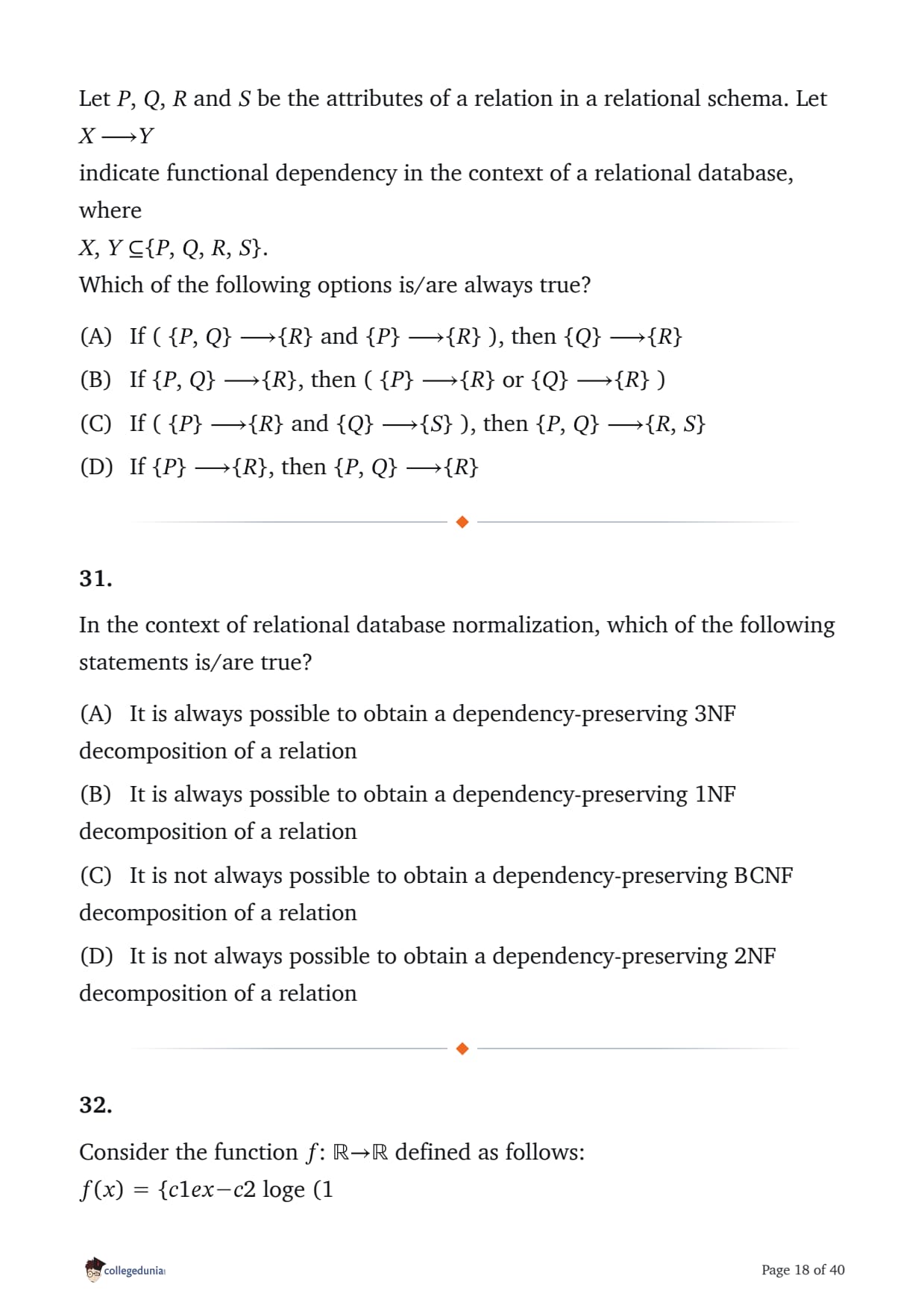
Let ????, ????, ???? and ???? be the attributes of a relation in a relational schema. Let ???? ⟶????
indicate functional dependency in the context of a relational database, where
????, ???? ⊆{????, ????, ????, ????}.
Which of the following options is/are always true?
In the context of relational database normalization, which of the following
statements is/are true?
Consider the function ????: ℝ→ℝ defined as follows:
????(????) = {????1????????−????2 loge (1
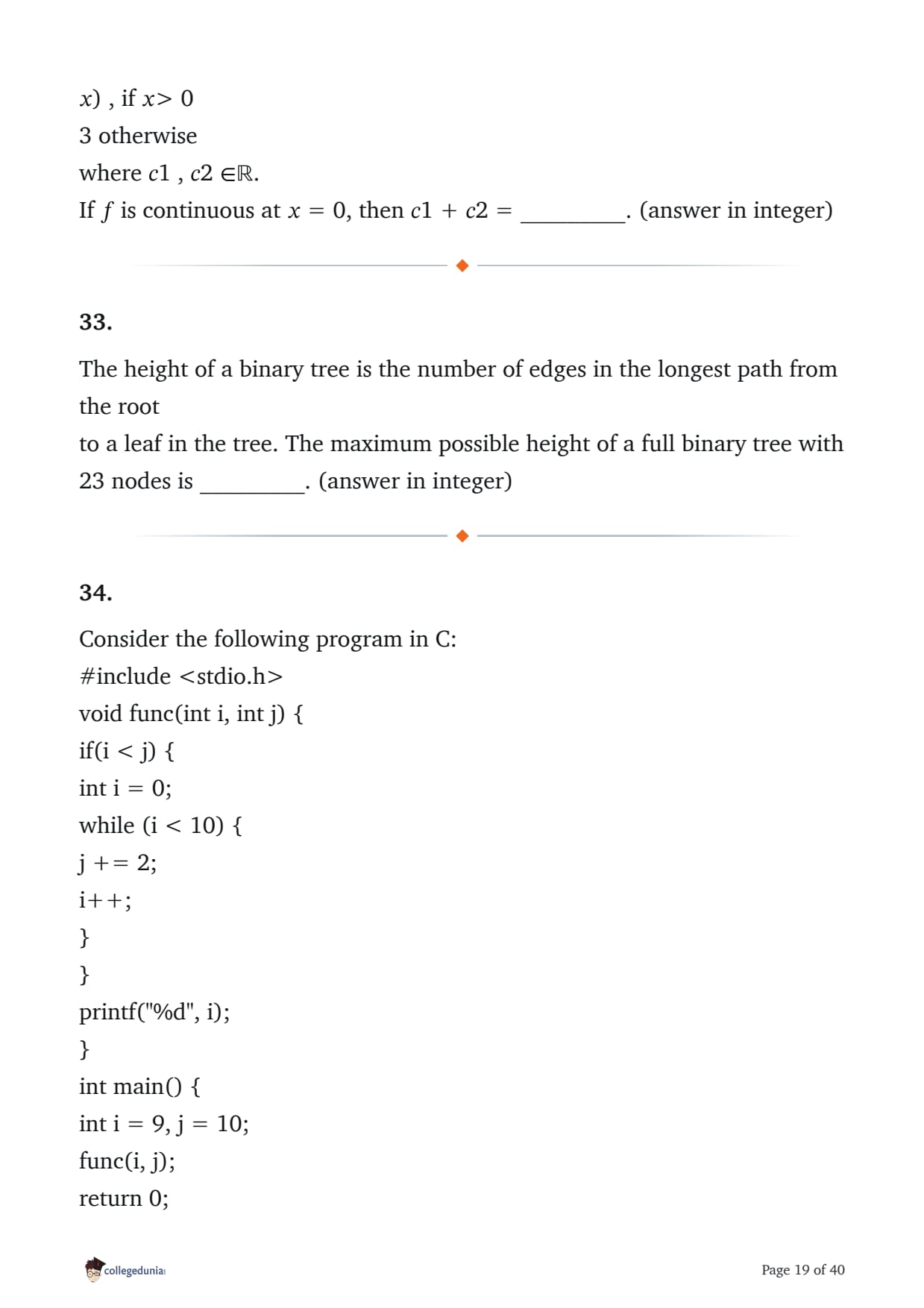
????) , if ????> 0
3 otherwise
where ????1 , ????2 ∈ℝ.
If ???? is continuous at ???? = 0, then ????1 + ????2 = _________. (answer in integer)
The height of a binary tree is the number of edges in the longest path from the root
to a leaf in the tree. The maximum possible height of a full binary tree with
23 nodes is _________. (answer in integer)
Consider the following program in C:
#include <stdio.h>
void func(int i, int j) {
if(i < j) {
int i = 0;
while (i < 10) {
j += 2;
i++;
}
}
printf("%d", i);
}
int main() {
int i = 9, j = 10;
func(i, j);
return 0;
}
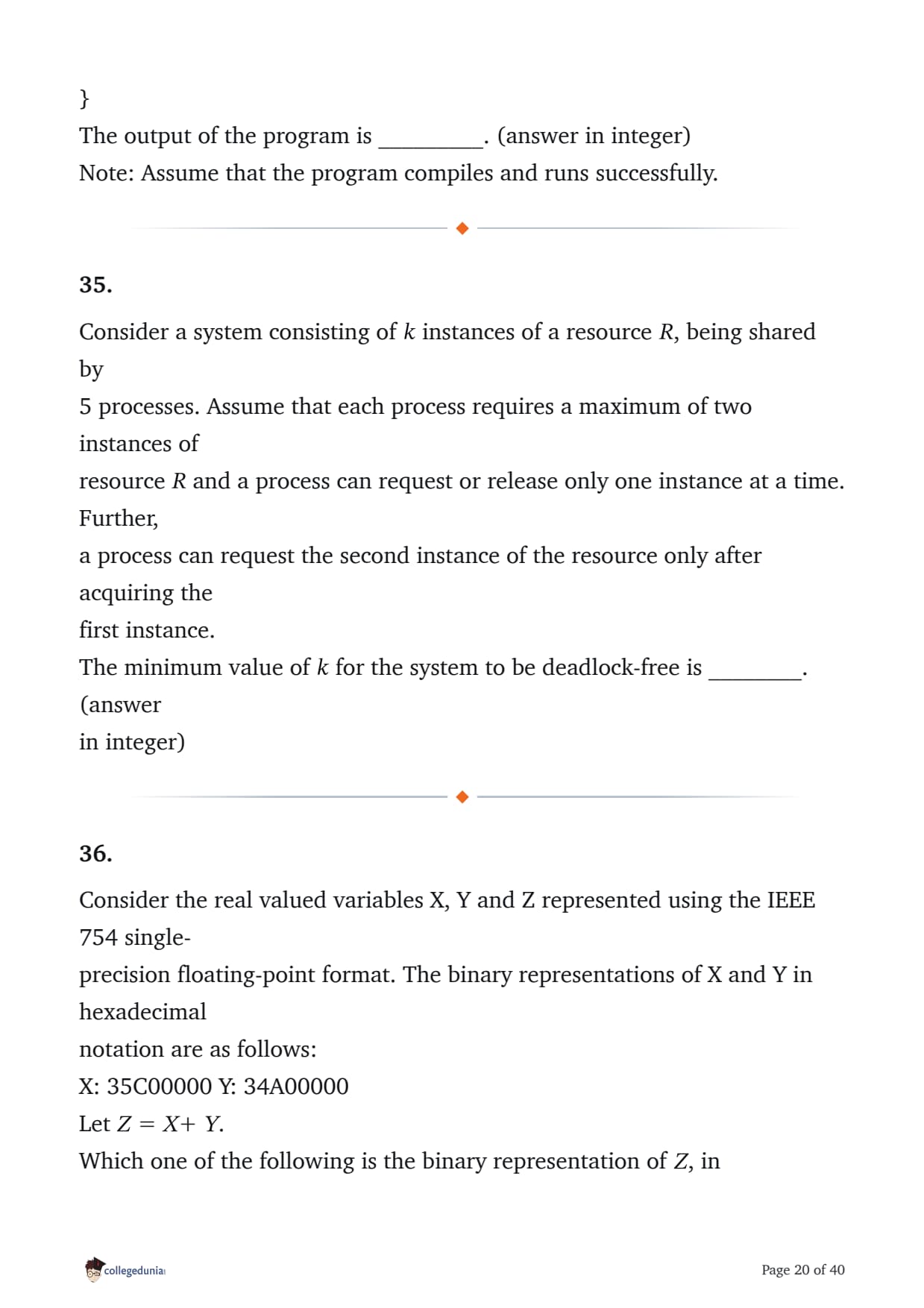
The output of the program is _________. (answer in integer)
Note: Assume that the program compiles and runs successfully.
Consider a system consisting of ???? instances of a resource ????, being shared by
5 processes. Assume that each process requires a maximum of two instances of
resource ???? and a process can request or release only one instance at a time. Further,
a process can request the second instance of the resource only after acquiring the
first instance.
The minimum value of ???? for the system to be deadlock-free is ________. (answer
in integer)
Consider the real valued variables X, Y and Z represented using the IEEE 754 single-
precision floating-point format. The binary representations of X and Y in hexadecimal
notation are as follows:
X: 35C00000 Y: 34A00000
Let ???? = ????+ ????.
Which one of the following is the binary representation of ????, in hexadecimal
notation?
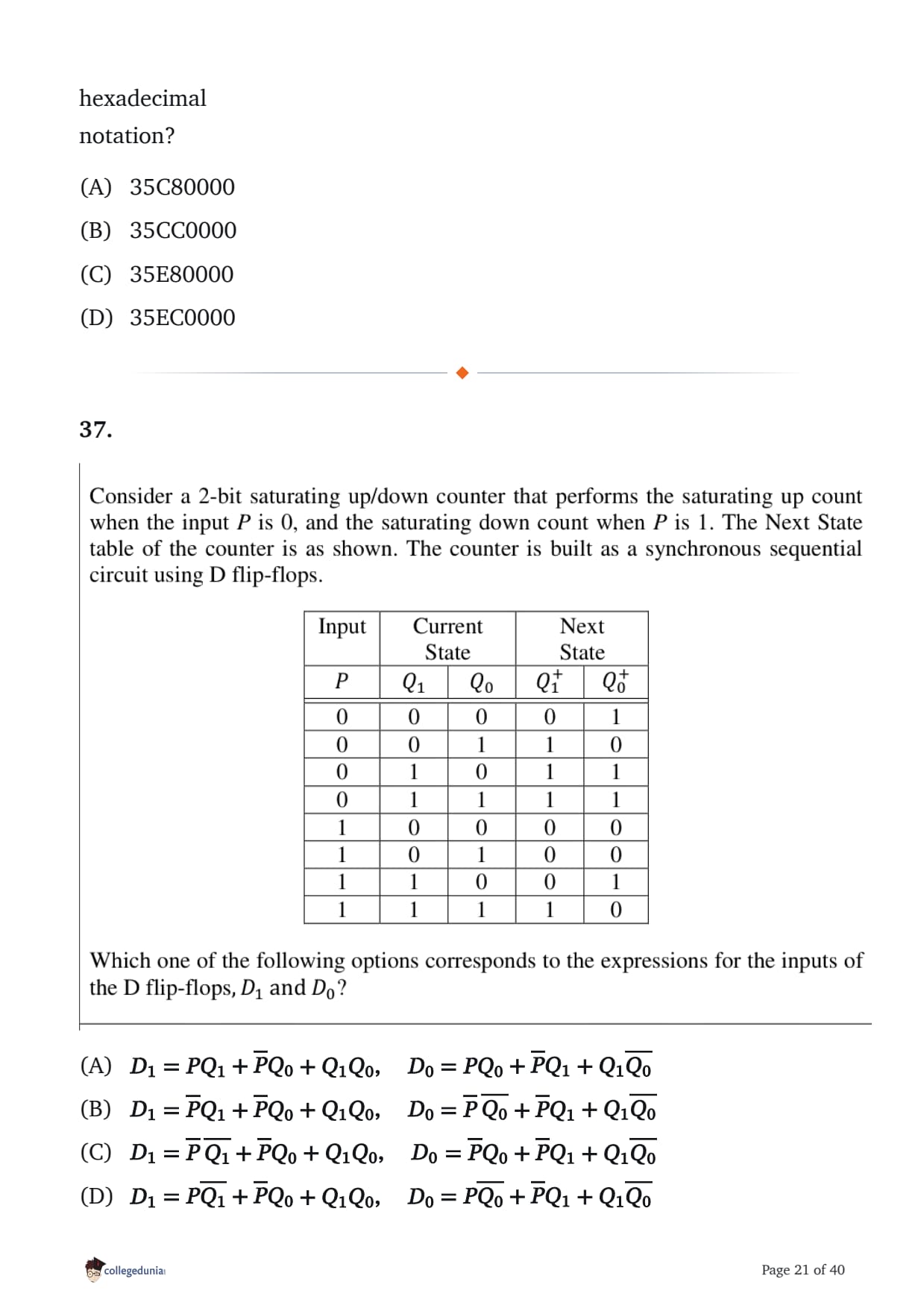
Consider a 2-bit saturating up/down counter that performs the saturating up count when the input \(P\) is 0, and the saturating down count when \(P\) is 1. The next-state table of the counter is shown below. The counter is built as a synchronous sequential circuit using D flip-flops. Which one of the following options gives the expressions for the inputs \(D_1\) and \(D_0\)?

The size of the physical address space of a processor is 232 bytes. The capacity of a
cache memory unit is 223 bytes. The cache block size is 128 bytes. The cache
memory unit can be built as a direct mapped cache or as a ????-way set-associative
cache, where ????= 2???? and ????∈{1, 2, 3}. Let the length of the TAG field be ???? bits
for the direct mapped cache, and ???? bits for the set-associative cache.
Which one of the following options is true?
Consider the following code snippet in C language that computes the number of
nodes in a non-empty singly linked list pointed to by the pointer variable head.
struct node{
int elt;
struct node *next;
};
int getListSize (struct node *head)
{
if( E1 ) return 1;
return E2;
}
Which one of the following options gives the correct replacements for the
expressions E1 and E2?
Let ???? be the set of all integers from 1 to 15. Consider any order of insertion of the
elements of ???? into a binary search tree that creates a complete binary tree.
Which one of the following elements can NEVER be the third element that is
inserted?
Let ????(????, ????) be an undirected, edge-weighted graph with integer weights. The weight
of a path is the sum of the weights of the edges in that path. The length of a path is
the number of edges in that path.
Let ????∈???? be a vertex in ????. For every ????∈???? and for every ???? ≥0, let ????????(????) denote
the weight of a shortest path (in terms of weight) from ???? to ???? of length at most ????. If
there is no path from ???? to ???? of length at most ????, then ????????(????) = ∞.
Consider the statements:
S1:
For every ???? ≥0 and ???? ∈????, ????????+1(????) ≤????????(????).
S2:
For every (????, ????) ∈????, if (????, ????) is part of a shortest path (in terms of
weight) from ???? to ????, then for every ????≥ 0, ????????(????) ≤????????(????).
Which one of the following options is correct?
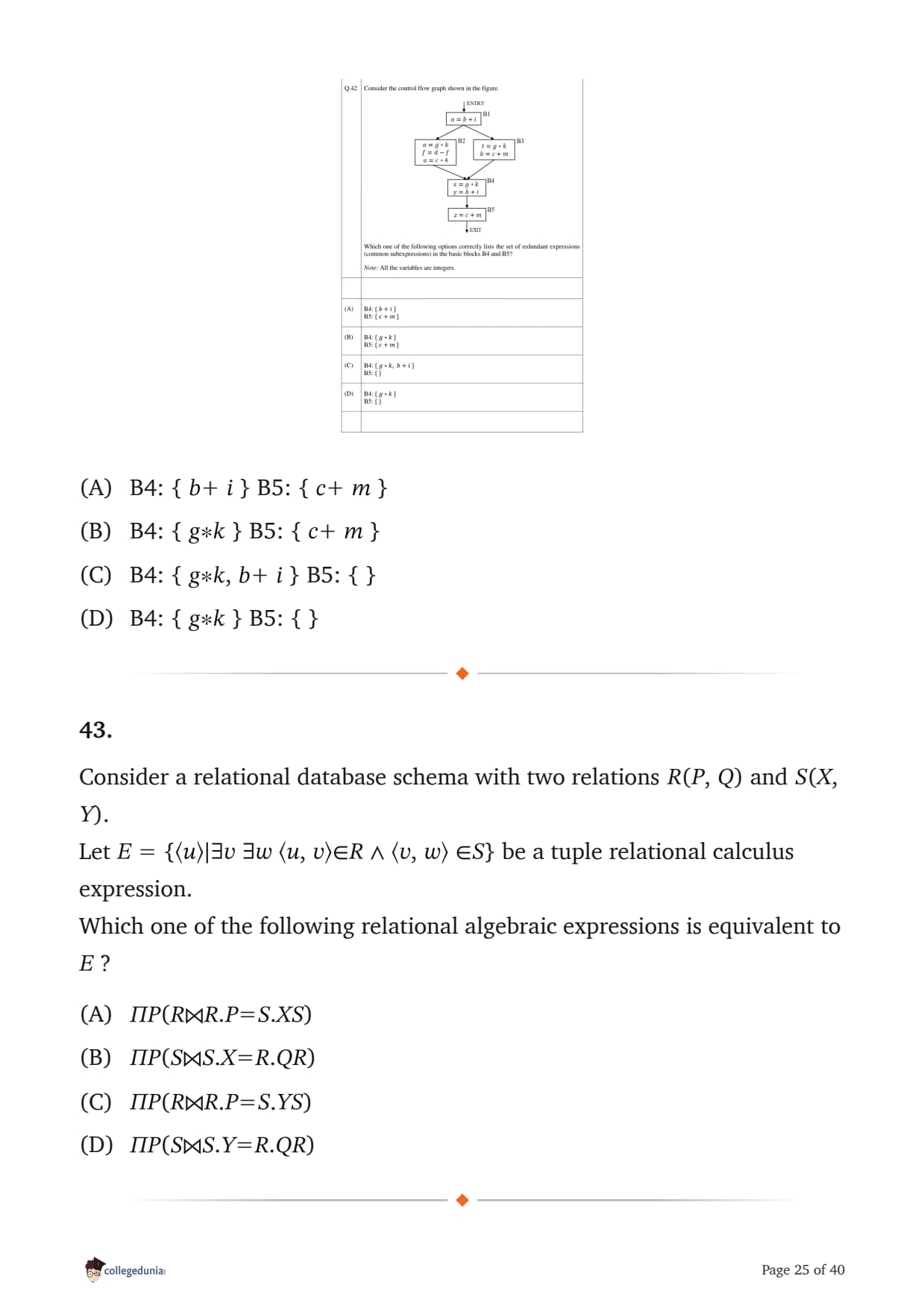
Consider the control flow graph shown in the figure.
Which one of the following options correctly lists the set of redundant expressions
(common subexpressions) in the basic blocks B4 and B5?
Note: All the variables are integers.

Consider a relational database schema with two relations ????(????, ????) and ????(????, ????).
Let ???? = {⟨????⟩∣∃???? ∃???? ⟨????, ????⟩∈???? ∧ ⟨????, ????⟩ ∈????} be a tuple relational calculus
expression.
Which one of the following relational algebraic expressions is equivalent to ???? ?
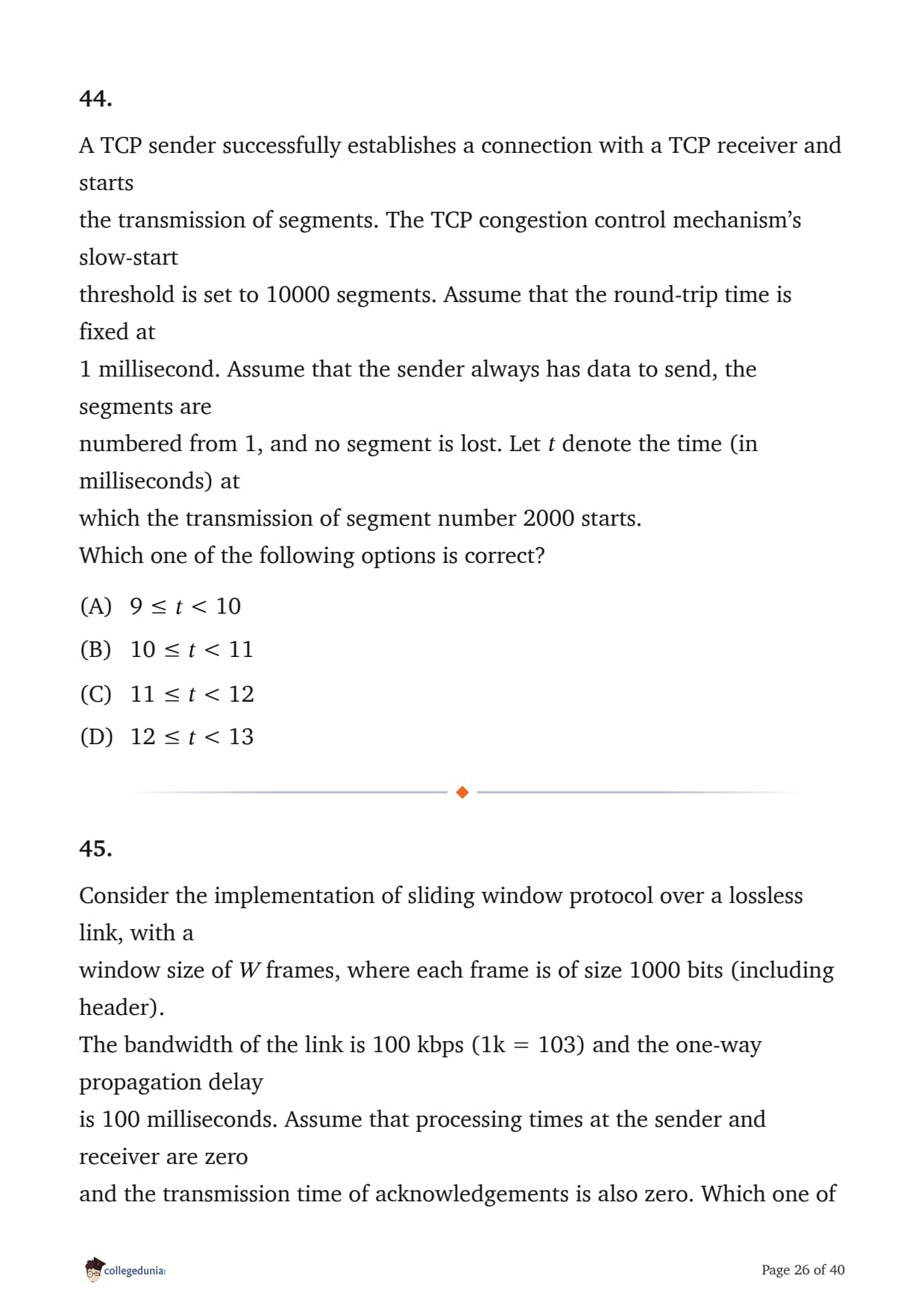
A TCP sender successfully establishes a connection with a TCP receiver and starts
the transmission of segments. The TCP congestion control mechanism’s slow-start
threshold is set to 10000 segments. Assume that the round-trip time is fixed at
1 millisecond. Assume that the sender always has data to send, the segments are
numbered from 1, and no segment is lost. Let ???? denote the time (in milliseconds) at
which the transmission of segment number 2000 starts.
Which one of the following options is correct?
Consider the implementation of sliding window protocol over a lossless link, with a
window size of ???? frames, where each frame is of size 1000 bits (including header).
The bandwidth of the link is 100 kbps (1k = 103) and the one-way propagation delay
is 100 milliseconds. Assume that processing times at the sender and receiver are zero
and the transmission time of acknowledgements is also zero. Which one of the
following options gives the minimum size of ???? (in number of frames) required to
achieve 100% link utilization?
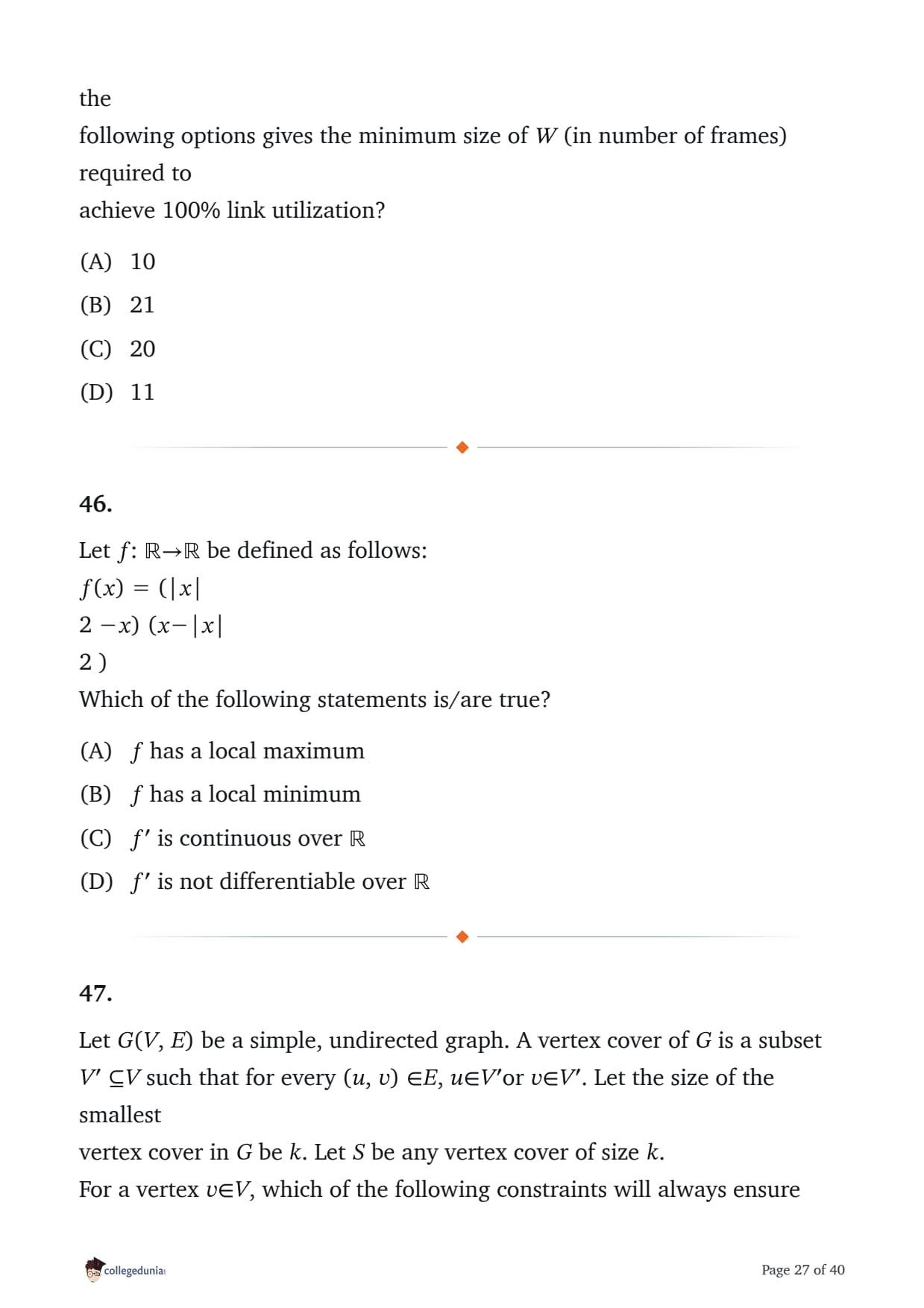
Let ????: ℝ→ℝ be defined as follows:
????(????) = (|????|
2 −????) (????−|????|
2 )
Which of the following statements is/are true?
Let ????(????, ????) be a simple, undirected graph. A vertex cover of ???? is a subset
????′ ⊆???? such that for every (????, ????) ∈????, ????∈????′or ????∈????′. Let the size of the smallest
vertex cover in ???? be ????. Let ???? be any vertex cover of size ????.
For a vertex ????∈????, which of the following constraints will always ensure that
????∈???? ?
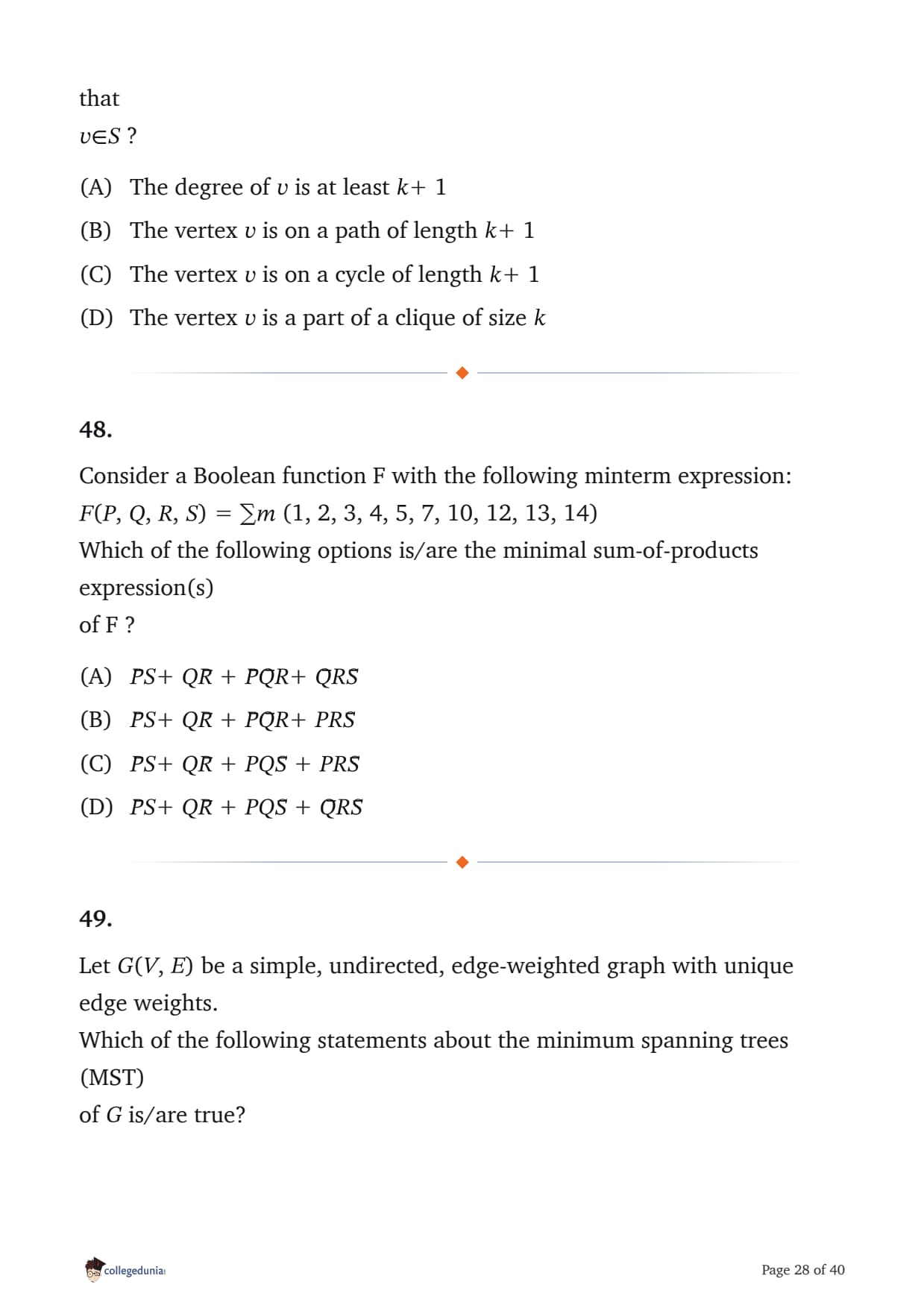
Consider a Boolean function F with the following minterm expression:
????(????, ????, ????, ????) = ∑???? (1, 2, 3, 4, 5, 7, 10, 12, 13, 14)
Which of the following options is/are the minimal sum-of-products expression(s)
of F ?
Let ????(????, ????) be a simple, undirected, edge-weighted graph with unique edge weights.
Which of the following statements about the minimum spanning trees (MST)
of ???? is/are true?
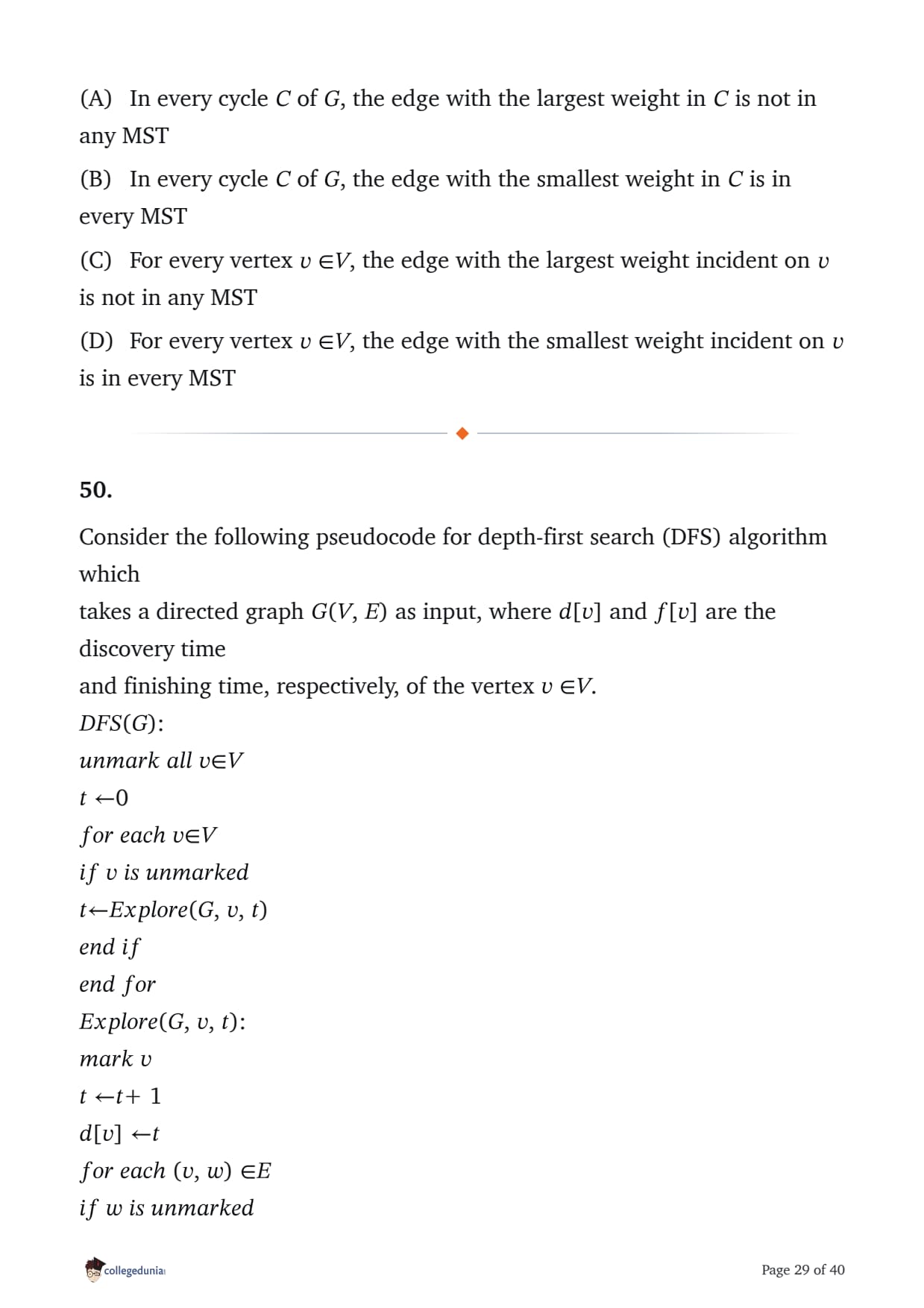
Consider the following pseudocode for depth-first search (DFS) algorithm which
takes a directed graph ????(????, ????) as input, where ????[????] and ????[????] are the discovery time
and finishing time, respectively, of the vertex ???? ∈????.
????????????(????):
???????????????????????? ???????????? ????∈????
???? ←0
???????????? ????????????ℎ ????∈????
???????? ???? ???????? ????????????????????????????????
????←????????????????????????????(????, ????, ????)
???????????? ????????
???????????? ????????????
????????????????????????????(????, ????, ????):
???????????????? ????
???? ←????+ 1
????[????] ←????
???????????? ????????????ℎ (????, ????) ∈????
???????? ???? ???????? ????????????????????????????????
????←????????????????????????????(????, ????, ????)
???????????? ????????
???????????? ????????????
???? ←???? + 1
????[????] ←????
???????????????????????? ????
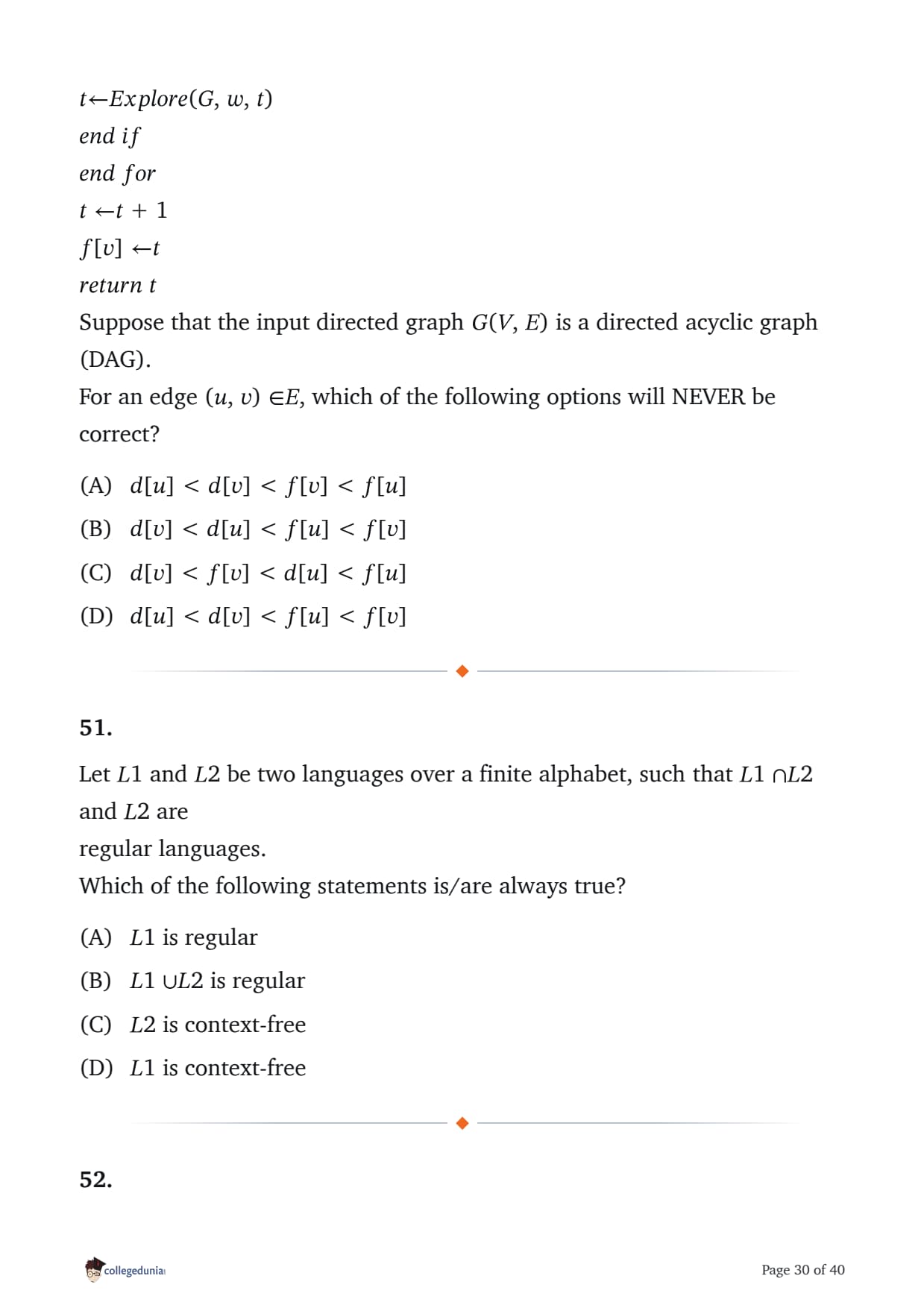
Suppose that the input directed graph ????(????, ????) is a directed acyclic graph (DAG).
For an edge (????, ????) ∈????, which of the following options will NEVER be correct?
Let ????1 and ????2 be two languages over a finite alphabet, such that ????1 ∩????2 and ????2 are
regular languages.
Which of the following statements is/are always true?
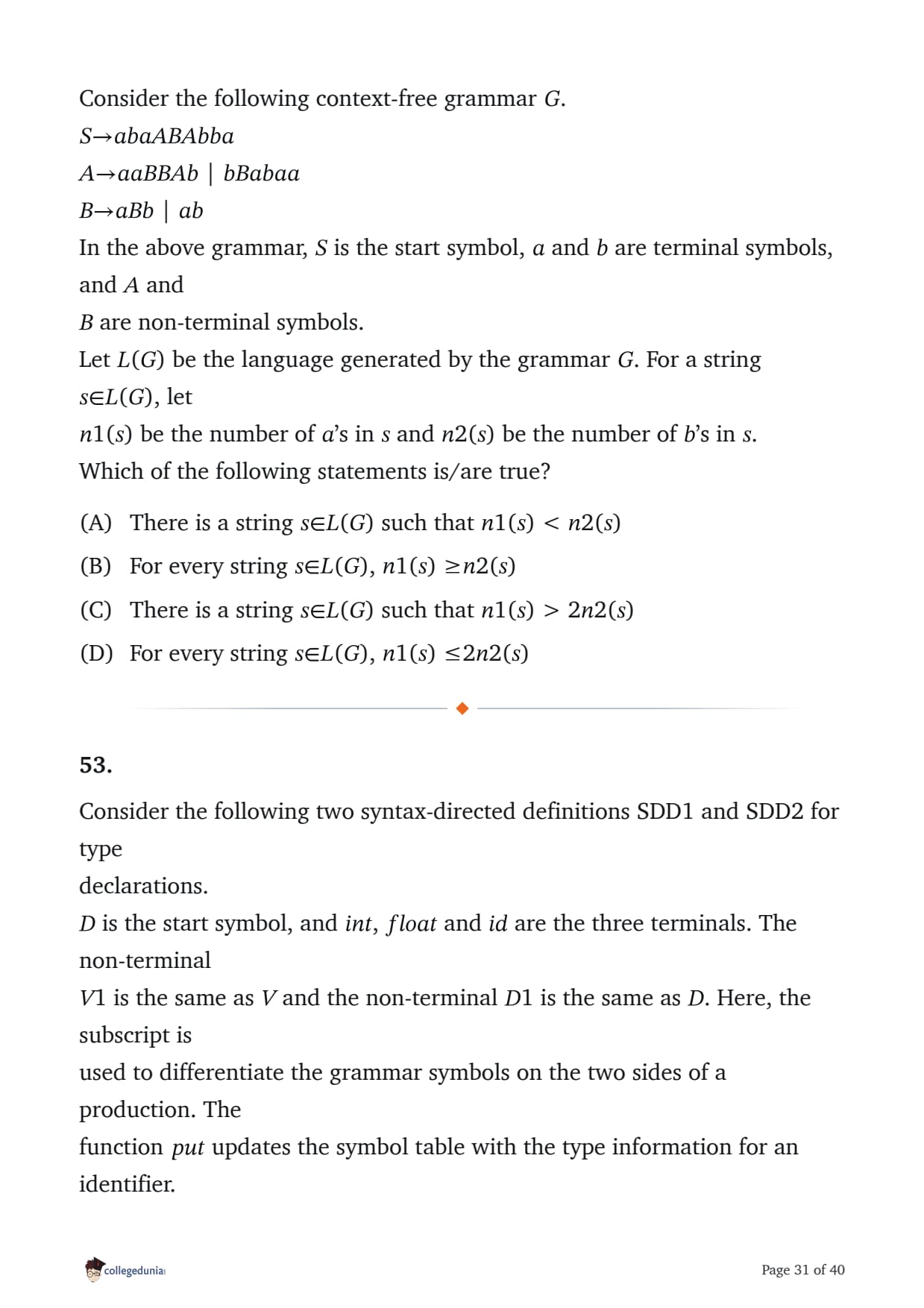
Consider the following context-free grammar ????.
????→????????????????????????????????????
????→???????????????????????? | ????????????????????????
????→???????????? | ????????
In the above grammar, ???? is the start symbol, ???? and ???? are terminal symbols, and ???? and
???? are non-terminal symbols.
Let ????(????) be the language generated by the grammar ????. For a string ????∈????(????), let
????1(????) be the number of ????’s in ???? and ????2(????) be the number of ????’s in ????.
Which of the following statements is/are true?
Consider the following two syntax-directed definitions SDD1 and SDD2 for type
declarations.
???? is the start symbol, and ????????????, ???????????????????? and ???????? are the three terminals. The non-terminal
????1 is the same as ???? and the non-terminal ????1 is the same as ????. Here, the subscript is
used to differentiate the grammar symbols on the two sides of a production. The
function ???????????? updates the symbol table with the type information for an identifier.
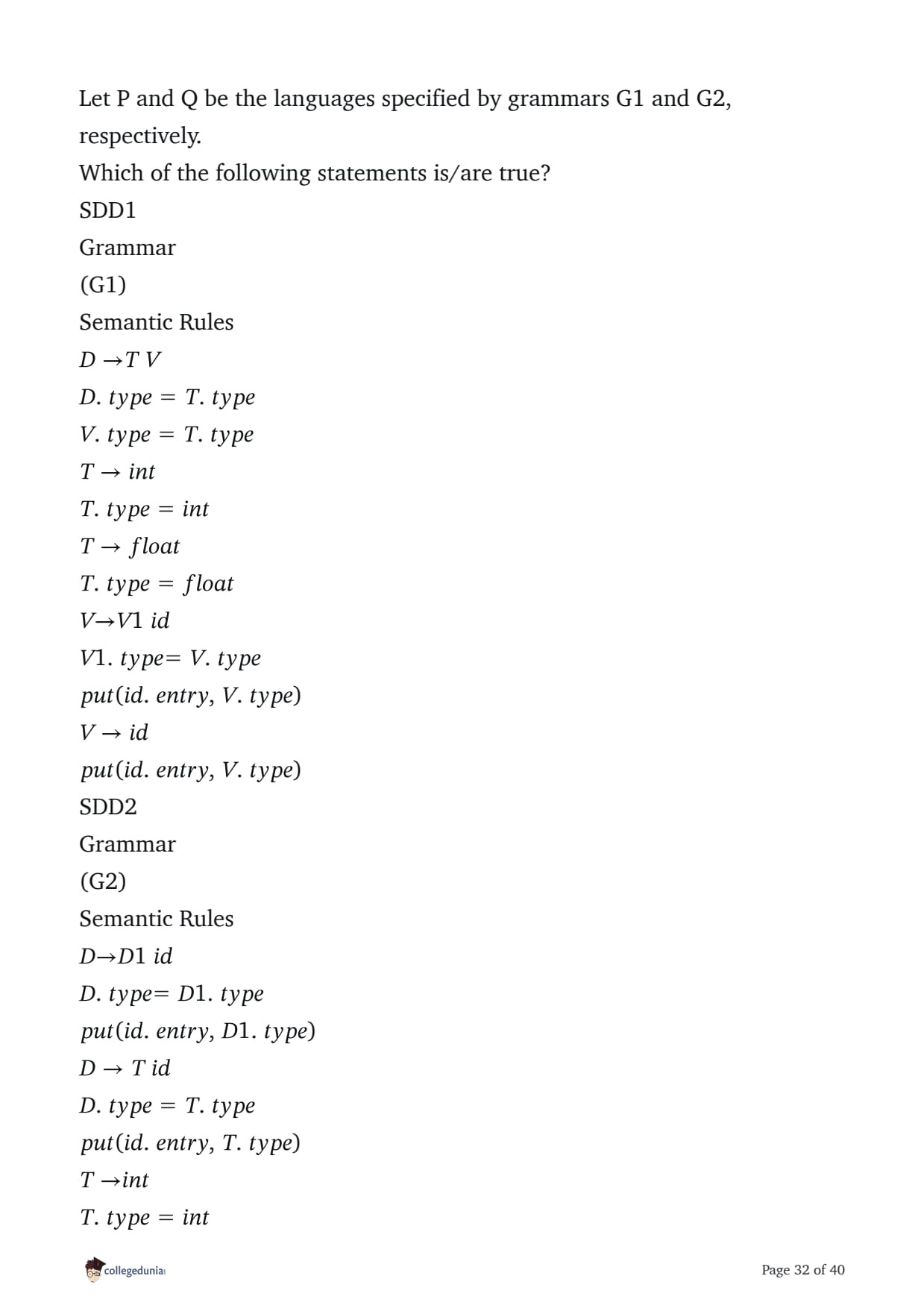
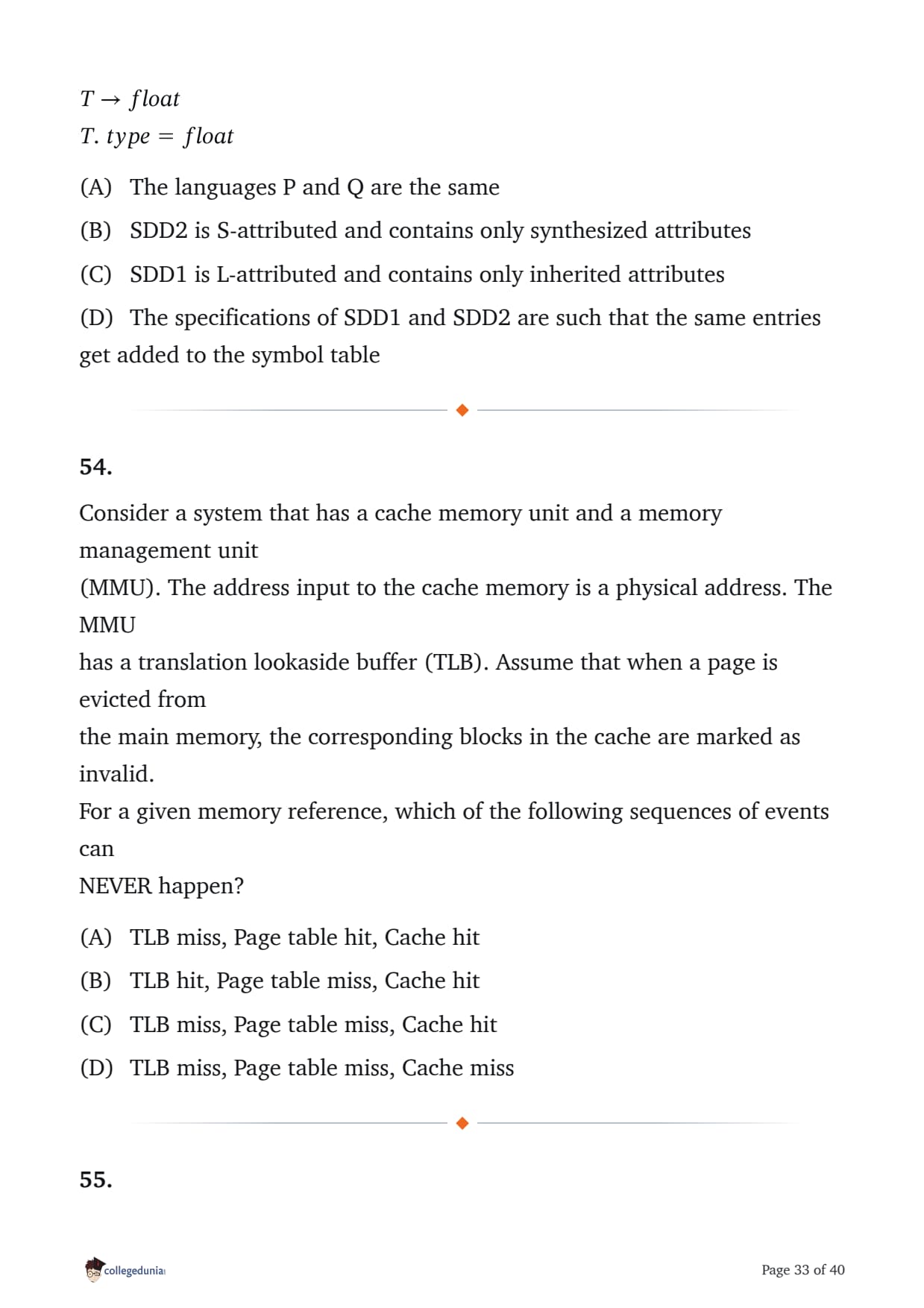
Let P and Q be the languages specified by grammars G1 and G2, respectively.
Which of the following statements is/are true?
SDD1
Grammar
(G1)
Semantic Rules
???? →???? ????
????. ???????????????? = ????. ????????????????
????. ???????????????? = ????. ????????????????
???? → ????????????
????. ???????????????? = ????????????
???? → ????????????????????
????. ???????????????? = ????????????????????
????→????1 ????????
????1. ????????????????= ????. ????????????????
????????????(????????. ????????????????????, ????. ????????????????)
???? → ????????
????????????(????????. ????????????????????, ????. ????????????????)
SDD2
Grammar
(G2)
Semantic Rules
????→????1 ????????
????. ????????????????= ????1. ????????????????
????????????(????????. ????????????????????, ????1. ????????????????)
???? → ???? ????????
????. ???????????????? = ????. ????????????????
????????????(????????. ????????????????????, ????. ????????????????)
???? →????????????
????. ???????????????? = ????????????
???? → ????????????????????
????. ???????????????? = ????????????????????
Consider a system that has a cache memory unit and a memory management unit
(MMU). The address input to the cache memory is a physical address. The MMU
has a translation lookaside buffer (TLB). Assume that when a page is evicted from
the main memory, the corresponding blocks in the cache are marked as invalid.
For a given memory reference, which of the following sequences of events can
NEVER happen?
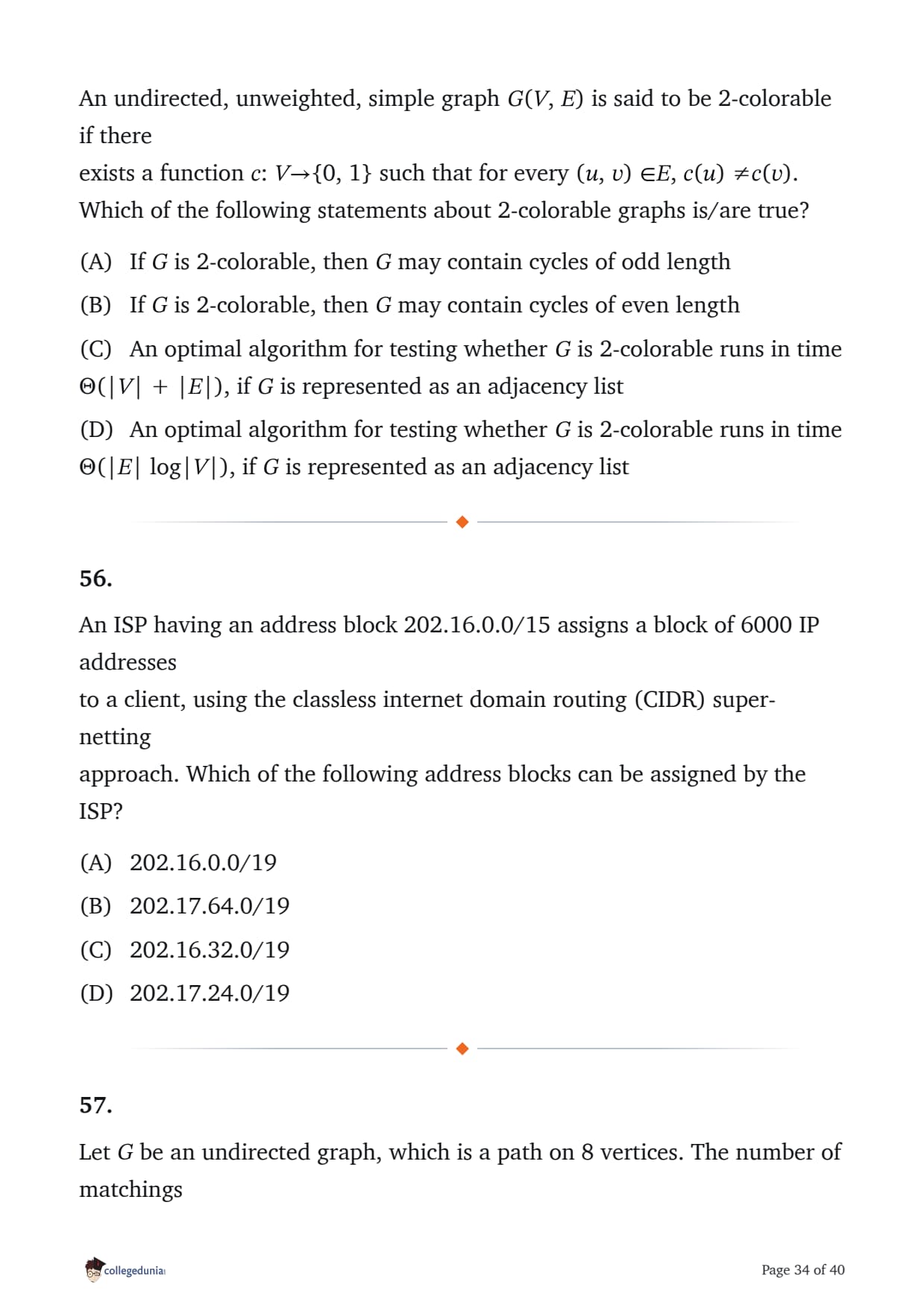
An undirected, unweighted, simple graph ????(????, ????) is said to be 2-colorable if there
exists a function ????: ????→{0, 1} such that for every (????, ????) ∈????, ????(????) ≠????(????).
Which of the following statements about 2-colorable graphs is/are true?
An ISP having an address block 202.16.0.0/15 assigns a block of 6000 IP addresses
to a client, using the classless internet domain routing (CIDR) super-netting
approach. Which of the following address blocks can be assigned by the ISP?
Let ???? be an undirected graph, which is a path on 8 vertices. The number of matchings
in ???? is ______. (answer in integer)
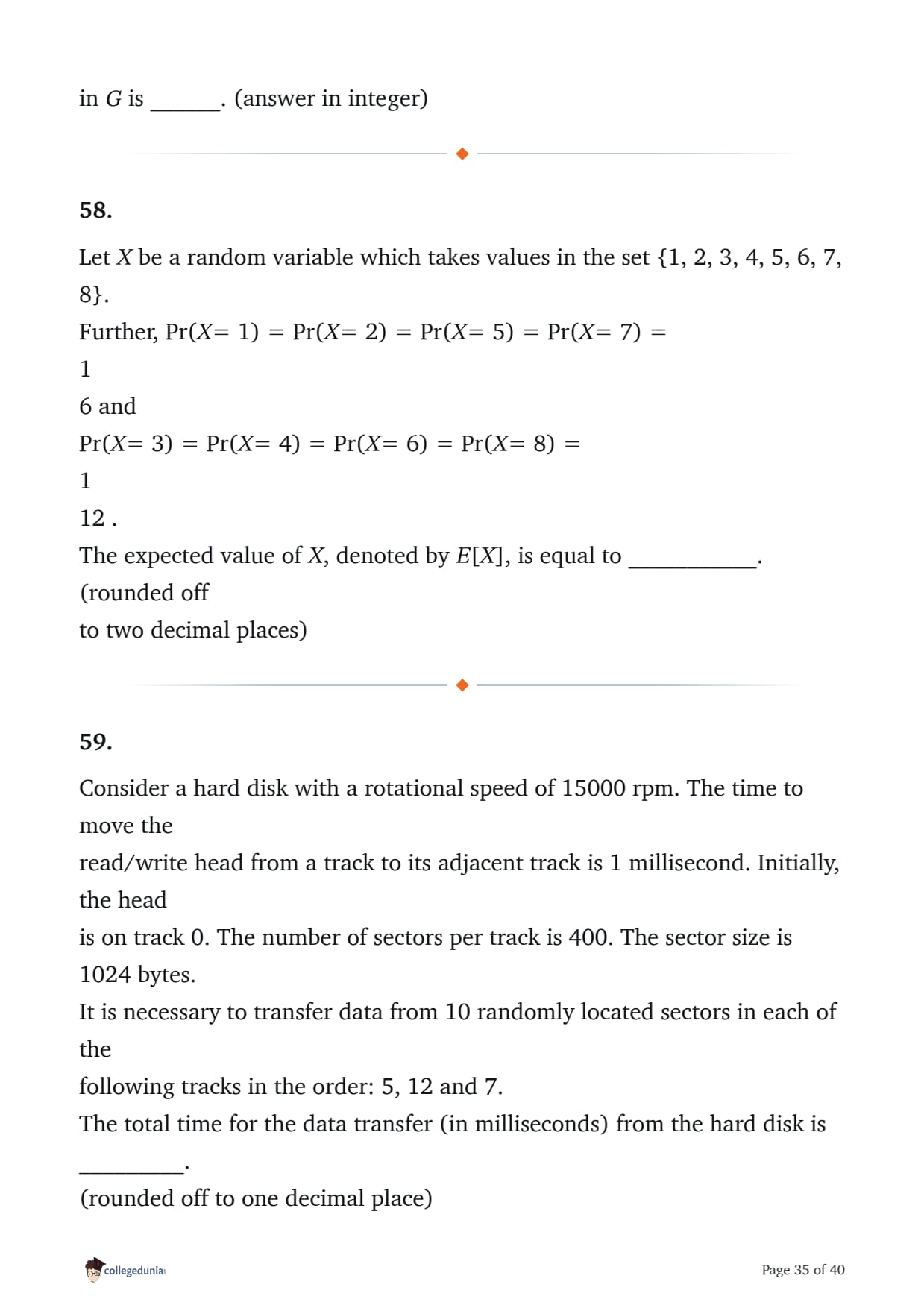
Let ???? be a random variable which takes values in the set {1, 2, 3, 4, 5, 6, 7, 8}.
Further, Pr(????= 1) = Pr(????= 2) = Pr(????= 5) = Pr(????= 7) =
1
6 and
Pr(????= 3) = Pr(????= 4) = Pr(????= 6) = Pr(????= 8) =
1
12 .
The expected value of ????, denoted by ????[????], is equal to ___________. (rounded off
to two decimal places)
Consider a hard disk with a rotational speed of 15000 rpm. The time to move the
read/write head from a track to its adjacent track is 1 millisecond. Initially, the head
is on track 0. The number of sectors per track is 400. The sector size is 1024 bytes.
It is necessary to transfer data from 10 randomly located sectors in each of the
following tracks in the order: 5, 12 and 7.
The total time for the data transfer (in milliseconds) from the hard disk is _________.
(rounded off to one decimal place)
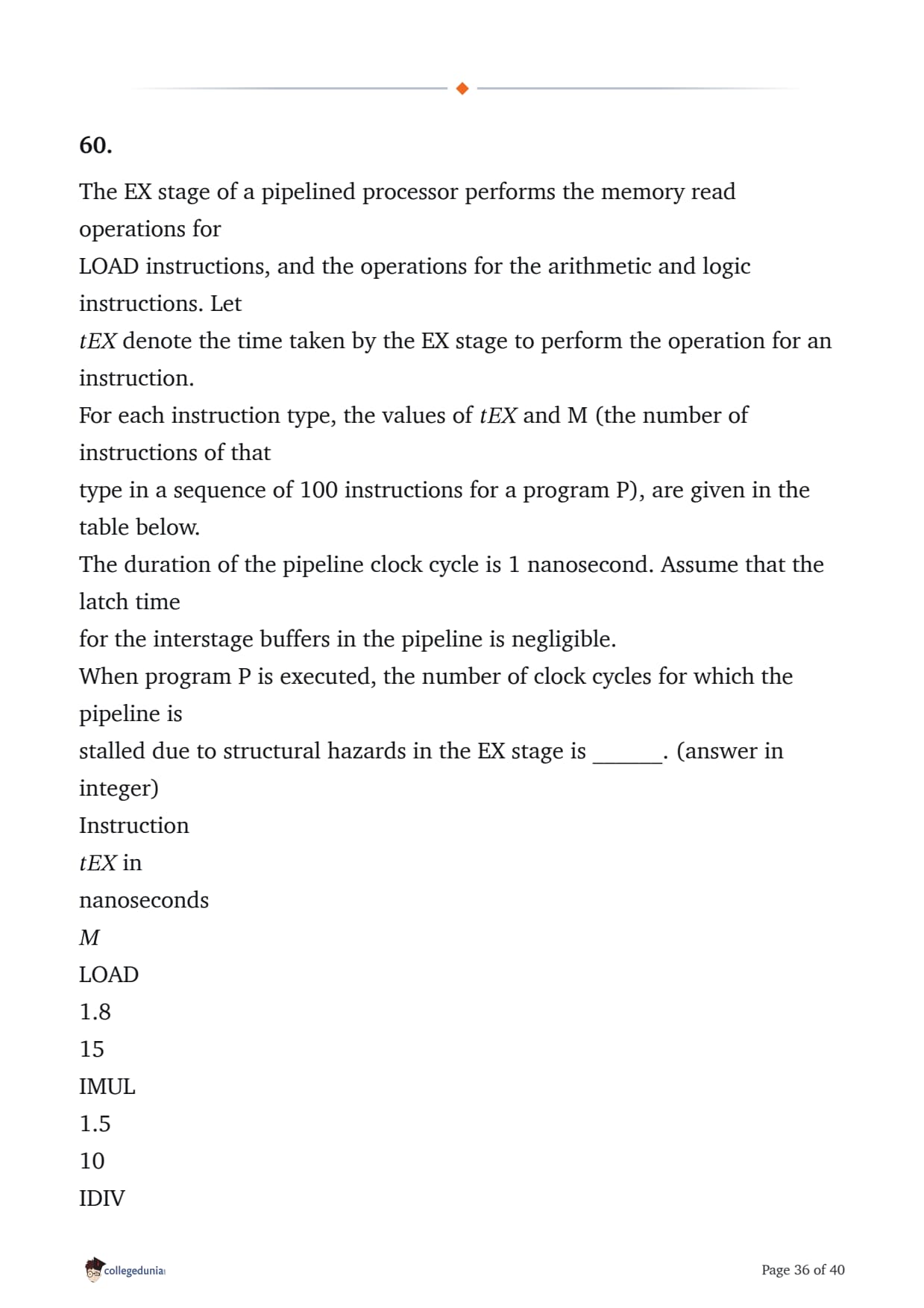
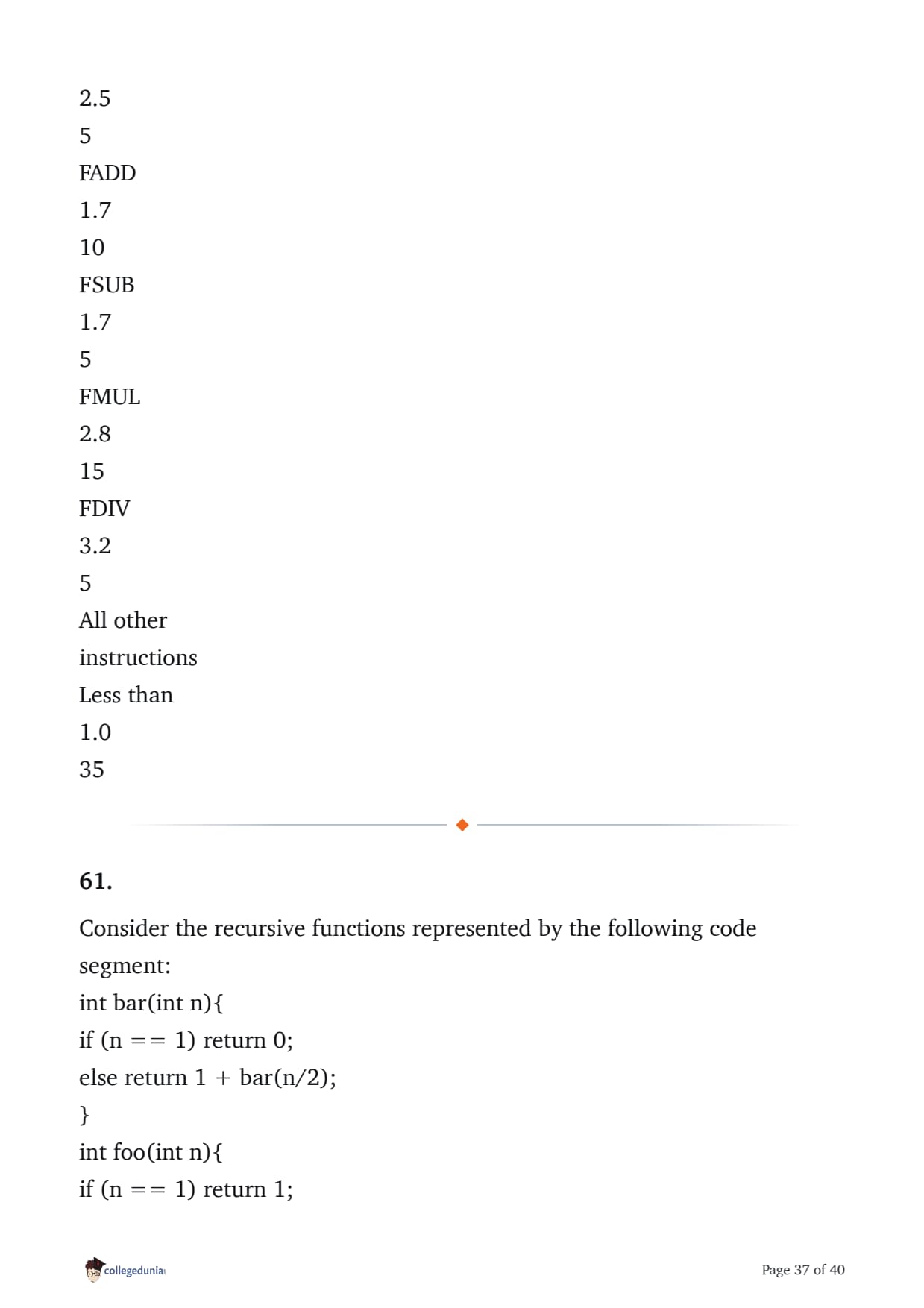
The EX stage of a pipelined processor performs the memory read operations for
LOAD instructions, and the operations for the arithmetic and logic instructions. Let
???????????? denote the time taken by the EX stage to perform the operation for an instruction.
For each instruction type, the values of ???????????? and M (the number of instructions of that
type in a sequence of 100 instructions for a program P), are given in the table below.
The duration of the pipeline clock cycle is 1 nanosecond. Assume that the latch time
for the interstage buffers in the pipeline is negligible.
When program P is executed, the number of clock cycles for which the pipeline is
stalled due to structural hazards in the EX stage is ______. (answer in integer)
Instruction
???????????? in
nanoseconds
????
LOAD
1.8
15
IMUL
1.5
10
IDIV
2.5
5
FADD
1.7
10
FSUB
1.7
5
FMUL
2.8
15
FDIV
3.2
5
All other
instructions
Less than
1.0
35
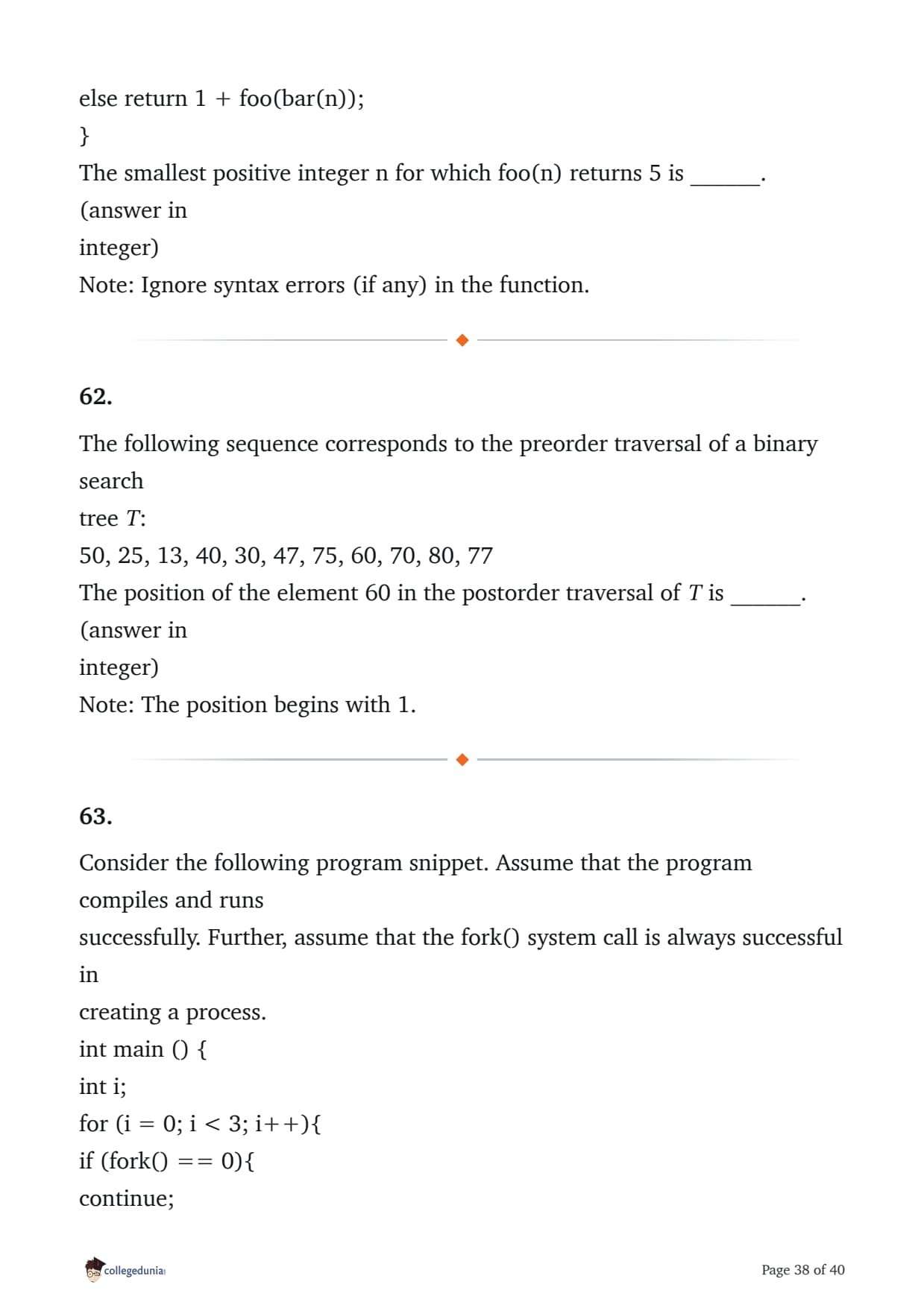
Consider the recursive functions represented by the following code segment:
int bar(int n){
if (n == 1) return 0;
else return 1 + bar(n/2);
}
int foo(int n){
if (n == 1) return 1;
else return 1 + foo(bar(n));
}
The smallest positive integer n for which foo(n) returns 5 is ______. (answer in
integer)
Note: Ignore syntax errors (if any) in the function.
The following sequence corresponds to the preorder traversal of a binary search
tree ????:
50, 25, 13, 40, 30, 47, 75, 60, 70, 80, 77
The position of the element 60 in the postorder traversal of ???? is ______. (answer in
integer)
Note: The position begins with 1.
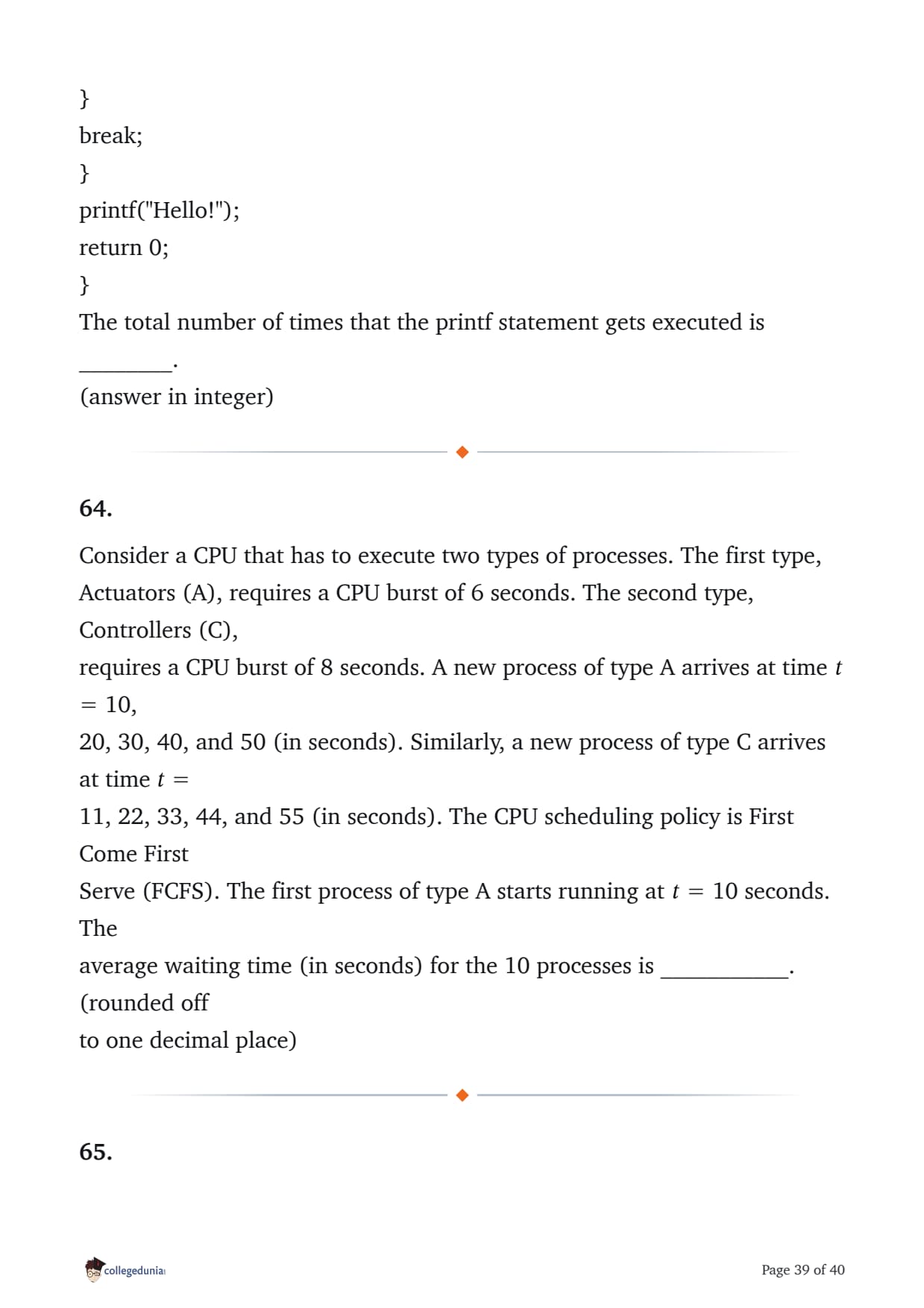
Consider the following program snippet. Assume that the program compiles and runs
successfully. Further, assume that the fork() system call is always successful in
creating a process.
int main () {
int i;
for (i = 0; i < 3; i++){
if (fork() == 0){
continue;
}
break;
}
printf("Hello!");
return 0;
}
The total number of times that the printf statement gets executed is ________.
(answer in integer)
Consider a CPU that has to execute two types of processes. The first type,
Actuators (A), requires a CPU burst of 6 seconds. The second type, Controllers (C),
requires a CPU burst of 8 seconds. A new process of type A arrives at time ???? = 10,
20, 30, 40, and 50 (in seconds). Similarly, a new process of type C arrives at time ???? =
11, 22, 33, 44, and 55 (in seconds). The CPU scheduling policy is First Come First
Serve (FCFS). The first process of type A starts running at ???? = 10 seconds. The
average waiting time (in seconds) for the 10 processes is ___________. (rounded off
to one decimal place)
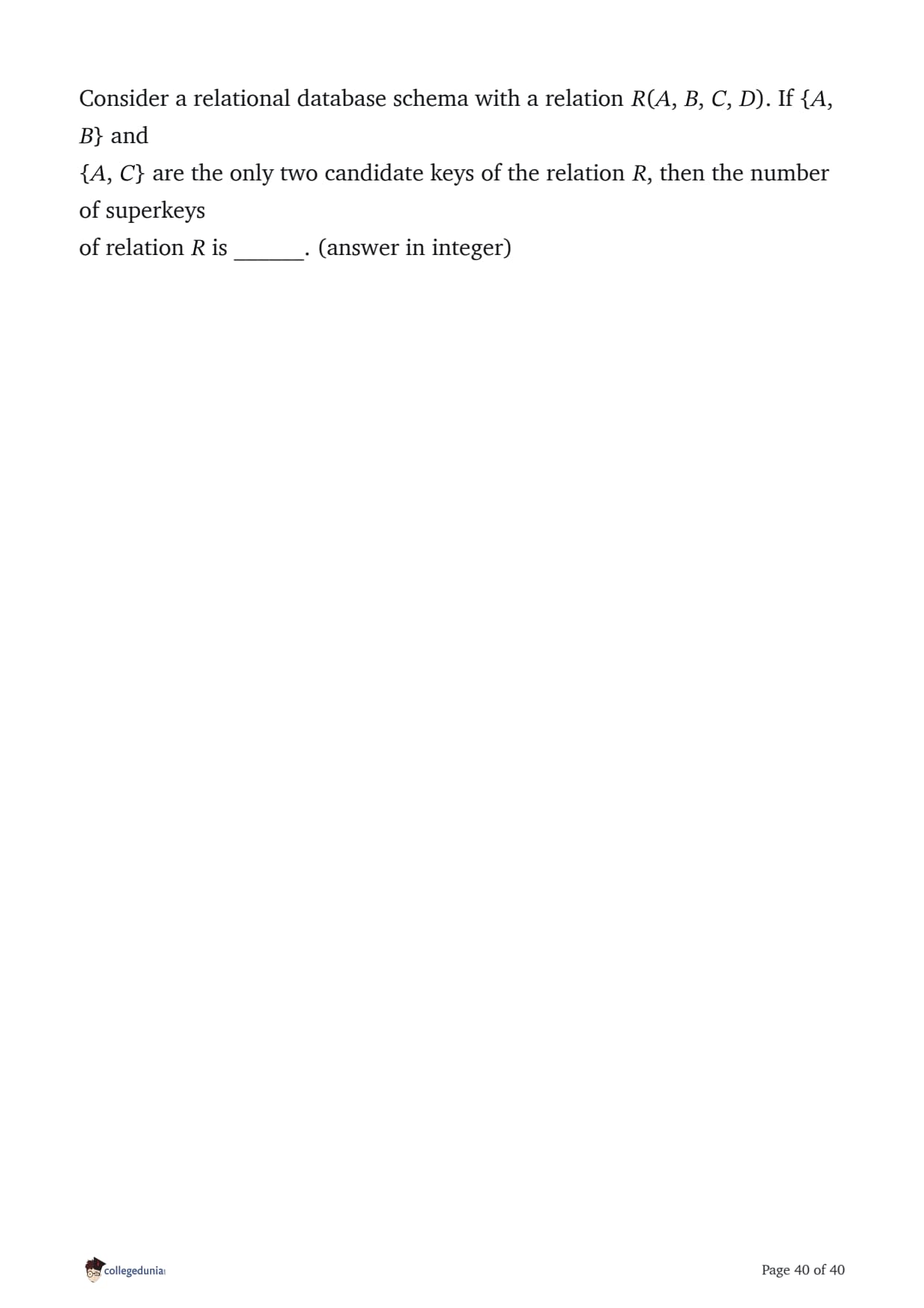
Consider a relational database schema with a relation ????(????, ????, ????, ????). If {????, ????} and
{????, ????} are the only two candidate keys of the relation ????, then the number of superkeys
of relation ???? is ______. (answer in integer)
GATE 2026 CS-1 Exam Pattern and Marking Scheme Explained
The official GATE 2026 master paper confirms a 100-mark computer-based test with MCQ, MSQ, and NAT formats.
- Total questions: 65, including 10 General Aptitude questions
- Duration: 3 hours in one continuous session
- Question mix: 33 single-correct MCQs, 19 multiple-select questions, and 13 numerical-answer questions
- MCQ marking: one-third negative for a wrong 1-mark MCQ and two-thirds negative for a wrong 2-mark MCQ
- MSQ and NAT marking: no negative marking
High-Weightage Topics in GATE 2026 CS-1 from the Tagged Questions
The counts below come directly from the 65 resolved QACMS topic tags for this official session.
- Computer Organization and Architecture: 4 questions in the tagged paper
- Trees: 4 questions in the tagged paper
- Operating Systems: 4 questions in the tagged paper
- Probability: 3 questions in the tagged paper
- Digital Logic: 3 questions in the tagged paper
- Compiler Design: 3 questions in the tagged paper
GATE 2026 CS-1 Official Cutoff and Paper Verification
The official GATE 2026 cutoff page records a CS qualifying mark of 30 for GEN, 27 for OBC-NCL/EWS, and 20 for SC/ST/PwD. IIT Guwahati reports 259,922 registrations and 211,020 appearances for CS.
- Official GATE 2026 master question papers and answer keys
- Official GATE 2026 examination schedule
- Official GATE 2026 CS cutoff marks
GATE 2026 CS-1 Question Paper Detailed Solution Video
Source: YouTube
How to Use the GATE 2026 CS-1 Question Paper for Practice
Use the official timing and the linked explanations to turn this paper into a complete revision test.
- Attempt all 65 questions in a strict 180-minute window
- Check MCQ, MSQ, and NAT responses against the official key after the attempt
- Open the per-question links for step-by-step reasoning instead of checking only the final answer
- Redo questions from the six highest-count topics listed above
- Use the GATE virtual scientific calculator during numerical practice; physical calculators are not permitted
GATE 2026 CS-1 Question Paper with Solutions FAQs
Ques. Where can I download the GATE 2026 CS-1 question paper with solutions PDF?
Ans. Use the Download PDF and Check Solutions links in the table above. The question booklet has 65 questions, and the companion PDF gives a detailed solution for every row.
Ques. Is the GATE 2026 CS-1 paper an official GATE 2026 paper?
Ans. Yes. The questions and all 65 answers were checked against IIT Guwahati's official master paper and associated answer key for this session.
Ques. How many MCQ, MSQ, and NAT questions were in GATE 2026 CS-1?
Ans. The paper contained 33 single-correct MCQs, 19 multiple-select questions, and 13 numerical-answer questions.
Ques. What was the GATE 2026 CS qualifying cutoff?
Ans. The official cutoff was 30 marks for GEN, 27 for OBC-NCL/EWS, and 20 for SC/ST/PwD.
Ques. Can I use a physical calculator while solving GATE CS papers?
Ans. No. GATE provides a virtual scientific calculator inside the CBT interface; physical calculators are not allowed.
Ques. Was GATE 2026 CS conducted in two sessions?
Ans. Yes. CS-1 ran from 9:30 AM to 12:30 PM and CS-2 ran from 2:30 PM to 5:30 PM on February 8, 2026.



Comments