




The GATE 2026 Environmental Science & Engineering (ES) question paper is now available with detailed solutions for free download. GATE 2026 ES was conducted by IIT Guwahati on February 7, 2026, in the forenoon shift (9:30 AM to 12:30 PM), and the paper carried 65 questions for 100 marks in 3 hours.
| GATE 2026 Environmental Science & Engineering Question Paper with Solutions | Download PDF | Check Solutions |

GATE 2026 Environmental Science & Engineering Questions with Solutions
Suresh said, “I did it yesterday.”
Which one of the following options is the correct form of this sentence in indirect speech?
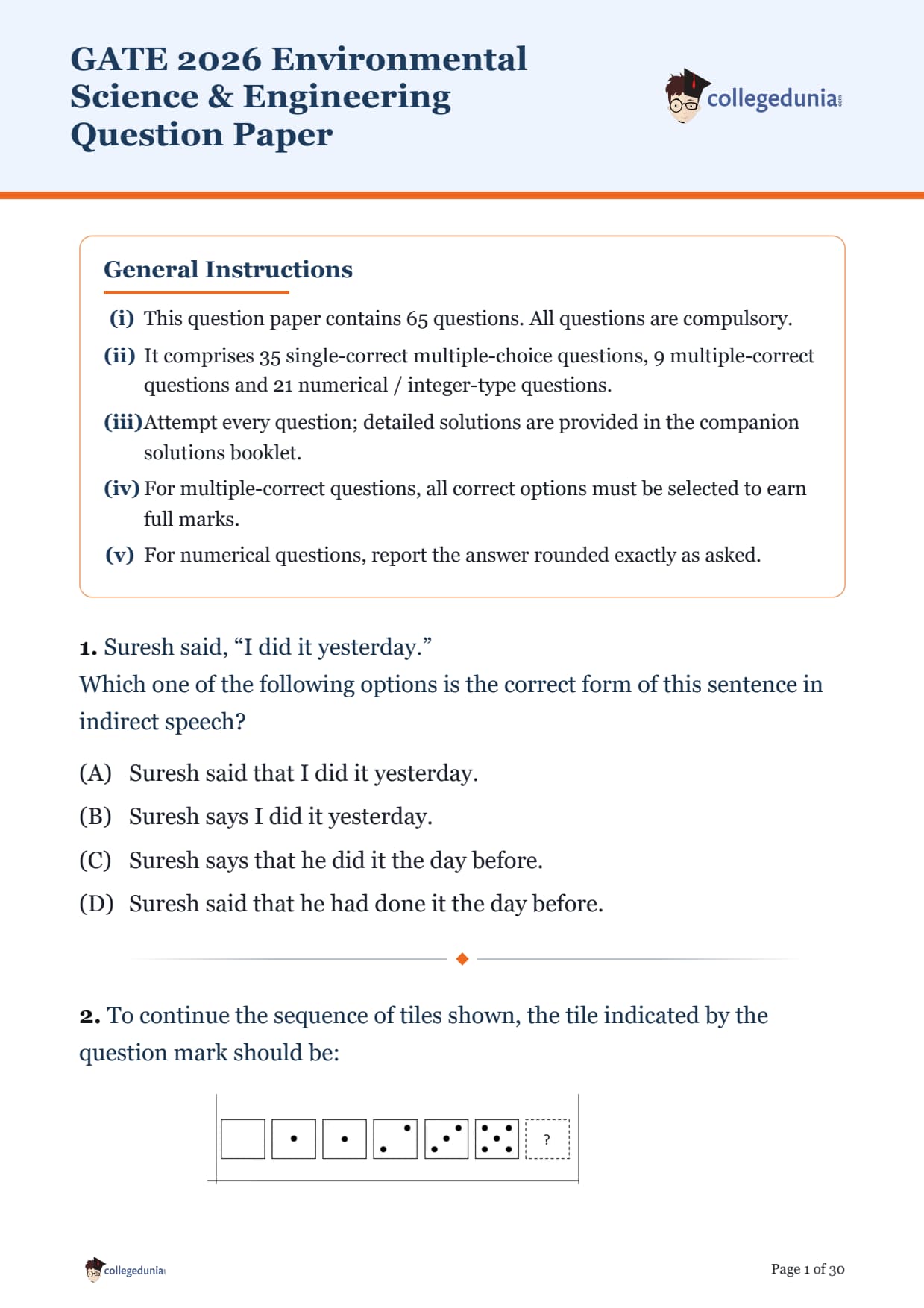
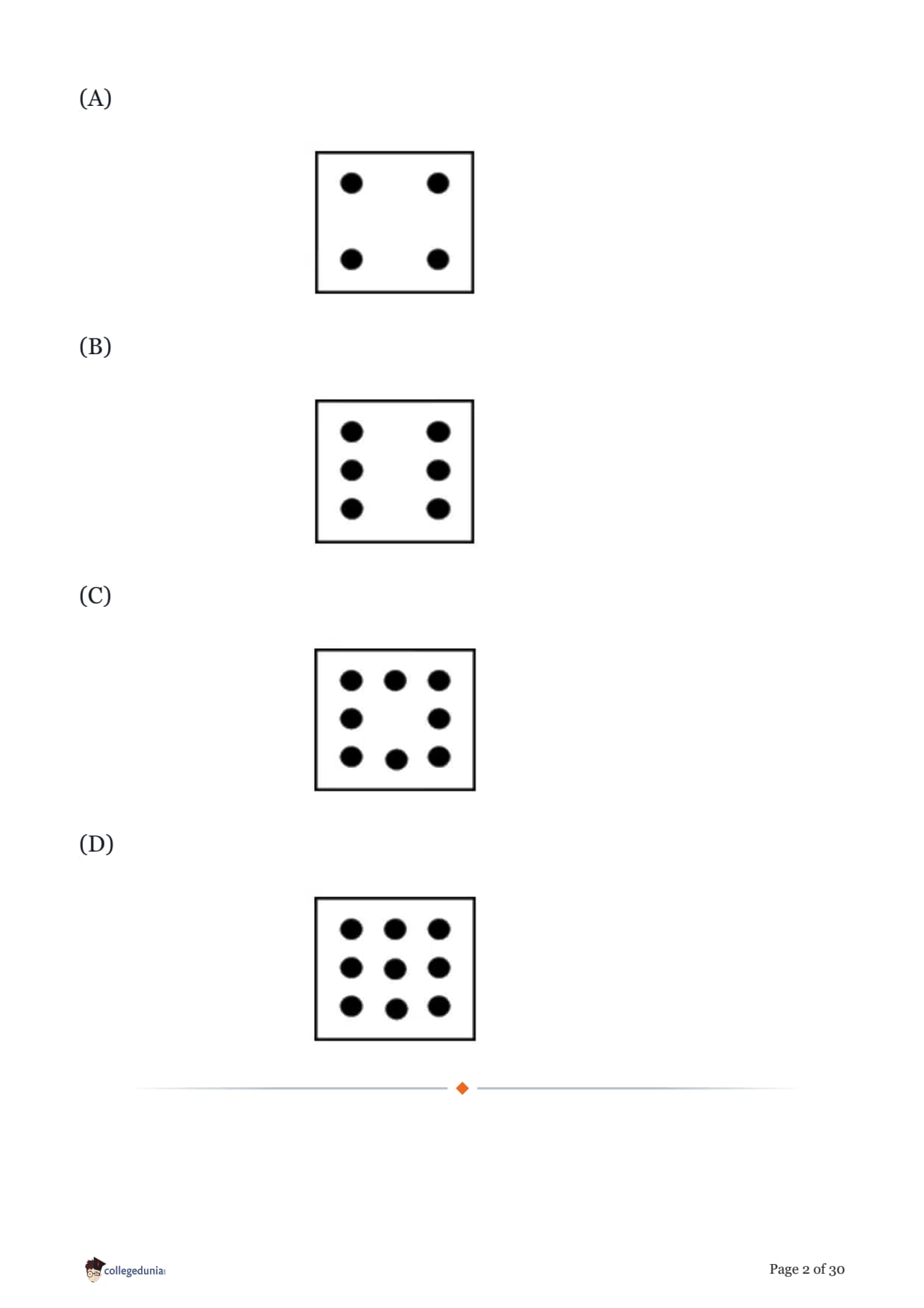
To continue the sequence of tiles shown, the tile indicated by the question mark should be:

- (A)
![]()
- (B)
![]()
- (C)
![]()
- (D)
![]()


Consider an art gallery whose walkways are shown as lines in the diagram. A black dot represents a junction of two walkways. A guard may be placed at a junction to watch over the walkways that join at that junction. The minimum number of guards needed to watch all the walkways is ________.

The 2nd of June is a Thursday in a certain year. Which day of the week is the 3rd of July in that year?
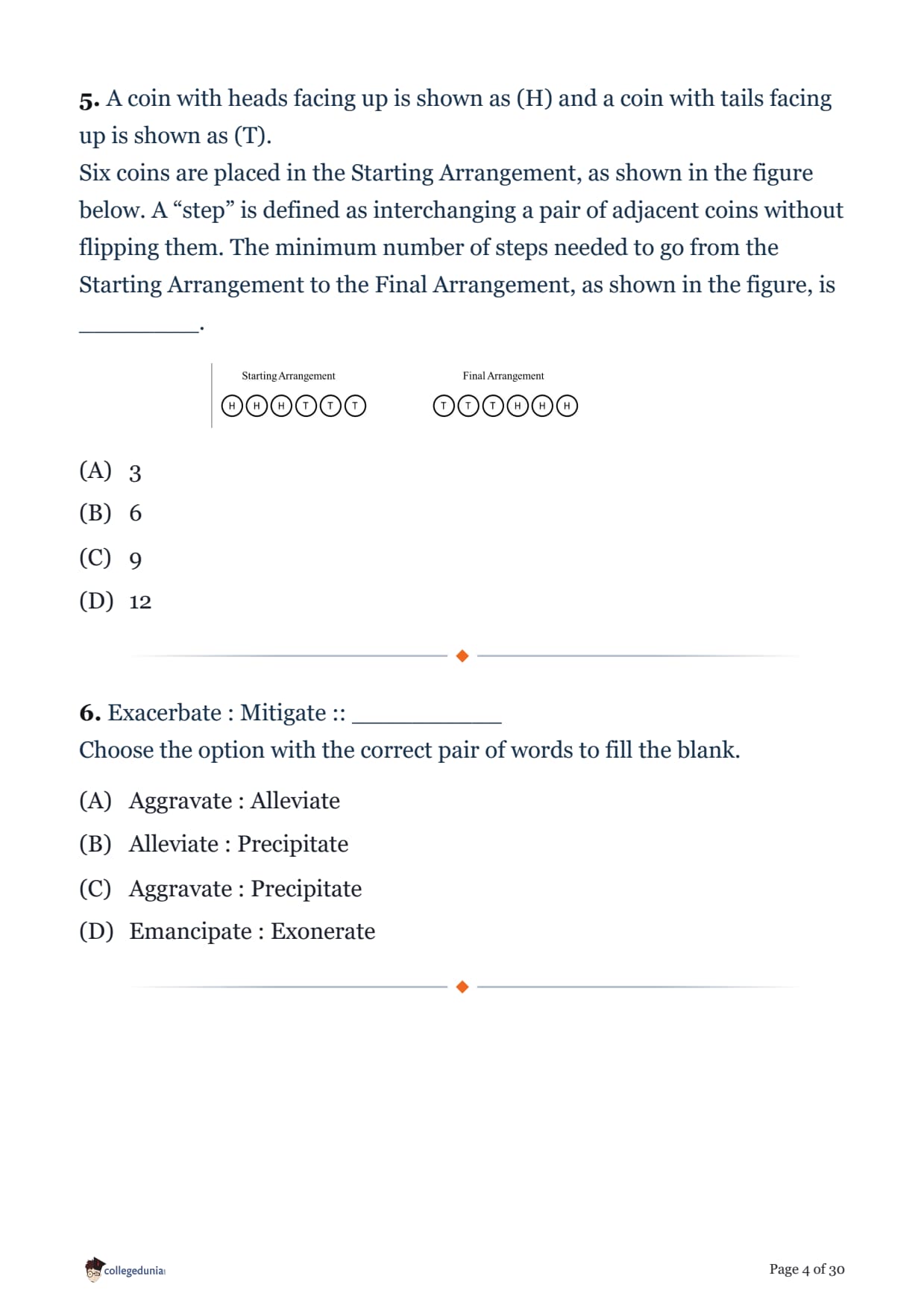
A coin with heads facing up is shown as (H) and a coin with tails facing up is shown as (T).
Six coins are placed in the Starting Arrangement, as shown in the figure below. A “step” is defined as interchanging a pair of adjacent coins without flipping them. The minimum number of steps needed to go from the Starting Arrangement to the Final Arrangement, as shown in the figure, is ________.

Exacerbate : Mitigate :: __________
Choose the option with the correct pair of words to fill the blank.
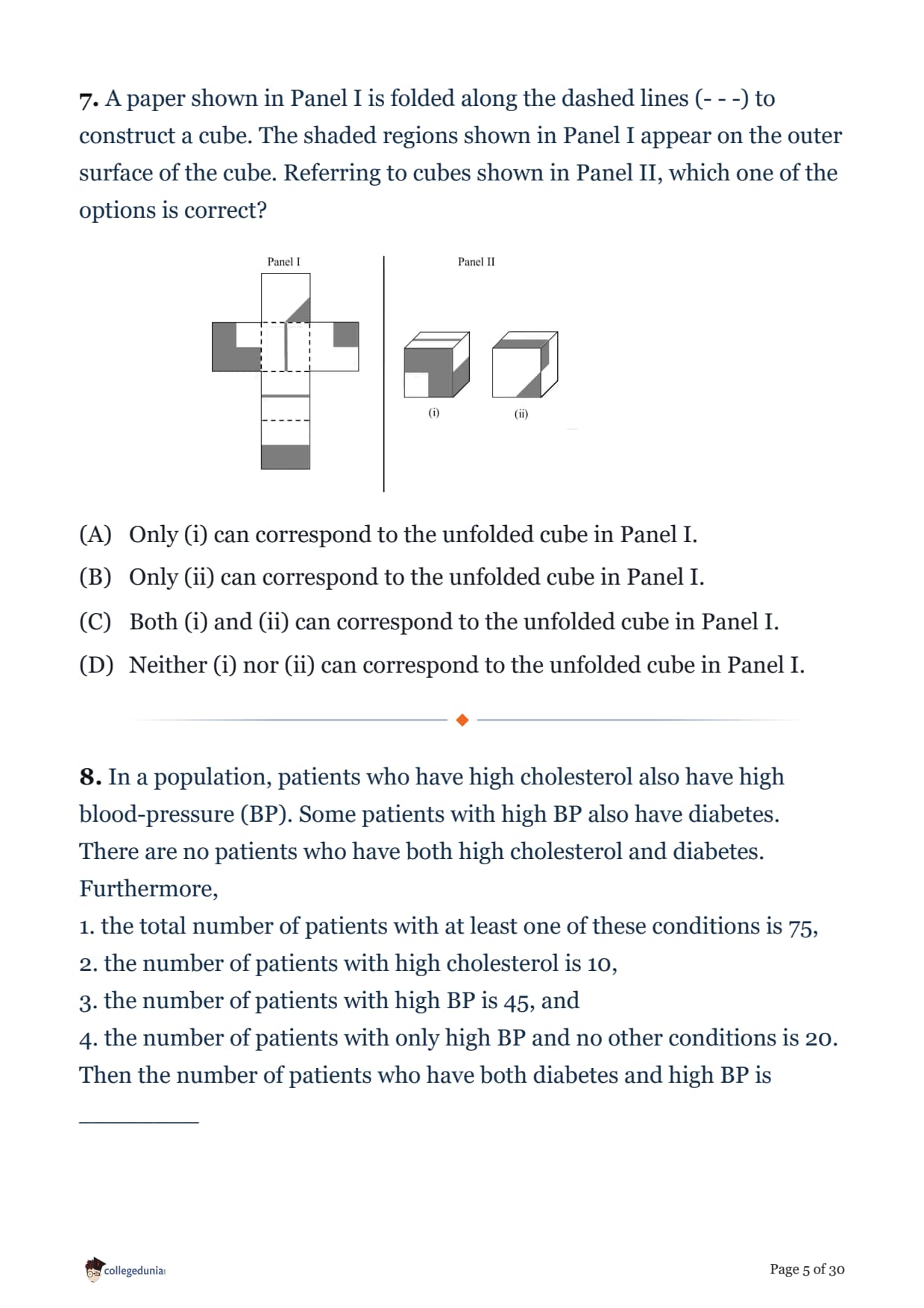
A paper shown in Panel I is folded along the dashed lines (- - -) to construct a cube. The shaded regions shown in Panel I appear on the outer surface of the cube. Referring to cubes shown in Panel II, which one of the options is correct?

In a population, patients who have high cholesterol also have high blood-pressure (BP). Some patients with high BP also have diabetes. There are no patients who have both high cholesterol and diabetes. Furthermore,
1. the total number of patients with at least one of these conditions is 75,
2. the number of patients with high cholesterol is 10,
3. the number of patients with high BP is 45, and
4. the number of patients with only high BP and no other conditions is 20.
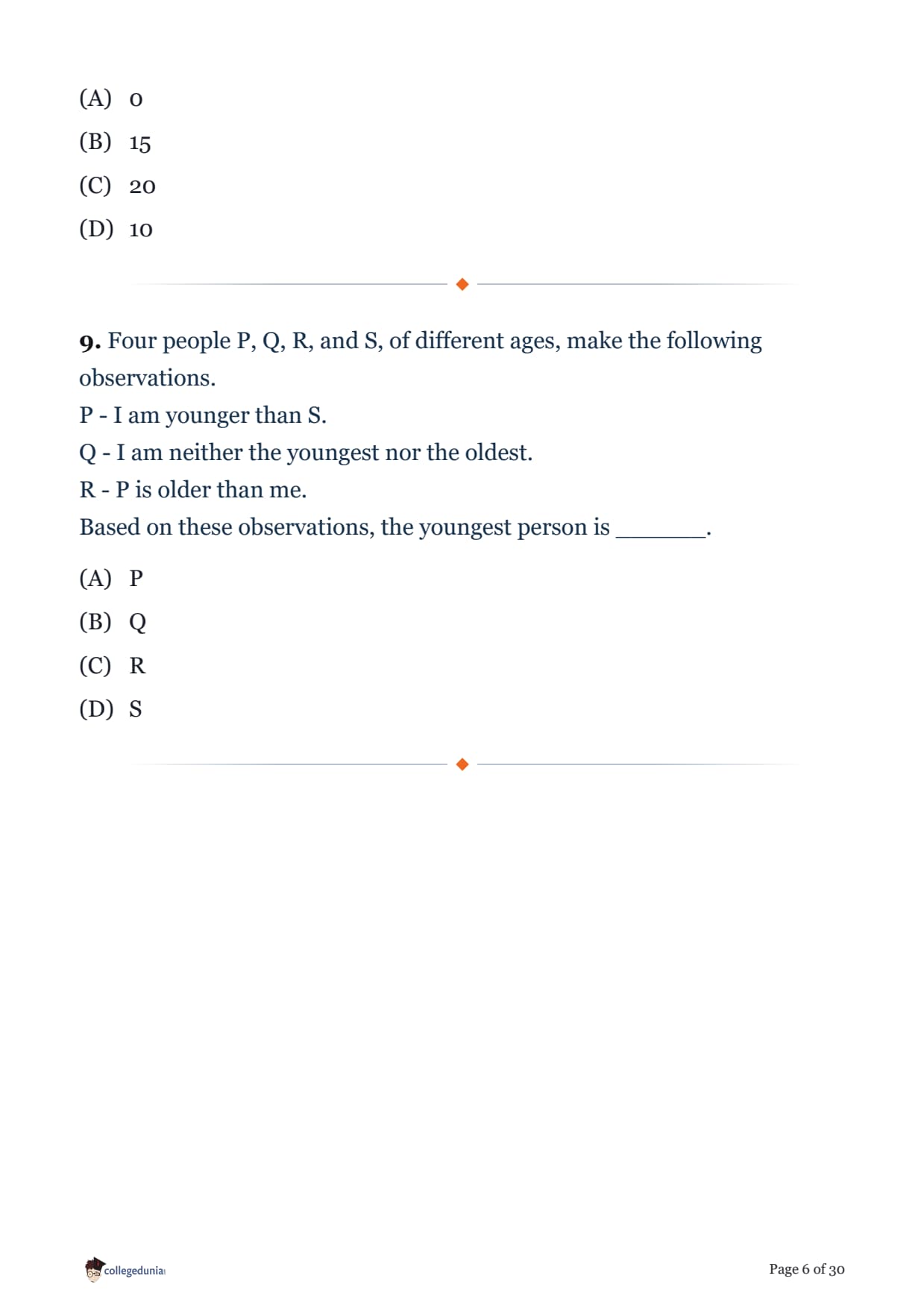
Then the number of patients who have both diabetes and high BP is ________
Four people P, Q, R, and S, of different ages, make the following observations.
P - I am younger than S.
Q - I am neither the youngest nor the oldest.
R - P is older than me.
Based on these observations, the youngest person is ______.
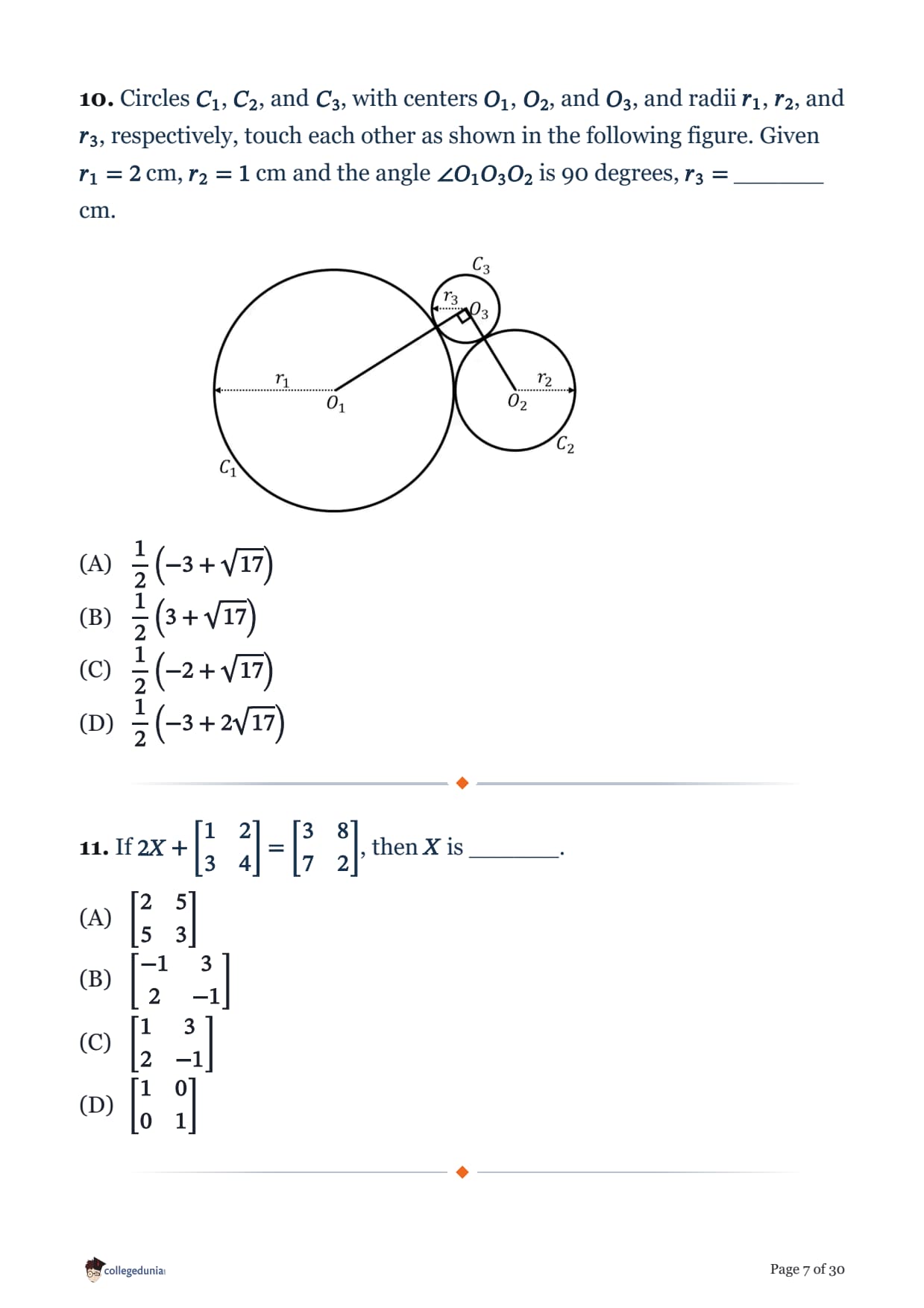
Circles \(C_1\), \(C_2\), and \(C_3\), with centers \(O_1\), \(O_2\), and \(O_3\), and radii \(r_1\), \(r_2\), and \(r_3\), respectively, touch each other as shown in the following figure. Given \(r_1 = 2\) cm, \(r_2 = 1\) cm and the angle \(\angle O_1 O_3 O_2\) is 90 degrees, \(r_3 =\) ______ cm.

If \(2X + \begin{bmatrix} 1 & 2 \\ 3 & 4 \end{bmatrix} = \begin{bmatrix} 3 & 8 \\ 7 & 2 \end{bmatrix}\), then \(X\) is ______.
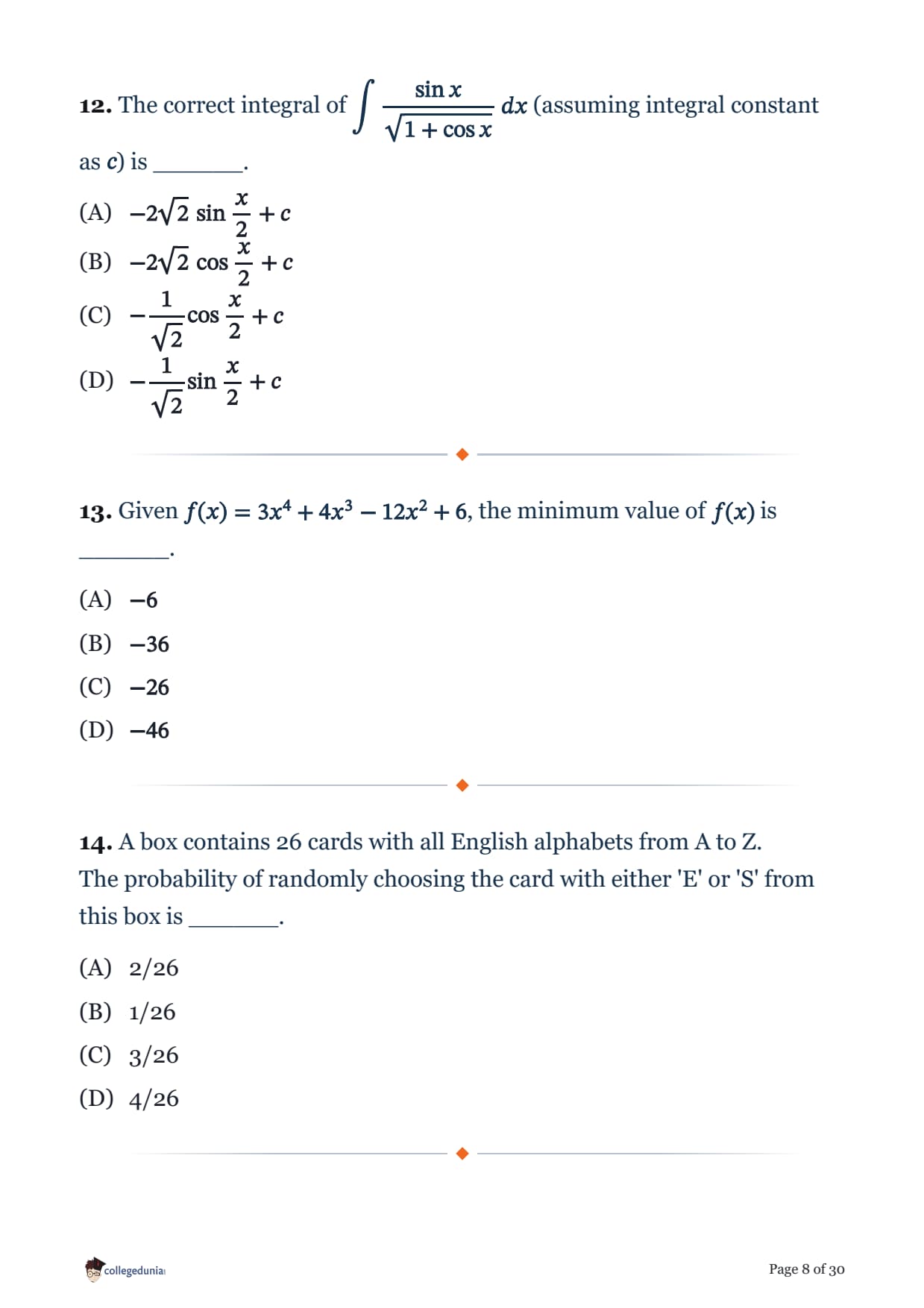
The correct integral of \(\displaystyle\int \frac{\sin x}{\sqrt{1+\cos x}}\,dx\) (assuming integral constant as \(c\)) is ______.
Given \(f(x) = 3x^4 + 4x^3 - 12x^2 + 6\), the minimum value of \(f(x)\) is ______.
A box contains 26 cards with all English alphabets from A to Z.
The probability of randomly choosing the card with either 'E' or 'S' from this box is ______.
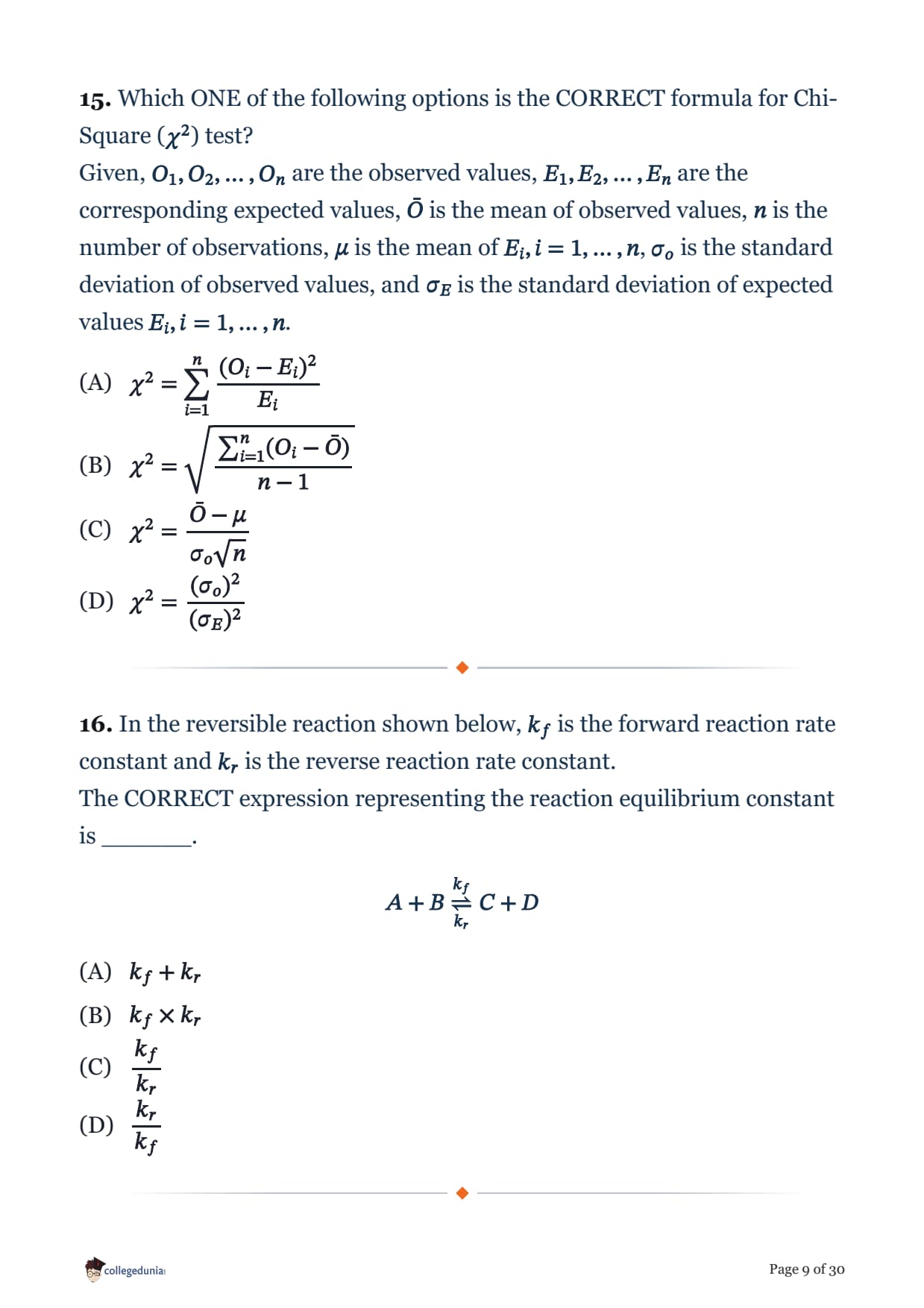
Which ONE of the following options is the CORRECT formula for Chi-Square (\(\chi^2\)) test?
Given, \(O_1, O_2, \ldots, O_n\) are the observed values, \(E_1, E_2, \ldots, E_n\) are the corresponding expected values, \(\bar{O}\) is the mean of observed values, \(n\) is the number of observations, \(\mu\) is the mean of \(E_i, i = 1, \ldots, n\), \(\sigma_o\) is the standard deviation of observed values, and \(\sigma_E\) is the standard deviation of expected values \(E_i, i = 1, \ldots, n\).
In the reversible reaction shown below, \(k_f\) is the forward reaction rate constant and \(k_r\) is the reverse reaction rate constant.
The CORRECT expression representing the reaction equilibrium constant is ______.
\[A + B \underset{k_r}{\overset{k_f}{\rightleftharpoons}} C + D\]
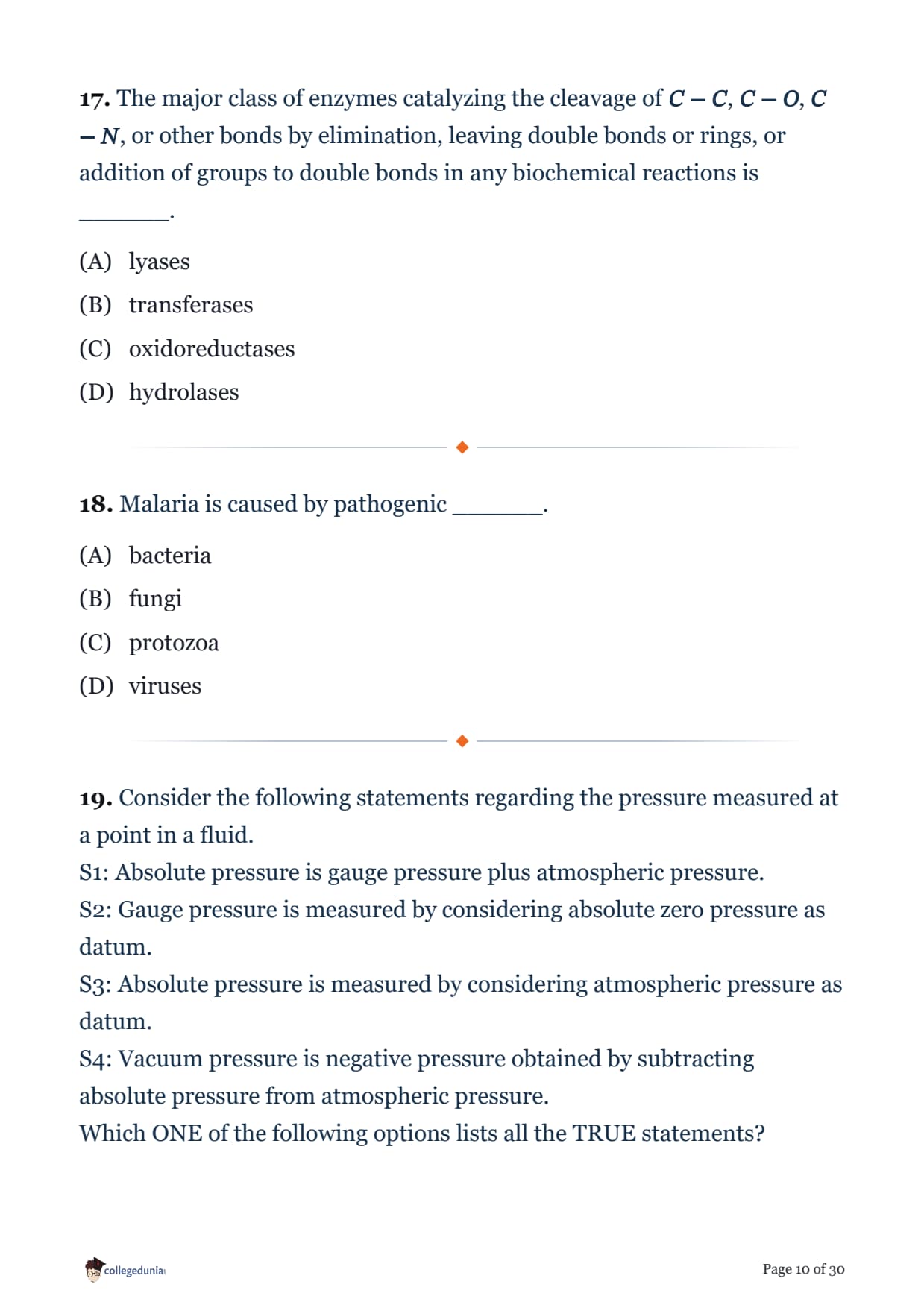
The major class of enzymes catalyzing the cleavage of \(C-C\), \(C-O\), \(C-N\), or other bonds by elimination, leaving double bonds or rings, or addition of groups to double bonds in any biochemical reactions is ______.
Malaria is caused by pathogenic ______.
Consider the following statements regarding the pressure measured at a point in a fluid.
S1: Absolute pressure is gauge pressure plus atmospheric pressure.
S2: Gauge pressure is measured by considering absolute zero pressure as datum.
S3: Absolute pressure is measured by considering atmospheric pressure as datum.
S4: Vacuum pressure is negative pressure obtained by subtracting absolute pressure from atmospheric pressure.
Which ONE of the following options lists all the TRUE statements?
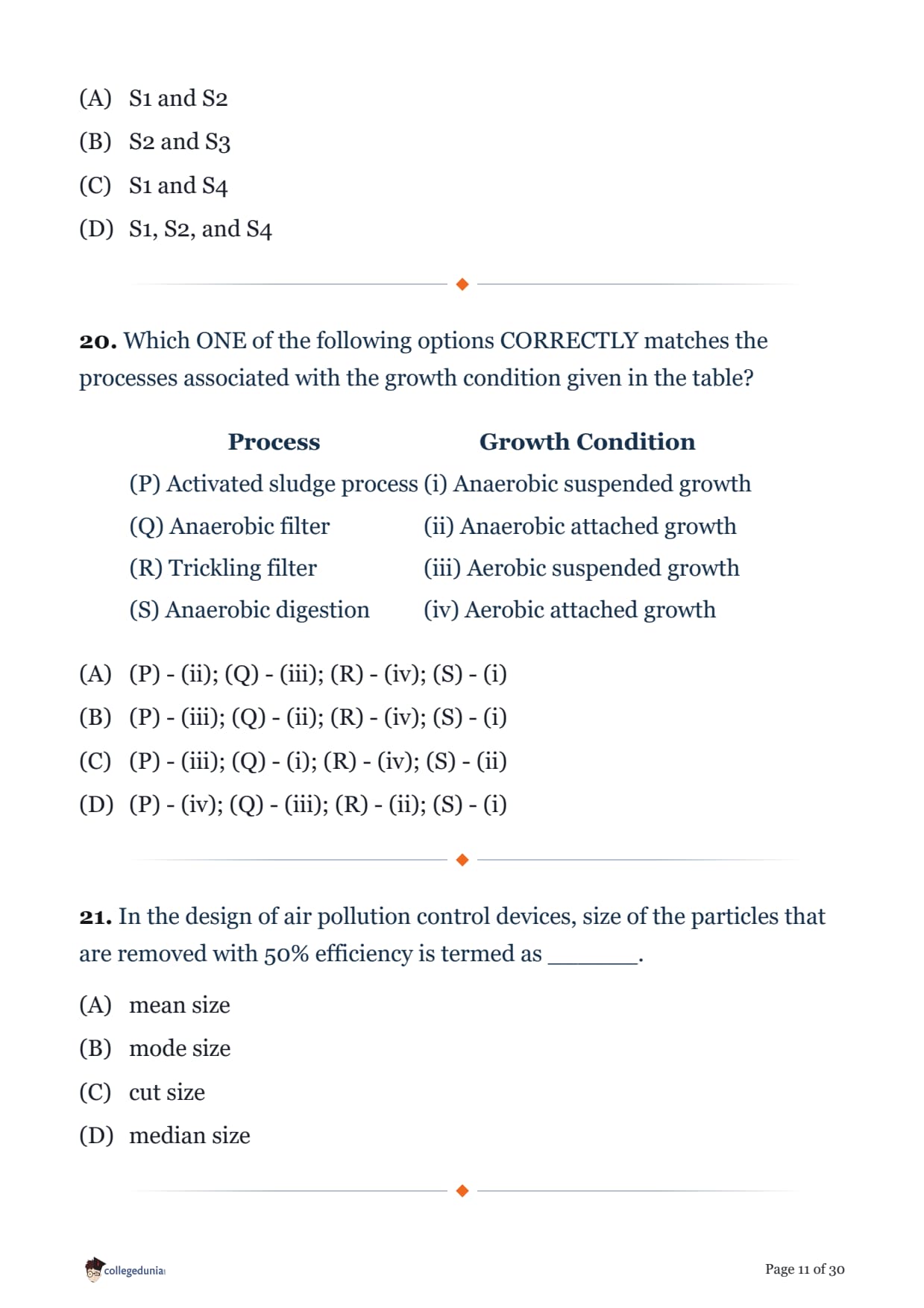
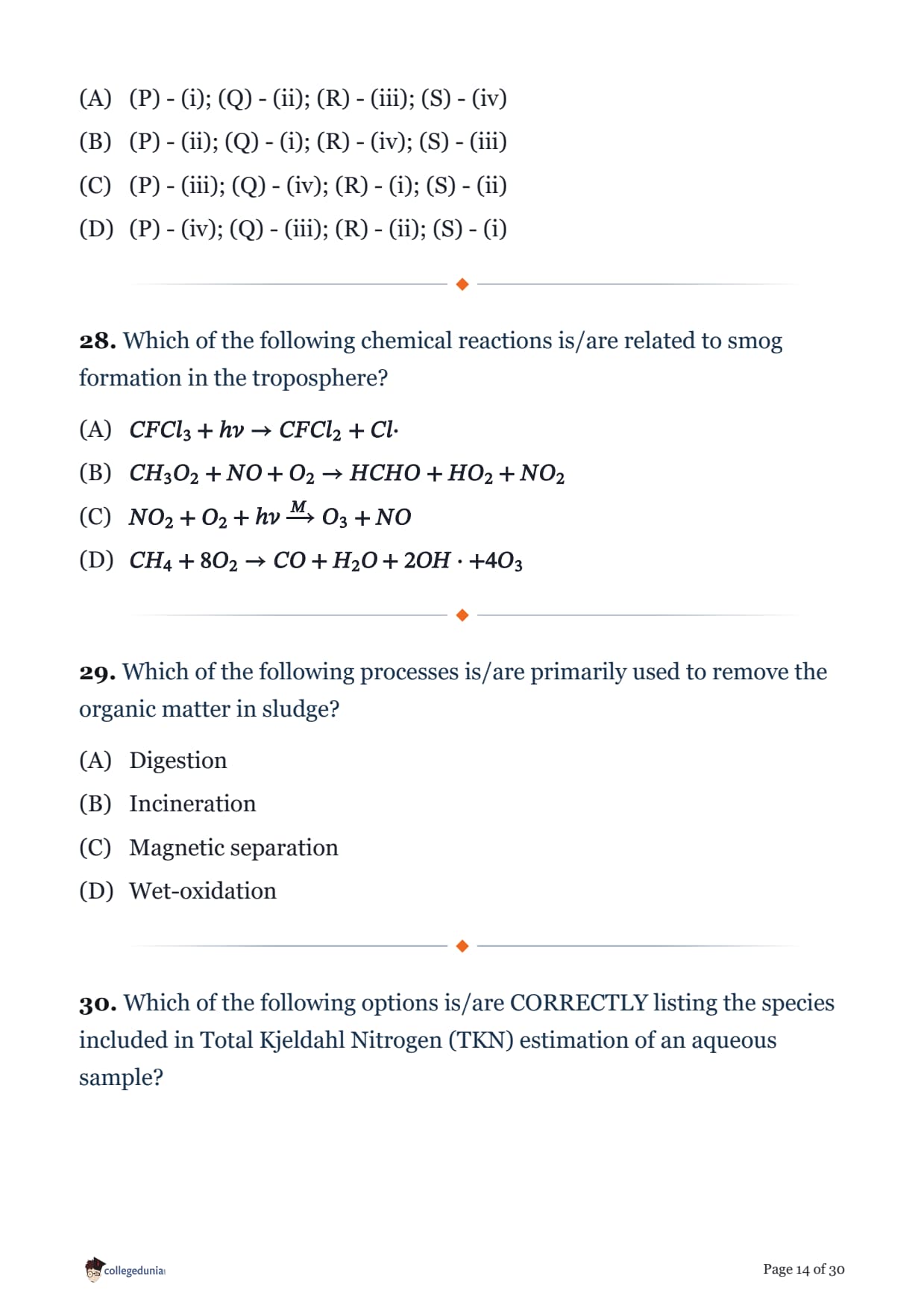
Which ONE of the following options CORRECTLY matches the processes associated with the growth condition given in the table?
| Process | Growth Condition |
|---|---|
| (P) Activated sludge process | (i) Anaerobic suspended growth |
| (Q) Anaerobic filter | (ii) Anaerobic attached growth |
| (R) Trickling filter | (iii) Aerobic suspended growth |
| (S) Anaerobic digestion | (iv) Aerobic attached growth |
In the design of air pollution control devices, size of the particles that are removed with 50% efficiency is termed as ______.
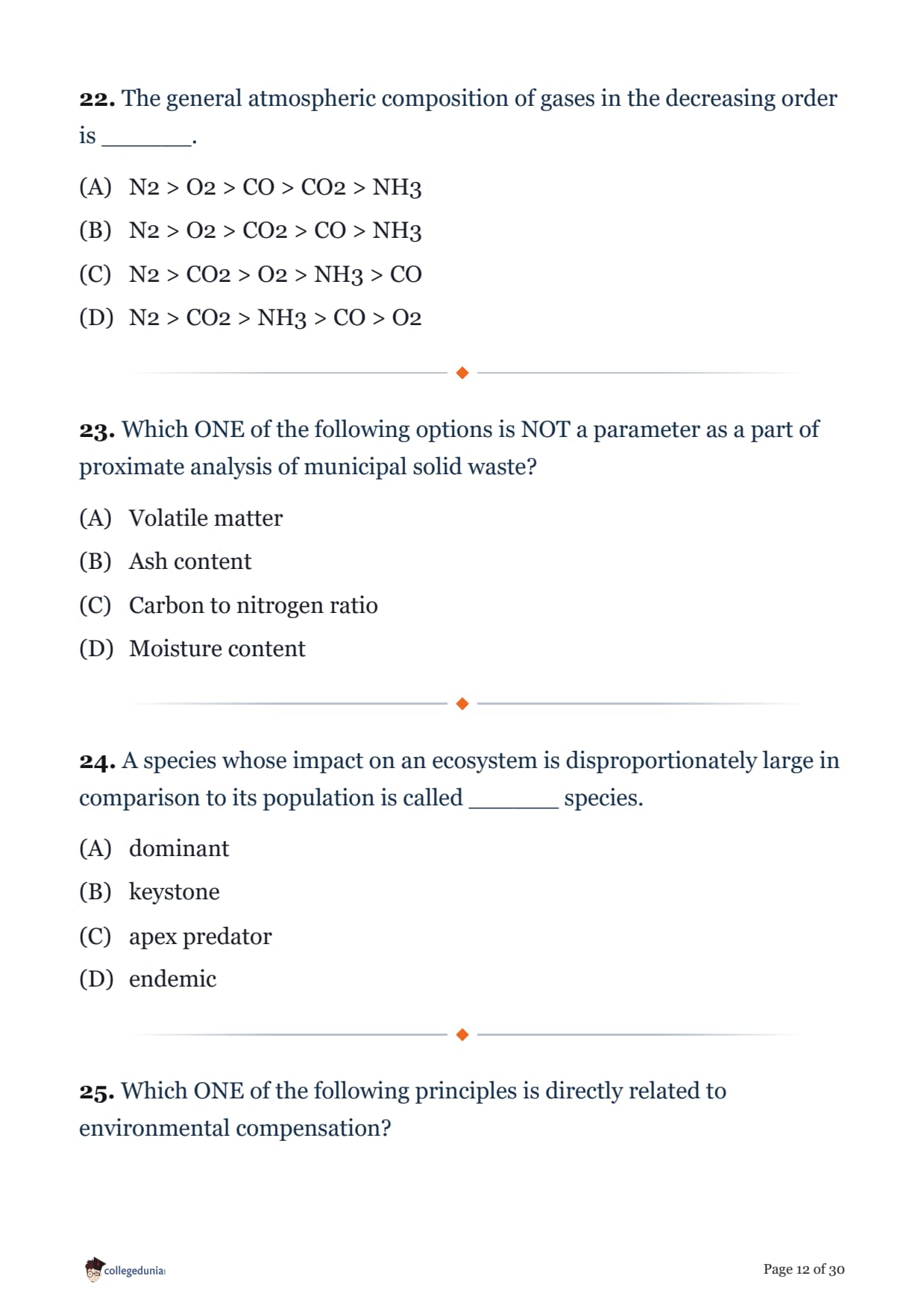
The general atmospheric composition of gases in the decreasing order is ______.
Which ONE of the following options is NOT a parameter as a part of proximate analysis of municipal solid waste?
A species whose impact on an ecosystem is disproportionately large in comparison to its population is called ______ species.
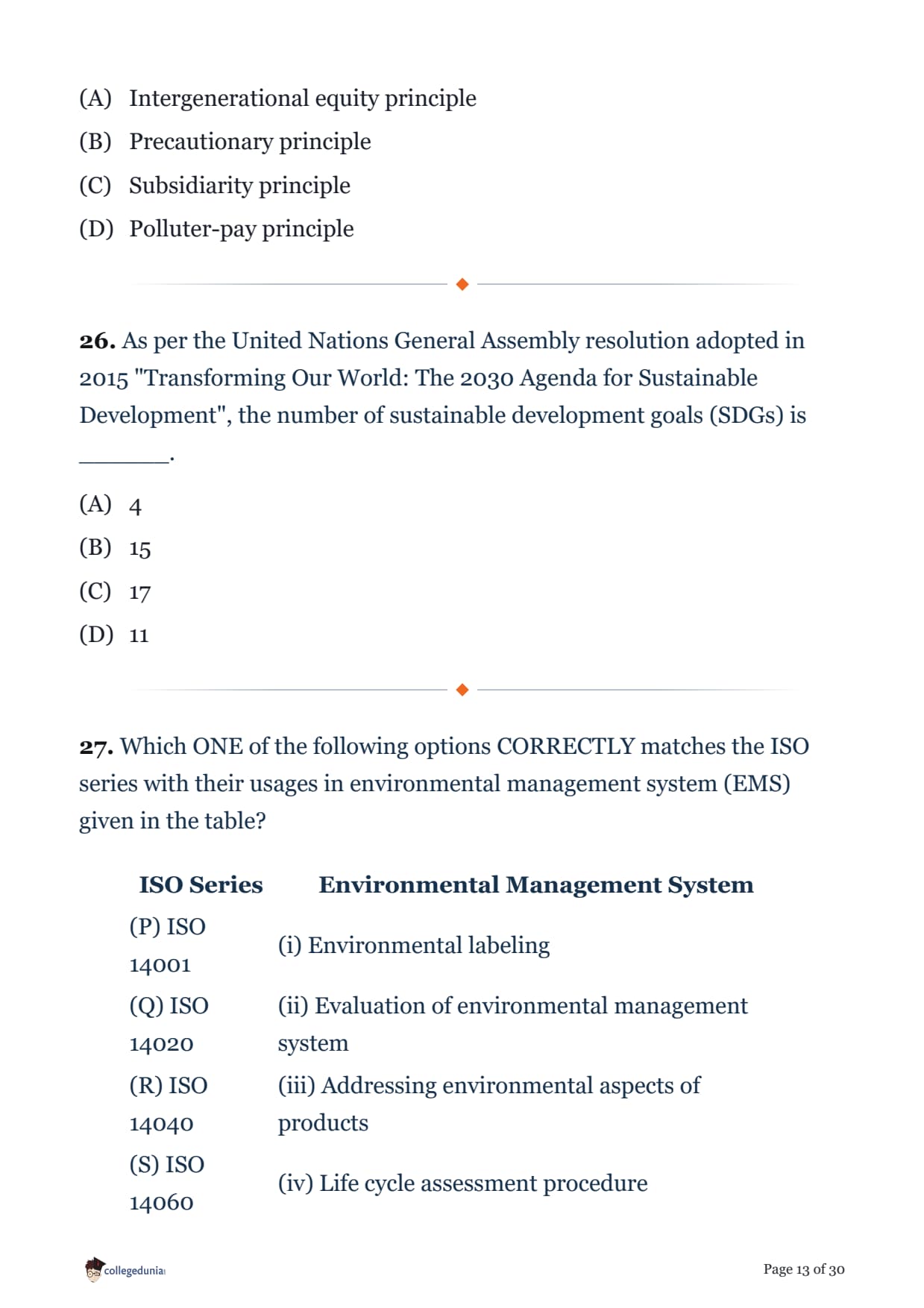
Which ONE of the following principles is directly related to environmental compensation?
As per the United Nations General Assembly resolution adopted in 2015 "Transforming Our World: The 2030 Agenda for Sustainable Development", the number of sustainable development goals (SDGs) is ______.
Which ONE of the following options CORRECTLY matches the ISO series with their usages in environmental management system (EMS) given in the table?
| ISO Series | Environmental Management System |
|---|---|
| (P) ISO 14001 | (i) Environmental labeling |
| (Q) ISO 14020 | (ii) Evaluation of environmental management system |
| (R) ISO 14040 | (iii) Addressing environmental aspects of products |
| (S) ISO 14060 | (iv) Life cycle assessment procedure |
Which of the following chemical reactions is/are related to smog formation in the troposphere?
Which of the following processes is/are primarily used to remove the organic matter in sludge?
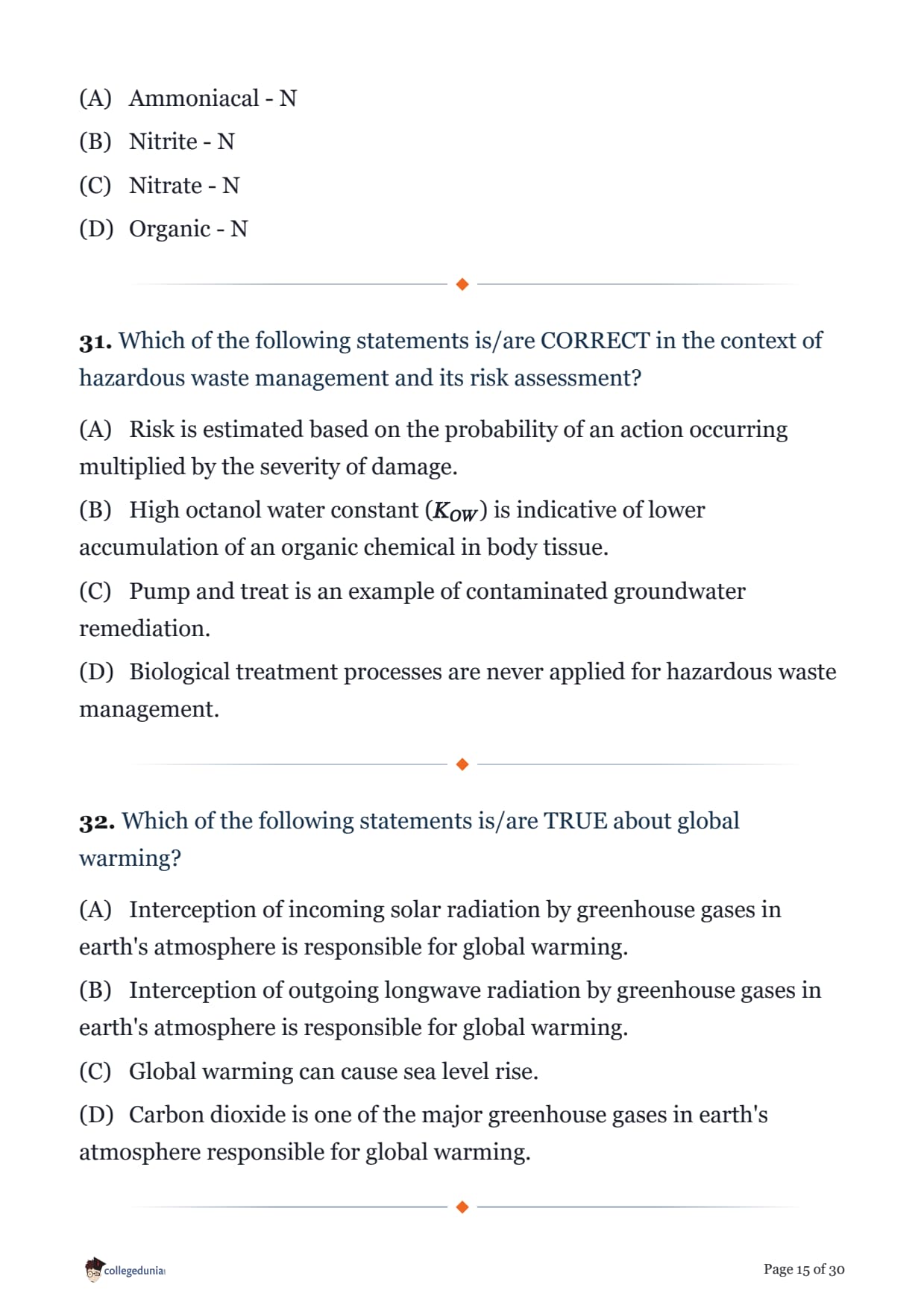
Which of the following options is/are CORRECTLY listing the species included in Total Kjeldahl Nitrogen (TKN) estimation of an aqueous sample?
Which of the following statements is/are CORRECT in the context of hazardous waste management and its risk assessment?
Which of the following statements is/are TRUE about global warming?
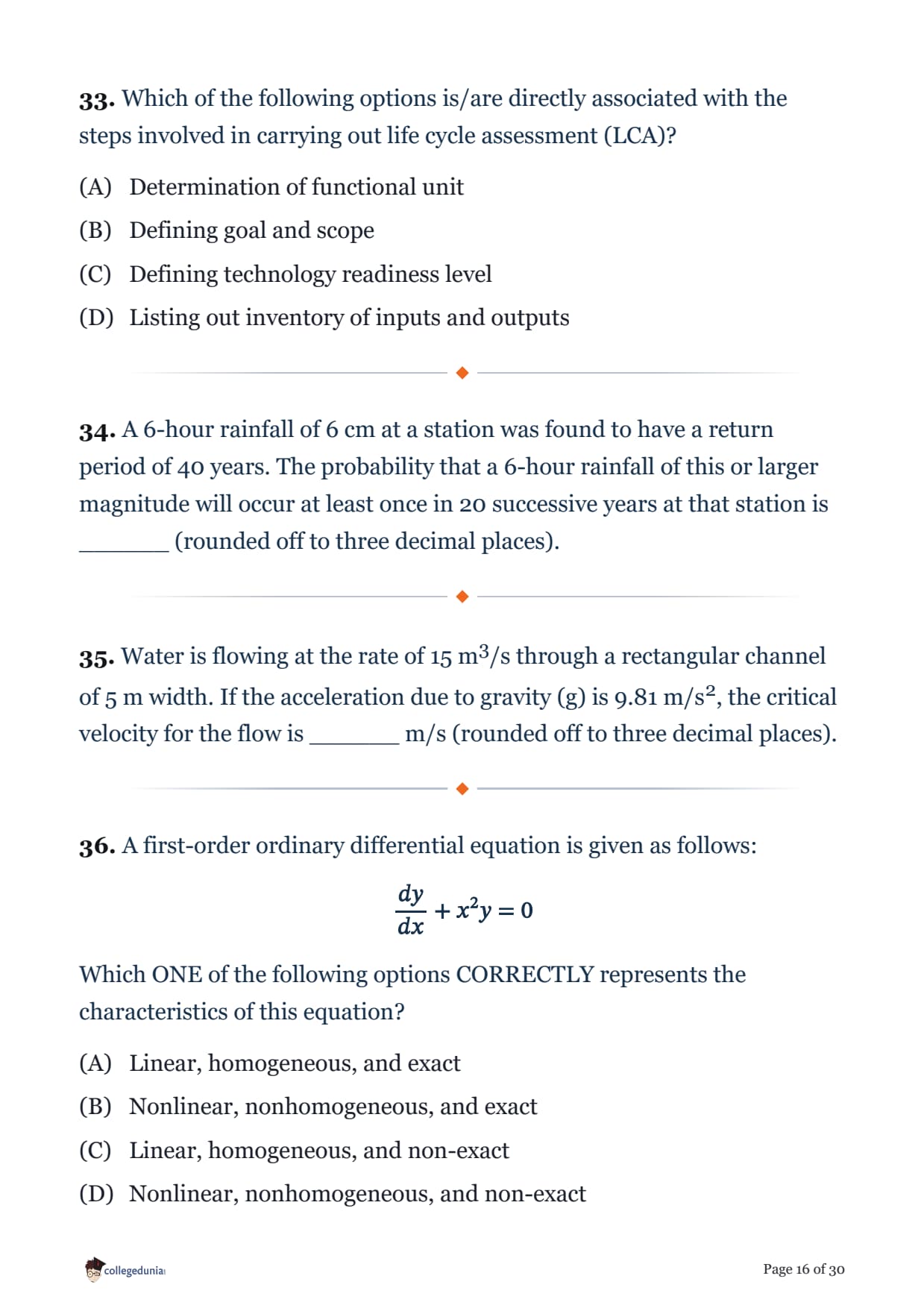
Which of the following options is/are directly associated with the steps involved in carrying out life cycle assessment (LCA)?
A 6-hour rainfall of 6 cm at a station was found to have a return period of 40 years. The probability that a 6-hour rainfall of this or larger magnitude will occur at least once in 20 successive years at that station is ______ (rounded off to three decimal places).
Water is flowing at the rate of 15 m3/s through a rectangular channel of 5 m width. If the acceleration due to gravity (g) is 9.81 m/s2, the critical velocity for the flow is ______ m/s (rounded off to three decimal places).
A first-order ordinary differential equation is given as follows: \[\frac{dy}{dx} + x^2 y = 0\] Which ONE of the following options CORRECTLY represents the characteristics of this equation?
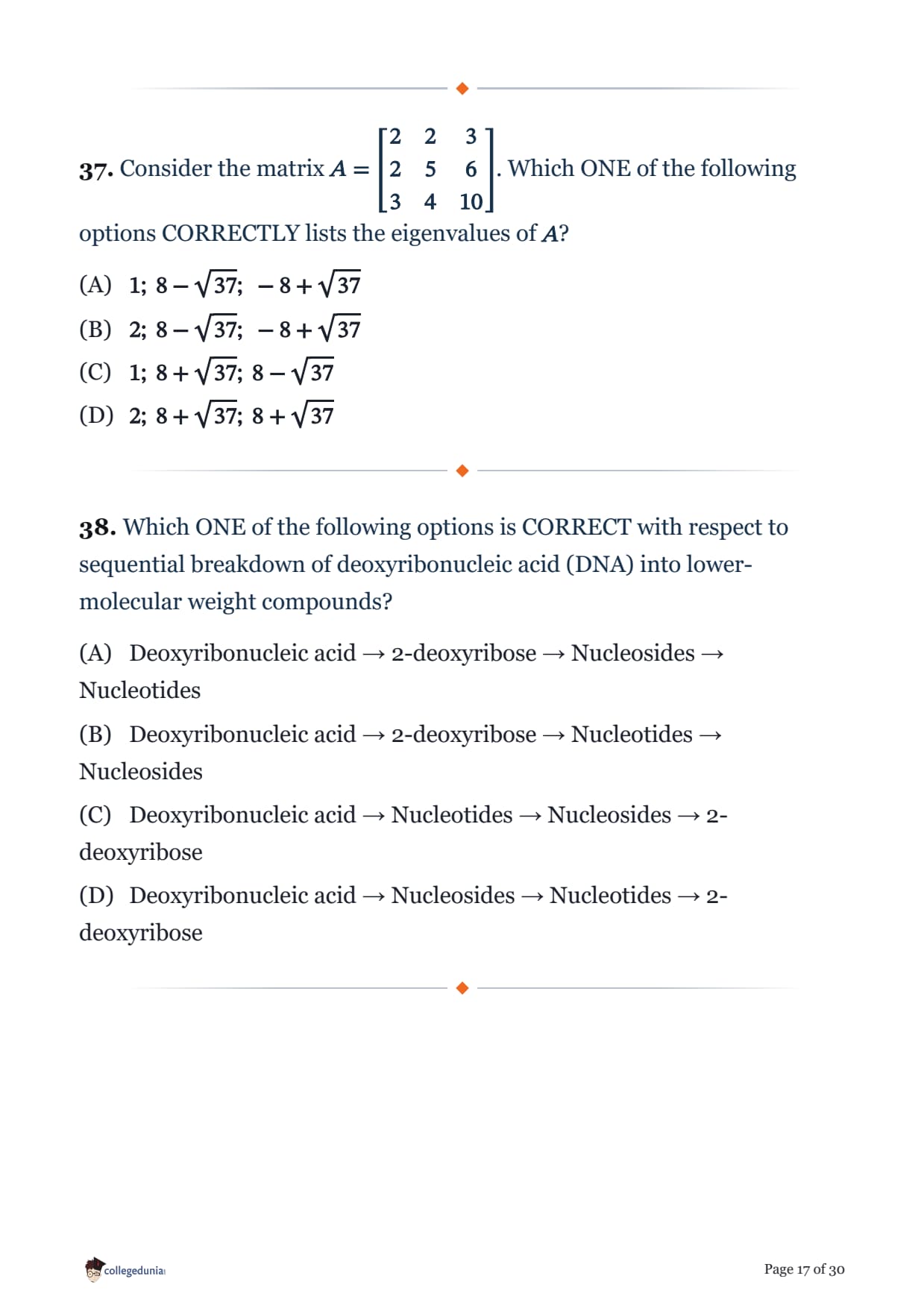
Consider the matrix \(A = \begin{bmatrix} 2 & 2 & 3 \\ 2 & 5 & 6 \\ 3 & 4 & 10 \end{bmatrix}\). Which ONE of the following options CORRECTLY lists the eigenvalues of \(A\)?
Which ONE of the following options is CORRECT with respect to sequential breakdown of deoxyribonucleic acid (DNA) into lower-molecular weight compounds?
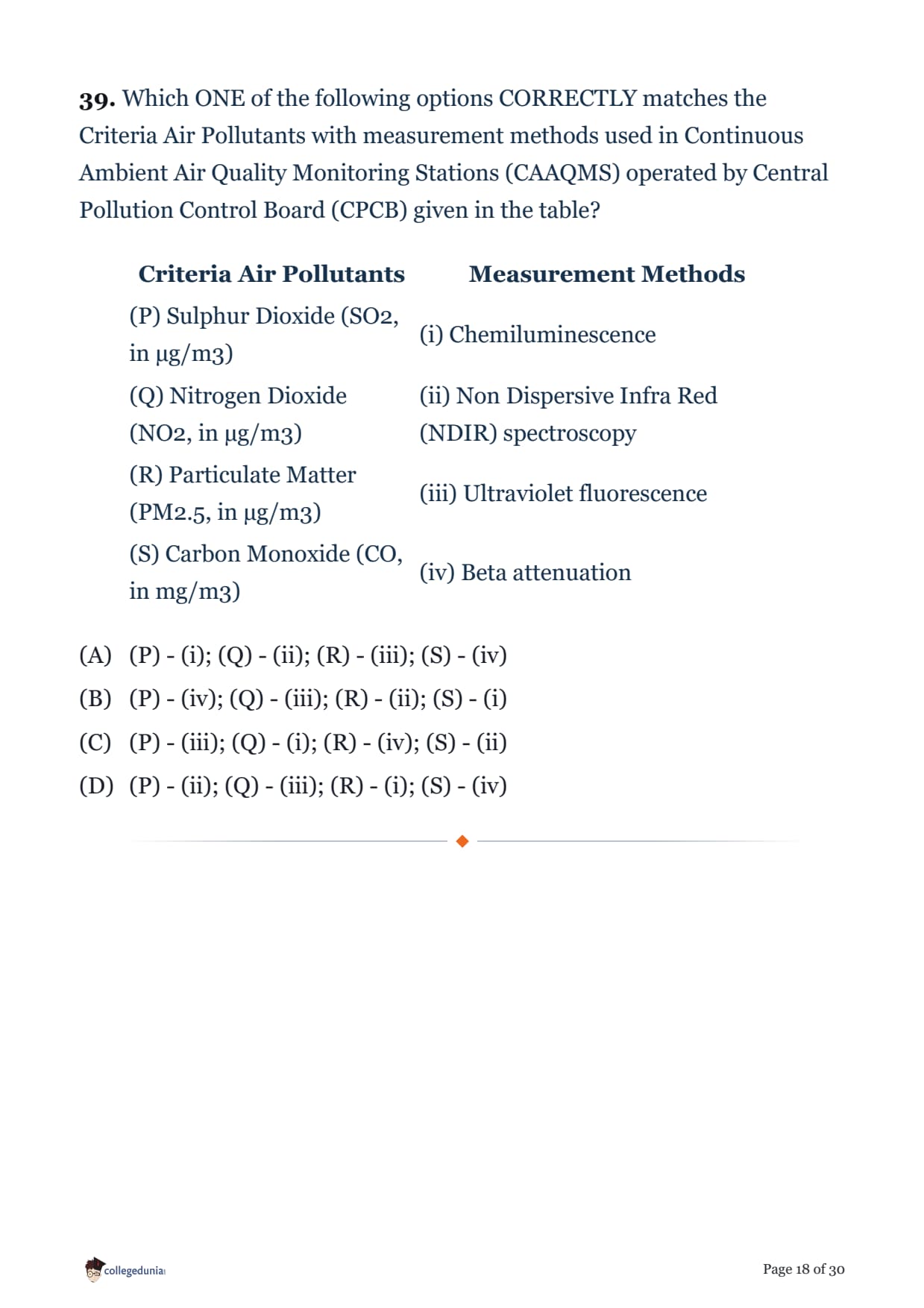
Which ONE of the following options CORRECTLY matches the Criteria Air Pollutants with measurement methods used in Continuous Ambient Air Quality Monitoring Stations (CAAQMS) operated by Central Pollution Control Board (CPCB) given in the table?
| Criteria Air Pollutants | Measurement Methods |
|---|---|
| (P) Sulphur Dioxide (SO2, in µg/m3) | (i) Chemiluminescence |
| (Q) Nitrogen Dioxide (NO2, in µg/m3) | (ii) Non Dispersive Infra Red (NDIR) spectroscopy |
| (R) Particulate Matter (PM2.5, in µg/m3) | (iii) Ultraviolet fluorescence |
| (S) Carbon Monoxide (CO, in mg/m3) | (iv) Beta attenuation |
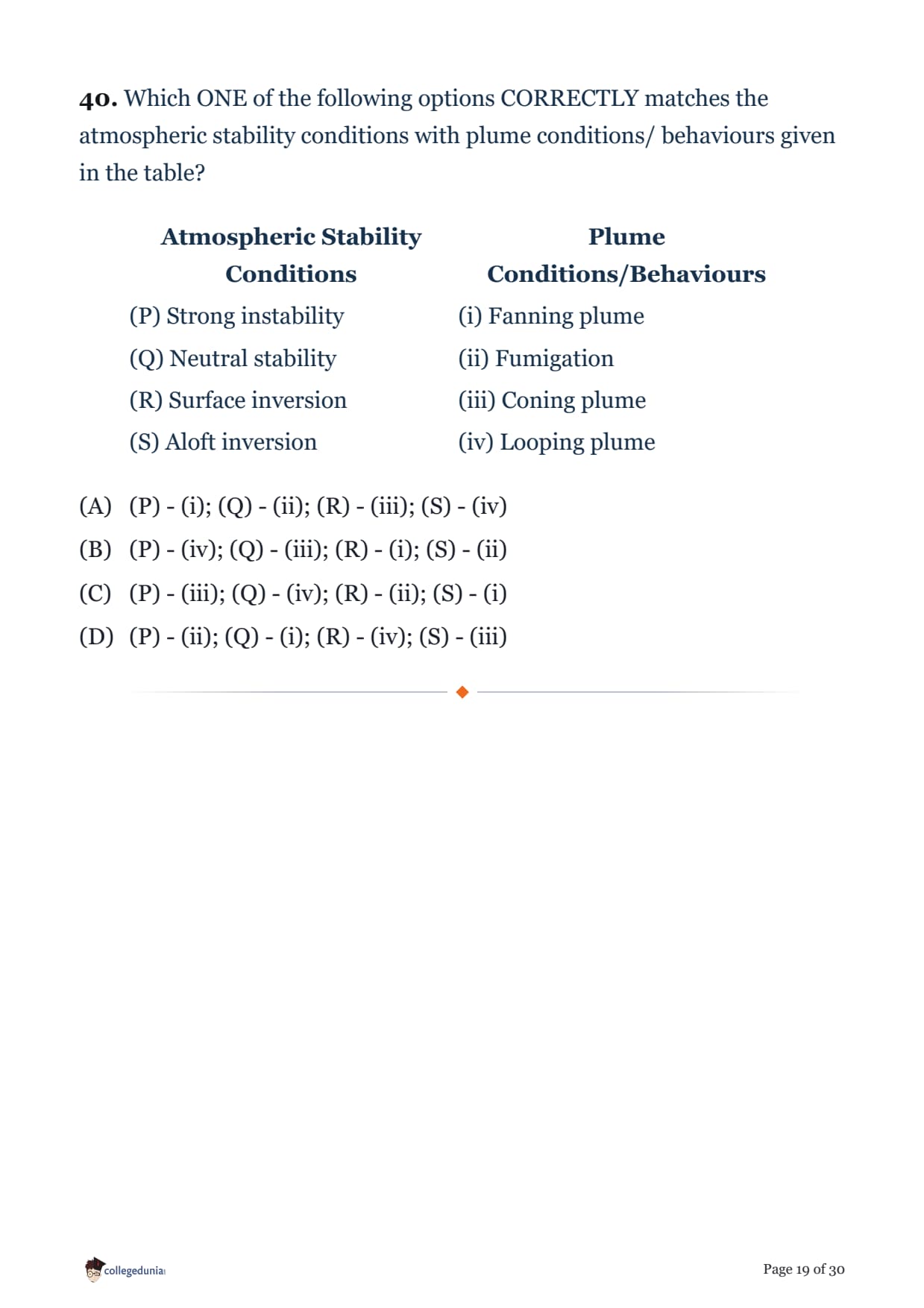
Which ONE of the following options CORRECTLY matches the atmospheric stability conditions with plume conditions/ behaviours given in the table?
| Atmospheric Stability Conditions | Plume Conditions/Behaviours |
|---|---|
| (P) Strong instability | (i) Fanning plume |
| (Q) Neutral stability | (ii) Fumigation |
| (R) Surface inversion | (iii) Coning plume |
| (S) Aloft inversion | (iv) Looping plume |
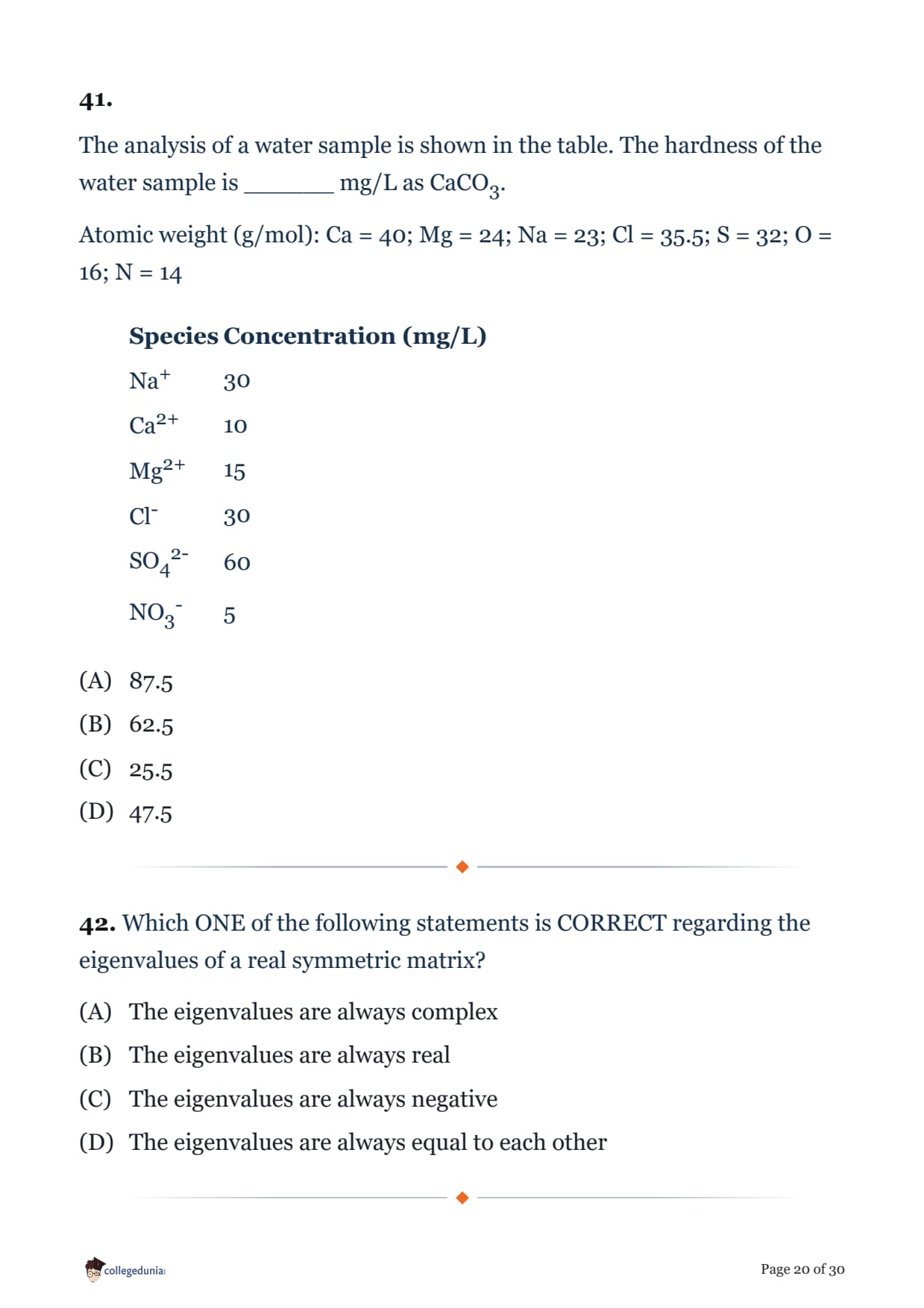
The analysis of a water sample is shown in the table. The hardness of the water sample is ______ mg/L as CaCO3.
Atomic weight (g/mol): Ca = 40; Mg = 24; Na = 23; Cl = 35.5; S = 32; O = 16; N = 14
| Species | Concentration (mg/L) |
|---|---|
| Na+ | 30 |
| Ca2+ | 10 |
| Mg2+ | 15 |
| Cl- | 30 |
| SO42- | 60 |
| NO3- | 5 |
Which ONE of the following statements is CORRECT regarding the eigenvalues of a real symmetric matrix?
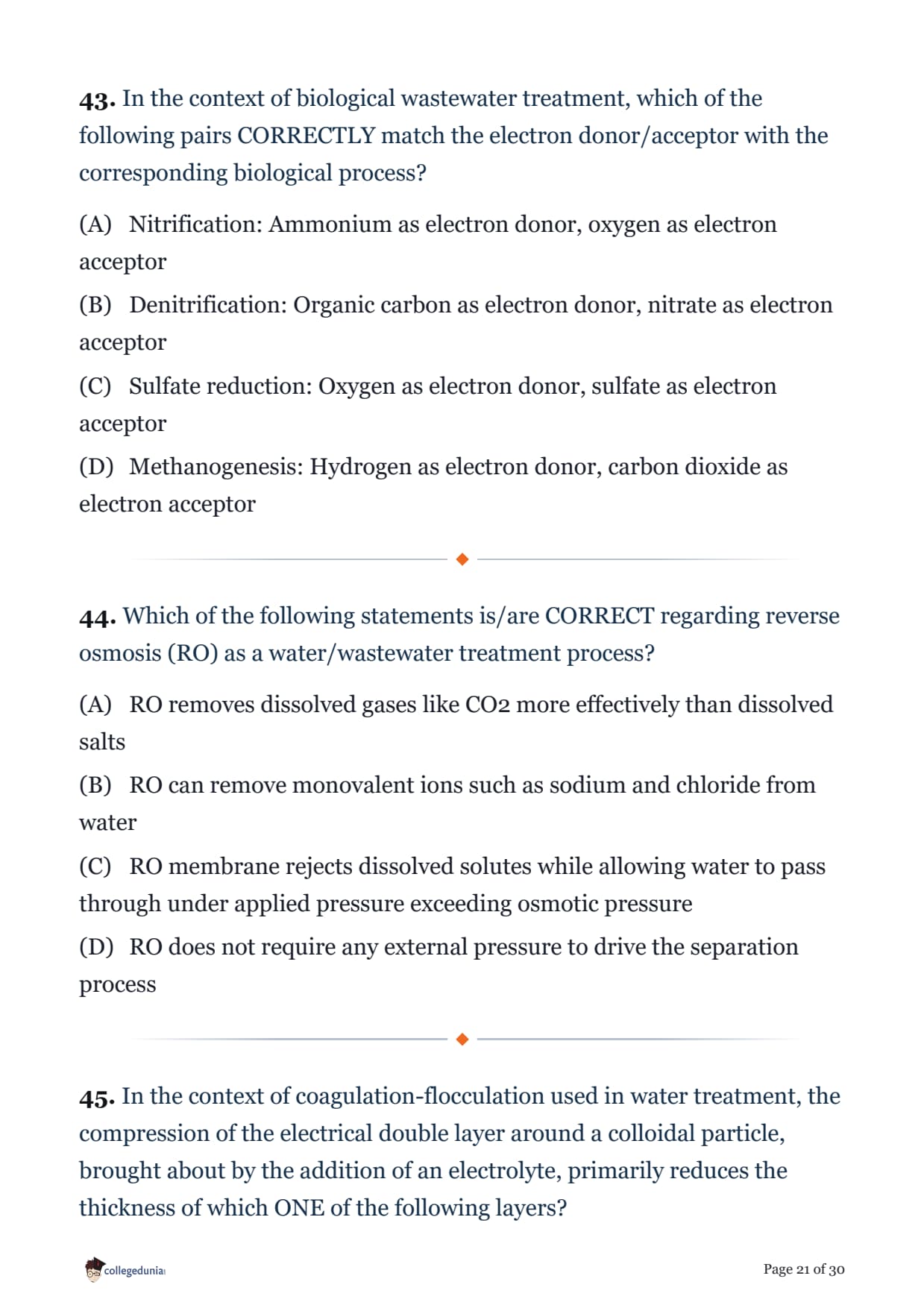
In the context of biological wastewater treatment, which of the following pairs CORRECTLY match the electron donor/acceptor with the corresponding biological process?
Which of the following statements is/are CORRECT regarding reverse osmosis (RO) as a water/wastewater treatment process?
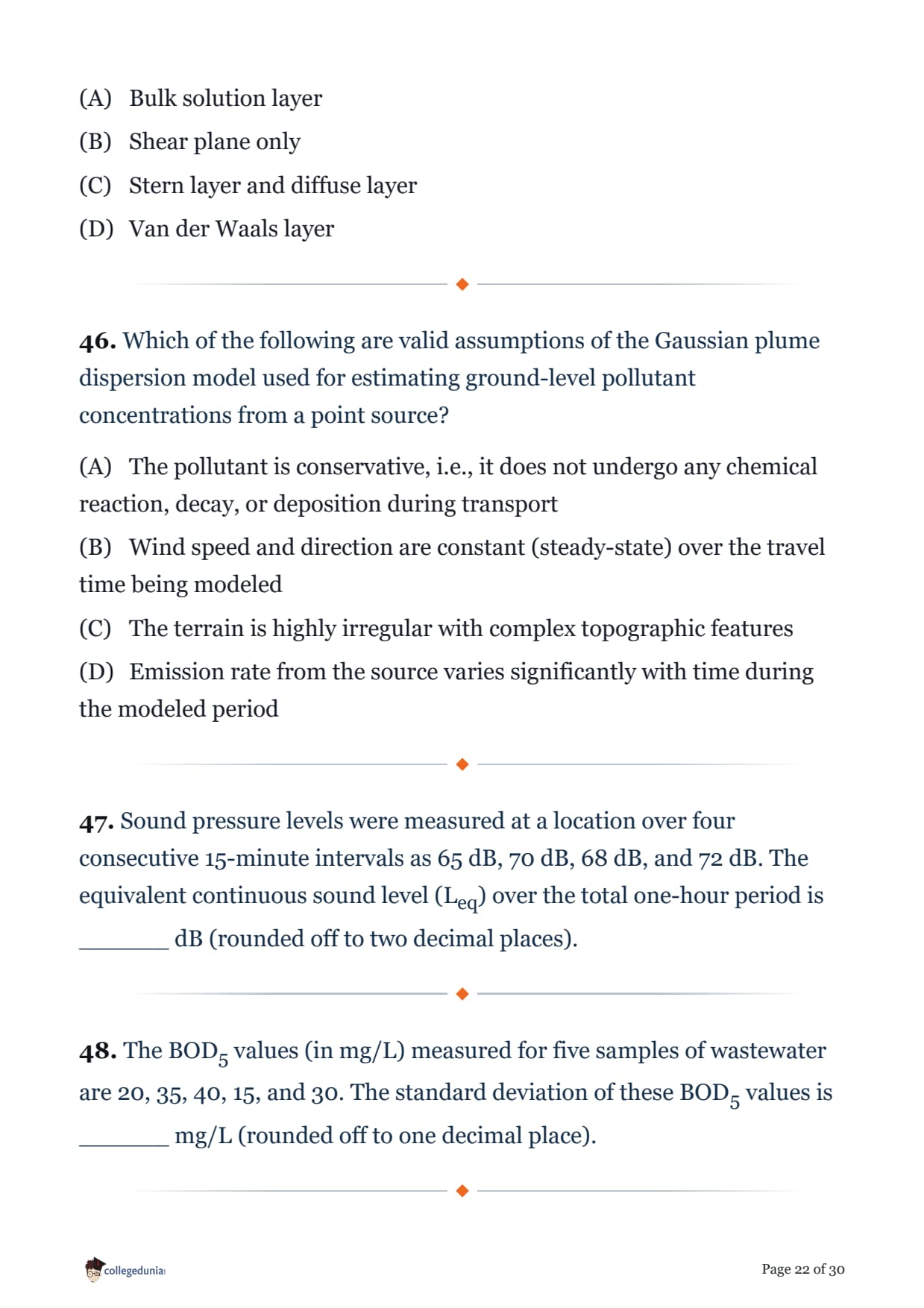
In the context of coagulation-flocculation used in water treatment, the compression of the electrical double layer around a colloidal particle, brought about by the addition of an electrolyte, primarily reduces the thickness of which ONE of the following layers?
Which of the following are valid assumptions of the Gaussian plume dispersion model used for estimating ground-level pollutant concentrations from a point source?
Sound pressure levels were measured at a location over four consecutive 15-minute intervals as 65 dB, 70 dB, 68 dB, and 72 dB. The equivalent continuous sound level (Leq) over the total one-hour period is ______ dB (rounded off to two decimal places).
The BOD5 values (in mg/L) measured for five samples of wastewater are 20, 35, 40, 15, and 30. The standard deviation of these BOD5 values is ______ mg/L (rounded off to one decimal place).
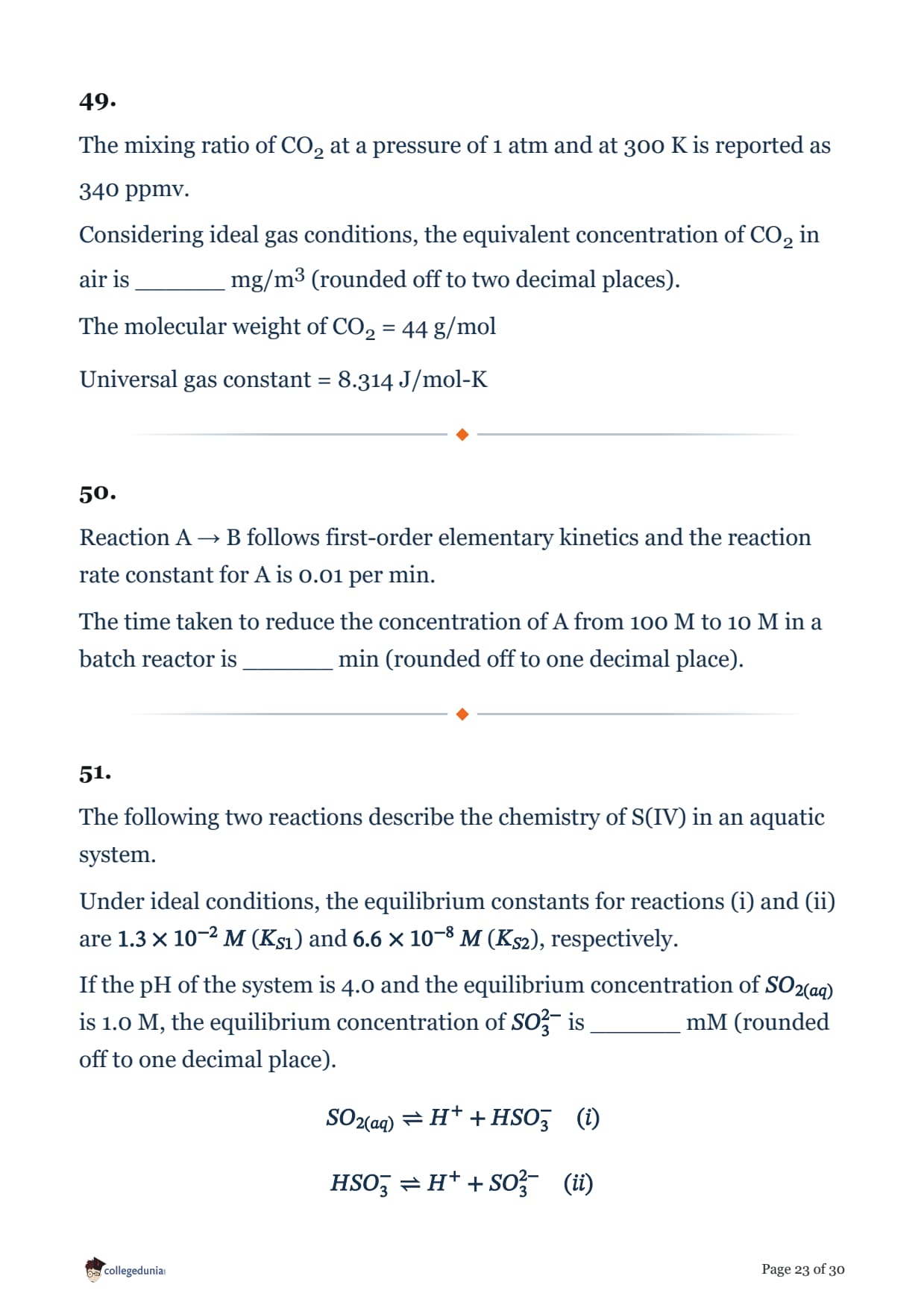
The mixing ratio of CO2 at a pressure of 1 atm and at 300 K is reported as 340 ppmv.
Considering ideal gas conditions, the equivalent concentration of CO2 in air is ______ mg/m3 (rounded off to two decimal places).
The molecular weight of CO2 = 44 g/mol
Universal gas constant = 8.314 J/mol-K
Reaction A → B follows first-order elementary kinetics and the reaction rate constant for A is 0.01 per min.
The time taken to reduce the concentration of A from 100 M to 10 M in a batch reactor is ______ min (rounded off to one decimal place).
The following two reactions describe the chemistry of S(IV) in an aquatic system.
Under ideal conditions, the equilibrium constants for reactions (i) and (ii) are \(1.3\times10^{-2}\ M\) (\(K_{S1}\)) and \(6.6\times10^{-8}\ M\) (\(K_{S2}\)), respectively.
If the pH of the system is 4.0 and the equilibrium concentration of \(SO_{2(aq)}\) is 1.0 M, the equilibrium concentration of \(SO_3^{2-}\) is ______ mM (rounded off to one decimal place).
\[SO_{2(aq)} \rightleftharpoons H^+ + HSO_3^- \quad (i)\]
\[HSO_3^- \rightleftharpoons H^+ + SO_3^{2-} \quad (ii)\]
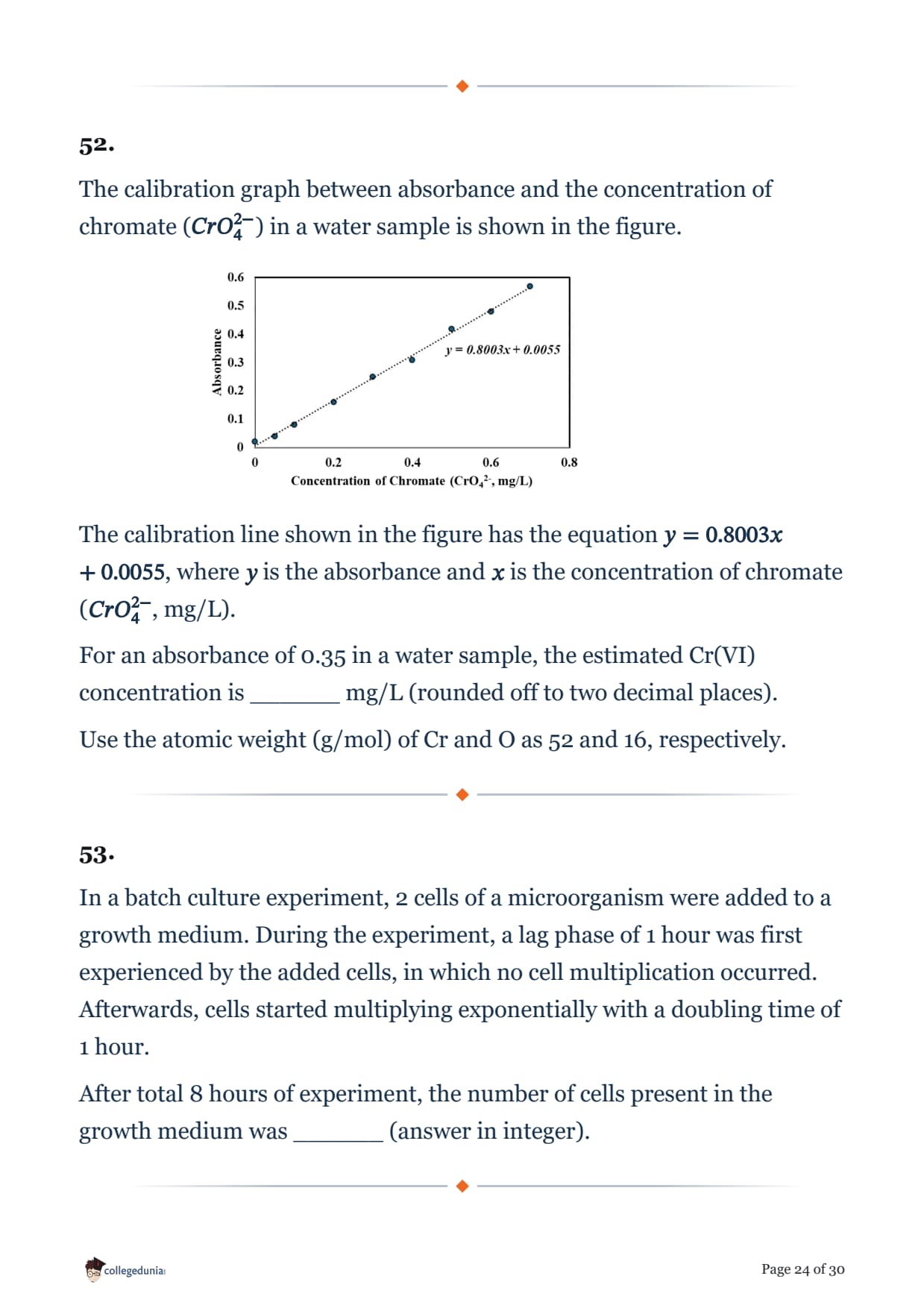
The calibration graph between absorbance and the concentration of chromate (\(CrO_4^{2-}\)) in a water sample is shown in the figure.

The calibration line shown in the figure has the equation \(y = 0.8003x + 0.0055\), where \(y\) is the absorbance and \(x\) is the concentration of chromate (\(CrO_4^{2-}\), mg/L).
For an absorbance of 0.35 in a water sample, the estimated Cr(VI) concentration is ______ mg/L (rounded off to two decimal places).
Use the atomic weight (g/mol) of Cr and O as 52 and 16, respectively.
In a batch culture experiment, 2 cells of a microorganism were added to a growth medium. During the experiment, a lag phase of 1 hour was first experienced by the added cells, in which no cell multiplication occurred. Afterwards, cells started multiplying exponentially with a doubling time of 1 hour.
After total 8 hours of experiment, the number of cells present in the growth medium was ______ (answer in integer).
A thermal process, at a specific temperature, results in 2-log10 removal of non-thermotolerant pathogenic microorganisms from a water sample in 20 min.
The time needed to achieve 99.999% removal of these microorganisms under similar condition is ______ min (answer in integer).
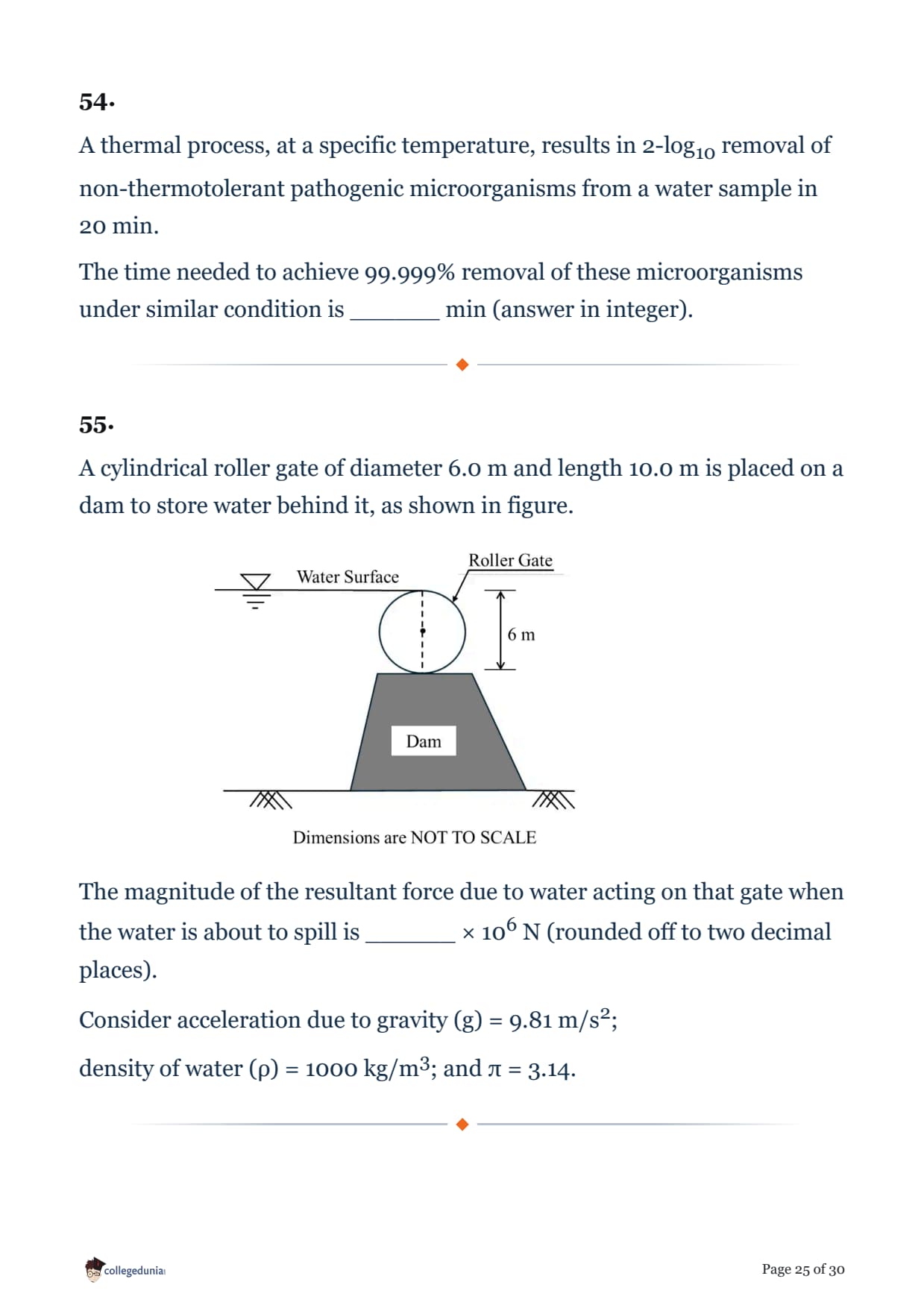
A cylindrical roller gate of diameter 6.0 m and length 10.0 m is placed on a dam to store water behind it, as shown in figure.

The magnitude of the resultant force due to water acting on that gate when the water is about to spill is ______ × 106 N (rounded off to two decimal places).
Consider acceleration due to gravity (g) = 9.81 m/s2;
density of water (ρ) = 1000 kg/m3; and π = 3.14.
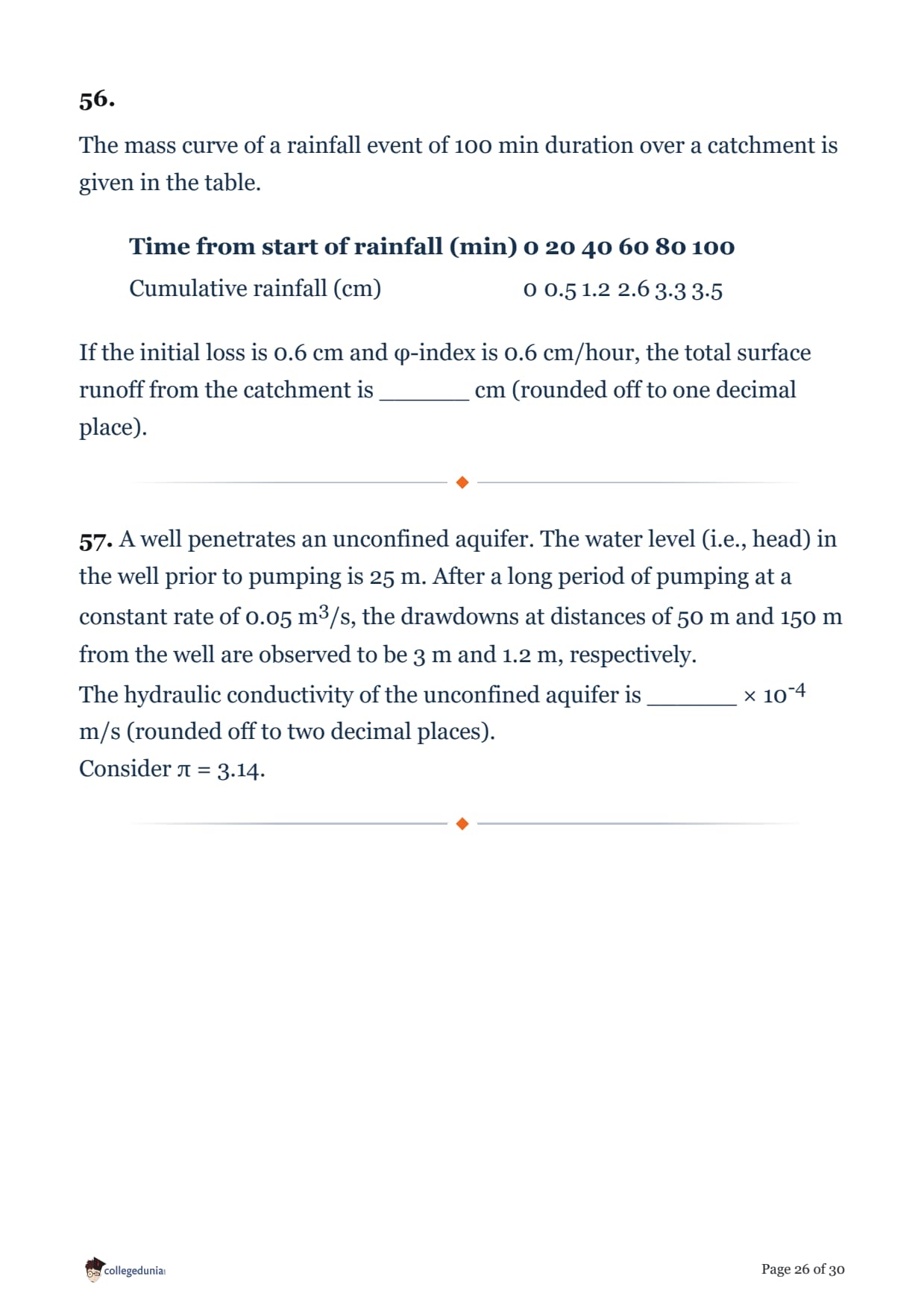
The mass curve of a rainfall event of 100 min duration over a catchment is given in the table.
| Time from start of rainfall (min) | 0 | 20 | 40 | 60 | 80 | 100 |
|---|---|---|---|---|---|---|
| Cumulative rainfall (cm) | 0 | 0.5 | 1.2 | 2.6 | 3.3 | 3.5 |
If the initial loss is 0.6 cm and φ-index is 0.6 cm/hour, the total surface runoff from the catchment is ______ cm (rounded off to one decimal place).
A well penetrates an unconfined aquifer. The water level (i.e., head) in the well prior to pumping is 25 m. After a long period of pumping at a constant rate of 0.05 m3/s, the drawdowns at distances of 50 m and 150 m from the well are observed to be 3 m and 1.2 m, respectively.
The hydraulic conductivity of the unconfined aquifer is ______ × 10-4 m/s (rounded off to two decimal places).
Consider π = 3.14.
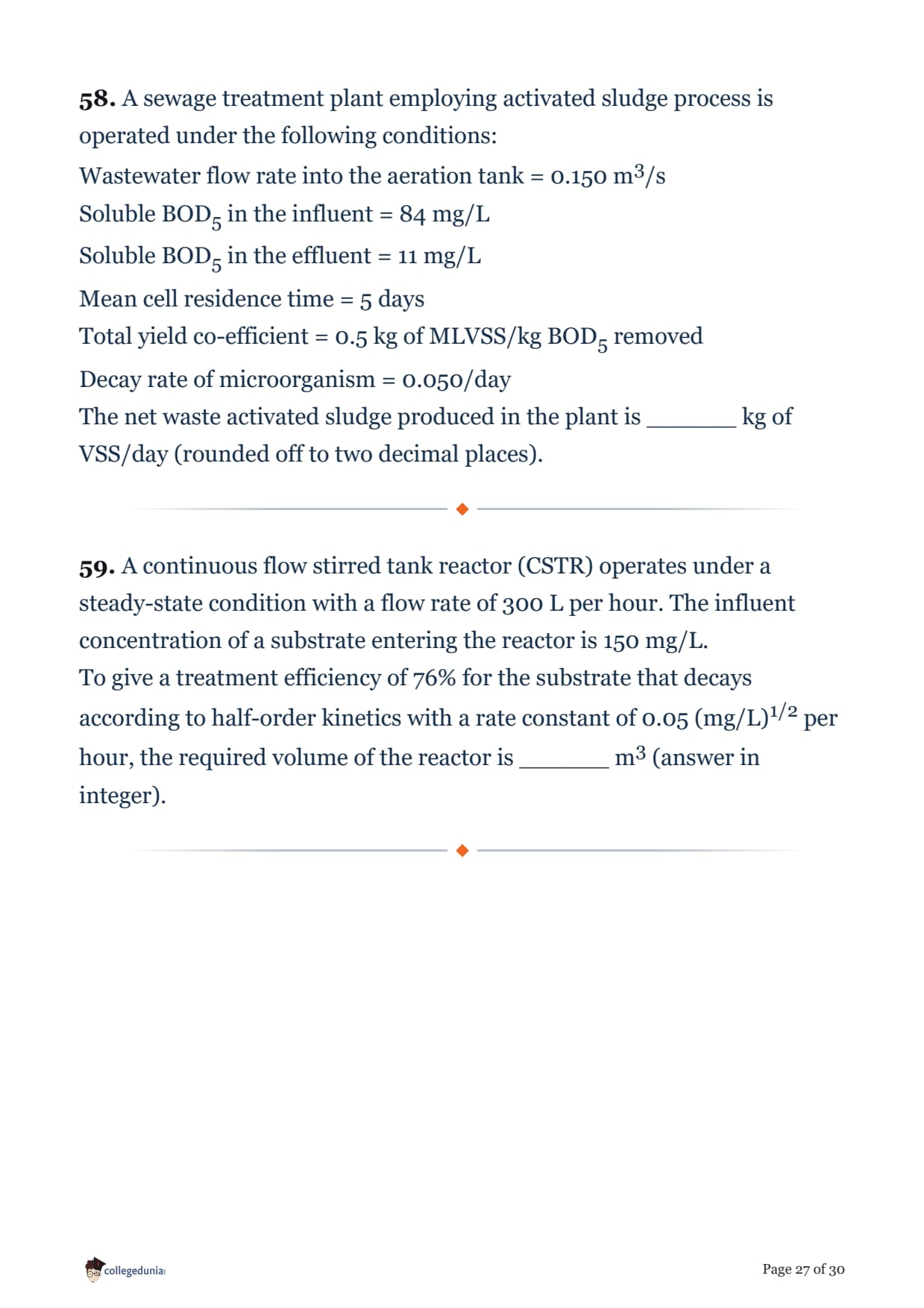
A sewage treatment plant employing activated sludge process is operated under the following conditions:
Wastewater flow rate into the aeration tank = 0.150 m3/s
Soluble BOD5 in the influent = 84 mg/L
Soluble BOD5 in the effluent = 11 mg/L
Mean cell residence time = 5 days
Total yield co-efficient = 0.5 kg of MLVSS/kg BOD5 removed
Decay rate of microorganism = 0.050/day
The net waste activated sludge produced in the plant is ______ kg of VSS/day (rounded off to two decimal places).
A continuous flow stirred tank reactor (CSTR) operates under a steady-state condition with a flow rate of 300 L per hour. The influent concentration of a substrate entering the reactor is 150 mg/L.
To give a treatment efficiency of 76% for the substrate that decays according to half-order kinetics with a rate constant of 0.05 (mg/L)1/2 per hour, the required volume of the reactor is ______ m3 (answer in integer).
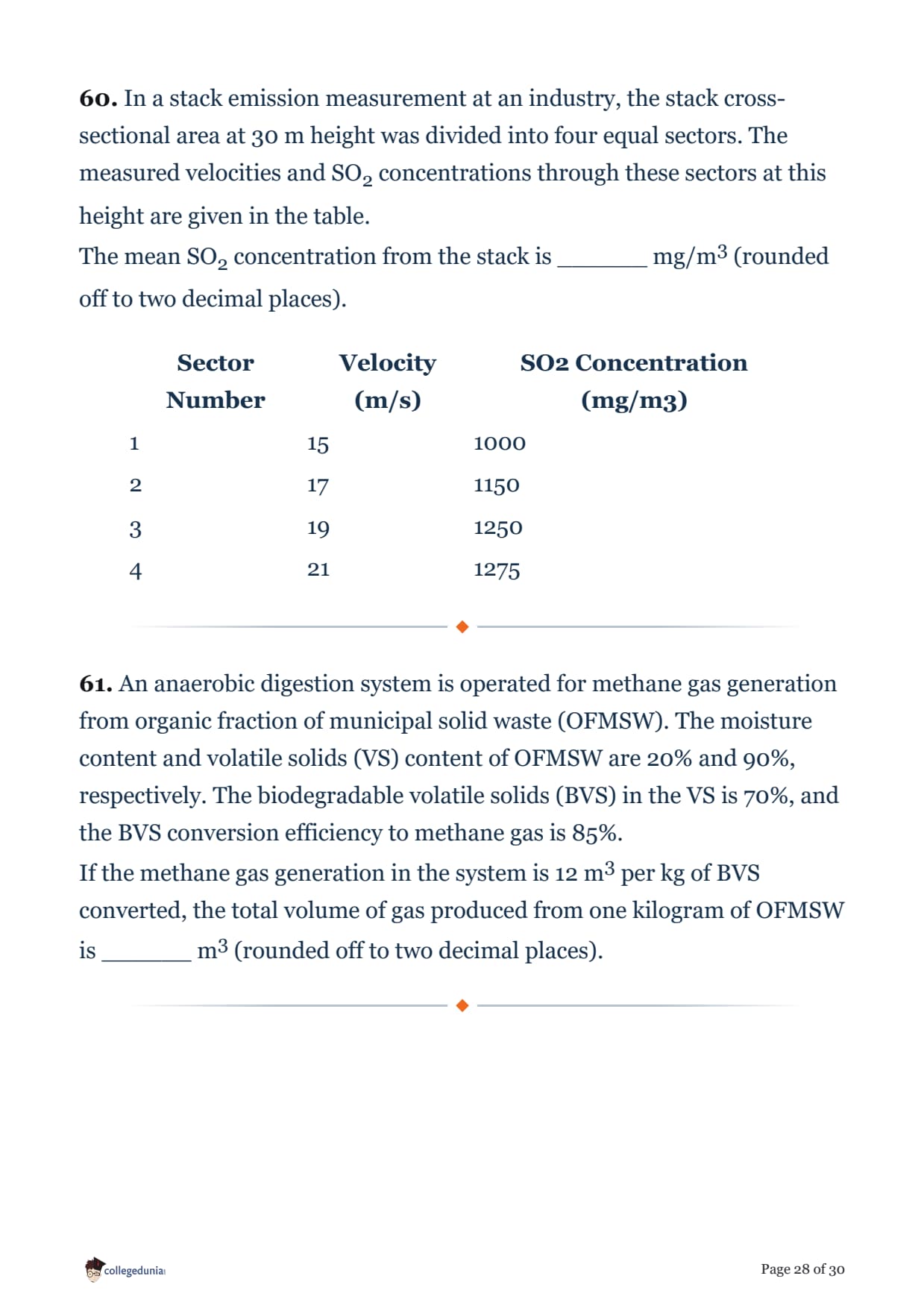
In a stack emission measurement at an industry, the stack cross-sectional area at 30 m height was divided into four equal sectors. The measured velocities and SO2 concentrations through these sectors at this height are given in the table.
The mean SO2 concentration from the stack is ______ mg/m3 (rounded off to two decimal places).
| Sector Number | Velocity (m/s) | SO2 Concentration (mg/m3) |
|---|---|---|
| 1 | 15 | 1000 |
| 2 | 17 | 1150 |
| 3 | 19 | 1250 |
| 4 | 21 | 1275 |
An anaerobic digestion system is operated for methane gas generation from organic fraction of municipal solid waste (OFMSW). The moisture content and volatile solids (VS) content of OFMSW are 20% and 90%, respectively. The biodegradable volatile solids (BVS) in the VS is 70%, and the BVS conversion efficiency to methane gas is 85%.
If the methane gas generation in the system is 12 m3 per kg of BVS converted, the total volume of gas produced from one kilogram of OFMSW is ______ m3 (rounded off to two decimal places).
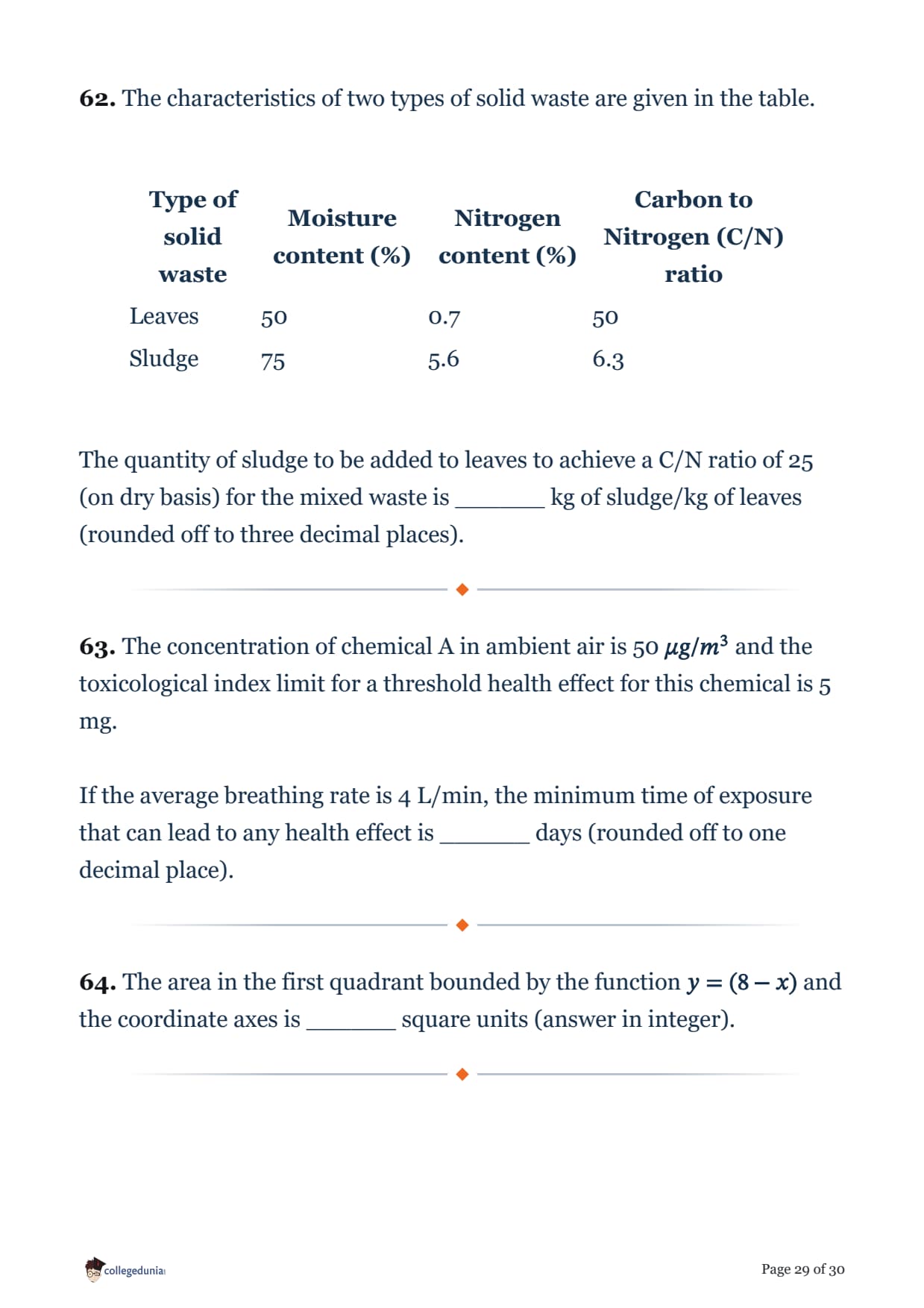
The characteristics of two types of solid waste are given in the table.
| Type of solid waste | Moisture content (%) | Nitrogen content (%) | Carbon to Nitrogen (C/N) ratio |
|---|---|---|---|
| Leaves | 50 | 0.7 | 50 |
| Sludge | 75 | 5.6 | 6.3 |
The quantity of sludge to be added to leaves to achieve a C/N ratio of 25 (on dry basis) for the mixed waste is ______ kg of sludge/kg of leaves (rounded off to three decimal places).
The concentration of chemical A in ambient air is 50 \(\mu g/m^3\) and the toxicological index limit for a threshold health effect for this chemical is 5 mg.
If the average breathing rate is 4 L/min, the minimum time of exposure that can lead to any health effect is ______ days (rounded off to one decimal place).
The area in the first quadrant bounded by the function \(y = (8-x)\) and the coordinate axes is ______ square units (answer in integer).
An agricultural land can support energy crops yield to produce 7000 L of bioethanol per hectare and energy content of bioethanol is 21 MJ/L. This bioethanol displaces fossil-based petrol.
The \(CO_2\) offset potential of land used for growing energy crops as a bioethanol feedstock is ______ \(\times 10^6\) g of \(CO_2\)/hectare (rounded off to one decimal place).
Consider \(CO_2\) footprints of 10 g and 80 g of \(CO_2\) per MJ for bioethanol and petrol, respectively.
GATE 2026 ES Exam Pattern and Marking Scheme Explained
As per the information bulletin on the official GATE 2026 website (gate2026.iitg.ac.in), GATE ES is a computer-based test split across three sections.
- Total questions: 65, split as 10 General Aptitude + 55 Engineering Mathematics and core Environmental Science & Engineering
- Duration: 3 hours (forenoon shift, 9:30 AM to 12:30 PM)
- Total marks: 100 - General Aptitude carries 15 marks, Engineering Mathematics 13 marks, and the core ES subject 72 marks
- Marking scheme: 1 or 2 marks per question, with negative marking applied only to MCQs (no negative marking on MSQ or NAT questions)
- Question types: MCQ (single correct), MSQ (multiple correct), and NAT (numerical answer type)
High-Weightage Subjects in GATE 2026 ES to Focus On First
Solid and Hazardous Waste Management and Water & Wastewater Treatment carried the heaviest load in this paper, and this question set reflects that split closely.
- Solid and Hazardous Waste Management: the single highest-weightage area in this paper - composting C/N ratios, sludge treatment, digestion, and risk assessment all featured
- Water and Wastewater Treatment and Management: around 8 questions - hardness, reverse osmosis, coagulation-flocculation, disinfection kinetics, and activated sludge design
- Air Pollution and Control: smog chemistry, atmospheric dispersion modelling, CAAQMS monitoring methods, and stack sampling
- Environmental Microbiology and Biotechnology: nucleic acid biochemistry, bacterial growth kinetics, and biological wastewater treatment
- Engineering Mathematics: linear algebra, ODEs, and calculus questions carried their usual 13-mark share
How to Use the GATE ES Question Paper for Practice
Treat this as a timed mock before checking a single solution - GATE ES rewards accuracy on the numerical-heavy waste management and water treatment questions.
- Attempt all 65 questions in one 3-hour sitting first, exactly like exam day
- Mark every question you were unsure of before checking the solution PDF
- Redo the Solid and Hazardous Waste Management and Water & Wastewater Treatment questions separately, since they carried the most marks
- Recheck every MSQ you attempted - a single wrong option selected loses the mark with no partial credit
GATE ES 2026 Good Attempts Benchmark
- 48-53 correct attempts out of 65 was the good-attempt range student reviews pointed to for this paper
- The paper leaned easy-to-moderate overall, but the Water Resources and Treatment NAT questions involved multi-step calculations that cost time
- Use 48-53 as your target when you time yourself against this paper
GATE 2026 ES Question Paper FAQs
Ques. Was GATE 2026 ES tougher than previous years?
Ans. Student reviews called it easy-to-moderate overall, though a few sources flagged it moderate-to-tough - Environmental Chemistry and Microbiology were conceptual and scoring, while the Water Resources and Treatment NAT questions involved multi-step calculations that ate up time.
Ques. How many questions should I attempt in GATE ES to qualify?
Ans. Student feedback pegged 48-53 attempts with reasonable accuracy as a good performance for this paper. The expected qualifying cutoff based on previous years is around 27-30 marks out of 100.
Ques. Which topics had the highest weightage in GATE 2026 ES?
Ans. Solid and Hazardous Waste Management carried the maximum weightage, followed closely by Water & Wastewater Treatment and Management with around 8 questions. Air Pollution and Control and Environmental Microbiology also featured heavily.
Ques. Are GATE ES questions repeated from previous years?
Ans. Core concepts like C/N ratio composting calculations, water hardness, and disinfection kinetics recur across years in reworded form, but the exact numbers and options change every year, so solving this paper builds pattern familiarity rather than memorized answers.
Ques. Is negative marking applicable in GATE ES?
Ans. Yes, but only for MCQ (single-correct) questions. MSQ (multiple-correct) and NAT (numerical answer type) questions carry no negative marking, so an educated attempt on those costs nothing if wrong.
Ques. Where can I download the GATE 2026 ES question paper with solutions PDF for free?
Ans. Use the download table above on Collegedunia for the question paper with solutions PDF. The official question paper and answer key are released on gate2026.iitg.ac.in, the IIT Guwahati GATE 2026 site.



Comments