




The GATE 2026 Data Science and Artificial Intelligence (DA) Question Paper with Solution PDF will be available here following the completion of the exam. The GATE DA paper is scheduled for February 15, 2026, in the Afternoon Session (AN) from 2:30 PM to 5:30 PM.
Based on trends since its introduction in 2024, the GATE DA paper is generally expected to be moderate to hard. Candidates aiming for top-tier IITs or specialized data science programs should target a score between 60–75+ marks. Achieving this typically requires a strategic attempt of 42–50 questions with high accuracy, given the significant weightage of Machine Learning and Probability & Statistics.
GATE 2026 Data Science and Artificial Intelligence (DA) Question Paper with Solution PDF
| GATE 2026 Data Science and Artificial Intelligence (DA) Question Paper |  Download Download |
Check Solutions |

"If his latest movie had been a commercial success, the actor would have made enough money to sponsor his next movie." Based only on the above sentence, which one is TRUE?
P, Q and R are three points on a circle of radius 10cm with O as its center. PQ = RQ and \(\angle\)PQR = 45\(^\circ\) the area of the shaded region PQRO is __________ cm\(^2\).

Verbosity : Brevity :: Insolence : _______
My friend and I parted _____ the door _____ the cabin that I had rented _____ the night"
The product of the digits of a three-digit number is 70. The sum of the digits of the three-digit number is:
Consider two distinct positive numbers m, n with m \(>\) n. Let x = n\(^{log_n m}\), y = m\(^{log_m n}\). The relation between x and y is-
Five integers are picked from 0 to 20 with possible representation such that their mean is 12, median is 18 and they have single mode of 20. Ignoring the permutation, the number of ways to pick these five integers is ____.
Rishi and Swathi are students of Class 5. Pavan and Tanvi are students of Class 4. Rishi and Pavan are boys. Swathi and Tanvi are girls. These four students played a total of three games of chess. The games were played one after another. A player who lost a game did not participate in any more games. It was observed that:
1. The first game was the only game where two students of the same class played against each other.
2. The students of Class 5 won more games than the students of Class 4.
3. The boys won 2 games and the girl won 1 game.
The student who did not lose any game is:
Consider the visualization of a 3-dimensional data cube showing sales quantity for each combination of the attributes Product-type, Month & Country. From this, if we want to further visualize the sale quantity for each combination of PT, M & S, which of the following OLAP operator should be performed?
Which of the following NOT true? (The name of the predicate are intuitive)
A clinic specializes in testing for a Disease D. The result of the test can be either positive (+ve) or negative (-ve). A study reveals that if a person suffers from the Disease D, the test result in that clinic comes up +ve 80% of the time and negative 20% of the time. If a person is not suffering from the Disease D, the test comes out positive 10% of the time & negative 90% of the time. It is also known among the general population the disease D occurs in 30% of the individuals. If the person tests positive for D in that clinic, the probability that he/she actually suffers from the Disease D is __________ (Round off to 2 decimal places).
A node size is 4096B. Node pointer size is 10B. Search key is 11B. Record pointer is 12B. What is the Max node pointers that can be stored in a non-leaf node of a B+ tree?
Consider two relations R(A,B) and S(E,C). A is primary key and E is a FK referring A. Which of the following operations never violate FK constraint?
Consider two entity sets E1(A11, A12, A13) and E2(A21,A22,A23) with A11 and A21 as PK. A22 is a multivalued attribute. R12 is a many to many relationship with total participation on both side. What is the min number of relations required to convert this ER model to relational model in 3NF?
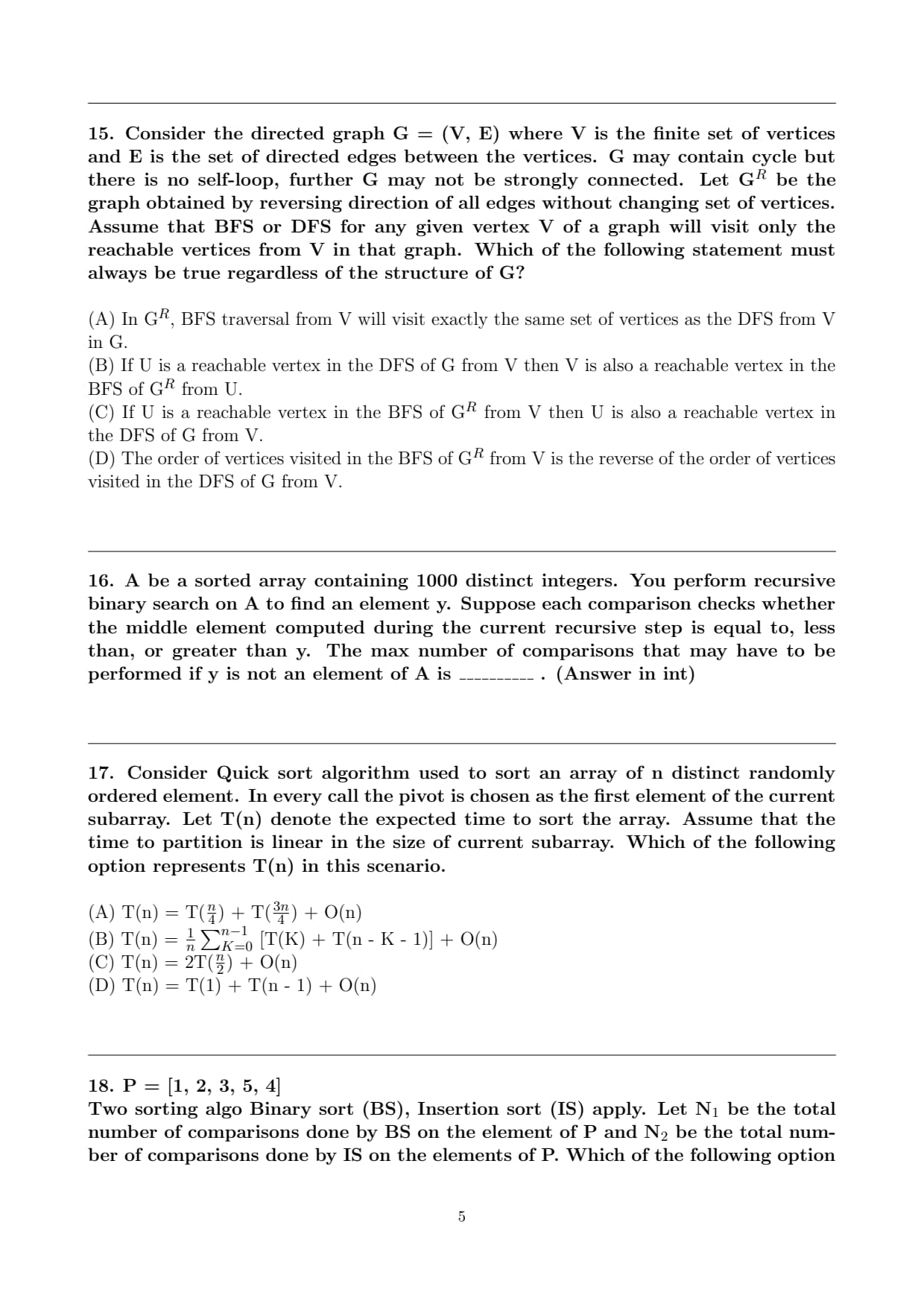
Consider the directed graph G = (V, E) where V is the finite set of vertices and E is the set of directed edges between the vertices. G may contain cycle but there is no self-loop, further G may not be strongly connected. Let G\(^R\) be the graph obtained by reversing direction of all edges without changing set of vertices. Assume that BFS or DFS for any given vertex V of a graph will visit only the reachable vertices from V in that graph. Which of the following statement must always be true regardless of the structure of G?
A be a sorted array containing 1000 distinct integers. You perform recursive binary search on A to find an element y. Suppose each comparison checks whether the middle element computed during the current recursive step is equal to, less than, or greater than y. The max number of comparisons that may have to be performed if y is not an element of A is __________ . (Answer in int)
Consider Quick sort algorithm used to sort an array of n distinct randomly ordered element. In every call the pivot is chosen as the first element of the current subarray. Let T(n) denote the expected time to sort the array. Assume that the time to partition is linear in the size of current subarray. Which of the following option represents T(n) in this scenario.
P = [1, 2, 3, 5, 4]
Two sorting algo Binary sort (BS), Insertion sort (IS) apply. Let N\(_1\) be the total number of comparisons done by BS on the element of P and N\(_2\) be the total number of comparisons done by IS on the elements of P. Which of the following option is/are correct?
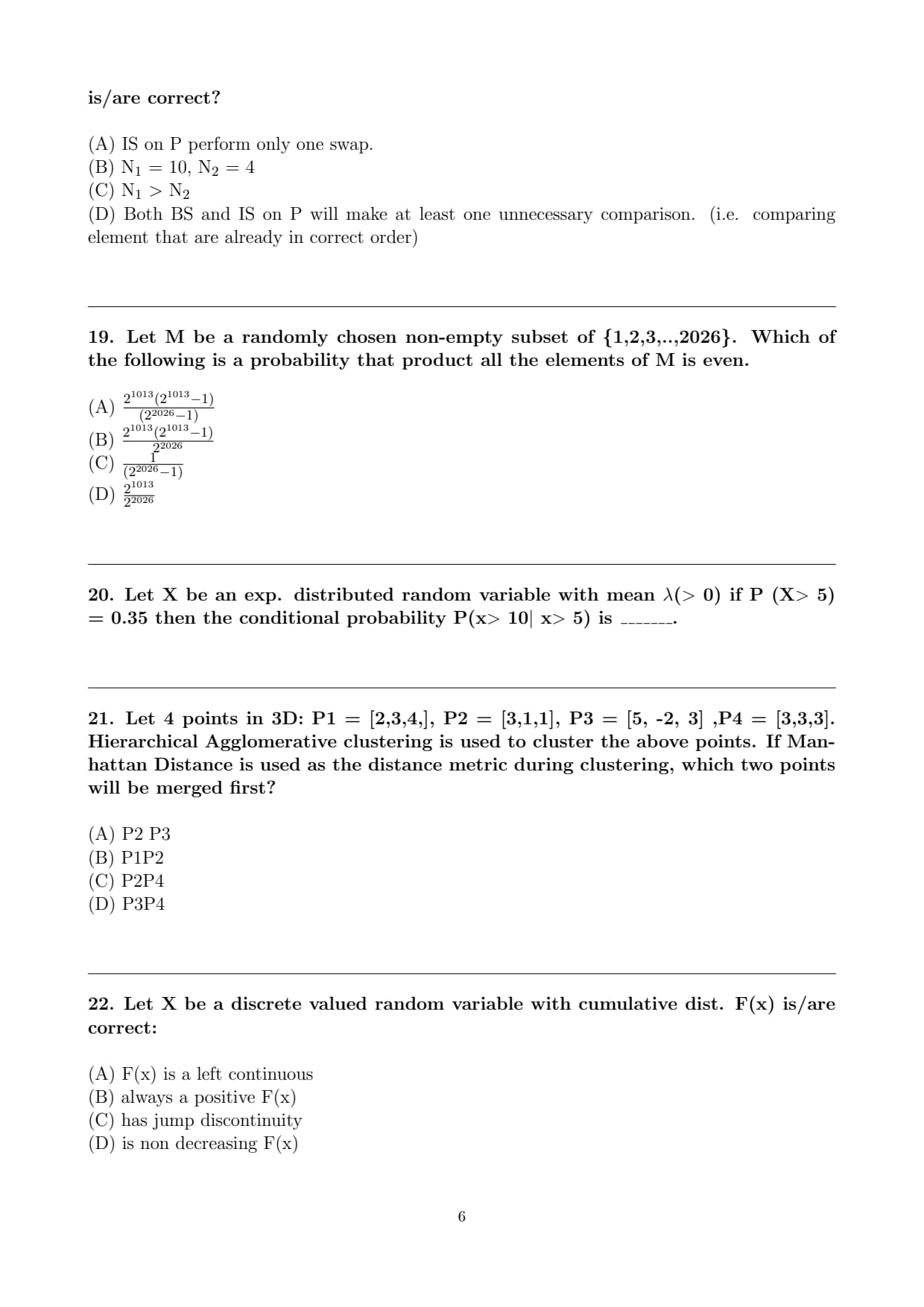
Let M be a randomly chosen non-empty subset of {1,2,3,..,2026}. Which of the following is a probability that product all the elements of M is even.
Let X be an exp. distributed random variable with mean \(\lambda\)(\(>\) 0) if P (X\(>\) 5) = 0.35 then the conditional probability P(x\(>\) 10\(|\) x\(>\) 5) is _______.
Let 4 points in 3D: P1 = [2,3,4,], P2 = [3,1,1], P3 = [5, -2, 3] ,P4 = [3,3,3]. Hierarchical Agglomerative clustering is used to cluster the above points. If Manhattan Distance is used as the distance metric during clustering, which two points will be merged first?
Let X be a discrete valued random variable with cumulative dist. F(x) is/are correct:
Let y1, y2, y3 eigen value of M = \(\begin{bmatrix} 1 & 0 & 0
0 & \cos t & \sin t
0 & \sin t & \cos t \end{bmatrix}\) Where t \(\in\) [-\(\pi\),\(\pi\)] & y\(_1\) + y\(_2\) + y\(_3\) = 1 + \(\sqrt{2}\) then t = ?
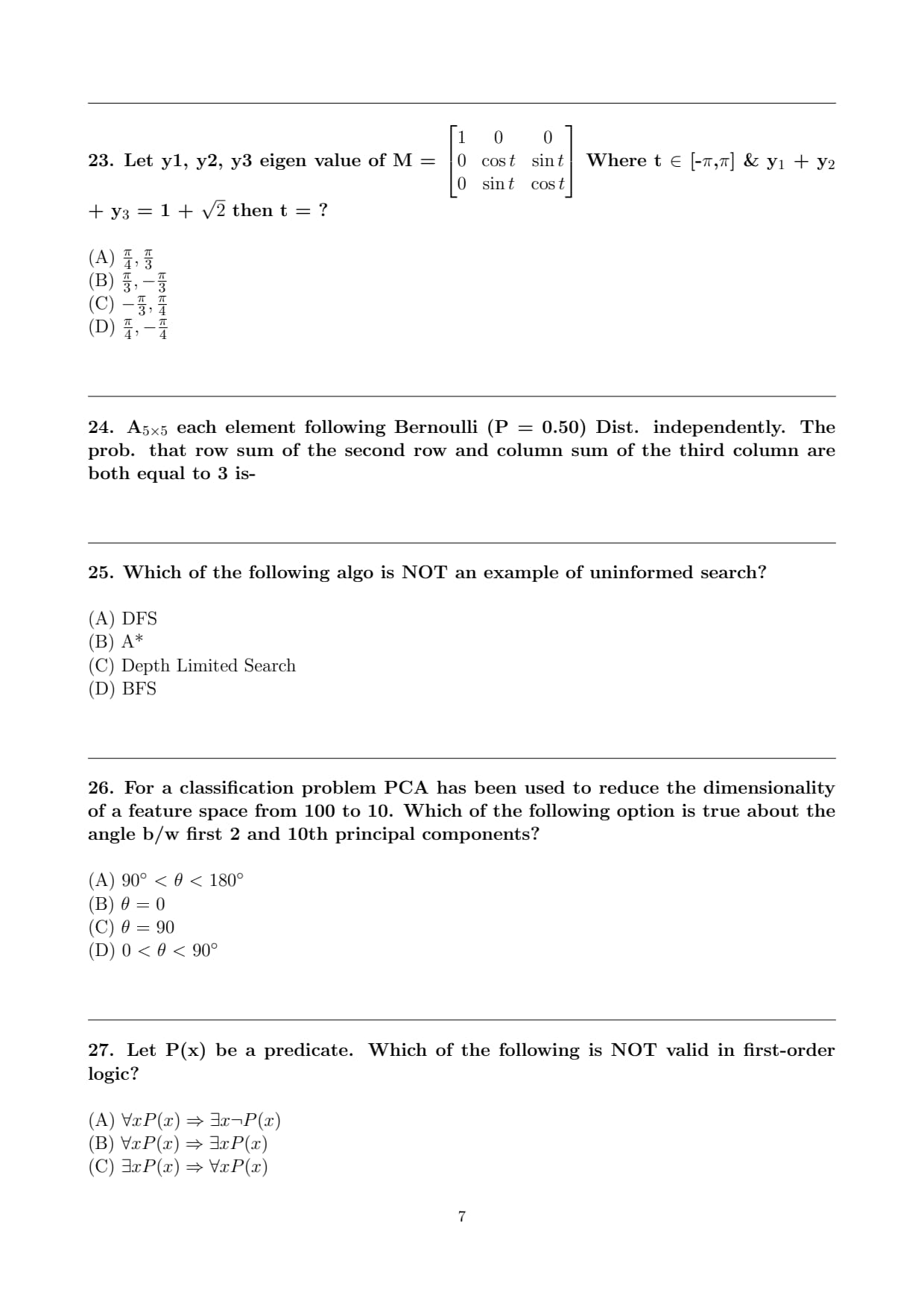
A\(_{5\times5}\) each element following Bernoulli (P = 0.50) Dist. independently. The prob. that row sum of the second row and column sum of the third column are both equal to 3 is-
Which of the following algo is NOT an example of uninformed search?
For a classification problem PCA has been used to reduce the dimensionality of a feature space from 100 to 10. Which of the following option is true about the angle b/w first 2 and 10th principal components?
Let P(x) be a predicate. Which of the following is NOT valid in first-order logic?
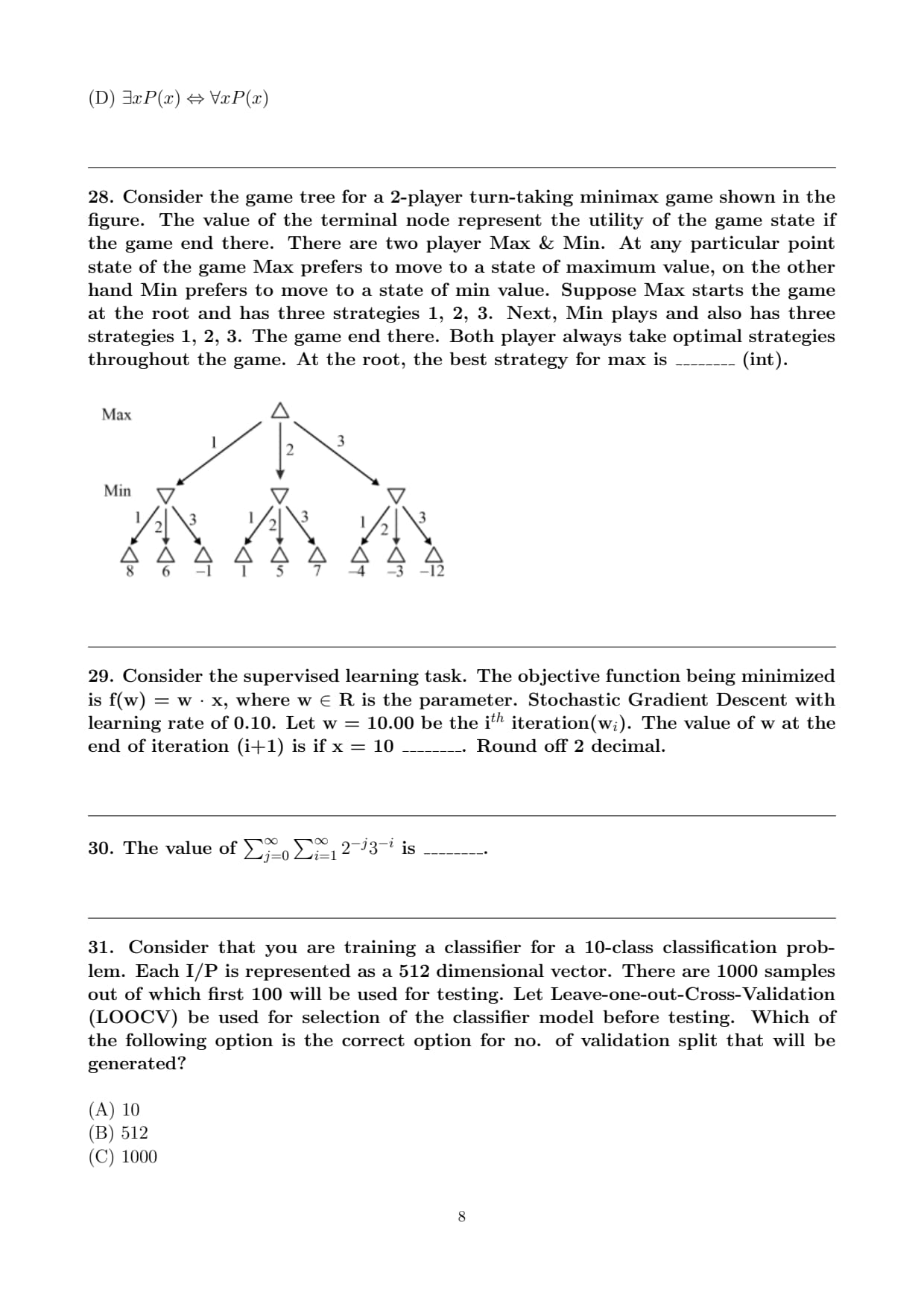
Consider the game tree for a 2-player turn-taking minimax game shown in the figure. The value of the terminal node represent the utility of the game state if the game end there. There are two player Max & Min. At any particular point state of the game Max prefers to move to a state of maximum value, on the other hand Min prefers to move to a state of min value. Suppose Max starts the game at the root and has three strategies 1, 2, 3. Next, Min plays and also has three strategies 1, 2, 3. The game end there. Both player always take optimal strategies throughout the game. At the root, the best strategy for max is ________ (int).

Consider the supervised learning task. The objective function being minimized is f(w) = w \(\cdot\) x, where w \(\in\) R is the parameter. Stochastic Gradient Descent with learning rate of 0.10. Let w = 10.00 be the i\(^{th}\) iteration(w\(_i\)). The value of w at the end of iteration (i+1) is if x = 10 ________. Round off 2 decimal.
The value of \(\sum_{j=0}^{\infty} \sum_{i=1}^{\infty} 2^{-j}3^{-i}\) is ________.
Consider that you are training a classifier for a 10-class classification problem. Each I/P is represented as a 512 dimensional vector. There are 1000 samples out of which first 100 will be used for testing. Let Leave-one-out-Cross-Validation (LOOCV) be used for selection of the classifier model before testing. Which of the following option is the correct option for no. of validation split that will be generated?
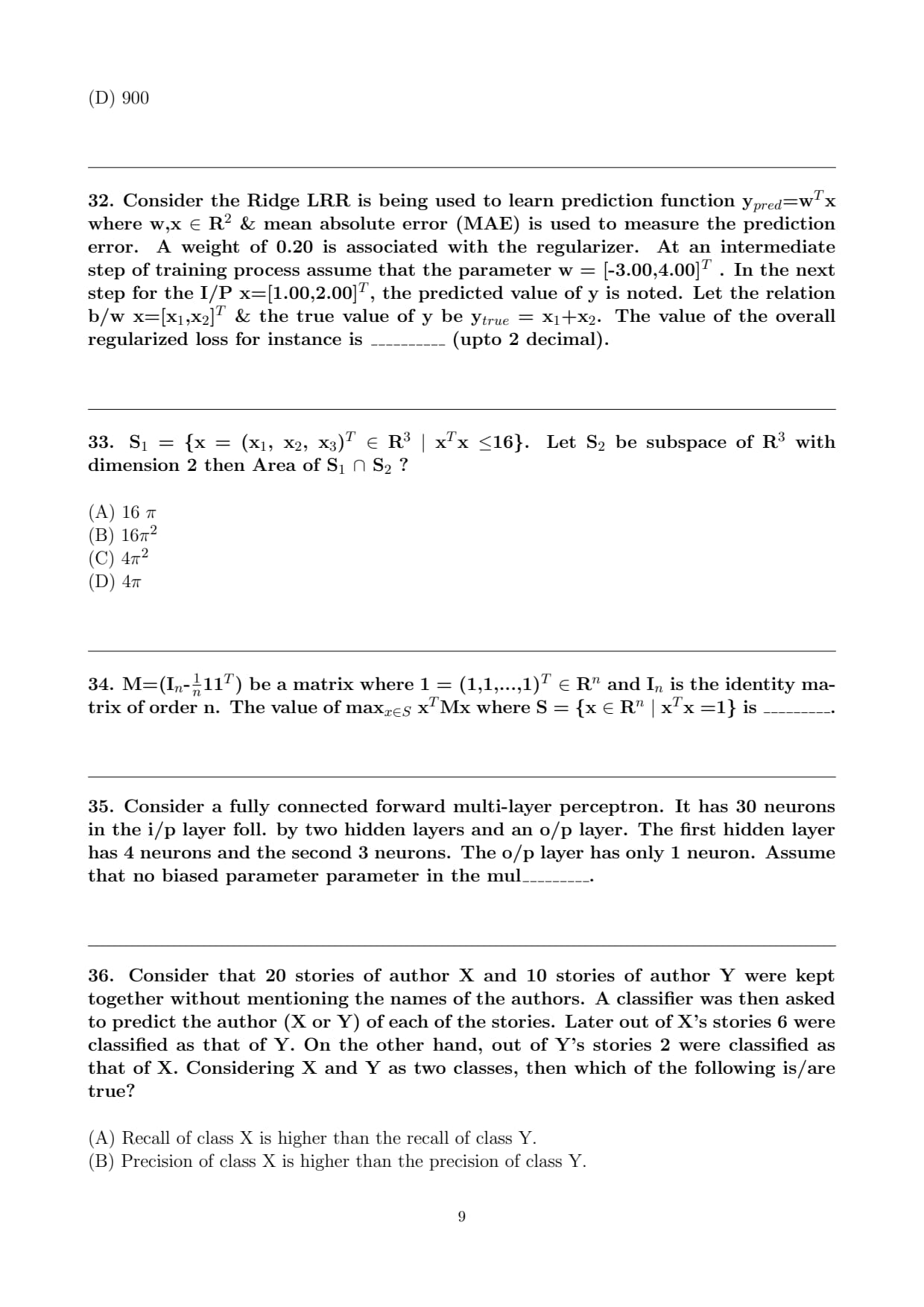
Consider the Ridge LRR is being used to learn prediction function y\(_{pred}\)=w\(^T\)x where w,x \(\in\) R\(^2\) & mean absolute error (MAE) is used to measure the prediction error. A weight of 0.20 is associated with the regularizer. At an intermediate step of training process assume that the parameter w = [-3.00,4.00]\(^T\) . In the next step for the I/P x=[1.00,2.00]\(^T\), the predicted value of y is noted. Let the relation b/w x=[x\(_1\),x\(_2\)]\(^T\) & the true value of y be y\(_{true}\) = x\(_1\)+x\(_2\). The value of the overall regularized loss for instance is __________ (upto 2 decimal).
S\(_1\) = \{x = (x\(_1\), x\(_2\), x\(_3\))\(^T\) \(\in\) R\(^3\) \(|\) x\(^T\)x \(\le\)16\. Let S\(_2\) be subspace of R\(^3\) with dimension 2 then Area of S\(_1\) \(\cap\) S\(_2\) ?
M=(I\(_n\)-\(\frac{1}{n}\)11\(^T\)) be a matrix where 1 = (1,1,...,1)\(^T\) \(\in\) R\(^n\) and I\(_n\) is the identity matrix of order n. The value of max\(_{x \in S}\) x\(^T\)Mx where S = \{x \(\in\) R\(^n\) \(|\) x\(^T\)x =1\ is _________.
Consider a fully connected forward multi-layer perceptron. It has 30 neurons in the i/p layer foll. by two hidden layers and an o/p layer. The first hidden layer has 4 neurons and the second 3 neurons. The o/p layer has only 1 neuron. Assume that no biased parameter parameter in the mul_________.
Consider that 20 stories of author X and 10 stories of author Y were kept together without mentioning the names of the authors. A classifier was then asked to predict the author (X or Y) of each of the stories. Later out of X's stories 6 were classified as that of Y. On the other hand, out of Y's stories 2 were classified as that of X. Considering X and Y as two classes, then which of the following is/are true?
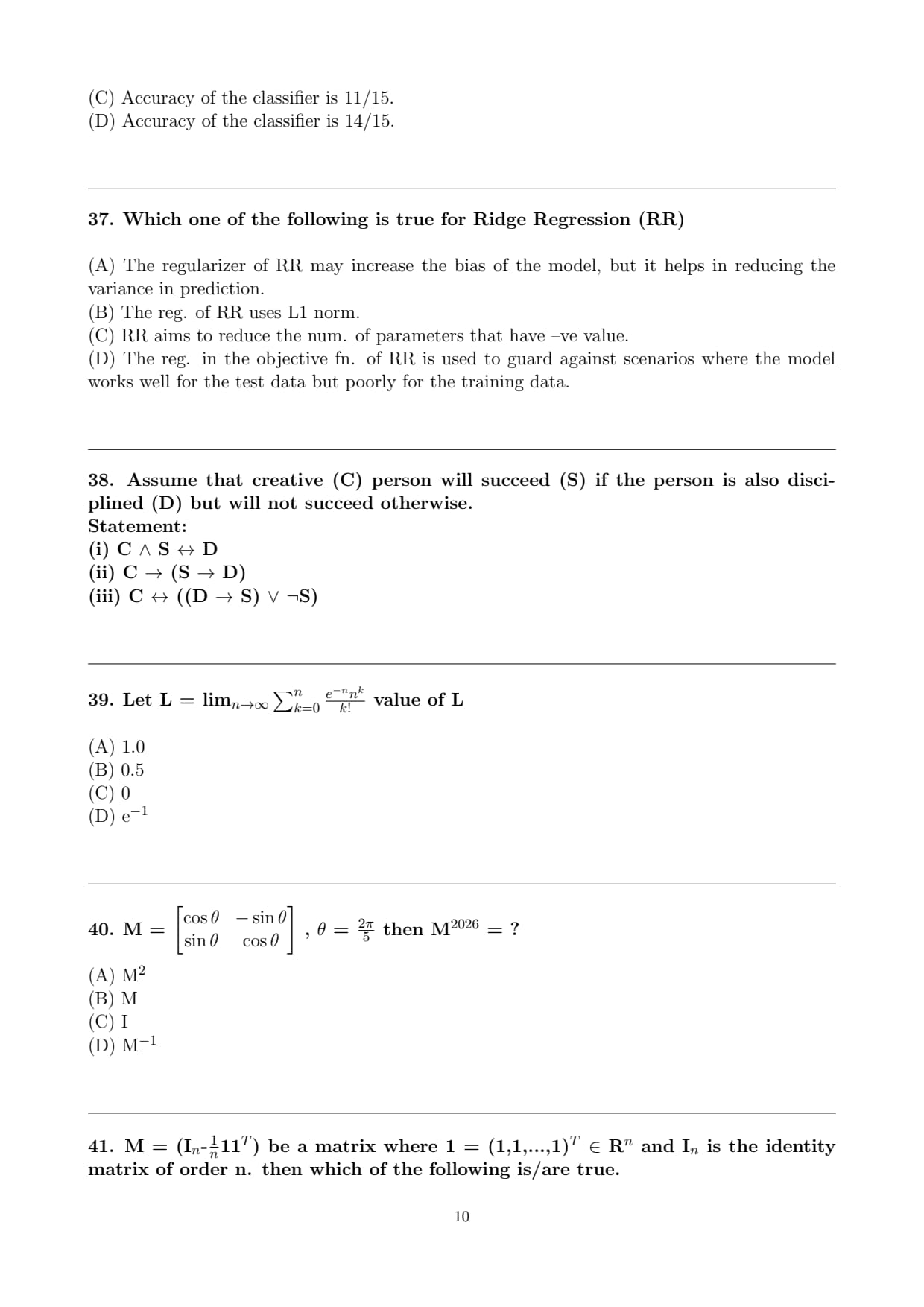
Which one of the following is true for Ridge Regression (RR)
Assume that creative (C) person will succeed (S) if the person is also disciplined (D) but will not succeed otherwise.
Statement:
(i) C \(\land\) S \(\leftrightarrow\) D
(ii) C \(\rightarrow\) (S \(\rightarrow\) D)
(iii) C \(\leftrightarrow\) ((D \(\rightarrow\) S) \(\lor\) \(\neg\)S)
Let L = lim\(_{n \to \infty} \sum_{k=0}^{n} \frac{e^{-n} n^k}{k!}\) value of L
M = \(\begin{bmatrix} \cos\theta & -\sin\theta
\sin\theta & \cos\theta \end{bmatrix}\) , \(\theta\) = \(\frac{2\pi}{5}\) then M\(^{2026}\) = ?
M = (I\(_n\)-\(\frac{1}{n}\)11\(^T\)) be a matrix where 1 = (1,1,...,1)\(^T\) \(\in\) R\(^n\) and I\(_n\) is the identity matrix of order n. then which of the following is/are true.
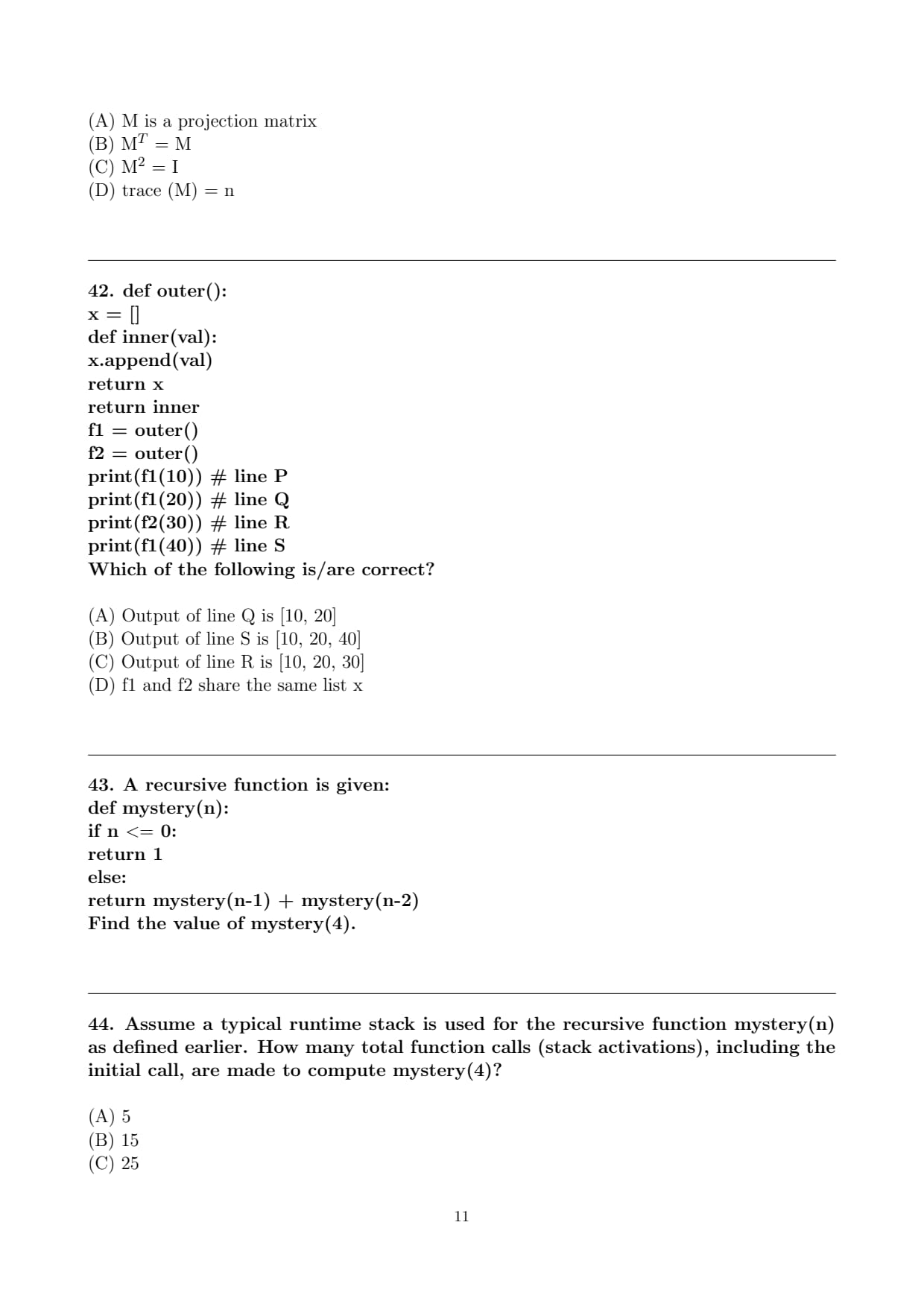
def outer():
\indent x = []
\indent def inner(val):
\indent \indent x.append(val)
\indent \indent return x
\indent return inner
f1 = outer()
f2 = outer()
print(f1(10)) \# line P
print(f1(20)) \# line Q
print(f2(30)) \# line R
print(f1(40)) \# line S
Which of the following is/are correct?
A recursive function is given:
def mystery(n):
\indent if n \(<=\) 0:
\indent \indent return 1
\indent else:
\indent \indent return mystery(n-1) + mystery(n-2)
Find the value of mystery(4).
Assume a typical runtime stack is used for the recursive function mystery(n) as defined earlier. How many total function calls (stack activations), including the initial call, are made to compute mystery(4)?
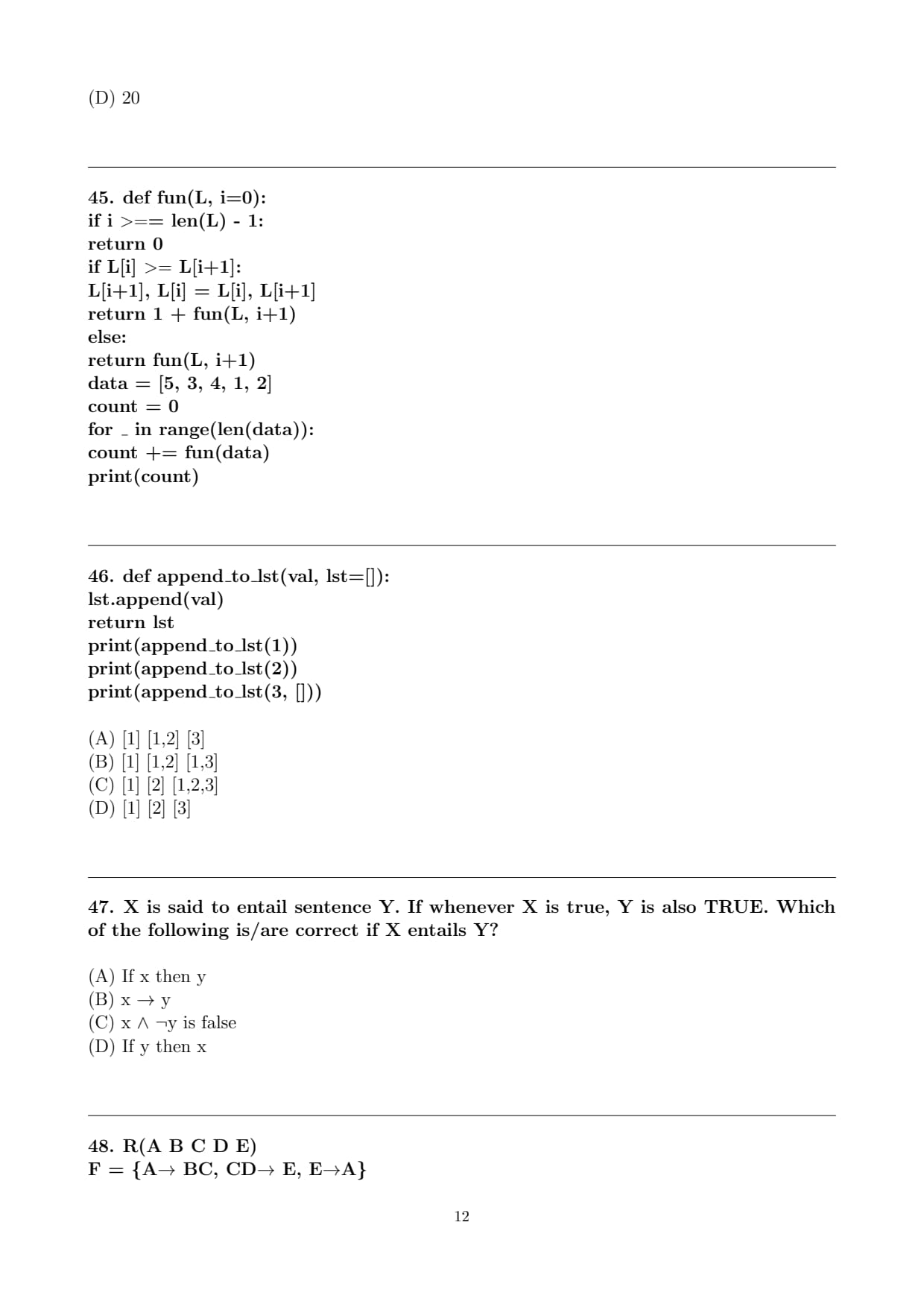
def fun(L, i=0):
\indent if i \(>=\) len(L) - 1:
\indent \indent return 0
\indent if L[i] \(>\) L[i+1]:
\indent \indent L[i+1], L[i] = L[i], L[i+1]
\indent \indent return 1 + fun(L, i+1)
\indent else:
\indent \indent return fun(L, i+1)
data = [5, 3, 4, 1, 2]
count = 0
for _ in range(len(data)):
\indent count += fun(data)
print(count)
def append_to_lst(val, lst=[]):
\indent lst.append(val)
\indent return lst
print(append_to_lst(1))
print(append_to_lst(2))
print(append_to_lst(3, []))
X is said to entail sentence Y. If whenever X is true, Y is also TRUE. Which of the following is/are correct if X entails Y?
R(A B C D E)
F = {A\(\rightarrow\) BC, CD\(\rightarrow\) E, E\(\rightarrow\)A\
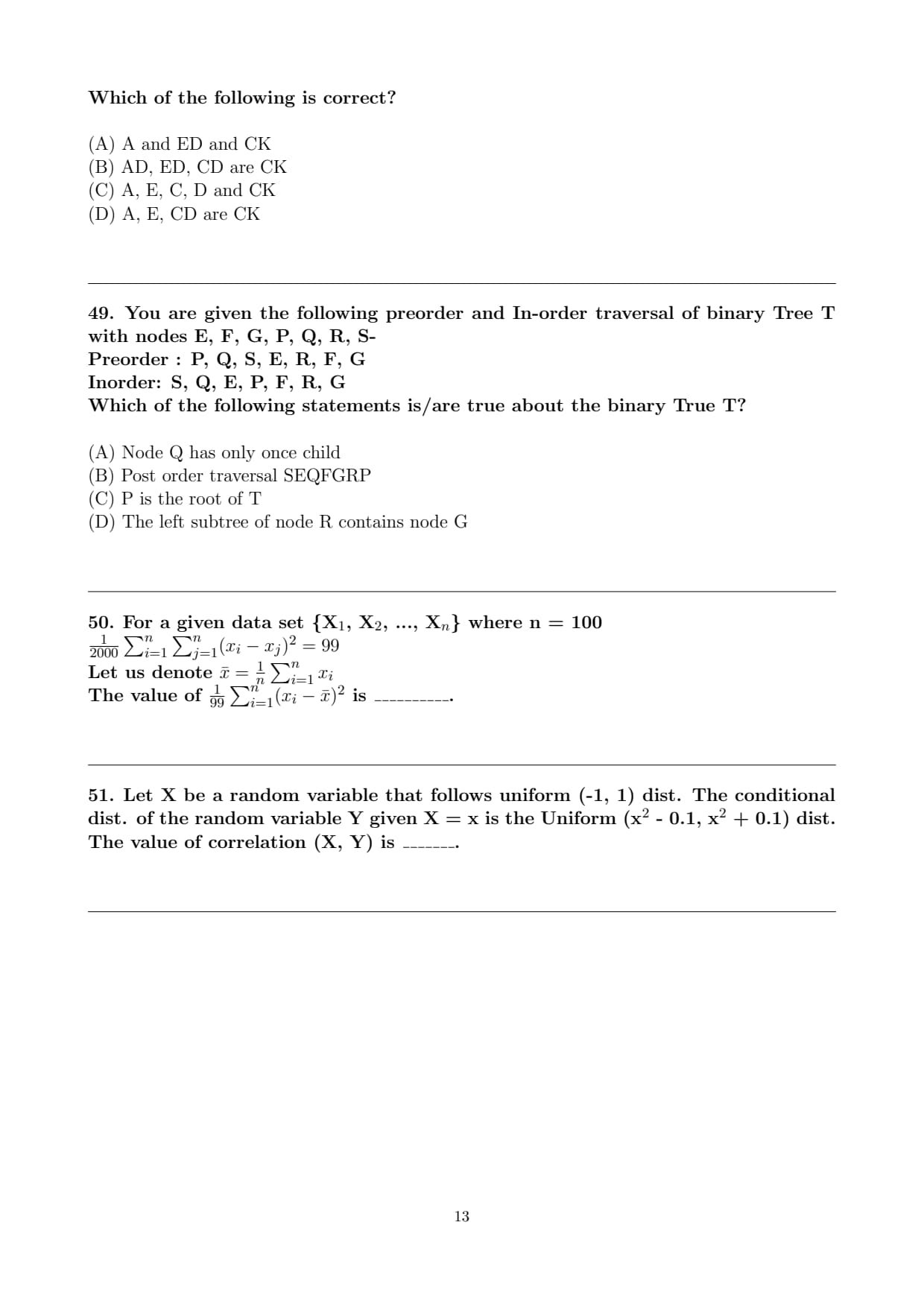
Which of the following is correct?
You are given the following preorder and In-order traversal of binary Tree T with nodes E, F, G, P, Q, R, S-
Preorder : P, Q, S, E, R, F, G
Inorder: S, Q, E, P, F, R, G
Which of the following statements is/are true about the binary True T?
For a given data set {X\(_1\), X\(_2\), ..., X\(_n\)\ where n = 100
\(\frac{1}{2000} \sum_{i=1}^{n} \sum_{j=1}^{n} (x_i - x_j)^2 = 99\)
Let us denote \(\bar{x} = \frac{1}{n}\sum_{i=1}^{n} x_i\)
The value of \(\frac{1}{99} \sum_{i=1}^{n} (x_i - \bar{x})^2\) is __________.
Let X be a random variable that follows uniform (-1, 1) dist. The conditional dist. of the random variable Y given X = x is the Uniform (x\(^2\) - 0.1, x\(^2\) + 0.1) dist. The value of correlation (X, Y) is _______.



Comments