




The GATE 2026 Architecture and Planning (AR) Question Paper with Solution PDF will be available here following the conclusion of the exam. The GATE AR paper is scheduled for tomorrow, February 14, 2026, in the Afternoon Session (AN) from 2:30 PM to 5:30 PM.
Based on previous years' trends, the GATE AR paper is generally expected to be moderate in difficulty. Candidates aiming for top-tier institutions like SPA Delhi or IITs should target a score between 65–75+ marks. Attempting 50 to 60 questions with 85–90% accuracy is typically considered a safe and competitive range for a high rank.
GATE 2026 Architecture and Planning (AR) Question Paper with Solution PDF
| GATE 2026 Architecture and Planning (AR) Question Paper with Solution PDF | Download | Check Solutions |

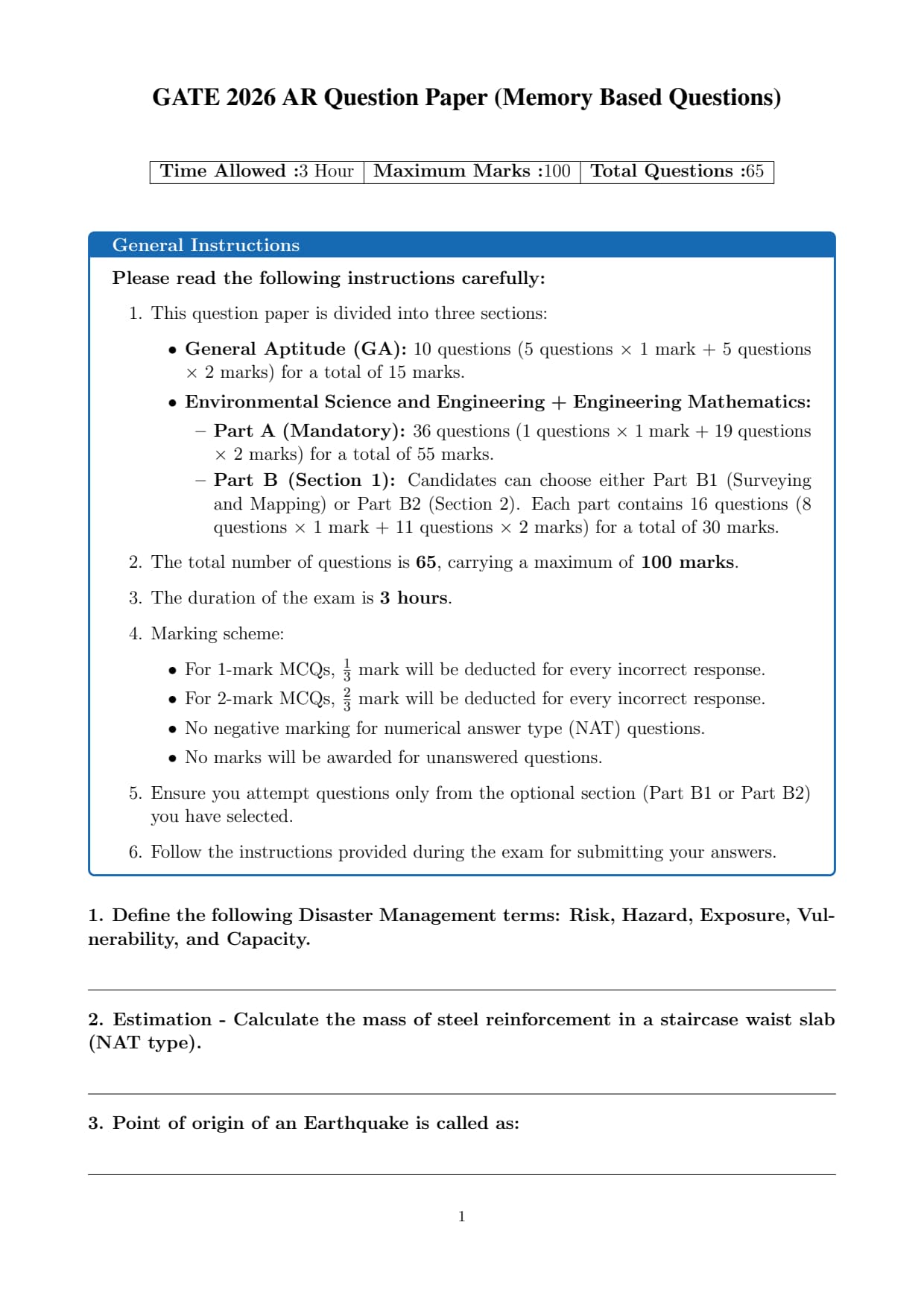
Define the following Disaster Management terms: Risk, Hazard, Exposure, Vulnerability, and Capacity.
View Solution
Step 1: Understanding the Concept:
Disaster Management involves analyzing the interaction between physical threats and the socio-economic conditions of a community. These five terms are the building blocks of the "Disaster Risk Equation," which helps in assessing the potential impact of disasters.
Step 2: Detailed Explanation:
Hazard: A process, phenomenon, or human activity that may cause loss of life, injury, or property damage (e.g., an earthquake, a cyclone, or a chemical spill).
Exposure: The people, property, or systems located in hazard-prone areas that are subject to potential losses.
Vulnerability: The conditions determined by physical, social, and economic factors which increase the susceptibility of an individual or community to the impact of hazards.
Capacity: The strengths, attributes, and resources available within a community to manage and reduce disaster risks or strengthen resilience.
Risk: The potential loss of life, injury, or destroyed assets which could occur to a system or a community in a specific period of time.
Step 3: Final Answer:
Risk is defined as the probability of harmful consequences resulting from interactions between natural or human-induced hazards and vulnerable conditions, mitigated by the existing capacity of the community. Quick Tip: To simplify: Risk = (Hazard \(\times\) Vulnerability \(\times\) Exposure) / Capacity. Increasing Capacity is the most effective way to reduce overall Risk.
Estimation - Calculate the mass of steel reinforcement in a staircase waist slab (NAT type).
View Solution
Step 1: Understanding the Concept:
Estimating steel reinforcement involves finding the total length of the bars (including the inclined length of the waist slab and necessary hooks/bends) and converting that length into weight using the unit weight of steel.
Step 2: Key Formula or Approach:
1. Inclined Length of Waist Slab (\(L\)): \[ L = \sqrt{R^2 + T^2} \times No. of steps \] (where \(R\) is Rise and \(T\) is Tread).
2. Unit Weight of Steel (\(W\)): \[ W = \frac{d^2}{162} kg/m \] (where \(d\) is the diameter of the bar in mm).
3. Total Mass: \[ Mass = Total Length \times Unit Weight \]
Step 3: Detailed Explanation:
1. Calculate Bar Lengths:
Main Bars: Calculate the inclined length of the slab. Add development lengths (\(L_d\)) where the slab anchors into the landing beams.
Distribution Bars: These run along the width of the staircase. Length = Width of stair + Bends/Hooks.
2. Determine Quantity: Use the spacing provided to find the number of bars: \[ No. of bars = \left(\frac{Length}{Spacing}\right) + 1 \]
3. Convert to Mass: Multiply the total running length of each diameter by its respective unit weight (\(d^2/162\)).
Step 4: Final Answer:
The mass is the summation of the weights of all main and distribution bars used in the waist slab. Ensure to include a wastage factor (usually 5%) if required by the specification. Quick Tip: When calculating the inclined length, always use the 'effective' span which includes the horizontal distance of the landing if it is monolithic with the waist slab.
Point of origin of an Earthquake is called as:
View Solution
Step 1: Understanding the Concept:
Seismology distinguishes between the actual point of energy release deep inside the earth and the corresponding point on the surface.
Step 2: Detailed Explanation:
The point within the Earth's crust where a fracture begins and the first release of seismic energy occurs is known as the Focus (also called the Hypocenter). The energy travels from this point in the form of seismic waves. The point on the Earth's surface directly vertically above the focus is called the Epicenter.
Step 3: Final Answer:
The point of origin of an earthquake is called the Focus or Hypocenter. Quick Tip: Remember: Focus is the 'underground' origin, while the Epicenter is the 'surface' location used for geographic reporting.
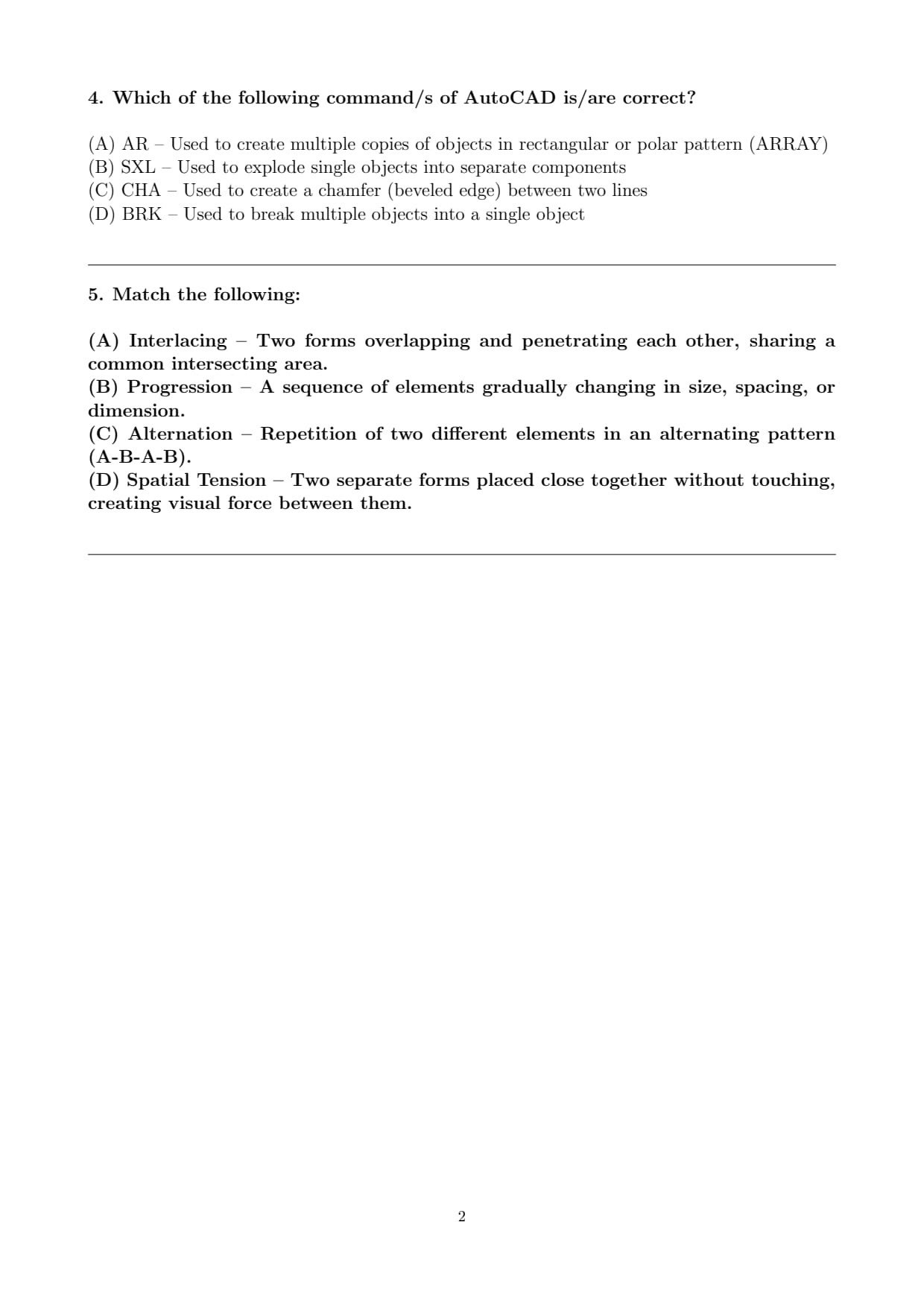
Which of the following command/s of AutoCAD is/are correct?
View Solution
Step 1: Understanding the Concept:
This question focuses on AutoCAD command aliases, which are keyboard shortcuts used to trigger full commands. Mastery of these aliases is essential for increasing drafting efficiency and speed.
Step 2: Detailed Explanation:
- Option A (Correct): AR is the standard shortcut for ARRAY. This command replicates objects in a specified pattern, such as Rectangular (rows and columns), Polar (around a center point), or Path (along a line or curve).
- Option B (Incorrect): The shortcut for the EXPLODE command is simply X. There is no standard SXL alias in AutoCAD.
- Option C (Correct): CHA is the standard shortcut for the CHAMFER command. It modifies two intersecting or non-parallel lines by adding an angled (beveled) edge at the corner.
- Option D (Incorrect): BR is the alias for BREAK, which creates a gap in an object or splits it at a point. To combine multiple objects, the JOIN (J) command is used instead.
Step 3: Final Answer:
The correct AutoCAD commands and their respective descriptions are **A (AR)** and **C (CHA)**. Quick Tip: To remember AutoCAD aliases: Most are the first letter (L for Line, C for Circle) or first two/three letters (CO for Copy, CHA for Chamfer) of the actual command name.
Match the following:
(A) Interlacing – Two forms overlapping and penetrating each other, sharing a common intersecting area.
(B) Progression – A sequence of elements gradually changing in size, spacing, or dimension.
(C) Alternation – Repetition of two different elements in an alternating pattern (A-B-A-B).
(D) Spatial Tension – Two separate forms placed close together without touching, creating visual force between them.
View Solution
Step 1: Understanding the Concept:
This question addresses the fundamental principles of design and spatial organization in architecture. These concepts define how separate forms relate to one another to create visual order, rhythm, or psychological impact.
Step 2: Detailed Explanation:
- A. Interlacing (Interlocking): This occurs when two volumes merge. The resulting shared volume can belong to both forms equally, often used in architecture to create a unified transitional space between two wings of a building.
- B. Progression (Gradation): This is a form of rhythm where an element undergoes a controlled change in a specific direction (e.g., getting taller, wider, or more spaced out). It is often used to create a sense of perspective or focal point.
- C. Alternation: This creates rhythm through the use of contrasting elements. Instead of repeating the same item (A-A-A), a secondary element is introduced (A-B-A-B), which adds complexity and visual vibration to a facade or plan.
- D. Spatial Tension: This relies on proximity. When two forms are brought very close, the "void" between them becomes pressurized and visually active. The viewer's mind completes the connection even though no physical link exists.
Step 3: Final Answer:
The matching pairs are: A relates to Interlocking Volumes, B relates to Gradated Sequence, C relates to Contrast Rhythm, and D relates to Proximity/Gestalt Tension. Quick Tip: In design, 'Spatial Tension' is a powerful tool to signify an entrance or a threshold without using physical barriers like doors or gates.



Comments