



.png?h=35&w=35&mode=stretch)
If you are preparing for JEE Main Physics, follow a proper study plan along with consistent practice. The JEE Main Physics will include 25 Questions, 20 MCQs and 5 NAT Questions, carrying a weightage of 100 marks in a 300-mark exam of JEE Mains.
The JEE Main Physics Syllabus will be released by NTA on the official website, jeemain.nta.nic.in.
- Topics with the most weightage, like Mechanics 30-35%, Electrostatics and current electricity around 20-25%, optics & modern physics, including around 20-25% weightage, are important for JEE Main Physics Preparation 2026.
- Around 60-65% of the weightage will be from numerical-based questions, practising previous year papers and reference books from H.C. Verma and D.C. Pandey will be helpful.
You should regularly revise the formulas, derivations and practical concepts for JEE Main Physics Preparation and stay updated on the official website for any current updates.
Also Read
| Key Summary: In this Article, we have discussed about JEE Main Physics Preparation 2026, including the Time Table, Preparation Plan & Mock Tests.
|
- JEE Main Physics Preparation Strategy
- Smart Physics Preparation Hacks for JEE Main 2026
- JEE Main Physics Preparation: Topic Weightage
- JEE Main Physics Preparation: Important Topics
- JEE Main Physics Previous Year Question Paper
- Study Notes and Topic Wise Weightage
- Part A: Theory Preparation Tips
- Part B: Practical Components Preparation Tips
- JEE Main Physics Last Minute Preparation
- Ideal way to Score 100+ in JEE Main Physics section
- JEE Main vs JEE Advanced Physics Topic Wise Comparison
- NEET Physics Preparation vs JEE Physics Preparation
- NCERT and Other Books for JEE Main Physics
- Tricks to Solve JEE Main Physics Questions
- Preparation Through NTA Content Based Lectures
-
JEE Main Physics Preparation Strategy
The JEE Main Physics includes 25 Questions, 20 MCQs and 5 NAT Questions, carrying a 100 marks weightage. As per the previous year's trends, Mechanics, Electricity & Magnetism and Optics & Modern Physics carry almost 70% of the exam.
Below is the JEE Main Physics preparation plan for the remaining months:
JEE Main Physics Preparation: September 2025
- Complete all the Mechanics Chapters, including Kinetics, Law of motions, work-energy & power, Rotational motion, Gravitation, carrying 35% of the weightage.
- Solve around 200-250 questions from H.C. Verma and NCERT Questions.
- Major focus should be on derivations like Newton’s Law, energy theorems, torque, and angular momentum.
- Topics like motion graphs and full-body diagrams should be properly revised.
- Attempt at least 1 Part mock test till the end of the month.
JEE Main Physics Preparation: October 2025
- Cover topics like Electrostatics, Current Electricity, Magnetism, EM Induction and Alternating current as they carry around 20-25% weightage.
- Practice the numerical-based problems like Ohm’s law, Kirchhoff’s rule and capacitor circuits.
- Graph-based questions should be properly revised.
- Solve the last 10 years' previous year question papers for current electricity and electrostatics.
- Solve 3-4 full-length mock tests under time restrictions.
JEE Main Physics Preparation: November 2025
- Focus on topics like Ray Optics, Wave Optics, Heat & Thermodynamics, Kinetic theory and modern physics, which includes 25 to 28% weightage.
- Prepare the lens/mirror combination problems and interference/diffraction numericals.
- Revise the law of thermodynamics, Carnot engine and entropy as they are directly asked in the exam.
- Cover modern physics topics as they are scoring and formula-based.
- At least 300 practice problems should be attempted this month.
JEE Main Physics Preparation: December 2025
- Prepare the semiconductors, communication system, EM Waves, Gravitation, SHM, which carries 10-12% of the weightage.
- Revise Class 12 NCERT Experiments, including resistance, potentiometer, pris,m, etc.
- Start doing full syllabus mock tests at least 2 mock tests per week.
- Analyse your performance, focus on weak areas and manage your time effectively.
- Revise class 11 chapters as well.
JEE Main Physics Preparation: January 2026
- Revise all the high-weightage chapters like mechanics, Electricity, Magnetism, and Modern Physics.
- Attempt full 8-10 full-length mock tests in the last days.
- Revise formulas and flashcards for at least 30-40 mins.
- Revise the numerical shortcuts for problem solving.
- In the last few days, do a light revision and solve PYQs instead of practice.
Also Read
Smart Physics Preparation Hacks for JEE Main 2026
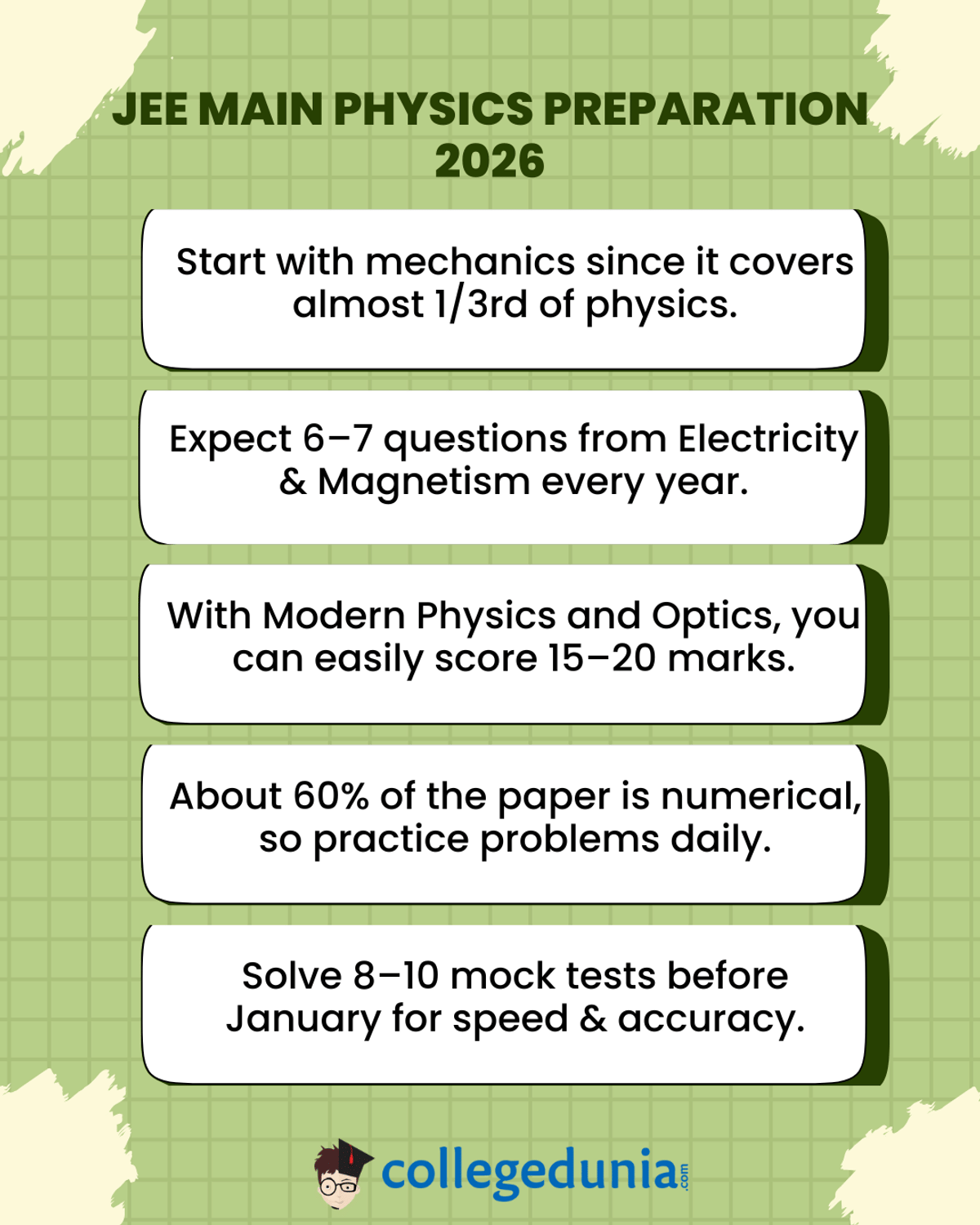
The JEE Main Physics section includes 60-65% of the numerical-based questions. For proper preparation, conceptual clarity, problem-solving speed, and weightage-wise topic prioritisation are important.
Also Read
JEE Main SyllabusHow to Study Physics for JEE from Zero Level?
To start JEE Main Physics Preparation from scratch a proper preparation plan is required. As JEE Main Physics Preparation involves both concepts and problem-solving, students should focus on building basics from NCERT, and then go towards advanced problems.
JEE MAIN Physics Preparation from Zero
| Step | What to Do | Data-Oriented Focus |
|---|---|---|
| 1. NCERT First | Read NCERT line by line for Class 11 & 12 Physics | Covers 70% of theory-based questions directly |
| 2. Concept Building | Use books like HC Verma & DC Pandey for deeper understanding | Improves accuracy by 20–25% in numerical questions |
| 3. Chapter Prioritization | Start with Mechanics, then Electrostatics, Current Electricity, Optics, and Modern Physics | These 5 units contribute 55–60% of JEE Physics marks |
| 4. Daily Practice | Solve at least 30–40 numericals per day | Builds speed and reduces negative marking by 15–20% |
| 5. Mock Tests | Attempt topic-wise & full-length mocks every 2 weeks | Boosts score consistency by 25–30 marks |
| 6. Formula Revision | Prepare a short formula sheet and revise daily | Helps in solving 70% of numerical-based questions quickly |
JEE Main Physics Preparation: Topic-Wise Weightage
As per the previous year analysis, a few topics in JEE Main Physics, like Mechanics, Electricity & Magnetism and Modern Physics, along with optics, cover 70% of the paper.
JEE Main Physics Topic-wise Weightage
- Mechanics is the most important topic, and contributes around 30-35% of the physics section.
- Electricity & Magnetism carries around 20-25% weightage, making it a high-priority section for class 12.
- Around 60-65% questions are numerical-based, which requires consistent practice from the NCERT and PYQs.
| Major Topics | Approx. Weightage (%) | Important Chapters. |
|---|---|---|
| Mechanics | 30–35% | Kinematics, Laws of Motion, WEP, Rotational Motion, Gravitation, Oscillations |
| Electricity & Magnetism | 20–25% | Electrostatics, Current Electricity, Magnetism, EMI, Alternating Current |
| Optics + Modern Physics | 15–18% | Ray Optics, Wave Optics, Photoelectric Effect, Bohr Model, Nuclear Physics |
| Heat & Thermodynamics | 8–10% | Laws of Thermodynamics, Kinetic Theory, Heat Transfer |
| Waves & Sound | 5–7% | Wave Motion, Sound Waves, Doppler Effect |
| Electromagnetic Waves + AC | 3–5% | EM Waves, AC Circuits |
| Semiconductors & Communication | 3–5% | Logic Gates, Diodes, Transistors, Communication Systems |
| Experimental/Practical Physics | 2–3% | Errors, Measurements, Practical-based Questions |
Also Read
JEE Main Chapter-Wise WeightageJEE Main Physics Preparation: Important Topics
JEE Main Physics includes 25 questions, as per the previous year analysis 70% of the physics section from 12-13 chapters.
Class 11 topics like mechanics and class 12 topics like Electrostatics, current electricity, optics, and modern physics carry high weightage.
| Class 11 Topics (Physics) | Class 12 Topics (Physics) |
|---|---|
| Kinematics | Electrostatics |
| Laws of Motion | Current Electricity |
| Work, Energy & Power | Magnetism & Electromagnetic Induction |
| Rotational Motion | Alternating Current |
| Gravitation | Ray Optics & Wave Optics |
| Oscillations & SHM | Modern Physics (Atoms & Nuclei) |
| Waves & Sound | Semiconductor & Communication Systems |
| Heat & Thermodynamics | Electromagnetic Waves |
JEE Main Physics Previous Year Question Paper
JEE Main Physics Preparation 2026: Study Notes and Weightage
Here is the chapter wise weightage for JEE Main Physics syllabus, based on the previous year trends.
| Topics | No of Questions | Weightage |
|---|---|---|
| Electrostatics | 1 | 3.33% |
| Current Electricity | 3 | 10.00% |
| Capacitor | 1 | 3.33% |
| Magnetic Effect of Current & Magnetism | 2 | 6.67% |
| Alternating Current | 2 | 6.67% |
| KTG & Thermodynamics | 2 | 6.67% |
| SHM | 1 | 3.33% |
| Sound Waves | 1 | 3.33% |
| KInematics | 1 | 3.33% |
| Work Power Energy | 1 | 3.33% |
| Laws of motion | 1 | 3.33% |
| Centre Of Mass | 2 | 6.67% |
| Rotational Dynamics | 2 | 6.67% |
| Modern Physics | 2 | 6.67% |
| NLM | 1 | 3.33% |
| Elasticity | 1 | 3.33% |
| Wave Optics | 2 | 6.67% |
| Error | 1 | 3.33% |
| Circular Motion | 1 | 3.33% |
| Electromagnetic Waves | 1 | 3.33% |
| Semiconductors | 1 | 3.33% |
| Communication System | 1 | 3.33% |
| Total | 30 | 100% |
Also Read
JEE Main Chapter-wise papersJEE Main Physics Preparation Part A: Theory Preparation Tips
Once you understand the topic-wise weightage and the number of questions that could be asked, you can develop a good approach towards preparation of important topics.
Mechanics
Mechanics is one of the topics with the highest weightage. It consists of 9 chapters. While preparing for this topic, consider the weightage of each chapter and dedicate an appropriate amount of time and effort.
Some of the important concepts for your preparation in Mechanics are -
| Dimensional and error analysis |
| Acceleration due to gravity |
| Conservation of momentum & energy and collisions |
| Equations of motion |
| Kepler’s laws |
| Mechanics of common forces |
| Moment of inertia and dynamics of rotational motion |
| Pascal’s law, Bernoulli’s principle, viscosity and Reynolds’ number |
| Potential energy of a spring |
| Projectile and circular motion |
| Relative motion |
| Satellites |
| Simple Harmonic motion |
| Standing waves & Beats, Doppler effect |
| Transverse and longitudinal waves: superposition and reflection |
Electrostatics and Magnetism
This section needs an utmost clarity of concepts. Almost 4 questions are asked every year from electrostatics in JEE Main. Concept of Physics by HC Verma is a good book to cover core fundamentals and also contains good quality numerical solved questions.
Some of the important concepts in Electrostatics and Magnetism for your preparation are -
| Ampere's Circuital law |
| Bandwidth and modulation of signals in communication systems |
| Bar magnet and magnetic field lines |
| Biot-Savart Law |
| Capacitance and Capacitors |
| Continuous charge distribution and Gauss’s Law |
| Electric charge and Coulomb’s Law |
| Electric field, field lines, flux |
| Electromagnetic waves and spectrum |
| Electrostatic potential and work done |
| Electrostatics of conductors and Dielectrics |
| Force between two parallel currents |
| Motion in electric and magnetic fields and Cyclotrons |
| Potential energy in an external field |
| The earth’s magnetism |
| Torque on current loop and magnetic dipole |
Optics
This is one of the scoring topics and contains some important chapters like Huygens principle. To get a grasp of these topics, go through advanced optics, understanding physics for JEE Main and Modern Physics by DC Pandey.
Heat and Thermodynamics
- Clearly know all of your basics regarding this JEE Main Physics portion.
- Understand the principles of Zeroth Law of Thermodynamics, Joules Law and the First Law of Thermodynamics.
- Practice model papers on Carnot Engine - Efficiency and Coefficient of Performance.
- Kinetic Theory of Gasses is a portion that can be easily solved with practice.
Some of the important concepts in Heat and Thermodynamics for your preparation are -
| First Law of Thermodynamics and Heat Capacity |
| Heat engines, refrigerators and heat pumps |
| Heat transfer |
| Law of equipartition of energy, specific heat capacity and mean free path |
| Newton’s Law of Cooling |
| Reversible and irreversible processes and Carnot engine |
| Second law of thermodynamics |
| Specific Heat Capacity and Calorimetry |
| Thermodynamic state variables, equation of state and thermodynamic processes |
| Transfer of Thermal Expansion |
Motion of System, Particles and Rigid Body
- Questions for determining torque and moment of inertia of regular bodies using the theorem of parallel and perpendicular axes is considered an essential section in JEE Main Physics. Train more for questions like these.
- Practice numerical based questions on angular momentum, conservation and rolling motion.
- Circular Motion problems are easy for the candidates to answer. Do practice answering these questions.
Kinematics
- Kinematics is the most important segment of JEE Main Physics. This chapter is considered simple and interesting by most students.
- In JEE Main Physics, problems focused on finding maximum height, range, flight time, and velocity at any point in the trajectory are considered important. Practice is important.
- Make copies of all important formulae, theorems and derivations. That will help you prepare at the last minute.
- Gain clarity on the definitions of displacement, acceleration, average velocity, and relative velocity.
Modern Physics
One of the important topics for JEE Main and JEE Advanced, this is a scoring section. Sub topics in this section to be covered up include radioactive substances, nuclear fusion and fission, dual nature of matter and x rays. Bohr’s model should not be forgotten. The trick to ace this section includes solving numerical problems.
NCERT is the best source to cover up the basics. Then students can move onto HC Verma for covering up the theory part and 3000 numerical problems by Schaum for practice.
- This topic is where you can score a lot of marks in the JEE Main Physics section. You can begin with studying Radioactive Decay of Substances, Nuclear Fission and Fusion, Dual Nature of Matter, X-rays and Bohr’s Model.
- You can get your basic concepts clear with NCERT Physics.
- To study the theory part, refer to ‘Concepts of Physics’ by H.C Verma. For numerical, refer to ‘3000 Solved Problems in Physics’ by Schaum.
Collegedunia Tip: Make short note and flash cards
This is a good reference tactic during the last days of the exam. Make short notes of each topic that you cover during preparation . This will allow you to check marks for topics while revising without going into details and opening textbooks. Make flash cards for tricks and formulas
JEE Main Physics Preparation Part B: Practical Components Preparation Tips
While preparing and revising the physics syllabus candidates must take note of part B which states that 20% weightage of the entire paper will be given to practical components that are experimental skills. As every mark counts it is advised to gain maximum benefits from attempting this section the right way and get the maximum scores. The questions are quite simple and based on the following topics:
| Vernier callipers: its use to measure the internal and external diameter and depth of a vessel. |
| Screw gauge: its use to determine thickness/diameter of thin sheet/wire. |
| Simple Pendulum: dissipation of energy by plotting a graph between square of amplitude and time. |
| Metre Scale: the mass of a given object by the principle of moments. |
| Young’s modulus of elasticity of the material of a metallic wire. |
| The surface tension of water by capillary rise and effect of detergents. |
| The coefficient of Viscosity of a given viscous liquid by measuring the terminal velocity of a given spherical body. |
| Plotting a cooling curve for the relationship between the temperature of a hot body and time. |
| The speed of sound in air at room temperature using a resonance tube. |
| The specific heat capacity of a given solid and liquid by method of mixtures. |
| The resistivity of the material of a given wire using a meter bridge. |
| The resistance of a given wire using Ohm’s law. |
| Potentiometer: Comparison of emf of two primary cells and Determination of the internal resistance of a cell. |
| Resistance and figure of merit of a galvanometer by half deflection method. |
| The focal length of a Convex mirror, Concave mirror, and Convex lens using the parallax method. |
| The plot of the angle of deviation vs angle of incidence for a triangular prism. |
| Refractive index of a glass slab using a traveling microscope. |
| Characteristic curves of a p-n junction diode in forward and reverse bias. |
| Characteristic curves of a Zener diode and finding reverse breakdown voltage. |
| Characteristic curves of a transistor and finding current gain and voltage gain. |
| Identification of Diode, LED, Transistor, IC, Resistor, and Capacitor from mixed collection of such items. |
| Using the multimeter to: (i) Identify base of a transistor (ii) Distinguish between NPN and PNP type transistor (iii) See the unidirectional flow of current in case of a diode and an LED (iv) Check the correctness or otherwise of a given electronic component (diode, transistor or IC). |
Collegedunia Tip: Stress Buster
Do take out time for an activity that you love doing, this will release the excess stress accumulated. A small walk, some recreational activity or anything else. Sitting all day continuously is not a healthy practice. Finish a topic and opt for a break.
Must Read Interviews of JEE Main Toppers (NTA Score 100)
- JEE Main Topper Rongala Arun Siddardha
- JEE Main Topper Landa Jitendra
- JEE Main Topper Parth Dwivedi
- JEE Main Topper Chagari Koushal Kumar Reddy
JEE Main Physics Last Minute Preparation
- Focus on your strong points, don't start anything new: Rely on your strong points and ensure no question from these areas is left or is incorrect. Last minute is not the time to start anything new. Hone and sharpen strong areas.
- Revise important formulae: Take reference of short notes and flash cards created to revise formulas and tricks. This is not an appropriate time to go through details in the books. Revise those topics that carry a high weightage and have dominated question papers of the last few years.
- Go easy with the mock test: Certain students get affected by the hype of solving practice papers and spend too much of time on that. While mock tests are essential, just blindly practicing them will bear no fruit. It is important to solve one to two mock tests each day, analyse them and work on the weak points. This ensures that mistakes made are not repeated on the exam day. A bad mock test should not demoralise a candidate, rather help in improving.
- There is no room for self doubt: Any bad practice session or mock test or peer pressure should not demotivate you. The last few days are crucial so keep yourself mentally strong. Revise topic wise, practice questions based on that and move on to the next topic without any doubt.
- Take timely breaks: Continuous study can cause fatigue, thus it is advised to take small breaks after every hour or so to break the monotony and keep the momentum high. Though the breaks should be timely and as per schedule to ensure there is no wastage of time.
- Eat healthy and get some good sleep: Depriving yourself of sleep in the last few days can cause high stress levels and lack of concentration. Thus ensure a good amount of sleep and relaxation. Eat healthy, avoid junk and try to keep fit especially in the last few days before the actual exam.
- Avoid Preparation Discussion: Over Discussing preparation levels with friends and family can increase anxiety in aspirants.
Ideal way to Score 100+ in JEE Main Physics section
- Practice Previous Year Question Papers: Solving previous year question papers will give an idea on what kind of questions are asked and in which domain you lack knowledge. Enhance your score by practicing a varied number of questions.
- Shortcuts and formulae: To ace numerical type of questions formulae play an important role. Mugging up formulae will help arrive at the solutions quickly. If effort is taken to understand them, formulae can be derived on their own.
- Time Management: Students should not spend more than 45-50 minutes in physics as 30-40 % questions are theoretical in nature, thus can be attempted in less than a minute And as they say every second saved is a second earned.
- Elimination of Wrong Answers: At the first instance, elimination of options that seem incorrect by intelligent guessing and wisdom can lead to solving questions the right way and even arriving at the correct answer.
- Easy question first: It is advised to solve easy and approachable questions first. This will maximise the number of questions attempted and help you score good marks. Time left can be spent on questions that are remaining.
JEE Main vs JEE Advanced Physics Topic Wise Comparison
Candidates who attempt JEE Main wish to clear it and make it to the advanced level. Thus a comprehensive preparation for both the exams should be kept in mind. Several topics are covered under the domain of both the exams whereas certain topics are exclusive to each. Let's have a look at the difference of topics in the chemistry section:
| Common Topics | Topics in JEE Main and not in JEE Advanced | Topics in JEE Advanced and not in JEE Main |
|---|---|---|
| Kinematics | Electronic devices | Kirchoff’s laws |
| Gravitation | Oscillators | Newton's law of cooling |
| Laws of Motion | Electronic Waves | Black body radiation |
| Optics | Electromagnetic Spectrum | Absorptive and Emissive power |
| Waves | Communication System | Stefan’s law |
| Electromagnetic Induction | Propagation of Electromagnetic Waves | Wien's displacement law |
NEET Physics Preparation vs JEE Physics Preparation
Joint Entrance Examination (JEE) is an admission examination to engineering colleges while the National Eligibility cum Entrance Test (NEET) is an admission examination for medical colleges. Both examinations are conducted by the National Testing Agency (NTA). JEE and NEET have a Physics segment with a few similarities and differences.
| Pattern | NEET Physics Pattern | JEE Main Physics Pattern |
|---|---|---|
| Number of Questions | 45 Questions | 25 Questions |
| Total Marks | 180 Marks | 180 Marks |
| Type of Questions | Multiple Choice Questions (MCQs) | 20 Multiple Choice Questions (MCQs); 5 Numericals |
| Marking Scheme | + 4 for the correct answer, -1 for an incorrect answer | + 4 for the correct answer, -1 for an incorrect answer for MCQs; + 4 for the correct answer, 0 for an incorrect answer for Numericals |
| Exam Mode | Offline (Pen and Paper Test) | Online |
It is important to note that the preparation strategies for NEET Physics and JEE Physics differ considerably. NEET Physics expectations are not as high as those of JEE Physics because it is an entrance exam to medical colleges while JEE is for engineering colleges.
- While preparing for NEET Physics, one must not refer to books of JEE Physics because NEET does not require you to solve the complex numericals asked in JEE Advanced. This is also because NEET aspirants usually opt out of Mathematics after Class 10 while JEE aspirants have a strong relationship with Mathematics.
- The exam pattern of NEET Physics and JEE Physics differs considerably. Therefore, preparation strategies must be formed accordingly.
- NEET Physics asks only MCQs while JEE Physics asks MCQs and numericals. Practice should be done keeping this in mind.
- NEET Physics preparation must be lighter than JEE Physics preparation due to the nature of the difficulty of questions. JEE Physics requires more intense practice with complex numericals.
NCERT and Other Books for JEE Main Physics
NCERT Physics has all the important preparation topics to crack JEE Physics. Students require a lot of practice with NCERT books to ace the Physics section in JEE. NCERT Physics Solutions have been curated by subject matter experts after extensive research to provide the best study material for JEE Physics. The concepts are explained in a learner-friendly manner which makes it easy for students to understand and apply the concepts. Students preparing for JEE Physics can revise efficiently with NCERT books. They are the best resources for developing strong fundamentals in Physics and work on your weak areas.
Sources - Online versions from NCERT official website
- NCERT Physics for Classes 11 and 12 are the best books for JEE Main Physics preparation. You should consider these books as a Bible because about 50 percent of questions from the JEE Main Physics section come from NCERT Physics books.
- H.C Verma Solutions are known to be the most sought-after study materials for JEE Main Physics. They provide conceptual clarity and in-depth knowledge of core concepts. Every chapter includes multiple-choice questions, varied approaches, numerical problems, analytical questions, brief answers and more.
- H.C Verma Solutions give clear and succinct explanations that can help students develop a strong fundamental base in physics. Preparing from H.C Verma Solutions Vol. 1 and 2 is the best way in which you can develop problem-solving skills in physics. This material helps to quickly understand the basic and advanced concepts usually asked in JEE Main Physics.
Candidates can refer to the following books while preparing for JEE Main Physics section:
| Publisher/ Author | Books |
|---|---|
| I.E. Irodov | Problems in General Physics |
| Arihant Publications | Understanding Physics by D.C. Pandey: Set of books for: Electricity & Magnetism Mechanics (Vol. 1 & 2) Optics & Modern Physics Waves & Thermodynamics |
| R.P. Feynman | Feynman Lectures on Physics |
| SS Krotov | Problems in Physics |
| Arthur Beiser, Shobhit Mahajan, S. Rai Choudhury | Concepts of Modern Physics |
| Halliday, Resnick and Walker | Fundamentals of Physics |
| Advanced Level Physics: Examples and Exercises | Nelkon, Michael, Parker, Philip |
Preparation as per type of questions in JEE Main Physics
Preparation According to the Type of JEE Main Physics Questions
| Type of questions | Preparation |
|---|---|
| Theory oriented/fact-based | Direct from NCERT |
| Numerical/derivation-based | NCERT-based |
| Logical concepts | Concepts are from NCERT Application of these concepts |
| Critical concept-based | Very complex questions Tips from toppers |
The topics mentioned below do not do not hold a substantial part in the reading order of JEE Main but should be handled in a way that candidates are aware of basic concepts in case questions arise.
- Dual Nature of matter and radiation
- Physics and Measurement
- Communication System
- Gravitation
- KTG
Tricks to Solve JEE Main Physics Questions
- If you already have notes from the teacher of your coaching institute, then there is no need to make comprehensive notes again.
- You may enhance the class notes by using a red pen or neon highlighter to illustrate important concepts.
- You can also add substance to the notes with some good/popular questions that you answered earlier so that you will certainly see them again when revising your notes.
- You can add tips/tricks that you might have learned later in the space provided for margins to prevent any errors.
- You can make short notes with full-length notes too, but that will take a lot of time.
- Do not waste time writing down notes again and again.
- Develop an interest in the concepts and formulas that you are studying. A lack of interest will make it harder to remember formulas.
- Use visual memory to connect concepts to formulas. This helps in easy memorization because you will know the process behind the formulas.
- Practice the formulas you want to memorize as often as you can. The more you practice, the better you will understand the application of formulas.
- Writing down formulas again and again will help in speedy and long-lasting memorization.
- You can stick the written formulas on the wall so that you will repeatedly see them.
- Before you go to sleep, think about the formulas. Your brain will have better chances of remembering them the next day.
Tips for JEE Main Physics During the Exam
- Find the easier and approachable questions first and solve them
- Keep on solving questions and fill the OMR sheet side but side
- Do not opt for guess work as it can degrade your marks and overall score.
- Do not panic if stuck at any questions, try to be calm and solve the maximum number of problems you can.
- Do not assume that you have a full one hour for the physics section, try to wrap up the portion in 45 minutes or so. The remaining time is necessary for revision and omr sheet filling.
JEE Main Physics Preparation Through NTA Content Based Lectures
Candidates can also prepare from the online physics video lectures provided by NTA on it’s official website. The steps to access the video lectures are as follows:
- Step 1: Visit the official website of NTA i.e. nta.ac.in.
- Step 2: Click on the “CONTENT BASED LECTURES - FOR JEE MAIN AND NEET-UG BY IIT PROFESSORS / SUBJECT EXPERTS” tab.
- Step 3: You will be redirected to the page containing the name of different subjects.
- Step 4: Choose the video lecture by clicking on the subject.
Direct Link to JEE Main Physics Video Lectures
BIE Telangana Mock Test Facility for JEE Main
Board of Intermediate Education Telangana has launched a free mock test for JEE Main aspirants on a daily, weekly basis. An android app has been launched for smartphones users, thus candidates can take the test from their phones as well. In order to avail the facility candidates need to register themselves at tscie.rankr.io.
In order to register, aspirants have to provide their name, college name and contact information. Mock test facility is available in English and Telugu medium.
Government Online Portals for JEE Main Physics Preparation
HRD minister Ramesh Pokhriyal Nishank launched the National Test Abhyaas App on May 19, 2020 for candidates preparing for JEE Main. The application has been developed by the NTA and it will be available for download on android and ios platforms. As announced by the HRD minister Shri Ramesh Pokhriyal, National Test Abhyaas App is mainly for the preparation of the upcoming JEE Main. More than 17 lakh times practice tests have been taken on the Abhyas app and over 10 lakh candidates have downloaded the app which shows its growing popularity. Mock tests are also available in Hindi in order to promote students from all backgrounds.
The app has been developed by NTA on advice of the HRD minister. The benefits of National Test Abhyaas App are:
- One full question paper of 3 hours will be available everyday for both the exams which will be like the real examination
- There is no fixed schedule for the test, and candidates can anytime practice according to their convenience
- The app will also provide the correct answers and detailed explanations for each answer thus analysis can be aptly done.
- After the test the students will be able to see the analysis of time management i.e. time spent on each section
- The app will provide benefit for all the students staying in rural and urban areas and they will be able to practice daily up to the date of exam
Earlier, the HRD minister suggested the aspirants of JEE Main to study for SWAYAM, Swayam Prabha TV and Diksha portal. All these portals have been exclusively developed for the students preparing for exams conducted by NTA. All these portals have been launched under PM e-Vidya program as a part of ‘one nation one digital platform’ for online education.
Gujarat Board Question Bank For JEE Preparation
The Gujarat state board has released question banks for the aspirants who are preparing for JEE Main, NEET and GUJCET and are supposed to take the examination in 2024. Question banks will be released for all the four subjects included in the syllabus of JEE Main, NEET and GUJCET i.e. Mathematics, Biology, Physics and Chemistry. Read More
The question banks are going to be available in Gujarati and English language. Chapter-wise question papers will also be framed for the aspirants. The question bank can be downloaded from the official website of Gujarat Board.
Direct links for download of question banks:
Free Doubt Solving Sessions by IIT-JEE Toppers
- Edvizo has started conducting the sessions through the zoom app everyday from 6 a.m.to 9 p.m. Aspirants with doubts can get the solution through a live video
- The group includes doctors, IITians and senior subject experts. The main motive of the group is to clear all the uncertainties of the aspirants in context to their preparation strategy and approach.
- The announcement was made by Edvizo (a Guwahati based startup) which has launched the 30-days initiative to help the aspirants of JEE Main and NEET in resolving their issues/doubts online.
- Over 50,000 students have been registered from all over the country and a tie-up has been made with around 2500 coaching institutes in order to carry the idea on a larger platform so that maximum students can get the benefit.
- The main aim behind this initiative was to ensure that the students do not feel demotivated due to the lockdown and the flow must be carried. The team has also planned to start a career-guidance session online on the weekends for a duration of seven hours starting from 9 a.m.
FAQs on JEE Main Physics 2026
Ques. How to prepare for JEE Physics?
Ans. For JEE Main Physics Preparation, a balance of theory and problem-solving is important. Candidates should practice at least 2 hours daily to improve their scores by 20-30 marks.
- Gain concepts from NCERT along with HC Verma/DC Pandey, as 70% questions are concept-based.
- Focus more on Mechanics, Electricity, and Modern Physics as they together carry around 55% weightage.
- Solve the previous 10 years’ PYQs for improving accuracy.
- Practice 30–40 numericals daily to increase speed.
- Take mock tests every 2 weeks to analyse weak areas.
Ques. Is 97% good in JEE Mains?
Ans. Yes, 97 percentile is a very good score. According to the previous year's information, 97% candidates will be placed between 25,000 to 30,000 ranks.
| Percentile | Expected Rank Range | Chances for NITs |
|---|---|---|
| 97% | 25,000 – 30,000 | Decent chance in lower NIT branches |
| 98–99% | 8,000 – 20,000 | Better chances in top NITs (core branches) |
| 99.5%+ | 3,000 – 8,000 | High chance in CSE/EEE at top NITs |
Ques. Is Physics hard in JEE Mains?
Ans. Physics is amongst the toughest subjects in JEE Main, as per the students' feedback in 2025.
- Around 40% candidates found Physics difficult,
- Around 35% rated it moderate,
- Around 25% found it easy.
Ques. Is there any change in the JEE 2026 syllabus?
Ans. Currently, there are no official changes expected in the JEE Main 2026 Syllabus.
| Year | Syllabus Status | Key Note |
|---|---|---|
| JEE 2024 | The revised NCERT syllabus was introduced | Some Class 11 topics removed |
| JEE 2025 | Same as 2024 | Confirmed by NTA |
| JEE 2026 | Likely to remain the same | No updates yet |
Ques. Is NCERT enough for JEE Mains 2026?
Ans. For JEE Main Physics NCERT is essential, but not enough. As per the previous analysis, around 25 to 30% of the questions are theory-based, but for numerical practice, reference books are required.
- Theory questions – 100% covered in NCERT.
- Numerical/Applied problems – 30% covered.
- High-scoring strategy – Use NCERT for basics along with HC Verma/DC Pandey for numericals.



Comments