




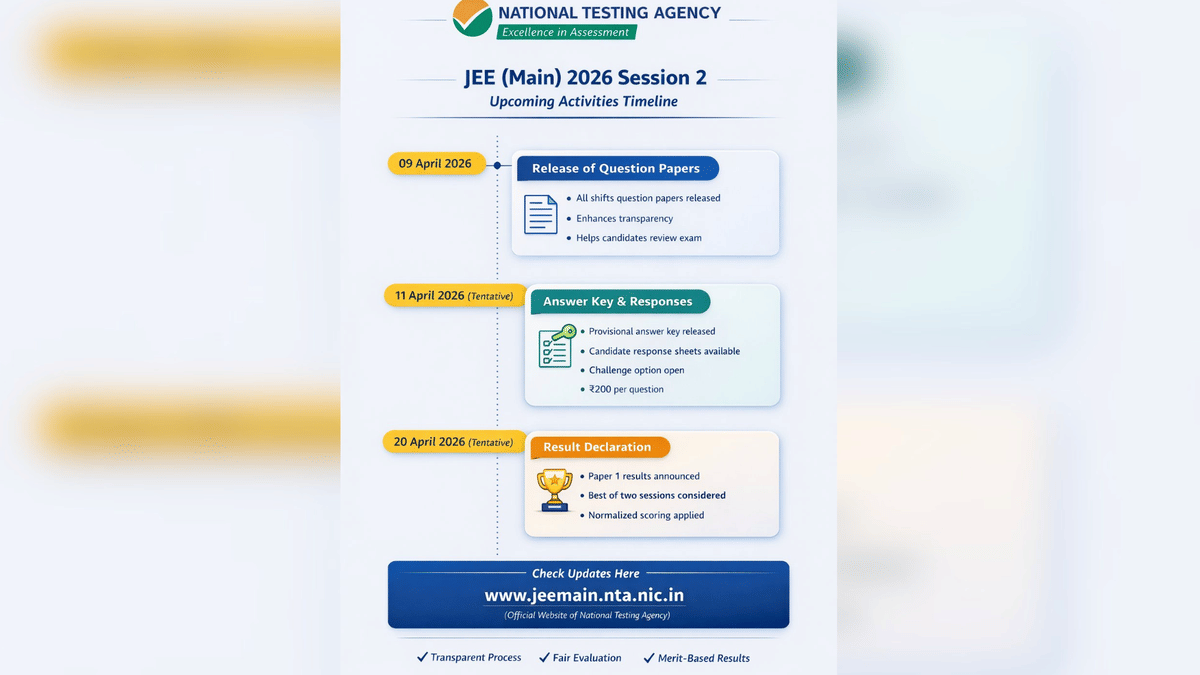
The NTA has released the JEE Main 2026 Session 2 Response Sheet and Provisional Answer Key on 11 April 2026 on its official website - jeemain.nta.nic.in.
With the help of the JEE Main response sheet, you can compare your answers, predict your JEE total scores, percentile, and estimate your potential colleges.
Source - x.com/NTA_Exams/status/2041909195830915546
- The JEE Main 2026 answer key challenge window for session 2 is now live on the official website.
- Candidates can challenge their answers till 13 April 2026 (up to 11:50 PM) by paying the challenge fee of Rs. 200 per question.
- After all the questions are reviewed, the NTA will release the final answer key, which is expected around 20 April 2026, along with the results.
Related Links:
- How to challenge the JEE Main Answer Key?
- JEE Main Percentile Predictor using Answer Key
- JEE Main 2026 Marks Vs Percentile for all shifts
Download JEE Main Session 2 Response Sheet 2026 (Shift-Wise)
Download JEE Main Session 1 Response Sheet 2026 (Shift-Wise)
What is the JEE Main Response Sheet 2026?
The JEE Main Response sheet is a document released by the NTA, which contains the candidate’s responses to each question attempted in the exam, whereas the Answer key shows only the officially correct answers.
The JEE Main Response sheet and answer key will have complete information, such as exam date and shift, candidate’s responses, official answers to each question, and the status of each answer.
Ques. Is the JEE Main response sheet released?
Ans. Yes, the JEE Main Response sheet has been released. The NTA has released the response sheet along with the provisional Answer Key on 11 April 2026 on the official website - jeemain.nta.nic.in/.
Ques. Was 28 Jan shift 1 easy?
Ans. The overall difficulty level of the 28 January, Shift 1 paper was rated as moderate to slightly easy by most candidates and coaching experts.
Section-wise Difficulty Level:
- General Aptitude (GA): Easy to Moderate, scoring section with predictable questions (ratios, percentages, basic English); most candidates attempted 8–9 questions with high accuracy.
- Engineering Mathematics: Moderate, concept-based and balanced coverage (Linear Algebra, Probability, Calculus); 70–80% attempts possible for well-prepared students.
- Core Subject: Moderate to Slightly Tough, mixed questions—some direct, some multi-step; a few time-consuming numericals made time management crucial.
Ques. Which shift was toughest in JEE 2026 till now?
Ans. As per the students feedback and experts analysis, the JEE Main 23 Jan 2026 shift 2 was the most difficult.
Why 23 Jan Shift 2 was the toughest?
- Mathematics was extremely lengthy and calculation-heavy
- Physics reached near JEE Advanced level (conceptual + tricky)
- Severe time management issues—many students couldn’t complete the paper
- Lowest average attempts compared to other shifts
- Both Physics + Maths were tough together, which made overall difficulty high
Ques. Is 93 a good score in JEE Mains?
Ans. Yes, 93 is considered a good score in JEE Mains, as it will place you in the top ~7% of candidates with an expected rank of around 70,000 – 90,000 (varies by session difficulty & normalization).
With this score you can get admission into mid-tier colleges like NIT Srinagar & Hamirpur fall around 92–94 percentile range, in Civil, Mechanical, Electrical branches.
Why is the JEE Main Response Sheet 2026 Important?
The JEE Main 2026 response sheet plays an important role in estimating the total scores scored, accuracy, percentile, and colleges.
- Helps in Accurate Score Calculation
- Essential for Raising an Objection
- Predict Percentile and Rank
- Impacts Final Percentile and Admission Chances
Ques. Why does my response sheet show fewer attempted questions than I remember?
Ans. This happens if some answers were not saved or submitted properly during the exam.
- The Responses marked but not confirmed, answers marked by session timeout, or technical glitches may not be recorded.
- Only the final saved answers that are visible on the screen at submission are reflected in the response sheet.
Ques. Can I still download the response sheet after results are out?
Ans. No, the JEE Main response sheet is available only for a limited time before the results are declared. Once the results are released, NTA removes access to the response sheet, so it is suggested to download and save it as soon as it is released.
Ques. Will I get my question paper and response sheet emailed, or only available online?
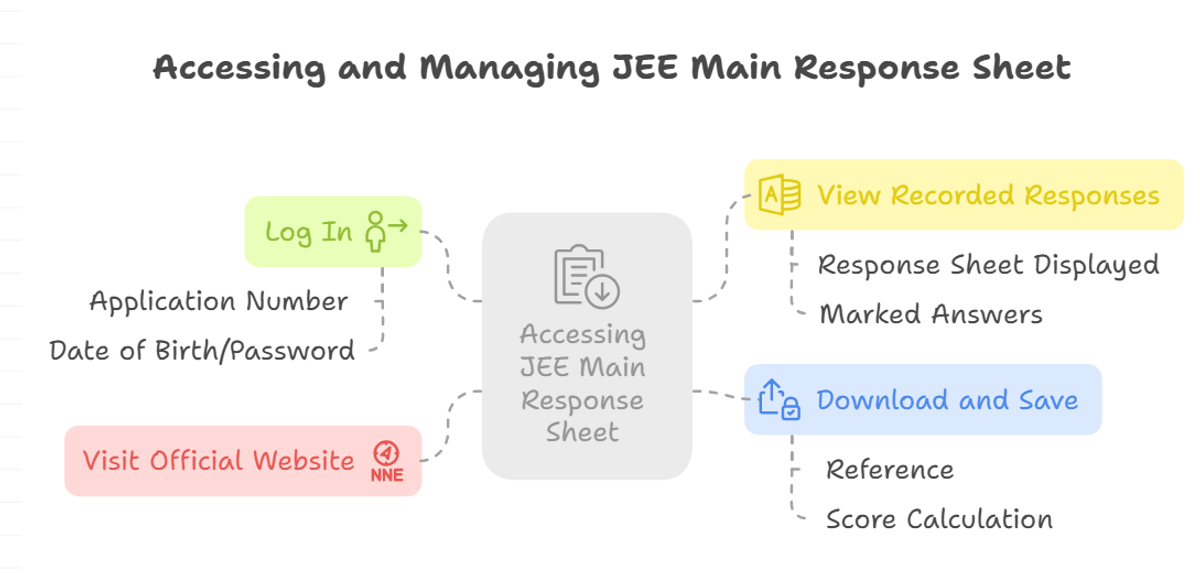
Ans. The JEE Main question paper and response sheets are not sent through email. The Candidates must log in to the official NTA JEE Main portal using their application number and password to access and download them.
JEE Main Response Sheet Notification
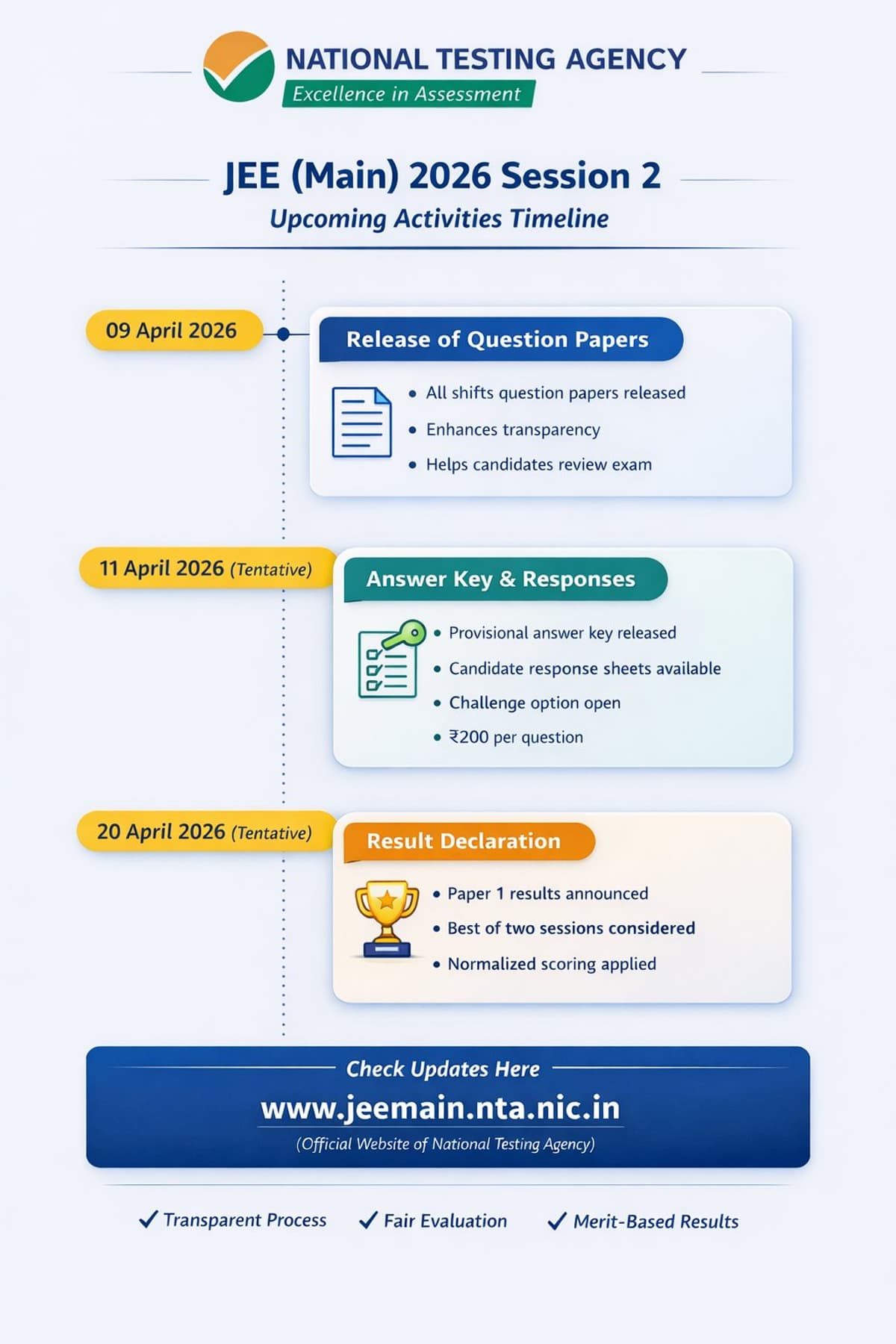
The NTA has posted on X, regarding the tentative dates of the provisional answer key and response sheet, which are 11 April 2026, and for the Final answer key and result, it is 20 April 2026.
Source: x.com/NTA_Exams/status/2041909195830915546
JEE Main 2026 Response Sheet Dates
| Event | Jan Session | Apr Session |
|---|---|---|
| JEE Main Exam | Jan 21‑30, 2026 | Apr 2‑8, 2026 |
| Provisional Answer Key | 4th Feb 2026 | 11 April 2026 (Out) |
| Challenge Window | 4th to 6th February | 11 -13 April 2026 (Live) |
| Final Answer Key | 1 week after challenges end | 20 April 2026 (Tentative) |
| Result Declaration | 12th February 2026 | 20 April 2026 (Tentative) |
JEE Main Response Sheet Date based on Previous Year Analysis
The previous years' data show that the JEE Main Response sheet is released after completing the exam, as in 2022-2025, the response sheet was released within 1-4 days after the last exam of each session.
| Year | Session | Exam Dates | Response Sheet Release Date |
|---|---|---|---|
| 2025 | Session 2 | April 2 to 9 | 11 April, 2025 |
| 2025 | Session 1 | January 22 to 30 | February 4, 2025 |
| 2024 | Session 1 | January 24 to 31 | February 2, 2024 |
| 2024 | Session 2 | April 4 to 9 | April 10, 2024 |
| 2023 | Session 1 | January 2 to February 1 | February 2, 2023 |
| 2023 | Session 2 | April 6 to 15 | April 19, 2023 |
| 2022 | Session 1 | June 23 – 29 | June 29, 2022 |
| 2022 | Session 2 | July 25 – 30 | August 3, 2022 |
How to Download JEE Main Response Sheet?
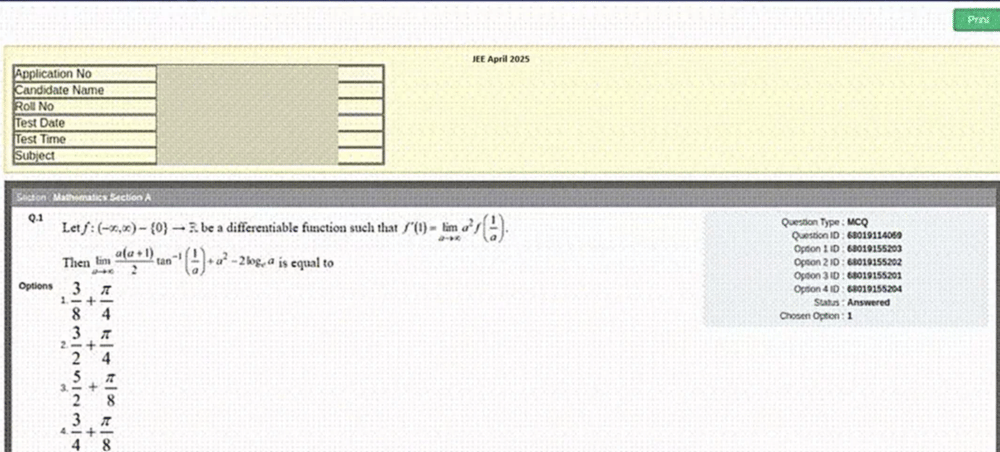
JEE Main Response Sheet Sample
With the help of JEE Main Response Sheet Sample, candidates can have an idea how the response sheet will look.
JEE Main 2026 Session 2 Question Paper PDF
The JEE Main Question Paper of the Session 2, along with the answer key, are available here. Candidates can download the shift wise Question Paper with Answer Key.
| Question Paper | Download |
|---|---|
| JEE Main 2026 2nd April Shift 1 Question Paper Download PDF | Check Here |
| JJEE Main 2026 2nd April Shift 2 Question Paper Download PDF | Check Here |
| JEE Main 2026 4th April Shift 1 Question Paper Download PDF | Check Here |
| JEE Main 2026 4th April Shift 2 Question Paper Download PDF | Check Here |
| JEE Main 2026 5th April Shift 1 Question Paper Download PDF | Check Here |
| JEE Main 2026 5th April Shift 2 Question Paper Download PDF | Check Here |
| JEE Main 2026 6th April Shift 1 Question Paper Download PDF | Check Here |
| JEE Main 2026 6th April Shift 2 Question Paper Download PDF | Check Here |
| JEE Main 2026 8th April Shift 2 Question Paper Download PDF | Check Here |
| JEE Main 2026 B.Arch Question Paper Download PDF | Check Here |
| JEE Main 2026 B.Planning Question Paper Download PDF | Check Here |
| JEE Main 2026 B.Arch and B.Planning Question Paper Download PDF | Check Here |
JEE Main 2026 Session 2 Answer Key PDF
Along with the JEE Main Answer PDF is also available in this article, for candidates to check if their answer is correct or not.
| Answer Key | Download |
| Download JEE Main 2nd April Shift 1 Answer Key PDF | Check Here |
| Download JEE Main 2nd April Shift 2 Answer Key PDF | Check Here |
| Download JEE Main 4th April Shift 1 Answer Key PDF | Check Here |
| Download JEE Main 4th April Shift 2 Answer Key PDF | Check Here |
| Download JEE Main 5th April Shift 1 Answer Key PDF | Check Here |
| Download JEE Main 5th April Shift 2 Answer Key PDF | Check Here |
| Download JEE Main 6th April Shift 1 Answer Key PDF | Check Here |
| Download JEE Main 6th April Shift 2 Answer Key PDF | Check Here |
| Download JEE Main 7th April Shift 2 Answer Key PDF | Check Here |
| Download JEE Main 8th April Shift 2 Answer Key PDF | Check Here |
JEE Main 2026 Session 1 Question Paper PDF
The JEE Main Question Paper, along with the answer key, will be available to be downloaded in this article once the exam is over, after each shift.
| Question Paper | Download |
|---|---|
| JEE Main 2026 21st January Shift 1 Question Paper Download PDF | Check Here |
| JEE Main 2026 21st January Shift 2 Question Paper Download PDF | Check Here |
| JEE Main 2026 22nd January Shift 1 Question Paper Download PDF | Check Here |
| JEE Main 2026 22nd January Shift 2 Question Paper Download PDF | Check Here |
| JEE Main 2026 23rd January Shift 1 Question Paper Download PDF | Check Here |
| JEE Main 2026 23rd January Shift 2 Question Paper Download PDF | Check Here |
| JEE Main 2026 24th January Shift 1 Question Paper Download PDF | Check Here |
| JEE Main 2026 24th January Shift 2 Question Paper Download PDF | Check Here |
| JEE Main 2026 28th January Shift 1 Question Paper Download PDF | Check Here |
| JEE Main 2026 28th January Shift 2 Question Paper Download PDF | Check Here |
| JEE Main 2026 B.Arch Question Paper Download PDF | Check Here |
| JEE Main 2026 B.Planning Question Paper Download PDF | Check Here |
JEE Main 2026 Session 1 Answer Key PDF
Along with the JEE Main Question Paper, the answer key will also be available in this article, for candidates to check if their answer is correct or not.
| Answer Key | Download |
|---|---|
| Download JEE Main 21st January Shift 1 Answer Key PDF | Check Here |
| Download JEE Main 21st January Shift 2 Answer Key PDF | Check Here |
| Download JEE Main 22nd January Shift 1 Answer Key PDF | Check Here |
| Download JEE Main 22nd January Shift 2 Answer Key PDF | Check Here |
| Download JEE Main 23rd January Shift 1 Answer Key PDF | Check Here |
| Download JEE Main 23rd January Shift 2 Answer Key PDF | Check Here |
| Download JEE Main 24th January Shift 1 Answer Key PDF | Check Here |
| Download JEE Main 24th January Shift 2 Answer Key PDF | Check Here |
| Download JEE Main 28th January Shift 1 Answer Key PDF | Check Here |
| Download JEE Main 28th January Shift 2 Answer Key PDF | Check Here |
| Download JEE Main B.Arch Answer Key PDF | Check Here |
| Download JEE Main B.Planning Answer Key PDF | Check Here |
JEE Main Previous-Year Question Paper
JEE Main Score Calculator from Response Sheet
To calculate your JEE Main 2026 score, you need to download your response sheet and the provisional Answer Key released by the NTA. You can compare the answers you marked in the exam with the officially correct answers.
JEE Main follows a question-type, based marking scheme, and your score depends on the number of correct answers, incorrect answers, and unattempted questions.
JEE Main 2026 Marking Scheme (Paper 1 – B.E./B.Tech)
| Question Type | Marks for Correct | Negative Marking | Notes |
|---|---|---|---|
| MCQs | +4 | –1 | Negative marking for incorrect answers |
| Numerical Value Questions | +4 | 0 | No negative marking |
Calculate all the marks obtained using the following formula:
Add the marks scored in the NVQ separately, as there is no negative marking in this section.
Example of Calculation
| Response Type | Number of Questions | Marks Calculation |
|---|---|---|
| Correct Answers | 50 | 50 × 4 = 200 |
| Incorrect Answers | 10 | 10 × (-1) = -10 |
| Unanswered Questions | 10 | 10 × 0 = 0 |
| Total Score | - | 200 - 10 = 190 |
Final Step
Sum up the marks obtained from MCQs sections and the Numerical Value Questions, and calculate your total raw score in JEE Main 2026.
This raw score can be used to predict your expected percentile, keeping in mind that the final result is calculated using the normalization process, as JEE Main is conducted in multiple shifts.

Check:
JEE Main 2026 Score vs Percentile
The JEE Main score vs percentile2026 data shows that the competition is extremely strong, especially at the higher score ranges.
-
Scoring 200+ marks can place you in the 99.9+ percentile, where even a few marks can change your percentile.
- The 180-199 mark range will place you in the 99.5-99.9 percentile, where you can still qualify for the JEE Advanced.
- The marks range of 150–179 will fall in the 98-99.2 percentile, which is strong for the top NITs and IIITs.
- Marks below 150, the percentile will drop drastically between 92 and 96 percentiles
| Marks | Approx. Percentile | Insights |
|---|---|---|
| 200+ | 99.9 – 100 | Top percentile cluster, toppers & national toppers. |
| 180 – 199 | 99.5 – 99.9 | Likely JEE Advanced qualification zone. |
| 150 – 179 | 98 – 99.2 | Strong performance; high chances for top NITs & IIITs. |
| 120 – 149 | 96 – 98 | Good percentile; competitive for many branches in good NITs. |
| 90 – 119 | 92 – 96 | Mid-tier percentile; may land newer NITs/state quota admissions. |
| 60 – 89 | 83 – 92 | Below average; admissions likely in lesser-preferred colleges. |
| Below 60 | < 80 | Significantly lower percentile; risky for mainstream engineering seats. |
Related Links:
How to Challenge the JEE Main Response Sheet and Answer Key?
After the provisional Answer key and response sheet are released, the NTA will provide a 2-3-day window on its official website, where candidates can challenge any discrepancies they have in the response sheet and answer key.
- The candidates have to log in by entering their Application Number and DOB/Password.
- Fill out the objection form available on the official website.
- For each objection raised against the JEE Mau answer key and response sheet, you are required to pay a non-refundable fee of ₹200 per question.
- While objecting, you can select the Question ID and Option ID that you believe is incorrect and upload supporting proof from any reference or standard book.
- After reviewing all objections, the NTA will release the Final Answer Key.
| Parameter | Details |
|---|---|
| Fee per question | ₹200 |
| Refundable? | No |
| Objection window | Usually 2–3 days |
| Who reviews objections? | Subject experts appointed by NTA |
| Final decision | Reflected only in final answer key |
JEE Main Acceptance Rate of Objections
The data shows that JEE Main objection acceptance rates are consistently very low, remaining around 1–2% from 2023 to 2025, despite thousands of objections being filed each year.
Acceptance Rate of Objections
| Year | Objections Filed | Accepted | Acceptance Rate |
|---|---|---|---|
| 2025 | ~6,000–7,000 | 80–120 | ~1–2% |
| 2024 | ~5,000–6,000 | 70–100 | ~1.5–2% |
| 2023 | ~4,500–5,000 | 60–90 | ~1–1.8% |
Acceptance Rate of Objections (Session-wise)
| Year | Session | Questions Dropped/Changed | Subjects Affected (Breakdown) | Error Rate Insights |
|---|---|---|---|---|
| 2025 | Session 1 (Jan) | 12 dropped | Physics: 8 Chemistry: 2 Mathematics: 2 | 1.6% (across ~900-1,080 questions in 10-12 shifts) |
| 2025 | Session 2 (Apr) | 9 changed/dropped (based on flagged errors) | Physics: 4 Chemistry: 3 Mathematics: 2 | Not specified; similar to Session 1 trends |
| 2024 | Session 1 (Jan) | 6 dropped | Primarily Physics (e.g., error analysis, kinematics); some Chemistry and Math | ~0.7% |
| 2024 | Session 2 (Apr) | 4 dropped | Mixed across subjects | ~0.4% |
| 2023 | Session 1 (Jan) | 6-8 dropped | Physics: 3-4 Chemistry: 2 Mathematics: 1-2 | ~0.7-0.9% (accuracy ~96%) |
| 2023 | Session 2 (Apr) | 5 dropped | Similar distribution | ~0.6% |
| 2022 | Session 1 (Jun) | 4 dropped | Physics and Chemistry heavy | ~0.4% |
| 2022 | Session 2 (Jul) | 6 dropped | Mixed | ~0.7% |
| 2021 | Sessions 1 & 2 (Feb-Apr) | 0 dropped | N/A | 0% |
Also Read: Marks vs Percentile JEE Mains 2025 April Attempt
JEE Main Most Commonly Challenged Sections
Based on previous trends, the most commonly challenged sections are Physics, then Chemistry, and least in the Maths section.
- Physics: Highest number of objections due to conceptual ambiguity, numerical rounding, and multiple valid approaches
- Chemistry: Moderate objections, mainly from Physical Chemistry calculations and occasionally NCERT-based factual questions
- Mathematics: Lowest number of objections, as questions are largely formula-driven with definitive answers.
Ques. Why is the response sheet important for objections/challenges?
Ans. The JEE Main response sheet is important for objections because it allows the candidates to verify the answers they have marked against the official answer key.
Ques. Common glitches or errors users face?
Ans. Common issues faced while accessing the JEE Main response sheet are:
- Login errors
- Website server overload
- Incorrect response mapping
- Blank or missing answers
- Difficulty downloading the PDF.
These issues usually occur due to high traffic or temporary technical glitches on the NTA portal.
JEE Main Response Sheet FAQs
Ques. Does JEE Main Release a Response Sheet?
Ans: Yes, NTA releases the JEE Main response sheet on the official website, jeemain.nta.nic.in, after each session. It shows the answer marked by candidates during the exam, and it will verify your response before the result is declared.
| Aspect | Details |
|---|---|
| Released by | NTA (National Testing Agency) |
| Availability | Before result declaration |
| Purpose | Answer verification & score calculation |
| Format | PDF (question-wise responses) |
Ques. How to Download JEE Main Response Sheet?
Ans. Candidates can download the response sheet from the official website after it is released.
- You have to visit the official website, jeemain.nta.nic.in and click on “View Response Sheet”.
- Then login using Application Number & D.O.B, and download and save the PDF.
Ques. Is 96% Good in JEE Mains?
Ans. Yes, 96th percentile is a good score, especially as the competition is high.
It usually places the candidates within the top 4% of total candidates who appeared for the exam and offers chances for admission to NITs, IIITs, and other GFTIs.
| Parameter | Insight |
|---|---|
| Relative performance | Better than 96% candidates |
| Approx rank range | 45,000 – 55,000 |
| NIT chances | Mid-tier branches possible |
| JEE Advanced eligibility | Yes (usually qualifies) |
Ques. Was 28 Jan Shift 1 Tough?
Ans. Yes, 28 Jan shift 1 is considered as moderate and tough, due to lengthy mathematics and chemistry sections.
| Subject | Difficulty | Reason |
|---|---|---|
| Mathematics | Difficult & lengthy | Numerical-heavy |
| Physics | Easy to Moderate | Calculative |
| Chemistry | Moderate & lengthy | Statement-based |
Ques. Is 97% Good in JEE Mains?
Ans. The 97%ile is considered as good score in JEE Main 2026.
| Factor | Outcome |
|---|---|
| Approx rank | 25,000 – 30,000 |
| NIT options | Core branches in good NITs |
| Advanced cutoff | Safely above cutoff |
| Competition level | Top 3% of candidates |
Ques. Who got 99.97 percentile in JEE Main 2025?
Ans. In the previous years, a 99.97 percentile in JEE Main was achieved by
- Vansh Goel (2025 Amritsar topper)
- Aayush Agarwal & Paras Gore (2025)
- Nevish Ashok Pathe, Anubhav Pandey
- Tanishka Kabra (2022)
- Gurbaaz Singh Nandra (2019)



Comments