




The Joint Seat Allocation Authority (JoSAA) has officially commenced the JoSAA Counselling 2026 in an online centralized mode starting June 2, 2026, and will end on June 11, 2026 for rank holders of both JEE Main 2026 and JEE Advanced 2026.
Eligible candidates seeking admission to undergraduate engineering and architecture programs (B.Tech/B.Arch) can register and submit their choices through a one-time choice-filling window.
- JoSAA Counselling: Registration and choice filling is ongoing until June 11, 2026, for 67,323 seats across 138 institutes, including 23 IITs, 31 NITs, 26 IIITs and 56 other GFTIs.
- AAT 2026 Result: The Architecture Aptitude Test result was declared on June 7, 2026, at 5:00 PM for JEE Advanced qualifiers seeking B.Arch admission at IITs.
- Seat Allotment Round 1: Expected to begin around June 12, 2026, based on the previous year's pattern. JoSAA conducts six rounds of seat allotment for final admissions.
- Document Verification: Candidates allotted seats must complete online document verification and pay the seat acceptance fee within the prescribed timeline to secure admission.
Related Links:
- JEE Main Counselling 2026: Important dates, Fees, JoSAA Vs CSAB, Participating Institutes
- JoSAA Counselling 2026: Registration, Choice Filling and Round-Wise Seat Allotment
JEE Main 2026 Overview
| Particulars | Details |
|---|---|
| Exam Name | Joint Entrance Examination (Main) 2026 |
| Conducting Body | National Testing Agency (NTA) |
| Exam Mode | Computer-Based Test (CBT) |
| Number of Sessions | 2 (Session 1 and Session 2) |
| Total Candidates Registered | 16,04,854 |
| Papers | Paper 1 (B.E./B.Tech), Paper 2A (B.Arch), Paper 2B (B.Planning) |
| Language Options | 13 languages (Hindi, English, Assamese, Bengali, Gujarati, Kannada, Malayalam, Marathi, Odia, Punjabi, Tamil, Telugu, Urdu) |
| Official Website | jeemain.nta.nic.in |
JEE Main 2026 Important Dates
The JEE Main 2026 important dates cover the complete examination timeline from registration to final seat allotment. You should keep track of these dates to avoid missing any crucial deadlines.
| Event | Session 1 | Session 2 |
|---|---|---|
| JoSAA Counselling Registration | June 2, 2026 | |
| JoSAA Choice Filling | June 2-11, 2026 | |
| JoSAA Seat Allotment Round 1 | Expected: June 12, 2026 | |
| AAT 2026 Result Declaration | June 7, 2026 | |
| JEE Advanced 2026 Result | (Out) May 2026 | |
| JEE Main Session 2 Result | (Out) April 20, 2026 | |
| JEE Main Session 2 Exam | (Over) April 2-9, 2026 | |
| JEE Main Session 1 Result | (Out) February 16, 2026 | |
| JEE Main Session 1 Exam | (Over) January 21-29, 2026 | |
The AAT 2026 was conducted today (June 4, 2026) for JEE Advanced qualifiers seeking admission to B.Arch programs in IITs. Results will be declared on June 7, 2026.
Source: NTA JEE Main Official Website
JEE Main 2026 Cutoff
JEE Main 2026 cutoff refers to the minimum marks or percentile required for qualification and admission to various engineering colleges. The cutoff varies based on the category, session, and the type of institute you want to get admission to.
JEE Main 2026 Qualifying Cutoff for NIT Admission
| Category | Cutoff Percentile (Expected) |
|---|---|
| General/EWS | 87-92 |
| OBC-NCL | 68-75 |
| SC | 52-58 |
| ST | 42-48 |
| PwD | 0.1-5 |
JEE Advanced 2026 Qualification Cutoff
To qualify for JEE Advanced 2026, candidates needed to be among the top 2,50,000 qualifiers in JEE Main 2026. The approximate cutoff percentiles for JEE Advanced qualification were:
| Category | Approximate Cutoff Percentile |
|---|---|
| General (Common Merit List) | 89.75 |
| EWS | 78.20 |
| OBC-NCL | 74.31 |
| SC | 54.01 |
| ST | 44.33 |
| PwD | 0.17 |
The cutoff for top NITs like NIT Trichy, NIT Warangal, and NIT Surathkal is typically higher, often requiring above 97 percentile for Computer Science and Electronics branches in the general category.
Also Check: JEE Main Marks vs Percentile 2026: Check Shift-Wise Marks and Rank Prediction
JEE Main 2026 Counselling and Seat Allotment
JEE Main 2026 counselling is conducted by the Joint Seat Allocation Authority (JoSAA) for admission to 138 participating institutes, including 23 IITs, 31 NITs, 26 IIITs, and 56 other Government Funded Technical Institutes. The counselling process includes registration, choice filling, seat allotment, and admission confirmation.
JoSAA 2026 registration began on June 2, 2026, with the choice filling deadline until June 11, 2026. A total of 67,323 seats are available for allocation across all participating institutes.
Architecture Aptitude Test (AAT) 2026 Update
The Architecture Aptitude Test (AAT) 2026 was conducted today, June 4, 2026, for JEE Advanced qualified candidates seeking admission to B.Arch programs in IITs. The AAT result was declared on June 7, 2026, at 5:00 PM.
AAT is mandatory for admission to B.Arch programs at IITs and is conducted for JEE Advanced qualifiers only. The test evaluates the candidate’s aptitude for architecture through drawing, visualization, and aesthetic sensitivity.
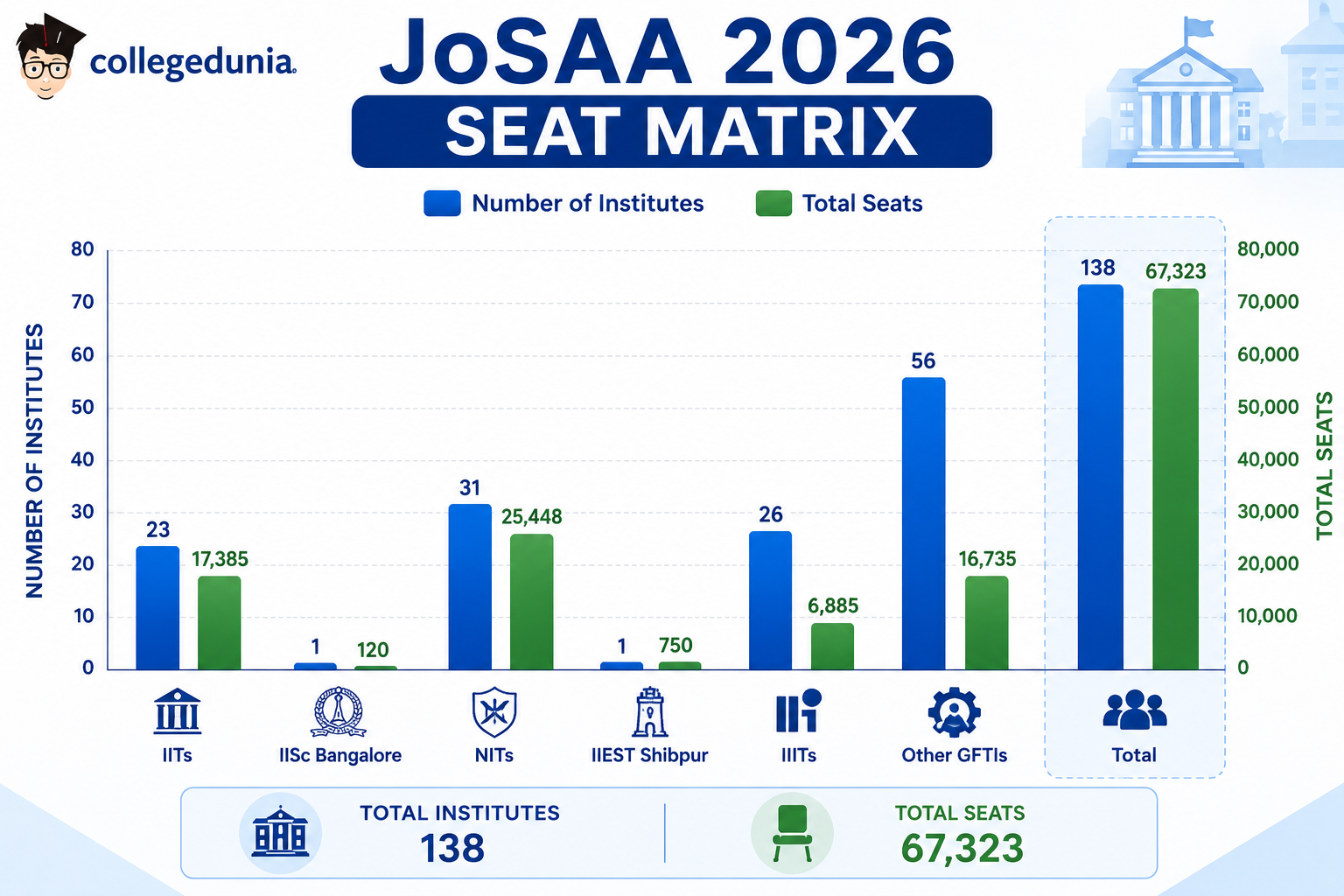
JoSAA 2026 Seat Matrix
| Institute Type | Number of Institutes | Total Seats |
|---|---|---|
| IITs | 23 | 17,385 |
| IISc Bangalore | 1 | 120 |
| NITs | 31 | 25,448 |
| IIEST Shibpur | 1 | 750 |
| IIITs | 26 | 6,885 |
| Other GFTIs | 56 | 16,735 |
| Total | 138 | 67,323 |
 Also Check: JEE Main Seat Matrix 2026: Released on 2 June, Category Wise Distribution and Total Seats 67,323
JEE Main 2026 Marks vs Rank Analysis
JEE Main 2026 marks vs rank analysis helps candidates understand the relationship between raw scores and All India Rank (AIR). The rank depends on the percentile score, which varies based on the difficulty level of the exam and the performance of all candidates.
With more than 16 lakh candidates appearing for JEE Main 2026, the competition was intense. The marks vs rank analysis shows that even a difference of 1-2 marks can significantly impact the rank, especially in the higher score ranges.
Expected JEE Main 2026 Marks vs Rank (General Category)
 |
|---|
Category-wise Rank Analysis
The rank calculation varies significantly based on the candidate’s category. Here’s how the same percentile translates to different ranks:
| Percentile | General Rank | OBC Rank | SC Rank | ST Rank |
|---|---|---|---|---|
| 99.5 | 8,000 | 2,100 | 800 | 400 |
| 98.0 | 32,000 | 8,500 | 3,200 | 1,600 |
| 95.0 | 80,000 | 21,000 | 8,000 | 4,000 |
| 90.0 | 1,60,000 | 42,000 | 16,000 | 8,000 |

JEE Advanced Qualification Marks Trend
To qualify for JEE Advanced 2026, candidates needed to be among the top 2,50,000 performers in JEE Main 2026. The approximate qualifying marks for JEE Advanced were:
- General Category: 89-92 percentile (approximately 200-210 marks)
- EWS Category: 78-82 percentile (approximately 165-175 marks)
- OBC-NCL Category: 74-78 percentile (approximately 155-165 marks)
- SC Category: 54-58 percentile (approximately 110-120 marks)
- ST Category: 44-48 percentile (approximately 90-100 marks)
Note: The exact marks vs percentile may vary based on the normalisation process applied by NTA and the overall performance of candidates in different sessions.
This analysis helps candidates set realistic targets for JEE Main 2027 and understand the level of preparation required for their desired colleges and branches.
Top Engineering Colleges Accepting JEE Main 2026
JEE Main 2026 scores are accepted by over 1,000 engineering colleges across India for admission to B.Tech programs. The participating institutes include premier government institutions as well as reputed private engineering colleges offering various specializations.
Government Engineering Colleges
Indian Institutes of Technology (IITs) - 23 IITs
IITs accept JEE Main scores for the JEE Advanced qualification. Only JEE Advanced qualified candidates can get admission to IITs:
- IIT Bombay: Established in 1958, it offers 10 B.Tech programs
- IIT Delhi: Established in 1961, offers 11 B.Tech programs
- IIT Madras: Established in 1959, it offers 12 B.Tech programs
- IIT Kanpur: Established in 1959, it offers 13 B.Tech programs
- IIT Kharagpur: Established in 1951, offers 19 B.Tech programs
National Institutes of Technology (NITs) - 31 NITs
| NIT | Location | Total B.Tech Seats | Popular Branches |
|---|---|---|---|
| NIT Trichy | Tamil Nadu | 1,088 | CSE, ECE, Mechanical, Chemical |
| NIT Warangal | Telangana | 1,051 | CSE, ECE, Electrical, Civil |
| NIT Surathkal | Karnataka | 780 | CSE, ECE, Mechanical, Chemical |
| NIT Rourkela | Odisha | 1,190 | CSE, ECE, Mechanical, Metallurgy |
| NIT Calicut | Kerala | 780 | CSE, ECE, Mechanical, Civil |
Indian Institutes of Information Technology (IIITs) - 26 IIITs
- IIIT Hyderabad: Premier institute for Computer Science and Electronics
- IIIT Allahabad: Offers IT and Electronics programs
- IIIT Bangalore: Known for research in Computer Science
- IIIT Gwalior: Offers B.Tech in IT and Computer Science
- IIIT Jabalpur: Focus on Information Technology
Also Check: List of Top Colleges in India Accepting JEE Main Based on 2026 Ranking
State Government Engineering Colleges
Top State Engineering Colleges
| State | Top Engineering Colleges | Admission Process |
|---|---|---|
| Maharashtra | COEP Pune, VJTI Mumbai, ICT Mumbai | CAP Round + JEE Main |
| Karnataka | BMSCE, RV College, PES University | KCET + JEE Main |
| Tamil Nadu | CEG Anna University, PSG Coimbatore | TNEA + JEE Main |
| West Bengal | Jadavpur University, BESU | WBJEE + JEE Main |
| Delhi | DTU, NSUT, IIIT Delhi | JAC Delhi + JEE Main |
Private Engineering Colleges
Top Private Engineering Institutes
- Manipal Institute of Technology: Multiple campuses, direct admission
- SRM Institute of Science and Technology: Chennai, SRMJEEE + JEE Main
- VIT University: Vellore and Chennai, VITEEE + JEE Main
- Thapar Institute of Engineering: Patiala, JEE Main based
- BITS Pilani: Multiple campuses, BITSAT required
Cutoff Trends for Top Colleges (General Category)
| College | Branch | JEE Main Percentile Required | Approximate Rank |
|---|---|---|---|
| NIT Trichy | Computer Science | 99.4+ | Under 10,000 |
| NIT Warangal | Computer Science | 99.3+ | Under 12,000 |
| IIIT Hyderabad | Computer Science | 99.5+ | Under 8,000 |
| DTU Delhi | Computer Science | 99.2+ | Under 15,000 |
| PEC Chandigarh | Computer Science | 98.8+ | Under 20,000 |
These colleges offer excellent placement opportunities with average packages ranging from ₹8-15 lakh per annum for top NITs and IIITs. Private colleges also provide good industry exposure and internship opportunities.
You should consider factors like location, specialisation offered, placement records, and infrastructure while choosing colleges through JoSAA counselling or individual college admission processes.
JEE Main 2026 Statistics
JEE Main 2026 statistics provide valuable insights into the examination pattern, candidate participation, and performance trends. The data helps understand the competition level and success patterns across different categories and regions.
Overall Participation Statistics
| Statistic | Session 1 | Session 2 | Overall (Unique) |
|---|---|---|---|
| Registered Candidates | 3,55,293 | Data not specified | 16,04,854 |
| Appeared Candidates | 3,04,653 | Data not specified | Approximately 15 lakh |
| Attendance Percentage | 85.7% | Similar trend | Around 85% |
| Perfect Scorers (100 percentile) | Data not specified | 26 candidates | Combined data |
| Female Perfect Scorers | Data not specified | 5 candidates | Combined data |
Gender-wise Participation
JEE Main 2026 saw significant participation from female candidates, continuing the trend of increasing women’s representation in engineering:
| Gender | Registration Percentage | Appeared Percentage | Top Performers |
|---|---|---|---|
| Male | Approximately 65% | Similar trend | 21 out of 26 perfect scorers |
| Female | Approximately 35% | Similar trend | 5 out of 26 perfect scorers |
Category-wise Performance Analysis
The performance distribution across different categories shows the diversity in JEE Main participation:
| Category | Registration % | Qualification % for Advanced | Seats in Top NITs % |
|---|---|---|---|
| General | 45-50% | 40-45% | 50% |
| OBC-NCL | 35-40% | 40-45% | 27% |
| SC | 12-15% | 12-15% | 15% |
| ST | 5-8% | 5-8% | 7.5% |
| EWS | 8-10% | 8-10% | 10% |
State-wise Participation Trends
JEE Main 2026 attracted candidates from all states, with certain states showing higher participation rates:
- Uttar Pradesh: Highest number of registered candidates (approximately 2.8 lakh)
- Maharashtra: Second-highest participation (approximately 1.8 lakh)
- Bihar: Significant rural participation (approximately 1.2 lakh)
- Rajasthan: Strong representation (approximately 1.1 lakh)
- Madhya Pradesh: Consistent participation (approximately 95,000)
Question Paper Analysis Statistics
| Session | Total Questions Eliminated | Physics | Chemistry | Mathematics |
|---|---|---|---|---|
| Session 1 | 9 | 3 | 4 | 2 |
| Session 2 | Data not available | - | - | - |
Year-over-Year Growth Analysis
JEE Main has shown consistent growth in candidate registration over the past few years:
- 2024: Approximately 14.5 lakh unique candidates
- 2025: Approximately 15.2 lakh unique candidates
- 2026: 16.04 lakh unique candidates (7% growth)
This growth trend indicates the increasing popularity of engineering education and the competitive nature of the examination.
FAQs
Ques. What is JEE Main 2026, and who conducts it?
Ans. JEE Main 2026 is a national-level engineering entrance examination conducted by the National Testing Agency (NTA) for admission to undergraduate engineering programs in IITs, NITs, IIITs, and other Government Funded Technical Institutes across India.
Ques. How many times can I appear for JEE Main?
Ans. You can appear for JEE Main a maximum of 6 times over 3 consecutive years. Since the exam is conducted twice per year (Session 1 and Session 2), this gives you multiple opportunities to improve your score.
Ques. What is the minimum percentage required in Class 12 for JEE Main 2026?
Ans. You need a minimum of 75% marks in Class 12 (65% for SC/ST category) or be in the top 20 percentile of your respective board for admission to IITs, NITs, and other participating institutes through JoSAA counselling.
Ques. Is there any age limit for JEE Main 2026?
Ans. No, there is no age limit for appearing in JEE Main 2026. This change was implemented from JEE Main 2019 onwards, making the exam accessible to candidates of all ages.
Ques. What is the JEE Main 2026 exam pattern?
Ans. JEE Main 2026 has three papers - Paper 1 for B.E./B.Tech (90 questions, 300 marks), Paper 2A for B.Arch (72 questions, 350 marks), and Paper 2B for B.Planning. The exam is conducted in Computer Based Test mode with 3 hours duration.
Ques. How is JEE Main 2026 result calculated?
Ans. JEE Main 2026 result is calculated based on percentile scores, not absolute marks. The percentile is calculated considering the performance of all candidates who appeared in that session, and normalization is applied for multi-session exams.
Ques. What is the difference between JEE Main and JEE Advanced?
Ans. JEE Main is the first stage exam for engineering admissions, while JEE Advanced is the second stage. Top 2,50,000 JEE Main qualifiers are eligible to appear for JEE Advanced, which is required for IIT admissions.
Ques. Can I apply for both sessions of JEE Main 2026?
Ans. Yes, you can apply for both Session 1 and Session 2 of JEE Main 2026. The registration process is separate for each session, and you need to pay the application fee separately for each session.
Ques. What is the JoSAA counselling process for JEE Main 2026?
Ans. JoSAA counselling includes registration, choice filling, seat allotment (6 rounds), document verification, and admission confirmation. The counselling is conducted for 67,323 seats across 138 participating institutes including IITs, NITs, IIITs, and other GFTIs.
Ques. What is Architecture Aptitude Test (AAT) in JEE?
Ans. AAT is a mandatory test for JEE Advanced qualified candidates seeking admission to B.Arch programs in IITs. The AAT 2026 was conducted on June 4, 2026, and evaluates candidates’ aptitude for architecture through drawing and visualization skills.
Ques. Which colleges accept JEE Main 2026 scores?
Ans. JEE Main 2026 scores are accepted by over 1,000 engineering colleges including 23 IITs (through JEE Advanced), 31 NITs, 26 IIITs, 56 other GFTIs, state engineering colleges, and many private institutions across India.
Ques. How can I download my JEE Main 2026 scorecard?
Ans. You can download your JEE Main 2026 scorecard from the official website jeemain.nta.nic.in by entering your Application Number and Date of Birth. The scorecard includes your percentile score, All India Rank, and category rank.
The information provided is based on official NTA notifications and JoSAA guidelines. Candidates are advised to regularly check the official websites for the latest updates and changes in policies. This article serves as a comprehensive guide for JEE Main 2026 and preparation strategies for future sessions.



Comments