




JEE Main exam pattern for Physics has been published on the official website at jeemain.nta.nic.in. According to the JEE Main exam pattern 2026, the examination will feature 25 questions from JEE Main Physics for 100 marks.
- In 2025, the number of questions in JEE Main Physics was reduced from 30 to 25, eliminating the optional question from the examination. The same pattern is followed for JEE Main 2026.
- Out of 25 questions in JEE Main Physics 2026, you can expect around 16 questions from high-weightage units, including Electrostatics, Current Electricity, Modern Physics, Optics, etc.
- With an average of 60 minutes for JEE Main Physics, you will have around 144 seconds (2 minutes and 24 seconds) to answer each question.
JEE Main 2026 will have a total of 75 questions with 25 each from Physics, Chemistry and Mathematics. You can score a maximum of 300 marks in JEE Main 2026 within a total of 3 hours time limit.
Related Articles
Key Summary
- From a total of 20 units in JEE Main Physics syllabus 2026, there will be 25 questions asked in JEE Main question paper, with 3-4 questions from each high weightage chapter.
- JEE Main contributes 33.33% weightage in JEE Main question paper, with maximum score of 100 marks.
- You can score a maximum of 80 marks from MCQs and 20 marks from Numerical value Based questions in JEE Main Physics.
- For Numerical Value Based Questions, you will e required to enter the correct integer value using mouse and virtual keyboard on the screen.
- JEE Main Physics Exam Pattern
- JEE Main Physics Exam Pattern: Question Types
- JEE Main Physics Marking Scheme
- JEE Main Exam Pattern: Question Paper Medium
- JEE Main Physics Exam Pattern: Changes
- JEE Main Physics Exam Pattern: Syllabus & Weightage
6.1 JEE Main Physics Topic Wise Weightage Over Years
6.2 JEE Main Physics High Weightage Topics & Focus Priority
6.3 JEE Main 2026: PYQs on High Weightage Chapters
- JEE Main Physics Preparation Timeline for Last 2-3 Months
- JEE Main Physics Exam Pattern FAQs
JEE Main Physics Exam Pattern
As per the JEE Main Physics exam pattern, a total of 25 questions will be asked from Physics. Section A of JEE Main Physics will carry 20 MCQs, and Section B will carry 5 Numerical Value-Based questions. Maximum marks allocated to JEE Main Physics are 100.
You will be allowed to solve JEE Main question paper within 3 hours. There is no sectional time limit for JEE Main Physics.
| Particulars | Details |
|---|---|
| Exam Mode | Online (CBT) |
| Number of Questions | 25 |
| Section-Wise Number of Questions |
|
| Total Marks in Physics | 100 |

Source: @jeemain.nta.nic.in
Also Check
JEE Main Physics Exam Pattern: Question Types
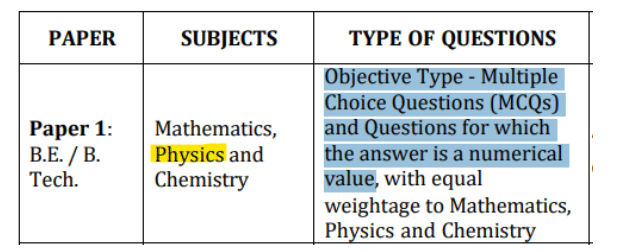
There will be mainly two types of questions asked in JEE Main Physics question paper. According to the JEE Main exam pattern, there will be Multiple-Choice questions with 4 options, and only one option is correct.
Another type of question asked in JEE Main Physics is Numerical Value-Based questions. To answer these questions, students must enter a numerical value after solving the question.
| Type of Questions | Number of Questions |
|---|---|
| Multiple Choice Questions (MCQs) | 20 |
| Numerical Value-Based Questions | 5 |
Source: @jeemain.nta.nic.in
To know the type of JEE Main questions asked, you can also read
JEE Main Physics Marking Scheme
Marking scheme in JEE Main 2026 is different for different types of questions. As per the JEE Main Marking scheme for MCQs and Numerical Value Based questions, 4 marks will be awarded for each correct answer and -1 mark will be deducted for each incorrect answer.
| Type of Questions | Answer Type | Marking Scheme |
|---|---|---|
| MCQs | Correct Answer | +4 |
| Incorrect Answer | -1 | |
| Unanswered | 0 | |
| Numerical Value Based | Correct Answer | +4 |
| Incorrect Answer | -1 | |
| Unanswered | 0 |

Source: @jeemain.nta.nic.in
JEE Main Exam Pattern: Question Paper Medium
As per the JEE Main information bulletin 2026, the examination will be conducted in 13 languages. The selection of languages will be based on the examination centres selected by the candidates, as mentioned in the table below.
| Language(s) | Examination Centres |
|---|---|
| English | All Examination Centres in India and Abroad |
| English and Hindi | All Examination Centres in India |
| English and Assamese | Examination Centres in Assam |
| English and Bengali | Examination Centres in West Bengal, Tripura, and the Andaman & Nicobar Islands |
| English and Gujarati | Examination Centres in Gujarat, Daman & Diu, Dadra & Nagar Haveli |
| English and Kannada | Examination Centres in Karnataka |
| English and Malayalam | Examination Centres in Kerala and Lakshadweep |
| English and Marathi | Examination Centres in Maharashtra |
| English and Odia | Examination Centres in Odisha |
| English and Punjabi | Based on present and permanent address in Punjab, Chandigarh, and Delhi/New Delhi (including Faridabad, Ghaziabad, Gurugram, Noida/ Greater Noida) |
| English and Tamil | Examination Centres in Tamil Nadu, Puducherry, and Andaman & Nicobar Islands |
| English and Telugu | Examination Centres in Andhra Pradesh and Telangana |
| English and Urdu | All Examination Centres in India |
JEE Main Physics Exam Pattern: Changes
Last year, NTA revised the JEE Main exam pattern and brought it to pre-covid format. As per the changes made, the number of questions has been reduced to 75 from 90. Section B of each subject of JEE Main examination has been reduced to 5 questions by removing the 5 optional questions from each subject.
| Particulars | Revised Exam Pattern (2025 onwards) | Exam Pattern Before 2025 |
|---|---|---|
| Total Numebr of Questions | 75 | 90 |
| Number of Questions in Physics | 25 | 30 |
| Number of Optional Questions | 0 | 5 (Numerical Value Based) |
Ques. How did the change in the JEE Main exam pattern change the JEE Main preparation strategy?
Ans. With the change in the JEE Main Physics exam pattern, there is no impact on MCQs, as Section A of the JEE Main Physics has no changes. Section B of JEE Main Physics has changes with a change in the number of questions from 10 to 5.
Now, Section B has only 5 questions, and all 5 are compulsory. This modification of the pattern builds pressure on accuracy for NVQs. You must practice more and more numericals and rounding off to match the answers in the JEE Main examination.
JEE Main Physics Exam Pattern: Syllabus & Weightage
As per the JEE Main Physics syllabus and weightage analysis, maximum weightage has been given to the class 12 syllabus for Physics. From the class 12 JEE Main physics syllabus, high-weightage topics include Electrostatics, Current Electricity, Magnetic Effects of Current and Magnetism, Optics, and Modern Physics.
From the JEE Main class 11th Physics syllabus, each chapter carries around 1 question. The thermodynamics chapter carries around 3 questions, the highest in class 11th Physics for JEE Main 2026.
| Unit No. | Unit Name | Weightage |
|---|---|---|
| Unit 1 | Units and Measurements | 1 |
| Unit 2 | Kinematics | 1 |
| Unit 3 | Laws of Motion | 1 |
| Unit 4 | Work, Energy, and Power | 1 |
| Unit 5 | Rotational Motion | 1 |
| Unit 6 | Gravitation | 1 |
| Unit 7 | Properties of Solids and Liquids | 1 |
| Unit 8 | Thermodynamics | 3 |
| Unit 9 | Kinetic Theory of Gases | 1 |
| Unit 10 | Oscillations and Waves | 1 |
| Unit 11 | Electrostatics | 3 |
| Unit 12 | Current Electricity | 3 |
| Unit 13 | Magnetic Effects of Current and Magnetism | 2 |
| Unit 14 | Electromagnetic Induction and Alternating Currents | 1 |
| Unit 15 | Electromagnetic Waves | 1 |
| Unit 16 | Optics | 3 |
| Unit 17 | Dual Nature of Matter and Radiation | 5 |
| Unit 18 | Atoms and Nuclei | |
| Unit 19 | Electronic Devices | |
| Unit 20 | Experimental Skills | 1 |
Check Here: JEE Main Chapter Wise Papers
JEE Main Physics Topic Wise Weightage Over Years
As per the weightage analysis from past years, Modern Physics carried the highest number of questions with a weightage of around 15-20%. Chapters like Current Electricity, Electrostatics, Optics, and Heat and Thermodynamics carried around 10% weightage in the JEE Main Physics section.
| Chapter | 2025 (%) | 2024 (%) | 2023 (%) | 2022 (%) | 2021 (%) | 2020 (%) | 2019 (%) | 2018 (%) | 2017 (%) |
|---|---|---|---|---|---|---|---|---|---|
| Modern Physics | 20 | 16.7 | 20 | 16.5 | 16.5 | 15 | 15 | 15 | 15 |
| Current Electricity | 10 | 9.9 | 9.9 | 10 | 10 | 10 | 10 | 10 | 10 |
| Electrostatics | 10 | 9.9 | 9.9 | 9.9 | 9.9 | 9.9 | 9.9 | 9.9 | 9.9 |
| Optics | 10 | 9.9 | 9.9 | 10 | 10 | 10 | 10 | 10 | 10 |
| Heat and Thermodynamics | 10 | 10 | 10 | 9.9 | 9.9 | 10 | 10 | 10 | 10 |
| Magnetics | 7 | 7 | 7 | 6.6 | 6.6 | 7 | 7 | 7 | 7 |
| Others (avg. per topic) | 3–4 | 3–4 | 3–4 | 3.3 | 3.3 | 3.3 | 3.3 | 3.3 | 3.3 |
JEE Main Physics High Weightage Topics & Focus Priority
With less than 75 days remaining for JEE Main, you should focus on revision and mock tests. You must revise JEE Main Physics with the highest priority on high-weightage topics like Mechanics and Electrodynamics.
After completing high-weightage topics, you should move to medium-weightage topics like Modern Physics, Optics, and Heat & Thermodynamics.
| Topic | Weightage (approx.) | Priority | Revision Tip from Toppers |
|---|---|---|---|
| Mechanics (NLM, Rotation, Gravitation, Fluids) | 25–30% | High | Master via Irodov + mocks; foundation of everything. |
| Electrodynamics (Capacitance, Current, EMI) | 20–25% | High | Formula-heavy; daily 20 questions. |
| Modern Physics + Optics + Waves | 15–20% | Medium-High | Easy scoring; NCERT + PYQs sufficient. |
| Heat & Thermodynamics, Units/Dimensions, Errors | 10–15% | Medium | Quick revision; guaranteed 1–2 questions. |
| Semiconductors, Communication, Experimental Physics | 5–10% | Low (but don’t skip) | 1-day revision from notes. |
Check Here: JEE Main Physics Mock Test
JEE Main 2026: PYQs on High Weightage Chapters
JEE Main Physics Preparation Timeline for Last 2-3 Months
| Time Slot / Frequency | Activity | Physics Details |
|---|---|---|
| Morning (2–3 hours) | Formula + Short Notes Revision | Quick scan of formula sheets + derivations (e.g., Mechanics, Electrostatics). Toppers like Arka Banerjee revised HC Verma selectively for concepts. |
| Mid-day (2–4 hours) | Targeted Chapter-wise Practice | 50–75 questions from weak areas (e.g., via Allen modules/PYQs). Chirag Singh focused on modules only. |
| Evening (3 hours) | Full Syllabus Mock Test | 1 timed mock daily (last month); analyze errors immediately. Reddit droppers: Start with 2024 PYQs as mocks from Dec. |
| Night (1–2 hours) | Error Analysis + Re-solve | Re-solve wrong questions; log conceptual gaps (e.g., calculation errors in EMI). Ahmad Shayan (AIR 629) emphasized test analysis. |
| Weekly (1 full day) | Light Revision + Past Papers | Solve 1 old JEE Main/Advanced paper (2015–2024); focus on high-weightage like Optics. PW toppers: Weekend mocks + review. |
JEE Main Physics Exam Pattern FAQs
Ques. How much time should I spend on JEE Main Physics out of 3 hours?
Ans. As per the exam pattern for JEE Main 2026, there is no time restriction on sections. You can spend 3 hours as per your convenience. It is recommended that you spend around 50-60 minutes solving JEE Main Physics section.
Ques. For Physics, are there any easy topics in JEE Main 2026?
Ans. Yes, there are many easy topics in JEE Main Physics that students can prepare. Some of the JEE Main Physics easy chapters are Units and Dimensions, Error and Measurements, Modern Physics, Work, Power, and Energy, and Semiconductors. Modern Physics is among the easy topics in JEE Main Physics; however, it carries the high weightage in JEE Main question paper.
Ques. Which language will be considered in case of any discrepancy in JEE Main questions?
Ans. As prescribed by the NTA in the information bulletin, the English language will prevail in case of any difference of opinion.
Ques. Should I prioritise MCQs or NVQs in JEE Main Physics?
Ans. Each question in MCQs and NVQs has equal weightage in JEE Main Physics 2026. You should prioritise MCQs over numerical-based ones, as MCQs have a lower risk. On the other hand, Numerical Value-Based questions are time-consuming, and you can use the remaining time to tackle these time-consuming questions in JEE Main 2026.



Comments