




NIT Cutoff 2027 is the opening and closing ranks that decide B.Tech admission to the 31 National Institutes of Technology via JEE Main 2027. JoSAA will release NIT Cutoff 2027 after every counselling round, separately for each institute, branch, category, quota and gender pool. The NIT Cutoff 2027 is expected from June 2027 on the official website josaa.nic.in.
- The JEE Main cutoff for top NITs 2027 is expected at 1,100–1,600 ranks for NIT Trichy CSE, which is the toughest NIT seat with 99.85–99.9+ percentile.
- JoSAA 2026 Round 5 closed Other State CSE between ranks 1,373 at NIT Trichy and 10,512 at MANIT Bhopal, the base for every NIT cutoff 2027 projection.
- Home State candidates took NIT Rourkela CSE up to rank 9,635 in 2026 against 4,266 for Other State, as the 50% Home State quota runs a separate pool.
- The NIT cutoff category wise 2027 for OBC-NCL CSE at NIT Trichy is expected to be near 350–500 after the EWS seat closed at 287 in 2026.
- The branch-wise NIT cutoff rank 2027 stays more relaxed for ECE, EEE, Mechanical and Civil with top NIT Civil closing beyond rank 20,000 in 2026.
- The percentile required for NIT 2027 CSE at Trichy, Surathkal and Warangal is 99.8+, or about 203–234 marks on JEE Main 2026 trends.
- NTA set the 2026 qualifying percentile at 93.4123549 for General but NIT seats depend on JoSAA rank and 75% in Class 12 (65% for SC, ST, PwD).
- NIT Manipur was the NIT with lowest cutoff for CSE among Other State seats in JoSAA 2026 and closes at rank 43,239 in the final round.
Related Articles:
- JEE Main Safe Score for NIT Trichy, Warangal and Surathkal via JoSAA
- JoSAA Colleges for Under 25000 JEE Main Rank: Top NITs and IIITs
- JoSAA NITs and IIITs With JEE Main Rank Under 10000

Key Summary
- NIT seats follow category reservation of 27% OBC-NCL, 15% SC, 10% EWS and 7.5% ST, with 5% PwD horizontal reservation across categories.
- Female candidates compete first in the female-only pool of supernumerary seats, created to ensure at least 20% female enrolment at NITs.
- The home state for the NIT cutoff quota is the state where a candidate first appeared for Class 12, not domicile, native place or residence.
- Final-round NIT cutoff ranks are the benchmark as NIT Surathkal Other State CSE loosened from 1,605 in Round 1 to 1,954 in JoSAA 2026 Round 5.
- NIT Kurukshetra and NIT Durgapur CSE are expected at 8,500–12,000 and 10,000–15,000 ranks for Other State candidates with 99 percentile.
NIT Cutoff 2027 Overview: JoSAA Rules for JEE Main Cutoff
NIT Cutoff 2027 follows a 50% Home State and 50% Other State seat split in every category, creating separate JEE Main cutoff pools.
- Home State NIT cutoff and Other State NIT cutoff can differ by thousands of ranks because JoSAA uses separate seat pools.
- NIT Cutoff 2027 for female candidates includes supernumerary seats aimed at at least 20% enrolment before the Gender-Neutral pool.
- These JoSAA NIT admission rules directly affect the JEE Main Cutoff for Top NITs 2027 and their closing ranks.
| JoSAA Rule / Aspect | Description | Impact on NIT Cutoff (2027 Expected) |
|---|---|---|
| Home State (HS) vs Other State (OS) Quota |
|
|
| Category Reservation |
|
|
| Gender-Neutral vs Female-Only |
|
|
| Opening & Closing Ranks |
|
|
| Multiple Counselling Rounds |
|
|
| Eligibility Criteria |
|
|
| State of Eligibility | The state where a candidate first appeared for Class 12 sets the code | A wrong state code can cancel a seat if the quota does not match |
| Seat Allotment Algorithm | Allotment runs on rank, category, gender, state eligibility and locked choices | Heavy demand for CSE at top NITs keeps those cutoffs the tightest |
Also Check:
Ques. Who releases the NIT cutoff 2027?
Ans. The Joint Seat Allocation Authority (JoSAA) releases the official NIT opening and closing ranks after each counselling round. The NIT cutoff 2027 will be based on JEE Main ranks and seat allotment results released during JoSAA 2027 counselling.
JEE Main Cutoff for Top NITs 2027: CSE Closing Ranks and Percentile
CSE at NIT Trichy, Surathkal and Warangal is expected at 99.75+ percentile with a 2,600 rank in JEE Main 2027.
- NIT Trichy CSE Cutoff 2027 is expected at 1,100-1,600 with a required JEE Main percentile of 99.85-99.9+.
| NIT Name | Expected Closing Rank (CSE) | Expected Percentile Range |
|---|---|---|
| NIT Tiruchirappalli | 1,100 – 1,600 | 99.85 – 99.9+ |
| NIT Karnataka, Surathkal | 1,600 – 2,400 | 99.80 – 99.88 |
| NIT Warangal | 2,100 – 2,600 | 99.75 – 99.85 |
| NIT Rourkela | 3,200 – 4,500 | 99.60 – 99.75 |
| MNNIT Allahabad | 4,500 – 5,800 | 99.50 – 99.65 |
| NIT Calicut | 4,800 – 6,000 | 99.45 – 99.60 |
| MNIT Jaipur | 5,500 – 6,800 | 99.40 – 99.55 |
| VNIT Nagpur | 6,000 – 7,500 | 99.35 – 99.50 |
| NIT Delhi | 7,000 – 9,000 | 99.20 – 99.40 |
| MANIT Bhopal | 8,000 – 11,000 | 99.05 – 99.30 |
| NIT Kurukshetra | 8,500 – 12,000 | 99.00 – 99.25 |
| NIT Durgapur | 10,000 – 15,000 | 98.80 – 99.10 |
Also Check:
Ques. Who will release the NIT cutoff 2027?
Ans. The Joint Seat Allocation Authority (JoSAA) will release the NIT cutoff 2027 as opening and closing ranks after each counselling round. The cutoff will cover NITs, courses, categories and quotas.
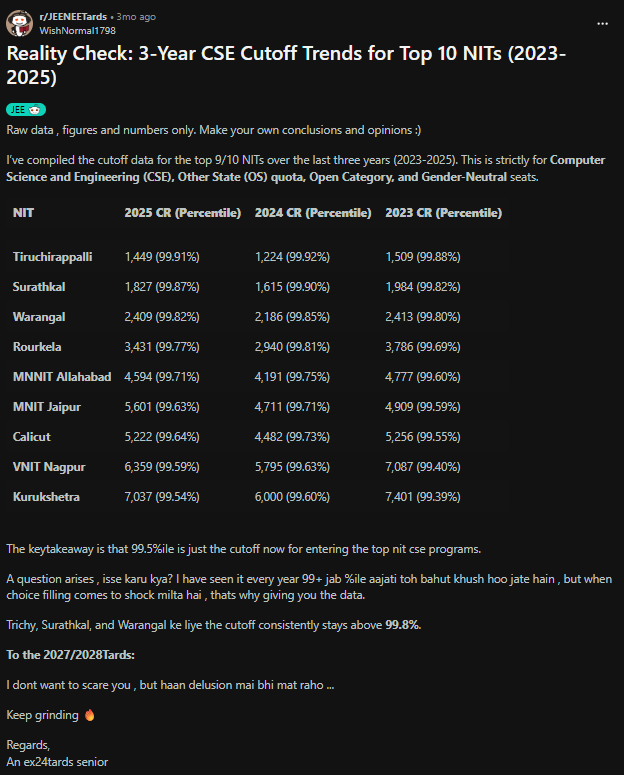
According to a Reddit discussion, candidates reviewed 3-year JEE Main CSE cutoff trends for the top NITs, based on 2023–2025 closing ranks and percentiles. The discussion highlighted that Trichy, Surathkal and Warangal had consistently high CSE cutoffs, with the top NITs generally requiring very high percentiles.
Source: Reddit
NIT CSE Cutoff 2027: Home State vs Other State Expected Rank
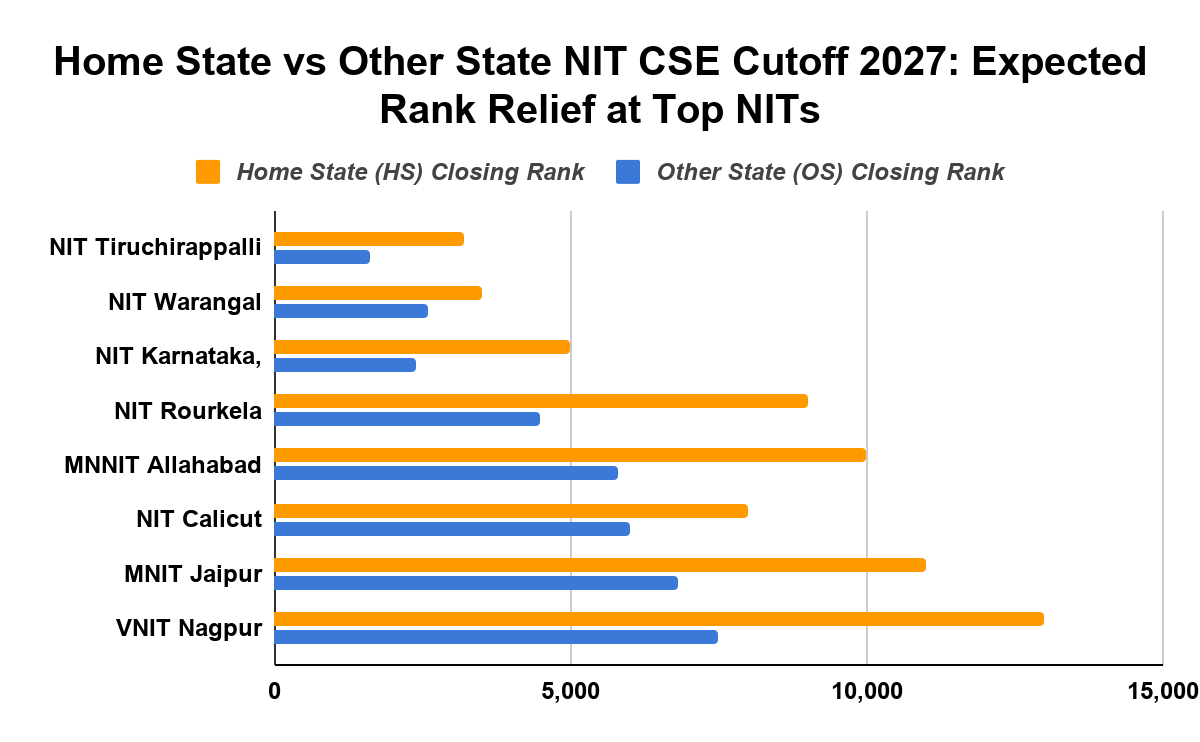
Home State candidates at NIT Trichy can get CSE with ranks of 2,500-3,200, compared with 1,100-1,600 for Other State candidates.
- The Home State vs Other State NIT Cutoff 2027 gap at NIT Trichy is around 1,400-1,600 ranks for CSE.
- The 50% Home State quota creates separate cutoff pools at high demand NITs such as NIT Surathkal and NIT Warangal.
| NIT Name | Home State (HS) Closing Rank | Other State (OS) Closing Rank | Advantage for HS Candidates |
|---|---|---|---|
| NIT Tiruchirappalli | 2,500 – 3,200 | 1,100 – 1,600 | ~1,400–1,600 ranks more relaxed |
| NIT Warangal | 2,800 – 3,500 | 2,100 – 2,600 | ~700–900 ranks more relaxed |
| NIT Karnataka, Surathkal | 3,500 – 5,000 | 1,600 – 2,400 | ~1,900–2,600 ranks more relaxed |
| NIT Rourkela | 6,500 – 9,000 | 3,200 – 4,500 | ~3,000–4,500 ranks more relaxed |
| MNNIT Allahabad | 7,500 – 10,000 | 4,500 – 5,800 | ~3,000–4,200 ranks more relaxed |
| NIT Calicut | 5,500 – 8,000 | 4,800 – 6,000 | Moderate advantage |
| MNIT Jaipur | 8,000 – 11,000 | 5,500 – 6,800 | ~2,500–4,000 ranks more relaxed |
| VNIT Nagpur | 9,000 – 13,000 | 6,000 – 7,500 | Significant advantage |
Also Check:
Ques. How is the home state decided for NIT admission?
Ans. The home state for NIT admission is decided by the state where a candidate first appeared for the Class 12 or equivalent examination. It is not based on domicile, native place or residence.
NIT Cutoff Category Wise 2027: Expected CSE Closing Ranks for EWS, OBC-NCL, SC and ST
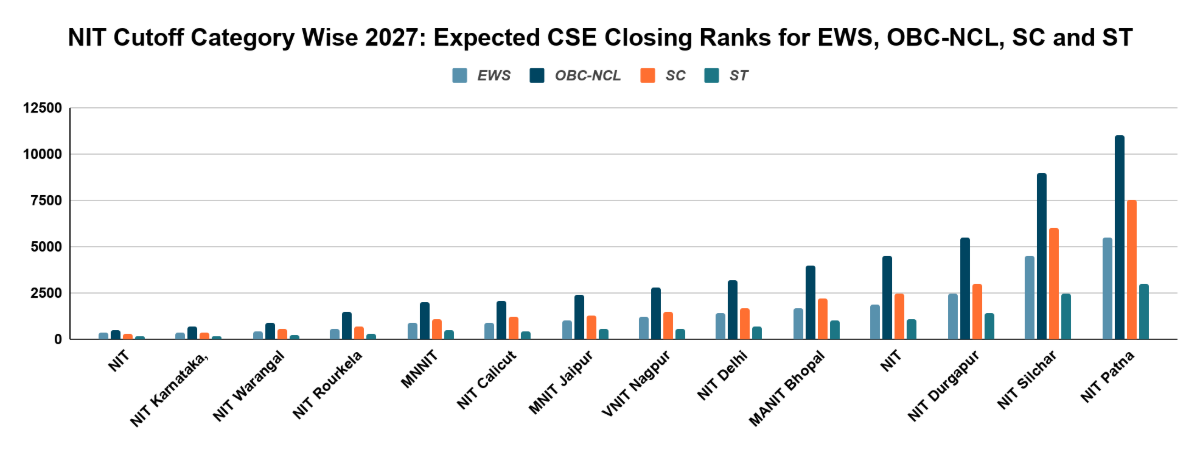
OBC-NCL ranks for CSE in top NITs through JEE Main 2027 are expected to be 2-2.5 times the General ranks with NIT Trichy near 350-500.
- SC and ST candidates can secure CSE seats at top NITs such as Trichy and Surathkal with category ranks below 400 and 160 based on previous years JEE Main cutoff trends.
| NIT (Other State) | EWS | OBC-NCL | SC | ST |
|---|---|---|---|---|
| NIT Tiruchirappalli | 200 – 350 | 350 – 500 | 150 – 300 | 50 – 150 |
| NIT Karnataka, Surathkal | 250 – 400 | 500 – 700 | 200 – 400 | 80 – 160 |
| NIT Warangal | 250 – 450 | 600 – 900 | 300 – 550 | 100 – 250 |
| NIT Rourkela | 400 – 600 | 1,000 – 1,500 | 400 – 700 | 150 – 300 |
| MNNIT Allahabad | 600 – 900 | 1,400 – 2,000 | 700 – 1,100 | 300 – 500 |
| NIT Calicut | 600 – 900 | 1,500 – 2,100 | 700 – 1,200 | 250 – 450 |
| MNIT Jaipur | 700 – 1,000 | 1,700 – 2,400 | 800 – 1,300 | 300 – 550 |
| VNIT Nagpur | 800 – 1,200 | 1,900 – 2,800 | 900 – 1,500 | 350 – 600 |
| NIT Delhi | 900 – 1,400 | 2,200 – 3,200 | 1,000 – 1,700 | 400 – 700 |
| MANIT Bhopal | 1,100 – 1,700 | 2,800 – 4,000 | 1,400 – 2,200 | 600 – 1,000 |
| NIT Kurukshetra | 1,200 – 1,900 | 3,000 – 4,500 | 1,500 – 2,500 | 650 – 1,100 |
| NIT Durgapur | 1,500 – 2,500 | 3,500 – 5,500 | 1,800 – 3,000 | 800 – 1,400 |
| NIT Silchar | 2,500 – 4,500 | 5,000 – 9,000 | 3,000 – 6,000 | 1,200 – 2,500 |
| NIT Patna | 3,000 – 5,500 | 6,000 – 11,000 | 3,500 – 7,500 | 1,500 – 3,000 |
Also Check:
Ques. Is there an all NIT CSE cutoff category wise list?
Ans. Yes. JoSAA publishes NIT opening and closing ranks for each institute, course, category, quota and counselling round. The 2027 category-wise NIT CSE cutoff list will be available after JoSAA 2027 counselling; previous-year data can be used to compare General, EWS, OBC-NCL, SC and ST cutoffs.
Branch-Wise NIT Cutoff Rank 2027 at Top NITs: Expected ECE, EEE, Mechanical and Civil Ranks
NIT ECE Cutoff 2027 is expected to be 1.5-2 times higher than CSE ranks with NIT Trichy ECE expected at 4,000-7,000 for General Other State candidates.
- NIT Branch-Wise Cutoff 2027 shows more relaxed ranks for Mechanical and Civil Engineering, with ranks beyond 15,000-20,000 at NIT Trichy, Surathkal and Warangal.
| NIT Name | ECE (Expected) | EEE / Electrical (Expected) | Mechanical (Expected) | Civil (Expected) |
|---|---|---|---|---|
| NIT Tiruchirappalli | 4,000 – 7,000 | 6,000 – 10,000 | 10,000 – 16,000 | 15,000 – 22,000 |
| NIT Karnataka, Surathkal | 5,000 – 9,000 | 8,000 – 13,000 | 12,000 – 20,000 | 18,000 – 28,000 |
| NIT Warangal | 5,500 – 9,500 | 9,000 – 14,000 | 13,000 – 22,000 | 20,000 – 30,000 |
| NIT Rourkela | 7,000 – 13,000 | 12,000 – 18,000 | 15,000 – 25,000 | 25,000 – 40,000 |
| MNNIT Allahabad | 8,000 – 14,000 | 13,000 – 20,000 | 16,000 – 28,000 | 28,000 – 45,000 |
| NIT Calicut | 9,000 – 15,000 | 14,000 – 22,000 | 18,000 – 30,000 | 30,000 – 48,000 |
| MNIT Jaipur | 10,000 – 16,000 | 15,000 – 24,000 | 20,000 – 35,000 | 32,000 – 50,000 |
| VNIT Nagpur | 11,000 – 18,000 | 16,000 – 26,000 | 22,000 – 38,000 | 35,000 – 55,000 |
| NIT Delhi | 12,000 – 20,000 | 18,000 – 28,000 | 25,000 – 40,000 | 38,000 – 60,000 |
| MANIT Bhopal | 14,000 – 22,000 | 20,000 – 32,000 | 25,000 – 45,000 | 40,000 – 65,000 |
| NIT Kurukshetra | 15,000 – 24,000 | 22,000 – 35,000 | 28,000 – 48,000 | 45,000 – 70,000 |
| NIT Durgapur | 16,000 – 26,000 | 24,000 – 38,000 | 30,000 – 50,000 | 48,000 – 75,000 |
| NIT Silchar | 22,000 – 35,000 | 30,000 – 50,000 | 40,000 – 65,000 | 55,000 – 90,000 |
| NIT Patna | 25,000 – 40,000 | 35,000 – 55,000 | 45,000 – 70,000 | 60,000 – 1,00,000 |
Also Check:
Ques. Is ECE easier to get than CSE at top NITs?
Ans. Yes. ECE generally has a higher closing rank than CSE at top NITs, making it relatively easier to secure. For example, in 2026, NIT Surathkal’s OBC-NCL CSE closed at 2,251, while ECE closed at 3,862 in the final round.
Percentile Required for NIT 2027: Marks, Rank and Seats Within Reach
The Percentile Required for NIT 2027 is around 99.8+ percentile or 210-240 marks for CSE at NIT Trichy, NIT Surathkal or NIT Warangal.
- A 99 percentile in JEE Main 2027 with around 170-195 marks and a rank under 13,000 can open mid-tier NIT CSE and top NIT ECE seats.
| Percentile Range | Approx. Marks | Approx. Rank (CRL) | Seats Within Reach (Realistic Targets) |
|---|---|---|---|
| 99.8 – 99.9+ | 210 – 240+ | Under 2,500 | Top 3 NITs CSE (Trichy, Surathkal, Warangal) |
| 99.5 – 99.8 | 190 – 215 | 2,500 – 6,000 | Top NITs CSE / ECE; Strong mid-tier NITs CSE |
| 99.0 – 99.5 | 170 – 195 | 6,000 – 13,000 | Mid-tier NITs CSE; Top NITs ECE / Electrical |
| 98.0 – 99.0 | 150 – 175 | 13,000 – 26,000 | Mid-tier NITs ECE / Mechanical; Lower NITs CSE |
| 96.0 – 98.0 | 130 – 155 | 26,000 – 55,000 | Lower / Newer NITs CSE; Mid-tier Mechanical / Civil |
| 93.0 – 96.0 | 110 – 135 | 55,000 – 90,000+ | Newer NITs any branch; Core branches at mid NITs |
| Below 93 | Below 110 | 90,000+ | Limited options (mainly CSAB or very low-demand seats) |
Also Check:
- JEE Main and JEE Advance Difference Explained: Difference in Syllabus, Exam pattern, Difficulty, Eligibility
- JEE Main 2026 Chapterwise Papers
Ques. Is the JEE Main qualifying percentile required for NIT admission?
Ans. No. The JEE Main qualifying percentile is not the direct requirement for NIT admission. Candidates must meet the Class 12 eligibility criteria and secure a JEE Main rank for JoSAA counselling. For NIT admission, the requirement is 75% marks in Class 12 or the category-wise top 20 percentile; the requirement is 65% for SC/ST/PwD candidates.
NIT Cutoff 2027: Previous Year Data vs Expected Cutoff
NIT Trichy CSE Cutoff stayed around 1,400-1,500 ranks from 2024 to 2026 while the NIT Cutoff 2027 is expected at 1,100-1,600.
- Top NIT CSE Cutoff ranks changed by only 100-300 ranks each year which shows limited variation in the JEE Main NIT cutoff trend.
| NIT Name | 2024 Closing Rank | 2025 Closing Rank | 2026 Closing Rank | 2027 Expected Closing Rank |
|---|---|---|---|---|
| NIT Tiruchirappalli | ~1,420 | ~1,470 | 1,373 | 1,100 – 1,600 |
| NIT Karnataka, Surathkal | ~2,250 | ~2,380 | 1,954 | 1,600 – 2,400 |
| NIT Warangal | ~2,150 | ~2,280 | 2,581 | 2,100 – 2,600 |
| NIT Rourkela | ~7,200 | ~7,700 | 4,266 | 3,200 – 4,500 |
| MNNIT Allahabad | ~5,600 | ~5,900 | 5,375 | 4,500 – 5,800 |
| NIT Calicut | ~3,900 | ~4,150 | 5,769 | 4,800 – 6,000 |
| MNIT Jaipur | ~6,200 | ~6,600 | 5,868 | 5,500 – 6,800 |
| VNIT Nagpur | ~6,500 | ~7,000 | 7,419 | 6,000 – 7,500 |
| NIT Delhi | ~7,500 | ~7,800 | 8,669 | 7,000 – 9,000 |
| MANIT Bhopal | ~8,500 | ~9,000 | 10,512 | 8,000 – 11,000 |
Also Check:
- JoSAA 2026 Colleges for JEE Main Rank Under 50000 CRL
- Top Colleges in India Accepting JEE Main - Rankings, Fees, Placements - Collegedunia
Ques. What EWS rank will be needed for CSE at a top NIT in 2027?
Ans. An EWS rank below 1,000 is a strong target for CSE at top NITs. In 2026, CSE closed at 287 in NIT Trichy and 361 in NIT Surathkal for EWS candidates. The JEE Main 2027 cutoff will vary by NIT and counselling round.
You can watch the YouTube video "JEE 2027: Minimum Marks for TOP NITs | Safe Score for JEE Main 2027 | 95–99%ile" by RS Institute IIT to understand the JEE Main cutoff for top NITs in 2027. The video covers JEE Main 2026 marks vs percentile, tier-wise NIT lists, Other State and Home State CSE ranks, last-branch marks targets and a 10–20 mark safety buffer.
NIT with Lowest Cutoff for CSE: Options Beyond the Top NITs for 2027
NIT Mizoram and NIT Sikkim are expected to have some of the lowest NIT CSE Cutoff 2027 ranks, ranging from 50,000 to over 3.5 lakh for General Other State.
- Candidates with JEE Main ranks beyond 20,000-30,000 can still get CSE at several North-Eastern NITs in later JoSAA rounds or through CSAB.
| NIT Name | Expected Closing Rank (CSE, Gen OS) | Approx. Percentile Needed | Notes |
|---|---|---|---|
| NIT Mizoram | 50,000 – 3,50,000+ | 85 – 92 | One of the most relaxed CSE options |
| NIT Sikkim | 40,000 – 1,80,000 | 88 – 93 | High closing ranks, especially in later rounds |
| NIT Nagaland | 40,000 – 1,00,000+ | 88 – 93 | Consistently among the easiest CSE seats |
| NIT Arunachal Pradesh | 40,000 – 90,000 | 88 – 93 | Good option for ranks beyond 40k |
| NIT Manipur | 40,000 – 70,000 | 89 – 93 | Relatively accessible CSE seats |
| NIT Meghalaya | 35,000 – 70,000 | 90 – 94 | Competitive among North-Eastern NITs |
| NIT Agartala | 25,000 – 80,000 | 91 – 95 | Wider range depending on round |
| NIT Srinagar | 20,000 – 40,000 | 93 – 96 | Better location, moderate competition |
| NIT Puducherry | 18,000 – 35,000 | 93 – 96 | Improving demand in recent years |
| NIT Goa | 15,000 – 25,000 | 94 – 97 | Attractive location advantage |
| NIT Uttarakhand | 18,000 – 30,000 | 93 – 96 | Solid mid-lower option |
| NIT Silchar | 15,000 – 25,000 | 94 – 97 | Established North-East NIT |
Also Check:
- How to Prepare for JEE Main Paper 2? IIT JEE Study Plan, Time Table, Best Books, Mock Tests, PYQs
- Top 10 Android Apps for JEE Main Preparation
Ques. Which is the NIT with lowest cutoff for CSE?
Ans. For Other State candidates, NIT Manipur had the loosest NIT CSE cutoff among the 31 NITs in JoSAA 2026 Round 5, at rank 43,239. Under the Home State quota, NIT Mizoram closed at 5,22,326 for Mizoram candidates.
Factors Determining NIT Cutoff 2027
JEE Main 2027 is expected to have 13-14 lakh candidates and higher participation may tighten top NIT CSE cutoff ranks by a few hundred.
- The fixed 50% Home State quota can create a 1,400-2,600 rank gap between local and Other State candidates at premier NITs.
| Factor | How It Influences Cutoff | Expected Impact in 2027 |
|---|---|---|
| Total number of JEE Main candidates | Total number of JEE Main candidates | Likely 13–14 lakh+ candidates; mild upward pressure on ranks |
| Paper difficulty level | Tougher paper lowers marks for the same percentile | Moderate difficulty assumed; ranks may stay stable |
| Seat matrix changes | Addition or reduction of seats in popular branches | Minor changes expected; CSE seats remain limited |
| Preference for CSE / ECE | High demand for Computer Science keeps top NIT cutoffs tight | CSE at top NITs will stay the most competitive |
| Home State vs Other State quota | 50% HS seats create two separate pools | HS candidates continue to enjoy significant relief |
| Category-wise reservations | Separate rank lists for EWS, OBC-NCL, SC, ST | Reserved categories see more relaxed cutoffs |
| Number of counselling rounds | Later rounds allow rank movement through Float/Slide | Final-round ranks usually relax 100–500+ from Round 1 |
| Female supernumerary seats | Extra seats to achieve ~20% female enrolment | Slightly more relaxed ranks in Female-only pool |
| Board exam performance (75% rule) | Candidates must meet 75% (or top 20 percentile) criterion | Filters some high-rank candidates if not met |
| Economic & location preferences | Candidates prefer NITs closer to home or with better placements | Influences demand at specific institutes |
Also Check:
- JoSAA NIT Calicut CSE Cutoff: Opening and Closing Ranks by Category
- NIT Warangal CSE Cutoff: JoSAA Closing Ranks by Category
Ques. What EWS rank will be needed for CSE at a top NIT in 2027?
Ans. An EWS rank below 1,000 is a strong target for CSE at top NITs. In 2026, CSE closed at 287 in NIT Trichy and 361 in NIT Surathkal for EWS candidates. The JEE Main 2027 cutoff will vary by NIT and counselling round.
Ques. Should a candidate choose Float or Freeze in JoSAA?
Ans. Freeze keeps the allotted seat fixed and ends participation in further JoSAA rounds. Float accepts the seat while allowing consideration for a higher-preference choice at another institute in later rounds.
NIT Cutoff 2027: Frequently Asked Questions (FAQs)
Ques. What JEE Main rank is needed for CSE at the top 5 NITs?
Ans. A JEE Main rank of around AIR 1,300–5,800 may be required for CSE at the top 5 NITs for a General Other State candidate, based on expected NIT cutoff 2027 bands. A rank near the Round 1 closing rank of the respective band can improve the chances of securing a seat in the earlier counselling round.
Ques. Is the cut off for NIT based on JEE Main marks or rank?
Ans. The NIT cutoff is based on JEE Main rank, not marks. JoSAA publishes NIT opening and closing ranks for each programme and category, while JEE Main marks are used to determine the candidate's rank.
Ques. Can I get CSE in NIT with a 15,000 rank?
Ans. Yes. A 15,000 JEE Main rank can provide CSE options at some NITs, depending on category, home-state quota and counselling round.
Ques. Is NIT fee less than IIT?
Ans. NIT and IIT fees are not identical and vary by institute and programme. The tuition fee, institute charges, hostel fee and other expenses should be checked separately for each institute.
Ques. Can I get NIT if I fail in JEE Advanced?
Ans. Yes. JEE Advanced is not required for NIT admission. NIT admissions through JoSAA are based on JEE Main eligibility and rank.
Ques. Which Tier 3 NIT is best?
Ans. NITs should be compared using factors such as branch-wise cutoff, placements, fees, location, academic programmes and previous-year JoSAA data rather than a single tier label.



Comments
Found 4 Comments
To check the colleges that will accept your JEE Main rank for admission, you can simply use the Collegedunia’s College Predictor. You have to enter your JEE Main rank or score, category and state and click on check results.
JEE Main 2022 Cut off for NITs will be released soon by JoSAA. The excepted opening and closing ranks for admission to NIT Calicut ranges from 5,000 to 10,000 from various Specialization.
The cutoff is released in form of opening and closing ranks. The average required rank for admission to NIT Trichy ranges from 20,000 to 25,000.