




JEE Main cutoff 2027 is the minimum score required to qualify for JEE Advanced as well as admissions to NITs, IIITs, and GFTIs.
- In 2026, the cutoff was around 93.5–95 percentile for General, 80–82 for EWS, 79–81 for OBC-NCL, 61–63 for SC, 47.5–50 for ST and 0.001–0.02 for PwD.
- The JEE Main 2027 qualifying cutoff may increase as the number of candidates and competition continue to rise.
- The General category cutoff increased from 90.78 percentile in 2023 to 93.10 in 2025 and 93.41 in 2026.
Based on previous trends, the expected category-wise qualifying percentile for JEE Main 2027 to get eligible for JEE Advanced is:
| Category | Expected Cutoff Percentile |
|---|---|
| General (UR) | 93.0–95.0+ |
| Gen-EWS | 80.0–82.5 |
| OBC-NCL | 79.0–81.5 |
| SC | 60.0–62.0 |
| ST | 47.5–50.0 |
| UR-PwD | 0.001–0.02 |
- It is expected that the JEE Main 2027 cutoff may increase as it increased from 90.78 percentile in 2023 to 93.10 in 2025 and 93.41 in 2026.
- With a large number of candidates appearing each year, even a 0.1 percentile difference can affect your rank, college, and branch options.
Note: The National Testing Agency will release the official JEE Main 2027 cutoff in April 2027 after both exam sessions conclude.
Understanding previous-year cutoff trends can help you set a realistic target for JEE Main 2027 and plan your preparation accordingly.
Related Links:
- JEE Main Marks vs Percentile 2026: Check Shift-Wise Marks and Rank Prediction
- JEE Main Seat Matrix 2027: Check Expected Seat Intake for NITs, IIITs & GFTIs
- Check JoSAA Counselling 2027 Process

JEE Main Cutoff 2027: Highlights
| Particular | Details |
|---|---|
| Exam | JEE Main 2027 |
| Conducting Body | National Testing Agency (NTA) |
| Cutoff Type | Qualifying Percentile |
| JEE Advanced Eligibility | Based on JEE Main Paper 1 cutoff |
| JEE Main 2027 Cutoff | To be announced |
| Latest Official Cutoff | JEE Main 2026 |
| 2026 General Cutoff | 93.4123549 percentile |
| 2026 OBC-NCL Cutoff | 80.9232583 percentile |
| 2026 EWS Cutoff | 82.4164528 percentile |
| 2026 SC Cutoff | 63.9172792 percentile |
| 2026 ST Cutoff | 52.0174712 percentile |
| 2026 JEE Advanced Qualifiers | 2,50,182 |
What is the JEE Main Cutoff 2027?
The cutoff for JEE Main 2026 is the minimum percentile you need to clear the exam. NTA sets it separately for each category. If you score this percentile or more, you become eligible for JEE Advanced 2026.
NTA decides this mark after both sessions are over. It depends on the number of students, the paper difficulty, and the available seats. The cutoff is released as a percentile, not as raw marks.
Difference between JEE Main Qualifying Cutoff & Admission Cutoff
| Particular | Qualifying Cutoff | Admission Cutoff |
|---|---|---|
| Purpose | Determines eligibility for JEE Advanced | Determines admission to participating institutes |
| Released by | NTA | JoSAA |
| Usually shown as | NTA percentile | Opening and closing ranks |
| Applicable for | JEE Advanced eligibility | NITs, IIITs, IIEST and GFTIs |
| Based on | Category-wise JEE Main performance | College, branch, category and seat availability |
| When available | After the JEE Main Session 2 result | During JoSAA counselling |
| Can you get admission with only this cutoff? | No | Yes, if your rank meets the required closing rank and you satisfy institute eligibility |
Note: A candidate who does not clear the JEE Main qualifying cutoff can still be eligible for admission to NITs/IIITs/GFTIs based on their JEE Main rank, provided they meet the applicable admission and counselling requirements
Related Links:
Ques. What is the expected JEE Main 2027 cutoff for General category?
Ans. The General cutoff could remain around 93–95 percentile if the candidate pool and exam difficulty remain close to 2026.
Ques. Is 90 percentile enough for JEE Main 2027?
Ans. A 90 percentile score may not be enough for General-category JEE Advanced eligibility if the cutoff remains near the 2026 level of 93.41 percentile.
JEE Main 2027 Cutoff: Expected Category-Wise Percentile
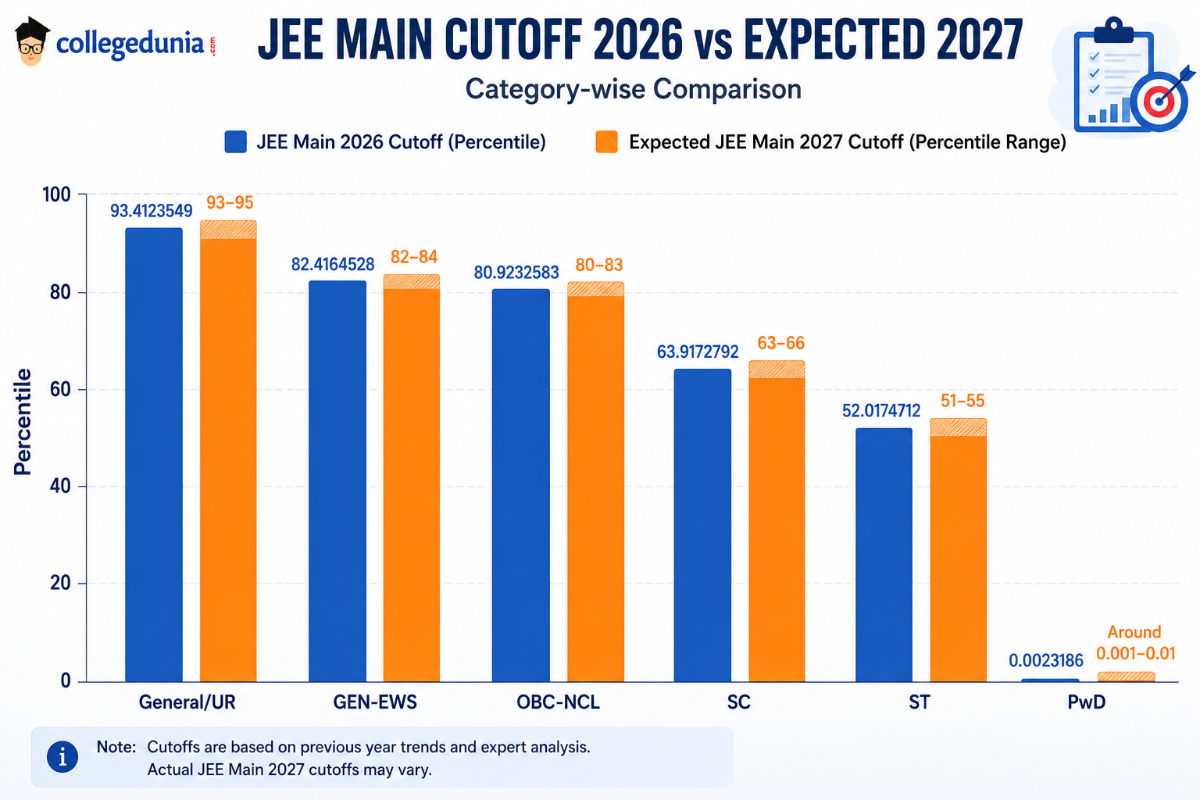
- The expected 0.5-1.5 percentile increase in JEE Main cutoff 2027 if the candidates number increases.
- For candidates even 0.1 percentile change can affect the rank, so candidates should target more than the only expected cutoff to have a good admission chance.
- A good strategy is to keep your target 2-3 percentile above the expected cutoff, especially if you are aiming for NITs, IIITs or other top institutes.
| Category | JEE Main 2026 Cutoff | Expected JEE Main 2027 Cutoff |
|---|---|---|
| General/UR | 93.4123549 | 93–95 |
| GEN-EWS | 82.4164528 | 82–84 |
| OBC-NCL | 80.9232583 | 80–83 |
| SC | 63.9172792 | 63–66 |
| ST | 52.0174712 | 51–55 |
| PwD | 0.0023186 | Around 0.001–0.01 |
Ques. Does JEE Main cutoff guarantee admission to NIT?
Ans. No. The qualifying cutoff only determines eligibility for JEE Advanced. NIT admission depends on your JEE Main rank and the relevant JoSAA closing rank.
Ques. What is the difference between JEE Main cutoff and NIT cutoff?
Ans. JEE Main cutoff refers to the qualifying percentile. NIT cutoff generally refers to the closing rank for a particular institute and course.
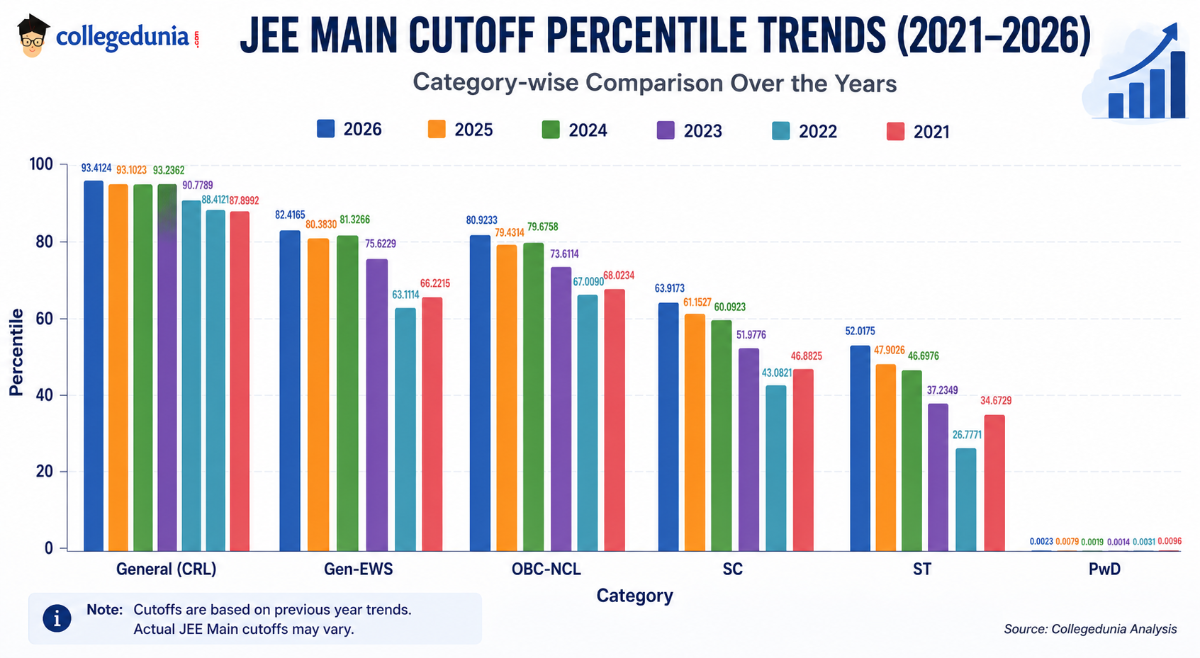
What are the JEE Main Qualifying Cutoff Trends for 6 Years?
- The General cutoff increased from 87.90 percentile in 2021 to 93.41 in 2026, an increase of about 5.5 percentage points.
- From 2025 to 2026, the cutoff increased by 0.31 percentage points for General, 2.03 for EWS, 1.49 for OBC-NCL, 2.76 for SC and 4.11 for ST.
- The trend shows why you should not target the minimum cutoff alone. A higher percentile gives a much safer position for JEE Advanced eligibility and college options.
| Category | 2026 | 2025 | 2024 | 2023 | 2022 | 2021 |
|---|---|---|---|---|---|---|
| General (CRL) | 93.4124 | 93.1023 | 93.2362 | 90.7789 | 88.4121 | 87.8992 |
| Gen-EWS | 82.4165 | 80.3830 | 81.3266 | 75.6229 | 63.1114 | 66.2215 |
| OBC-NCL | 80.9233 | 79.4314 | 79.6758 | 73.6114 | 67.0090 | 68.0234 |
| SC | 63.9173 | 61.1527 | 60.0923 | 51.9776 | 43.0821 | 46.8825 |
| ST | 52.0175 | 47.9026 | 46.6976 | 37.2349 | 26.7771 | 34.6729 |
| PwD | 0.0023 | 0.0079 | 0.0019 | 0.0014 | 0.0031 | 0.0096 |
Check:
- List of Colleges for 50,000 to 75,000 rank in JEE Main
- JEE Main colleges for ranks below 50,000
- List of Colleges accepting 90+ Percentile in JEE Main 2026
- JEE Main College-List Rank Wise
Ques. Has the JEE Main cutoff increased every year?
Ans. No. The cutoff does not rise every year. For example, the General cutoff decreased slightly from 93.2362 in 2024 to 93.1023 in 2025, before increasing to 93.4124 in 2026.
Ques. Which category had the highest increase in recent years?
Ans. Among the major categories, the SC and ST cutoffs showed particularly large increases between 2022 and 2026.
JEE Main 2027 Cutoff Reddit Discussion: What Marks Are Required for 99+ Percentile?
A JEE aspirant asked what score should be targeted in JEE Main 2027 to achieve 99+ percentile, as online predictions vary between around 170 and 190 marks.

Source: Reddit
One response highlighted that the required score depends on the paper’s difficulty and advised students to focus on accuracy and preparation rather than targeting a fixed score.

Source: Reddit
JEE Main 2027 Admission Cutoff
The admission cutoff is the closing rank in JoSAA counselling. It decides your seat in an NIT, IIIT, or GFTI. This rank is far tighter than the qualifying mark.
- You clear the qualifying mark with a percentile, like 93.41 for General.
- You get a seat based on your rank, like a rank under 2,000 for a top NIT CSE.
- The qualifying mark gates JEE Advanced. The admission cutoff gates college seats.
JEE Main 2027: Minimum Cutoff Required for Top IIITs
- 180+ marks: A strong target score if you want to compete for top IIITs and better branches.
- 165-180 marks: Keeps several good IIIT options open, depending on rank and counselling.
- 140-165 marks: Can be enough for several IIITs, particularly those with later-closing ranks.
- 120-140 marks: Options may be limited, with college location and branch playing a bigger role.
- Below 120 marks: Getting an IIIT through JoSAA becomes more difficult and depends heavily on category, branch and institute.
| IIIT Tier | Approx. Percentile Range | Approx. JEE Main Marks | Expected Admission Level |
|---|---|---|---|
| Top IIITs | 99.5+ | 180–220+ | Strong chance for top branches |
| Tier 1 IIITs | 99.0–99.6 | 165–220 | CSE/IT and ECE-level options |
| Tier 2 IIITs | 97.5–99.0 | 140–175 | CSE/ECE available at several institutes |
| Tier 3 IIITs | 96.0–98.0 | 120–150 | CSE/ECE options depending on institute |
| Lower-closing IIITs | 95.0–97.0 | 110–140 | Limited branch and college choices |
JEE Main 2027 Cutoff Score for Top NITs
- For candidates targeting CSE in an NIT, the required score varies significantly by the NIT tier.
- For the top NITs, candidates should target around 170–220+ marks, corresponding roughly to the 99.4–99.9+ percentile range.
- For Tier 2 NITs, around 155–190 marks may be a useful target, while CSE at some Tier 3 NITs may be possible around 130–160 marks.
| NIT Tier | Target Branch/Admission Level | Approx. Percentile | Approx. Marks* |
|---|---|---|---|
| Tier 1 NITs | CSE | 99.4–99.9+ | 170–220+ |
| Tier 1 NITs | Lower/last available branch | 96–97+ | 110–150 |
| Tier 2 NITs | CSE | 99–99.4+ | 155–190 |
| Tier 2 NITs | Lower/last available branch | Around 96+ | 110–130 |
| Tier 3 NITs | CSE | 97–98+ | 130–160 |
| Tier 3 NITs | Lower/last available branch | Around 96+ | 110–120 |
As discussed in the video, JEE Main 2027 candidates can use the following NIT-wise tier classification and estimated score ranges as a practical target for securing admission to top, mid-tier and newer NITs, depending on their preferred branch and category.
| NIT Tier | NITs Colleges | Approx. Score Range |
|---|---|---|
| Tier 1 | 110–220+ depending on branch | |
| Tier 2 | 110–190 depending on branch | |
| Tier 3 |
| 110–160 depending on branch |
Ques. What percentile is required for NIT CSE?
Ans. There is no single percentile cutoff. The required percentile varies by NIT, CSE closing rank, category, quota and counselling round.
Ques. Is 95 percentile enough for NIT?
Ans. It depends on the candidate's category, rank, home state, branch and available seats. A 95 percentile should be evaluated against previous JoSAA closing ranks rather than a fixed NIT cutoff.
Minimum Marks Required for Top GFTIs for JEE Main 2027
- Students with 99+ percentile have the best chances of getting top GFTIs and preferred branches.
- Those scoring 95–99 percentile can get several good GFTIs, while options become more limited below 95 percentile, depending on the branch and home-state quota.
| GFTI/Institute | Best/Top Branch Closing Rank | Top Branch Percentile | Last Branch Closing Rank | Last Branch Percentile | Approx. Marks Target for 2027 |
|---|---|---|---|---|---|
| IIIT Naya Raipur | 18,000 | 98%ile | 30,000 | 97%ile | 160–180 |
| Punjab Engineering College, Chandigarh | 13,000 | 99%ile | 58,000 | 96%ile | 170–190 |
| University of Hyderabad | 36,000 | 97%ile | 72,000 | 95%ile | 150–170 |
| BIT Mesra, Ranchi | 18,000 | 98%ile | 61,000 | 95%ile | 160–180 |
| JNU, Delhi | 31,000 | 97%ile | 45,000 | 98%ile | 160–180 |
| IIIT Bhubaneswar | 34,000 | 97%ile | 46,000 | 96%ile | 155–175 |
| NIAMT Ranchi | 56,000 | 96%ile | 68,000 | 95%ile | 140–160 |
| BIT Patna | 49,000 | 96%ile | 78,000 | 94%ile | 140–160 |
| Central University of Haryana | 64,000 | 95%ile | 1,00,000 | 91%ile | 120–145 |
| SOE Tezpur | 64,000 | 95%ile | 1,00,000 | 91%ile | 120–145 |
| PTU Puducherry | 56,000 | 94.6%ile | 78,000 | 96.2%ile | 125–150 |
| SLIT Longowal | 64,000 | 95%ile | 1,00,000 | 92.9%ile | 125–150 |
| Dr. H.S. Gour University | 70,000 | 95%ile | 1,25,000 | 91%ile | 120–145 |
| GKCIET Malda | 60,000 | 95.9%ile | 1,06,525 | 90%ile | 110–140 |
Watch the video below for a detailed explanation of Minimum Marks Required for Top GFTIs for JEE Main 2027.
Also Check:
Check JEE Main 2026 Closing Ranks
You can check the JEE Main 2026 college-wise opening and closing ranks on the official JoSAA website. Select the institute, academic programme, category, and counselling round to find the closing rank for your preferred college and branch.
JoSAA 2025 Opening and Closing Ranks
| Rounds | IITs | NIT | IIIT | GFTI |
|---|---|---|---|---|
| Round 1 | Download PDF | Download PDF | Download PDF | Download PDF |
| Round 2 | Download PDF | Download PDF | Download PDF | Download PDF |
| Round 3 | Download PDF | Download PDF | Download PDF | Download PDF |
| Round 4 | Download PDF | Download PDF | Download PDF | Download PDF |
| Round 5 | Download PDF | Download PDF | Download PDF | Download PDF |
| Round 6 | Download PDF | Download PDF | Download PDF | Download PDF |
JoSAA 2024 Opening and Closing Ranks
The following table contains links of JoSAA opening and closing ranks for 2024.
| Rounds | JoSAA Cutoff 2024- Opening and Closing Ranks | |||
|---|---|---|---|---|
| IITs | NITs | IIITs | GFTIs | |
| Round 1 | Check Here | Check Here | Check Here | Check Here |
| Round 2 | Check Here | Check Here | Check Here | Check Here |
| Round 3 | Check Here | Check Here | Check Here | Check Here |
| Round 4 | Check Here | Check Here | Check Here | Check Here |
| Round 5 | Check Here | Check Here | Check Here | Check Here |
JoSAA 2023 Opening and Closing Ranks
The following table contains links of JoSAA opening and closing ranks for 2023.
| Rounds | JoSAA Cutoff 2023- Opening and Closing Ranks | |||
|---|---|---|---|---|
| IITs | NITs | IIITs | GFTIs | |
| Round 1 | Check Here | Check Here | Check Here | Check Here |
| Round 2 | Check Here | Check Here | Check Here | Check Here |
| Round 3 | Check Here | Check Here | Check Here | Check Here |
| Round 4 | Check Here | Check Here | Check Here | Check Here |
| Round 5 | Check Here | Check Here | Check Here | Check Here |
| Round 6 | Check Here | Check Here | Check Here | Check Here |
Factors Influencing JEE Main 2027 Cutoff Marks
The JEE Main cutoff changes every year based on several factors. The main factors include:
- Number of Students Appearing: More students mean higher competition, which can increase the cutoff.
- Exam Difficulty: An easy paper can lead to higher cutoffs, while a difficult paper may lower them.
- Student Performance: If more students score well, the cutoff may increase. Lower overall performance can reduce it.
- Number of Seats: More seats can lower competition, while fewer seats can push the cutoff higher.
- Previous Year Trends: Previous cutoffs help estimate the expected cutoff but do not guarantee the same cutoff for 2027.
- Category: Cutoffs vary for General, OBC-NCL, EWS, SC, and ST candidates due to reservation rules.

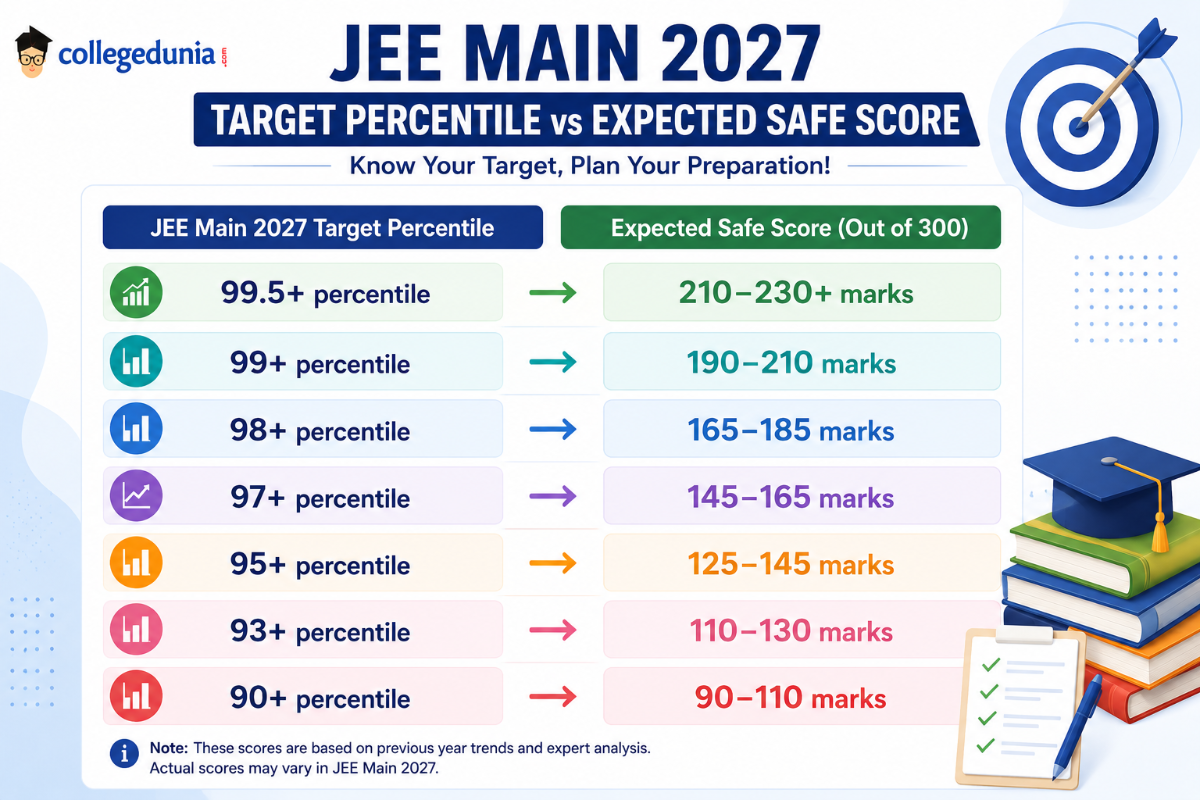
JEE Main 2027 Expected Safe Score & Percentile
- Candidates targeting 99+ percentile should aim for around 190-210 marks to keep a safer margin, although the actual marks required can vary by shift difficulty.
- A score of around 145-165 marks can be a useful target for candidates aiming for 97+ percentile, while 125-145 marks may be suitable for a 95+ percentile target.
- Candidates aiming to stay above the JEE Main qualifying cutoff should target at least 110-130 marks rather than relying on the minimum expected cutoff.
- These ranges are only estimates because JEE Main uses normalisation, so the same raw score may result in different percentiles in different shifts.
| JEE Main 2027 Target Percentile | Expected Safe Score (Out of 300) |
|---|---|
| 99.5+ percentile | 210–230+ marks |
| 99+ percentile | 190–210 marks |
| 98+ percentile | 165–185 marks |
| 97+ percentile | 145–165 marks |
| 95+ percentile | 125–145 marks |
| 93+ percentile | 110–130 marks |
| 90+ percentile | 90–110 marks |
Check:
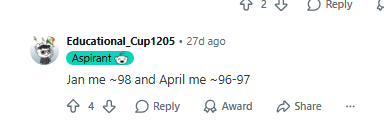
Reddit Discussion on JEE Main 2027 Marks vs Percentile

Source: Reddit
Source: Reddit
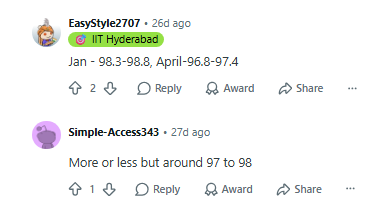
Reddit users estimate that 140–150 marks in JEE Main 2027 could result in around 97–98 percentile, although the actual percentile will depend on the exam shift and difficulty level.
Source: Reddit
Ques. How many marks are required for 90 percentile in JEE Main?
Ans. There is no fixed marks-to-percentile conversion. The marks required for 90 percentile can change according to the exam difficulty and shift.
Ques. How many marks are needed for 95 percentile?
Ans. The required raw marks cannot be fixed in advance. Candidates should use marks-vs-percentile analysis based on the relevant year's papers and shift data.
JEE Main 2027 Cutoff FAQs
Ques. What is the expected JEE Main 2027 cutoff?
Ans. The General category cutoff may remain around 93–95 percentile, while the exact category-wise cutoff will be known only after the JEE Main 2027 Session 2 result.
Ques. What was the JEE Main cutoff in 2026?
Ans. The 2026 qualifying cutoff was 93.4123549 for General, 82.4164528 for GEN-EWS, 80.9232583 for OBC-NCL, 63.9172792 for SC and 52.0174712 for ST.
Ques. Is JEE Main cutoff the same as NIT cutoff?
Ans. No. The JEE Main qualifying cutoff determines eligibility for JEE Advanced. NIT admission depends on JoSAA closing ranks.
Ques. What percentile is safe for JEE Advanced 2027?
Ans. There is no officially declared safe percentile. Candidates should target a percentile comfortably above the previous year's category cutoff because the 2027 cutoff can change.
Ques. Will JEE Main 2027 cutoff increase?
Ans. It may increase or decrease. The 2026 General cutoff increased only about 0.31 percentile points over 2025, showing that year-to-year movement is not always large.
Ques. How many students qualified for JEE Advanced in 2026?
Ans. 2,50,182 candidates qualified for JEE Advanced 2026 through JEE Main Paper 1.
Ques. Does 99 percentile guarantee NIT CSE?
Ans. No. A 99 percentile does not guarantee CSE at a particular NIT. Admission depends on the candidate's rank, category, quota, institute and JoSAA closing rank.



Comments
Found 20 Comments
With a 98th percentile in JEE Main 2026 (estimated rank 20,000–25,000), you are in a strong position for top-tier institutions. As per previous data on cutoff, you can secure core branches like Mechanical or Electrical at premier NITs like NIT Trichy, Surathkal, and Warangal. For CSE or IT, you can target mid-tier NITs such as NIT Jamshedpur, NIT Kurukshetra, or NIT Durgapur. Additionally, top IIITs like IIIT Gwalior and IIIT Lucknow (for specialized tracks) or BIT Mesra are highly realistic options.
As per the previous data available, the 90th percentile (approx. 1,00,000–1,50,000 rank) makes you eligible for CSE at newer IIITs like IIIT Nagpur, IIIT Pune, or IIIT Bhagalpur (often in later rounds or for reserved categories). You can also secure CSE at top private universities like KIIT Bhubaneswar, LPU, and SRM, or premium state-government colleges under home-state quotas.
With a 90th percentile in JEE Main 2026 (estimated rank 1,00,000–1,50,000), securing Computer Science Engineering (CSE) in top NITs is difficult for general candidates. However, as per previous cutoff trends, there are chances at newer IIITs like IIIT Bhagalpur, IIIT Manipur, and IIIT Agartala. You can also target prominent GFTIs such as Assam University, SLIET Punjab, and GKV Haridwar. Additionally, high-ranking private universities like KIIT Bhubaneswar, LPU, and Chandigarh University are excellent options for CSE with this score.
With a 90th percentile in JEE Main 2026, which translates to an estimated All-India Rank of 1,00,000 to 1,50,000, your best options for Information Technology (IT) or related tech branches are mentioned below:
With an 80th percentile in JEE Main 2026 (estimated rank 1.5 L–2.5L), you can secure Mechanical Engineering in several GFTIs and state-level colleges. According to previous data available, top options include BIT Mesra (Deoghar/Patna), Assam University, SLIET Punjab, and GKV Haridwar. You also have chances in state government colleges via home-state quotas.
With an 80th percentile in JEE Main 2026, you can secure seats in lower NITs in core branches, several GFTIs, and top private universities. Notable options include Assam University, Sant Longowal Institute (SLIET), and Gurukula Kangri. Private institutions like LPU, Amity, and Chandigarh University are also likely. For NITs, newer campuses like NIT Sikkim or Arunachal Pradesh, NIT Mizoram or NIT Nagaland may offer core branches.
With a 90th percentile (approx. 1,00,000–1,50,000 rank)) In JEE Main 2026, securing CSE in top-tier NITs is difficult for general candidates; however, previous data suggests strong chances in newer IIITs like IIIT Bhagalpur, IIIT Manipur, IIIT Nagpur, IIIT Vadodara, and IIIT Dharwad. You can also target GFTIs such as Assam University and BIT Mesra (off-campus), as well as top private universities like LPU and KIIT.
With a 90th percentile in JEE Main 2026, the rank corresponds to around 1 lakh to 1.5 lakh; you can secure Information Technology (IT) or related branches in several reputable institutes. According to the previous data on cutoff available, realistic options include NIT Raipur (Home State), BIT Mesra (Off-campuses), IIIT Nagpur, IIIT Vadodara, IIIT Bhagalpur, and IIIT Agartala. You also have strong chances at GFTIs like Assam University and top-tier private universities.
With a 90th percentile in JEE Main 2026, securing Computer Science Engineering (CSE) at top NITs is competitive, but several GFTIs and IIITs remain viable. According to previous data available on cutoffs, you can target IIIT Bhagalpur, IIIT Manipur, and IIIT Dharwad. For GFTIs, Assam University, Tezpur University, and Shri Mata Vaishno Devi University are strong options. Additionally, top-tier private universities like KIIT Bhubaneswar, SRM IST, and LPU offer excellent CSE placements for this percentile bracket.
With a 90th percentile in JEE Main 2026, you have strong chances at several NITs through the Home State (HS) quota, particularly in newer or northeastern institutes. According to previous data available on cutoff trends, you can target NIT Raipur (Metallurgy/Mining), NIT Agartala (Production), and NIT Srinagar (Civil/Mechanical). Additionally, NIT Sikkim, NIT Meghalaya, and NIT Mizoram often have closing ranks for home state candidates that accommodate this percentile for core engineering branches
With an 85th percentile in JEE Main 2026, securing a seat in Uttar Pradesh's top government colleges like IET Lucknow or HBTU Kanpur (for CSE/IT) is challenging for General category students. However, previously available cutoff data suggest strong chances for core branches like Mechanical, Civil, or Chemical at BIET Jhansi, KNIT Sultanpur, and MMMUT Gorakhpur. Additionally, private institutions like Amity Noida, Galgotias University, and GL Bajaj are highly accessible for tech branches at this score.
With a 90th percentile in JEE Main 2026, securing a seat in Maharashtra's top-tier autonomous colleges like COEP, VJTI, or SPIT (which prioritize MHT CET) is difficult for tech branches via the All India quota. However, previous available data on cutoffs indicate you can secure admission in highly-rated private institutions such as MIT-WPU Pune, DY Patil Akurdi, and Pimpri Chinchwad College of Engineering (PCCOE) for core or specialized tech branches. Additionally, newer IIITs like IIIT Nagpur and IIIT Pune are viable targets through JoSAA/CSAB counseling for this percentile range.
With a 95th percentile in JEE Main 2026 (estimated rank 55,000–60,000), your best options in Delhi vary significantly based on your residency status. For Delhi State (HS) candidates, there are chances for core branches like Mechanical, Civil, or Environmental Engineering at DTU and NSUT. Female candidates may also secure ECE or IT at IGDTUW. If you are an Outside Delhi candidate, you can target top private institutions like MAIT or MSIT for tech branches, as top government spots close at much higher percentiles.
With a 92 percentile in JEE Main 2026 (estimated All India Rank 90,000–1,20,000), you have competitive options in newer NITs, IIITs, and prominent GFTIs. According to previous data available on cutoffs, the options include NIT Srinagar (Mechanical/Civil), NIT Mizoram, and NIT Nagaland. For tech branches, you can explore IIIT Bhagalpur, IIIT Manipur, or IIIT Agartala. Additionally, GFTIs like Assam University and top-tier private universities like KIIT, LPU, and LNMIIT Jaipur (for ECE) are excellent alternatives with robust placement records at this percentile
With an 80th percentile in JEE Main 2026 (estimated rank 1.5L–2.5L), securing a seat in top-tier NITs as a General category candidate is difficult. However, previous cutoff trends suggest you can target core branches in newer NITs like NIT Agartala, NIT Manipur, or NIT Meghalaya through Home State quotas. Prominent GFTIs like Assam University, SLIET Punjab, and Gurukula Kangri are also realistic. Additionally, high-ranking private universities like LPU, Chandigarh University, and Amity Noida offer excellent placements for this percentile bracket
Are there any state-specific quotas affecting NIT Trichy cutoffs?
In NITs, seats are set aside according to eligibility status; home-state candidates are granted 50% of the seats, with the remaining 50% going to EWS, OBC, SC, and ST candidates.
To find out the percentile corresponding to 51 marks for OBC category candidates in JEE Main 2024, you would need to refer to the official percentile score data provided by the NTA. This data is typically released along with the JEE Main results on the official website of JEE Main.
To check the list of all the colleges in India that will accept you JEE Main score or rank for admission, please use the JEE Main College Predictor by Collegedunia. Please enter your rank, gender and state to check the available colleges.
The excepted cutoff for EWS catagory students for JEE main 2022 is around 70 to 75 percentile. The cutoff will be released after completion of Counselling process by JOSAA.
The average cutoff of JEE main 2021 for OBC category students was around 68 percentile. The cutoff varies from branches to branches of B.Tech course.