




The GATE 2026 Electronics and Communication Engineering (EC) question paper is now available with detailed solutions for free download. GATE 2026 EC was conducted by IIT Guwahati on February 15, 2026, in the forenoon session (9:30 AM to 12:30 PM), and the paper carried 65 questions for 100 marks in 3 hours.
| GATE 2026 Electronics and Communication Engineering Question Paper with Solutions | Download PDF | Check Solutions |
GATE 2026 Electronics and Communication Engineering Questions with Solutions
Among the following options, the antonym of the word 'nocturnal' is _________.
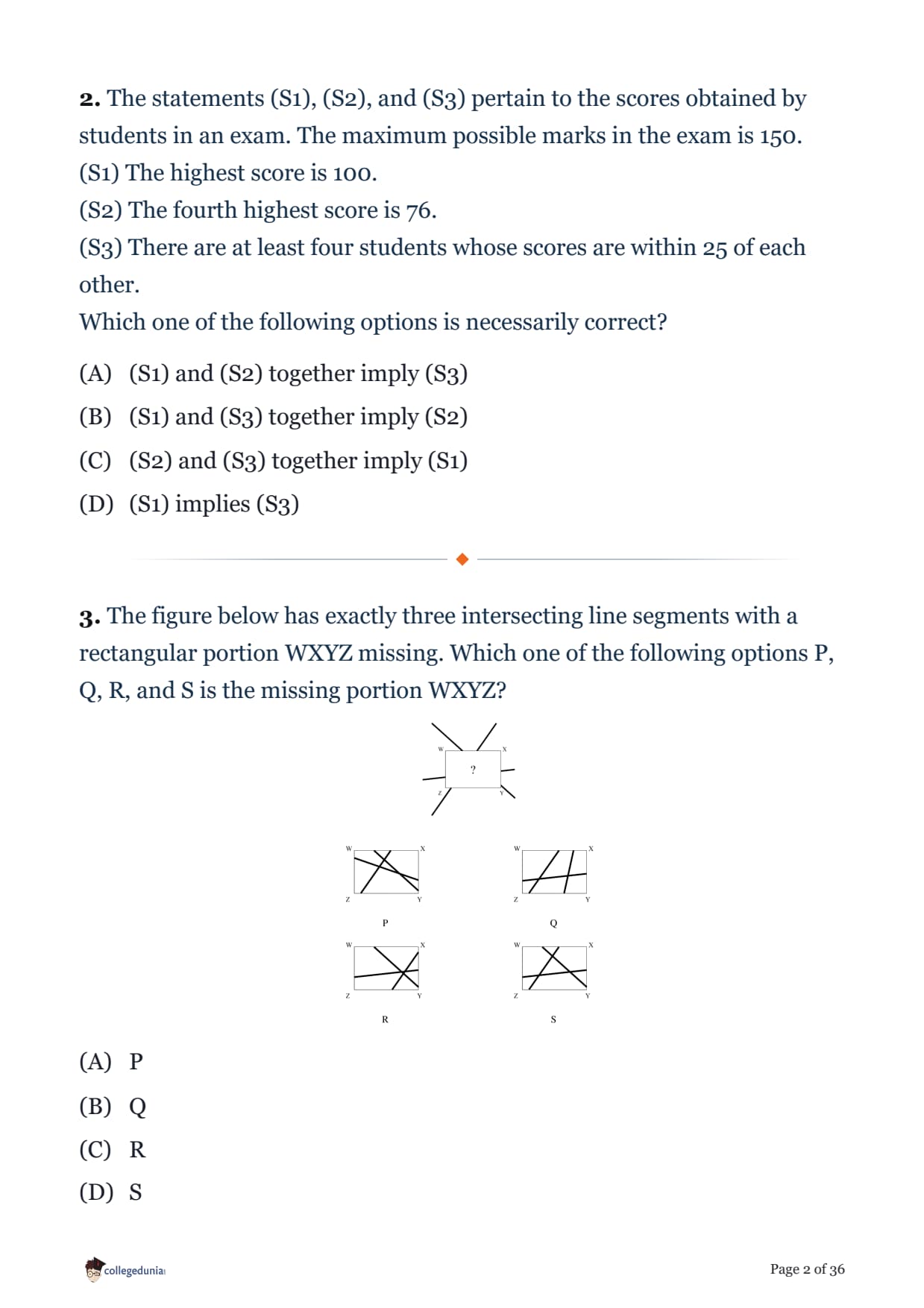
The statements (S1), (S2), and (S3) pertain to the scores obtained by students in an exam. The maximum possible marks in the exam is 150.
(S1) The highest score is 100.
(S2) The fourth highest score is 76.
(S3) There are at least four students whose scores are within 25 of each other.
Which one of the following options is necessarily correct?
The figure below has exactly three intersecting line segments with a rectangular portion WXYZ missing. Which one of the following options P, Q, R, and S is the missing portion WXYZ?

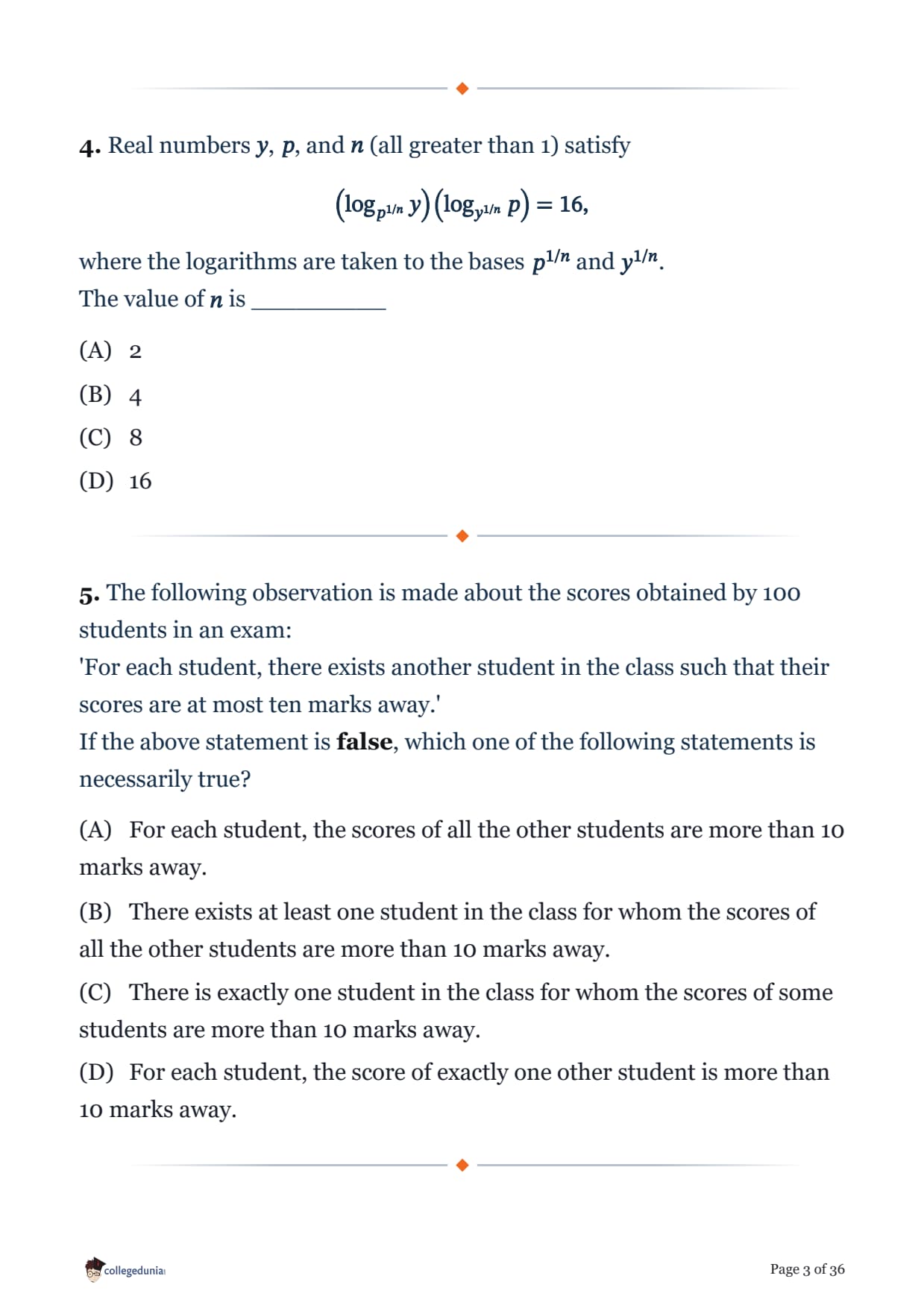
Real numbers \(y\), \(p\), and \(n\) (all greater than 1) satisfy
\[
\left(\log_{p^{1/n}} y\right)\left(\log_{y^{1/n}} p\right) = 16,
\]
where the logarithms are taken to the bases \(p^{1/n}\) and \(y^{1/n}\).
The value of \(n\) is _________
The following observation is made about the scores obtained by 100 students in an exam:
'For each student, there exists another student in the class such that their scores are at most ten marks away.'
If the above statement is false, which one of the following statements is necessarily true?
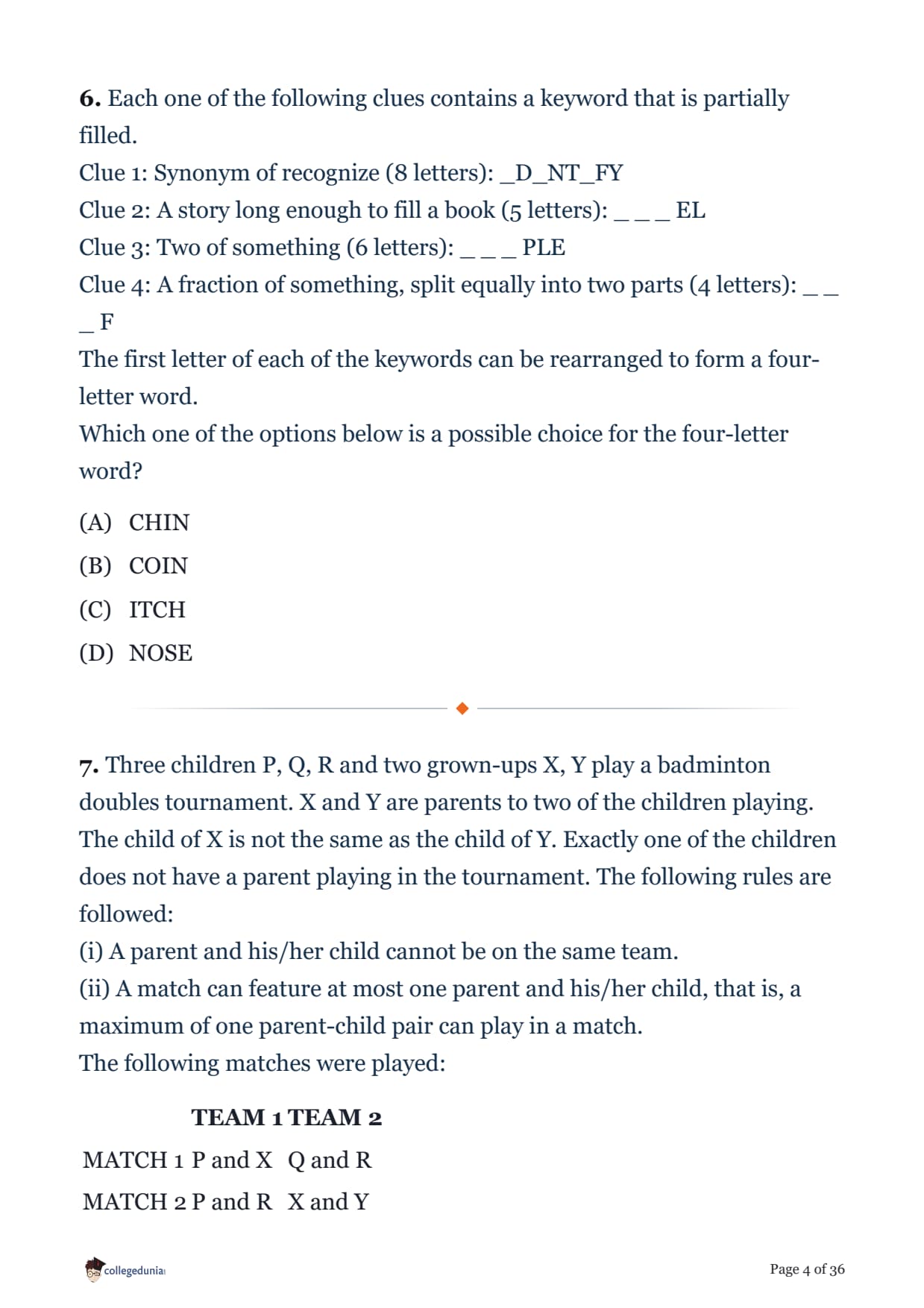
Each one of the following clues contains a keyword that is partially filled.
Clue 1: Synonym of recognize (8 letters): _D_NT_FY
Clue 2: A story long enough to fill a book (5 letters): _ _ _ EL
Clue 3: Two of something (6 letters): _ _ _ PLE
Clue 4: A fraction of something, split equally into two parts (4 letters): _ _ _ F
The first letter of each of the keywords can be rearranged to form a four-letter word.
Which one of the options below is a possible choice for the four-letter word?
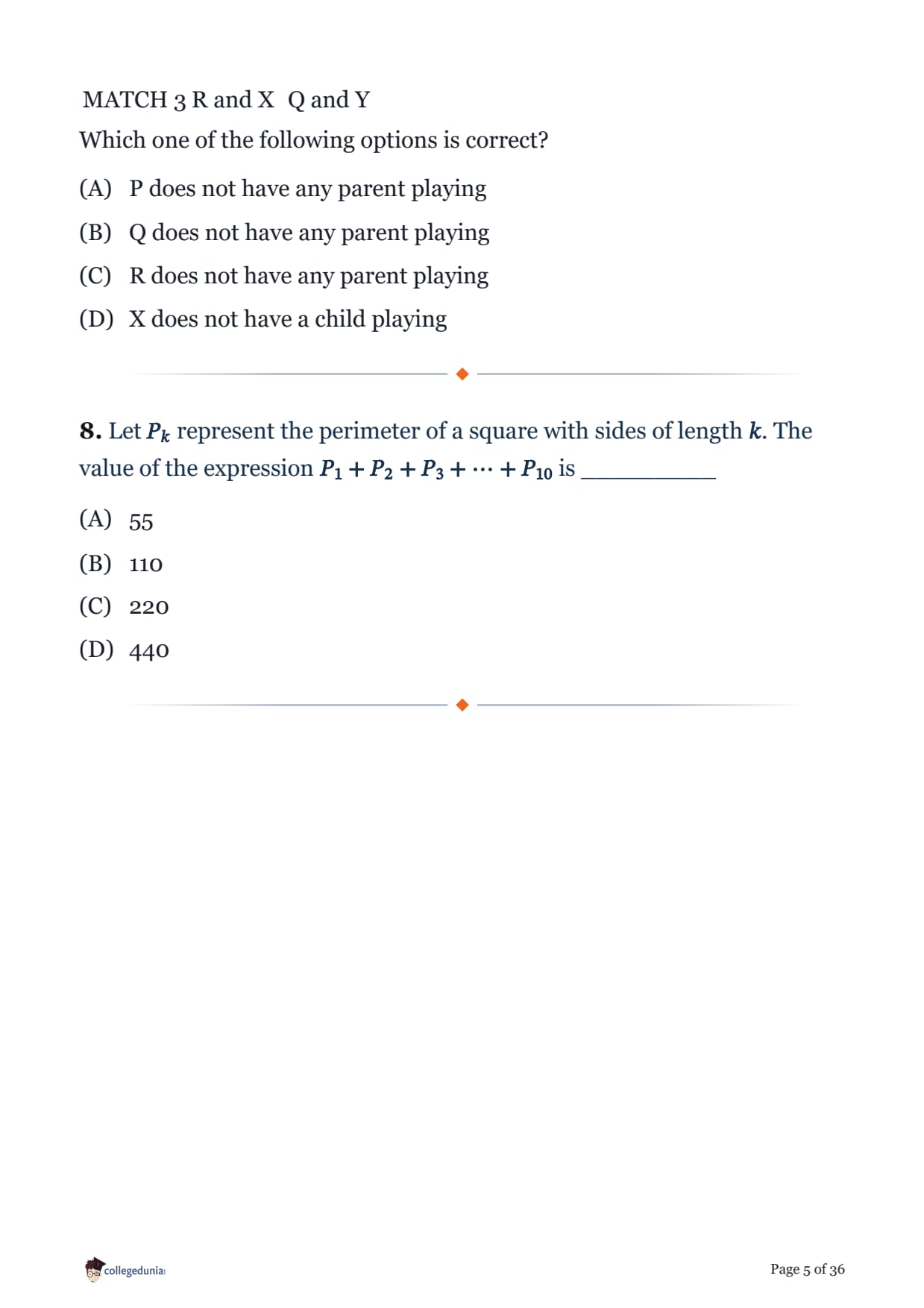
Three children P, Q, R and two grown-ups X, Y play a badminton doubles tournament. X and Y are parents to two of the children playing. The child of X is not the same as the child of Y. Exactly one of the children does not have a parent playing in the tournament. The following rules are followed:
(i) A parent and his/her child cannot be on the same team.
(ii) A match can feature at most one parent and his/her child, that is, a maximum of one parent-child pair can play in a match.
The following matches were played:
| TEAM 1 | TEAM 2 | |
|---|---|---|
| MATCH 1 | P and X | Q and R |
| MATCH 2 | P and R | X and Y |
| MATCH 3 | R and X | Q and Y |
Let \(P_k\) represent the perimeter of a square with sides of length \(k\). The value of the expression \(P_1+P_2+P_3+\cdots+P_{10}\) is _________
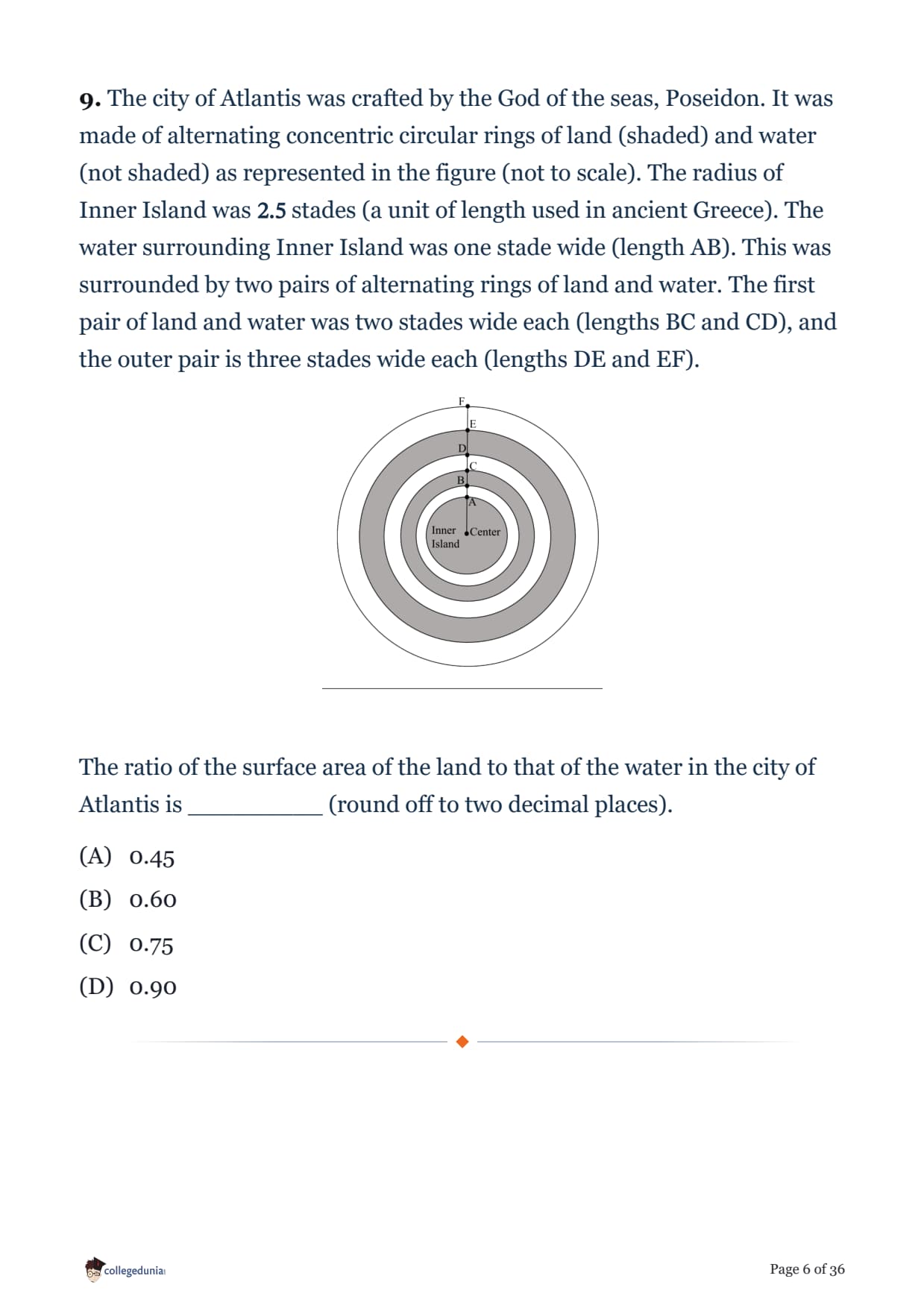
The city of Atlantis was crafted by the God of the seas, Poseidon. It was made of alternating concentric circular rings of land (shaded) and water (not shaded) as represented in the figure (not to scale). The radius of Inner Island was \(2.5\) stades (a unit of length used in ancient Greece). The water surrounding Inner Island was one stade wide (length AB). This was surrounded by two pairs of alternating rings of land and water. The first pair of land and water was two stades wide each (lengths BC and CD), and the outer pair is three stades wide each (lengths DE and EF). 
The ratio of the surface area of the land to that of the water in the city of Atlantis is _________ (round off to two decimal places).
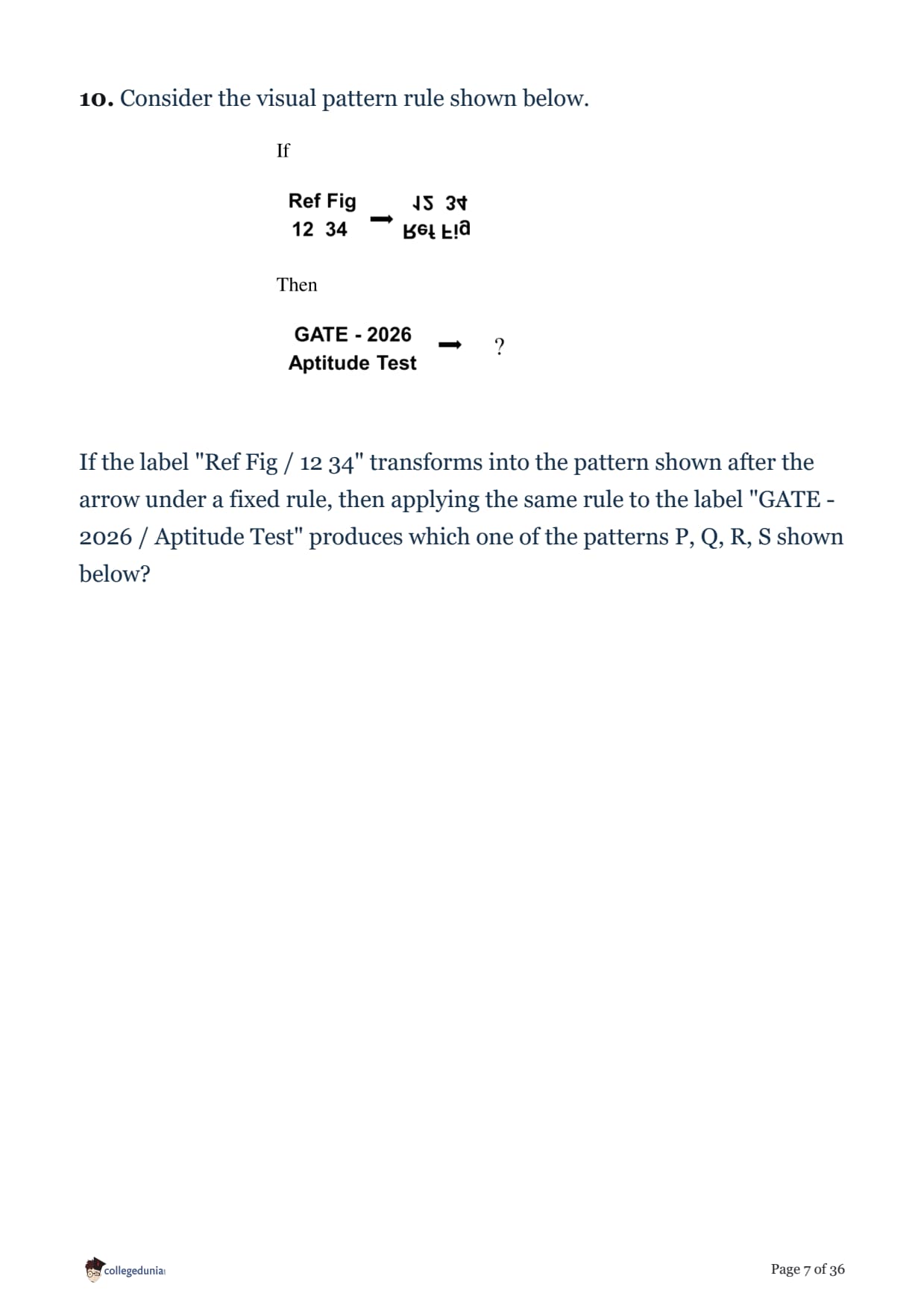
Consider the visual pattern rule shown below. 
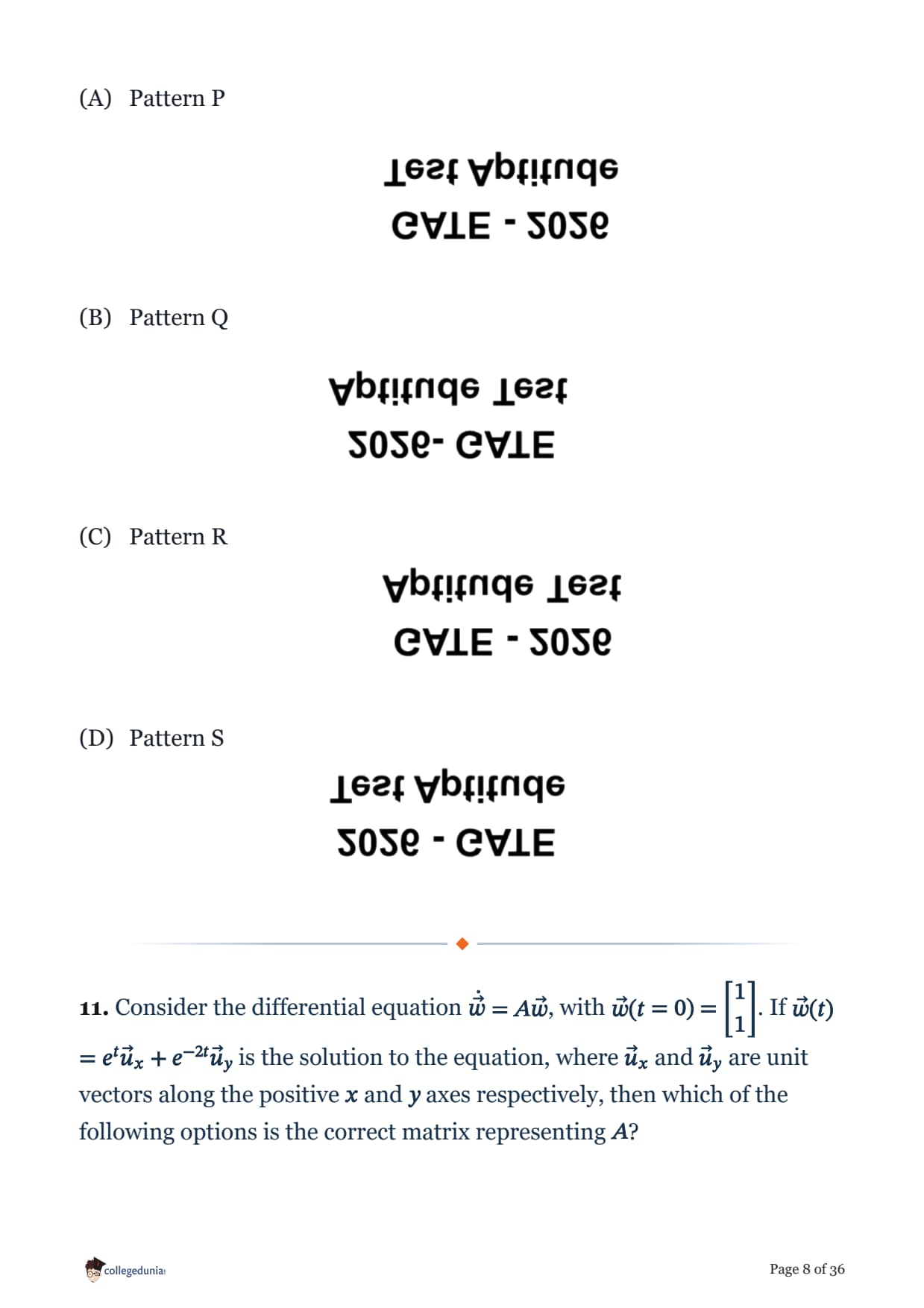
If the label "Ref Fig / 12 34" transforms into the pattern shown after the arrow under a fixed rule, then applying the same rule to the label "GATE - 2026 / Aptitude Test" produces which one of the patterns P, Q, R, S shown below?
- (A) Pattern P
![]()
- (B) Pattern Q
![]()
- (C) Pattern R
![]()
- (D) Pattern S
![]()


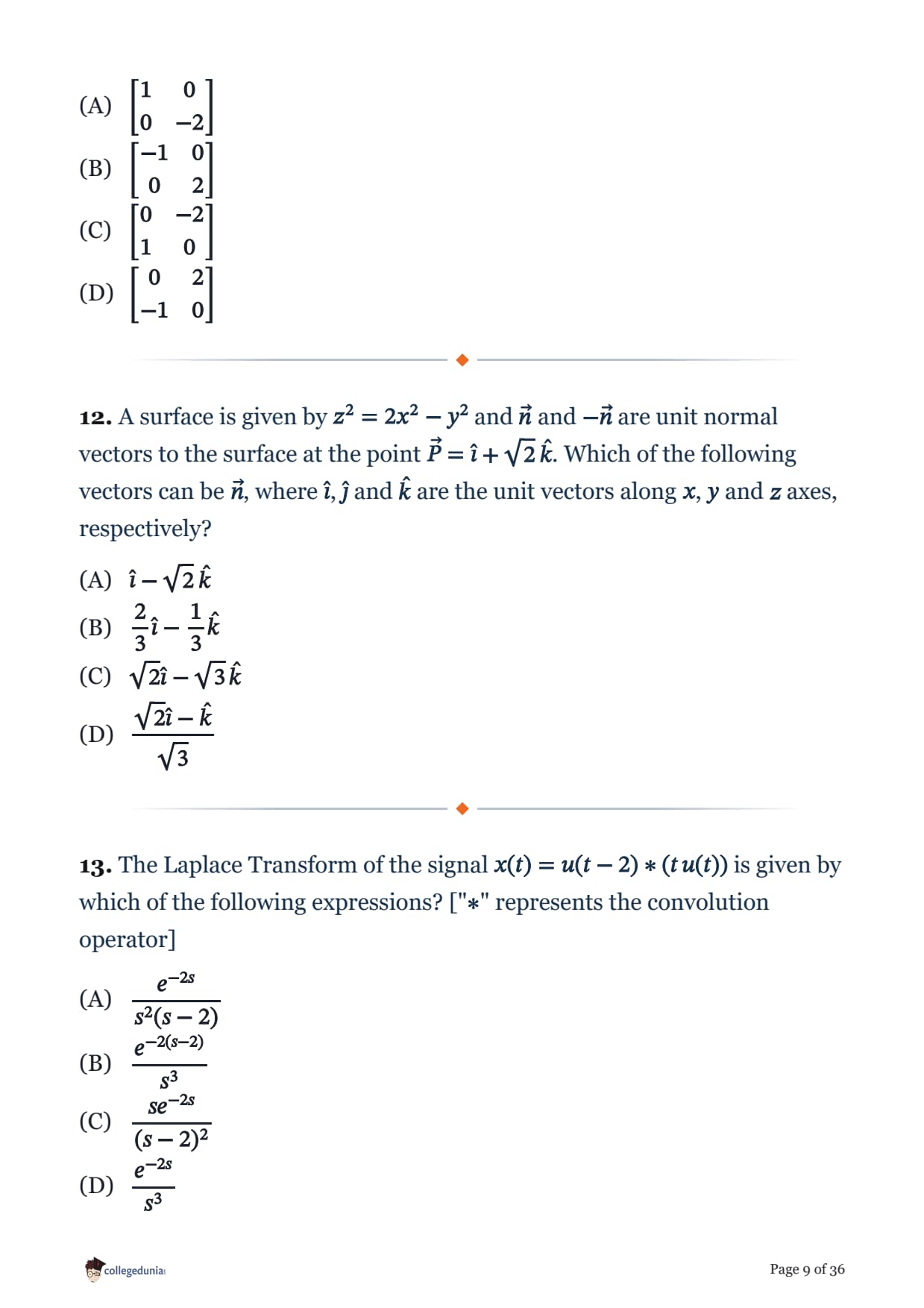
Consider the differential equation \(\dot{\vec{w}}=A\vec{w}\), with \(\vec{w}(t=0)=\begin{bmatrix}1\\1\end{bmatrix}\). If \(\vec{w}(t)=e^{t}\vec{u}_x+e^{-2t}\vec{u}_y\) is the solution to the equation, where \(\vec{u}_x\) and \(\vec{u}_y\) are unit vectors along the positive \(x\) and \(y\) axes respectively, then which of the following options is the correct matrix representing \(A\)?
A surface is given by \(z^{2}=2x^{2}-y^{2}\) and \(\vec{n}\) and \(-\vec{n}\) are unit normal vectors to the surface at the point \(\vec{P}=\hat{\imath}+\sqrt{2}\,\hat{k}\). Which of the following vectors can be \(\vec{n}\), where \(\hat{\imath}\), \(\hat{\jmath}\) and \(\hat{k}\) are the unit vectors along \(x\), \(y\) and \(z\) axes, respectively?
The Laplace Transform of the signal \(x(t)=u(t-2)*(t\,u(t))\) is given by which of the following expressions? ["\(*\)" represents the convolution operator]
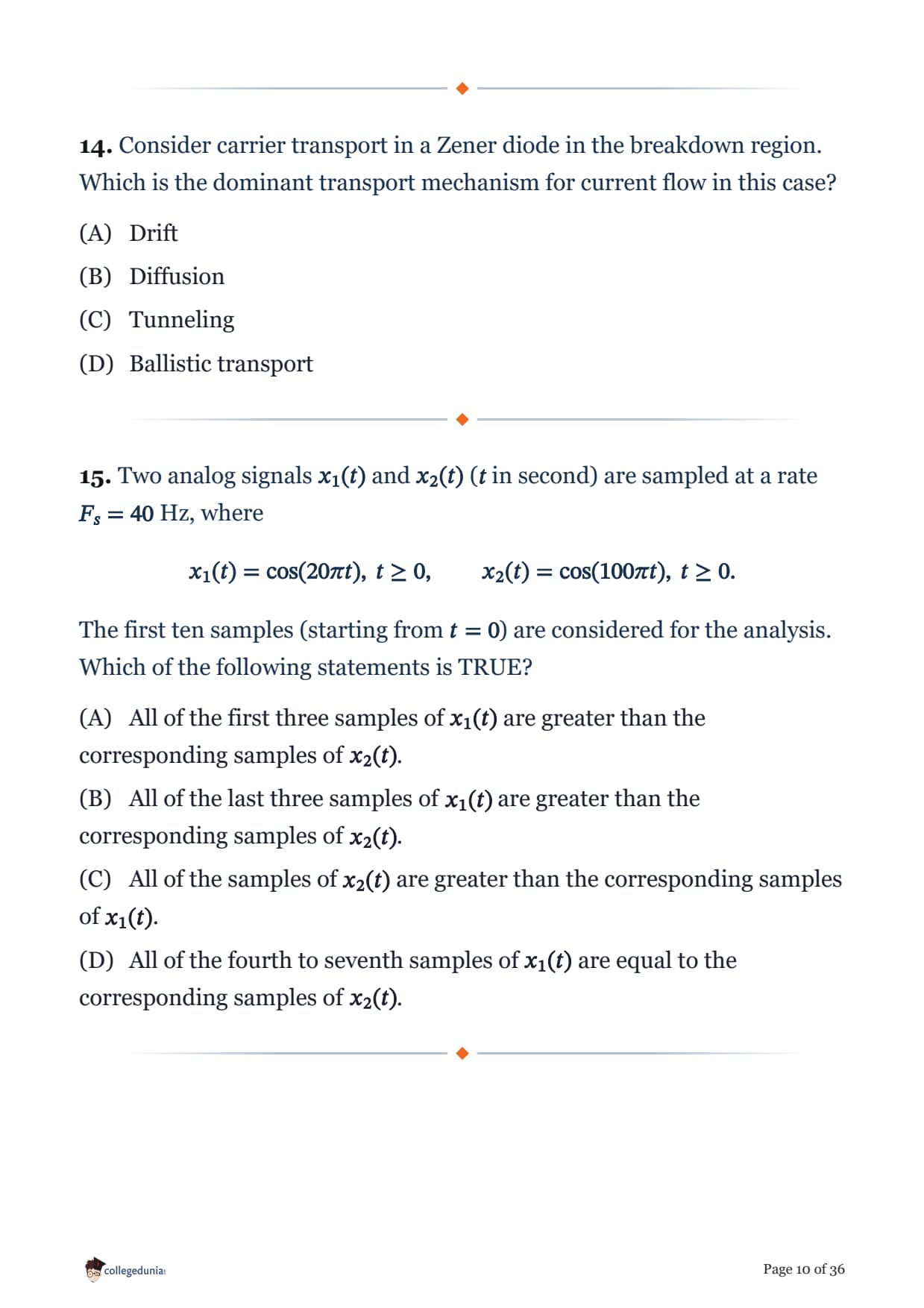
Consider carrier transport in a Zener diode in the breakdown region. Which is the dominant transport mechanism for current flow in this case?
Two analog signals \(x_1(t)\) and \(x_2(t)\) (\(t\) in second) are sampled at a rate \(F_s=40\) Hz, where
\[ x_1(t)=\cos(20\pi t),\ t\geq0,\qquad x_2(t)=\cos(100\pi t),\ t\geq0. \] The first ten samples (starting from \(t=0\)) are considered for the analysis. Which of the following statements is TRUE?
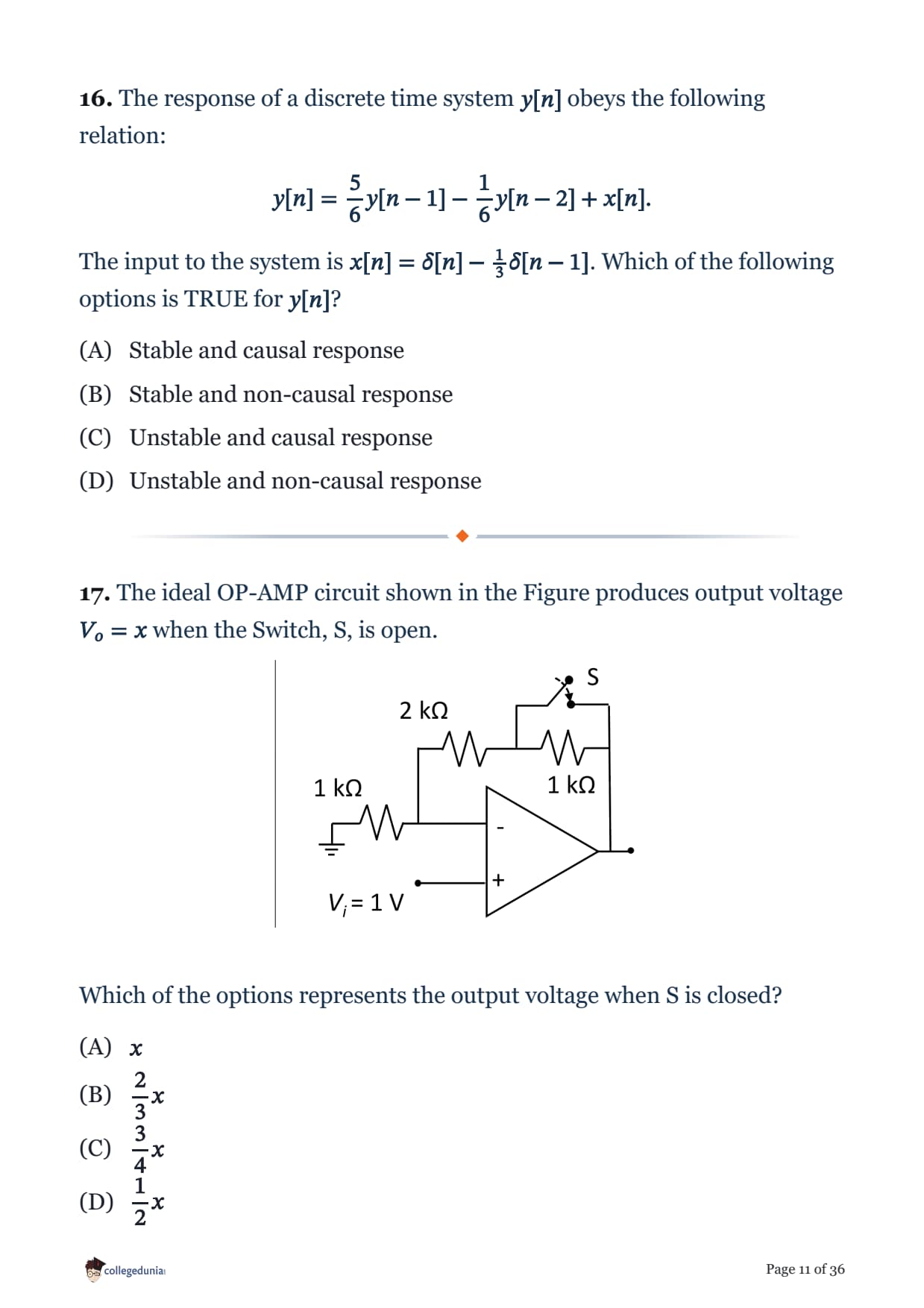
The response of a discrete time system \(y[n]\) obeys the following relation:
\[ y[n]=\frac{5}{6}y[n-1]-\frac{1}{6}y[n-2]+x[n]. \] The input to the system is \(x[n]=\delta[n]-\frac{1}{3}\delta[n-1]\). Which of the following options is TRUE for \(y[n]\)?
The ideal OP-AMP circuit shown in the Figure produces output voltage \(V_o=x\) when the Switch, S, is open. 
Which of the options represents the output voltage when S is closed?
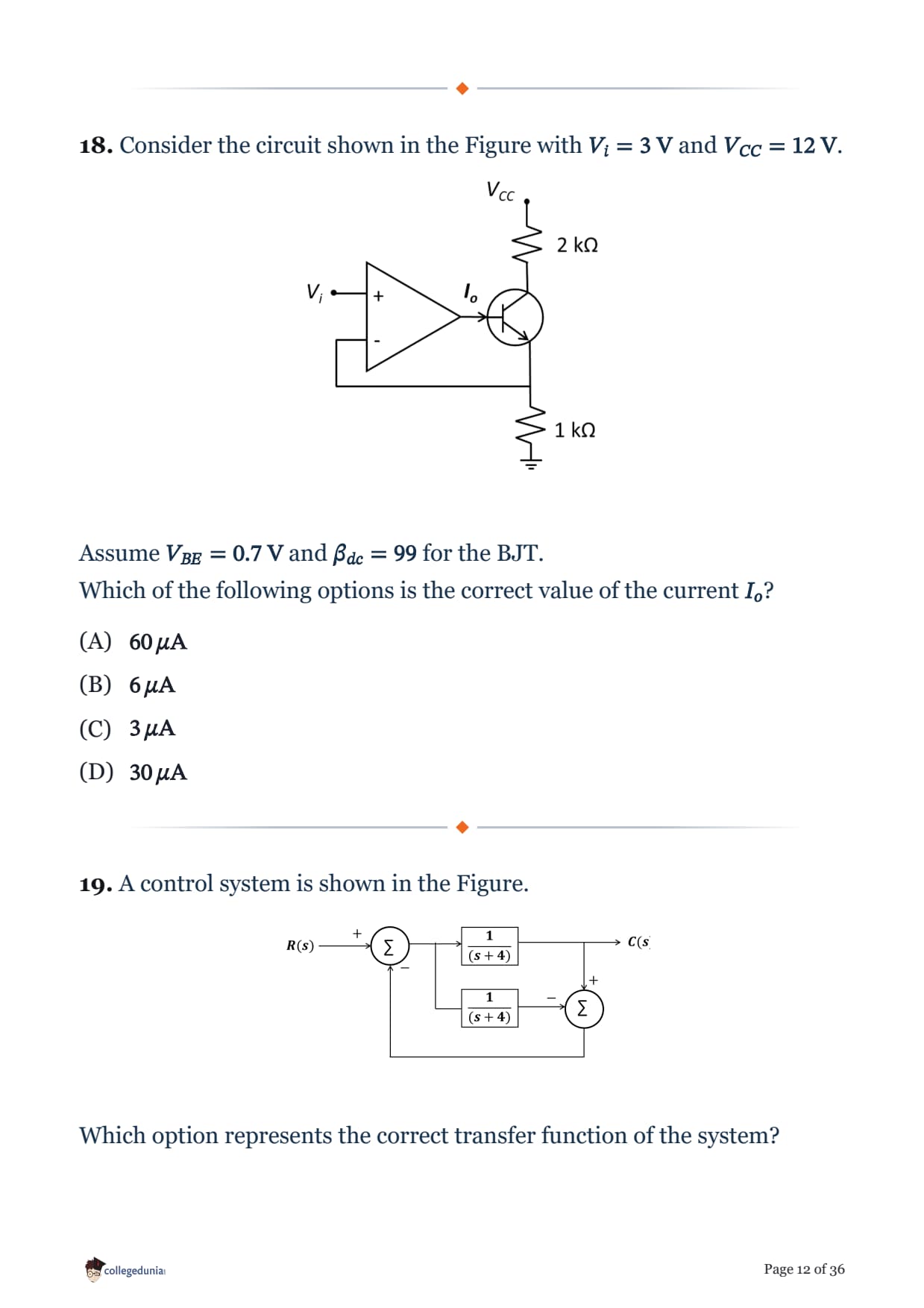
Consider the circuit shown in the Figure with \(V_i=3\text{ V}\) and \(V_{CC}=12\text{ V}\). 
Assume \(V_{BE}=0.7\text{ V}\) and \(\beta_{dc}=99\) for the BJT.
Which of the following options is the correct value of the current \(I_o\)?
A control system is shown in the Figure. 
Which option represents the correct transfer function of the system?
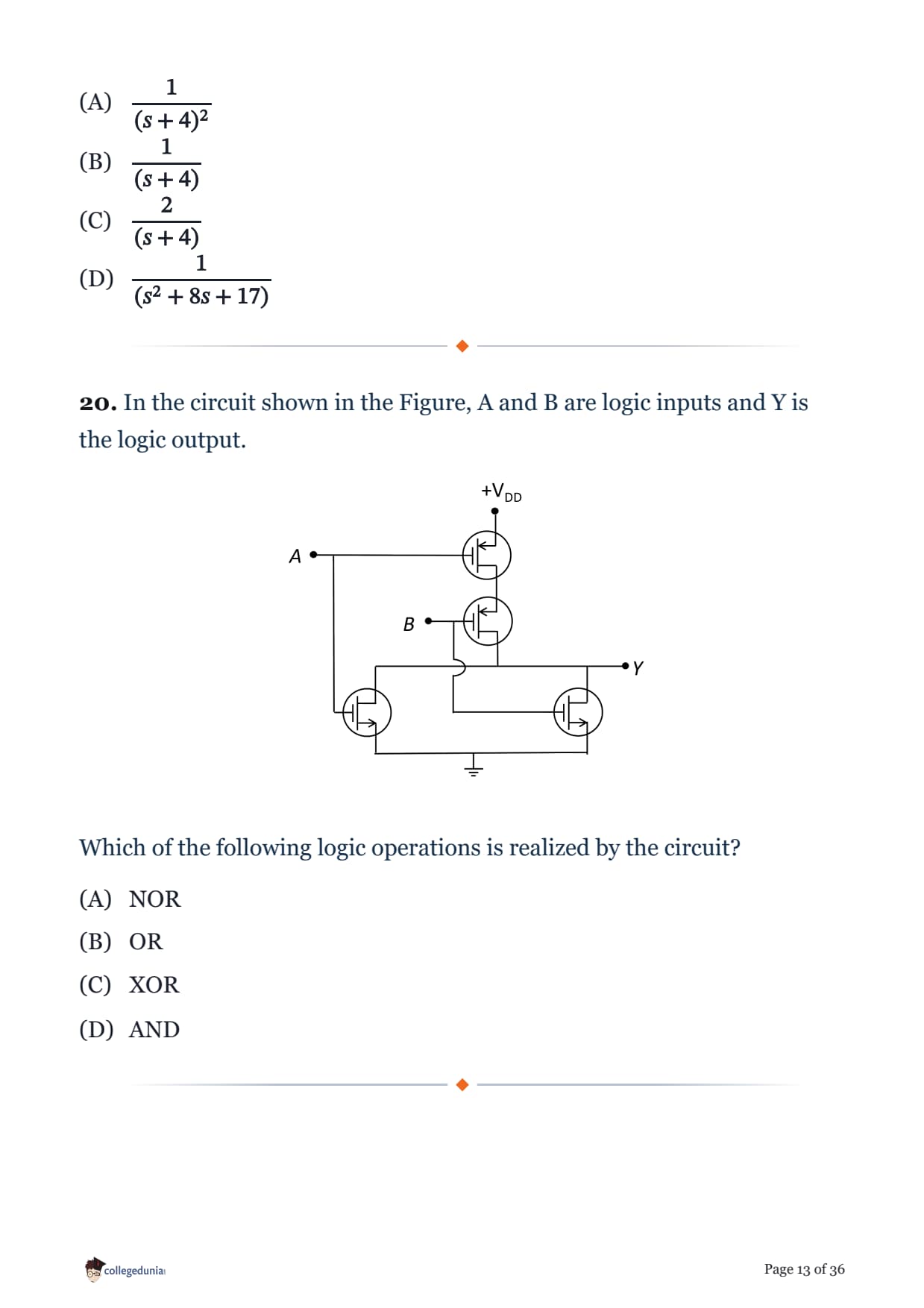
In the circuit shown in the Figure, A and B are logic inputs and Y is the logic output. 
Which of the following logic operations is realized by the circuit?
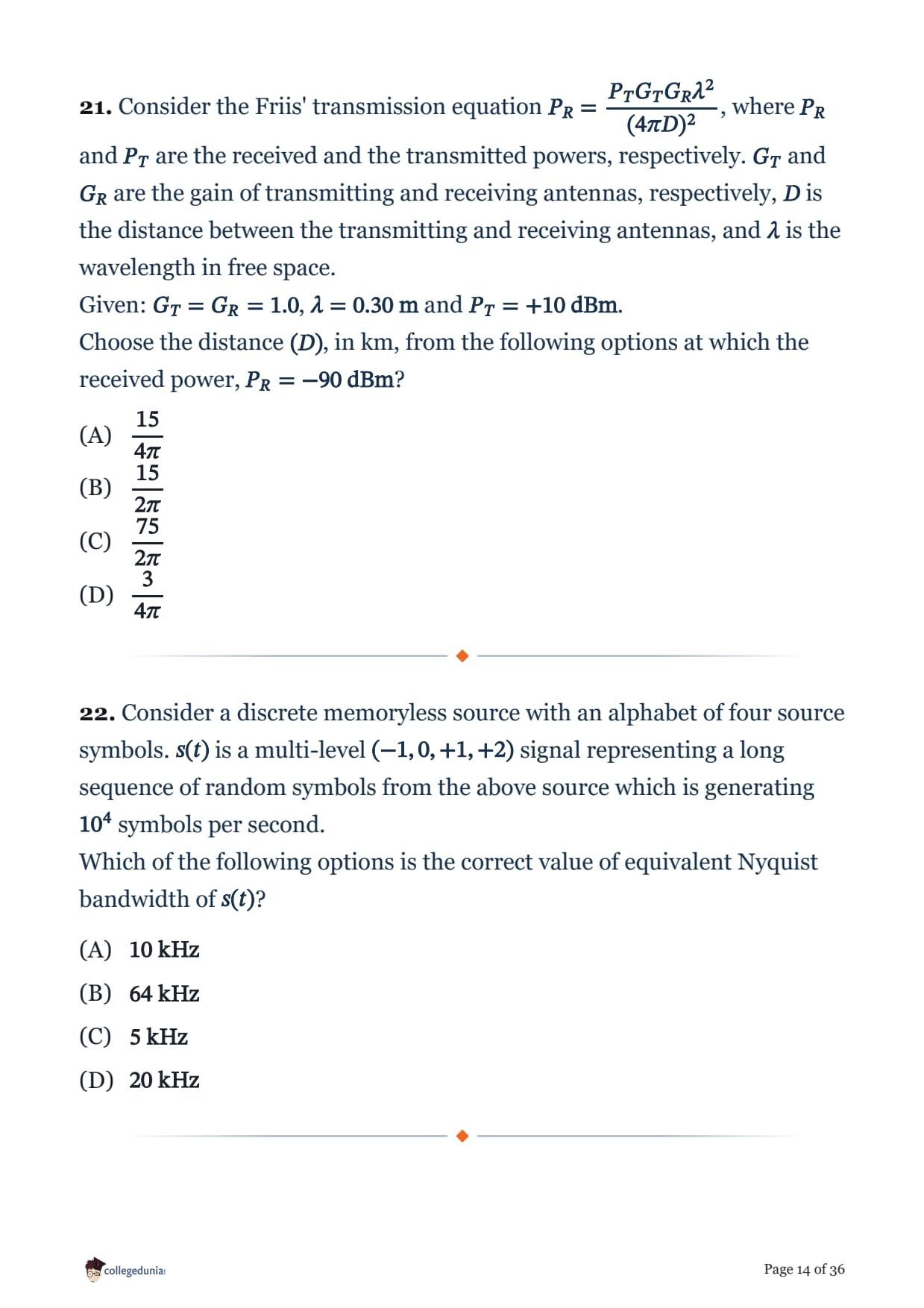
Consider the Friis' transmission equation \(P_R=\dfrac{P_TG_TG_R\lambda^2}{(4\pi D)^2}\), where \(P_R\) and \(P_T\) are the received and the transmitted powers, respectively. \(G_T\) and \(G_R\) are the gain of transmitting and receiving antennas, respectively, \(D\) is the distance between the transmitting and receiving antennas, and \(\lambda\) is the wavelength in free space.
Given: \(G_T=G_R=1.0\), \(\lambda=0.30\text{ m}\) and \(P_T=+10\text{ dBm}\).
Choose the distance \((D)\), in km, from the following options at which the received power, \(P_R=-90\text{ dBm}\)?
Consider a discrete memoryless source with an alphabet of four source symbols. \(s(t)\) is a multi-level \((-1,0,+1,+2)\) signal representing a long sequence of random symbols from the above source which is generating \(10^4\) symbols per second.
Which of the following options is the correct value of equivalent Nyquist bandwidth of \(s(t)\)?
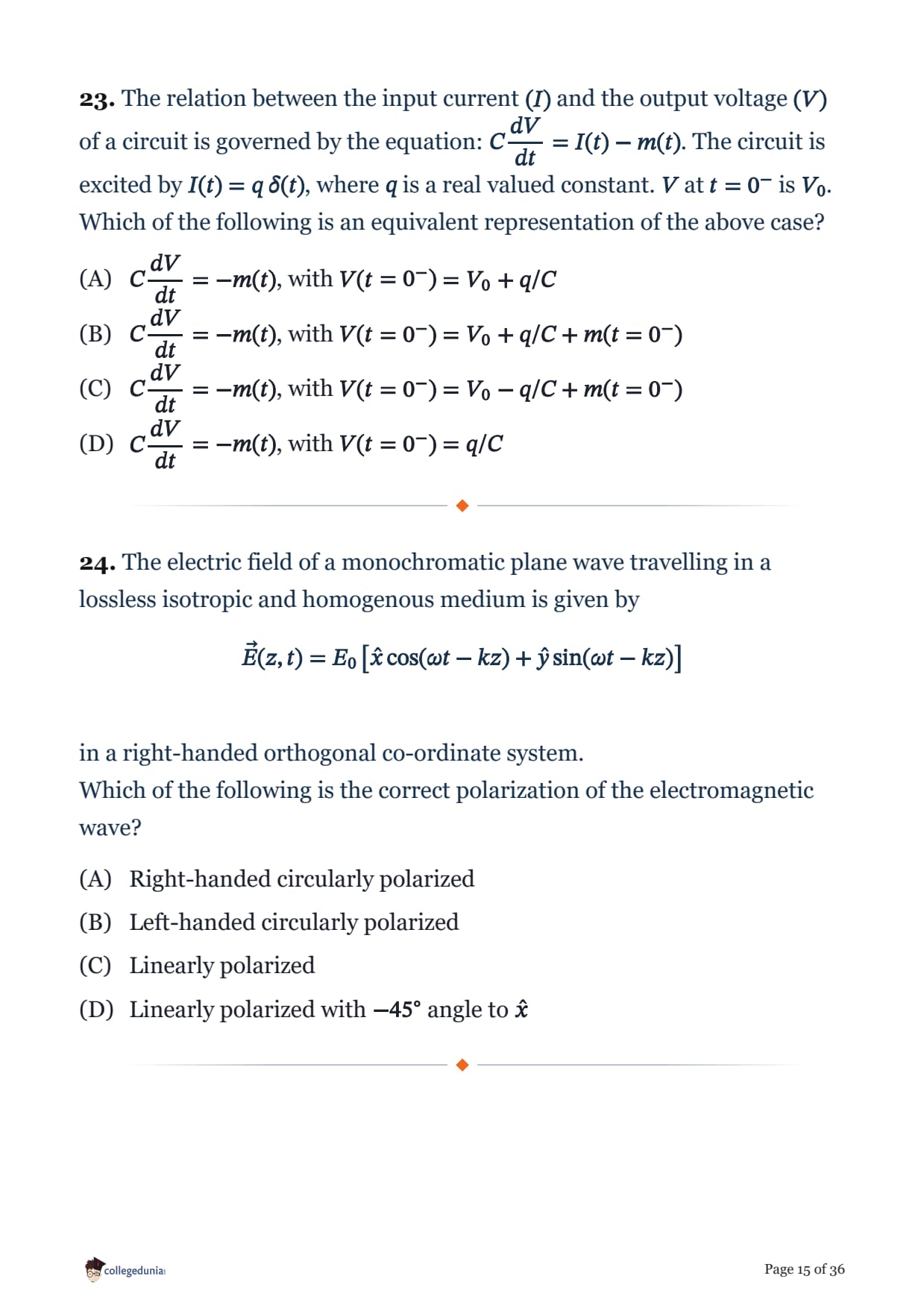
The relation between the input current \((I)\) and the output voltage \((V)\) of a circuit is governed by the equation: \(C\dfrac{dV}{dt}=I(t)-m(t)\). The circuit is excited by \(I(t)=q\,\delta(t)\), where \(q\) is a real valued constant. \(V\) at \(t=0^-\) is \(V_0\).
Which of the following is an equivalent representation of the above case?
The electric field of a monochromatic plane wave travelling in a lossless isotropic and homogenous medium is given by
\[ \vec{E}(z,t)=E_0\left[\hat{x}\cos(\omega t-kz)+\hat{y}\sin(\omega t-kz)\right] \]
in a right-handed orthogonal co-ordinate system.
Which of the following is the correct polarization of the electromagnetic wave?
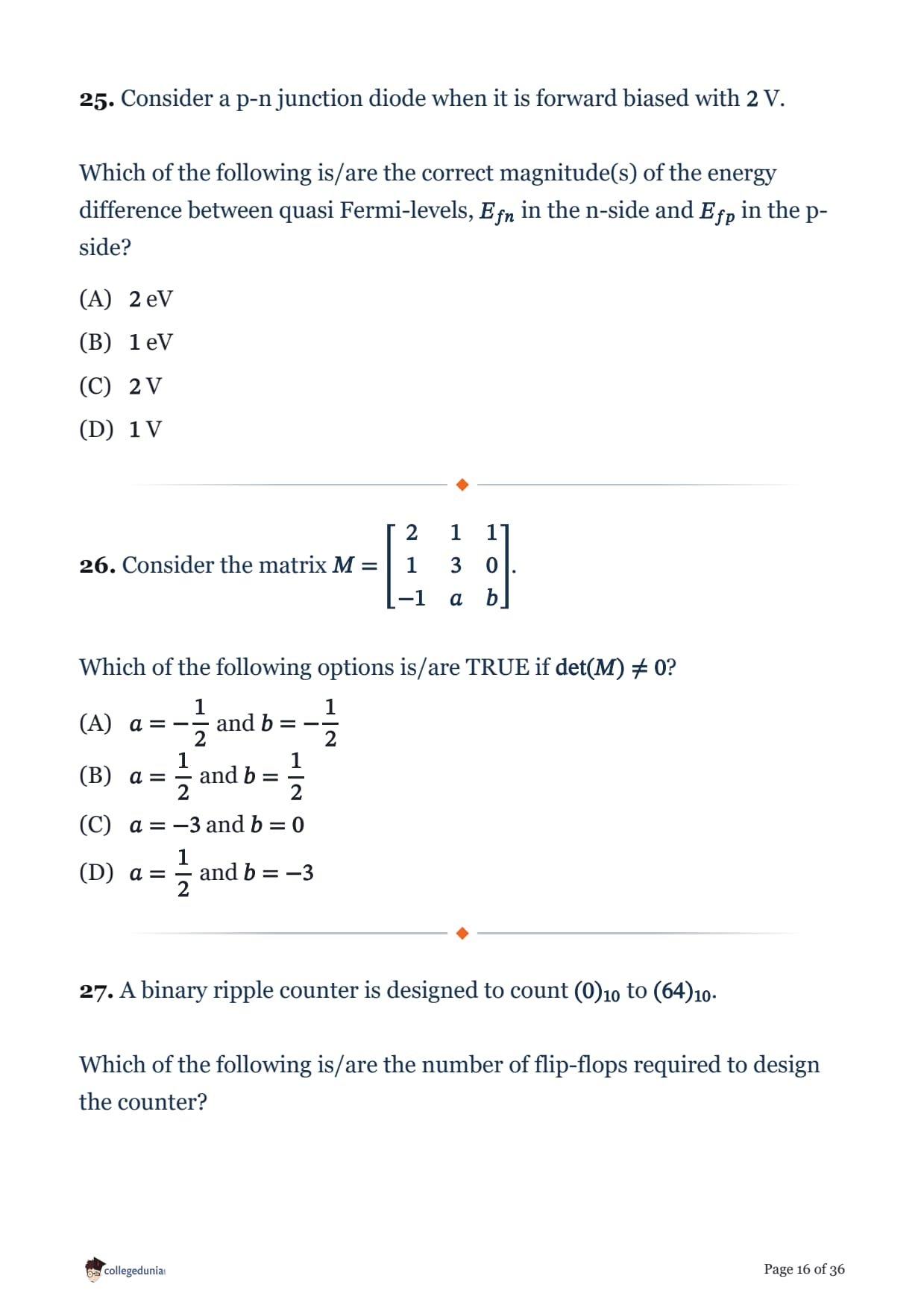
Consider a p-n junction diode when it is forward biased with \(2\) V.
Which of the following is/are the correct magnitude(s) of the energy difference between quasi Fermi-levels, \(E_{fn}\) in the n-side and \(E_{fp}\) in the p-side?
Consider the matrix \(M=\begin{bmatrix}2 & 1 & 1\\ 1 & 3 & 0\\ -1 & a & b\end{bmatrix}\).
Which of the following options is/are TRUE if \(\det(M)\neq0\)?
A binary ripple counter is designed to count \((0)_{10}\) to \((64)_{10}\).
Which of the following is/are the number of flip-flops required to design the counter?
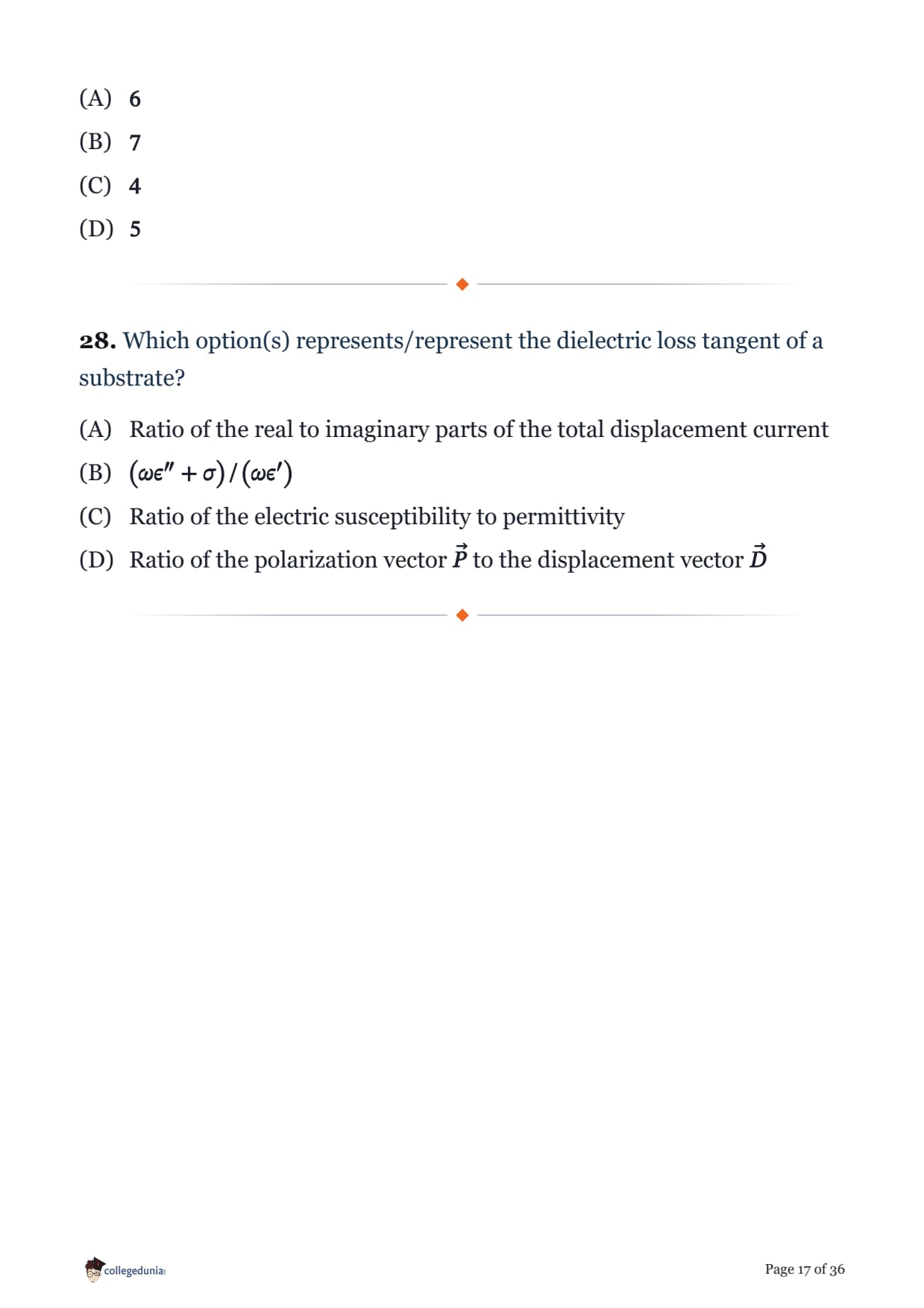
Which option(s) represents/represent the dielectric loss tangent of a substrate?
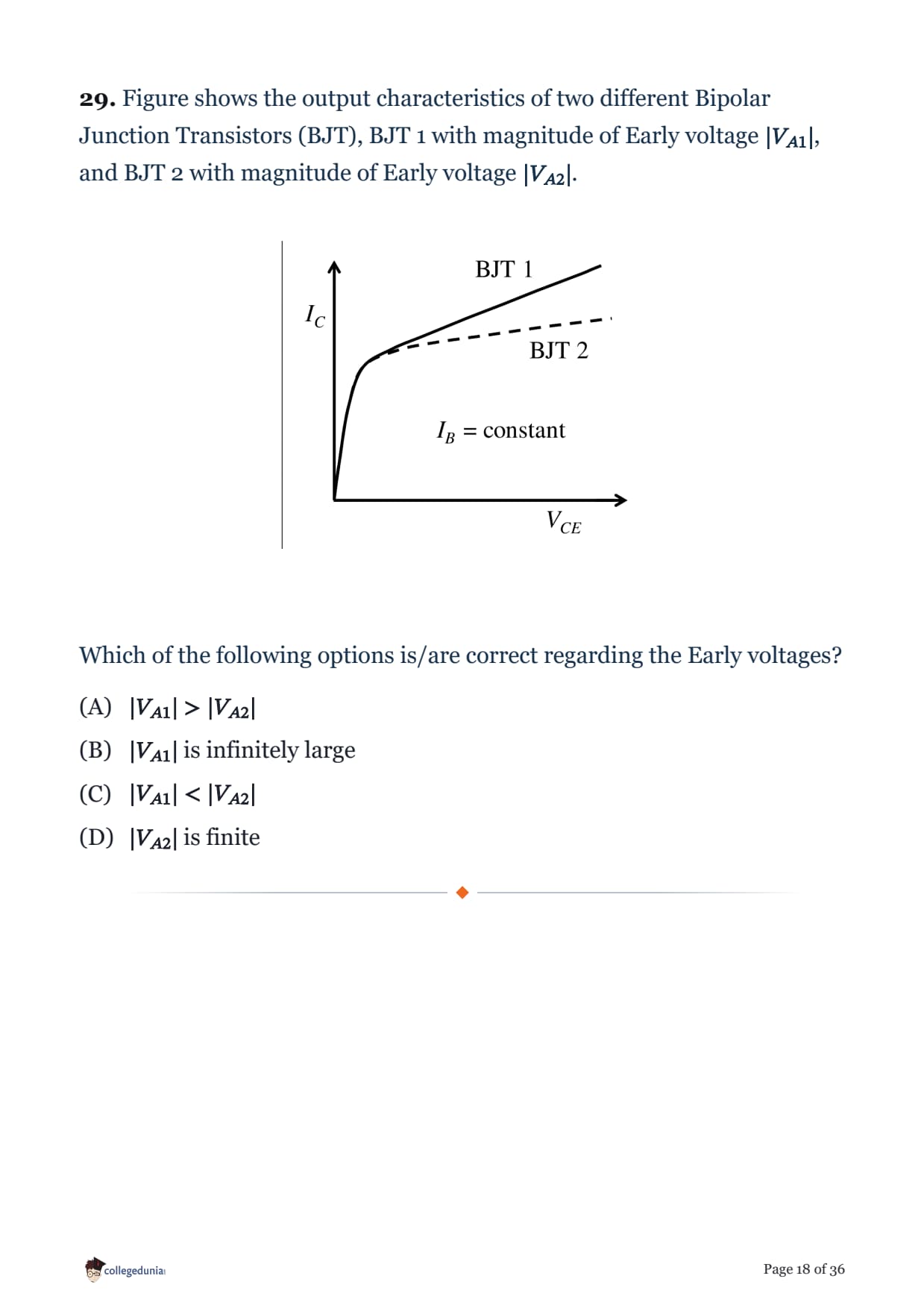
Figure shows the output characteristics of two different Bipolar Junction Transistors (BJT), BJT 1 with magnitude of Early voltage \(|V_{A1}|\), and BJT 2 with magnitude of Early voltage \(|V_{A2}|\).
Which of the following options is/are correct regarding the Early voltages?
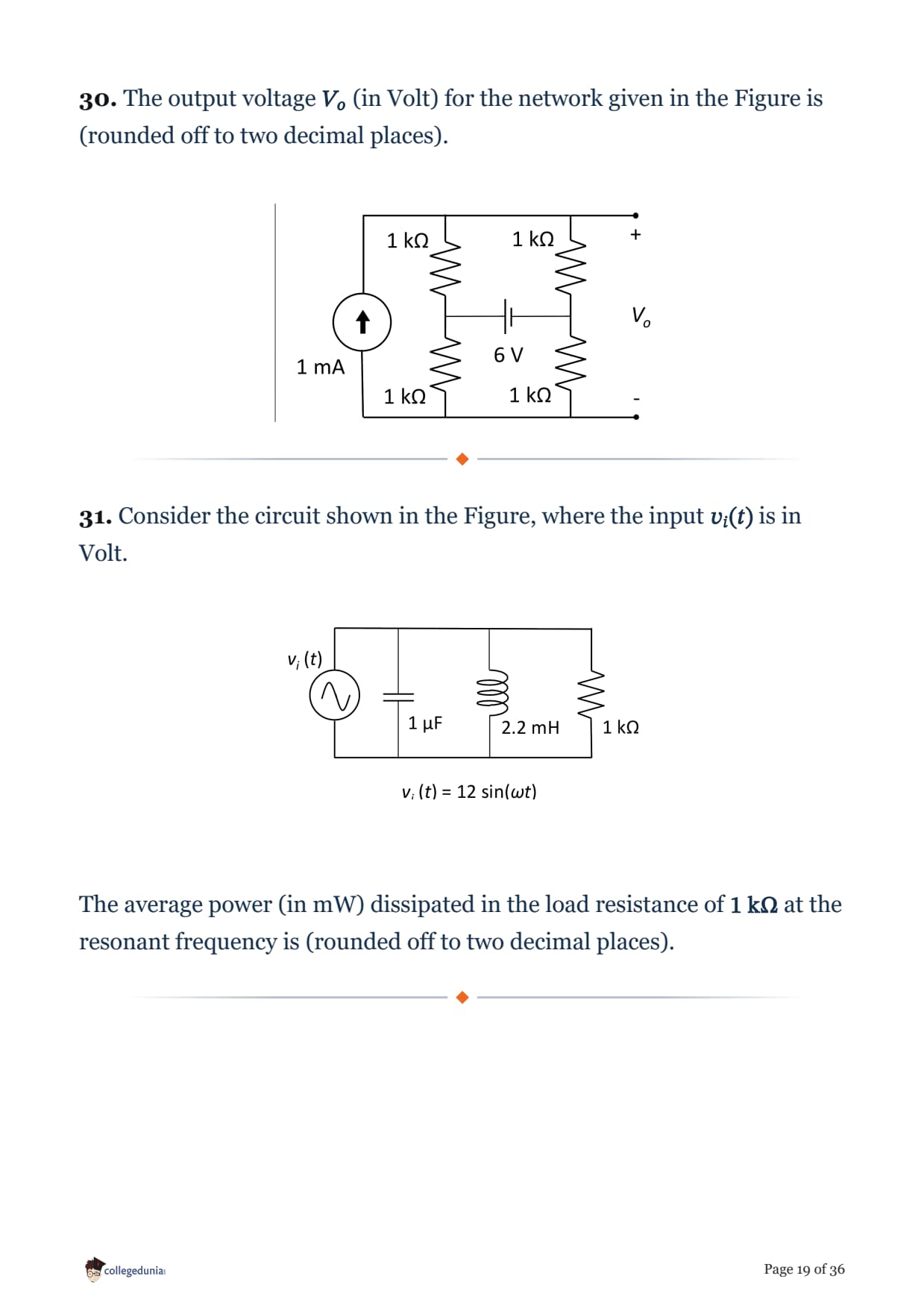
The output voltage \(V_o\) (in Volt) for the network given in the Figure is (rounded off to two decimal places).
Consider the circuit shown in the Figure, where the input \(v_i(t)\) is in Volt.
The average power (in mW) dissipated in the load resistance of \(1\ \text{k}\Omega\) at the resonant frequency is (rounded off to two decimal places).
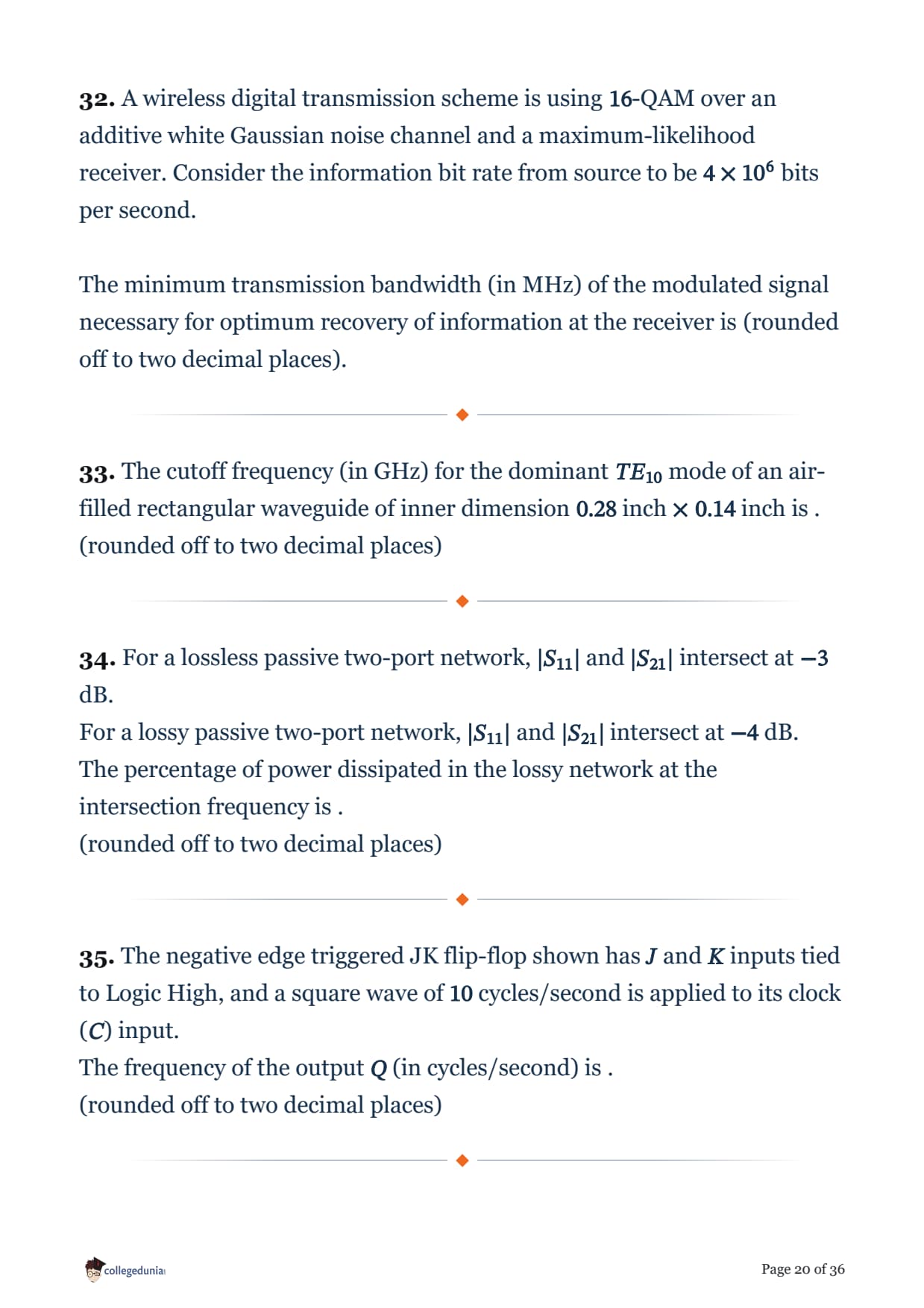
A wireless digital transmission scheme is using \(16\)-QAM over an additive white Gaussian noise channel and a maximum-likelihood receiver. Consider the information bit rate from source to be \(4\times10^{6}\) bits per second.
The minimum transmission bandwidth (in MHz) of the modulated signal necessary for optimum recovery of information at the receiver is (rounded off to two decimal places).
The cutoff frequency (in GHz) for the dominant \(TE_{10}\) mode of an air-filled rectangular waveguide of inner dimension \(0.28\) inch \(\times\) \(0.14\) inch is .
(rounded off to two decimal places)
For a lossless passive two-port network, \(|S_{11}|\) and \(|S_{21}|\) intersect at \(-3\) dB.
For a lossy passive two-port network, \(|S_{11}|\) and \(|S_{21}|\) intersect at \(-4\) dB.
The percentage of power dissipated in the lossy network at the intersection frequency is .
(rounded off to two decimal places)
The negative edge triggered JK flip-flop shown has \(J\) and \(K\) inputs tied to Logic High, and a square wave of \(10\) cycles/second is applied to its clock (\(C\)) input.
The frequency of the output \(Q\) (in cycles/second) is .
(rounded off to two decimal places)
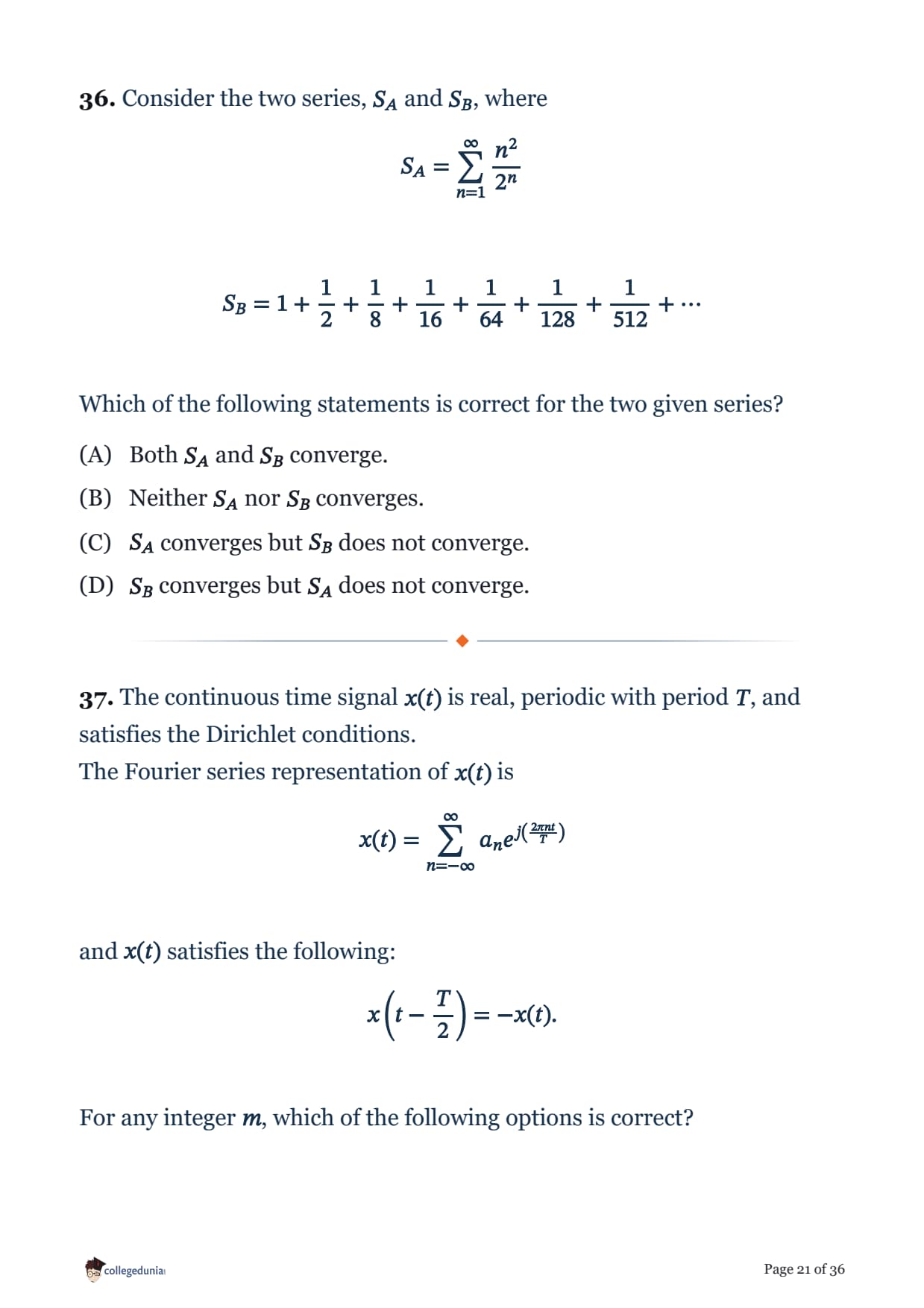
Consider the two series, \(S_A\) and \(S_B\), where
\[
S_A=\sum_{n=1}^{\infty}\frac{n^2}{2^n}
\]
\[
S_B=1+\frac{1}{2}+\frac{1}{8}+\frac{1}{16}+\frac{1}{64}+\frac{1}{128}+\frac{1}{512}+\cdots
\]
Which of the following statements is correct for the two given series?
The continuous time signal \(x(t)\) is real, periodic with period \(T\), and satisfies the Dirichlet conditions.
The Fourier series representation of \(x(t)\) is
\[
x(t)=\sum_{n=-\infty}^{\infty}a_ne^{j\left(\frac{2\pi nt}{T}\right)}
\]
and \(x(t)\) satisfies the following:
\[
x\left(t-\frac{T}{2}\right)=-x(t).
\]
For any integer \(m\), which of the following options is correct?
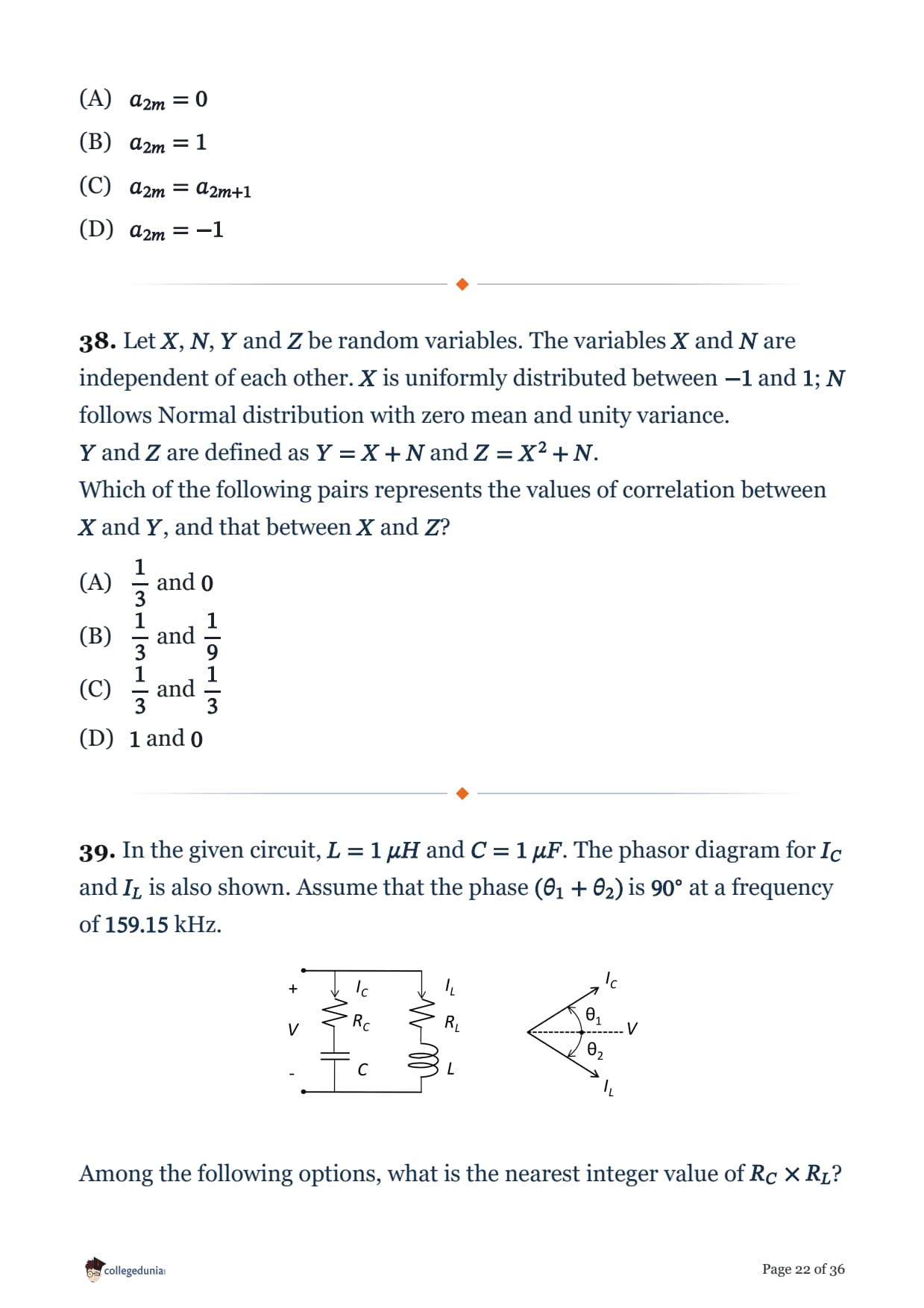
Let \(X\), \(N\), \(Y\) and \(Z\) be random variables. The variables \(X\) and \(N\) are independent of each other. \(X\) is uniformly distributed between \(-1\) and \(1\); \(N\) follows Normal distribution with zero mean and unity variance.
\(Y\) and \(Z\) are defined as \(Y=X+N\) and \(Z=X^2+N\).
Which of the following pairs represents the values of correlation between \(X\) and \(Y\), and that between \(X\) and \(Z\)?
In the given circuit, \(L=1\ \mu H\) and \(C=1\ \mu F\). The phasor diagram for \(I_C\) and \(I_L\) is also shown. Assume that the phase \((\theta_1+\theta_2)\) is \(90^{\circ}\) at a frequency of \(159.15\) kHz.

Among the following options, what is the nearest integer value of \(R_C\times R_L\)?
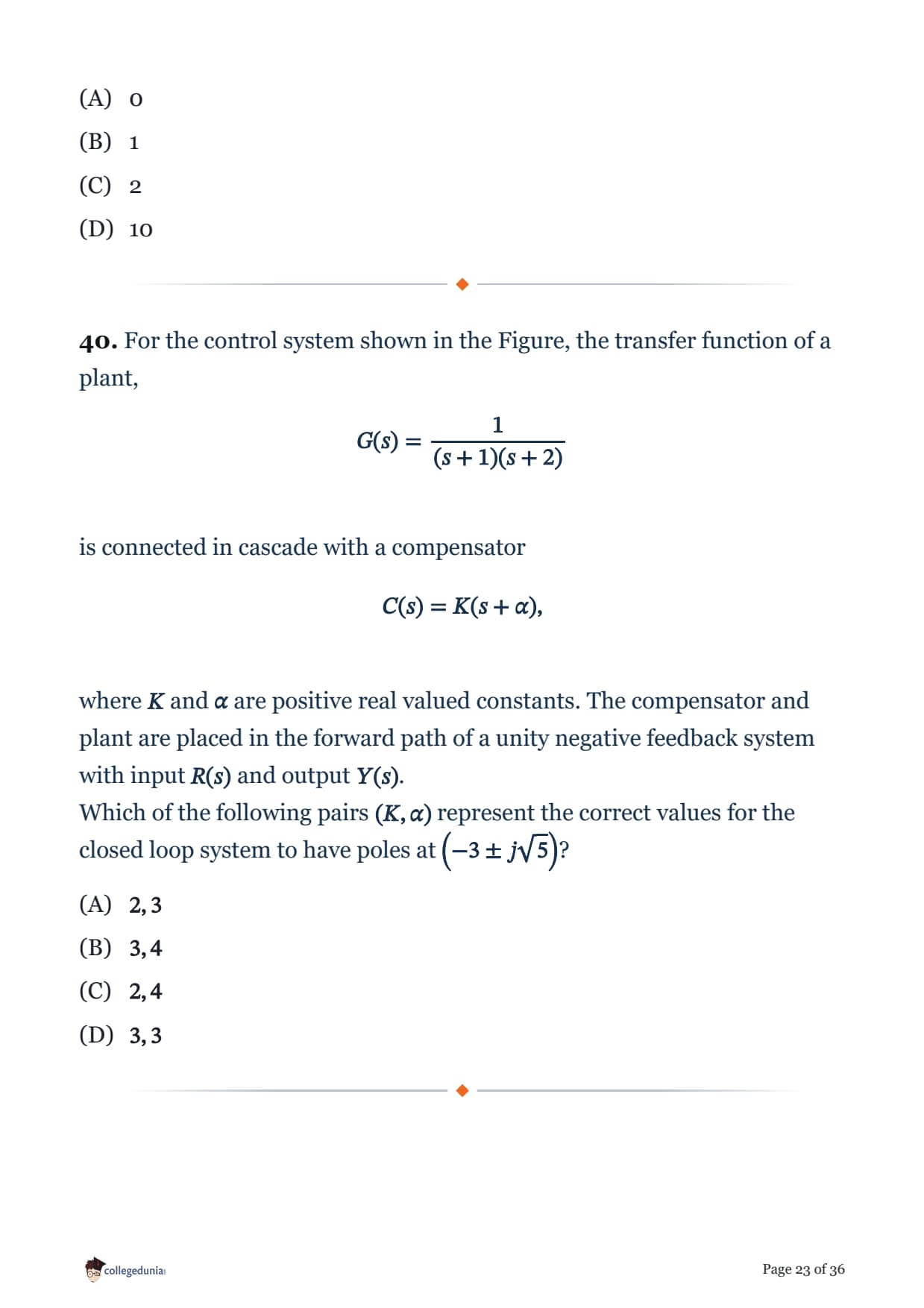
For the control system shown in the Figure, the transfer function of a plant,
\[
G(s)=\frac{1}{(s+1)(s+2)}
\]
is connected in cascade with a compensator
\[
C(s)=K(s+\alpha),
\]
where \(K\) and \(\alpha\) are positive real valued constants. The compensator and plant are placed in the forward path of a unity negative feedback system with input \(R(s)\) and output \(Y(s)\).
Which of the following pairs \((K,\alpha)\) represent the correct values for the closed loop system to have poles at \(\left(-3\pm j\sqrt{5}\right)\)?
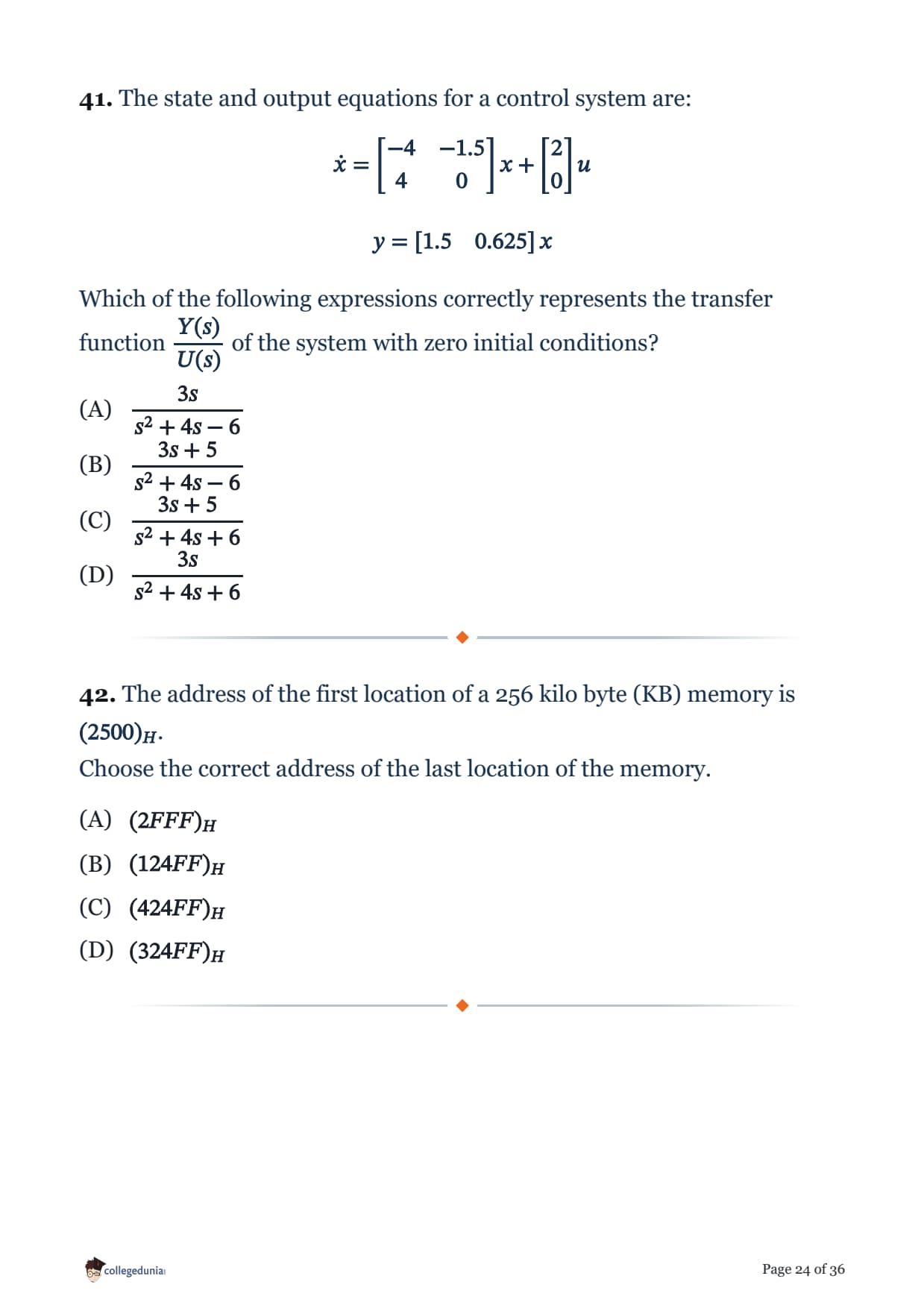
The state and output equations for a control system are: \[ \dot{x} = \begin{bmatrix} -4 & -1.5 \\ 4 & 0 \end{bmatrix} x + \begin{bmatrix} 2 \\ 0 \end{bmatrix} u \] \[ y = \begin{bmatrix} 1.5 & 0.625 \end{bmatrix} x \] Which of the following expressions correctly represents the transfer function \(\dfrac{Y(s)}{U(s)}\) of the system with zero initial conditions?
The address of the first location of a 256 kilo byte (KB) memory is \((2500)_H\).
Choose the correct address of the last location of the memory.
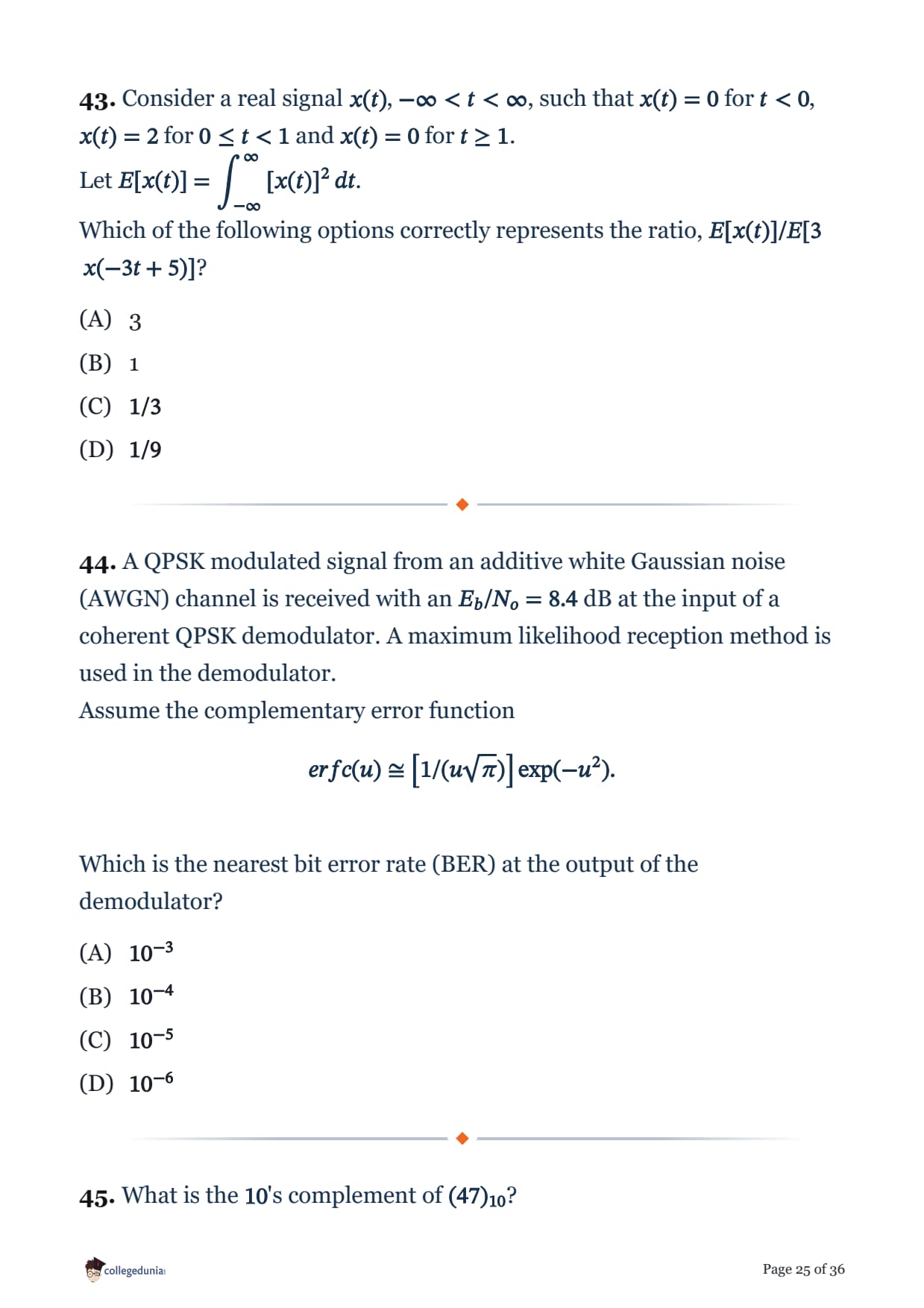
Consider a real signal \(x(t)\), \(-\infty < t < \infty\), such that \(x(t)=0\) for \(t<0\), \(x(t)=2\) for \(0\le t<1\) and \(x(t)=0\) for \(t\ge1\).
Let \(E[x(t)]=\displaystyle\int_{-\infty}^{\infty}[x(t)]^2\,dt\).
Which of the following options correctly represents the ratio, \(E[x(t)]/E[3\,x(-3t+5)]\)?
A QPSK modulated signal from an additive white Gaussian noise (AWGN) channel is received with an \(E_b/N_o=8.4\) dB at the input of a coherent QPSK demodulator. A maximum likelihood reception method is used in the demodulator.
Assume the complementary error function \[ erfc(u)\cong\left[1/(u\sqrt{\pi})\right]\exp(-u^2). \]
Which is the nearest bit error rate (BER) at the output of the demodulator?
What is the \(10\)'s complement of \((47)_{10}\)?
Consider a real baseband signal \(x(t)=e^{-2t}\), for \(t\) (in seconds) \(\ge0\).
If \(99\%\) of the energy of \(x(t)\) lies within \(B\) Hz, then which of the following options is TRUE for the value of \(B\)?
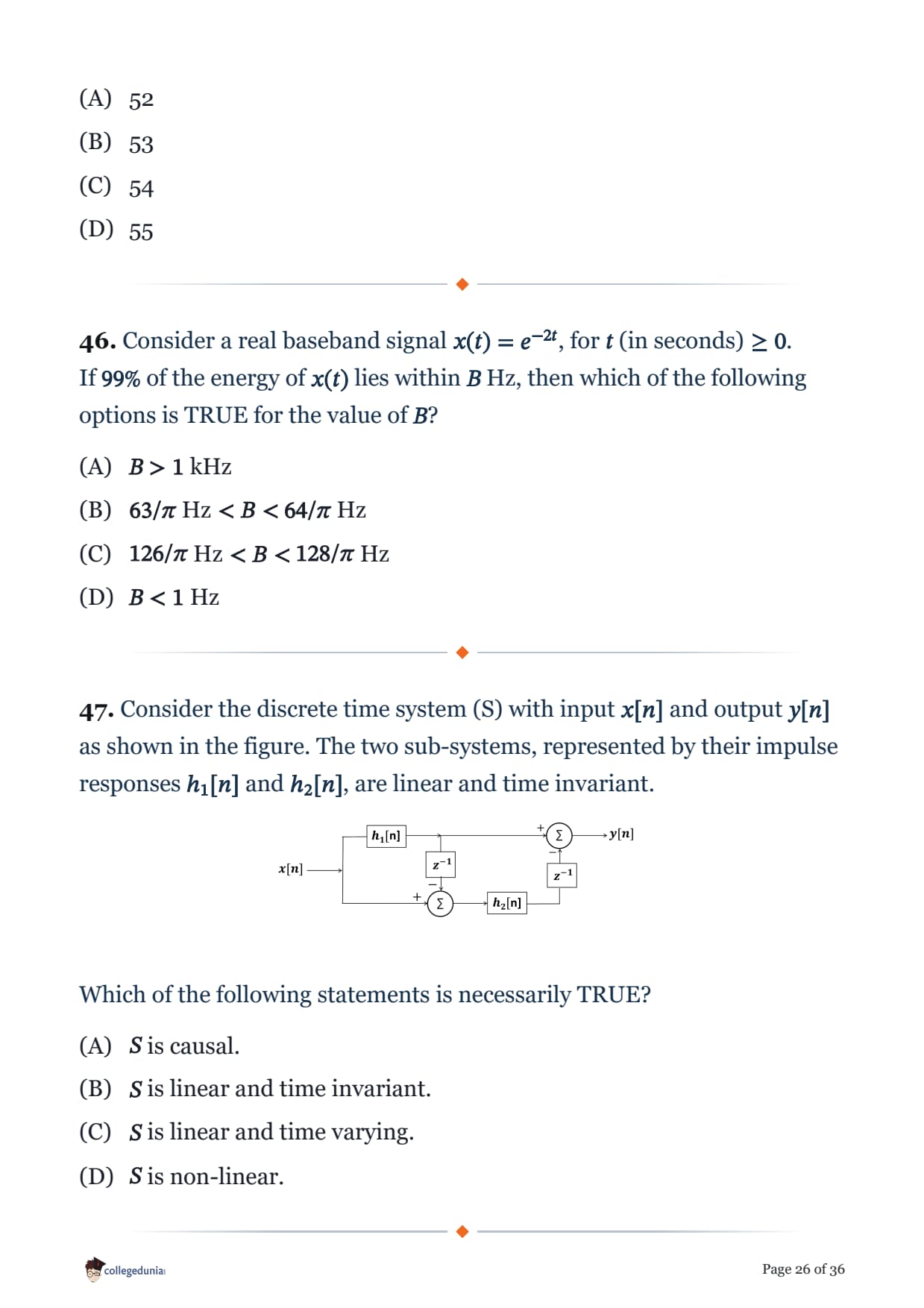
Consider the discrete time system (S) with input \(x[n]\) and output \(y[n]\) as shown in the figure. The two sub-systems, represented by their impulse responses \(h_1[n]\) and \(h_2[n]\), are linear and time invariant.
Which of the following statements is necessarily TRUE?
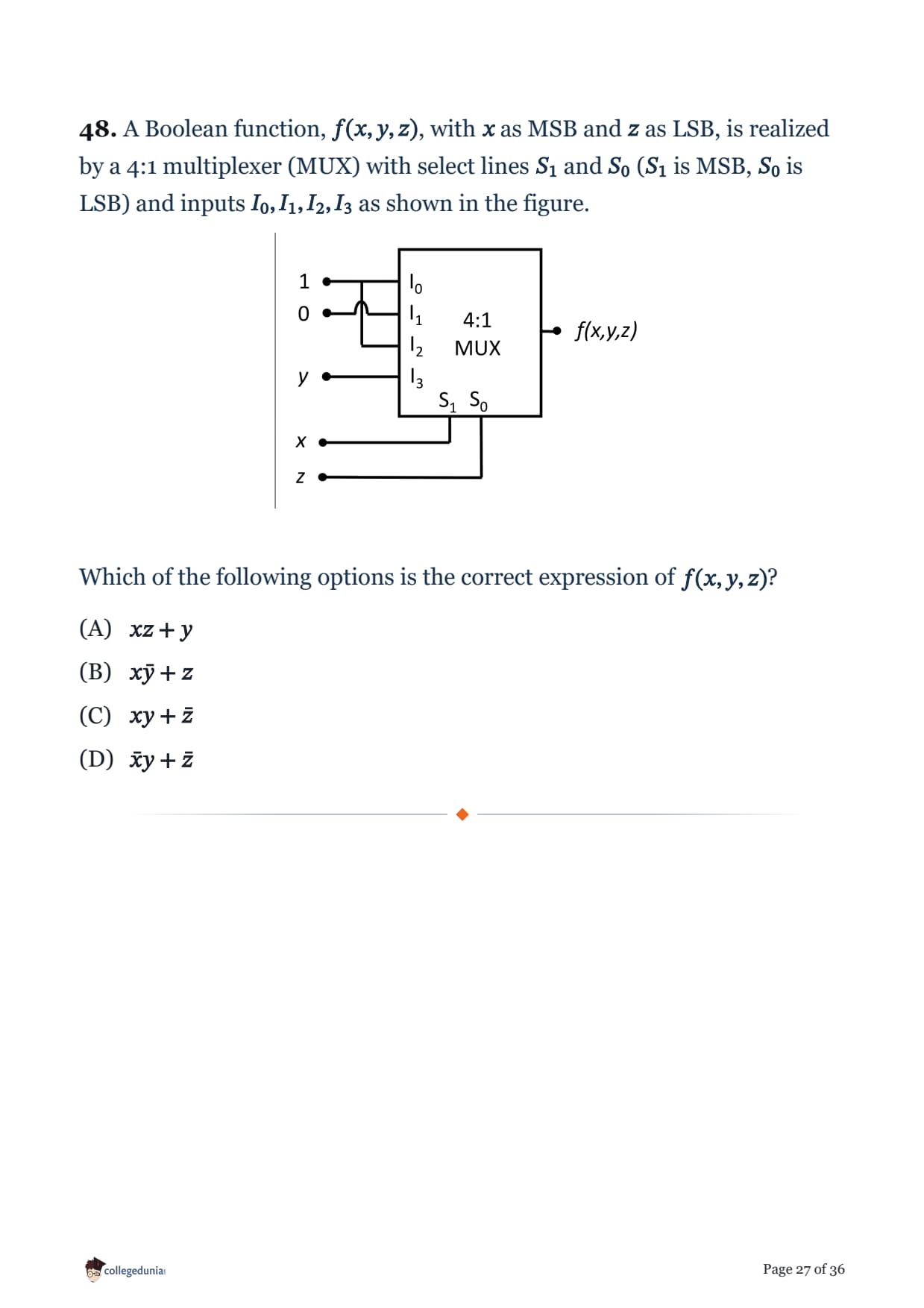
A Boolean function, \(f(x,y,z)\), with \(x\) as MSB and \(z\) as LSB, is realized by a 4:1 multiplexer (MUX) with select lines \(S_1\) and \(S_0\) (\(S_1\) is MSB, \(S_0\) is LSB) and inputs \(I_0, I_1, I_2, I_3\) as shown in the figure.
Which of the following options is the correct expression of \(f(x,y,z)\)?
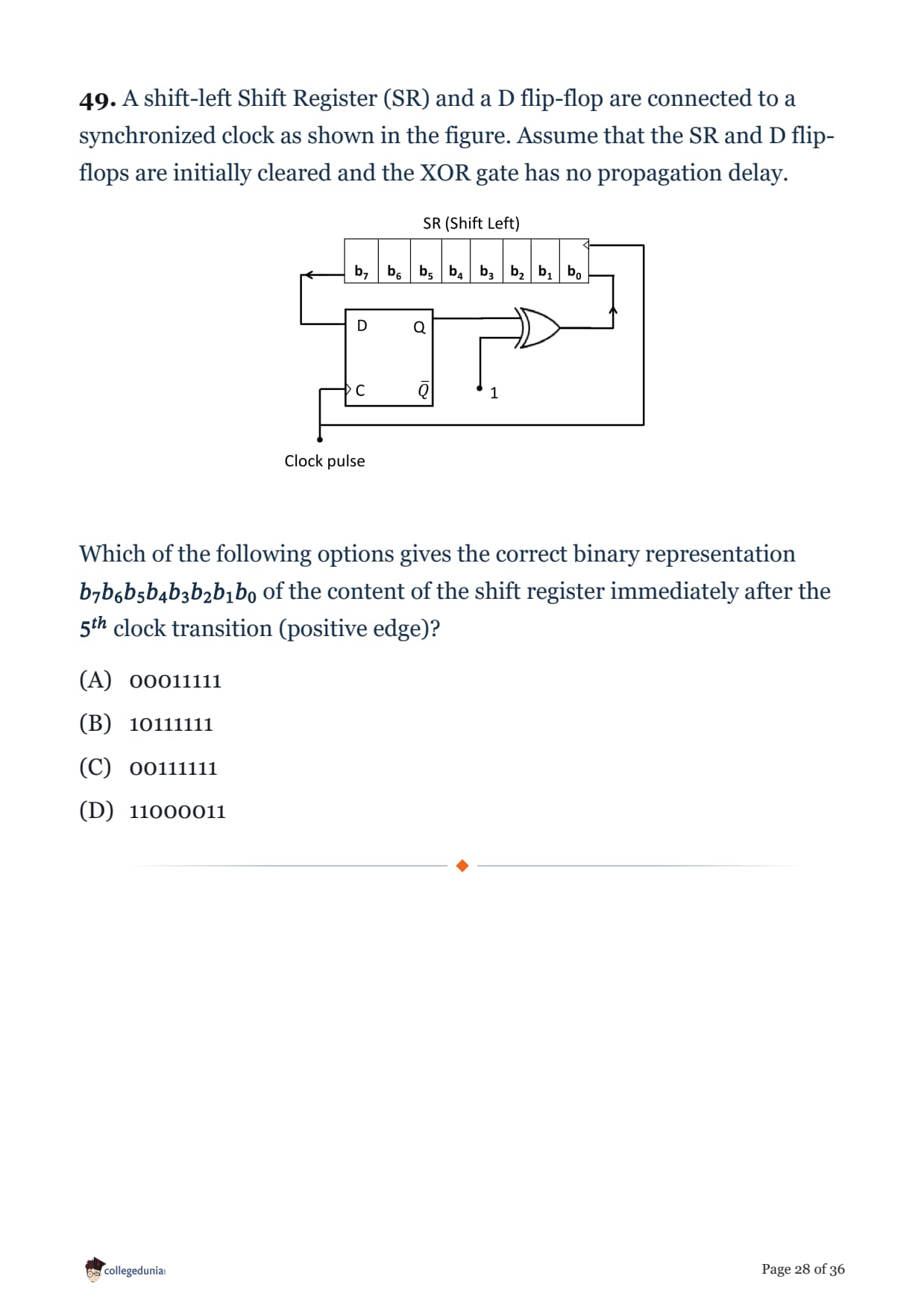
A shift-left Shift Register (SR) and a D flip-flop are connected to a synchronized clock as shown in the figure. Assume that the SR and D flip-flops are initially cleared and the XOR gate has no propagation delay.
Which of the following options gives the correct binary representation \(b_7b_6b_5b_4b_3b_2b_1b_0\) of the content of the shift register immediately after the \(5^{th}\) clock transition (positive edge)?
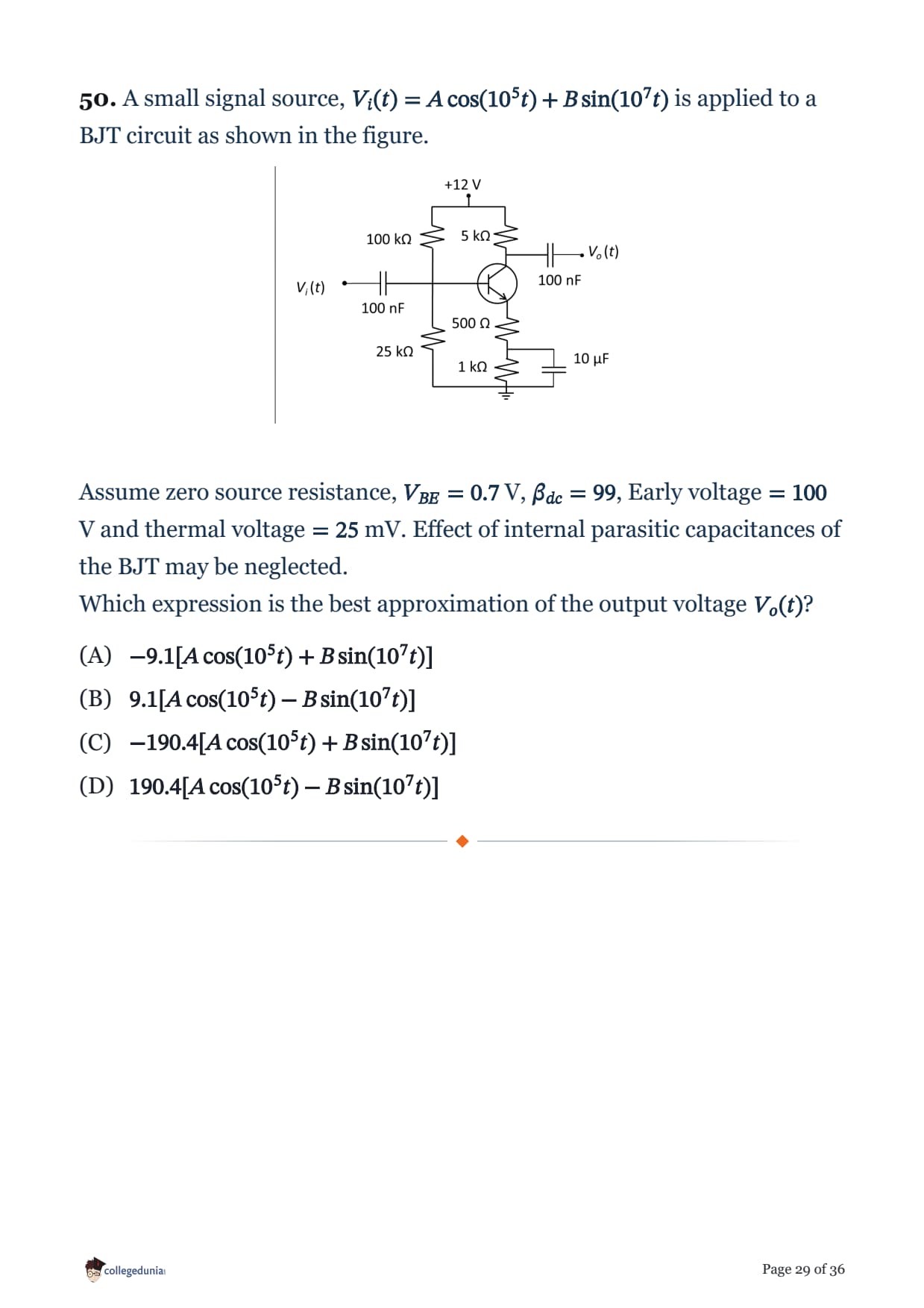
A small signal source, \(V_i(t)=A\cos(10^5t)+B\sin(10^7t)\) is applied to a BJT circuit as shown in the figure.
Assume zero source resistance, \(V_{BE}=0.7\) V, \(\beta_{dc}=99\), Early voltage \(=100\) V and thermal voltage \(=25\) mV. Effect of internal parasitic capacitances of the BJT may be neglected.
Which expression is the best approximation of the output voltage \(V_o(t)\)?
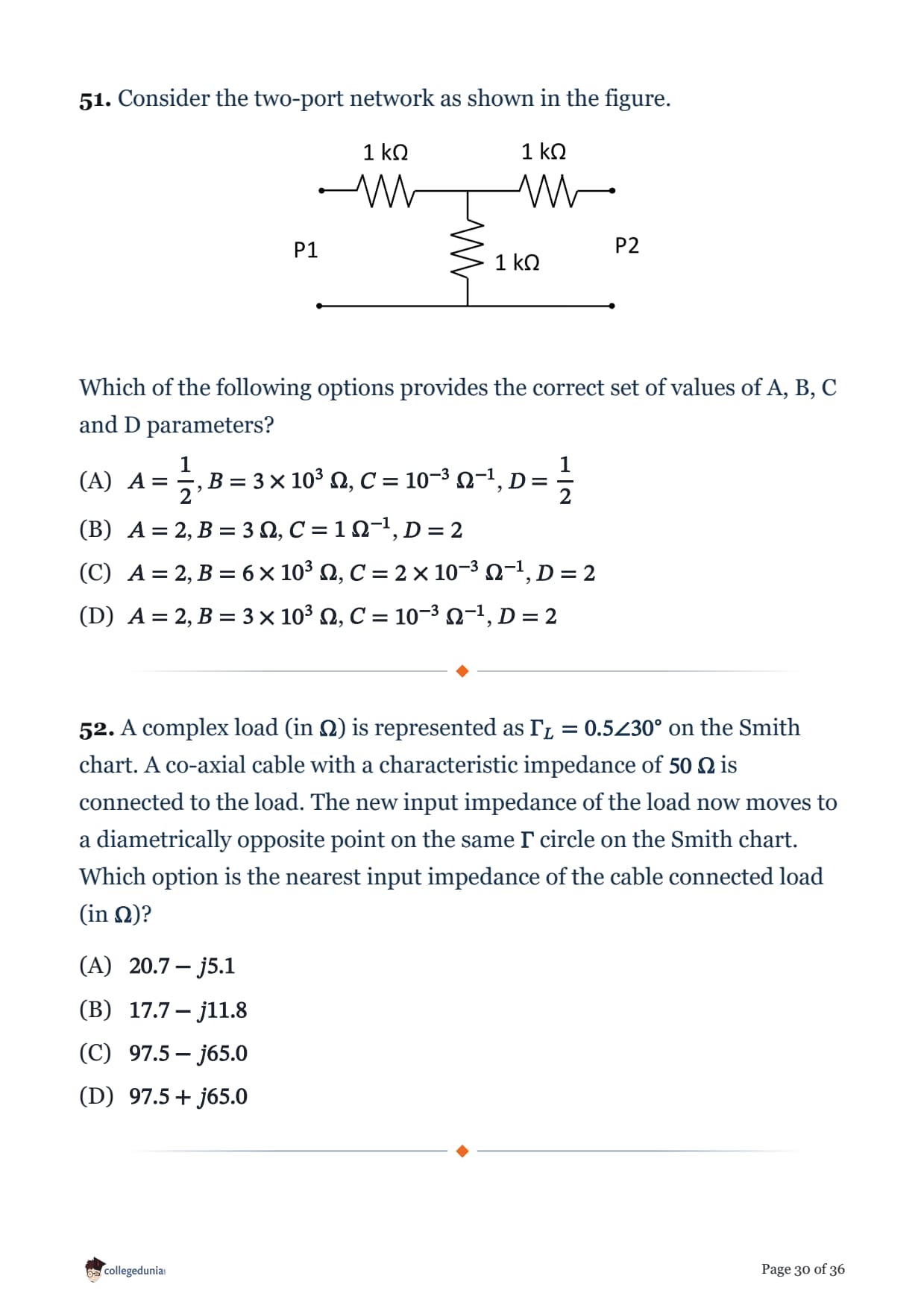
Consider the two-port network as shown in the figure.
Which of the following options provides the correct set of values of A, B, C and D parameters?
A complex load (in \(\Omega\)) is represented as \(\Gamma_L=0.5\angle30^{\circ}\) on the Smith chart. A co-axial cable with a characteristic impedance of \(50\ \Omega\) is connected to the load. The new input impedance of the load now moves to a diametrically opposite point on the same \(\Gamma\) circle on the Smith chart.
Which option is the nearest input impedance of the cable connected load (in \(\Omega\))?
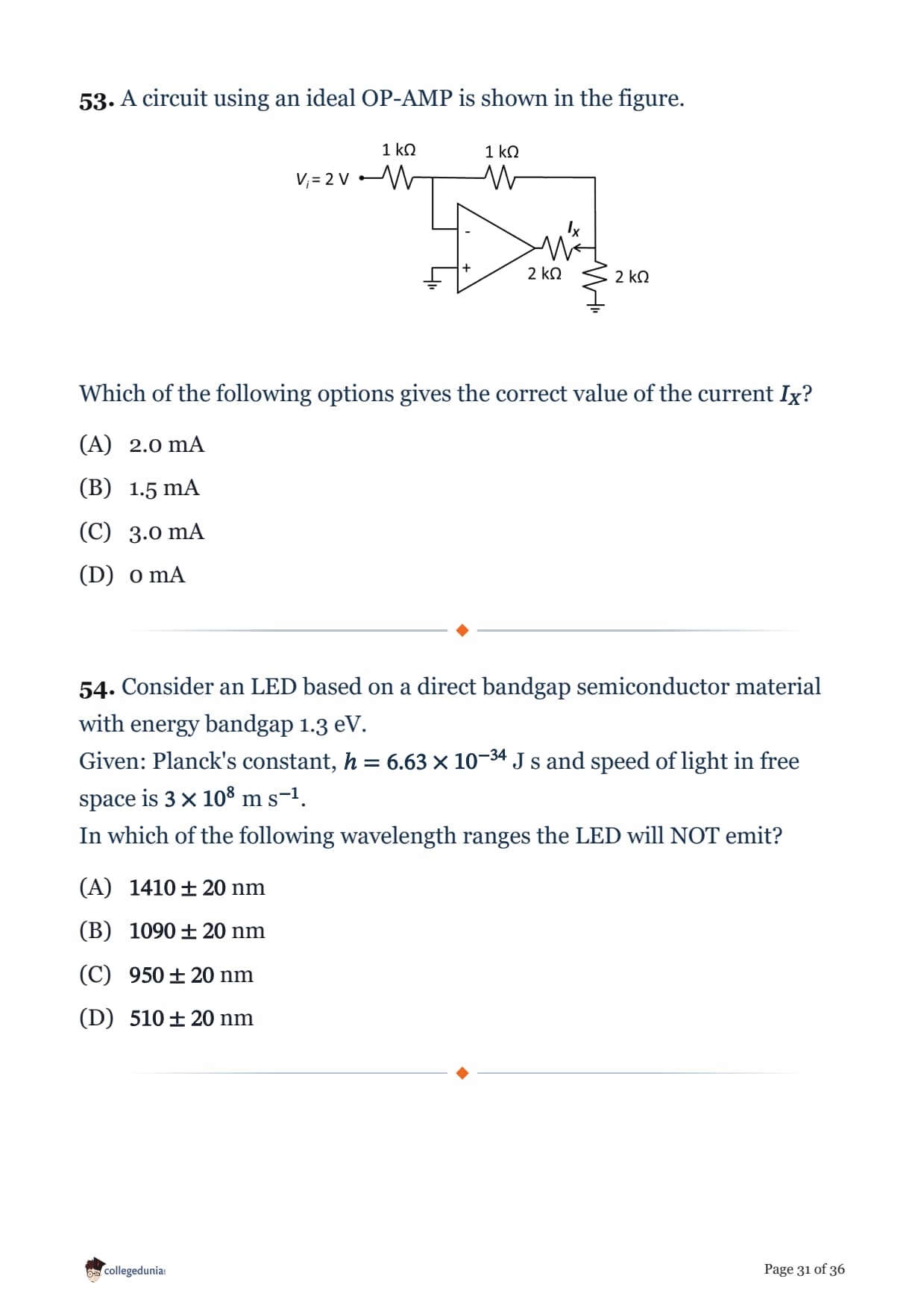
A circuit using an ideal OP-AMP is shown in the figure.
Which of the following options gives the correct value of the current \(I_X\)?
Consider an LED based on a direct bandgap semiconductor material with energy bandgap 1.3 eV.
Given: Planck's constant, \(h=6.63\times10^{-34}\) J s and speed of light in free space is \(3\times10^{8}\) m s\(^{-1}\).
In which of the following wavelength ranges the LED will NOT emit?
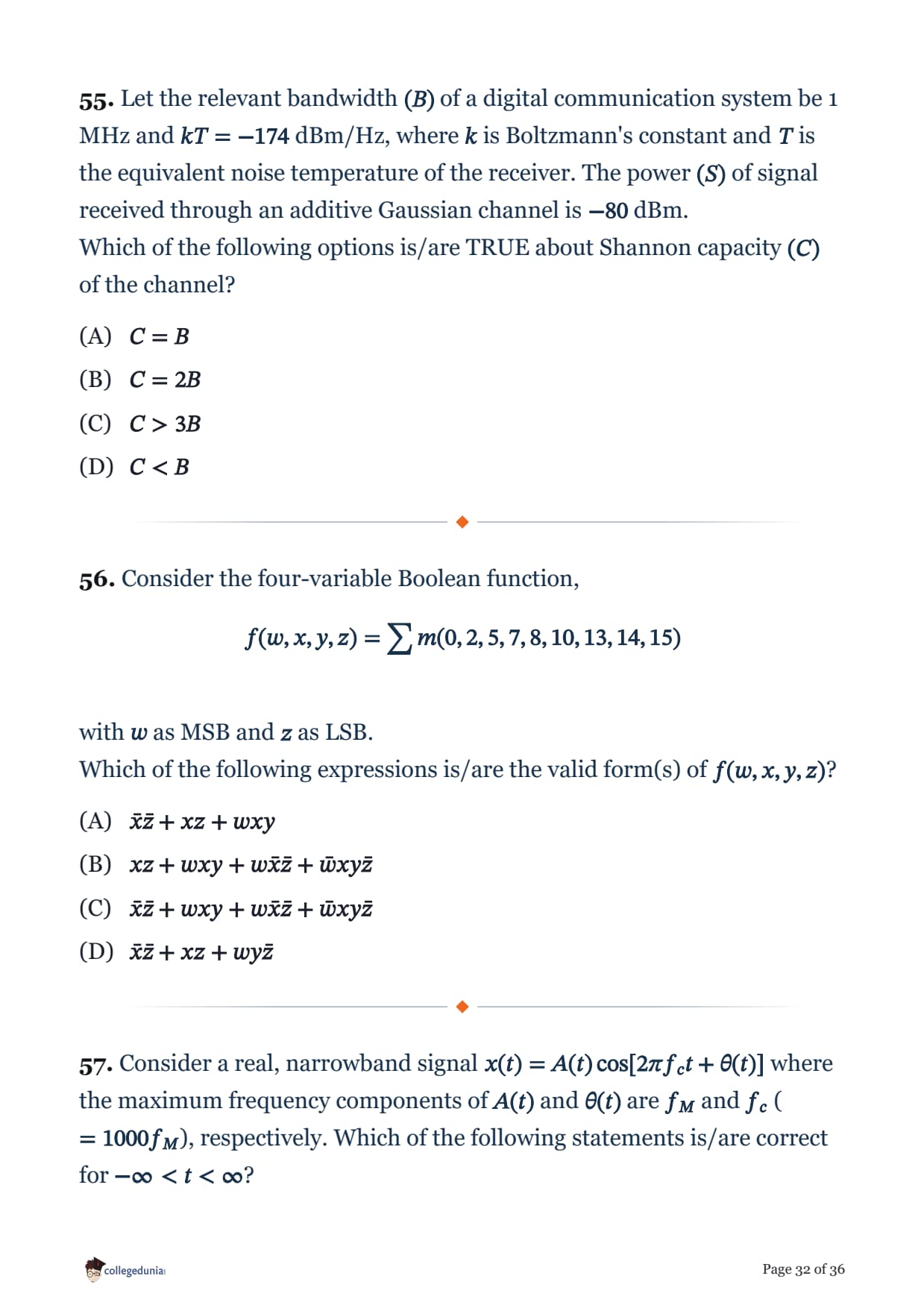
Let the relevant bandwidth \((B)\) of a digital communication system be 1 MHz and \(kT=-174\) dBm/Hz, where \(k\) is Boltzmann's constant and \(T\) is the equivalent noise temperature of the receiver. The power \((S)\) of signal received through an additive Gaussian channel is \(-80\) dBm.
Which of the following options is/are TRUE about Shannon capacity \((C)\) of the channel?
Consider the four-variable Boolean function,
\[f(w,x,y,z)=\sum m(0,2,5,7,8,10,13,14,15)\]
with \(w\) as MSB and \(z\) as LSB.
Which of the following expressions is/are the valid form(s) of \(f(w,x,y,z)\)?
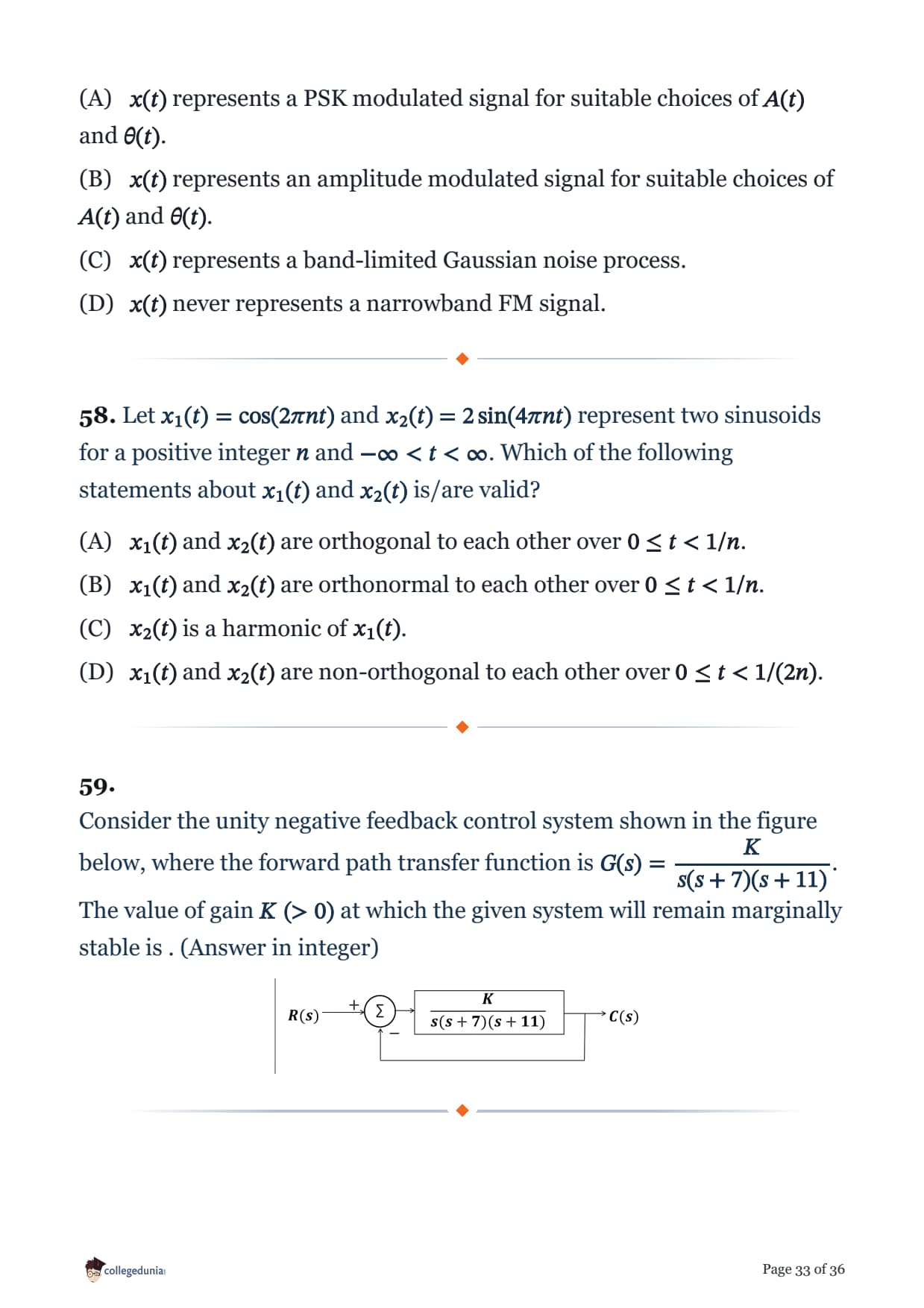
Consider a real, narrowband signal \(x(t) = A(t)\cos[2\pi f_c t + \theta(t)]\) where the maximum frequency components of \(A(t)\) and \(\theta(t)\) are \(f_M\) and \(f_c\) (\(=1000f_M\)), respectively. Which of the following statements is/are correct for \(-\infty<t<\infty\)?
Let \(x_1(t)=\cos(2\pi nt)\) and \(x_2(t)=2\sin(4\pi nt)\) represent two sinusoids for a positive integer \(n\) and \(-\infty<t<\infty\). Which of the following statements about \(x_1(t)\) and \(x_2(t)\) is/are valid?


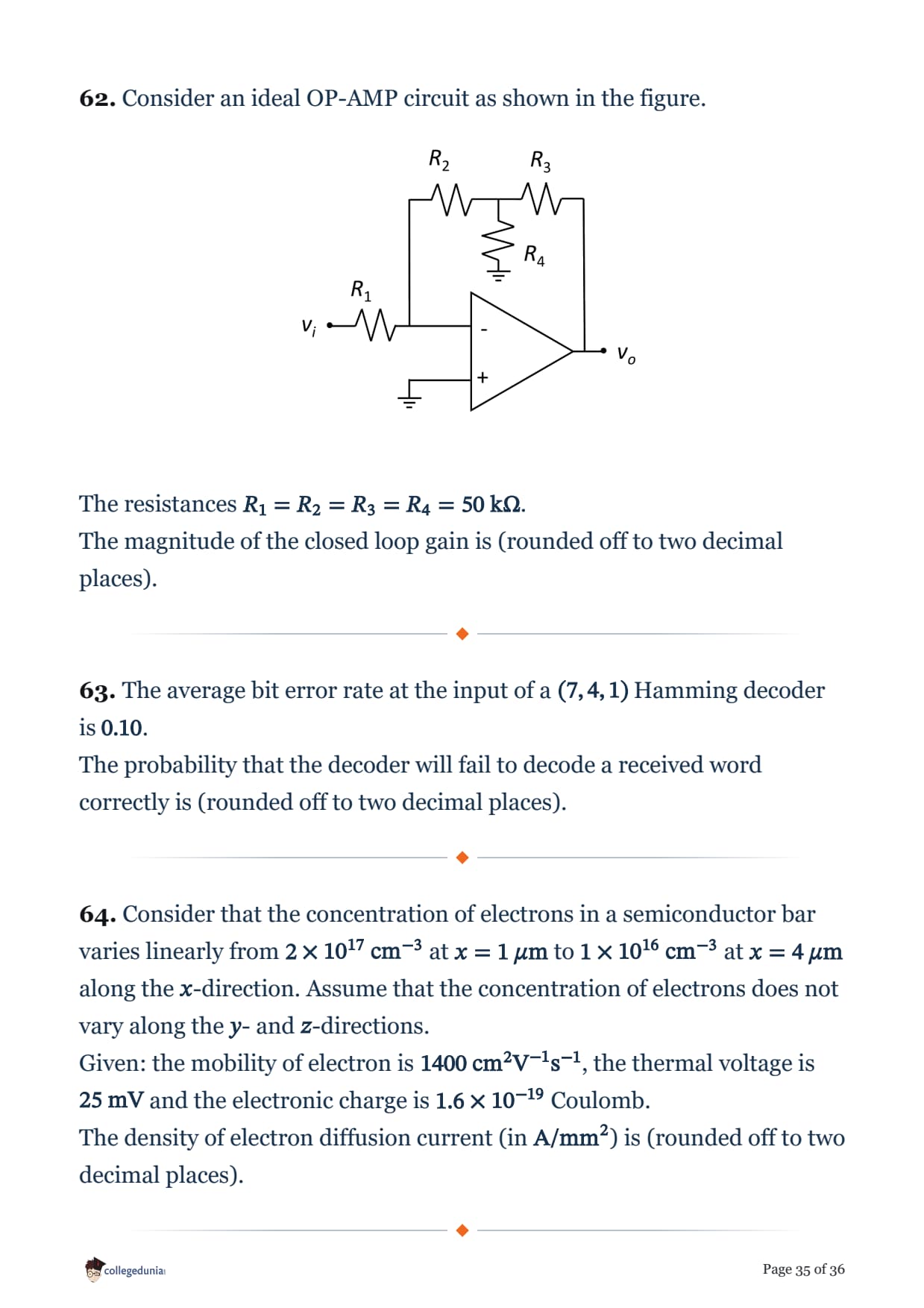
Consider an ideal OP-AMP circuit as shown in the figure.

The resistances \(R_1=R_2=R_3=R_4=50\text{ k}\Omega\).
The magnitude of the closed loop gain is (rounded off to two decimal places).
The average bit error rate at the input of a \((7,4,1)\) Hamming decoder is \(0.10\).
The probability that the decoder will fail to decode a received word correctly is (rounded off to two decimal places).
Consider that the concentration of electrons in a semiconductor bar varies linearly from \(2\times10^{17}\text{ cm}^{-3}\) at \(x=1\ \mu\text{m}\) to \(1\times10^{16}\text{ cm}^{-3}\) at \(x=4\ \mu\text{m}\) along the \(x\)-direction. Assume that the concentration of electrons does not vary along the \(y\)- and \(z\)-directions.
Given: the mobility of electron is \(1400\ \text{cm}^2\text{V}^{-1}\text{s}^{-1}\), the thermal voltage is \(25\text{ mV}\) and the electronic charge is \(1.6\times10^{-19}\) Coulomb.
The density of electron diffusion current (in \(\text{A/mm}^2\)) is (rounded off to two decimal places).
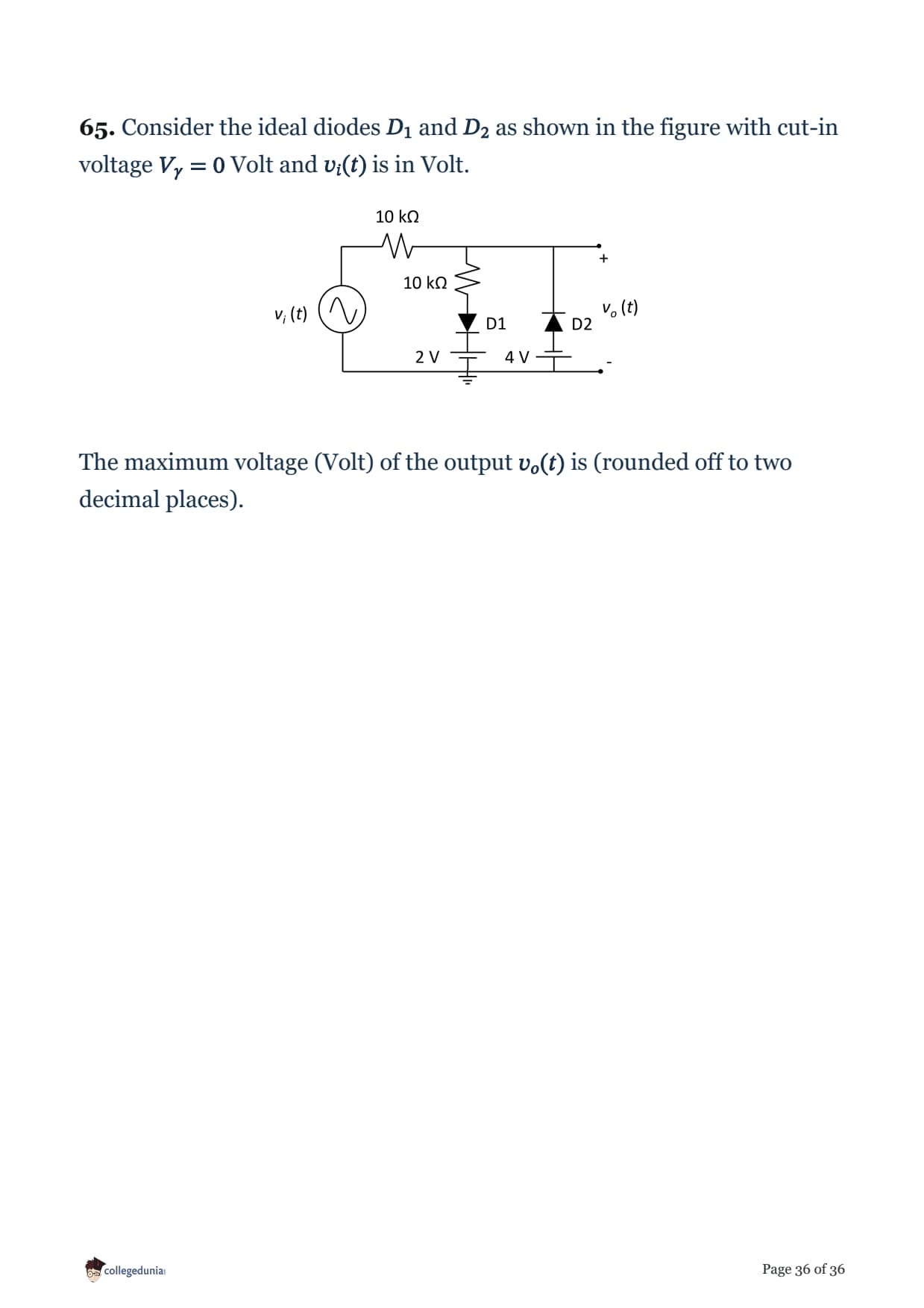
Consider the ideal diodes \(D_1\) and \(D_2\) as shown in the figure with cut-in voltage \(V_\gamma=0\) Volt and \(v_i(t)\) is in Volt.

The maximum voltage (Volt) of the output \(v_o(t)\) is (rounded off to two decimal places).
GATE 2026 EC Exam Pattern and Marking Scheme Explained
As per the information bulletin on the official website (gate2026.iitg.ac.in), GATE 2026 EC is a single 3-hour computer-based test covering General Aptitude, Engineering Mathematics, and the core Electronics and Communication syllabus.
- Total questions: 65, a mix of Multiple Choice (MCQ), Multiple Select (MSQ), and Numerical Answer Type (NAT) questions
- Duration: 3 hours
- Total marks: 100 - questions 1 to 10 (General Aptitude) carry 15 marks, and questions 11 to 65 (Engineering Mathematics and core Electronics and Communication) carry 85 marks
- Subject split within the 85 marks: Engineering Mathematics makes up about 13% of the paper, while core Electronics and Communication topics make up close to 72%
- Marking scheme: a wrong MCQ answer costs 1/3 mark on a 1-mark question and 2/3 mark on a 2-mark question; NAT and MSQ questions carry no negative marking
High-Weightage Topics in GATE 2026 EC to Focus On First
Communications has consistently been the single busiest area on the GATE EC paper, with Digital and Analog Circuits close behind.
- Communications: the highest-weightage area at around 12-13% of the paper, built around AM/FM modulation and digital communication
- Digital Circuits: about 10-11% weightage, spanning combinational and sequential logic design and number systems
- Analog Circuits: close to 10% weightage, covering BJT and MOSFET biasing, small-signal analysis, and op-amp circuits
- Networks, Signals and Systems, and Electromagnetics: each around 8-10%, with Network Theorems, Two-Port Networks, and Fourier Transform applications the recurring themes
- Engineering Mathematics: about 13% weightage, led by Linear Algebra and Differential Equations
GATE 2026 EC Question Paper Analysis Video
Source: NPTEL
How to Use the GATE 2026 EC Question Paper for Practice
Treat this paper as a timed mock before you look at a single solution.
- Attempt all 65 questions in 3 hours under exam conditions first, without checking the solution PDF
- Score yourself with the marking scheme above to get a realistic number
- Since Communications, Digital Circuits, and Analog Circuits carried the most weightage this year, redo every question you got wrong in these three areas first
- Use the solution PDF's working for the Numerical Answer Type questions in Networks and Signals and Systems - these carry the longest, most calculation-heavy solutions
- Re-attempt the paper a week later, focusing only on the areas where you lost marks
GATE 2026 EC Good Attempts and Qualifying Score Benchmark
- Aim for 50-60 attempts at 85-90% accuracy - the safe zone students used to gauge this year's forenoon EC paper
- The official qualifying cutoff for GATE 2026 EC is 26.4 marks for General category, 23.7 for OBC-NCL/EWS, and 17.5 for SC/ST/PwD
- Of the 1,15,448 students registered for GATE 2026 EC, 95,752 appeared for the exam
- Use these as your weekly targets when you redo the paper
GATE 2026 EC Question Paper FAQs
Ques. Was GATE 2026 EC tougher than previous years?
Ans. The GATE 2026 EC forenoon session was rated moderate to difficult. General Aptitude was moderate to lengthy, Engineering Mathematics was easy to moderate, and Networks, Signals and Systems, and Control Systems were the most time-consuming.
Ques. Which topics had the highest weightage in GATE 2026 EC?
Ans. Communications led with around 12-13% weightage, followed by Digital Circuits (10-11%) and Analog Circuits (about 10%). Networks, Signals and Systems, and Electromagnetics each carried roughly 8-10%.
Ques. How many questions should I attempt for a good score in GATE 2026 EC?
Ans. Students aimed for 50-60 attempts at 85-90% accuracy in the core sections. Attempting every General Aptitude and Engineering Mathematics question first is the safer strategy since those sections were comparatively easier.
Ques. What is the qualifying cutoff for GATE 2026 EC?
Ans. As per the official cutoff released by IIT Guwahati, the GATE 2026 EC qualifying mark is 26.4 for General category, 23.7 for OBC-NCL/EWS, and 17.5 for SC/ST/PwD.
Ques. When was the GATE 2026 result declared?
Ans. The GATE 2026 result was declared on March 19, 2026, with scorecards available for free download from March 27 to May 31, 2026, on the official GOAPS portal.
Ques. Where can I download the GATE 2026 EC question paper with solutions PDF for free?
Ans. Use the download table above on Collegedunia for the free question paper and solutions PDF. For the official paper and provisional answer key, check gate2026.iitg.ac.in.



Comments