




The GATE 2026 Computer Science & Information Technology (CS-2) question paper is now available with detailed solutions for free download. GATE 2026 was conducted by IIT Guwahati on February 8, 2026, in the afternoon session (2:30 PM to 5:30 PM), and the CS-2 paper carried 65 questions for 100 marks in 3 hours.
| GATE 2026 Computer Science & Information Technology (CS-2) Question Paper with Solutions | Download PDF | Check Solutions |
GATE 2026 Computer Science & Information Technology (CS-2) Questions with Solutions
Expedite, Hasten, Hurry,
Fill the blank by choosing a word with a meaning similar to that of the words given above.
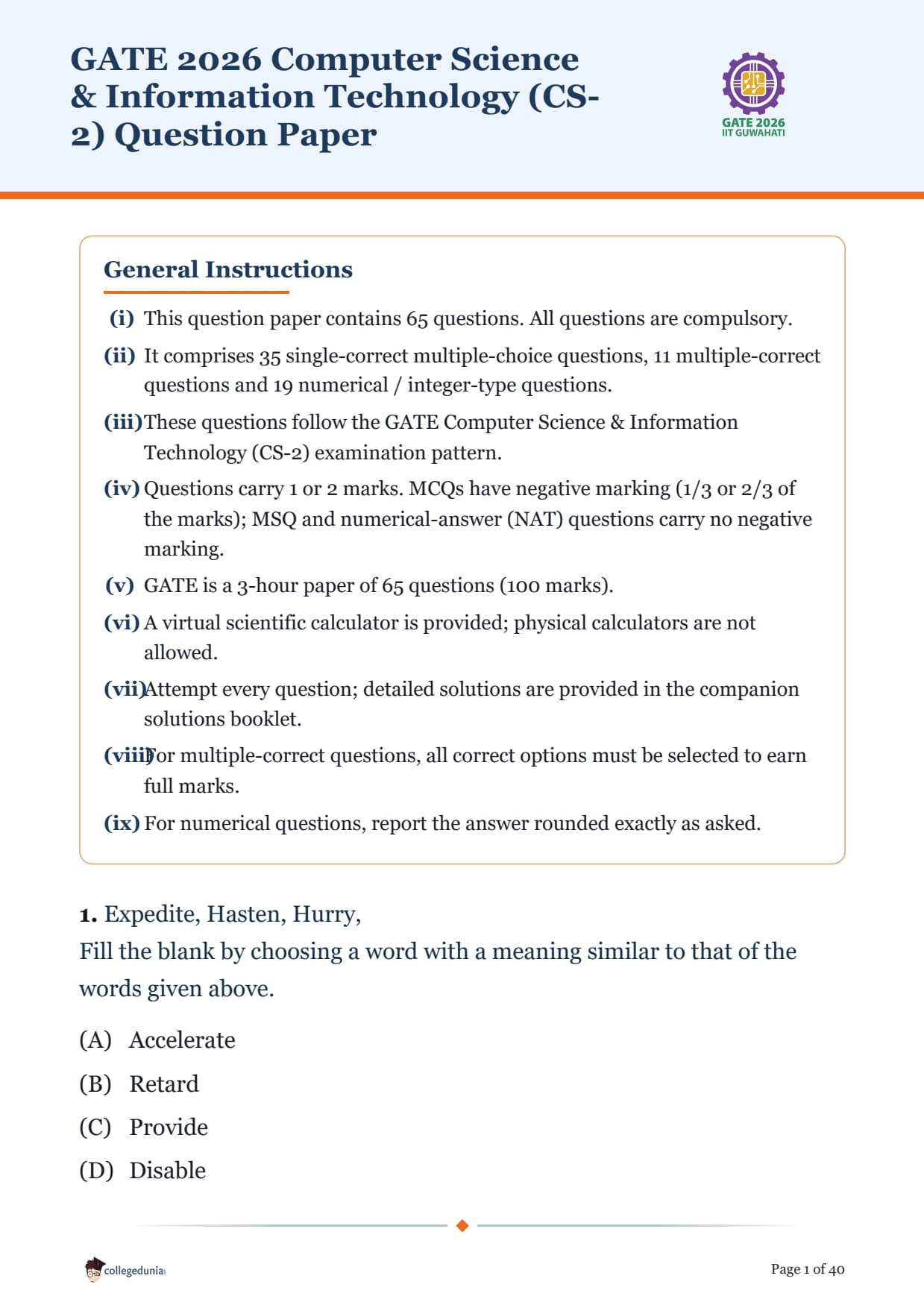
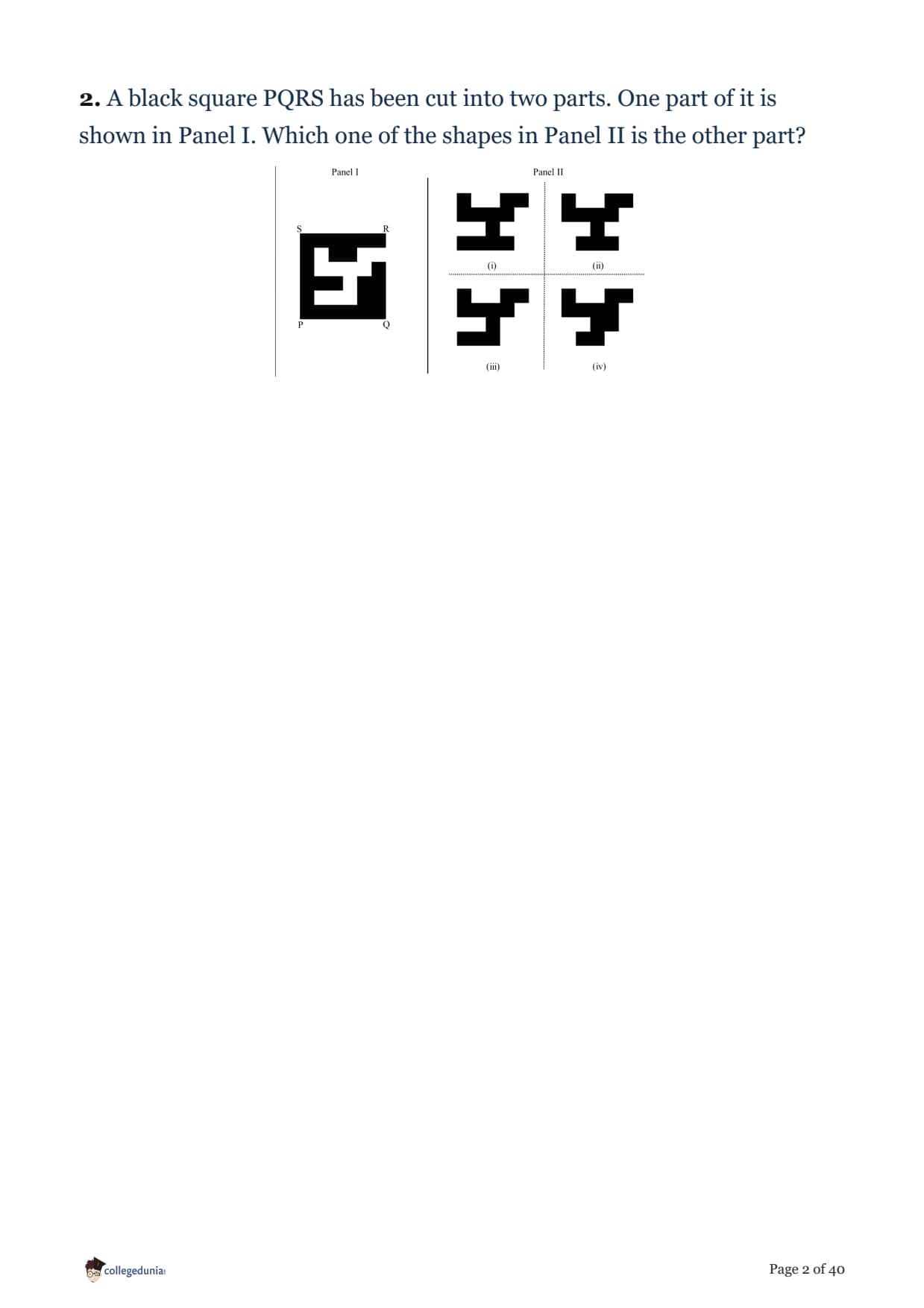
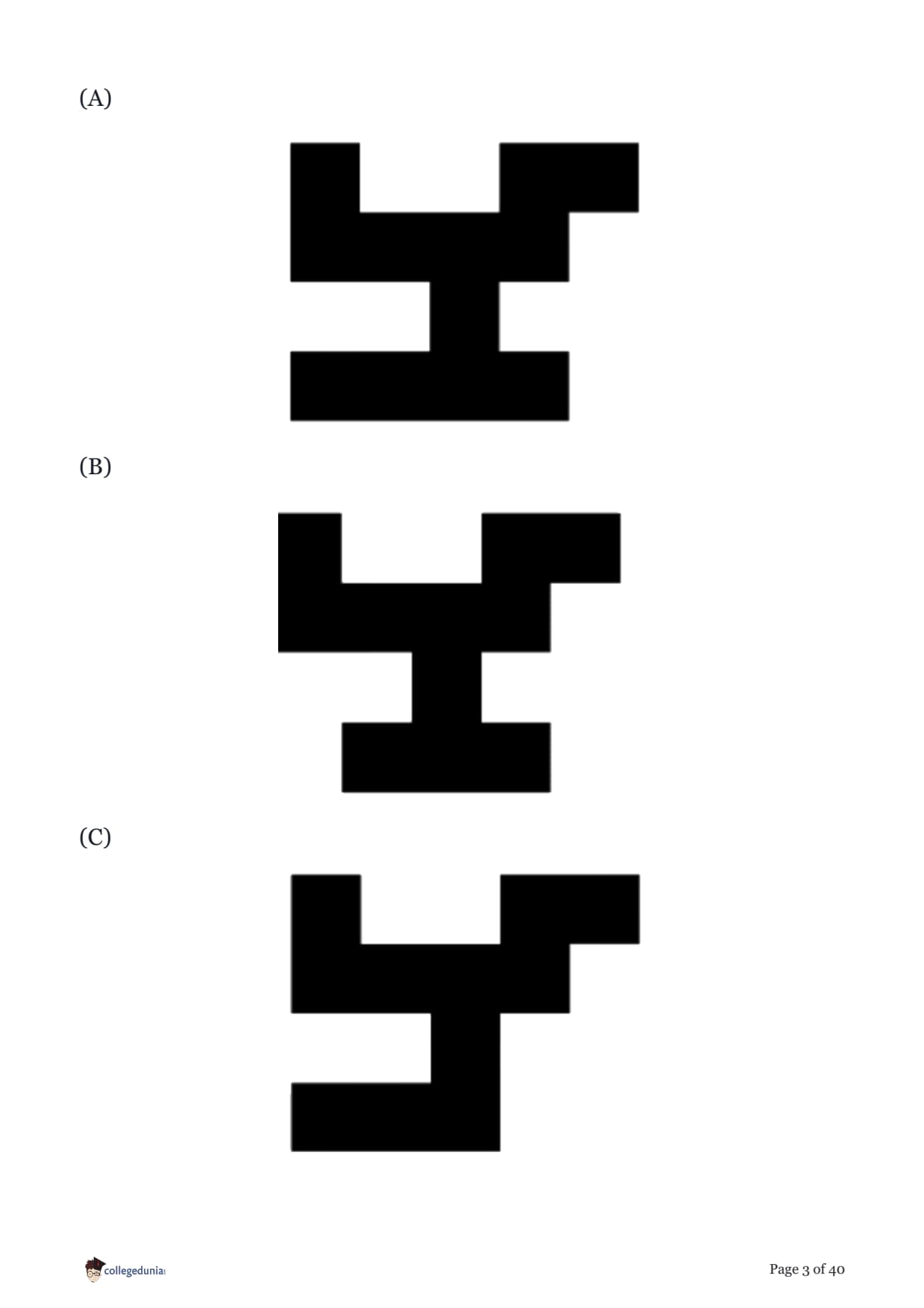
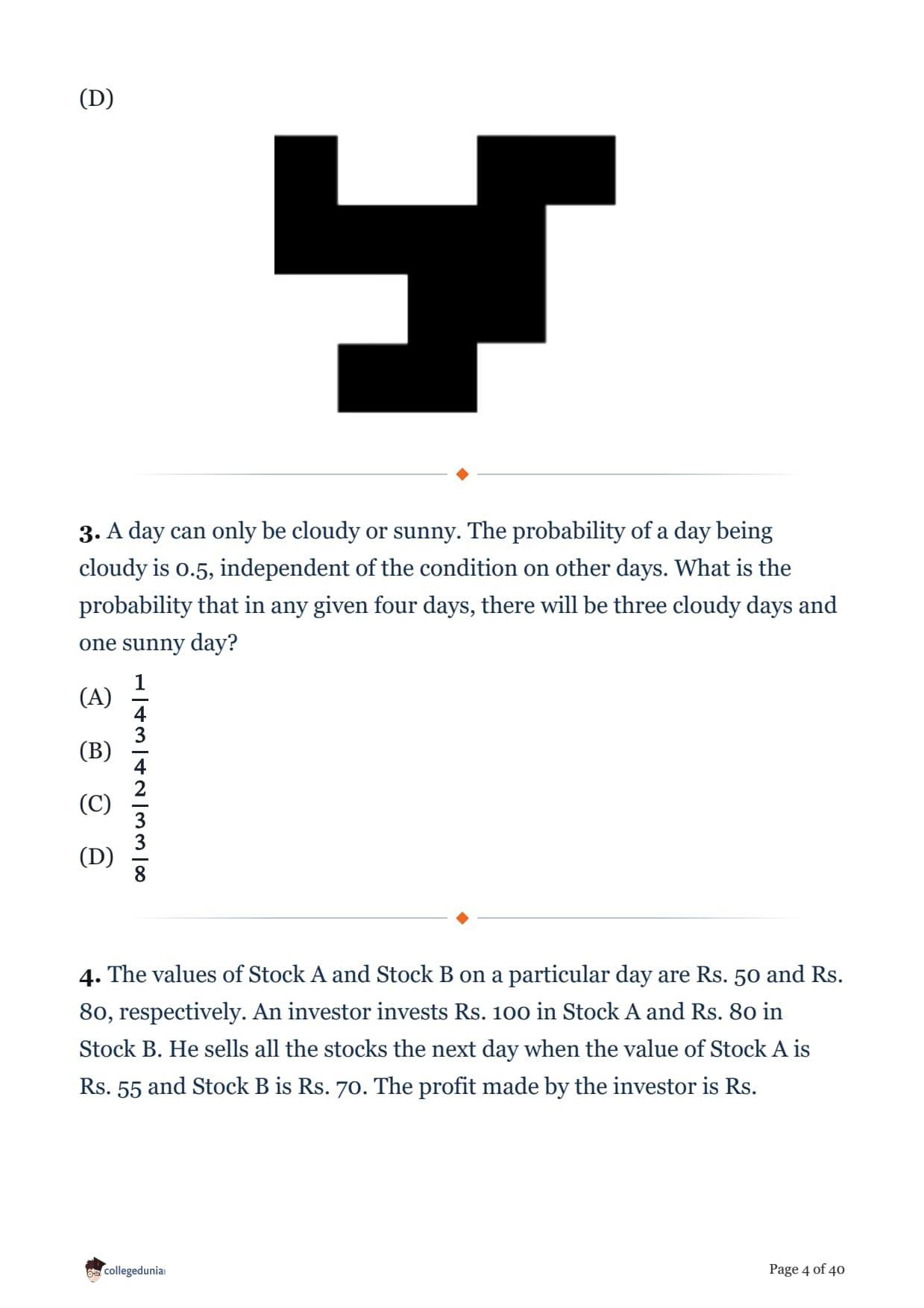
A black square PQRS has been cut into two parts. One part of it is shown in Panel I. Which one of the shapes in Panel II is the other part?

- (A)
![]()
- (B)
![]()
- (C)
![]()
- (D)
![]()


A day can only be cloudy or sunny. The probability of a day being cloudy is 0.5, independent of the condition on other days. What is the probability that in any given four days, there will be three cloudy days and one sunny day?
The values of Stock A and Stock B on a particular day are Rs. 50 and Rs. 80, respectively. An investor invests Rs. 100 in Stock A and Rs. 80 in Stock B. He sells all the stocks the next day when the value of Stock A is Rs. 55 and Stock B is Rs. 70. The profit made by the investor is Rs.
'When it is raining, peacocks dance.'
Based only on this sentence, which one of the following options is necessarily true?
Water : P :: Food : Q
Choose the P and Q combination from the options below to form a meaningful analogy.
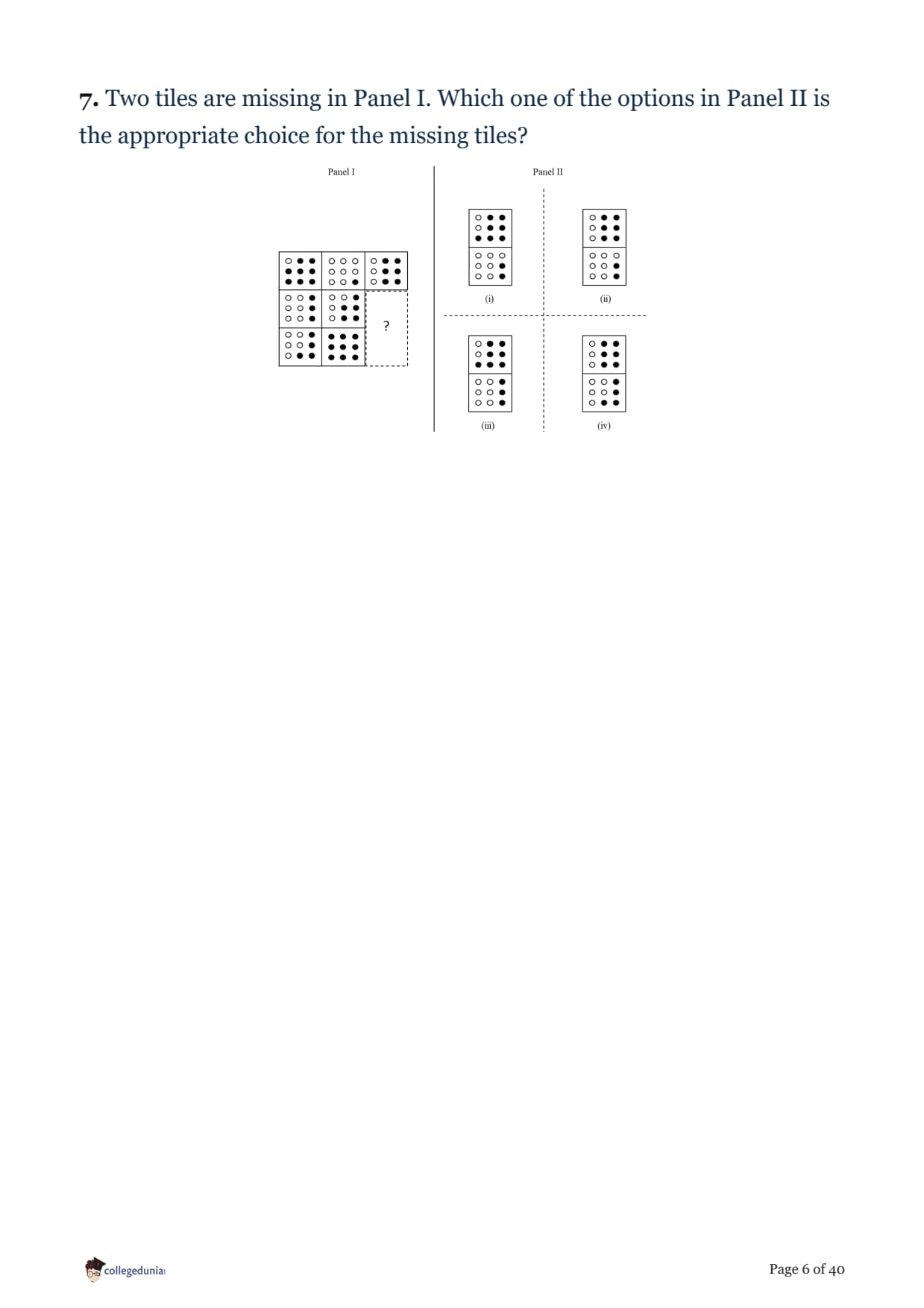
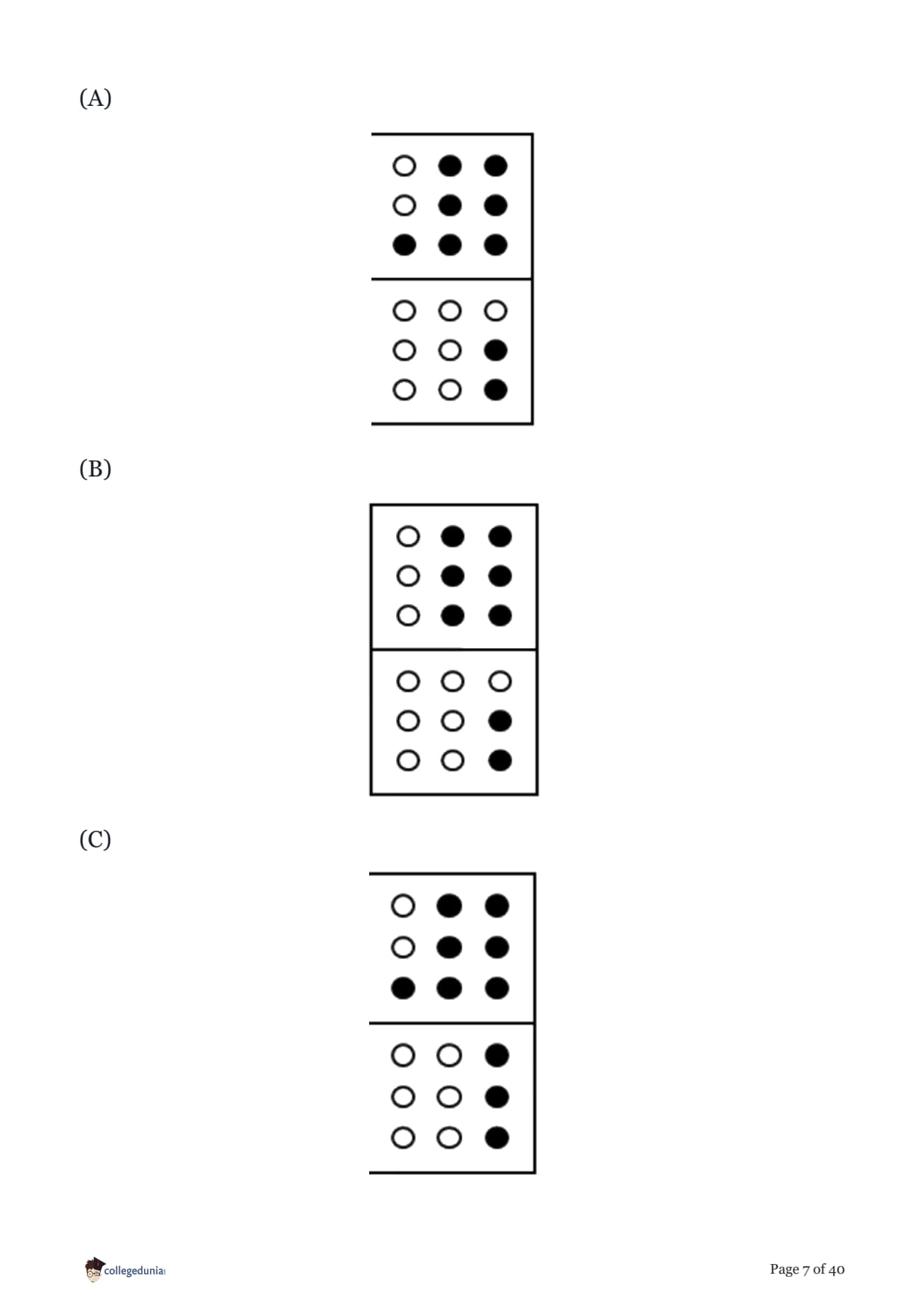
Two tiles are missing in Panel I. Which one of the options in Panel II is the appropriate choice for the missing tiles?

- (A)
![]()
- (B)
![]()
- (C)
![]()
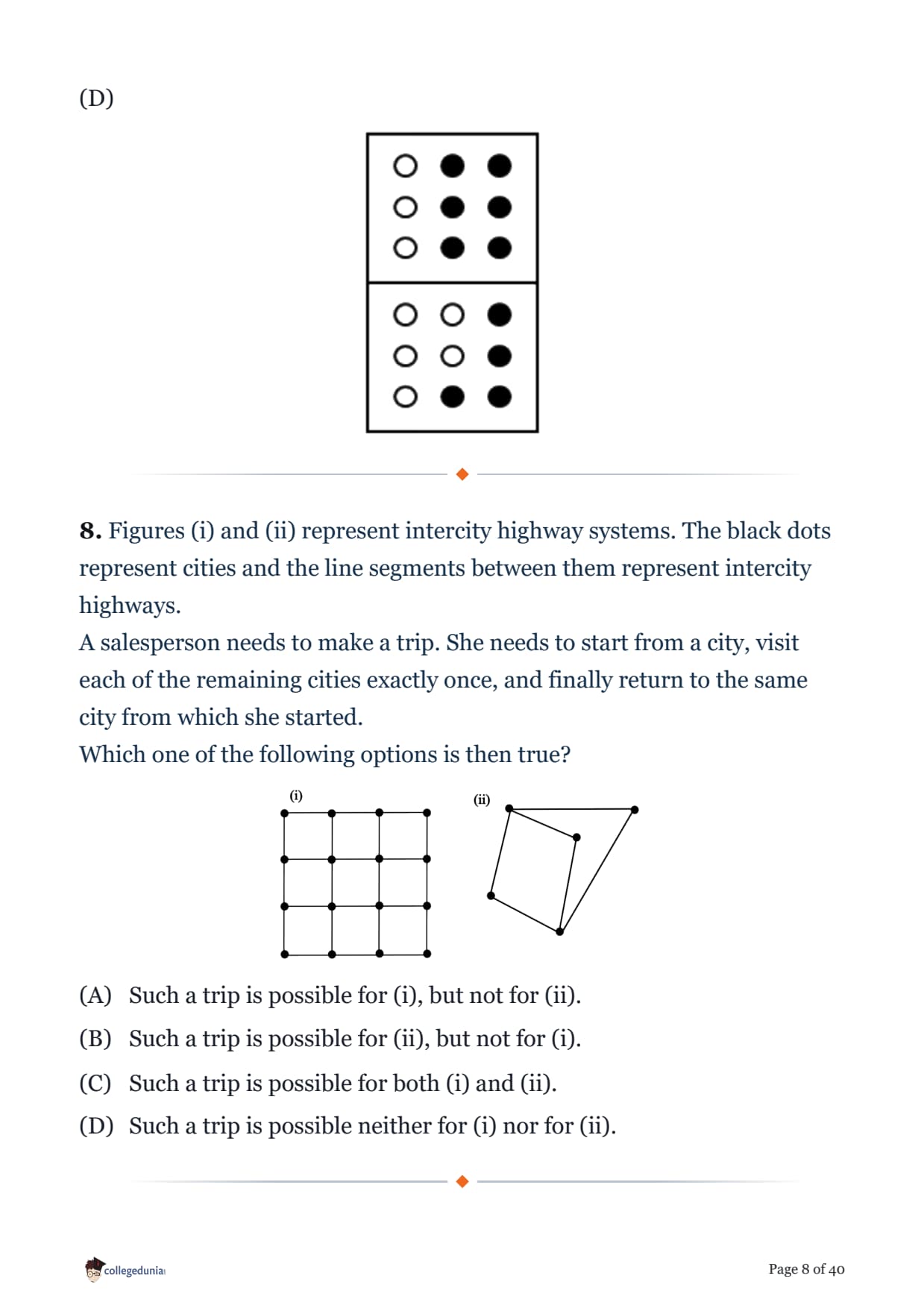
- (D)
![]()


Figures (i) and (ii) represent intercity highway systems. The black dots represent cities and the line segments between them represent intercity highways.
A salesperson needs to make a trip. She needs to start from a city, visit each of the remaining cities exactly once, and finally return to the same city from which she started.
Which one of the following options is then true?

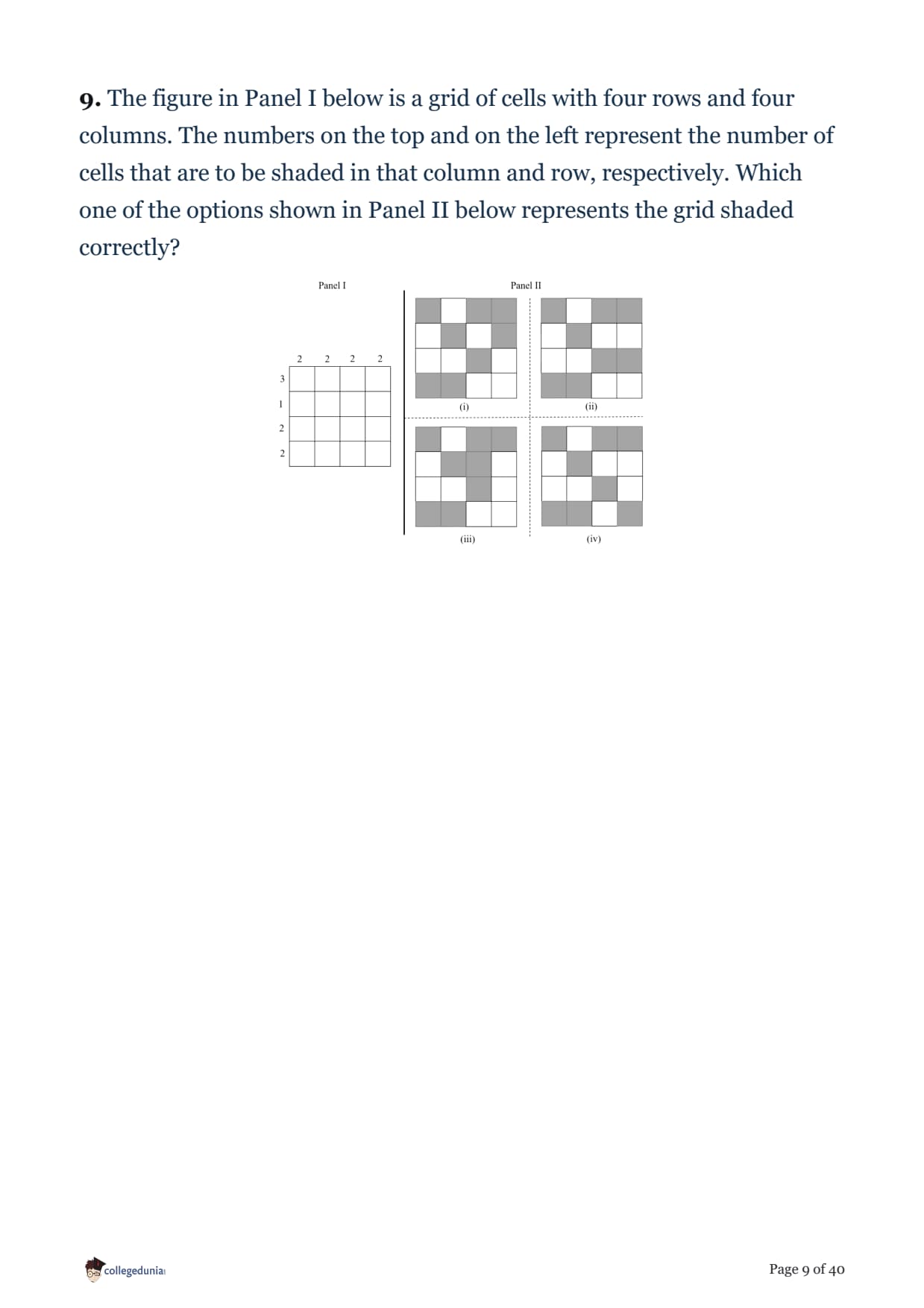
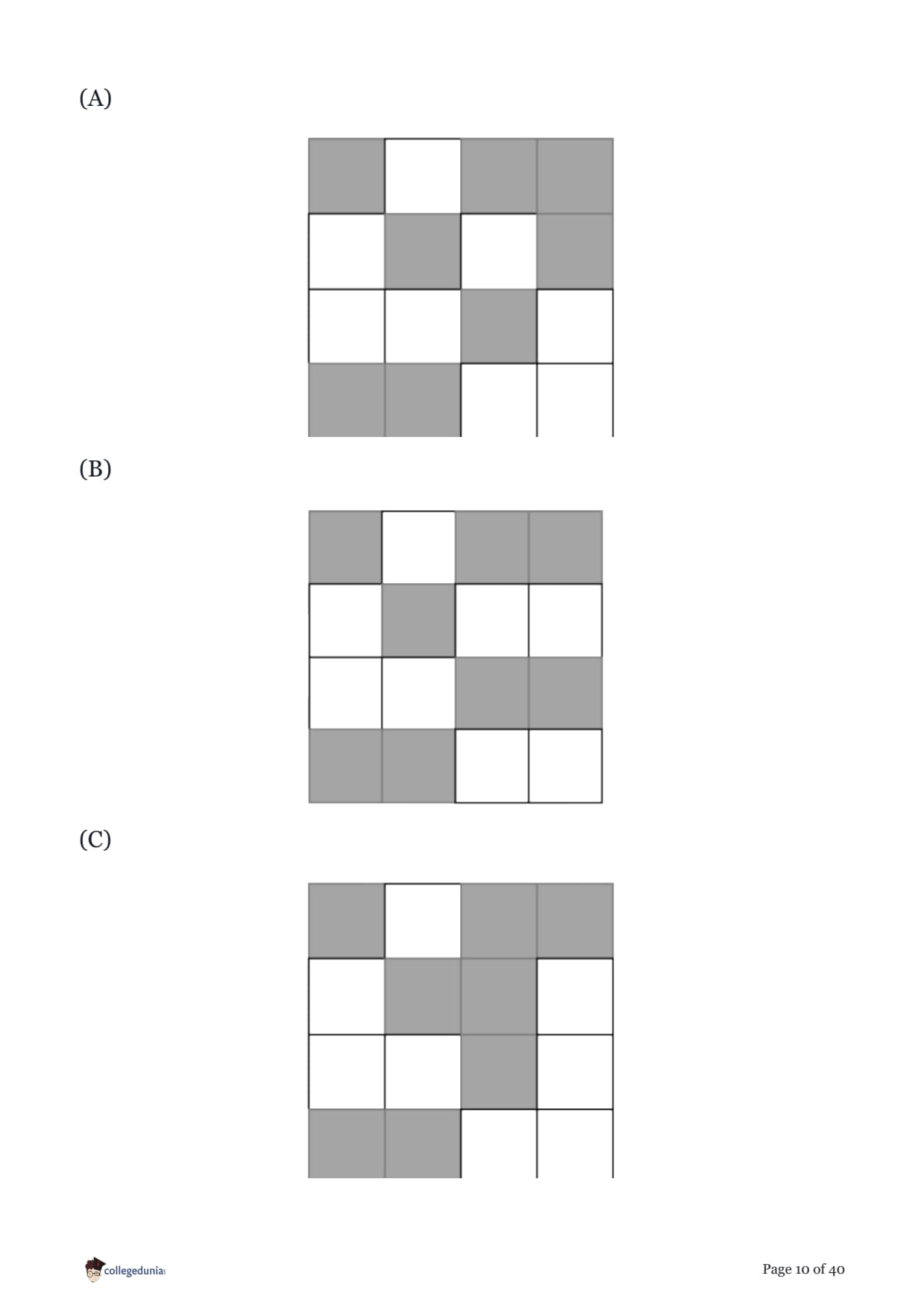
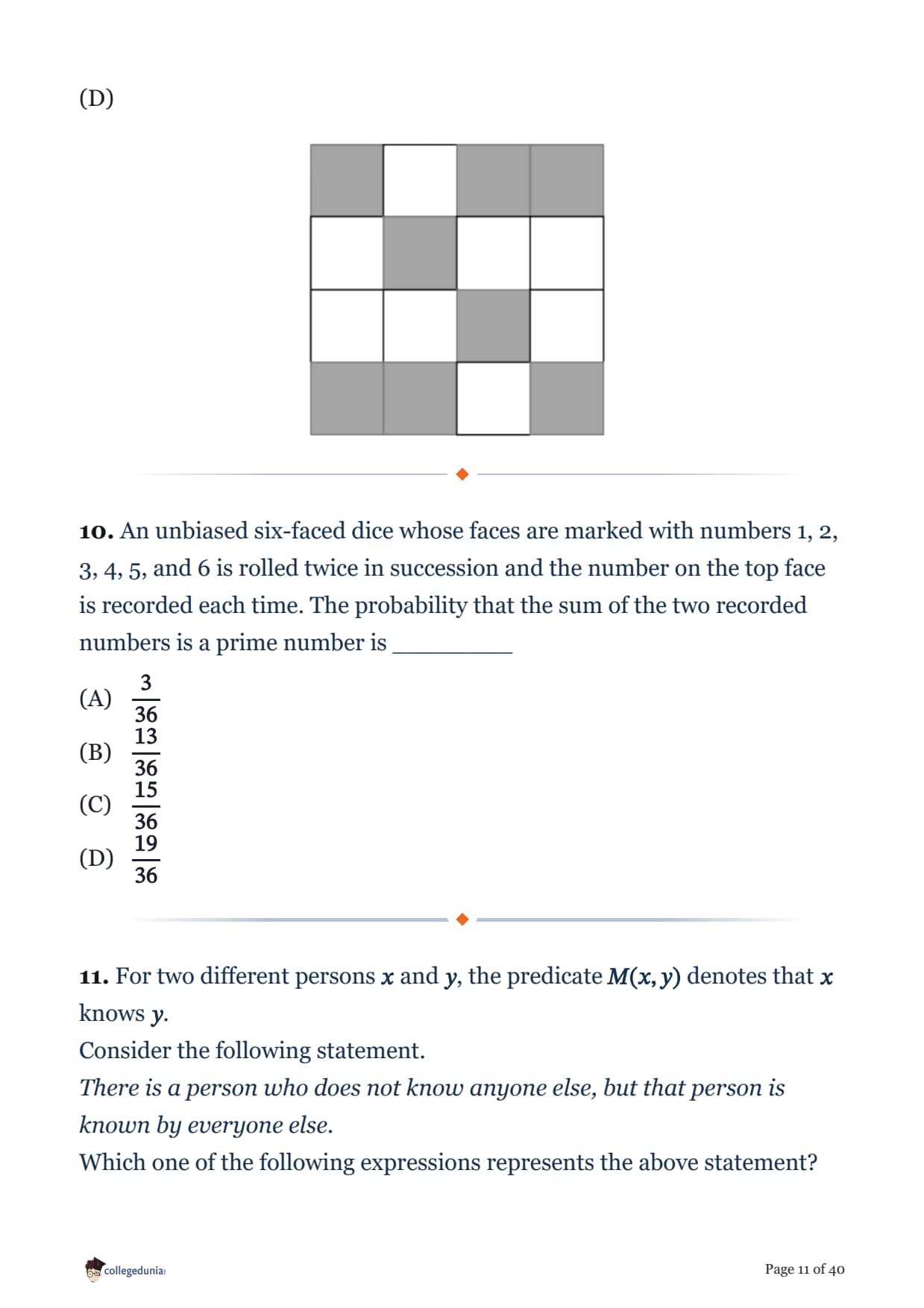
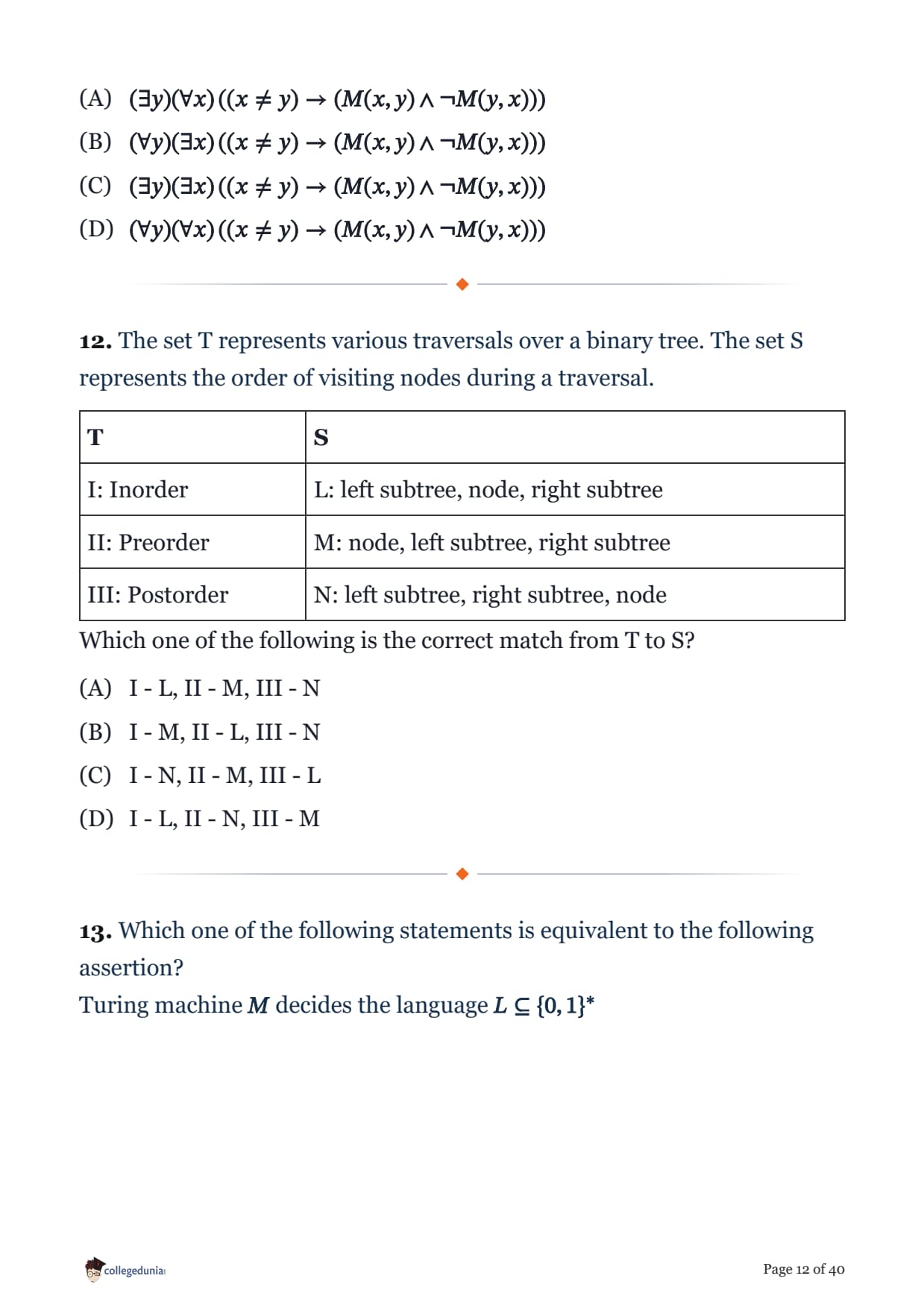
The figure in Panel I below is a grid of cells with four rows and four columns. The numbers on the top and on the left represent the number of cells that are to be shaded in that column and row, respectively. Which one of the options shown in Panel II below represents the grid shaded correctly?

- (A)
![]()
- (B)
![]()
- (C)
![]()
- (D)
![]()


An unbiased six-faced dice whose faces are marked with numbers 1, 2, 3, 4, 5, and 6 is rolled twice in succession and the number on the top face is recorded each time. The probability that the sum of the two recorded numbers is a prime number is ________
For two different persons \(x\) and \(y\), the predicate \(M(x, y)\) denotes that \(x\) knows \(y\).
Consider the following statement.
There is a person who does not know anyone else, but that person is known by everyone else.
Which one of the following expressions represents the above statement?
The set T represents various traversals over a binary tree. The set S represents the order of visiting nodes during a traversal.
| T | S |
|---|---|
| I: Inorder | L: left subtree, node, right subtree |
| II: Preorder | M: node, left subtree, right subtree |
| III: Postorder | N: left subtree, right subtree, node |
Which one of the following statements is equivalent to the following assertion?
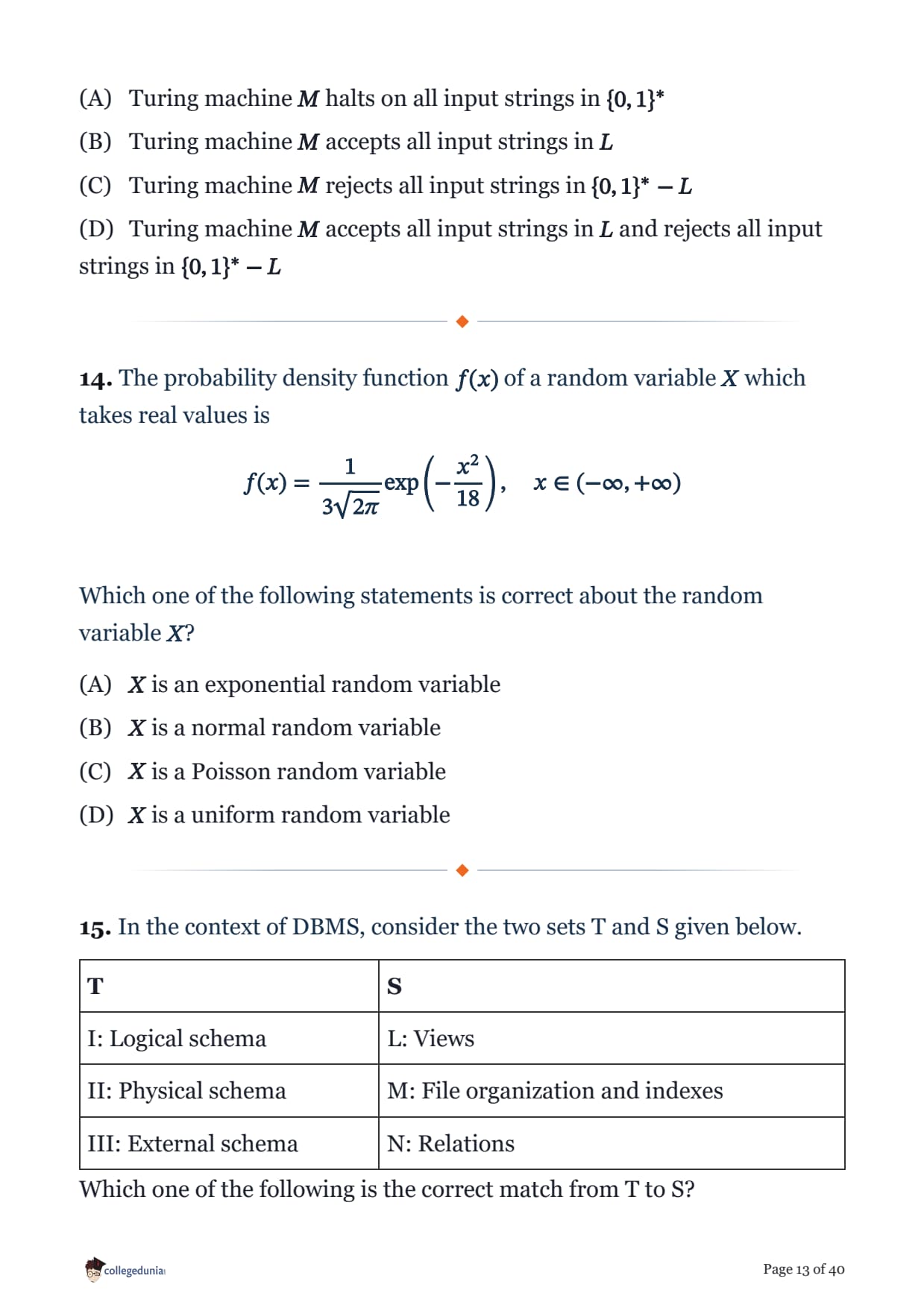
Turing machine \(M\) decides the language \(L \subseteq \{0,1\}^*\)
The probability density function \(f(x)\) of a random variable \(X\) which takes real values is
\[ f(x) = \frac{1}{3\sqrt{2\pi}} \exp\left(-\frac{x^2}{18}\right), \quad x \in (-\infty, +\infty) \]
Which one of the following statements is correct about the random variable \(X\)?
In the context of DBMS, consider the two sets T and S given below.
| T | S |
|---|---|
| I: Logical schema | L: Views |
| II: Physical schema | M: File organization and indexes |
| III: External schema | N: Relations |
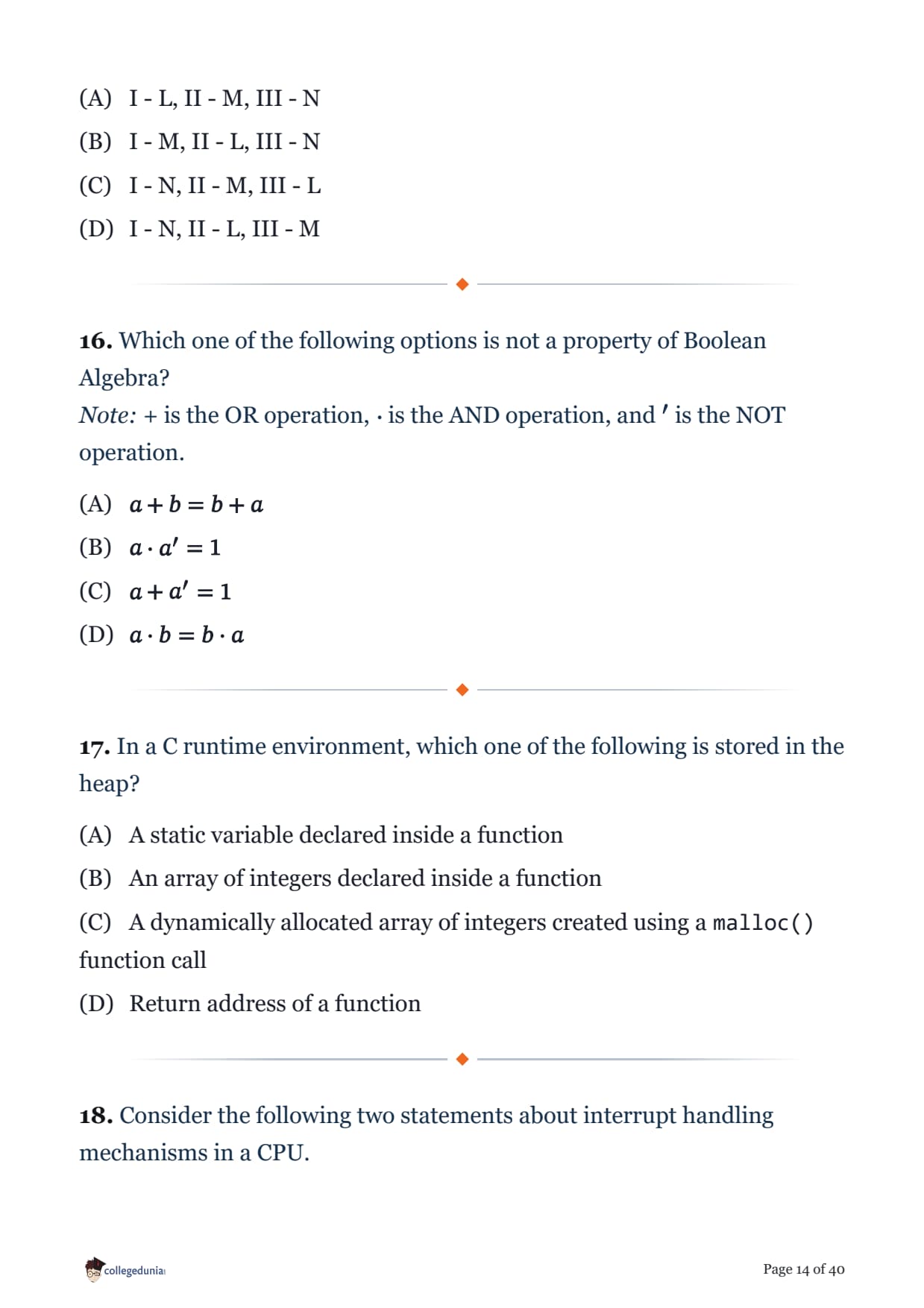
Which one of the following options is not a property of Boolean Algebra?
Note: + is the OR operation, \(\cdot\) is the AND operation, and \('\) is the NOT operation.
In a C runtime environment, which one of the following is stored in the heap?
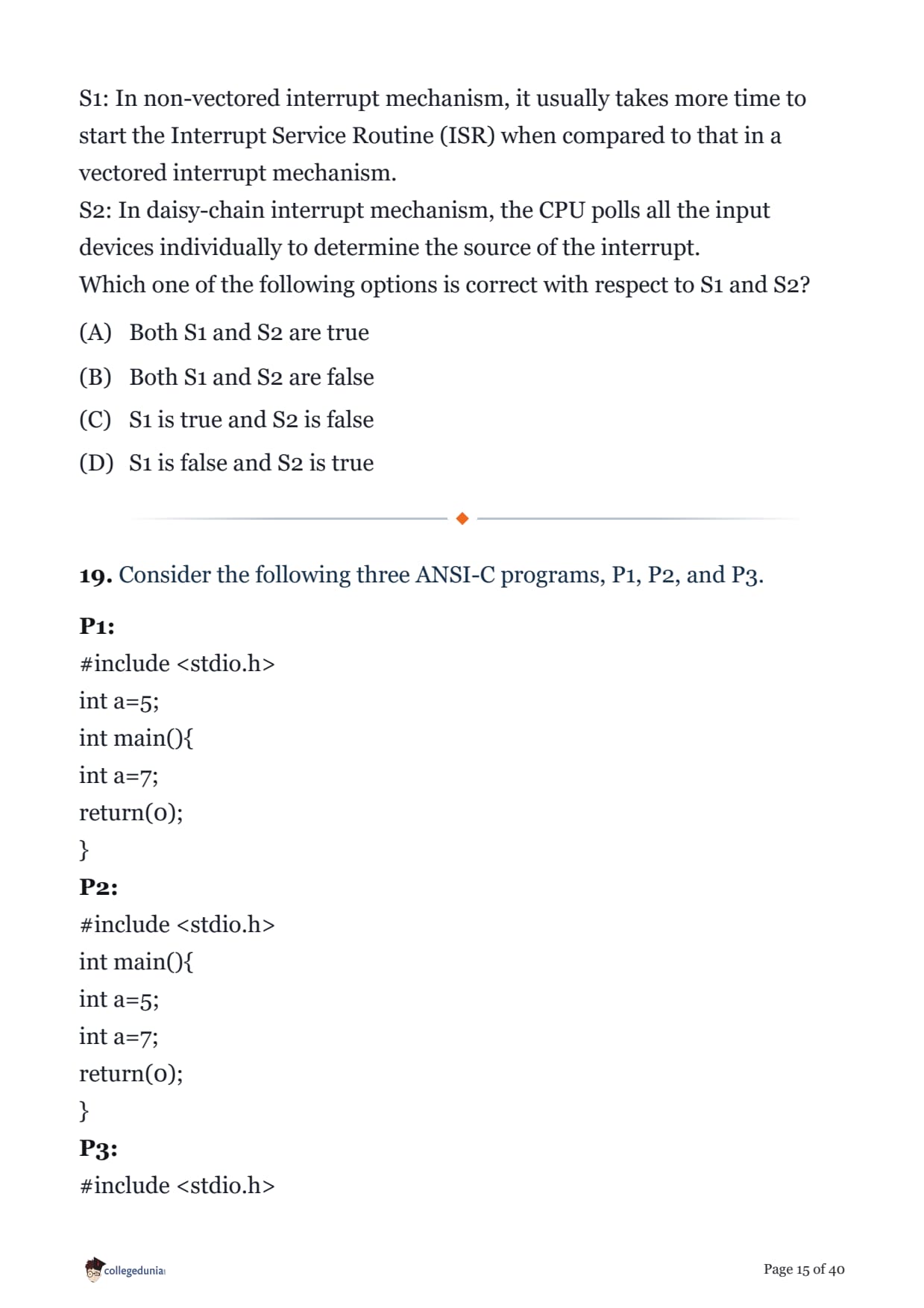
Consider the following two statements about interrupt handling mechanisms in a CPU.
Consider the following three ANSI-C programs, P1, P2, and P3.
#include <stdio.h>
int a=5;
int main(){
int a=7;
return(0);
}
#include <stdio.h>
int main(){
int a=5;
int a=7;
return(0);
}
#include <stdio.h>
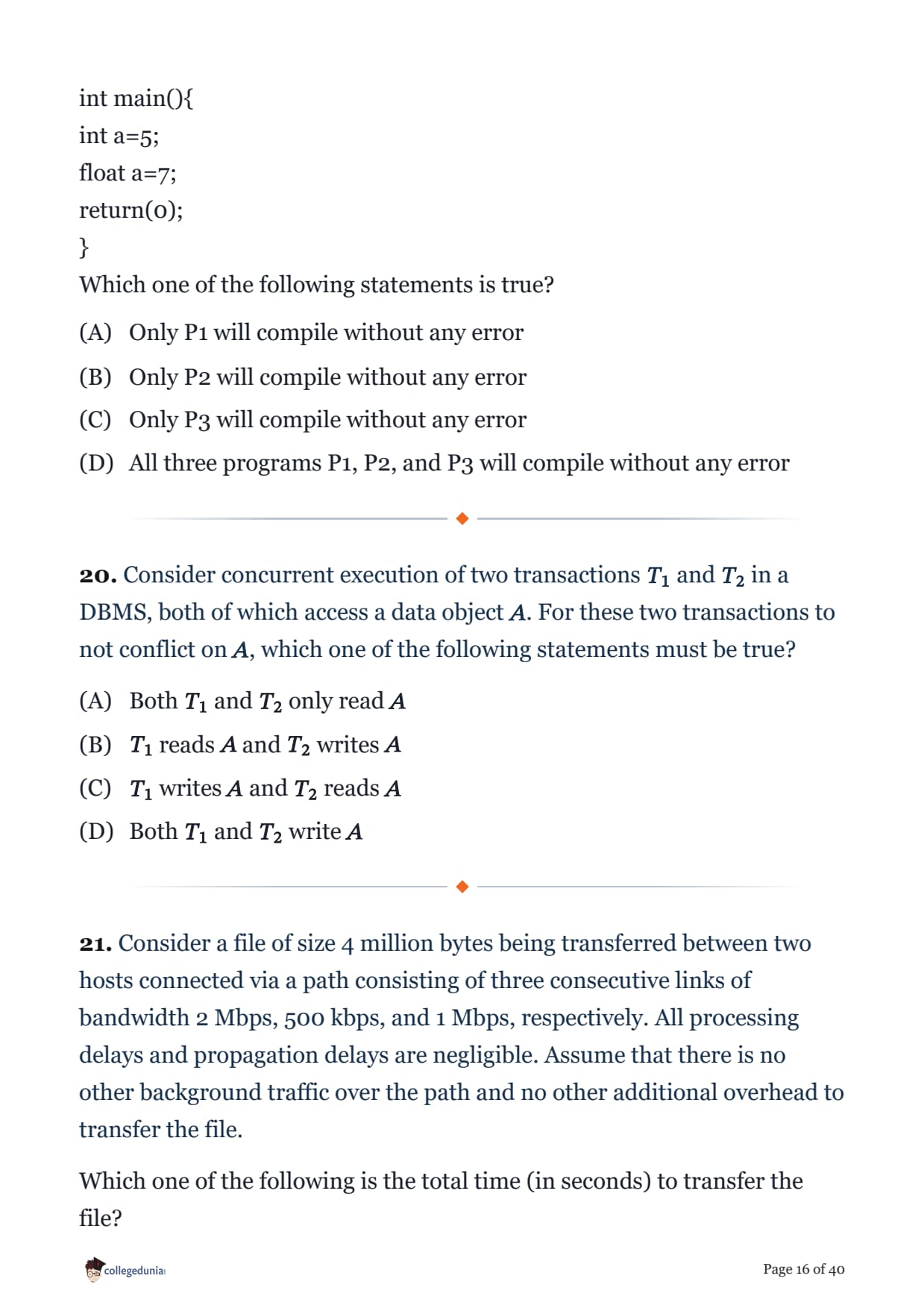
int main(){
int a=5;
float a=7;
return(0);
}
Consider concurrent execution of two transactions \(T_1\) and \(T_2\) in a DBMS, both of which access a data object \(A\). For these two transactions to not conflict on \(A\), which one of the following statements must be true?
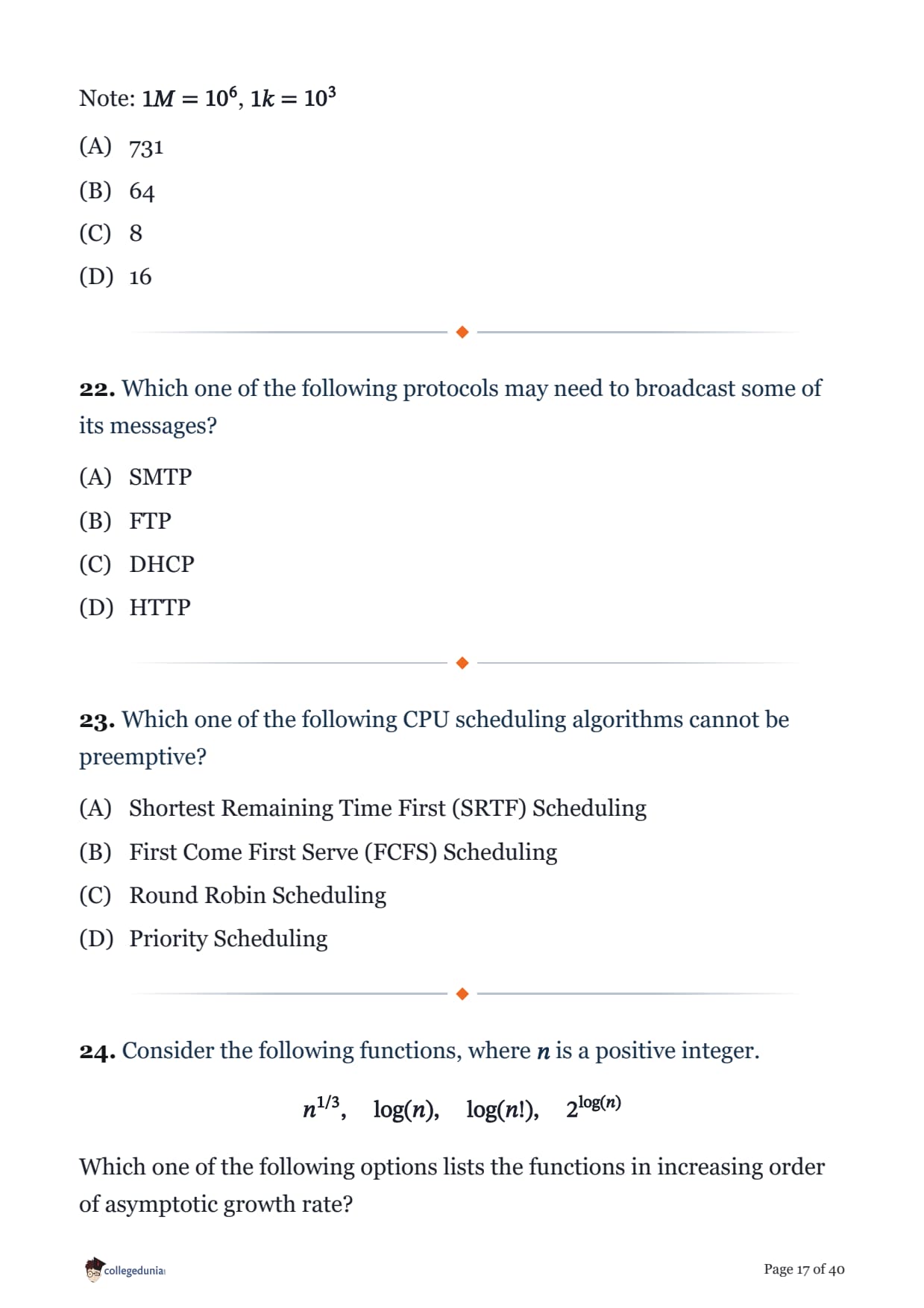
Consider a file of size 4 million bytes being transferred between two hosts connected via a path consisting of three consecutive links of bandwidth 2 Mbps, 500 kbps, and 1 Mbps, respectively. All processing delays and propagation delays are negligible. Assume that there is no other background traffic over the path and no other additional overhead to transfer the file.
Which one of the following protocols may need to broadcast some of its messages?
Which one of the following CPU scheduling algorithms cannot be preemptive?
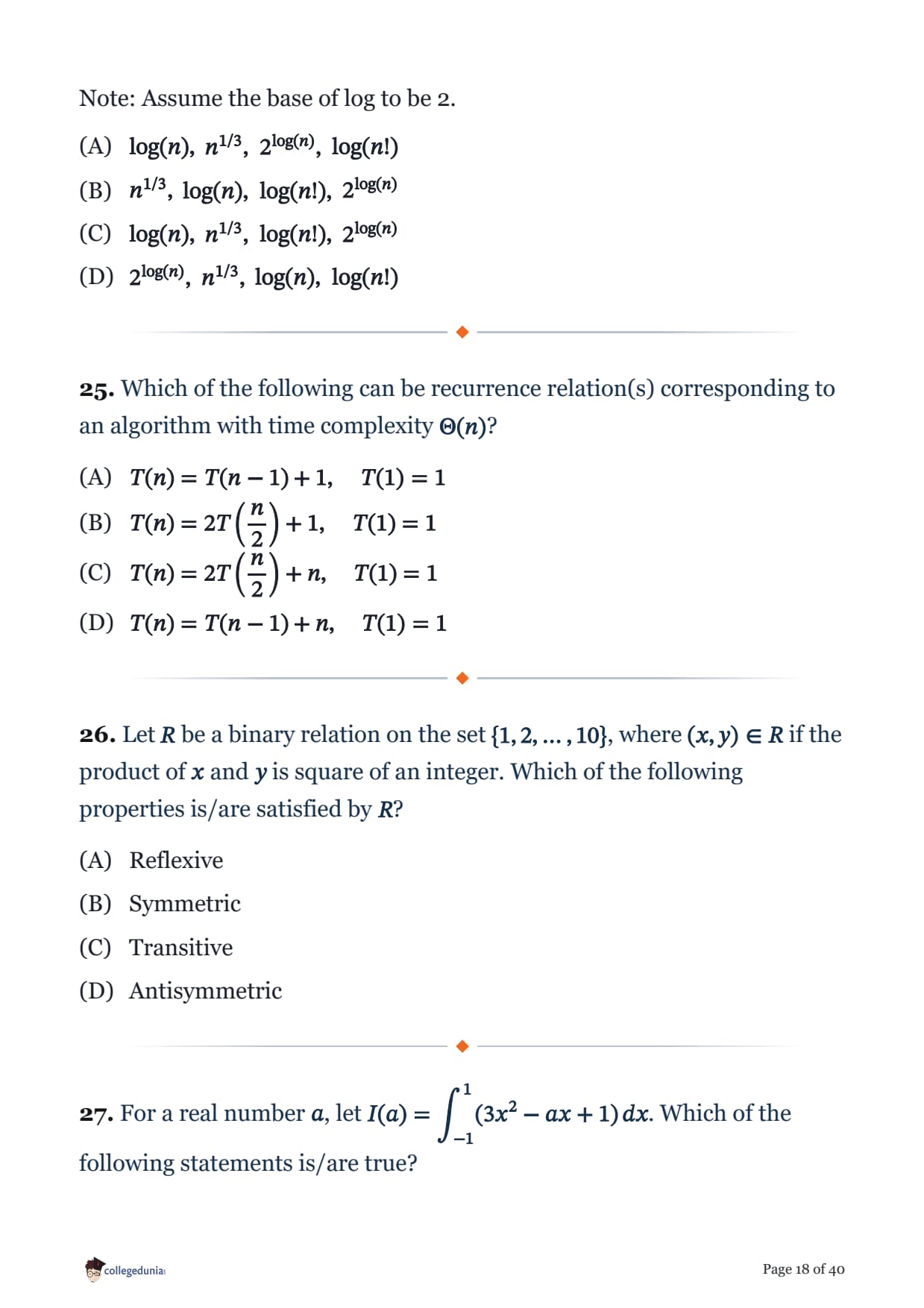
Consider the following functions, where \(n\) is a positive integer.
Which of the following can be recurrence relation(s) corresponding to an algorithm with time complexity \(\Theta(n)\)?
Let \(R\) be a binary relation on the set \(\{1, 2, \ldots, 10\}\), where \((x,y) \in R\) if the product of \(x\) and \(y\) is square of an integer. Which of the following properties is/are satisfied by \(R\)?
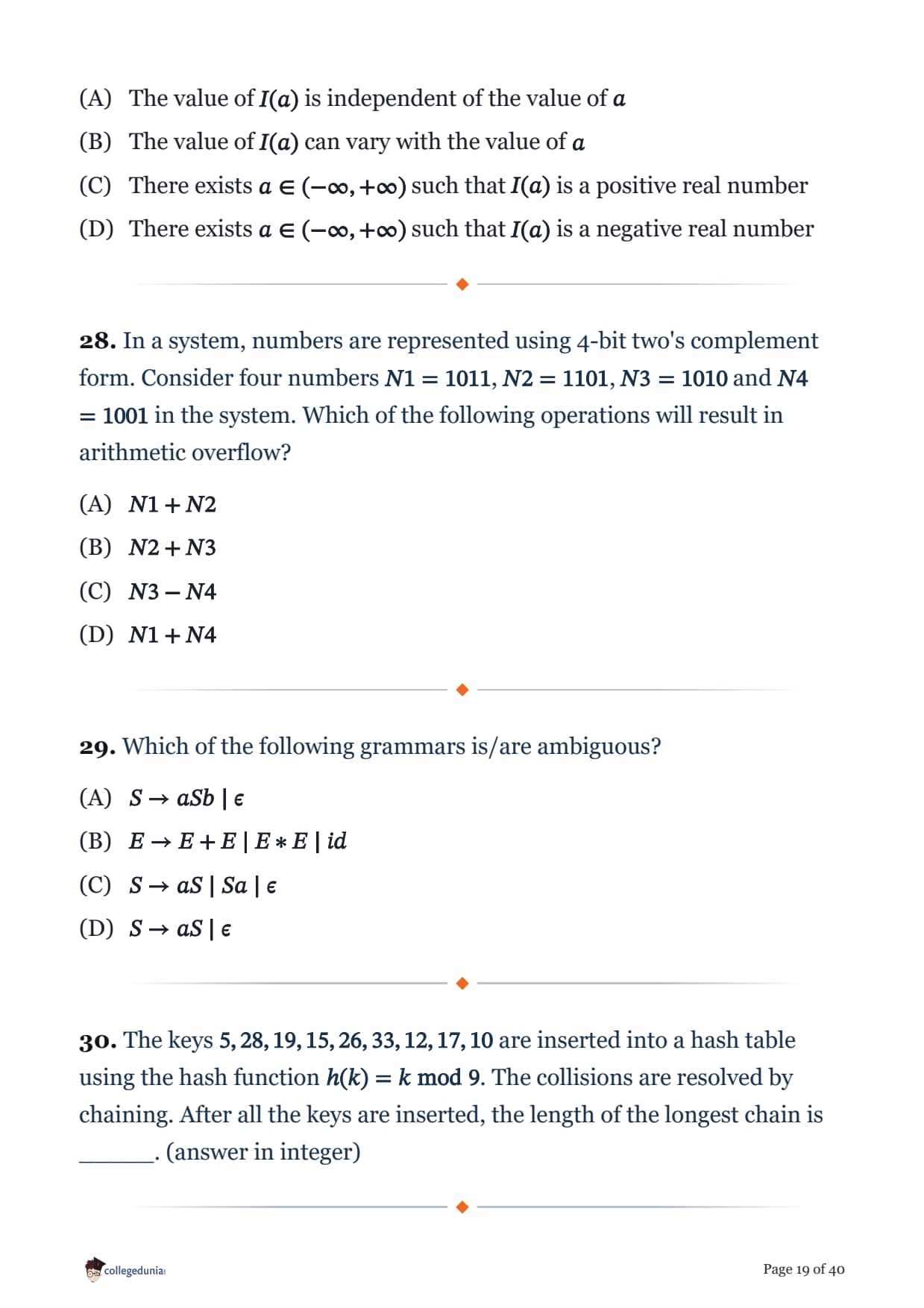
For a real number \(a\), let \(I(a) = \displaystyle\int_{-1}^{1} (3x^2 - ax + 1)\, dx\). Which of the following statements is/are true?
In a system, numbers are represented using 4-bit two's complement form. Consider four numbers \(N1 = 1011\), \(N2 = 1101\), \(N3 = 1010\) and \(N4 = 1001\) in the system. Which of the following operations will result in arithmetic overflow?
Which of the following grammars is/are ambiguous?
The keys \(5, 28, 19, 15, 26, 33, 12, 17, 10\) are inserted into a hash table using the hash function \(h(k) = k \bmod 9\). The collisions are resolved by chaining. After all the keys are inserted, the length of the longest chain is _____. (answer in integer)
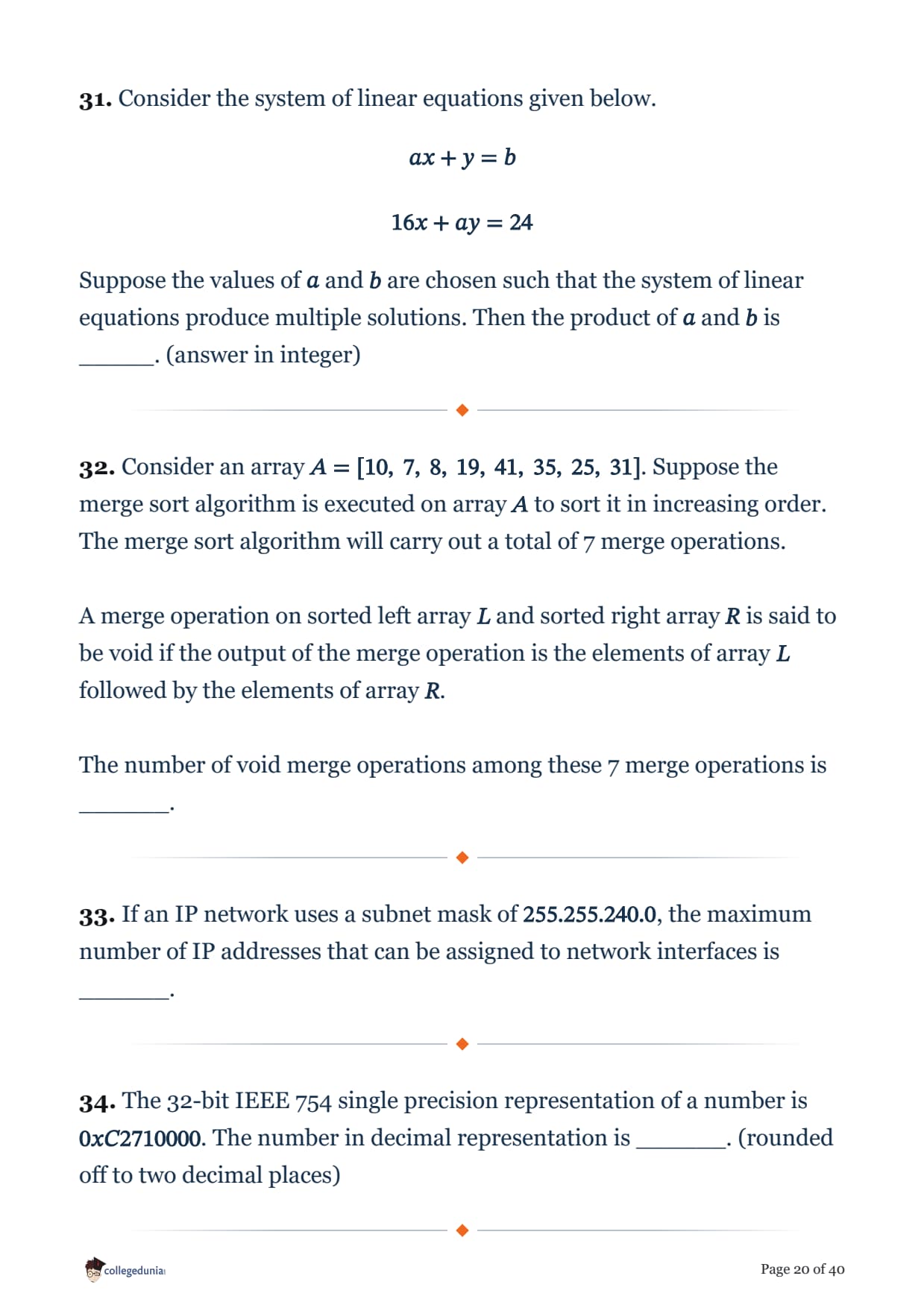
Consider the system of linear equations given below.
\[ ax + y = b \]
\[ 16x + ay = 24 \]
Suppose the values of \(a\) and \(b\) are chosen such that the system of linear equations produce multiple solutions. Then the product of \(a\) and \(b\) is _____. (answer in integer)
Consider an array \(A = [10,\ 7,\ 8,\ 19,\ 41,\ 35,\ 25,\ 31]\). Suppose the merge sort algorithm is executed on array \(A\) to sort it in increasing order. The merge sort algorithm will carry out a total of 7 merge operations.
A merge operation on sorted left array \(L\) and sorted right array \(R\) is said to be void if the output of the merge operation is the elements of array \(L\) followed by the elements of array \(R\).
The number of void merge operations among these 7 merge operations is ______.
If an IP network uses a subnet mask of \(255.255.240.0\), the maximum number of IP addresses that can be assigned to network interfaces is ______.
The 32-bit IEEE 754 single precision representation of a number is \(0xC2710000\). The number in decimal representation is ______. (rounded off to two decimal places)
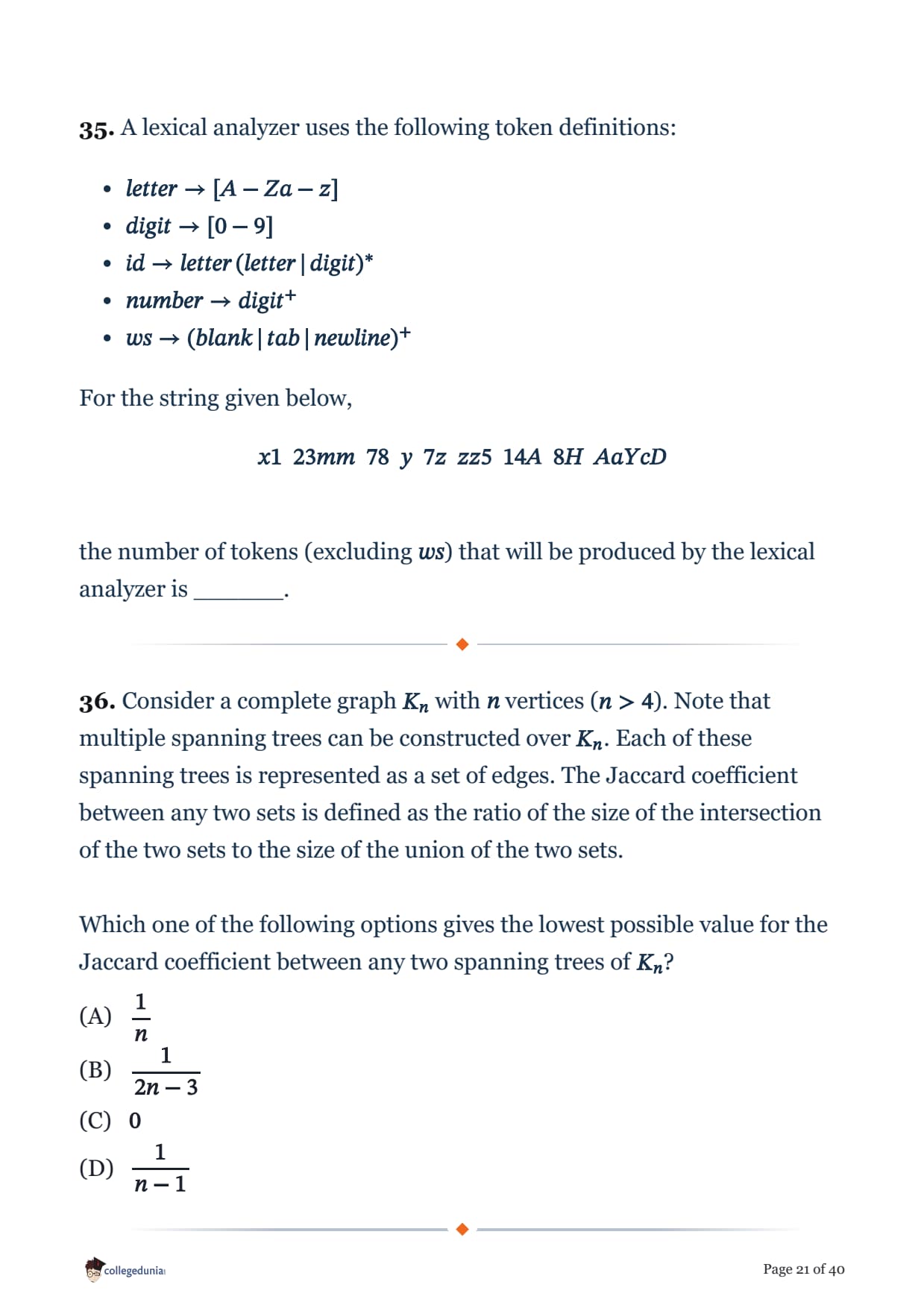
A lexical analyzer uses the following token definitions:
- \(letter \rightarrow [A-Za-z]\)
- \(digit \rightarrow [0-9]\)
- \(id \rightarrow letter\,(letter\,|\,digit)^{*}\)
- \(number \rightarrow digit^{+}\)
- \(ws \rightarrow (blank\,|\,tab\,|\,newline)^{+}\)
\[ x1\ \ 23mm\ \ 78\ \ y\ \ 7z\ \ zz5\ \ 14A\ \ 8H\ \ AaYcD \]
the number of tokens (excluding \(ws\)) that will be produced by the lexical analyzer is ______.
Consider a complete graph \(K_n\) with \(n\) vertices (\(n>4\)). Note that multiple spanning trees can be constructed over \(K_n\). Each of these spanning trees is represented as a set of edges. The Jaccard coefficient between any two sets is defined as the ratio of the size of the intersection of the two sets to the size of the union of the two sets.
Which one of the following options gives the lowest possible value for the Jaccard coefficient between any two spanning trees of \(K_n\)?
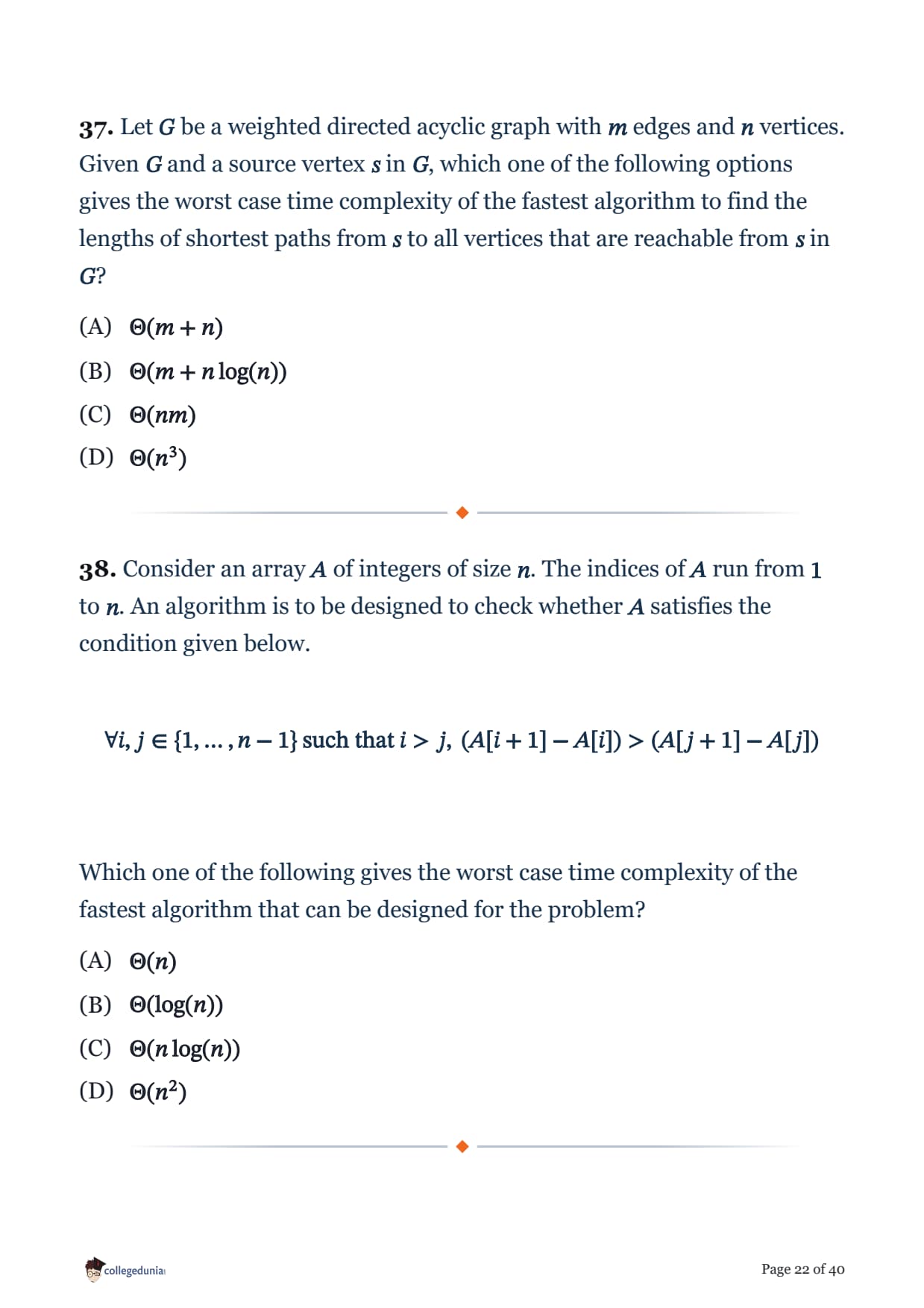
Let \(G\) be a weighted directed acyclic graph with \(m\) edges and \(n\) vertices. Given \(G\) and a source vertex \(s\) in \(G\), which one of the following options gives the worst case time complexity of the fastest algorithm to find the lengths of shortest paths from \(s\) to all vertices that are reachable from \(s\) in \(G\)?
Consider an array \(A\) of integers of size \(n\). The indices of \(A\) run from \(1\) to \(n\). An algorithm is to be designed to check whether \(A\) satisfies the condition given below.
\[ \forall i,j\in\{1,\ldots,n-1\}\ \text{such that}\ i>j,\ (A[i+1]-A[i])>(A[j+1]-A[j]) \]
Which one of the following gives the worst case time complexity of the fastest algorithm that can be designed for the problem?
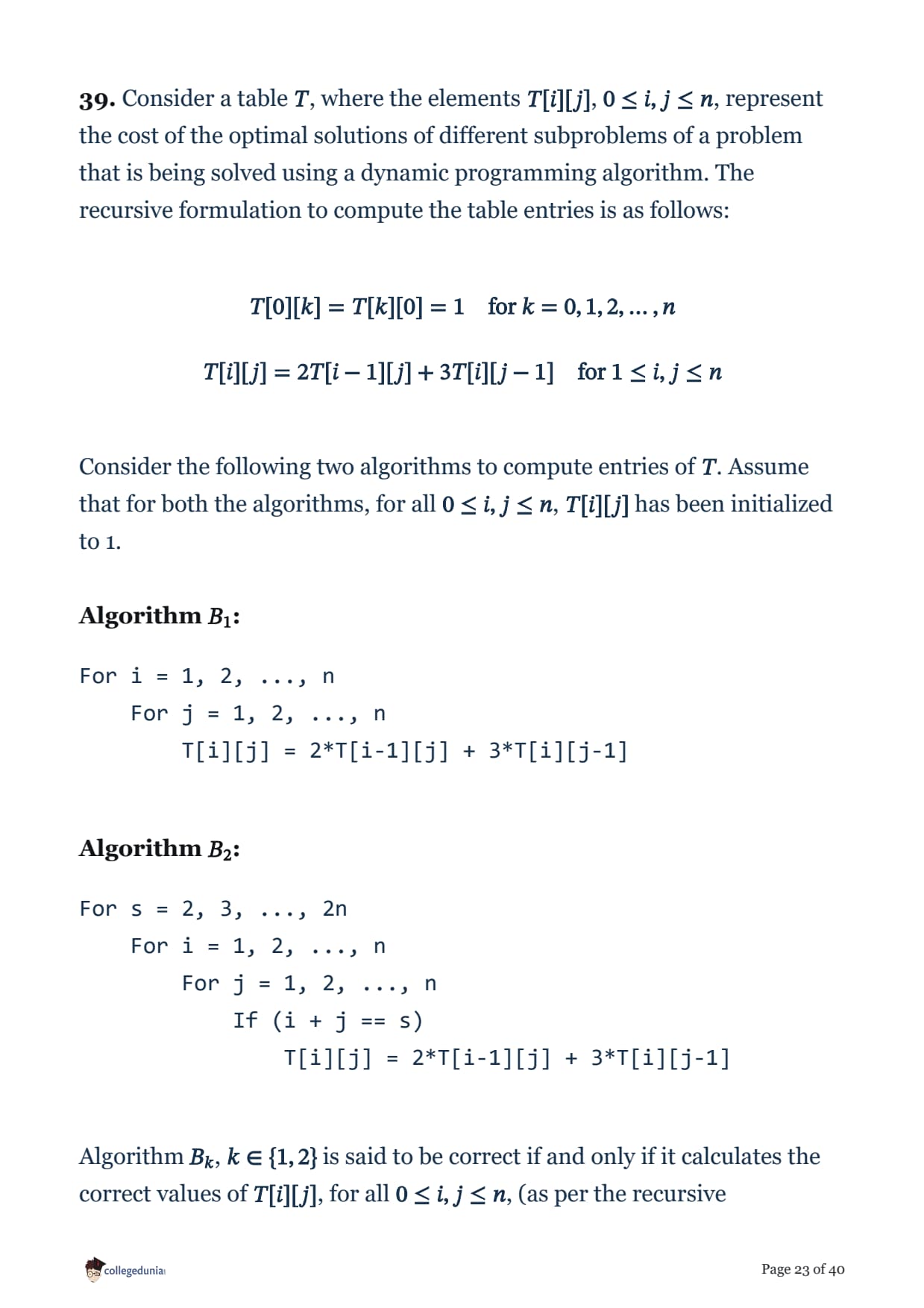
Consider a table \(T\), where the elements \(T[i][j]\), \(0 \leq i, j \leq n\), represent the cost of the optimal solutions of different subproblems of a problem that is being solved using a dynamic programming algorithm. The recursive formulation to compute the table entries is as follows:
\[ T[0][k] = T[k][0] = 1 \quad \text{for } k = 0,1,2,\dots,n \]
\[ T[i][j] = 2T[i-1][j] + 3T[i][j-1] \quad \text{for } 1 \leq i,j \leq n \]
Consider the following two algorithms to compute entries of \(T\). Assume that for both the algorithms, for all \(0 \leq i,j \leq n\), \(T[i][j]\) has been initialized to 1.
Algorithm \(B_1\):
For i = 1, 2, ..., n
    For j = 1, 2, ..., n
        T[i][j] = 2*T[i-1][j] + 3*T[i][j-1]
Algorithm \(B_2\):
For s = 2, 3, ..., 2n
    For i = 1, 2, ..., n
        For j = 1, 2, ..., n
            If (i + j == s)
                T[i][j] = 2*T[i-1][j] + 3*T[i][j-1]
Algorithm \(B_k\), \(k \in \{1,2\}\) is said to be correct if and only if it calculates the correct values of \(T[i][j]\), for all \(0 \leq i,j \leq n\), (as per the recursive formulation) at the end of the execution of the algorithm \(B_k\).
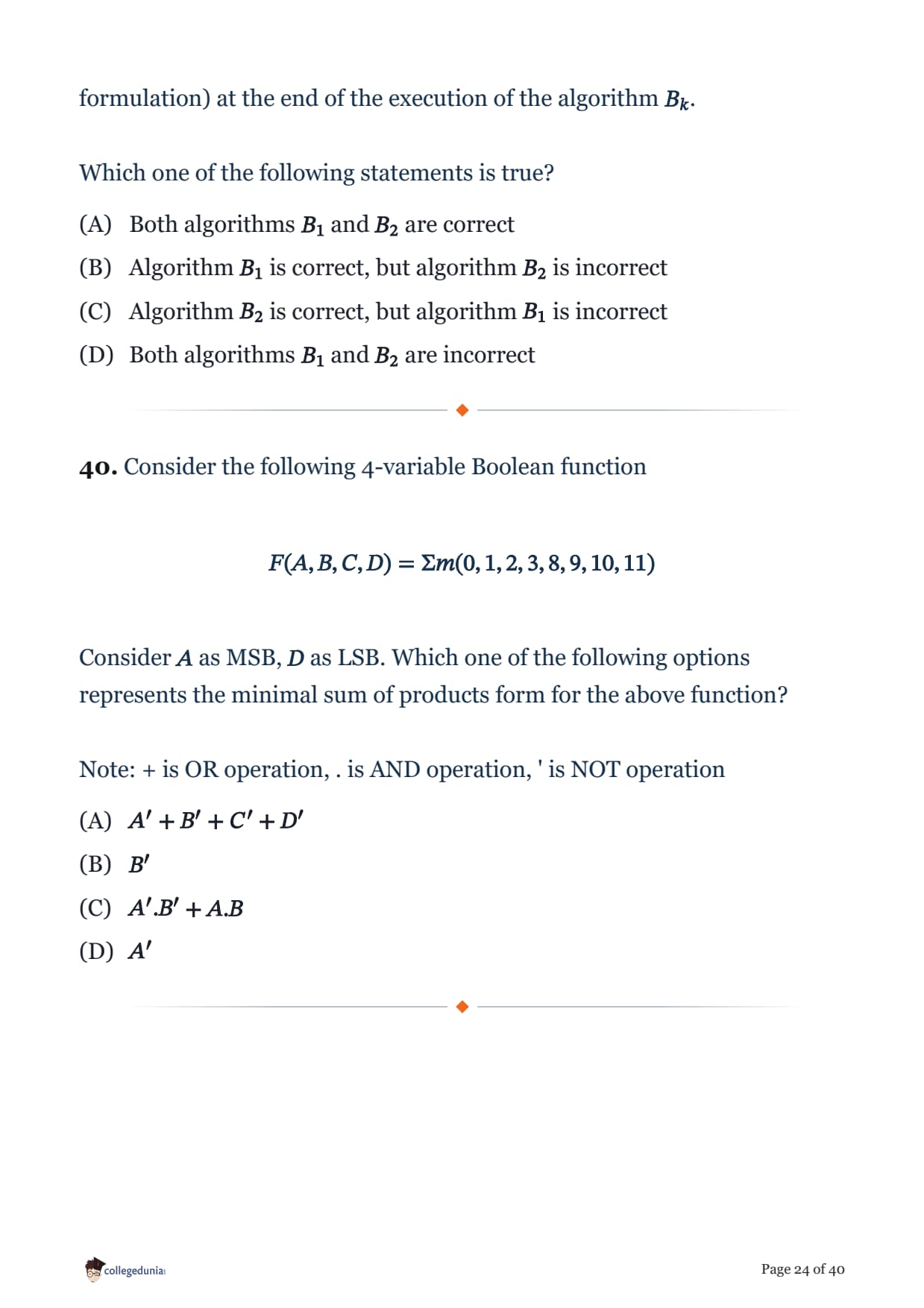
Which one of the following statements is true?
Consider the following 4-variable Boolean function
\[ F(A, B, C, D) = \Sigma m(0, 1, 2, 3, 8, 9, 10, 11) \]
Consider \(A\) as MSB, \(D\) as LSB. Which one of the following options represents the minimal sum of products form for the above function?
Note: + is OR operation, . is AND operation, ' is NOT operation
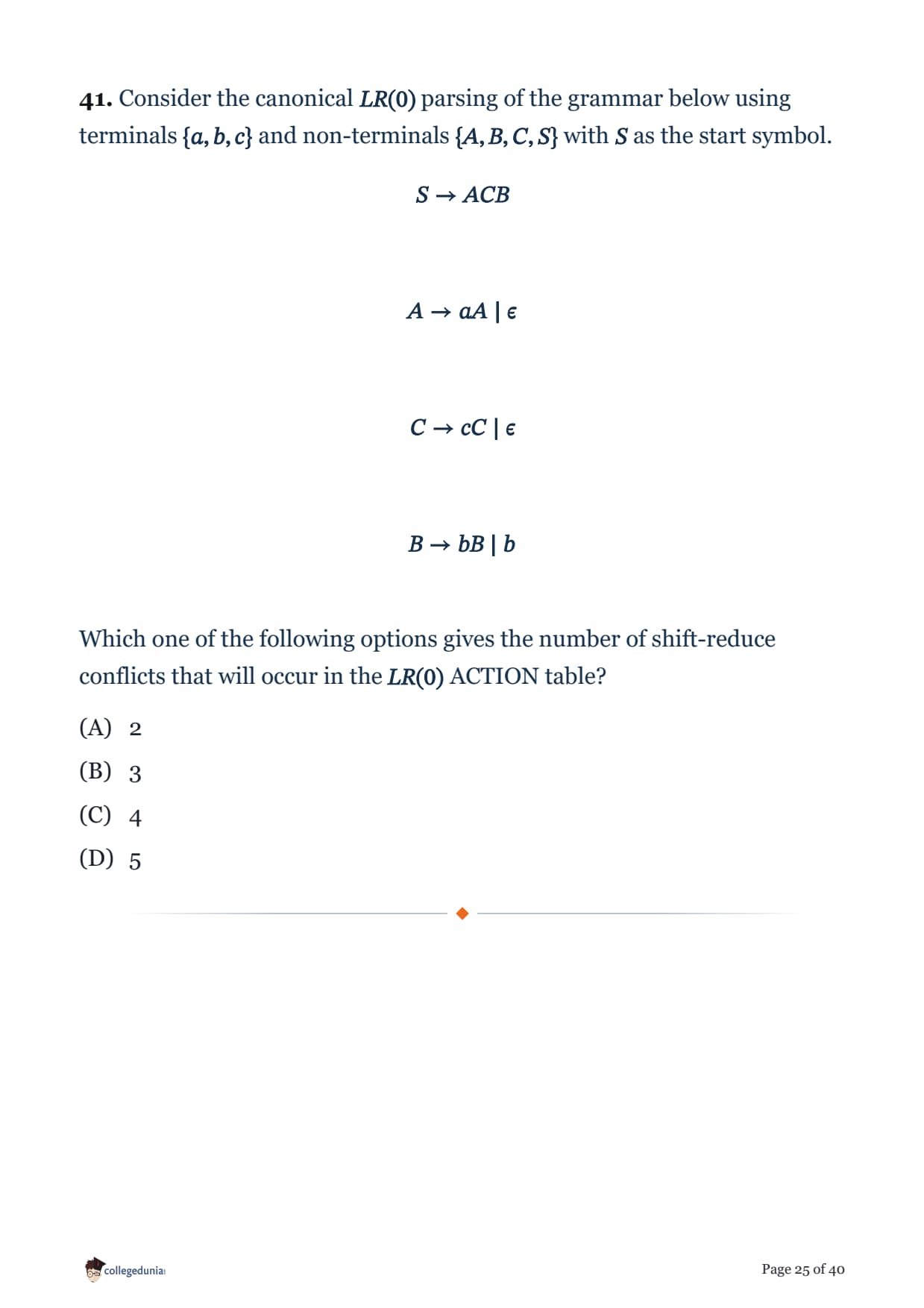
Consider the canonical \(LR(0)\) parsing of the grammar below using terminals \(\{a,b,c\}\) and non-terminals \(\{A,B,C,S\}\) with \(S\) as the start symbol.
\[ S \to ACB \]
\[ A \to aA \mid \epsilon \]
\[ C \to cC \mid \epsilon \]
\[ B \to bB \mid b \]
Which one of the following options gives the number of shift-reduce conflicts that will occur in the \(LR(0)\) ACTION table?
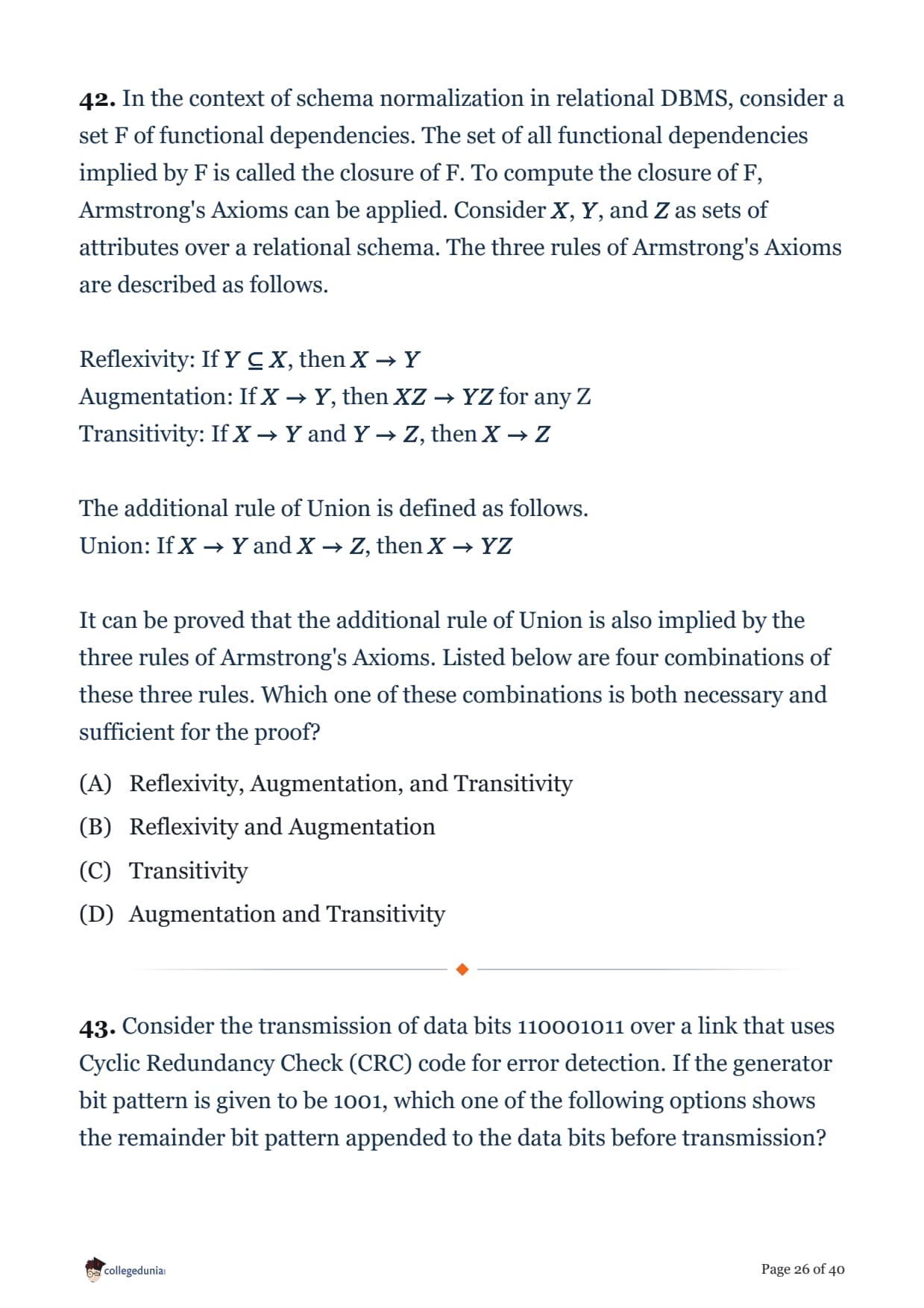
In the context of schema normalization in relational DBMS, consider a set F of functional dependencies. The set of all functional dependencies implied by F is called the closure of F. To compute the closure of F, Armstrong's Axioms can be applied. Consider \(X\), \(Y\), and \(Z\) as sets of attributes over a relational schema. The three rules of Armstrong's Axioms are described as follows.
Reflexivity: If \(Y \subseteq X\), then \(X \to Y\)
Augmentation: If \(X \to Y\), then \(XZ \to YZ\) for any Z
Transitivity: If \(X \to Y\) and \(Y \to Z\), then \(X \to Z\)
The additional rule of Union is defined as follows.
Union: If \(X \to Y\) and \(X \to Z\), then \(X \to YZ\)
It can be proved that the additional rule of Union is also implied by the three rules of Armstrong's Axioms. Listed below are four combinations of these three rules. Which one of these combinations is both necessary and sufficient for the proof?
Consider the transmission of data bits 110001011 over a link that uses Cyclic Redundancy Check (CRC) code for error detection. If the generator bit pattern is given to be 1001, which one of the following options shows the remainder bit pattern appended to the data bits before transmission?
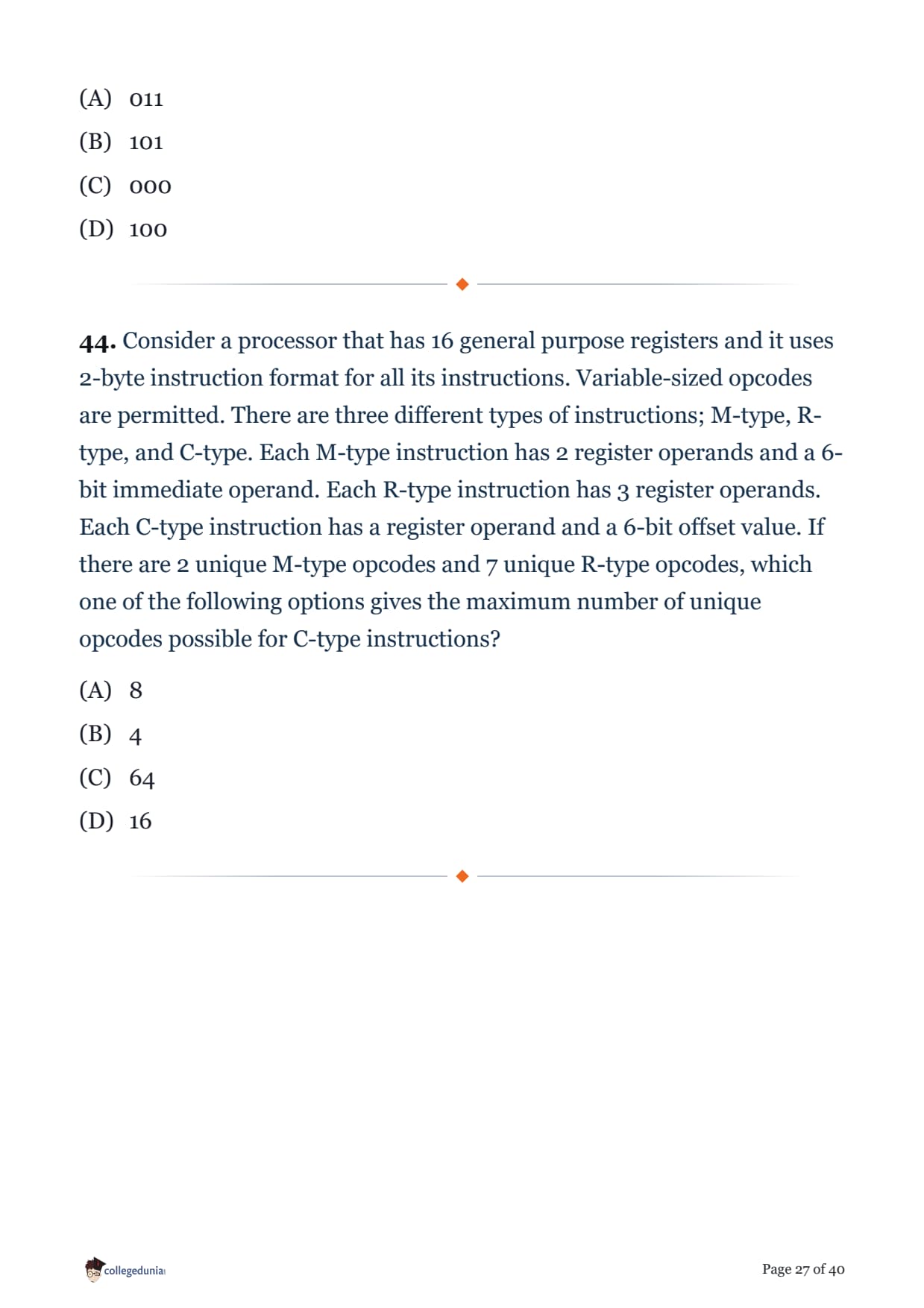
Consider a processor that has 16 general purpose registers and it uses 2-byte instruction format for all its instructions. Variable-sized opcodes are permitted. There are three different types of instructions; M-type, R-type, and C-type. Each M-type instruction has 2 register operands and a 6-bit immediate operand. Each R-type instruction has 3 register operands. Each C-type instruction has a register operand and a 6-bit offset value. If there are 2 unique M-type opcodes and 7 unique R-type opcodes, which one of the following options gives the maximum number of unique opcodes possible for C-type instructions?
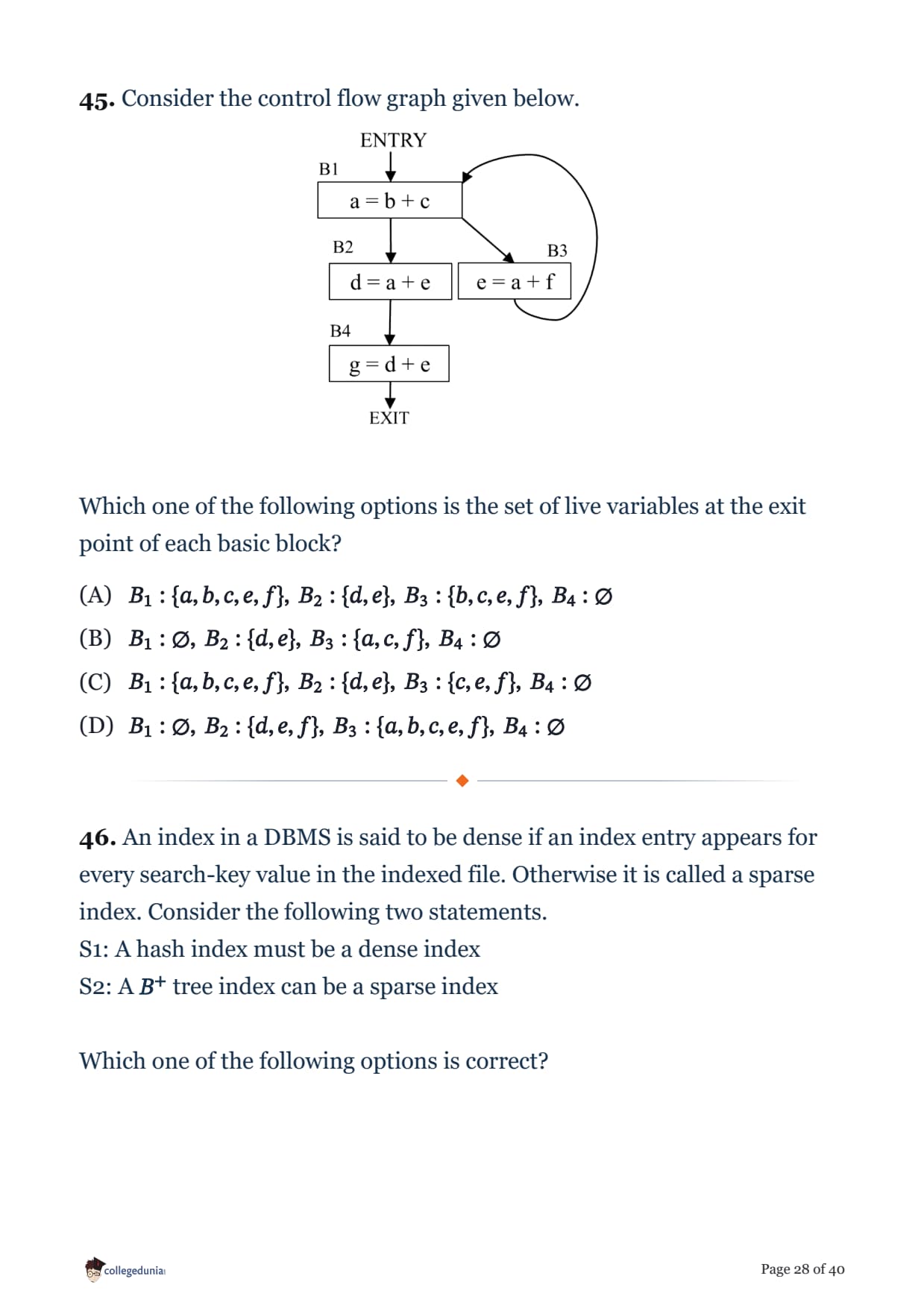
Consider the control flow graph given below.

Which one of the following options is the set of live variables at the exit point of each basic block?
An index in a DBMS is said to be dense if an index entry appears for every search-key value in the indexed file. Otherwise it is called a sparse index. Consider the following two statements.
S1: A hash index must be a dense index
S2: A \(B^{+}\) tree index can be a sparse index
Which one of the following options is correct?
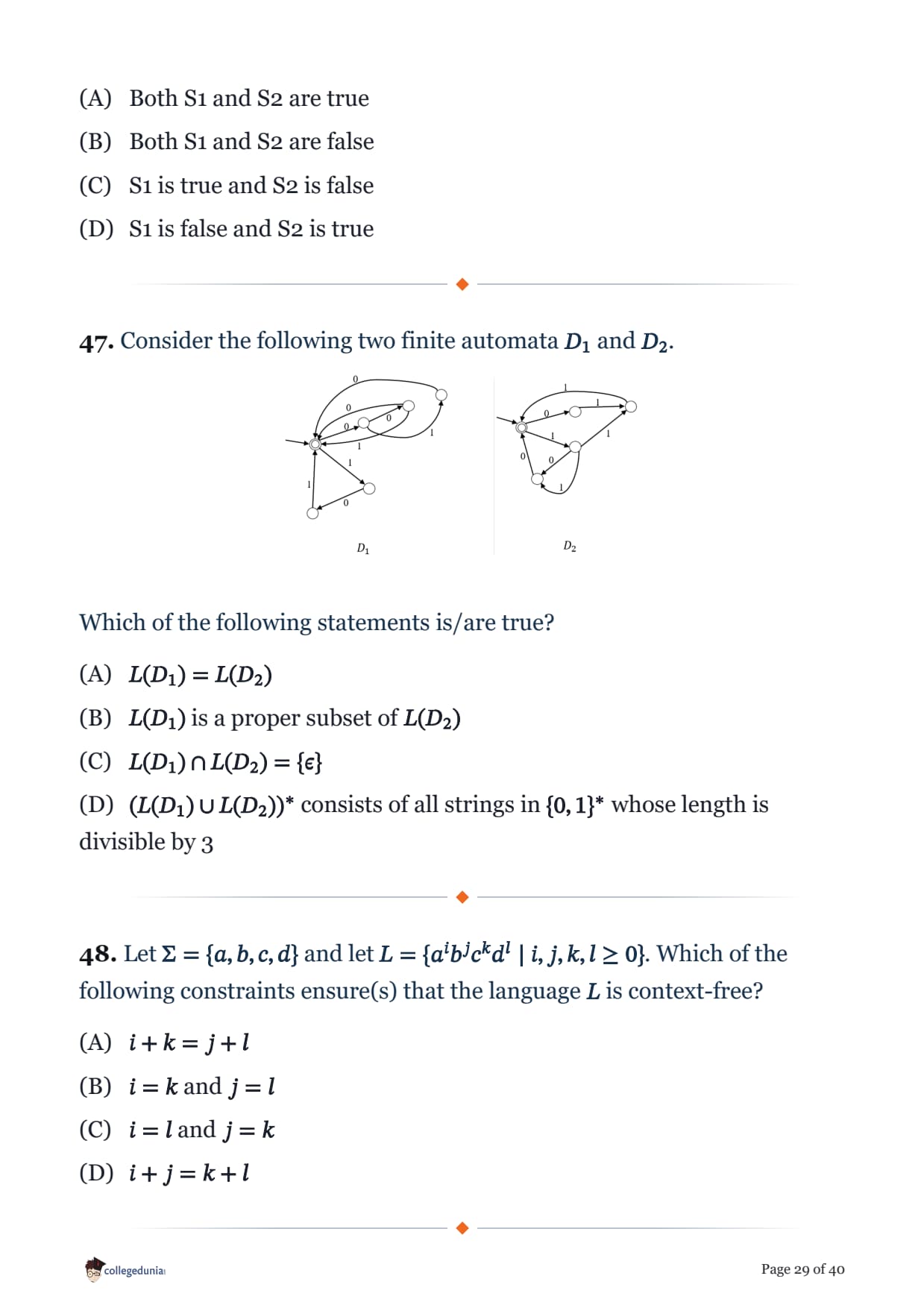
Consider the following two finite automata \(D_1\) and \(D_2\).

Which of the following statements is/are true?
Let \(\Sigma = \{a, b, c, d\}\) and let \(L = \{a^i b^j c^k d^l \mid i, j, k, l \geq 0\}\). Which of the following constraints ensure(s) that the language \(L\) is context-free?
Consider a binary search tree (BST) with \(n\) leaf nodes (\(n>0\)). Given any node \(V\), the key present in the node is denoted as \(Val(V)\). All the keys present in the given BST are distinct. The keys belong to the set of real numbers.
For a node \(V\), let \(Suc(V)\) denote the node that is its inorder successor. If a node \(V\) does not have an inorder successor, then \(Suc(V)\) is \(NULL\). As there are no duplicates, if \(Suc(V)\) is not \(NULL\), then \(Val(V) < Val(Suc(V))\).
Corresponding to every leaf node \(L_i\) that has a non-NULL \(Suc(L_i)\), a new key \(k_i\) with the following property is to be inserted into the BST.
\[
Val(L_i) < k_i < Val(Suc(L_i))
\]
Let \(K\) represent the list of all such new keys to be inserted into the BST. Which of the following statements is/are true?
Consider a stack \(S\) and a queue \(Q\). Both of them are initially empty and have the capacity to store ten elements each. The elements \(1, 2, 3, 4\), and \(5\) arrive one by one, in that order. When an element arrives, it is assigned either to \(S\) (pushed on \(S\)) or to \(Q\) (enqueued to \(Q\)). Once all the five elements are stored, the output is generated in two steps. First, stack \(S\) is emptied by popping all elements. Then queue \(Q\) is emptied by dequeueing all elements. The output obtained by following this process is \(4\ 3\ 1\ 2\ 5\).
Given the output, the objective is to predict whether an element was assigned to \(S\) or \(Q\).
Which of the following options is/are possible valid assignment(s) of the elements?
Note: In the options, the notation \(xS\) denotes that element \(x\) was assigned to \(S\) and \(yQ\) denotes that element \(y\) was assigned to \(Q\).
Consider three processes \(P1\), \(P2\), and \(P3\) running identical code, as shown in the pseudocode below. \(A\) and \(B\) are two binary semaphores initialized to \(1\) and \(0\), respectively. \(X\) is a shared variable initialized to \(0\). Each line in the pseudocode is executed atomically.
Pseudocode of P1, P2, and P3
Wait(A);
Print(*);
X = X+1;
If (X == 2)
{
Print($);
Signal(B);
}
Signal(A);
Wait(B);
Print(#);
Signal(B);
Assume that any of the three processes can start to execute first and context switching can happen between these processes at any arbitrary time and in any arbitrary order.
Which of the following patterns is/are possible to be generated as an outcome of the execution of these three processes?
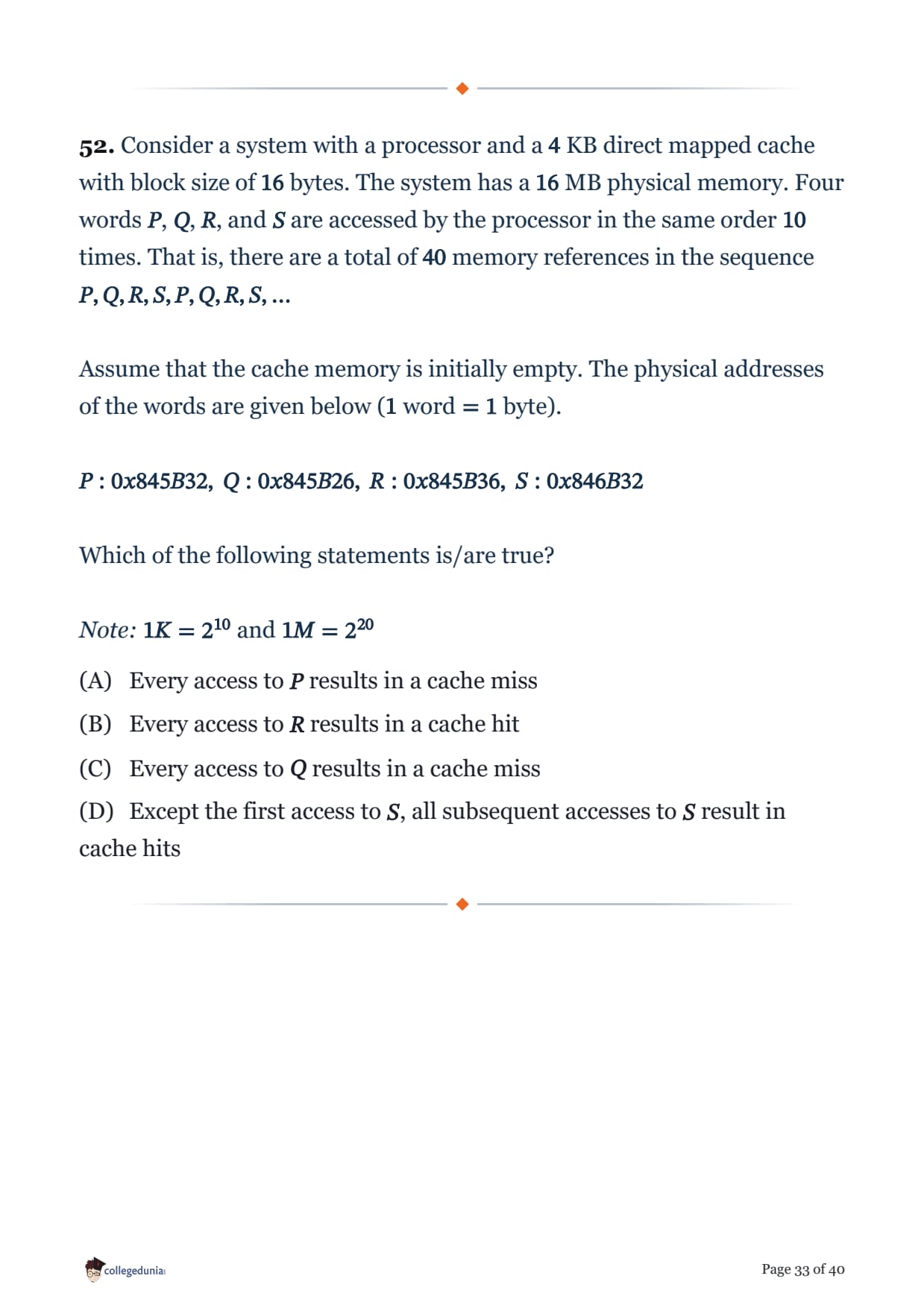
Consider a system with a processor and a \(4\) KB direct mapped cache with block size of \(16\) bytes. The system has a \(16\) MB physical memory. Four words \(P\), \(Q\), \(R\), and \(S\) are accessed by the processor in the same order \(10\) times. That is, there are a total of \(40\) memory references in the sequence \(P, Q, R, S, P, Q, R, S,\ldots\)
Assume that the cache memory is initially empty. The physical addresses of the words are given below (\(1\) word \(=1\) byte).
\(P: 0x845B32,\ Q: 0x845B26,\ R: 0x845B36,\ S: 0x846B32\)
Which of the following statements is/are true?
Note: \(1K=2^{10}\) and \(1M=2^{20}\)
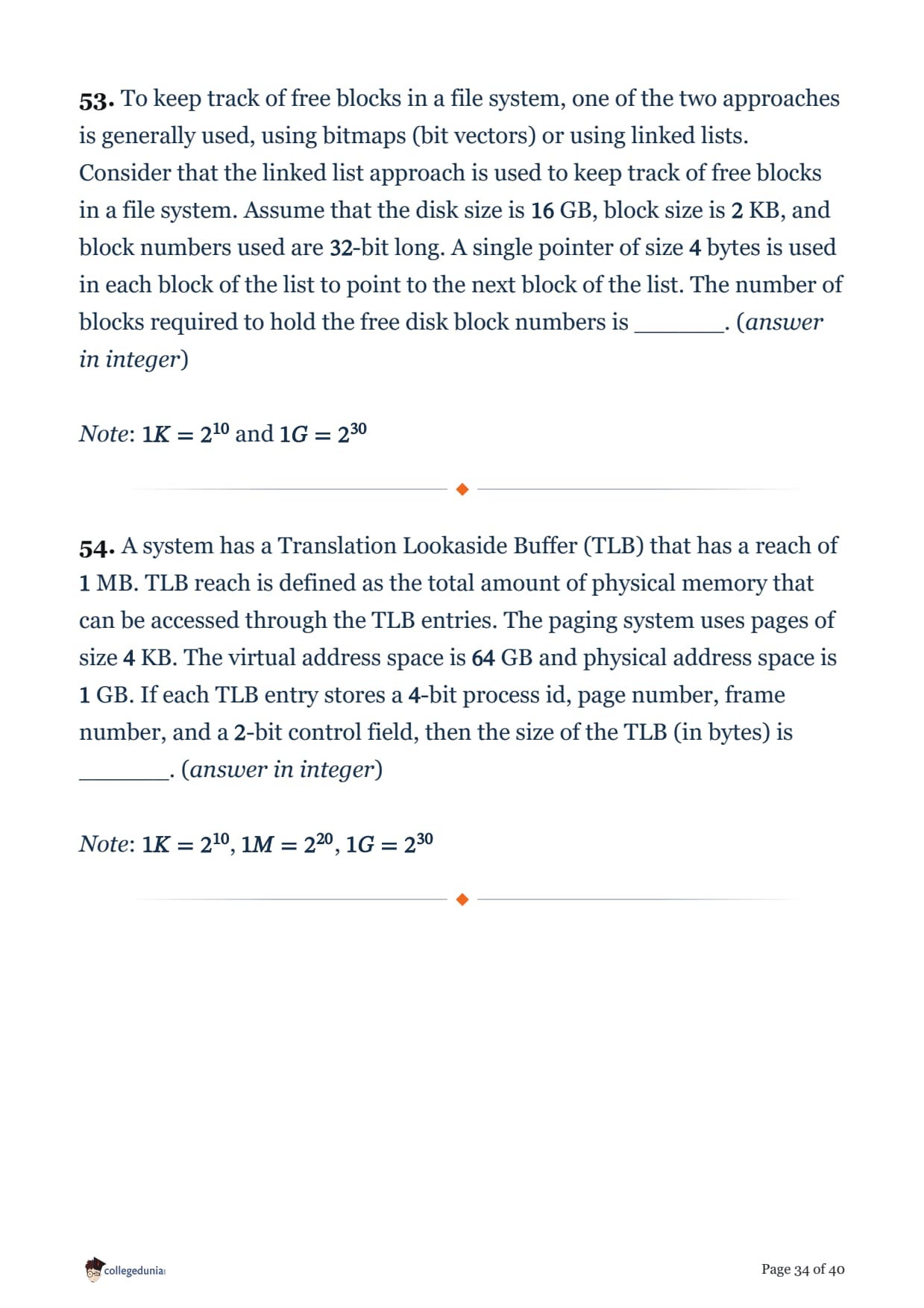
To keep track of free blocks in a file system, one of the two approaches is generally used, using bitmaps (bit vectors) or using linked lists. Consider that the linked list approach is used to keep track of free blocks in a file system. Assume that the disk size is \(16\) GB, block size is \(2\) KB, and block numbers used are \(32\)-bit long. A single pointer of size \(4\) bytes is used in each block of the list to point to the next block of the list. The number of blocks required to hold the free disk block numbers is ______. (answer in integer)
Note: \(1K=2^{10}\) and \(1G=2^{30}\)
A system has a Translation Lookaside Buffer (TLB) that has a reach of \(1\) MB. TLB reach is defined as the total amount of physical memory that can be accessed through the TLB entries. The paging system uses pages of size \(4\) KB. The virtual address space is \(64\) GB and physical address space is \(1\) GB. If each TLB entry stores a \(4\)-bit process id, page number, frame number, and a \(2\)-bit control field, then the size of the TLB (in bytes) is ______. (answer in integer)
Note: \(1K=2^{10}\), \(1M=2^{20}\), \(1G=2^{30}\)
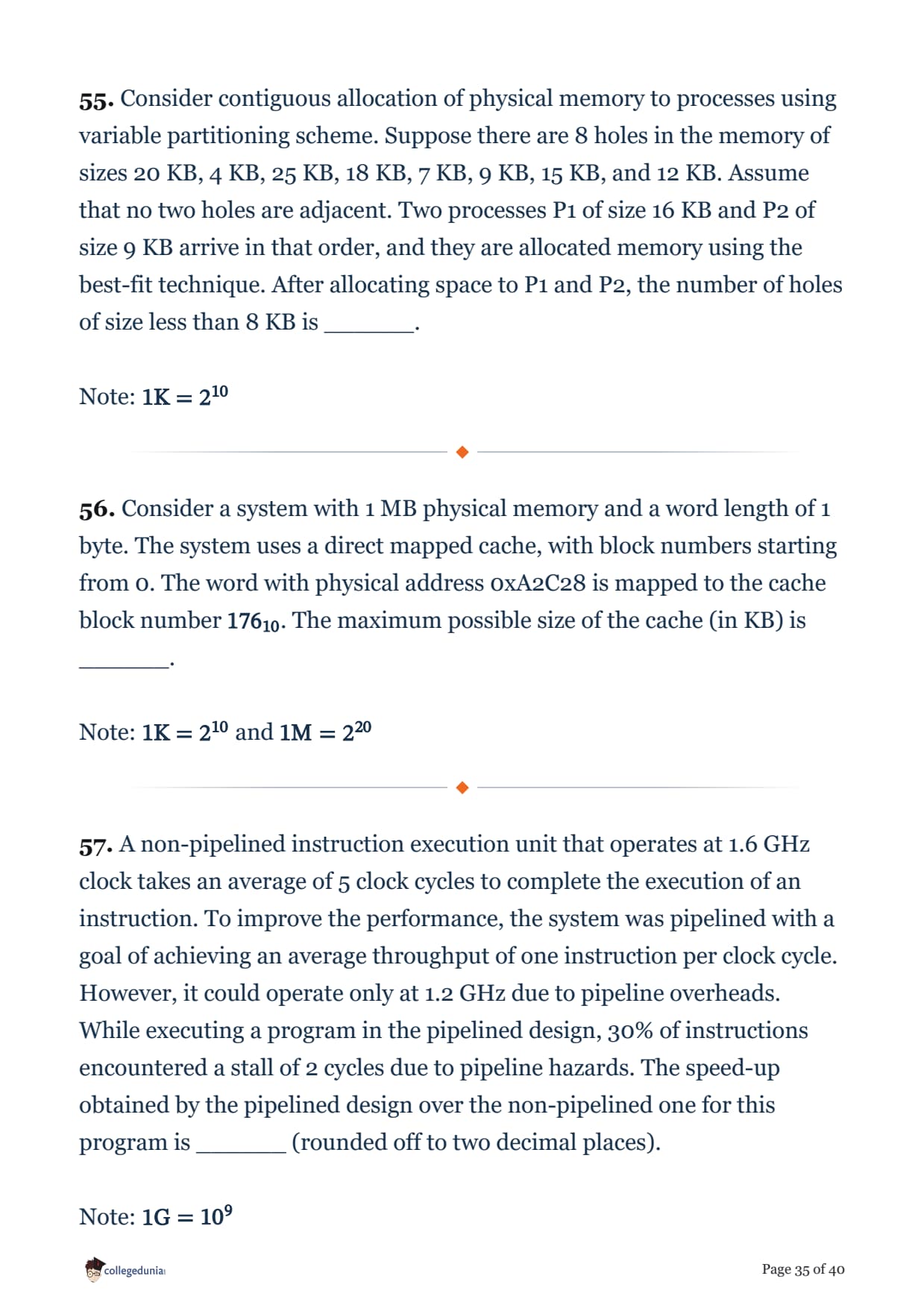
Consider contiguous allocation of physical memory to processes using variable partitioning scheme. Suppose there are 8 holes in the memory of sizes 20 KB, 4 KB, 25 KB, 18 KB, 7 KB, 9 KB, 15 KB, and 12 KB. Assume that no two holes are adjacent. Two processes P1 of size 16 KB and P2 of size 9 KB arrive in that order, and they are allocated memory using the best-fit technique. After allocating space to P1 and P2, the number of holes of size less than 8 KB is ______.
Note: \(1\text{K}=2^{10}\)
Consider a system with 1 MB physical memory and a word length of 1 byte. The system uses a direct mapped cache, with block numbers starting from 0. The word with physical address 0xA2C28 is mapped to the cache block number \(176_{10}\). The maximum possible size of the cache (in KB) is ______.
Note: \(1\text{K}=2^{10}\) and \(1\text{M}=2^{20}\)
A non-pipelined instruction execution unit that operates at 1.6 GHz clock takes an average of 5 clock cycles to complete the execution of an instruction. To improve the performance, the system was pipelined with a goal of achieving an average throughput of one instruction per clock cycle. However, it could operate only at 1.2 GHz due to pipeline overheads. While executing a program in the pipelined design, 30% of instructions encountered a stall of 2 cycles due to pipeline hazards. The speed-up obtained by the pipelined design over the non-pipelined one for this program is ______ (rounded off to two decimal places).
Note: \(1\text{G}=10^{9}\)
Consider a new TCP connection between a sender and a receiver. The receiver advertised window is constant at 48 KB, the maximum segment size (MSS) is 2 KB, and the slow start threshold for TCP congestion control is 16 KB. Assume that there are no timeouts or duplicate acknowledgements. The number of rounds of transmission required for the congestion control algorithm of the TCP connection to reach the congestion avoidance phase is ______.
Note: \(1\text{K}=2^{10}\)
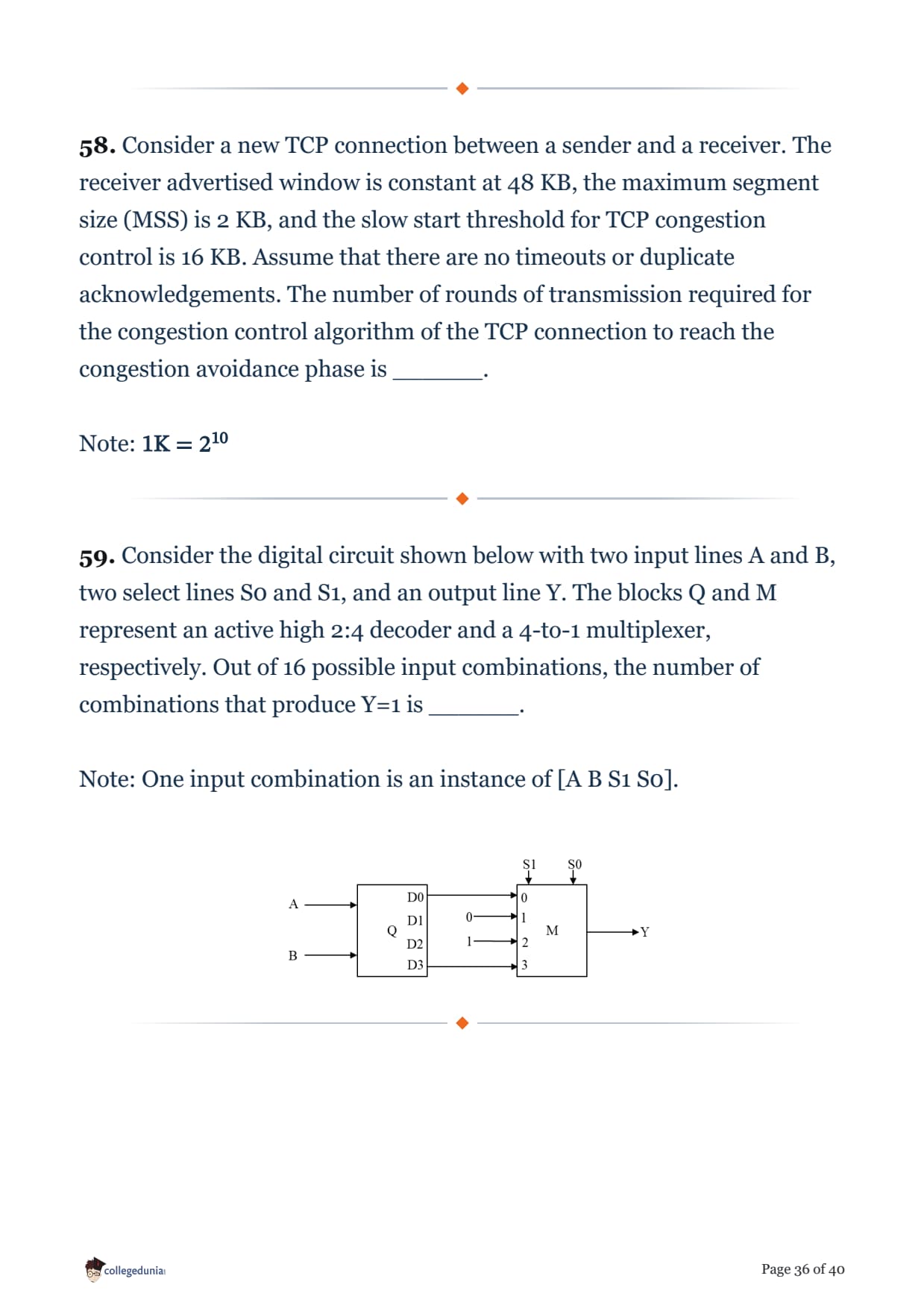
Consider the digital circuit shown below with two input lines A and B, two select lines S0 and S1, and an output line Y. The blocks Q and M represent an active high 2:4 decoder and a 4-to-1 multiplexer, respectively. Out of 16 possible input combinations, the number of combinations that produce Y=1 is ______.
Note: One input combination is an instance of [A B S1 S0].
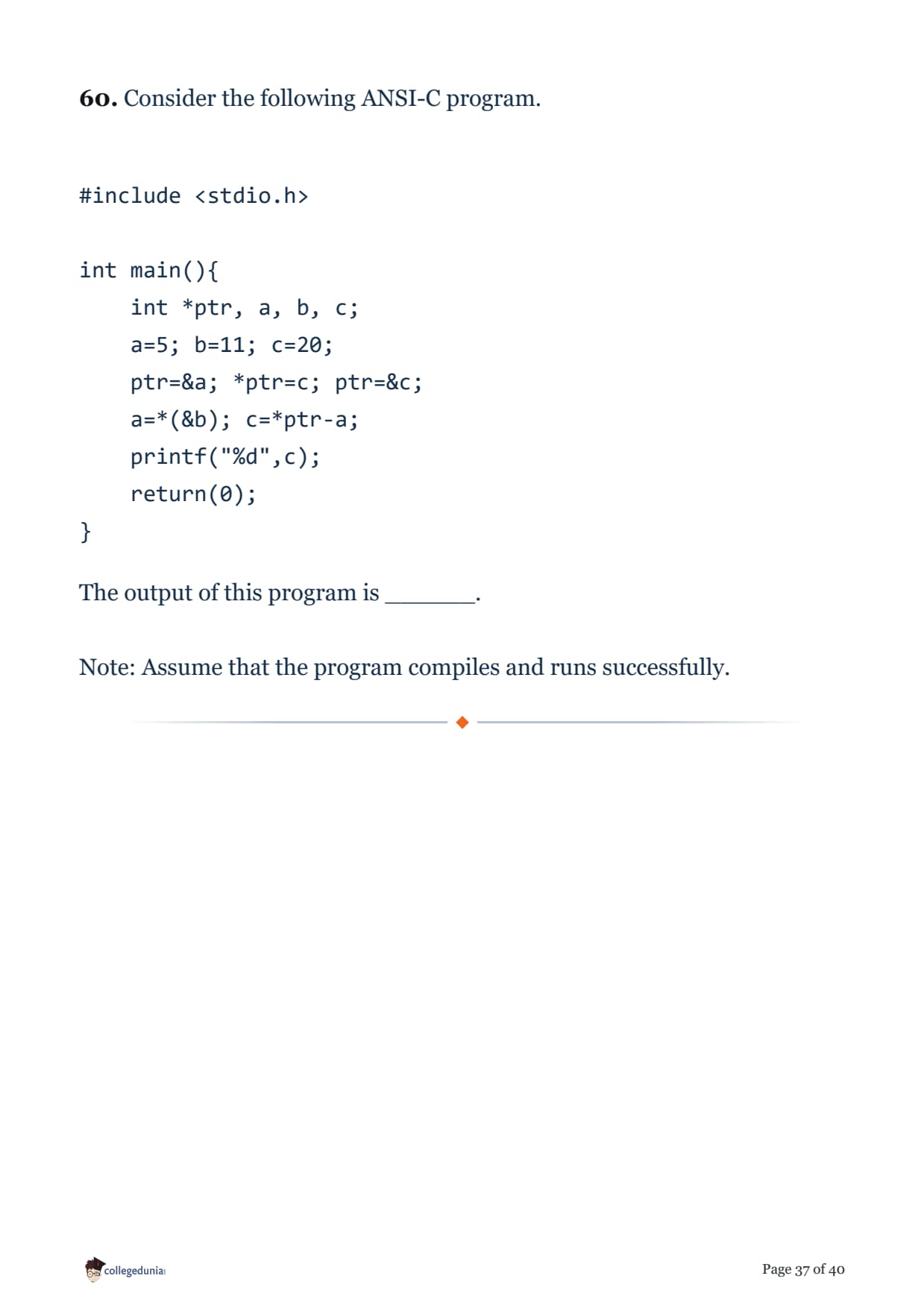
Consider the following ANSI-C program.
#include <stdio.h>

int main(){
    int *ptr, a, b, c;
    a=5; b=11; c=20;
    ptr=&a; *ptr=c; ptr=&c;
    a=*(&b); c=*ptr-a;
    printf("%d",c);
    return(0);
}
The output of this program is ______.Note: Assume that the program compiles and runs successfully.
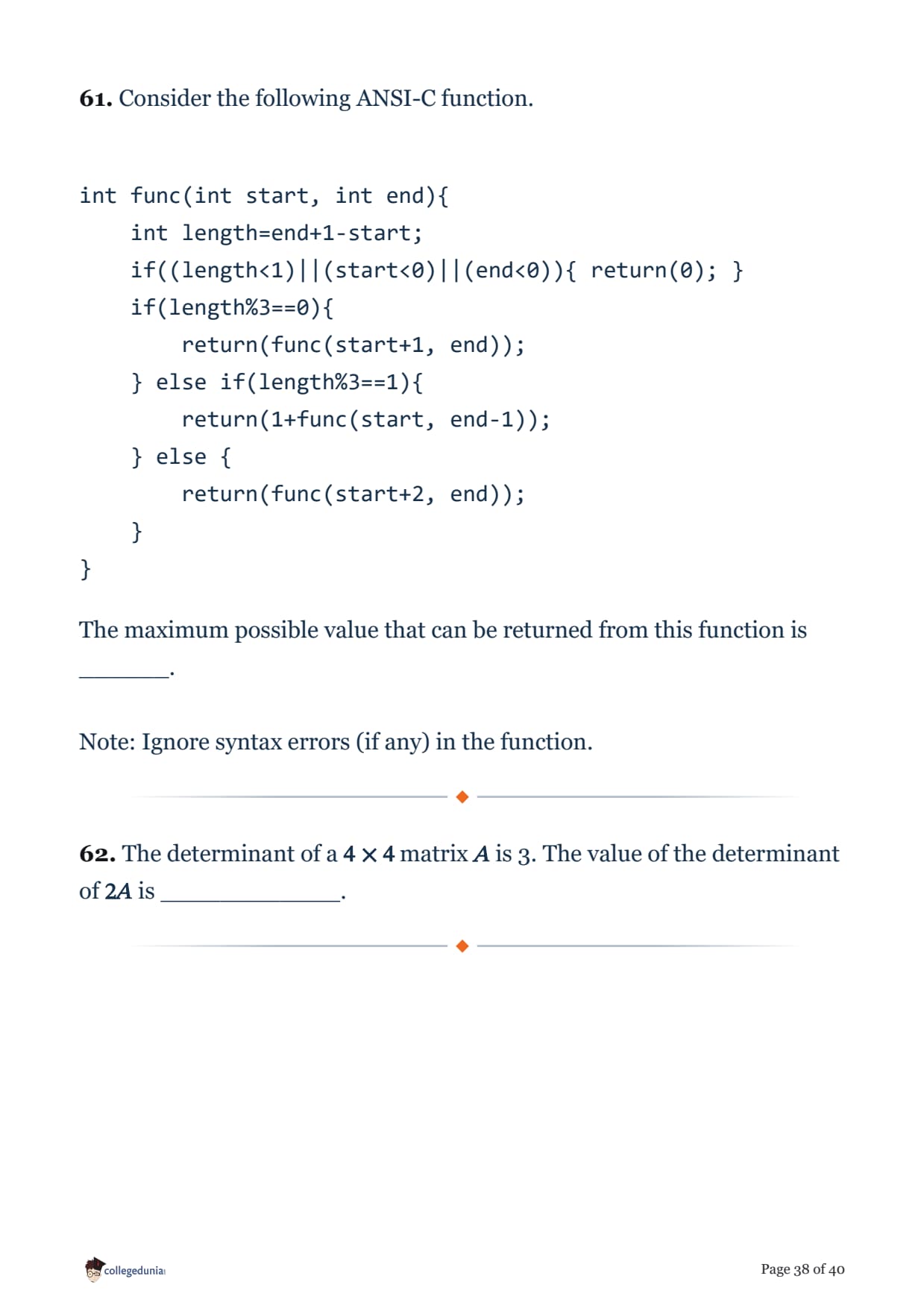
Consider the following ANSI-C function.
int func(int start, int end){
    int length=end+1-start;
    if((length<1)||(start<0)||(end<0)){ return(0); }
    if(length%3==0){
        return(func(start+1, end));
    } else if(length%3==1){
        return(1+func(start, end-1));
    } else {
        return(func(start+2, end));
    }
}
The maximum possible value that can be returned from this function is ______.Note: Ignore syntax errors (if any) in the function.
The determinant of a \(4 \times 4\) matrix \(A\) is 3. The value of the determinant of \(2A\) is ____________.
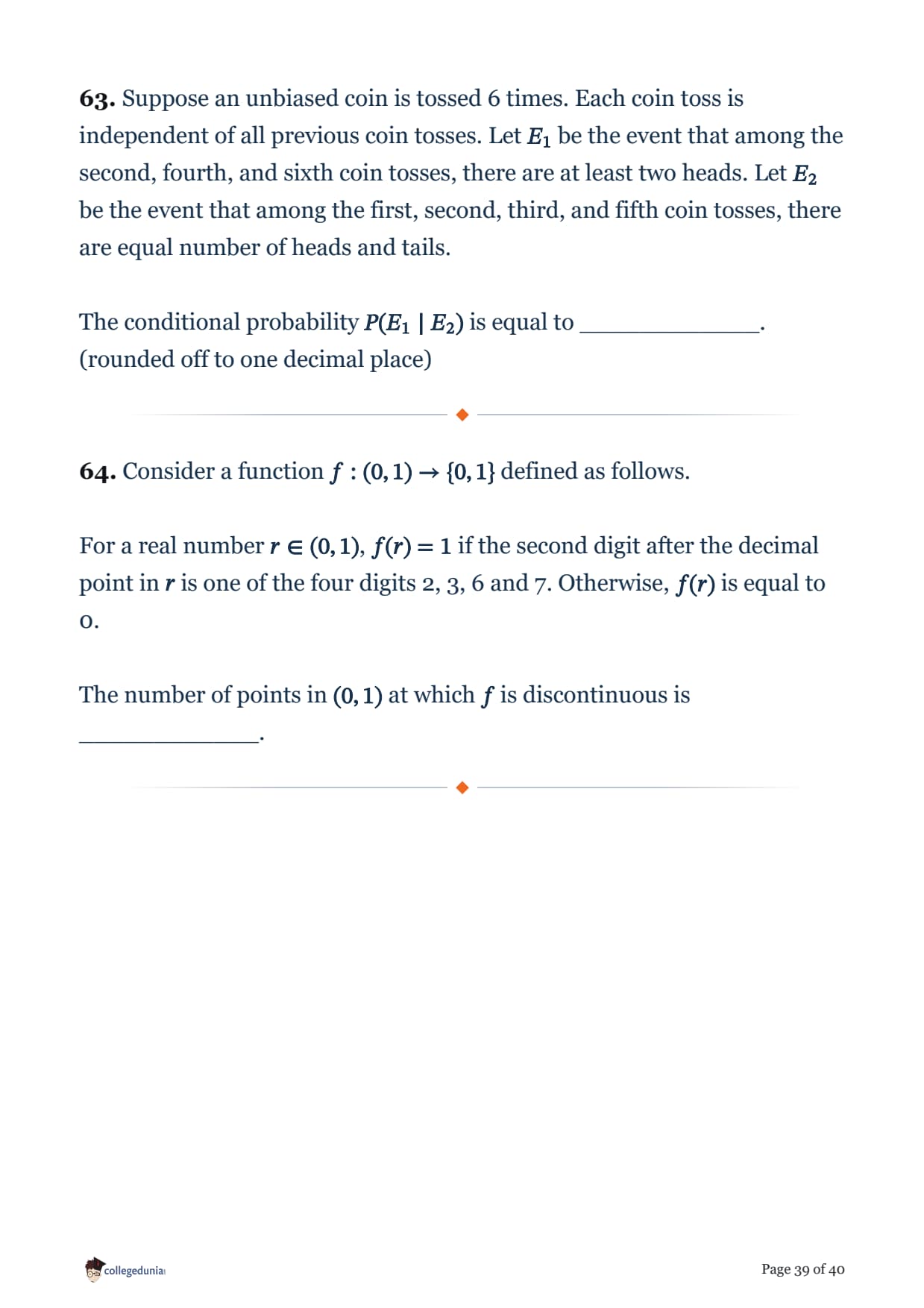
Suppose an unbiased coin is tossed 6 times. Each coin toss is independent of all previous coin tosses. Let \(E_1\) be the event that among the second, fourth, and sixth coin tosses, there are at least two heads. Let \(E_2\) be the event that among the first, second, third, and fifth coin tosses, there are equal number of heads and tails.
The conditional probability \(P(E_1 \mid E_2)\) is equal to ____________. (rounded off to one decimal place)
Consider a function \(f:(0,1) \to \{0,1\}\) defined as follows.
For a real number \(r \in (0,1)\), \(f(r) = 1\) if the second digit after the decimal point in \(r\) is one of the four digits 2, 3, 6 and 7. Otherwise, \(f(r)\) is equal to 0.
The number of points in \((0,1)\) at which \(f\) is discontinuous is ____________.
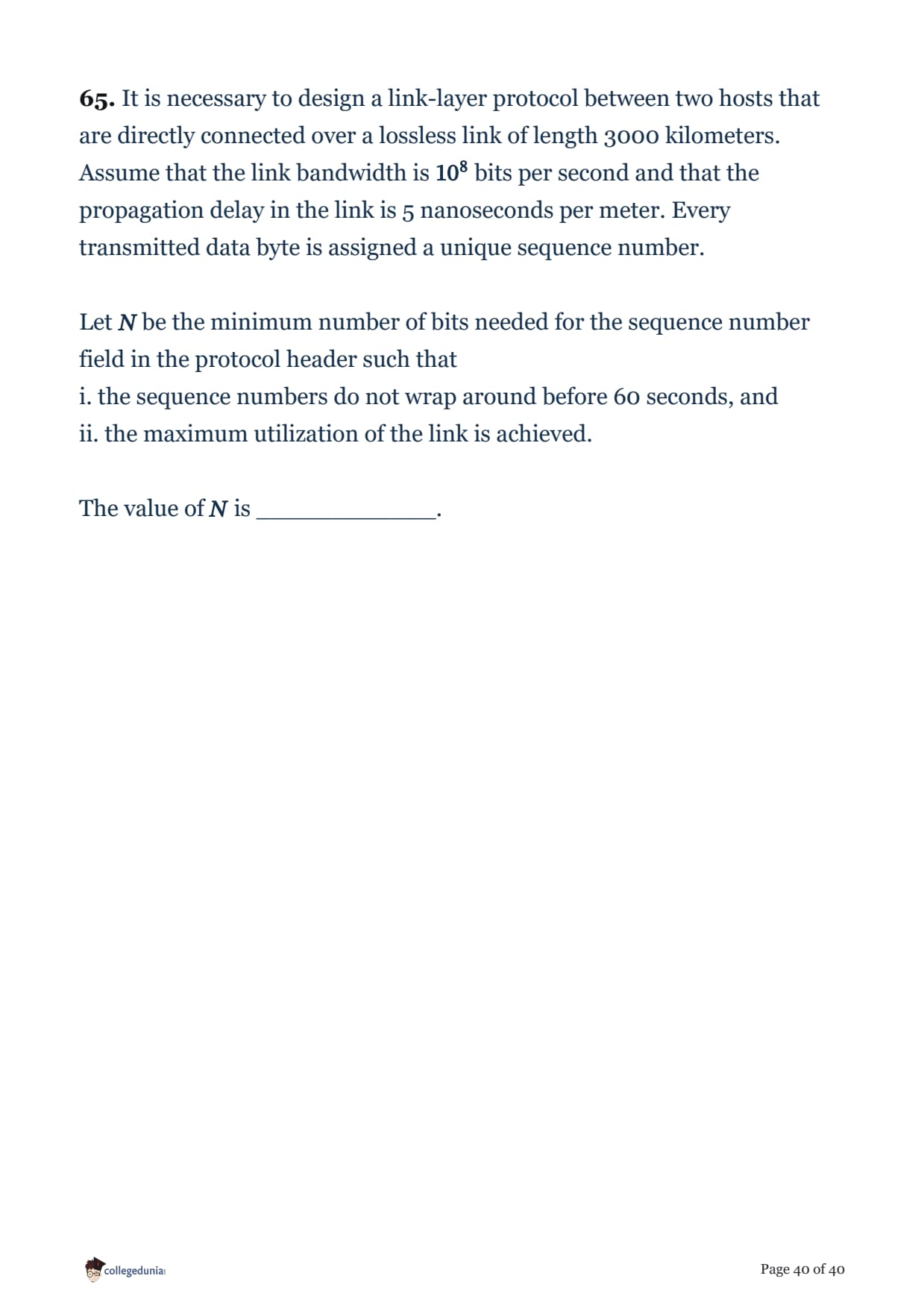
It is necessary to design a link-layer protocol between two hosts that are directly connected over a lossless link of length 3000 kilometers. Assume that the link bandwidth is \(10^8\) bits per second and that the propagation delay in the link is 5 nanoseconds per meter. Every transmitted data byte is assigned a unique sequence number.
Let \(N\) be the minimum number of bits needed for the sequence number field in the protocol header such that
i. the sequence numbers do not wrap around before 60 seconds, and
ii. the maximum utilization of the link is achieved.
The value of \(N\) is ____________.
GATE 2026 Computer Science & Information Technology (CS-2) Exam Pattern and Marking Scheme Explained
The CS-2 afternoon paper followed the standard GATE structure set by IIT Guwahati, mixing General Aptitude with Engineering Mathematics and the core Computer Science syllabus across three question types.
- Total questions: 65 questions (10 General Aptitude + 55 from Engineering Mathematics and Computer Science core)
- Duration: 3 hours (180 minutes)
- Total marks: 100 (General Aptitude 15 marks, the rest 85 marks)
- Marking scheme: negative marking on MCQ only, 1/3 mark off for a wrong 1-mark MCQ and 2/3 off for a wrong 2-mark MCQ; no negative marking on MSQ or NAT
- Question types: MCQ (single correct), MSQ (multiple select), and NAT (numerical answer type); the CS-2 shift carried close to 19 NAT and 11 MSQ questions this year
High-Weightage Subjects in GATE 2026 CS-2 to Focus On First
Programming and Data Structures carried the single biggest share of the CS-2 afternoon paper, with Operating Systems and Algorithms following close behind.
- Programming and Data Structures: the heaviest area with about 8 questions, built around stacks, trees and sorting-heavy problems
- Operating Systems: around 5 questions, with process scheduling and memory management the recurring themes
- Algorithms: 4 questions, mostly complexity analysis and standard design techniques
- Engineering Mathematics: pulled from Linear Algebra, Probability and Discrete Mathematics, moderate overall with a few tricky ones
- Core CS spread: Database Management, Computer Networks, Computer Organisation and Architecture, Theory of Computation and Compiler Design each contributed questions
- General Aptitude: the most scoring part of the paper, with direct arithmetic, verbal ability and logical reasoning questions
GATE 2026 Computer Science CS-2 Question Paper Analysis Video
Source: NPTEL
How to Use the GATE 2026 CS-2 Question Paper for Practice
Treat this paper as a full timed mock before you open the solutions PDF, since CS-2 rewards clean concept application over pure formula recall.
- Solve all 65 questions in one 3-hour sitting to build exam stamina and pacing
- Review every question with the solutions PDF, especially the NAT questions where a single calculation slip costs the whole mark
- Redo the Programming and Data Structures and Operating Systems sets first, since together they carried around 13 of the 55 core questions
- Log the MSQ questions separately, because a partially wrong pick there still costs the full mark even without negative marking
GATE CS-2 Good Attempts and Qualifying Score Benchmark
- Around 50 to 55 accurate attempts was the working benchmark for a rank under 1000 across the February 8 GATE sessions
- The GATE 2026 CSE qualifying cutoff was 30 marks for General, 27 for OBC-NCL/EWS and 20 for SC/ST/PwD, so aim well above the qualifying line for admissions
- Use these as your weekly targets when you redo the paper and track your score each time
GATE 2026 CS-2 Question Paper FAQs
Ques. Was the GATE 2026 CS-2 paper tough?
Ans. The CS-2 afternoon paper was easy to moderate, slightly gentler than the CS-1 forenoon shift. Programming and Data Structures and Operating Systems carried the bulk of the tricky, application-heavy questions, while General Aptitude stayed direct and scoring.
Ques. Which subjects had the highest weightage in GATE 2026 CS-2?
Ans. Programming and Data Structures led with about 8 questions, followed by Operating Systems at around 5 and Algorithms at 4. Database Management, Computer Networks, Computer Organisation and Architecture, Theory of Computation and Compiler Design each added a few more.
Ques. How many questions should I attempt in GATE CS-2 for a good rank?
Ans. Around 50 to 55 accurate attempts was the working benchmark for a rank under 1000 in the February 8 sessions. The GATE 2026 CSE qualifying cutoff was 30 marks for the General category, so aim to clear that comfortably and higher for IIT and NIT admissions.
Ques. Is there negative marking in GATE CS-2 NAT and MSQ questions?
Ans. No. NAT (numerical answer type) and MSQ (multiple select) questions carry no negative marking. Only single-correct MCQs are penalised, losing 1/3 mark for a 1-mark question and 2/3 mark for a 2-mark question.
Ques. How many questions are there in the GATE CS-2 paper?
Ans. The GATE CS-2 paper has 65 questions for 100 marks in 3 hours. This splits into 10 General Aptitude questions worth 15 marks and 55 questions worth 85 marks from Engineering Mathematics and the core Computer Science syllabus.
Ques. Where can I download the GATE 2026 CS-2 question paper with solutions PDF for free?
Ans. You can download it from the table at the top of this page on Collegedunia, both the question paper and the full solutions PDF. The official master question paper and answer key are also available on the IIT Guwahati GATE 2026 portal at gate2026.iitg.ac.in.



Comments