The GATE 2026 Chemistry (CY) question paper is now available with detailed solutions for free download. GATE 2026 CY was conducted by IIT Guwahati on February 7, 2026, in the afternoon session (2:30 PM to 5:30 PM), and the paper carried 65 questions for 100 marks in 3 hours.
"He often the numbers. False claims are not going to help. Honesty trust", said the manager. Choose the option with the correct order of words to fill the blanks.
In a group of students, 10 students like Mathematics, 12 students like English, 4 students like both Mathematics and English, and 6 students like neither Mathematics nor English. The number of students in the group is
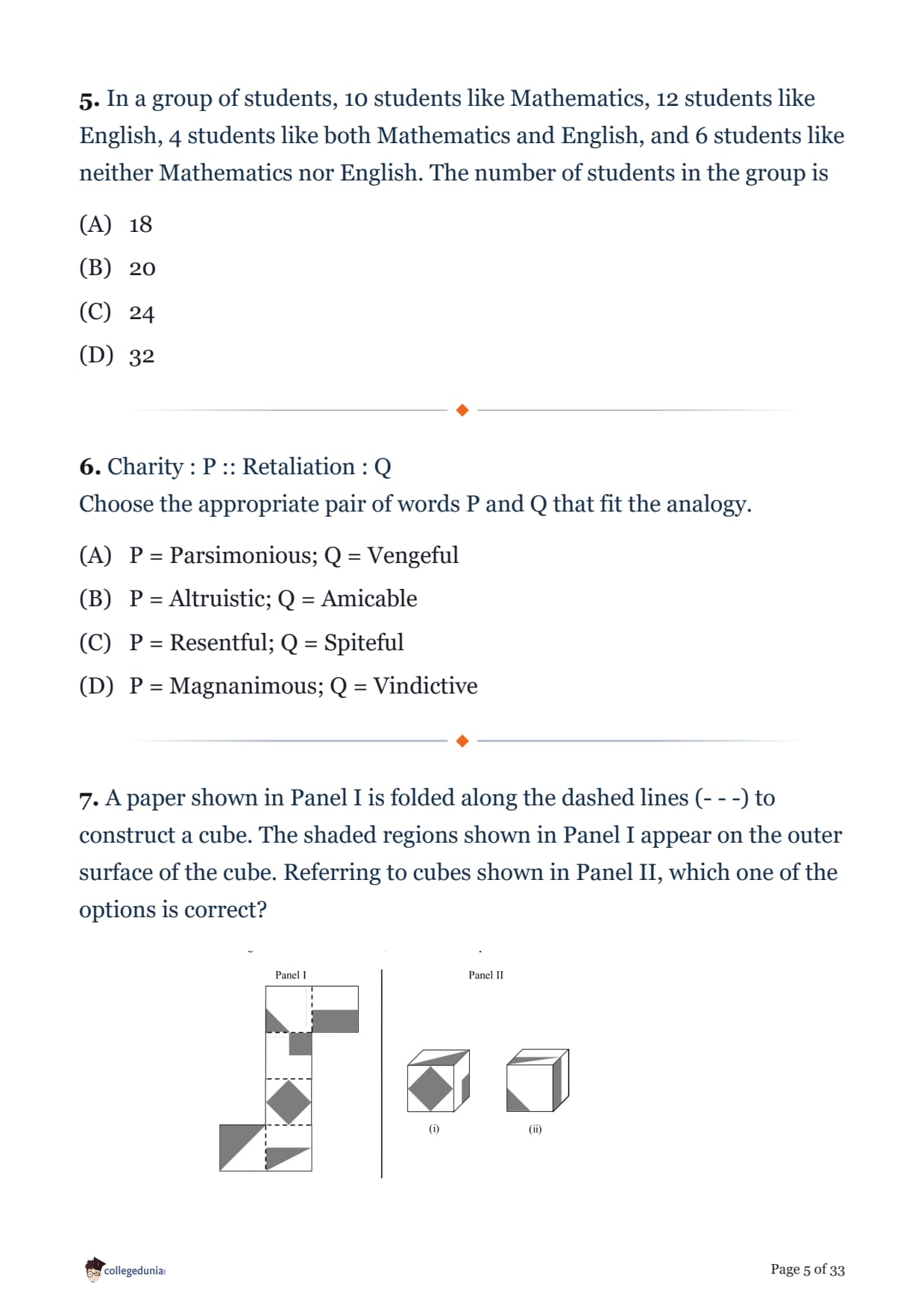
A paper shown in Panel I is folded along the dashed lines (- - -) to construct a cube. The shaded regions shown in Panel I appear on the outer surface of the cube. Referring to cubes shown in Panel II, which one of the options is correct?
(A) Only (i) can correspond to the unfolded cube in Panel I.
(B) Only (ii) can correspond to the unfolded cube in Panel I.
(C) Both (i) and (ii) can correspond to the unfolded cube in Panel I.
(D) Neither (i) nor (ii) can correspond to the unfolded cube in Panel I.
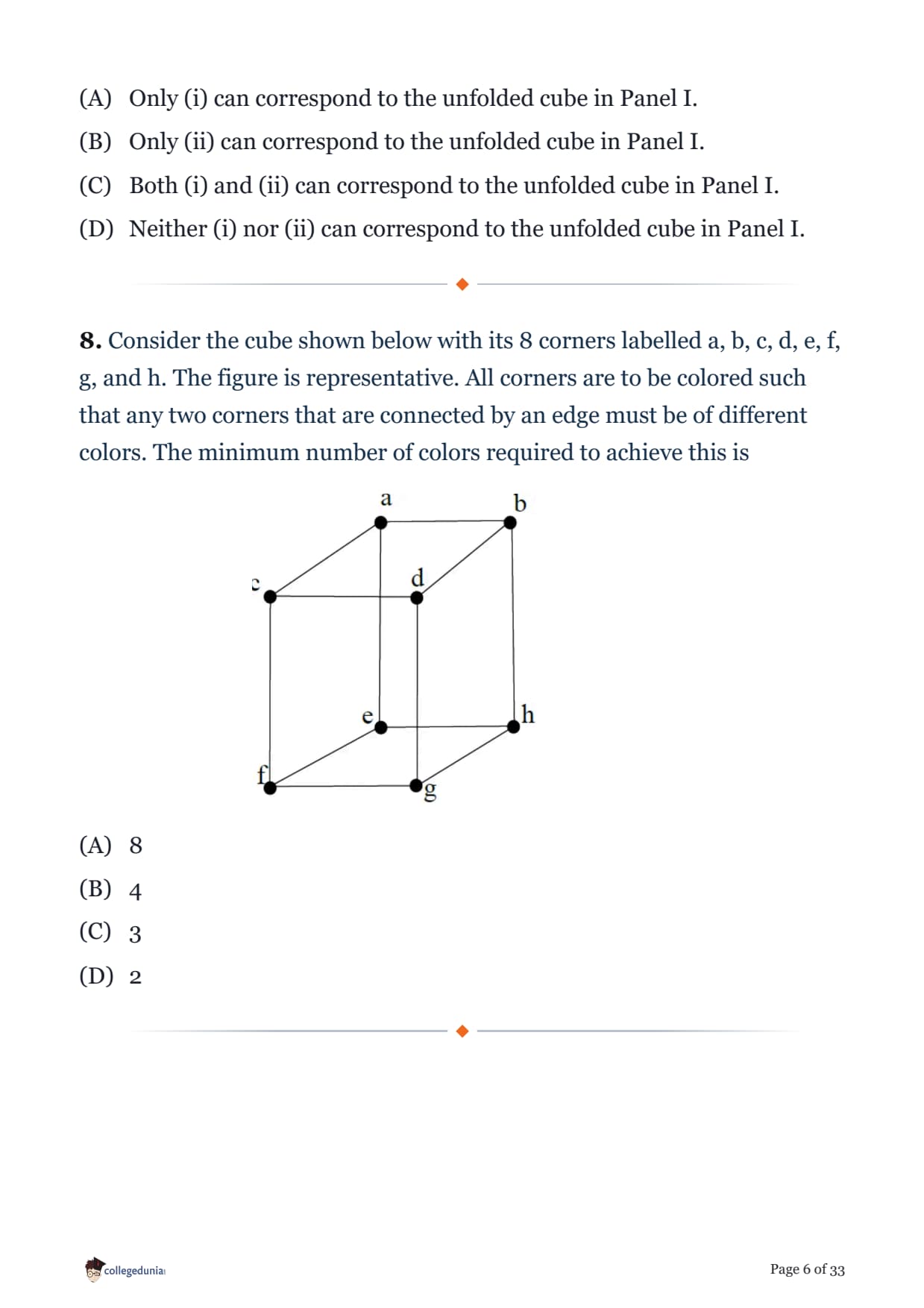
Consider the cube shown below with its 8 corners labelled a, b, c, d, e, f, g, and h. The figure is representative. All corners are to be colored such that any two corners that are connected by an edge must be of different colors. The minimum number of colors required to achieve this is
Four hills \(H_1, H_2, H_3\), and \(H_4\) are present in an area. The following observations are made about them: (i) Neither \(H_2\) nor \(H_3\) is the easternmost hill. (ii) Neither \(H_2\) nor \(H_3\) is the westernmost hill. (iii) Neither the easternmost hill nor the westernmost hill is the southernmost hill. (iv) Two hills are located to the west of \(H_2\). (v) The southernmost hill has at least two hills to its east. The southernmost hill is .
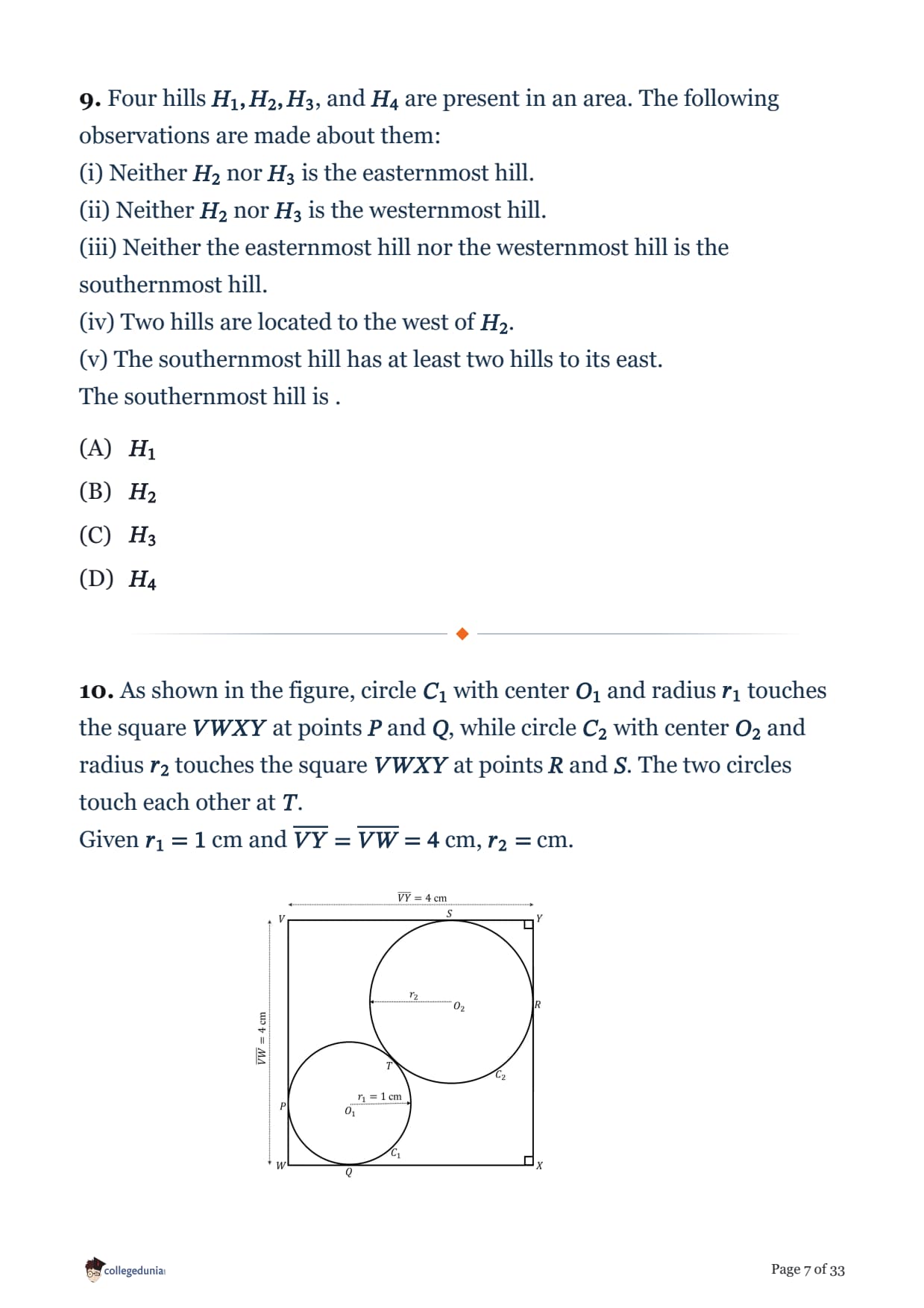
As shown in the figure, circle \(C_1\) with center \(O_1\) and radius \(r_1\) touches the square \(VWXY\) at points \(P\) and \(Q\), while circle \(C_2\) with center \(O_2\) and radius \(r_2\) touches the square \(VWXY\) at points \(R\) and \(S\). The two circles touch each other at \(T\). Given \(r_1 = 1\) cm and \(\overline{VY} = \overline{VW} = 4\) cm, \(r_2 =\) cm.
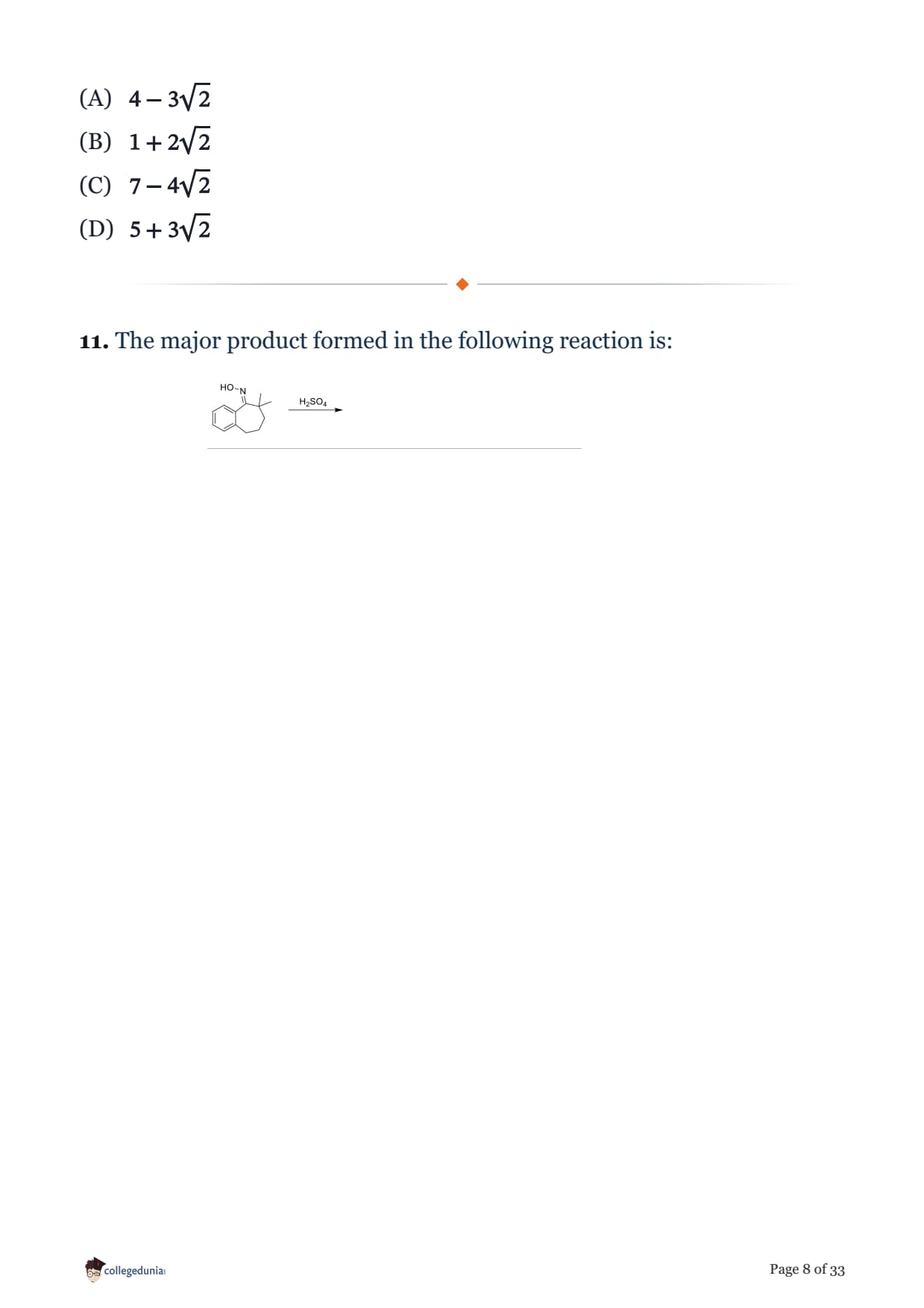
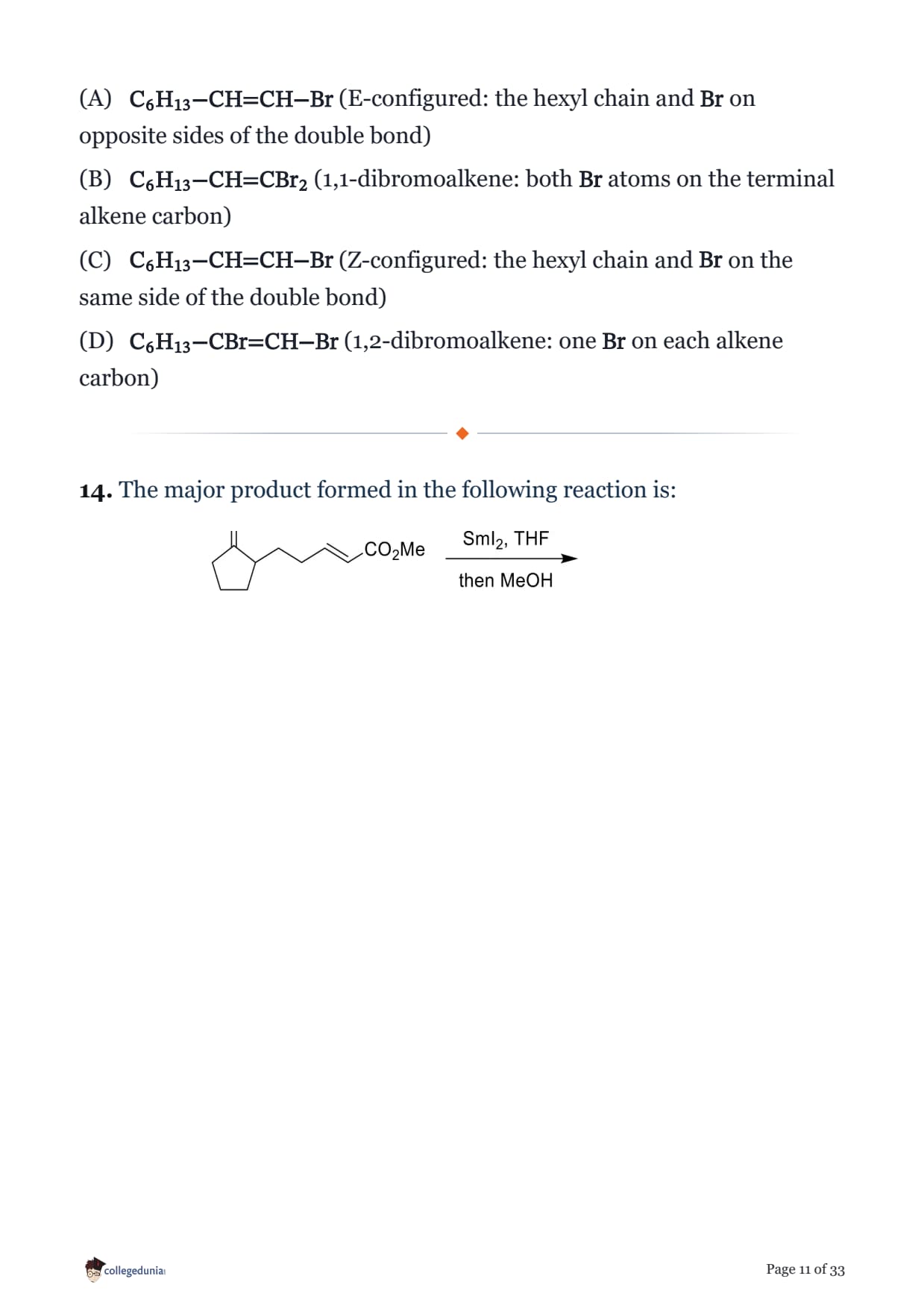
The major product formed in the following reaction sequence is: Step 1: \(\mathrm{C_6H_{13}{-}C{\equiv}CH}\) is treated with catecholborane, then heated. Step 2: the product from Step 1 is treated with \(\mathrm{Br_2}\), then \(\mathrm{NaOMe}\).
(A) \(\mathrm{C_6H_{13}{-}CH{=}CH{-}Br}\) (E-configured: the hexyl chain and \(\mathrm{Br}\) on opposite sides of the double bond)
(B) \(\mathrm{C_6H_{13}{-}CH{=}CBr_2}\) (1,1-dibromoalkene: both \(\mathrm{Br}\) atoms on the terminal alkene carbon)
(C) \(\mathrm{C_6H_{13}{-}CH{=}CH{-}Br}\) (Z-configured: the hexyl chain and \(\mathrm{Br}\) on the same side of the double bond)
(D) \(\mathrm{C_6H_{13}{-}CBr{=}CH{-}Br}\) (1,2-dibromoalkene: one \(\mathrm{Br}\) on each alkene carbon)
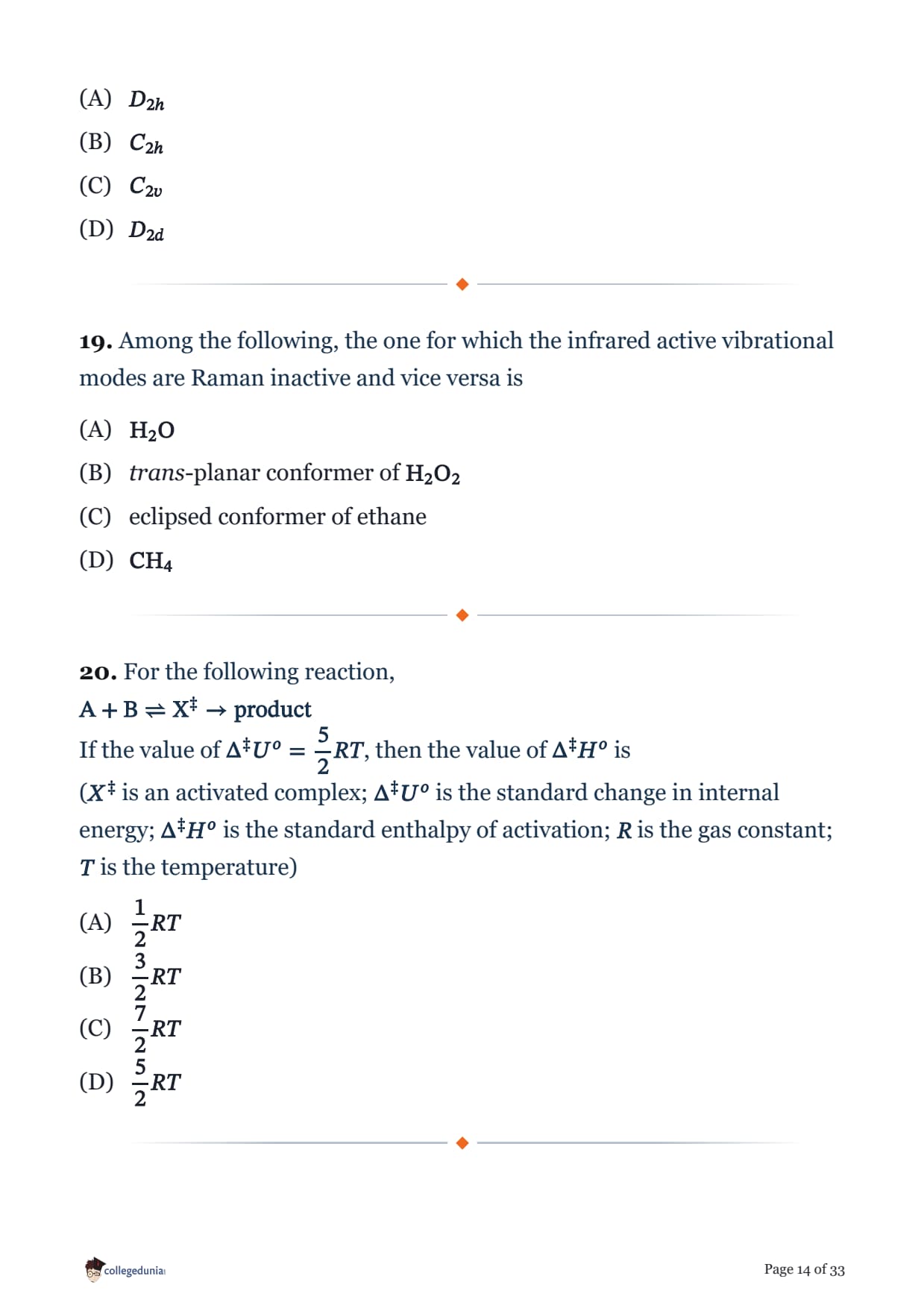
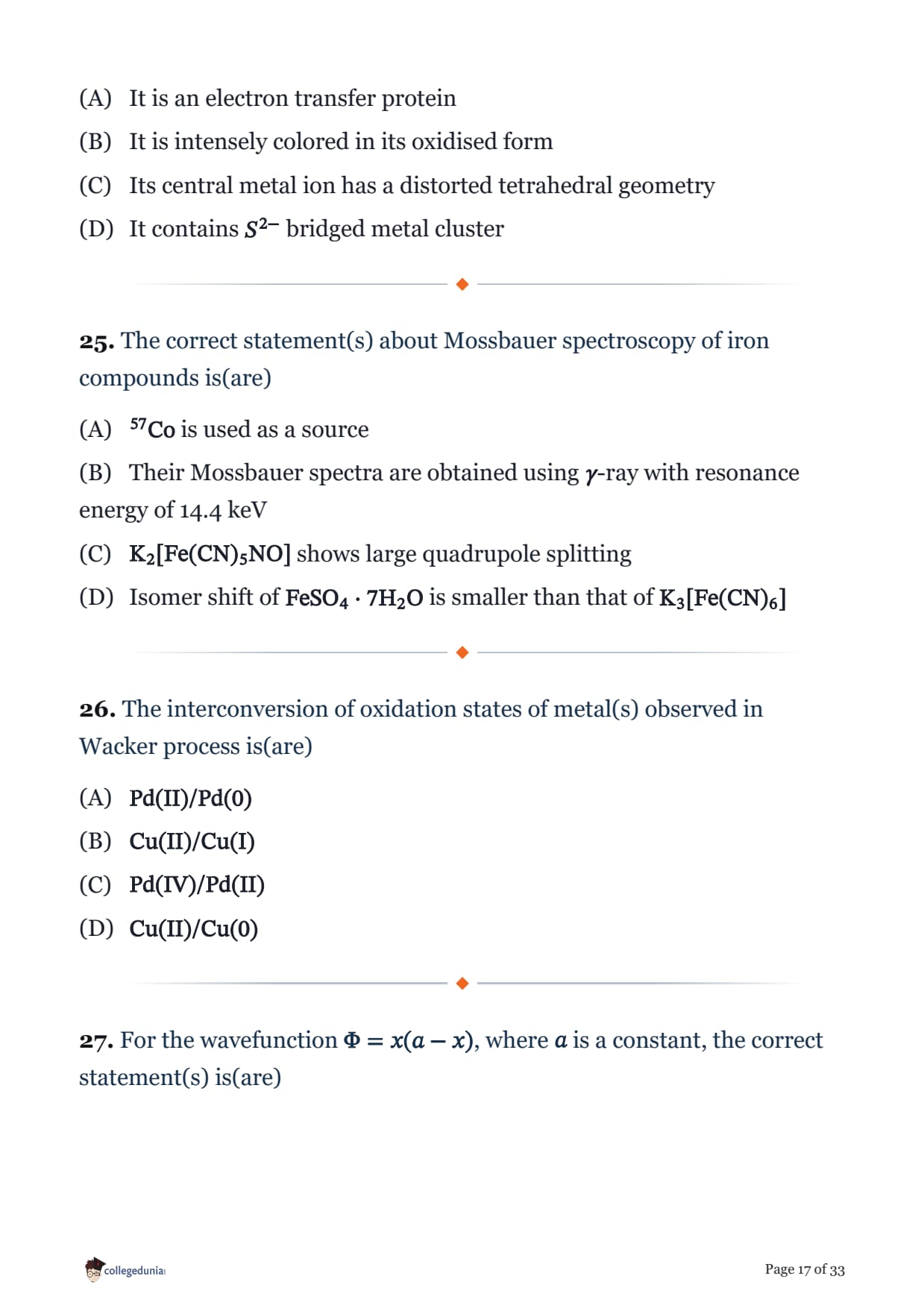
For the following reaction, \(\mathrm{A + B \rightleftharpoons X^{\ddagger} \rightarrow product}\) If the value of \(\Delta^{\ddagger}U^{o} = \dfrac{5}{2}RT\), then the value of \(\Delta^{\ddagger}H^{o}\) is (\(X^{\ddagger}\) is an activated complex; \(\Delta^{\ddagger}U^{o}\) is the standard change in internal energy; \(\Delta^{\ddagger}H^{o}\) is the standard enthalpy of activation; \(R\) is the gas constant; \(T\) is the temperature)
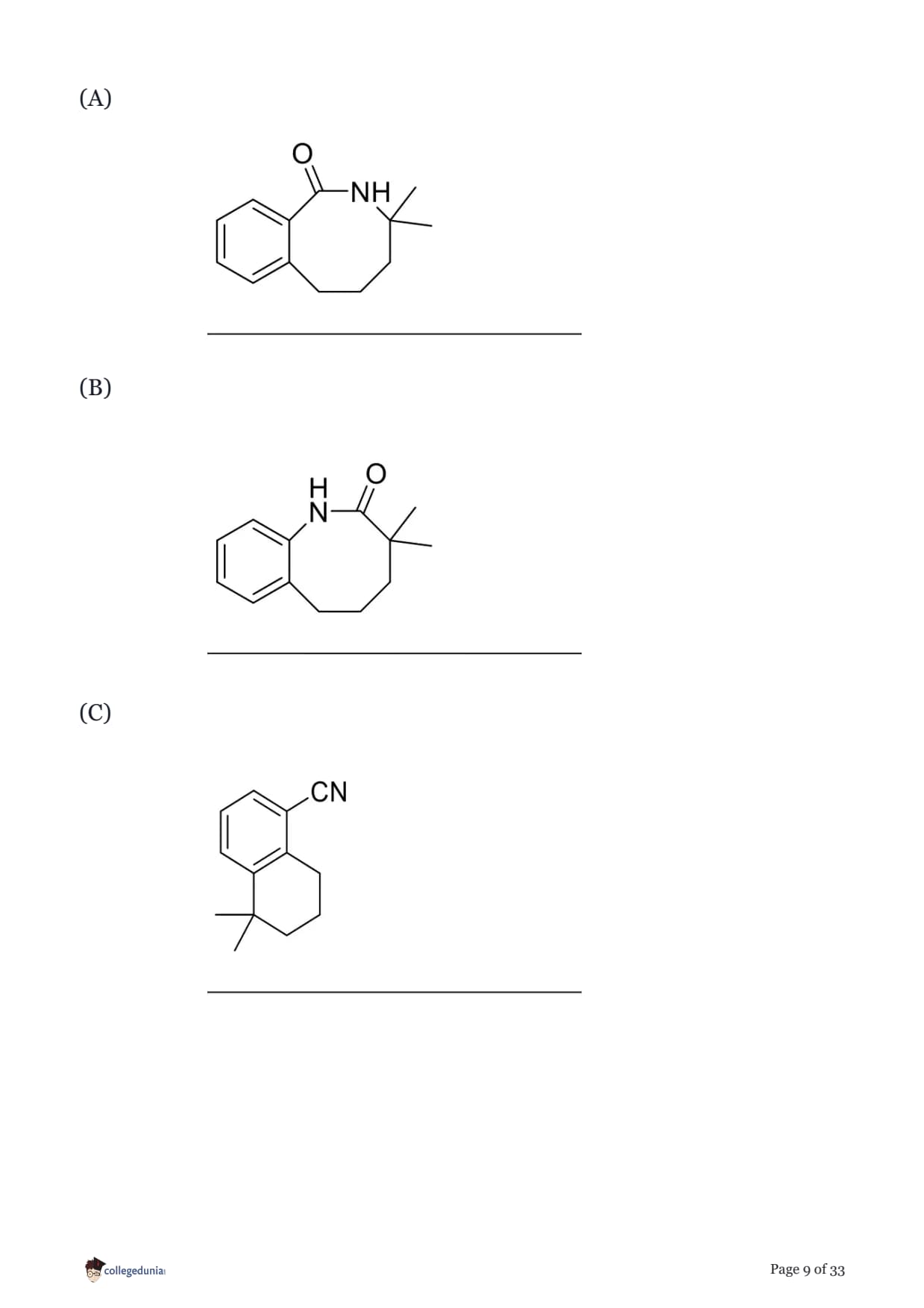
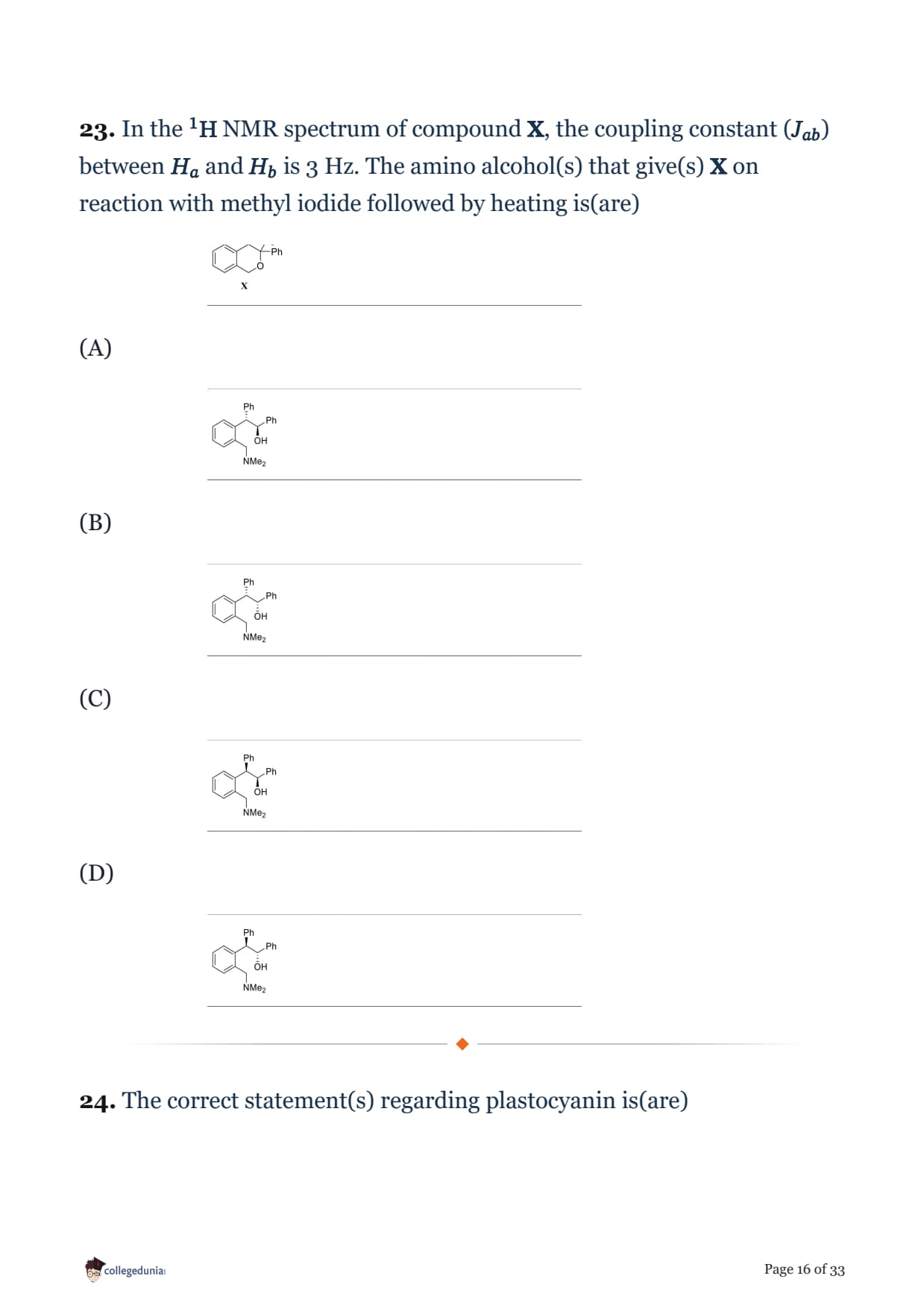
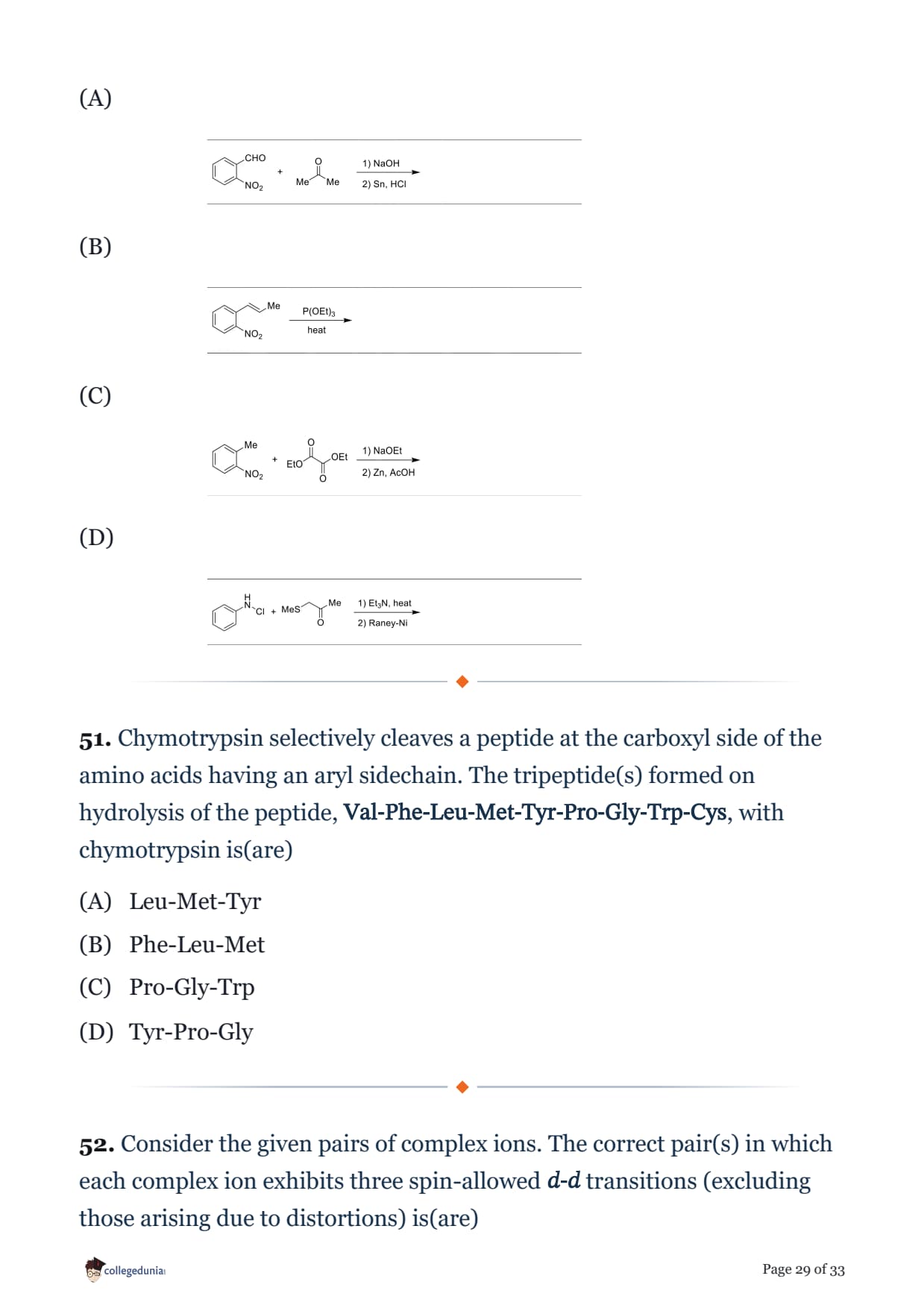
In the \(^1\mathrm{H}\) NMR spectrum of compound \(\mathbf{X}\), the coupling constant (\(J_{ab}\)) between \(H_a\) and \(H_b\) is 3 Hz. The amino alcohol(s) that give(s) \(\mathbf{X}\) on reaction with methyl iodide followed by heating is(are)
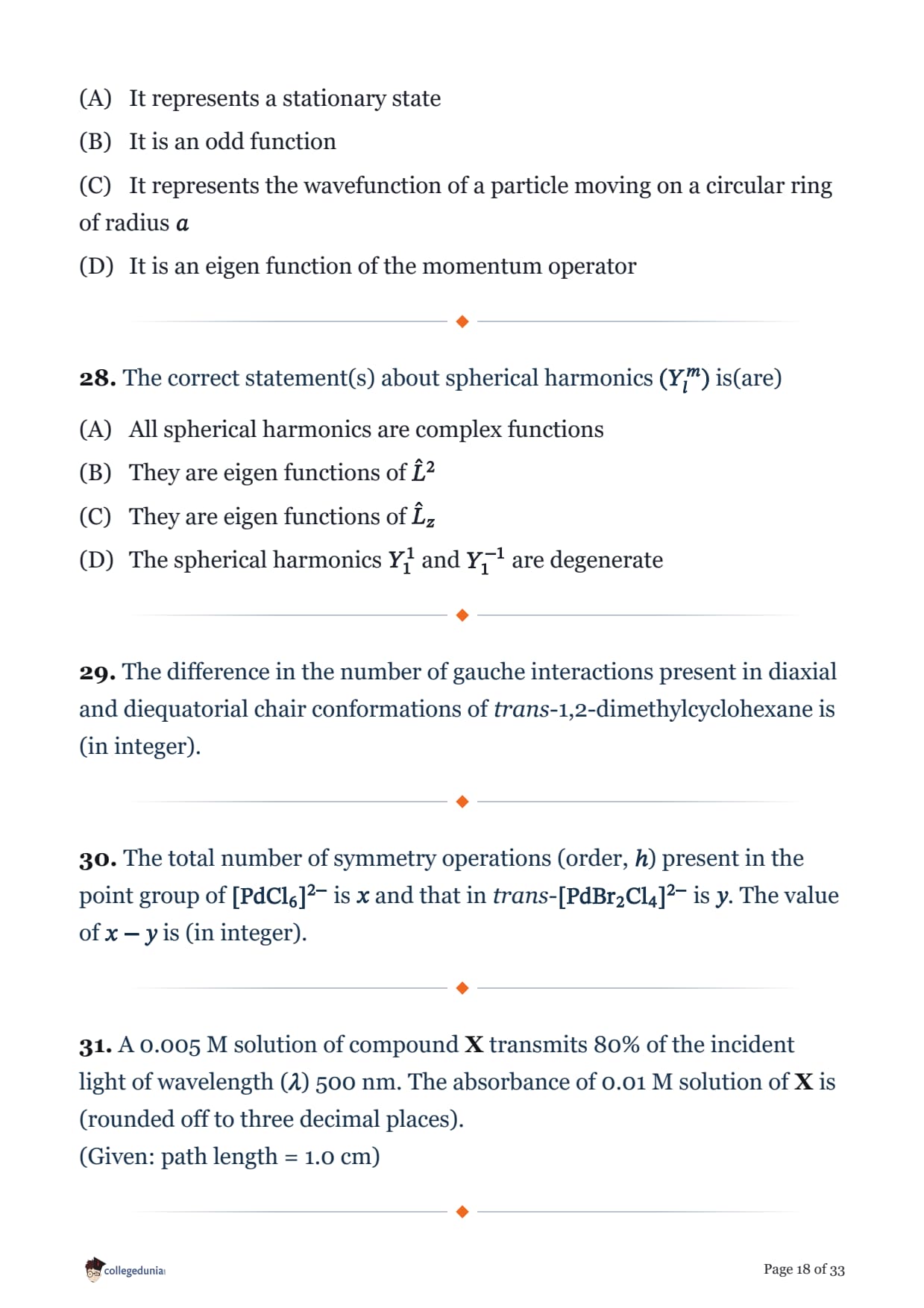
The difference in the number of gauche interactions present in diaxial and diequatorial chair conformations of trans-1,2-dimethylcyclohexane is (in integer).
The total number of symmetry operations (order, \(h\)) present in the point group of \([\mathrm{PdCl_6}]^{2-}\) is \(x\) and that in trans-\([\mathrm{PdBr_2Cl_4}]^{2-}\) is \(y\). The value of \(x-y\) is (in integer).
A 0.005 M solution of compound X transmits 80% of the incident light of wavelength (\(\lambda\)) 500 nm. The absorbance of 0.01 M solution of X is (rounded off to three decimal places). (Given: path length = 1.0 cm)
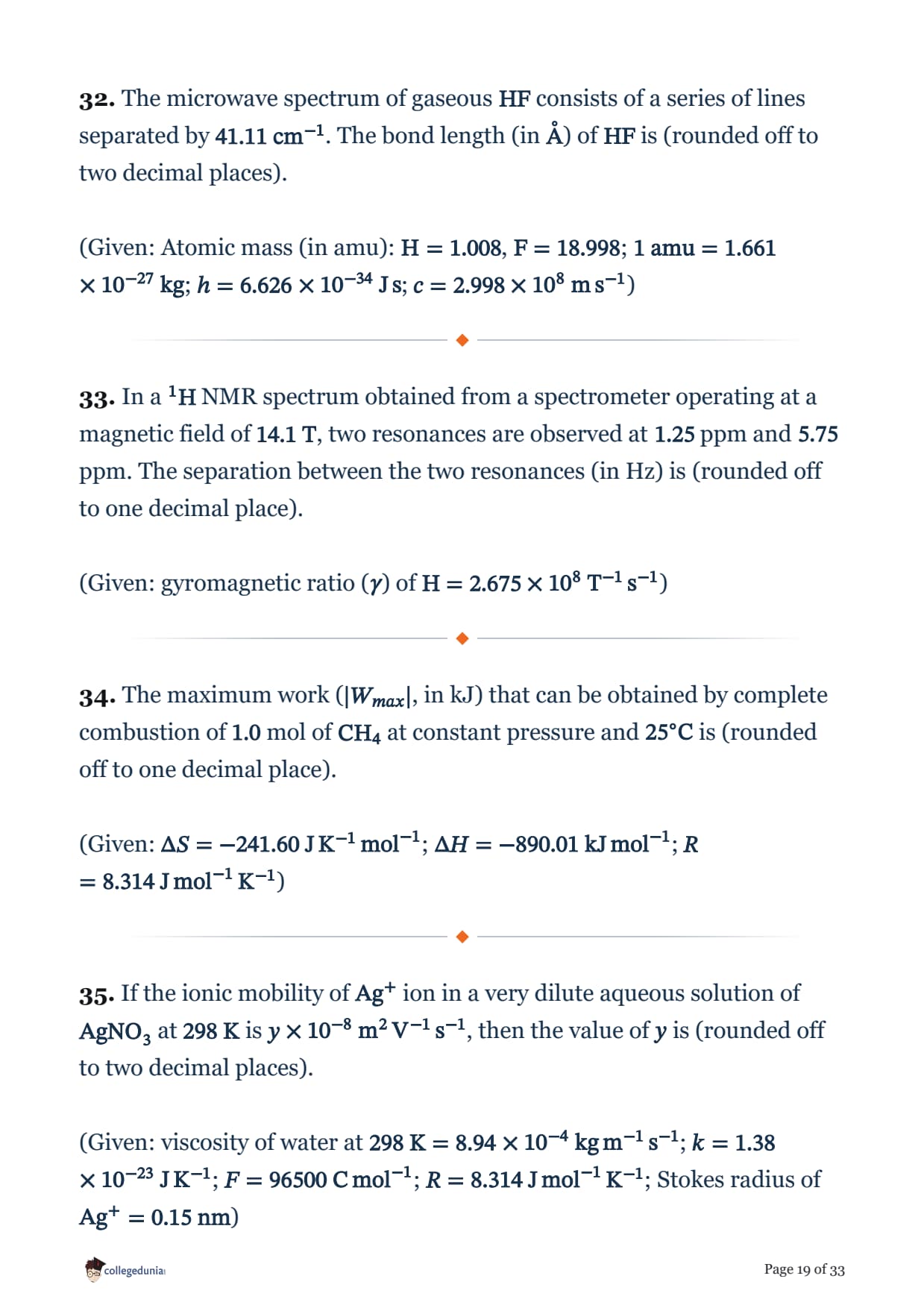
The microwave spectrum of gaseous \(\mathrm{HF}\) consists of a series of lines separated by \(41.11\ \mathrm{cm^{-1}}\). The bond length (in \(\mathrm{\mathring{A}}\)) of \(\mathrm{HF}\) is (rounded off to two decimal places).
In a \(^1\mathrm{H}\) NMR spectrum obtained from a spectrometer operating at a magnetic field of \(14.1\ \mathrm{T}\), two resonances are observed at \(1.25\) ppm and \(5.75\) ppm. The separation between the two resonances (in Hz) is (rounded off to one decimal place).
(Given: gyromagnetic ratio (\(\gamma\)) of \(\mathrm{H} = 2.675\times10^{8}\ \mathrm{T^{-1}\,s^{-1}}\))
The maximum work (\(|W_{max}|\), in kJ) that can be obtained by complete combustion of \(1.0\) mol of \(\mathrm{CH_4}\) at constant pressure and \(25^{\circ}\mathrm{C}\) is (rounded off to one decimal place).
(Given: \(\Delta S = -241.60\ \mathrm{J\,K^{-1}\,mol^{-1}}\); \(\Delta H = -890.01\ \mathrm{kJ\,mol^{-1}}\); \(R = 8.314\ \mathrm{J\,mol^{-1}\,K^{-1}}\))
If the ionic mobility of \(\mathrm{Ag^+}\) ion in a very dilute aqueous solution of \(\mathrm{AgNO_3}\) at \(298\ \mathrm{K}\) is \(y\times10^{-8}\ \mathrm{m^2\,V^{-1}\,s^{-1}}\), then the value of \(y\) is (rounded off to two decimal places).
(Given: viscosity of water at \(298\ \mathrm{K} = 8.94\times10^{-4}\ \mathrm{kg\,m^{-1}\,s^{-1}}\); \(k = 1.38\times10^{-23}\ \mathrm{J\,K^{-1}}\); \(F = 96500\ \mathrm{C\,mol^{-1}}\); \(R = 8.314\ \mathrm{J\,mol^{-1}\,K^{-1}}\); Stokes radius of \(\mathrm{Ag^+} = 0.15\ \mathrm{nm}\))
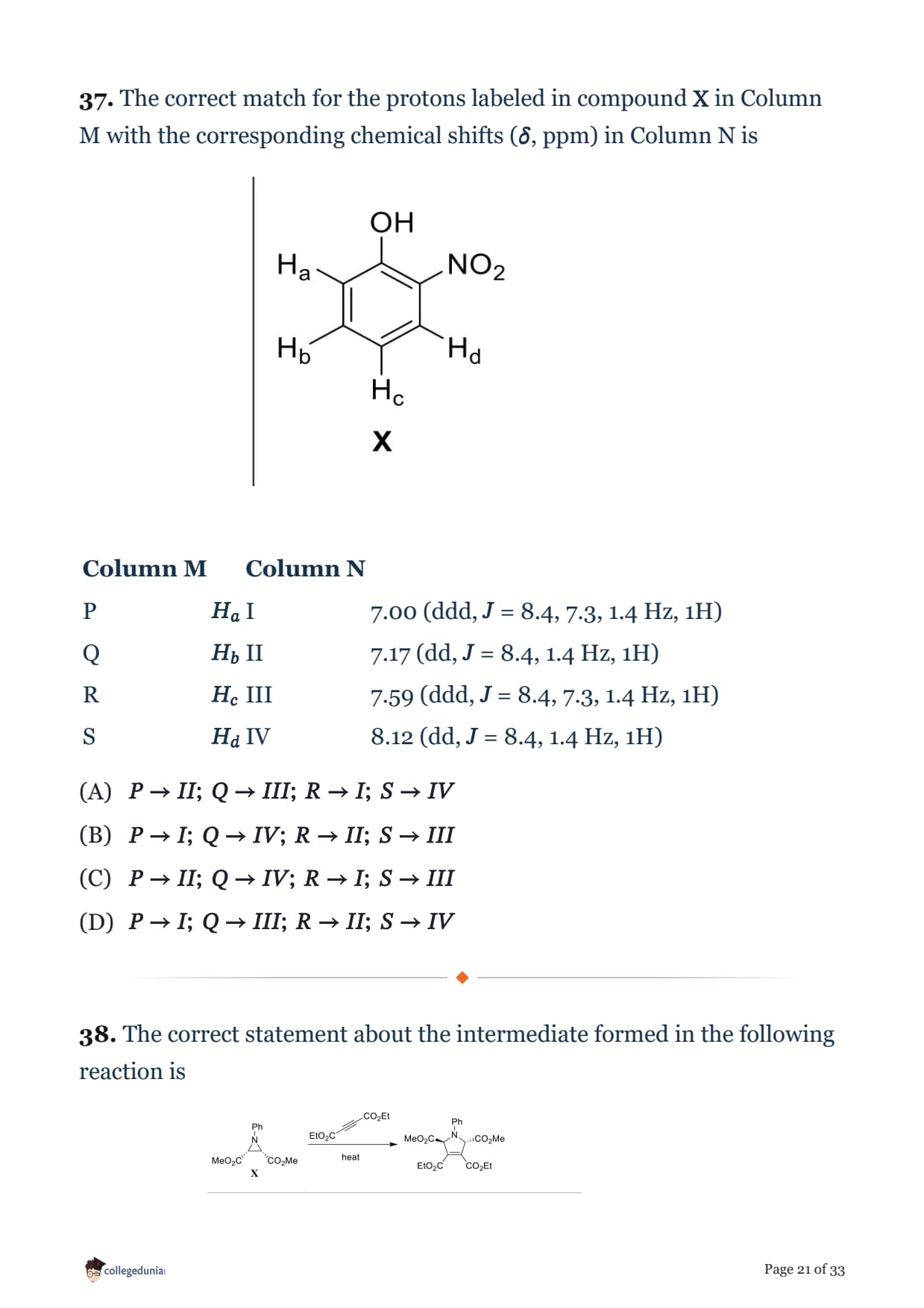
The correct match for the protons labeled in compound \(\mathrm{X}\) in Column M with the corresponding chemical shifts (\(\delta\), ppm) in Column N is
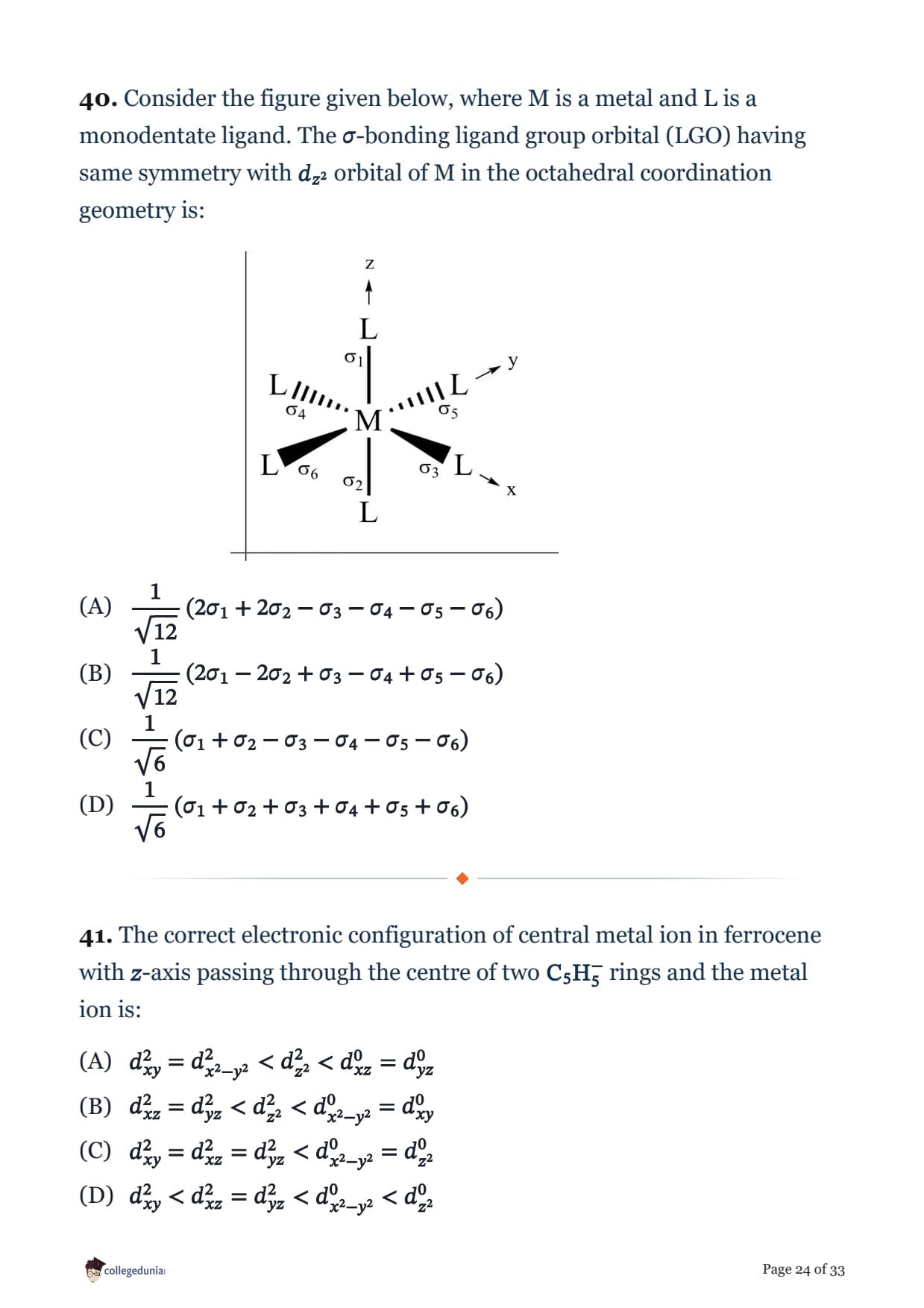
Consider the figure given below, where M is a metal and L is a monodentate ligand. The \(\sigma\)-bonding ligand group orbital (LGO) having same symmetry with \(d_{z^2}\) orbital of M in the octahedral coordination geometry is:
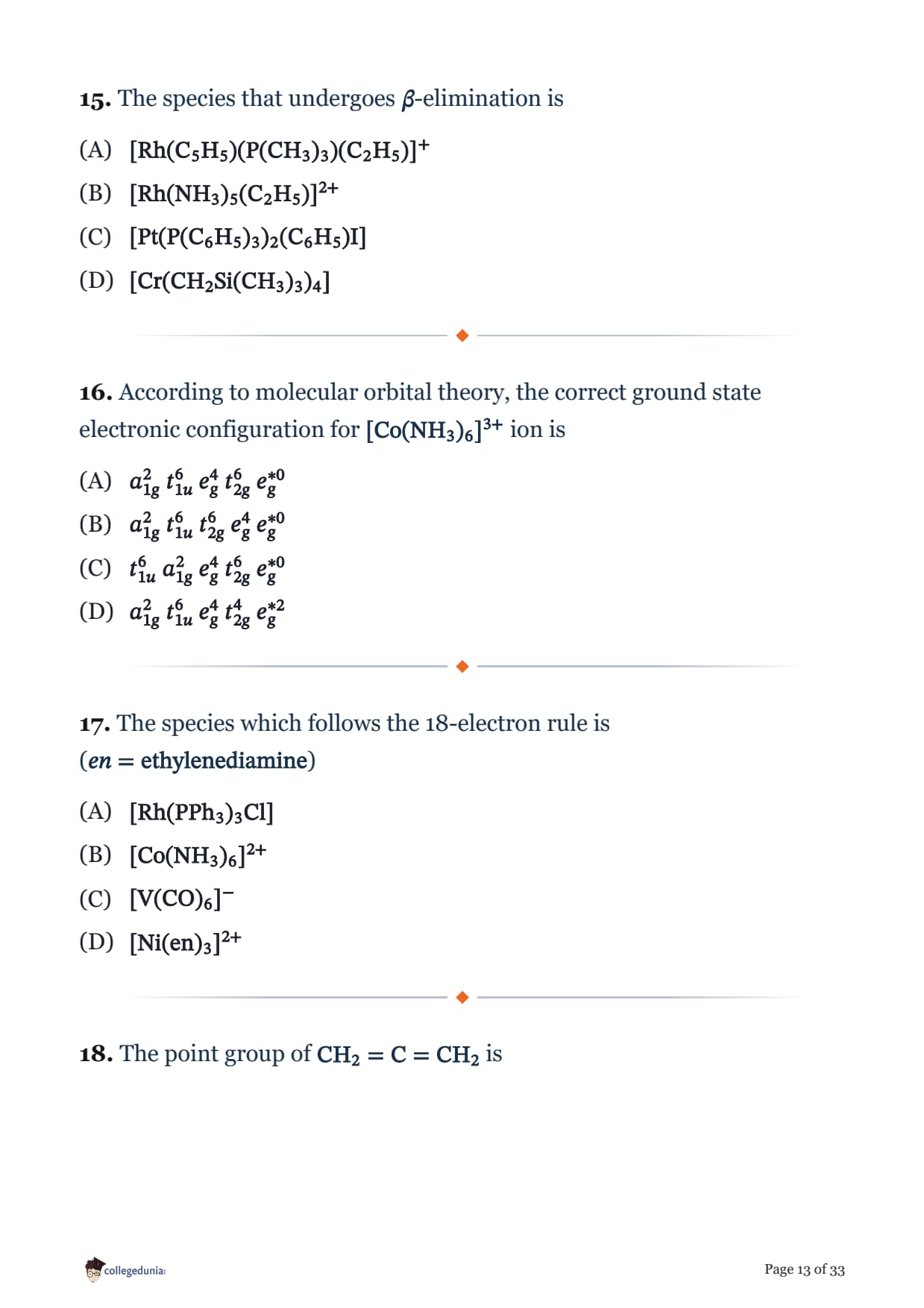
The correct electronic configuration of central metal ion in ferrocene with \(z\)-axis passing through the centre of two \(\mathrm{C_5H_5^-}\) rings and the metal ion is:
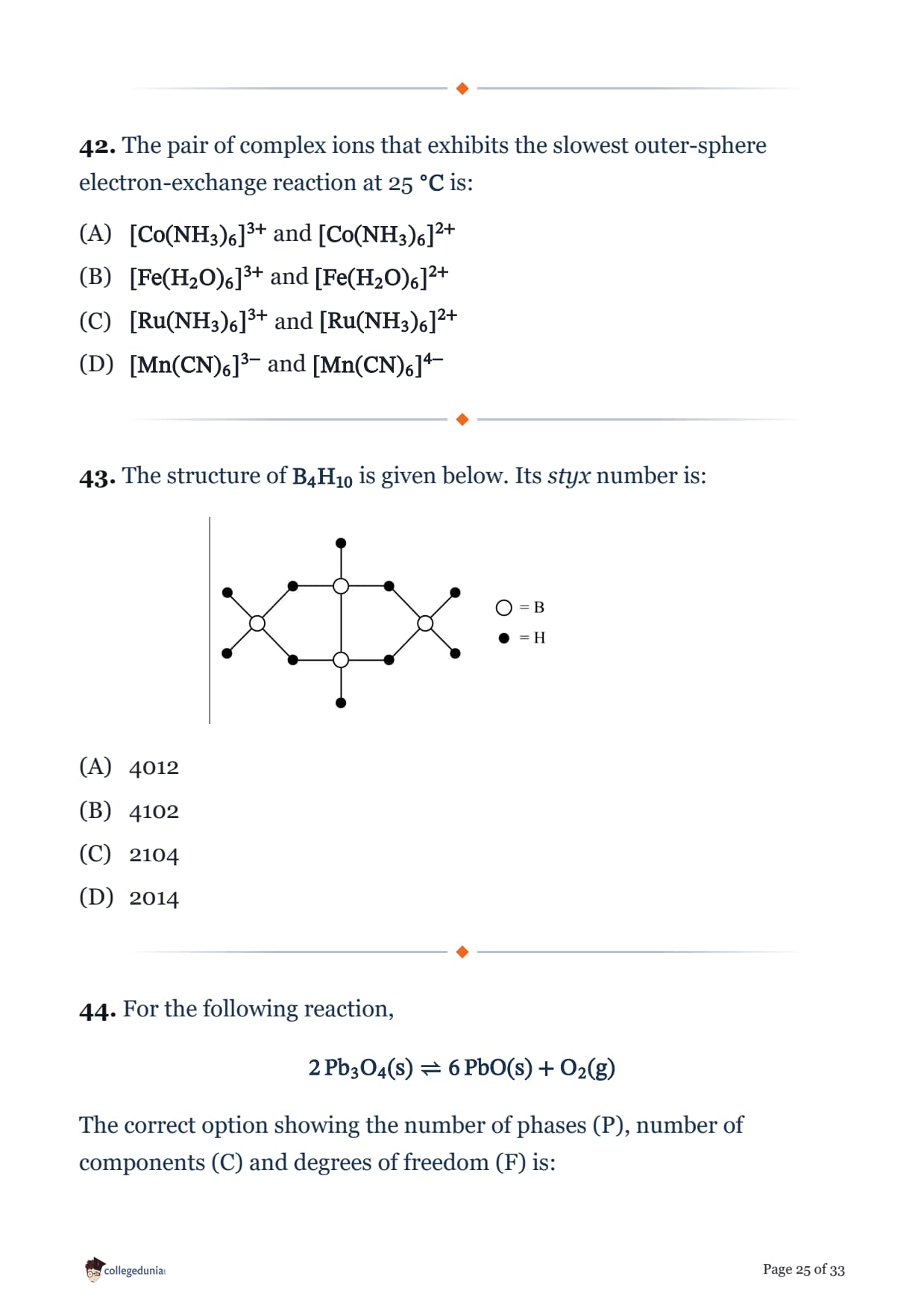
For the following reaction, \[ 2\,\mathrm{Pb_3O_4(s)} \rightleftharpoons 6\,\mathrm{PbO(s)} + \mathrm{O_2(g)} \] The correct option showing the number of phases (P), number of components (C) and degrees of freedom (F) is:
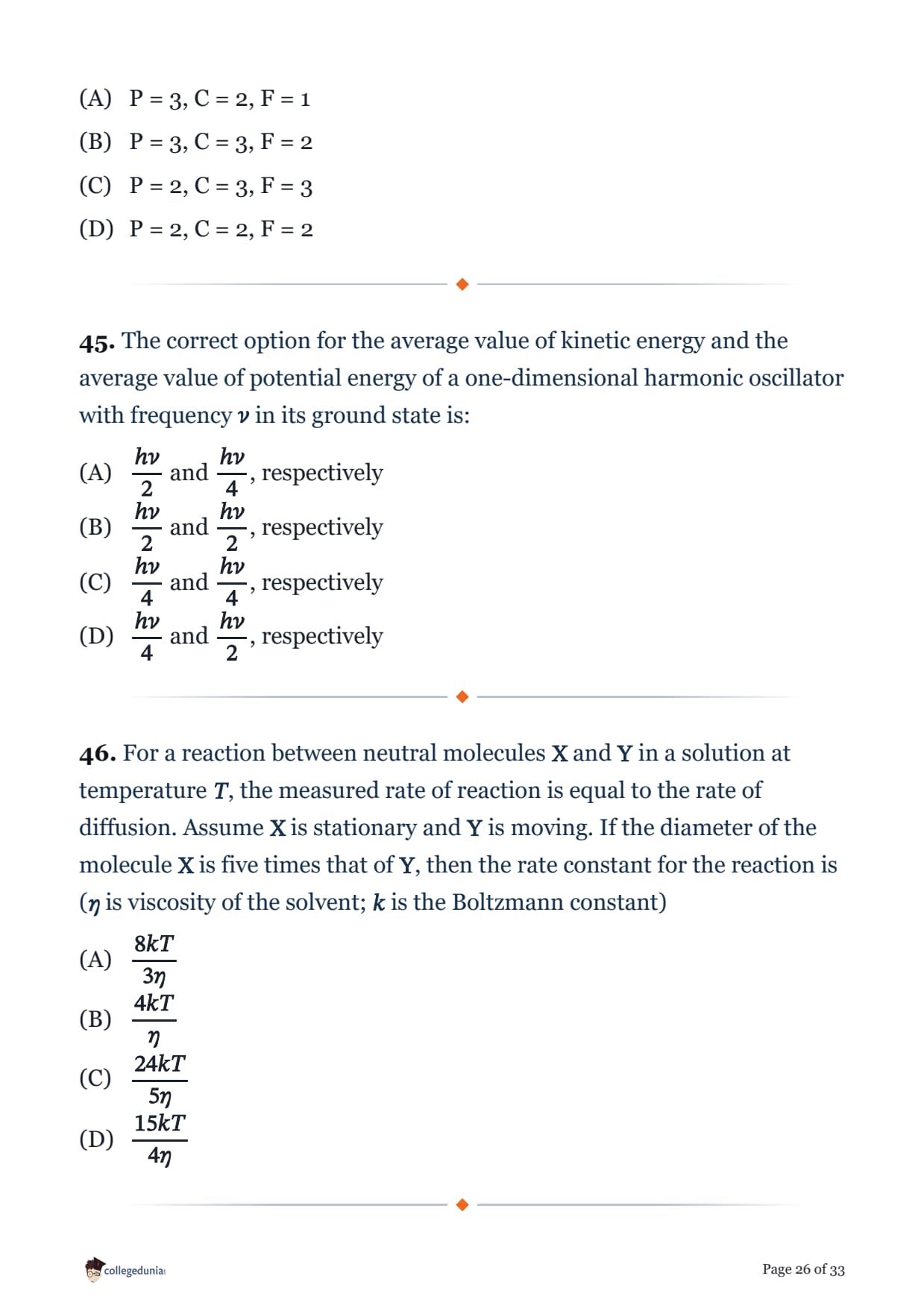
The correct option for the average value of kinetic energy and the average value of potential energy of a one-dimensional harmonic oscillator with frequency \(\nu\) in its ground state is:
(A) \(\dfrac{h\nu}{2}\) and \(\dfrac{h\nu}{4}\), respectively
(B) \(\dfrac{h\nu}{2}\) and \(\dfrac{h\nu}{2}\), respectively
(C) \(\dfrac{h\nu}{4}\) and \(\dfrac{h\nu}{4}\), respectively
(D) \(\dfrac{h\nu}{4}\) and \(\dfrac{h\nu}{2}\), respectively
For a reaction between neutral molecules \(\mathrm{X}\) and \(\mathrm{Y}\) in a solution at temperature \(T\), the measured rate of reaction is equal to the rate of diffusion. Assume \(\mathrm{X}\) is stationary and \(\mathrm{Y}\) is moving. If the diameter of the molecule \(\mathrm{X}\) is five times that of \(\mathrm{Y}\), then the rate constant for the reaction is (\(\eta\) is viscosity of the solvent; \(k\) is the Boltzmann constant)
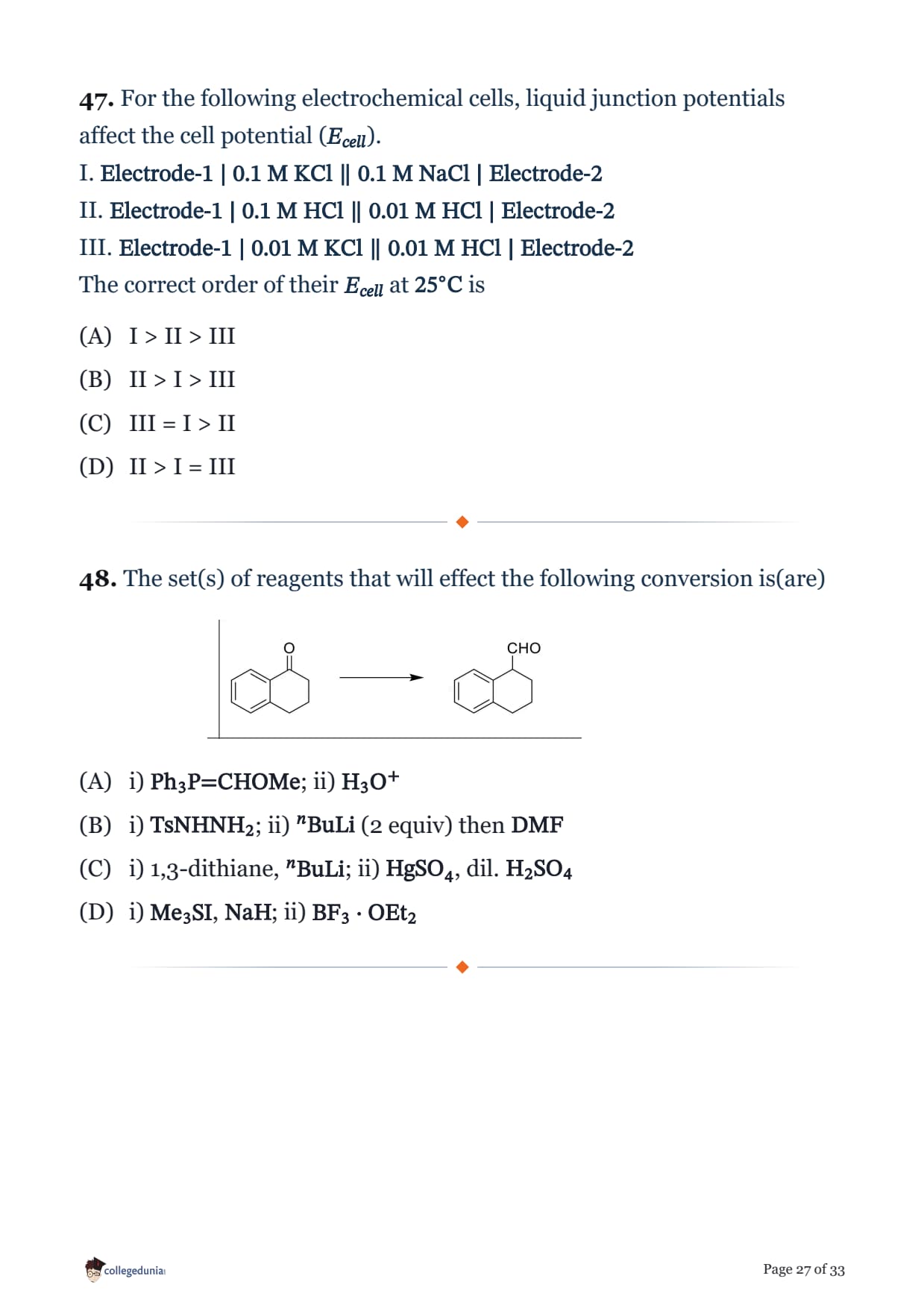
For the following electrochemical cells, liquid junction potentials affect the cell potential (\(E_{cell}\)). I. \(\mathrm{Electrode\text{-}1 \mid 0.1\ M\ KCl \parallel 0.1\ M\ NaCl \mid Electrode\text{-}2}\) II. \(\mathrm{Electrode\text{-}1 \mid 0.1\ M\ HCl \parallel 0.01\ M\ HCl \mid Electrode\text{-}2}\) III. \(\mathrm{Electrode\text{-}1 \mid 0.01\ M\ KCl \parallel 0.01\ M\ HCl \mid Electrode\text{-}2}\) The correct order of their \(E_{cell}\) at \(25^{\circ}\mathrm{C}\) is
Chymotrypsin selectively cleaves a peptide at the carboxyl side of the amino acids having an aryl sidechain. The tripeptide(s) formed on hydrolysis of the peptide, \(\mathrm{Val\text{-}Phe\text{-}Leu\text{-}Met\text{-}Tyr\text{-}Pro\text{-}Gly\text{-}Trp\text{-}Cys}\), with chymotrypsin is(are)
Consider the given pairs of complex ions. The correct pair(s) in which each complex ion exhibits three spin-allowed \(d\text{-}d\) transitions (excluding those arising due to distortions) is(are)
(A) \(\mathrm{[V(H_2O)_6]^{3+}}\) and \(\mathrm{[Ni(H_2O)_6]^{2+}}\)
(B) \(\mathrm{[Cr(H_2O)_6]^{3+}}\) and \(\mathrm{[NiCl_4]^{2-}}\)
(C) \(\mathrm{[Ti(H_2O)_6]^{3+}}\) and \(\mathrm{[Mn(H_2O)_6]^{2+}}\)
(D) \(\mathrm{[FeF_6]^{3-}}\) and \(\mathrm{[FeCl_4]^{2-}}\)
The pair(s) of lanthanide ions whose ground state term symbols have same spin multiplicity \((2S+1)\) and orbital angular momentum \((L)\), but different spin-orbit coupling \((J)\) is(are) (Given: Atomic number: \(\mathrm{Nd}=60\); \(\mathrm{Pm}=61\); \(\mathrm{Ho}=67\); \(\mathrm{Er}=68\))
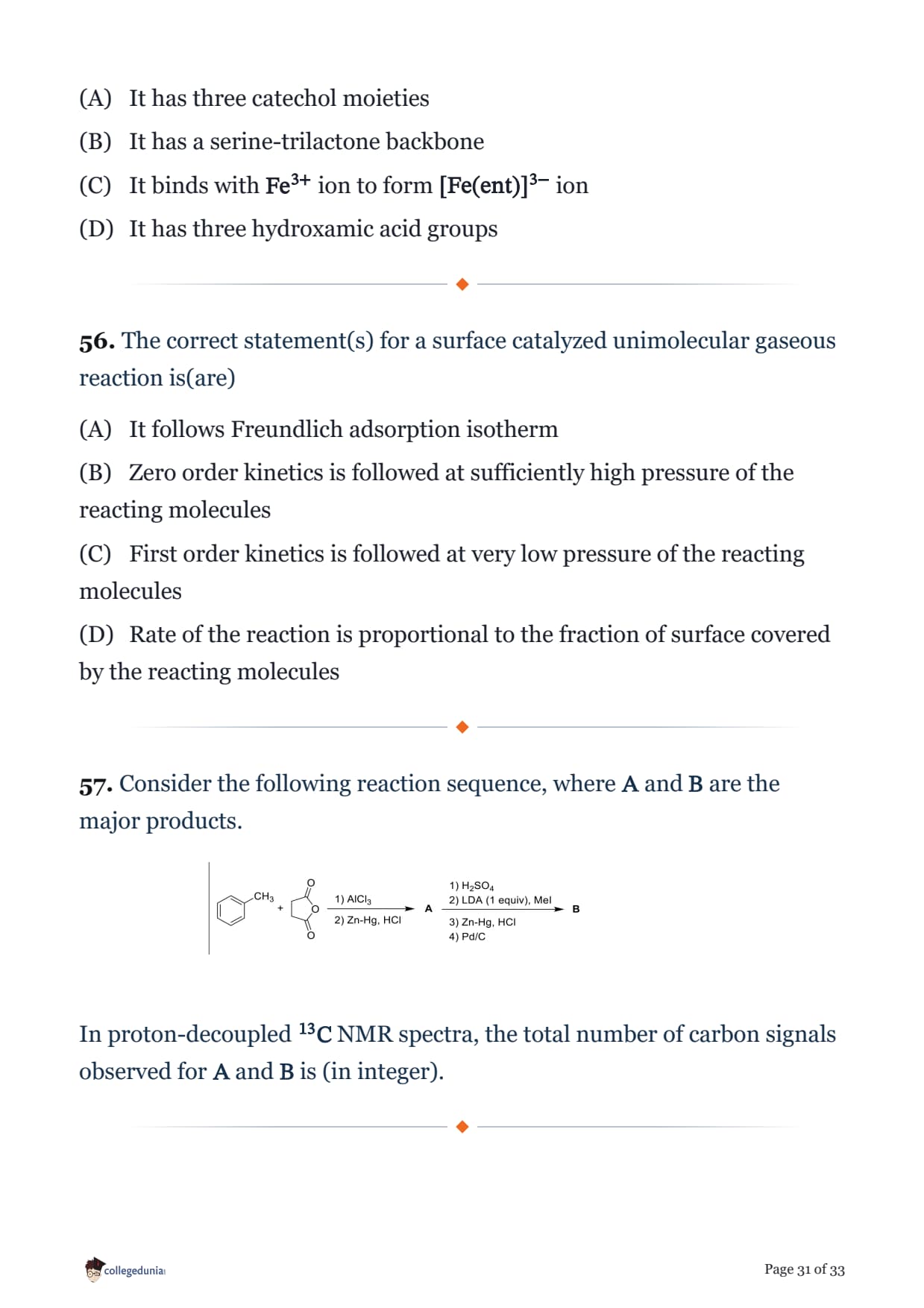
Consider the following reaction sequence, where \(\mathrm{A}\) and \(\mathrm{B}\) are the major products.
In proton-decoupled \(^{13}\mathrm{C}\) NMR spectra, the total number of carbon signals observed for \(\mathrm{A}\) and \(\mathrm{B}\) is (in integer).
The sum of bond orders of metal-metal bonds in \([\mathrm{Os_2Cl_8}]^{2-}\), \([\mathrm{Re_2Cl_8}]^{2-}\), \([\mathrm{W_2(NMe_2)_6}]\) and \([\mathrm{Mo(C_5H_5)(CO)_2}]_2\) is (in integer).
The sum of the number of \(\alpha\)-particles and \(\beta\)-particles emitted in the nuclear decay process, \(^{238}_{92}\mathrm{U} \rightarrow\, ^{206}_{82}\mathrm{Pb}\), is (in integer).
The positions of two atoms in spherical polar coordinates \((r, \theta, \Phi)\) are \((1, \frac{\pi}{2}, \frac{\pi}{2})\) and \((1, \frac{\pi}{4}, \frac{3\pi}{2})\), where the distance is in \(\overset{\circ}{\mathrm{A}}\) and the angles are in radian. The interatomic distance (in \(\overset{\circ}{\mathrm{A}}\)) is (rounded off to two decimal places).
If the translational partition function for \(\mathrm{H_2}\) confined in a 1 L vessel at 300 K is \(y \times 10^{27}\), then the value of \(y\) is (rounded off to one decimal place). (Given: Atomic mass (in amu): H = 1.008; 1 amu = \(1.661 \times 10^{-27}\) kg; \(h = 6.626 \times 10^{-34}\) J s; \(k = 1.381 \times 10^{-23}\) J K\(^{-1}\))
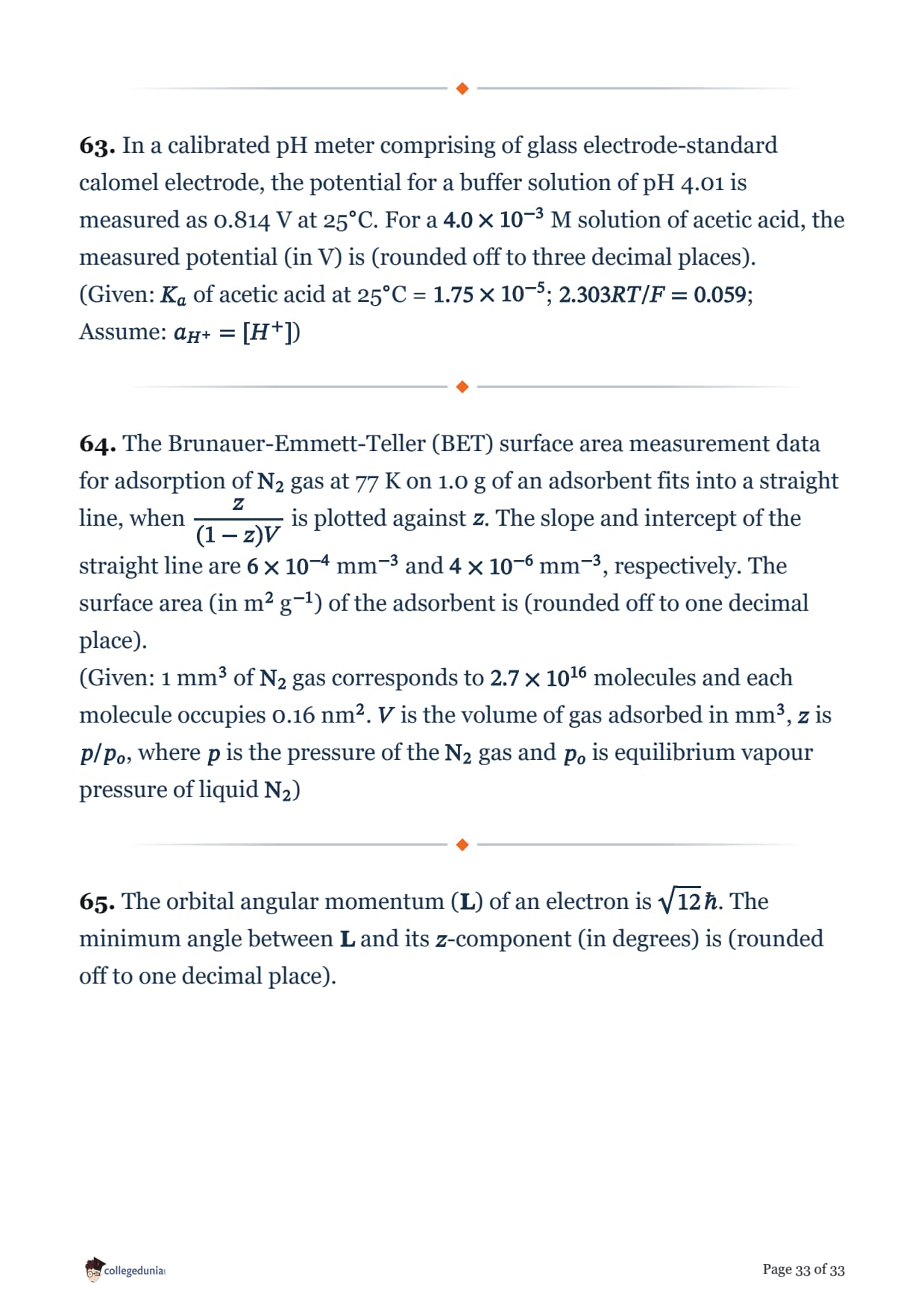
In a calibrated pH meter comprising of glass electrode-standard calomel electrode, the potential for a buffer solution of pH 4.01 is measured as 0.814 V at 25\(^{\circ}\)C. For a \(4.0 \times 10^{-3}\) M solution of acetic acid, the measured potential (in V) is (rounded off to three decimal places). (Given: \(K_a\) of acetic acid at 25\(^{\circ}\)C = \(1.75 \times 10^{-5}\); \(2.303RT/F = 0.059\); Assume: \(a_{H^+} = [H^+]\))
The Brunauer-Emmett-Teller (BET) surface area measurement data for adsorption of \(\mathrm{N_2}\) gas at 77 K on 1.0 g of an adsorbent fits into a straight line, when \(\dfrac{z}{(1-z)V}\) is plotted against \(z\). The slope and intercept of the straight line are \(6 \times 10^{-4}\) mm\(^{-3}\) and \(4 \times 10^{-6}\) mm\(^{-3}\), respectively. The surface area (in m\(^2\) g\(^{-1}\)) of the adsorbent is (rounded off to one decimal place). (Given: 1 mm\(^3\) of \(\mathrm{N_2}\) gas corresponds to \(2.7 \times 10^{16}\) molecules and each molecule occupies 0.16 nm\(^2\). \(V\) is the volume of gas adsorbed in mm\(^3\), \(z\) is \(p/p_o\), where \(p\) is the pressure of the \(\mathrm{N_2}\) gas and \(p_o\) is equilibrium vapour pressure of liquid \(\mathrm{N_2}\))
The orbital angular momentum (\(\mathbf{L}\)) of an electron is \(\sqrt{12}\,\hbar\). The minimum angle between \(\mathbf{L}\) and its \(z\)-component (in degrees) is (rounded off to one decimal place).
GATE 2026 Chemistry Exam Pattern and Marking Scheme Explained
As per the information bulletin on the official website (gate2026.iitg.ac.in), GATE 2026 CY is a single 3-hour computer-based test covering General Aptitude and the core Chemistry syllabus, which is split into Physical, Organic, and Inorganic Chemistry.
Total questions: 65, made up of 33 single-correct MCQs, 16 Multiple Select (MSQ) questions, and 16 Numerical Answer Type (NAT) questions
Duration: 3 hours
Total marks: 100 - General Aptitude carries 15 marks (10 questions) and the core Chemistry section carries 85 marks (55 questions)
Mark split: questions 1 to 5 and 11 to 35 carry 1 mark each; questions 6 to 10 and 36 to 65 carry 2 marks each
Marking scheme: a wrong MCQ answer costs 1/3 mark on a 1-mark question and 2/3 mark on a 2-mark question; NAT and MSQ questions carry no negative marking
High-Weightage Areas in GATE 2026 Chemistry to Focus On First
Going through this year's 65 solved questions, Physical Chemistry was the heaviest section, followed closely by Organic and Inorganic Chemistry.
Physical Chemistry: 21 questions - the largest block, led by Quantum Chemistry (about 5 questions on operators, spherical harmonics, and angular momentum), with Electrochemistry, Chemical Kinetics, Chemical Thermodynamics, and molecular Spectroscopy close behind
Organic Chemistry: 18 questions, spread across reaction mechanisms and rearrangements, pericyclic reactions, and stereochemistry (four questions on relative configuration and chirality alone)
Inorganic Chemistry: 16 questions, with Organometallic Chemistry the single busiest topic (about 5 questions), plus Coordination Chemistry, Bioinorganic Chemistry, boranes, and lanthanide term symbols
General Aptitude: 10 questions worth 15 marks, mixing verbal reasoning, spatial reasoning, and quantitative puzzles
GATE 2026 Chemistry Paper Analysis Video
Source: NPTEL
How to Use the GATE 2026 CY Question Paper for Practice
Treat this paper as a timed mock before you look at a single solution.
Attempt all 65 questions in 3 hours under exam conditions first, without checking the solution PDF
Score yourself with the marking scheme above (MCQ negative marking, NAT and MSQ with no negative marking) to get a realistic number
Since Physical Chemistry carried the most questions this year, redo every Quantum Chemistry, Electrochemistry, and Kinetics question you got wrong before moving to lower-weightage topics
Use the solution PDF's step-by-step working for the Numerical Answer Type questions - the physical-chemistry NAT problems in this paper carried the longest, most calculation-heavy solutions
Re-attempt the paper a second time a week later, focusing only on the areas where you lost marks
GATE 2026 Chemistry Question Paper FAQs
Ques. Was GATE 2026 Chemistry tougher than previous years?
Ans. Post-exam analysis rated GATE 2026 CY as moderate to difficult. The Multiple Select questions and the calculation-based Numerical Answer Type questions in Physical Chemistry were the trickiest, while most General Aptitude and factual Inorganic Chemistry questions were comparatively easier.
Ques. Which areas had the highest weightage in GATE 2026 Chemistry?
Ans. Physical Chemistry led with 21 questions, followed by Organic Chemistry with 18 and Inorganic Chemistry with 16. Within these, Quantum Chemistry and Organometallic Chemistry were the busiest individual topics.
Ques. How many questions in GATE 2026 CY were General Aptitude versus core Chemistry?
Ans. General Aptitude had 10 questions worth 15 marks. The remaining 55 questions came from the core Chemistry syllabus (Physical, Organic, and Inorganic) worth 85 marks, for 100 marks total.
Ques. Is there negative marking in GATE 2026 Chemistry?
Ans. Yes, but only for MCQs - a wrong answer costs 1/3 mark on a 1-mark MCQ and 2/3 mark on a 2-mark MCQ. Numerical Answer Type (NAT) and Multiple Select (MSQ) questions carry no negative marking, so it is safer to attempt those even when you are not fully sure.
Ques. When was the GATE 2026 result declared?
Ans. The GATE 2026 result was declared on March 19, 2026, with scorecards available for free download from March 27 to May 31, 2026, on the official GOAPS portal.
Ques. Where can I download the GATE 2026 Chemistry question paper with solutions PDF for free?
Ans. Use the download table above on Collegedunia for the free question paper and solutions PDF. For the official paper and provisional answer key, check gate2026.iitg.ac.in.








Comments