




A GATE score of 500 often means about 40–50 marks out of 100, but the exact marks differ by branch and the year’s difficulty. A mid-40s score (such as 43–47 marks) frequently falls close to the 500 score band in many engineering papers.
- A GATE score of 500 is considered good but not top-tier: strong enough for multiple NITs, good state universities, and certain younger IITs or specialisations
- Generally, below the cut-offs for the top IIT core branches.
- Computer Science programs usually require scores between 43 and 47, depending on the exam's difficulty.
- Branches like Electronics and Communication Engineering, Mechanical Engineering, and Civil Engineering might require scores that are equal to or slightly higher.
This article discusses what the GATE Score 500 means how many marks students need to get in the GATE score. It also discusses the admission opportunities in various colleges.
Also Read: What will be the GATE Cutoff for NIT and IIT for the general category?

Key Summary
- 40–50 raw marks tend to be similar to a GATE score of 500, depending on the paper and year.
- A score of 500 is acceptable for many National Institutes of Technology, newer Indian Institutes of Technology, state universities, and specialised or interdisciplinary programs.
- However, it doesn't provide many opportunities in the core areas of the top Indian Institutes of Technology.
- Previously, a 500 score could be achieved by clearly over the qualifying cutoff, often in the mid‑range within the cutoff and the highest marks.
Also Check: GATE 2026 Expected Cutoff for Top Branches
Ques. How many marks exactly does a GATE score of 500 mean?
Ans. A 500 score often falls between 40 and 50 marks for various significant branches, with CSE typically falling between 43 and 47 points in average-difficulty years.
GATE Score 500: How Many Marks Can You Expect in 2026?
A score of 500 is often earned by achieving over the qualifying cutoff but below the top-tier marks in that paper. Because GATE uses standardisation and an adaptive scaling method, the exact marks for a 500 score vary year after year.
| GATE paper | Expected Marks for 500 Score (Approx.) |
|---|---|
| Computer Science (CSE) | 43–47 marks |
| Electronics & Communication (ECE) | 45–50 marks |
| Electrical Engineering (EE) | 42–48 marks |
| Mechanical Engineering (ME) | 45–50 marks |
| Civil Engineering (CE) | 42–48 marks |
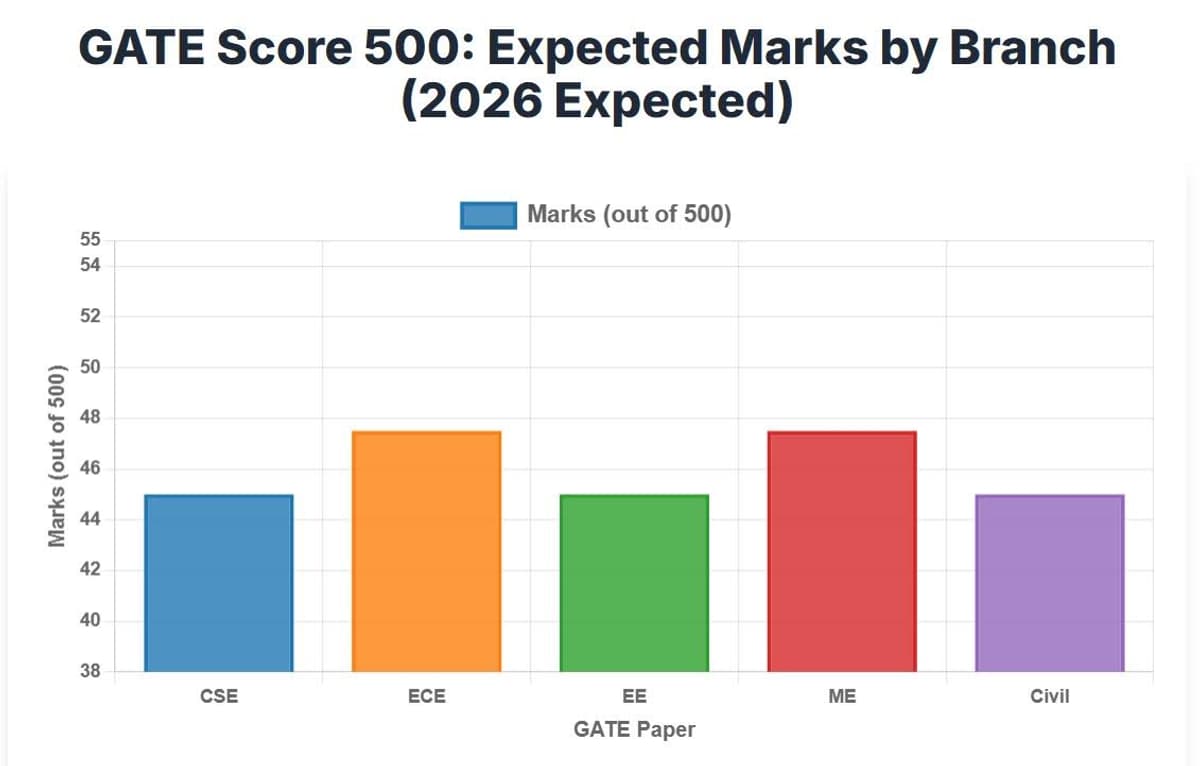
These bands are indicative, based on past marks‑vs‑score and marks‑vs‑rank trends for GATE; actual 2026 values will depend on that year’s difficulty, topper marks, and cutoffs.
Ques. Does a GATE score of 500 require 45 marks?
Ans. In many years and branches, 45 marks can be near or just above 500, especially in tough papers; the actual number depend on that year’s cutoff and topper grades.
Also Read:
- GATE Score Calculation 2026, Formula, Calculation Method, Normalization, Marks vs Score vs Rank
- GATE 2026 Score Validity: Check for M.Tech Admission at IIT and NIT, PSU, and Government Jobs
GATE Score 500 Means How Many Marks: Historical / Trend‑Based View
A 500 score typically falls in the mid-40s mark range for many popular fields in average-difficulty years, according to a historical study of GATE marks vs. score patterns.
Typical trend witnessed in recent years (approximate):
- CSE: Approximately 43–47 points often correspond to a score close to 500, with minor variations from year to year.
- ECE/EE: In simpler papers, these branches may occasionally require somewhat higher or comparable scores than CSE to get 500.
- ME/CE: In difficult years, candidates may need to score in the mid- to high-40s; in easier years, they may need to score in the low-40s.
| Branch | 2025 | 2024 | 2023 | 2022 | General Trend |
|---|---|---|---|---|---|
| CSE | 42–46 | 43–47 | 44–48 | 41–45 | Usually requires +12 to +18 marks over the qualifying marks |
| ECE | 44–48 | 43–47 | 45-50 | 42–46 | Varies with paper difficulty; often +10 to +20 marks over the cutoff |
| EE | 41–45 | 42–46 | 43–47 | 40–44 | Typically +11 to +17 marks over qualifying marks |
| ME | 44–48 | 43–47 | 42–46 | 43–47 | Needs +12 to +18 marks above the cutoff in most years |
| Civil | 42–46 | 41–45 | 40–44 | 42–46 | Generally +10 to +16 marks over the cutoff; shifts with difficulty |
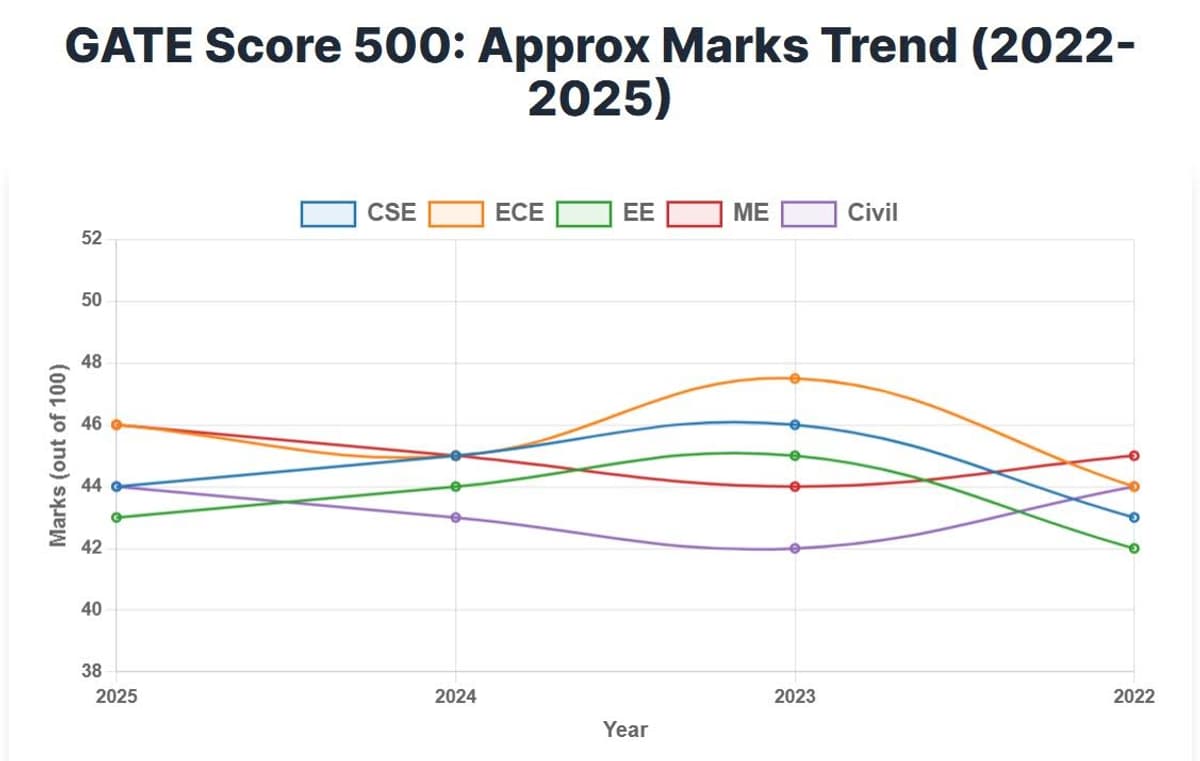
Note: The data for the historical trends is sourced by analysing various year-wise mark vs percentile analyses.
Ques. If I don't get into IITs, what are the top universities for a 500 GATE score?
Ans. Top and mid-tier NITs, reputable state universities, and certain central or private institutions that offer M. Tech/ME in core or applied branches—where 500-level scores are frequently accepted—are good choices.
Also, check the previous year's cutoff for Different Institutes:
- GATE Cutoff 2025 for IIT Bombay
- GATE Cutoff 2025 for IISc Bangalore
- GATE Cutoff 2025 for IIT Ropar
- GATE Cutoff 2025 for IIT Dhanbad
GATE Score 500: Admission Opportunities
A GATE score of 500 widens your options much more than just clearing the cutoff. It may not be enough for top IIT specialisations in the open category, but it can still open good doors.
| Category | Institute Type | What a 500 Score Typically Offers |
|---|---|---|
| IITs—Old | Top, established IITs | Generally, below cutoffs for high-demand core branches (CSE, ECE, EE, ME, CE) in the open category; possible in some niche/interdisciplinary programs and for OBC/EWS/SC/ST in certain years. |
| IITs—Newer | Newer / less competitive IITs | Certain interdisciplinary or less demanding specialisations may accept around 500, especially in non-CSE branches and for reserved categories. |
| NITs – Top | NIT Trichy, Surathkal, Warangal, etc. | 500 can make you competitive for good but not the most sought‑after specialisations, more so in non‑CSE branches or with a reservation. |
| NITs—Mid/ New | Mid-tier and newer NITs | Many accept 500–600 scores for core branches or strong specialisations, especially for general and OBC candidates. |
| Other Institutes | State government colleges & universities | Often, M. Tech/ME cutoffs are at or below the 500 range for various programs. |
| Private/Other | Reputed private or specialised institutes | 500 can be strong enough for specialised areas like environmental, energy, or other less crowd-pulling branches, even in otherwise competitive colleges. |
Ques. Do IITs accept applicants with a 500 GATE score?
Ans. 500 is typically below the general category cutoff for top IITs and high-demand core disciplines, although in certain years it might still be competitive for reserved categories, multidisciplinary or specialist specialisations, and newer IITs.
Ques. Can a PSU job be obtained with a score of 500?
Ans. 500 is typically borderline or below average PSU standards, but it may still put you in contention in certain years or for particular categories/posts. The majority of major PSUs set higher cutoffs than 500 for the general category in prominent branches.
GATE Score of 500: Student Opinions
Students might wonder What can we do with a GATE score of 500?
As per Quora: A GATE score of 500 is solid but not at the very top; its usefulness depends on the GATE paper (discipline), normalized score vs. cutoff, your category.
Another user Sourabh Jain said: You may get call for MS & Ph.d. in some of Old IITs ( there are less chances as scenario changes every year but still keep hopes).
We have also received multiple questions like How many marks are needed to score 500+ on the GATE?
As per Quora user Deepak Kumar Tiwary: It can be said that if you score 45+, you can get a score of 500+.
Rank and Competition compared with GATE Score 500
Rank, grades, and GATE score are closely related, yet not in an easy one-to-one manner.
- A 500 score often translates into ranks in the 1000–500 range for well-known branches, including CSE, ECE, EE, ME, and CE, though this varies depending on the year and paper difficulty.
- The same 500 score could result in a higher position in less crowded branches since there are fewer competitors and the distribution is different.
- Annual rank-versus-marks charts show why, particularly in highly competitive branches, a slight shift in marks in the mid-40s to mid-50s can result in a substantial rise in rank.



Comments