




The GATE 2026 Petroleum Engineering (PE) Slot 2 Question Paper with Solution PDF will be provided here after the exam is completed. The GATE PE exam is scheduled on February 8th, in the Afternoon Session (AN) from 2:30 PM to 5:30 PM.
The GATE Petroleum Engineering exam will be held in CBT mode. The total duration will be 3 hours. There will be two sections in the question paper: General Aptitude with 5 Marks and Core & Math with 85 Marks. Combining both, the exam will be held for a total of 100 marks.
According to the analysis of previous years’ question paper, the PE question paper is expected to be moderate to difficult. Candidates who will attempt 55 to 65 questions with around 85 - 90% accuracy is considered to be safe. It can help them to score around 60-70 marks out of 100 which is considered to be safe and good.
GATE 2026 PE Question Paper with Solution PDF
| GATE 2026 PE Question Paper with Solution PDF | Download | Check Solutions |
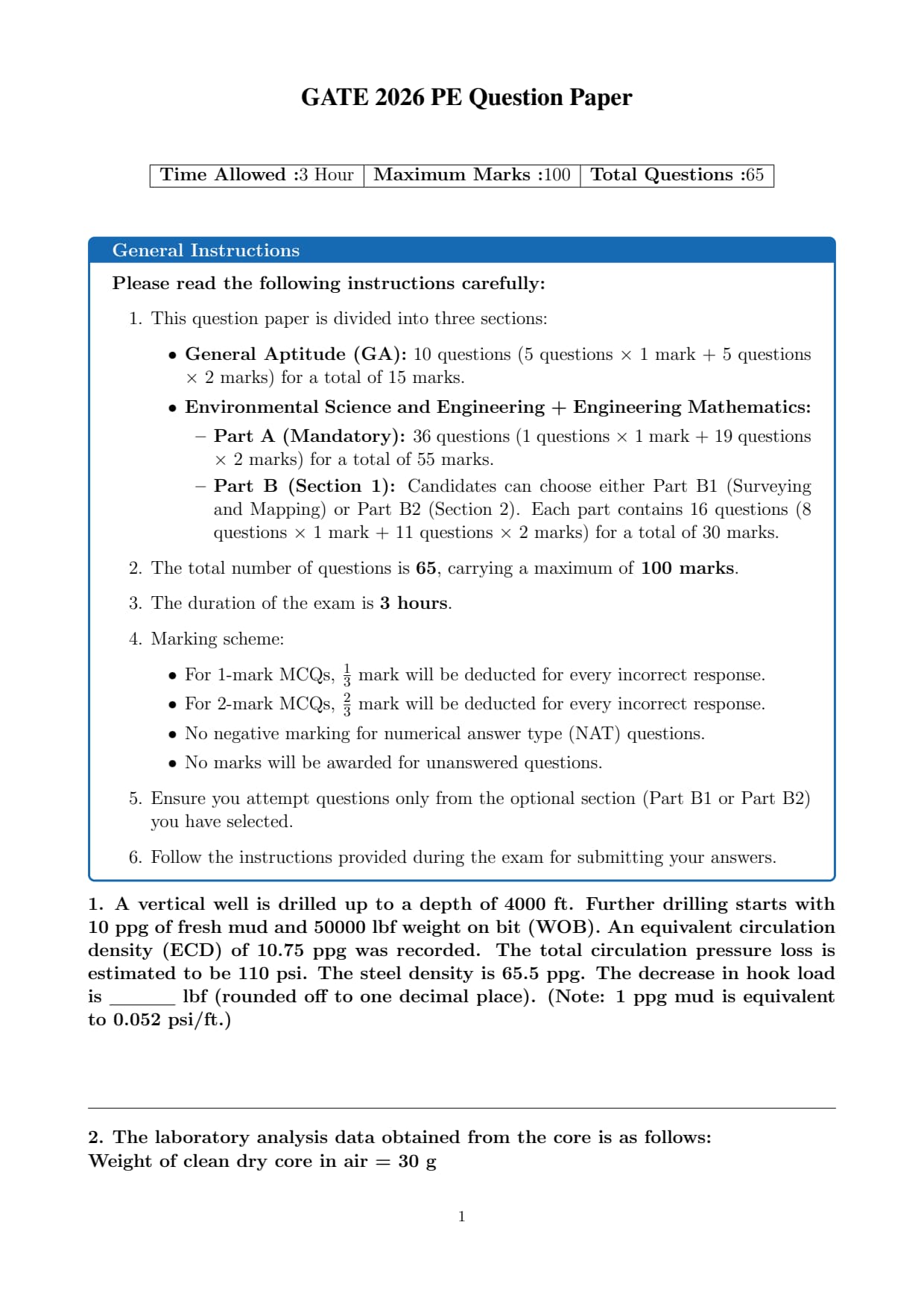
A vertical well is drilled up to a depth of 4000 ft. Further drilling starts with 10 ppg of fresh mud and 50000 lbf weight on bit (WOB). An equivalent circulation density (ECD) of 10.75 ppg was recorded. The total circulation pressure loss is estimated to be 110 psi. The steel density is 65.5 ppg.
The decrease in hook load is lbf (rounded off to one decimal place).
(Note: 1 ppg mud is equivalent to 0.052 psi/ft.)
The laboratory analysis data obtained from the core is as follows:
Weight of clean dry core in air = 30 g
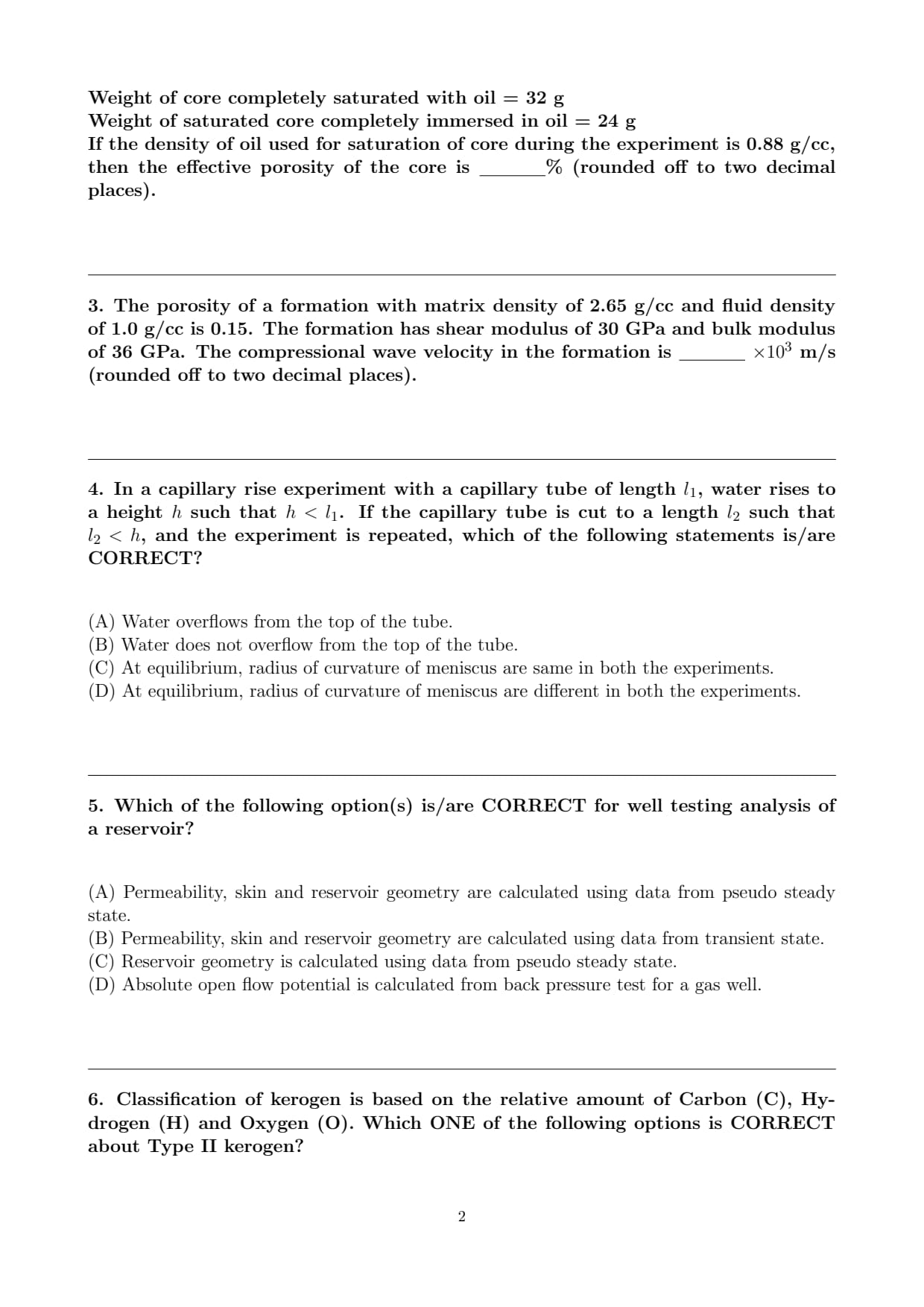
Weight of core completely saturated with oil = 32 g
Weight of saturated core completely immersed in oil = 24 g
If the density of oil used for saturation of core during the experiment is 0.88 g/cc, then the effective porosity of the core is \hspace{1.5cm}% (rounded off to two decimal places).
The porosity of a formation with matrix density of 2.65 g/cc and fluid density of 1.0 g/cc is 0.15. The formation has shear modulus of 30 GPa and bulk modulus of 36 GPa.
The compressional wave velocity in the formation is (times 10^3) m/s (rounded off to two decimal places).
In a capillary rise experiment with a capillary tube of length \(l_1\), water rises to a height \(h\) such that \(h < l_1\).
If the capillary tube is cut to a length \(l_2\) such that \(l_2 < h\), and the experiment is repeated, which of the following statements is/are CORRECT?
Which of the following option(s) is/are CORRECT for well testing analysis of a reservoir?
Classification of kerogen is based on the relative amount of Carbon (C), Hydrogen (H) and Oxygen (O).
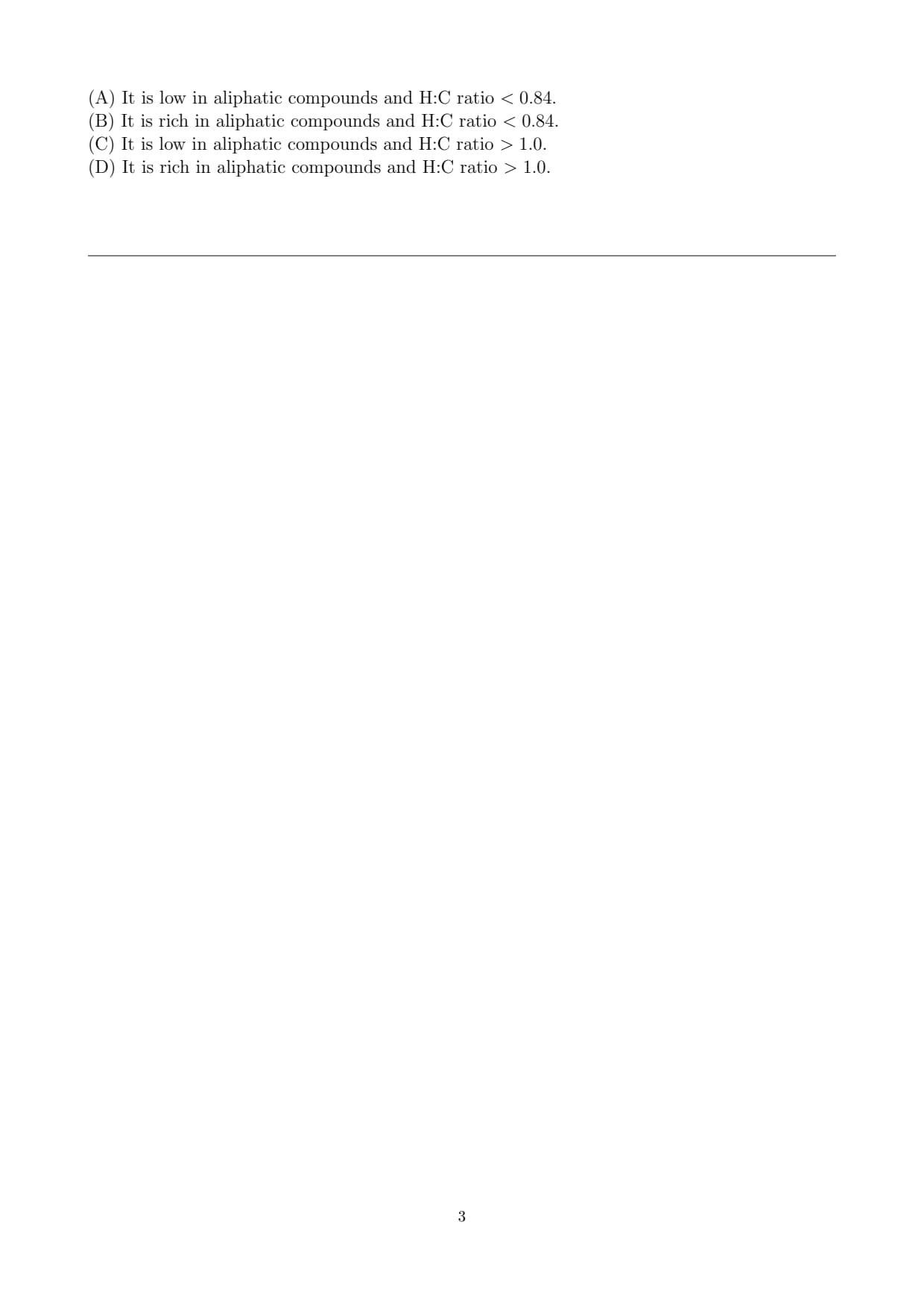
Which ONE of the following options is CORRECT about Type II kerogen?



Comments