




The question paper for GATE 2026 Mathematics (MA) along with the solution pdf will be available here after the exam. Candidates can download both question papers and solutions after the exam, i,e February 7th from 9:30 AM to 12:30 PM.
The Mathematics paper is made up of 65 questions, of which 10 questions come from general aptitude, and the other 55 questions are from core Mathematics. Out of 100 marks, 85 marks will be covered by core Mathematics, whereas the General Aptitude section will be of 15 marks.
Based on the previous year’s analysis, the Mathematics paper is continuing to be moderate yet challenging. To secure under 1000 rank in MA, you likely need to score 55-60+ marks out 100.
GATE 2026 MA Question Paper with Solution PDF
| GATE 2026 MA Question Paper with Solution PDF | Download | Check Solutions |

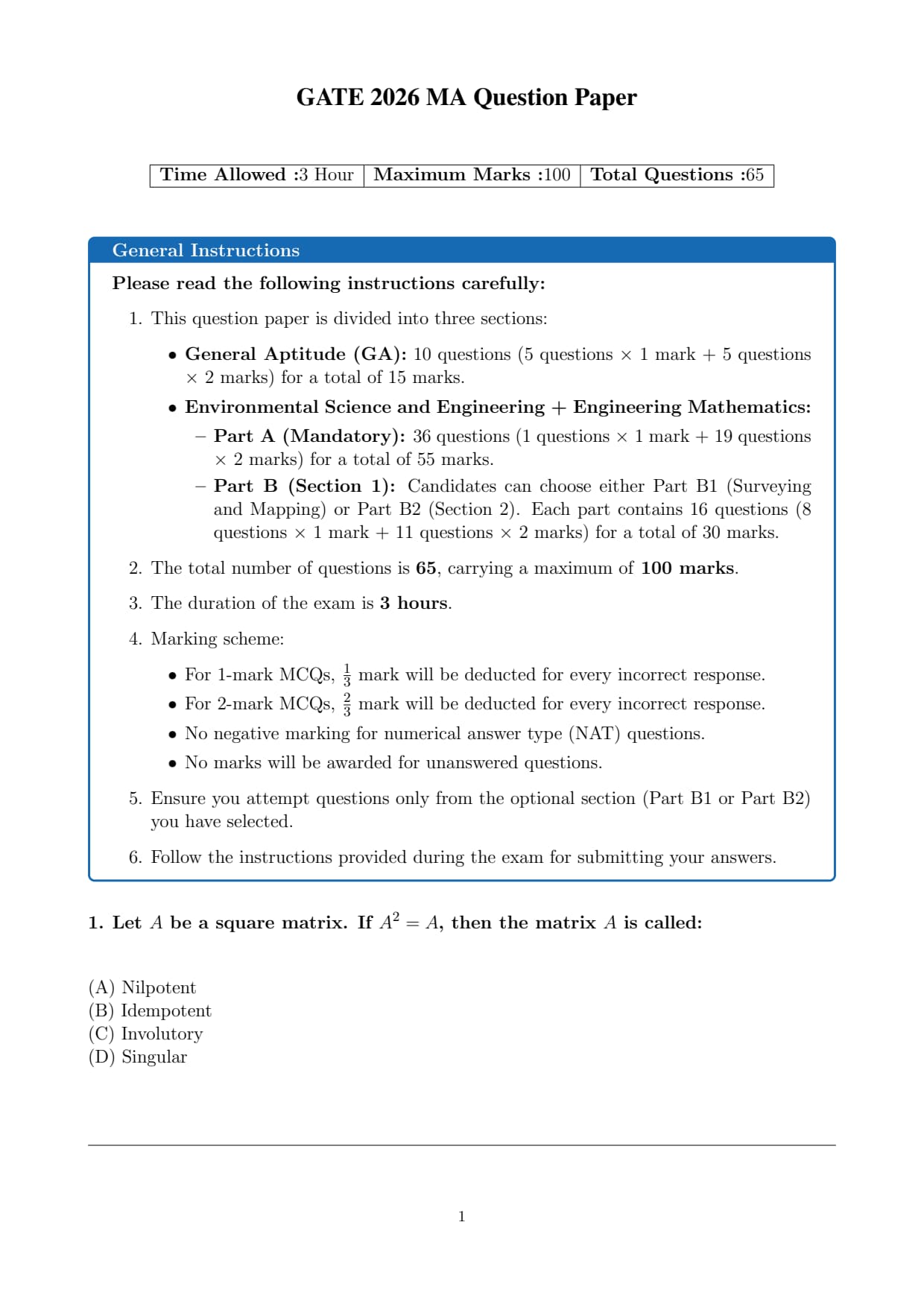
Let \(A\) be a square matrix. If \(A^2 = A\), then the matrix \(A\) is called:
View Solution
Step 1: Understanding the given condition.
The condition given in the question is \(A^2 = A\). This means that when the matrix \(A\) is multiplied by itself, the result is the same matrix \(A\).
Step 2: Definition of an idempotent matrix.
A square matrix \(A\) is called an idempotent matrix if it satisfies the condition \[ A^2 = A \]
This definition directly matches the given condition in the question.
Step 3: Analysis of the given options.
(A) Nilpotent: A nilpotent matrix satisfies \(A^k = 0\) for some positive integer \(k\), which is not given here.
(B) Idempotent: Correct — an idempotent matrix satisfies \(A^2 = A\).
(C) Involutory: An involutory matrix satisfies \(A^2 = I\), where \(I\) is the identity matrix.
(D) Singular: A singular matrix is one whose determinant is zero, which is unrelated to the given condition.
Step 4: Conclusion.
Since the matrix satisfies \(A^2 = A\), it is correctly classified as an idempotent matrix.
Quick Tip: Remember these key matrix properties: \(A^2 = A\) (Idempotent), \(A^2 = I\) (Involutory), \(A^k = 0\) (Nilpotent).
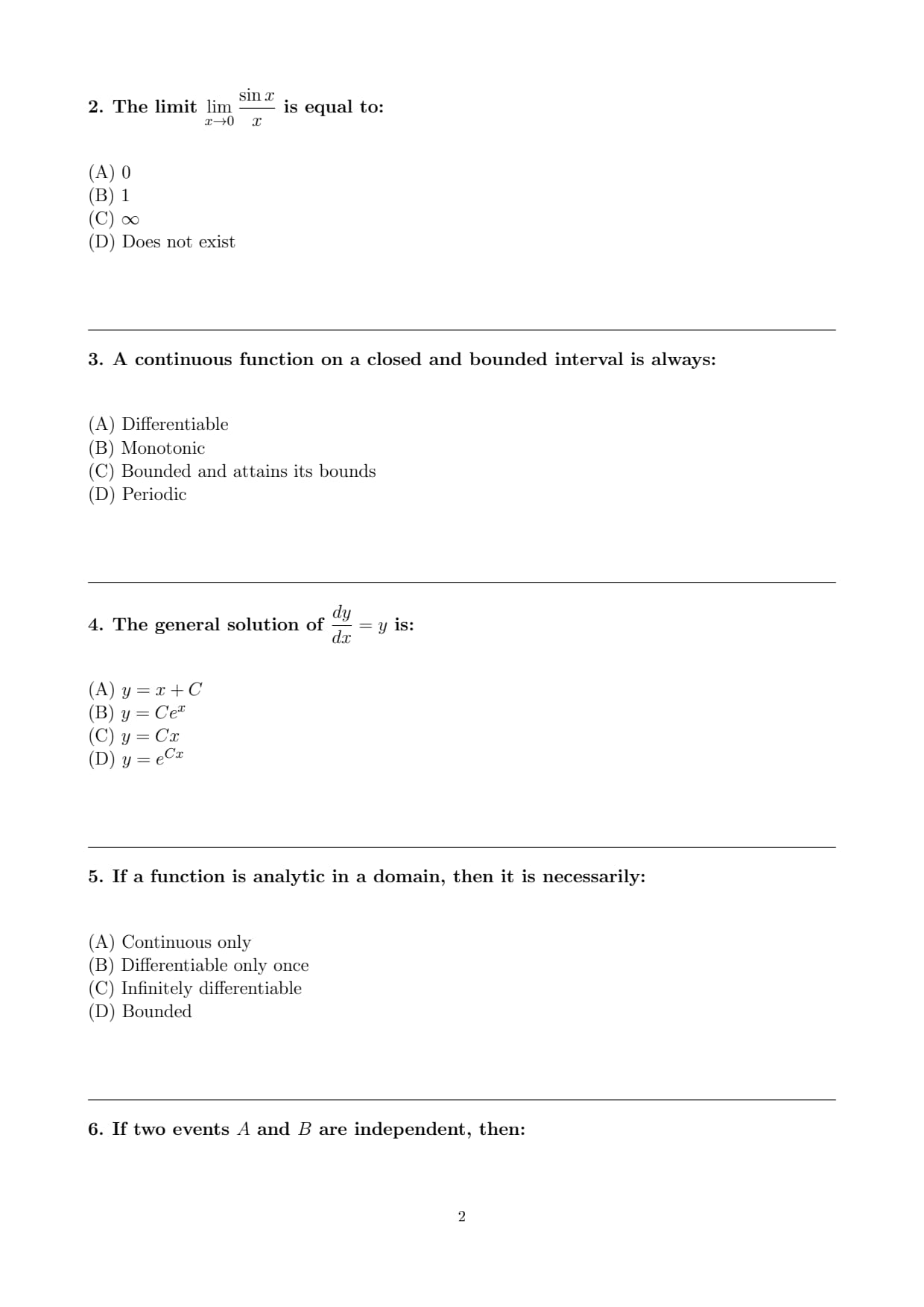
The limit \(\displaystyle \lim_{x \to 0} \frac{\sin x}{x}\) is equal to:
View Solution
Step 1: Understanding the meaning of the limit.
The expression \[ \lim_{x \to 0} \frac{\sin x}{x} \]
asks for the value that the ratio \(\frac{\sin x}{x}\) approaches as \(x\) gets very close to zero from both the positive and negative sides.
Step 2: Behavior of numerator and denominator near zero.
As \(x \to 0\), \[ \sin x \to 0 \quad and \quad x \to 0 \]
So the expression is of the indeterminate form \(\frac{0}{0}\), which means we must evaluate the limit carefully rather than substituting directly.
Step 3: Using a fundamental trigonometric identity.
One of the most important standard limits in calculus is: \[ \lim_{x \to 0} \frac{\sin x}{x} = 1 \]
This result is obtained using geometric arguments involving the unit circle or by comparing areas of sectors and triangles.
Step 4: Conceptual explanation.
For very small values of \(x\) (measured in radians), the value of \(\sin x\) becomes almost equal to \(x\). Hence, the ratio \(\frac{\sin x}{x}\) becomes closer and closer to \(1\) as \(x\) approaches zero.
Step 5: Analysis of the given options.
(A) \(0\): Incorrect, because \(\sin x\) decreases at the same rate as \(x\), not faster.
(B) \(1\): Correct — the ratio approaches \(1\) as \(x \to 0\).
(C) \(\infty\): Incorrect, the expression remains finite near zero.
(D) Does not exist: Incorrect, since the left-hand and right-hand limits are equal.
Step 6: Final conclusion.
Since the ratio \(\frac{\sin x}{x}\) approaches \(1\) from both sides as \(x \to 0\), the value of the limit is 1.
Quick Tip: This limit is the foundation of derivatives of trigonometric functions, especially \(\frac{d}{dx}(\sin x) = \cos x\).
A continuous function on a closed and bounded interval is always:
View Solution
Step 1: Understanding the given condition.
The function is stated to be continuous on a closed and bounded interval.
Let the interval be \([a, b]\), where \(a\) and \(b\) are real numbers, \(a < b\), and both endpoints are included.
Step 2: Applying the Extreme Value Theorem.
According to the Extreme Value Theorem, if a function is continuous on a closed and bounded interval \([a, b]\), then:
• The function is bounded on \([a, b]\), and
• The function attains both its maximum and minimum values at least once in \([a, b]\).
Step 3: Analysis of the given options.
(A) Differentiable: Incorrect — continuity does not guarantee differentiability. A function can be continuous but not differentiable.
(B) Monotonic: Incorrect — a continuous function may increase and decrease within the interval.
(C) Bounded and attains its bounds: Correct — this follows directly from the Extreme Value Theorem.
(D) Periodic: Incorrect — periodicity is unrelated to continuity on a closed interval.
Step 4: Conclusion.
Since every continuous function on a closed and bounded interval is bounded and achieves both its maximum and minimum values, the correct answer is (C).
Quick Tip: Always associate “continuous + closed and bounded interval” with the Extreme Value Theorem.
The general solution of \(\displaystyle \frac{dy}{dx} = y\) is:
View Solution
Step 1: Identifying the type of differential equation.
The given equation \[ \frac{dy}{dx} = y \]
is a first-order differential equation in which variables can be separated. Hence, it is a separable differential equation.
Step 2: Separating the variables.
Rewriting the equation, we get: \[ \frac{1}{y}\,dy = dx \]
This separates all \(y\) terms on one side and all \(x\) terms on the other side.
Step 3: Integrating both sides.
Integrating both sides, \[ \int \frac{1}{y}\,dy = \int dx \]
which gives \[ \ln |y| = x + C \]
where \(C\) is the constant of integration.
Step 4: Removing the logarithm.
Taking exponential on both sides, \[ |y| = e^{x+C} \]
This can be written as \[ y = Ce^{x} \]
where \(C\) is an arbitrary constant (positive or negative).
Step 5: Analysis of the given options.
(A) \(y = x + C\): Incorrect — this satisfies \(\frac{dy}{dx} = 1\), not \(y\).
(B) \(y = Ce^{x}\): Correct — differentiating gives \(\frac{dy}{dx} = Ce^{x} = y\).
(C) \(y = Cx\): Incorrect — derivative is constant \(C\).
(D) \(y = e^{Cx}\): Incorrect — this does not represent the general solution form.
Step 6: Conclusion.
The general solution of the differential equation \(\displaystyle \frac{dy}{dx} = y\) is \[ \boxed{y = Ce^{x}} \]
Quick Tip: For equations of the form \(\frac{dy}{dx} = ky\), the general solution is always \(y = Ce^{kx}\).
If a function is analytic in a domain, then it is necessarily:
View Solution
Step 1: Understanding the meaning of an analytic function.
A complex function is said to be analytic in a domain if it is complex differentiable at every point of that domain. Complex differentiability is a much stronger condition than real differentiability.
Step 2: Important property of analytic functions.
One of the fundamental results of complex analysis states that if a function is analytic in a domain, then it possesses derivatives of all orders in that domain. That is, the function is infinitely differentiable.
Step 3: Theoretical justification.
Analytic functions satisfy the Cauchy–Riemann equations and can be represented by a power series in a neighborhood of every point in the domain. This power series representation guarantees the existence of derivatives of all orders.
Step 4: Analysis of the given options.
(A) Continuous only: Incorrect — analytic functions are not just continuous, they have much stronger smoothness properties.
(B) Differentiable only once: Incorrect — analyticity implies differentiability of all orders.
(C) Infinitely differentiable: Correct — this is a direct consequence of analyticity.
(D) Bounded: Incorrect — an analytic function need not be bounded in its domain.
Step 5: Conclusion.
Since every analytic function has derivatives of all orders in its domain, it is necessarily infinitely differentiable.
Quick Tip: In complex analysis, remember: \textbf{Analytic \(\Rightarrow\) infinitely differentiable \(\Rightarrow\) power series expansion}.
If two events \(A\) and \(B\) are independent, then:
View Solution
Step 1: Meaning of independent events.
Two events \(A\) and \(B\) are called independent if the occurrence of one event does not influence the occurrence of the other. In simple terms, knowing whether \(A\) has occurred gives no information about \(B\), and vice versa.
Step 2: Conditional probability viewpoint.
By definition, if \(A\) and \(B\) are independent, then \[ P(A|B) = P(A) \quad and \quad P(B|A) = P(B) \]
This means the probability of \(A\) remains the same even after \(B\) has occurred.
Step 3: Deriving the required formula.
We know the general formula of conditional probability: \[ P(A|B) = \frac{P(A \cap B)}{P(B)} \]
Since \(P(A|B) = P(A)\) for independent events, we get: \[ \frac{P(A \cap B)}{P(B)} = P(A) \]
Multiplying both sides by \(P(B)\), \[ P(A \cap B) = P(A)P(B) \]
Step 4: Checking the given options.
(A) Incorrect — addition rule applies to mutually exclusive events, not independent ones.
(B) Correct — this is the defining condition of independent events.
(C) Incorrect — for independent events, \(P(A|B) = P(A)\), not a sum.
(D) Incorrect — probability of union follows a different formula.
Step 5: Final conclusion.
If events \(A\) and \(B\) are independent, then the probability of their intersection is \[ \boxed{P(A \cap B) = P(A)P(B)} \]
Quick Tip: Independence in probability always leads to \textbf{multiplication of probabilities}, never addition.
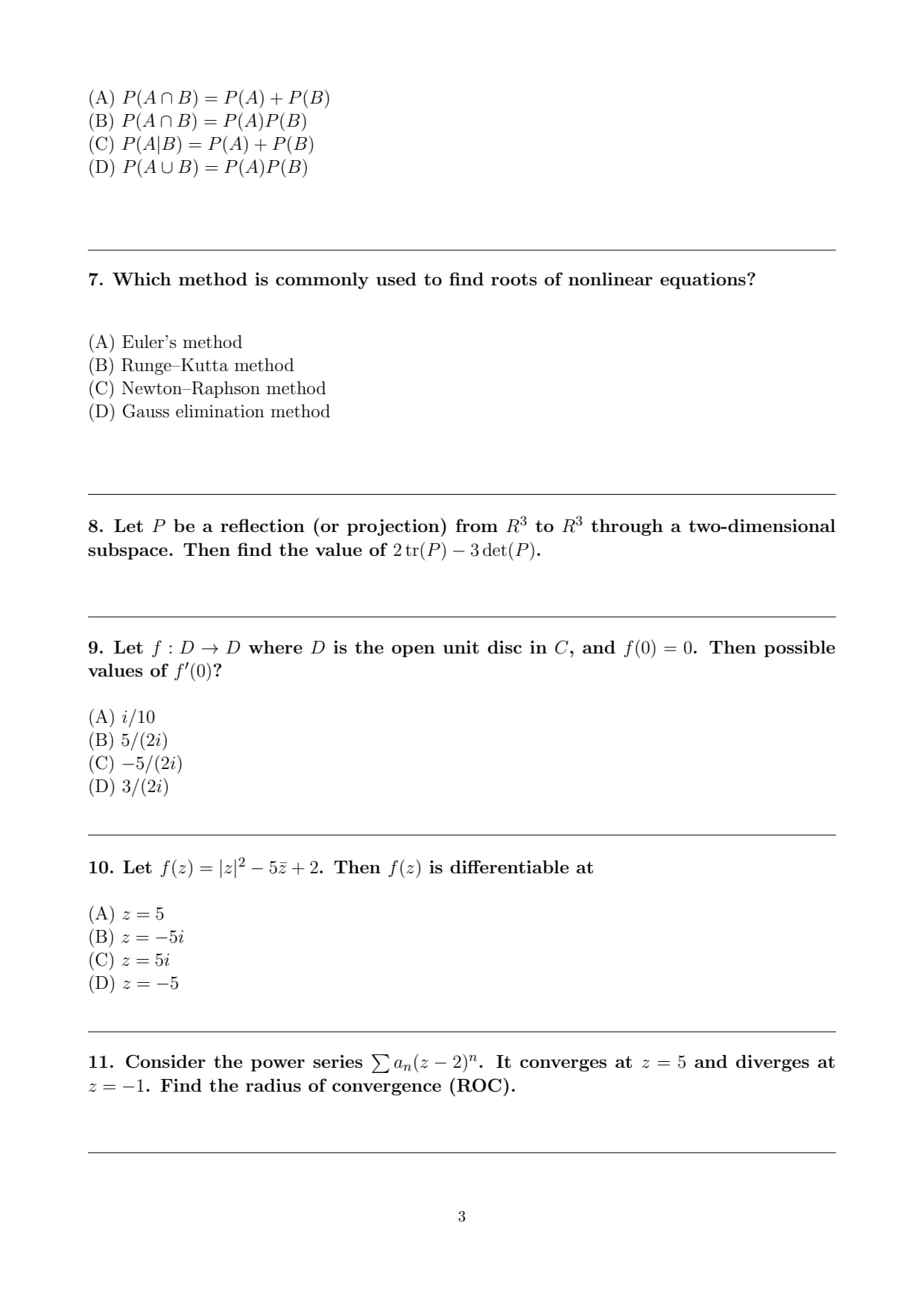
Which method is commonly used to find roots of nonlinear equations?
View Solution
Step 1: Understanding nonlinear equations.
A nonlinear equation is an equation of the form \[ f(x) = 0 \]
where \(f(x)\) is a nonlinear function. Such equations usually cannot be solved exactly using algebraic methods.
Step 2: Need for numerical methods.
Since analytical solutions are often not possible, numerical methods are used to approximate the roots of nonlinear equations with increasing accuracy.
Step 3: Basic idea of Newton–Raphson method.
The Newton–Raphson method is based on the idea of approximating a nonlinear function by its tangent line at a chosen point. The point where the tangent cuts the \(x\)-axis gives a better approximation of the root.
Step 4: Mathematical formula.
If \(x_n\) is the current approximation of the root, the next approximation is given by: \[ x_{n+1} = x_n - \frac{f(x_n)}{f'(x_n)} \]
This process is repeated until the successive values converge to the actual root.
Step 5: Why Newton–Raphson is preferred.
The Newton–Raphson method converges very fast when the initial guess is close to the true root. This makes it one of the most efficient and commonly used root-finding techniques.
Step 6: Analysis of options.
(A) Euler’s method: Used for solving differential equations.
(B) Runge–Kutta method: Also used for differential equations.
(C) Newton–Raphson method: Correct — used for finding roots of nonlinear equations.
(D) Gauss elimination method: Used for solving systems of linear equations.
Step 7: Final conclusion.
The most commonly used numerical technique for finding roots of nonlinear equations is the \[ \boxed{Newton–Raphson method} \]
Quick Tip: Newton–Raphson method has \textbf{quadratic convergence}, which makes it faster than many other numerical methods.
Let \( P \) be a reflection (or projection) from \( \mathbb{R}^3 \) to \( \mathbb{R}^3 \) through a two-dimensional subspace. Then find the value of \( 2 \operatorname{tr}(P) - 3 \det(P) \).
View Solution
Step 1: Understanding the Concept:
In linear algebra, the trace (\(\operatorname{tr}\)) is the sum of eigenvalues and the determinant (\(\det\)) is the product of eigenvalues. These values are invariant properties of linear transformations based on the subspace they interact with.
Step 2: Key Formula or Approach:
For a linear operator \(T\) on \(\mathbb{R}^3\) with eigenvalues \(\lambda_1, \lambda_2, \lambda_3\): \[ \operatorname{tr}(T) = \lambda_1 + \lambda_2 + \lambda_3 \] \[ \det(T) = \lambda_1 \cdot \lambda_2 \cdot \lambda_3 \]
Step 3: Detailed Explanation:
Case A: Projection onto a 2D subspace.
The eigenvalues are \(1, 1, 0\). \[ \operatorname{tr}(P) = 1+1+0 = 2 \] \[ \det(P) = 1 \cdot 1 \cdot 0 = 0 \] \[ Value = 2(2) - 3(0) = 4 \]
Case B: Reflection through a 2D subspace.
The eigenvalues are \(1, 1, -1\). \[ \operatorname{tr}(P) = 1+1-1 = 1 \] \[ \det(P) = 1 \cdot 1 \cdot (-1) = -1 \] \[ Value = 2(1) - 3(-1) = 2 + 3 = 5 \]
Step 4: Final Answer:
The value is 4 (for projection) or 5 (for reflection).
Quick Tip: A projection matrix \(P\) always satisfies \(P^2 = P\), meaning its eigenvalues are only 0 or 1. A reflection matrix \(R\) satisfies \(R^2 = I\), so its eigenvalues are only 1 or -1.
Let \( f: D \to D \) where \( D \) is the open unit disc in \( \mathbb{C} \), and \( f(0) = 0 \). Then possible values of \( f'(0) \)?
View Solution
Step 1: Understanding the Concept:
This problem applies the Schwarz Lemma, which restricts the growth and derivative of a holomorphic function that maps the unit disc to itself and fixes the origin.
Step 2: Key Formula or Approach:
According to the Schwarz Lemma, if \(f: D \to D\) is holomorphic and \(f(0) = 0\), then: \[ |f'(0)| \le 1 \]
Step 3: Detailed Explanation:
We must find which option has a modulus less than or equal to 1:
(A) \( |i/10| = 0.1 \le 1 \) (Valid)
(B) \( |5/(2i)| = 2.5 > 1 \) (Invalid)
(C) \( |-5/(2i)| = 2.5 > 1 \) (Invalid)
(D) \( |3/(2i)| = 1.5 > 1 \) (Invalid)
Step 4: Final Answer:
The possible value is (A) \( i/10 \).
Quick Tip: The Schwarz Lemma essentially states that such functions are "contractions" or rotations; they cannot "stretch" the area around the origin.
Let \( f(z) = |z|^2 - 5 \bar{z} + 2 \). Then \( f(z) \) is differentiable at
View Solution
Step 1: Understanding the Concept:
For a function involving \(\bar{z}\) to be complex-differentiable at a point, it must satisfy the Cauchy-Riemann equations, which in complex notation requires the Wirtinger derivative with respect to \(\bar{z}\) to vanish.
Step 2: Key Formula or Approach:
Use the property \(|z|^2 = z\bar{z}\) and solve: \[ \frac{\partial f}{\partial \bar{z}} = 0 \]
Step 3: Detailed Explanation:
Express the function as: \[ f(z, \bar{z}) = z\bar{z} - 5\bar{z} + 2 \]
Differentiating partially with respect to \(\bar{z}\): \[ \frac{\partial f}{\partial \bar{z}} = z - 5 \]
Setting this to zero for differentiability: \[ z - 5 = 0 \implies z = 5 \]
Step 4: Final Answer:
The function is differentiable at (A) \( z = 5 \).
Quick Tip: If a function is differentiable only at a point (and not in a neighborhood), it is not "analytic" or "holomorphic" there.
Consider the power series \( \sum a_n (z - 2)^n \). It converges at \( z = 5 \) and diverges at \( z = -1 \). Find the radius of convergence (ROC).
View Solution
Step 1: Understanding the Concept:
The Radius of Convergence (\(R\)) of a power series defines the distance from the center within which the series must converge and beyond which it must diverge.
Step 2: Key Formula or Approach:
For a series centered at \(c\):
1. If it converges at \(z_1\), then \(R \ge |z_1 - c|\).
2. If it diverges at \(z_2\), then \(R \le |z_2 - c|\).
Step 3: Detailed Explanation:
The center of the series is \(c = 2\).
Distance to convergence point \(z = 5\): \(|5 - 2| = 3\). Thus, \(R \ge 3\).
Distance to divergence point \(z = -1\): \(|-1 - 2| = 3\). Thus, \(R \le 3\).
Combining these, we get \(3 \le R \le 3\).
Step 4: Final Answer:
The radius of convergence (ROC) is 3.
Quick Tip: On the boundary of the circle (\( |z-c| = R \)), the series might either converge or diverge; the ROC tells us the behavior everywhere else.



Comments