




GATE 2024 Mechanical Engineering Question Paper PDF is available here. IISc Banglore conducted GATE 2024 Mechanical Engineering exam on February 3 in the Afternoon Session from 2:30 PM to 5:30 PM. Students have to answer 65 questions in GATE 2024 Mechanical Engineering Question Paper carrying a total weightage of 100 marks. 10 questions are from the General Aptitude section and 55 questions are from Engineering Mathematics and Core Discipline.
Also Check:
- GATE Question Paper (Available): Check Previous Year Question Paper with Solution PDF
- GATE Question Paper 2025 (Soon): Check Previous Year Question Paper with Solution PDF
- GATE Question Paper 2024 (Available): Check Previous Year Question Paper with Solution PDF
- GATE Paper Analysis, Difficulty Level, Branch-wise Question Paper Analysis, Weightage of Topics
GATE 2024 Mechanical Engineering Question Paper with Answer Key PDF
| GATE 2024 Mechanical Engineering Question Paper PDF |  Download Download |
Check Solutions |
GATE 2024 Mechanical Engineering Question Paper with Answer Key PDF
Question 1:
If '→' denotes increasing order of intensity, then the meaning of the words [smile → giggle → laugh] is analogous to [disapprove → ____ → chide]. Which one of the given options is appropriate to fill the blank?
View Solution
Solution: Step 1: Analyze the pattern of increasing intensity in the first set.
The words 'smile', 'giggle', and 'laugh' show increasing levels of amusement.
Step 2: Apply the same pattern to the second set.
'Disapprove', followed by a word of greater intensity, would logically be 'reprove', and the highest level would be 'chide'.
Conclusion: The correct option is (1) reprove.
Question 2:
Find the odd one out in the set: {19, 37, 21, 17, 23, 29, 31, 11}.
View Solution
Solution: Step 1: Observe the properties of the numbers.
All numbers except 21 are prime.
Step 2: Identify the odd one out.
21 is a composite number (divisible by 3 and 7), whereas all others are prime.
Conclusion: The correct option is (1) 21.
Question 3:
In the following series, identify the number that needs to be changed to form the Fibonacci series: 1, 1, 2, 3, 6, 8, 13, 21,...
View Solution
Solution: Step 1: Understand the Fibonacci sequence.
Each term is the sum of the two preceding terms.
Step 2: Compare the given series with the Fibonacci sequence.
The series should be: 1, 1, 2, 3, 5, 8, 13, 21. The number 6 needs to be replaced by 5.
Conclusion: The correct option is (3) 6.
Question 4:
The real variables x, y, z, and the real constants p, q, r satisfy
x⁄pq-r² = y⁄qr-p² = z⁄rp-q²
Given that the denominators are non-zero, the value of px + qy + rz is:
View Solution
Solution: The given equation is:
x⁄pq-r² = y⁄qr-p² = z⁄rp-q² = k
Step 1: Express x, y, and z in terms of k:
x = k(pq - r²), y = k(qr - p²), z = k(rp - q²)
Step 2: Substitute x, y, and z into the expression px + qy + rz:
px + qy + rz = k[p(pq - r²) + q(qr - p²) + r(rp - q²)]
Step 3: Simplify the expression inside the brackets:
= k[p²q - pr² + q²r – qp² + r²p - rq²]
Step 4: Group terms and simplify further:
= k[p²q – qp² + q²r - rq² + r²p - pr²]
Step 5: Note that the terms cancel out:
= k(0) = 0
Conclusion: px + qy + rz = 0
Question 5:
Take two long dice (rectangular parallelepiped), each having four rectangular faces labelled as 2, 3, 5, and 7. If thrown, the long dice cannot land on the square faces and has 1/4 probability of landing on any of the four rectangular faces. The label on the top face of the dice is the score of the throw. If thrown together, what is the probability of getting the sum of the two long dice scores greater than 11?
View Solution
Solution: Step 1: Identify the possible outcomes of rolling two dice. Each die has four possible outcomes: 2, 3, 5, 7. The total number of outcomes is 4 × 4 = 16.
Step 2: Find combinations where the sum exceeds 11. The valid pairs are:
(5, 7), (7, 5), (7, 7).
This gives 3 favorable outcomes.
Step 3: Calculate the probability.
So, the probability = 1⁄4 × 1⁄4 + 1⁄4 × 1⁄4 + 1⁄4 × 1⁄4 = 3⁄16.
Conclusion: The correct option is (4) 3⁄16.
Question 6:
In the given text, the blanks are numbered (i)–(iv). Select the best match for all the blanks. Prof. P (i) merely a man who narrated funny stories. (ii) in his blackest moments he was capable of self-deprecating humor. Prof. Q (iii) a man who hardly narrated funny stories. (iv) in his blackest moments was he able to find humor.
View Solution
Solution: Step 1: Analyze the context of each sentence.
Prof. P was not merely a storyteller, hence the correct verb for (i) is “wasn't".
“Even” fits logically in (ii) to emphasize humor in dark moments.
Prof. Q was a man with rare humor, so (iii) uses “was”.
"Only" appropriately concludes (iv).
Conclusion: The correct option is (2).
Question 7:
How many combinations of non-null sets A, B, C are possible from the subsets of {2, 3, 5}, satisfying the conditions: (i) A is a subset of B, and (ii) B is a subset of C?
View Solution
Solution: Step 1: Understand the conditions.
Each element of {2, 3, 5} must satisfy:
A ⊆ B ⊆ C
Step 2: Use set theory rules.
For each element, there are 3 possibilities:
- The element belongs to A, B, C,
- The element belongs to B, C (but not A),
- The element belongs to C only.
Thus, the total combinations are:
3³ = 27.
Conclusion: The correct option is (2) 27.
Question 8:
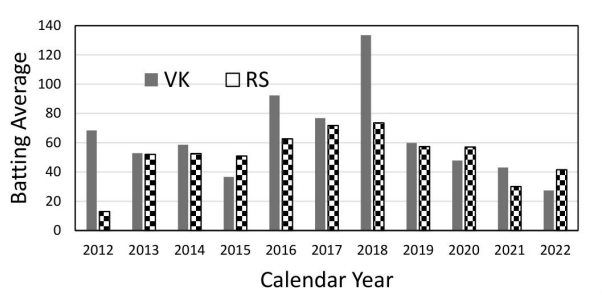
The bar chart gives the batting averages of VK and RS for 11 calendar years from 2012 to 2022. Considering that 2015 and 2019 are world cup years, which one of the following options is true?
View Solution
Solution: Step 1: Analyze the batting averages from 2015 to 2019.
VK's averages are higher than RS in all the years between the two world cups.
Step 2: Validate other options.
- Option (1) is false as RS does not have a higher average in every world cup year.
- Option (2) is false as VK does not have a higher average in every world cup year.
- Option (4) is false because VK's average is higher in the last three years.
Conclusion: The correct option is (3).
Question 9:
A planar rectangular paper has two V-shaped pieces attached as shown below.
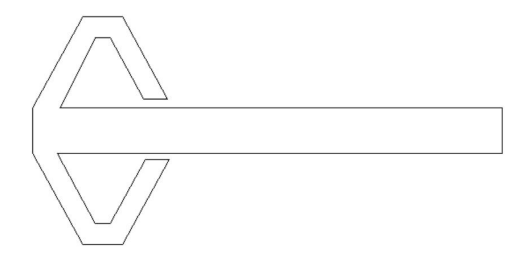
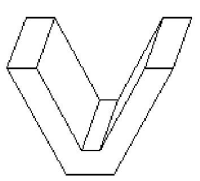
This piece of paper is folded to make the following closed three-dimensional object. The number of folds required to form the above object is:
View Solution
Solution: Step 1: Analyze the geometry of the object.
The paper includes a main rectangular strip and two V-shaped sections. Each section requires folds along its edges to form the closed 3D structure.
Step 2: Breakdown of folds required:
- The long rectangular strip requires two folds, one for each end.
- Each V-shaped section requires 3 folds (two for the arms and one at the vertex).
Step 3: Total folds calculation: The plane rectangular paper when folded to form the 3-D shave the number of folding required is = 2 + 1 + 3 + 3 = 9
Conclusion: The correct number of folds is (1) 9.
Question 10:
Four equilateral triangles are used to form a regular closed three-dimensional object by joining along the edges. The angle between any two faces is:
View Solution
Solution: Step 1: Analyze the geometry.
The four equilateral triangles form a regular tetrahedron. A tetrahedron has 4 triangular faces and 6 edges.
Step 2: Dihedral angle formula.
The dihedral angle between two triangular faces of a tetrahedron is given by:
Dihedral Angle = cos⁻¹ (1⁄3).
Step 3: Simplify the calculation:
cos⁻¹ (1⁄3) ≈ 60°.
Conclusion: The angle between any two faces is (2) 60°.
Question 11:
In order to numerically solve the ordinary differential equation dy⁄dt = -y for t > 0, with an initial condition y(0) = 1, the following scheme is employed:
yn+1 - yn⁄Δt = -1⁄2(yn+1+yn).
Here, Δt is the time step and yn = y(nΔt) for n = 0, 1, 2, ... This numerical scheme will yield a solution with non-physical oscillations for Δt > h. The value of h is:
Question 12:
The value of the surface integral ∫∫s z dx dy, where S is the external surface of the sphere x² + y² + z² = R², is:
Question 13:
Let f(z) be an analytic function, where z = x + iy. If the real part of f(z) is cosh x cos y, and the imaginary part of f(z) is zero for y = 0, then f(z) is:
Question 14:
Consider the system of linear equations:
x + 2y + z = 5, 2x + ay + 4z = 12, 2x + 4y + 6z = b.
The values of a and b such that there exists a non-trivial null space and the system admits infinite solutions are:
Question 15:
Let f(·) be a twice-differentiable function from R² → R. If p, x₀ ∈ R², where ||p|| is sufficiently small (here || · || is the Euclidean norm or distance function), then:
f(x₀ + p) = f(x₀) + ∇f(x₀)Tp + 1⁄2pT∇²f(ψ)p,
where ψ ∈ R² is a point on the line segment joining x₀ and x₀ + p. If x₀ is a strict local minimum of f(x), which one of the following statements is true?
Question 16:
The velocity field of a two-dimensional, incompressible flow is given by:
v = 2 sinh x i + v(x, y) j,
where i and j denote the unit vectors in the x- and y-directions respectively. If v(x, 0) = cosh x, find v(0, −1).
Question 17:
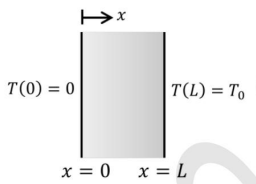
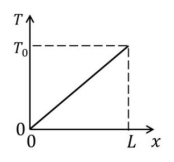
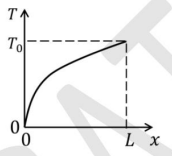
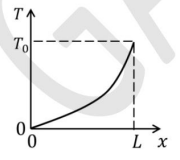
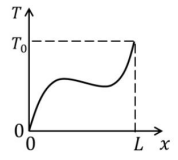
A plane, solid slab of thickness L has thermal conductivity k = A + Bx, where A > 0 and B > 0. The slab walls are maintained at T(0) = 0 and T(L) = To. Which plot qualitatively depicts the steady-state temperature distribution?
Question 18:
Consider incompressible laminar flow over a flat plate with freestream velocity of u∞. The Nusselt number corresponding to this flow velocity is Nu₁. If the freestream velocity is doubled, the Nusselt number changes to Nu₂. Choose the correct option for Nu₂/Nu₁.
Question 19:
Consider a hydrodynamically fully developed laminar flow through a circular pipe with the flow along the axis (i.e., z direction). In the following statements, T is the temperature of the fluid, Tw is the wall temperature, and Tm is the bulk mean temperature of the fluid. Which one of the following statements is TRUE?
Question 20:
A furnace can supply heat steadily at 1200 K at a rate of 24000 kJ/min. The maximum amount of power (in kW) that can be produced by using the heat supplied by this furnace in an environment at 300 K is:
Question 21:
Which one of the following statements regarding a Rankine cycle is FALSE?
Question 22:
For a ball bearing, the fatigue life in millions of revolutions is given by L = (C⁄P)ⁿ, where P is the constant applied load and C is the basic dynamic load rating. Which one of the following statements is TRUE?
Question 23:
The change in kinetic energy ∆E of an engine is 300 J, and minimum and maximum shaft speeds are ωmin = 220 rad/s and ωmax = 280 rad/s, respectively.Assume that the torque-time function is purely harmonic. To achieve a coefficient of fluctuation of speed 0.05, the moment of inertia (in kg · m²) of the flywheel to be mounted on the engine shaft is
Question 24:
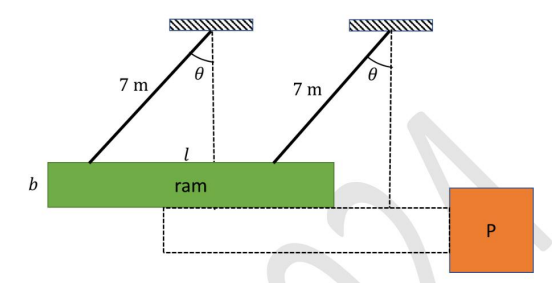
A ram in the form of a rectangular body of size l = 9 m and b = 2m is suspended by two parallel ropes of lengths 7 m. Assume the center of mass is at the geometric center and g = 9.81 m/s². For striking the object P with a horizontal velocity of 5 m/s, what is the angle θ with the vertical from which the ram should be released from rest?
Question 25:
A linear spring-mass-dashpot system with a mass of 2 kg is set in motion with viscous damping. If the natural frequency is 15 Hz, and the amplitudes of two successive cycles measured are 7.75 mm and 7.20 mm, the coefficient of viscous damping (in N.s/m) is:
Question 26:
Which one of the following failure theories is the most conservative design approach against fatigue failure?
Question 27:
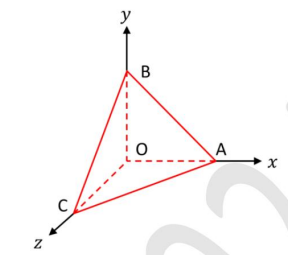
A rigid massless tetrahedron is placed such that vertex O is at the origin and the other three vertices A, B and C lie on the co-ordinate axes as shown in the figure. The body is acted on by three point loads, of which one is acting at A along x-axis and other at point B along y-axis. for the body to be in equilibrium, the third point load acting at point O must be
Question 28:
The phases present in pearlite are:
Question 29:
The "Earing” phenomenon in metal forming is associated with:
Question 30:
The grinding wheel used to provide the best surface finish is:
Question 31:
The allowance provided to a pattern for easy withdrawal from a sand mold is:
Question 32:
The most suitable electrode material used for joining low alloy steels using Gas Metal Arc Welding (GMAW) process is:
Question 33:
The preparatory functions in Computer Numerical Controlled (CNC) machine programming are denoted by the alphabet:
Question 34:
A set of jobs U, V, W, X, Y, Z arrive at time t = 0 to a production line consisting of two workstations in series. Each job must be processed by both workstations in sequence (i.e., the first followed by the second). The process times (in minutes) for each job on each workstation in the production line are given below.
| Job | U | V | W | X | Y | Z |
|---|---|---|---|---|---|---|
| Workstation 1 | 5 | 7 | 3 | 4 | 6 | 8 |
| Workstation 2 | 4 | 6 | 6 | 8 | 5 | 7 |
(1) W – X – Z - V - Y – U
(2) W – X – V – Z – Y – U
(3) W – U – Z - V - Y – X
(4) U – Y – V – Z – X – W
Question 35:
A queueing system has one single server workstation that admits an infinitely long queue. The rate of arrival of jobs to the queueing system follows the Poisson distribution with a mean of 5 jobs/hour. The service time of the server is exponentially distributed with a mean of 6 minutes. The probability that the server is not busy at any point in time is:
Question 36:
The matrix
| 1 | a |
| 8 | 3 |
(where a > 0) has a negative eigenvalue if a is greater than:
Question 37:
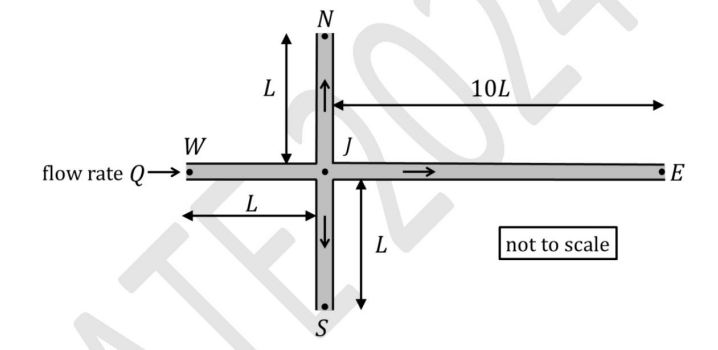
In the pipe network as shown in figure, all pipes have the same cross section areas and can be assumed to have the same friction factor. The pipes connecting points W, N and S with the joint J have an equal length L. The pipe connecting points J and E has a length 10L. The pressures at the ends N, E and S are equal. The flow rate in the pipe connecting W and J is Q. Assume that the fluid flow is steady, incompressible, and the pressure losses at the pipe entrance and the junction are negligible, Consider the following statements.
I. The flow rate in pipe connecting J & E is Q/21
II. The pressure difference between J & N is equal to the pressure difference between J & E. Which one of the following options is CORRECT?
Question 38:
A company orders gears in conditions identical to those considered in the Economic Order Quantity (EOQ) model in inventory control. The annual demand is 8000 gears, the cost per order is 300 rupees, and the holding cost is 12 rupees per month per gear.The company uses an order size that is 25% more than the optimal order quantity determined by the EOQ model. The percentage change in the total cost of ordering and holding inventory from that associated with the optimal order quantity is:
Question 39:
At the current basic feasible solution (bfs) v₀ (v₀ ∈ R⁵), the simplex method yields the following form of a linear programming problem in standard form:
Minimize z = -x₁ - 2x₂
Subject to:
x₃ = 2 + 2x₁ - x₂
x₄ = 7 + x₁ - 2x₂
x₅ = 3 - x₁
x₁, x₂, x₃, x₄, x₅ ≥ 0
Here the objective function is written as a function of the non-basic variables. If the simplex method moves to the adjacent bfs v₁ (v₁ ∈ R⁵) that best improves the objective function, which of the following represents the objective function at v₁, assuming that the objective function is written in the same manner as above?
Question 40:
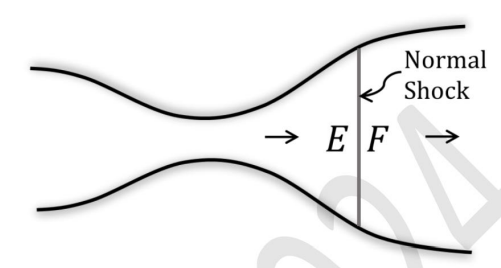
Steady, compressible flow of air takes place through an adiabatic converging-diverging nozzle, as shown in the figure. For a particular value of pressure difference across the nozzle, a stationary normal shock wave forms in the diverging section of the nozzle. If E and F denote the flow conditions just upstream and downstream of the normal shock, respectively, which of the following statement(s) is/are TRUE?
Question 41:
Which of the following beam(s) is/are statically determinate?
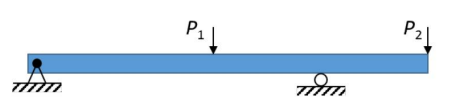

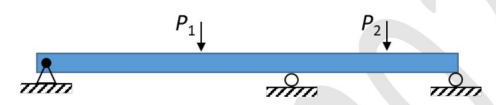

Question 42:
If the value of double integral
∫x=3x=4∫y=1y=2 (x + y)² dy dx
is logₑ(25⁄α), then α is _________ (Answer in integer).
Question 43:
If x(t) satisfies the differential equation
t dx⁄dt + (t - x) = 0
subject to the condition x(1) = 0, then the value of x(2) is _______ (rounded off to 2 decimal places).
Question 44:
Let X be a continuous random variable defined on [0, 1] such that its probability density function f(x) = 1 for 0 ≤ x ≤ 1 and 0 otherwise. Let Y = lnₑ(X + 1). Then the expected value of Y is: (rounded off to 2 decimal places).
Question 45:
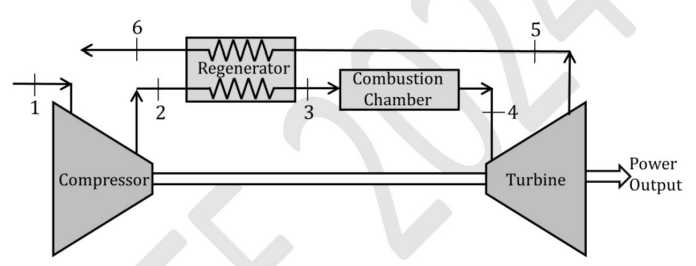
Consider an air-standard Brayton cycle with adiabatic compressor and turbine, and a regenerator, as shown in the figure. Air enters the compressor at 100 kPa and 300 K and exits the compressor at 600 kPa and 550 K. The air exits the combustion chamber at 1250 K and exits the adiabatic turbine at 100 kPa and 800 K. The exhaust air from the turbine is used to preheat the air in the regenerator. The exhaust air exits the regenerator (state 6) at 600 K. There is no pressure drop across the regenerator and the combustion chamber. Also, there is no heat loss from the regenerator to the surroundings. The ratio of specific heats at constant pressure and volume is cₚ/cᵥ = 1.4. The thermal efficiency of the cycle is _______ % (answer in integer).
Question 46:
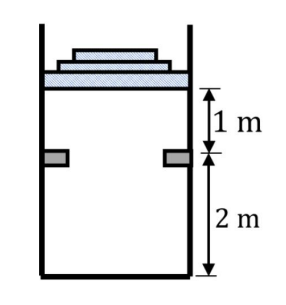
A piston-cylinder arrangement shown in the figure has a stop located 2 m above the base. The cylinder initially contains air at 140 kPa and 350°C, and the piston is resting in equilibrium at a position that is 1 m above the stops. The system is now cooled to the ambient temperature of 25°C. Consider air to be an ideal gas with a value of gas constant R = 0.287 kJ/(kg·K). The absolute value of specific work done during the process is _____ kJ/kg (rounded off to 1 decimal place).
Question 47:
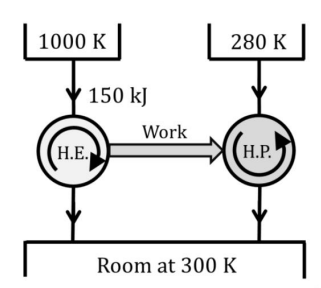
A heat pump (H.P.) is driven by the work output of a heat engine (H.E.) as shown in the figure. The heat engine extracts 150 kJ of heat from the source at 1000 K. The heat pump absorbs heat from the ambient at 280 K and delivers heat to the room maintained at 300 K. Considering the combined system to be ideal, the total amount of heat delivered to the room together by the heat engine and heat pump is _______ kJ (answer in integer).
Question 48:
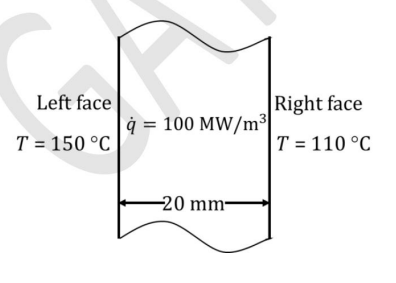
Consider a slab of 20 mm thickness. There is a uniform heat generation of q = 100 MW/m³ inside the slab. The left and right faces of the slab are maintained at 150°C and 110°C, respectively. The plate has a constant thermal conductivity of 200 W/(m·K). Considering a 1-D steady-state heat conduction, the location of the maximum temperature from the left face will be at _______ mm (answer in integer).
Question 49:
A condenser is used as a heat exchanger in a large steam power plant in which steam is condensed to liquid water. The condenser is a shell and tube heat exchanger which consists of 1 shell and 20,000 tubes. Water flows through each of the tubes at a rate of 1 kg/s with an inlet temperature of 30°C. The steam in the condenser shell condenses at the rate of 430 kg/s at a temperature of 50°C. If the heat of vaporization is 2.326 MJ/kg and specific heat of water is 4 kJ/(kg·K), the effectiveness of the heat exchanger is _______ (rounded off to 3 decimal places).
Question 50:
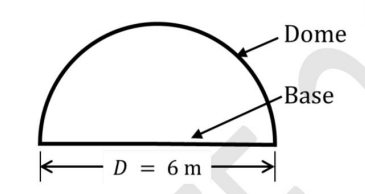
Consider a hemispherical furnace of diameter D = 6 m with a flat base. The dome of the furnace has an emissivity of 0.7, and the flat base is a blackbody. The base and the dome are maintained at uniform temperatures of 300 K and 1200 K, respectively. Under steady-state conditions, the rate of radiation heat transfer from the dome to the base is ______ kW (rounded off to the nearest integer). Use Stefan-Boltzmann constant σ = 5.67 × 10⁻⁸ W/(m²·K⁴).
Question 51:
A liquid fills a horizontal capillary tube whose one end is dipped in a large pool of the liquid. Experiments show that the distance L travelled by the liquid meniscus inside the capillary in time t is given by
L = kγaRbμc√t,
where γ is the surface tension, R is the inner radius of the capillary, and μ is the dynamic viscosity of the liquid. If k is a dimensionless constant, then the exponent a is _______ (rounded off to 1 decimal place).
Question 52:
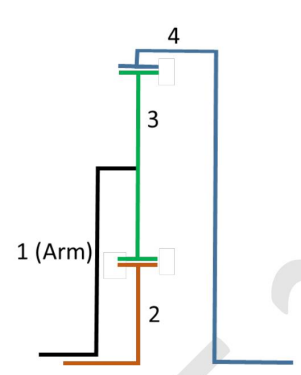
The Levi type-A train illustrated in the figure has gears with module m = 8mm/tooth. Gears 2 and 3 have 19 and 24 teeth, respectively. Gear 2 is fixed and internal gear 4 rotates at 20 rev/min counter-clockwise. The magnitude of angular velocity of the arm is _______ rev/min. (rounded off to 2 decimal places)
Question 53:
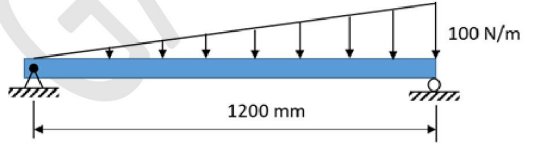
A horizontal beam of length 1200 mm is pinned at the left end and is resting on a roller at the other end as shown in the figure. A linearly varying distributed load is applied on the beam. The magnitude of maximum bending moment acting on the beam is _____ N.m. (round off to 1 decimal place)
Question 54:
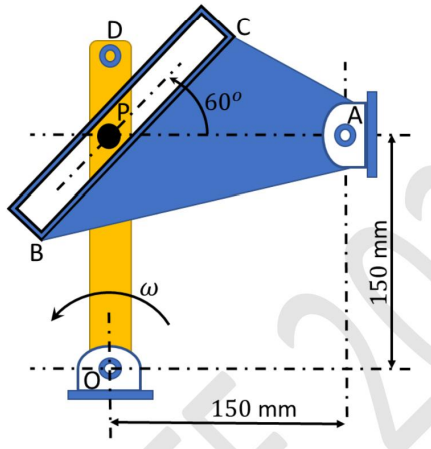
At the instant when OP is vertical and AP is horizontal, the link OD is rotating counter-clockwise at a constant rate ω = 7 rad/s. Pin P on link OD slides in the slot BC of link ABC which is hinged at A, and causes a clockwise rotation of the link ABC. The magnitude of angular velocity of link ABC for this instant is _______ rad/s. (rounded off to 2 decimal places)
Question 55:
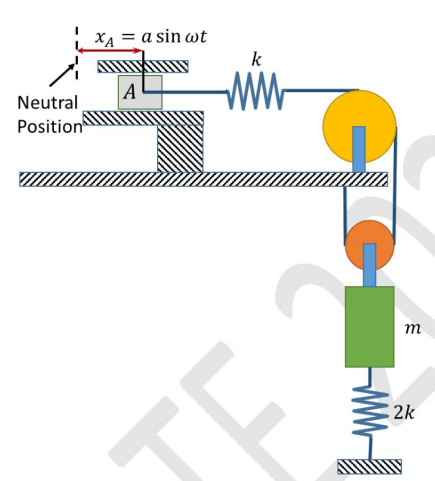
A vibratory system consists of mass m, a vertical spring of stiffness 2k, and a horizontal spring of stiffness k. The end A of the horizontal spring is given a horizontal motion xₐ = a sin ωt. The other end of the spring is connected to an inextensible rope that passes over two massless pulleys as shown. Assume m = 10 kg, k = 1.5 kN/m, and neglect friction. The magnitude of critical driving frequency for which the oscillations of mass m tend to become excessively large is ______ rad/s. (answer in integer)
Question 56:
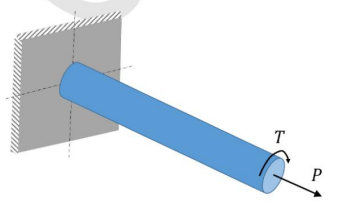
A solid massless cylindrical member of 50 mm diameter is rigidly attached at one end, and is subjected to an axial force P = 100 kN and a torque T = 600 N.m at the other end as shown. Assume that the axis of the cylinder is normal to the support. Considering distortion energy theory with allowable yield stress as 300 MPa, the factor of safety in the design is _______ (rounded off to 1 decimal place).
Question 57:
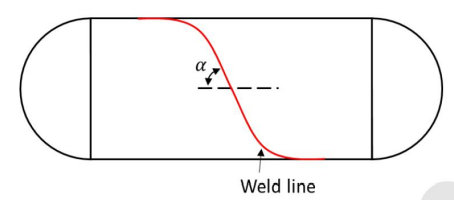
The figure shows a thin cylindrical pressure vessel constructed by welding plates together along a line that makes an angle α = 60° with the horizontal. The closed vessel has a wall thickness of 10 mm and diameter of 2 m. When subjected to an internal pressure of 200 kPa, the magnitude of the normal stress acting on the weld is _______ MPa (rounded off to 1 decimal place).
Question 58:
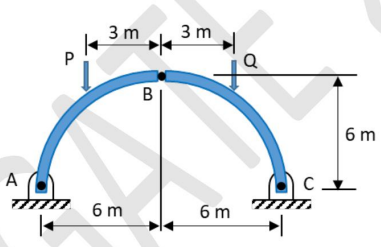
A three-hinge arch ABC in the form of a semi-circle is shown in the figure. The arch is in static equilibrium under vertical loads of P = 100 kN and Q = 50 kN. Neglect friction at all the hinges. The magnitude of the horizontal reaction at B is _______ kN (rounded off to 1 decimal place).
Question 59:
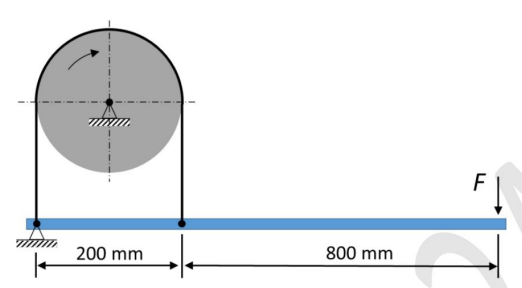
A band brake shown in the figure has a coefficient of friction of 0.3. The band can take a maximum force of 1.5 kN. The maximum braking force F that can be safely applied is _______ N (rounded off to the nearest integer).
Question 60:
A cutting tool provides a tool life of 60 minutes while machining with the cutting speed of 60 m/min. When the same tool is used for machining the same material, it provides a tool life of 10 minutes for a cutting speed of 100 m/min. If the cutting speed is changed to 80 m/min for the same tool and work material combination, the tool life computed using Taylor's tool life model is _______ minutes (rounded off to 2 decimal places).
Question 61:
Aluminium is casted in a cube-shaped mold having dimensions as 20 mm × 20 mm × 20 mm. Another mold of the same mold material is used to cast a sphere of aluminium having a diameter of 20 mm. The pouring temperature for both cases is the same. The ratio of the solidification times of the cube-shaped mold to the spherical mold is _______ (answer in integer).
Question 62:
A blanking operation is performed on C20 steel sheet to obtain a circular disc having a diameter of 20 mm and a thickness of 2 mm. An allowance of 0.04 mm is provided. The punch size used for the operation is _______ mm (rounded off to 2 decimal places).
Question 63:
In an arc welding process, the voltage and current are 30 V and 200 A, respectively. The cross-sectional area of the joint is 20 mm² and the welding speed is 5 mm/s. The heat required to melt the material is 20 J/s. The percentage of heat lost to the surrounding during the welding process is _______ (rounded off to 2 decimal places).
Question 64:
A flat surface of a C60 steel having dimensions of 100 mm (length) × 200 mm (width) is produced by a HSS slab mill cutter. The 8-toothed cutter has 100 mm diameter and 200 mm width. The feed per tooth is 0.1 mm, cutting velocity is 20 m/min, and depth of cut is 2 mm. The machining time required to remove the entire stock is _______ minutes (rounded off to 2 decimal places).
Question 65:
In a supplier-retailer supply chain, the demand of each retailer, the capacity of each supplier, and the unit cost in rupees of material supply from each supplier to each retailer are tabulated below. The supply chain manager wishes to minimize the total cost of transportation across the supply chain.
| Supplier | Retailer I | Retailer II | Retailer III | Retailer IV | Capacity |
|---|---|---|---|---|---|
| Supplier A | 11 | 16 | 19 | 13 | 300 |
| Supplier B | 5 | 10 | 7 | 8 | 300 |
| Supplier C | 12 | 14 | 17 | 11 | 300 |
| Supplier D | 8 | 15 | 11 | 9 | 300 |
| Demand | 300 | 300 | 300 | 300 |
The optimal cost of satisfying the total demand from all retailers is _______ rupees (answer in integer).



Comments