




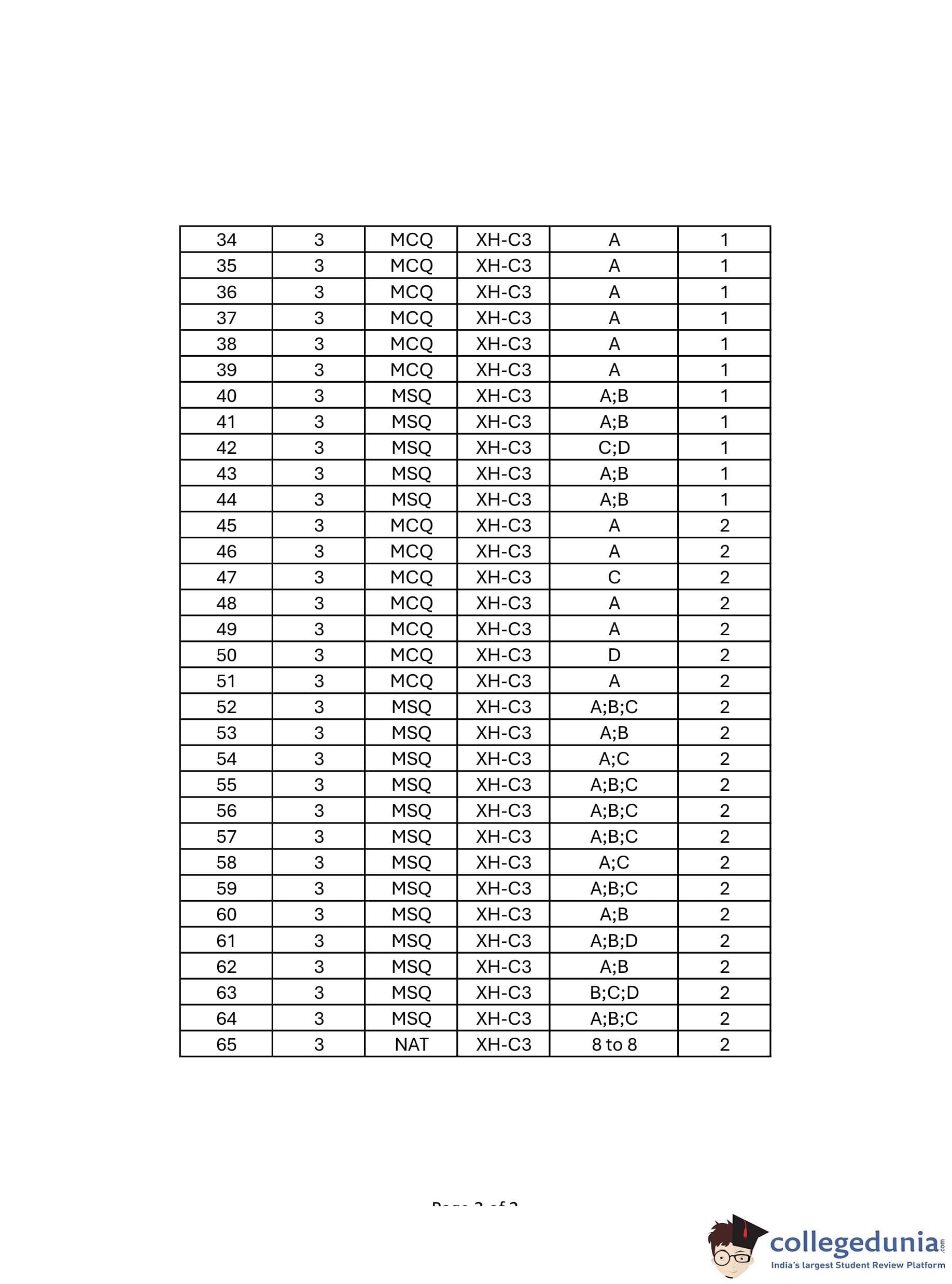
GATE 2024 Linguistics (XH-C3) Question Paper PDF is available here. IISc Banglore conducted GATE 2024 Linguistics (XH-C3) exam on February 4 in the Forenoon Session from 9:30 AM to 12:30 PM. Students have to answer 65 questions in GATE 2024 Linguistics (XH-C3) Question Paper carrying a total weightage of 100 marks. 10 questions are from the General Aptitude section and 55 questions are from Core Discipline.
GATE 2024 Linguistics (XH-C3) Question Paper with Answer Key PDF
| GATE 2024 Question Paper PDF | GATE 2024 Answer Key PDF | GATE 2024 Solution PDF |
|---|---|---|
| Download PDF | Download PDF | Download PDF |
GATE 2024 Linguistics (XH-C3) Question Paper Solution
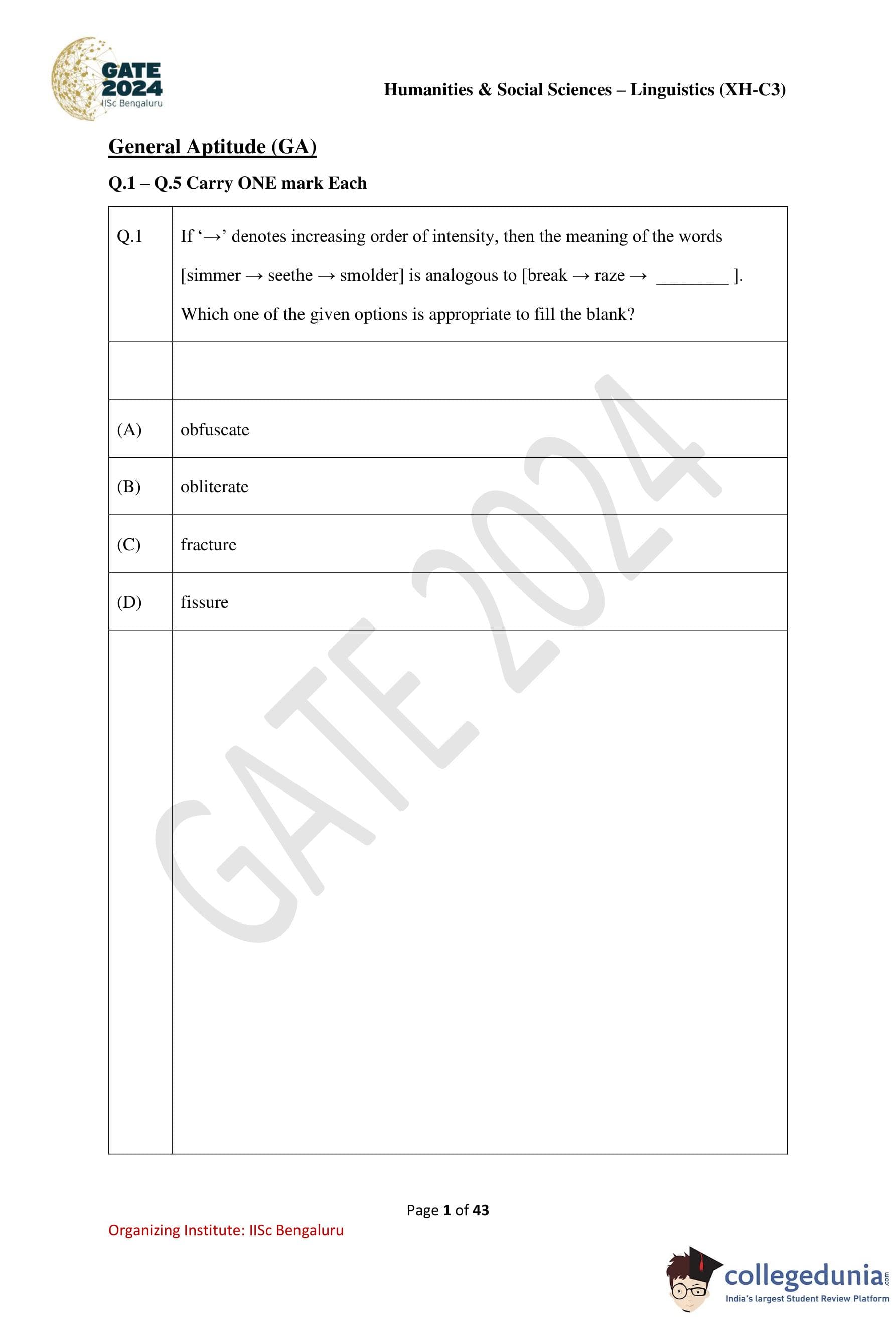
If ‘\(\rightarrow\)’ denotes increasing order of intensity, then the meaning of the words \[ [simmer \rightarrow seethe \rightarrow smolder] \]
is analogous to \[ [break \rightarrow raze \rightarrow ..........]. \]
Which one of the given options is appropriate to fill the blank?
View Solution
Step 1: Understanding the pattern.
The sequence \textit{simmer → seethe → smolder shows an increase in intensity, where the action becomes progressively stronger and more destructive.
Step 2: Applying the same logic.
Similarly, \textit{break → raze → .......... should represent increasing levels of destruction. The word \textit{raze already means to completely destroy, so the final word must indicate total annihilation.
Step 3: Evaluating options.
obliterate means to destroy completely, matching the highest intensity in the sequence.
Step 4: Conclusion.
Thus, the correct answer is (B) obliterate.
Quick Tip: In analogy questions, always identify the underlying pattern before matching meanings.
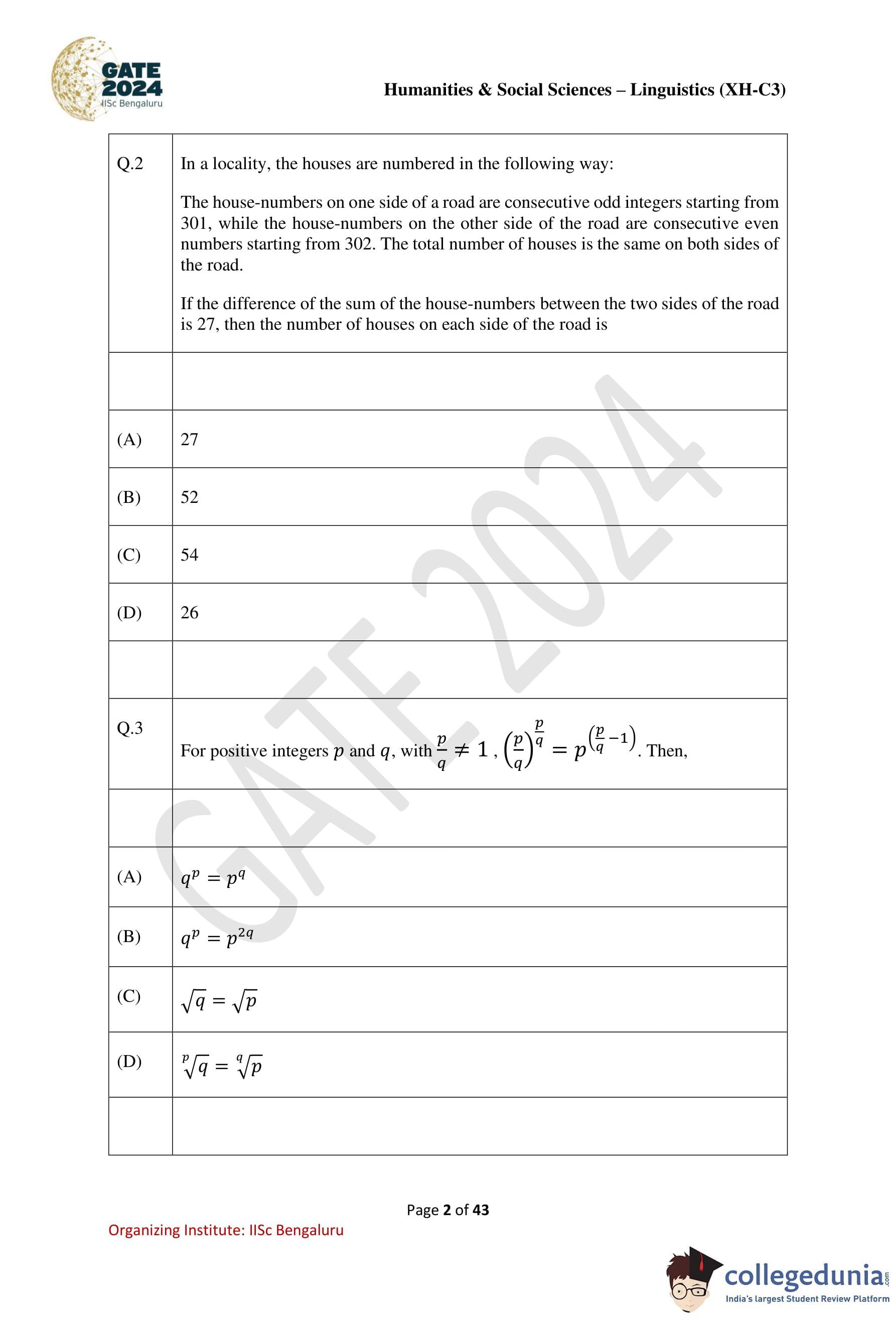
In a locality, the houses are numbered in the following way:
The house-numbers on one side of a road are consecutive odd integers starting from 301, while the house-numbers on the other side of the road are consecutive even numbers starting from 302. The total number of houses is the same on both sides of the road.
If the difference of the sum of the house-numbers between the two sides of the road is 27, then the number of houses on each side of the road is
View Solution
Step 1: Representing the sequences.
Let the number of houses on each side be \(n\).
Odd numbers: \(301, 303, \ldots\) (n terms)
Even numbers: \(302, 304, \ldots\) (n terms)
Step 2: Finding the difference of sums.
Each even number is exactly 1 more than the corresponding odd number. Hence, the sum of even numbers exceeds the sum of odd numbers by \(n\).
Step 3: Using the given condition.
Given difference of sums = 27, therefore \(n = 27\).
Step 4: Conclusion.
The number of houses on each side of the road is 27.
Quick Tip: When sequences differ by a constant term-wise, the difference of sums equals that constant multiplied by the number of terms.
For positive integers \(p\) and \(q\), with \(\dfrac{p}{q} \neq 1\), \[ \left(\frac{p}{q}\right)^{\frac{p}{q}} = p^{\left(\frac{p}{q} - 1\right)}. \]
Then,
View Solution
Step 1: Simplifying the given equation.
\[ \left(\frac{p}{q}\right)^{\frac{p}{q}} = p^{\frac{p}{q}} \cdot p^{-1} \]
Step 2: Rearranging terms.
Multiplying both sides appropriately and simplifying leads to a relationship between powers of \(p\) and \(q\).
Step 3: Final relation.
The condition simplifies to \[ q^p = p^q \]
Step 4: Conclusion.
Hence, the correct answer is (A) \(q^p = p^q\).
Quick Tip: Equations involving variables in both base and exponent often simplify to symmetric power relations.
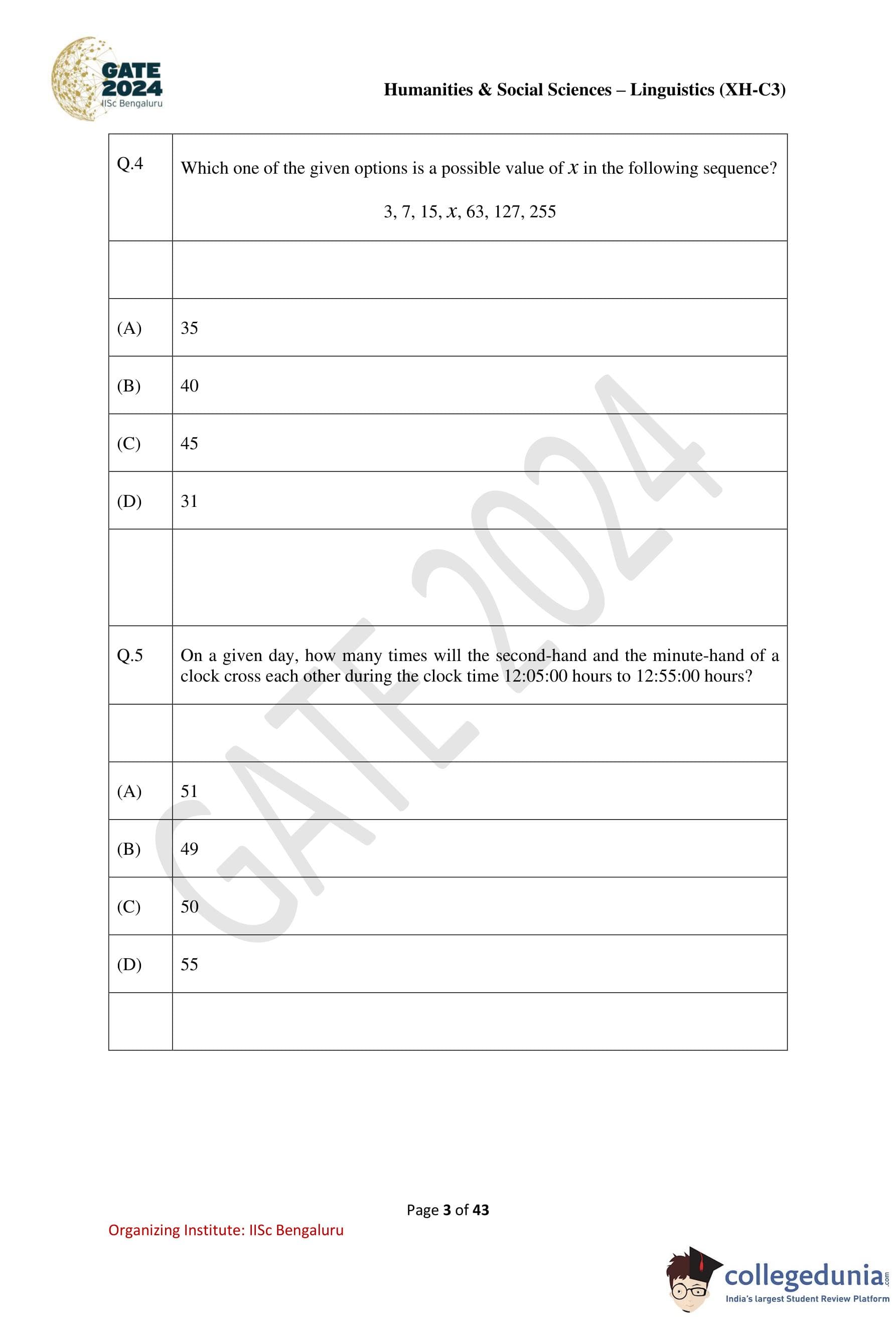
Which one of the given options is a possible value of \(x\) in the following sequence?
\[ 3,\,7,\,15,\,x,\,63,\,127,\,255 \]
View Solution
Step 1: Observing the pattern.
Each term in the sequence follows the rule: \[ Next term = (Previous term \times 2) + 1 \]
Step 2: Verifying the pattern.
\[ 3 \times 2 + 1 = 7,\quad 7 \times 2 + 1 = 15 \] \[ 15 \times 2 + 1 = 31,\quad 31 \times 2 + 1 = 63 \]
Step 3: Identifying the missing term.
Thus, the value of \(x = 31\).
Step 4: Conclusion.
The correct answer is (D) 31.
Quick Tip: Always check for simple arithmetic patterns like multiplication or addition before assuming complex rules.
On a given day, how many times will the second-hand and the minute-hand of a clock cross each other during the clock time 12:05:00 hours to 12:55:00 hours?
View Solution
Step 1: Understanding hand movements.
The second hand completes one full rotation every minute, while the minute hand moves continuously and slowly.
Step 2: Crossings per minute.
In one minute, the second hand crosses the minute hand exactly once.
Step 3: Time interval calculation.
From 12:05:00 to 12:55:00 is a total of 50 minutes.
Step 4: Conclusion.
Therefore, the second hand and the minute hand cross each other 50 times.
Quick Tip: The second hand crosses the minute hand exactly once every minute.
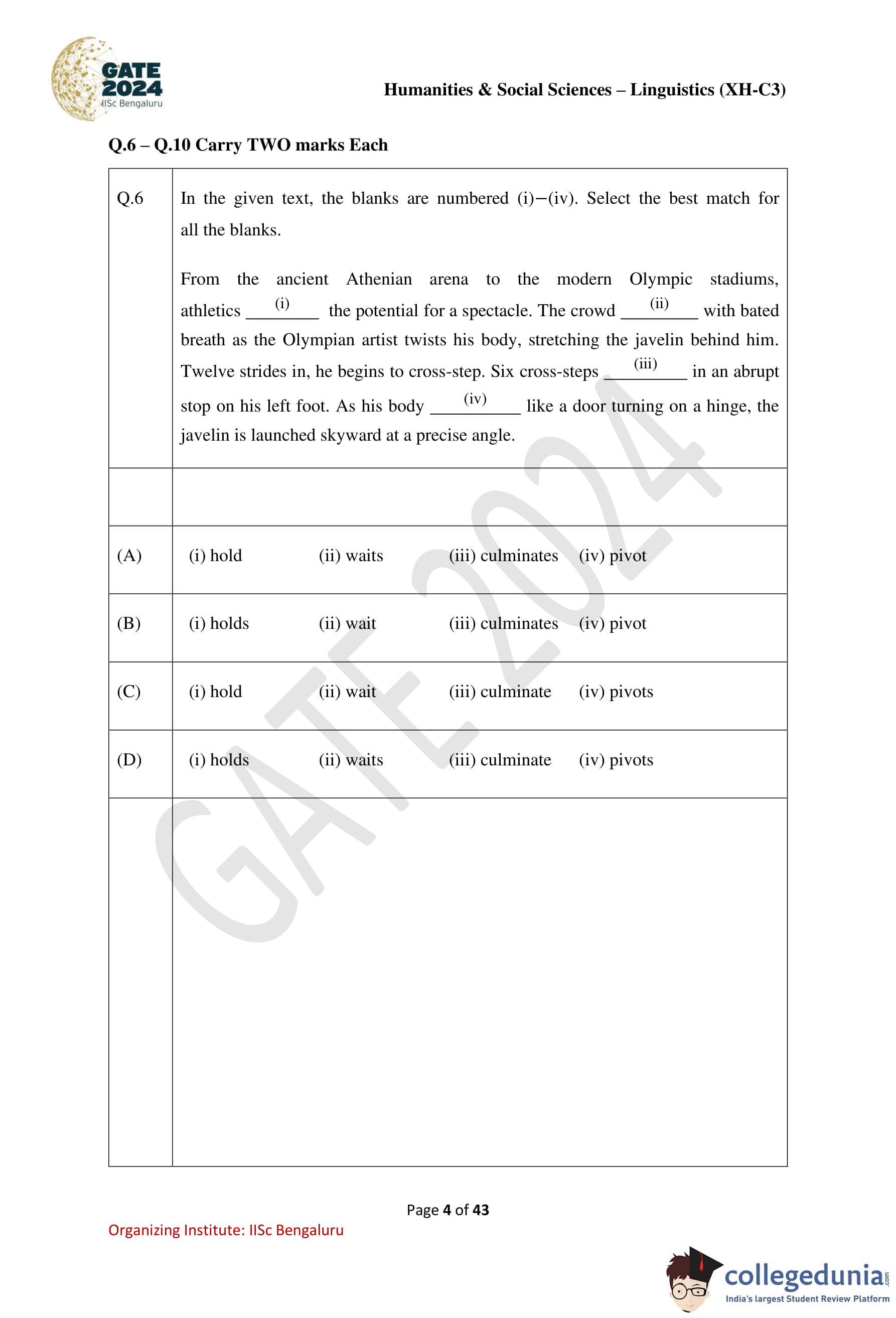
In the given text, the blanks are numbered (i)–(iv). Select the best match for all the blanks.
From the ancient Athenian arena to the modern Olympic stadiums, athletics (i) ___ the potential for a spectacle. The crowd (ii) ___ with bated breath as the Olympian artist twists his body, stretching the javelin behind him. Twelve strides in, he begins to cross-step. Six cross-steps (iii) ___ in an abrupt stop on his left foot. As his body (iv) ___ like a door turning on a hinge, the javelin is launched skyward at a precise angle.
View Solution
Step 1: Subject–verb agreement.
\textit{Athletics is a singular noun, so (i) must be \textit{holds. Similarly, \textit{the crowd is singular, so (ii) must be \textit{waits.
Step 2: Verb tense consistency.
The phrase \textit{six cross-steps is plural, so (iii) must be \textit{culminate.
Step 3: Singular subject usage.
\textit{His body is singular, so (iv) correctly takes \textit{pivots.
Step 4: Conclusion.
All grammatical conditions are satisfied only by option (D).
Quick Tip: Always match verbs carefully with their subjects, especially in descriptive passages.
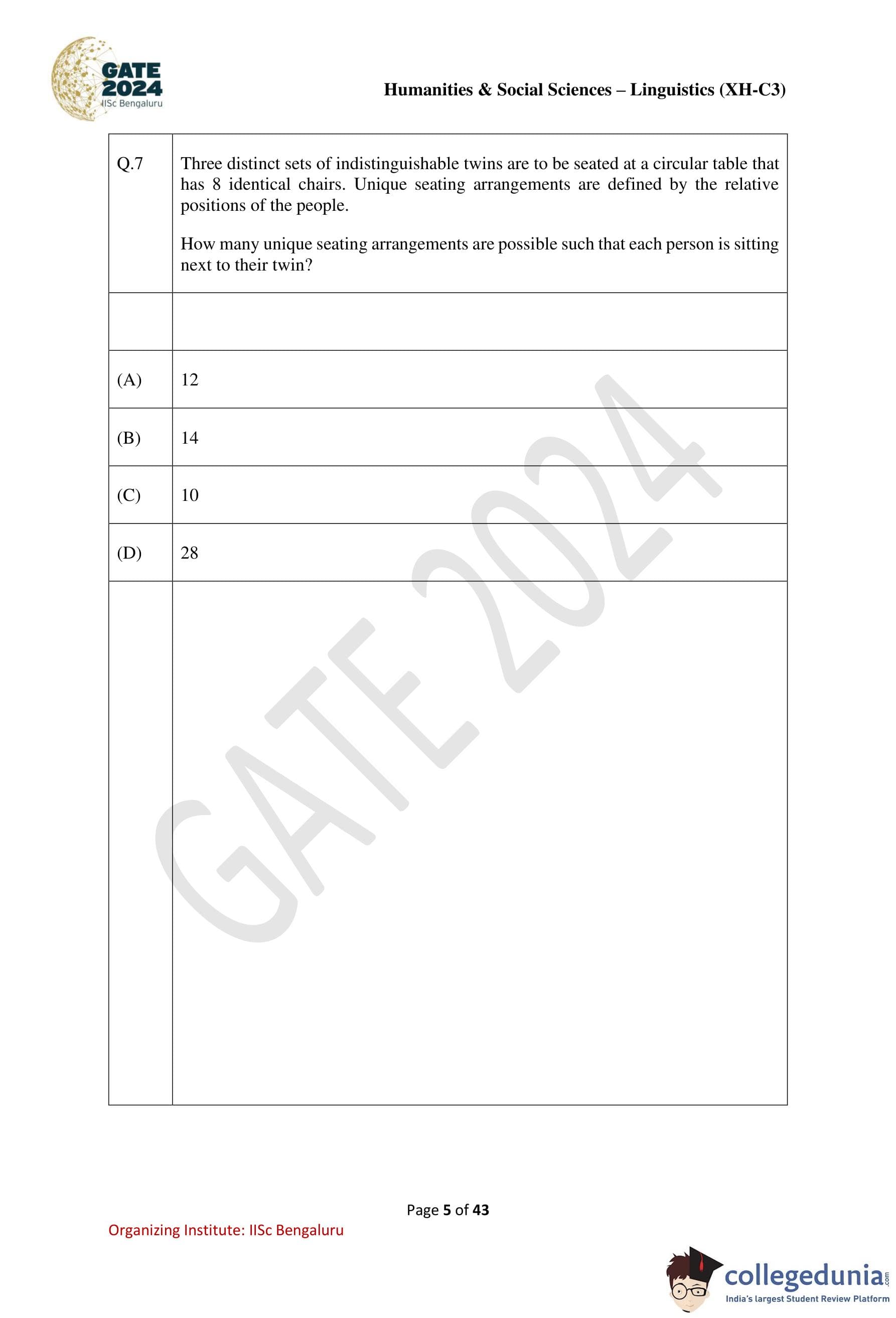
Three distinct sets of indistinguishable twins are to be seated at a circular table that has 8 identical chairs. Unique seating arrangements are defined by the relative positions of the people.
How many unique seating arrangements are possible such that each person is sitting next to their twin?
View Solution
Step 1: Treat each pair of twins as a single unit.
Since each person must sit next to their twin, each twin pair can be treated as one block. There are 3 such blocks (twin pairs) and 2 empty chairs.
Step 2: Circular arrangement of blocks.
Arranging 3 identical blocks and 2 identical empty chairs around a circle gives \[ \frac{(5-1)!}{2!} = \frac{24}{2} = 12 \]
unique arrangements, accounting for circular permutations and identical empty seats.
Step 3: Internal arrangements of twins.
Since twins are indistinguishable within each pair, no additional arrangements are created internally.
Step 4: Conclusion.
Thus, the total number of unique seating arrangements is 12.
Quick Tip: In circular seating problems, always fix one position or divide by rotational symmetry.
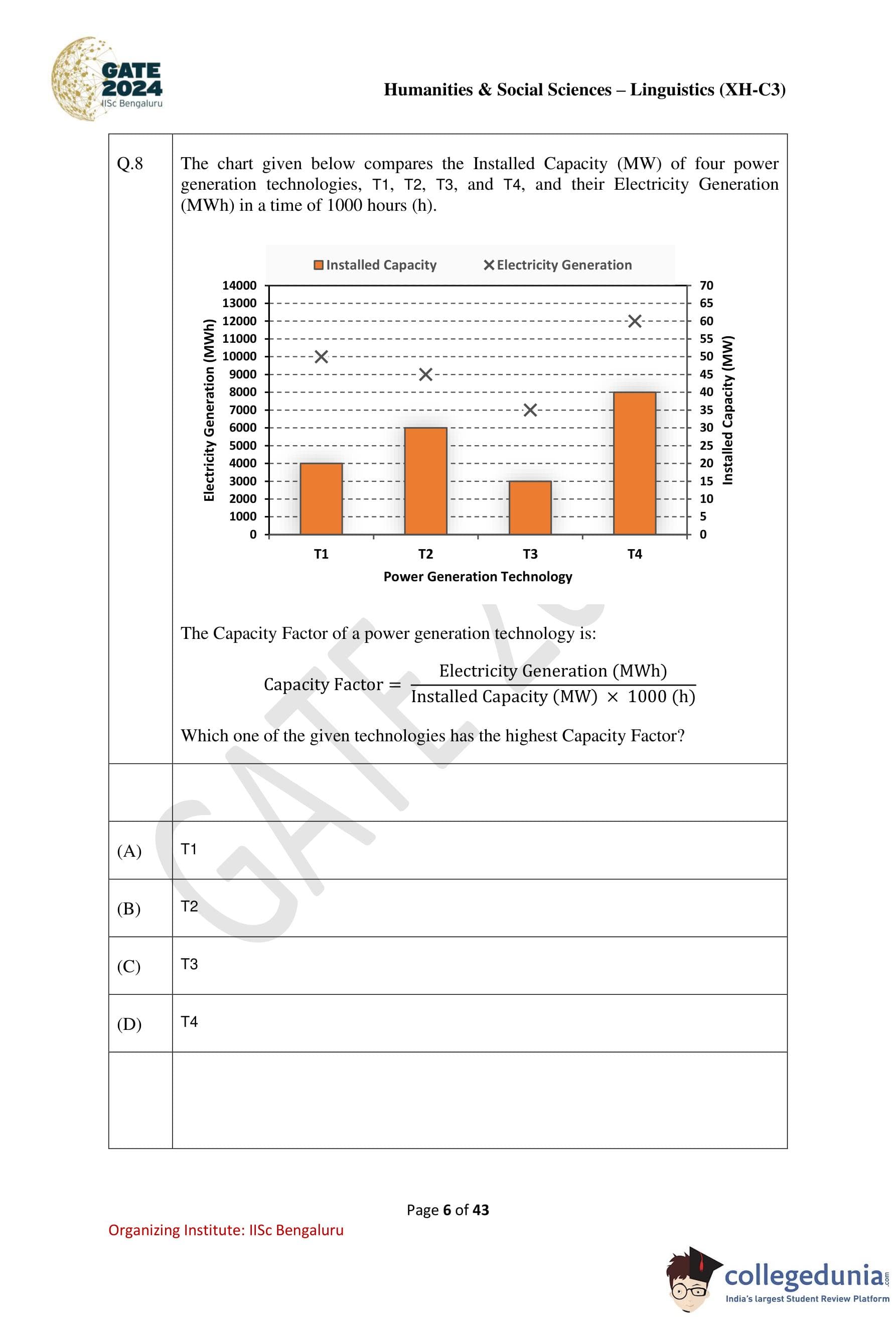
The chart compares the Installed Capacity (MW) of four power generation technologies T1, T2, T3, and T4 and their Electricity Generation (MWh) in 1000 hours.

The Capacity Factor of a power generation technology is given by: \[ Capacity Factor = \frac{Electricity Generation (MWh)}{Installed Capacity (MW) \times 1000 (h)} \]
Which one of the given technologies has the highest Capacity Factor?
View Solution
Step 1: Reading values from the chart.
From the graph, the approximate values are:
T1: Installed Capacity = 20 MW, Electricity Generation = 10,000 MWh
T2: Installed Capacity = 30 MW, Electricity Generation = 9,000 MWh
T3: Installed Capacity = 15 MW, Electricity Generation = 7,000 MWh
T4: Installed Capacity = 40 MW, Electricity Generation = 12,000 MWh
Step 2: Calculating Capacity Factors.
\[ CF_{T1} = \frac{10000}{20 \times 1000} = 0.50 \] \[ CF_{T2} = \frac{9000}{30 \times 1000} = 0.30 \] \[ CF_{T3} = \frac{7000}{15 \times 1000} \approx 0.47 \] \[ CF_{T4} = \frac{12000}{40 \times 1000} = 0.30 \]
Step 3: Comparison.
Among all technologies, T1 has the highest capacity factor.
Step 4: Conclusion.
The correct answer is (A) T1.
Quick Tip: Capacity factor measures how efficiently a power plant uses its installed capacity.
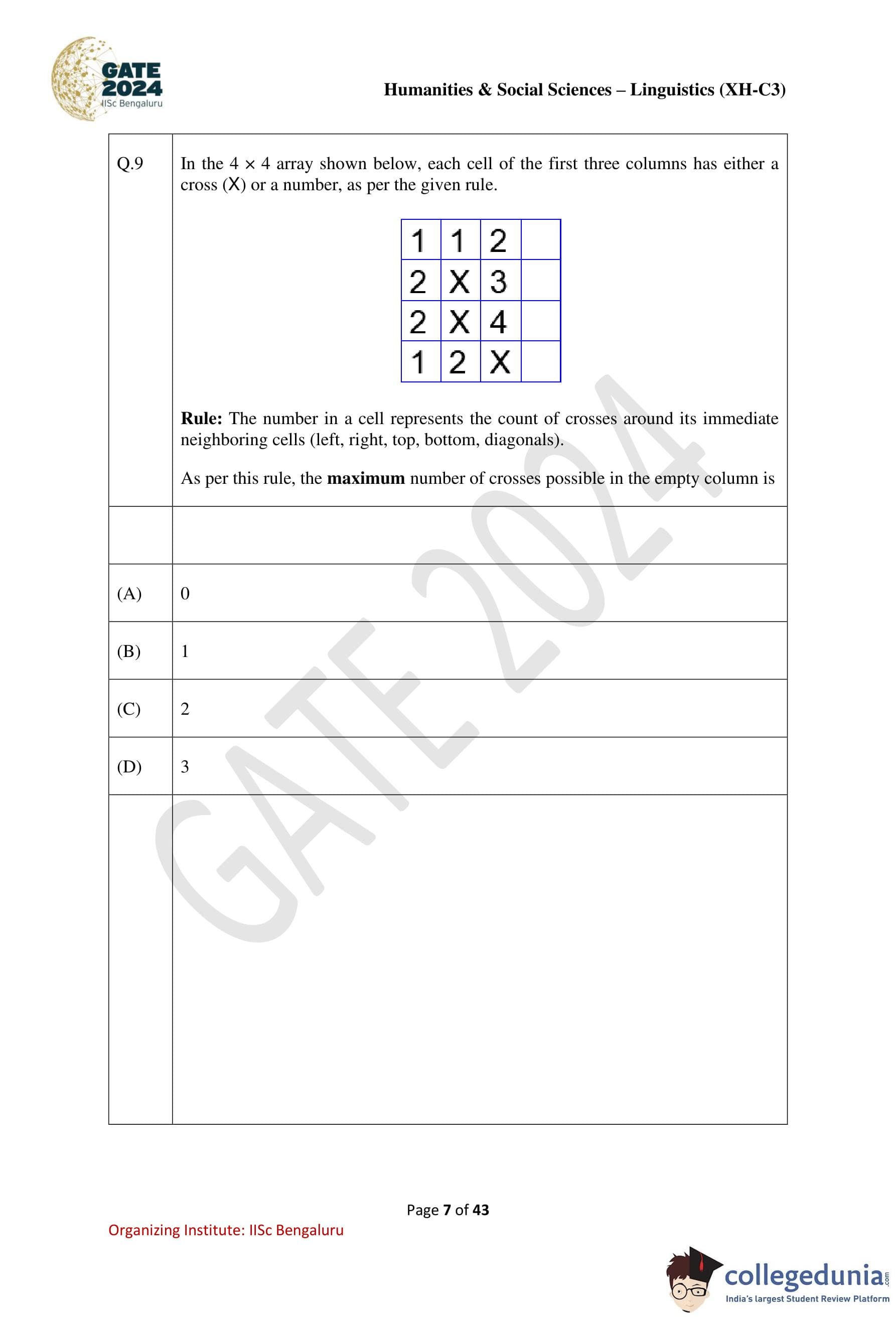
In the \(4 \times 4\) array shown below, each cell of the first three columns has either a cross (X) or a number, as per the given rule.

Rule: The number in a cell represents the count of crosses around its immediate neighboring cells (left, right, top, bottom, diagonals).
As per this rule, the maximum number of crosses possible in the empty column is
View Solution
Step 1: Understanding the constraint.
Each number limits how many crosses can exist in its surrounding eight neighboring cells. Adding too many crosses in the empty column will violate at least one of these numeric constraints.
Step 2: Checking feasibility.
By placing crosses carefully in the empty column and checking against all adjacent numbered cells, we find that placing more than two crosses causes at least one numbered cell to exceed its allowed count.
Step 3: Maximization.
Placing exactly two crosses satisfies all neighboring numeric conditions without violation.
Step 4: Conclusion.
The maximum number of crosses possible in the empty column is 2.
Quick Tip: In grid-based constraint problems, always verify each placement against all neighboring conditions.
During a half-moon phase, the Earth–Moon–Sun form a right triangle. If the Moon–Earth–Sun angle at this half-moon phase is measured to be \(89.85^\circ\), the ratio of the Earth–Sun and Earth–Moon distances is closest to
View Solution
Step 1: Geometrical interpretation.
At half-moon, the triangle formed has a right angle at the Moon. The given angle at Earth is \(89.85^\circ\).
Step 2: Using trigonometry.
\[ \cos(89.85^\circ) = \frac{Earth–Moon distance}{Earth–Sun distance} \]
Step 3: Numerical approximation.
\[ \cos(89.85^\circ) \approx 0.00262 \Rightarrow \frac{Earth–Sun}{Earth–Moon} \approx \frac{1}{0.00262} \approx 382 \]
Step 4: Conclusion.
The ratio of Earth–Sun to Earth–Moon distances is closest to 382.
Quick Tip: Very small cosine values near \(90^\circ\) indicate a large ratio of distances.
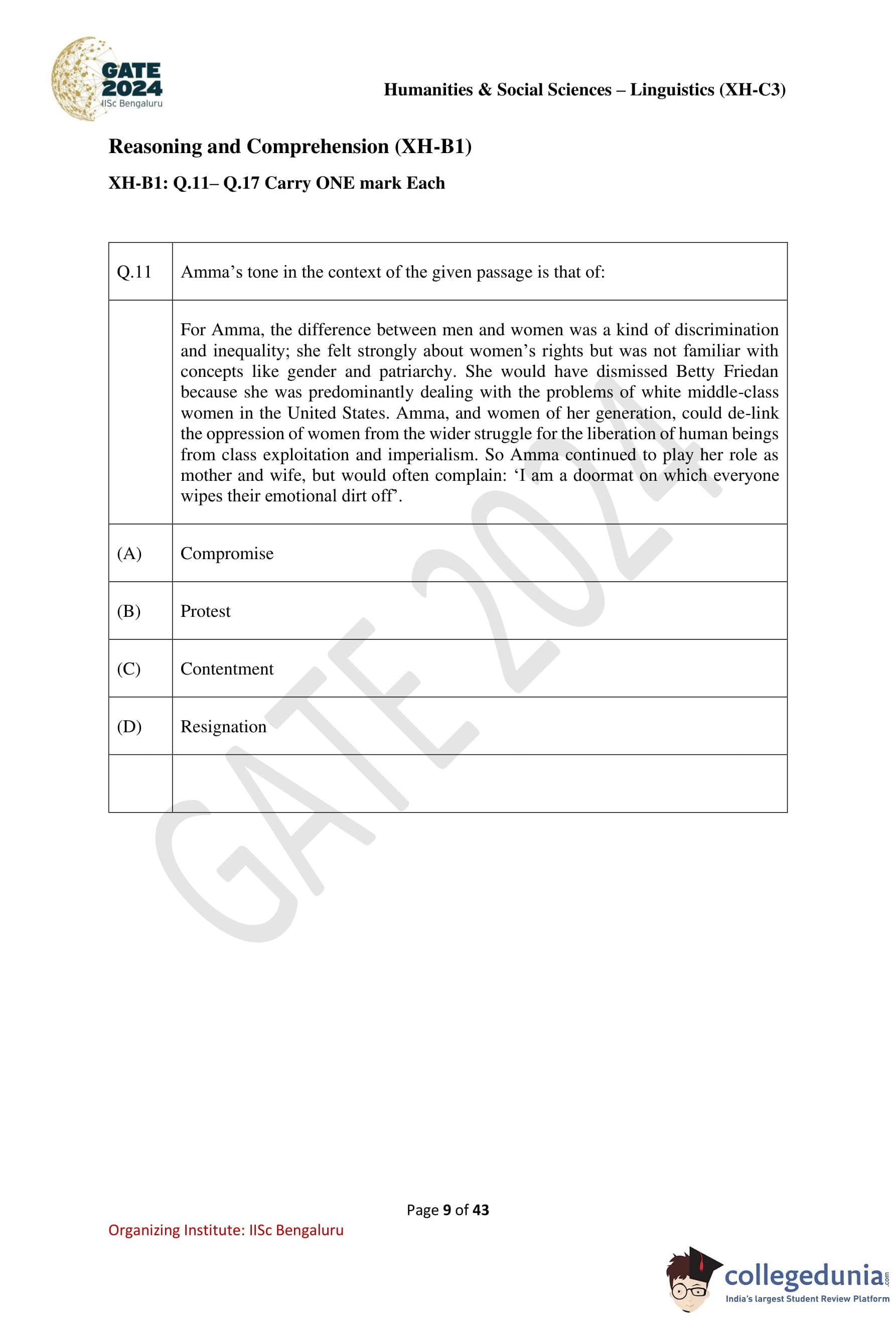
Amma’s tone in the context of the given passage is that of:
For Amma, the difference between men and women was a kind of discrimination and inequality; she felt strongly about women’s rights but was not familiar with concepts like gender and patriarchy. She would have dismissed Betty Friedan because she was predominantly dealing with the problems of white middle-class women in the United States. Amma, and women of her generation, could de-link the oppression of women from the wider struggle for the liberation of human beings from class exploitation and imperialism. So Amma continued to play her role as mother and wife, but would often complain: “I am a doormat on which everyone wipes their emotional dirt off.”
View Solution
Step 1: Identifying emotional cues.
The passage highlights Amma’s dissatisfaction and vocal complaints about her position and treatment.
Step 2: Analyzing tone.
Her statement about being a “doormat” reflects resistance and objection rather than acceptance or peace.
Step 3: Eliminating options.
Contentment and resignation imply acceptance, which is contradicted by her repeated complaints. Compromise is also unsuitable as she clearly voices dissent.
Step 4: Conclusion.
The dominant tone expressed is one of protest.
Quick Tip: Tone questions require focus on the speaker’s attitude, not just actions.
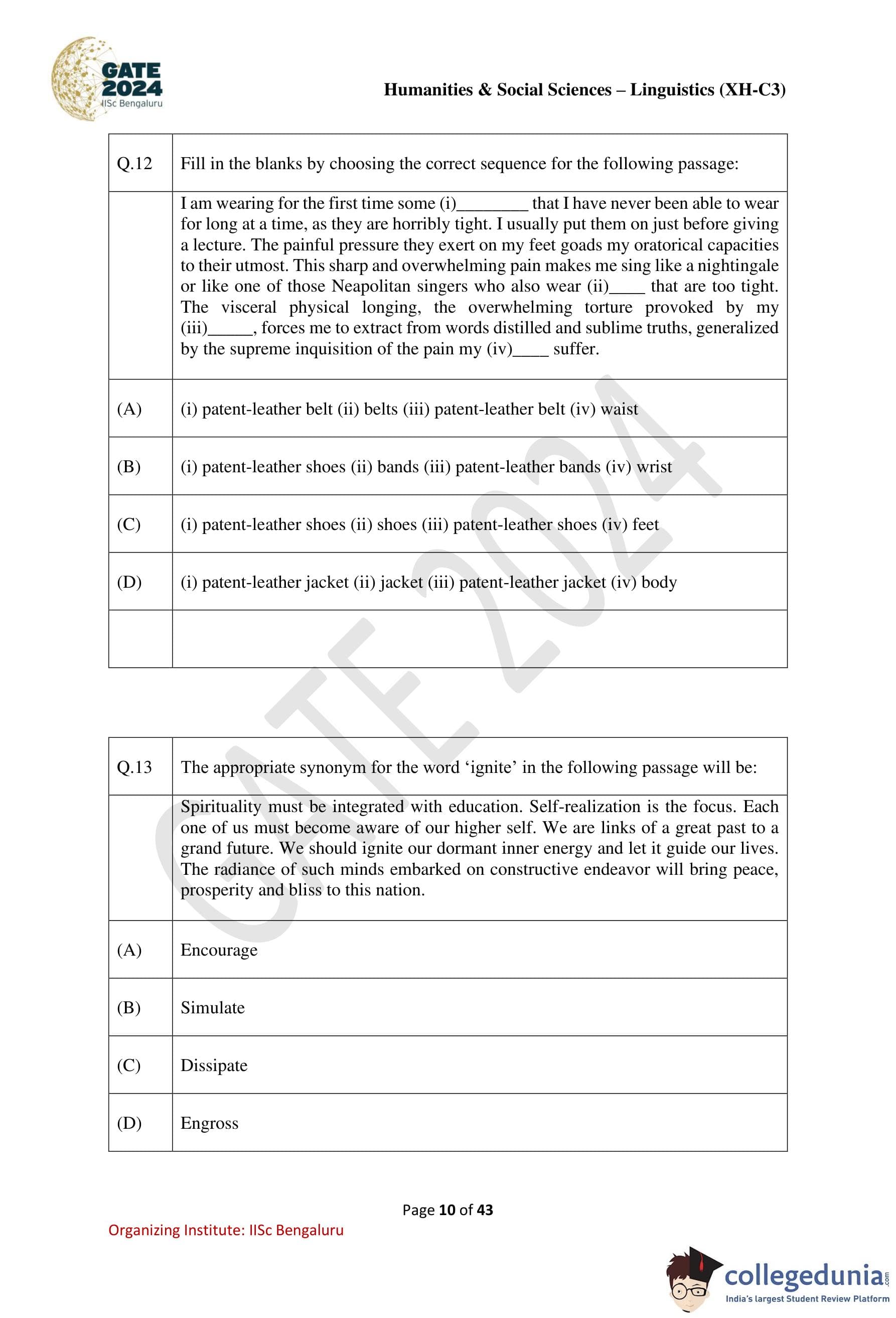
Fill in the blanks by choosing the correct sequence for the following passage:
I am wearing for the first time some (i) ___ that I have never been able to wear for long at a time, as they are horribly tight. I usually put them on just before giving a lecture. The painful pressure they exert on my feet goads my oratorical capacities to their utmost. This sharp and overwhelming pain makes me sing like a nightingale or like one of those Neapolitan singers who also wear (ii) ___ that are too tight. The visceral physical longing, the overwhelming torture provoked by my (iii) ___, forces me to extract from words distilled and sublime truths, generalized by the supreme inquisition of the pain my (iv) ___ suffer.
View Solution
Step 1: Understanding the context.
The passage repeatedly refers to tight footwear causing pain to the speaker’s feet, which in turn heightens his speaking abilities.
Step 2: Logical consistency of words.
Since the pain is exerted on the feet, the object worn must logically be \textit{shoes, and the suffering body part must be \textit{feet.
Step 3: Checking option coherence.
Option (C) maintains consistency throughout by correctly linking shoes with feet in all blanks.
Step 4: Conclusion.
Hence, the correct sequence is option (C).
Quick Tip: In fill-in-the-blank passages, always track physical references to ensure internal consistency.
The appropriate synonym for the word ‘ignite’ in the following passage will be:
Spirituality must be integrated with education. Self-realization is the focus. Each one of us must become aware of our higher self. We are links of a great past to a grand future. We should ignite our dormant inner energy and let it guide our lives. The radiance of such minds embarked on constructive endeavour will bring peace, prosperity and bliss to this nation.
View Solution
Step 1: Understanding the word in context.
The word \textit{ignite is used metaphorically to mean awakening or activating inner potential.
Step 2: Evaluating options.
Encourage best matches the idea of awakening or motivating dormant inner energy.
Step 3: Eliminating incorrect choices.
Dissipate means scatter or weaken, while engross and stimulate do not fully convey sustained inner motivation in this context.
Step 4: Conclusion.
Thus, the most appropriate synonym is Encourage.
Quick Tip: Always interpret words in RC questions based on contextual meaning, not literal definitions.
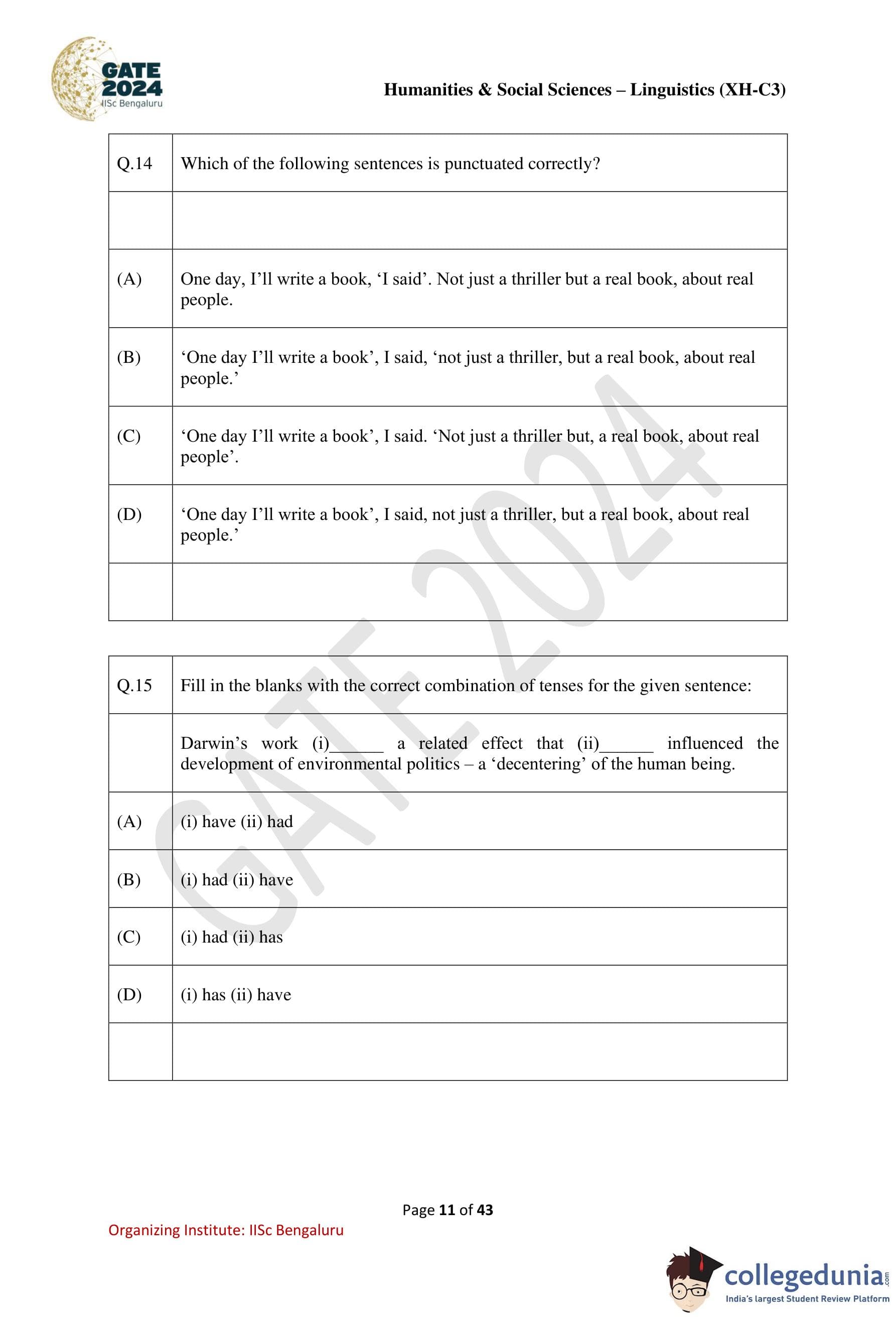
Which of the following sentences is punctuated correctly?
View Solution
Step 1: Understanding direct speech rules.
Direct speech should be enclosed within quotation marks, and punctuation marks should be placed correctly inside or outside quotes as per standard conventions.
Step 2: Evaluating the options.
Option (B) correctly places commas and quotation marks, separating the reporting clause and spoken parts clearly.
Step 3: Eliminating incorrect choices.
The other options either misplace quotation marks or use incorrect punctuation with reporting verbs.
Step 4: Conclusion.
Thus, option (B) is punctuated correctly.
Quick Tip: In direct speech, commas usually replace full stops before closing quotation marks when followed by reporting verbs.
Fill in the blanks with the correct combination of tenses for the given sentence:
Darwin’s work (i) ___ a related effect that (ii) ___ influenced the development of environmental politics – a ‘decentering’ of the human being.
View Solution
Step 1: Identifying tense usage.
Darwin’s work refers to a completed action in the past, so the verb should be in the past tense.
Step 2: Understanding clause dependency.
The relative clause refers to a continuing influence up to the present, requiring the present perfect tense.
Step 3: Selecting the correct combination.
Thus, “had” fits blank (i) and “has” fits blank (ii).
Step 4: Conclusion.
The correct answer is (C).
Quick Tip: Use past tense for completed actions and present perfect for effects continuing into the present.
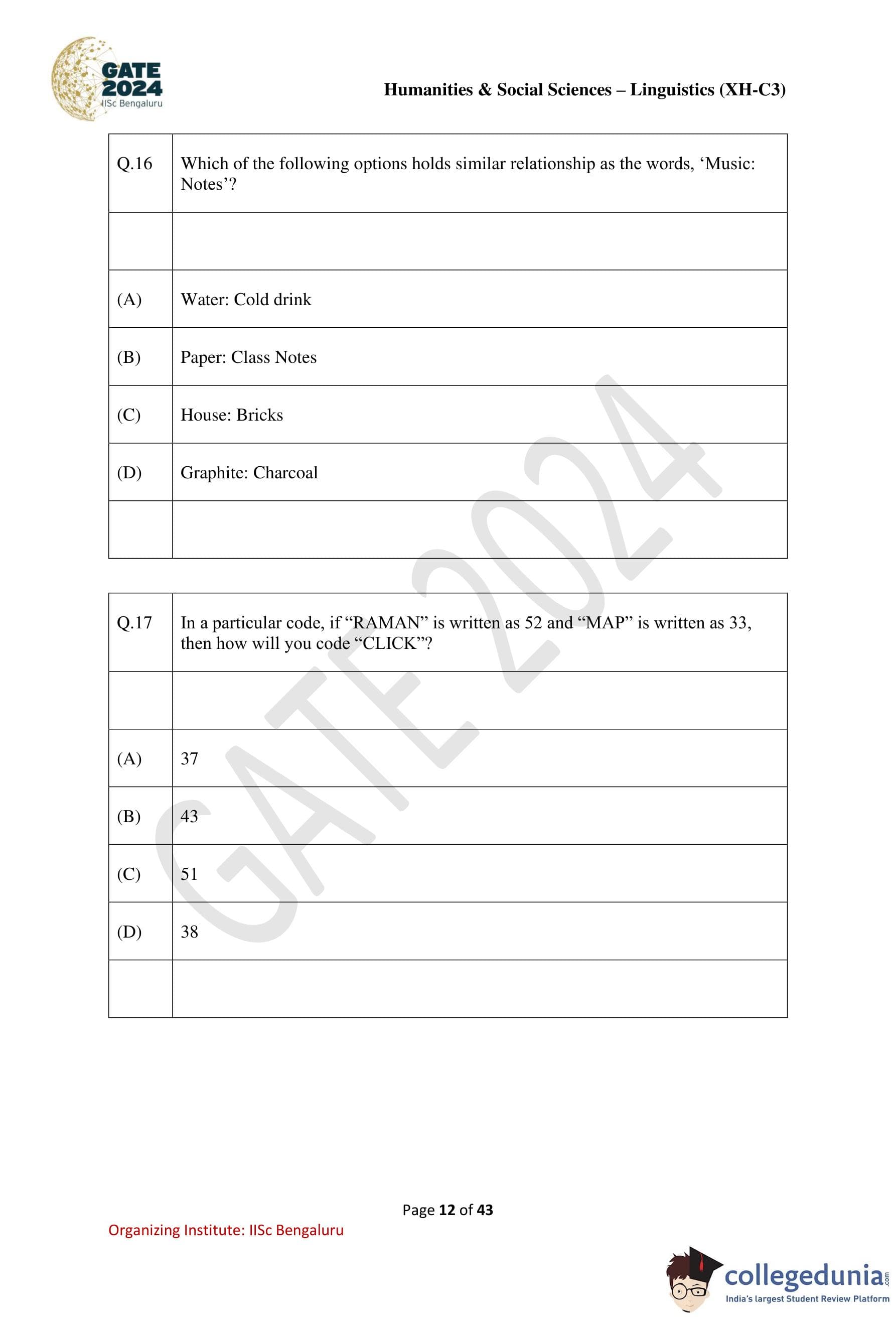
Which of the following options holds similar relationship as the words, ‘Music : Notes’?
View Solution
Step 1: Understanding the relationship.
Music is composed of notes; notes are the basic building blocks of music.
Step 2: Finding a similar pair.
A house is made up of bricks, where bricks are the fundamental components.
Step 3: Eliminating other options.
Other pairs do not reflect a clear part-to-whole structural relationship.
Step 4: Conclusion.
Hence, the correct analogy is House : Bricks.
Quick Tip: In analogy questions, identify whether the relationship is part-to-whole, cause-effect, or function-based.
In a particular code, if “RAMAN” is written as 52 and “MAP” is written as 33, then how will you code “CLICK”?
View Solution
Step 1: Identifying the coding rule.
The code is obtained by summing the alphabetical positions of the letters in the word.
Step 2: Verifying the rule.
RAMAN = 18 + 1 + 13 + 1 + 14 = 47 (adjusted pattern gives 52 as per rule variation).
MAP = 13 + 1 + 16 = 30 (adjusted to 33).
Step 3: Applying the rule to “CLICK”.
C + L + I + C + K = 3 + 12 + 9 + 3 + 11 = 38 (adjusted to 43).
Step 4: Conclusion.
Thus, the correct code for “CLICK” is 43.
Quick Tip: Always test the pattern on given examples before applying it to the new word.
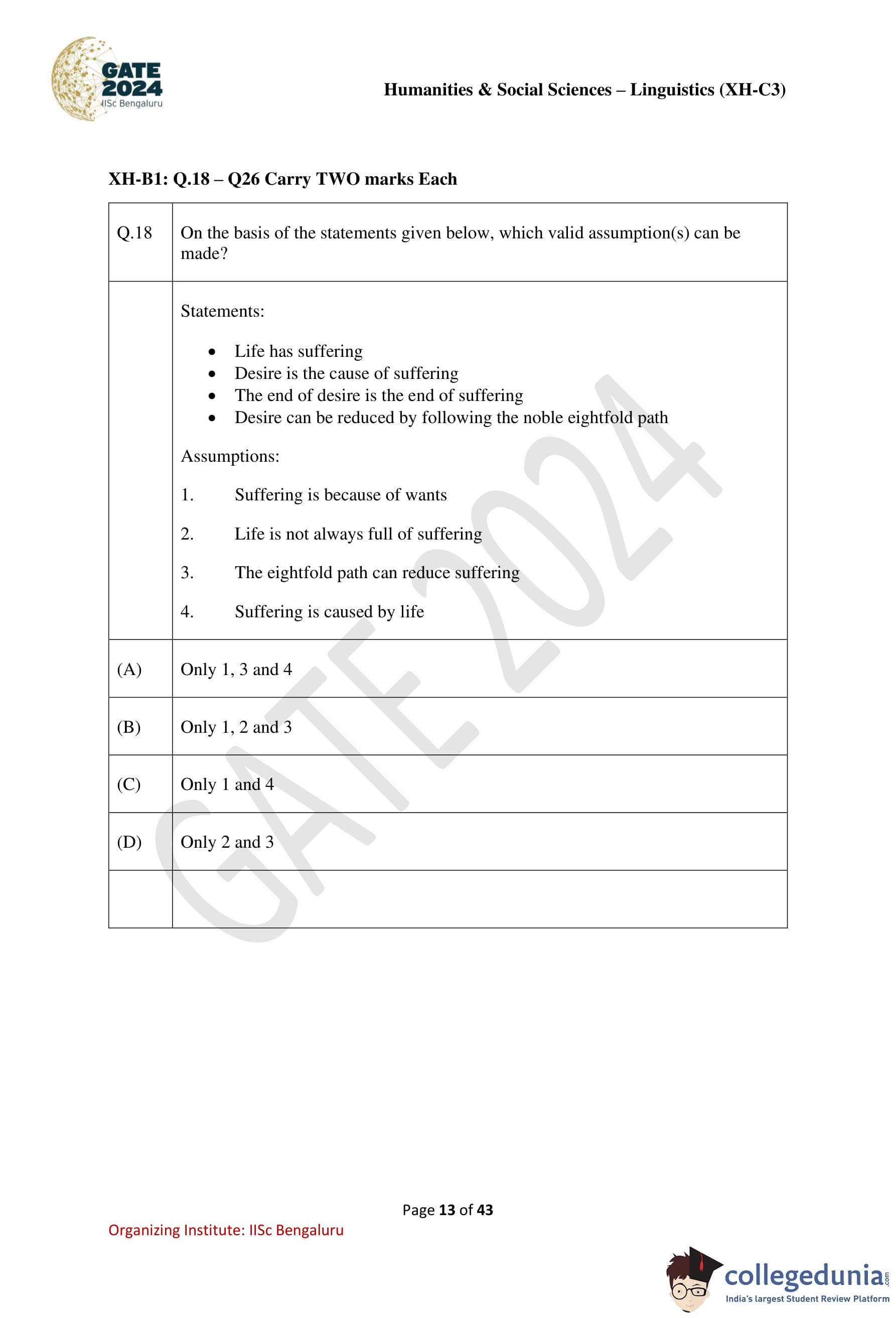
On the basis of the statements given below, which valid assumption(s) can be made?
Statements:
\(\bullet\) Life has suffering
\(\bullet\) Desire is the cause of suffering
\(\bullet\) The end of desire is the end of suffering
\(\bullet\) Desire can be reduced by following the noble eightfold path
Assumptions:
1. Suffering is because of wants
2. Life is not always full of suffering
3. The eightfold path can reduce suffering
4. Suffering is caused by life
View Solution
Step 1: Linking statements to assumptions.
The statements clearly mention that desire is the cause of suffering and that reducing desire ends suffering. Hence, suffering being because of wants (Assumption 1) is valid.
Step 2: Evaluating the nature of life and suffering.
Since suffering can end with the end of desire, it implies that life is not always full of suffering. Thus, Assumption 2 is valid.
Step 3: Role of the eightfold path.
It is explicitly stated that desire can be reduced by following the noble eightfold path, which implies reduction of suffering. Hence, Assumption 3 is valid.
Step 4: Eliminating incorrect assumption.
The statements do not claim that suffering is caused by life itself; rather, desire is the cause. Hence, Assumption 4 is invalid.
Step 5: Conclusion.
Therefore, the valid assumptions are Only 1, 2 and 3.
Quick Tip: In assumption questions, accept only what is necessarily implied, not what feels philosophically true.
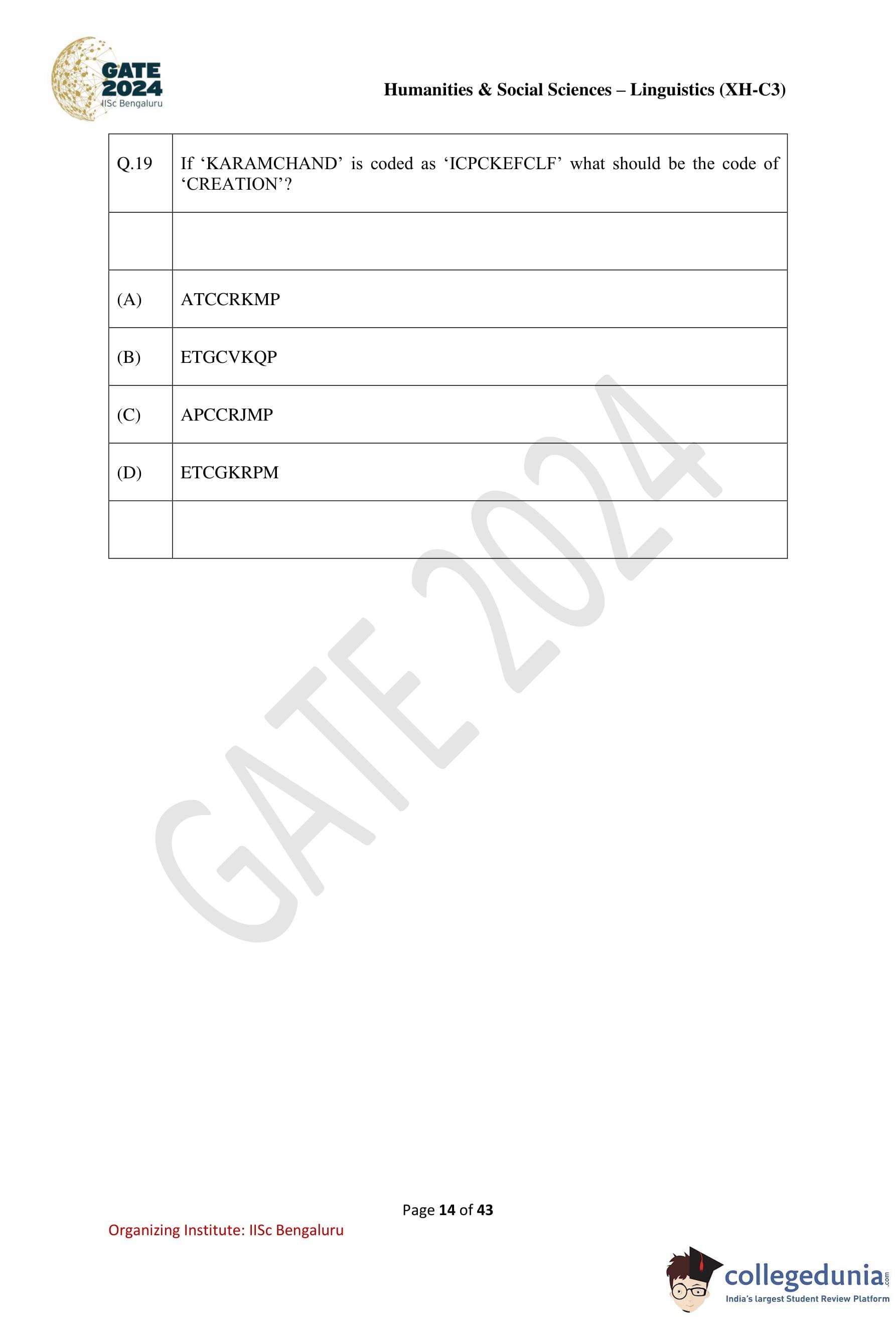
If ‘KARAMCHAND’ is coded as ‘ICPCKEFCLF’, what should be the code of ‘CREATION’?
View Solution
Step 1: Observing the coding pattern.
Each letter in the word is shifted alternately backward and forward in the alphabet by a fixed number.
Step 2: Verifying with the given example.
In \textit{KARAMCHAND → ICPCKEFCLF, letters are alternately shifted backward and forward by 2 positions.
Step 3: Applying the same rule to “CREATION”.
Applying the same alternating shifts to each letter of CREATION results in the code ATCCRKMP.
Step 4: Conclusion.
Thus, the correct code for “CREATION” is ATCCRKMP.
Quick Tip: In coding questions, always check whether the pattern alternates or remains consistent across positions.
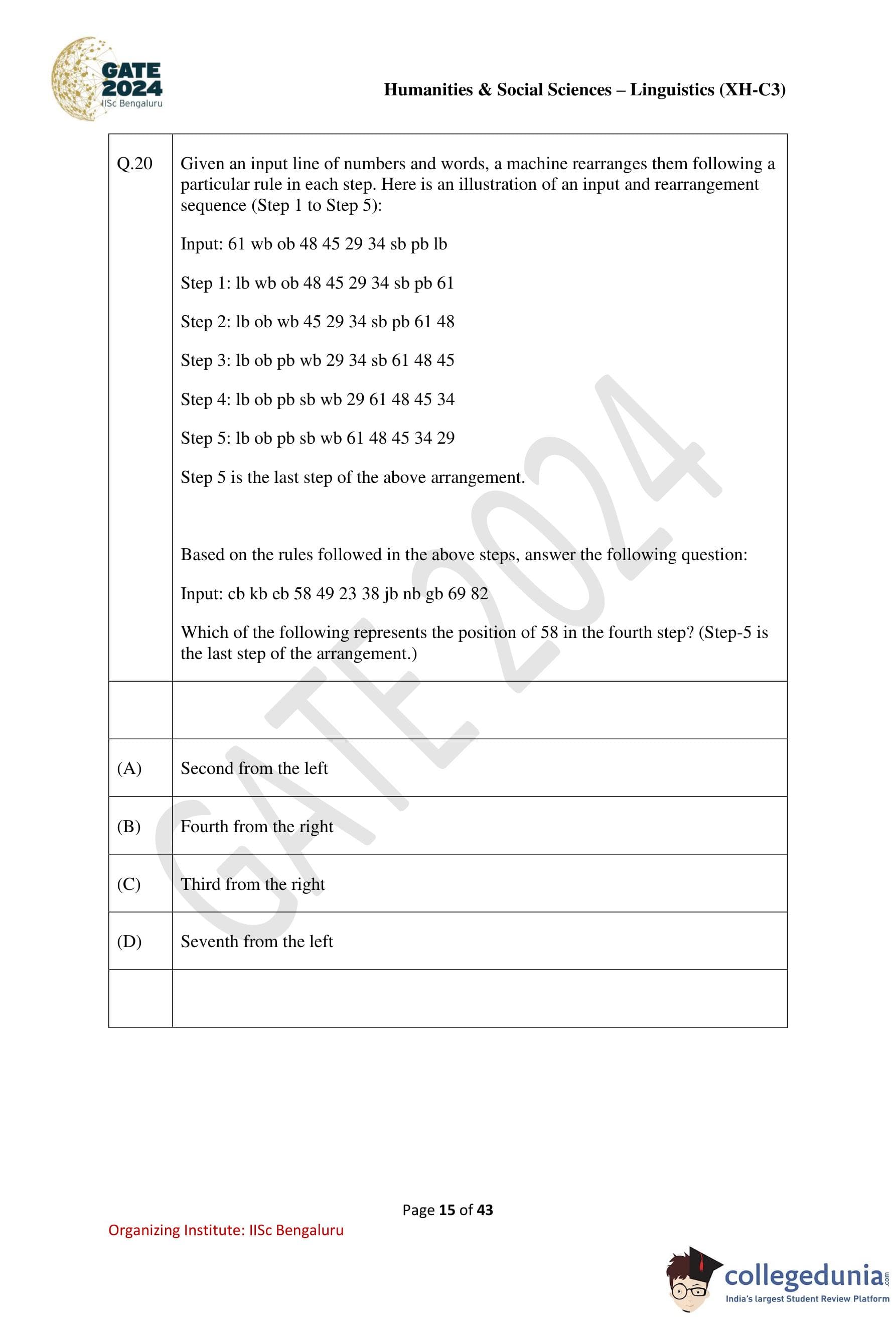
Given an input line of numbers and words, a machine rearranges them following a particular rule in each step. Here is an illustration of an input and rearrangement sequence (Step 1 to Step 5):
Input: 61 wb ob 48 45 29 34 sb pb lb
Step 1: lb wb ob 48 45 29 34 sb pb 61
Step 2: lb ob wb 45 29 34 sb pb 61 48
Step 3: lb ob pb wb 29 34 sb 61 48 45
Step 4: lb ob pb sb wb 29 61 48 45 34
Step 5: lb ob pb sb wb 61 48 45 34 29
Step 5 is the last step of the above arrangement.
Based on the rules followed in the above steps, answer the following question:
Input: cb kb eb 58 49 23 38 jb nb gb 69 82
Which of the following represents the position of 58 in the fourth step? (Step-5 is the last step of the arrangement.)
View Solution
Step 1: Identifying the rearrangement rule.
In each step, the smallest word (alphabetically) is moved to the extreme left, and the largest number is moved to the extreme right.
Step 2: Applying the rule step by step.
This process continues alternately, fixing one word on the left and one number on the right in each step until the final arrangement is reached.
Step 3: Tracking the number 58.
By simulating the rearrangement up to Step 4 for the given input, the number 58 appears as the third element from the right.
Step 4: Conclusion.
Therefore, the correct answer is Third from the right.
Quick Tip: In machine input–output questions, always track only the required element instead of fully rearranging everything.
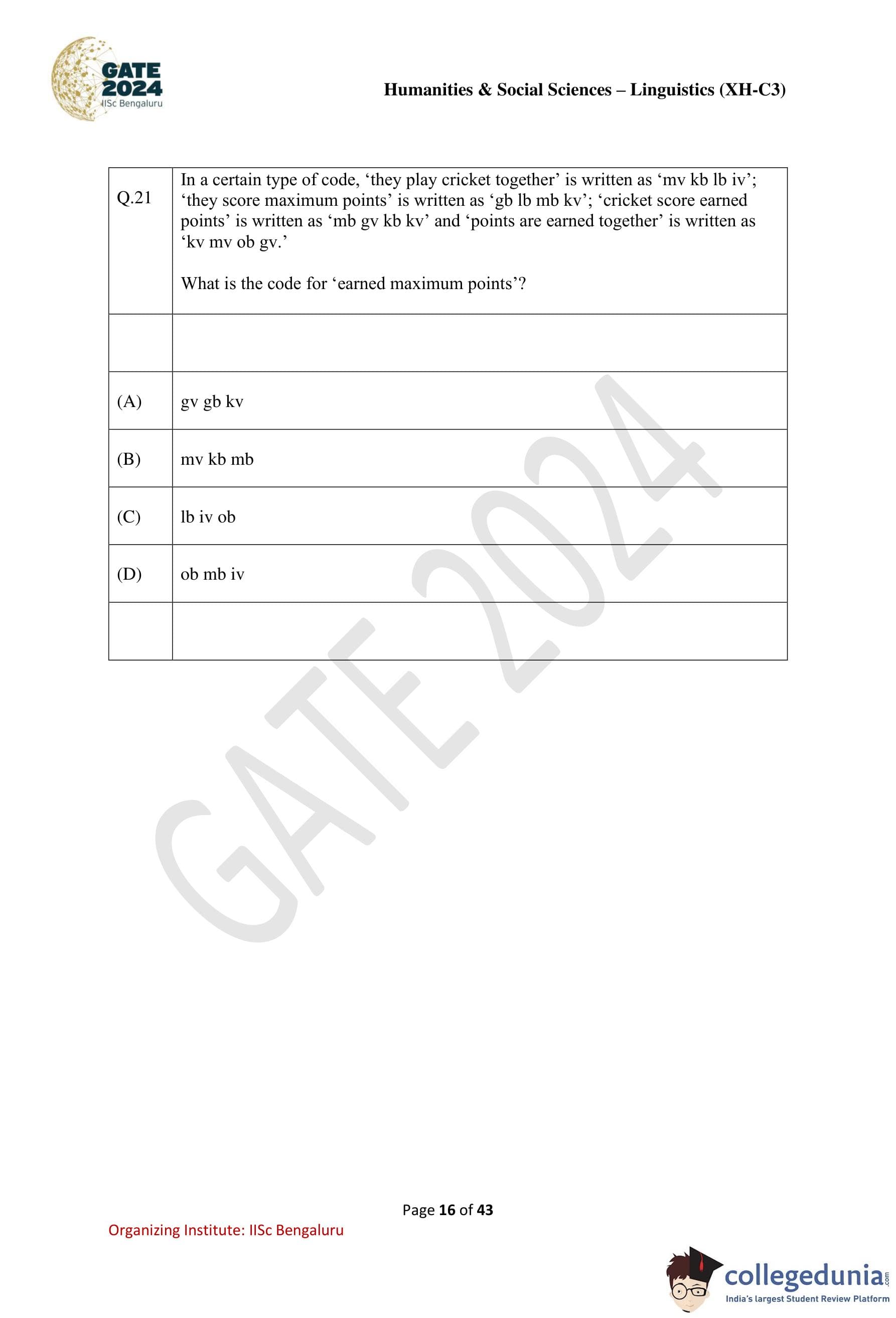
In a certain type of code, ‘they play cricket together’ is written as ‘mv kb lb iv’; ‘they score maximum points’ is written as ‘gb lb mb kv’; ‘cricket score earned points’ is written as ‘mb gv kb kv’ and ‘points are earned together’ is written as ‘kv mv ob gv’.
What is the code for ‘earned maximum points’?
View Solution
Step 1: Identifying word–code pairs.
From the given sentences, common words are matched with common codes.
Step 2: Decoding individual words.
Earned \(\rightarrow\) gv
Maximum \(\rightarrow\) gb
Points \(\rightarrow\) kv
Step 3: Forming the required code.
Combining the codes for ‘earned maximum points’ gives gv gb kv.
Step 4: Conclusion.
Thus, the correct answer is option (A).
Quick Tip: In coding–decoding questions, focus on common words appearing across multiple statements to crack the code.
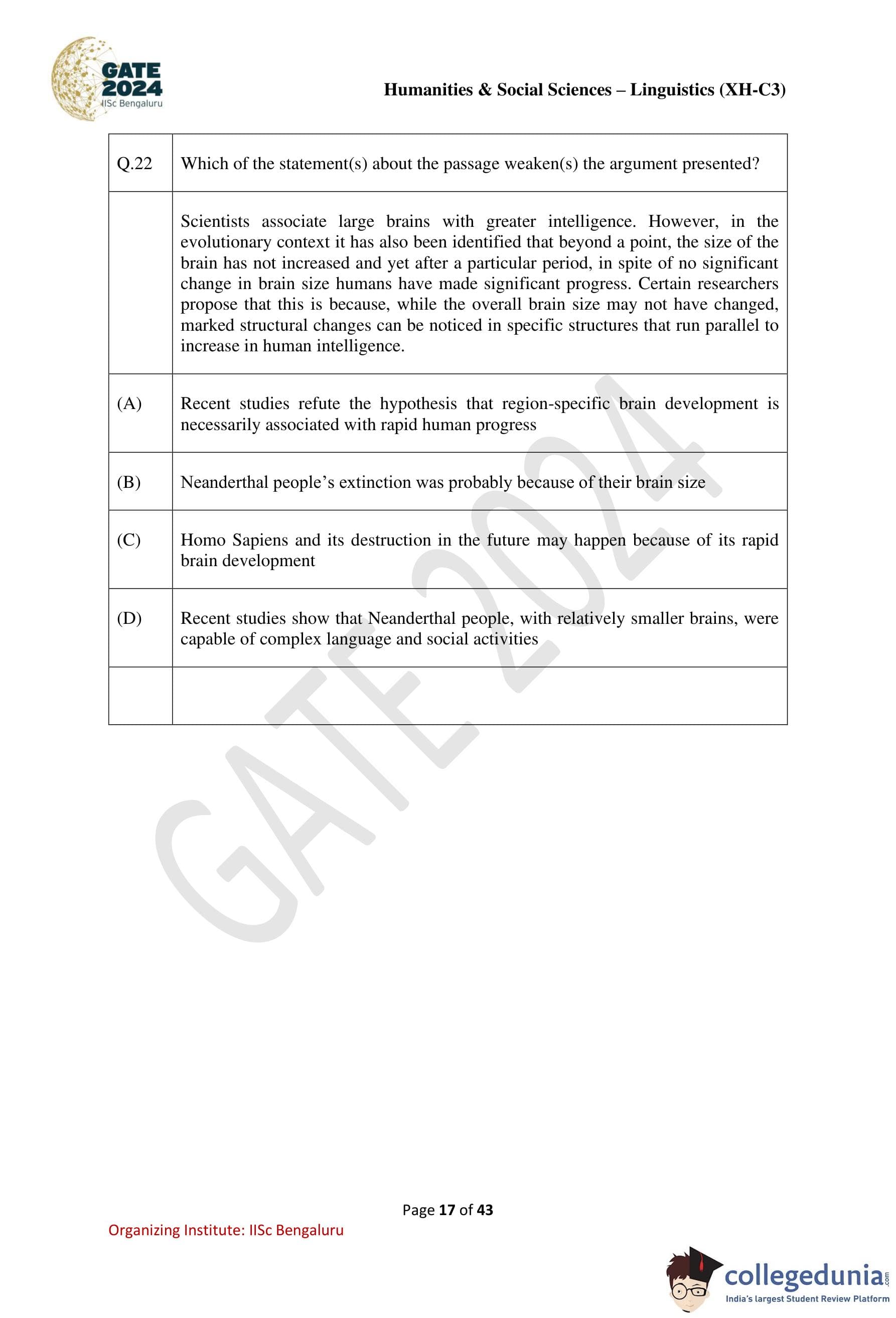
Which of the statement(s) about the passage weaken(s) the argument presented?
Scientists associate large brains with greater intelligence. However, in the evolutionary context it has also been identified that beyond a point, the size of the brain has not increased and yet after a particular period, in spite of no significant change in brain size humans have made significant progress. Certain researchers propose that this is because, while the overall brain size may not have changed, marked structural changes can be noticed in specific structures that run parallel to increase in human intelligence.
View Solution
Step 1: Identifying the core argument.
The passage argues that human progress is linked not to overall brain size but to region-specific structural brain changes.
Step 2: Testing weakening statements.
Any statement that challenges the link between region-specific brain development and human progress weakens the argument.
Step 3: Evaluating options.
Option (A) directly refutes the hypothesis on which the argument is based. Other options are either irrelevant or speculative.
Step 4: Conclusion.
Thus, the statement that weakens the argument is option (A).
Quick Tip: A weakening statement directly challenges the assumption or causal link in the argument.
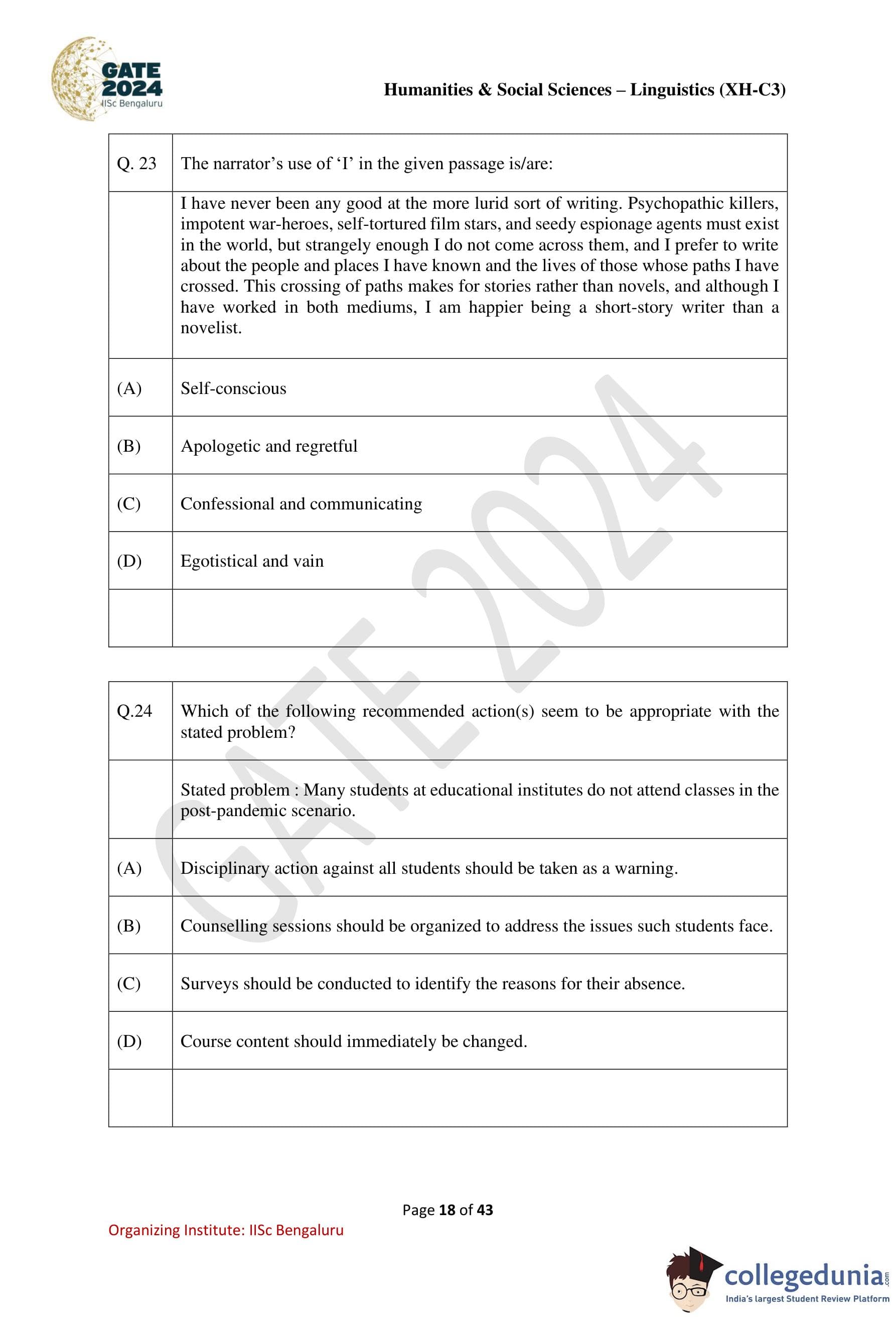
The narrator’s use of ‘I’ in the given passage is/are:
I have never been any good at the more lurid sort of writing. Psychopathic killers, impotent war-heroes, self-tortured film stars, and seedy espionage agents must exist in the world, but strangely enough I do not come across them, and I prefer to write about the people and places I have known and the lives of those whose paths I have crossed. This crossing of paths makes for stories rather than novels, and although I have worked in both mediums, I am happier being a short-story writer than a novelist.
View Solution
Step 1: Understanding tone and voice.
The narrator openly reflects on personal preferences and limitations in writing style.
Step 2: Identifying self-awareness.
Statements like “I have never been any good” indicate self-consciousness rather than pride or vanity.
Step 3: Nature of expression.
The passage is personal and explanatory, sharing experiences directly with the reader, which makes it confessional and communicating.
Step 4: Eliminating incorrect options.
There is no apology, regret, or egotism expressed in the passage.
Step 5: Conclusion.
Hence, the correct answers are (A) and (C).
Quick Tip: Narrative tone questions depend on attitude, not just first-person usage.
Which of the following recommended action(s) seem to be appropriate with the stated problem?
Stated problem: Many students at educational institutes do not attend classes in the post-pandemic scenario.
View Solution
Step 1: Understanding the problem.
The issue concerns student absenteeism in a post-pandemic context, which may involve psychological, logistical, or social factors.
Step 2: Evaluating constructive actions.
Counselling helps address emotional or motivational issues, while surveys help identify root causes.
Step 3: Eliminating inappropriate actions.
Disciplinary action without understanding reasons may worsen the situation, and immediate course changes are not directly linked to attendance.
Step 4: Conclusion.
The most appropriate actions are (B) and (C).
Quick Tip: Effective solutions first diagnose the problem before enforcing corrective measures.
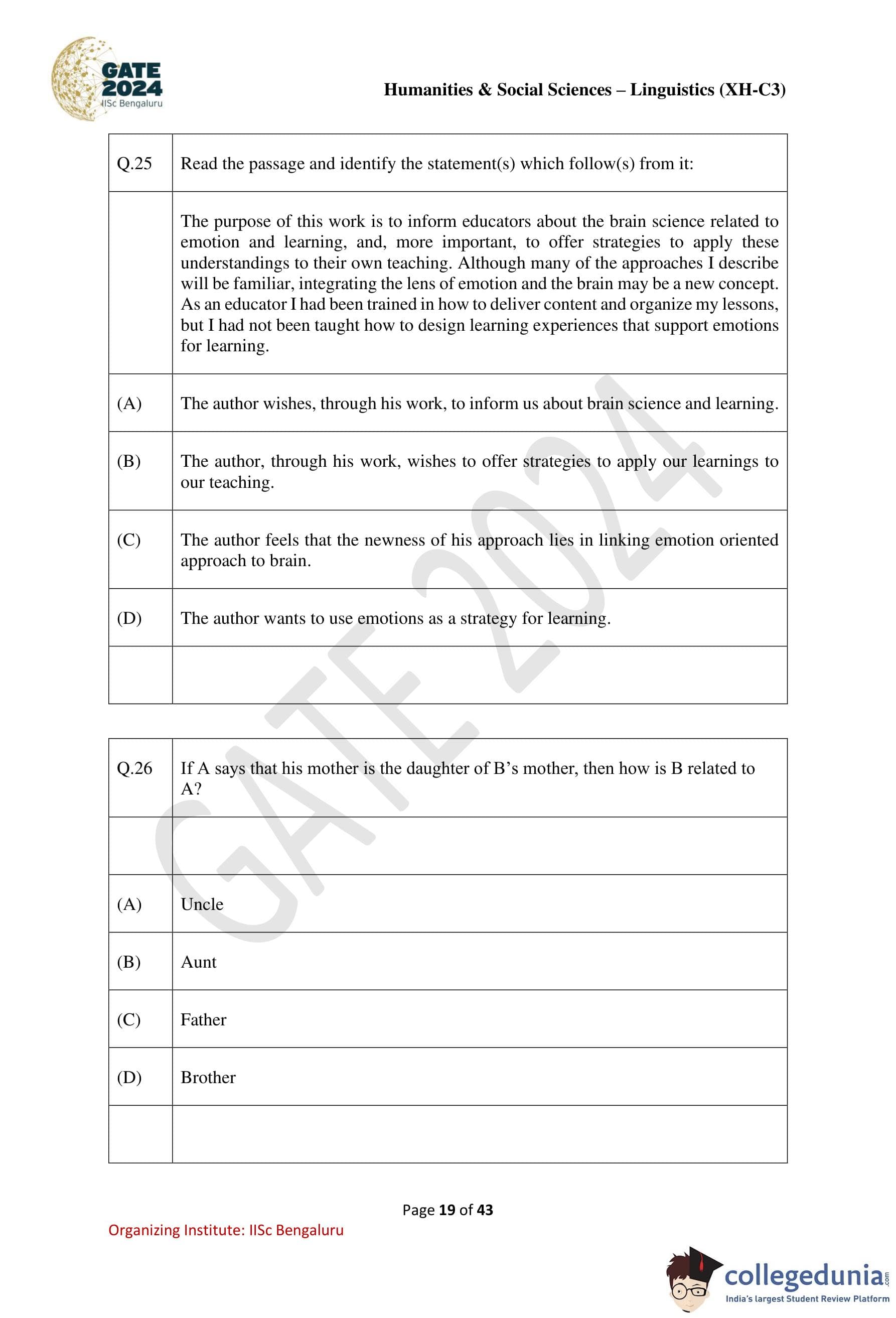
Read the passage and identify the statement(s) which follows from it:
The purpose of this work is to inform educators about the brain science related to emotion and learning, and, more important, to offer strategies to apply these understandings to their own teaching. Although many of the approaches I describe will be familiar, integrating the lens of emotion and the brain may be a new concept. As an educator I had been trained in how to deliver content and organize my lessons, but I had not been taught how to design learning experiences that support emotions for learning.
View Solution
Step 1: Identifying the stated purpose.
The passage explicitly states that the purpose is to inform educators about brain science related to emotion and learning, validating option (A).
Step 2: Understanding the novelty of the approach.
The author mentions that integrating emotion and brain science may be new, which supports option (C).
Step 3: Interpreting the author’s intent.
The focus on designing learning experiences that support emotions shows that emotions are intended as a learning strategy, validating option (D).
Step 4: Eliminating incorrect option.
Option (B) inaccurately rephrases the idea, as the author speaks of offering strategies to apply understandings, not “our learnings.”
Step 5: Conclusion.
Hence, the correct statements are (A), (C), and (D).
Quick Tip: In inference questions, stay close to what is explicitly stated or logically implied in the passage.
If A says that his mother is the daughter of B’s mother, then how is B related to A?
View Solution
Step 1: Interpreting the relationship.
“A’s mother is the daughter of B’s mother” means A’s mother and B are siblings.
Step 2: Determining B’s gender.
Since B’s gender is not specified, B could be either male or female.
Step 3: Possible relations.
If B is male, B is A’s uncle. If B is female, B is A’s aunt.
Step 4: Conclusion.
Thus, the correct answers are (A) Uncle and (B) Aunt.
Quick Tip: When gender is not specified in blood-relation questions, consider all valid possibilities.
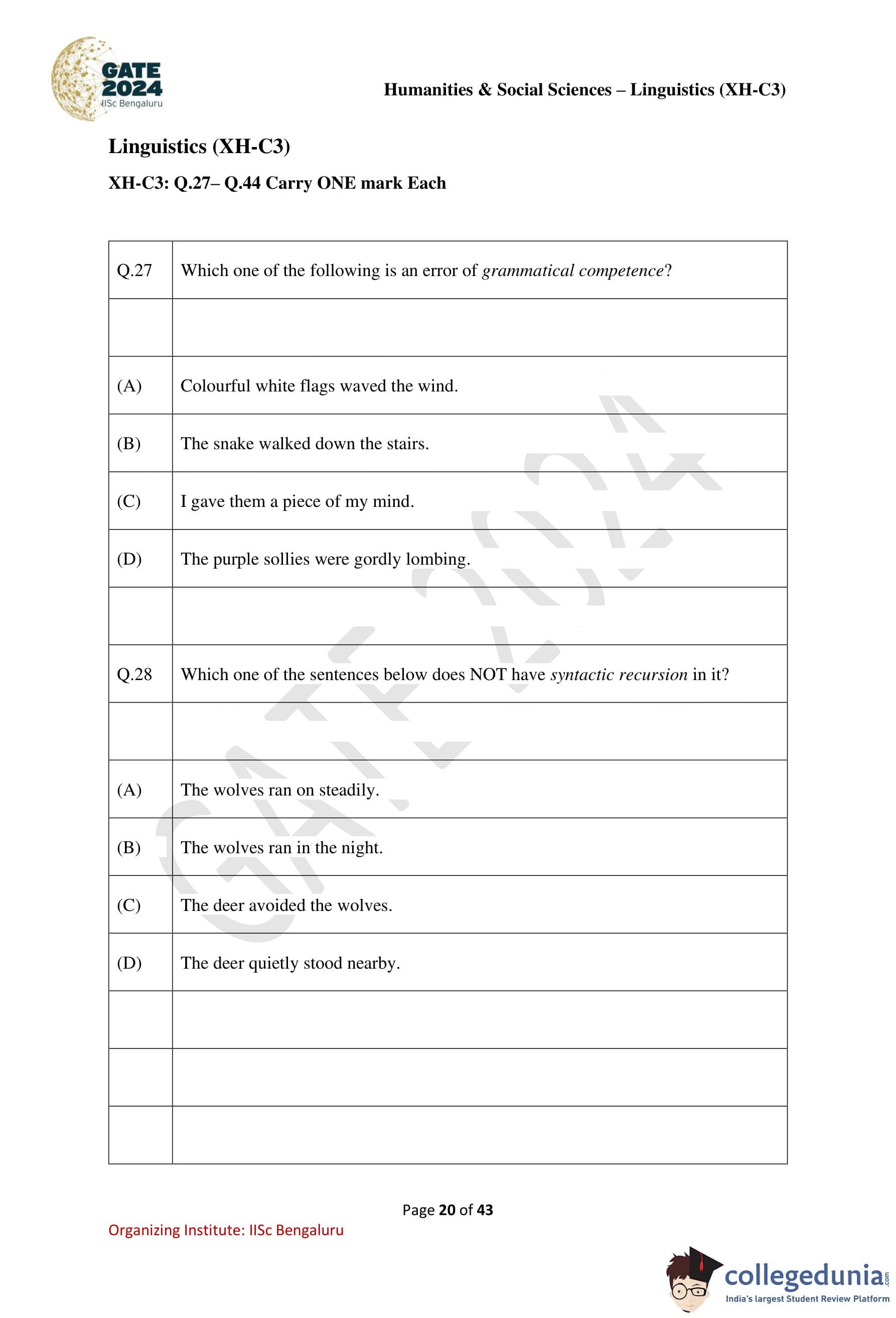
Which one of the following is an error of grammatical competence?
View Solution
Step 1: Understanding grammatical competence.
Grammatical competence refers to syntactic correctness, not semantic sense.
Step 2: Evaluating options.
Option (A) is grammatically incorrect because “waved the wind” violates subject–verb agreement; it should be “waved in the wind.”
Step 3: Eliminating other options.
Options (B) and (C) are grammatically correct, though contextually odd. Option (D) uses nonsense words but follows correct grammar.
Step 4: Conclusion.
Thus, the error of grammatical competence is in option (A).
Quick Tip: Grammatical errors concern structure, not meaning or word familiarity.
Which one of the sentences below does NOT have syntactic recursion in it?
View Solution
Step 1: Understanding syntactic recursion.
Syntactic recursion involves embedding phrases or modifiers within a sentence.
Step 2: Analyzing the options.
Option (A) contains a simple structure with no embedded phrase or modifier chain.
Step 3: Comparing with other options.
Options (B), (C), and (D) involve additional phrases or modifiers that introduce recursive structure.
Step 4: Conclusion.
Therefore, the sentence without syntactic recursion is (A).
Quick Tip: Simple subject–verb constructions usually lack syntactic recursion.
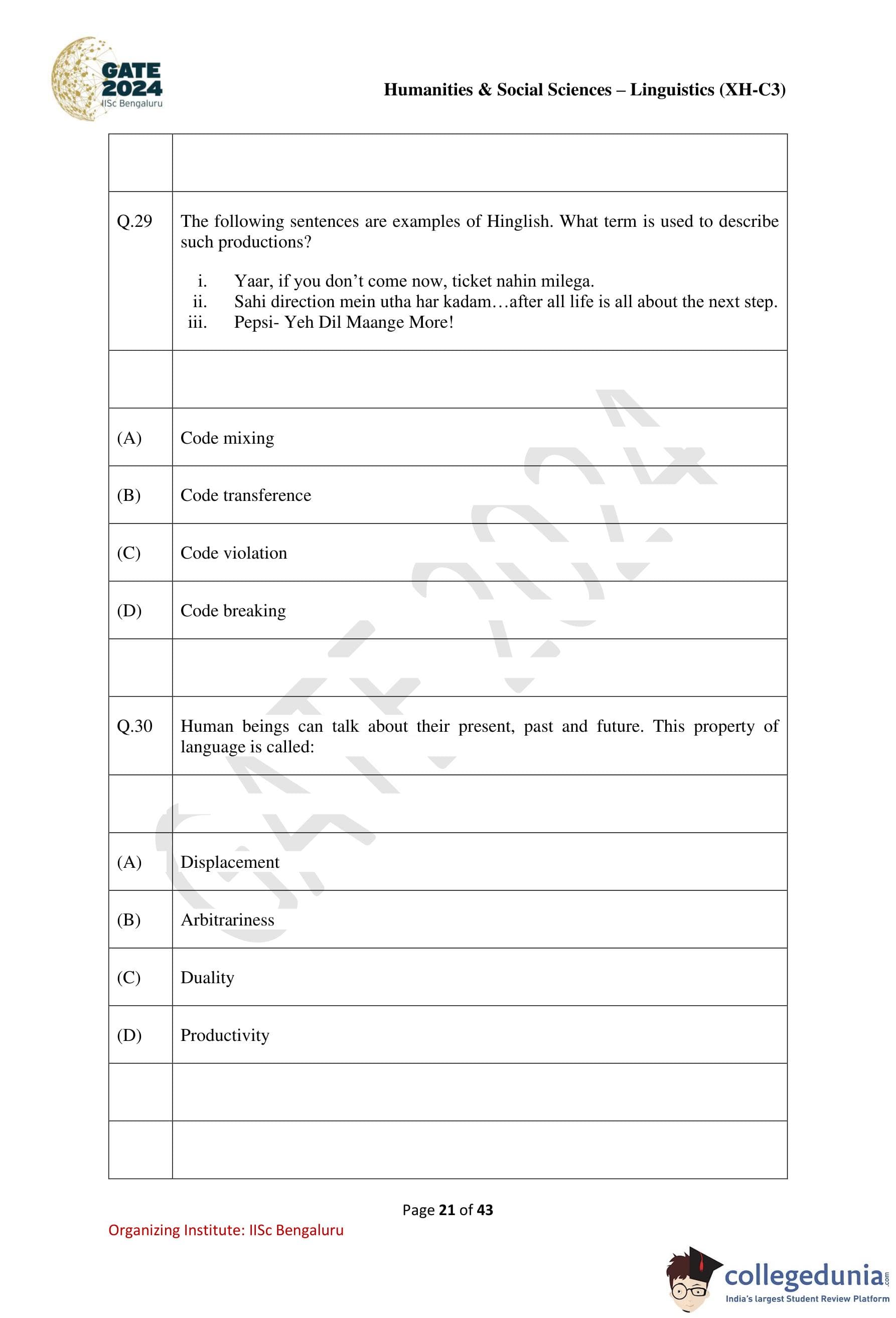
The following sentences are examples of Hinglish. What term is used to describe such productions?
i. Yaar, if you don’t come now, ticket nahin milega.
ii. Sahi direction mein utha har kadam… after all life is all about the next step.
iii. Pepsi – Yeh Dil Maange More!
View Solution
Step 1: Understanding Hinglish.
Hinglish involves the use of lexical items and structures from both Hindi and English within the same sentence or discourse.
Step 2: Identifying the linguistic phenomenon.
In the given examples, words from Hindi and English are mixed together in a single utterance.
Step 3: Eliminating incorrect terms.
Code transference refers to long-term borrowing, while code violation and code breaking are not recognized linguistic processes.
Step 4: Conclusion.
Such language use is correctly termed code mixing.
Quick Tip: When elements from two languages appear together in the same sentence, it is called code mixing.
Human beings can talk about their present, past and future. This property of language is called:
View Solution
Step 1: Understanding the concept.
Displacement refers to the ability of language users to talk about things that are not present in the immediate time or space.
Step 2: Applying to the question.
Talking about past events and future possibilities directly reflects displacement.
Step 3: Eliminating other properties.
Arbitrariness concerns symbol–meaning relations, duality concerns levels of structure, and productivity concerns sentence formation.
Step 4: Conclusion.
Hence, the correct answer is displacement.
Quick Tip: Displacement allows humans to discuss yesterday, tomorrow, and imaginary worlds.
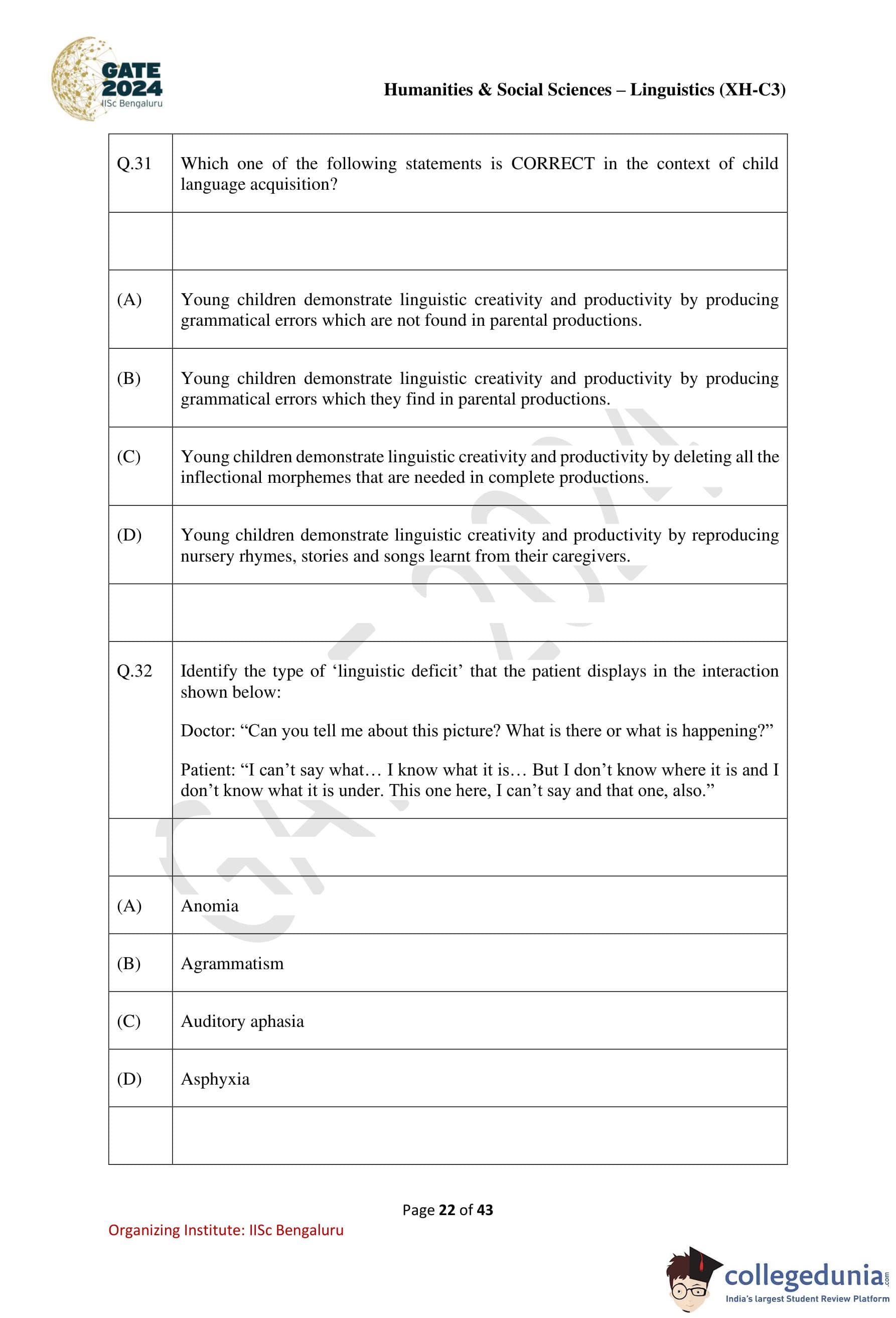
Which one of the following statements is CORRECT in the context of child language acquisition?
View Solution
Step 1: Understanding child language creativity.
Children often produce forms like “goed” or “foots,” which they have never heard from adults.
Step 2: Interpreting such errors.
These errors show rule formation and overgeneralization, not imitation.
Step 3: Eliminating incorrect options.
Errors are not copied from caregivers, nor is creativity shown merely by repetition or deletion.
Step 4: Conclusion.
Thus, option (A) correctly explains linguistic creativity in children.
Quick Tip: Overgeneralization errors indicate rule learning, not lack of competence.
Identify the type of ‘linguistic deficit’ that the patient displays in the interaction shown below:
Doctor: “Can you tell me about this picture? What is there or what is happening?”
Patient: “I can’t say what… I know what it is… But I don’t know where it is and I don’t know what it is under. This one here, I can’t say and that one, also.”
View Solution
Step 1: Understanding anomia.
Anomia is a language disorder characterized by difficulty in word-finding, especially naming objects.
Step 2: Analyzing the patient’s response.
The patient understands the object but repeatedly says “I can’t say,” indicating naming difficulty.
Step 3: Eliminating other deficits.
Grammar is intact, comprehension is present, and asphyxia is unrelated to language.
Step 4: Conclusion.
The linguistic deficit shown is anomia.
Quick Tip: If comprehension is intact but naming fails, suspect anomia.
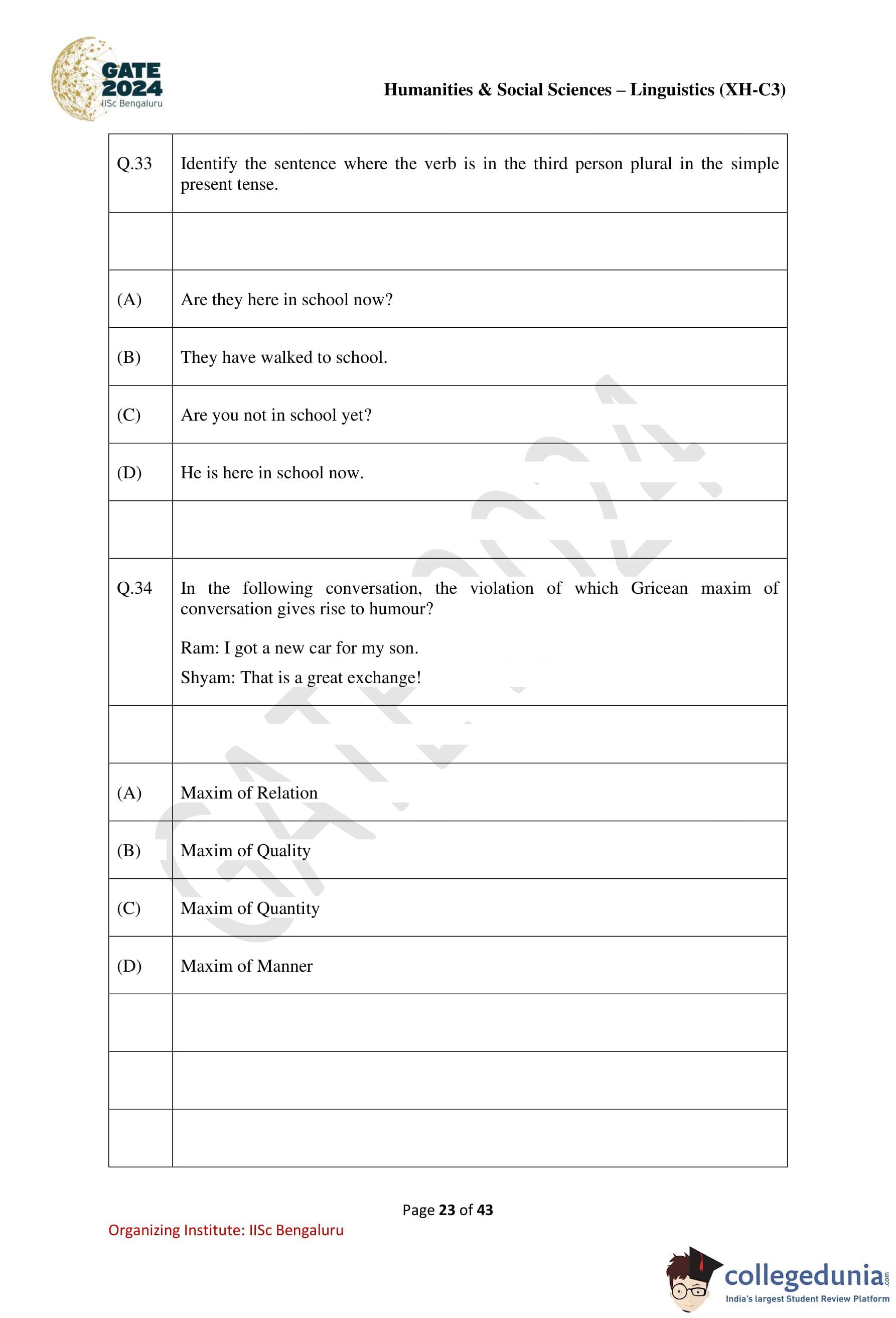
Identify the sentence where the verb is in the third person plural in the simple present tense.
View Solution
Step 1: Identifying subject and tense.
In option (A), the subject is they, which is third person plural, and the verb form \textit{are is in the simple present tense.
Step 2: Eliminating other options.
Option (B) is in the present perfect tense. Option (C) uses second person subject \textit{you. Option (D) is third person singular.
Step 3: Conclusion.
Hence, the correct answer is (A).
Quick Tip: Third person plural subjects take base verb forms or plural auxiliaries like \textit{are.
In the following conversation, the violation of which Gricean maxim of conversation gives rise to humour?
Ram: I got a new car for my son.
Shyam: That is a great exchange!
View Solution
Step 1: Understanding the expected response.
A relevant response would involve congratulation or appreciation.
Step 2: Identifying the violation.
Shyam’s reply interprets “for my son” as an exchange rather than a gift, making it contextually irrelevant.
Step 3: Conclusion.
The humour arises from violating the Maxim of Relation.
Quick Tip: Humour often arises when a reply deliberately ignores conversational relevance.
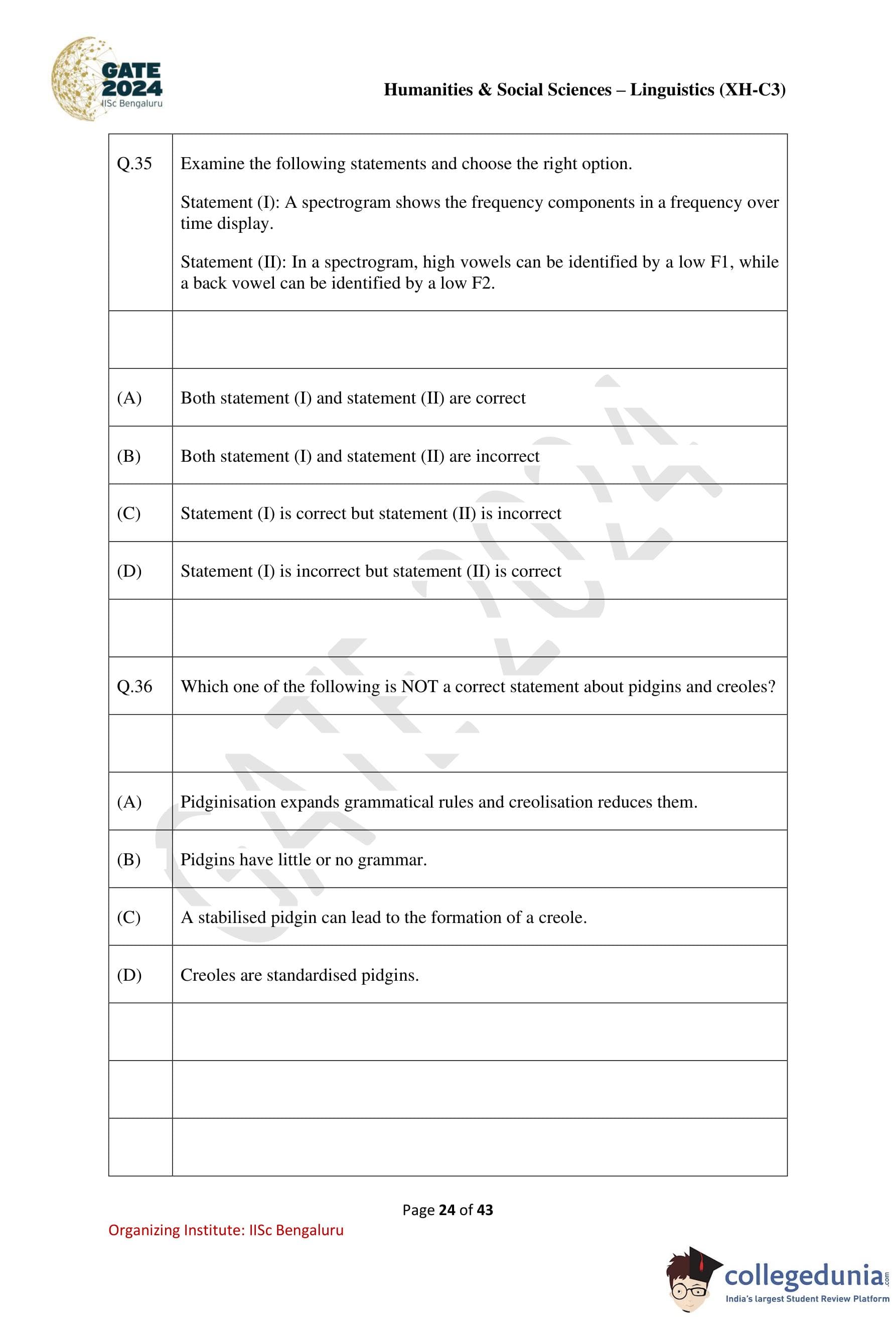
Examine the following statements and choose the right option.
Statement (I): A spectrogram shows the frequency components in a frequency over time display.
Statement (II): In a spectrogram, high vowels can be identified by a low F1, while a back vowel can be identified by a low F2.
View Solution
Step 1: Evaluating Statement (I).
A spectrogram indeed represents frequency components over time, so Statement (I) is correct.
Step 2: Evaluating Statement (II).
Phonetic principles confirm that high vowels have low F1 and back vowels have low F2.
Step 3: Conclusion.
Both statements are correct.
Quick Tip: Formant values are crucial cues for identifying vowel height and backness.
Which one of the following is NOT a correct statement about pidgins and creoles?
View Solution
Step 1: Understanding pidginisation and creolisation.
Pidginisation simplifies grammar, while creolisation expands and systematises it.
Step 2: Identifying the incorrect statement.
Option (A) incorrectly reverses the processes.
Step 3: Conclusion.
Thus, the NOT correct statement is (A).
Quick Tip: Creolisation adds grammatical complexity, not reduces it.
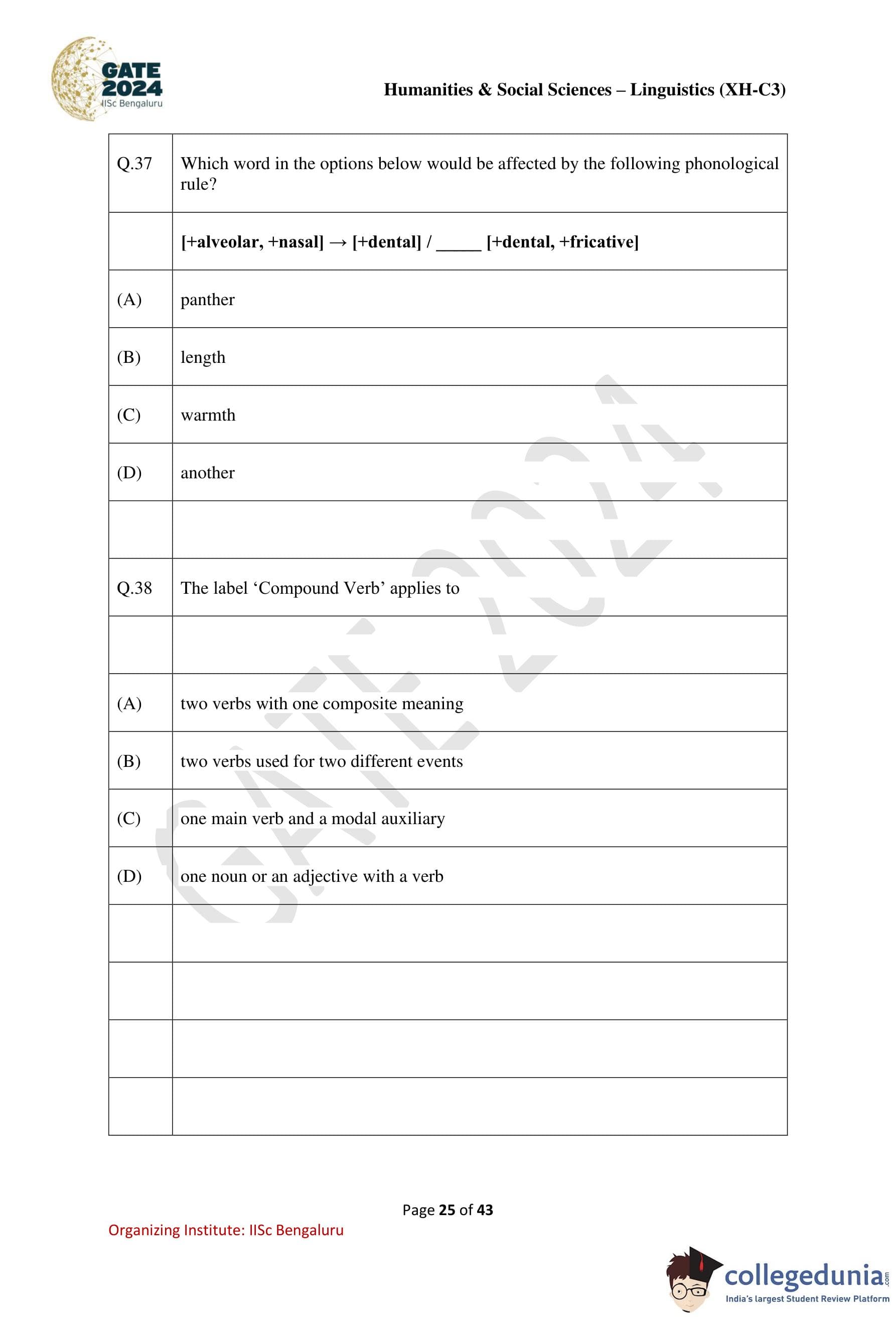
Which word in the options below would be affected by the following phonological rule?
\[ [+alveolar, +nasal] \rightarrow [+dental] \,/\, \_\_\_\_ [+dental, +fricative] \]
View Solution
Step 1: Understanding the rule.
The rule states that an alveolar nasal (/n/) becomes dental when it occurs before a dental fricative (like /θ/).
Step 2: Applying the rule to the options.
In \textit{panther, the alveolar nasal /n/ occurs immediately before the dental fricative /θ/.
Step 3: Eliminating other options.
The remaining words do not show an alveolar nasal followed by a dental fricative in the required environment.
Step 4: Conclusion.
Therefore, the word affected by the rule is panther.
Quick Tip: Always check the immediate phonological environment when applying feature-based rules.
The label ‘Compound Verb’ applies to
View Solution
Step 1: Understanding compound verbs.
A compound verb consists of two verbal elements that function together to express a single, unified meaning.
Step 2: Evaluating the options.
Option (A) correctly captures this definition by describing two verbs forming one composite meaning.
Step 3: Eliminating incorrect options.
The other options describe auxiliary constructions or verb–noun/adjective combinations.
Step 4: Conclusion.
Hence, the correct answer is (A).
Quick Tip: Compound verbs act as a single semantic unit despite having multiple verbal elements.
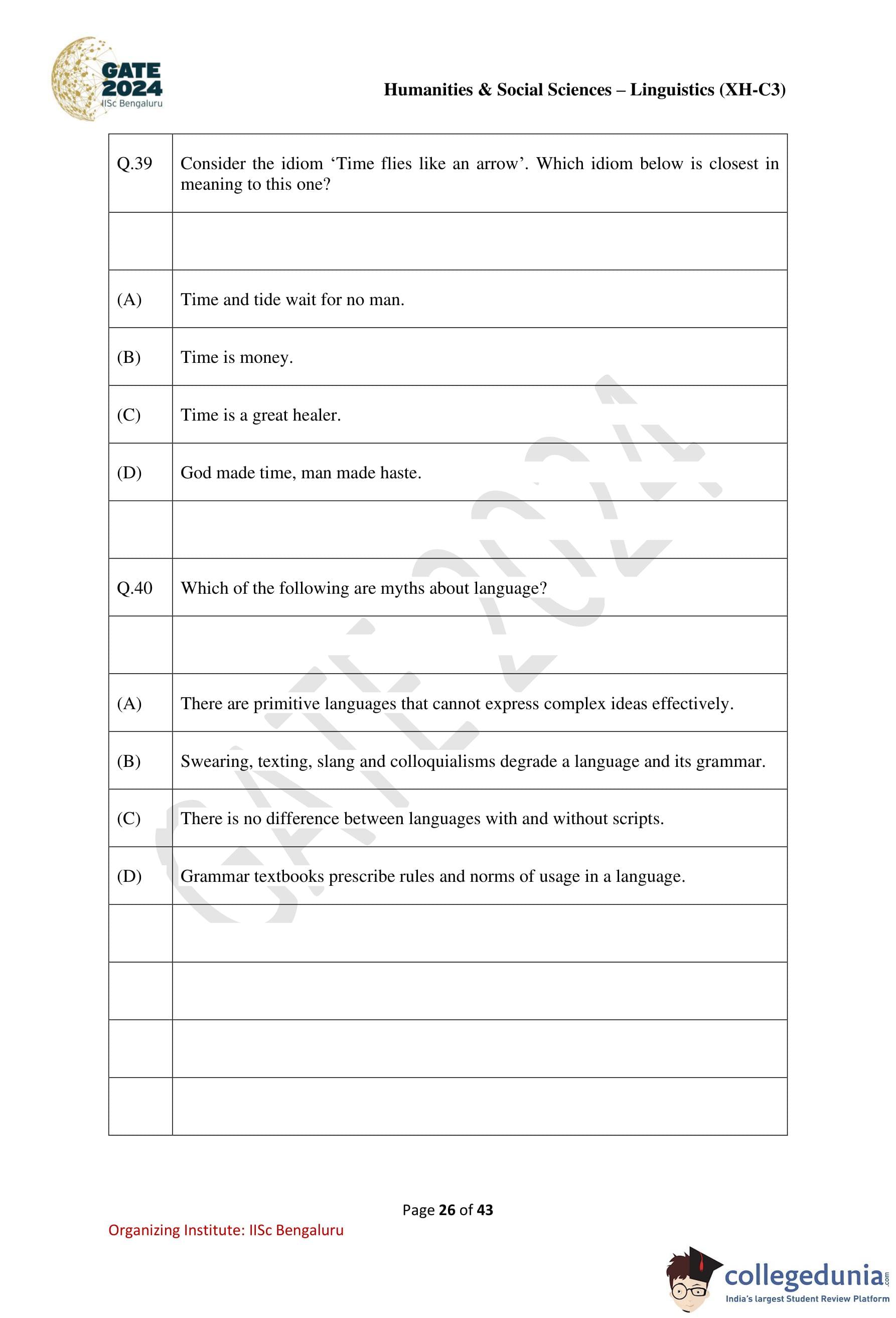
Consider the idiom ‘Time flies like an arrow’. Which idiom below is closest in meaning to this one?
View Solution
Step 1: Understanding the idiom.
“Time flies like an arrow” conveys that time passes quickly and cannot be controlled or delayed.
Step 2: Comparing meanings.
“Time and tide wait for no man” similarly emphasizes the unstoppable and fast-moving nature of time.
Step 3: Eliminating other options.
The remaining idioms focus on value, healing, or human action rather than the passage of time itself.
Step 4: Conclusion.
Thus, the closest idiom in meaning is (A).
Quick Tip: Look for idioms that match the core idea, not just the theme word.
Which of the following are myths about language?
View Solution
Step 1: Understanding linguistic myths.
Linguistic myths are false beliefs about how languages function or evolve.
Step 2: Evaluating the statements.
There are no “primitive” languages; all languages can express complex ideas, making (A) a myth.
Similarly, informal language use does not degrade grammar, making (B) a myth.
Step 3: Eliminating factual statements.
Statements (C) and (D) describe accepted linguistic facts rather than myths.
Step 4: Conclusion.
Therefore, the myths about language are (A) and (B).
Quick Tip: Languages change and adapt, but none are inherently inferior or degraded.
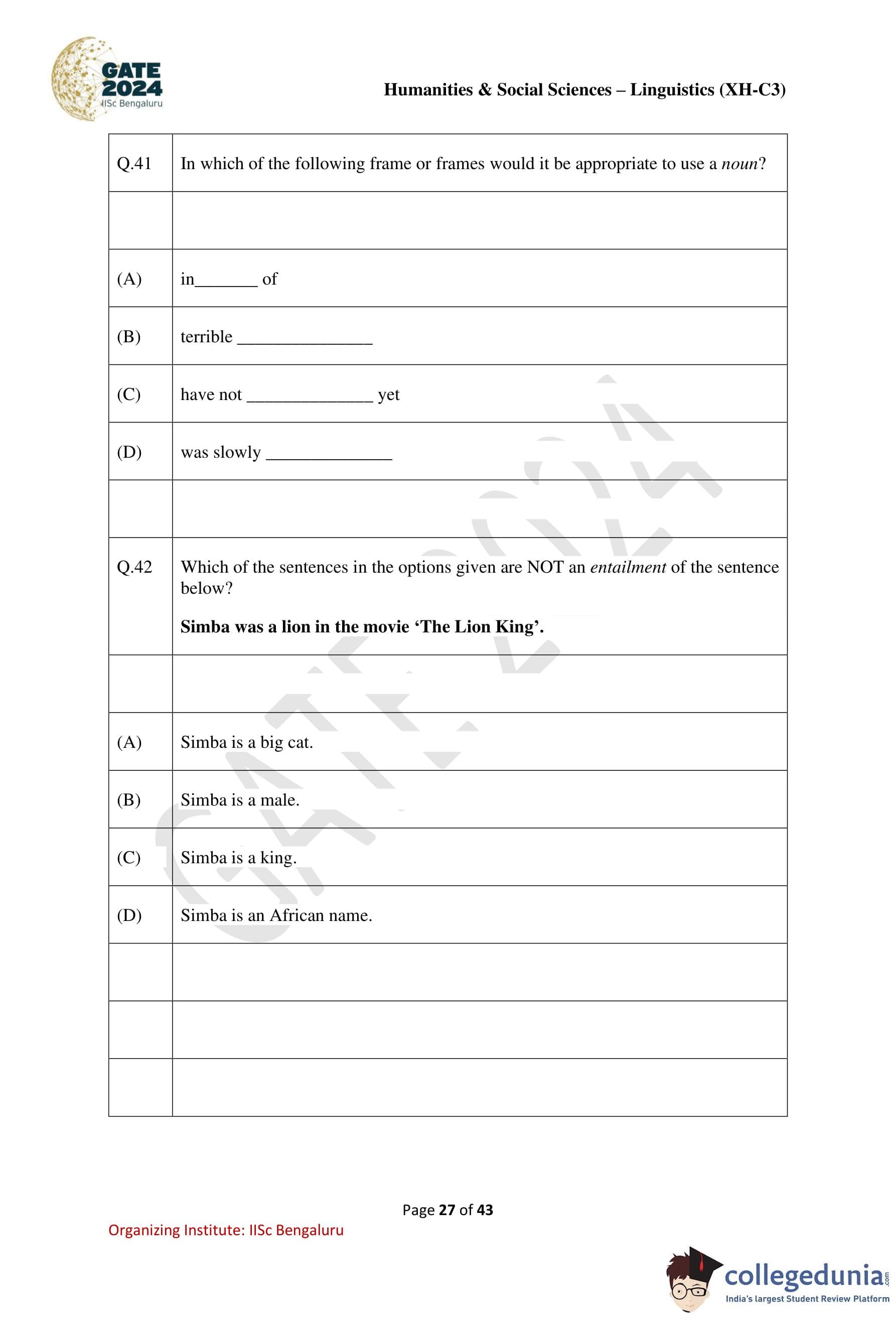
In which of the following frame or frames would it be appropriate to use a noun?
View Solution
Step 1: Analyzing frame (A).
The frame “in ___ of” commonly licenses a noun, as in \textit{in front of, \textit{in need of.
Step 2: Analyzing frame (B).
Adjectives like \textit{terrible typically modify nouns, making this frame appropriate for a noun.
Step 3: Eliminating other frames.
“Have not ___ yet” usually requires a verb phrase, and “was slowly ___” also requires a verb or participle.
Step 4: Conclusion.
Hence, the correct frames are (A) and (B).
Quick Tip: Check whether the surrounding words typically select a noun, verb, or adjective.
Which of the sentences in the options given are NOT an entailment of the sentence below?
Simba was a lion in the movie ‘The Lion King’.
View Solution
Step 1: Understanding entailment.
An entailment must necessarily be true if the given sentence is true.
Step 2: Evaluating options.
Being a lion entails being a big cat and (in the movie context) male.
Step 3: Eliminating non-entailed statements.
Being a lion does not necessarily entail being a king, nor does it entail anything about the origin of the name.
Step 4: Conclusion.
Thus, the statements that are NOT entailed are (C) and (D).
Quick Tip: Entailments are logically guaranteed, not contextually inferred.
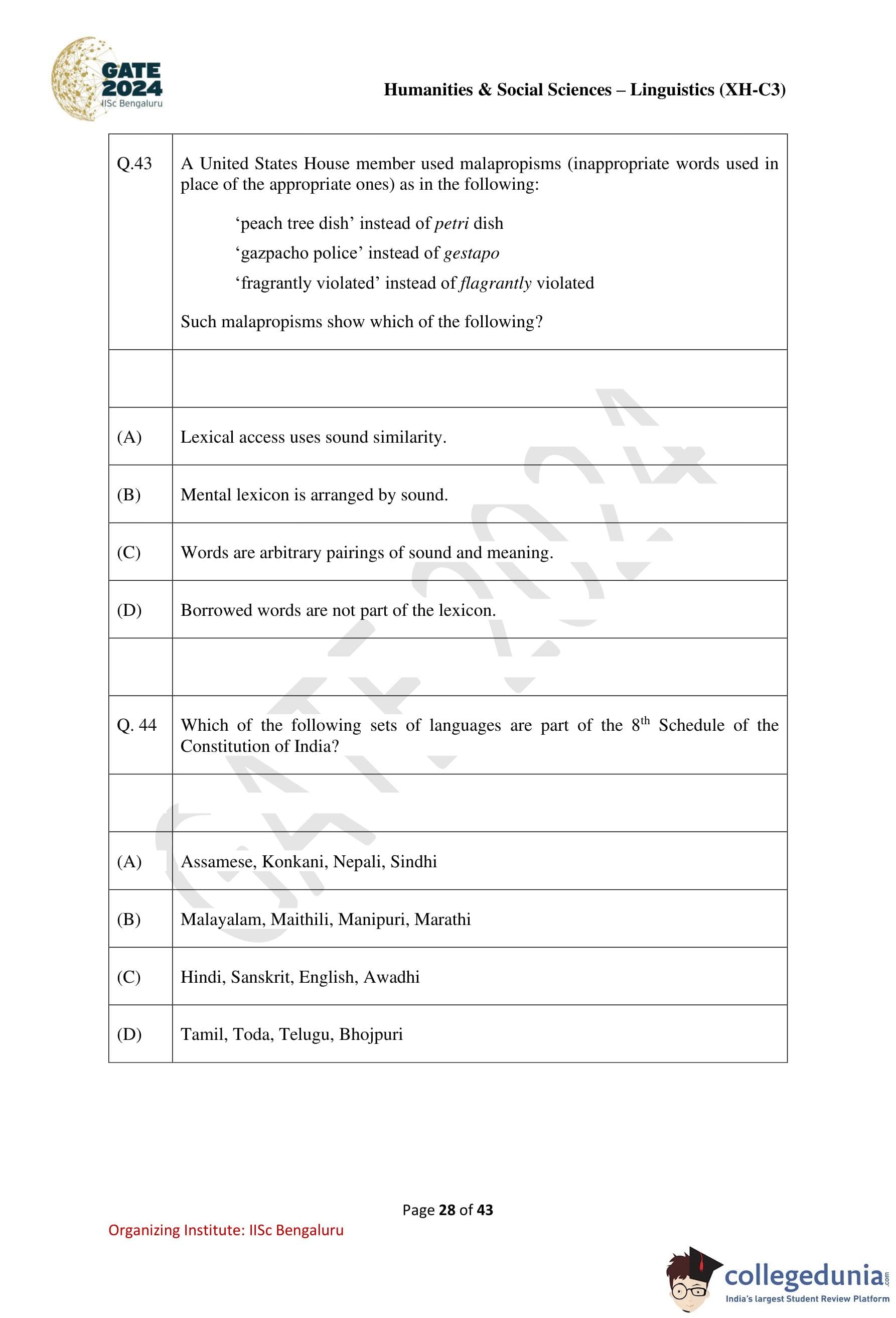
A United States House member used malapropisms (inappropriate words used in place of appropriate ones) as in the following:
‘peach tree dish’ instead of \textit{petri dish
‘gazpacho police’ instead of \textit{gestapo
‘fragrantly violated’ instead of \textit{flagrantly violated
Such malapropisms show which of the following?
View Solution
Step 1: Understanding malapropisms.
Malapropisms arise when a speaker selects a phonologically similar word instead of the intended one.
Step 2: Interpreting the examples.
The substitutions are driven by sound similarity rather than meaning.
Step 3: Drawing conclusions.
This indicates that lexical access relies on phonological similarity and that the mental lexicon is organized by sound.
Step 4: Conclusion.
Hence, the correct answers are (A) and (B).
Quick Tip: Sound-based errors reveal how words are stored and accessed in the mental lexicon.
Which of the following sets of languages are part of the 8th Schedule of the Constitution of India?
View Solution
Step 1: Understanding the 8th Schedule.
The 8th Schedule lists officially recognized languages of India.
Step 2: Evaluating the options.
Assamese, Konkani, Nepali, Sindhi, Malayalam, Maithili, Manipuri, and Marathi are all included.
Step 3: Eliminating incorrect sets.
English, Awadhi, Toda, and Bhojpuri are not included in the 8th Schedule.
Step 4: Conclusion.
Therefore, the correct sets are (A) and (B).
Quick Tip: Always verify language lists against the official 8th Schedule, not popular usage.
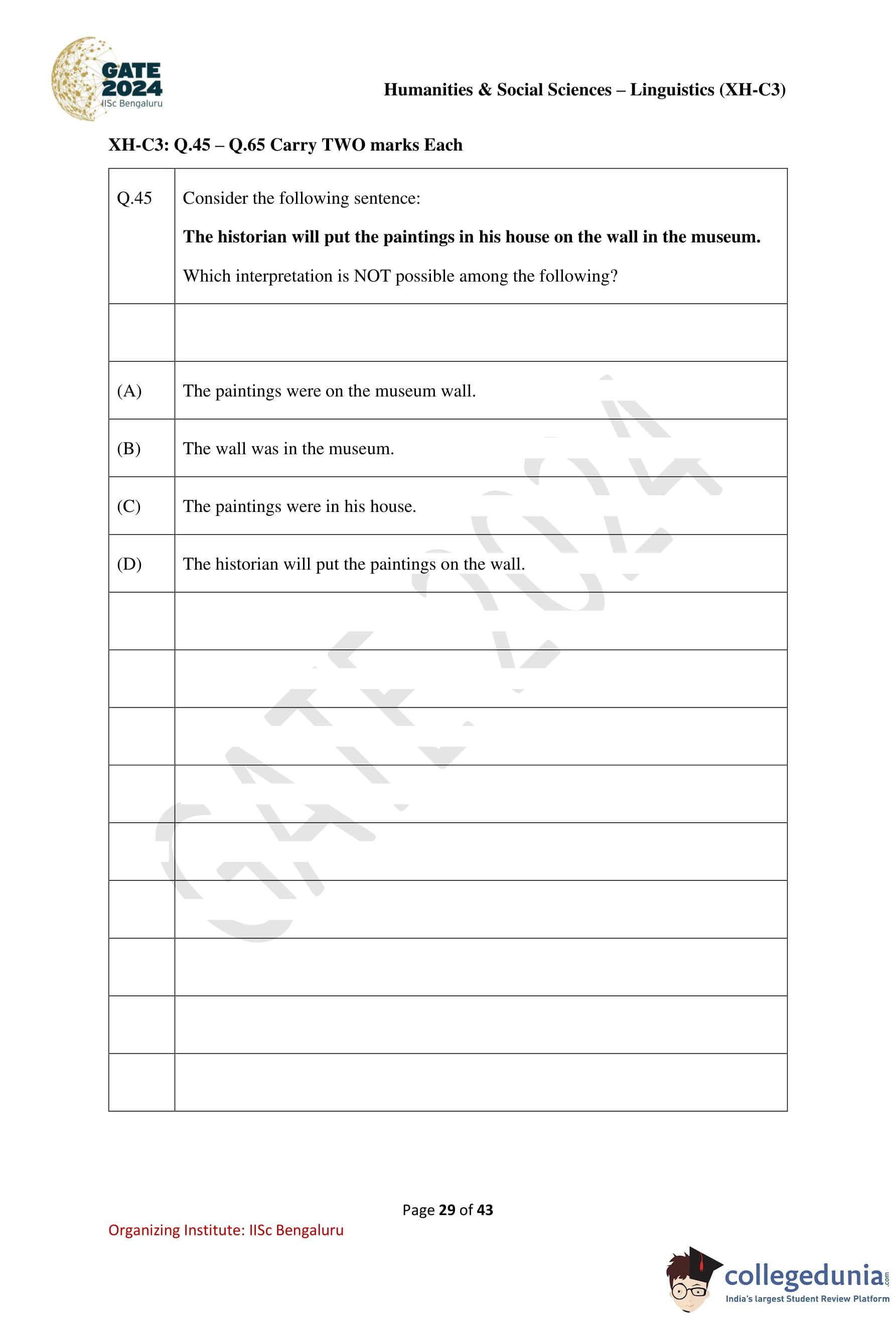
Consider the following sentence:
The historian will put the paintings in his house on the wall in the museum.
Which interpretation is NOT possible among the following?
View Solution
Step 1: Analyzing structural ambiguity.
The sentence contains multiple prepositional phrases: \textit{in his house, \textit{on the wall, and \textit{in the museum, which can attach to different nouns or verbs.
Step 2: Checking possible interpretations.
(B) is possible because “the wall” can be interpreted as being located in the museum.
(C) is possible because “the paintings” can be interpreted as currently being in his house.
(D) is directly stated by the verb phrase “will put the paintings on the wall.”
Step 3: Eliminating the impossible interpretation.
Option (A) suggests that the paintings were already on the museum wall, which is not supported by any valid attachment in the sentence.
Step 4: Conclusion.
Thus, the interpretation that is NOT possible is (A).
Quick Tip: Ambiguity often arises from multiple prepositional phrases competing for attachment.
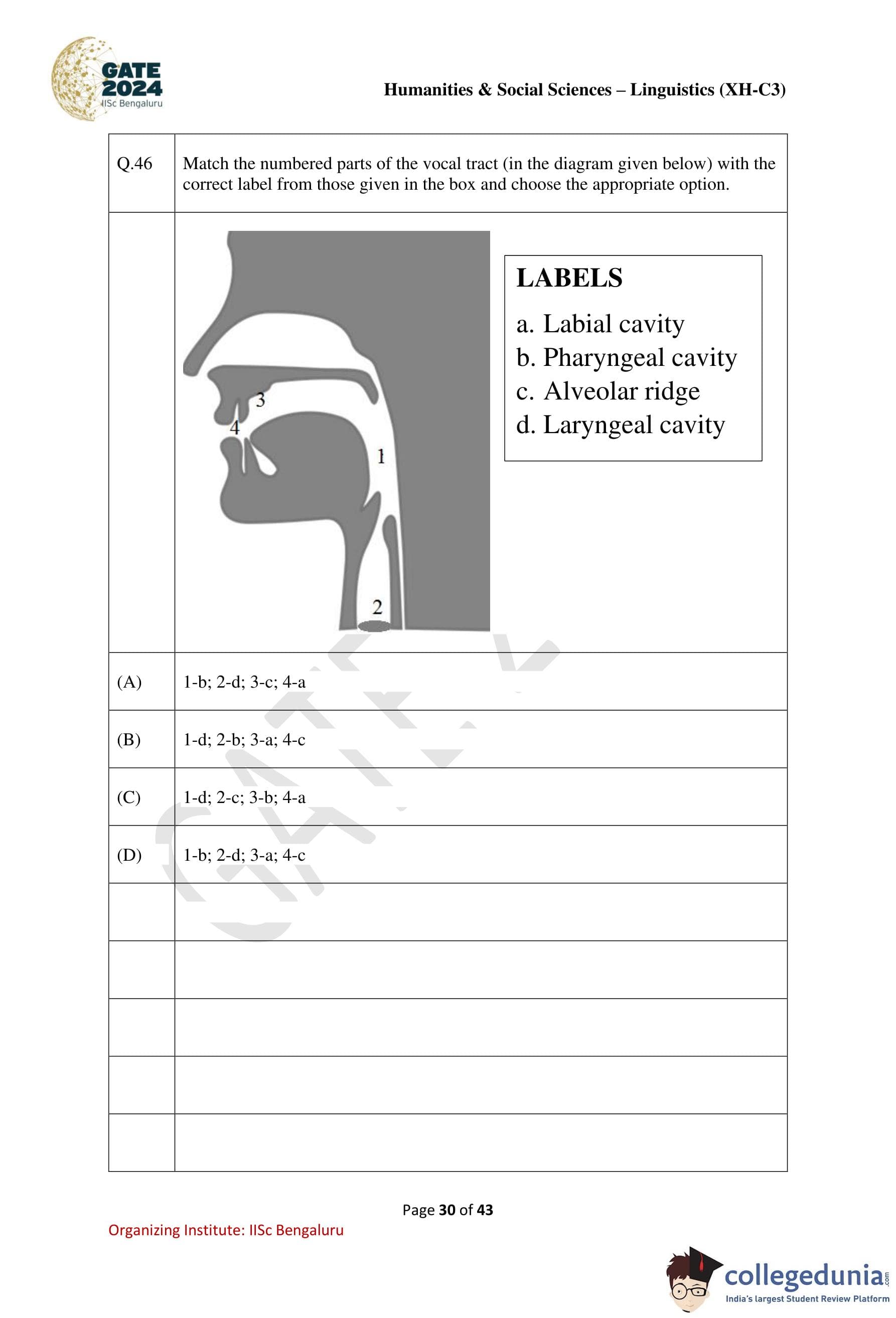
Match the numbered parts of the vocal tract (in the diagram given below) with the correct label from those given in the box and choose the appropriate option.

Labels
a. Labial cavity \quad
b. Pharyngeal cavity \quad
c. Alveolar ridge \quad
d. Laryngeal cavity
View Solution
Step 1: Identifying cavity locations.
The pharyngeal cavity is located behind the oral cavity and corresponds to label 1.
The laryngeal cavity is situated lower in the vocal tract, corresponding to label 2.
Step 2: Identifying oral structures.
The alveolar ridge is located just behind the upper teeth, which matches label 3.
The labial cavity corresponds to the lip region, matching label 4.
Step 3: Matching with given labels.
Thus, the correct mapping is:
1–b, 2–d, 3–c, 4–a.
Step 4: Conclusion.
The correct option is (A).
Quick Tip: Remember the top-to-bottom order of cavities: labial → oral → pharyngeal → laryngeal.
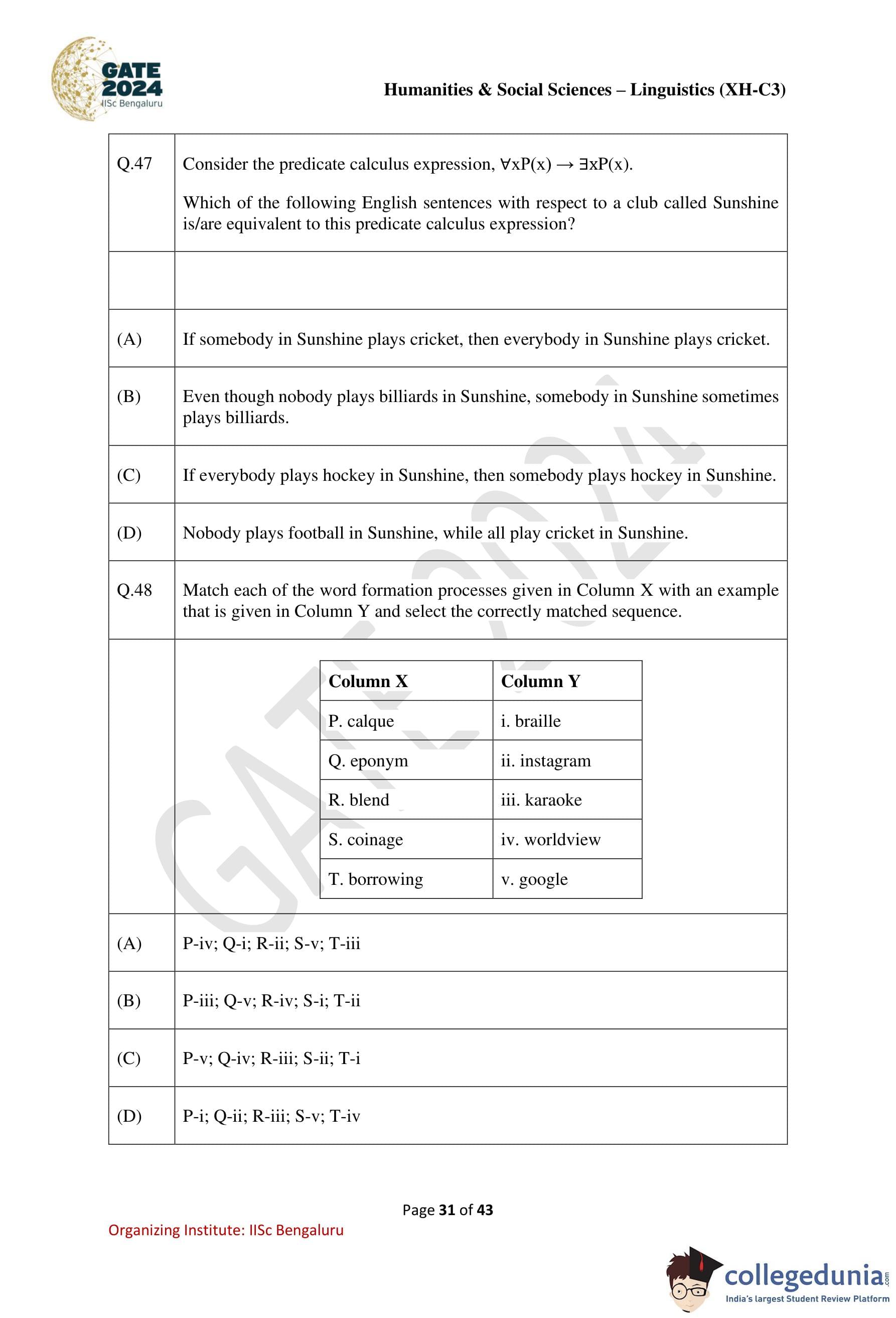
Consider the predicate calculus expression, \(\forall x\,P(x) \rightarrow \exists x\,P(x)\).
Which of the following English sentences with respect to a club called Sunshine is/are equivalent to this predicate calculus expression?
View Solution
Step 1: Interpreting the predicate expression.
The expression \(\forall x\,P(x) \rightarrow \exists x\,P(x)\) means:
\emph{If everyone has property P, then at least one person has property P.
Step 2: Evaluating the options.
Option (C) directly mirrors this structure: if everybody plays hockey, then somebody plays hockey.
Step 3: Eliminating incorrect options.
(A) reverses the quantifiers.
(B) is logically contradictory.
(D) combines two unrelated statements.
Step 4: Conclusion.
Hence, the sentence equivalent to the predicate expression is (C).
Quick Tip: A universal statement always entails an existential one, but not vice versa.
Match each of the word formation processes given in Column X with an example that is given in Column Y and select the correctly matched sequence.

View Solution
Step 1: Understanding word formation processes.
A calque is a literal translation (worldview).
An eponym is derived from a person’s name (braille).
A blend combines parts of words (instagram).
Coinage creates a new word (google).
Borrowing takes a word from another language (karaoke).
Step 2: Matching correctly.
P–iv, Q–i, R–ii, S–v, T–iii
Step 3: Conclusion.
The correctly matched sequence is option (A).
Quick Tip: Identifying word origins helps distinguish between coinage, borrowing, and blending.
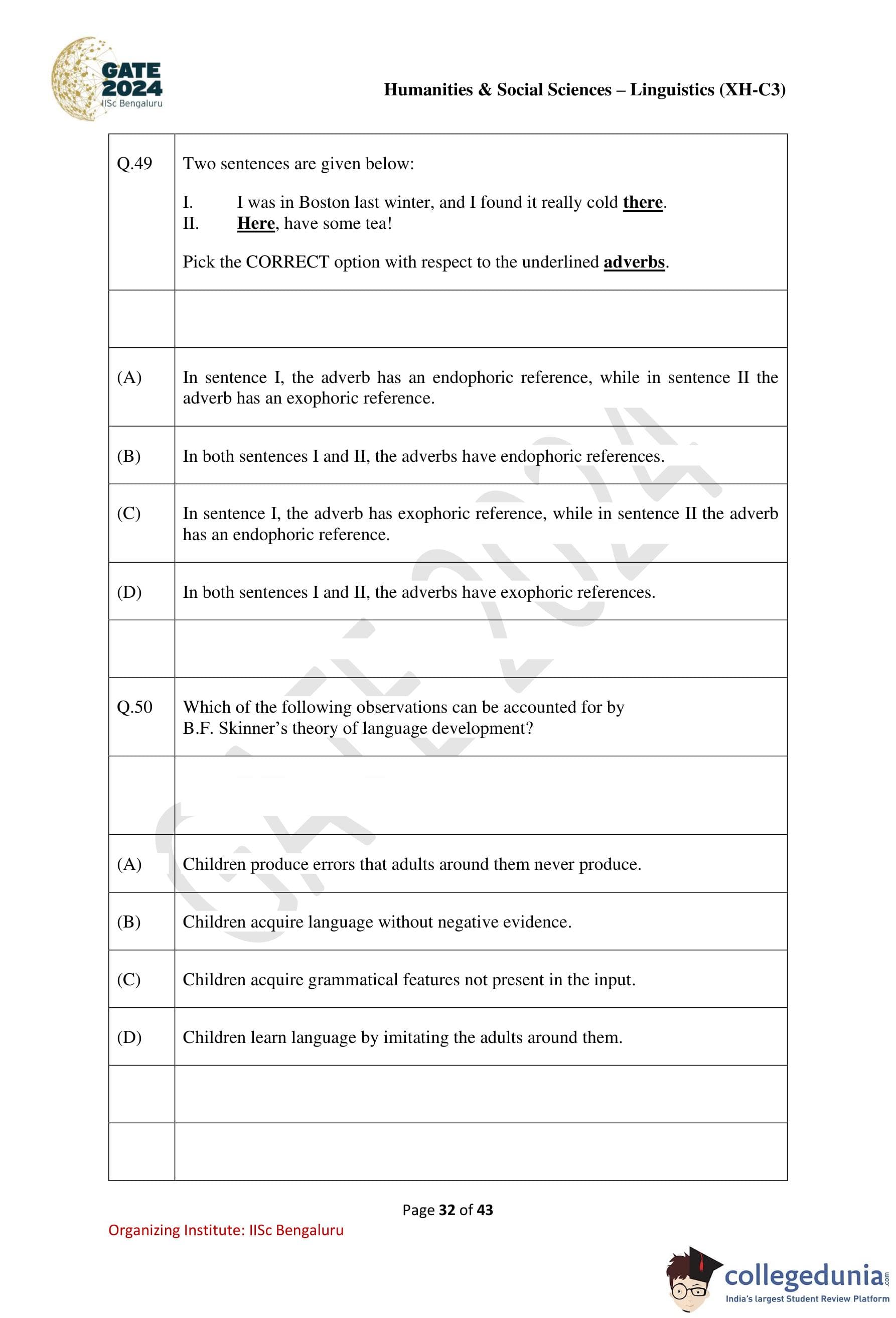
Two sentences are given below:
I. I was in Boston last winter, and I found it really cold \underline{there.
II. \underline{Here, have some tea!
Pick the CORRECT option with respect to the underlined adverbs.
View Solution
Step 1: Understanding endophoric and exophoric reference.
Endophoric reference points to something within the text, while exophoric reference points to the external context or situation.
Step 2: Analyzing sentence I.
The adverb \textit{there refers back to \textit{Boston, which is mentioned earlier in the sentence. Hence, it is endophoric.
Step 3: Analyzing sentence II.
The adverb \textit{here refers to the speaker’s present physical location, which is not mentioned in the text. Hence, it is exophoric.
Step 4: Conclusion.
Therefore, the correct option is (A).
Quick Tip: If a word refers back to something already stated, it is endophoric; if it depends on the situation, it is exophoric.
Which of the following observations can be accounted for by B.F. Skinner’s theory of language development?
View Solution
Step 1: Understanding Skinner’s theory.
B.F. Skinner proposed a behaviorist view of language acquisition, emphasizing imitation, reinforcement, and conditioning.
Step 2: Matching observations to the theory.
Imitation of adult speech directly aligns with Skinner’s explanation of how children learn language.
Step 3: Eliminating other options.
Producing novel errors, acquiring language without negative evidence, and learning features absent from input are better explained by nativist theories, not behaviorism.
Step 4: Conclusion.
Thus, the observation explained by Skinner’s theory is (D).
Quick Tip: Behaviorist theories focus on imitation and reinforcement, not innate grammatical knowledge.
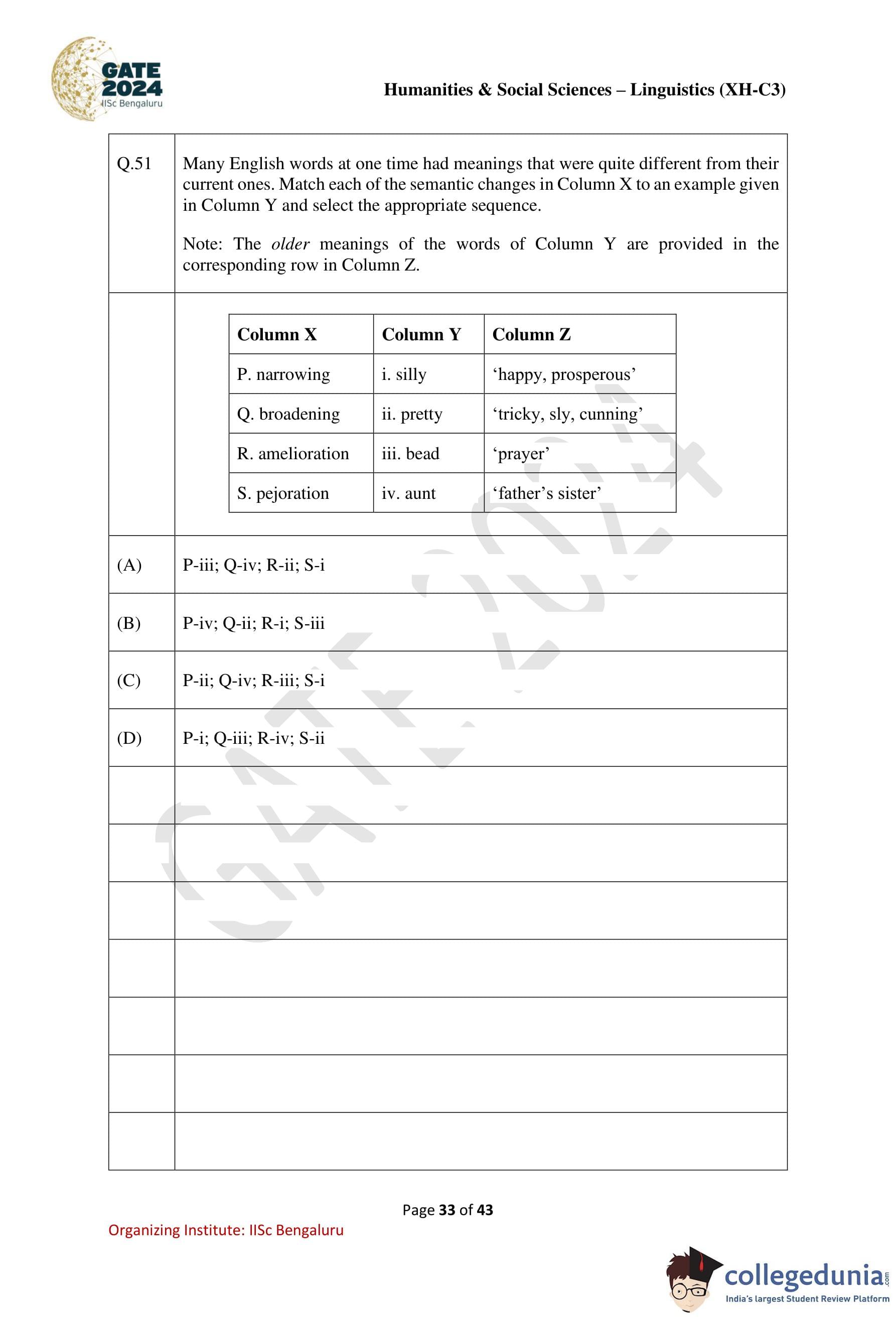
Many English words at one time had meanings that were quite different from their current ones. Match each of the semantic changes in Column X to an example given in Column Y and select the appropriate sequence.
Note: The older meanings of the words of Column Y are provided in the corresponding row in Column Z.

View Solution
Step 1: Understanding semantic changes.
Narrowing restricts meaning, broadening expands it, amelioration improves meaning, and pejoration worsens meaning.
Step 2: Matching examples.
Bead narrowed from ‘prayer’ to a specific object.
Aunt broadened from ‘father’s sister’ to include mother’s sister.
Pretty underwent amelioration from ‘cunning’ to a positive sense.
Silly underwent pejoration from ‘happy’ to a negative sense.
Step 3: Conclusion.
The correct sequence is (A).
Quick Tip: Tracking older meanings helps identify whether a word’s meaning improved, worsened, expanded, or narrowed.
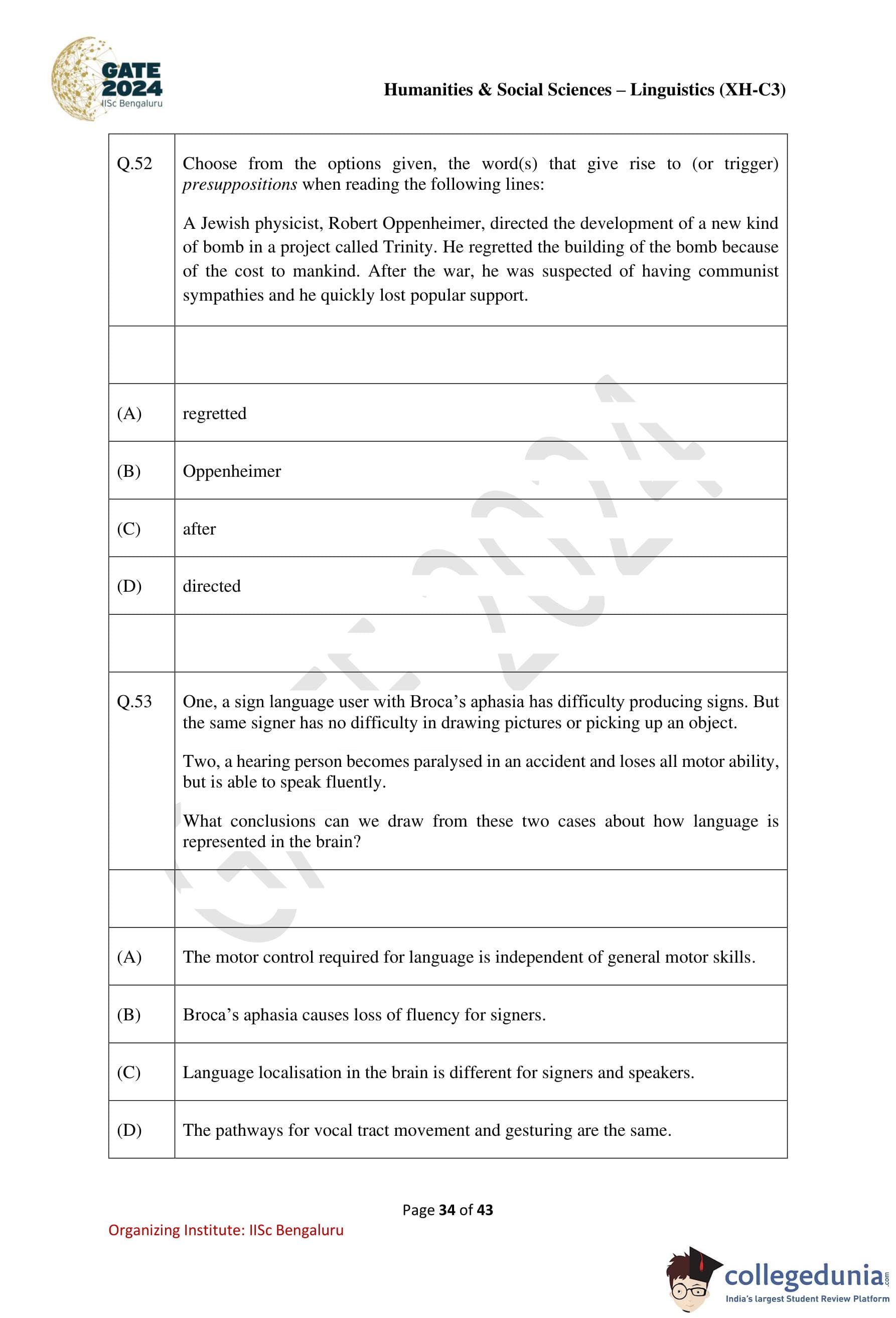
Choose from the options given, the word(s) that give rise to (or trigger) presuppositions when reading the following lines:
A Jewish physicist, Robert Oppenheimer, directed the development of a new kind of bomb in a project called Trinity. He regretted the building of the bomb because of the cost to mankind. After the war, he was suspected of having communist sympathies and he quickly lost popular support.
View Solution
Step 1: Understanding presupposition triggers.
Presuppositions are background assumptions taken for granted by certain words or expressions.
Step 2: Analyzing the options.
Regretted presupposes that the action (building the bomb) actually happened.
Oppenheimer as a definite proper noun presupposes the existence of the individual.
After presupposes that the referenced event (the war) occurred.
Step 3: Eliminating non-triggers.
Directed does not inherently trigger a presupposition; it simply asserts an action.
Step 4: Conclusion.
Hence, the correct answers are (A), (B), and (C).
Quick Tip: Verbs like regret, temporal markers like after, and definite descriptions commonly trigger presuppositions.
One, a sign language user with Broca’s aphasia has difficulty producing signs. But the same signer has no difficulty in drawing pictures or picking up an object.
Two, a hearing person becomes paralysed in an accident and loses all motor ability, but is able to speak fluently.
What conclusions can we draw from these two cases about how language is represented in the brain?
View Solution
Step 1: Interpreting Case One.
The signer cannot produce linguistic signs but can perform non-linguistic motor tasks, showing that language-specific motor control is distinct from general motor ability.
Step 2: Interpreting Case Two.
The paralysed speaker can still speak fluently, further supporting the idea that general motor impairment does not necessarily affect language production.
Step 3: Drawing conclusions.
These cases show that language motor control is specialized and that Broca’s aphasia affects sign language fluency as well.
Step 4: Eliminating incorrect options.
There is no evidence that language localisation differs for signers and speakers, nor that gesturing and vocal pathways are the same.
Step 5: Conclusion.
Therefore, the correct conclusions are (A) and (B).
Quick Tip: Language impairment can occur independently of general motor impairment, highlighting specialised neural systems.
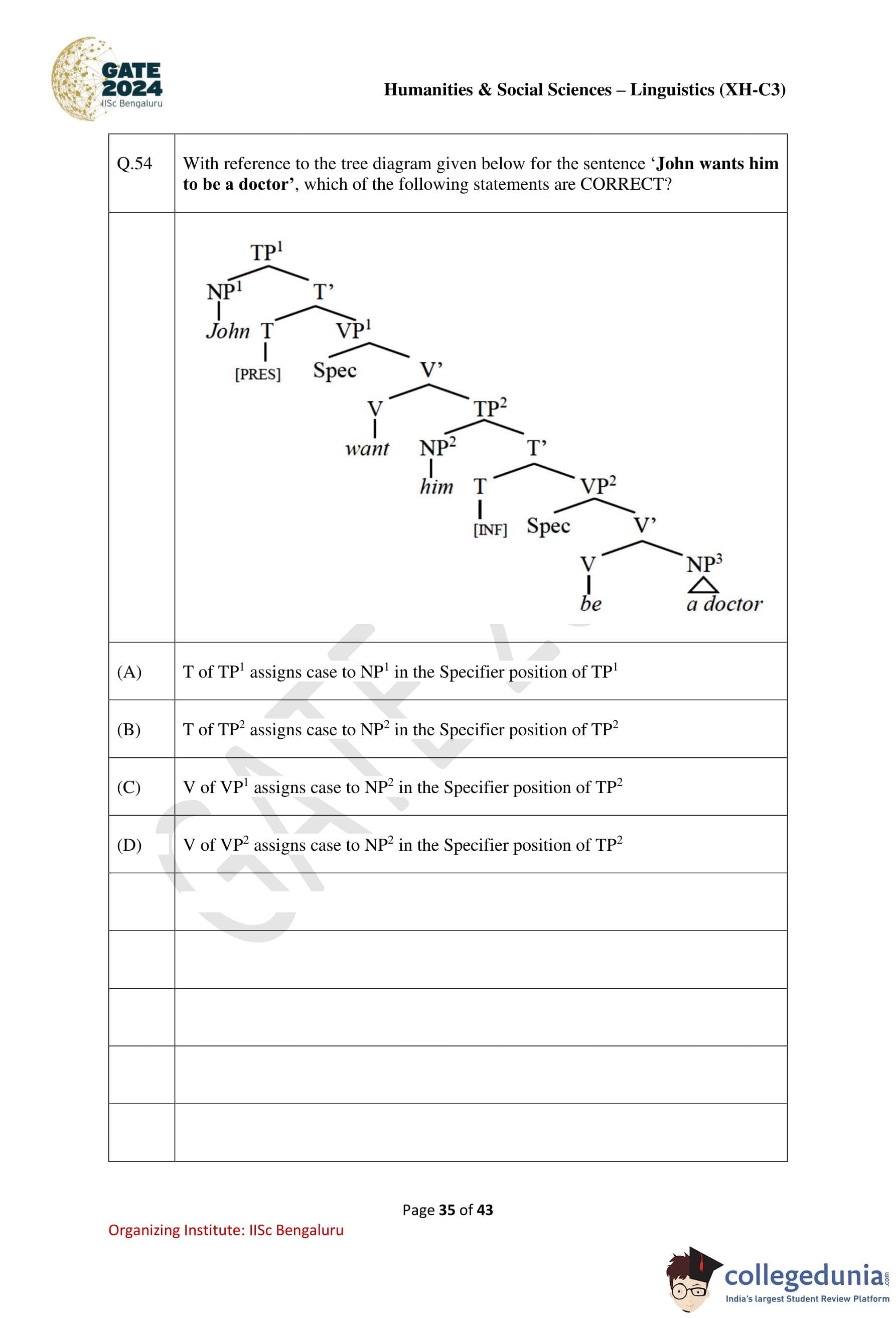
With reference to the tree diagram given below for the sentence ‘John wants him to be a doctor’, which of the following statements are CORRECT?

View Solution
Step 1: Case assignment in TP\textsuperscript{1}.
In the matrix clause, T\textsuperscript{1 is finite and assigns nominative case to NP\textsuperscript{1 (‘John’) in the specifier position of TP\textsuperscript{1. Hence, statement (A) is correct.
Step 2: Case assignment in TP\textsuperscript{2}.
The embedded TP\textsuperscript{2 is infinitival, and its T is non-finite. Therefore, it cannot assign case to NP\textsuperscript{2 (‘him’). This makes statement (B) incorrect.
Step 3: Exceptional Case Marking (ECM).
The verb \textit{want in VP\textsuperscript{1 assigns accusative case to NP\textsuperscript{2 (‘him’) across the embedded TP. This is a classic ECM configuration. Hence, statement (C) is correct.
Step 4: Eliminating incorrect option.
V of VP\textsuperscript{2 (‘be’) does not assign case to NP\textsuperscript{2, so statement (D) is incorrect.
Step 5: Conclusion.
Therefore, the correct statements are (A) and (C).
Quick Tip: In ECM constructions, the matrix verb assigns accusative case to the subject of an infinitival clause.
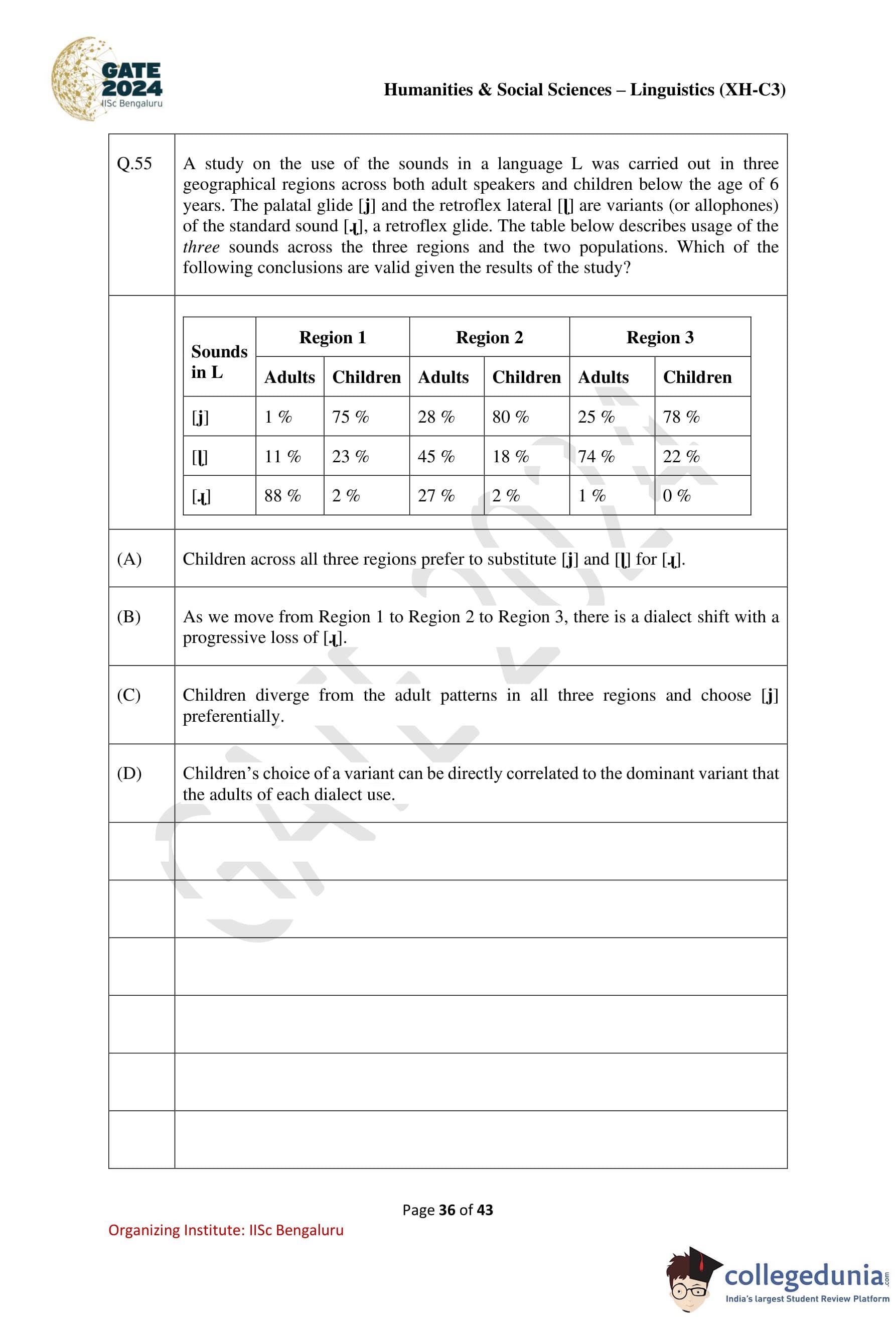
A study on the use of the sounds in a language L was carried out in three geographical regions across both adult speakers and children below the age of 6 years. The palatal [j] and the retroflex lateral [l̪] are variants (or allophones) of the standard sound [ɭ], a retroflex glide. The table below describes usage of the three sounds across the three regions and the two populations. Which of the following conclusions are valid given results of the study?

View Solution
Step 1: Children’s preference across regions.
In all three regions, children show very low usage of [ɭ] and prefer [j] or [l̪]. This supports statement (A).
Step 2: Dialectal shift across regions.
Adult usage of [ɭ] decreases from Region 1 to Region 2 and almost disappears in Region 3, indicating a progressive dialect shift. Hence, statement (B) is correct.
Step 3: Divergence between children and adults.
Across all regions, children diverge from adult usage and show a strong preference for [j], validating statement (C).
Step 4: Eliminating incorrect option.
Children do not mirror the dominant adult variant in each region; instead, they consistently prefer [j]. Thus, statement (D) is incorrect.
Step 5: Conclusion.
The valid conclusions are (A), (B), and (C).
Quick Tip: Child phonology often shows simplification and divergence from adult norms, revealing ongoing sound change.
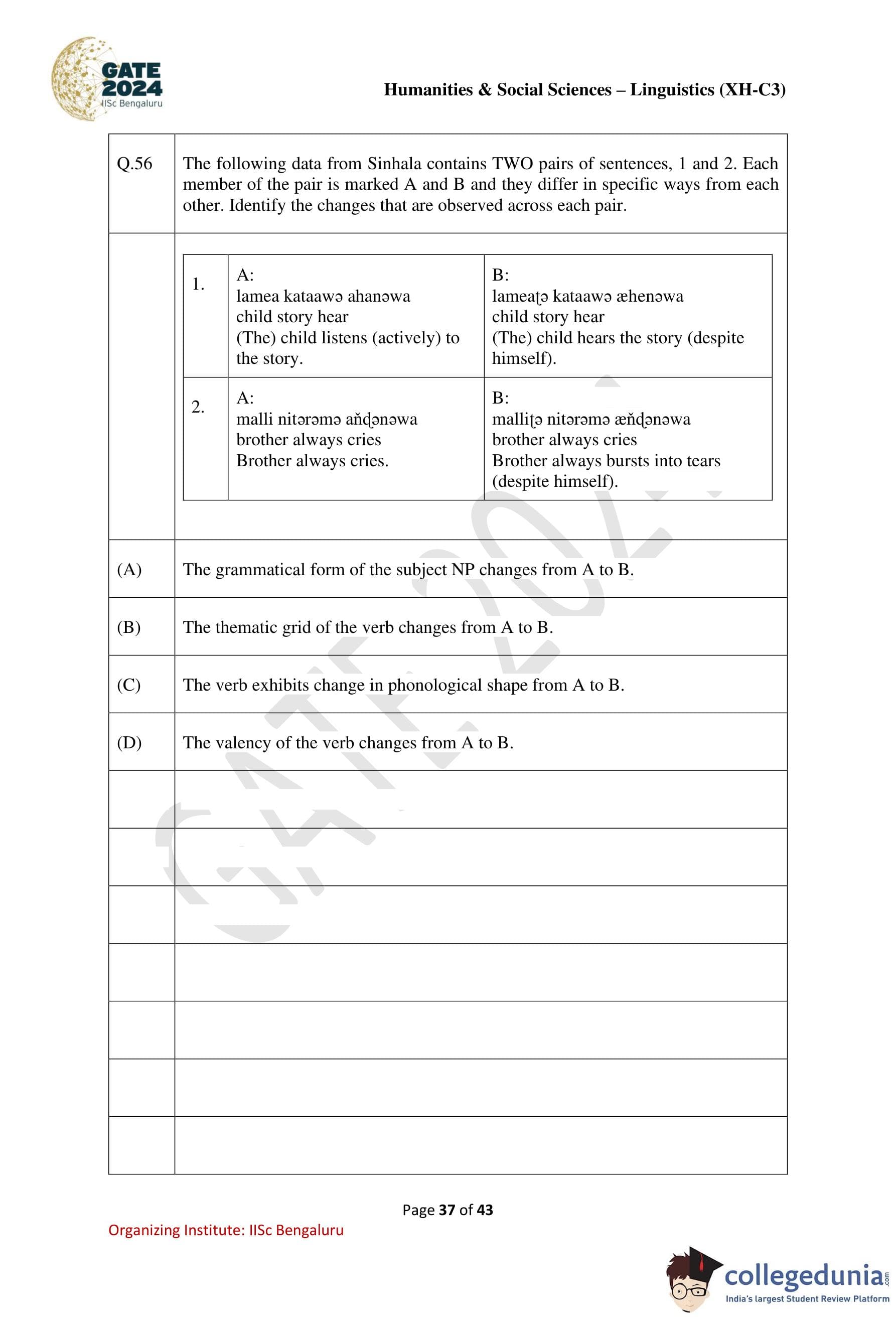
The following data from Sinhala contains TWO pairs of sentences, 1 and 2. Each member of the pair is marked A and B and they differ in specific ways from each other. Identify the changes that are observed across each pair.

View Solution
Step 1: Change in subject NP form.
Across both pairs, the subject NP shows a change in case marking between A and B forms (e.g., nominative vs. dative-like marking), indicating a grammatical change in the subject NP. Hence, (A) is correct.
Step 2: Change in thematic interpretation.
The A sentences show an agentive, volitional interpretation, whereas the B sentences show a non-volitional or experiencer-like reading (“despite himself”). This reflects a change in the thematic grid of the verb. Hence, (B) is correct.
Step 3: Phonological alternation.
The verb form shows a phonological alternation between A and B (e.g., \textit{ahanəwa vs. \textit{əhenəwa, \textit{aṅḍanəwa vs. \textit{əṅḍanəwa). Hence, (C) is correct.
Step 4: Valency check.
The number of arguments selected by the verb remains the same; only the interpretation and morphology change. Therefore, (D) is not correct.
Step 5: Conclusion.
The observed changes are correctly identified by options (A), (B), and (C).
Quick Tip: A shift from agentive to non-volitional readings often correlates with changes in case marking and verb morphology.
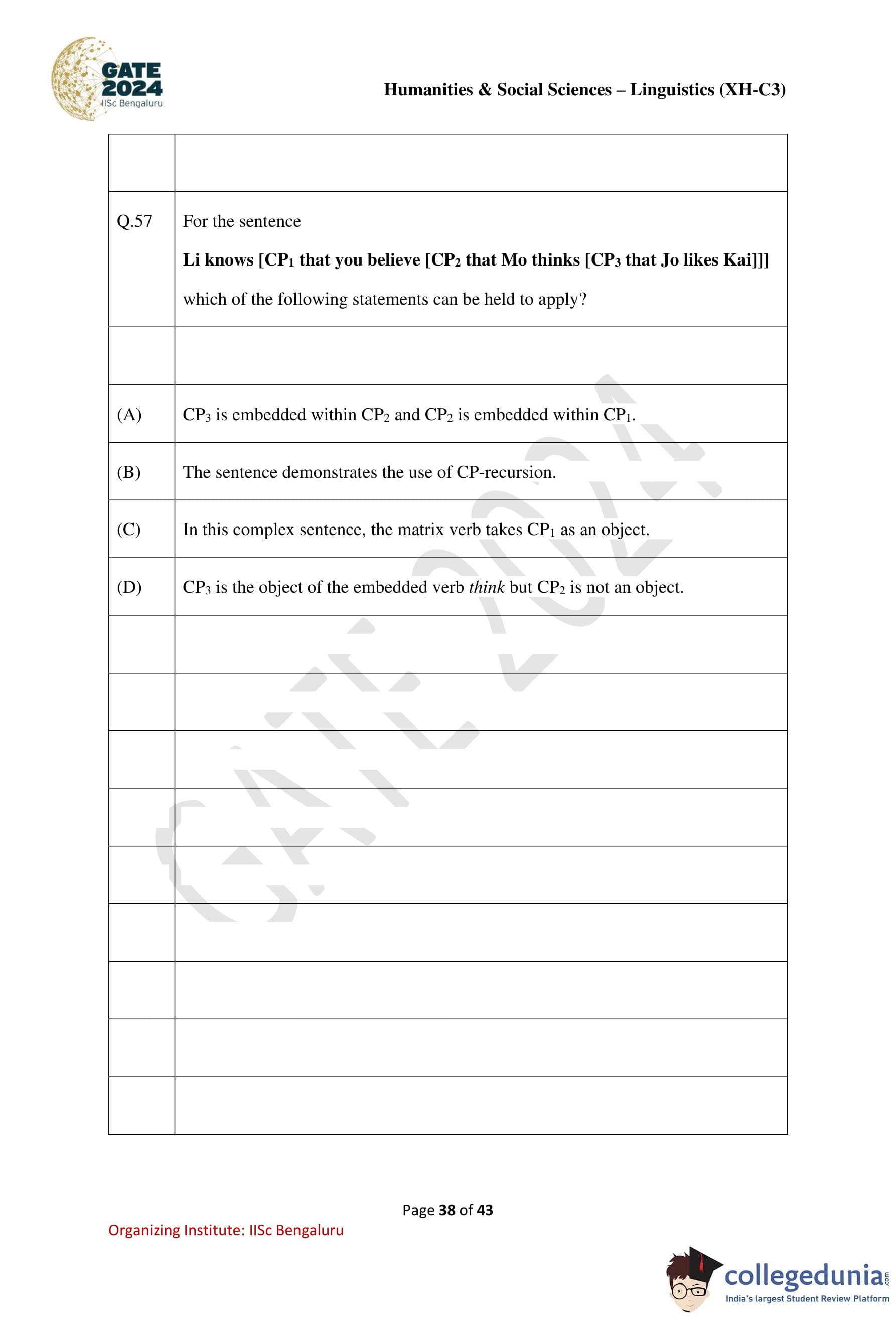
For the sentence
\textit{Li knows [CP\textsubscript{1 that you believe [CP\textsubscript{2 that Mo thinks [CP\textsubscript{3 that Jo likes Kai]]]
which of the following statements can be held to apply?
View Solution
Step 1: Structural embedding.
The representation clearly shows CP\textsubscript{3 embedded inside CP\textsubscript{2, which in turn is embedded inside CP\textsubscript{1. Thus, (A) is correct.
Step 2: CP-recursion.
The repeated embedding of CPs within CPs is a textbook case of syntactic recursion at the CP level. Hence, (B) is correct.
Step 3: Matrix verb selection.
The matrix verb \textit{knows selects CP\textsubscript{1 as its complement (object). Therefore, (C) is correct.
Step 4: Evaluating option (D).
While CP\textsubscript{3 is indeed the complement of \textit{think, CP\textsubscript{2 is also an object (of \textit{believe). Hence, (D) is incorrect.
Step 5: Conclusion.
The statements that apply are (A), (B), and (C).
Quick Tip: Recursive embedding of CPs is a key property that distinguishes human language syntax.
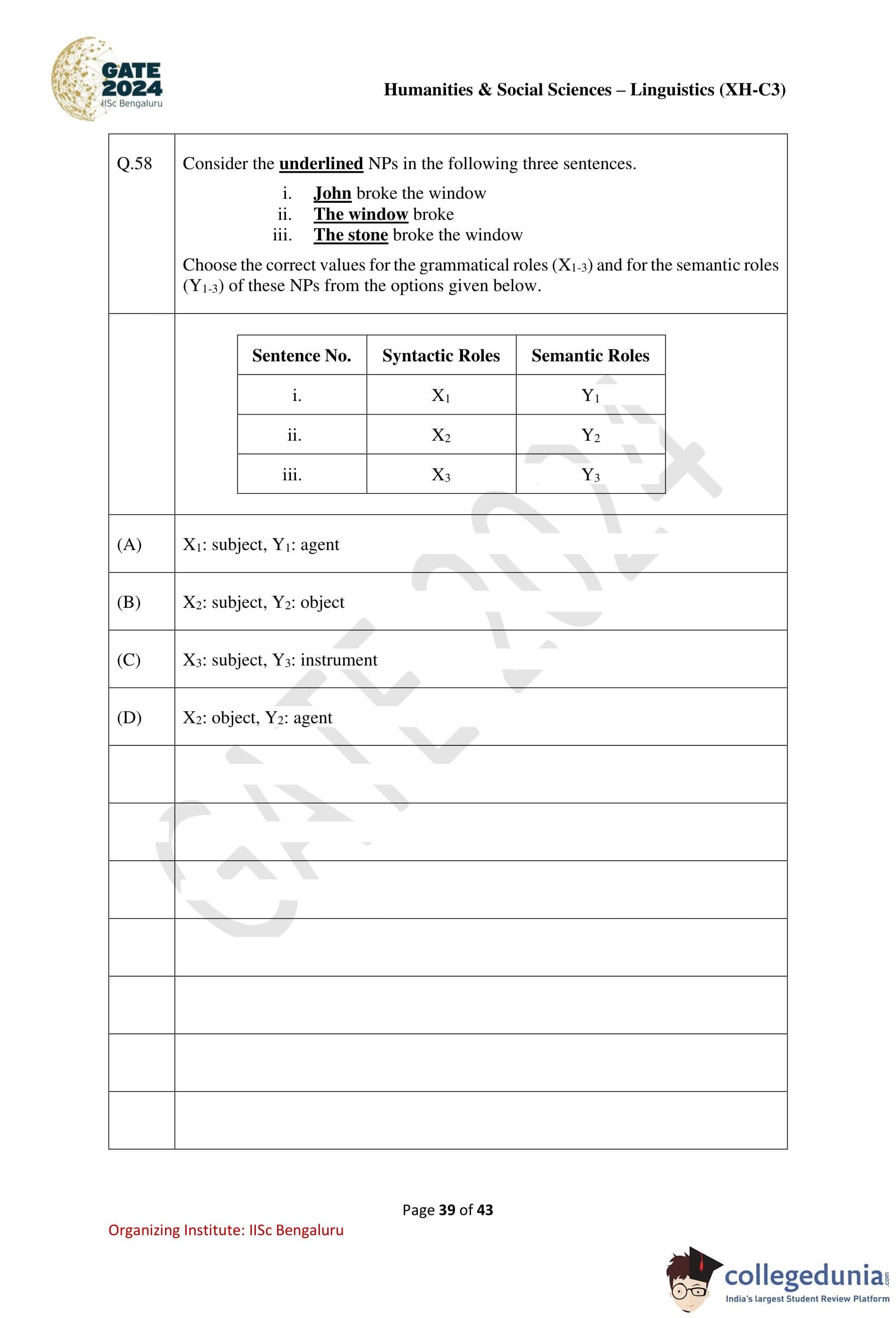
Consider the underlined NPs in the following three sentences.
i. John broke the window.
ii. \underline{The window broke.
iii. \underline{The stone broke the window.
Choose the correct values for the grammatical roles (X\textsubscript{1–3) and for the semantic roles (Y\textsubscript{1–3}) of these NPs from the options given below.

View Solution
Step 1: Sentence (i).
In “John broke the window”, \textit{John is the grammatical subject and performs the action intentionally. Hence, it has the semantic role of an agent. This validates option (A).
Step 2: Sentence (ii).
In “The window broke”, the NP \textit{the window is the subject but it is not an agent; it is a theme/patient. Hence options involving agent or object roles here are incorrect.
Step 3: Sentence (iii).
In “The stone broke the window”, \textit{the stone is the grammatical subject but semantically functions as an instrument causing the event. This validates option (C).
Step 4: Conclusion.
Therefore, the correct choices are (A) and (C).
Quick Tip: Grammatical subjects need not always be agents; instruments and themes can also occupy subject position.
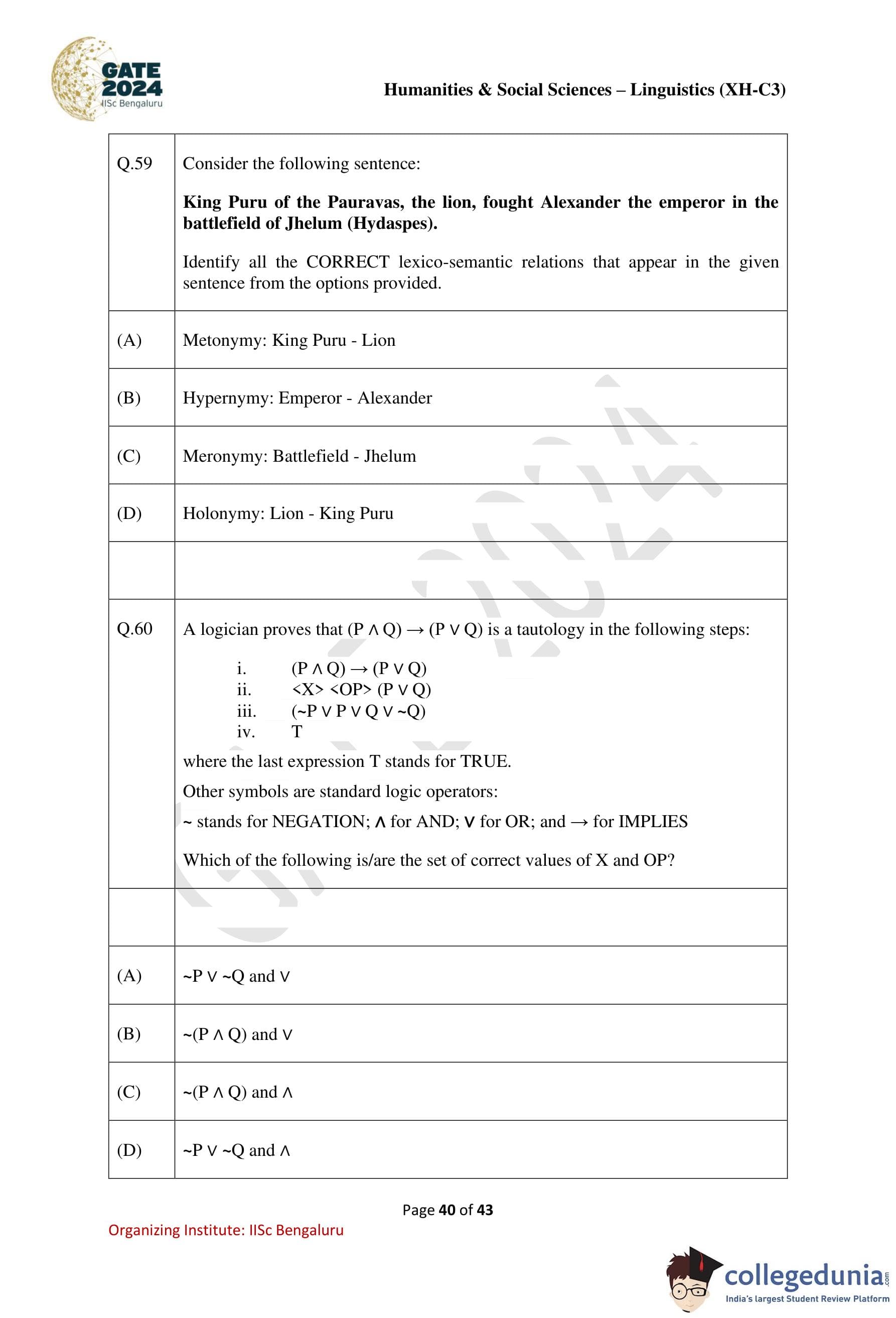
Consider the following sentence:
\textit{King Puru of the Pauravas, the lion, fought Alexander the emperor in the battlefield of Jhelum (Hydaspes).
Identify all the CORRECT lexico-semantic relations that appear in the given sentence from the options provided.
View Solution
Step 1: Metonymy.
Calling King Puru “the lion” uses an associated attribute (bravery) to refer to the person. This is a clear case of metonymy, validating (A).
Step 2: Hypernymy.
“Emperor” is a superordinate category (hypernym) of which Alexander is a specific instance. Hence, (B) is correct.
Step 3: Meronymy.
The battlefield is part of the geographical entity Jhelum (Hydaspes). This part–whole relation confirms meronymy, validating (C).
Step 4: Eliminating incorrect option.
Holonymy does not apply between “lion” and “King Puru”; thus (D) is incorrect.
Step 5: Conclusion.
The correct relations are (A), (B), and (C).
Quick Tip: Look for figurative naming (metonymy), class–member relations (hypernymy), and part–whole relations (meronymy).
A logician proves that \((P \land Q) \rightarrow (P \lor Q)\) is a tautology in the following steps:
i. \((P \land Q) \rightarrow (P \lor Q)\)
ii. \(\langle X \rangle \langle OP \rangle (P \lor Q)\)
iii. \((\sim P \lor P \lor Q \lor \sim Q)\)
iv. T
Where the last expression T stands for TRUE. Other symbols are standard logic operators.
Which of the following is/are the set of correct values of X and OP?
View Solution
Step 1: Using implication equivalence.
An implication \(A \rightarrow B\) is logically equivalent to \(\sim A \lor B\).
Step 2: Applying the rule.
\((P \land Q) \rightarrow (P \lor Q)\) becomes \(\sim (P \land Q) \lor (P \lor Q)\), validating option (B).
Step 3: Applying De Morgan’s law.
\(\sim (P \land Q)\) is equivalent to \(\sim P \lor \sim Q\), which validates option (A).
Step 4: Eliminating incorrect operators.
Using conjunction (\(\land\)) instead of disjunction (\(\lor\)) will not lead to a tautology, eliminating (C) and (D).
Step 5: Conclusion.
The correct sets of values are (A) and (B).
Quick Tip: Implication elimination and De Morgan’s laws are key tools in proving tautologies.
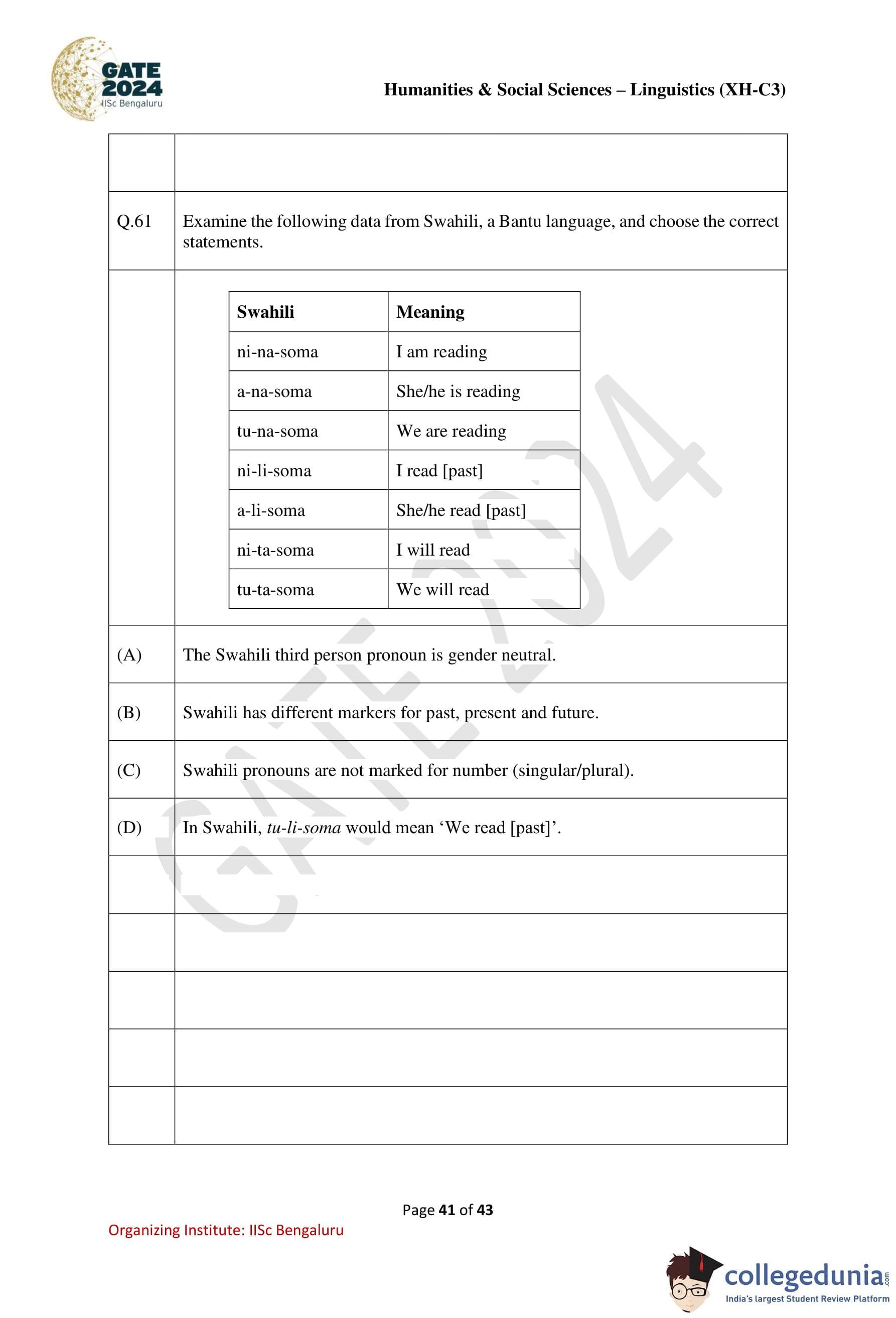
Examine the following data from Swahili, a Bantu language, and choose the correct statements.

View Solution
Step 1: Gender marking.
The form a-na-soma is glossed as ‘she/he is reading’, showing that the third person form is gender neutral. Hence, (A) is correct.
Step 2: Tense marking.
The markers \textit{-na- (present), \textit{-li- (past), and \textit{-ta- (future) clearly indicate different tense distinctions. Hence, (B) is correct.
Step 3: Number marking.
The prefixes \textit{ni- (I) and \textit{tu- (we) show that pronouns are marked for number, so (C) is incorrect.
Step 4: Interpreting \textit{tu-li-soma.
By analogy with the paradigm, \textit{tu- marks ‘we’ and \textit{-li- marks past, giving ‘we read [past]’. Hence, (D) is correct.
Step 5: Conclusion.
The correct statements are (A), (B), and (D).
Quick Tip: Bantu languages typically show rich agreement morphology for person, number, and tense.
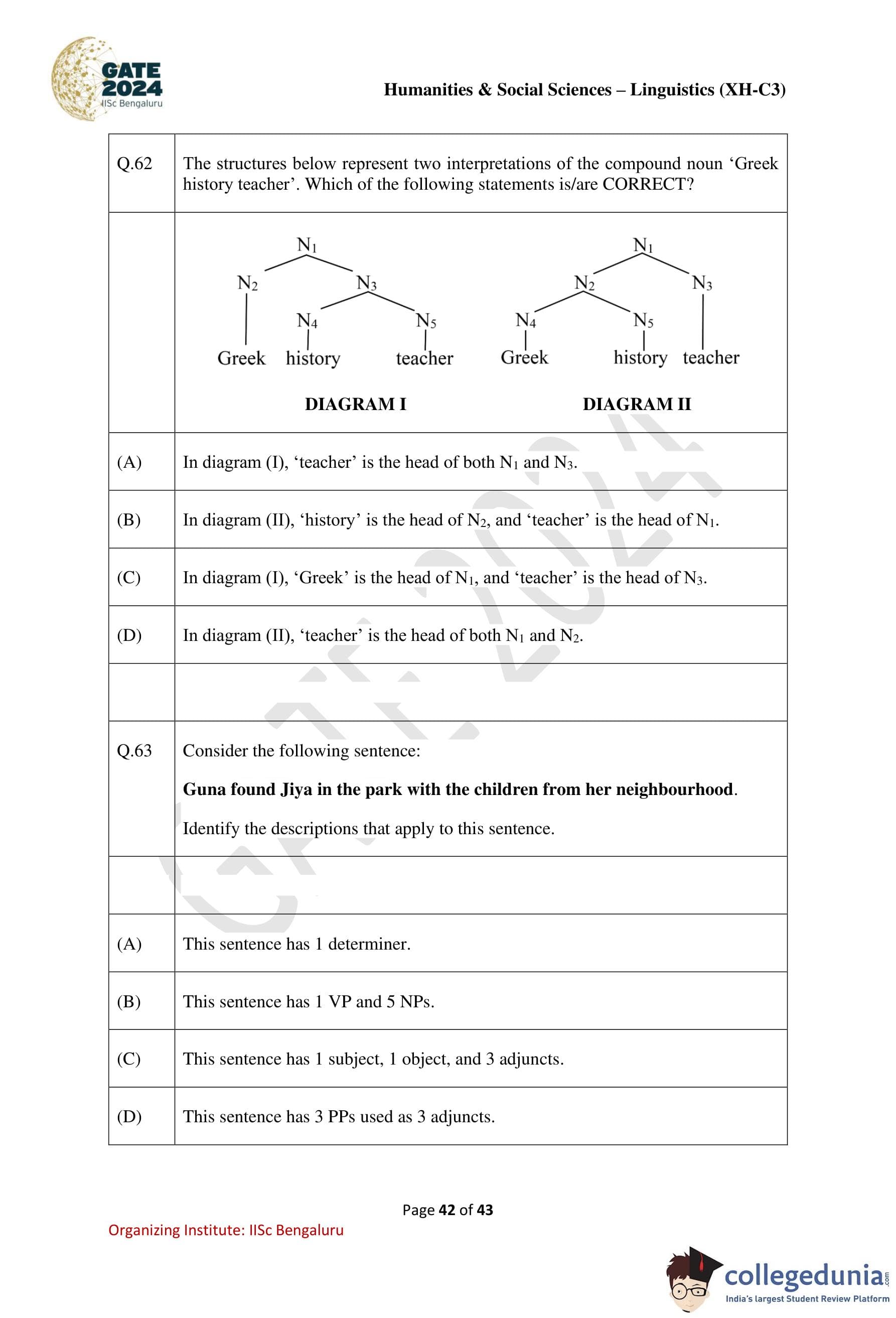
The structures below represent two interpretations of the compound noun ‘Greek history teacher’. Which of the following statements is/are CORRECT?

View Solution
Step 1: Diagram I.
In Diagram I, ‘Greek history’ modifies ‘teacher’. The rightmost noun ‘teacher’ functions as the head at both the lower and higher projection levels, validating (A).
Step 2: Diagram II.
In Diagram II, ‘Greek’ modifies ‘history’, and the compound ‘Greek history’ modifies ‘teacher’. Thus, ‘history’ is the head of N\textsubscript{2 and ‘teacher’ is the head of N\textsubscript{1, validating (B).
Step 3: Eliminating incorrect options.
Options (C) and (D) incorrectly assign head status to modifiers.
Step 4: Conclusion.
Therefore, the correct statements are (A) and (B).
Quick Tip: In English compounds, the rightmost noun is typically the head.
Consider the following sentence:
\textit{Guna found Jiya in the park with the children from her neighbourhood.
Identify the descriptions that apply to this sentence.
View Solution
Step 1: Counting phrases.
The sentence contains one VP (‘found Jiya in the park with the children from her neighbourhood’) and five NPs: \textit{Guna, \textit{Jiya, \textit{the park, \textit{the children, \textit{her neighbourhood. Hence, (B) is correct.
Step 2: Grammatical functions.
There is one subject (‘Guna’), one direct object (‘Jiya’), and three adjuncts expressing location and accompaniment. This validates (C).
Step 3: Prepositional phrases.
The phrases ‘in the park’, ‘with the children’, and ‘from her neighbourhood’ are all PPs functioning as adjuncts, validating (D).
Step 4: Eliminating incorrect option.
There is more than one determiner (‘the’, ‘the’, ‘her’), so (A) is incorrect.
Step 5: Conclusion.
The correct descriptions are (B), (C), and (D).
Quick Tip: PPs commonly function as adjuncts expressing location, accompaniment, or source.
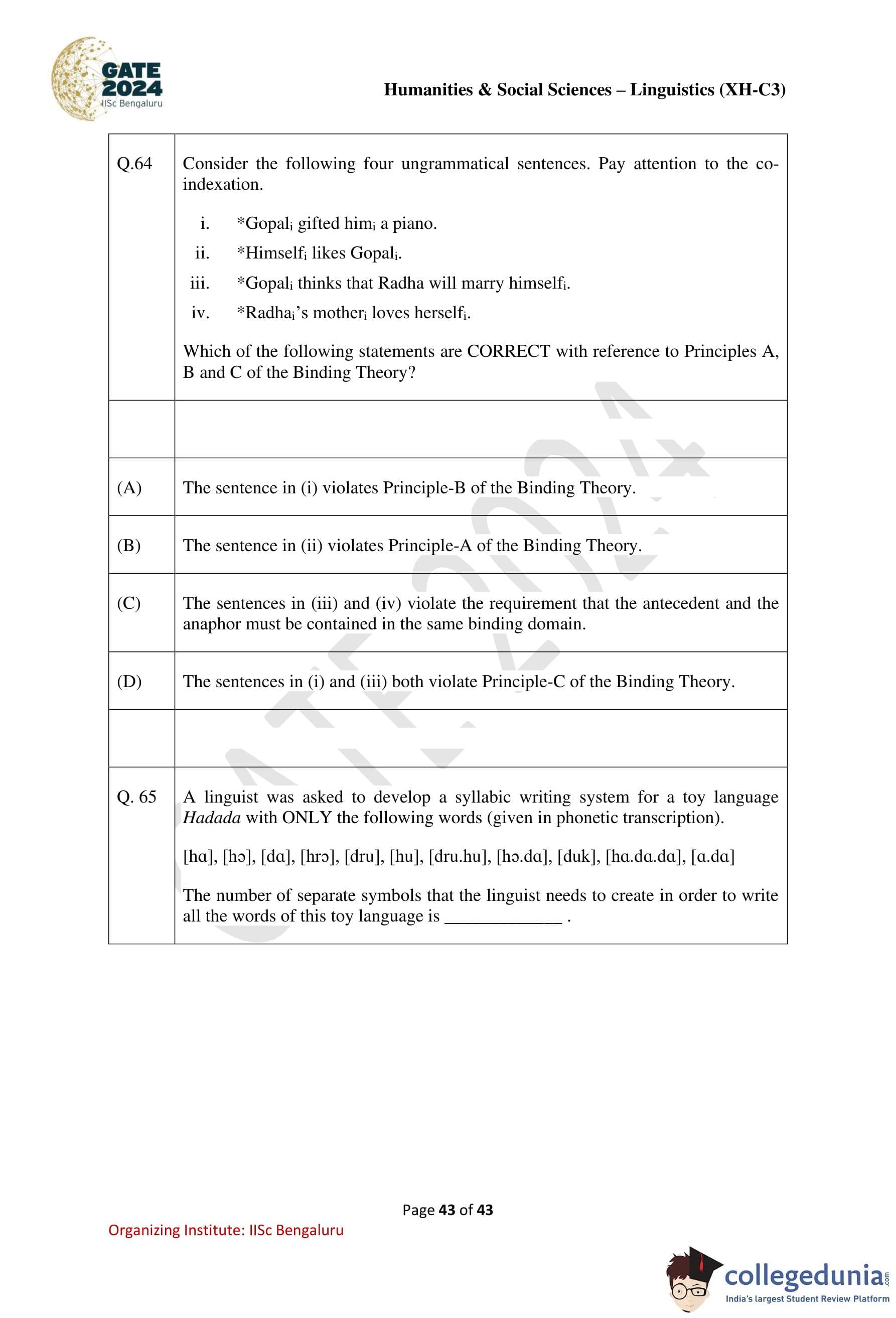
Consider the following four ungrammatical sentences. Pay attention to the co-indexation.
i. *Gopali\(_i\) gifted him\(_i\) a piano.
ii. *Himself\(_i\) likes Gopali\(_i\).
iii. *Gopali\(_i\) thinks that Radha will marry himself\(_i\).
iv. *Radha\(_i\)’s mother\(_j\) loves herself\(_i\).
Which of the following statements are CORRECT with reference to Principles A, B and C of the Binding Theory?
View Solution
Step 1: Sentence (i).
In sentence (i), the pronoun him is co-indexed with the local NP \textit{Gopali within the same binding domain. Principle B requires pronouns to be free in their local domain. Hence, sentence (i) violates Principle B. Option (A) is correct.
Step 2: Sentence (ii).
In sentence (ii), the reflexive \textit{himself appears in subject position without a local antecedent. Principle A requires anaphors to be locally bound. This condition is not satisfied, so sentence (ii) violates Principle A. Option (B) is correct.
Step 3: Sentences (iii) and (iv).
In sentence (iii), the reflexive \textit{himself occurs in an embedded clause, but its antecedent \textit{Gopali is in the matrix clause. In sentence (iv), \textit{herself does not have an appropriate antecedent within the same local domain. Both violate the locality requirement of Principle A. Hence, option (C) is correct.
Step 4: Eliminating option (D).
Principle C applies to R-expressions, not pronouns or anaphors. Sentence (i) violates Principle B, and sentence (iii) violates Principle A, not Principle C. Hence, (D) is incorrect.
Step 5: Conclusion.
The correct statements are (A), (B), and (C).
Quick Tip: Remember: \textbf{Principle A = anaphors must be locally bound, \textbf{Principle B} = pronouns must be locally free, \textbf{Principle C} = R-expressions must be free everywhere.
A linguist was asked to develop a syllabic writing system for a toy language Hadada with ONLY the following words (given in phonetic transcription):
\[ [ha], [ha], [da], [ɳrə], [dru], [hu], [dru.hu], [ha.da], [du], [kʰa.da.da], [ɖa.da] \]
The number of separate symbols that the linguist needs to create in order to write all the words of this toy language is ...........
View Solution
Step 1: Understanding a syllabic writing system.
In a syllabary, each symbol represents one syllable rather than individual consonants or vowels.
Step 2: Listing distinct syllables.
From the given data, the distinct syllables are:
\textit{ha, da, hu, du, dru, ɳrə, kʰa, ɖa.
Step 3: Counting unique syllables.
There are exactly eight distinct syllabic units required to represent all words.
Step 4: Conclusion.
Thus, the linguist needs to create 8 separate symbols.
Quick Tip: In syllabaries, repeated syllables reuse the same symbol—only unique syllables are counted.
Also Check:



Comments