




GATE 2024 ECE Question Paper PDF is available here. IISc Banglore conducted GATE 2024 ECE exam on February 11 in the Forenoon Session from 9:30 AM to 12:30 PM. Students have to answer 65 questions in GATE 2024 ECE Question Paper carrying a total weightage of 100 marks. 10 questions are from the General Aptitude section and 55 questions are from Engineering Mathematics and Core Discipline.
GATE 2024 ECE Question Paper with Answer Key PDF
GATE 2024 ECE Question Paper with Answer Key PDF
| GATE 2024 ECE Question Paper PDF |  Download Download |
Check Solutions |
GATE 2024 ECE Question Paper with Answer Key PDF
Question 1:
If ‘→' denotes increasing order of intensity, then the meaning of the words [charm → enamor → bewitch] is analogous to [bored → ____ → weary]. Which one of the given options is appropriate to fill the blank?
Question 2:
P, Q, R, S, and T have launched a new startup. Two of them are siblings. The office of the startup has just three rooms. All of them agree that the siblings should not share the same room. If S and Q are single children, and the room allocations shown below are acceptable to all:
P, R T, S Q
P, Q R, T S
Then, which one of the given options is the siblings?
Question 3:
Five years ago, the ratio of Aman's age to his father's age was 1:4, and five years from now, the ratio will be 2:5. What was his father's age when Aman was born?
Question 4:
For a real number x > 1, solve the equation: 1⁄log2x + 1⁄log3x + 1⁄log4x= 1 The value of x is:
Question 5:
The greatest prime factor of (3199 – 3196) is:
Question 6:
Sequence the following sentences (P, Q, R, S) in a coherent passage:
P: Shifu's student exclaimed, “Why do you run since the bull is an illusion?"
Q: Shifu said, “Surely my running away from the bull is also an illusion."
R: Shifu once proclaimed that all life is illusion.
S: One day, when a bull gave him chase, Shifu began running for his life.
Question 7:
Four identical cylindrical chalk-sticks, each of radius r = 0.5 cm and length l = 10 cm, are bound tightly together using a duct tape as shown in the following figure.
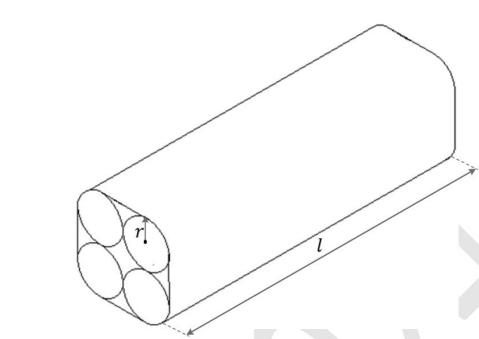
The width of the duct tape is equal to the length of the chalk-stick. The area (in cm²) of the duct tape required to wrap the bundle of chalk-sticks once, is:
Question 8:
The bar chart shows the data for the percentage of population falling into different categories based on Body Mass Index (BMI) in 2003 and 2023. Based on the data provided, which one of the following options is INCORRECT?

Question 9:
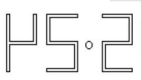
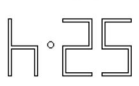
Examples of mirror and water reflections are shown in the figures below:
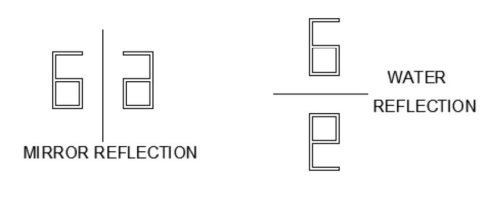
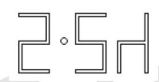
An object appears as the following image after first reflecting in a mirror and then reflecting on water:
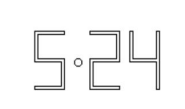
The original object is:

Question 10:
Two identical sheets A and B, of dimensions 24 cm × 16 cm, can be folded into half using two distinct operations, FO1 or FO2. In FO1, the axis of folding remains parallel to the initial long edge, and in FO2, the axis of folding remains parallel to the initial short edge. If sheet A is folded twice using FO1, and sheet B is folded twice using FO2, the ratio of the perimeters of the final shapes of A and B is:
Question 11:
The general form of the complementary function of a differential equation is given by:
yc(t) = (At + B)e-2t, where A and B are real constants determined by the initial condition. The corresponding differential equation is:
Question 12:
In the context of Bode magnitude plots, 40 dB/decade is the same as:
Question 13:
In the feedback control system shown in the figure below,
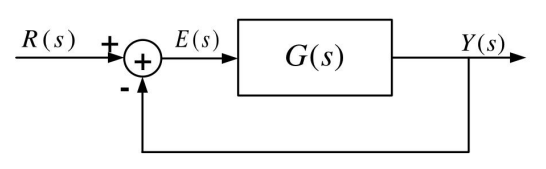
R(s), Y(s), and E(s) are the Laplace transforms of r(t), y(t), and e(t), respectively. If the input r(t) is a unit step function, then:
Question 14:
A digital communication system transmits through a noiseless bandlimited channel [-W, W]. The received signal z(t) at the output of the receiving filter is given by:
z(t) = ∑n b[n]x(t − nT), where b[n] are the symbols and x(t) is the overall system response to a single symbol. The received signal is sampled at t = mT. The Fourier transform of x(t) is X(f). The Nyquist condition that X(f) must satisfy for zero intersymbol interference at the receiver is:
Question 15:
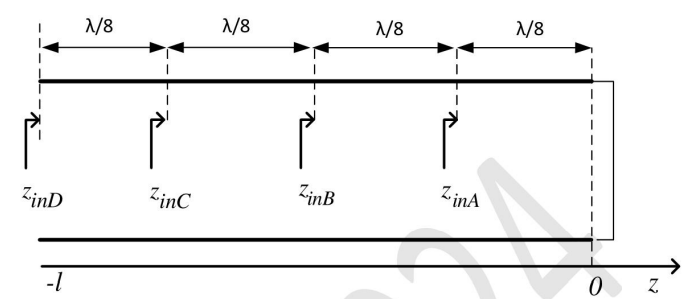
Consider a lossless transmission line terminated with a short circuit as shown in the figure below. As one moves towards the generator from the load, the normalized impedances ZinA, ZinB, ZinC, and zinD (indicated in the figure) are:
Question 16:
Let î and ĵ be the unit vectors along x and y axes, respectively, and let A be a positive constant. Which one of the following statements is true for the vector fields:
F₁ = A(îy + ĵx) and F₂ = A(îy – ĵx)?
Question 17:
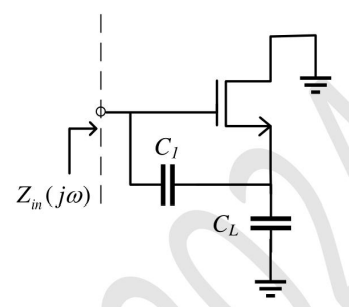
In the circuit below, assume that the long channel NMOS transistor is biased in saturation. The small signal transconductance of the transistor is gm. Neglect body effect, channel length modulation, and intrinsic device capacitances. The small signal input impedance Zin(jw) is:
Question 18:
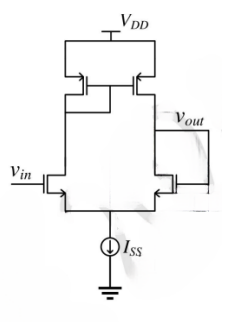
For the closed-loop amplifier circuit shown below, the magnitude of open-loop low-frequency small signal voltage gain is 40. All the transistors are biased in saturation. The current source Iss is ideal. Neglect body effect, channel length modulation, and intrinsic device capacitances. The closed-loop low-frequency small signal voltage gain Vout⁄Vin (rounded off to three decimal places) is:
Question 19:
For the Boolean function: F(A, B, C, D) = ∑m(0, 2, 5, 7, 8, 10, 12, 13, 14, 15), the essential prime implicants are:
Question 20:
A white Gaussian noise w(t) with zero mean and power spectral density N0⁄2, when applied to a first-order RC low-pass filter produces an output n(t). At a particular time t = tk, the variance of the random variable n(tk) is:
Question 21:
A causal and stable LTI system with impulse response h(t) produces an output y(t) for an input signal x(t). A signal x(0.5t) is applied to another causal and stable LTI system with impulse response h(0.5t). The resulting output is:
Question 22:
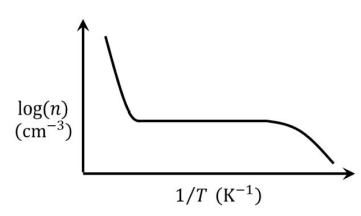
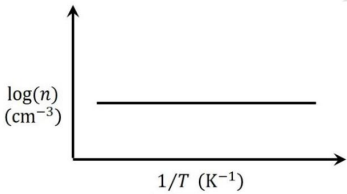
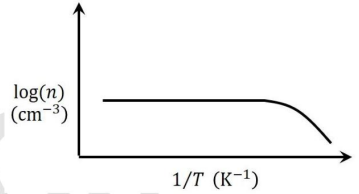
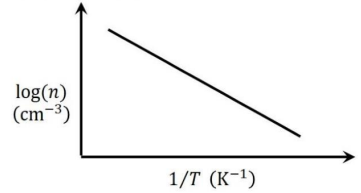
For non-degenerately doped n-type silicon, which one of the following plots represents the temperature (T) dependence of free electron concentration (n)?
Question 23:
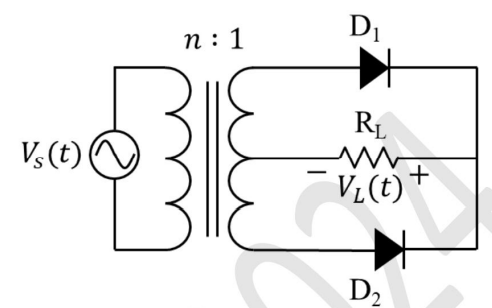
In the circuit shown, the n : 1 step-down transformer and the diodes are ideal. The diodes have no voltage drop in forward-biased condition. If the input voltage (in Volts) is Vs(t) = 10 sin ωt and the average value of load voltage VL(t) (in Volts) is 2.5/π, the value of n is ____.
Question 24:
For a causal discrete-time LTI system with transfer function: H(z) = 2z2 + 3⁄(z + 1⁄3)(z - 1⁄2) which of the following statements is/are true?
Question 25:
Let ρ(x, y, z, t) and u(x, y, z, t) represent density and velocity, respectively, at a point (x, y, z) and time t. Assume ∂ρ⁄∂t is continuous. Let V be an arbitrary volume in space enclosed by the closed surface S, and ĥ be the outward unit normal of S. Which of the following equations is/are equivalent to:
∂ρ⁄∂t + ∇ ⋅ (ρu) = 0?
Question 26:
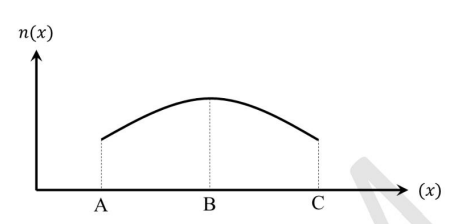
The free electron concentration profile n(x) in a doped semiconductor at equilibrium is shown in the figure, where the points A, B, and C mark three different positions. Which of the following statements is/are true?
Question 27:
A machine has a 32-bit architecture with 1-word long instructions. It has 24 registers and supports an instruction set of size 40. Each instruction has five distinct fields, namely opcode, two source register identifiers, one destination register identifier, and an immediate value. Assuming that the immediate operand is an unsigned integer, its maximum value is ____.
Question 28:
An amplitude modulator has output (in Volts): s(t) = A cos(400πt) + B cos(360πt) + B cos(440πt). The carrier power normalized to 1Ω resistance is 50 Watts. The ratio of the total sideband power to the total power is 1
/9. The value of B (in Volts, rounded off to two decimal places) is ____
Question 29:
In a number system of base r, the equation x2 − 12x + 37 = 0 has x = 8 as one of its solutions. The value of r is ____.
Question 30:
Let ℝ and ℝ3 denote the set of real numbers and the three-dimensional vector space over it, respectively. The value of α for which the set of vectors: {[2 3 α], [3 -1 3], [1 -5 7]} does not form a basis of ℝ3 is ____.
Question 31:
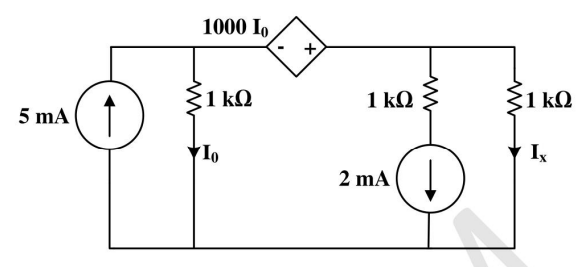
In the given circuit, the current Ix (in mA) is ____.
Question 32:
In the circuit given below, the switch S was kept open for a sufficiently long time and is closed at time t = 0. The time constant (in seconds) of the circuit for t > 0 is ____. 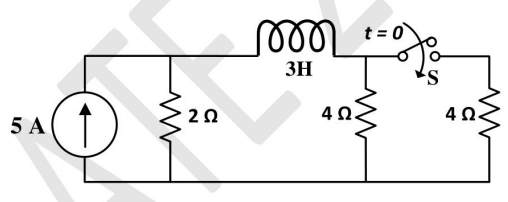
Question 33:
Suppose X and Y are independent and identically distributed random variables that are distributed uniformly in the interval [0, 1]. The probability that X > Y is ____.
Question 34:
A source transmits symbols from an alphabet of size 16. The value of maximum achievable entropy (in bits) is ____.
Question 35:
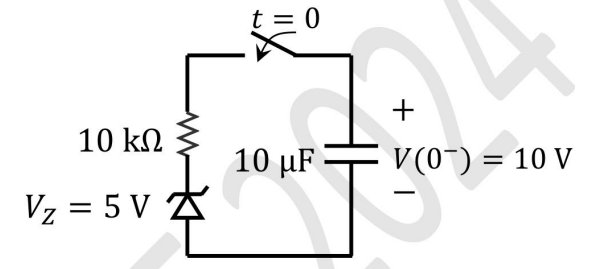
As shown in the circuit, the initial voltage across the capacitor is 10 V, with the switch being open. The switch is then closed at t = 0. The total energy dissipated in the ideal Zener diode (Vz = 5 V) after the switch is closed (in mJ, rounded off to three decimal places) is ____.
Question 36:
Consider the Earth to be a perfect sphere of radius R. Then the surface area of the region, enclosed by the 60°N latitude circle, that contains the north pole in its interior is ____.
Question 37:
Consider a unity negative feedback control system with forward path gain: G(s) = K⁄(s+1)(s+2)(s+3)
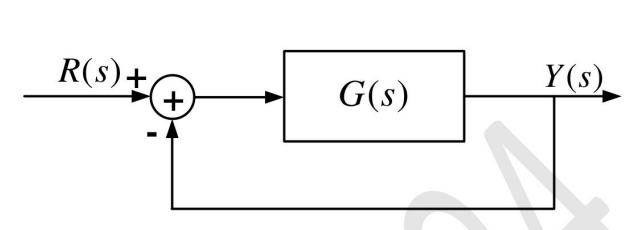
The impulse response of the closed-loop system decays faster than e-t if ____.
Question 38:
A satellite attitude control system, as shown below, has a plant with transfer function: G(s) = 1⁄s2, cascaded with a compensator: C(s) = K(s+α)⁄s+4
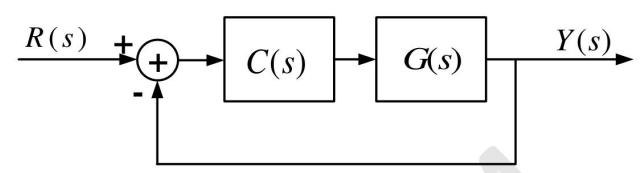
where K and α are positive real constants. In order for the closed-loop system to have poles at −1 ± j√3, the value of α must be ____.
Question 39:
A uniform plane wave with electric field: E(x) = Aŷe-j2πx/λ V/m, is traveling in the air (relative permittivity, εr = 1, and relative permeability, μr = 1) in the +x direction. It is incident normally on an ideal electric conductor (conductivity, σ = ∞) at x = 0. The position of the first null of the total magnetic field in the air (measured from x = 0, in meters) is ____.
Question 40:
A 4-bit priority encoder has inputs D3, D2, D1, and D0 in descending order of priority. The two-bit output A̅B̅ is generated as 00, 01, 10, and 11 corresponding to inputs D3, D2, D1, and D0, respectively. The Boolean expression of the output bit B is ____.
Question 41:
The propagation delay of the 2 × 1 MUX shown in the circuit is 10 ns. Consider the propagation delay of the inverter as 0 ns. If S is set to 1, then the output Y is ____. 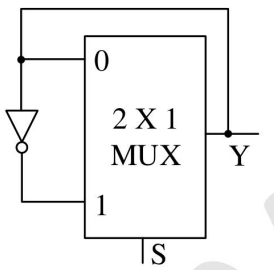
Question 42:
The sequence of states (Q1Q0) of the given synchronous sequential circuit is ____.
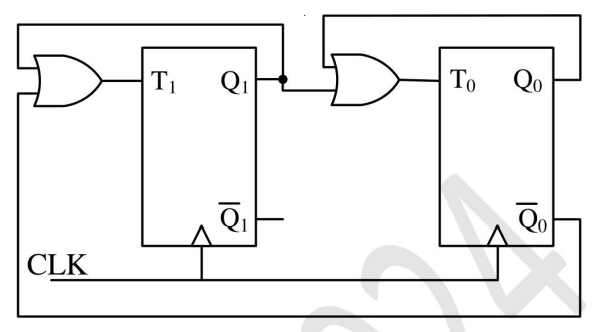
Question 43:
Let z be a complex variable. If f(z) = sin(πz)⁄z2(z-2) and C is the circle in the complex plane with |z| = 3, then: ∫C f(z) dz is ____.
Question 44:
Consider two continuous-time signals x(t) and y(t) as shown below. If X(f) denotes the Fourier transform of x(t), then the Fourier transform of y(t) is ____.
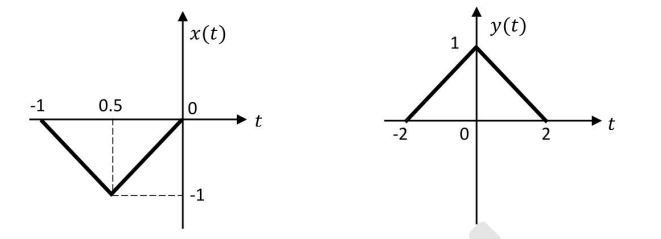
Question 45:
A source transmits a symbol s, taken from {−4, 0, 4} with equal probability, over an additive white Gaussian noise channel. The received noisy symbol r is given by r = s+w, where the noise w is zero mean with variance 4 and is independent of s. Using: Q(x) = 1⁄√2π ∫x∞e-t2/2 dt, the optimum symbol error probability is ____.
Question 46:
A full-scale sinusoidal signal is applied to a 10-bit ADC. The fundamental signal component in the ADC output has a normalized power of 1 W, and the total noise and distortion normalized power is 10 μW. The effective number of bits (rounded off to the nearest integer) of the ADC is ____.
Question 47:
The information bit sequence {111010101} is to be transmitted by encoding with Cyclic Redundancy Check 4 (CRC-4) code, for which the generator polynomial is G(x) = x4 + x + 1. The encoded sequence of bits is ____.
Question 48:
A continuous-time signal x(t) = 2 cos(8πt + π/3) is sampled at a rate of 15 Hz. The sampled signal xs(t), when passed through an LTI system with impulse response: h(t) = sin(2πt)⁄πt cos(38πt − π/2), produces an output xo(t). The expression for xo(t) is ____.
Question 49:
The opamps in the circuit shown are ideal but have saturation voltages of ±10 V.
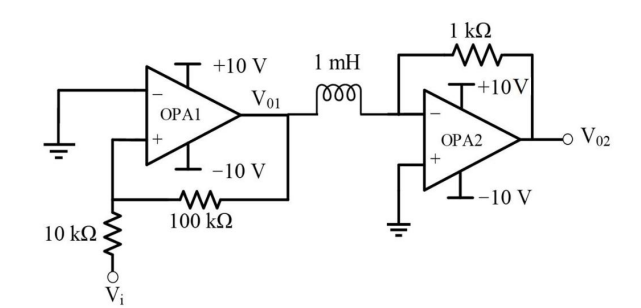
Assume that the initial inductor current is 0 A. The input voltage (Vi) is a triangular signal with peak voltages of ±2 V and a time period of 8 μs. Which one of the following statements is true?
Question 50:
In the circuit below, the opamp is ideal. If the circuit is to show sustained oscillations, the respective values of R1 and the corresponding frequency of oscillation are ____. 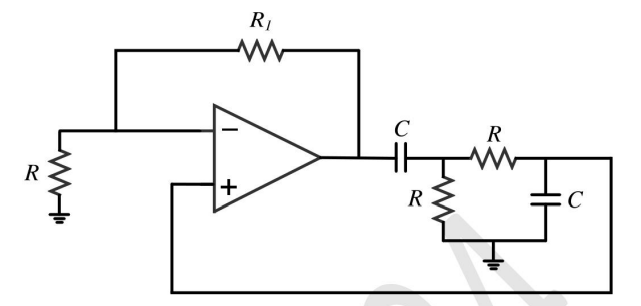
Question 51:
In the circuit shown below, the transistors M1 and M2 are biased in saturation. Their small signal transconductances are gm1 and gm2, respectively. Neglect body effect, channel length modulation, and intrinsic device capacitances.
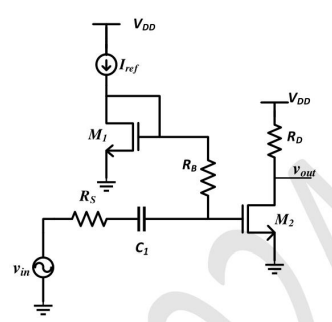
Assuming that capacitor C1 is a short circuit for AC analysis, the exact magnitude of small signal voltage gain |Vout⁄Vin| is ____.
Question 52:
Which of the following statements is/are true for a BJT with respect to its DC current gain β?
Question 53:
Consider a system S represented in state space as: dx⁄dt = [0 -2]⁄1 -3 x + 1⁄0 r, y = [2 -5]x. Which of the state space representations given below has/have the same transfer function as that of S?
Question 54:
Let F1, F2, and F3 be functions of (x, y, z). Suppose that for every given pair of points A and B in space, the line integral: ∫C (F1dx + F2dy + F3dz) evaluates to the same value along any path C that starts at A and ends at B. Then which of the following is/are true?
Question 55:
Consider the matrix: 1 k⁄2 1 , where k is a positive real number. Which of the following vectors is/are eigenvector(s) of this matrix?
Question 56:
The radian frequency value(s) for which the discrete-time sinusoidal signal: x[n] = A cos(Ωn + π/3) has a period of 40 is/are ____.
Question 57:
Let X(t) = A cos(2πf0t + θ) be a random process, where amplitude A and phase θ are independent of each other, and are uniformly distributed in the intervals [-2, 2] and [0, 2π], respectively. X(t) is fed to an 8-bit uniform mid-rise type quantizer. Given that the autocorrelation of X(t) is: RX(τ) = 2⁄3 cos(2πf0τ), the signal-to-quantization noise ratio (in dB, rounded off to two decimal places) at the output of the quantizer is ____.
Question 58:
A lossless transmission line with characteristic impedance Z0 = 50Ω is terminated with an unknown load. The magnitude of the reflection coefficient is |Γ| = 0.6. As one moves towards the generator from the load, the maximum value of the input impedance magnitude looking towards the load (in Ω) is ____.
Question 59:
The relationship between any N-length sequence x[n] and its corresponding N-point discrete Fourier transform X[k] is defined as: X[k] = F{x[n]}. Another sequence y[n] is formed as: y[n] = F{F{F{x[n]}}}. For the sequence x[n] = {1, 2, 1, 3}, the value of y[0] is ____.
Question 60:
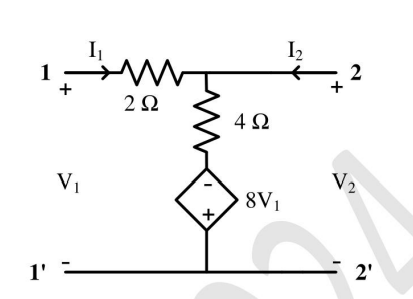
For the two-port network shown below, the value of the Y21 parameter (in Siemens) is ____.
Question 61:
Consider a MOS capacitor made with p-type silicon. It has an oxide thickness of 100 nm, a fixed positive oxide charge of 10-8 C/cm2 at the oxide-silicon interface, and a metal work function of 4.6 eV. Assume that the relative permittivity of the oxide is 4, and the absolute permittivity of free space is 8.85 × 10⁻¹⁴ F/cm. If the flatband voltage is 0 V, the work function of the p-type silicon (in eV, rounded off to two decimal places) is ____.
Question 62:
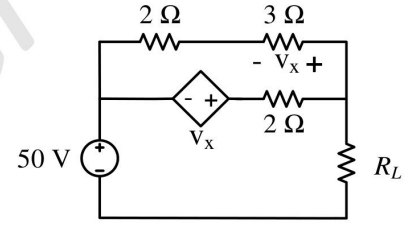
In the network shown below, maximum power is to be transferred to the load RL. The value of RL (in Ω) is ____.
Question 63:
A non-degenerate n-type semiconductor has 5% neutral dopant atoms. Its Fermi level is located at 0.25 eV below the conduction band (Ec) and the donor energy level (ED) has a degeneracy of 2. Assuming the thermal voltage to be 20mV, the difference between Ec and ED (in eV, rounded off to two decimal places) is ____.
Question 64:
An NMOS transistor operating in the linear region has IDS = 5 μA at VDS = 0.1 V. Keeping VGS constant, the VDS is increased to 1.5 V. Given that: W⁄LμnCox = 50 μA/V2, the transconductance at the new operating point (in μA/V, rounded off to two decimal places) is ____.
Question 65:
The photocurrent of a PN junction diode solar cell is 1 mA. The voltage corresponding to its maximum power point is 0.3 V. If the thermal voltage is 30 mV, the reverse saturation current of the diode (in nA, rounded off to two decimal places) is ____.





Comments