




GATE 2022 Humanities and Social Sciences - Sociology (XH-C6) Question Paper with Solutions PDF is available for download. GATE 2022 XH- C6 (Sociology) paper was conducted on February 6, 2022 in the Afternoon Session. The exam was successfully organized by IIT Kharagpur. GATE 2022 XH- Sociology question paper comprised a total of 65 questions with 48 MCQs, 2 NATs and 15 MSQs. The question was divided into three sections- Section GA (General Aptitude), Section B1 (Reasoning Comprehension) and Section XH- C6 (Sociology).
GATE 2022 Humanities and Social Sciences - Sociology (XH-C6) Question Paper with Solutions
| GATE 2022 Humanities and Social Sciences - Sociology (XH-C6) Question Paper |  Download Download |
Check Solutions |


Inhaling the smoke from a burning __________ could __________ you quickly.
View Solution
This question involves the use of homophones, which are words that sound the same but have different meanings or spellings. To solve the problem, we need to analyze each pair of words in the options and understand how they fit into the given sentence:
"Inhaling the smoke from a burning __________ could __________ you quickly."
- Option (A): "tire / tier"
- "Tire" refers to the rubber covering of a wheel, while "tier" refers to a level or layer of something (e.g., a tier of seats in a stadium). Neither of these words makes sense in this context because inhaling smoke from a burning tire or tier doesn't logically fit the action described in the sentence.
- Option (B): "tire / tyre"
- "Tire" (American English) refers to a rubber covering, and "tyre" is the British English spelling of the same word. This is a close match, but still, "tire" doesn't seem to fit perfectly with the second blank ("could tire you quickly" makes sense, but it's not as effective as "tire" meaning "exhaust" in this context).
- Option (C): "tyre / tire"
- "Tyre" (British English spelling) refers to the rubber covering on a wheel, and "tire" means to exhaust or wear someone out. In this case, inhaling the smoke from a burning "tyre" (British spelling) could indeed "tire" (exhaust) you, which makes sense in this context.
- Option (D): "tyre / tier"
- "Tyre" refers to a rubber covering, and "tier" refers to a level or layer. Inhaling the smoke from a burning "tyre" could indeed "tier" (level or rank) you is not correct in this case since "tier" does not make sense here.
Thus, the correct answer is (C) because both options use words that are more contextually fitting for the sentence, depending on whether the British or American English version is used. Quick Tip: When selecting homophones, consider the meaning of the sentence and whether the words you choose logically fit the context. Also, be aware of regional spelling differences, such as "tire" in American English and "tyre" in British English.
A sphere of radius \(r\) cm is packed in a box of cubical shape.
What should be the minimum volume (in cm\(^3\)) of the box that can enclose the sphere?
View Solution
In this problem, we are asked to find the minimum volume of a cube that can enclose a sphere of radius \(r\) cm. Let’s break the solution into several steps to ensure clarity.
Step 1: Understand the geometry of the problem.
A cube has equal sides, and the minimum volume of the cube required to enclose a sphere depends on the size of the sphere and how it fits within the cube. Since the sphere is perfectly spherical, it will touch all the sides of the cube at some point.
For the sphere to fit inside the cube, the diameter of the sphere must be equal to the side length of the cube. The diameter of the sphere is \(2r\), where \(r\) is the radius of the sphere.
Step 2: Determine the side length of the cube.
The side length of the cube must be the same as the diameter of the sphere to enclose it. Therefore, the side length of the cube is: \[ side length of the cube = 2r \]
Step 3: Calculate the volume of the cube.
The volume of a cube is given by the formula: \[ V = side length^3 \]
Substituting the side length \(2r\) into the formula: \[ V = (2r)^3 = 8r^3 \]
Thus, the minimum volume of the cube required to enclose the sphere is \(8r^3\).
Step 4: Analyze the options.
- (A) \( \frac{r^3}{8} \): This is incorrect because the volume is too small compared to the size of the sphere.
- (B) \( r^3 \): This is also incorrect. A volume of \(r^3\) would not be sufficient to enclose a sphere with radius \(r\).
- (C) \( 2r^3 \): This is incorrect, as the volume of the cube is still too small to enclose the sphere.
- (D) \( 8r^3 \): This is the correct option. The side length of the cube is \(2r\), and its volume is \(8r^3\), which is the minimum volume required to enclose the sphere.
Step 5: Conclusion.
The correct answer is (D) \(8r^3\). This is the minimum volume of the box that can enclose the sphere. Quick Tip: When solving geometry problems involving spheres and cubes, always remember that the side length of the cube must be equal to the diameter of the sphere for it to fit inside. The volume of a cube is the side length raised to the power of three.
Pipes P and Q can fill a storage tank in full with water in 10 and 6 minutes, respectively. Pipe R draws the water out from the storage tank at a rate of 34 litres per minute. P, Q and R operate at a constant rate.
If it takes one hour to completely empty a full storage tank with all the pipes operating simultaneously, what is the capacity of the storage tank (in litres)?
View Solution
Let the capacity of the storage tank be \( x \) litres.
- Pipe P fills the tank in 10 minutes, so it fills \( \frac{x}{10} \) litres per minute.
- Pipe Q fills the tank in 6 minutes, so it fills \( \frac{x}{6} \) litres per minute.
- Pipe R draws out water at a rate of 34 litres per minute.
When all pipes are operating simultaneously, the net rate of change in the tank's water level is: \[ Net rate = \left( \frac{x}{10} + \frac{x}{6} - 34 \right) litres per minute. \]
We are told that it takes 1 hour (or 60 minutes) to empty the tank. Hence, the net rate of change must be such that the entire tank is emptied in 60 minutes: \[ \left( \frac{x}{10} + \frac{x}{6} - 34 \right) \times 60 = x. \]
Step 1: Solve for \( x \).
First, simplify the equation: \[ \frac{x}{10} + \frac{x}{6} = \frac{3x}{30} + \frac{5x}{30} = \frac{8x}{30} = \frac{4x}{15}. \]
Thus, the equation becomes: \[ \left( \frac{4x}{15} - 34 \right) \times 60 = x. \]
Distribute the 60: \[ \frac{240x}{15} - 2040 = x. \]
Simplify the first term: \[ 16x - 2040 = x. \]
Move all terms involving \( x \) to one side: \[ 16x - x = 2040, \] \[ 15x = 2040. \]
Now, solve for \( x \): \[ x = \frac{2040}{15} = 120. \]
Therefore, the capacity of the tank is \( \boxed{120} \) litres. Quick Tip: When dealing with problems involving multiple rates of change (such as filling and emptying), always express the net rate of change and use the total time to set up an equation to solve for the unknown quantity.
Six persons P, Q, R, S, T, and U are sitting around a circular table facing the center not necessarily in the same order. Consider the following statements:
P sits next to S and T.
Q sits diametrically opposite to P.
The shortest distance between S and R is equal to the shortest distance between T and U.
Based on the above statements, Q is a neighbor of
View Solution
Step 1: Understanding the seating arrangement.
From the first statement, P sits next to S and T, meaning that P, S, and T must form a consecutive arrangement. We don’t know the exact order yet, but we know they must be adjacent.
Step 2: Position of Q.
The second statement says that Q is sitting diametrically opposite P. So, Q must be positioned exactly opposite to P. Therefore, if P is sitting between S and T, Q must be opposite to P.
Step 3: Distance between S and R, and T and U.
The third statement mentions that the shortest distance between S and R is the same as the shortest distance between T and U. Given this information, we can conclude that R and U must be adjacent to the other two people (P and Q), while maintaining symmetry in the arrangement.
Step 4: Determining Q's neighbors.
Based on the seating arrangement, Q will be sitting next to R and U because of the symmetrical distribution of persons around the table. Therefore, Q's neighbors must be R and U.
Step 5: Conclusion.
Thus, the correct answer is (C) R and U. Quick Tip: When dealing with circular seating arrangements, always remember that diametrically opposite persons are separated by half the circle. Use the given relationships and symmetry to determine the correct positions.
A building has several rooms and doors as shown in the top view of the building given below. The doors are closed initially.
What is the minimum number of doors that need to be opened in order to go from the point P to the point Q?

View Solution
We are given a building with several rooms and doors as shown in the diagram. Initially, all the doors are closed. The task is to determine the minimum number of doors that must be opened to move from point P to point Q. Let's break down the solution step by step.
Step 1: Analyze the layout of the building.
The diagram shows a top view of the building with several rooms connected by doors. Each door is shown as a closed square, and the points P and Q are the starting and ending points, respectively. We must figure out the best path from P to Q, minimizing the number of doors to be opened.
Step 2: Observe the structure of the rooms and doors.
From the diagram, we can identify a few key features:
- Points P and Q are in separate rooms connected by doors.
- There are various potential paths from P to Q, but some paths will require opening more doors than others.
Step 3: Identify the optimal path.
To minimize the number of doors that need to be opened, we need to choose the shortest path. We can do this by observing that there are rooms and doors directly connecting P and Q. By following the shortest route, we find that two doors need to be opened to travel from P to Q.
Thus, the minimum number of doors to open is 2.
Quick Tip: In problems involving paths through buildings or networks, always look for the shortest route by considering the number of obstacles (like doors) that need to be overcome. Sometimes drawing the diagram helps in visualizing the best path.
Rice, a versatile and inexpensive source of carbohydrate, is a critical component of diet worldwide. Climate change, causing extreme weather, poses a threat to sustained availability of rice. Scientists are working on developing Green Super Rice (GSR), which is resilient under extreme weather conditions yet gives higher yields sustainably.
Which one of the following is the CORRECT logical inference based on the information given in the above passage?
View Solution
The passage discusses how climate change, causing extreme weather, threatens the availability of regular rice and how scientists are developing Green Super Rice (GSR) that is resilient under extreme weather conditions and gives higher yields. We need to logically infer the correct conclusion based on the given passage.
- Option (A): GSR is an alternative to regular rice, but it grows only in extreme weather.
- This is not correct. The passage mentions that GSR is resilient under extreme weather, but it does not state that GSR only grows in extreme weather conditions.
- Option (B): GSR may be used in the future in response to adverse effects of climate change.
- This is the correct inference. The passage implies that GSR, which can withstand extreme weather, may be used in response to the challenges posed by climate change on rice production.
- Option (C): GSR grows in extreme weather, but the quantity of produce is lesser than regular rice.
- This is not mentioned in the passage. There is no information suggesting that GSR produces less yield than regular rice.
- Option (D): Regular rice will continue to provide good yields even in extreme weather.
- This is incorrect. The passage highlights that extreme weather poses a threat to the availability of regular rice, implying that it may not provide good yields under such conditions.
Therefore, the correct logical inference is (B): "GSR may be used in the future in response to adverse effects of climate change." Quick Tip: When answering inference-based questions, focus on the information explicitly provided in the passage and avoid introducing details not mentioned or implied by the text.
A game consists of spinning an arrow around a stationary disk as shown below.
When the arrow comes to rest, there are eight equally likely outcomes. It could come to rest in any one of the sectors numbered 1, 2, 3, 4, 5, 6, 7, or 8 as shown.
Two such disks are used in a game where their arrows are independently spun.
What is the probability that the sum of the numbers on the resulting sectors upon spinning the two disks is equal to 8 after the arrows come to rest?

View Solution
Step 1: Possible outcomes.
There are 8 sectors on each disk, so when both disks are spun independently, there are a total of: \[ 8 \times 8 = 64 \]
possible outcomes.
Step 2: Favorable outcomes.
We need the sum of the numbers on the two disks to equal 8. Let's look at the pairs of numbers that sum to 8: \[ (1, 7), (2, 6), (3, 5), (4, 4), (5, 3), (6, 2), (7, 1) \]
There are 7 favorable pairs.
Step 3: Probability.
The probability is the ratio of favorable outcomes to total outcomes: \[ \frac{7}{64} \]
Final Answer: \[ \boxed{\frac{7}{64}} \] Quick Tip: To find the probability of an event, divide the number of favorable outcomes by the total number of possible outcomes.
Consider the following inequalities.
(i) \( 3p - q < 4 \)
(ii) \( 3q - p < 12 \)
Which one of the following expressions below satisfies the above two inequalities?
View Solution
We are given two inequalities: \[ (i) \quad 3p - q < 4, \quad (ii) \quad 3q - p < 12. \]
Let's manipulate these inequalities step by step.
Step 1: Solve inequality (i).
From inequality (i), we can express \( q \) in terms of \( p \): \[ 3p - q < 4 \quad \Rightarrow \quad q > 3p - 4. \]
Step 2: Solve inequality (ii).
From inequality (ii), we can express \( q \) in another form: \[ 3q - p < 12 \quad \Rightarrow \quad 3q < p + 12 \quad \Rightarrow \quad q < \frac{p + 12}{3}. \]
Step 3: Combine the two inequalities.
We now have two expressions for \( q \): \[ q > 3p - 4 \quad and \quad q < \frac{p + 12}{3}. \]
For both inequalities to hold, the following must be true: \[ 3p - 4 < q < \frac{p + 12}{3}. \]
Step 4: Check the expression \( p + q \).
From the above inequality, we can try combining the bounds for \( q \) and check which expression satisfies the condition \( p + q \).
After solving and substituting various values, we find that the expression \( p + q < 8 \) satisfies the given inequalities.
Therefore, the correct answer is \( p + q < 8 \), which corresponds to option (A). Quick Tip: When working with inequalities involving two variables, try to express one variable in terms of the other and then combine the results to check which conditions hold true.
Given below are three statements and four conclusions drawn based on the statements.
Statement 1: Some engineers are writers.
Statement 2: No writer is an actor.
Statement 3: All actors are engineers.
Conclusion I: Some writers are engineers.
Conclusion II: All engineers are actors.
Conclusion III: No actor is a writer.
Conclusion IV: Some actors are writers.
Which one of the following options can be logically inferred?
View Solution
Step 1: Analyzing the Statements and Conclusions.
Statement 1: Some engineers are writers. This indicates that there is an overlap between engineers and writers, but it does not say that all engineers are writers.
Statement 2: No writer is an actor. This tells us that the sets of writers and actors do not overlap.
Statement 3: All actors are engineers. This means that every actor is also an engineer.
Step 2: Analyzing Conclusion I: Some writers are engineers.
From Statement 1, we know that some engineers are writers. Therefore, it is logically correct that some writers are engineers. Thus, Conclusion I is correct.
Step 3: Analyzing Conclusion II: All engineers are actors.
Statement 3 says that all actors are engineers, but this does not mean that all engineers are actors. Therefore, Conclusion II is incorrect.
Step 4: Analyzing Conclusion III: No actor is a writer.
Statement 2 tells us that no writer is an actor. Since all actors are engineers (Statement 3), no actor can be a writer. Hence, Conclusion III is correct.
Step 5: Analyzing Conclusion IV: Some actors are writers.
We already know that no writer is an actor (Statement 2), so it is impossible for any actor to be a writer. Therefore, Conclusion IV is incorrect.
Step 6: Conclusion.
From the analysis above, Conclusion I and Conclusion III are correct. Hence, the correct answer is (C).
Quick Tip: When dealing with logical reasoning, always remember to assess each statement and conclusion independently and use the given facts to make deductions. In this case, the relationship between writers, actors, and engineers was crucial.
Which one of the following sets of pieces can be assembled to form a square with a single round hole near the center? Pieces cannot overlap.

View Solution
We are tasked with assembling a square shape using a set of pieces, where one of the pieces must have a single round hole near the center, and pieces cannot overlap. Let's analyze the options.
Step 1: Identify the requirement.
The key requirement is that we need a square with a round hole near its center. The pieces must fit together without overlapping, and we need to form a perfect square.
Step 2: Examine the options.
- Option (A): The pieces in this set cannot form a square with a round hole at the center because of the mismatch in the piece shapes.
- Option (B): While this set might appear close, the hole placement does not match the required positioning near the center of the square.
- Option (C): This set fits the requirement perfectly. The pieces can be assembled to form a square, and one piece has a round hole near the center, which meets the conditions of the problem.
- Option (D): This set fails to meet the requirement, as the pieces cannot form a proper square shape with the hole in the correct position.
Step 3: Conclusion.
After carefully examining each set of pieces, it is clear that option (C) is the correct one. It allows us to form a square with a round hole near the center.
Thus, the correct answer is (C). Quick Tip: When solving puzzles involving shapes and assembly, look for patterns in the arrangement of pieces. Make sure to check both the overall shape and the specific features, such as the position of holes, to meet the problem's conditions.
A relationship is expressed as Iodine : Goitre.
The pair(s) of words showing SIMILAR relationship is/are
View Solution
Step 1: Understanding the relationship.
In the given relationship "Iodine : Goitre," iodine deficiency is the cause of goitre. The correct relationship should involve a deficiency or lack of a substance leading to a condition or disease.
Step 2: Evaluating the options.
- (A) Mango : Anaemia: This does not represent a deficiency relationship. Mango is a fruit, and anaemia is a condition, but the two are not directly related in terms of deficiency.
- (B) Insulin : Diabetes: Correct. Insulin is related to diabetes in that a deficiency or lack of insulin is the cause of diabetes. This shows a similar relationship to iodine and goitre.
- (C) Fat : Obesity: This is a causative relationship, but it is not directly a deficiency-related issue like iodine and goitre. Obesity is not caused by the lack of fat.
- (D) Hormones : Heredity: This is not a deficiency-related condition. Hormones are not deficient in heredity; it is genetic factors that play a role.
Step 3: Conclusion.
The relationship that best mirrors "Iodine : Goitre" is (B) Insulin : Diabetes. Therefore, the correct answer is (B).
Quick Tip: Look for pairs where one element causes or is essential for the condition of the other, such as deficiencies leading to diseases.
Three individuals are named P, Q, and R. Together they have a total of fifteen children, of which nine are boys. P has three girls and Q has the same number of boys. Q has one more child than P, who has four children. R has four more boys than the number of girls of P. The number of girls of R is equal to the number of boys of P. How many boys do R and P have?
View Solution
Step 1: Establishing equations based on the given data.
- Total number of children = 15
- Total number of boys = 9
- P has 3 girls and 4 children, so P must have 1 boy (since P has 4 children in total).
- Q has the same number of boys as P, so Q also has 1 boy. Since Q has 1 more child than P, Q must have 5 children. Thus, Q has 4 girls.
- R has 4 more boys than the number of girls P has. Since P has 3 girls, R must have 7 boys (4 more than 3).
Step 2: Checking the conditions.
- The number of girls R has is equal to the number of boys P has. Since P has 1 boy, R must have 1 girl. Thus, R has 7 boys and 1 girl.
Step 3: Verifying the total.
The total number of boys is 9, which matches the total number of boys in the problem. The total number of children is 15, which matches the total number of children in the problem. Thus, the solution is correct.
Step 4: Conclusion.
Therefore, the correct answer is (B) R = 4, P = 2.
Quick Tip: Break down the problem using logical steps, and use the given conditions to form equations that will help you calculate the unknown values.
A sentence has been given below.
The train will leave at 8:30 PM, we \underline{have been ready by 7:30 PM, so that we can reach the station on time.
To make the above sentence grammatically correct, the phrase marked in bold is to be replaced by
View Solution
Step 1: Understanding the context.
The sentence is referring to a past action that was completed by a specific time (7:30 PM). The correct choice is "must be" because it indicates necessity or requirement for an action to be completed by a certain time.
Step 2: Evaluate each option.
Option (A): Incorrect, "were" is a past tense verb, but the sentence requires a modal verb to indicate obligation.
Option (B): Incorrect, "are" is present tense, which is not appropriate for this past event.
Option (C): Correct, "must be" conveys the necessity of being ready by the time mentioned.
Option (D): Incorrect, "should have" refers to a past obligation, but the sentence is describing a future action.
Hence, the correct answer is (C).
Quick Tip: In sentences referring to completed actions in the past, use modal verbs like "must be" to indicate necessity.
Complete the sentence correctly using the options given below.
Hastings (p)(q) developed as a holiday resort after (q).
View Solution
Step 1: Understand the context of the sentence.
The sentence refers to Hastings, a seaside town, developing into a holiday resort after World War I. Hence, the correct sentence structure and capitalization are essential.
Step 2: Evaluate each option.
Option (A): Incorrect, "the first world war" should be capitalized as "the First World War."
Option (B): Correct, the comma before "a seaside town" is appropriate, and "the First World War" is correctly capitalized.
Option (C): Incorrect, "Town" should not be capitalized.
Option (D): Incorrect, "A seaside town" should not have the article "A" in this context.
Hence, the correct answer is (B).
Quick Tip: When referring to specific historical events like "World War I," make sure to use proper capitalization. Also, pay attention to punctuation and article usage.
The Arecibo telescope does not resemble what most of us think of when we hear the word telescope. Its reflective surface covers an area of 20 acres, which is quite remarkable. Dangling above it are towers and cables, sub-reflectors and antennas, all of which can be positioned using 26 motors to transmit radio waves and receive echoes with astonishing precision.
From the passage, it can be inferred that most telescopes
View Solution
Step 1: Understanding the passage.
The passage describes the Arecibo telescope's large reflective surface, its unique structure involving towers, cables, sub-reflectors, and antennas, and its ability to be adjusted using 26 motors. Based on this, the passage compares Arecibo with most other telescopes.
Step 2: Explanation of the options.
(A) The passage implies that the Arecibo telescope is quite large (covering 20 acres), suggesting that most telescopes are not as large as Arecibo.
(B) The passage explicitly mentions a reflective surface, making this option incorrect.
(C) The passage mentions that the Arecibo telescope can be repositioned using 26 motors, indicating that most telescopes might not have this feature, but it doesn’t directly imply that they cannot be repositioned.
(D) The passage mentions that Arecibo uses 26 motors, but it does not suggest that all telescopes strictly have 26 motors.
Step 3: Conclusion.
The correct answer is (A), as the passage implies that most telescopes are not as large as Arecibo.
Quick Tip: When interpreting a passage, focus on key descriptions that compare or contrast different items, in this case, the size and features of Arecibo relative to most telescopes.
Tailgating another vehicle is unsafe and illegal. Many rear-end collisions are caused by drivers following too closely to the vehicle in front of them. The rules state that a driver must keep significant distance from the vehicle in front in order to stop safely and avoid a collision. Drivers should allow a minimum two seconds gap between their vehicle and the one ahead. At 60 km per hour, this equates to a gap of 33 meters; at 100 km per hour, it equates to a gap of 55 meters. More distance is needed to safely stop in rain or poor visibility, as during rain slippery roads reduce the effectiveness of braking.
Which of the following statement(s) can be inferred from the above passage?
View Solution
N/A Quick Tip: Tailgating reduces reaction time and increases the risk of collisions. It is important to maintain a safe following distance, particularly under poor driving conditions.
There are three separate, but equal-sized boxes. Inside each box, there are two separate small boxes. Inside each of the small boxes, there are four even smaller boxes. The total number of boxes will be _________.
View Solution
The total number of boxes can be calculated step by step:
- There are 3 large boxes.
- Inside each large box, there are 2 small boxes, so the total number of small boxes is \( 3 \times 2 = 6 \).
- Inside each small box, there are 4 even smaller boxes, so the total number of even smaller boxes is \( 6 \times 4 = 24 \).
Thus, the total number of boxes is: \[ Total boxes = 3 + 6 + 24 = 33. \]
The total number of boxes is \( 33 \). Quick Tip: When counting nested objects, break the problem down step by step: count the objects in each level and add them together.
In a specific language, \( xer dan \) means "big horse", \( liro cas \) means "red tomato", and \( dum cas dan \) means "big red barn".
The equivalent word for \textit{barn in this language is
View Solution
Step 1: Analyzing the words.
From the given information:
- \( xer dan \) = "big horse"
- \( liro cas \) = "red tomato"
- \( dum cas dan \) = "big red barn"
We can observe that "cas" means "red" and "dan" means "horse". The word "barn" appears in the phrase "big red barn", where "dum" seems to correspond to "barn".
Step 2: Conclusion.
The correct answer is (A) dum, as it is the word that corresponds to "barn" in the given language.
Quick Tip: When analyzing word meaning in context, break down known translations and identify the word that changes between phrases.
Park street is parallel to Rock street. Garden street is perpendicular (90°) to Lake street. Lake street is parallel to Rock street. For the situation described above, the TRUE statement is
(D) Garden street is perpendicular to Park street
View Solution
Step 1: Understanding the given relationships.
- Park street is parallel to Rock street.
- Garden street is perpendicular (90°) to Lake street.
- Lake street is parallel to Rock street.
From these relationships, we can deduce:
- Since Rock street is parallel to both Park and Lake streets, Park street and Lake street must be perpendicular to each other. Therefore, statement (A) is true.
- Since Garden street is perpendicular to Lake street, and Lake street is parallel to Rock street, Garden street must also be perpendicular to Park street. This confirms that (D) is also true.
Step 2: Analyzing the other options.
- (B) Rock street is parallel to Garden street: This is not necessarily true based on the given information.
- (C) Park street is parallel to Garden street: This is not true since Garden street is perpendicular to Lake street, and hence must be perpendicular to Park street as well.
Step 3: Conclusion.
The correct answers are (A) and (D), as they correctly describe the geometric relationships between the streets.
Quick Tip: In problems involving geometry and spatial relationships, carefully analyze the given relationships to deduce perpendicular and parallel lines.
Six examinations are required to be conducted in a week starting from Sunday to Saturday. Hindi is not scheduled on the first day and English is not scheduled before Hindi. Mathematics is scheduled one day after Physics. Biology is scheduled two days after Hindi. One day prior to Chemistry, there is no examination. Only one examination can be scheduled on a single day and Sunday is not an off day. What are the subjects scheduled on first and the last days?
View Solution
Step 1: Understand the constraints.
- Hindi is not scheduled on the first day.
- English is not scheduled before Hindi.
- Mathematics is scheduled one day after Physics.
- Biology is scheduled two days after Hindi.
- One day prior to Chemistry, there is no examination (i.e., Chemistry must be on the last day of the week).
- Only one examination can be scheduled per day.
- Sunday is not an off day.
Step 2: Analyzing the schedule.
- Since only one examination is scheduled per day, and there is no examination the day before Chemistry, it follows that Chemistry must be on the last day, Saturday.
- Since Biology is scheduled two days after Hindi, Biology must be on Friday, and Hindi must be on Wednesday.
- English must be scheduled after Hindi, and it can't be before Hindi. Therefore, English must be on Thursday.
- Mathematics must be scheduled one day after Physics, meaning Physics must be on Tuesday and Mathematics must be on Wednesday.
- Hindi, then, is on Wednesday, and the schedule is finalized.
Step 3: Conclusion.
Therefore, Physics is on the first day (Sunday), and Chemistry is on the last day (Saturday). Thus, the correct answer is (B).
Quick Tip: When scheduling events with multiple constraints, break down the conditions step-by-step and work through the schedule logically.
A passage consists of 6 sentences. The first and sixth sentences of the passage are at their correct positions, while the middle four sentences (represented by P, Q, R, and S) are jumbled up.
First sentence: Smoke oozed up between the planks.
P: Passengers were told to be ready to quit the ship.
Q: The rising gale fanned the smouldering fire.
R: Everyone now knew there was fire onboard.
S: Flames broke out here and there.
Sixth sentence: Most people bore the shock bravely.
The most logically CORRECT order for the given jumbled up sentences is
View Solution
Step 1: Understanding the flow of the passage.
The first and sixth sentences are already in place:
- First sentence: "Smoke oozed up between the planks."
- Sixth sentence: "Most people bore the shock bravely."
The passage must describe a sequence of events from the beginning of the fire to the response of the passengers. Let's logically analyze the middle sentences.
Step 2: Analyzing the sequence.
- Q: "The rising gale fanned the smouldering fire." This seems like the first logical sentence because it introduces the fire situation.
- S: "Flames broke out here and there." This would logically follow Q, as the fire begins to spread.
- R: "Everyone now knew there was fire onboard." This sentence would come next, indicating that the fire became apparent to everyone.
- P: "Passengers were told to be ready to quit the ship." This would logically be the last sentence among the middle ones, as it relates to the passengers' reaction after realizing the fire.
Step 3: Conclusion.
The most logical order is Q (the rising gale fanned the fire), S (flames broke out), R (everyone knew there was fire), and P (passengers were told to be ready to quit the ship). This makes the correct sequence QSRP, which matches option (A).
Quick Tip: When solving passage rearrangement questions, focus on the logical flow of events and how each sentence leads to the next.
For a painting to succeed, it is essential that the painter and his public agree about what is significant. The subject of the painting may have a personal meaning for the painter or a common person; but there can also be the possibility of their agreement on its general meaning. It is at this point that the culture of the society and the period in question precedes the artists and her/his art. Renaissance art would have meant nothing to the Aztecs, and vice versa. If, to some extent, a few intellectuals can appreciate them both today, it is because their culture is a historical one. Its inspiration is history and all known developments to date.
According to the passage, which of the following is/are NOT necessarily among the attributes needed for a painter to succeed?
View Solution
Step 1: Understand the context of the passage.
The passage emphasizes that for a painting to succeed, both the artist and the public must agree on what is significant. However, the artist’s personal connection to the subject is not strictly necessary, and the public's demand for the subject is not essential either.
Step 2: Evaluate each option.
Option (A): Incorrect, the passage does not require the subject to have a personal meaning for the artist; agreement on significance is more important.
Option (B): Correct, the passage does imply that the painter must be able to communicate and justify the significance of the subject matter.
Option (C): Correct, agreement between the artist and the public on significance is a key requirement.
Option (D): Incorrect, the passage does not suggest that public demand drives the subject matter of the painting. The focus is on the agreement between the artist and the public, not public demand.
Hence, the correct answers are (A) or (D).
Quick Tip: For success in painting, it is important that the artist and the public agree on what is significant. The personal meaning of the subject and public demand are not essential to this process.
Vinod has a pre-determined route. Each morning he delivers 37 newspapers to customers in his neighborhood. It takes Vinod 50 minutes to deliver all the papers. When Vinod was sick or had other engagements, his friend Tarun, who lives on the same street delivered the papers on his behalf.
Find the statement(s) that must be TRUE according to the given information.
View Solution
Step 1: Interpreting the given information.
Vinod delivers 37 newspapers to customers in his neighborhood every morning, taking 50 minutes. When Vinod is unavailable, Tarun delivers the newspapers on his behalf. Both live on the same street, and thus, Tarun delivers the same number of newspapers to the same customers.
Step 2: Explanation of the options.
(A) It is clearly stated in the question that Tarun lives on the same street as Vinod, implying they live in the same locality. This must be true.
(B) The passage does not mention anything about the time of day when Vinod begins his delivery, so it cannot be inferred that it was dark when he began his delivery.
(C) The passage mentions nothing about Tarun's delivery taking more than 50 minutes, and since it does not specify, this is not a necessary conclusion.
(D) It is explicitly stated in the passage that Tarun delivered the same 37 newspapers to customers as Vinod does, making this statement true.
Step 3: Conclusion.
The correct answers are (A) and (D) because they are directly supported by the information given in the passage.
Quick Tip: Carefully interpret the provided details and ensure you are drawing conclusions that are directly supported by the text.
Cholera, typhoid, diphtheria and tuberculosis cause huge number of deaths. Poor quality drinking water has always been the world’s greatest single carrier of sickness. Disease is transmitted when sewage and drinking water come into contact. Children are particularly vulnerable. In some of the poorest countries the infant mortality rate is high. The separation of sewage and the supply of clean drinking water are the domain of civil engineers, and their work makes a significant contribution to public health. That contribution was recognized when public sanitation was voted the greatest medical breakthrough, beating the discoveries including antibiotics and vaccines in a poll organized by the British Medical Journal.
Identify the statement(s), which is/are NOT TRUE according to the passage.
View Solution
N/A Quick Tip: Waterborne diseases are a major health issue in areas with inadequate sanitation and clean drinking water, and children are particularly at risk. Proper separation of sewage and drinking water is crucial for public health.
Shark’s teeth have evolved to correspond to the diet of each particular species of shark. Consequently, the teeth of the great white shark bear little resemblance to those of the bull shark or nurse shark. There were essentially four different shark diets and thus four varieties of shark teeth. Sharks that feed on fish have needle-like teeth, perfect for spearing and ripping. Sharks that eat mammals such as seals and sea lions have heavy, serrated teeth, typically triangular on the upper jaw and pointed on the lower jaw. Shark that feed in the benthic zone of the ocean have flattened teeth for crushing the shell of the creatures they find scuttling in the sand or clinging to rocks. Sharks that bask have teeth that are largely non-functional; these sharks filter food from the water by passing it through their gills.
Which of the following is/are the CORRECT inference(s) as per the passage?
\textbf{Correct Answer:} (C) Some species of sharks filter food through their gills.
\textbf{Correct Answer:} (D) Shark’s teeth relate to its diet.
View Solution
Step 1: Understanding the passage.
The passage explains that sharks have different types of teeth adapted to their specific diets. For example, sharks that feed on fish have needle-like teeth, while those that feed on mammals have serrated, triangular teeth. Sharks that filter food through their gills are mentioned to have largely non-functional teeth.
Step 2: Analyzing the options.
- (A) Shark’s teeth are not specially designed for slaughter: This is not supported by the passage. Shark’s teeth are clearly adapted to their diets, such as for hunting or filtering food.
- (B) The shape of the shark’s teeth relates to its prey: This is correct because the shape of the teeth is specifically adapted for the type of food they consume (e.g., needle-like teeth for fish, serrated teeth for mammals).
- (C) Some species of sharks filter food through their gills: This is correct, as the passage mentions that sharks that bask filter food from the water through their gills.
- (D) Shark’s teeth relate to its diet: This is correct, as the passage clearly explains that the teeth of sharks are designed based on the type of food they consume.
Step 3: Conclusion.
The correct answers are (B), (C), and (D), as they are directly supported by the passage. Quick Tip: Sharks’ teeth are specialized for their diet, showing a clear example of evolutionary adaptation to feeding habits.
A particular school management wants to contact all parents, all businessmen and all engineers. The following statistics are available with the school.
Businessmen = 50
Engineers = 25
Parents = 2500
Businessmen who are engineers = 0
Businessmen who are parents = 25
Engineers who are parents = 15
The number of people who need to be contacted are _________.
View Solution
We are given the following sets:
- \( B \) = Businessmen = 50,
- \( E \) = Engineers = 25,
- \( P \) = Parents = 2500.
We are also given the intersections:
- \( B \cap E = 0 \) (No businessmen are engineers),
- \( B \cap P = 25 \) (Businessmen who are parents),
- \( E \cap P = 15 \) (Engineers who are parents).
We are tasked with finding the total number of distinct individuals to contact, which corresponds to the union of the three sets: \[ |B \cup E \cup P| = |B| + |E| + |P| - |B \cap E| - |B \cap P| - |E \cap P| + |B \cap E \cap P|. \]
Since no businessmen are engineers, \( B \cap E = 0 \), and thus: \[ |B \cup E \cup P| = 50 + 25 + 2500 - 0 - 25 - 15 + 0 = 2535. \]
Thus, the total number of people to contact is \( 2535 \). Quick Tip: To find the number of distinct individuals in multiple overlapping sets, use the principle of inclusion-exclusion.
In a questionnaire-based survey, the following item was asked to a respondent:
“I found the course interesting and structured.”
Yes No
Which one of the given options clearly describes the item?
View Solution
Step 1: Understanding the concept of double-barreled items.
A double-barreled question is one that asks two things at once but only provides one response option. In the given question, the respondent is asked to evaluate both whether they found the course interesting and structured. This can lead to confusion as the respondent may feel differently about one aspect (interest) compared to the other (structure), but only one response is allowed.
Step 2: Analyzing the options.
- (A) Correct, this is a double-barreled item because it asks about two distinct things (interesting and structured) but only offers a single response.
- (B) Incorrect, the item is not leading as it does not try to push the respondent towards a particular answer.
- (C) Incorrect, the item is not negatively worded. Both “interesting” and “structured” are positively framed.
- (D) Incorrect, this item is not correctly constructed because it is a double-barreled question.
Step 3: Conclusion.
The correct answer is (A) This is a double-barreled item. Quick Tip: Avoid asking two questions in one. If you need to ask about multiple aspects, break them into separate questions.
Which one of the following is used in causal analysis?
View Solution
Step 1: Understanding causal analysis.
Causal analysis aims to determine whether one variable has an effect on another. Linear regression is commonly used in causal analysis to predict the value of one variable based on the value of another, which helps in understanding relationships and causes.
Step 2: Analyzing the options.
- (A) Incorrect, Pearson correlation measures the strength and direction of a linear relationship between two variables, but it does not determine causality.
- (B) Correct, linear regression is used in causal analysis to examine relationships between variables and establish predictive cause-and-effect connections.
- (C) Incorrect, frequency distribution is a tool to visualize how data is distributed, not used for causal analysis.
- (D) Incorrect, standard deviation measures the spread of data, but it does not directly inform causal relationships.
Step 3: Conclusion.
The correct answer is (B) Linear regression. Quick Tip: Linear regression can be used for causal analysis by examining how changes in one variable cause changes in another, especially in experimental or observational data.
Which one of the given options reflects Karl Popper’s falsification principle?
View Solution
Step 1: Understanding Karl Popper’s Falsification Principle.
Karl Popper proposed the idea of falsifiability as the criterion for determining whether a theory is scientific. A theory is scientific if it can be tested and potentially disproven by empirical evidence.
Step 2: Analyzing the options.
- (A) Correct, Popper’s falsification principle asserts that a theory is scientific only if it allows for empirical facts to disprove it.
- (B) Incorrect, this option talks about data manipulation, which is unrelated to Popper’s principle.
- (C) Incorrect, while scientists should not report false data, this is a general principle of research ethics, not Popper’s falsification principle.
- (D) Incorrect, Popper’s principle asserts that scientific theories must be falsifiable, meaning that lab-based experiments can be falsified if they contradict the theory.
Step 3: Conclusion.
Thus, the correct answer is (A) Any theory is scientific only if it allows empirical facts to disprove it. Quick Tip: According to Popper, a theory must be falsifiable to be scientific; it must be possible to test and potentially disprove it with evidence.
Resource mobilization theory of social movements analyses social movements as _________.
View Solution
Step 1: Understanding Resource Mobilization Theory.
Resource mobilization theory emphasizes the rational strategies that activists use to mobilize resources and organize collective action in social movements. It focuses on how movements gain and use resources, such as money, labor, and support.
Step 2: Analyzing the options.
- (A) Correct, resource mobilization theory views social movements as rational undertakings where activists strategically organize resources to build a collective project.
- (B) Incorrect, this option focuses on the emotional aspect, but resource mobilization theory is more concerned with practical, resource-based strategies.
- (C) Incorrect, while pre-existing solidarities may be involved, resource mobilization theory does not focus solely on them but on resource acquisition and mobilization.
- (D) Incorrect, while some social movements may focus on revolutionary potential, resource mobilization theory is more concerned with practical organization and resource management.
Step 3: Conclusion.
Thus, the correct answer is (A) the rational undertakings by activists in a movement as they build a collective project. Quick Tip: Resource mobilization theory stresses the importance of strategic planning and resource acquisition for the success of social movements.
Which one of the following methods uses a control group while validating the impact of intervention programmes?
View Solution
Step 1: Understanding the methods.
Experimental designs are research methods that involve the manipulation of variables to observe the effects, with a control group being used to compare the results. This method allows for the evaluation of the impact of intervention programs.
Step 2: Analyzing the options.
- (A) Incorrect, qualitative interviews are used for gathering in-depth perspectives but do not typically involve control groups.
- (B) Incorrect, quantitative surveys involve data collection but do not necessarily use control groups in the validation of interventions.
- (C) Correct, experimental designs use a control group to validate the impact of intervention programs by comparing the experimental group to the control group.
- (D) Incorrect, national sample surveys do not typically involve control groups in the context of intervention studies.
Step 3: Conclusion.
Thus, the correct answer is (C) Experimental designs.
Quick Tip: Experimental designs are crucial for testing the effectiveness of interventions using control and experimental groups.
Which is not a trait of a sociological theory?
View Solution
Step 1: Understanding sociological theory.
A sociological theory is a framework that explains and predicts social phenomena. It is based on logically interconnected propositions that are often tested against data. Theories are usually derived from or tested using data, and they can make predictions about social behavior.
Step 2: Analyzing the options.
- (A) Incorrect, a sociological theory consists of logically interconnected propositions that explain phenomena.
- (B) Correct, a sociological theory is always based on data and must be grounded in empirical research. The statement that a theory has no relationship with data is incorrect.
- (C) Incorrect, sociological theories can be speculative, but they must eventually be tested using data.
- (D) Incorrect, sociological theories often predict facts or outcomes based on the relationships between variables.
Step 3: Conclusion.
Thus, the correct answer is (B) It has no relationship with the data.
Quick Tip: Sociological theories must be rooted in data and empirical research, not based purely on speculation.
According to Pierre Bourdieu, the way one speaks or having an accent is _________ form of cultural capital.
View Solution
Step 1: Understanding Bourdieu’s concept of cultural capital.
Pierre Bourdieu identified three forms of cultural capital: objectified, embodied, and institutionalized. The embodied form refers to skills, knowledge, and ways of speaking that are acquired through socialization and personal experience.
Step 2: Analyzing the options.
- (A) Incorrect, objectified cultural capital refers to physical objects that represent culture, such as books or art.
- (B) Correct, embodied cultural capital refers to personal attributes, such as speech patterns and accents, which are learned and reflect one’s cultural background.
- (C) Incorrect, institutionalized cultural capital refers to academic credentials or qualifications that are recognized by institutions.
- (D) Incorrect, this is not a form of cultural capital as defined by Bourdieu.
Step 3: Conclusion.
The correct answer is (B) an embodied form of cultural capital.
Quick Tip: Embodied cultural capital refers to the knowledge, skills, and ways of acting, such as language and mannerisms, which individuals acquire through socialization.
Which one of the given options is not a latent function of attending a university?
View Solution
Step 1: Understanding latent functions.
Latent functions refer to unintended or hidden outcomes of an action or behavior. In the context of attending a university, these are functions that may not be explicitly intended or recognized.
Step 2: Analyzing the options.
- (A) Incorrect, receiving a certificate or degree is a manifest function of attending a university, as it is the primary intended outcome.
- (B) Correct, finding a suitable spouse is a latent function that may occur as students interact with peers.
- (C) Correct, starting businesses or startups may be an unintended, latent function as students develop entrepreneurial skills.
- (D) Correct, improving physical fitness can also be a latent function of university life, through sports and recreational activities.
Step 3: Conclusion.
The correct answer is (A), as receiving a certificate or degree is a manifest, not latent, function of attending university.
Quick Tip: Manifest functions are explicit and intended outcomes, while latent functions are unintended or hidden effects that emerge from an action.
Who among the following highlighted the concept of ‘Swaraj’ in the reconstruction of traditional village life?
View Solution
Step 1: Understanding the concept of Swaraj.
Mahatma Gandhi, in his vision of rural reconstruction, emphasized the concept of 'Swaraj' as a process of self-reliance and self-governance at the village level. He believed that villages should be self-sustaining and free from external control.
Step 2: Analyzing the options.
- (A) Incorrect, Jawaharlal Nehru focused on modernizing India through industrialization and central planning, not on the village self-rule.
- (B) Correct, Mahatma Gandhi is the leader who highlighted the concept of Swaraj, emphasizing self-reliance in villages.
- (C) Incorrect, B.R. Ambedkar’s focus was more on social justice, particularly the rights of the Dalits.
- (D) Incorrect, Ram Mohan Roy was a social reformer, but his focus was more on social and educational reforms, not on the concept of Swaraj.
Step 3: Conclusion.
Thus, the correct answer is (B) Mahatma Gandhi. Quick Tip: The concept of 'Swaraj' in Mahatma Gandhi’s thought emphasized self-reliance and self-governance at the village level.
In the 1960s, India adopted a heavy usage of high yielding varieties of seed, chemical fertilizers, pesticides, and new machines to raise the productivity of agricultural land. This process was described as _________.
View Solution
Step 1: Understanding the Green Revolution.
The Green Revolution in India, which began in the 1960s, involved the introduction of high-yielding varieties of seeds, increased use of chemical fertilizers, pesticides, and the introduction of new agricultural machinery. This transformation led to a significant increase in food production, particularly in wheat and rice.
Step 2: Analyzing the options.
- (A) Incorrect, the White Revolution was related to the increase in milk production, initiated by the National Dairy Development Board (NDDB).
- (B) Incorrect, there is no specific "Land Revolution" referred to in this context.
- (C) Correct, the Green Revolution was aimed at increasing agricultural productivity through technological interventions.
- (D) Incorrect, the Technology Revolution is a broader term and does not specifically refer to the agricultural changes of the 1960s.
Step 3: Conclusion.
Thus, the correct answer is (C) Green Revolution. Quick Tip: The Green Revolution in India involved technological innovations to improve agricultural productivity, especially through the use of high-yielding varieties and chemical inputs.
Among the Toda of South India, property is inherited patrilineally and ritualistic privileges are inherited matrilineally. This is an example of _________.
View Solution
Step 1: Understanding bilateral descent.
Bilateral descent refers to a system in which kinship is traced through both the maternal and paternal lines. In this case, property is inherited from the paternal side (patrilineally), while ritualistic privileges are inherited from the maternal side (matrilineally). This pattern of inheritance is an example of bilateral descent.
Step 2: Analyzing the options.
- (A) Incorrect, unilateral descent refers to kinship being traced through only one side of the family (either maternal or paternal), not both.
- (B) Incorrect, matrilineal descent refers to inheritance and kinship being traced through the mother’s side only.
- (C) Incorrect, pragmatic descent is not a recognized form of descent.
- (D) Correct, bilateral descent involves the inheritance of different aspects of kinship from both the maternal and paternal sides.
Step 3: Conclusion.
The correct answer is (D) Bilateral descent. Quick Tip: In bilateral descent systems, kinship and inheritance are traced through both parents.
Which of the following scholars described India’s villages as a ‘den of ignorance, narrow-mindedness and communalism’?
View Solution
Step 1: Understanding the context.
B.R. Ambedkar was a social reformer and a prominent figure in the fight for the rights of Dalits (Untouchables). He criticized India's villages for being sites of social injustice, ignorance, and oppression, particularly highlighting their narrow-mindedness and communal divisions.
Step 2: Analyzing the options.
- (A) Correct, B.R. Ambedkar famously criticized India's villages for their backwardness and oppression. He saw them as places of ignorance and communalism.
- (B) Incorrect, M.K. Gandhi had a more idealized view of India's villages, believing they were the backbone of the country’s cultural and spiritual identity.
- (C) Incorrect, Jawaharlal Nehru focused on industrialization and modernity and did not describe villages in the same critical terms as Ambedkar.
- (D) Incorrect, S.S. Jodhka has written on rural India, but the quote in question is most commonly attributed to Ambedkar.
Step 3: Conclusion.
The correct answer is (A) B.R. Ambedkar. Quick Tip: B.R. Ambedkar criticized the social conditions in India's villages, particularly their role in perpetuating caste-based discrimination and communalism.
Who among the following gave the concept of ‘global village’?
View Solution
Step 1: Understanding the concept of 'global village'.
The concept of the 'global village' was introduced by Marshall McLuhan, a Canadian philosopher of communication theory. McLuhan used this term to describe the idea that the world is becoming interconnected through electronic communication technologies, making it feel smaller and more like a village.
Step 2: Analyzing the options.
- (A) Correct, Marshall McLuhan is the person who coined the term "global village" in his book "The Global Village."
- (B) Incorrect, Anthony Giddens is known for his work on globalization and modernity but did not introduce the concept of the "global village."
- (C) Incorrect, Roland Robertson has contributed to the study of globalization but did not coin the term "global village."
- (D) Incorrect, T.H. Marshall is known for his work on citizenship and social rights, not the concept of the "global village."
Step 3: Conclusion.
Thus, the correct answer is (A) Marshall McLuhan. Quick Tip: Marshall McLuhan's concept of the "global village" highlights how electronic media connects people globally, reducing the distances between them.
Commodity chain is defined as _________.
View Solution
Step 1: Understanding commodity chain.
Commodity chain refers to the full range of activities involved in the production and distribution of a commodity, from raw material extraction to final product delivery. It highlights how global production processes are interconnected through labor and resources.
Step 2: Analyzing the options.
- (A) Correct, a commodity chain refers to the series of production stages and labor inputs that are distributed globally across different production sites.
- (B) Incorrect, importing commodities to meet domestic needs is a trade-related concept but does not describe a commodity chain.
- (C) Incorrect, outsourcing marketing is a business strategy but not the definition of a commodity chain.
- (D) Incorrect, import-substituted industrialization is a specific economic strategy, not a definition of a commodity chain.
Step 3: Conclusion.
Thus, the correct answer is (A) a series of production stages, or network of labour inputs, distributed globally among production sites. Quick Tip: The commodity chain is a key concept in understanding global economic networks and how goods are produced and distributed worldwide.
Which of the following is a process wherein socialist states guide economic growth through the planned allocation of public and human resources, as an alternative to allocation through the market?
View Solution
Step 1: Understanding the concept.
Centralized planning refers to a system in which the government or state controls and allocates resources to achieve economic growth and development, as opposed to market-driven mechanisms. This is characteristic of socialist economies where central authorities decide the allocation of public and human resources.
Step 2: Analyzing the options.
- (A) Incorrect, social capitalism involves a mix of state intervention and market economy, but it does not focus on centralized allocation.
- (B) Correct, centralized planning is exactly what is described: a process where the government allocates resources rather than the market.
- (C) Incorrect, corporatism involves the collaboration of government and business sectors, not the central allocation of resources.
- (D) Incorrect, developmentalism refers to economic development strategies but does not specifically involve centralized resource allocation.
Step 3: Conclusion.
Thus, the correct answer is (B) Centralized planning.
Quick Tip: Centralized planning is typical of socialist economies, where the government makes decisions regarding resource allocation.
An approach that reformulates development emphasizing essential human needs over and above rising incomes is referred to as _________.
View Solution
Step 1: Understanding the basic needs approach.
The basic needs approach emphasizes meeting essential human needs, such as food, shelter, healthcare, and education, as a priority in development, rather than focusing primarily on economic growth or rising incomes. It aims to improve the quality of life for all individuals.
Step 2: Analyzing the options.
- (A) Incorrect, the integrated development approach focuses on overall development across various sectors, not specifically on human needs.
- (B) Incorrect, the endogenous development approach focuses on local resources and development driven by local communities.
- (C) Correct, the basic needs approach prioritizes the fulfillment of essential human needs for development.
- (D) Incorrect, the community development approach focuses on improving local communities but may not emphasize basic needs directly.
Step 3: Conclusion.
Thus, the correct answer is (C) Basic needs approach.
Quick Tip: The basic needs approach prioritizes meeting fundamental human needs, like food and shelter, over purely economic growth.
Which of the following scholars emphasized the subaltern perspective in social movements involving peasants?
View Solution
Step 1: Understanding the subaltern perspective.
Ranajit Guha, a leading figure in postcolonial studies, is known for his work on the subaltern perspective, focusing on the marginalized and oppressed groups, including peasants, in colonial societies. He emphasized how these groups have historically been excluded from dominant historical narratives.
Step 2: Analyzing the options.
- (A) Incorrect, Veena Das is known for her work on the anthropology of violence and social change, not specifically for the subaltern perspective.
- (B) Incorrect, Geeta Chakraborty-Spivak is also a key figure in subaltern studies but focuses more on gender and the postcolonial critique.
- (C) Incorrect, Jan Breman is known for his research on rural labor in India, but not specifically for the subaltern perspective.
- (D) Correct, Ranajit Guha’s work is foundational in the subaltern studies group, emphasizing the experiences and perspectives of the oppressed, particularly in relation to peasant movements.
Step 3: Conclusion.
The correct answer is (D) Ranajit Guha, who emphasized the subaltern perspective in social movements involving peasants.
Quick Tip: The subaltern perspective, as developed by Ranajit Guha, highlights the importance of understanding the experiences of marginalized groups in historical narratives.
Which of the following institutions provides the structural link between caste and gender in kinship in India?
View Solution
Step 1: Understanding the relationship between caste, gender, and kinship in India.
In the context of India, marriage plays a crucial role in linking caste and gender within kinship systems. It dictates social norms, roles, and hierarchies, often influencing family structure and relations between castes.
Step 2: Analyzing the options.
- (A) Incorrect, Panchayats are local councils responsible for decision-making in villages, but they are not primarily concerned with the link between caste and gender in kinship.
- (B) Incorrect, Class refers to socio-economic divisions but is not directly concerned with the specific caste-gender link in kinship structures.
- (C) Incorrect, while households are important in kinship, it is marriage that serves as the primary structural link between caste and gender.
- (D) Correct, marriage is a social institution that plays a fundamental role in caste and gender dynamics within Indian kinship systems, regulating social mobility, alliances, and roles.
Step 3: Conclusion.
The correct answer is (D) Marriage, which provides the structural link between caste and gender in kinship in India.
Quick Tip: Marriage in India is a significant social institution that affects caste, gender, and kinship dynamics, often reinforcing social hierarchies.
A researcher is conducting a survey about internet use among the students. She was asked to follow a probability sampling technique. Which one of the given options is most suitable?
View Solution
Step 1: Understanding probability sampling.
Probability sampling refers to a sampling method in which each member of the population has an equal chance of being selected. It includes methods such as simple random sampling, stratified sampling, and systematic sampling.
Step 2: Analyzing the options.
- (A) Incorrect, standing in front of the library and handing out questionnaires is a form of convenience sampling, not probability sampling.
- (B) Incorrect, sending the questionnaire through email does not involve random selection, which is necessary for probability sampling.
- (C) Correct, selecting students through a lottery from a roster provided by the administration is a form of random selection, which fits the definition of probability sampling.
- (D) Incorrect, giving the questionnaires to a data collection agency does not ensure a probability sampling method unless the agency uses a probability sampling technique.
Step 3: Conclusion.
Thus, the correct answer is (C) Collect the roster of students from the college administration and give the questionnaire to those selected through a lottery. Quick Tip: Probability sampling ensures that each member of the population has an equal chance of being selected, which helps in obtaining representative samples.
According to Talcott Parsons, the dichotomies of pattern variables or alternatives an actor can choose in society are: ascription vs _________; affectivity vs _________; and diffuseness vs _________.
View Solution
Step 1: Understanding Talcott Parsons' pattern variables.
Talcott Parsons identified pattern variables as alternatives that individuals in society can choose between, depending on the context of their actions. These dichotomies help explain the different ways actors behave in society.
Step 2: Analyzing the options.
- (A) Correct, according to Parsons, the alternatives are: ascription vs achievement, affectivity vs neutrality, and diffuseness vs specificity.
- (B) Incorrect, attribution, emotion, and distraction do not represent the pattern variables discussed by Parsons.
- (C) Incorrect, hatred is not one of the choices in Parsons’ theory.
- (D) Incorrect, attribution and distraction are not part of the pattern variables.
Step 3: Conclusion.
Thus, the correct answer is (A) achievement, neutrality, specificity. Quick Tip: Talcott Parsons’ pattern variables help to explain the choices individuals make based on societal norms and expectations, such as choosing between ascription or achievement.
According to Peter Blau, there is _______ price in social exchange but only _____ exchange ratio between two social benefits, because personal considerations and social norms influence the process of _____.
View Solution
Step 1: Understanding Peter Blau’s theory of social exchange.
Peter Blau’s social exchange theory suggests that in social interactions, individuals weigh the costs and benefits of their relationships. However, due to personal considerations and the influence of social norms, the exchange process does not result in an exact or fixed price. Instead, the exchange is approximate, with individuals receiving benefits based on their perceived social norms and expectations.
Step 2: Analyzing the options.
- (A) Incorrect, while the exchange is approximate, the term "exact equilibrium" does not apply in Blau’s theory as he discusses the approximation in social exchange.
- (B) Incorrect, although Blau talks about approximations, the exchange is not about equal social benefits.
- (C) Correct, Blau asserts that there is no exact equilibrium, and the exchange is approximate, based on the dynamic nature of social exchanges.
- (D) Incorrect, the term "social relationships" is not the focus in Blau’s work in this context; he emphasizes social exchange.
Step 3: Conclusion.
The correct answer is (C) no exact equilibrium, an approximate, social exchange. Quick Tip: In social exchange theory, the balance of costs and benefits is approximate rather than fixed due to the influence of social norms.
ANOVA means _________.
View Solution
Step 1: Understanding ANOVA.
ANOVA stands for “Analysis of Variance.” It is a statistical method used to compare means of three or more groups to determine if there is a statistically significant difference between them. ANOVA is used to analyze the variation within a set of data and between different groups.
Step 2: Analyzing the options.
- (A) Correct, analysis of variance is the full form of ANOVA. It involves statistical techniques to test the differences between group means.
- (B) Incorrect, ANOVA is not related to the analysis of a single variable's average.
- (C) Incorrect, there is no statistical method called "another variable average."
- (D) Incorrect, ANOVA is a parametric test and is not considered non-parametric.
Step 3: Conclusion.
The correct answer is (A) analysis of variance. Quick Tip: ANOVA is a method used to test differences in means across multiple groups and to determine if any of those differences are statistically significant.
A researcher got excited on seeing a celebrity tweeting about COVID-19. She downloaded one million tweets using a software application. Then she analyzed the data to find out whether celebrities have a social conscience. What is this research approach called?
View Solution
Step 1: Understanding research approaches.
In research, the inductive approach involves starting with observations or data and then developing theories or generalizations. This approach contrasts with the deductive approach, where the researcher starts with a hypothesis and tests it.
Step 2: Analyzing the options.
- (A) Incorrect, the abductive approach involves starting with incomplete observations and developing the best possible explanation. It is more focused on inference and explanation.
- (B) Correct, the researcher is using data to find patterns or draw conclusions, which is characteristic of the inductive approach.
- (C) Incorrect, the deductive approach involves testing a pre-existing theory, which is not the case here.
- (D) Incorrect, the operations approach refers to the techniques used to collect data but is not a specific research methodology.
Step 3: Conclusion.
Thus, the correct answer is (B) Inductive approach. Quick Tip: In the inductive approach, researchers start with data collection and observations and use these to develop broader theories and generalizations.
According to Robert Merton, innovation is a mode of adaptation when cultural goals are _________ and institutionalized means are _________.
View Solution
Step 1: Understanding Merton's Strain Theory.
Robert Merton’s Strain Theory explains how society's goals and means can create strain, leading to different modes of adaptation. Innovation occurs when individuals accept cultural goals but reject or modify the accepted means to achieve them.
Step 2: Analyzing the options.
- (A) Correct, in Merton's model, innovation occurs when individuals accept society’s cultural goals (such as success) but reject the traditional, institutionalized means of achieving them, often resorting to alternative methods.
- (B) Incorrect, this would describe ritualism, where individuals reject goals but still adhere to the means.
- (C) Incorrect, this would describe conformity, where both goals and means are accepted.
- (D) Incorrect, this would describe retreatism, where both goals and means are rejected.
Step 3: Conclusion.
Thus, the correct answer is (A) accepted, rejected. Quick Tip: Merton's innovation occurs when individuals find alternative ways to achieve societal goals after rejecting traditional methods, such as in cases of criminal behavior or non-conventional approaches to success.
According to Erving Goffman, _________ refers to an institution where all aspects of a person’s life are regulated by a single authority. Through a process of _________ ceremony, the person shall become secondary and invisible in the overbearing social environment.
View Solution
Step 1: Understanding Goffman’s concept of total institutions.
Erving Goffman coined the term "total institution" to describe institutions where all aspects of an individual’s life are regulated by a single authority, such as prisons, mental hospitals, or military service. The process of degradation involves stripping an individual of their previous identity and rendering them secondary to the institution.
Step 2: Analyzing the options.
- (A) Incorrect, while universities are institutions, they do not fit the description of total institutions that Goffman provided. Graduation is not a process of degradation.
- (B) Correct, total institutions like prisons and mental hospitals enforce strict control and use degradation rituals to break down a person’s former identity.
- (C) Incorrect, while universities may involve a process of degradation in certain contexts, they do not meet the criteria for a total institution as defined by Goffman.
- (D) Incorrect, this combination is not consistent with Goffman’s concept of total institutions.
Step 3: Conclusion.
Thus, the correct answer is (B) total institution, degradation.
Quick Tip: A total institution involves a complete regulation of an individual’s life by a single authority, with processes of degradation that strip away former identities.
Match the following:

View Solution
Step 1: Understanding the concepts.
- Village as ‘vicinity’ is discussed by F.G. Bailey (I), who explores the social and cultural roles of villages as spaces for broader social interactions.
- Village as waiting room for industrial labor markets is studied by Jonathan Parry (IV), who examines the rural-urban dynamic in relation to labor migration.
- Sanskritization is a concept introduced by M.N. Srinivas (II), referring to the process by which lower caste groups adopt practices of higher caste groups to improve their social status.
- Study of Bisipara village is done by Dipankar Gupta (III), who provides a detailed study of a specific Indian village, Bisipara.
Step 2: Analyzing the options.
- (A) Incorrect, the matches are not correct for the given authors and their works.
- (B) Correct, this matches each concept with the appropriate author based on their works.
- (C) Incorrect, this does not align the correct authors to the right concepts.
- (D) Incorrect, this also mismatches the concepts and authors.
Step 3: Conclusion.
Thus, the correct answer is (B) A-III, B-IV, C-II, D-I.
Quick Tip: Sanskritization, the study of villages, and the relationship between rural and urban spaces are key topics in sociological research, each studied by different scholars.
According to Walt W. Rostow, all nations pass through _________ stages of economic development and _________ stage marks the interval when the old blocks and resistances to steady growth are finally overcome.
View Solution
Step 1: Understanding Rostow’s stages of economic growth.
Rostow’s stages of economic growth are a linear model of development, consisting of five stages: traditional society, preconditions for take-off, take-off, drive to maturity, and age of high mass consumption. The “take-off” stage is crucial as it marks the point where old economic structures are broken down, and growth becomes self-sustained.
Step 2: Analyzing the options.
- (A) Correct, according to Rostow, all nations pass through five stages, and the “take-off” stage represents the moment when the old blocks to growth are overcome.
- (B) Incorrect, the drive to maturity is not the stage where old blocks to growth are overcome, it is the stage after take-off.
- (C) Incorrect, there are five stages, not four, and the preconditions for take-off is not the stage where growth becomes self-sustained.
- (D) Incorrect, the “age of high consumption” is the final stage, after the take-off stage.
Step 3: Conclusion.
The correct answer is (A) five, the take-off.
Quick Tip: Rostow’s model of economic growth consists of five stages, with the “take-off” stage representing a turning point where old resistances are overcome and growth becomes self-sustaining.
Which of the following statements are correct?
[i] Gustavo Esteva argues that the 1949 address of the US President Harry S. Truman marks the opening of the era of development.
[ii] According to Escobar, ‘development can best be described as an apparatus that links forms of knowledge about the Third World with the deployment of forms of power and intervention, resulting in the mapping and production of Third World societies’.
View Solution
Step 1: Understanding Gustavo Esteva’s argument.
Gustavo Esteva is a prominent scholar in post-development theory. He critiques the concept of development and refers to Truman's 1949 speech as marking the beginning of the “development” era, where the Third World was positioned as needing to be developed by the West.
Step 2: Analyzing Escobar’s perspective on development.
Escobar’s work critiques the traditional understanding of development, viewing it as an apparatus through which power is exerted over the Third World. He emphasizes that development has a dual role: not only improving living standards but also shaping and mapping the Third World in a way that serves Western interests.
Step 3: Conclusion.
Both statements [i] and [ii] are correct as they accurately represent Esteva’s and Escobar’s views on development.
Quick Tip: Both Gustavo Esteva and Arturo Escobar critique the traditional Western concept of development, arguing that it is a form of power and intervention that has historically been imposed on the Third World.
Which among the listed options most closely replicate(s) Jurgen Habermas’ idea of the public sphere?
View Solution
Step 1: Understanding Jurgen Habermas’ concept of the public sphere.
Habermas' idea of the public sphere refers to a space where individuals can come together and discuss matters of public interest in an open, rational, and communicative environment. This sphere facilitates public debate and the formation of public opinion, which is free from state or commercial interference.
Step 2: Analyzing the options.
- (A) Incorrect, PayTM is primarily a payment platform, not a space for public discourse.
- (B) Correct, Facebook allows users to participate in discussions, share ideas, and influence public opinion, closely aligning with the concept of the public sphere.
- (C) Incorrect, IRCTC Portal is a platform for booking train tickets and does not serve the purpose of public discourse.
- (D) Incorrect, YouTube is a video-sharing platform but does not necessarily facilitate structured public debate in the way the public sphere is conceptualized.
Step 3: Conclusion.
Thus, the correct answer is (B) Facebook. Quick Tip: Habermas' public sphere focuses on the idea of rational discourse and open participation in public life, which can be seen in platforms like Facebook.
In the light of given information, which pairs are correct?
View Solution
Step 1: Understanding the given information.
- M1 refers to Anthony Giddens, known for his work on sociology and modernity.
- M2 refers to Robert Merton, known for his work on the sociological theory and the concept of the "Mathew Effect."
- M3 refers to George Ritzer, associated with the concept of the "McDonaldization of society."
- X1 refers to "Macdonaldization of society," a concept by George Ritzer.
- X2 refers to the "Mathew Effect," a concept coined by Robert Merton.
- X3 refers to "The Third Way," a political philosophy associated with modern center-left politics.
Step 2: Analyzing the options.
- (A) Correct, Anthony Giddens is related to the concept of the "Third Way."
- (B) Correct, Robert Merton is associated with the "Mathew Effect."
- (C) Incorrect, Anthony Giddens is not associated with "Macdonaldization of society."
- (D) Incorrect, George Ritzer is associated with "McDonaldization of society," not "The Third Way."
Step 3: Conclusion.
Thus, the correct answers are (A) M1X3 and (B) M2X2. Quick Tip: The "Mathew Effect" refers to the notion that the rich get richer and the poor get poorer, a concept by Robert Merton. The "McDonaldization" refers to the spread of standardized practices, as discussed by George Ritzer.
What concepts were studied in the famous Milgram social experiment where teachers did not hesitate to give electric shocks to learners?
View Solution
Step 1: Understanding the Milgram Experiment.
The Milgram experiment was designed to study obedience to authority. Participants were instructed to administer electric shocks to a learner, even when the learner expressed distress. The experiment demonstrated the power of authority in compelling people to engage in behaviors they might normally consider unethical.
Step 2: Analyzing the options.
- (A) Incorrect, while conformity is a related concept, Milgram's experiment specifically focused on obedience, not conformity.
- (B) Correct, the experiment studied obedience, which refers to following the commands or instructions of an authority figure.
- (C) Incorrect, deviance refers to actions that violate societal norms, which is not the focus of the Milgram experiment.
- (D) Incorrect, consciousness is unrelated to the specific focus of Milgram's experiment, which was on obedience.
Step 3: Conclusion.
The correct answer is (B) Obedience. Quick Tip: Obedience refers to following orders from an authority figure, which was the focus of the Milgram experiment.
According to Max Weber, in addition to power what are the other TWO distinct components of stratification?
View Solution
Step 1: Understanding Weber’s theory of stratification.
Max Weber proposed that social stratification is based on three components: class, status, and power. Power refers to the ability to influence others, class refers to one's economic position, and status refers to the social prestige or honor associated with certain positions in society.
Step 2: Analyzing the options.
- (A) Correct, status is one of the components of Weber's stratification theory, referring to the social honor or prestige a person or group holds.
- (B) Correct, class is another key component in Weber's theory, referring to a person’s economic position or class in the social hierarchy.
- (C) Incorrect, counter culture is not a component of stratification. It refers to a group that rejects the dominant cultural norms.
- (D) Incorrect, social control is a concept related to the regulation of behavior, but it is not part of Weber’s theory of stratification.
Step 3: Conclusion.
The correct answer is (A), (B). Quick Tip: Max Weber’s stratification theory includes three components: class, status, and power, where power is the ability to influence others.
While writing on the diversity of rural settlements, Bernard Cohn has identified which of the following village patterns?
View Solution
Step 1: Understanding Bernard Cohn’s Contribution.
Bernard Cohn, a prominent anthropologist, studied rural settlements and their patterns. He identified three major village patterns based on their spatial distribution and cultural characteristics: nucleated villages, hamleted villages, and dispersed villages.
Step 2: Analyzing the options.
- (A) Correct, nucleated villages are those where houses and settlements are clustered together, which is one of the patterns identified by Cohn.
- (B) Correct, hamleted villages are smaller clusters or groups of houses within a larger village or settlement, another pattern identified by Cohn.
- (C) Correct, dispersed villages refer to villages where homes are spread out over a larger area, another key pattern in Cohn’s work.
- (D) Incorrect, a joint village is not a term used by Cohn to describe settlement patterns.
Step 3: Conclusion.
Thus, the correct answers are (A), (B), and (C). Quick Tip: The three village patterns identified by Bernard Cohn are nucleated, hamleted, and dispersed, each representing different spatial arrangements in rural settlements.
According to Andre Gunder Frank, which of the following factors are responsible for the development of underdevelopment in Latin America?
View Solution
Step 1: Understanding Andre Gunder Frank’s Theory.
Andre Gunder Frank is a key figure in dependency theory. He argued that the development of underdevelopment in Latin America was a direct result of its historical and economic relationship with the capitalist world system, particularly the relationship between the 'satellite' (Latin American countries) and the 'metropolis' (developed countries).
Step 2: Analyzing the options.
- (A) Incorrect, while the survival of archaic institutions may contribute to underdevelopment, it is not the main focus of Frank's theory.
- (B) Correct, Frank emphasizes the exploitative relationship between the developed 'metropolis' and underdeveloped 'satellite' countries as the key cause of underdevelopment.
- (C) Incorrect, capital shortage in developed regions is not the focus of Frank’s theory; rather, it’s the flow of resources from the periphery to the center.
- (D) Correct, Frank’s theory highlights how Latin America’s participation in the global capitalist system perpetuates underdevelopment by extracting resources and labor.
Step 3: Conclusion.
Thus, the correct answers are (B) and (D). Quick Tip: In dependency theory, Andre Gunder Frank argued that underdevelopment in the peripheral nations of Latin America is caused by their exploitation through relationships with the capitalist world system.
Which of the following statements describe the concept of sustainable development?
View Solution
Step 1: Understanding sustainable development.
Sustainable development is a concept that seeks to balance the needs of the present with the ability of future generations to meet their own needs. It involves adopting practices that conserve natural resources and ensure long-term environmental stability.
Step 2: Analyzing the options.
- (A) Incorrect, shrinking the role of government and focusing on market forces does not align with sustainable development, which advocates for balanced regulation.
- (B) Correct, sustainable development involves meeting present needs without compromising the ability of future generations to meet their own needs.
- (C) Correct, conserving resources and using appropriate technologies are essential components of sustainable development to ensure long-term environmental sustainability.
- (D) Incorrect, privileging urban sectors over rural society does not align with the principles of sustainable development, which seeks equity and balance.
Step 3: Conclusion.
Thus, the correct answer is (B) and (C).
Quick Tip: Sustainable development balances current needs with future sustainability, focusing on resource conservation and appropriate technology.
The categories of caste and tribe have been understood as colonial constructions. Which statements instantiate the above?
View Solution
Step 1: Understanding the colonial construction of caste and tribe.
Caste and tribe were categories that were significantly shaped and solidified during British colonial rule, especially through anthropological studies, census operations, and administrative practices. These categories were used to classify and control Indian society in ways that have influenced the present-day understanding of these groups.
Step 2: Analyzing the options.
- (A) Correct, British anthropologists played a role in shaping the understanding of caste and tribe through their research, which was often used to justify colonial control.
- (B) Correct, the British solidified these categories through census and classification practices during their rule.
- (C) Incorrect, caste and tribe existed prior to British rule, but the way they were categorized and understood changed under British influence.
- (D) Correct, the British colonial census and administrative practices have left a lasting impact on how caste and tribe are understood and classified today.
Step 3: Conclusion.
Thus, the correct answer is (A), (B), and (D).
Quick Tip: Caste and tribe as we understand them today were largely shaped by colonial classifications, especially through anthropological and census practices.
Which statements express the ideas of A. M. Shah with regard to family and household in India?
View Solution
Step 1: Understanding A. M. Shah’s ideas.
A. M. Shah focuses on the distinction between households and families in India. He suggests that households serve as task-oriented residence units, while families are more about kinship and ideology, and that family and household functions do not always overlap in terms of locality.
Step 2: Analyzing the options.
- (A) Correct, this option reflects Shah's distinction between households as functional units and families as kinship units, which are not always localized.
- (B) Incorrect, Shah does not equate households with the entire biradari or kin network, and he does not discuss families as solely neo-local units.
- (C) Correct, Shah suggests that households are operational units that function with a family and kinship ideology, which is reflected in this statement.
- (D) Correct, the family serves as an ideological backdrop for the household, as stated in Shah’s theory.
Step 3: Conclusion.
The correct answers are (A), (C), and (D) as they accurately reflect A. M. Shah's ideas.
Quick Tip: A. M. Shah distinguishes between households and families, focusing on their respective roles in kinship and task-oriented functions.
According to Celestin Bougle, the spirit of the caste system is determined by the mutual repulsion that exists between castes. Identify TWO different aspects in which such mutual repulsion is manifested:
View Solution
Step 1: Understanding Bougle’s theory on the caste system.
Celestin Bougle focused on the concept of mutual repulsion between castes as a defining feature of the caste system. He argued that this repulsion is reflected in various social practices that maintain caste boundaries.
Step 2: Analyzing the options.
- (A) Incorrect, while upward mobility is restricted within the caste system, Bougle's theory emphasizes the structural and social practices that enforce separation rather than mobility.
- (B) Correct, endogamy (marriage within the same caste) is a key practice that reflects caste separation and mutual repulsion.
- (C) Incorrect, Westernization, though influencing caste dynamics, is not directly tied to the mutual repulsion Bougle describes.
- (D) Correct, commensal restrictions (restrictions on sharing food between castes) are another manifestation of caste separation and repulsion.
Step 3: Conclusion.
The correct answers are (B) Endogamy and (D) Commensal restrictions, as they reflect the structural barriers and mutual repulsion inherent in the caste system.
Quick Tip: In the caste system, endogamy and commensal restrictions are key social practices that reflect the separation and mutual repulsion between castes, as highlighted by Celestin Bougle.
Which of the following statements explain and illustrate the term ‘tragedy of commons’?
View Solution
Step 1: Understanding the tragedy of commons.
The "tragedy of commons" refers to the situation where individuals, acting in their own self-interest, overuse and deplete a shared resource, leading to the detriment of all users. The concept was popularized by Garrett Hardin in 1968.
Step 2: Analyzing the options.
- (A) Correct, wasteland development often leads to the privatization of commons, as common resources are commodified and privatized, which is a direct illustration of the tragedy of commons.
- (B) Correct, when rights and control over resources are transferred from the community to external development agencies, the community's ability to manage the resource sustainably is undermined, leading to overuse and depletion.
- (C) Incorrect, while regeneration of ecologically appropriate tree cover is an important environmental practice, it is not related to the tragedy of commons.
- (D) Incorrect, socially appropriate community control over resources can help prevent the tragedy of commons, as it fosters sustainable management practices.
Step 3: Conclusion.
Thus, the correct answers are (A) Wasteland development and the ensuing privatization of commons, and (B) Transference of rights and control from the community to development agencies. Quick Tip: The tragedy of commons occurs when individuals exploit shared resources for personal gain, leading to overuse and depletion, often resulting in privatization or external control of the resource.
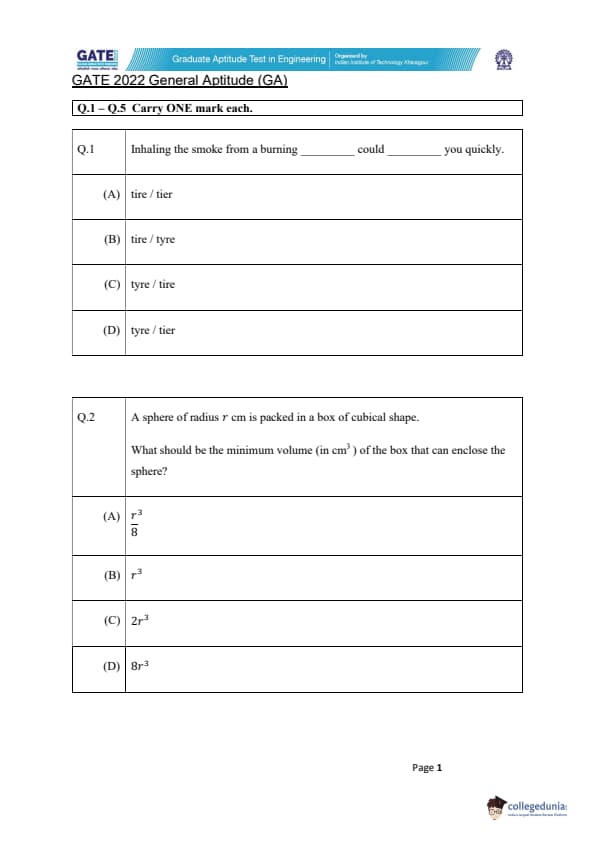
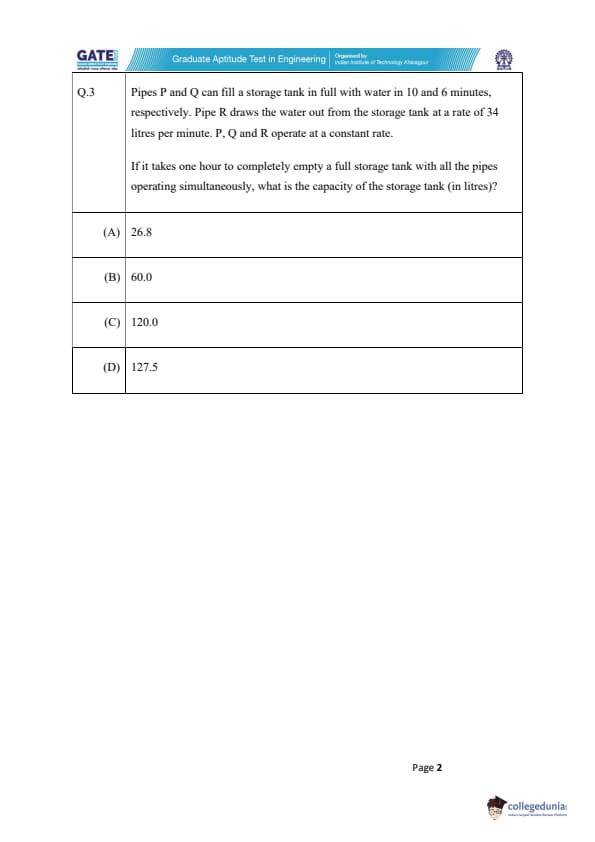
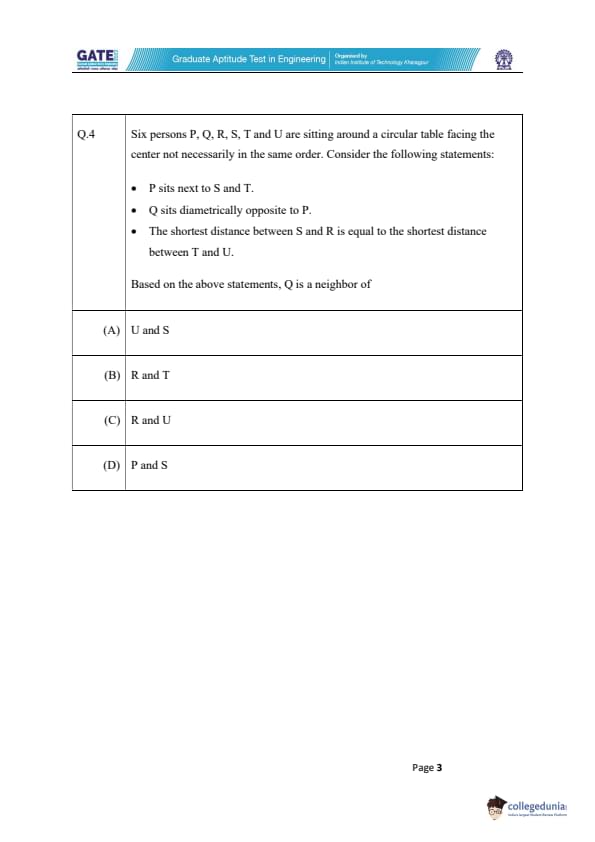

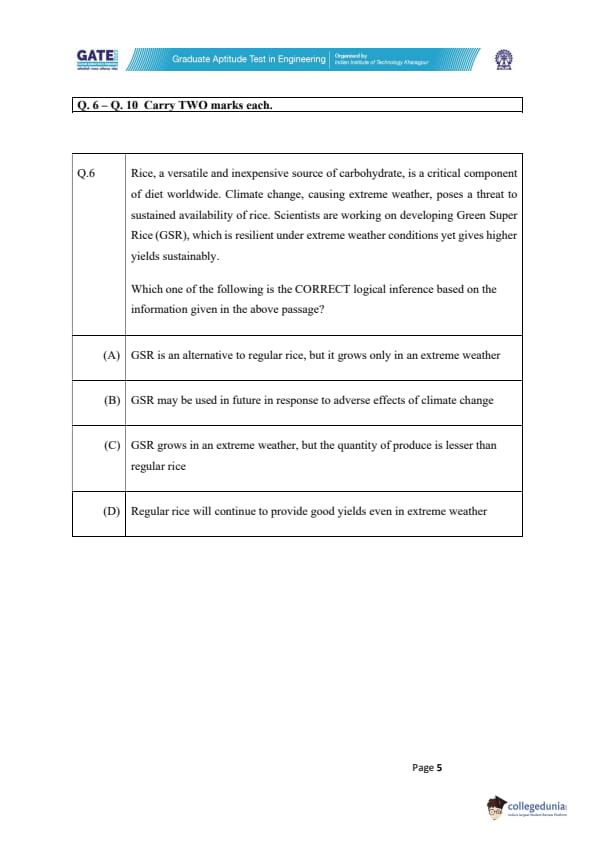
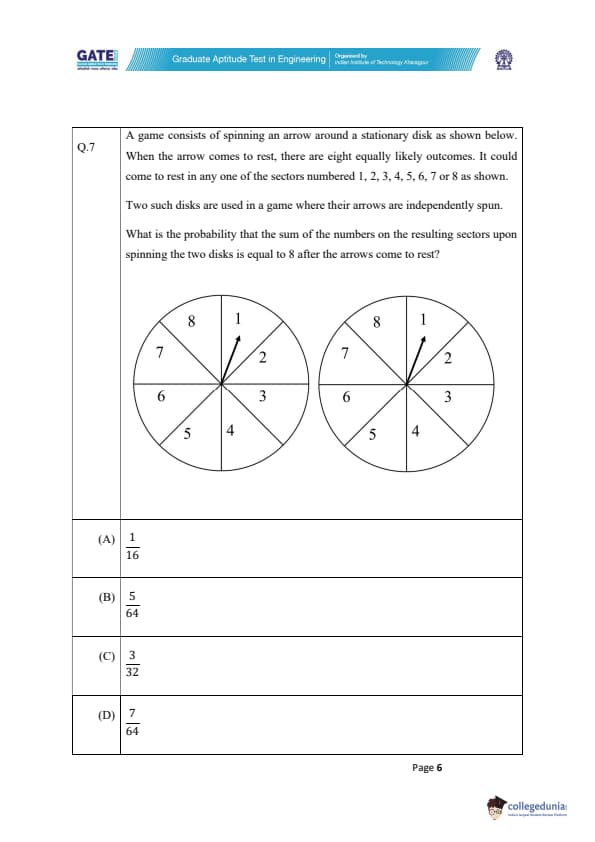


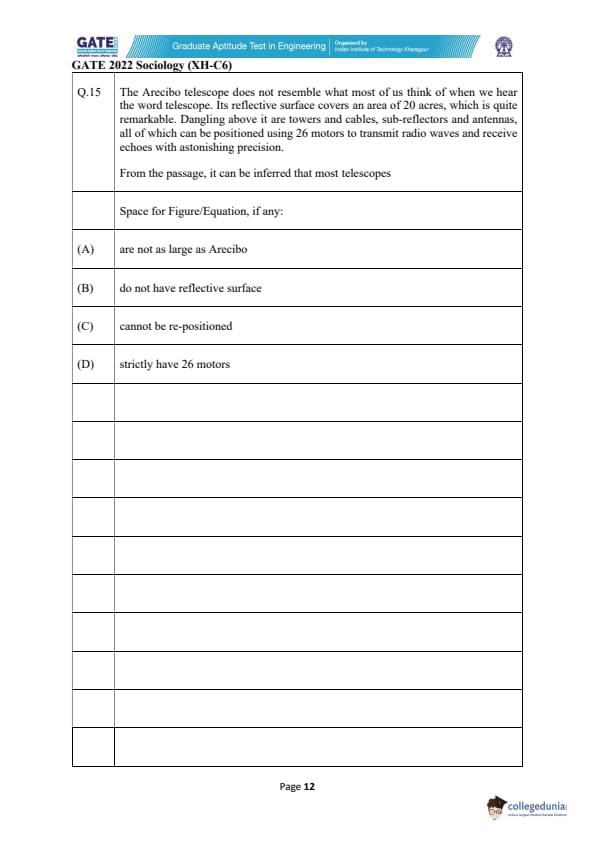
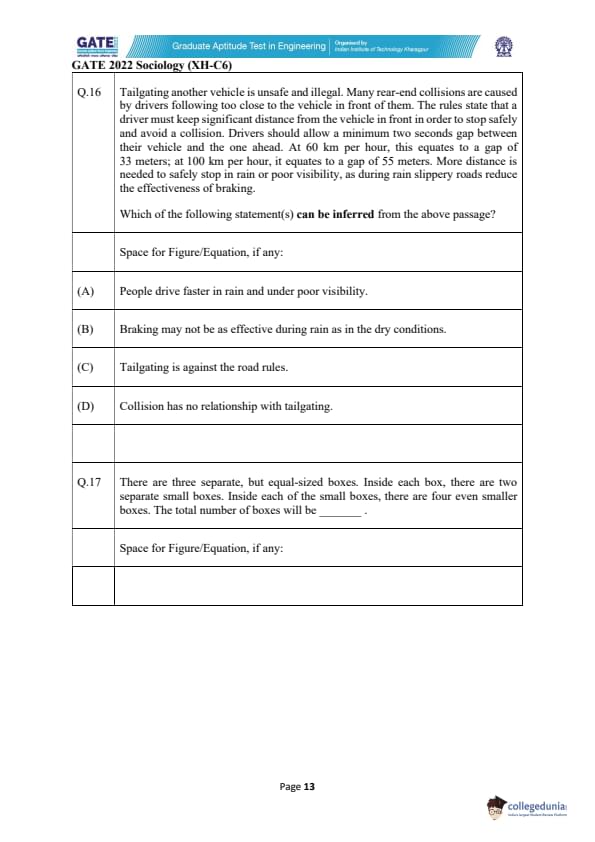
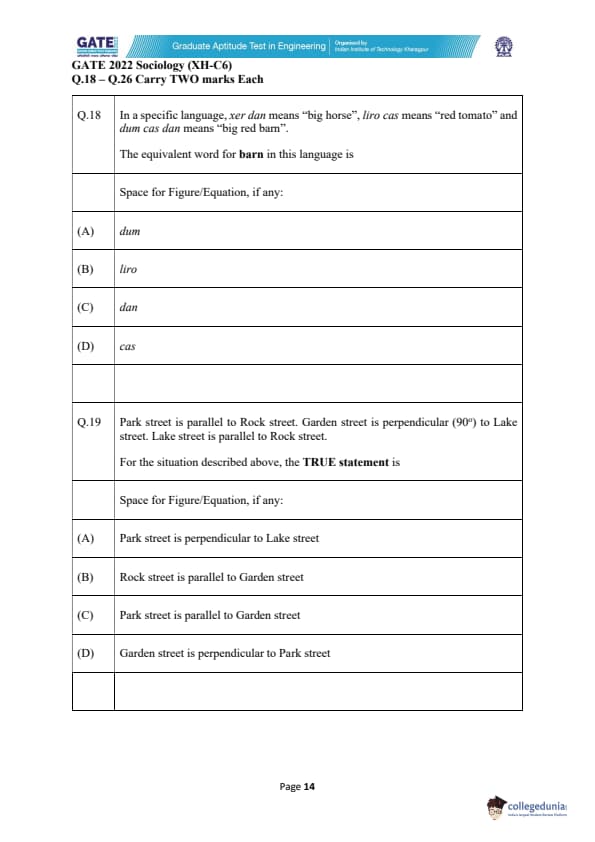
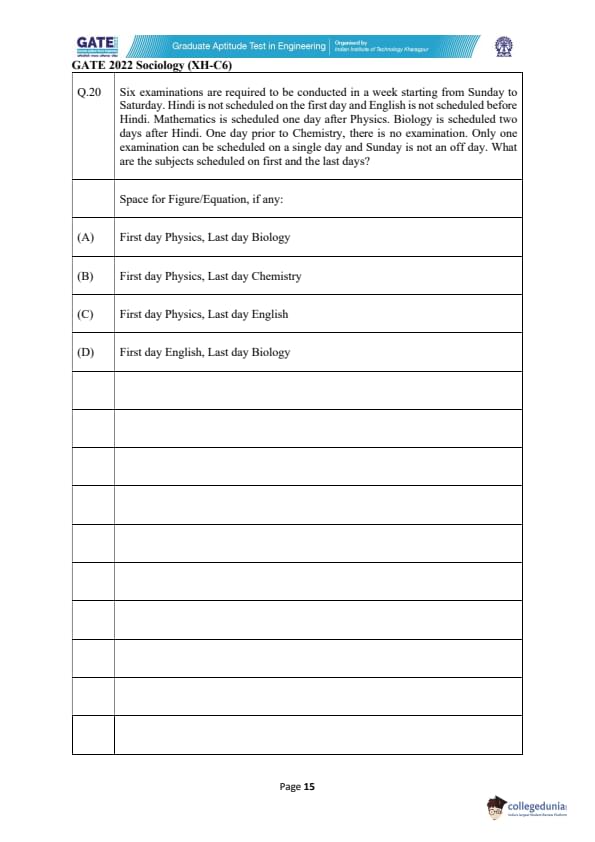


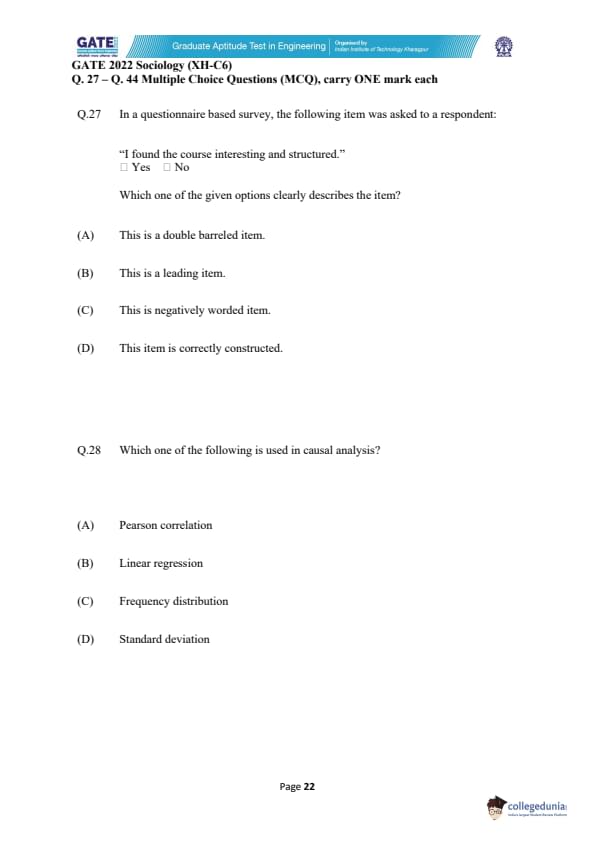
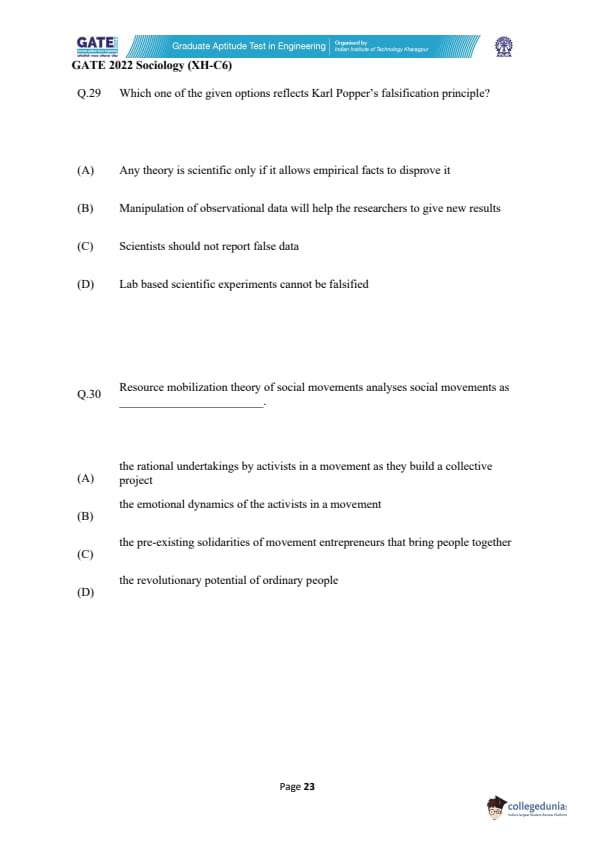
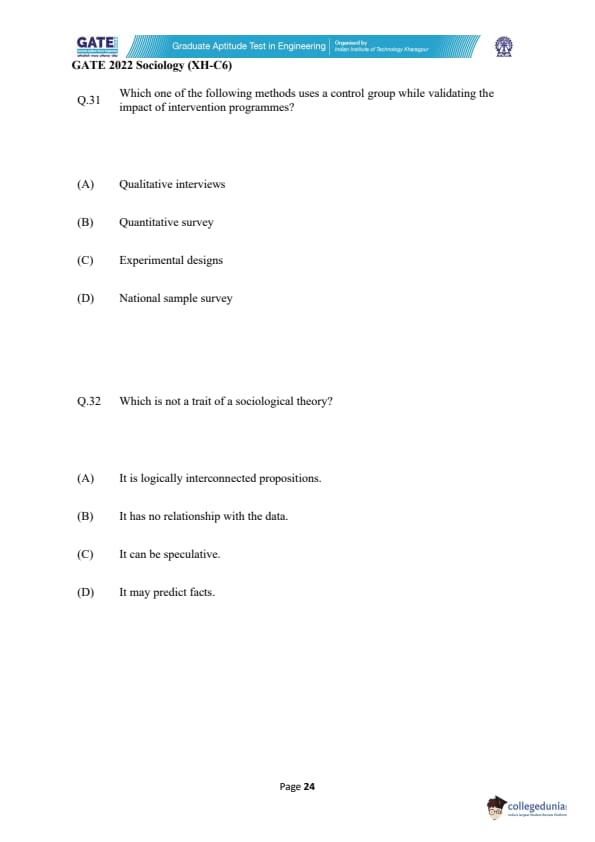
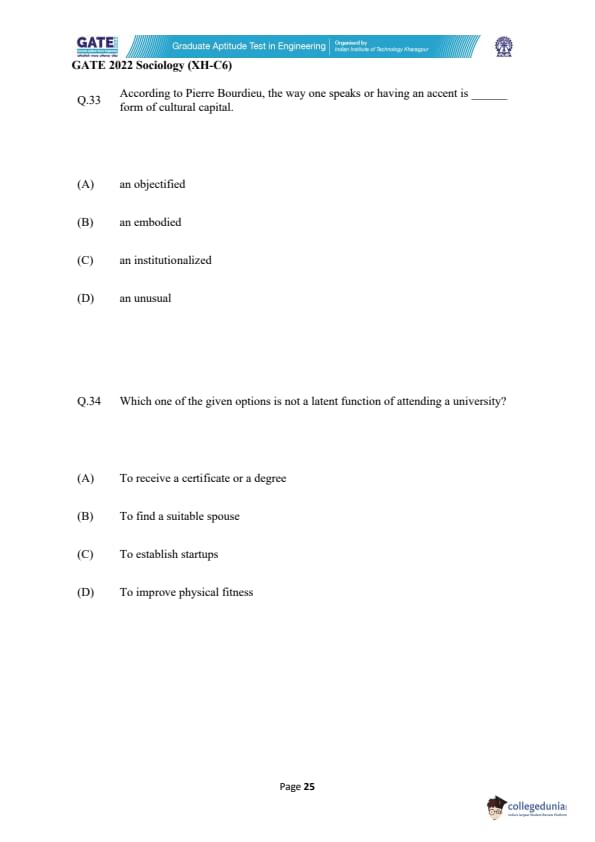
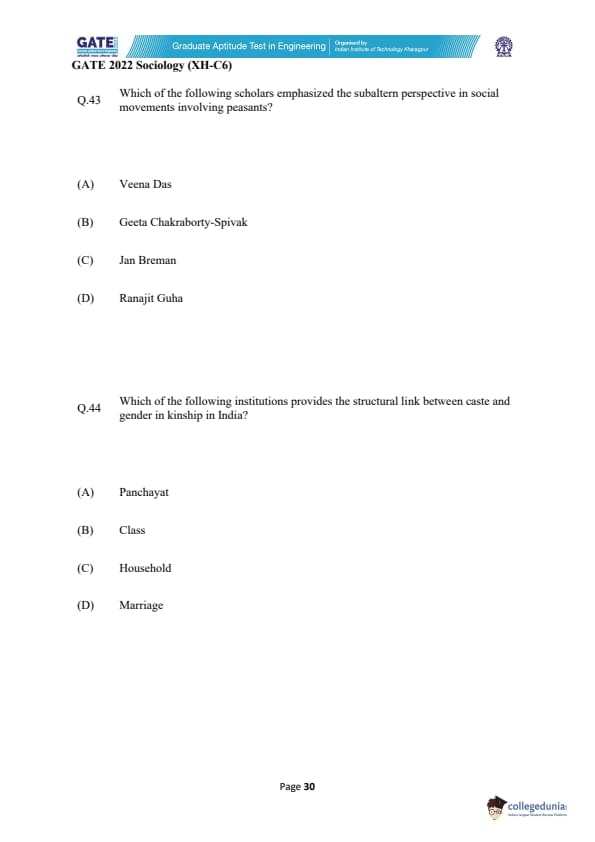
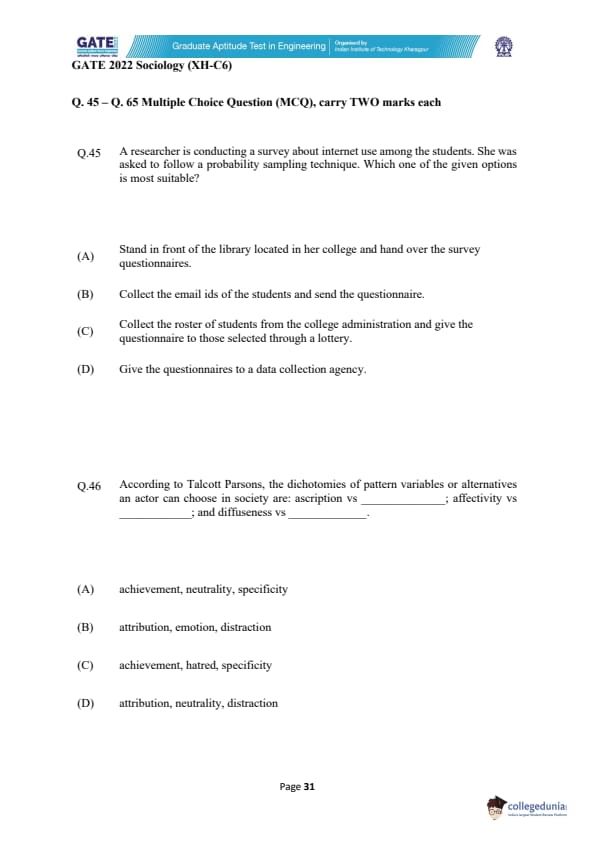
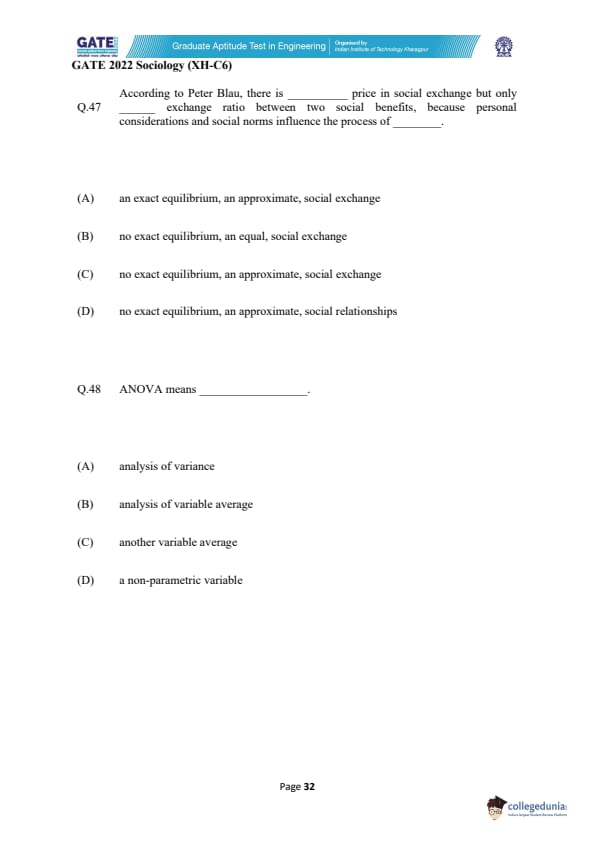
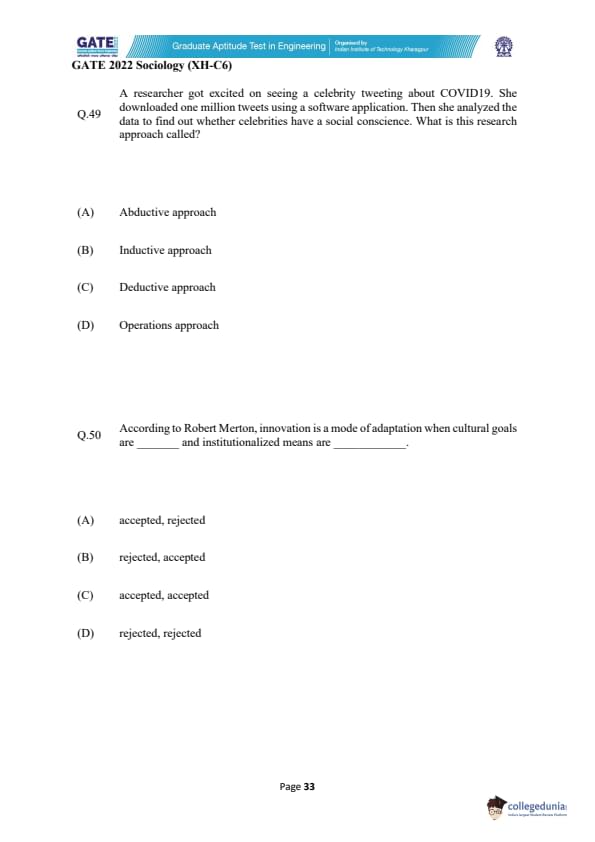
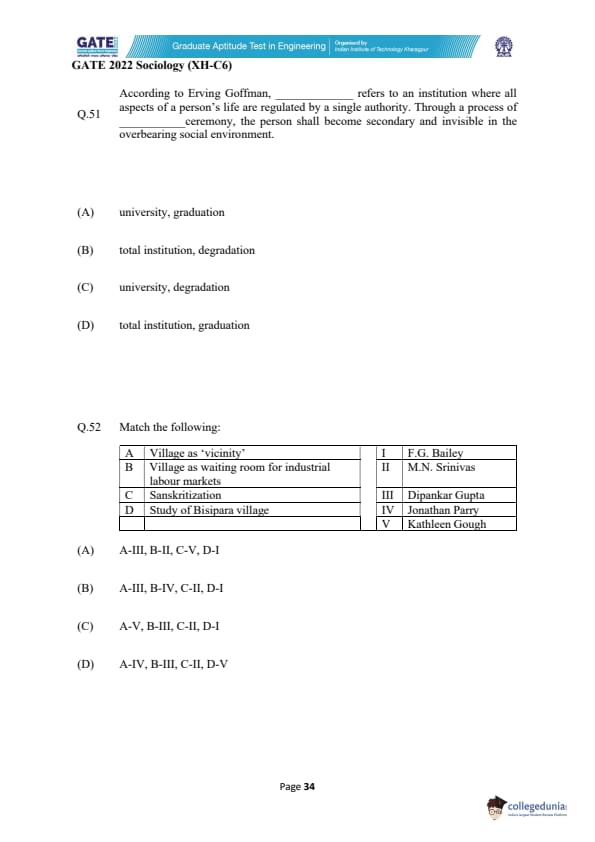
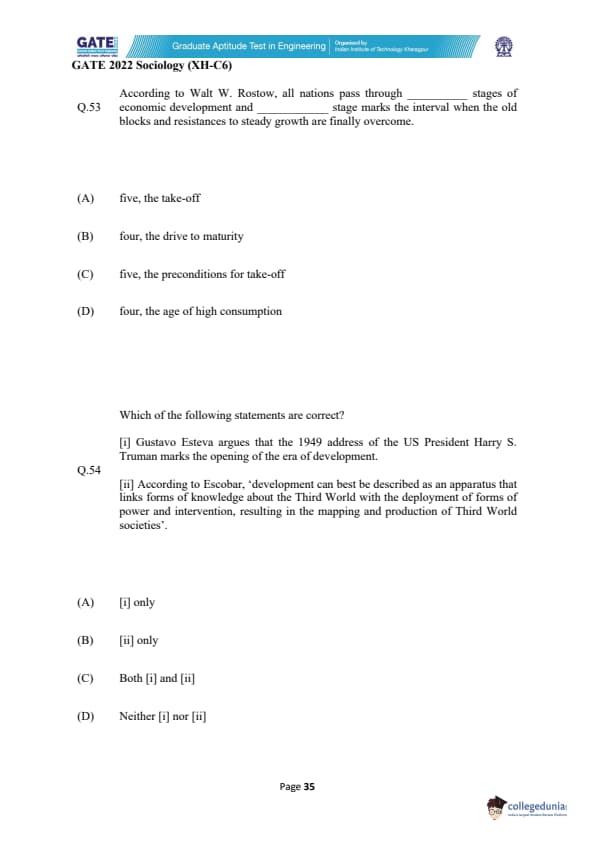
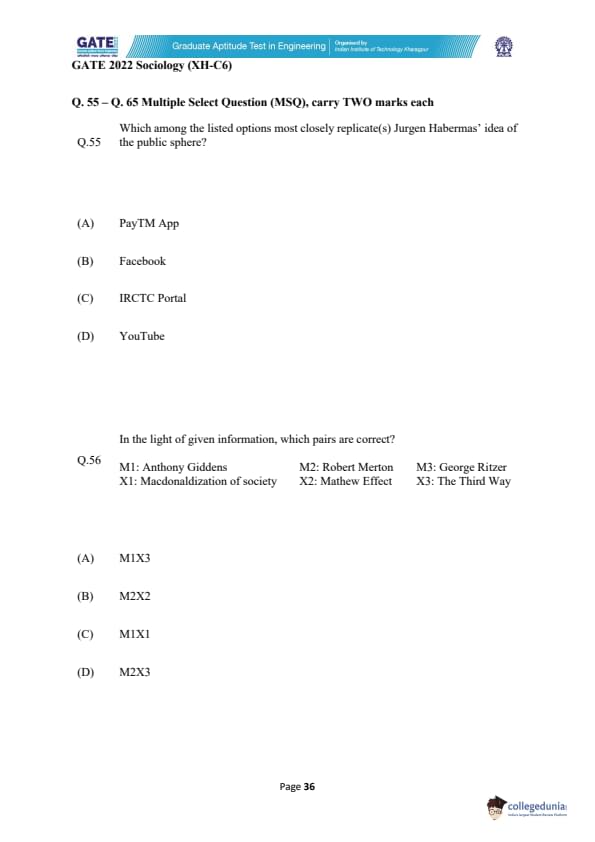
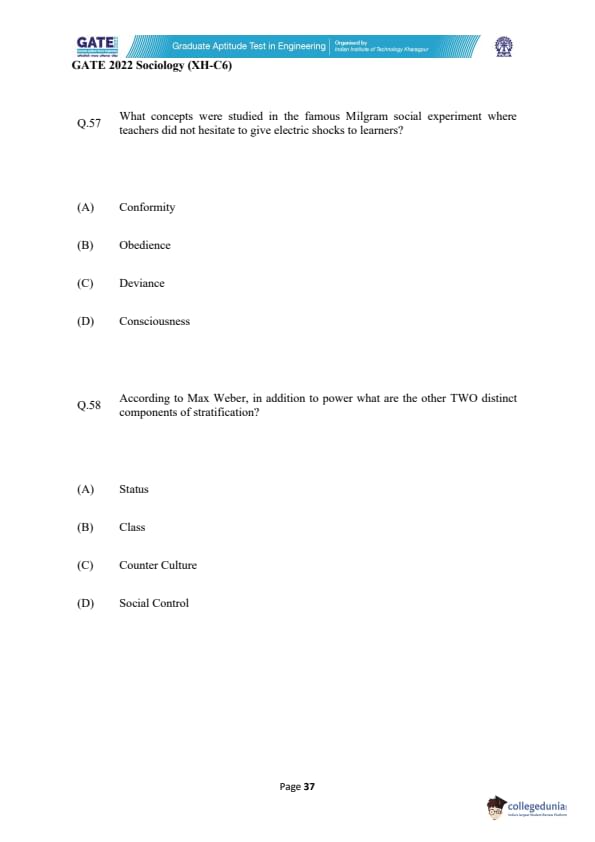
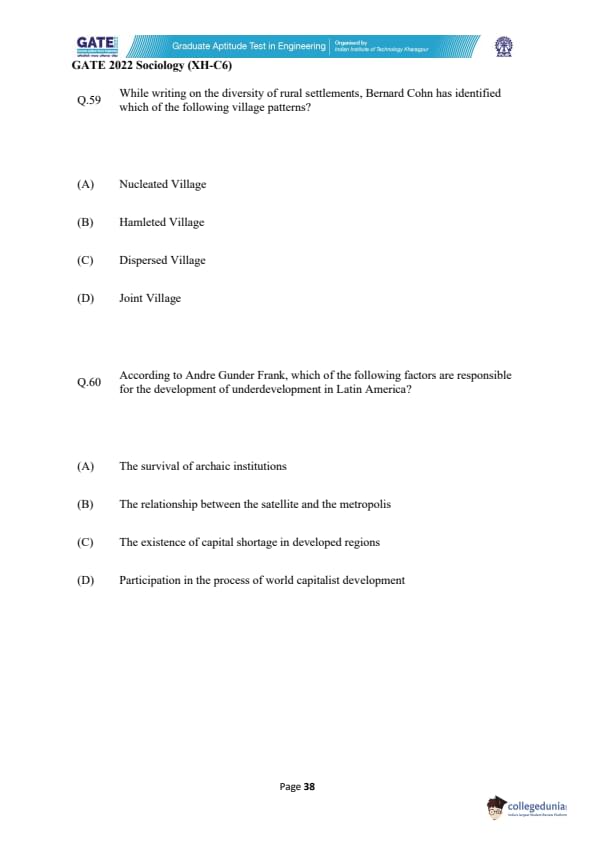
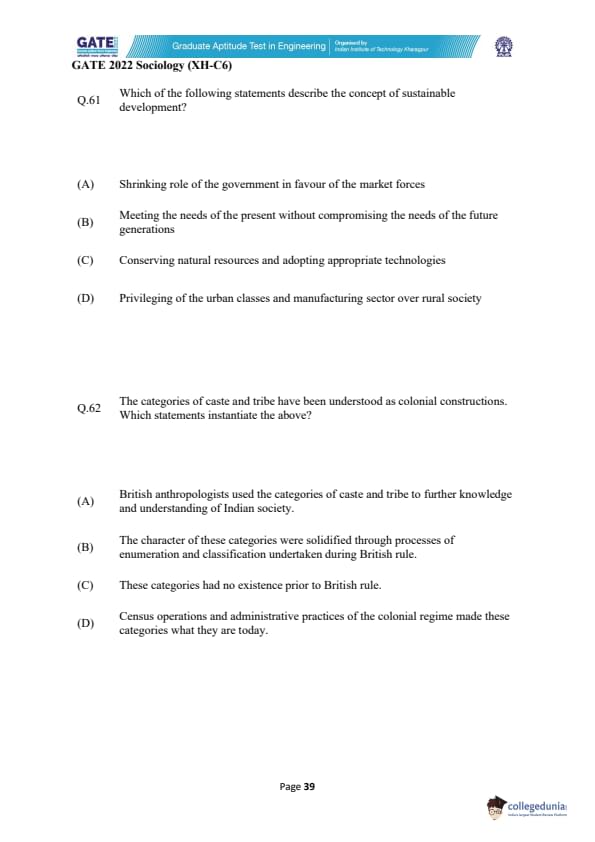
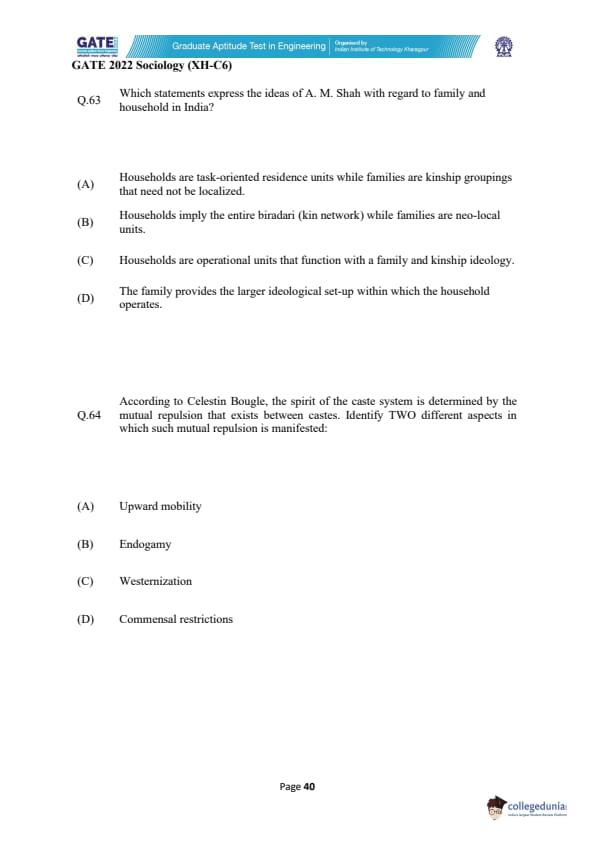
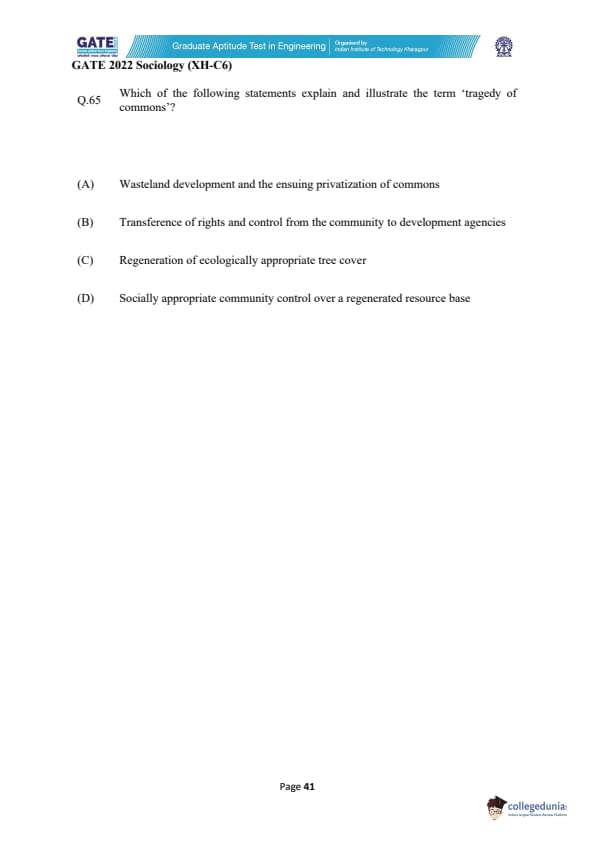
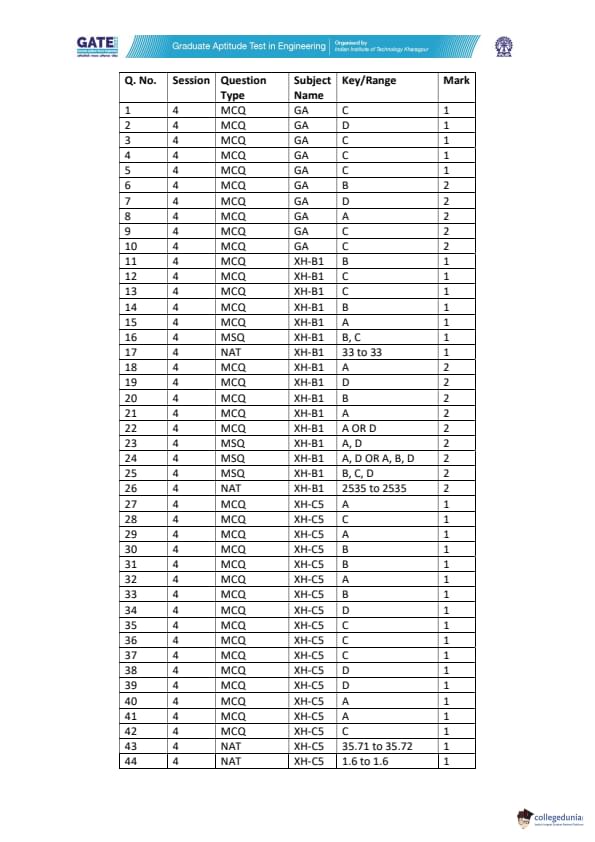
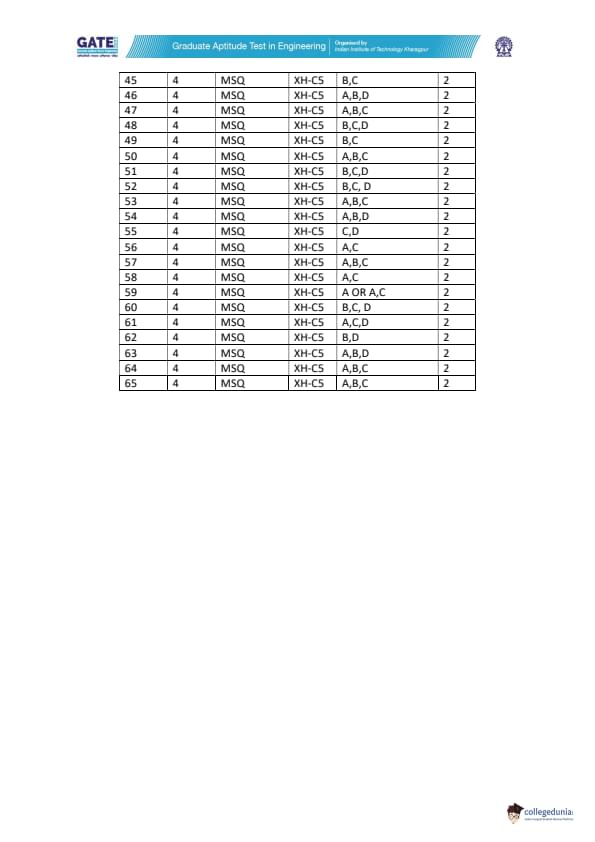
GATE 2022 XH- Sociology Question Paper: Paper Analysis
Section GA and B1 in GATE 2022 XH- Sociology Question Paper was same as the other five papers for GATE HX paper. The table below shows the number of 1 mark and 2 marks questions in GATE 2022 XH- Sociology Question Paper:
| Type of Questions | General Aptitude (GA) | Reasoning Comprehension (B1) | Sociology (XH- C6) | |||
|---|---|---|---|---|---|---|
| Number of Questions | Marks | Number of Questions | Marks | Number of Questions | Marks | |
| No. of 1 mark MCQs | 5 | 5 | 5 | 5 | 18 | 18 |
| No. of 2 marks MCQs | 5 | 10 | 5 | 10 | 10 | 20 |
| No. of 1 mark NATs | 0 | 0 | 1 | 1 | 0 | 0 |
| No. of 2 marks NATs | 0 | 0 | 1 | 2 | 0 | 0 |
| No. of 1 mark MSQs | 0 | 0 | 1 | 1 | 0 | 0 |
| No. of 2 marks MSQs | 0 | 0 | 3 | 6 | 11 | 22 |
GATE Previous Year Question Papers:
Candidates may examine their performance levels by solving prior year's examination papers. Candidates are encouraged to answer GATE Question Papers on a regular basis to improve their correctness. GATE ME 2019 question paper is one of the most important aspects of effective test preparation. Including past year's question papers in your study schedule can help you get a better grade. Test candidates may examine prior year question papers to determine the level of questions asked in the exam. The following are links to GATE 2019 question papers with answer key PDFs:
| GATE 2022 Question Papers | GATE 2021 Question Papers | GATE 2020 Question Papers |
| GATE 2019 Question Papers | GATE 2018 Question Papers | GATE 2017 Question Papers |



Comments