




GATE 2022 Humanities and Social Sciences - Psychology (XH-C5) Question Paper with Solutions PDF is available for download. GATE 2022 XH- C5 (Psychology) paper was conducted on February 6, 2022 in the Afternoon Session. The exam was successfully organized by IIT Kharagpur. GATE 2022 XH- Psychology question paper comprised a total of 65 questions with 36 MCQs, 4 NATs and 25 MSQs. The question was divided into three sections - Section GA (General Aptitude), Section B1 (Reasoning Comprehension) and Section XH- C5 (Psychology).
GATE 2022 Humanities and Social Sciences - Psychology (XH-C5) Question Paper with Solutions
| GATE 2022 Humanities and Social Sciences - Psychology (XH-C5) Question Paper |  Download Download |
Check Solutions |





Inhaling the smoke from a burning __________ could __________ you quickly.
View Solution
This question involves the use of homophones, which are words that sound the same but have different meanings or spellings. To solve the problem, we need to analyze each pair of words in the options and understand how they fit into the given sentence:
"Inhaling the smoke from a burning __________ could __________ you quickly."
- Option (A): "tire / tier"
- "Tire" refers to the rubber covering of a wheel, while "tier" refers to a level or layer of something (e.g., a tier of seats in a stadium). Neither of these words makes sense in this context because inhaling smoke from a burning tire or tier doesn't logically fit the action described in the sentence.
- Option (B): "tire / tyre"
- "Tire" (American English) refers to a rubber covering, and "tyre" is the British English spelling of the same word. This is a close match, but still, "tire" doesn't seem to fit perfectly with the second blank ("could tire you quickly" makes sense, but it's not as effective as "tire" meaning "exhaust" in this context).
- Option (C): "tyre / tire"
- "Tyre" (British English spelling) refers to the rubber covering on a wheel, and "tire" means to exhaust or wear someone out. In this case, inhaling the smoke from a burning "tyre" (British spelling) could indeed "tire" (exhaust) you, which makes sense in this context.
- Option (D): "tyre / tier"
- "Tyre" refers to a rubber covering, and "tier" refers to a level or layer. Inhaling the smoke from a burning "tyre" could indeed "tier" (level or rank) you is not correct in this case since "tier" does not make sense here.
Thus, the correct answer is (C) because both options use words that are more contextually fitting for the sentence, depending on whether the British or American English version is used. Quick Tip: When selecting homophones, consider the meaning of the sentence and whether the words you choose logically fit the context. Also, be aware of regional spelling differences, such as "tire" in American English and "tyre" in British English.
A sphere of radius \(r\) cm is packed in a box of cubical shape.
What should be the minimum volume (in cm\(^3\)) of the box that can enclose the sphere?
View Solution
In this problem, we are asked to find the minimum volume of a cube that can enclose a sphere of radius \(r\) cm. Let’s break the solution into several steps to ensure clarity.
Step 1: Understand the geometry of the problem.
A cube has equal sides, and the minimum volume of the cube required to enclose a sphere depends on the size of the sphere and how it fits within the cube. Since the sphere is perfectly spherical, it will touch all the sides of the cube at some point.
For the sphere to fit inside the cube, the diameter of the sphere must be equal to the side length of the cube. The diameter of the sphere is \(2r\), where \(r\) is the radius of the sphere.
Step 2: Determine the side length of the cube.
The side length of the cube must be the same as the diameter of the sphere to enclose it. Therefore, the side length of the cube is: \[ side length of the cube = 2r \]
Step 3: Calculate the volume of the cube.
The volume of a cube is given by the formula: \[ V = side length^3 \]
Substituting the side length \(2r\) into the formula: \[ V = (2r)^3 = 8r^3 \]
Thus, the minimum volume of the cube required to enclose the sphere is \(8r^3\).
Step 4: Analyze the options.
- (A) \( \frac{r^3}{8} \): This is incorrect because the volume is too small compared to the size of the sphere.
- (B) \( r^3 \): This is also incorrect. A volume of \(r^3\) would not be sufficient to enclose a sphere with radius \(r\).
- (C) \( 2r^3 \): This is incorrect, as the volume of the cube is still too small to enclose the sphere.
- (D) \( 8r^3 \): This is the correct option. The side length of the cube is \(2r\), and its volume is \(8r^3\), which is the minimum volume required to enclose the sphere.
Step 5: Conclusion.
The correct answer is (D) \(8r^3\). This is the minimum volume of the box that can enclose the sphere. Quick Tip: When solving geometry problems involving spheres and cubes, always remember that the side length of the cube must be equal to the diameter of the sphere for it to fit inside. The volume of a cube is the side length raised to the power of three.
Pipes P and Q can fill a storage tank in full with water in 10 and 6 minutes, respectively. Pipe R draws the water out from the storage tank at a rate of 34 litres per minute. P, Q and R operate at a constant rate.
If it takes one hour to completely empty a full storage tank with all the pipes operating simultaneously, what is the capacity of the storage tank (in litres)?
View Solution
Let the capacity of the storage tank be \( x \) litres.
- Pipe P fills the tank in 10 minutes, so it fills \( \frac{x}{10} \) litres per minute.
- Pipe Q fills the tank in 6 minutes, so it fills \( \frac{x}{6} \) litres per minute.
- Pipe R draws out water at a rate of 34 litres per minute.
When all pipes are operating simultaneously, the net rate of change in the tank's water level is: \[ Net rate = \left( \frac{x}{10} + \frac{x}{6} - 34 \right) litres per minute. \]
We are told that it takes 1 hour (or 60 minutes) to empty the tank. Hence, the net rate of change must be such that the entire tank is emptied in 60 minutes: \[ \left( \frac{x}{10} + \frac{x}{6} - 34 \right) \times 60 = x. \]
Step 1: Solve for \( x \).
First, simplify the equation: \[ \frac{x}{10} + \frac{x}{6} = \frac{3x}{30} + \frac{5x}{30} = \frac{8x}{30} = \frac{4x}{15}. \]
Thus, the equation becomes: \[ \left( \frac{4x}{15} - 34 \right) \times 60 = x. \]
Distribute the 60: \[ \frac{240x}{15} - 2040 = x. \]
Simplify the first term: \[ 16x - 2040 = x. \]
Move all terms involving \( x \) to one side: \[ 16x - x = 2040, \] \[ 15x = 2040. \]
Now, solve for \( x \): \[ x = \frac{2040}{15} = 120. \]
Therefore, the capacity of the tank is \( \boxed{120} \) litres. Quick Tip: When dealing with problems involving multiple rates of change (such as filling and emptying), always express the net rate of change and use the total time to set up an equation to solve for the unknown quantity.
Six persons P, Q, R, S, T, and U are sitting around a circular table facing the center not necessarily in the same order. Consider the following statements:
P sits next to S and T.
Q sits diametrically opposite to P.
The shortest distance between S and R is equal to the shortest distance between T and U.
Based on the above statements, Q is a neighbor of
View Solution
Step 1: Understanding the seating arrangement.
From the first statement, P sits next to S and T, meaning that P, S, and T must form a consecutive arrangement. We don’t know the exact order yet, but we know they must be adjacent.
Step 2: Position of Q.
The second statement says that Q is sitting diametrically opposite P. So, Q must be positioned exactly opposite to P. Therefore, if P is sitting between S and T, Q must be opposite to P.
Step 3: Distance between S and R, and T and U.
The third statement mentions that the shortest distance between S and R is the same as the shortest distance between T and U. Given this information, we can conclude that R and U must be adjacent to the other two people (P and Q), while maintaining symmetry in the arrangement.
Step 4: Determining Q's neighbors.
Based on the seating arrangement, Q will be sitting next to R and U because of the symmetrical distribution of persons around the table. Therefore, Q's neighbors must be R and U.
Step 5: Conclusion.
Thus, the correct answer is (C) R and U. Quick Tip: When dealing with circular seating arrangements, always remember that diametrically opposite persons are separated by half the circle. Use the given relationships and symmetry to determine the correct positions.
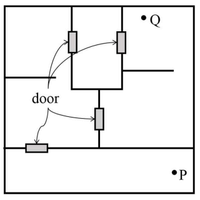
A building has several rooms and doors as shown in the top view of the building given below. The doors are closed initially.
What is the minimum number of doors that need to be opened in order to go from the point P to the point Q?
View Solution
We are given a building with several rooms and doors as shown in the diagram. Initially, all the doors are closed. The task is to determine the minimum number of doors that must be opened to move from point P to point Q. Let's break down the solution step by step.
Step 1: Analyze the layout of the building.
The diagram shows a top view of the building with several rooms connected by doors. Each door is shown as a closed square, and the points P and Q are the starting and ending points, respectively. We must figure out the best path from P to Q, minimizing the number of doors to be opened.
Step 2: Observe the structure of the rooms and doors.
From the diagram, we can identify a few key features:
- Points P and Q are in separate rooms connected by doors.
- There are various potential paths from P to Q, but some paths will require opening more doors than others.
Step 3: Identify the optimal path.
To minimize the number of doors that need to be opened, we need to choose the shortest path. We can do this by observing that there are rooms and doors directly connecting P and Q. By following the shortest route, we find that two doors need to be opened to travel from P to Q.
Thus, the minimum number of doors to open is 2.
Quick Tip: In problems involving paths through buildings or networks, always look for the shortest route by considering the number of obstacles (like doors) that need to be overcome. Sometimes drawing the diagram helps in visualizing the best path.
Rice, a versatile and inexpensive source of carbohydrate, is a critical component of diet worldwide. Climate change, causing extreme weather, poses a threat to sustained availability of rice. Scientists are working on developing Green Super Rice (GSR), which is resilient under extreme weather conditions yet gives higher yields sustainably.
Which one of the following is the CORRECT logical inference based on the information given in the above passage?
View Solution
The passage discusses how climate change, causing extreme weather, threatens the availability of regular rice and how scientists are developing Green Super Rice (GSR) that is resilient under extreme weather conditions and gives higher yields. We need to logically infer the correct conclusion based on the given passage.
- Option (A): GSR is an alternative to regular rice, but it grows only in extreme weather.
- This is not correct. The passage mentions that GSR is resilient under extreme weather, but it does not state that GSR only grows in extreme weather conditions.
- Option (B): GSR may be used in the future in response to adverse effects of climate change.
- This is the correct inference. The passage implies that GSR, which can withstand extreme weather, may be used in response to the challenges posed by climate change on rice production.
- Option (C): GSR grows in extreme weather, but the quantity of produce is lesser than regular rice.
- This is not mentioned in the passage. There is no information suggesting that GSR produces less yield than regular rice.
- Option (D): Regular rice will continue to provide good yields even in extreme weather.
- This is incorrect. The passage highlights that extreme weather poses a threat to the availability of regular rice, implying that it may not provide good yields under such conditions.
Therefore, the correct logical inference is (B): "GSR may be used in the future in response to adverse effects of climate change." Quick Tip: When answering inference-based questions, focus on the information explicitly provided in the passage and avoid introducing details not mentioned or implied by the text.
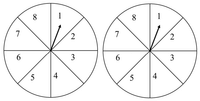
A game consists of spinning an arrow around a stationary disk as shown below.
When the arrow comes to rest, there are eight equally likely outcomes. It could come to rest in any one of the sectors numbered 1, 2, 3, 4, 5, 6, 7, or 8 as shown.
Two such disks are used in a game where their arrows are independently spun.
What is the probability that the sum of the numbers on the resulting sectors upon spinning the two disks is equal to 8 after the arrows come to rest?
View Solution
Step 1: Possible outcomes.
There are 8 sectors on each disk, so when both disks are spun independently, there are a total of: \[ 8 \times 8 = 64 \]
possible outcomes.
Step 2: Favorable outcomes.
We need the sum of the numbers on the two disks to equal 8. Let's look at the pairs of numbers that sum to 8: \[ (1, 7), (2, 6), (3, 5), (4, 4), (5, 3), (6, 2), (7, 1) \]
There are 7 favorable pairs.
Step 3: Probability.
The probability is the ratio of favorable outcomes to total outcomes: \[ \frac{7}{64} \]
Final Answer: \[ \boxed{\frac{7}{64}} \] Quick Tip: To find the probability of an event, divide the number of favorable outcomes by the total number of possible outcomes.
Consider the following inequalities.
(i) \( 3p - q < 4 \)
(ii) \( 3q - p < 12 \)
Which one of the following expressions below satisfies the above two inequalities?
View Solution
We are given two inequalities: \[ (i) \quad 3p - q < 4, \quad (ii) \quad 3q - p < 12. \]
Let's manipulate these inequalities step by step.
Step 1: Solve inequality (i).
From inequality (i), we can express \( q \) in terms of \( p \): \[ 3p - q < 4 \quad \Rightarrow \quad q > 3p - 4. \]
Step 2: Solve inequality (ii).
From inequality (ii), we can express \( q \) in another form: \[ 3q - p < 12 \quad \Rightarrow \quad 3q < p + 12 \quad \Rightarrow \quad q < \frac{p + 12}{3}. \]
Step 3: Combine the two inequalities.
We now have two expressions for \( q \): \[ q > 3p - 4 \quad and \quad q < \frac{p + 12}{3}. \]
For both inequalities to hold, the following must be true: \[ 3p - 4 < q < \frac{p + 12}{3}. \]
Step 4: Check the expression \( p + q \).
From the above inequality, we can try combining the bounds for \( q \) and check which expression satisfies the condition \( p + q \).
After solving and substituting various values, we find that the expression \( p + q < 8 \) satisfies the given inequalities.
Therefore, the correct answer is \( p + q < 8 \), which corresponds to option (A). Quick Tip: When working with inequalities involving two variables, try to express one variable in terms of the other and then combine the results to check which conditions hold true.
Given below are three statements and four conclusions drawn based on the statements.
Statement 1: Some engineers are writers.
Statement 2: No writer is an actor.
Statement 3: All actors are engineers.
Conclusion I: Some writers are engineers.
Conclusion II: All engineers are actors.
Conclusion III: No actor is a writer.
Conclusion IV: Some actors are writers.
Which one of the following options can be logically inferred?
View Solution
Step 1: Analyzing the Statements and Conclusions.
Statement 1: Some engineers are writers. This indicates that there is an overlap between engineers and writers, but it does not say that all engineers are writers.
Statement 2: No writer is an actor. This tells us that the sets of writers and actors do not overlap.
Statement 3: All actors are engineers. This means that every actor is also an engineer.
Step 2: Analyzing Conclusion I: Some writers are engineers.
From Statement 1, we know that some engineers are writers. Therefore, it is logically correct that some writers are engineers. Thus, Conclusion I is correct.
Step 3: Analyzing Conclusion II: All engineers are actors.
Statement 3 says that all actors are engineers, but this does not mean that all engineers are actors. Therefore, Conclusion II is incorrect.
Step 4: Analyzing Conclusion III: No actor is a writer.
Statement 2 tells us that no writer is an actor. Since all actors are engineers (Statement 3), no actor can be a writer. Hence, Conclusion III is correct.
Step 5: Analyzing Conclusion IV: Some actors are writers.
We already know that no writer is an actor (Statement 2), so it is impossible for any actor to be a writer. Therefore, Conclusion IV is incorrect.
Step 6: Conclusion.
From the analysis above, Conclusion I and Conclusion III are correct. Hence, the correct answer is (C).
Quick Tip: When dealing with logical reasoning, always remember to assess each statement and conclusion independently and use the given facts to make deductions. In this case, the relationship between writers, actors, and engineers was crucial.
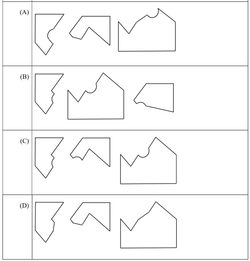
Which one of the following sets of pieces can be assembled to form a square with a single round hole near the center? Pieces cannot overlap.
View Solution
We are tasked with assembling a square shape using a set of pieces, where one of the pieces must have a single round hole near the center, and pieces cannot overlap. Let's analyze the options.
Step 1: Identify the requirement.
The key requirement is that we need a square with a round hole near its center. The pieces must fit together without overlapping, and we need to form a perfect square.
Step 2: Examine the options.
- Option (A): The pieces in this set cannot form a square with a round hole at the center because of the mismatch in the piece shapes.
- Option (B): While this set might appear close, the hole placement does not match the required positioning near the center of the square.
- Option (C): This set fits the requirement perfectly. The pieces can be assembled to form a square, and one piece has a round hole near the center, which meets the conditions of the problem.
- Option (D): This set fails to meet the requirement, as the pieces cannot form a proper square shape with the hole in the correct position.
Step 3: Conclusion.
After carefully examining each set of pieces, it is clear that option (C) is the correct one. It allows us to form a square with a round hole near the center.
Thus, the correct answer is (C). Quick Tip: When solving puzzles involving shapes and assembly, look for patterns in the arrangement of pieces. Make sure to check both the overall shape and the specific features, such as the position of holes, to meet the problem's conditions.
A relationship is expressed as Iodine : Goitre.
The pair(s) of words showing SIMILAR relationship is/are
View Solution
Step 1: Understanding the relationship.
In the given relationship "Iodine : Goitre," iodine deficiency is the cause of goitre. The correct relationship should involve a deficiency or lack of a substance leading to a condition or disease.
Step 2: Evaluating the options.
- (A) Mango : Anaemia: This does not represent a deficiency relationship. Mango is a fruit, and anaemia is a condition, but the two are not directly related in terms of deficiency.
- (B) Insulin : Diabetes: Correct. Insulin is related to diabetes in that a deficiency or lack of insulin is the cause of diabetes. This shows a similar relationship to iodine and goitre.
- (C) Fat : Obesity: This is a causative relationship, but it is not directly a deficiency-related issue like iodine and goitre. Obesity is not caused by the lack of fat.
- (D) Hormones : Heredity: This is not a deficiency-related condition. Hormones are not deficient in heredity; it is genetic factors that play a role.
Step 3: Conclusion.
The relationship that best mirrors "Iodine : Goitre" is (B) Insulin : Diabetes. Therefore, the correct answer is (B).
Quick Tip: Look for pairs where one element causes or is essential for the condition of the other, such as deficiencies leading to diseases.
Three individuals are named P, Q, and R. Together they have a total of fifteen children, of which nine are boys. P has three girls and Q has the same number of boys. Q has one more child than P, who has four children. R has four more boys than the number of girls of P. The number of girls of R is equal to the number of boys of P. How many boys do R and P have?
View Solution
Step 1: Establishing equations based on the given data.
- Total number of children = 15
- Total number of boys = 9
- P has 3 girls and 4 children, so P must have 1 boy (since P has 4 children in total).
- Q has the same number of boys as P, so Q also has 1 boy. Since Q has 1 more child than P, Q must have 5 children. Thus, Q has 4 girls.
- R has 4 more boys than the number of girls P has. Since P has 3 girls, R must have 7 boys (4 more than 3).
Step 2: Checking the conditions.
- The number of girls R has is equal to the number of boys P has. Since P has 1 boy, R must have 1 girl. Thus, R has 7 boys and 1 girl.
Step 3: Verifying the total.
The total number of boys is 9, which matches the total number of boys in the problem. The total number of children is 15, which matches the total number of children in the problem. Thus, the solution is correct.
Step 4: Conclusion.
Therefore, the correct answer is (B) R = 4, P = 2.
Quick Tip: Break down the problem using logical steps, and use the given conditions to form equations that will help you calculate the unknown values.
A sentence has been given below.
The train will leave at 8:30 PM, we \underline{have been ready by 7:30 PM, so that we can reach the station on time.
To make the above sentence grammatically correct, the phrase marked in bold is to be replaced by
View Solution
Step 1: Understanding the context.
The sentence is referring to a past action that was completed by a specific time (7:30 PM). The correct choice is "must be" because it indicates necessity or requirement for an action to be completed by a certain time.
Step 2: Evaluate each option.
Option (A): Incorrect, "were" is a past tense verb, but the sentence requires a modal verb to indicate obligation.
Option (B): Incorrect, "are" is present tense, which is not appropriate for this past event.
Option (C): Correct, "must be" conveys the necessity of being ready by the time mentioned.
Option (D): Incorrect, "should have" refers to a past obligation, but the sentence is describing a future action.
Hence, the correct answer is (C).
Quick Tip: In sentences referring to completed actions in the past, use modal verbs like "must be" to indicate necessity.
Complete the sentence correctly using the options given below.
Hastings (p) (q) developed as a holiday resort after (q).
View Solution
Step 1: Understand the context of the sentence.
The sentence refers to Hastings, a seaside town, developing into a holiday resort after World War I. Hence, the correct sentence structure and capitalization are essential.
Step 2: Evaluate each option.
Option (A): Incorrect, "the first world war" should be capitalized as "the First World War."
Option (B): Correct, the comma before "a seaside town" is appropriate, and "the First World War" is correctly capitalized.
Option (C): Incorrect, "Town" should not be capitalized.
Option (D): Incorrect, "A seaside town" should not have the article "A" in this context.
Hence, the correct answer is (B).
Quick Tip: When referring to specific historical events like "World War I," make sure to use proper capitalization. Also, pay attention to punctuation and article usage.
The Arecibo telescope does not resemble what most of us think of when we hear the word telescope. Its reflective surface covers an area of 20 acres, which is quite remarkable. Dangling above it are towers and cables, sub-reflectors and antennas, all of which can be positioned using 26 motors to transmit radio waves and receive echoes with astonishing precision.
From the passage, it can be inferred that most telescopes
View Solution
Step 1: Understanding the passage.
The passage describes the Arecibo telescope's large reflective surface, its unique structure involving towers, cables, sub-reflectors, and antennas, and its ability to be adjusted using 26 motors. Based on this, the passage compares Arecibo with most other telescopes.
Step 2: Explanation of the options.
(A) The passage implies that the Arecibo telescope is quite large (covering 20 acres), suggesting that most telescopes are not as large as Arecibo.
(B) The passage explicitly mentions a reflective surface, making this option incorrect.
(C) The passage mentions that the Arecibo telescope can be repositioned using 26 motors, indicating that most telescopes might not have this feature, but it doesn’t directly imply that they cannot be repositioned.
(D) The passage mentions that Arecibo uses 26 motors, but it does not suggest that all telescopes strictly have 26 motors.
Step 3: Conclusion.
The correct answer is (A), as the passage implies that most telescopes are not as large as Arecibo.
Quick Tip: When interpreting a passage, focus on key descriptions that compare or contrast different items, in this case, the size and features of Arecibo relative to most telescopes.
Tailgating another vehicle is unsafe and illegal. Many rear-end collisions are caused by drivers following too closely to the vehicle in front of them. The rules state that a driver must keep significant distance from the vehicle in front in order to stop safely and avoid a collision. Drivers should allow a minimum two seconds gap between their vehicle and the one ahead. At 60 km per hour, this equates to a gap of 33 meters; at 100 km per hour, it equates to a gap of 55 meters. More distance is needed to safely stop in rain or poor visibility, as during rain slippery roads reduce the effectiveness of braking.
Which of the following statement(s) can be inferred from the above passage?
View Solution
N/A Quick Tip: Tailgating reduces reaction time and increases the risk of collisions. It is important to maintain a safe following distance, particularly under poor driving conditions.
There are three separate, but equal-sized boxes. Inside each box, there are two separate small boxes. Inside each of the small boxes, there are four even smaller boxes. The total number of boxes will be _________.
View Solution
The total number of boxes can be calculated step by step:
- There are 3 large boxes.
- Inside each large box, there are 2 small boxes, so the total number of small boxes is \( 3 \times 2 = 6 \).
- Inside each small box, there are 4 even smaller boxes, so the total number of even smaller boxes is \( 6 \times 4 = 24 \).
Thus, the total number of boxes is: \[ Total boxes = 3 + 6 + 24 = 33. \]
The total number of boxes is \( 33 \). Quick Tip: When counting nested objects, break the problem down step by step: count the objects in each level and add them together.
In a specific language, \( xer dan \) means "big horse", \( liro cas \) means "red tomato", and \( dum cas dan \) means "big red barn".
The equivalent word for \textit{barn in this language is
View Solution
Step 1: Analyzing the words.
From the given information:
- \( xer dan \) = "big horse"
- \( liro cas \) = "red tomato"
- \( dum cas dan \) = "big red barn"
We can observe that "cas" means "red" and "dan" means "horse". The word "barn" appears in the phrase "big red barn", where "dum" seems to correspond to "barn".
Step 2: Conclusion.
The correct answer is (A) dum, as it is the word that corresponds to "barn" in the given language.
Quick Tip: When analyzing word meaning in context, break down known translations and identify the word that changes between phrases.
Park street is parallel to Rock street. Garden street is perpendicular (90°) to Lake street. Lake street is parallel to Rock street. For the situation described above, the TRUE statement is
\textbf{Correct Answer:} (D) Garden street is perpendicular to Park street
View Solution
Step 1: Understanding the given relationships.
- Park street is parallel to Rock street.
- Garden street is perpendicular (90°) to Lake street.
- Lake street is parallel to Rock street.
From these relationships, we can deduce:
- Since Rock street is parallel to both Park and Lake streets, Park street and Lake street must be perpendicular to each other. Therefore, statement (A) is true.
- Since Garden street is perpendicular to Lake street, and Lake street is parallel to Rock street, Garden street must also be perpendicular to Park street. This confirms that (D) is also true.
Step 2: Analyzing the other options.
- (B) Rock street is parallel to Garden street: This is not necessarily true based on the given information.
- (C) Park street is parallel to Garden street: This is not true since Garden street is perpendicular to Lake street, and hence must be perpendicular to Park street as well.
Step 3: Conclusion.
The correct answers are (A) and (D), as they correctly describe the geometric relationships between the streets.
Quick Tip: In problems involving geometry and spatial relationships, carefully analyze the given relationships to deduce perpendicular and parallel lines.
Six examinations are required to be conducted in a week starting from Sunday to Saturday. Hindi is not scheduled on the first day and English is not scheduled before Hindi. Mathematics is scheduled one day after Physics. Biology is scheduled two days after Hindi. One day prior to Chemistry, there is no examination. Only one examination can be scheduled on a single day and Sunday is not an off day. What are the subjects scheduled on first and the last days?
View Solution
Step 1: Understand the constraints.
- Hindi is not scheduled on the first day.
- English is not scheduled before Hindi.
- Mathematics is scheduled one day after Physics.
- Biology is scheduled two days after Hindi.
- One day prior to Chemistry, there is no examination (i.e., Chemistry must be on the last day of the week).
- Only one examination can be scheduled per day.
- Sunday is not an off day.
Step 2: Analyzing the schedule.
- Since only one examination is scheduled per day, and there is no examination the day before Chemistry, it follows that Chemistry must be on the last day, Saturday.
- Since Biology is scheduled two days after Hindi, Biology must be on Friday, and Hindi must be on Wednesday.
- English must be scheduled after Hindi, and it can't be before Hindi. Therefore, English must be on Thursday.
- Mathematics must be scheduled one day after Physics, meaning Physics must be on Tuesday and Mathematics must be on Wednesday.
- Hindi, then, is on Wednesday, and the schedule is finalized.
Step 3: Conclusion.
Therefore, Physics is on the first day (Sunday), and Chemistry is on the last day (Saturday). Thus, the correct answer is (B).
Quick Tip: When scheduling events with multiple constraints, break down the conditions step-by-step and work through the schedule logically.
A passage consists of 6 sentences. The first and sixth sentences of the passage are at their correct positions, while the middle four sentences (represented by P, Q, R, and S) are jumbled up.
First sentence: Smoke oozed up between the planks.
P: Passengers were told to be ready to quit the ship.
Q: The rising gale fanned the smouldering fire.
R: Everyone now knew there was fire onboard.
S: Flames broke out here and there.
Sixth sentence: Most people bore the shock bravely.
The most logically CORRECT order for the given jumbled up sentences is
View Solution
Step 1: Understanding the flow of the passage.
The first and sixth sentences are already in place:
- First sentence: "Smoke oozed up between the planks."
- Sixth sentence: "Most people bore the shock bravely."
The passage must describe a sequence of events from the beginning of the fire to the response of the passengers. Let's logically analyze the middle sentences.
Step 2: Analyzing the sequence.
- Q: "The rising gale fanned the smouldering fire." This seems like the first logical sentence because it introduces the fire situation.
- S: "Flames broke out here and there." This would logically follow Q, as the fire begins to spread.
- R: "Everyone now knew there was fire onboard." This sentence would come next, indicating that the fire became apparent to everyone.
- P: "Passengers were told to be ready to quit the ship." This would logically be the last sentence among the middle ones, as it relates to the passengers' reaction after realizing the fire.
Step 3: Conclusion.
The most logical order is Q (the rising gale fanned the fire), S (flames broke out), R (everyone knew there was fire), and P (passengers were told to be ready to quit the ship). This makes the correct sequence QSRP, which matches option (A).
Quick Tip: When solving passage rearrangement questions, focus on the logical flow of events and how each sentence leads to the next.
For a painting to succeed, it is essential that the painter and his public agree about what is significant. The subject of the painting may have a personal meaning for the painter or a common person; but there can also be the possibility of their agreement on its general meaning. It is at this point that the culture of the society and the period in question precedes the artists and her/his art. Renaissance art would have meant nothing to the Aztecs, and vice versa. If, to some extent, a few intellectuals can appreciate them both today, it is because their culture is a historical one. Its inspiration is history and all known developments to date.
According to the passage, which of the following is/are NOT necessarily among the attributes needed for a painter to succeed?
View Solution
Step 1: Understand the context of the passage.
The passage emphasizes that for a painting to succeed, both the artist and the public must agree on what is significant. However, the artist’s personal connection to the subject is not strictly necessary, and the public's demand for the subject is not essential either.
Step 2: Evaluate each option.
Option (A): Incorrect, the passage does not require the subject to have a personal meaning for the artist; agreement on significance is more important.
Option (B): Correct, the passage does imply that the painter must be able to communicate and justify the significance of the subject matter.
Option (C): Correct, agreement between the artist and the public on significance is a key requirement.
Option (D): Incorrect, the passage does not suggest that public demand drives the subject matter of the painting. The focus is on the agreement between the artist and the public, not public demand.
Hence, the correct answers are (A) or (D).
Quick Tip: For success in painting, it is important that the artist and the public agree on what is significant. The personal meaning of the subject and public demand are not essential to this process.
Vinod has a pre-determined route. Each morning he delivers 37 newspapers to customers in his neighborhood. It takes Vinod 50 minutes to deliver all the papers. When Vinod was sick or had other engagements, his friend Tarun, who lives on the same street delivered the papers on his behalf.
Find the statement(s) that must be TRUE according to the given information.
View Solution
Step 1: Interpreting the given information.
Vinod delivers 37 newspapers to customers in his neighborhood every morning, taking 50 minutes. When Vinod is unavailable, Tarun delivers the newspapers on his behalf. Both live on the same street, and thus, Tarun delivers the same number of newspapers to the same customers.
Step 2: Explanation of the options.
(A) It is clearly stated in the question that Tarun lives on the same street as Vinod, implying they live in the same locality. This must be true.
(B) The passage does not mention anything about the time of day when Vinod begins his delivery, so it cannot be inferred that it was dark when he began his delivery.
(C) The passage mentions nothing about Tarun's delivery taking more than 50 minutes, and since it does not specify, this is not a necessary conclusion.
(D) It is explicitly stated in the passage that Tarun delivered the same 37 newspapers to customers as Vinod does, making this statement true.
Step 3: Conclusion.
The correct answers are (A) and (D) because they are directly supported by the information given in the passage.
Quick Tip: Carefully interpret the provided details and ensure you are drawing conclusions that are directly supported by the text.
Cholera, typhoid, diphtheria and tuberculosis cause huge number of deaths. Poor quality drinking water has always been the world’s greatest single carrier of sickness. Disease is transmitted when sewage and drinking water come into contact. Children are particularly vulnerable. In some of the poorest countries the infant mortality rate is high. The separation of sewage and the supply of clean drinking water are the domain of civil engineers, and their work makes a significant contribution to public health. That contribution was recognized when public sanitation was voted the greatest medical breakthrough, beating the discoveries including antibiotics and vaccines in a poll organized by the British Medical Journal.
Identify the statement(s), which is/are NOT TRUE according to the passage.
View Solution
N/A Quick Tip: Waterborne diseases are a major health issue in areas with inadequate sanitation and clean drinking water, and children are particularly at risk. Proper separation of sewage and drinking water is crucial for public health.
Shark’s teeth have evolved to correspond to the diet of each particular species of shark. Consequently, the teeth of the great white shark bear little resemblance to those of the bull shark or nurse shark. There were essentially four different shark diets and thus four varieties of shark teeth. Sharks that feed on fish have needle-like teeth, perfect for spearing and ripping. Sharks that eat mammals such as seals and sea lions have heavy, serrated teeth, typically triangular on the upper jaw and pointed on the lower jaw. Shark that feed in the benthic zone of the ocean have flattened teeth for crushing the shell of the creatures they find scuttling in the sand or clinging to rocks. Sharks that bask have teeth that are largely non-functional; these sharks filter food from the water by passing it through their gills.
Which of the following is/are the CORRECT inference(s) as per the passage?
(C) Some species of sharks filter food through their gills.
(D) Shark’s teeth relate to its diet.
View Solution
Step 1: Understanding the passage.
The passage explains that sharks have different types of teeth adapted to their specific diets. For example, sharks that feed on fish have needle-like teeth, while those that feed on mammals have serrated, triangular teeth. Sharks that filter food through their gills are mentioned to have largely non-functional teeth.
Step 2: Analyzing the options.
- (A) Shark’s teeth are not specially designed for slaughter: This is not supported by the passage. Shark’s teeth are clearly adapted to their diets, such as for hunting or filtering food.
- (B) The shape of the shark’s teeth relates to its prey: This is correct because the shape of the teeth is specifically adapted for the type of food they consume (e.g., needle-like teeth for fish, serrated teeth for mammals).
- (C) Some species of sharks filter food through their gills: This is correct, as the passage mentions that sharks that bask filter food from the water through their gills.
- (D) Shark’s teeth relate to its diet: This is correct, as the passage clearly explains that the teeth of sharks are designed based on the type of food they consume.
Step 3: Conclusion.
The correct answers are (B), (C), and (D), as they are directly supported by the passage. Quick Tip: Sharks’ teeth are specialized for their diet, showing a clear example of evolutionary adaptation to feeding habits.
A particular school management wants to contact all parents, all businessmen and all engineers. The following statistics are available with the school.
Businessmen = 50
Engineers = 25
Parents = 2500
Businessmen who are engineers = 0
Businessmen who are parents = 25
Engineers who are parents = 15
The number of people who need to be contacted are _________.
View Solution
We are given the following sets:
- \( B \) = Businessmen = 50,
- \( E \) = Engineers = 25,
- \( P \) = Parents = 2500.
We are also given the intersections:
- \( B \cap E = 0 \) (No businessmen are engineers),
- \( B \cap P = 25 \) (Businessmen who are parents),
- \( E \cap P = 15 \) (Engineers who are parents).
We are tasked with finding the total number of distinct individuals to contact, which corresponds to the union of the three sets: \[ |B \cup E \cup P| = |B| + |E| + |P| - |B \cap E| - |B \cap P| - |E \cap P| + |B \cap E \cap P|. \]
Since no businessmen are engineers, \( B \cap E = 0 \), and thus: \[ |B \cup E \cup P| = 50 + 25 + 2500 - 0 - 25 - 15 + 0 = 2535. \]
Thus, the total number of people to contact is \( 2535 \). Quick Tip: To find the number of distinct individuals in multiple overlapping sets, use the principle of inclusion-exclusion.
The construct validity of a test is assessed through ___________.
View Solution
Step 1: Understanding construct validity.
Construct validity refers to how well a test measures the concept it is intended to measure. It is assessed by examining the relationships between the test and other measures of the same or different constructs.
Step 2: Analyzing the options.
- (A) Correct, convergent validity refers to the degree to which two measures of the same construct are related, while discriminant validity refers to the degree to which measures of different constructs are unrelated. Together, they help establish construct validity.
- (B) Incorrect, concurrent validity is concerned with how well a test correlates with a measure that is known to be accurate at the same time, not related to construct validity. Predictive validity refers to how well a test predicts future outcomes.
- (C) Incorrect, while convergent validity is relevant, predictive validity is not directly used to assess construct validity.
- (D) Incorrect, discriminant and predictive validity are not used together to assess construct validity.
Step 3: Conclusion.
The correct answer is (A) Convergent and Discriminant validity. Quick Tip: To assess construct validity, a test must demonstrate both convergent validity (correlation with similar measures) and discriminant validity (lack of correlation with unrelated measures).
Memory involves three stages. Find out the correct sequence from the following:
View Solution
Step 1: Understanding the stages of memory.
Memory involves three primary stages: encoding (the process of transforming sensory input into a form that can be stored in memory), storage (the retention of encoded information over time), and retrieval (the process of recalling stored information).
Step 2: Analyzing the options.
- (A) Incorrect, the correct order starts with encoding, followed by storage, and then retrieval.
- (B) Incorrect, the stages of memory do not follow this sequence. Retrieval happens after encoding and storage.
- (C) Correct, the correct sequence of memory stages is encoding, followed by storage, and then retrieval.
- (D) Incorrect, decoding is not a formal stage of memory.
Step 3: Conclusion.
The correct answer is (C) Encoding, Storage, Retrieval. Quick Tip: The three stages of memory are encoding, storage, and retrieval. Remember, encoding occurs first, followed by storage, and finally, retrieval.
Erickson’s fifth stage of psychosocial development is
View Solution
Step 1: Understanding the question.
Erik Erikson's stages of psychosocial development outline key conflicts individuals face as they grow. The fifth stage of development occurs during adolescence and focuses on the challenge of identity formation.
Step 2: Analyzing the options.
- (A) Correct, the fifth stage is "Identity vs role confusion," where adolescents explore their personal identity and role in society.
- (B) Incorrect, "Intimacy vs isolation" is the sixth stage, focused on forming deep relationships during early adulthood.
- (C) Incorrect, "Generative vs stagnation" is the seventh stage, which occurs during middle adulthood and involves contributing to society and future generations.
- (D) Incorrect, "Integrity vs despair" is the eighth and final stage, which takes place in late adulthood, focusing on reflecting on one's life.
Step 3: Conclusion.
Thus, the correct answer is (A) Identity vs role confusion. Quick Tip: Erikson's stages of development provide a framework for understanding key psychosocial conflicts that shape an individual's identity at different life stages.
Test developers use reverse coding of certain items in a scale to offset the effects of _________.
View Solution
Step 1: Understanding the question.
Reverse coding is a technique used in survey and test design to address certain biases in responding patterns. Acquiescence bias refers to the tendency of respondents to agree with statements regardless of their content.
Step 2: Analyzing the options.
- (A) Incorrect, while social desirability bias can influence responses, reverse coding primarily targets acquiescence bias.
- (B) Correct, reverse coding is used to reduce acquiescence bias by requiring respondents to disagree with statements that are phrased in a way that encourages agreement.
- (C) Incorrect, while faking responses is a concern in some tests, reverse coding is not specifically used to address this.
- (D) Incorrect, random responding does not reflect a systematic pattern that reverse coding can address.
Step 3: Conclusion.
Thus, the correct answer is (B) Acquiescence. Quick Tip: Reverse coding helps mitigate acquiescence bias, ensuring that respondents thoughtfully consider both positive and negative items.
According to Kohlberg’s theory of Moral development, at which level individuals judge morality in terms of abstract principles?
View Solution
Step 1: Understanding Kohlberg’s theory.
Kohlberg's theory of moral development consists of three levels: pre-conventional, conventional, and post-conventional. At the post-conventional level, individuals move beyond societal norms to evaluate morality based on abstract ethical principles.
Step 2: Analyzing the options.
- (A) Incorrect, at the pre-conventional level, moral decisions are based on personal consequences (e.g., punishment or reward).
- (B) Correct, at the post-conventional level, individuals make moral decisions based on abstract principles like justice, rights, and equality.
- (C) Incorrect, at the conventional level, moral decisions are made based on social norms and the expectations of others.
- (D) Incorrect, transcendental is not a stage in Kohlberg's theory of moral development.
Step 3: Conclusion.
Thus, the correct answer is (B) Post-conventional.
Quick Tip: At the post-conventional stage, individuals use abstract principles to determine right and wrong, beyond societal rules.
You had been driving a car with manual-gear for 5 years. Recently, you started driving a new car with an auto-gear. If you are having any trouble, it is most likely due to _________.
View Solution
Step 1: Understanding interference in memory.
Interference refers to the disruption of memory due to competing information. Proactive interference occurs when previously learned information interferes with the learning of new information. In this case, the knowledge of driving a manual-gear car is interfering with learning how to drive an automatic car.
Step 2: Analyzing the options.
- (A) Correct, proactive interference happens when older memories (driving manual-gear) interfere with the learning of new ones (driving auto-gear).
- (B) Incorrect, retroactive interference happens when new information interferes with the recall of old information.
- (C) Incorrect, anterograde interference refers to difficulty in forming new memories after a particular event or injury.
- (D) Incorrect, learning difficulties would generally affect learning, but they don't specifically refer to the type of memory interference described.
Step 3: Conclusion.
Thus, the correct answer is (A) Proactive interference.
Quick Tip: Proactive interference occurs when older information makes it harder to learn new information, such as the case of learning to drive a new type of car.
Which of the following is not a behaviour therapy technique?
View Solution
Step 1: Understanding behaviour therapy techniques.
Behaviour therapy involves techniques that aim to change harmful behaviours through various methods. Techniques like flooding, counterconditioning, and systematic desensitization are common approaches in behaviour therapy.
Step 2: Analyzing the options.
- (A) Correct, flooding is a behaviour therapy technique that involves exposing a person to a feared object or situation in a controlled manner to eliminate anxiety.
- (B) Incorrect, countertransference is not a behaviour therapy technique. It refers to the therapist's emotional reactions to the client, which can affect the therapeutic process.
- (C) Correct, counterconditioning is a technique used to replace undesirable responses with more desirable ones, such as using positive stimuli to counteract a fear response.
- (D) Correct, systematic desensitization is a gradual exposure therapy used to help individuals overcome phobias by associating relaxation with feared stimuli.
Step 3: Conclusion.
The correct answer is (B) Countertransference, as it is not a behaviour therapy technique.
Quick Tip: Behaviour therapy focuses on changing maladaptive behaviours through various techniques, while countertransference relates to emotional reactions of the therapist and is not part of therapeutic techniques.
According to Robert Sternberg, “Street Smarts” refers to –
View Solution
Step 1: Understanding the term "Street Smarts."
Robert Sternberg refers to “Street Smarts” as practical intelligence, which involves the ability to adapt to everyday situations, solve real-life problems, and deal with challenges that are not taught in school.
Step 2: Analyzing the options.
- (A) Incorrect, analytical intelligence involves problem-solving, logical reasoning, and academic skills.
- (B) Incorrect, creative intelligence refers to the ability to think creatively, to solve novel problems.
- (C) Incorrect, emotional intelligence involves understanding and managing one's emotions and the emotions of others.
- (D) Correct, practical intelligence is the ability to apply knowledge to real-world situations, which aligns with “Street Smarts.”
Step 3: Conclusion.
Thus, the correct answer is (D) Practical intelligence. Quick Tip: Practical intelligence, also known as “Street Smarts,” is about using knowledge and skills to navigate and solve real-life problems effectively.
Research design in which several age groups of participants are studied at one particular point of time is called:
View Solution
Step 1: Understanding the research designs.
- Cross-sectional design (C) involves studying participants from different age groups at the same point in time to compare different age-related variables.
- Longitudinal design (D) involves studying the same participants over an extended period of time to observe changes.
- Cross-sequential design (A) is a combination of both cross-sectional and longitudinal methods, studying multiple age groups over time.
- Functional design (B) is not a standard term in research design.
Step 2: Analyzing the options.
- (A) Incorrect, as cross-sequential design involves both cross-sectional and longitudinal elements.
- (B) Incorrect, functional design is not a recognized type of research design.
- (C) Correct, cross-sectional design is used to study multiple age groups at a specific point in time.
- (D) Incorrect, as longitudinal design follows the same group over time rather than different age groups at one point.
Step 3: Conclusion.
Thus, the correct answer is (C) Cross-sectional design. Quick Tip: In cross-sectional designs, participants from different age groups are studied at a single point in time to explore age differences in a given variable.
Proximo-distal direction of development explains the nature of the development from _________.
View Solution
Step 1: Understanding proximo-distal development.
Proximo-distal development refers to the pattern of growth and development where development starts from the centre of the body and moves outward toward the extremities. This is often observed in motor development, where control over the trunk muscles develops before control over the arms and legs.
Step 2: Analyzing the options.
- (A) Incorrect, this describes the top-to-bottom development, but it is not specific to proximo-distal development.
- (B) Incorrect, this describes the internal to external organ development but is not specifically related to proximo-distal direction.
- (C) Correct, proximo-distal development is indeed the pattern of development from the centre of the body (proximal) to the outer limbs (distal).
- (D) Incorrect, sensory organs and motor organs do not describe the proximo-distal developmental pattern.
Step 3: Conclusion.
The correct answer is (C) Centre to periphery. Quick Tip: Proximo-distal development refers to the pattern where the central parts of the body develop before the outer parts.
A cricket player who could not play an easy ball and gets out without scoring any run and blames the pitch, is an expression of _________.
View Solution
Step 1: Understanding projection.
Projection is a defense mechanism in which individuals attribute their own undesirable feelings, thoughts, or behaviors onto others. In this case, the player blames the pitch (external factor) for their inability to perform, instead of accepting personal responsibility.
Step 2: Analyzing the options.
- (A) Incorrect, sublimation involves channeling negative emotions into positive activities, which is not the case here.
- (B) Incorrect, regression involves reverting to an earlier stage of development or behavior, which is not applicable here.
- (C) Correct, projection is when the individual attributes their own shortcomings or faults to an external factor.
- (D) Incorrect, rationalization involves providing logical reasons to justify actions, but here the player is projecting blame onto the pitch rather than rationalizing their performance.
Step 3: Conclusion.
The correct answer is (C) Projection. Quick Tip: Projection is a defense mechanism where individuals attribute their own undesirable feelings to others or external factors.
The process through which we seek to identify the causes of other’s behaviour and gain knowledge of their stable traits and dispositions is known as _________.
View Solution
Step 1: Understanding the question.
The question focuses on the process of understanding others' behaviour and stable traits, which is a key concept in social psychology.
Step 2: Analyzing the options.
- (A) Incorrect, "distribution" is unrelated to the process of understanding others' behaviour and traits.
- (B) Incorrect, "dissemination" refers to the process of spreading information, not understanding behaviour.
- (C) Incorrect, "retribution" refers to punishment, not the process of understanding traits.
- (D) Correct, "attribution" is the process through which we assign causes to behaviours and understand stable traits of individuals.
Step 3: Conclusion.
Thus, the correct answer is (D) Attribution. Quick Tip: Attribution theory helps explain how people interpret others' behaviours, either as being caused by internal traits or external circumstances.
Which of the following techniques is used to measure the variations in the activity of Ascending Reticular Activating System (ARAS)?
View Solution
Step 1: Understanding ARAS.
The Ascending Reticular Activating System (ARAS) plays a crucial role in regulating wakefulness and alertness. To measure its activity, various brain imaging techniques are used.
Step 2: Analyzing the options.
- (A) Incorrect, ECG (Electrocardiogram) measures heart activity, not brain activity.
- (B) Incorrect, PET (Positron Emission Tomography) is used for imaging metabolic activity in the brain but is not specifically designed for measuring ARAS.
- (C) Incorrect, fMRI (functional Magnetic Resonance Imaging) detects brain activity by measuring blood flow but is not typically used for ARAS specifically.
- (D) Correct, EEG (Electroencephalogram) is a technique that directly measures electrical activity in the brain, including that of the ARAS.
Step 3: Conclusion.
Thus, the correct answer is (D) EEG. Quick Tip: EEG is a valuable tool for studying brain waves and activity associated with different neural systems, including the ARAS.
The statement “I can do no wrong, but, you can do no right”, refers to _________.
View Solution
Step 1: Understanding self-serving bias.
Self-serving bias is a cognitive bias where individuals tend to attribute their successes to their own actions and abilities, but attribute their failures to external factors. The statement in the question reflects this type of bias because the person is attributing their own rightness while blaming others for their wrongs.
Step 2: Analyzing the options.
- (A) Correct, this is a clear example of the self-serving bias.
- (B) Incorrect, the self-other bias is not a commonly used term in psychology.
- (C) Incorrect, the other-self bias does not describe the situation.
- (D) Incorrect, the other-serving bias refers to the opposite of what is described in the statement.
Step 3: Conclusion.
Thus, the correct answer is (A) The self-serving bias.
Quick Tip: Self-serving bias is when people attribute their success to their own actions and their failures to external factors.
Which of the following is a qualitative research design where learned experiences of individuals are examined in their life world?
View Solution
Step 1: Understanding phenomenology.
Phenomenology is a qualitative research design that focuses on studying the lived experiences of individuals, particularly how they perceive and make sense of their world. It involves in-depth interviews to explore individuals' personal experiences and meanings.
Step 2: Analyzing the options.
- (A) Correct, phenomenology is specifically focused on examining individual experiences and their life world.
- (B) Incorrect, ethnography involves studying cultures and social practices, not specifically focusing on individual lived experiences.
- (C) Incorrect, focused-group discussions are used for gathering opinions but not specifically for understanding lived experiences.
- (D) Incorrect, grounded theory involves developing theories from data but not necessarily focusing on individual lived experiences.
Step 3: Conclusion.
Thus, the correct answer is (A) Phenomenology.
Quick Tip: Phenomenology is used to study individuals' lived experiences and how they make sense of their world.
Which part of the brain is responsible for transferring information from STM to LTM?
View Solution
Step 1: Understanding memory transfer.
The hippocampus is a critical brain structure involved in the transfer of information from short-term memory (STM) to long-term memory (LTM). It plays a key role in memory consolidation, which is the process of stabilizing a memory trace after initial acquisition.
Step 2: Analyzing the options.
- (A) Incorrect, the amygdala is involved in processing emotions, not in transferring information from STM to LTM.
- (B) Incorrect, the hypothalamus regulates body functions like hunger, thirst, and temperature, but it is not responsible for memory transfer.
- (C) Correct, the hippocampus is essential for converting short-term memories into long-term memories.
- (D) Incorrect, the cerebellum is involved in motor control and coordination, not in memory transfer.
Step 3: Conclusion.
The hippocampus is the brain structure responsible for transferring information from STM to LTM.
Quick Tip: The hippocampus plays a vital role in the consolidation of memories, transferring them from short-term to long-term storage.
The mean of a distribution is 14 and standard deviation is 5. What would be the value of coefficient of variation? (round off to two decimal places)
View Solution
The coefficient of variation (CV) is given by the formula: \[ CV = \frac{\sigma}{\mu} \times 100 \]
where:
- \( \sigma = 5 \) (standard deviation),
- \( \mu = 14 \) (mean).
Substituting the values: \[ CV = \frac{5}{14} \times 100 = 35.71% \]
Thus, the coefficient of variation is approximately 35.71%. Quick Tip: The coefficient of variation expresses the standard deviation as a percentage of the mean, helping to compare variability between different distributions.
Swami gets a test score of 190, the mean is 150 and SD is 25. Assuming normal distribution, the Z score would be _________. (round off to one decimal place)
View Solution
The Z score is given by the formula: \[ Z = \frac{X - \mu}{\sigma} \]
where:
- \( X = 190 \) (test score),
- \( \mu = 150 \) (mean),
- \( \sigma = 25 \) (standard deviation).
Substituting the values: \[ Z = \frac{190 - 150}{25} = \frac{40}{25} = 1.6 \]
Thus, the Z score is 1.6. Quick Tip: The Z score represents the number of standard deviations a data point is from the mean. A positive Z score means the value is above the mean.
Which of the following statement(s) is/are correct regarding Multiple Analysis of Variance (MANOVA)?
View Solution
Step 1: Understanding MANOVA.
MANOVA is used when there are multiple dependent variables and the goal is to test whether there are any statistically significant differences between the means of more than two groups. It is an extension of ANOVA (Analysis of Variance) that allows for the inclusion of more than one dependent variable.
Step 2: Analyzing the options.
- (A) Incorrect, as MANOVA involves multiple dependent variables, not just one.
- (B) Correct, MANOVA tests the mean differences across more than two groups on several dependent variables simultaneously.
- (C) Correct, in MANOVA, the independent variable is typically categorical (nominal), and the dependent variables are measured on interval or ratio scales.
- (D) Incorrect, as MANOVA involves independent variables measured on a nominal scale, not the dependent variable.
Step 3: Conclusion.
Thus, the correct answers are (B) and (C). Quick Tip: MANOVA is used when there are multiple dependent variables and when you need to examine the effect of one or more independent variables on these dependent variables.
Which of the following statements is/are related to observational learning?
View Solution
Step 1: Understanding observational learning.
Observational learning, also known as social learning or modeling, occurs when an individual learns by observing the actions of others and the consequences of those actions. It involves attention, retention, reproduction, and motivation to learn by watching others.
Step 2: Analyzing the options.
- (A) Correct, remembering the steps to perform a task is part of observational learning, where one retains information learned from others.
- (B) Correct, learning by watching others is a key characteristic of observational learning, such as learning how to use utensils at a dinner.
- (C) Incorrect, using a reward (chocolate) to motivate someone is an example of operant conditioning, not observational learning.
- (D) Correct, the ability to reproduce the observed action is part of the observational learning process.
Step 3: Conclusion.
Thus, the correct answers are (A), (B), and (D). Quick Tip: Observational learning involves learning through watching others and imitating their behavior. It requires attention, retention, reproduction, and motivation.
Find out the statements which are related to different types of reliability?
View Solution
Step 1: Understanding types of reliability.
Reliability refers to the consistency or stability of a measurement instrument. Different types of reliability are assessed by examining how consistent the results are under different conditions.
Step 2: Analyzing the options.
- (A) Correct, this describes test-retest reliability, where the same test is given to the same people at two different times to see if results are consistent.
- (B) Correct, this describes inter-rater reliability, where the test is scored by two different scorers or using two different methods to check for consistency.
- (C) Correct, this describes split-half reliability, where a test is divided into two halves, and the scores are compared to check for consistency.
- (D) Incorrect, this describes the concept of validity, not reliability. Validity refers to how well a test measures what it is intended to measure, not consistency over time or between scorers.
Step 3: Conclusion.
The correct answer is (A), (B), (C). Quick Tip: Reliability is concerned with the consistency of a test, and different types, like test-retest, inter-rater, and split-half reliability, assess consistency under different conditions.
Which of the following statement(s) regarding test scores and their interpretations is/are correct?
View Solution
Step 1: Understanding the statements.
- Frequency distributions are graphs that help us visualize how test scores are distributed across different values.
- The normal probability distribution is a theoretical distribution that shows how test scores are expected to be spread in a population. It is particularly useful in understanding how common or rare certain test scores are.
- Central tendency measures, such as mean, median, and mode, are numerical tools used to determine the center or middle of a distribution.
- Measures of variability, such as range, variance, and standard deviation, are numerical tools used to understand how spread out the test scores are within a distribution.
Step 2: Analyzing the options.
- (A) Incorrect, frequency distributions are graphs, but this option has an incorrect phrasing ("are graphs" should be clarified to mean that they are tools for representing the distribution).
- (B) Correct, normal probability distribution is a fundamental concept in statistics, used to describe how test scores are distributed.
- (C) Correct, central tendency measures help in understanding the central point in a set of test scores.
- (D) Correct, measures of variability explain how dispersed or spread out the scores are from the central value.
Step 3: Conclusion.
The correct answer is (B), (C), (D). Quick Tip: Central tendency measures (like the mean) and measures of variability (like standard deviation) are essential tools for interpreting the distribution of test scores.
Which of the following statement(s) is/are correct regarding the negative symptoms of schizophrenia?
View Solution
Step 1: Understanding negative symptoms of schizophrenia.
Negative symptoms in schizophrenia refer to a decrease or loss of certain capacities or abilities, which can affect the ability to engage in normal activities, express emotions, and function socially.
Step 2: Analyzing the options.
- (A) Incorrect, auditory hallucinations, persecution, and disorganized thinking are positive symptoms of schizophrenia, not negative ones.
- (B) Correct, negative symptoms include lack of motivation, social withdrawal, and reduced emotional expression, as described in this option.
- (C) Correct, loss of interest in daily activities, lack of will, and difficulty in expressing emotions are classic negative symptoms of schizophrenia.
- (D) Incorrect, visual hallucinations, delusions of grandeur, and delusions of control are positive symptoms, not negative symptoms.
Step 3: Conclusion.
Thus, the correct answers are (B) and (C). Quick Tip: Negative symptoms of schizophrenia can severely impact a person's social interactions, daily functioning, and emotional expression.
Which of the following statement(s) is/are correct about children with ADHD (Attention Deficit Hyperactivity Disorder)?
View Solution
Step 1: Understanding ADHD.
ADHD is a neurodevelopmental disorder characterized by difficulty in attention regulation, hyperactivity, and impulsiveness. These children often have deficits in executive functions controlled by the brain's frontal lobes and other areas involved in motor coordination.
Step 2: Analyzing the options.
- (A) Correct, children with ADHD often have deficits in executive functions, which include planning, attention, and impulse control.
- (B) Correct, the frontal lobes are involved in voluntary movement control, problem-solving, and verbal expression, which can be impaired in children with ADHD.
- (C) Correct, the cerebellum is involved in motor coordination, and issues with it can affect muscle control and motor skills in children with ADHD.
- (D) Incorrect, ADHD is not typically referred to as a "hypokinetic disorder," which involves a reduction in movement, unlike ADHD's hyperactivity component.
Step 3: Conclusion.
Thus, the correct answers are (A), (B), and (C). Quick Tip: Children with ADHD often have deficits in executive functions such as attention, impulse control, and motor coordination, impacting their daily functioning.
Which of the following assumptions are correct about equity theory?
View Solution
Step 1: Understanding equity theory.
Equity theory suggests that individuals are motivated by a desire for fairness in their relationships, particularly in the workplace. They compare their inputs (effort, time, skills) to their outputs (rewards, pay) relative to others.
Step 2: Analyzing the options.
- (A) Incorrect, equity theory does not focus specifically on procedural justice, though fairness is a part of it.
- (B) Correct, motivation in equity theory is influenced by both relative rewards (compared to others) and absolute rewards (compared to the effort or input).
- (C) Correct, the referent in equity theory is typically others, but "other-inside" might refer to comparing oneself to a reference group internally within the organization or context.
- (D) Correct, equity theory emphasizes achieving balance between input and output, ensuring fairness and motivation.
Step 3: Conclusion.
Thus, the correct answer is (B), (C), and (D).
Quick Tip: In equity theory, individuals are motivated to ensure a fair balance between their inputs and the rewards they receive, especially in relation to others.
Which of the following statement(s) are related to Bem’s theory of self-perception?
View Solution
Step 1: Understanding Bem’s theory of self-perception.
Bem’s theory of self-perception suggests that people infer their own attitudes and feelings by observing their behavior and the context in which it occurs. This theory emphasizes that behavior influences the perception of one's own attitudes and beliefs.
Step 2: Analyzing the options.
- (A) Incorrect, while self-concept can be related to attitudes, Bem's theory focuses more on how behavior informs attitudes rather than the development of self-concept.
- (B) Correct, Bem's theory posits that behavior is a key source of knowledge for understanding attitudes.
- (C) Correct, Bem's theory is directly related to attitude formation through the observation of behavior.
- (D) Correct, Bem suggests that people often change their attitudes based on their actions or behaviors, especially if these behaviors are inconsistent with their initial attitudes.
Step 3: Conclusion.
Thus, the correct answer is (B), (C), and (D).
Quick Tip: Bem’s self-perception theory suggests that we learn about our attitudes by observing our own behavior.
Which of the following statements are related to social cognition?
View Solution
Step 1: Understanding social cognition.
Social cognition refers to how people process, store, and apply information about other people and social situations. It involves how we interpret and organize information, make judgments, and form attitudes about the social world.
Step 2: Analyzing the options.
- (A) Correct, this is a fundamental aspect of social cognition, involving how individuals interpret and process information about the social world.
- (B) Correct, social cognition also involves organizing information and creating mental structures to make sense of the social world.
- (C) Correct, how individuals think about themselves and others is central to social cognition.
- (D) Incorrect, social cognition involves interaction between people and their environment.
Step 3: Conclusion.
The correct answers are (A), (B), and (C), as they are all key elements of social cognition.
Quick Tip: Social cognition is concerned with how we process and organize information about the social world, including how we think about ourselves and others.
Which of the following theory(ies) is/are related to work motivation?
View Solution
Step 1: Understanding work motivation theories.
Work motivation theories aim to explain why individuals are motivated to perform in the workplace. These theories focus on the factors that influence employee motivation, satisfaction, and performance.
Step 2: Analyzing the options.
- (A) Correct, the Motivation-Hygiene Theory (Herzberg's two-factor theory) suggests that job satisfaction and dissatisfaction are influenced by different factors.
- (B) Correct, Expectancy Theory (Vroom's theory) proposes that individuals are motivated based on the expected outcomes of their actions.
- (C) Incorrect, Trait Theory focuses on personality traits, not specifically on work motivation.
- (D) Correct, ERG Theory (Alderfer's theory) focuses on three categories of needs (Existence, Relatedness, Growth) that influence motivation.
Step 3: Conclusion.
The correct answers are (A), (B), and (D), as these theories are related to work motivation.
Quick Tip: Work motivation theories, such as Motivation-Hygiene Theory, Expectancy Theory, and ERG Theory, help explain the factors influencing employee motivation and job satisfaction.
Which of the following are not part of Thurstone’s theory of primary mental abilities?
View Solution
Step 1: Understanding Thurstone’s theory.
Thurstone’s theory of primary mental abilities includes factors like numerical ability, word fluency, verbal comprehension, spatial ability, and inductive reasoning, but it does not include analytical ability or short-term memory as primary factors.
Step 2: Analyzing the options.
- (A) Incorrect, numerical ability is one of the primary mental abilities in Thurstone’s theory.
- (B) Incorrect, word fluency is also one of the primary mental abilities.
- (C) Correct, analytical ability is not part of Thurstone's primary mental abilities.
- (D) Correct, short-term memory is not part of Thurstone’s primary mental abilities either.
Step 3: Conclusion.
Thus, the correct answers are (C) Analytical Ability and (D) Short-Term Memory. Quick Tip: Thurstone's theory focuses on primary mental abilities such as numerical ability, word fluency, and spatial ability, but not on analytical ability or short-term memory.
Which of the following are the competencies of a Bystander?
View Solution
Step 1: Understanding the competencies of a bystander.
The competencies of a bystander involve deciding how to help and what actions to take when witnessing an emergency. The decision to stand by and help in such situations is a key competency, but being too busy or avoiding the person is not typically considered a helpful response.
Step 2: Analyzing the options.
- (A) Correct, helping a person in need is a critical competency of a bystander.
- (B) Incorrect, avoiding the person during distress is not considered a positive competency.
- (C) Correct, deciding to stay with a person during their emergency is an important competency for a bystander.
- (D) Incorrect, being too busy to help is not a competency.
Step 3: Conclusion.
Thus, the correct answers are (A) and (C). Quick Tip: Bystander intervention involves the decision to help, support, or stay with a person in need during an emergency.
Which of the following functions are related to pancreas?
View Solution
Step 1: Understanding the functions of the pancreas.
The pancreas is an organ that has both endocrine (hormone production) and exocrine (digestive enzyme production) functions. It plays a crucial role in regulating blood sugar levels and digesting food.
Step 2: Analyzing the options.
- (A) Correct, the pancreas releases hormones like insulin and glucagon that regulate blood sugar levels.
- (B) Correct, the pancreas helps in converting food into fuel by releasing digestive enzymes.
- (C) Correct, the pancreas regulates glucose levels in the blood through the release of insulin.
- (D) Incorrect, the pancreas does not damage the digestive system, but it helps in digestion by releasing enzymes.
Step 3: Conclusion.
The correct answer is (A), (B), (C). Quick Tip: The pancreas is essential for both digestive and endocrine functions, including glucose regulation and enzyme secretion.
Which of the following psychologists do not belong to behaviourism?
View Solution
Step 1: Understanding the behaviorist movement.
Behaviorism is a psychological perspective that focuses on observable behavior, rejecting internal mental states. Prominent behaviorists include B.F. Skinner and J.B. Watson. Sigmund Freud and William James, however, did not belong to behaviorism; Freud was the founder of psychoanalysis, and James was a pioneer in functionalism.
Step 2: Analyzing the options.
- (A) Correct, Sigmund Freud was not a behaviorist. He developed psychoanalysis, which emphasizes the role of the unconscious mind.
- (B) Incorrect, B.F. Skinner is a well-known behaviorist who studied operant conditioning.
- (C) Correct, William James was a philosopher and psychologist associated with functionalism, not behaviorism.
- (D) Incorrect, J.B. Watson is considered one of the founders of behaviorism.
Step 3: Conclusion.
The correct answer is (A), (C). Quick Tip: Behaviorism emphasizes observable behaviors, while Freud focused on the unconscious mind, and James focused on the function of consciousness.
Which of the following theories of emotion explains that arousal must occur before experience of emotion?
View Solution
Step 1: Understanding Schachter & Singer's Theory.
The Schachter & Singer theory, also known as the Two-Factor Theory, explains that emotions are the result of physiological arousal followed by cognitive labeling of that arousal. This theory suggests that arousal must occur first, and then the individual interprets this arousal to experience emotion.
Step 2: Analyzing the options.
- (A) Correct, Schachter & Singer’s theory proposes that arousal precedes the emotional experience.
- (B) Incorrect, Hertzberg’s Theory is related to motivation, not emotion, and does not involve the sequence of arousal and emotion.
- (C) Incorrect, Cannon-Bard’s theory suggests that arousal and emotion occur simultaneously, not sequentially.
- (D) Incorrect, Maslow’s Theory is related to the hierarchy of needs and does not address the sequence of arousal and emotion.
Step 3: Conclusion.
Thus, the correct answer is (A) Schachter & Singer’s Theory. Quick Tip: Schachter & Singer’s Two-Factor Theory emphasizes that physiological arousal must first be experienced, followed by cognitive labeling to generate emotion.
Who among the following psychologists do not belong to the domain of emotional intelligence?
View Solution
Step 1: Understanding emotional intelligence.
Emotional intelligence refers to the ability to identify, understand, manage, and use emotions effectively in oneself and others. Psychologists like David Mayer, Robert R. Baron, and others have contributed to this field.
Step 2: Analyzing the options.
- (A) Incorrect, David Mayer is one of the pioneers in the development of emotional intelligence theory.
- (B) Correct, Sigmund Freud is known for his work on psychoanalysis, and his contributions do not directly relate to emotional intelligence.
- (C) Correct, William James is considered a founder of psychology but his work primarily focuses on behavior and consciousness, not emotional intelligence.
- (D) Correct, Robert R. Baron has worked extensively on emotional intelligence, including its development and application.
Step 3: Conclusion.
Thus, the correct answers are (B), (C), and (D). Quick Tip: Emotional intelligence involves the ability to perceive, use, understand, and manage emotions, and its domain includes psychologists like Mayer and Baron, but not Freud or James.
Which of the followings are the projective tests of personality?
View Solution
Step 1: Understanding projective tests.
Projective tests are a type of psychological test in which individuals are asked to respond to ambiguous stimuli, such as pictures or words. These tests are used to assess underlying thoughts, feelings, and personal dynamics. Common projective tests include the Rorschach Inkblot Test, TAT (Thematic Apperception Test), and WAT (Word Association Test).
Step 2: Analyzing the options.
- (A) Correct, the Rorschach Inkblot Test is a well-known projective test where individuals interpret ambiguous inkblots.
- (B) Incorrect, the 16 PF (16 Personality Factor Questionnaire) is a personality test, but it is not a projective test. It uses structured questions, not ambiguous stimuli.
- (C) Correct, TAT (Thematic Apperception Test) is a projective test where individuals create stories based on ambiguous pictures.
- (D) Correct, WAT (Word Association Test) is a projective test where individuals respond to words with the first word that comes to mind, revealing unconscious associations.
Step 3: Conclusion.
Thus, the correct answer is (A), (C), and (D).
Quick Tip: Projective tests, such as the Rorschach and TAT, are designed to assess underlying thoughts and emotions through ambiguous stimuli.
Which of the followings are not learning disorders?
View Solution
Step 1: Understanding learning disorders.
Learning disorders refer to difficulties in acquiring specific skills or knowledge, such as reading, writing, or arithmetic. Common learning disorders include dyslexia (reading difficulty), dysgraphia (writing difficulty), and others. Dystopia and dystonia are not related to learning disorders; they are medical conditions.
Step 2: Analyzing the options.
- (A) Incorrect, dyslexia is a common learning disorder characterized by difficulty in reading despite normal intelligence and education.
- (B) Correct, dystopia refers to a fictional society, not a learning disorder.
- (C) Incorrect, dysgraphia is a learning disorder involving difficulty with writing, including forming letters and sentences.
- (D) Correct, dystonia is a neurological condition that causes muscle contractions, not a learning disorder.
Step 3: Conclusion.
Thus, the correct answer is (B) and (D).
Quick Tip: Dyslexia, dysgraphia, and similar conditions are learning disorders, while dystopia and dystonia are not related to learning difficulties.
Which of the following concepts are not related to Piaget’s theory of cognitive development?
View Solution
Step 1: Understanding Piaget’s theory of cognitive development.
Piaget’s theory focuses on how children develop cognitive structures, including concepts like schemas, assimilation, and accommodation. These concepts are central to how children understand and adapt to the world.
Step 2: Analyzing the options.
- (A) Correct, imprinting is not related to Piaget’s theory. It is a concept from ethology, particularly studied by Konrad Lorenz.
- (B) Correct, attachment is more closely related to Bowlby’s work in attachment theory, not Piaget’s cognitive development theory.
- (C) Incorrect, schemas are a key concept in Piaget’s theory, referring to mental structures that organize knowledge.
- (D) Correct, the Zone of Proximal Development is a concept from Vygotsky’s theory, not Piaget’s.
Step 3: Conclusion.
The correct answers are (A), (B), and (D), as they are not part of Piaget’s cognitive development theory.
Quick Tip: Piaget’s theory focuses on cognitive development through schemas, while concepts like imprinting and attachment belong to other areas of developmental psychology.
Which of the following statement(s) is/are correct regarding exploratory factor analysis (EFA) technique?
View Solution
Step 1: Understanding Exploratory Factor Analysis (EFA).
EFA is a statistical method used to reduce data by identifying underlying factors that explain correlations between observed variables. It is primarily used to simplify complex datasets.
Step 2: Analyzing the options.
- (A) Correct, EFA is used to reduce a large number of variables into a smaller set of factors, which helps to explain the underlying structure of the data.
- (B) Correct, EFA helps in uncovering latent variables or concepts that are not directly measurable.
- (C) Correct, EFA works by extracting the common variance from all variables, grouping them into factors that explain the variance.
- (D) Incorrect, this description is more aligned with Confirmatory Factor Analysis (CFA), which is used to verify the factor structure rather than explore it.
Step 3: Conclusion.
The correct answers are (A), (B), and (C), as they accurately describe the purpose and function of Exploratory Factor Analysis (EFA).
Quick Tip: EFA helps in data reduction by grouping variables into factors that explain the observed variance, while CFA is used to test a hypothesized factor structure.
If you want to examine the difference between the work values of employees in public and private sectors and the relationship of work values with employee engagement, what would be the appropriate statistics to test the hypotheses?
View Solution
Step 1: Understanding the question and hypotheses.
The question involves two types of analysis: one examining the difference between work values in the public and private sectors, and the other examining the relationship between work values and employee engagement.
Step 2: Analyzing the statistical options.
- (A) F-test: The F-test is used to compare the variances between multiple groups. It can be useful for comparing work values across different sectors, especially when there are multiple groups or categories.
- (B) t-test: The t-test can be used to compare the means between two groups (such as public vs. private sector) and is appropriate for testing the difference in work values between these groups.
- (C) Pearson Product moment correlation: This test is used to measure the strength and direction of the linear relationship between two continuous variables, such as work values and employee engagement.
- (D) Chi-square: The chi-square test is used for categorical data, and it would not be appropriate for testing continuous data like work values or employee engagement.
Step 3: Conclusion.
Thus, the appropriate statistical tests to examine the differences in work values between sectors and the relationship with employee engagement are (A) F-test, (B) t-test, and (C) Pearson Product moment correlation. Quick Tip: Use the F-test or t-test to compare means between groups, and use Pearson correlation for examining relationships between continuous variables.



Comments