




GATE 2022 Humanities and Social Sciences - Philosophy (XH-C4) Question Paper with Solutions PDF is available for download. GATE 2022 XH- C4 (Philosophy) paper was conducted on February 6, 2022 in the Afternoon Session. The exam was successfully organized by IIT Kharagpur. GATE 2022 XH- Philosophy question paper comprised a total of 65 questions with 39 MCQs, 2 NATs and 24 MSQs. The question was divided into three sections- Section GA (General Aptitude), Section B1 (Reasoning Comprehension) and Section XH- C4 (Philosophy).
GATE 2022 Humanities and Social Sciences - Philosophy (XH-C4) Question Paper with Solutions
| GATE 2022 Humanities and Social Sciences - Philosophy (XH-C4) Question Paper |  Download Download |
Check Solutions |
Inhaling the smoke from a burning __________ could __________ you quickly.
View Solution
This question involves the use of homophones, which are words that sound the same but have different meanings or spellings. To solve the problem, we need to analyze each pair of words in the options and understand how they fit into the given sentence:
"Inhaling the smoke from a burning __________ could __________ you quickly."
- Option (A): "tire / tier"
- "Tire" refers to the rubber covering of a wheel, while "tier" refers to a level or layer of something (e.g., a tier of seats in a stadium). Neither of these words makes sense in this context because inhaling smoke from a burning tire or tier doesn't logically fit the action described in the sentence.
- Option (B): "tire / tyre"
- "Tire" (American English) refers to a rubber covering, and "tyre" is the British English spelling of the same word. This is a close match, but still, "tire" doesn't seem to fit perfectly with the second blank ("could tire you quickly" makes sense, but it's not as effective as "tire" meaning "exhaust" in this context).
- Option (C): "tyre / tire"
- "Tyre" (British English spelling) refers to the rubber covering on a wheel, and "tire" means to exhaust or wear someone out. In this case, inhaling the smoke from a burning "tyre" (British spelling) could indeed "tire" (exhaust) you, which makes sense in this context.
- Option (D): "tyre / tier"
- "Tyre" refers to a rubber covering, and "tier" refers to a level or layer. Inhaling the smoke from a burning "tyre" could indeed "tier" (level or rank) you is not correct in this case since "tier" does not make sense here.
Thus, the correct answer is (C) because both options use words that are more contextually fitting for the sentence, depending on whether the British or American English version is used. Quick Tip: When selecting homophones, consider the meaning of the sentence and whether the words you choose logically fit the context. Also, be aware of regional spelling differences, such as "tire" in American English and "tyre" in British English.
A sphere of radius \(r\) cm is packed in a box of cubical shape.
What should be the minimum volume (in cm\(^3\)) of the box that can enclose the sphere?
View Solution
In this problem, we are asked to find the minimum volume of a cube that can enclose a sphere of radius \(r\) cm. Let’s break the solution into several steps to ensure clarity.
Step 1: Understand the geometry of the problem.
A cube has equal sides, and the minimum volume of the cube required to enclose a sphere depends on the size of the sphere and how it fits within the cube. Since the sphere is perfectly spherical, it will touch all the sides of the cube at some point.
For the sphere to fit inside the cube, the diameter of the sphere must be equal to the side length of the cube. The diameter of the sphere is \(2r\), where \(r\) is the radius of the sphere.
Step 2: Determine the side length of the cube.
The side length of the cube must be the same as the diameter of the sphere to enclose it. Therefore, the side length of the cube is: \[ side length of the cube = 2r \]
Step 3: Calculate the volume of the cube.
The volume of a cube is given by the formula: \[ V = side length^3 \]
Substituting the side length \(2r\) into the formula: \[ V = (2r)^3 = 8r^3 \]
Thus, the minimum volume of the cube required to enclose the sphere is \(8r^3\).
Step 4: Analyze the options.
- (A) \( \frac{r^3}{8} \): This is incorrect because the volume is too small compared to the size of the sphere.
- (B) \( r^3 \): This is also incorrect. A volume of \(r^3\) would not be sufficient to enclose a sphere with radius \(r\).
- (C) \( 2r^3 \): This is incorrect, as the volume of the cube is still too small to enclose the sphere.
- (D) \( 8r^3 \): This is the correct option. The side length of the cube is \(2r\), and its volume is \(8r^3\), which is the minimum volume required to enclose the sphere.
Step 5: Conclusion.
The correct answer is (D) \(8r^3\). This is the minimum volume of the box that can enclose the sphere. Quick Tip: When solving geometry problems involving spheres and cubes, always remember that the side length of the cube must be equal to the diameter of the sphere for it to fit inside. The volume of a cube is the side length raised to the power of three.
Pipes P and Q can fill a storage tank in full with water in 10 and 6 minutes, respectively. Pipe R draws the water out from the storage tank at a rate of 34 litres per minute. P, Q and R operate at a constant rate.
If it takes one hour to completely empty a full storage tank with all the pipes operating simultaneously, what is the capacity of the storage tank (in litres)?
View Solution
Let the capacity of the storage tank be \( x \) litres.
- Pipe P fills the tank in 10 minutes, so it fills \( \frac{x}{10} \) litres per minute.
- Pipe Q fills the tank in 6 minutes, so it fills \( \frac{x}{6} \) litres per minute.
- Pipe R draws out water at a rate of 34 litres per minute.
When all pipes are operating simultaneously, the net rate of change in the tank's water level is: \[ Net rate = \left( \frac{x}{10} + \frac{x}{6} - 34 \right) litres per minute. \]
We are told that it takes 1 hour (or 60 minutes) to empty the tank. Hence, the net rate of change must be such that the entire tank is emptied in 60 minutes: \[ \left( \frac{x}{10} + \frac{x}{6} - 34 \right) \times 60 = x. \]
Step 1: Solve for \( x \).
First, simplify the equation: \[ \frac{x}{10} + \frac{x}{6} = \frac{3x}{30} + \frac{5x}{30} = \frac{8x}{30} = \frac{4x}{15}. \]
Thus, the equation becomes: \[ \left( \frac{4x}{15} - 34 \right) \times 60 = x. \]
Distribute the 60: \[ \frac{240x}{15} - 2040 = x. \]
Simplify the first term: \[ 16x - 2040 = x. \]
Move all terms involving \( x \) to one side: \[ 16x - x = 2040, \] \[ 15x = 2040. \]
Now, solve for \( x \): \[ x = \frac{2040}{15} = 120. \]
Therefore, the capacity of the tank is \( \boxed{120} \) litres. Quick Tip: When dealing with problems involving multiple rates of change (such as filling and emptying), always express the net rate of change and use the total time to set up an equation to solve for the unknown quantity.
Six persons P, Q, R, S, T, and U are sitting around a circular table facing the center not necessarily in the same order. Consider the following statements:
P sits next to S and T.
Q sits diametrically opposite to P.
The shortest distance between S and R is equal to the shortest distance between T and U.
Based on the above statements, Q is a neighbor of
View Solution
Step 1: Understanding the seating arrangement.
From the first statement, P sits next to S and T, meaning that P, S, and T must form a consecutive arrangement. We don’t know the exact order yet, but we know they must be adjacent.
Step 2: Position of Q.
The second statement says that Q is sitting diametrically opposite P. So, Q must be positioned exactly opposite to P. Therefore, if P is sitting between S and T, Q must be opposite to P.
Step 3: Distance between S and R, and T and U.
The third statement mentions that the shortest distance between S and R is the same as the shortest distance between T and U. Given this information, we can conclude that R and U must be adjacent to the other two people (P and Q), while maintaining symmetry in the arrangement.
Step 4: Determining Q's neighbors.
Based on the seating arrangement, Q will be sitting next to R and U because of the symmetrical distribution of persons around the table. Therefore, Q's neighbors must be R and U.
Step 5: Conclusion.
Thus, the correct answer is (C) R and U. Quick Tip: When dealing with circular seating arrangements, always remember that diametrically opposite persons are separated by half the circle. Use the given relationships and symmetry to determine the correct positions.
A building has several rooms and doors as shown in the top view of the building given below. The doors are closed initially.
What is the minimum number of doors that need to be opened in order to go from the point P to the point Q?

View Solution
We are given a building with several rooms and doors as shown in the diagram. Initially, all the doors are closed. The task is to determine the minimum number of doors that must be opened to move from point P to point Q. Let's break down the solution step by step.
Step 1: Analyze the layout of the building.
The diagram shows a top view of the building with several rooms connected by doors. Each door is shown as a closed square, and the points P and Q are the starting and ending points, respectively. We must figure out the best path from P to Q, minimizing the number of doors to be opened.
Step 2: Observe the structure of the rooms and doors.
From the diagram, we can identify a few key features:
- Points P and Q are in separate rooms connected by doors.
- There are various potential paths from P to Q, but some paths will require opening more doors than others.
Step 3: Identify the optimal path.
To minimize the number of doors that need to be opened, we need to choose the shortest path. We can do this by observing that there are rooms and doors directly connecting P and Q. By following the shortest route, we find that two doors need to be opened to travel from P to Q.
Thus, the minimum number of doors to open is 2.
Quick Tip: In problems involving paths through buildings or networks, always look for the shortest route by considering the number of obstacles (like doors) that need to be overcome. Sometimes drawing the diagram helps in visualizing the best path.
Rice, a versatile and inexpensive source of carbohydrate, is a critical component of diet worldwide. Climate change, causing extreme weather, poses a threat to sustained availability of rice. Scientists are working on developing Green Super Rice (GSR), which is resilient under extreme weather conditions yet gives higher yields sustainably.
Which one of the following is the CORRECT logical inference based on the information given in the above passage?
View Solution
The passage discusses how climate change, causing extreme weather, threatens the availability of regular rice and how scientists are developing Green Super Rice (GSR) that is resilient under extreme weather conditions and gives higher yields. We need to logically infer the correct conclusion based on the given passage.
- Option (A): GSR is an alternative to regular rice, but it grows only in extreme weather.
- This is not correct. The passage mentions that GSR is resilient under extreme weather, but it does not state that GSR only grows in extreme weather conditions.
- Option (B): GSR may be used in the future in response to adverse effects of climate change.
- This is the correct inference. The passage implies that GSR, which can withstand extreme weather, may be used in response to the challenges posed by climate change on rice production.
- Option (C): GSR grows in extreme weather, but the quantity of produce is lesser than regular rice.
- This is not mentioned in the passage. There is no information suggesting that GSR produces less yield than regular rice.
- Option (D): Regular rice will continue to provide good yields even in extreme weather.
- This is incorrect. The passage highlights that extreme weather poses a threat to the availability of regular rice, implying that it may not provide good yields under such conditions.
Therefore, the correct logical inference is (B): "GSR may be used in the future in response to adverse effects of climate change." Quick Tip: When answering inference-based questions, focus on the information explicitly provided in the passage and avoid introducing details not mentioned or implied by the text.
A game consists of spinning an arrow around a stationary disk as shown below.
When the arrow comes to rest, there are eight equally likely outcomes. It could come to rest in any one of the sectors numbered 1, 2, 3, 4, 5, 6, 7, or 8 as shown.
Two such disks are used in a game where their arrows are independently spun.
What is the probability that the sum of the numbers on the resulting sectors upon spinning the two disks is equal to 8 after the arrows come to rest?

View Solution
Step 1: Possible outcomes.
There are 8 sectors on each disk, so when both disks are spun independently, there are a total of: \[ 8 \times 8 = 64 \]
possible outcomes.
Step 2: Favorable outcomes.
We need the sum of the numbers on the two disks to equal 8. Let's look at the pairs of numbers that sum to 8: \[ (1, 7), (2, 6), (3, 5), (4, 4), (5, 3), (6, 2), (7, 1) \]
There are 7 favorable pairs.
Step 3: Probability.
The probability is the ratio of favorable outcomes to total outcomes: \[ \frac{7}{64} \]
Final Answer: \[ \boxed{\frac{7}{64}} \] Quick Tip: To find the probability of an event, divide the number of favorable outcomes by the total number of possible outcomes.
Consider the following inequalities.
(i) \( 3p - q < 4 \)
(ii) \( 3q - p < 12 \)
Which one of the following expressions below satisfies the above two inequalities?
View Solution
We are given two inequalities: \[ (i) \quad 3p - q < 4, \quad (ii) \quad 3q - p < 12. \]
Let's manipulate these inequalities step by step.
Step 1: Solve inequality (i).
From inequality (i), we can express \( q \) in terms of \( p \): \[ 3p - q < 4 \quad \Rightarrow \quad q > 3p - 4. \]
Step 2: Solve inequality (ii).
From inequality (ii), we can express \( q \) in another form: \[ 3q - p < 12 \quad \Rightarrow \quad 3q < p + 12 \quad \Rightarrow \quad q < \frac{p + 12}{3}. \]
Step 3: Combine the two inequalities.
We now have two expressions for \( q \): \[ q > 3p - 4 \quad and \quad q < \frac{p + 12}{3}. \]
For both inequalities to hold, the following must be true: \[ 3p - 4 < q < \frac{p + 12}{3}. \]
Step 4: Check the expression \( p + q \).
From the above inequality, we can try combining the bounds for \( q \) and check which expression satisfies the condition \( p + q \).
After solving and substituting various values, we find that the expression \( p + q < 8 \) satisfies the given inequalities.
Therefore, the correct answer is \( p + q < 8 \), which corresponds to option (A). Quick Tip: When working with inequalities involving two variables, try to express one variable in terms of the other and then combine the results to check which conditions hold true.
Given below are three statements and four conclusions drawn based on the statements.
Statement 1: Some engineers are writers.
Statement 2: No writer is an actor.
Statement 3: All actors are engineers.
Conclusion I: Some writers are engineers.
Conclusion II: All engineers are actors.
Conclusion III: No actor is a writer.
Conclusion IV: Some actors are writers.
Which one of the following options can be logically inferred?
View Solution
Step 1: Analyzing the Statements and Conclusions.
Statement 1: Some engineers are writers. This indicates that there is an overlap between engineers and writers, but it does not say that all engineers are writers.
Statement 2: No writer is an actor. This tells us that the sets of writers and actors do not overlap.
Statement 3: All actors are engineers. This means that every actor is also an engineer.
Step 2: Analyzing Conclusion I: Some writers are engineers.
From Statement 1, we know that some engineers are writers. Therefore, it is logically correct that some writers are engineers. Thus, Conclusion I is correct.
Step 3: Analyzing Conclusion II: All engineers are actors.
Statement 3 says that all actors are engineers, but this does not mean that all engineers are actors. Therefore, Conclusion II is incorrect.
Step 4: Analyzing Conclusion III: No actor is a writer.
Statement 2 tells us that no writer is an actor. Since all actors are engineers (Statement 3), no actor can be a writer. Hence, Conclusion III is correct.
Step 5: Analyzing Conclusion IV: Some actors are writers.
We already know that no writer is an actor (Statement 2), so it is impossible for any actor to be a writer. Therefore, Conclusion IV is incorrect.
Step 6: Conclusion.
From the analysis above, Conclusion I and Conclusion III are correct. Hence, the correct answer is (C).
Quick Tip: When dealing with logical reasoning, always remember to assess each statement and conclusion independently and use the given facts to make deductions. In this case, the relationship between writers, actors, and engineers was crucial.
Which one of the following sets of pieces can be assembled to form a square with a single round hole near the center? Pieces cannot overlap.

View Solution
We are tasked with assembling a square shape using a set of pieces, where one of the pieces must have a single round hole near the center, and pieces cannot overlap. Let's analyze the options.
Step 1: Identify the requirement.
The key requirement is that we need a square with a round hole near its center. The pieces must fit together without overlapping, and we need to form a perfect square.
Step 2: Examine the options.
- Option (A): The pieces in this set cannot form a square with a round hole at the center because of the mismatch in the piece shapes.
- Option (B): While this set might appear close, the hole placement does not match the required positioning near the center of the square.
- Option (C): This set fits the requirement perfectly. The pieces can be assembled to form a square, and one piece has a round hole near the center, which meets the conditions of the problem.
- Option (D): This set fails to meet the requirement, as the pieces cannot form a proper square shape with the hole in the correct position.
Step 3: Conclusion.
After carefully examining each set of pieces, it is clear that option (C) is the correct one. It allows us to form a square with a round hole near the center.
Thus, the correct answer is (C). Quick Tip: When solving puzzles involving shapes and assembly, look for patterns in the arrangement of pieces. Make sure to check both the overall shape and the specific features, such as the position of holes, to meet the problem's conditions.
A relationship is expressed as Iodine : Goitre.
The pair(s) of words showing SIMILAR relationship is/are
View Solution
Step 1: Understanding the relationship.
In the given relationship "Iodine : Goitre," iodine deficiency is the cause of goitre. The correct relationship should involve a deficiency or lack of a substance leading to a condition or disease.
Step 2: Evaluating the options.
- (A) Mango : Anaemia: This does not represent a deficiency relationship. Mango is a fruit, and anaemia is a condition, but the two are not directly related in terms of deficiency.
- (B) Insulin : Diabetes: Correct. Insulin is related to diabetes in that a deficiency or lack of insulin is the cause of diabetes. This shows a similar relationship to iodine and goitre.
- (C) Fat : Obesity: This is a causative relationship, but it is not directly a deficiency-related issue like iodine and goitre. Obesity is not caused by the lack of fat.
- (D) Hormones : Heredity: This is not a deficiency-related condition. Hormones are not deficient in heredity; it is genetic factors that play a role.
Step 3: Conclusion.
The relationship that best mirrors "Iodine : Goitre" is (B) Insulin : Diabetes. Therefore, the correct answer is (B).
Quick Tip: Look for pairs where one element causes or is essential for the condition of the other, such as deficiencies leading to diseases.
Three individuals are named P, Q, and R. Together they have a total of fifteen children, of which nine are boys. P has three girls and Q has the same number of boys. Q has one more child than P, who has four children. R has four more boys than the number of girls of P. The number of girls of R is equal to the number of boys of P. How many boys do R and P have?
View Solution
Step 1: Establishing equations based on the given data.
- Total number of children = 15
- Total number of boys = 9
- P has 3 girls and 4 children, so P must have 1 boy (since P has 4 children in total).
- Q has the same number of boys as P, so Q also has 1 boy. Since Q has 1 more child than P, Q must have 5 children. Thus, Q has 4 girls.
- R has 4 more boys than the number of girls P has. Since P has 3 girls, R must have 7 boys (4 more than 3).
Step 2: Checking the conditions.
- The number of girls R has is equal to the number of boys P has. Since P has 1 boy, R must have 1 girl. Thus, R has 7 boys and 1 girl.
Step 3: Verifying the total.
The total number of boys is 9, which matches the total number of boys in the problem. The total number of children is 15, which matches the total number of children in the problem. Thus, the solution is correct.
Step 4: Conclusion.
Therefore, the correct answer is (B) R = 4, P = 2.
Quick Tip: Break down the problem using logical steps, and use the given conditions to form equations that will help you calculate the unknown values.
A sentence has been given below.
The train will leave at 8:30 PM, we \underline{have been ready by 7:30 PM, so that we can reach the station on time.
To make the above sentence grammatically correct, the phrase marked in bold is to be replaced by
View Solution
Step 1: Understanding the context.
The sentence is referring to a past action that was completed by a specific time (7:30 PM). The correct choice is "must be" because it indicates necessity or requirement for an action to be completed by a certain time.
Step 2: Evaluate each option.
Option (A): Incorrect, "were" is a past tense verb, but the sentence requires a modal verb to indicate obligation.
Option (B): Incorrect, "are" is present tense, which is not appropriate for this past event.
Option (C): Correct, "must be" conveys the necessity of being ready by the time mentioned.
Option (D): Incorrect, "should have" refers to a past obligation, but the sentence is describing a future action.
Hence, the correct answer is (C).
Quick Tip: In sentences referring to completed actions in the past, use modal verbs like "must be" to indicate necessity.
Complete the sentence correctly using the options given below.
Hastings (p) (q) developed as a holiday resort after (q).
View Solution
Step 1: Understand the context of the sentence.
The sentence refers to Hastings, a seaside town, developing into a holiday resort after World War I. Hence, the correct sentence structure and capitalization are essential.
Step 2: Evaluate each option.
Option (A): Incorrect, "the first world war" should be capitalized as "the First World War."
Option (B): Correct, the comma before "a seaside town" is appropriate, and "the First World War" is correctly capitalized.
Option (C): Incorrect, "Town" should not be capitalized.
Option (D): Incorrect, "A seaside town" should not have the article "A" in this context.
Hence, the correct answer is (B).
Quick Tip: When referring to specific historical events like "World War I," make sure to use proper capitalization. Also, pay attention to punctuation and article usage.
The Arecibo telescope does not resemble what most of us think of when we hear the word telescope. Its reflective surface covers an area of 20 acres, which is quite remarkable. Dangling above it are towers and cables, sub-reflectors and antennas, all of which can be positioned using 26 motors to transmit radio waves and receive echoes with astonishing precision.
From the passage, it can be inferred that most telescopes
View Solution
Step 1: Understanding the passage.
The passage describes the Arecibo telescope's large reflective surface, its unique structure involving towers, cables, sub-reflectors, and antennas, and its ability to be adjusted using 26 motors. Based on this, the passage compares Arecibo with most other telescopes.
Step 2: Explanation of the options.
(A) The passage implies that the Arecibo telescope is quite large (covering 20 acres), suggesting that most telescopes are not as large as Arecibo.
(B) The passage explicitly mentions a reflective surface, making this option incorrect.
(C) The passage mentions that the Arecibo telescope can be repositioned using 26 motors, indicating that most telescopes might not have this feature, but it doesn’t directly imply that they cannot be repositioned.
(D) The passage mentions that Arecibo uses 26 motors, but it does not suggest that all telescopes strictly have 26 motors.
Step 3: Conclusion.
The correct answer is (A), as the passage implies that most telescopes are not as large as Arecibo.
Quick Tip: When interpreting a passage, focus on key descriptions that compare or contrast different items, in this case, the size and features of Arecibo relative to most telescopes.
Tailgating another vehicle is unsafe and illegal. Many rear-end collisions are caused by drivers following too closely to the vehicle in front of them. The rules state that a driver must keep significant distance from the vehicle in front in order to stop safely and avoid a collision. Drivers should allow a minimum two seconds gap between their vehicle and the one ahead. At 60 km per hour, this equates to a gap of 33 meters; at 100 km per hour, it equates to a gap of 55 meters. More distance is needed to safely stop in rain or poor visibility, as during rain slippery roads reduce the effectiveness of braking.
Which of the following statement(s) can be inferred from the above passage?
View Solution
N/A Quick Tip: Tailgating reduces reaction time and increases the risk of collisions. It is important to maintain a safe following distance, particularly under poor driving conditions.
There are three separate, but equal-sized boxes. Inside each box, there are two separate small boxes. Inside each of the small boxes, there are four even smaller boxes. The total number of boxes will be _________.
View Solution
The total number of boxes can be calculated step by step:
- There are 3 large boxes.
- Inside each large box, there are 2 small boxes, so the total number of small boxes is \( 3 \times 2 = 6 \).
- Inside each small box, there are 4 even smaller boxes, so the total number of even smaller boxes is \( 6 \times 4 = 24 \).
Thus, the total number of boxes is: \[ Total boxes = 3 + 6 + 24 = 33. \]
The total number of boxes is \( 33 \). Quick Tip: When counting nested objects, break the problem down step by step: count the objects in each level and add them together.
In a specific language, \( xer dan \) means "big horse", \( liro cas \) means "red tomato", and \( dum cas dan \) means "big red barn".
The equivalent word for \textit{barn in this language is
View Solution
Step 1: Analyzing the words.
From the given information:
- \( xer dan \) = "big horse"
- \( liro cas \) = "red tomato"
- \( dum cas dan \) = "big red barn"
We can observe that "cas" means "red" and "dan" means "horse". The word "barn" appears in the phrase "big red barn", where "dum" seems to correspond to "barn".
Step 2: Conclusion.
The correct answer is (A) dum, as it is the word that corresponds to "barn" in the given language.
Quick Tip: When analyzing word meaning in context, break down known translations and identify the word that changes between phrases.
Park street is parallel to Rock street. Garden street is perpendicular (90°) to Lake street. Lake street is parallel to Rock street. For the situation described above, the TRUE statement is
\textbf{Correct Answer:} (D) Garden street is perpendicular to Park street
View Solution
Step 1: Understanding the given relationships.
- Park street is parallel to Rock street.
- Garden street is perpendicular (90°) to Lake street.
- Lake street is parallel to Rock street.
From these relationships, we can deduce:
- Since Rock street is parallel to both Park and Lake streets, Park street and Lake street must be perpendicular to each other. Therefore, statement (A) is true.
- Since Garden street is perpendicular to Lake street, and Lake street is parallel to Rock street, Garden street must also be perpendicular to Park street. This confirms that (D) is also true.
Step 2: Analyzing the other options.
- (B) Rock street is parallel to Garden street: This is not necessarily true based on the given information.
- (C) Park street is parallel to Garden street: This is not true since Garden street is perpendicular to Lake street, and hence must be perpendicular to Park street as well.
Step 3: Conclusion.
The correct answers are (A) and (D), as they correctly describe the geometric relationships between the streets.
Quick Tip: In problems involving geometry and spatial relationships, carefully analyze the given relationships to deduce perpendicular and parallel lines.
Six examinations are required to be conducted in a week starting from Sunday to Saturday. Hindi is not scheduled on the first day and English is not scheduled before Hindi. Mathematics is scheduled one day after Physics. Biology is scheduled two days after Hindi. One day prior to Chemistry, there is no examination. Only one examination can be scheduled on a single day and Sunday is not an off day. What are the subjects scheduled on first and the last days?
View Solution
Step 1: Understand the constraints.
- Hindi is not scheduled on the first day.
- English is not scheduled before Hindi.
- Mathematics is scheduled one day after Physics.
- Biology is scheduled two days after Hindi.
- One day prior to Chemistry, there is no examination (i.e., Chemistry must be on the last day of the week).
- Only one examination can be scheduled per day.
- Sunday is not an off day.
Step 2: Analyzing the schedule.
- Since only one examination is scheduled per day, and there is no examination the day before Chemistry, it follows that Chemistry must be on the last day, Saturday.
- Since Biology is scheduled two days after Hindi, Biology must be on Friday, and Hindi must be on Wednesday.
- English must be scheduled after Hindi, and it can't be before Hindi. Therefore, English must be on Thursday.
- Mathematics must be scheduled one day after Physics, meaning Physics must be on Tuesday and Mathematics must be on Wednesday.
- Hindi, then, is on Wednesday, and the schedule is finalized.
Step 3: Conclusion.
Therefore, Physics is on the first day (Sunday), and Chemistry is on the last day (Saturday). Thus, the correct answer is (B).
Quick Tip: When scheduling events with multiple constraints, break down the conditions step-by-step and work through the schedule logically.
A passage consists of 6 sentences. The first and sixth sentences of the passage are at their correct positions, while the middle four sentences (represented by P, Q, R, and S) are jumbled up.
First sentence: Smoke oozed up between the planks.
P: Passengers were told to be ready to quit the ship.
Q: The rising gale fanned the smouldering fire.
R: Everyone now knew there was fire onboard.
S: Flames broke out here and there.
Sixth sentence: Most people bore the shock bravely.
The most logically CORRECT order for the given jumbled up sentences is
View Solution
Step 1: Understanding the flow of the passage.
The first and sixth sentences are already in place:
- First sentence: "Smoke oozed up between the planks."
- Sixth sentence: "Most people bore the shock bravely."
The passage must describe a sequence of events from the beginning of the fire to the response of the passengers. Let's logically analyze the middle sentences.
Step 2: Analyzing the sequence.
- Q: "The rising gale fanned the smouldering fire." This seems like the first logical sentence because it introduces the fire situation.
- S: "Flames broke out here and there." This would logically follow Q, as the fire begins to spread.
- R: "Everyone now knew there was fire onboard." This sentence would come next, indicating that the fire became apparent to everyone.
- P: "Passengers were told to be ready to quit the ship." This would logically be the last sentence among the middle ones, as it relates to the passengers' reaction after realizing the fire.
Step 3: Conclusion.
The most logical order is Q (the rising gale fanned the fire), S (flames broke out), R (everyone knew there was fire), and P (passengers were told to be ready to quit the ship). This makes the correct sequence QSRP, which matches option (A).
Quick Tip: When solving passage rearrangement questions, focus on the logical flow of events and how each sentence leads to the next.
For a painting to succeed, it is essential that the painter and his public agree about what is significant. The subject of the painting may have a personal meaning for the painter or a common person; but there can also be the possibility of their agreement on its general meaning. It is at this point that the culture of the society and the period in question precedes the artists and her/his art. Renaissance art would have meant nothing to the Aztecs, and vice versa. If, to some extent, a few intellectuals can appreciate them both today, it is because their culture is a historical one. Its inspiration is history and all known developments to date.
According to the passage, which of the following is/are NOT necessarily among the attributes needed for a painter to succeed?
View Solution
Step 1: Understand the context of the passage.
The passage emphasizes that for a painting to succeed, both the artist and the public must agree on what is significant. However, the artist’s personal connection to the subject is not strictly necessary, and the public's demand for the subject is not essential either.
Step 2: Evaluate each option.
Option (A): Incorrect, the passage does not require the subject to have a personal meaning for the artist; agreement on significance is more important.
Option (B): Correct, the passage does imply that the painter must be able to communicate and justify the significance of the subject matter.
Option (C): Correct, agreement between the artist and the public on significance is a key requirement.
Option (D): Incorrect, the passage does not suggest that public demand drives the subject matter of the painting. The focus is on the agreement between the artist and the public, not public demand.
Hence, the correct answers are (A) or (D).
Quick Tip: For success in painting, it is important that the artist and the public agree on what is significant. The personal meaning of the subject and public demand are not essential to this process.
Vinod has a pre-determined route. Each morning he delivers 37 newspapers to customers in his neighborhood. It takes Vinod 50 minutes to deliver all the papers. When Vinod was sick or had other engagements, his friend Tarun, who lives on the same street delivered the papers on his behalf.
Find the statement(s) that must be TRUE according to the given information.
View Solution
Step 1: Interpreting the given information.
Vinod delivers 37 newspapers to customers in his neighborhood every morning, taking 50 minutes. When Vinod is unavailable, Tarun delivers the newspapers on his behalf. Both live on the same street, and thus, Tarun delivers the same number of newspapers to the same customers.
Step 2: Explanation of the options.
(A) It is clearly stated in the question that Tarun lives on the same street as Vinod, implying they live in the same locality. This must be true.
(B) The passage does not mention anything about the time of day when Vinod begins his delivery, so it cannot be inferred that it was dark when he began his delivery.
(C) The passage mentions nothing about Tarun's delivery taking more than 50 minutes, and since it does not specify, this is not a necessary conclusion.
(D) It is explicitly stated in the passage that Tarun delivered the same 37 newspapers to customers as Vinod does, making this statement true.
Step 3: Conclusion.
The correct answers are (A) and (D) because they are directly supported by the information given in the passage.
Quick Tip: Carefully interpret the provided details and ensure you are drawing conclusions that are directly supported by the text.
Cholera, typhoid, diphtheria and tuberculosis cause huge number of deaths. Poor quality drinking water has always been the world’s greatest single carrier of sickness. Disease is transmitted when sewage and drinking water come into contact. Children are particularly vulnerable. In some of the poorest countries the infant mortality rate is high. The separation of sewage and the supply of clean drinking water are the domain of civil engineers, and their work makes a significant contribution to public health. That contribution was recognized when public sanitation was voted the greatest medical breakthrough, beating the discoveries including antibiotics and vaccines in a poll organized by the British Medical Journal.
Identify the statement(s), which is/are NOT TRUE according to the passage.
View Solution
N/A Quick Tip: Waterborne diseases are a major health issue in areas with inadequate sanitation and clean drinking water, and children are particularly at risk. Proper separation of sewage and drinking water is crucial for public health.
Shark’s teeth have evolved to correspond to the diet of each particular species of shark. Consequently, the teeth of the great white shark bear little resemblance to those of the bull shark or nurse shark. There were essentially four different shark diets and thus four varieties of shark teeth. Sharks that feed on fish have needle-like teeth, perfect for spearing and ripping. Sharks that eat mammals such as seals and sea lions have heavy, serrated teeth, typically triangular on the upper jaw and pointed on the lower jaw. Shark that feed in the benthic zone of the ocean have flattened teeth for crushing the shell of the creatures they find scuttling in the sand or clinging to rocks. Sharks that bask have teeth that are largely non-functional; these sharks filter food from the water by passing it through their gills.
Which of the following is/are the CORRECT inference(s) as per the passage?
\textbf{Correct Answer:} (C) Some species of sharks filter food through their gills.
\textbf{Correct Answer:} (D) Shark’s teeth relate to its diet.
View Solution
Step 1: Understanding the passage.
The passage explains that sharks have different types of teeth adapted to their specific diets. For example, sharks that feed on fish have needle-like teeth, while those that feed on mammals have serrated, triangular teeth. Sharks that filter food through their gills are mentioned to have largely non-functional teeth.
Step 2: Analyzing the options.
- (A) Shark’s teeth are not specially designed for slaughter: This is not supported by the passage. Shark’s teeth are clearly adapted to their diets, such as for hunting or filtering food.
- (B) The shape of the shark’s teeth relates to its prey: This is correct because the shape of the teeth is specifically adapted for the type of food they consume (e.g., needle-like teeth for fish, serrated teeth for mammals).
- (C) Some species of sharks filter food through their gills: This is correct, as the passage mentions that sharks that bask filter food from the water through their gills.
- (D) Shark’s teeth relate to its diet: This is correct, as the passage clearly explains that the teeth of sharks are designed based on the type of food they consume.
Step 3: Conclusion.
The correct answers are (B), (C), and (D), as they are directly supported by the passage. Quick Tip: Sharks’ teeth are specialized for their diet, showing a clear example of evolutionary adaptation to feeding habits.
A particular school management wants to contact all parents, all businessmen and all engineers. The following statistics are available with the school.
Businessmen = 50
Engineers = 25
Parents = 2500
Businessmen who are engineers = 0
Businessmen who are parents = 25
Engineers who are parents = 15
The number of people who need to be contacted are _________.
View Solution
We are given the following sets:
- \( B \) = Businessmen = 50,
- \( E \) = Engineers = 25,
- \( P \) = Parents = 2500.
We are also given the intersections:
- \( B \cap E = 0 \) (No businessmen are engineers),
- \( B \cap P = 25 \) (Businessmen who are parents),
- \( E \cap P = 15 \) (Engineers who are parents).
We are tasked with finding the total number of distinct individuals to contact, which corresponds to the union of the three sets: \[ |B \cup E \cup P| = |B| + |E| + |P| - |B \cap E| - |B \cap P| - |E \cap P| + |B \cap E \cap P|. \]
Since no businessmen are engineers, \( B \cap E = 0 \), and thus: \[ |B \cup E \cup P| = 50 + 25 + 2500 - 0 - 25 - 15 + 0 = 2535. \]
Thus, the total number of people to contact is \( 2535 \). Quick Tip: To find the number of distinct individuals in multiple overlapping sets, use the principle of inclusion-exclusion.
Let us consider the cases of Shweta and Rani. While Shweta has access to, and can afford to buy good quality dairy products, she and her spouse decide to pursue a vegan lifestyle. Therefore, she no longer buys milk or dairy-based products for her family. Rani’s family on the other hand, has a meagre income. Although Rani’s children like milk and kheer, Rani refrains from buying milk and instead spends on rice.
In light of the concepts of functioning and capability as defined by Martha Nussbaum, which one of the following options holds for the above cases?
View Solution
Step 1: Understanding the concepts of functioning and capability.
In Martha Nussbaum’s framework, "functioning" refers to what a person can actually do (their achievements), whereas "capability" refers to the real opportunities they have to achieve things. Shweta and Rani differ in their capabilities, as Shweta has the financial freedom to choose a vegan lifestyle, while Rani is constrained by her financial situation. Therefore, their differing capabilities affect their choices.
Step 2: Analyzing the options.
- (A) They differ on the basis of capability: This is correct, as the difference in their financial situations reflects a difference in their capabilities to make choices.
- (B) They differ on the basis of functioning: This is incorrect, as both women’s functioning might involve similar dietary choices, but their capabilities are different.
- (C) They differ on the basis of both functioning and capability: This is incorrect because the primary difference is in their capabilities, not their actual functioning.
- (D) They do not differ since the end-result is the same in both: This is incorrect, as the end-result is achieved through different capabilities, not identical circumstances.
Step 3: Conclusion.
The correct answer is (A) because their difference lies in their capabilities rather than their actual functioning.
Quick Tip: In Nussbaum’s framework, capability is about the real opportunities available to a person, while functioning refers to what they have achieved with those opportunities.
In the opposition of propositions, which one among the following is the contradictory of A proposition?
View Solution
Step 1: Understanding the opposition of propositions.
In logic, the opposition of propositions involves the relationship between different types of categorical propositions (A, E, I, O). The contradictory of a proposition is the one that is always opposite in truth value.
Step 2: Analyzing the options.
- (A) Only O: The contradictory of an A proposition is an O proposition. This is correct because A and O propositions are opposites.
- (B) Only E: E propositions are contradictories of I propositions, not A propositions.
- (C) Only I: I propositions are contradictories of E propositions, not A propositions.
- (D) E and O: This is incorrect, as only the O proposition is the contradictory of the A proposition.
Step 3: Conclusion.
The correct answer is (A), as the O proposition is the contradictory of the A proposition.
Quick Tip: In logical terms, the contradictory of an A proposition (All S are P) is an O proposition (Some S are not P).
A study in Europe concluded that whenever there is an increase in the circulation of fake news in social media, the ruling party gains political mileage. Conversely, a proportionate decrease in the circulation of fake news corresponds to the decline in its popularity.
Which one of Mill’s methods is entailed in the above reasoning?
View Solution
Step 1: Understanding Mill's Methods.
Mill's method of concomitant variation is used when there is a correlation between the variation of two phenomena. The change in one phenomenon (such as the circulation of fake news) is directly related to the change in another (political mileage). This is consistent with the situation described in the question.
Step 2: Explanation of the Method.
According to the method of concomitant variation, when two phenomena vary in a consistent manner, one is likely a cause of the other. In this case, the increase and decrease in the circulation of fake news are directly related to the changes in the ruling party's political mileage.
Step 3: Final Conclusion.
This reasoning is an example of the method of concomitant variation, as the study shows that changes in one variable (fake news circulation) are proportional to changes in another variable (political mileage). Quick Tip: The method of concomitant variation is useful when two variables change together in a regular pattern. If one increases and the other decreases proportionally, it suggests a causal relationship.
Which one among the following Greek philosophers upholds the ontology of things by stating that ‘all things are flowing’ and ‘nothing ever is, everything is becoming’?
View Solution
Step 1: Understanding Heraclitus' Philosophy.
Heraclitus is famous for his doctrine that "everything is in flux" and "you cannot step into the same river twice." This highlights his belief that everything is constantly changing, and nothing remains static.
Step 2: Analysis of Other Philosophers.
- (B) Pythagoras: Known for his work in mathematics and the theory of numbers, but he did not promote the idea that everything is in flux.
- (C) Thales: Believed that water is the basic substance of all things, not in the concept of constant change.
- (D) Anaxagoras: Proposed that everything is made of infinitely divisible particles, but he did not focus on the idea of constant change.
Step 3: Final Conclusion.
Heraclitus' view that "everything is becoming" and "nothing ever is" best reflects the philosophy described in the question. He is known for his concept of perpetual change. Quick Tip: Heraclitus is known for his concept of change, emphasizing that "everything flows" and nothing is permanent.
Which one among the following will be in agreement with Rene Descartes’ confirmation of the cogito, in his Discourse on Method?
View Solution
Step 1: Understanding Descartes' "Cogito".
Descartes' famous statement "Cogito, ergo sum" ("I think, therefore I am") implies that the existence of the self is certain, even in the absence of any external world or external senses. Descartes uses doubt as a method to prove the self’s existence, asserting that the act of doubting confirms the existence of the doubter.
Step 2: Analyzing the options.
- (A) Self exists as an imperfect thing: Descartes does not claim that the self is imperfect; his focus is on the certainty of the self's existence, not its imperfection.
- (B) Self exists as a perfect thing: While Descartes acknowledges the self’s certainty, he does not assert its perfection in this context.
- (C) Only the world exists: This contradicts Descartes’ argument, as he doubts the existence of the external world, relying only on the certainty of the self.
- (D) Only the self exists: This aligns with Descartes’ philosophy, where the existence of the self (as a thinking being) is undeniable.
Step 3: Conclusion.
The correct answer is (D) because it aligns with Descartes' assertion that the self exists independently of the external world. Quick Tip: Descartes' "Cogito" emphasizes the certainty of the self's existence. The external world may be doubted, but the self as a thinking entity cannot be doubted.
According to Immanuel Kant, duty as rationally conceived is determined by:
View Solution
Step 1: Understanding Kant's theory of duty.
Kant's philosophy stresses that moral duty is determined by reason, not by contingent factors like self-interest or divine command. According to Kant, duty is an objective, rational principle, determined by the categorical imperative, which is based on the will as an a priori principle of moral action.
Step 2: Analyzing the options.
- (A) The will as an a priori principle: This is correct. Kant believed that the will, guided by reason and the categorical imperative, determines moral duty.
- (B) The self-interest of the will: This contradicts Kant's philosophy, as Kant argued that moral duties are not based on self-interest but on rational principles.
- (C) The divine will: While Kant recognized religion, moral duties are not based on divine will but on rational principles that are universally binding.
- (D) The desire as the will: Kant did not equate moral duty with personal desires; he viewed duty as based on rational will, not on subjective desire.
Step 3: Conclusion.
The correct answer is (A) because Kant argued that duty is determined by the will as an a priori principle, guided by reason. Quick Tip: Kant’s moral philosophy emphasizes that duty is determined by reason, not by self-interest or external factors, and is grounded in the categorical imperative.
Which one among the following is NOT a pramāṇa in Sāṅkhya epistemology?
View Solution
Step 1: Understanding pramāṇas.
In Sāṅkhya epistemology, the valid sources of knowledge are called pramāṇas. These include perception, inference, and valid testimony. Comparison (upamāna) is not considered one of the pramāṇas in Sāṅkhya.
Step 2: Analyzing the options.
- (A) Comparison (upamāna): This is not a pramāṇa in Sāṅkhya epistemology, as the system does not recognize it as a valid source of knowledge.
- (B) Perception (dṛṣṭa/pratyakṣa): This is a valid pramāṇa, as it refers to direct sensory experience.
- (C) Inference (anumāna): This is a valid pramāṇa, as it involves logical deduction based on observed phenomena.
- (D) Valid testimony (āptavacana): This is a valid pramāṇa, as it refers to knowledge gained from reliable sources.
Step 3: Conclusion.
The correct answer is (A) Comparison (upamāna), as it is not considered a pramāṇa in Sāṅkhya.
Quick Tip: In Sāṅkhya philosophy, the accepted pramāṇas include perception, inference, and testimony, but comparison is not considered a valid means of knowledge.
‘Hare’s horn (śāśa-viṣāṇa)’, according to the Philosophy of Yoga, is a valid example of which kind of citta-vṛtti?
View Solution
Step 1: Understanding citta-vṛtti.
In Yoga philosophy, citta-vṛtti refers to the mental modifications or fluctuations. "Hare's horn" is a classical example used to explain a type of mental activity that involves a false imagination or a product of the mind, which is known as constructive imagination (vikalpa).
Step 2: Analyzing the options.
- (A) Constructive Imagination (vikalpa): This is correct because the example of "Hare’s horn" is a product of the mind, illustrating a mental construction that does not correspond to reality.
- (B) Wrong cognition or false knowledge (viparyaya): This option refers to misperceptions or incorrect knowledge, but the example is about an imagination rather than incorrect cognition.
- (C) Absence of cognition or sleep (nidra): This is not relevant to the example given, as the "Hare’s horn" example involves active imagination, not sleep or unconsciousness.
- (D) Memory (smṛti): This refers to recollection, but the "Hare’s horn" is not an example of a memory, but rather an imagined construct.
Step 3: Conclusion.
The correct answer is (A) Constructive Imagination (vikalpa), as it directly relates to the concept of a false mental construct.
Quick Tip: In Yoga philosophy, constructive imagination (vikalpa) refers to the mental creation of ideas or images that do not correspond to reality, like the "Hare's horn."
According to Jaimini, in Mīmāṃsā, which one among the following is a command or injunction that impels humans to perform action?
View Solution
Step 1: Understanding the context.
In Mīmāṃsā philosophy, Jaimini discusses the concept of injunctions that prompt humans to perform specific actions. Among these, the concept of "Dharma" refers to the moral law or duty that compels individuals to act in certain ways as part of their ethical responsibilities.
Step 2: Analyzing the options.
- (A) Dharma: This is correct because "Dharma" refers to the set of duties or actions that an individual is required to perform, according to religious or moral law.
- (B) Apūrva: This refers to a cause that explains the effect of an action, but it does not directly refer to an injunction for action.
- (C) Adṛṣṭa: This refers to the unseen consequences or results of actions, not a command or injunction to act.
- (D) Niṣkāmakarma: This refers to selfless action without attachment to results, but it doesn't specifically serve as an injunction or command to perform actions.
Step 3: Conclusion.
The correct answer is (A) Dharma, as it is the concept in Mīmāṃsā that impels humans to perform actions according to moral and ethical guidelines. Quick Tip: In Mīmāṃsā philosophy, Dharma is the key concept that governs actions, acting as the ethical guide for human behavior.
According to Vaiśeṣika theory of atomism, which one of the following is NOT atomic?
View Solution
Step 1: Understanding Vaiśeṣika Theory of Atomism.
The Vaiśeṣika school of philosophy in India is known for its atomic theory, where it categorizes all substances into atomic and non-atomic elements. According to this theory, the basic elements of the world include earth, water, fire, air, and ether. However, ether (ākāśa) is considered to be non-atomic because it is an infinite medium, unlike the other four elements, which are composed of atoms.
Step 2: Analyzing the options.
- (A) Ether (\={akāśa): This is correct because ether is considered non-atomic in Vaiśeṣika theory.
- (B) Earth (pṛthvī): Earth is atomic in Vaiśeṣika theory.
- (C) Fire (tejas): Fire is atomic in Vaiśeṣika theory.
- (D) Air (vāyu): Air is atomic in Vaiśeṣika theory.
Step 3: Conclusion.
The correct answer is (A) Ether (\={akāśa), as it is not considered atomic in the Vaiśeṣika theory. Quick Tip: In Vaiśeṣika philosophy, the basic elements are divided into atomic (earth, fire, air) and non-atomic (ether) categories.
The Cārvāka system rejects inference (anumāna) as a pramāṇa because it does not accept:
View Solution
Step 1: Understanding the Cārvāka system's rejection of inference.
The Cārvāka system, also known as the materialist school of Indian philosophy, rejects inference (anumāna) as a valid means of knowledge (pramāṇa). One of the reasons for this rejection is the inability to establish invariable concomitance (vyāpti), which is the essential condition for drawing conclusions through inference. Cārvāka philosophers argued that the connection between premises and conclusions in inference is not always reliably established.
Step 2: Analyzing the options.
- (A) Invariable concomitance (vyāpti): This is correct because the Cārvāka system rejects inference due to the lack of invariable concomitance.
- (B) Comparison (upamāna) as a pramāṇa: This is not the reason for rejecting inference. The Cārvāka system does not deny comparison as a valid means of knowledge.
- (C) The theory of pramāṇa altogether: This is incorrect, as the Cārvāka system accepts perception as a valid pramāṇa, but rejects inference due to the lack of invariable concomitance.
- (D) Śabda as a pramāṇa: The Cārvāka system does not reject Śabda (verbal testimony) entirely, but does not rely on it as a primary source of knowledge.
Step 3: Conclusion.
The correct answer is (A) Invariable concomitance (vyāpti), as this is the reason why the Cārvāka system rejects inference as a valid pramāṇa. Quick Tip: In Cārvāka philosophy, inference is rejected because it cannot establish a consistent and reliable link (vyāpti) between cause and effect.
The Muṇḍakopaniṣad distinguishes between ‘higher knowledge’ (parā vidyā) and ‘lower knowledge’ (aparā vidyā). What does the higher knowledge (parā vidyā) imply?
View Solution
Step 1: Understanding Higher Knowledge.
In the context of the Muṇḍakopaniṣad, ‘higher knowledge’ (parā vidyā) refers to spiritual wisdom or knowledge that leads to self-realization and union with the divine. The Ātman is considered the ultimate self or soul, which is realized through higher knowledge.
Step 2: Explanation of the Options.
- (A) Knowledge of the Ātman: This is the correct answer, as parā vidyā is synonymous with knowledge of the Ātman, the true self.
- (B) Knowledge of the World: This is incorrect as it refers to worldly knowledge, which is considered lower knowledge.
- (C) Knowledge of Karma: Karma refers to actions and their consequences, but it is not the higher knowledge as described in the text.
- (D) Knowledge of God: While knowledge of God is important, it is often included under the broader concept of self-realization (Ātman), which is the focus of higher knowledge.
Step 3: Conclusion.
The correct answer is (A) Knowledge of the Ātman, as parā vidyā specifically refers to spiritual wisdom that leads to self-realization. Quick Tip: In the Upanishadic philosophy, the highest form of knowledge (parā vidyā) is the knowledge of the self (Ātman), which leads to liberation (moksha).
In the Bhagavadgītā, the conception of ‘lokasamgraha’ denotes that the perfect person:
View Solution
Step 1: Understanding Lokasamgraha.
In the Bhagavadgītā, lokasamgraha refers to the responsibility of a perfect person (who has realized their self) to act in a way that promotes the welfare of the world. This involves engaging in actions that benefit others and contribute to the greater good, while still maintaining spiritual awareness.
Step 2: Explanation of the Options.
- (A) Purely acts for the wellbeing and welfare of humanity: This is the correct answer. The concept of lokasamgraha is about acting for the welfare of the world.
- (B) Purely concentrates on the Absolute by negating the world: This is incorrect, as lokasamgraha involves action in the world, not negation of it.
- (C) Fully detaches herself/himself from worldly affairs: This is incorrect, as detachment from worldly affairs contradicts the active role that a perfect person plays in society as per lokasamgraha.
- (D) Fully devotes herself/himself to speak about God to people: While speaking about God is important, lokasamgraha emphasizes action for the welfare of humanity, not just preaching.
Step 3: Conclusion.
The correct answer is (A) because the ideal person in the Bhagavadgītā is one who acts for the well-being of all beings in the world. Quick Tip: In the Bhagavadgītā, the concept of lokasamgraha stresses the importance of action for the greater good of humanity, without attachment or selfish motives.
S. Radhakrishnan, in his An Idealistic View of Life, delineates the nature of ultimate reality as “pure consciousness, pure freedom and infinite possibility.” Which school of Indian Philosophy influenced him most?
View Solution
Step 1: Understanding Radhakrishnan’s philosophy.
S. Radhakrishnan is well known for interpreting Indian philosophy through an idealistic and spiritual lens. In An Idealistic View of Life, he describes ultimate reality in terms of pure consciousness, limitless freedom, and infinite potential—ideas that strongly resonate with non-dualistic spiritual thought.
Step 2: Matching the description with schools of Indian thought.
- Advaita Vedānta teaches that ultimate reality (Brahman) is pure consciousness—unchanging, infinite, and the ground of all existence. This aligns exactly with Radhakrishnan’s description.
- Sāṅkhya is dualistic and does not describe ultimate reality as pure consciousness.
- Cārvāka is materialistic and denies metaphysical consciousness altogether.
- Mīmāṃsā focuses on ritualism and not on pure consciousness as the ultimate reality.
Step 3: Conclusion.
Radhakrishnan’s description aligns most closely with Advaita Vedānta, which identifies ultimate reality as pure, infinite consciousness. Quick Tip: Advaita Vedānta is the school that emphasizes Brahman as pure consciousness—the closest match to Radhakrishnan’s idealistic metaphysics.
Karl Marx in his Economic and Philosophic Manuscripts discusses various forms of alienation within capitalist society. Which of the following appear(s) in Marx’s list of alienation?
View Solution
Step 1: Marx’s theory of alienation.
In Marx's "Economic and Philosophic Manuscripts," he outlines several forms of alienation experienced by individuals under capitalism. These include alienation from the products of their labour, from their species-being (human essence), and from one another. Alienation from one's natural rights does not appear in his analysis.
Step 2: Analyzing the options.
- (A) From the product of one’s labour: This is a key aspect of Marx's alienation theory. Workers are alienated from the products of their labour because they do not own or control what they produce.
- (B) From one’s species-being: This refers to the alienation from one's true human nature, which Marx argues is suppressed under capitalist systems.
- (C) From one another: Marx also discusses how capitalism leads to alienation between individuals, creating competition and isolating people from one another.
- (D) From one’s natural rights: This is not part of Marx's theory of alienation.
Step 3: Conclusion.
The correct answers are (A), (B), and (C), as these align with Marx’s description of alienation in capitalist society.
Quick Tip: Marx's theory of alienation highlights how capitalism distorts human nature by separating workers from their labor, their essence, and their fellow humans.
Which among the following option(s) define(s) the nature of Forms according to Plato?
View Solution
Step 1: Plato’s theory of Forms.
In Plato’s philosophy, the Forms are abstract, perfect, and unchanging concepts or ideals that exist independently of the physical world. They are non-mental in the sense that they are not dependent on any individual's mind or perception. They also exist independently of particular instances in the material world.
Step 2: Analyzing the options.
- (A) Non-mental: This is correct because the Forms are not products of human thought or perception but exist as independent realities.
- (B) Independent of particulars: This is correct because the Forms are ideal and exist beyond any individual particular instance in the material world.
- (C) Temporal: This is incorrect because the Forms are timeless and not bound by time.
- (D) Residing in God: This is not a key feature of Plato's theory of Forms, although some interpretations link the Forms to a divine realm.
Step 3: Conclusion.
The correct answers are (A) Non-mental and (B) Independent of particulars, as these accurately describe the nature of Plato’s Forms.
Quick Tip: Plato’s Forms are perfect and eternal ideals that exist independently of the material world and the human mind. They are not temporal and do not reside in any specific being, including God.
Jīva and Ajīva are the Categories (padārtha) in Jainism. Which of the following are included in Ajīva?
View Solution
Step 1: Understanding Ajīva in Jainism.
Ajīva refers to non-living substances in Jainism. These include matter (pudgala), space (ākāśa), motion (dharma), and rest (adharma), as well as time (kāla). These are categorized as the passive elements in contrast to Jīva, the living soul.
Step 2: Analyzing the options.
- (A) Matter (pudgala): Correct. Matter is one of the categories in Ajīva.
- (B) Space (ākāśa): Correct. Space is also included in Ajīva.
- (C) Motion (dharma): Correct. Motion is part of Ajīva in Jainism.
- (D) Cause (hetu): Incorrect. Cause is not specifically listed as part of Ajīva; it is more related to the effects and causes in Jain philosophy but not a category of Ajīva.
Step 3: Conclusion.
The correct answers are (A), (B), and (C) because these are the categories included in Ajīva according to Jainism. Quick Tip: Ajīva includes non-living substances such as matter, space, and motion in Jainism, which are contrasted with the living soul (Jīva).
In the Śaivasiddhānta, the Supreme Reality is called Pati, the individual self/soul is called Paśu, and the fetters which bind the souls are called Paśa. Which of the following are included in Paśa?
View Solution
Step 1: Understanding Paśa in Śaivasiddhānta.
In Śaivasiddhānta, Paśa refers to the fetters that bind the soul (Paśu). These fetters are the causes of bondage and are primarily categorized as Karma (actions), Māyā (illusion), Kāma (desire), and Moha (delusion).
Step 2: Analyzing the options.
- (A) Karma: Correct. Karma refers to the actions that bind the soul, which is one of the fetters (Paśa).
- (B) Māyā: Correct. Māyā is the illusion or ignorance that binds the soul, making it a fetter (Paśa).
- (C) Kāma: Incorrect. Kāma (desire) is a fetter but is not specifically listed as a primary binding element in Śaivasiddhānta.
- (D) Moha: Incorrect. Moha (delusion) is a fetter, but it is not directly included in the primary binding categories of Paśa in Śaivasiddhānta.
Step 3: Conclusion.
The correct answers are (A) Karma and (B) Māyā, as they are the primary fetters that bind the soul according to Śaivasiddhānta. Quick Tip: In Śaivasiddhānta, the fetters (Paśa) such as Karma and Māyā bind the soul, leading to its entanglement in the cycle of birth and rebirth.
Read the passage carefully and answer the question:
“Only, unlike Kant, we do not see man as being essentially a positive will. On the contrary, he is first defined as a negativity. He is first at a distance from himself. He can coincide with himself only by agreeing never to rejoin himself. There is within him a perpetual playing with the negative, and he thereby escapes himself, he escapes his freedom. And it is precisely because an evil will is here possible that the words “to will oneself free” have a meaning. Therefore, not only do we assert that the existentialist doctrine permits the elaboration of an ethics, but it even appears to us as the only philosophy in which an ethics has its place. For, in a metaphysics of transcendence, in the classical sense of the term, evil is reduced to error; and in humanistic philosophies it is impossible to account for it, man being defined as complete in a complete world. Existentialism alone gives - like religions - a real role to evil, and it is this, perhaps, which make its judgments so gloomy. Men do not like to feel themselves in danger.”
- Simone de Beauvoir, \textit{The Ethics of Ambiguity
Which one of the following claim is made in the passage regarding Existentialism?
View Solution
Step 1: Understanding the passage.
In the passage, Simone de Beauvoir explains that existentialism, unlike other philosophical traditions, acknowledges the existence of evil by recognizing its role within the framework of human freedom and negativity. The passage highlights how existentialism uniquely offers a way to account for evil through its emphasis on human freedom and the experience of the negative.
Step 2: Analyzing the options.
- (A) Its emphasis on negativity means that it can account for evil: This is correct because the passage directly discusses how existentialism, through its focus on negativity and human freedom, can account for the existence of evil.
- (B) It cannot give rise to an ethic since it rejects the idea of evil: This is incorrect because the passage suggests that existentialism does in fact develop an ethic through the concept of evil.
- (C) It believes that evil is a kind of error: This is incorrect. While existentialism discusses evil, it does not reduce it to mere error, as suggested in other philosophical systems.
- (D) It must withhold judgments about evil: This is incorrect because the passage implies that existentialism does make judgments about evil.
Step 3: Conclusion.
The correct answer is (A) because the passage highlights existentialism's ability to account for evil by focusing on negativity and human freedom.
Quick Tip: Existentialism views evil as a real and important aspect of human existence, allowing for the elaboration of ethics, unlike other philosophies that may neglect or reduce its role.
Keeping in mind the central commitments of John Dewey’s Pragmatism, which one of the following applies to his concept of experience?
View Solution
Step 1: Understanding John Dewey's Concept of Experience.
John Dewey, in his pragmatism, emphasizes that experience is a dynamic, ongoing interaction between the individual and their environment. For Dewey, experience is not a passive reception of knowledge, but an active engagement that shapes and is shaped by the environment.
Step 2: Analyzing the Options.
- (A) It involves transaction between the individual and her environment: This is the correct answer, as Dewey’s concept of experience is centered around the active interaction between individuals and their environment.
- (B) It is an inferior source of knowledge: This is incorrect, as Dewey considers experience to be the foundation of knowledge.
- (C) It is shaped by the environment but cannot modify the environment: This is incorrect, as Dewey believes in the reciprocal nature of the relationship, where individuals can also modify their environment through experience.
- (D) It is overridden by reason in validating knowledge: This is incorrect, as Dewey views experience as central to understanding and knowledge, not overridden by reason.
Step 3: Conclusion.
The correct answer is (A) because Dewey’s concept of experience highlights the transactional nature of human engagement with the environment. Quick Tip: For Dewey, experience is the central source of knowledge, and it is defined by active engagement and reciprocal influence with the environment.
All Covid-19 patients are fighters
No Covid-19 patients are children
Therefore, no children are fighters
Which one among the following options determines the mood, figure, and fallacy of the above argument?
View Solution
Step 1: Analyzing the Argument Structure.
The argument uses categorical syllogism and consists of three propositions:
1. All Covid-19 patients are fighters (A proposition)
2. No Covid-19 patients are children (E proposition)
3. Therefore, no children are fighters (E proposition)
Step 2: Identifying the Mood and Figure.
- The mood of the syllogism is AEE, as it starts with an A proposition, followed by an E proposition, and ends with an E proposition.
- The figure is determined by the position of the middle term in the premises. In this case, the middle term "Covid-19 patients" appears in the first and second positions, making it Figure III.
Step 3: Identifying the Fallacy.
The fallacy here is an "Illicit Major" because the major term (fighters) is distributed in the conclusion, but it is not properly distributed in the major premise. This invalidates the argument.
Step 4: Conclusion.
The correct answer is (A) because the argument has the mood AEE, the figure III, and commits the Illicit Major fallacy. Quick Tip: In a syllogism, the Illicit Major fallacy occurs when the major term is distributed in the conclusion but is not distributed in the major premise.
In the theory of causation, the effect (kārya) is non-existent (asat) before its creation; it is a new beginning (ārambha). Which one of the following schools of thought in Indian philosophy upholds this theory?
View Solution
Step 1: Understanding the theory of causation.
In Nyāya philosophy, causation is explained through the theory of kārya (effect) being non-existent before its creation. This is in contrast with other schools of thought where the effect is considered as something inherent in the cause or pre-existing. Nyāya holds that the effect (kārya) is asat (non-existent) before its creation, aligning with the idea of a new beginning (ārambha).
Step 2: Analyzing the options.
- (A) Nyāya: This is the correct answer. Nyāya upholds the theory of non-existence of the effect before its creation.
- (B) Vedānta: Vedānta views creation as the unfolding of a pre-existing reality (Brahman), not as a new beginning.
- (C) Yoga: Yoga philosophy does not focus on causation in the same way Nyāya does.
- (D) Sāṅkhya: Sāṅkhya holds that effects are pre-existent in a potential form and not non-existent.
Step 3: Conclusion.
Nyāya is the school of philosophy that supports the theory where the effect is non-existent before its creation. Quick Tip: Nyāya is known for its detailed theory of causation, where effects are considered non-existent before their creation, and causality is explained through the relationship between cause and effect.
Read the passage carefully and answer the question:
“Passive resistance is a method of securing rights by personal suffering; it is the reverse of resistance by arms. When I refuse to do a thing that is repugnant to my conscience, I use soul-force. For instance, the Government of the day has passed a law which is applicable to me. I do not like it. If by using violence I force the Government to repeal the law, I am employing what may be termed body-force. If I do not obey the law and accept the penalty for its breach, I use soul-force. It involves sacrifice of self.”
– M. K. Gandhi, Hind Swaraj or Indian Home Rule
Which one among the following is NOT in conformity with the above passage?
View Solution
Step 1: Understanding the concept of soul-force.
In the passage, Gandhi contrasts passive resistance (soul-force) with active resistance (body-force). Soul-force is non-violent, involves personal suffering, and requires sacrifice of self, whereas body-force is associated with violence. Soul-force is a higher form of resistance, rooted in conscience, while brute force is the opposite of soul-force.
Step 2: Analyzing the options.
- (A) Soul-force is brute force: This is incorrect. Soul-force is non-violent and involves sacrifice, whereas brute force is violent and coercive.
- (B) Passive resistance involves sacrifice: This is correct. Gandhi explicitly mentions that passive resistance involves the sacrifice of self.
- (C) Conscience is the soul-force: This is correct. Gandhi links conscience with soul-force in the passage.
- (D) Active resistance is body-force: This is correct. Gandhi contrasts passive resistance (soul-force) with active resistance (body-force).
Step 3: Conclusion.
The correct answer is (A) because it contradicts Gandhi’s description of soul-force in the passage. Quick Tip: Soul-force, according to Gandhi, is non-violent resistance based on conscience, whereas brute force involves violence and coercion.
In light of Merleau-Ponty’s concepts of the body and perception in his Phenomenology of Perception, which of the following claim(s) is/are true about my body?
View Solution
Step 1: Understanding Merleau-Ponty's concepts.
Merleau-Ponty’s "Phenomenology of Perception" emphasizes the body as the foundational element of perception. He argues that the body is not just an object in perception, but rather the very means through which perception occurs.
Step 2: Analyzing the options.
- (A) It is the vantage-point of my perception: This is true because, according to Merleau-Ponty, the body is the subject and origin of perception—it provides the vantage point from which we experience the world.
- (B) It is the subject of perception: This is also true because the body is considered the subject, the agent that perceives and is intertwined with consciousness.
- (C) It can appear in my perception just like other objects: This is false. The body does not appear as an object within perception; instead, it is the foundation of all perception.
- (D) It is not embedded in my field of perception: This is incorrect because the body is always present and embedded in the field of perception—it is inseparable from it.
Step 3: Conclusion.
The correct answers are (A) and (B), as they align with Merleau-Ponty’s view of the body in perception.
Quick Tip: For Merleau-Ponty, the body is the subject of perception, meaning it is both the agent and the means through which we perceive the world.
Plato's theory of recollection sheds light on the origins of knowledge. Which among the following option(s) does it intend to explain?
View Solution
Step 1: Understanding Plato’s theory of recollection.
Plato’s theory of recollection proposes that knowledge is innate and that learning is essentially the process of recollecting knowledge that the soul knew before birth. This theory explains the origins of certain kinds of knowledge, especially philosophical, mathematical, and linguistic knowledge.
Step 2: Analyzing the options.
- (A) Philosophical and mathematical discoveries: This is correct because Plato believed that knowledge of abstract concepts such as mathematics and philosophy is innate and not learned from experience.
- (B) Our linguistic capacities: This is also correct, as Plato’s theory suggests that linguistic knowledge, including the ability to know universal concepts like justice or beauty, is a form of recollection.
- (C) Innateness of knowledge: This is correct because the theory posits that all knowledge is innate and simply needs to be recollected.
- (D) Only higher learning but not the ordinary learning: This is incorrect because Plato’s theory applies to all knowledge, not just higher learning.
Step 3: Conclusion.
The correct answers are (A), (B), and (C), as they reflect the different aspects of knowledge that Plato’s theory of recollection is designed to explain.
Quick Tip: According to Plato, knowledge is not something learned, but something recollected. This applies to both philosophical concepts and linguistic knowledge, which are innate to the soul.
Which among the following is/are correct statement(s) about Aristotle’s approach to the study of logic and its contribution to science (episteme)?
View Solution
Step 1: Understanding Aristotle’s view on Logic.
Aristotle viewed logic as an essential tool for gaining scientific knowledge but not as an end itself. His contributions to science were focused on using logic to understand and categorize the natural world, but he acknowledged that logic alone was insufficient to fully understand the mind-independent nature of things.
Step 2: Analyzing the options.
- (A) Logic is a mere tool and not an end in itself: Correct. Aristotle considered logic as a tool used to aid scientific inquiry.
- (B) Logic makes an important but incomplete contribution to science: Correct. Logic plays a significant role in science, but it is not the sole method of acquiring knowledge.
- (C) The mind-independent nature of things is not accessible only through Logic: Correct. Aristotle recognized that things exist independent of our logical reasoning, and logic alone cannot access all aspects of reality.
- (D) Science employs only Deductive Logic: Incorrect. While Aristotle emphasized deductive reasoning, science also employs inductive reasoning, observation, and experimentation.
Step 3: Conclusion.
The correct answers are (A), (B), and (C) as they align with Aristotle’s approach to logic and its contribution to science. Quick Tip: Aristotle emphasized logic as a crucial tool in scientific inquiry, but acknowledged that it was not sufficient on its own to understand the full nature of things.
Which among the following statement(s) is/are in accordance with John Locke’s epistemological concern in his An essay concerning human understanding?
View Solution
Step 1: Understanding Locke’s epistemological view.
John Locke’s theory of knowledge is grounded in empiricism, which asserts that all knowledge is derived from experience. He argued that the mind is a blank slate (tabula rasa) at birth and that experience is the primary source of ideas and knowledge.
Step 2: Analyzing the options.
- (A) All our knowledge ultimately derives from experience: Correct. Locke believed that all human knowledge is rooted in experience, through sensation and reflection.
- (B) Experience immediately provides us with ideas, not knowledge as such: Correct. According to Locke, ideas are the building blocks of knowledge, which are gained through experience.
- (C) Reason has no role to play in our acquisition of knowledge: Incorrect. Locke acknowledged the role of reason in organizing and processing the ideas acquired through experience.
- (D) Our knowledge has no limits: Incorrect. Locke did not believe that human knowledge was limitless; instead, he argued that knowledge is constrained by experience.
Step 3: Conclusion.
The correct answers are (A) and (B), as they align with Locke’s theory that all knowledge originates from experience. Quick Tip: Locke’s theory of knowledge emphasizes that all knowledge comes from sensory experience and that the mind organizes these experiences into ideas.
Which among the following fundamental rationalist beliefs concerning the cause and effect relation does David Hume reject?
View Solution
Step 1: Understanding Hume's view on causality.
David Hume, in his work on causality, argues that we cannot observe any necessary connection between cause and effect. He rejects the rationalist view that cause and effect are necessarily linked by some inherent power. Instead, he asserts that causal connections are derived from habit and custom, not from reason.
Step 2: Analyzing the options.
- (A) Causes contain their effects: This is a rationalist belief that Hume rejects, but it is not the one he focuses on in his critique of causality.
- (B) Causes entail their effects: Hume rejects this as well, as he argues that we cannot directly infer effects from causes with certainty.
- (C) There is necessary connection between cause and effect: This is the correct answer, as Hume explicitly rejects the idea of a necessary connection between cause and effect, stating that it cannot be observed through experience.
- (D) Causal reasoning is not like demonstrative reasoning: Hume actually emphasizes the difference between causal reasoning and demonstrative reasoning, so he does not reject this view.
Step 3: Conclusion.
The correct answer is (C) because Hume rejects the idea that there is a necessary connection between cause and effect.
Quick Tip: David Hume challenges the rationalist belief in a necessary connection between cause and effect, suggesting that causality is not based on reason but on habit and experience.
If Immanuel Kant is said to have brought about a Copernican revolution in philosophy, it is because of the following reasons:
View Solution
Step 1: Understanding Kant's Copernican Revolution.
Kant’s Copernican revolution in philosophy refers to his radical shift in thinking about the relationship between the mind and the world. He argued that rather than the mind passively receiving information from the world, the mind actively shapes the way we experience the world. This was a foundational change in metaphysics, epistemology, and ethics.
Step 2: Analyzing the options.
- (A) For bringing foundational change in metaphysics: This is correct because Kant's philosophy revolutionized metaphysics by arguing that the way we perceive the world is shaped by the structures of our mind.
- (B) For showing that objects conform to perception and not perception to objects: This is correct, as Kant argued that objects are experienced according to the mind’s structures, not the other way around.
- (C) For placing mind at the center of epistemology: This is correct because Kant placed the mind at the center of his epistemology, arguing that knowledge is shaped by mental faculties.
- (D) For bringing foundational change in the theory of morality: While Kant did make important contributions to ethics, his Copernican revolution primarily concerns metaphysics and epistemology, not morality.
Step 3: Conclusion.
The correct answers are (A), (B), and (C) because Kant's revolution transformed our understanding of the mind's role in shaping our knowledge and experience.
Quick Tip: Kant’s Copernican revolution changed philosophy by asserting that the mind plays an active role in shaping our experience of the world, especially in metaphysics and epistemology.
What differentiates Logical Positivism of the Vienna Circle from the earlier forms of Empiricism and Positivism of Hume, Mach, Comte and Mill?
View Solution
Step 1: Understanding Logical Positivism.
Logical Positivism, developed by the Vienna Circle, differentiated itself from earlier forms of Empiricism and Positivism by focusing on the verification principle, which emphasized the role of public experimental verification. Unlike earlier thinkers such as Hume, Mach, Comte, and Mill, who placed importance on individual experience or sense perception, Logical Positivism sought a more rigorous, scientifically-based validation of knowledge.
Step 2: Explanation of the Options.
- (A) In holding that the ultimate basis of knowledge rests upon public experimental verification rather than personal experience: This is correct. Logical Positivism emphasized the verification of knowledge through public, repeatable experiments rather than individual personal experiences.
- (B) In holding that metaphysical doctrines are not false but meaningless: This is also correct. Logical Positivists viewed metaphysical statements as meaningless because they could not be empirically verified, a departure from earlier views that might have considered them as false or speculative.
- (C) In holding that all genuine knowledge about nature can be expressed in a single language common to all the sciences: This is correct. Logical Positivism proposed that scientific knowledge could be unified into a single logical framework that could express all truths about nature.
- (D) In confirming the possibility of synthetic a priori: This is incorrect. Logical Positivism rejected the idea of synthetic a priori knowledge, which had been a feature of Kant’s philosophy. They argued that all knowledge must be empirically verified.
Step 3: Conclusion.
The correct answers are (A), (B), and (C) because these key principles define the unique approach of Logical Positivism, setting it apart from earlier forms of Empiricism and Positivism. Quick Tip: Logical Positivism is distinguished by its emphasis on the verification principle, which asserts that only knowledge verifiable through empirical observation or logical analysis is meaningful.
Bertrand Russell’s philosophy of Logical Atomism intends to establish his methodological and metaphysical standpoints. Which among the following is/are in accordance with his doctrine?
View Solution
Step 1: Understanding Logical Atomism.
Logical Atomism, as proposed by Bertrand Russell, asserts that the world consists of simple, indivisible components known as "logical atoms." These are the basic building blocks of reality, which can be analyzed to understand the structure of the world.
Step 2: Analyzing the options.
- (A) Everything we experience can be analyzed into logical atoms: This is in accordance with Russell's doctrine. According to Logical Atomism, all phenomena can be broken down into simpler components or "atoms."
- (B) Logical atoms are particulars, qualities, and relations: This is somewhat close to the idea of logical atoms, but it oversimplifies the concept. Logical atoms are more fundamental entities, typically not identified as qualities and relations directly.
- (C) Logical atoms are universals, and not about qualities and relations: This is incorrect. Logical atoms are considered basic particulars, not universals.
- (D) We can apprehend the reality as it is in itself, unaffected by the medium of thought: This idea aligns with more of an idealistic or direct realism approach, not Logical Atomism.
Step 3: Conclusion.
The correct answer is (A) because it directly aligns with Russell’s philosophy of Logical Atomism, where the world is composed of analyzable logical atoms. Quick Tip: Logical Atomism is a philosophy where reality is considered to consist of basic, simple units, or atoms, that can be understood by analyzing our experiences into these components.
Using the theories of punishment to argue for or against capital punishment, which among the following is/are true?
\textbf{Correct Answer:} (B) A combination of Utilitarian and Retributive theories will argue for capital punishment.
View Solution
Step 1: Understanding the theories of punishment.
- Utilitarian theory justifies punishment as a means of achieving the greatest good for the greatest number. Capital punishment, in this case, is seen as a deterrent to crime, potentially reducing harm to society.
- Deterrent theory argues that punishment, especially capital punishment, discourages others from committing similar offenses, promoting public safety.
- Retributive theory seeks punishment as a way to ensure justice is served, with the punishment fitting the crime. This could justify capital punishment for certain offenses.
- Reformative theory focuses on the rehabilitation of the criminal, which would generally argue against capital punishment, as it does not allow for the possibility of rehabilitation.
Step 2: Analyzing the options.
- (A) A combination of Utilitarian and Deterrent theories will argue for capital punishment: This is correct. Both theories support capital punishment as a means of deterrence and utilitarian good.
- (B) A combination of Utilitarian and Retributive theories will argue for capital punishment: This is also correct. Both theories justify capital punishment for reasons of deterrence and justice.
- (C) A combination of Utilitarian and Reformative theories will argue against capital punishment: This is correct, as the Reformative theory opposes capital punishment due to the focus on rehabilitation.
- (D) A combination of Reformative and Retributive theories will argue against capital punishment: This is incorrect. Retributive theory may justify capital punishment, while Reformative theory opposes it.
Step 3: Conclusion.
The correct answers are (A) and (B), as they align with the theories of punishment justifying capital punishment. Quick Tip: Utilitarian and Deterrent theories support capital punishment as a preventive measure, while Retributive theory justifies it as a form of justice. Reformative theory opposes capital punishment, favoring rehabilitation.
Gilbert Ryle believed that Descartes’ mind-body dualism commits a category mistake. Which of the following motive(s) of Descartes lead(s) to this category mistake?
View Solution
Step 1: Understanding Ryle’s critique of Descartes.
Gilbert Ryle criticized Descartes’ dualism by claiming that it commits a category mistake. Ryle argued that Descartes' division between the mental and the mechanical misses the interconnection of the two and miscategorizes the mental as a separate, non-physical entity. Descartes’ focus on the mechanical and his belief in the separation of the mind and body contribute to this misunderstanding.
Step 2: Analyzing the options.
- (A) Endorsement of the claims of mechanics but not the Hobbesian kind: This is correct. Descartes’ reliance on mechanical explanations of the body leads to the error of categorizing the mental as separate from the physical.
- (B) Belief in religion and morality: Descartes’ belief in a separate, non-material soul is linked to this category mistake, as it makes the mind something beyond the physical, leading to the error.
- (C) The mental cannot be a variety of the mechanical: This is also correct, as it represents Ryle’s critique that the mental should not be treated as an independent, non-physical substance.
- (D) Complete endorsement of Hobbesian mechanics: Descartes did not fully endorse Hobbesian mechanics, so this option is not relevant to Ryle's critique.
Step 3: Conclusion.
The correct answers are (A), (B), and (C) because they align with Ryle's critique of Descartes' dualism.
Quick Tip: Ryle’s concept of the “category mistake” critiques the mind-body dualism by showing that Descartes miscategorizes mental processes as separate from the physical world.
Ludwig Wittgenstein, in his Tractatus Logico-Philosophicus, writes, “A picture can depict any reality whose form it has.” Which of the following proposition(s) will be in line with this?
View Solution
Step 1: Understanding Wittgenstein’s theory.
In Wittgenstein’s Tractatus, the concept of a picture is central to his philosophy of language. He argues that a picture has a logical structure that mirrors the structure of the reality it depicts. Thus, a picture is a representation of a state of affairs in the world. Wittgenstein suggests that a picture can depict reality if its form corresponds to the form of the reality it represents.
Step 2: Analyzing the options.
- (A) A picture can always display a pictorial form: This is correct because Wittgenstein states that a picture must have a form that corresponds to the reality it depicts.
- (B) A picture has logical form: This is correct, as Wittgenstein asserts that pictures have logical forms, which allow them to represent states of affairs in the world.
- (C) A logical picture can depict the world: This is correct because a logical structure in a picture can correspond to and depict the world, according to Wittgenstein.
- (D) A picture can depict its pictorial form: This option is incorrect because Wittgenstein’s pictures represent states of affairs in the world, not their own form.
Step 3: Conclusion.
The correct answers are (A), (B), and (C), as they align with Wittgenstein’s views on pictures in his Tractatus.
Quick Tip: According to Wittgenstein, a picture can only depict the world if its structure mirrors the reality it represents.
Select the CORRECT combinations of the Vedanta schools (Group-I) and their proponents (Group-II) from the table.

View Solution
Step 1: Understanding the Vedanta schools and their proponents.
- Dvaita (dualism) was propounded by Madhva, so (a) matches with (iii).
- Śuddhādvaita (pure non-dualism) was taught by Rāmānuja, so (b) matches with (ii).
- Advaita (non-dualism) was propounded by Śankara, so (c) matches with (i).
- Viśiṣṭādvaita (qualified non-dualism) was taught by Nimbārka, so (d) matches with (iv).
Step 2: Analyzing the options.
- (A) (a) and (iii): Correct, as Dvaita is associated with Madhva.
- (B) (d) and (ii): Correct, as Viśiṣṭādvaita is associated with Rāmānuja.
- (C) (b) and (i): Incorrect, as Śuddhādvaita is associated with Rāmānuja, not Śankara.
- (D) (c) and (iv): Incorrect, as Advaita is associated with Śankara, not Nimbārka.
Step 3: Conclusion.
The correct answers are (A) and (B), which correctly match the Vedanta schools with their proponents. Quick Tip: The major Vedanta schools, such as Advaita, Dvaita, and Viśiṣṭādvaita, are associated with key philosophers like Śankara, Madhva, and Rāmānuja.
Which of the following is/are part of the six pāramitās (ṣaṭpāramitā) in Buddhism?
View Solution
Step 1: Understanding the six pāramitās in Buddhism.
The six pāramitās (ṣaṭpāramitā) are virtues that lead to enlightenment in Buddhism. They include:
- (A) dāna (charity or giving), which is one of the key practices in Buddhism.
- (B) śīla (virtuous conduct), which refers to ethical behavior and moral conduct.
- (C) kṣānti (forbearance or patience), which emphasizes tolerance and patience.
Step 2: Analyzing the options.
- (A) Charity or giving (dāna): Correct, as it is one of the six pāramitās.
- (B) Virtuous conduct (śīla): Correct, as it is also part of the pāramitās.
- (C) Forbearance or patience (kṣānti): Correct, as it is included in the six pāramitās.
- (D) Non-violence (ahimsā): Incorrect, as non-violence is a core principle in Buddhism but not explicitly listed among the six pāramitās.
Step 3: Conclusion.
The correct answers are (A), (B), and (C), which are all part of the six pāramitās in Buddhism. Quick Tip: The six pāramitās are essential virtues for achieving enlightenment in Buddhism, and they include practices like charity, virtuous conduct, and patience.
Read the passage carefully and answer the question:
“Habits of the constitutional morality may be essential for the maintenance of a constitutional form of government. But the maintenance of a constitutional form of Government is not the same thing as a self-government by the people. Similarly, it may be granted that adult suffrage can produce government of the people in the logical sense of the phrase, i.e., in contrast to the government of a king. But it cannot by itself be said to bring about a democratic government, in the sense of the government by the people and for the people.”
- B. R. Ambedkar, “Democracy”, The Essential Writings of B. R. Ambedkar
Which of the following statements is/are NOT in conformity with the above passage?
View Solution
Step 1: Understanding the passage.
The passage discusses the distinction between constitutional government and self-government by the people. Ambedkar emphasizes that while constitutional morality is essential for maintaining a constitutional government, it does not guarantee self-government by the people. Furthermore, adult suffrage (voting rights) is not sufficient by itself to establish a truly democratic government. The passage highlights the complexity of democratic governance beyond just the act of voting.
Step 2: Analyzing the options.
- (A) The maintenance of self-governance is always maintenance of constitutional government: This is incorrect because the passage distinguishes between constitutional government and self-governance, stating that they are not the same.
- (B) Constitutional morality may not be essential for preservation of constitutional form of government: This is incorrect because the passage suggests that constitutional morality is essential for maintaining a constitutional government.
- (C) Adult suffrage itself is sufficient to bring about a democratic government: This is incorrect because the passage argues that adult suffrage alone does not bring about a democratic government, as it does not ensure self-governance.
- (D) Elected government is logically in contrast to the government of a king: This is correct because the passage acknowledges the logical contrast between government by the people and the rule of a king.
Step 3: Conclusion.
The correct answers are (A), (B), and (C), as they are not in conformity with the claims made in the passage.
Quick Tip: Ambedkar's distinction between constitutional government and self-government is important in understanding the complexity of democratic systems. Adult suffrage alone does not guarantee democracy.
Read the passage carefully and answer the question:
"What do I mean by the ideal of universal religion? I do not mean any one universal philosophy, or any one universal mythology, or any one universal ritual held by all; for I know that this world must go on working, wheel within wheel, this intricate mass of machinery, most complex, most wonderful. What can we do then? We can make it run smoothly, we can lessen the friction; we can grease the wheels, as it were. How? By recognizing natural necessity of variation. Just as we have recognized unity by our very nature, so we must also recognize variation. We must learn that truth may be expressed in a hundred thousand ways, and that each of these ways is true as far as it goes. We must learn that same thing can be viewed from a hundred different standpoints, and yet be the same thing."
– Swami Vivekananda, "The Ideal of a Universal Religion", The Complete Works of Swami Vivekananda, Vol. II
Which of the following is/are characteristics of Vivekananda’s ideal of universal religion?
View Solution
Step 1: Understanding Vivekananda's Ideal of Universal Religion.
In the passage, Vivekananda stresses the idea of a universal religion that transcends individual philosophies, mythologies, or rituals. He emphasizes the recognition of natural variation and the acceptance of multiple perspectives on truth, without adhering to any one rigid system. This is central to his concept of universal religion, where unity and diversity coexist.
Step 2: Analyzing the Options.
- (A) No adherence to any particular religion: This is correct because Vivekananda’s ideal of universal religion does not involve strict adherence to any one particular tradition or ritual.
- (B) Celebration of differences: This is correct, as Vivekananda advocates for recognizing and celebrating the natural variations in how truth is expressed, understanding that different viewpoints are valid.
- (C) Recognition of multiple truths: This is correct but not directly addressed in the passage. The idea of multiple truths is implied, but the focus is more on the variation of truth expressions.
- (D) Reduction of all religions into a single religion: This is incorrect. Vivekananda does not seek to reduce all religions into one but rather to accept and respect the diversity of religious expressions.
Step 3: Conclusion.
The correct answers are (A) and (B) because Vivekananda’s universal religion involves non-adherence to any one religion and celebrates differences in the expressions of truth. Quick Tip: Vivekananda’s ideal of universal religion emphasizes respect for the diverse ways in which truth is expressed and encourages openness to multiple standpoints.
Read the song carefully and answer the question:
Deliverance is not for me in renunciation. I feel the embrace of freedom in a thousand bonds of delight.
Thou ever pourest for me the fresh draught of thy wine of various colours and fragrance, filling this earthen vessel to the brim.
My world will light its hundred different lamps with thy flame and place them before the altar of thy temple.
No, I will never shut the doors of my senses. The delights of sight and hearing and touch will bear thy delight.
Yes, all my illusions will burn into illumination of joy, and all my desires ripen into fruits of love.
- Rabindranath Tagore, Gitanjali, Song 73
The above song voices Tagore’s philosophy of life. Which among the following is/are in conformity with the message of the song?
View Solution
Step 1: Understanding the song.
This song from Gitanjali by Rabindranath Tagore expresses a philosophy of life where the individual does not seek escape or renunciation (asceticism) but embraces the joys and pleasures of the world. The song celebrates the fullness of life, where the sensory experiences and desires are seen as channels for divine expression. Tagore rejects the idea of withdrawing from the world and emphasizes the union of worldly experience with spiritual enlightenment.
Step 2: Analyzing the options.
- (A) Denial of asceticism: This is correct. The song explicitly rejects renunciation and asceticism, advocating for the embrace of life and its pleasures.
- (B) Worldliness and divinity are not at odds with each other: This is correct. The song suggests that worldly experiences and divine presence are intertwined, with the divine being expressed through the delights of the senses and the world.
- (C) Appreciation and enjoyment of the world: This is correct. The song emphasizes enjoying the sensory delights and embracing the world, rather than rejecting it.
- (D) Denial of sensuous indulgence in the world: This is incorrect. The song does not advocate for denial of sensuous pleasures but rather celebrates them as part of life’s beauty.
Step 3: Conclusion.
The correct answers are (A), (B), and (C), as they align with the song’s message of embracing the world and its pleasures as expressions of divine presence. Quick Tip: Tagore’s philosophy in Gitanjali emphasizes the unity of the divine and the worldly, rejecting asceticism and advocating for the appreciation of sensory experiences as part of spiritual fulfillment.
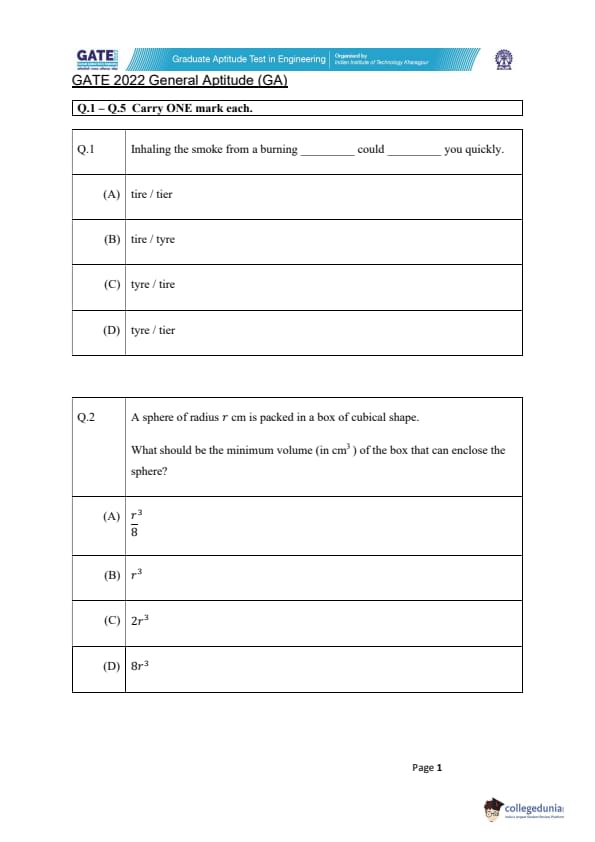
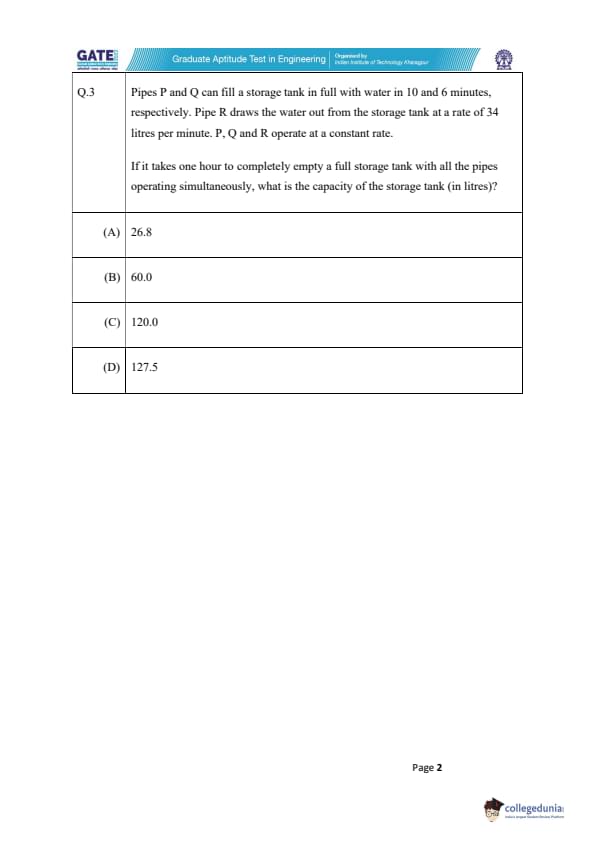
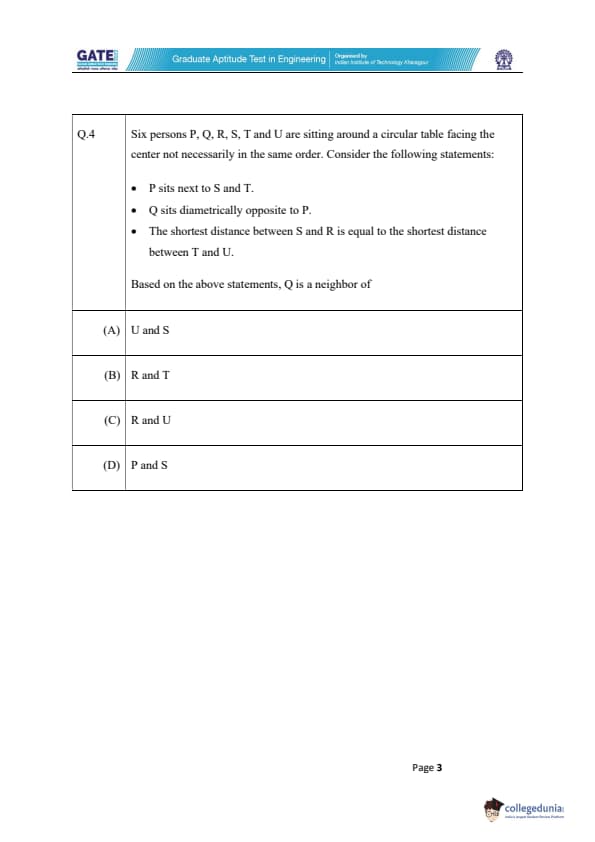
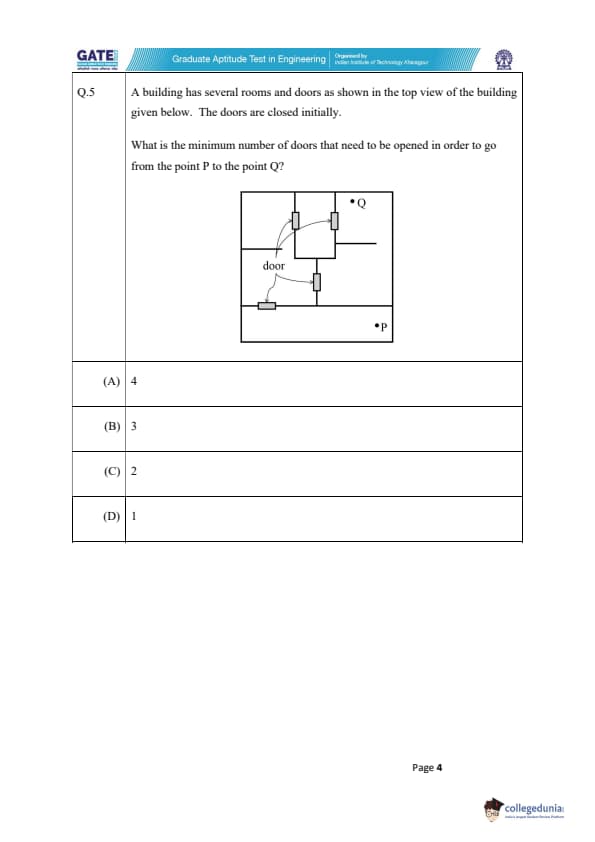
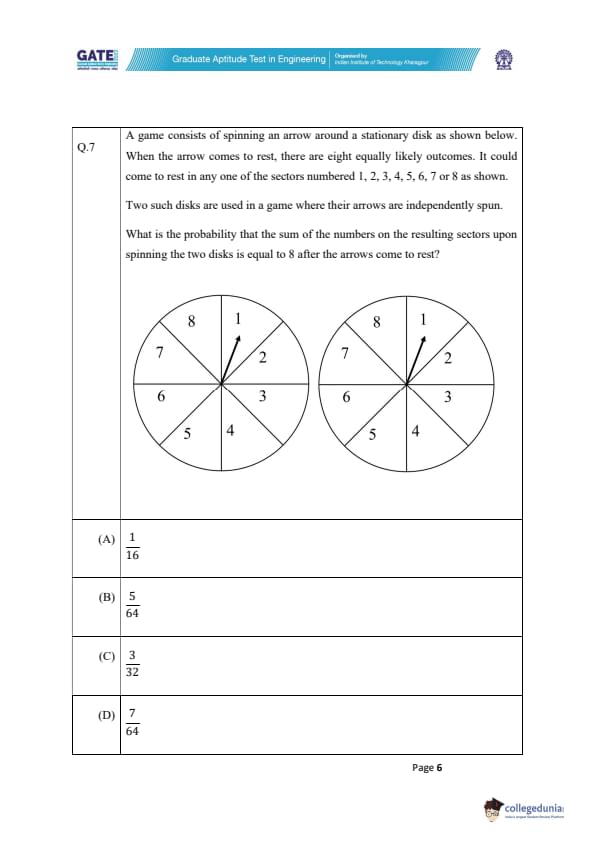
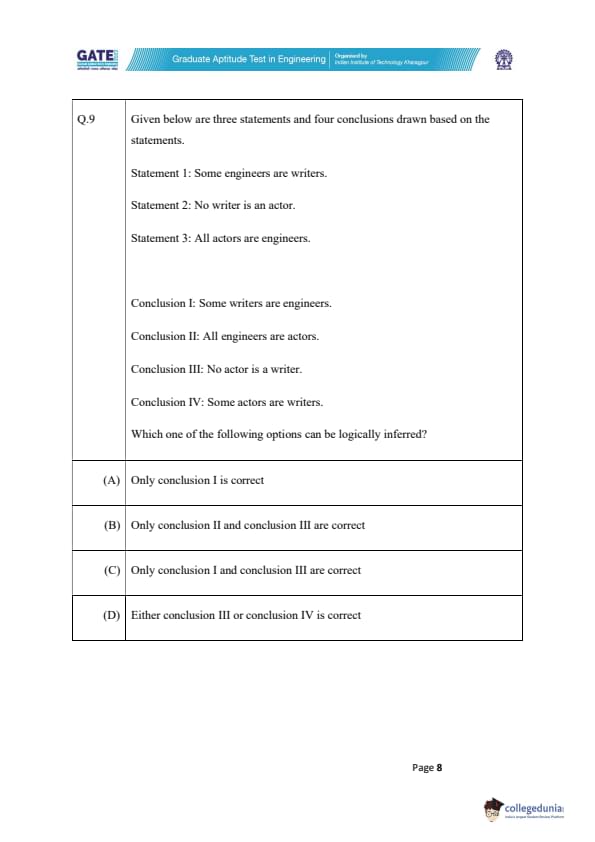
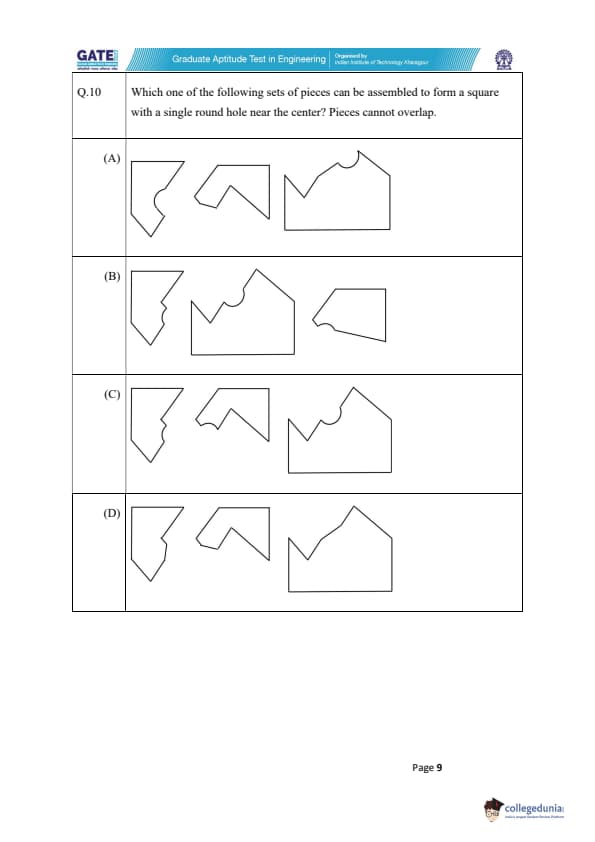
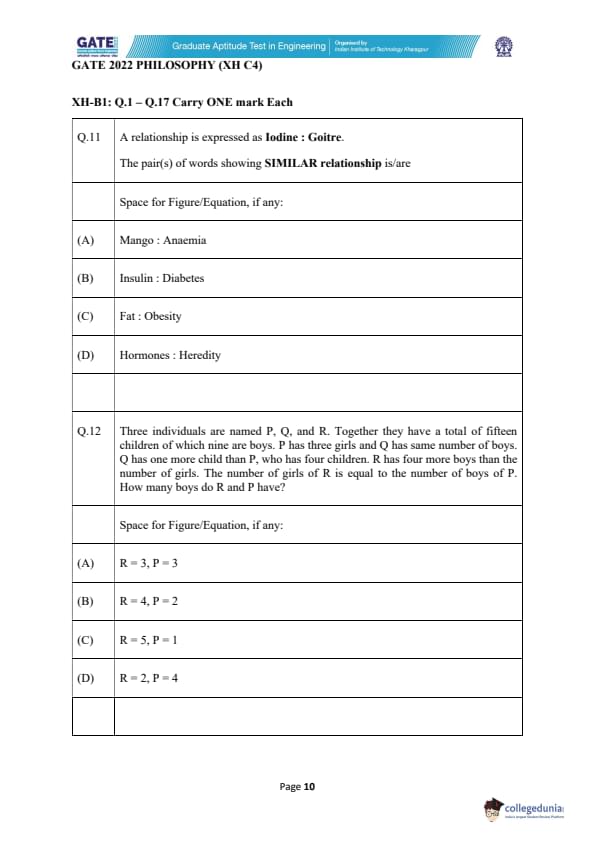
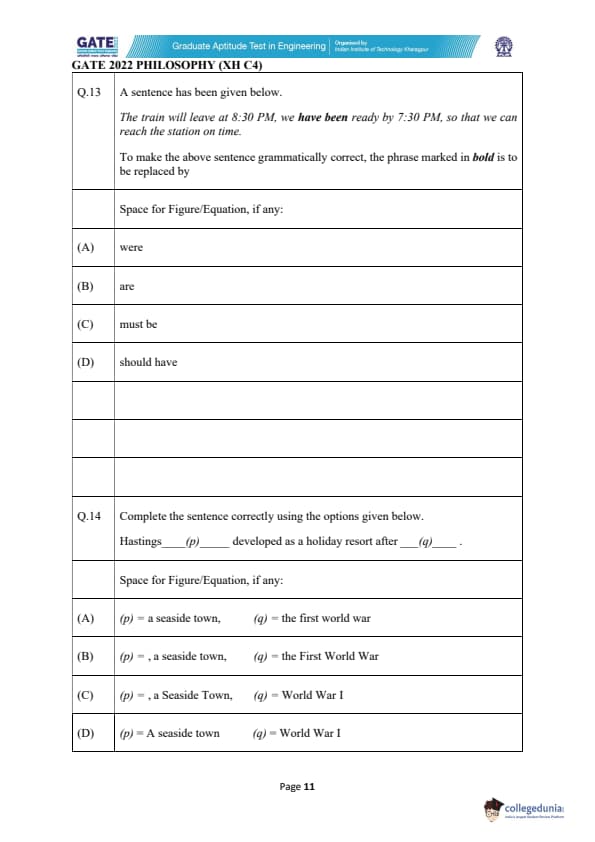
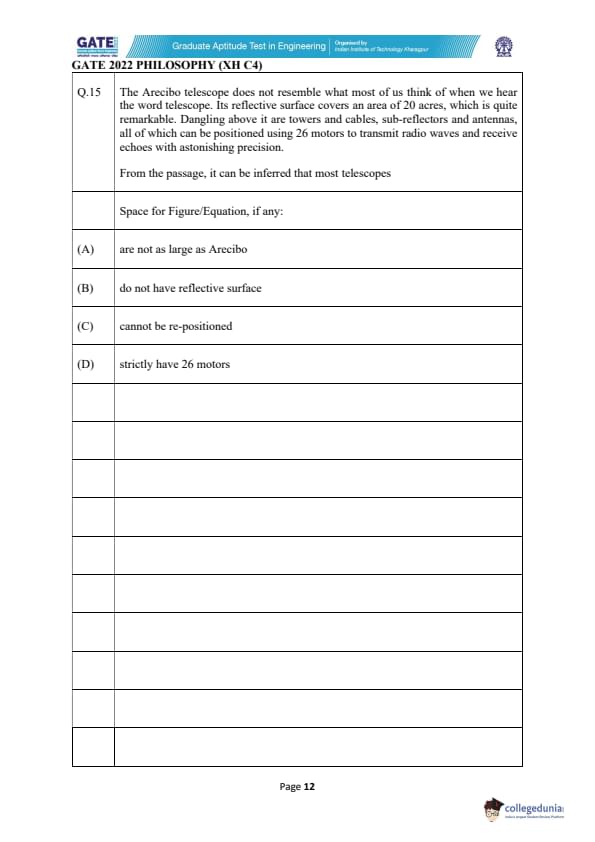
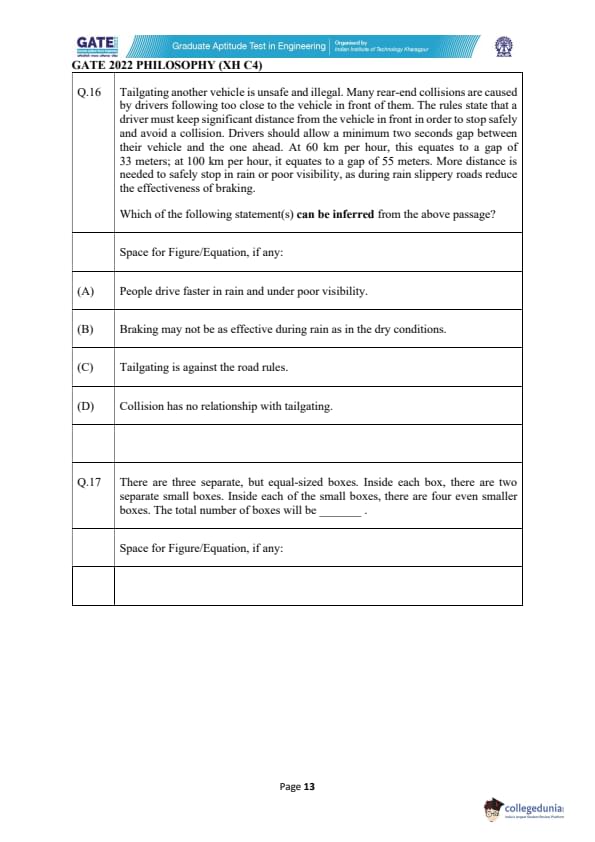
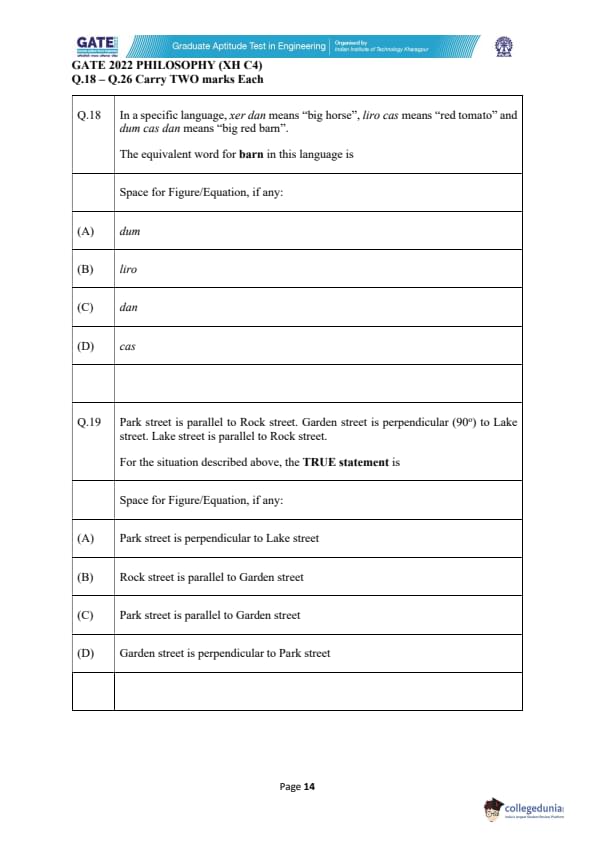
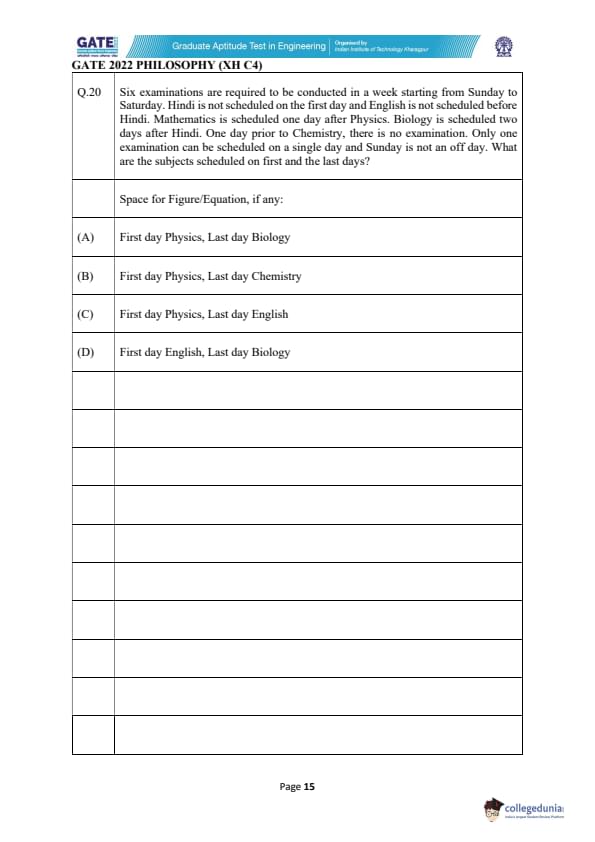
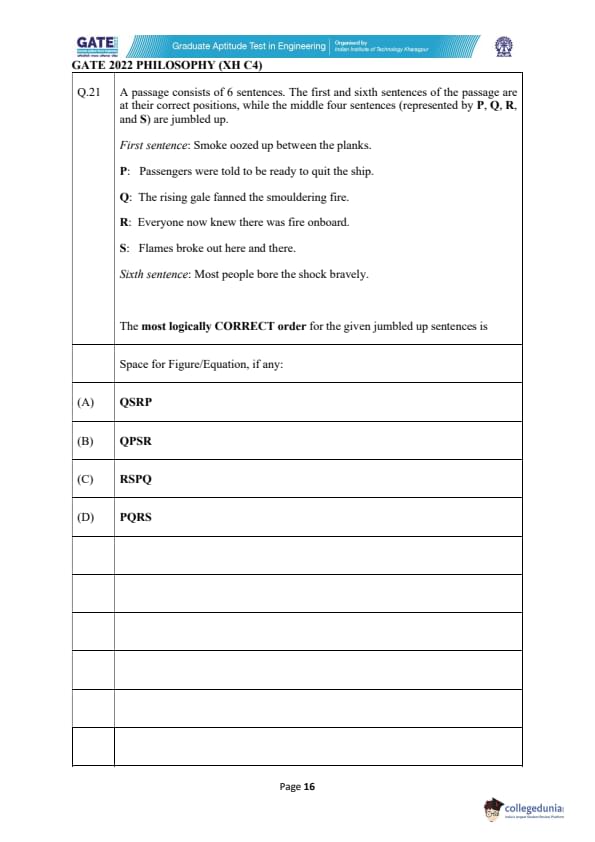
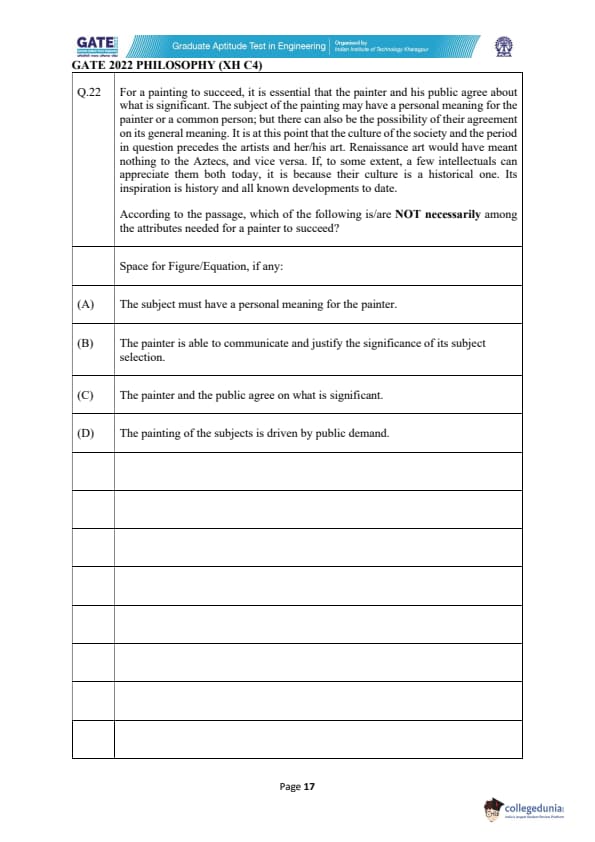
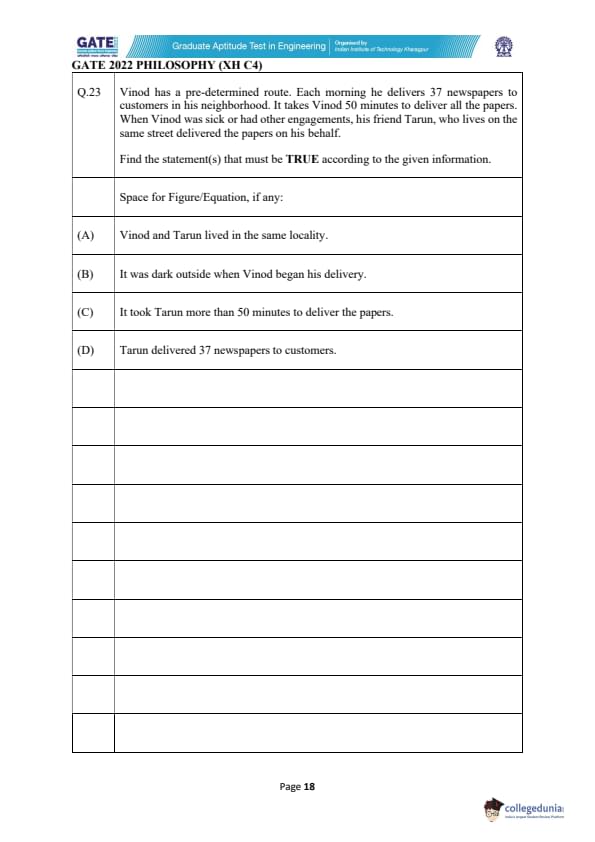
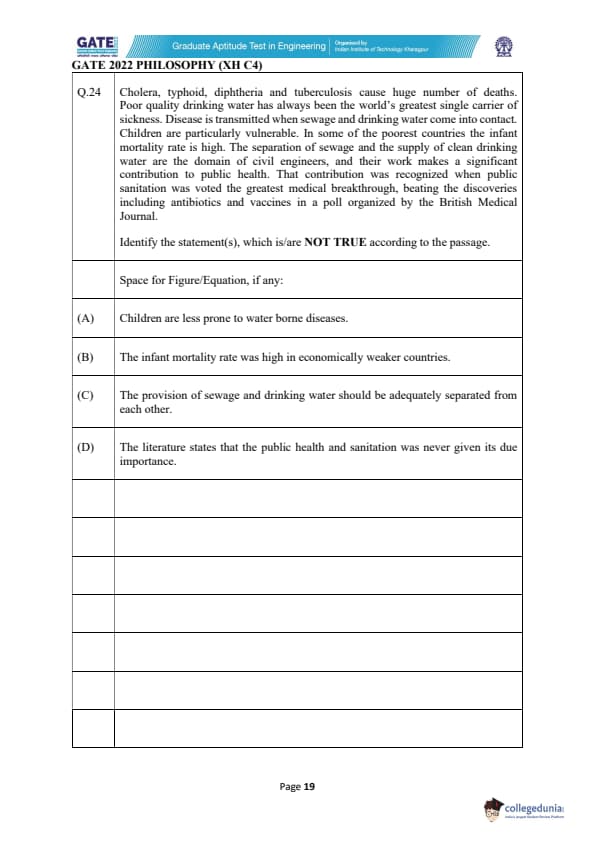
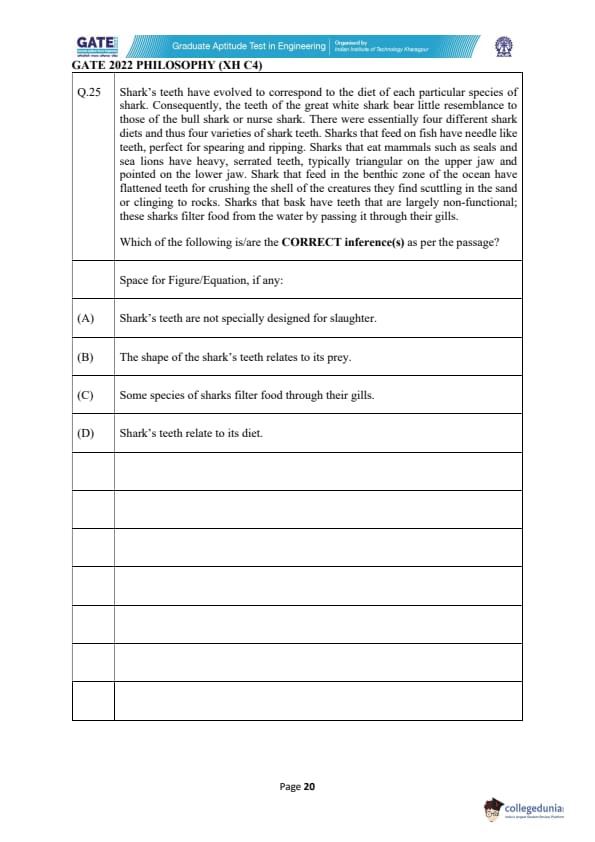
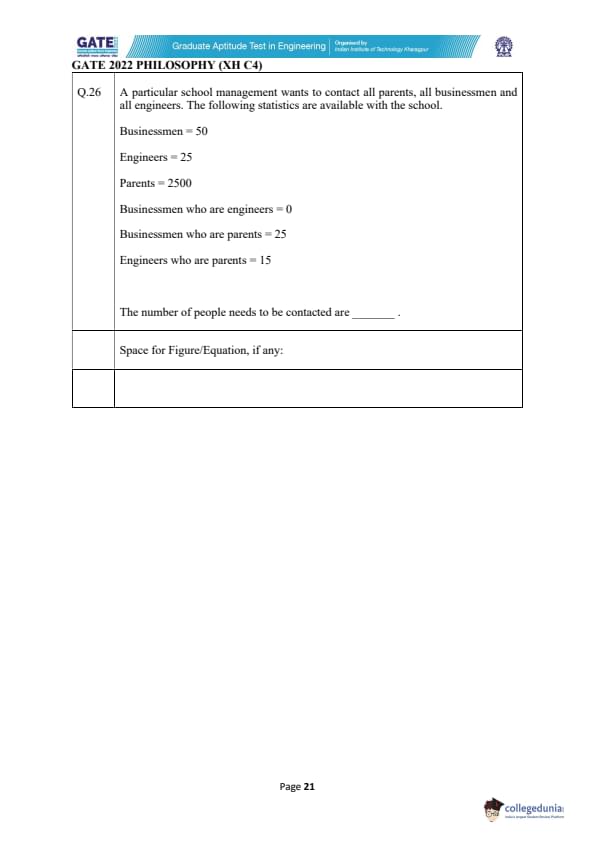
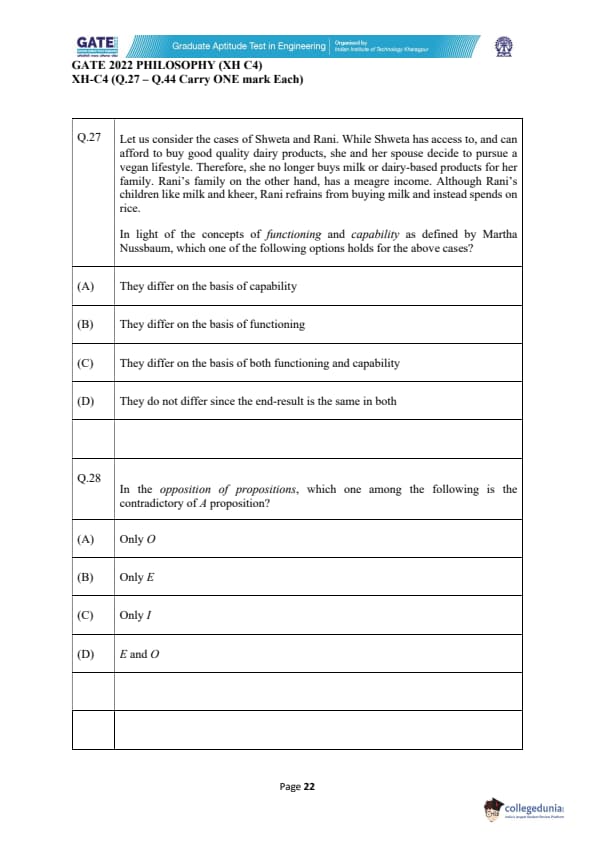
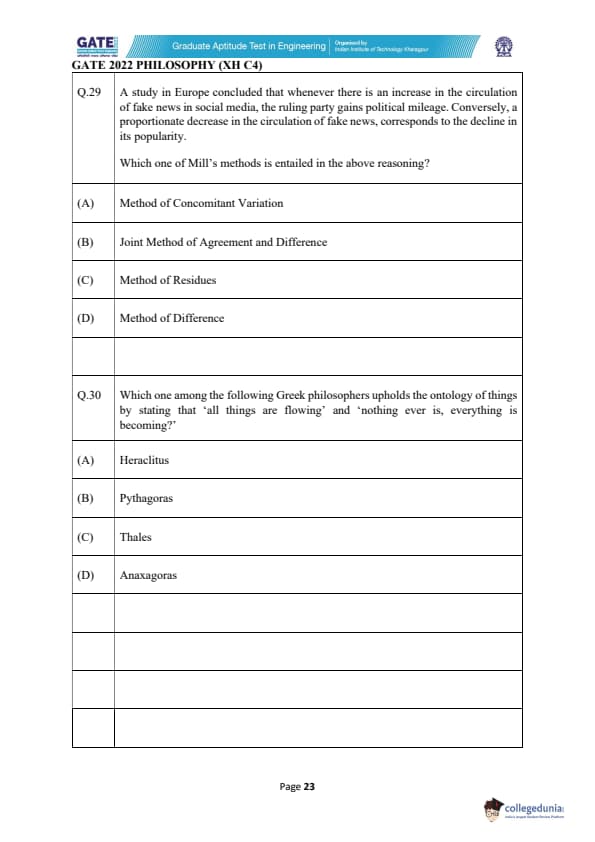
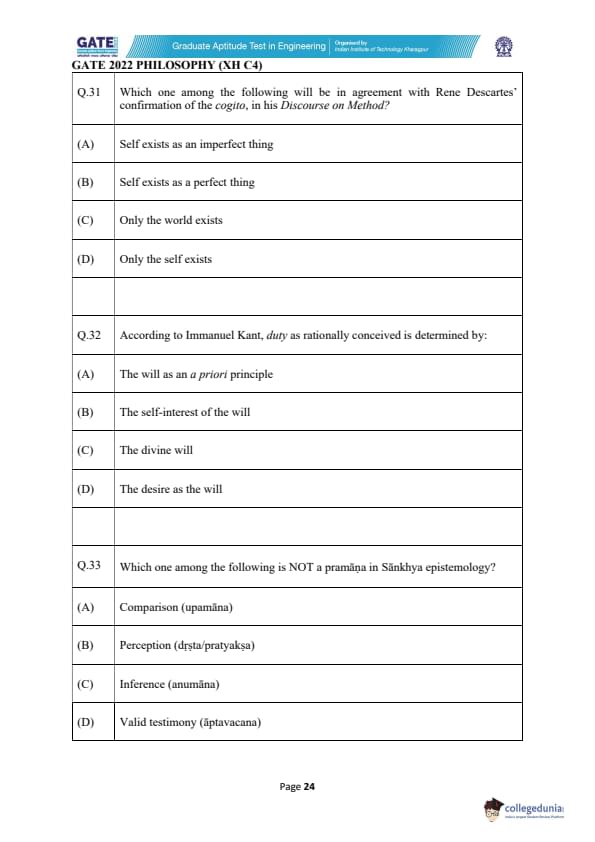
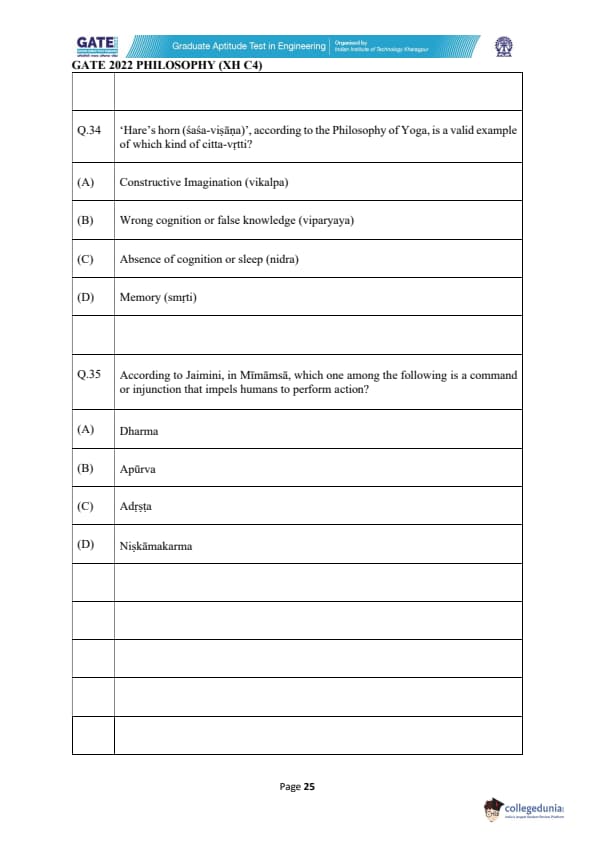
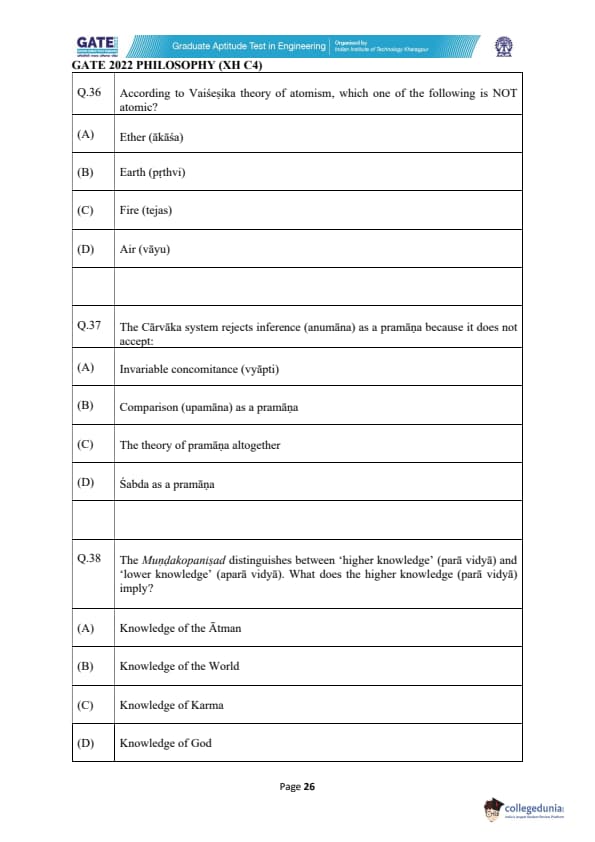
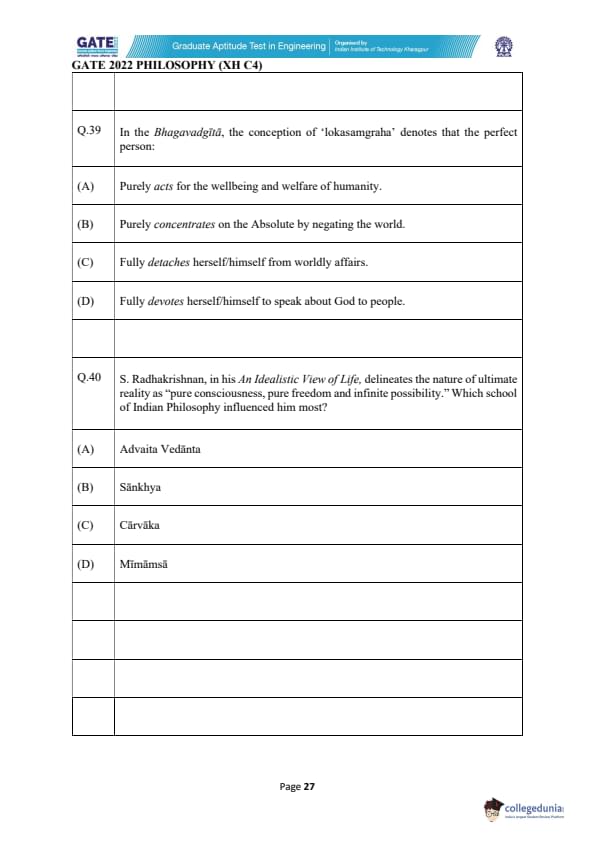
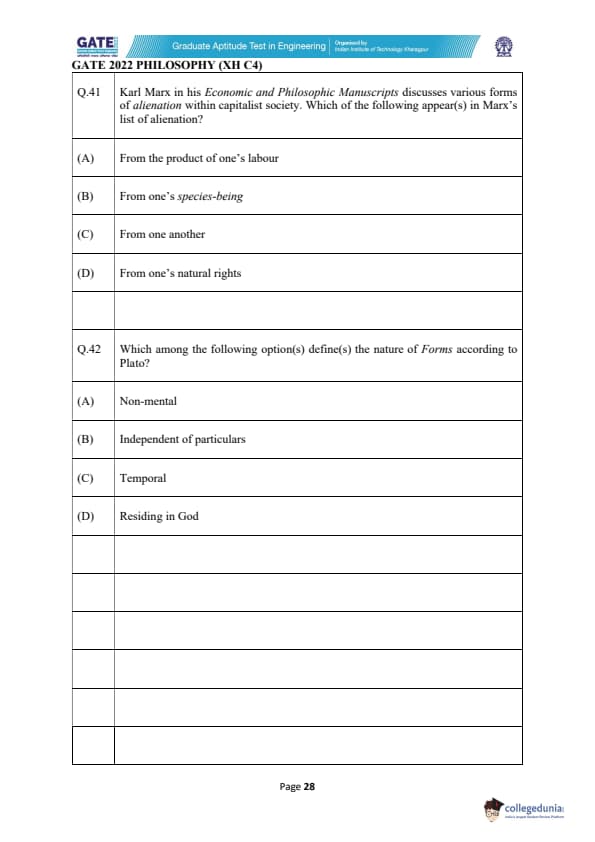
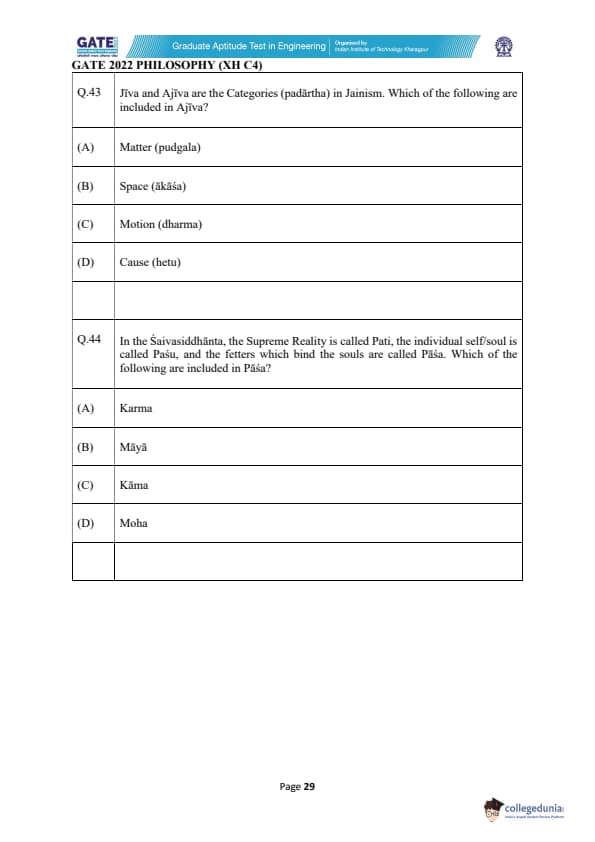
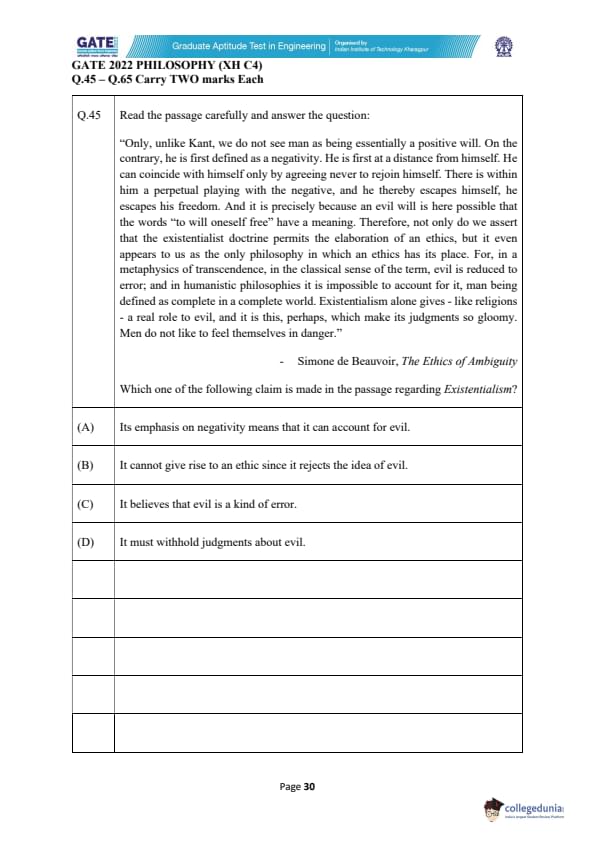
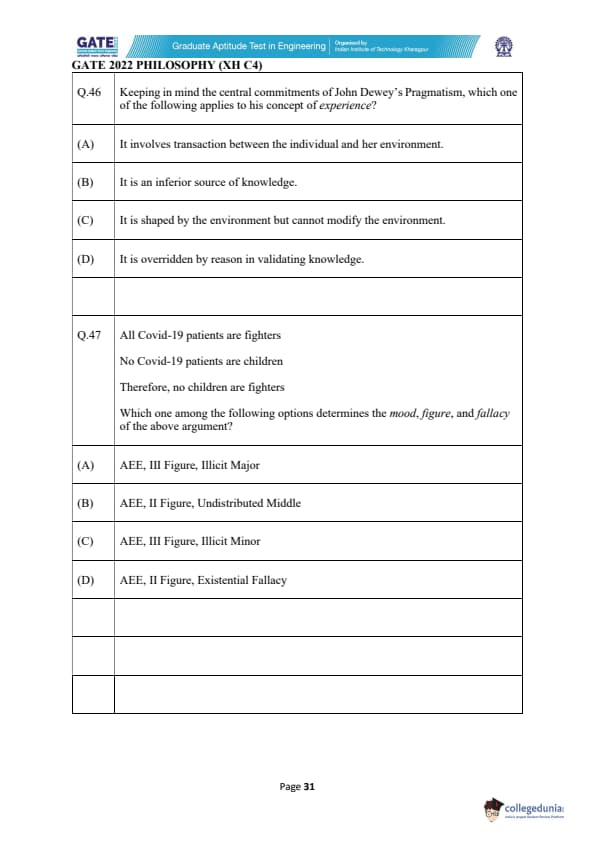
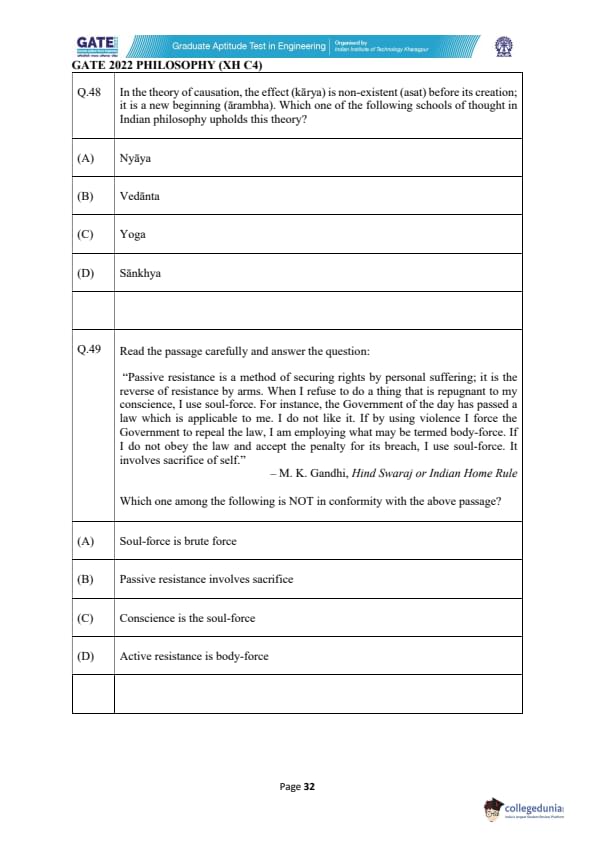
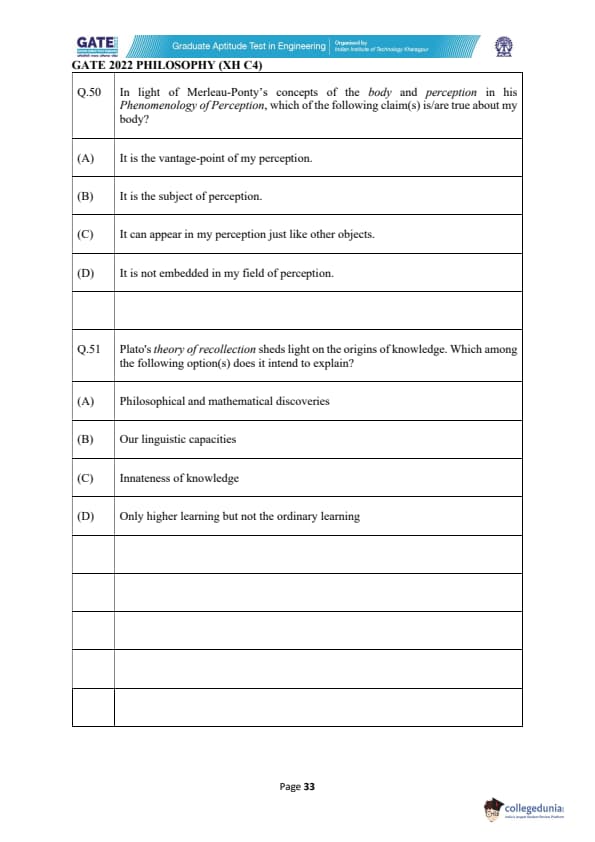
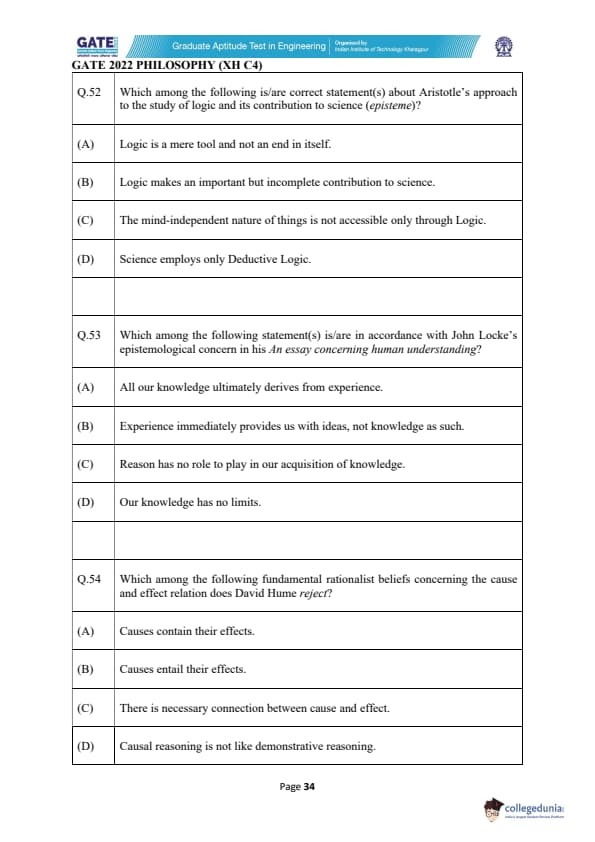
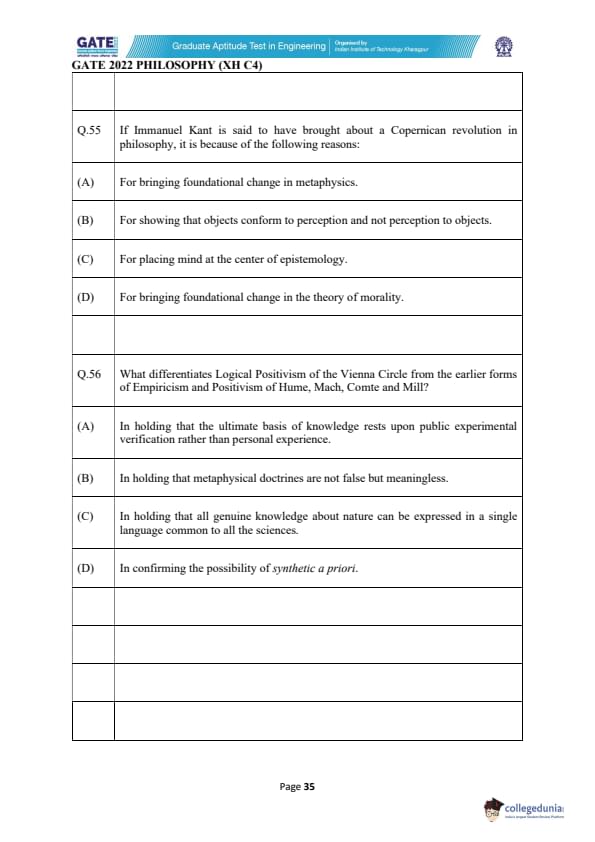
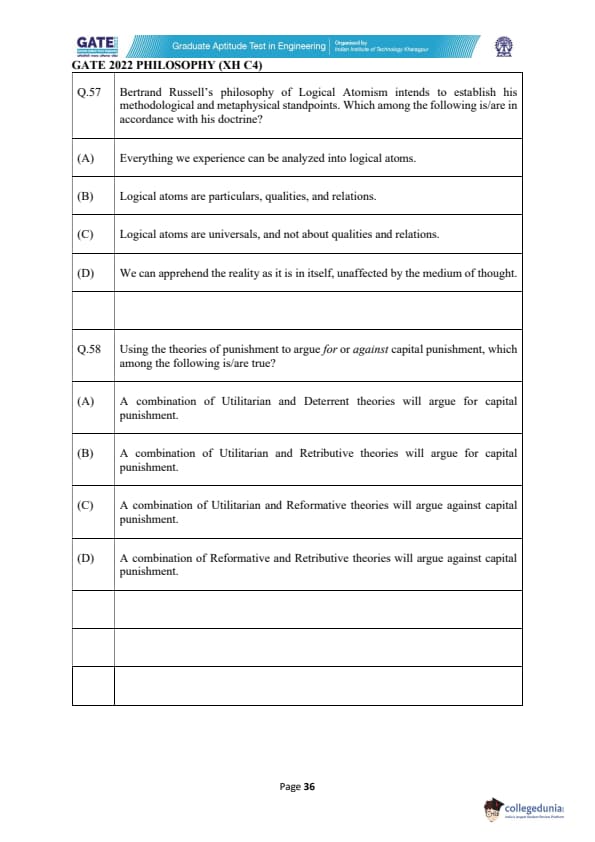
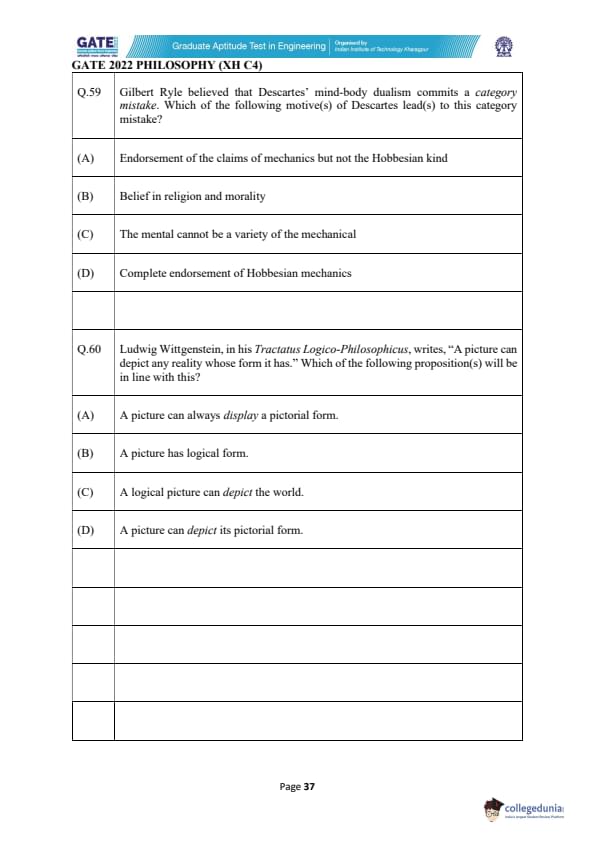
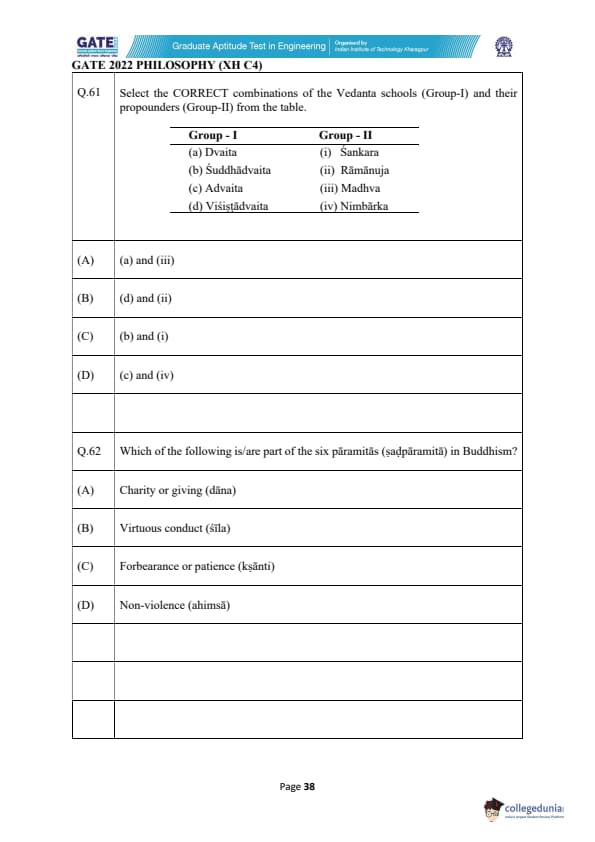
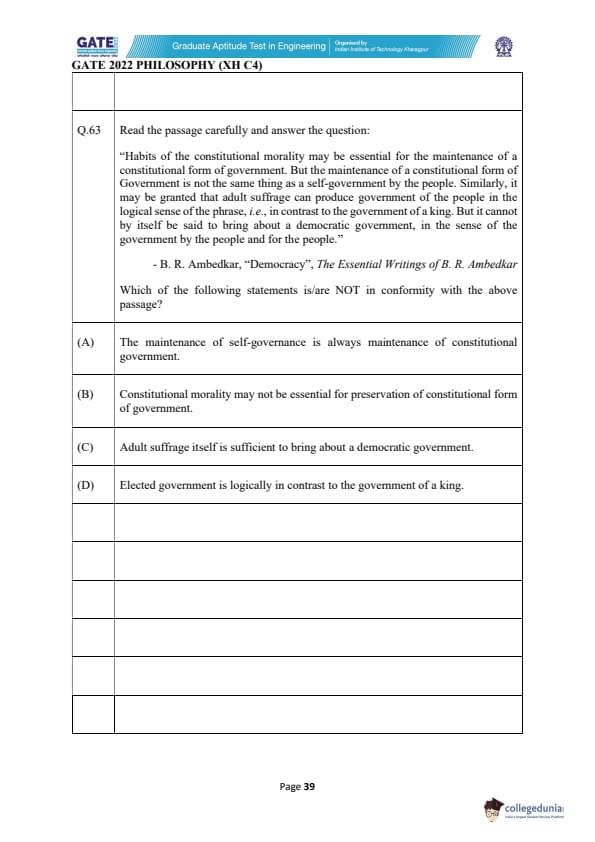
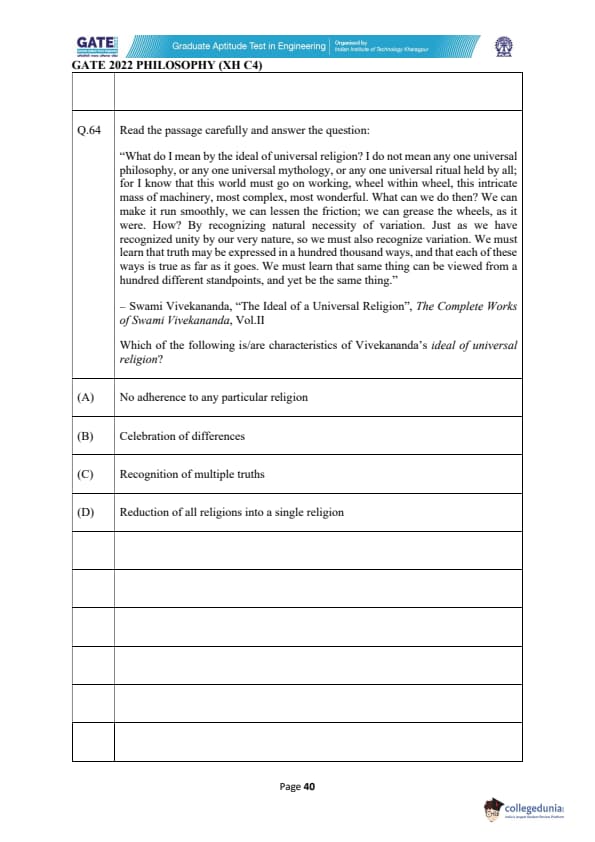
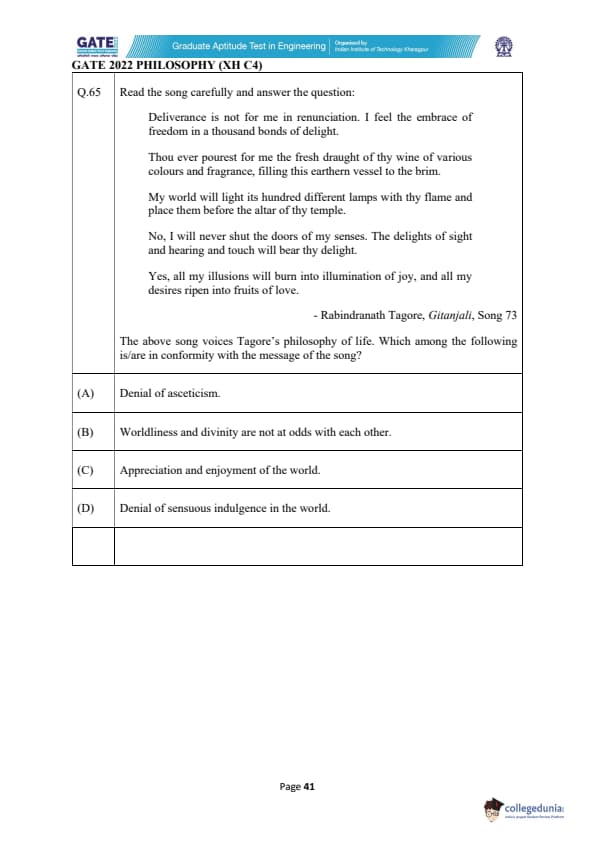
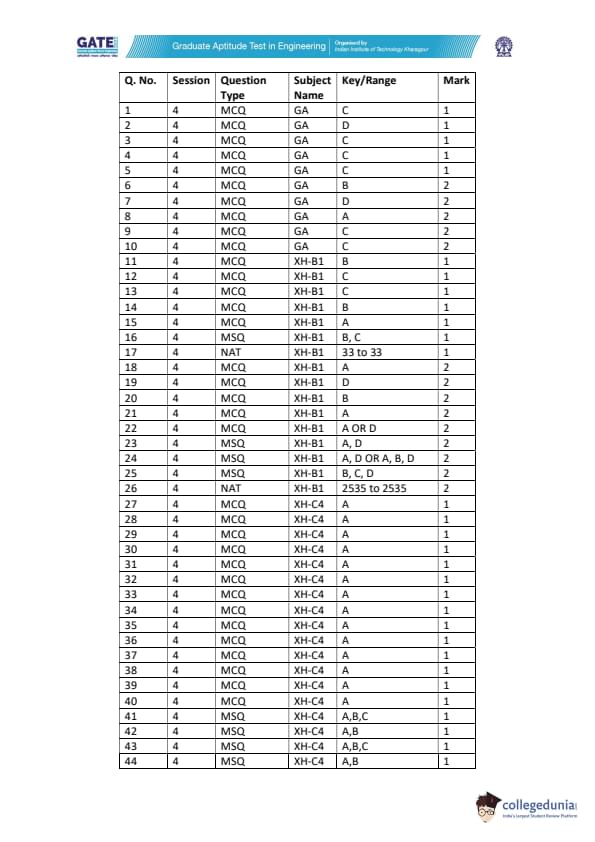
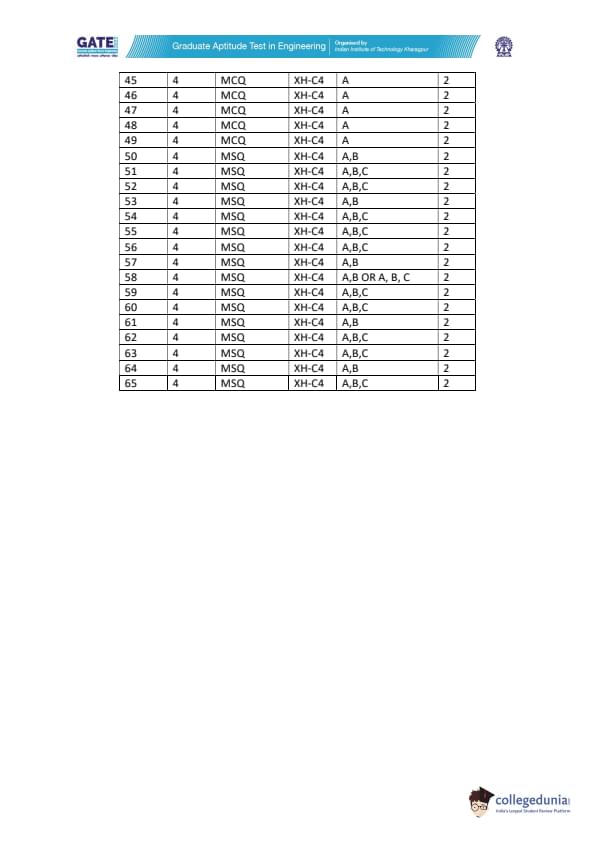
GATE 2022 XH-C4 Philosophy Question Paper: Paper Analysis
Section GA and B1 in GATE 2022 XH- Philosophy Question Paper was the same as the other five papers for GATE XH paper. The table below shows the number of 1 mark and 2 marks questions in GATE 2022 XH- Philosophy Question Paper:
| Type of Questions | General Aptitude (GA) | Reasoning Comprehension (B1) | Philosophy (XH- C4) | |||
|---|---|---|---|---|---|---|
| Number of Questions | Marks | Number of Questions | Marks | Number of Questions | Marks | |
| No. of 1 mark MCQs | 5 | 5 | 5 | 5 | 14 | 14 |
| No. of 2 marks MCQs | 5 | 10 | 5 | 10 | 5 | 10 |
| No. of 1 mark NATs | 0 | 0 | 1 | 1 | 0 | 0 |
| No. of 2 marks NATs | 0 | 0 | 1 | 2 | 0 | 0 |
| No. of 1 mark MSQs | 0 | 0 | 1 | 1 | 4 | 4 |
| No. of 2 marks MSQs | 0 | 0 | 3 | 6 | 16 | 32 |
GATE Previous Year Question Papers:
Candidates may examine their performance levels by solving prior year's examination papers. Candidates are encouraged to answer GATE Question Papers on a regular basis to improve their correctness. GATE ME 2019 question paper is one of the most important aspects of effective test preparation. Including past year's question papers in your study schedule can help you get a better grade. Test candidates may examine prior year question papers to determine the level of questions asked in the exam. The following are links to GATE 2019 question papers with answer key PDFs:
| GATE 2022 Question Papers | GATE 2021 Question Papers | GATE 2020 Question Papers |
| GATE 2019 Question Papers | GATE 2018 Question Papers | GATE 2017 Question Papers |



Comments