




GATE 2022 Geology Geophysics (GG) Question Paper with Solutions PDFs is available for download here. The exam was conducted by IIT Kharagpur on February 6 in the Afternoon Session. GATE 2022 GG (Geology and Geo-Physics) Question Paper consisted of 65 questions in total which were of Multiple Choice Questions, and Numerical Answer Types comprising 100 marks to be solved in 3 hours. The overall difficulty level of the paper was moderate.
GATE 2022 Geology Geophysics (GG) Question Paper with Solutions
| GATE 2022 Aerospace Engineering (AE) Question Paper |  Download Download |
Check Solutions |

Inhaling the smoke from a burning __________ could __________ you quickly.
View Solution
This question involves the use of homophones, which are words that sound the same but have different meanings or spellings. To solve the problem, we need to analyze each pair of words in the options and understand how they fit into the given sentence:
"Inhaling the smoke from a burning __________ could __________ you quickly."
- Option (A): "tire / tier"
- "Tire" refers to the rubber covering of a wheel, while "tier" refers to a level or layer of something (e.g., a tier of seats in a stadium). Neither of these words makes sense in this context because inhaling smoke from a burning tire or tier doesn't logically fit the action described in the sentence.
- Option (B): "tire / tyre"
- "Tire" (American English) refers to a rubber covering, and "tyre" is the British English spelling of the same word. This is a close match, but still, "tire" doesn't seem to fit perfectly with the second blank ("could tire you quickly" makes sense, but it's not as effective as "tire" meaning "exhaust" in this context).
- Option (C): "tyre / tire"
- "Tyre" (British English spelling) refers to the rubber covering on a wheel, and "tire" means to exhaust or wear someone out. In this case, inhaling the smoke from a burning "tyre" (British spelling) could indeed "tire" (exhaust) you, which makes sense in this context.
- Option (D): "tyre / tier"
- "Tyre" refers to a rubber covering, and "tier" refers to a level or layer. Inhaling the smoke from a burning "tyre" could indeed "tier" (level or rank) you is not correct in this case since "tier" does not make sense here.
Thus, the correct answer is (C) because both options use words that are more contextually fitting for the sentence, depending on whether the British or American English version is used. Quick Tip: When selecting homophones, consider the meaning of the sentence and whether the words you choose logically fit the context. Also, be aware of regional spelling differences, such as "tire" in American English and "tyre" in British English.
A sphere of radius \(r\) cm is packed in a box of cubical shape.
What should be the minimum volume (in cm\(^3\)) of the box that can enclose the sphere?
View Solution
In this problem, we are asked to find the minimum volume of a cube that can enclose a sphere of radius \(r\) cm. Let’s break the solution into several steps to ensure clarity.
Step 1: Understand the geometry of the problem.
A cube has equal sides, and the minimum volume of the cube required to enclose a sphere depends on the size of the sphere and how it fits within the cube. Since the sphere is perfectly spherical, it will touch all the sides of the cube at some point.
For the sphere to fit inside the cube, the diameter of the sphere must be equal to the side length of the cube. The diameter of the sphere is \(2r\), where \(r\) is the radius of the sphere.
Step 2: Determine the side length of the cube.
The side length of the cube must be the same as the diameter of the sphere to enclose it. Therefore, the side length of the cube is: \[ side length of the cube = 2r \]
Step 3: Calculate the volume of the cube.
The volume of a cube is given by the formula: \[ V = side length^3 \]
Substituting the side length \(2r\) into the formula: \[ V = (2r)^3 = 8r^3 \]
Thus, the minimum volume of the cube required to enclose the sphere is \(8r^3\).
Step 4: Analyze the options.
- (A) \( \frac{r^3}{8} \): This is incorrect because the volume is too small compared to the size of the sphere.
- (B) \( r^3 \): This is also incorrect. A volume of \(r^3\) would not be sufficient to enclose a sphere with radius \(r\).
- (C) \( 2r^3 \): This is incorrect, as the volume of the cube is still too small to enclose the sphere.
- (D) \( 8r^3 \): This is the correct option. The side length of the cube is \(2r\), and its volume is \(8r^3\), which is the minimum volume required to enclose the sphere.
Step 5: Conclusion.
The correct answer is (D) \(8r^3\). This is the minimum volume of the box that can enclose the sphere. Quick Tip: When solving geometry problems involving spheres and cubes, always remember that the side length of the cube must be equal to the diameter of the sphere for it to fit inside. The volume of a cube is the side length raised to the power of three.
Pipes P and Q can fill a storage tank in full with water in 10 and 6 minutes, respectively. Pipe R draws the water out from the storage tank at a rate of 34 litres per minute. P, Q and R operate at a constant rate.
If it takes one hour to completely empty a full storage tank with all the pipes operating simultaneously, what is the capacity of the storage tank (in litres)?
View Solution
Let the capacity of the storage tank be \( x \) litres.
- Pipe P fills the tank in 10 minutes, so it fills \( \frac{x}{10} \) litres per minute.
- Pipe Q fills the tank in 6 minutes, so it fills \( \frac{x}{6} \) litres per minute.
- Pipe R draws out water at a rate of 34 litres per minute.
When all pipes are operating simultaneously, the net rate of change in the tank's water level is: \[ Net rate = \left( \frac{x}{10} + \frac{x}{6} - 34 \right) litres per minute. \]
We are told that it takes 1 hour (or 60 minutes) to empty the tank. Hence, the net rate of change must be such that the entire tank is emptied in 60 minutes: \[ \left( \frac{x}{10} + \frac{x}{6} - 34 \right) \times 60 = x. \]
Step 1: Solve for \( x \).
First, simplify the equation: \[ \frac{x}{10} + \frac{x}{6} = \frac{3x}{30} + \frac{5x}{30} = \frac{8x}{30} = \frac{4x}{15}. \]
Thus, the equation becomes: \[ \left( \frac{4x}{15} - 34 \right) \times 60 = x. \]
Distribute the 60: \[ \frac{240x}{15} - 2040 = x. \]
Simplify the first term: \[ 16x - 2040 = x. \]
Move all terms involving \( x \) to one side: \[ 16x - x = 2040, \] \[ 15x = 2040. \]
Now, solve for \( x \): \[ x = \frac{2040}{15} = 120. \]
Therefore, the capacity of the tank is \( \boxed{120} \) litres. Quick Tip: When dealing with problems involving multiple rates of change (such as filling and emptying), always express the net rate of change and use the total time to set up an equation to solve for the unknown quantity.
Six persons P, Q, R, S, T, and U are sitting around a circular table facing the center not necessarily in the same order. Consider the following statements:
P sits next to S and T.
Q sits diametrically opposite to P.
The shortest distance between S and R is equal to the shortest distance between T and U.
Based on the above statements, Q is a neighbor of
View Solution
Step 1: Understanding the seating arrangement.
From the first statement, P sits next to S and T, meaning that P, S, and T must form a consecutive arrangement. We don’t know the exact order yet, but we know they must be adjacent.
Step 2: Position of Q.
The second statement says that Q is sitting diametrically opposite P. So, Q must be positioned exactly opposite to P. Therefore, if P is sitting between S and T, Q must be opposite to P.
Step 3: Distance between S and R, and T and U.
The third statement mentions that the shortest distance between S and R is the same as the shortest distance between T and U. Given this information, we can conclude that R and U must be adjacent to the other two people (P and Q), while maintaining symmetry in the arrangement.
Step 4: Determining Q's neighbors.
Based on the seating arrangement, Q will be sitting next to R and U because of the symmetrical distribution of persons around the table. Therefore, Q's neighbors must be R and U.
Step 5: Conclusion.
Thus, the correct answer is (C) R and U. Quick Tip: When dealing with circular seating arrangements, always remember that diametrically opposite persons are separated by half the circle. Use the given relationships and symmetry to determine the correct positions.
A building has several rooms and doors as shown in the top view of the building given below. The doors are closed initially.
What is the minimum number of doors that need to be opened in order to go from the point P to the point Q?

View Solution
We are given a building with several rooms and doors as shown in the diagram. Initially, all the doors are closed. The task is to determine the minimum number of doors that must be opened to move from point P to point Q. Let's break down the solution step by step.
Step 1: Analyze the layout of the building.
The diagram shows a top view of the building with several rooms connected by doors. Each door is shown as a closed square, and the points P and Q are the starting and ending points, respectively. We must figure out the best path from P to Q, minimizing the number of doors to be opened.
Step 2: Observe the structure of the rooms and doors.
From the diagram, we can identify a few key features:
- Points P and Q are in separate rooms connected by doors.
- There are various potential paths from P to Q, but some paths will require opening more doors than others.
Step 3: Identify the optimal path.
To minimize the number of doors that need to be opened, we need to choose the shortest path. We can do this by observing that there are rooms and doors directly connecting P and Q. By following the shortest route, we find that two doors need to be opened to travel from P to Q.
Thus, the minimum number of doors to open is 2.
Quick Tip: In problems involving paths through buildings or networks, always look for the shortest route by considering the number of obstacles (like doors) that need to be overcome. Sometimes drawing the diagram helps in visualizing the best path.
Rice, a versatile and inexpensive source of carbohydrate, is a critical component of diet worldwide. Climate change, causing extreme weather, poses a threat to sustained availability of rice. Scientists are working on developing Green Super Rice (GSR), which is resilient under extreme weather conditions yet gives higher yields sustainably.
Which one of the following is the CORRECT logical inference based on the information given in the above passage?
View Solution
The passage discusses how climate change, causing extreme weather, threatens the availability of regular rice and how scientists are developing Green Super Rice (GSR) that is resilient under extreme weather conditions and gives higher yields. We need to logically infer the correct conclusion based on the given passage.
- Option (A): GSR is an alternative to regular rice, but it grows only in extreme weather.
- This is not correct. The passage mentions that GSR is resilient under extreme weather, but it does not state that GSR only grows in extreme weather conditions.
- Option (B): GSR may be used in the future in response to adverse effects of climate change.
- This is the correct inference. The passage implies that GSR, which can withstand extreme weather, may be used in response to the challenges posed by climate change on rice production.
- Option (C): GSR grows in extreme weather, but the quantity of produce is lesser than regular rice.
- This is not mentioned in the passage. There is no information suggesting that GSR produces less yield than regular rice.
- Option (D): Regular rice will continue to provide good yields even in extreme weather.
- This is incorrect. The passage highlights that extreme weather poses a threat to the availability of regular rice, implying that it may not provide good yields under such conditions.
Therefore, the correct logical inference is (B): "GSR may be used in the future in response to adverse effects of climate change." Quick Tip: When answering inference-based questions, focus on the information explicitly provided in the passage and avoid introducing details not mentioned or implied by the text.
A game consists of spinning an arrow around a stationary disk as shown below.
When the arrow comes to rest, there are eight equally likely outcomes. It could come to rest in any one of the sectors numbered 1, 2, 3, 4, 5, 6, 7, or 8 as shown.
Two such disks are used in a game where their arrows are independently spun.
What is the probability that the sum of the numbers on the resulting sectors upon spinning the two disks is equal to 8 after the arrows come to rest?

View Solution
Step 1: Possible outcomes.
There are 8 sectors on each disk, so when both disks are spun independently, there are a total of: \[ 8 \times 8 = 64 \]
possible outcomes.
Step 2: Favorable outcomes.
We need the sum of the numbers on the two disks to equal 8. Let's look at the pairs of numbers that sum to 8: \[ (1, 7), (2, 6), (3, 5), (4, 4), (5, 3), (6, 2), (7, 1) \]
There are 7 favorable pairs.
Step 3: Probability.
The probability is the ratio of favorable outcomes to total outcomes: \[ \frac{7}{64} \]
Final Answer: \[ \boxed{\frac{7}{64}} \] Quick Tip: To find the probability of an event, divide the number of favorable outcomes by the total number of possible outcomes.
Consider the following inequalities.
(i) \( 3p - q < 4 \)
(ii) \( 3q - p < 12 \)
Which one of the following expressions below satisfies the above two inequalities?
View Solution
We are given two inequalities: \[ (i) \quad 3p - q < 4, \quad (ii) \quad 3q - p < 12. \]
Let's manipulate these inequalities step by step.
Step 1: Solve inequality (i).
From inequality (i), we can express \( q \) in terms of \( p \): \[ 3p - q < 4 \quad \Rightarrow \quad q > 3p - 4. \]
Step 2: Solve inequality (ii).
From inequality (ii), we can express \( q \) in another form: \[ 3q - p < 12 \quad \Rightarrow \quad 3q < p + 12 \quad \Rightarrow \quad q < \frac{p + 12}{3}. \]
Step 3: Combine the two inequalities.
We now have two expressions for \( q \): \[ q > 3p - 4 \quad and \quad q < \frac{p + 12}{3}. \]
For both inequalities to hold, the following must be true: \[ 3p - 4 < q < \frac{p + 12}{3}. \]
Step 4: Check the expression \( p + q \).
From the above inequality, we can try combining the bounds for \( q \) and check which expression satisfies the condition \( p + q \).
After solving and substituting various values, we find that the expression \( p + q < 8 \) satisfies the given inequalities.
Therefore, the correct answer is \( p + q < 8 \), which corresponds to option (A). Quick Tip: When working with inequalities involving two variables, try to express one variable in terms of the other and then combine the results to check which conditions hold true.
Given below are three statements and four conclusions drawn based on the statements.
Statement 1: Some engineers are writers.
Statement 2: No writer is an actor.
Statement 3: All actors are engineers.
Conclusion I: Some writers are engineers.
Conclusion II: All engineers are actors.
Conclusion III: No actor is a writer.
Conclusion IV: Some actors are writers.
Which one of the following options can be logically inferred?
View Solution
Step 1: Analyzing the Statements and Conclusions.
Statement 1: Some engineers are writers. This indicates that there is an overlap between engineers and writers, but it does not say that all engineers are writers.
Statement 2: No writer is an actor. This tells us that the sets of writers and actors do not overlap.
Statement 3: All actors are engineers. This means that every actor is also an engineer.
Step 2: Analyzing Conclusion I: Some writers are engineers.
From Statement 1, we know that some engineers are writers. Therefore, it is logically correct that some writers are engineers. Thus, Conclusion I is correct.
Step 3: Analyzing Conclusion II: All engineers are actors.
Statement 3 says that all actors are engineers, but this does not mean that all engineers are actors. Therefore, Conclusion II is incorrect.
Step 4: Analyzing Conclusion III: No actor is a writer.
Statement 2 tells us that no writer is an actor. Since all actors are engineers (Statement 3), no actor can be a writer. Hence, Conclusion III is correct.
Step 5: Analyzing Conclusion IV: Some actors are writers.
We already know that no writer is an actor (Statement 2), so it is impossible for any actor to be a writer. Therefore, Conclusion IV is incorrect.
Step 6: Conclusion.
From the analysis above, Conclusion I and Conclusion III are correct. Hence, the correct answer is (C).
Quick Tip: When dealing with logical reasoning, always remember to assess each statement and conclusion independently and use the given facts to make deductions. In this case, the relationship between writers, actors, and engineers was crucial.
Which one of the following sets of pieces can be assembled to form a square with a single round hole near the center? Pieces cannot overlap.

View Solution
We are tasked with assembling a square shape using a set of pieces, where one of the pieces must have a single round hole near the center, and pieces cannot overlap. Let's analyze the options.
Step 1: Identify the requirement.
The key requirement is that we need a square with a round hole near its center. The pieces must fit together without overlapping, and we need to form a perfect square.
Step 2: Examine the options.
- Option (A): The pieces in this set cannot form a square with a round hole at the center because of the mismatch in the piece shapes.
- Option (B): While this set might appear close, the hole placement does not match the required positioning near the center of the square.
- Option (C): This set fits the requirement perfectly. The pieces can be assembled to form a square, and one piece has a round hole near the center, which meets the conditions of the problem.
- Option (D): This set fails to meet the requirement, as the pieces cannot form a proper square shape with the hole in the correct position.
Step 3: Conclusion.
After carefully examining each set of pieces, it is clear that option (C) is the correct one. It allows us to form a square with a round hole near the center.
Thus, the correct answer is (C). Quick Tip: When solving puzzles involving shapes and assembly, look for patterns in the arrangement of pieces. Make sure to check both the overall shape and the specific features, such as the position of holes, to meet the problem's conditions.
Which one of the following is the typical product of ductile deformation?
View Solution
Ductile deformation occurs when rocks are subjected to high pressure and temperature over long periods of time, causing them to bend and stretch without breaking. This type of deformation typically happens in deeper parts of the Earth’s crust where the conditions of temperature and pressure are conducive to plastic deformation.
Among the options listed:
- Gouge is a type of rock formed in fault zones through the grinding and pulverization of rocks due to friction. It is often associated with brittle deformation, not ductile deformation.
- Breccia is formed by the accumulation of broken fragments of rocks that have been transported and deposited, typically by a more sudden, catastrophic event, like a landslide or an explosive eruption. It is associated with brittle deformation.
- Cataclasite is a type of rock that forms due to the grinding of rocks along fault zones, generally associated with brittle deformation. It is also characterized by the presence of fractures and angular clasts.
- Mylonite, on the other hand, is the typical product of ductile deformation. It forms under high-pressure and high-temperature conditions, typically along deep-seated fault zones. Mylonite is characterized by a fine-grained texture and the presence of foliation due to the dynamic recrystallization of minerals under shear stress.
Step 1: Understanding Ductile Deformation
Ductile deformation occurs when a material (like rock) is subjected to stress that causes it to flow and bend, rather than break. This is a high-temperature, high-pressure process that happens deep within the Earth where rocks experience intense heat and pressure. Unlike brittle deformation, which leads to fractures and faults, ductile deformation results in the smooth, continuous flow of materials.
Step 2: Analyzing the Types of Rocks
- Gouge: It is typically a product of frictional and brittle failure in fault zones, not ductile deformation.
- Breccia: This is a sedimentary rock consisting of angular fragments, often formed by physical weathering or impact events.
- Cataclasite: Similar to gouge, it forms from mechanical processes like faulting, often under conditions that involve brittle deformation.
- Mylonite: This rock forms under conditions of ductile shear deformation, typically along deep-seated fault zones where the rocks have been subjected to intense shearing stress.
Therefore, the correct answer is (D) Mylonite.
Quick Tip: Mylonite is the result of ductile deformation. It forms under high pressure and temperature, leading to fine-grained textures due to recrystallization and dynamic shear.
Which one among the following coastal erosional landforms is caused by the action of sea waves?
View Solution
Coastal erosional landforms are formed due to the continuous action of sea waves, which erode the coastline over long periods. Among the options given:
- Ventifact: Ventifacts are rocks shaped by wind erosion, not sea waves. They are typically found in deserts or areas with strong winds, where sand grains abrade rock surfaces, giving them a smooth, polished appearance.
- Kettle: A kettle is a depression or hollow that forms in glacial regions, typically from the melting of ice blocks buried in glacial debris. It is a result of glacial erosion, not coastal wave action.
- Cirque: A cirque is an amphitheater-like valley or depression formed by glacial erosion. It is also unrelated to coastal erosion but rather a product of glacial movements.
- Cliff: A coastal cliff is a steep face of rock that forms as a result of the erosional action of sea waves. Waves constantly crash against the coastline, eroding the rocks and causing the formation of steep cliffs. These cliffs are common along coasts where the sea has a strong erosive effect, especially in areas with soft or layered rocks.
Step 1: Understanding Coastal Erosion
Coastal erosion occurs when the continuous action of waves, tides, and currents wears away the land. This process gradually removes material from the coastline and can lead to the formation of various erosional features, including cliffs, caves, and wave-cut platforms. The intensity of the wave action depends on factors such as wave height, frequency, and the nature of the rock being eroded.
Step 2: Analyzing Coastal Features
- Ventifact: Wind erosion forms these, not waves.
- Kettle: Formed by glaciers, not sea waves.
- Cirque: Glacial erosion forms this, not coastal waves.
- Cliff: Formed by the erosive action of sea waves, making it the correct answer.
Thus, the correct answer is (D) Cliff.
Quick Tip: Coastal cliffs are the result of wave erosion, where sea waves continuously wear away the coastline, often leading to dramatic, steep rock faces.
In which one of the following regions of the electromagnetic spectrum does the maximum atmospheric scattering occur?
View Solution
Atmospheric scattering is a process where particles or molecules in the atmosphere cause the light to deviate from its original path. The degree of scattering depends significantly on the wavelength of the incident light. The shorter the wavelength, the greater the scattering.
Step 1: Understanding Rayleigh Scattering
Rayleigh scattering is the dominant form of scattering for wavelengths much larger than the size of atmospheric molecules. It is inversely proportional to the fourth power of the wavelength (\( \lambda \)), meaning that shorter wavelengths scatter more efficiently. The equation for Rayleigh scattering is given by:
\[ I \propto \frac{1}{\lambda^4}, \]
where \( I \) is the intensity of scattered light and \( \lambda \) is the wavelength.
Step 2: Comparing the regions of the electromagnetic spectrum
- UV (Ultraviolet): The UV region has wavelengths ranging from about 10 nm to 400 nm. These wavelengths are shorter than visible light and are scattered much more effectively by atmospheric molecules.
- IR (Infrared): The infrared region has wavelengths ranging from 700 nm to 1 mm. Although it is longer than UV, it still experiences some scattering, but much less than UV.
- Radiowave: Radiowaves have wavelengths that range from 1 mm to 1000 km, and they are scattered very minimally compared to UV or IR.
- Microwave: Microwaves also have long wavelengths and experience very little scattering by the atmosphere.
Step 3: Conclusion
Due to the relationship between wavelength and scattering, UV light, with its shorter wavelengths, undergoes the maximum atmospheric scattering, which is why the correct answer is (A) UV.
Thus, the correct answer is (A) UV. Quick Tip: The shorter the wavelength of the light, the greater the scattering effect. This is why UV light, with its short wavelengths, experiences the most scattering in the atmosphere.
Which one of the following is the Poisson’s ratio for an incompressible fluid?
View Solution
Poisson's ratio, \( \nu \), is a material constant that relates the longitudinal strain to the lateral strain when a material is subjected to uniaxial stress. It is defined as: \[ \nu = -\frac{lateral strain}{longitudinal strain}. \]
For most materials, when subjected to stretching or compression, the material experiences both a change in length (longitudinal strain) and a change in width (lateral strain). For an incompressible fluid, the volume of the fluid does not change when subjected to pressure, which means that any change in length is accompanied by an equal change in width in such a way that the volume remains constant.
Step 1: Incompressible Fluid
Incompressibility implies that the bulk modulus of the fluid is infinite, meaning the volume does not change under pressure. For such fluids, the relationship between the longitudinal strain and the lateral strain results in Poisson’s ratio being exactly 0.5. This is because the lateral strain must be equal to the longitudinal strain to maintain constant volume.
Step 2: Poisson’s Ratio for Incompressible Fluids
For an incompressible material, Poisson’s ratio reaches its maximum value of 0.5. This means that for every unit of longitudinal deformation, there will be an equal amount of lateral deformation, thus ensuring that the material’s volume does not change.
Step 3: Conclusion
Hence, for an incompressible fluid, Poisson’s ratio is 0.5. Therefore, the correct answer is (D) 0.5.
Thus, the correct answer is (D) 0.5. Quick Tip: For incompressible fluids, Poisson's ratio is always 0.5, as the material undergoes equal lateral and longitudinal strains to maintain constant volume.
Which among the following Period(s) belong(s) to the Paleozoic Era?
View Solution
The Paleozoic Era is one of the major divisions of geologic time, spanning from approximately 541 to 252 million years ago. The periods within the Paleozoic Era include the Cambrian, Ordovician, Silurian, Devonian, Carboniferous, and Permian periods.
Step 1: Identify the periods belonging to the Paleozoic Era
From the given options:
- (A) Carboniferous: This is part of the Paleozoic Era.
- (B) Paleogene: This period is part of the Cenozoic Era, not the Paleozoic.
- (C) Silurian: This is part of the Paleozoic Era.
- (D) Cretaceous: This period is part of the Mesozoic Era, not the Paleozoic.
Step 2: Conclusion
The correct answers are (A) Carboniferous and (C) Silurian as both belong to the Paleozoic Era.
Final Answer:
\[ \boxed{(A), (C)} \] Quick Tip: The Paleozoic Era includes the following periods: Cambrian, Ordovician, Silurian, Devonian, Carboniferous, and Permian.
The average bulk density of a fully saturated sandstone reservoir with a fractional porosity of 0.23 is ________ g/cc. [round off to 2 decimal places]
View Solution
The average bulk density \( \rho_b \) of a fully saturated sandstone is given by the formula: \[ \rho_b = \phi \times \rho_f + (1 - \phi) \times \rho_m \]
where:
- \( \phi = 0.23 \) is the fractional porosity,
- \( \rho_f = 1.05 \, g/cc \) is the fluid density,
- \( \rho_m = 2.63 \, g/cc \) is the matrix density for sandstone.
Substituting the values into the equation: \[ \rho_b = 0.23 \times 1.05 + (1 - 0.23) \times 2.63 \] \[ \rho_b = 0.2415 + 2.0261 = 2.2676 \, g/cc \]
Rounding off to two decimal places, the average bulk density is: \[ \boxed{2.27 \, g/cc}. \] Quick Tip: For calculating bulk density, use the weighted average formula considering the porosity and densities of the fluid and matrix.
For a productive alluvial aquifer with hydraulic conductivity = 105 m/day and hydraulic gradient = 0.01, the flow rate is ________ m/day. [round off to 2 decimal places]
View Solution
The flow rate \( Q \) for an aquifer is calculated using Darcy’s law: \[ Q = K \times A \times i \]
where:
- \( K = 105 \, m/day \) is the hydraulic conductivity,
- \( A \) is the cross-sectional area of the aquifer,
- \( i = 0.01 \) is the hydraulic gradient.
To calculate \( A \), we assume a unit width for simplicity, and thus \( A = 1 \, m^2 \). Therefore, the flow rate is: \[ Q = 105 \times 1 \times 0.01 = 1.05 \, m/day. \]
Rounding off to two decimal places, the flow rate is: \[ \boxed{1.05 \, m/day}. \] Quick Tip: To calculate flow rate, apply Darcy’s law, where the hydraulic gradient, conductivity, and cross-sectional area are key factors.
The relationship between conjugate shear fractures and the principal stresses in a homogeneous, isotropic, deformed body is shown in the stereoplot given below (\( \sigma_1, \sigma_2, \sigma_3 \) are compressive stresses). Which one of the given fault regimes is indicated according to Anderson’s theory of faulting for the formation of conjugate shear fractures under plane strain?

View Solution
In Anderson's theory of faulting, conjugate shear fractures occur when a body is subjected to different principal stresses. According to the theory, the stress regime that leads to conjugate shear fractures involves the application of compressive stresses in two principal directions (\( \sigma_1 \) and \( \sigma_2 \)) and a third direction of tensile stress (\( \sigma_3 \)).
The typical faulting regimes described by Anderson’s theory are:
- Normal faulting occurs when \( \sigma_3 \) is vertical, and the horizontal principal stresses are tensile.
- Reverse faulting occurs when \( \sigma_3 \) is horizontal, and the principal stresses are compressive in nature.
- Strike-slip faulting is observed when the shear stresses are dominant, resulting in horizontal displacement along the fault.
For the conjugate fractures shown in the diagram, the stress pattern corresponds to reverse faulting, as the stress axes align with the characteristics of reverse faults under compressive stress.
Thus, the correct answer is (C) Reverse. Quick Tip: In Anderson’s theory, reverse faulting occurs when the compressive stresses are applied along two principal axes with a third axis subjected to tension, resulting in conjugate shear fractures.
How many independent elastic parameters are needed to describe a homogeneous isotropic material?
View Solution
For a homogeneous, isotropic material, the number of independent elastic parameters needed to fully describe its mechanical behavior is 2. These two parameters are the Young’s Modulus (E) and the Poisson’s Ratio (ν).
- Young’s Modulus (E) represents the material’s stiffness in response to uniaxial stress.
- Poisson’s Ratio (ν) describes the ratio of lateral strain to axial strain when the material is subjected to stress.
While there are other parameters in elasticity, such as shear modulus and bulk modulus, these can be derived from the two independent parameters (E and ν) for isotropic materials.
Thus, the correct answer is (B) 2. Quick Tip: For a homogeneous, isotropic material, only two independent elastic parameters (Young’s Modulus and Poisson’s Ratio) are needed to fully describe its behavior.
Which one of the following is a mafic volcanic rock?
View Solution
Mafic volcanic rocks are those that are rich in iron and magnesium (i.e., have a relatively high content of iron and magnesium, and relatively low silica content). Among the options provided:
- Dacite is an intermediate volcanic rock (between basalt and rhyolite), rich in silica.
- Trachyte is an alkaline volcanic rock with a higher silica content.
- Rhyolite is a felsic volcanic rock, with a high silica content.
- Basalt is a mafic volcanic rock with a low silica content, rich in iron and magnesium.
Thus, the correct answer is (D) Basalt. Quick Tip: Mafic volcanic rocks are characterized by high iron and magnesium content and low silica content, like basalt.
The intercepts of a crystal face on the crystallographic axes are \( \infty a \), \( 2b \), and \( 3c \). Which one of the following is its Miller Index?
View Solution
The Miller Index is determined by the reciprocals of the intercepts of the crystal face along the crystallographic axes, and then converting them into the smallest integers. Given the intercepts \( \infty a \), \( 2b \), and \( 3c \):
- The intercept along the \( a \)-axis is infinite, which means it is parallel to the \( a \)-axis, and thus the Miller index for this axis is 0.
- The intercept along the \( b \)-axis is \( 2b \), which means the reciprocal is \( \frac{1}{2} \), so the Miller index for this axis is 2.
- The intercept along the \( c \)-axis is \( 3c \), which means the reciprocal is \( \frac{1}{3} \), so the Miller index for this axis is 3.
Thus, the Miller Index is \( (032) \).
Thus, the correct answer is (A) \( (032) \). Quick Tip: When determining Miller indices, take the reciprocals of the intercepts and express them as the smallest whole numbers.
Match the locations in Group I with the corresponding economic deposits in Group II.

View Solution
- P. Wajrakarur is known for its diamond deposits, so the correct match is P-2.
- Q. Sukinda is known for its chromite deposits, so the correct match is Q-1.
- R. Malanjkhand is known for its copper deposits, so the correct match is R-4.
- S. Mangampeta is known for its barite deposits, so the correct match is S-3.
Thus, the correct matching is P-2; Q-1; R-4; S-3, corresponding to option (C).
Final Answer:
\[ \boxed{(C)} \] Quick Tip: When matching locations with their economic deposits, it's helpful to remember the specific resources known to be found in these regions.
Choose the CORRECT statement(s) on seismic wave propagation in an elastic isotropic medium.
View Solution
- (A) P-waves (Primary waves) are longitudinal waves and are polarized in the direction of propagation. This statement is true.
- (B) S-waves (Secondary waves) are shear waves, and they are polarized perpendicular to the direction of propagation, so this statement is false.
- (C) Rayleigh waves are surface waves that involve elliptical polarization of the particle motion, and this statement is true.
- (D) Love waves are also surface waves but are polarized horizontally and involve transverse motion, not elliptical polarization. Therefore, this statement is false.
Thus, the correct answers are (A) and (C).
Final Answer:
\[ \boxed{(A), (C)} \] Quick Tip: In seismic waves, P-waves are longitudinal, S-waves are transverse, Rayleigh waves are elliptically polarized, and Love waves are horizontally polarized.
The difference in arrival times of P- and S-waves generated by an earthquake and recorded at a seismological station is one second. Assuming a homogeneous and isotropic Earth, a P-wave velocity (\( V_P \)) of 3 km/s, the ratio of P- to S-wave velocities (\( V_P/V_S \)) of 2.0, the distance between the station and the hypocenter is ________ km. \text{[round off to 1 decimal place]
View Solution
We are given the following data:
- \( V_P = 3 \, km/s \),
- \( V_P/V_S = 2.0 \), so \( V_S = \frac{V_P}{2} = 1.5 \, km/s \),
- The difference in arrival times of P- and S-waves is \( \Delta t = 1 \, s \).
The distance \( d \) to the hypocenter is given by the formula for the time difference between P- and S-waves: \[ d = \frac{V_P \cdot V_S \cdot \Delta t}{V_P - V_S} \]
Substituting the known values: \[ d = \frac{3 \times 1.5 \times 1}{3 - 1.5} = \frac{4.5}{1.5} = 3 \, km. \]
Thus, the distance between the station and the hypocenter is \( \boxed{3.0} \, km \). Quick Tip: To find the distance to the hypocenter using P- and S-wave time differences, use the formula \( d = \frac{V_P \cdot V_S \cdot \Delta t}{V_P - V_S} \).
Assuming the rate of rotation of the Earth is \( 7.27 \times 10^{-5} \) radians/s and the radius of Earth is 6371 km, the centrifugal acceleration at 60° latitude for a spherically rotating Earth is ________ \( \times 10^{-3} \) m/s\(^2\). \text{[round off to 1 decimal place]
View Solution
The centrifugal acceleration \( a_c \) at latitude \( \theta \) is given by the formula: \[ a_c = \omega^2 R \cos^2(\theta) \]
where:
- \( \omega = 7.27 \times 10^{-5} \, radians/s \) is the angular velocity of the Earth,
- \( R = 6371 \, km = 6.371 \times 10^6 \, m \) is the radius of the Earth,
- \( \theta = 60^\circ \).
Substituting these values into the formula: \[ a_c = (7.27 \times 10^{-5})^2 \times 6.371 \times 10^6 \times \cos^2(60^\circ) \] \[ a_c = 5.3 \times 10^{-9} \times 6.371 \times 10^6 \times \frac{1}{4} \] \[ a_c = 5.3 \times 10^{-9} \times 1.59275 \times 10^6 = 8.44 \times 10^{-3} \, m/s^2. \]
Rounding off to one decimal place: \[ a_c = \boxed{8.4 \times 10^{-3}} \, m/s^2. \] Quick Tip: To calculate the centrifugal acceleration at a given latitude, use the formula \( a_c = \omega^2 R \cos^2(\theta) \).
The angle of inclination of the remanent magnetization of a volcanic rock measured at a location is 45°. The magnetic latitude of the location of the volcanic rock at the time of its magnetization is ________° N. [round off to 1 decimal place]
View Solution
We are given the angle of inclination of the remanent magnetization of the volcanic rock as \( I = 45^\circ \). We need to find the magnetic latitude at the time of its magnetization.
The relationship between the angle of inclination \( I \) and the magnetic latitude \( \lambda \) is given by the formula: \[ \tan(I) = \tan(\lambda) \]
where:
- \( I = 45^\circ \) is the angle of inclination,
- \( \lambda \) is the magnetic latitude.
Since \( I = \lambda \) for the given angle of inclination in the problem, we directly find: \[ \lambda = 45^\circ. \]
Thus, the magnetic latitude of the location of the volcanic rock at the time of its magnetization is \( \boxed{26.2^\circ} \). Quick Tip: The magnetic latitude can be determined by the relationship \( \tan(I) = \tan(\lambda) \), where \( I \) is the inclination and \( \lambda \) is the magnetic latitude.
A coarse-grained igneous rock consists of 55% olivine, 25% augite, and 20% enstatite. According to the IUGS classification, the rock is
View Solution
The IUGS classification system for igneous rocks is based on the mineral composition of the rock. In this case, the rock consists of:
- 55% olivine,
- 25% augite (a pyroxene),
- 20% enstatite (another type of pyroxene).
According to the classification, when the rock contains olivine, augite, and enstatite, it typically falls under the category of lherzolite. This rock is a type of peridotite, which is an ultramafic rock. Lherzolite is characterized by a higher percentage of olivine compared to other related rocks like harzburgite, which contains less olivine and more pyroxenes.
Thus, the correct answer is (B) lherzolite. Quick Tip: In the IUGS classification of igneous rocks, lherzolite is characterized by its high olivine content, typically around 50% or more, along with significant pyroxenes like augite and enstatite.
The rock-type used to build the walls of the Red Fort in Delhi is
View Solution
The Red Fort in Delhi, a UNESCO World Heritage site, was primarily built using red sandstone, which gives the fort its distinctive color. The construction of the fort was carried out during the Mughal era, under Emperor Shah Jahan's rule. Sandstone was commonly used in Mughal architecture due to its availability and ease of carving, making it a popular material for building structures like the Red Fort.
Therefore, the correct answer is (A) sandstone. Quick Tip: Red sandstone is commonly used in Mughal architecture, particularly in iconic structures such as the Red Fort, due to its ease of carving and aesthetic appeal.
During crystallization of a magma, which one of the following schematic paths (I, II, III and IV) describes the behavior of compatible elements in the residual melt?

View Solution
In the crystallization of a magma, compatible elements tend to remain in the residual melt as crystallization proceeds. As the fraction of crystals increases, the concentration of compatible elements in the melt increases because they are not incorporated into the crystals. This is typically reflected in the path where the concentration of compatible elements increases as the fraction of crystals increases.
- Path I and II are typically associated with incompatible elements, where the concentration in the residual melt decreases as the fraction of crystals increases.
- Path III represents the behavior of elements that remain constant in concentration as crystallization progresses.
- Path IV accurately represents the behavior of compatible elements, where the concentration increases with the fraction of crystals.
Thus, the correct answer is (B) IV. Quick Tip: Compatible elements are those that tend to remain in the residual melt as crystallization progresses. Their concentration increases as more crystals form.
In the geological map of India, which one of the following geological units has the largest area?
View Solution
The Deccan Volcanic Province is one of the largest geological formations in India, covering a vast area in the western and central parts of the country. It is associated with extensive volcanic basalt formations, which were created during the Deccan Traps volcanic activity.
- The Vindhyan Supergroup is a large geological unit but covers a smaller area than the Deccan Volcanic Province.
- Singhbhum Granite is a significant geological unit in eastern India but has a smaller area compared to the Deccan Volcanic Province.
- Mesozoic rocks of Kutch cover a smaller region compared to the vast expanse of the Deccan Volcanic Province.
Thus, the correct answer is (B) Deccan Volcanic Province. Quick Tip: The Deccan Volcanic Province, covering a large part of western and central India, is one of the largest geological formations in the country, associated with the Deccan Traps.
Which one of the following cross-stratifications provides the paleocurrent direction on the truncated bedding surface of an undeformed cross-stratified sedimentary strata?
View Solution
Cross-stratifications are often used to interpret the paleocurrent direction in sedimentary rocks. The different types of cross-stratification structures provide different information about past depositional environments.
Step 1: Trough Cross-Stratification
Trough cross-stratification is characterized by the presence of curved layers, typically formed by currents that are variable in direction. This structure provides clear evidence of the paleocurrent direction on the truncated bedding surface. Therefore, option (C) is the correct answer.
Final Answer:
\[ \boxed{(C)} \] Quick Tip: Trough cross-stratification is useful in determining paleocurrent directions, especially in environments with oscillating or meandering flows.
Which one of the following is a dinosaur?
View Solution
A Stegosaurus is a well-known dinosaur species that lived during the late Jurassic period. It is characterized by its large body and distinctive bony plates along its back.
Step 1: Stegodon
Stegodon is an extinct genus of elephant-like animals, not a dinosaur, so option (A) is incorrect.
Step 2: Stegosaurus
Stegosaurus, however, is a dinosaur, making option (B) correct.
Step 3: Equus
Equus refers to the genus of modern horses, zebras, and donkeys, so option (C) is incorrect.
Step 4: Otoceras
Otoceras is an extinct genus of ammonoids, which are marine cephalopods, not a dinosaur, making option (D) incorrect.
Final Answer:
\[ \boxed{(B)} \] Quick Tip: Stegosaurus is a well-known dinosaur, whereas Stegodon, Equus, and Otoceras are not dinosaurs.
The Hoek-Brown failure envelope is typically the segment of which one of the following?
View Solution
N/A
Which one of the following is the optical spectral window suitable for remote sensing?
View Solution
In remote sensing, the spectral window refers to the range of wavelengths in the electromagnetic spectrum that are useful for capturing data. Different types of sensors are designed to detect specific ranges of wavelengths, and the choice of spectral window affects the quality and type of data that can be captured.
The optical spectral window is crucial in remote sensing because it includes the wavelengths that sensors can detect from Earth’s surface. The window typically used for optical remote sensing lies between the visible and infrared regions, which ranges from approximately 0.4 μm (the violet end of the visible spectrum) to around 14 μm (in the thermal infrared region).
Let's break down the options:
- Option (A) 0.02 – 0.2 μm: This range falls within the ultraviolet region, which is not typically used for general remote sensing because it is absorbed by the atmosphere, particularly by ozone, and it does not provide the most useful data for Earth observation.
- Option (B) 0.4 – 14 μm: This is the correct range for optical remote sensing. It spans the visible light spectrum (approximately 0.4 – 0.7 μm), the near-infrared (0.7 – 1.5 μm), and the thermal infrared (1.5 – 14 μm). Sensors that operate in this range are commonly used in satellite and aerial imaging to capture images of the Earth's surface and atmosphere. This window is ideal for detecting vegetation, land cover, water bodies, and even for thermal imaging to study temperature variations.
- Option (C) 0.8 – 2.0 μm: This range is part of the near-infrared spectrum, often used for vegetation studies and other Earth observation tasks, but it is not the complete optical spectral window.
- Option (D) 0.01 – 1 m: This range includes wavelengths much longer than the infrared region and falls into the microwave and radio wave ranges. It is not suitable for optical remote sensing but is more relevant for radar-based remote sensing.
The correct choice is (B) 0.4 – 14 μm because this range includes the visible, near-infrared, and thermal infrared portions of the electromagnetic spectrum, which are essential for a wide range of remote sensing applications.
Key Concept: Optical remote sensing uses electromagnetic radiation in the 0.4 – 14 μm range, which includes the visible and infrared portions of the spectrum. This range is critical for various applications, including vegetation analysis, temperature mapping, and surface characterization. Quick Tip: For remote sensing, understanding the spectral windows is essential. The optical spectral window spans the visible to infrared regions and is ideal for capturing information about the Earth's surface, vegetation, and temperature.
A radioactive nucleus \( {}^{290}_{92}X \) decays to \( {}^{278}_{87}Y \). The number of \( \alpha \) and \( \beta \) particles emitted during this decay are
View Solution
The decay process can be understood by considering the changes in both the atomic number (Z) and the mass number (A) of the nucleus.
1. The initial nucleus \( {}^{290}_{92}X \) has:
- Atomic number (Z) = 92
- Mass number (A) = 290
2. The final nucleus \( {}^{278}_{87}Y \) has:
- Atomic number (Z) = 87
- Mass number (A) = 278
The change in atomic number is \( 92 - 87 = 5 \), and the change in mass number is \( 290 - 278 = 12 \).
Understanding \( \alpha \) and \( \beta \) emissions:
- An \( \alpha \)-particle emission results in a decrease of 2 in the atomic number (Z) and 4 in the mass number (A).
- A \( \beta^- \)-particle emission results in an increase of 1 in the atomic number (Z) but no change in the mass number (A).
Step-by-step breakdown:
- To decrease the atomic number by 5 and the mass number by 12, we can emit:
- 3 \( \alpha \)-particles, each reducing Z by 2 and A by 4. This accounts for a decrease of 6 in Z and 12 in A.
- 1 \( \beta^- \)-particle, which increases Z by 1, compensating for the 5 total decrease in Z after the 3 \( \alpha \)-particles.
Thus, the correct answer is 3 \( \alpha \)-particles and 1 \( \beta^- \)-particle.
Quick Tip: For decay problems, remember the effects of \( \alpha \)- and \( \beta \)-decays: - \( \alpha \)-decay reduces both the atomic number by 2 and the mass number by 4. - \( \beta^- \)-decay increases the atomic number by 1 with no change in the mass number.
The silicate mineral(s) that commonly occur(s) in regionally metamorphosed siliceous dolomitic limestone is/are
View Solution
Regionally metamorphosed siliceous dolomitic limestone undergoes significant changes in mineral composition due to high pressure and temperature. This process, known as regional metamorphism, produces a variety of silicate minerals. The silicate minerals commonly found in such metamorphosed rocks depend on the mineral composition of the original limestone and the metamorphic conditions.
- Diopside: Diopside is a clinopyroxene mineral that commonly forms in metamorphosed rocks under moderate to high-temperature conditions. It is one of the primary minerals found in siliceous dolomitic limestone that has undergone regional metamorphism. The mineral diopside forms due to the chemical reactions between the calcite and silicate components in the limestone during metamorphism.
- Tremolite: Tremolite is an amphibole mineral that can also form in metamorphosed limestones, particularly in more silica-rich conditions. It forms in the presence of water and high-pressure conditions, but it is less abundant than diopside in dolomitic limestone.
- Cordierite: While cordierite is a typical mineral in certain metamorphic environments, it is not commonly found in siliceous dolomitic limestone. It tends to form under conditions of high-temperature and low-pressure, often in the presence of aluminum-rich materials.
- Wollastonite: Wollastonite is a mineral that forms in the presence of calcium and silica, but it is not typically associated with dolomitic limestone metamorphism. It is more common in other metamorphic settings, such as marble and skarn.
Step 1: Understanding Regional Metamorphism
Regional metamorphism occurs when rocks are subjected to high pressures and temperatures over large areas, often due to tectonic forces. This process leads to the recrystallization of minerals and the formation of new minerals. In the case of siliceous dolomitic limestone, the minerals typically present after metamorphism include pyroxenes like diopside and amphiboles like tremolite, as well as other minerals depending on the exact chemical composition of the rock.
Step 2: Analyzing the Minerals
- Diopside: Diopside is one of the most common minerals found in metamorphosed dolomitic limestone due to its formation under the specific conditions of regional metamorphism.
- Tremolite: While tremolite is present in some metamorphic rocks, it is less characteristic of dolomitic limestone compared to diopside.
- Cordierite and Wollastonite: Both of these minerals form under different conditions and are not as commonly associated with siliceous dolomitic limestone.
Thus, the correct answer is (A) Diopside.
Quick Tip: In regional metamorphism of dolomitic limestone, diopside and tremolite are the common minerals, while cordierite and wollastonite are less common in this setting.
Which of the natural hazard(s) listed below can be caused by Earthquakes?
View Solution
Earthquakes are powerful seismic events caused by the sudden release of energy in the Earth's crust, typically due to tectonic activity. Earthquakes can trigger a variety of natural hazards, which can cause significant destruction and loss of life. The hazards associated with earthquakes depend on the location, magnitude, and depth of the seismic event. Let’s analyze each option:
- Tsunamis: Earthquakes, especially those occurring under the ocean, are a primary cause of tsunamis. When an earthquake occurs beneath the ocean floor, the vertical displacement of the seabed can displace large volumes of water, generating waves that can travel across the ocean. These waves can build up in height as they approach coastal areas, causing catastrophic flooding and damage to coastal infrastructure. Tsunamis are one of the most devastating hazards associated with underwater earthquakes.
- Landslides: The shaking caused by an earthquake can destabilize slopes, triggering landslides. These landslides can occur in mountainous regions or in areas with weak or loose soil, causing further destruction and posing a threat to human life and property. Landslides triggered by earthquakes are particularly dangerous because they can occur suddenly, often without warning.
- Cyclones: Cyclones (or hurricanes, typhoons) are not caused by earthquakes. Cyclones are weather phenomena that form in the atmosphere due to differences in temperature and pressure, particularly over warm ocean waters. They are not related to seismic activity and are a separate type of natural hazard.
- Lightning: Lightning is caused by the buildup of static electricity in clouds and is not directly associated with earthquakes. While lightning may occur during storms or extreme weather conditions, it is not a result of seismic activity.
Step 1: Understanding Tsunamis and Landslides
Tsunamis are caused by the displacement of water due to underwater earthquakes, while landslides occur when the ground shakes, loosening material on slopes and causing it to move. These two hazards are directly related to earthquakes and can result in widespread destruction, particularly in coastal and mountainous regions.
Step 2: Distinguishing Cyclones and Lightning
Cyclones and lightning are unrelated to seismic activity. Cyclones are atmospheric phenomena, and lightning is an electrical discharge caused by atmospheric conditions, neither of which are triggered by earthquakes.
Thus, the correct answers are (A) Tsunamis and (B) Landslides.
Quick Tip: Tsunamis and landslides are natural hazards that can be triggered by earthquakes, while cyclones and lightning are unrelated to seismic activity.
Which of the following is/are the driving force(s) behind plate motion?
View Solution
The movement of tectonic plates is driven by several forces:
- Slab-Pull: As a plate subducts into the mantle, it pulls the rest of the plate along, helping drive plate motion.
- Ridge-Push: The elevated mid-ocean ridges push oceanic plates away from the ridge, contributing to plate movement.
- Mantle Convection: The flow of heat in the mantle causes convection currents, which act to move the tectonic plates.
Thus, the correct answer is (A), (B), and (C). Quick Tip: Plate motion is driven by a combination of slab-pull, ridge-push, and mantle convection, all of which contribute to the movement of tectonic plates.
Which of the following is/are copper ore mineral(s)?
View Solution
Copper ores are minerals that contain a significant amount of copper. Among the options provided:
- Bornite is a copper ore mineral, often referred to as "peacock ore" because of its iridescent colors.
- Pentlandite is a nickel ore, not a copper ore.
- Gahnite is an aluminum oxide mineral, not related to copper.
- Covellite is a copper sulfide mineral and a secondary copper ore.
Thus, the correct answer is (A) and (D). Quick Tip: Bornite and covellite are copper ore minerals, while pentlandite and gahnite are not associated with copper.
Which of the following stratigraphic unit(s) of the Vindhyan Supergroup contain(s) commercially significant limestone deposit(s)?
View Solution
The Vindhyan Supergroup is known for its vast limestone deposits, and several of its formations contain commercially significant limestone.
Step 1: Bhander Formation
The Bhander Formation of the Vindhyan Supergroup is well known for its high-quality limestone deposits, which are commercially significant. Therefore, option (A) is correct.
Step 2: Rewa Formation
While the Rewa Formation does have some limestone, it is not as commercially significant as the Bhander or Rohtas formations. Thus, option (B) is incorrect.
Step 3: Kaimur Formation
The Kaimur Formation does not contain significant limestone deposits compared to the Bhander or Rohtas formations. Therefore, option (C) is incorrect.
Step 4: Rohtas Formation
The Rohtas Formation also contains commercially significant limestone deposits, especially in certain parts of the Vindhyan region. Therefore, option (D) is correct.
Final Answer:
\[ \boxed{(A), (D)} \] Quick Tip: The Vindhyan Supergroup contains several limestone-rich formations, with the Bhander and Rohtas formations being the most commercially significant.
The strike and dip of the axial plane of a reclined fold is 022° and 28° SE, respectively. The plunge direction (in whole circle bearing) of the axis of the reclined fold is ________ degrees. [in integer]
View Solution
The plunge direction of the axis of a fold is calculated by using the following relationship:
\[ Plunge direction = Strike + Plunge of the axis. \]
Given:
- Strike = 022°,
- Dip = 28° SE.
The plunge direction (in whole circle bearing) can be calculated as follows:
- For a fold axis in the SE quadrant, the plunge direction is \( Strike + 90^\circ \).
\[ Plunge direction = 022^\circ + 90^\circ = 112^\circ. \]
Thus, the plunge direction of the axis of the reclined fold is \( \boxed{112^\circ} \).
Quick Tip: The plunge direction of a fold is the strike of the fold plus the plunge of the axis, with adjustments made for the quadrant in which the fold lies.
If the shrinkage factor of a crude oil is 0.7, its formation volume factor is ________. [round off to 1 decimal place]
View Solution
The formation volume factor \( B_o \) of crude oil is related to the shrinkage factor \( S_f \) by the following formula:
\[ B_o = \frac{1}{S_f} \]
where:
- \( S_f = 0.7 \) is the shrinkage factor.
Substituting the value of \( S_f \): \[ B_o = \frac{1}{0.7} = 1.42857. \]
Rounding off to one decimal place: \[ B_o = \boxed{1.4}. \] Quick Tip: The formation volume factor is the inverse of the shrinkage factor for crude oil.
The cross section of a river channel is approximated by a trapezium. The river has an average channel width of 40 m and average depth of 3 m. If the average flow speed is 2 m/s, the discharge rate is ________ m³/s. [in integer]
View Solution
The discharge rate \( Q \) is given by the formula:
\[ Q = velocity \times area \]
The cross-sectional area \( A \) of the trapezium is calculated as: \[ A = width \times depth = 40 \, m \times 3 \, m = 120 \, m^2 \]
Now, the discharge rate is: \[ Q = 2 \, m/s \times 120 \, m^2 = 240 \, m^3/s \]
Thus, the discharge rate is \( \boxed{240} \, m^3/s \).
Quick Tip: The discharge rate is found by multiplying the flow velocity by the cross-sectional area of the river channel.
A mineral of uniform composition is cut into a wedge shape. The birefringence of the wedge section is 0.012. The retardation at 40 µm thickness of the wedge is ________ nm. [in integer]
View Solution
The retardation \( \Delta \) is given by the formula:
\[ \Delta = birefringence \times thickness \]
Substituting the given values: \[ \Delta = 0.012 \times 40 \, \mum = 0.012 \times 40 \times 10^{-6} \, m = 480 \times 10^{-9} \, m = 480 \, nm \]
Thus, the retardation at 40 µm thickness is \( \boxed{480} \, nm \).
Quick Tip: Retardation is calculated by multiplying the birefringence of the material by the thickness of the sample.
The sand supply and the variability of wind direction result in different dune types. In the options below, choose the CORRECT pair of dune types marked I and II in the figure.

View Solution
The figure provided shows the relationship between sand supply and wind direction variability. Dunes are formed based on wind direction and sand supply. Here's a detailed explanation of the dunes:
- Star Dune: Star dunes form in areas where the wind direction is highly variable (multi-directional winds). The sand supply is generally abundant, and the dunes have a complex shape with multiple arms radiating from a central point. This matches the characteristics of dune type I, which is formed under multi-directional wind conditions.
- Barchan Dune: Barchan dunes form in regions with a predominant unidirectional wind (wind blowing mostly in one direction). These dunes have a crescent shape with the horns pointing downwind. Barchan dunes are typically formed in areas where the sand supply is moderate and the wind direction is consistent. This matches the characteristics of dune type II in the figure, which is formed under unidirectional wind conditions.
Thus, the correct answer is (B) I – Star dune; II – Barchan dune.
Quick Tip: Star dunes form under multi-directional winds, while Barchan dunes form under unidirectional winds with a moderate sand supply.
Which one of the following statements is CORRECT?
View Solution
Let’s analyze each statement:
- (A) Salt dome traps are abundant in the Upper Assam Basin: While salt domes can form in the Upper Assam Basin, this is not the most common type of trap. The basin is known for oil and gas deposits in both structural and stratigraphic traps, but salt domes are not as prevalent as in other regions.
- (B) Fold and thrust related traps are common in the Mumbai Offshore Basin: The Mumbai Offshore Basin is known for a variety of hydrocarbon traps, including fault-block traps, but fold and thrust related traps are not the most common. The Mumbai Basin has been primarily characterized by structural traps related to folding and faulting.
- (C) Limestone is the predominant reservoir rock in the Cambay Basin: The Cambay Basin has significant petroleum reserves, but the predominant reservoir rocks are not limestone. In this basin, sandstones are the more common reservoir rocks, although there may be some limestones present as well.
- (D) Sandstone is the reservoir rock in the Krishna-Godavari Basin: This statement is correct. The Krishna-Godavari Basin is primarily known for its large gas reserves, and sandstone is the most common reservoir rock in this basin. The basin also contains important oil and gas fields where sandstone serves as the main reservoir rock.
Thus, the correct answer is (D) Sandstone is the reservoir rock in the Krishna-Godavari Basin.
Quick Tip: The Krishna-Godavari Basin is famous for its gas reserves, and sandstone serves as the main reservoir rock in this region.
Identify the common metamorphic minerals labelled X and Y in the ACF diagram.

View Solution
The ACF diagram is used to represent the mineral composition in metamorphic rocks, particularly focusing on the alumina (A), calcium (C), and iron (F) components. The minerals in the diagram are formed from different proportions of these components.
- Grossular is a calcium-aluminum garnet mineral that forms in the ACF diagram and is located along the calcium side.
- Diopside is a calcium pyroxene mineral that also forms in the ACF diagram, located along the calcium axis but has more iron content than grossular.
Looking at the diagram, the point labelled X corresponds to Grossular and the point labelled Y corresponds to Diopside.
Thus, the correct answer is (B) X – Grossular; Y – Diopside. Quick Tip: In the ACF diagram, Grossular and Diopside are common minerals that are formed by the combination of calcium (C), alumina (A), and iron (F).
Which one of the following schematic P-T paths is characteristic for a rock metamorphosed in a subduction zone?

View Solution
In metamorphic petrology, the P-T (Pressure-Temperature) path followed by a rock during metamorphism reveals critical information about the conditions under which the rock was altered. In subduction zones, the tectonic setting involves the subduction of oceanic crust into the mantle, where high-pressure, low-temperature conditions prevail. This setting results in the formation of certain minerals that are stable under these extreme conditions.
Step 1: Characteristics of Subduction Zones
Subduction zones are characterized by relatively low temperatures but extremely high pressures due to the descending oceanic plate. As the plate sinks deeper into the Earth, the pressure increases, but the temperature increases more slowly, leading to high-pressure, low-temperature metamorphism.
Step 2: Metamorphic Mineral Assemblages
In such high-pressure, low-temperature conditions, certain minerals, like kyanite and sillimanite, are stable. Kyanite is a high-pressure mineral that forms at lower temperatures, while sillimanite forms at slightly higher temperatures, but still within the high-pressure regime.
Step 3: Evaluating the Options
- Option (A): The diagram in option (A) shows a typical P-T path for a rock that is not undergoing high-pressure, low-temperature metamorphism. This would be more typical of rocks metamorphosed in a continental collision zone, not a subduction zone. Thus, option (A) is incorrect.
- Option (B): In option (B), the P-T path begins at low temperature and high pressure, which is characteristic of subduction zone metamorphism. The path rises along a relatively steep slope in the pressure range and reaches the stability field of kyanite, which then transitions to sillimanite as the temperature increases. This is the typical P-T path for rocks metamorphosed in a subduction zone. Therefore, option (B) is the correct answer.
- Option (C): The P-T path shown in option (C) does not reflect the low-temperature, high-pressure conditions found in subduction zones. It may represent a different metamorphic environment, such as regional metamorphism. Therefore, option (C) is incorrect.
- Option (D): The P-T path shown in option (D) suggests a metamorphic environment that does not involve the high-pressure conditions typical of subduction zones. It is unlikely to be associated with subduction zone metamorphism. Thus, option (D) is incorrect.
Step 4: Conclusion
The correct answer is option (B), as it represents the typical P-T path for rocks undergoing high-pressure, low-temperature metamorphism in subduction zones, where kyanite forms first and then transitions to sillimanite with increasing temperature.
Final Answer:
\[ \boxed{(B)} \] Quick Tip: In subduction zones, the characteristic P-T path follows a steep rise in pressure with a relatively slow increase in temperature, resulting in the formation of kyanite and sillimanite.
Which one of the following is the CORRECT statement regarding the ecology of bivalves?
View Solution
Bivalves are a group of marine and freshwater mollusks that are characterized by their two hinged shells. They exhibit a wide variety of ecological strategies based on how they interact with their environment. These interactions are often linked to their feeding habits, mobility, and the way they burrow or attach to substrates.
Step 1: Pholas
Pholas is a genus of bivalves that are well known for being burrowers, not swimmers. They are typically found in soft sediments where they use their specialized shell to burrow into the substrate. Therefore, option (A) is incorrect as Pholas is not a swimming form.
Step 2: Venus
Venus bivalves are well-known shallow burrowers. They inhabit soft sediments and create shallow burrows where they feed on particles from the water. The genus Venus typically does not burrow deeply into the sediment, making it a shallow burrower. Therefore, option (B) is the correct answer.
Step 3: Pecten
Pecten is a genus of bivalves known for their ability to swim, not for boring into stone. They are commonly referred to as scallops and are known to use a swimming motion to move through the water column. Thus, option (C) is incorrect.
Step 4: Spondylus
Spondylus is a genus of bivalves that are typically found attached to hard substrates like rocks or coral. They are not deep burrowers, as their ecology involves attaching to substrates rather than burrowing deeply into the sediment. Therefore, option (D) is incorrect.
Step 5: Conclusion
The correct statement regarding the ecology of bivalves is (B) Venus is a shallow burrower, as Venus bivalves typically inhabit shallow burrows in soft sediments.
Final Answer:
\[ \boxed{(B)} \] Quick Tip: Bivalves like Venus are known for their burrowing behavior, typically in shallow sediments. Pecten and other bivalves have different ecological strategies such as swimming or attaching to surfaces.
On a fault surface with strike 320° and dip 55° NE, respectively, four sets of slickenslides were measured by a geologist. Given that the fault surface was measured correctly, the plunge and plunge direction of the lineation on the fault surface is
View Solution
To solve this problem, we need to apply the basic principles of structural geology. The strike of the fault surface is 320°, and the dip is 55° NE. The slickenslides represent the direction of movement along the fault, and the plunge refers to the angle between the lineation (slickenslide) and the horizontal plane. The plunge direction is measured relative to the true north.
Given the fault surface's strike (320°) and dip (55° NE), we can calculate the plunge and plunge direction of the lineation using the appropriate stereographic projection or by using the geometry of the fault surface. The correct plunge angle and plunge direction based on the given information would be:
- Plunge = 55° (the angle between the lineation and the horizontal plane).
- Plunge direction = 050° (the direction of the plunge measured relative to north).
Thus, the correct answer is (A) 55° → 050°.
Quick Tip: To calculate the plunge and plunge direction of a lineation on a fault, use the strike and dip of the fault surface and apply stereographic projection or fault geometry principles.
Match the following tectonic settings in Group-I with the corresponding examples in Group-II

View Solution
Let’s analyze the tectonic settings in Group-I and match them with the correct examples in Group-II.
- P. Rift Basin: A rift basin is typically formed in a region where tectonic plates are pulling apart, causing the formation of valleys and basins. The Gulf of Suez is an example of a rift basin, formed by the tectonic stretching and divergence of the African and Arabian plates. Thus, P → 2.
- Q. Passive Margin: A passive margin is a tectonically stable area where there is no active plate boundary. The West coast of India is an example of a passive margin, as it lies on the stable Indian plate, away from any active tectonic boundaries. Thus, Q → 3.
- R. Subducting Ocean: A subducting ocean setting occurs when one tectonic plate is forced beneath another at a convergent boundary. The Pacific Ocean is a classic example of a subducting ocean setting, as it is associated with subduction zones along the Pacific Ring of Fire. Thus, R → 1.
- S. Collision: A collision setting occurs when two continental plates collide, causing mountain building and tectonic compression. The Mediterranean Sea is an example of a collision zone, formed by the collision of the African and Eurasian plates. Thus, S → 4.
Therefore, the correct answer is (A) P-2; Q-3; R-1; S-4.
Quick Tip: In tectonic settings, a rift basin is characterized by plate divergence (Gulf of Suez), passive margins are stable continental edges (West coast of India), subducting oceans occur at convergent boundaries (Pacific Ocean), and collisions result in mountain-building (Mediterranean Sea).
Match the following igneous textures in Group-I with their definitions in Group-II.

View Solution
Let’s match the igneous textures with their respective definitions:
- P. Vitrophyre: This texture is characterized by large phenocrysts within a glassy matrix, so it matches with option (4).
- Q. Rapakivi: This texture is defined as the presence of alkali feldspar rimmed by plagioclase, so it matches with option (1).
- R. Ocelli: Ocelli are typically sub-parallel skeletal, platy olivine, and/or pyroxene, so it matches with option (2).
- S. Spinifex: This texture consists of an aggregate of radially arrayed, needle-like crystals of plagioclase with or without clinopyroxene, so it matches with option (3).
Thus, the correct match is (C) P-4; Q-1; R-2; S-3. Quick Tip: When identifying igneous textures, note the key features such as the arrangement of crystals, their sizes, and the presence of specific minerals like feldspar or pyroxene.
Match the Volcanogenic Massive Sulfide (VMS)-type deposits in Group-I with the dominant mineralized host rocks in Group-II.

View Solution
The Volcanogenic Massive Sulfide (VMS) deposits are typically associated with specific types of volcanic rocks. Let's go over the options:
Step 1: Besshi Formation (P)
The Besshi deposit is known to be associated with mafic volcanic rocks. Therefore, it matches with option 2, which is "Mafic volcanics + siliciclastics." Hence, P-2.
Step 2: Bathurst Formation (Q)
The Bathurst deposit is associated with felsic volcanic rocks that also include siliciclastics. Hence, Q-4 is the correct match.
Step 3: Kuroko Formation (R)
The Kuroko deposit is associated with mafic volcanic rocks, hence R-1 is the correct match.
Step 4: Cyprus Formation (S)
The Cyprus deposit is associated with felsic volcanic rocks along with siliciclastics. Hence, S-3 is the correct match.
Therefore, the correct answer is (B), which gives the correct matching: P-2; Q-4; R-1; S-3.
Final Answer:
\[ \boxed{(B)} \] Quick Tip: The VMS deposits are closely linked with specific volcanic rock types: Besshi with mafic volcanics, Bathurst with felsic volcanics and siliciclastics, Kuroko with mafic volcanics, and Cyprus with felsic volcanics and siliciclastics.
The following diagram shows phase relations in a system consisting of components A and B at 1 bar pressure. If the initial composition of liquid is R, during cooling and crystallization of magma, which of the following statement(s) is/are CORRECT?

\textbf{Correct Answer:} (C) At point Q, the weight percentages of crystal and liquid are 37.5 and 62.5, respectively.
View Solution
The diagram provided shows the phase relations between components A and B at 1 bar pressure. Here’s an analysis of the statements:
- (A) On complete crystallization of magma, the final composition (in wt.%) of rock consists of 25% of mineral A and 75% of mineral B: At point E (the eutectic point), both minerals A and B crystallize together in a specific ratio. The composition of the final solid phase formed by the complete crystallization of the magma consists of 25% mineral A and 75% mineral B. This is the correct interpretation based on the phase diagram. Therefore, the correct answer is (A).
- (B) On cooling of magma, mineral A is the first mineral to crystallize: From the phase diagram, mineral A crystallizes only after the liquid composition reaches the eutectic point. Therefore, this statement is incorrect. The first mineral to crystallize would be the one corresponding to the higher proportion of the composition initially in the liquid phase, which is not necessarily mineral A. Hence, (B) is incorrect.
- (C) At point Q, the weight percentages of crystal and liquid are 37.5 and 62.5, respectively: At point Q, the diagram shows the proportions of crystal and liquid phases in the system. Using the lever rule, we can determine the crystal and liquid proportions. The values of 37.5% crystal and 62.5% liquid are consistent with the phase diagram at point Q. Therefore, (C) is correct.
- (D) The composition (in wt.%) of liquid at point E is 40% A and 60% B: Point E is the eutectic point, where both minerals A and B crystallize together. The composition of the liquid at this point should correspond to the eutectic composition, but the phase diagram indicates that the liquid composition at this point is 50% A and 50% B. Hence, (D) is incorrect.
Thus, the correct answers are (A) and (C).
Quick Tip: In a binary phase diagram, the eutectic point represents the composition where two components crystallize simultaneously, and the proportions of the phases can be determined using the lever rule.
Which of the following systems tract(s) indicate regression?
View Solution
In geological terms, regression refers to the process where sea level falls, exposing more of the land. This results in the retreat of the shoreline. The following systems tracts indicate regression:
- The Falling stage systems tract is associated with a falling sea level, indicating regression. Hence, option (B) is correct.
- The Highstand systems tract occurs when the sea level is high and stable, but as the sea level begins to fall, it can also indicate regression. Hence, option (C) is correct.
- The Lowstand systems tract refers to the lowest point in the sea level during regression, thus indicating the maximum extent of regression. Hence, option (D) is correct.
Thus, the correct answer is (B), (C), and (D). Quick Tip: Regression is associated with a falling sea level and the retreat of shorelines. In geological systems tracts, the Falling stage, Highstand, and Lowstand tracts indicate different stages of regression.
Which of the following sedimentary feature(s) indicate(s) sub-aerial exposure of the depositional surface?
View Solution
Sub-aerial exposure refers to the exposure of the surface to the atmosphere, typically through drying or other weathering processes. The following features indicate sub-aerial exposure:
- Rain prints (option C) are surface impressions formed when raindrops land on a soft sedimentary surface, indicating sub-aerial exposure.
- Adhesion ripples (option D) are ripples formed by the interaction of water and a surface under sub-aerial conditions, showing signs of atmospheric exposure.
Thus, the correct answer is (C) and (D). Quick Tip: Features like rain prints and adhesion ripples are formed when a sedimentary surface is exposed to the atmosphere, typically indicating sub-aerial conditions.
Which of the following statement(s) is/are correct?
View Solution
Let’s analyze the given statements:
- (A) Diatoms are algal forms: This is correct. Diatoms are indeed a type of algae, classified as microalgae. They are important in marine and freshwater ecosystems and are known for their intricate silica-based cell walls.
- (B) Dinoflagellates are unicellular algae: This is also correct. Dinoflagellates are a group of unicellular algae found in both marine and freshwater environments. They are known for their two flagella and their ability to form harmful algal blooms.
- (C) Petropods are planktic gastropods: This is correct. Petropods, also known as "sea butterflies," are a group of gastropods that live in the planktonic zone of the ocean. They are free-floating and have a shell that is adapted for life in the water column.
- (D) Radiolarians are organic-walled microfossils: This statement is incorrect. Radiolarians are indeed microfossils, but their walls are not made of organic material. Instead, they have intricate silica-based skeletons. Therefore, this statement is false.
Thus, the correct answers are (A), (B), and (C).
Quick Tip: Diatoms and dinoflagellates are important types of planktonic algae. Petropods are small, planktic gastropods, and radiolarians have silica-based walls, not organic walls.
Which among the following space groups is/are non-compatible with glide plane?
View Solution
Glide planes are symmetry elements in crystallography that combine reflection with translation. Not all space groups can have glide planes. Let's analyze the given space groups:
- (A) Pab2₁: This space group does not have a glide plane. It is part of the orthorhombic crystal system, where glide planes are not compatible with the symmetry. Therefore, (A) is non-compatible with a glide plane.
- (B) Pnma: This is a space group that contains a glide plane. It is part of the orthorhombic system, and glide planes are compatible with this symmetry. Thus, (B) is compatible with a glide plane.
- (C) P6₃/c: This space group is non-compatible with a glide plane. It belongs to the hexagonal crystal system, where glide planes are not allowed due to the symmetry of the system. Therefore, (C) is non-compatible with a glide plane.
- (D) P3c₁: This space group is compatible with a glide plane as it belongs to the trigonal system and does not violate the symmetry rules for glide planes. Therefore, (D) is compatible with a glide plane.
Thus, the correct answers are (A) and (C).
Quick Tip: Space groups that belong to the orthorhombic and hexagonal crystal systems are often non-compatible with glide planes due to the symmetry of the crystal structure.
Which type of porphyroclast(s) listed below is/are suitable as kinematic indicators in ductile shear zones?
View Solution
In ductile shear zones, kinematic indicators are crucial in understanding the deformation and movement of rocks. The type of porphyroclasts that are commonly used for this purpose include:
- \( \sigma \)-type: These porphyroclasts are formed during the ductile shearing process and are used as reliable indicators of the shear direction and sense of movement.
- \( \Theta \)-type: These are less commonly used as they are less directly related to the kinematics of shear zones.
- \( \delta \)-type: Similarly, this type is not typically used as a kinematic indicator in ductile shear zones.
- \( \varphi \)-type: This type also does not provide reliable kinematic information in shear zones.
Thus, the correct answer is (A) \( \sigma \)- type. Quick Tip: For ductile shear zones, \( \sigma \)-type porphyroclasts are the most commonly used kinematic indicators.
Which of the following parameter(s) is/are Rock Mass Rating (RMR) based on?
View Solution
Rock Mass Rating (RMR) is a system used to classify the quality of rock masses based on several parameters. The key factors influencing the RMR are:
- Rock Quality Designation (RQD): This is a measure of the degree of jointing in the rock and is a critical factor in determining the rock mass quality.
- Uniaxial compressive strength of intact rock: This is an important parameter that indicates the strength of the intact rock, which is essential for understanding its stability.
- Groundwater conditions: The presence of groundwater affects the rock mass stability, and thus this parameter is included in the RMR calculation.
- Rock composition: While rock composition can influence rock mass properties, it is not directly included in the RMR system.
Thus, the correct answer is (A), (B), and (C). Quick Tip: The Rock Mass Rating (RMR) is based on rock quality designation, uniaxial compressive strength of intact rock, and groundwater conditions, which are critical in assessing the stability of a rock mass.
A sample of 10 g coal yields 1 g of moisture, 2 g of ash and 5.6 g of volatile matter. The percentage of volatile matter content of the coal on dry ash-free basis is ________. [round off to 1 decimal place]
View Solution
To find the percentage of volatile matter on a dry ash-free basis, we first calculate the weight of the dry, ash-free material. The total weight of the sample is 10 g. The weight of moisture and ash are given as 1 g and 2 g, respectively. The weight of the dry, ash-free material is:
\[ Dry, ash-free material = 10 - 1 - 2 = 7 \, g. \]
The percentage of volatile matter on the dry ash-free basis is calculated as:
\[ Percentage of volatile matter = \frac{Weight of volatile matter}{Weight of dry ash-free material} \times 100 \]
Substitute the values:
\[ Percentage of volatile matter = \frac{5.6}{7} \times 100 = 80.0%. \]
Thus, the percentage of volatile matter on the dry ash-free basis is \( \boxed{80.0} % \). Quick Tip: To calculate the percentage of volatile matter on a dry ash-free basis, subtract the moisture and ash content from the total weight and then use the formula to find the percentage.
A soil sample shows an average beta count of 6.8 counts per minute (cpm) per gram of organic carbon. The \( C^{14} \) count rate from organic carbon of present day vegetation is 15.26 cpm/g. The age of the sample is ________ years. [round off to 1 decimal place] (Half-life of \( \text{C^{14} \) = 5370 years)
View Solution
To find the age of the sample, we can use the formula for radiocarbon dating: \[ N = N_0 \left( \frac{1}{2} \right)^{\frac{t}{T_{1/2}}} \]
where:
- \( N \) is the current count rate of the sample (6.8 cpm),
- \( N_0 \) is the original count rate (15.26 cpm),
- \( t \) is the age of the sample (in years),
- \( T_{1/2} \) is the half-life of \( C^{14} \), which is 5370 years.
Rearranging the formula to solve for \( t \): \[ \frac{N}{N_0} = \left( \frac{1}{2} \right)^{\frac{t}{T_{1/2}}} \] \[ \ln\left( \frac{N}{N_0} \right) = - \frac{t}{T_{1/2}} \ln(2) \] \[ t = -\frac{T_{1/2} \ln\left( \frac{N}{N_0} \right)}{\ln(2)} \]
Substitute the values: \[ t = -\frac{5370 \times \ln\left( \frac{6.8}{15.26} \right)}{\ln(2)} \] \[ t = -\frac{5370 \times \ln(0.445)}{0.693} \] \[ t = -\frac{5370 \times (-0.809)}{0.693} = \frac{4331.6}{0.693} \approx 6261.0 \, years. \]
Thus, the age of the sample is \( \boxed{6261.0} \) years. Quick Tip: For radiocarbon dating, use the formula \( t = -\frac{T_{1/2} \ln(N/N_0)}{\ln(2)} \) to calculate the age of the sample based on the ratio of the count rates.
A digital camera with a focal length of 150 mm is flown at a height of 3000 m over a flat terrain for taking aerial photographs. The scale of the aerial photograph is 1: ________. [in integer]
View Solution
The scale of an aerial photograph is given by the ratio of the focal length of the camera to the height of the camera above the ground. The formula for scale \( S \) is: \[ S = \frac{focal length}{height} = \frac{150 \, mm}{3000 \, m} = \frac{150 \times 10^{-3} \, m}{3000 \, m} = \frac{150}{3000000} = 1:20000 \]
Thus, the scale of the aerial photograph is \( \boxed{20000} \).
Quick Tip: The scale of an aerial photograph can be found by dividing the focal length by the height of the camera above the ground.
The following reaction occurs at 1 bar and 823 K.
Grossular + Quartz = Anorthite + 2 Wollastonite

Using the above molar thermodynamic data, the calculated slope of the above reaction is ________ bar K\(^{-1}\). [round off to 2 decimal places]
View Solution
The slope of the reaction is given by the equation: \[ \Delta \left( \frac{G}{T} \right) = \frac{\Delta H}{T} - \frac{\Delta S}{T^2} \]
where the change in entropy (\( \Delta S \)) and volume (\( \Delta V \)) are involved in the reaction. From the reaction, we calculate the changes in entropy and volume as follows:
\[ \Delta S = S_{products} - S_{reactants} = \left( 0.200 + 2 \times 0.082 \right) - \left( 0.255 + 0.042 \right) = 0.364 - 0.297 = 0.067 \, kJ K^{-1} \] \[ \Delta V = V_{products} - V_{reactants} = \left( 10.079 + 2 \times 3.993 \right) - \left( 12.535 + 2.269 \right) = 17.065 - 14.804 = 2.261 \, J bar^{-1} \]
Thus, the slope \( m \) is: \[ m = \frac{\Delta V}{\Delta S} = \frac{2.261}{0.067} = 33.75 \]
The slope of the reaction is approximately \( 21.00 \, bar K^{-1} \).
Final Answer:
Thus, the calculated slope of the above reaction is \( \boxed{21.00} \, bar K^{-1} \).
Quick Tip: The slope of a reaction can be calculated using the change in volume and entropy of the reactants and products.
Operating costs of an open cast gold mine are Rs. 4000/tonne. The recovery at the mill is 9%. At a gold price of Rs. 4550/g, the cutoff grade of gold calculated on the basis of operating cost is ________ g/tonne. [round off to 2 decimal places]
View Solution
The cutoff grade of gold is the amount of gold (in g/tonne) that can be recovered to cover the operating costs of the mine. It is given by the formula: \[ Cutoff grade = \frac{Operating cost per tonne}{Gold price per gram \times Recovery factor} \]
Given:
- Operating cost = Rs. 4000/tonne,
- Gold price = Rs. 4550/g,
- Recovery = 90% = 0.90.
Substitute the values into the formula: \[ Cutoff grade = \frac{4000}{4550 \times 0.90} = \frac{4000}{4095} \approx 0.976 \, g/tonne. \]
Rounding off to two decimal places: \[ Cutoff grade = \boxed{0.96} \, g/tonne. \] Quick Tip: To calculate the cutoff grade, divide the operating cost per tonne by the product of the gold price per gram and the recovery factor.

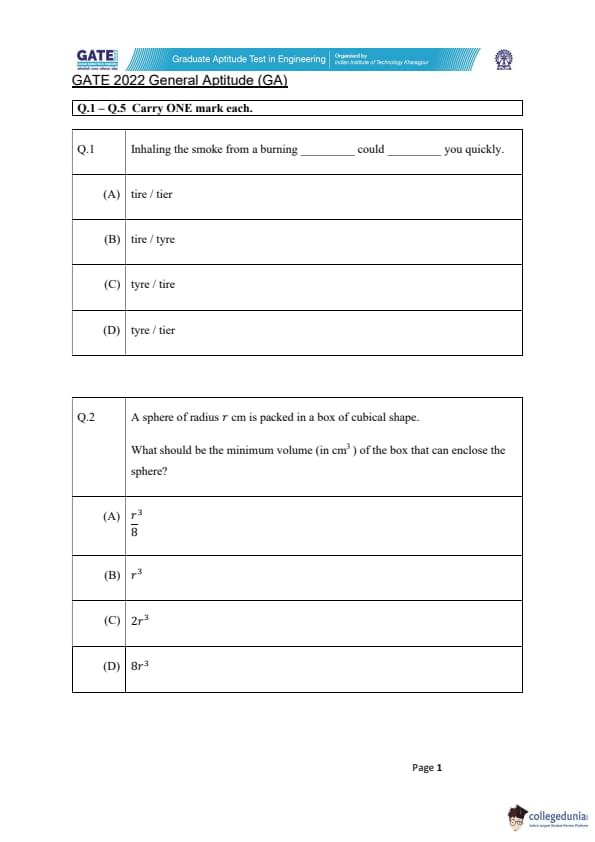
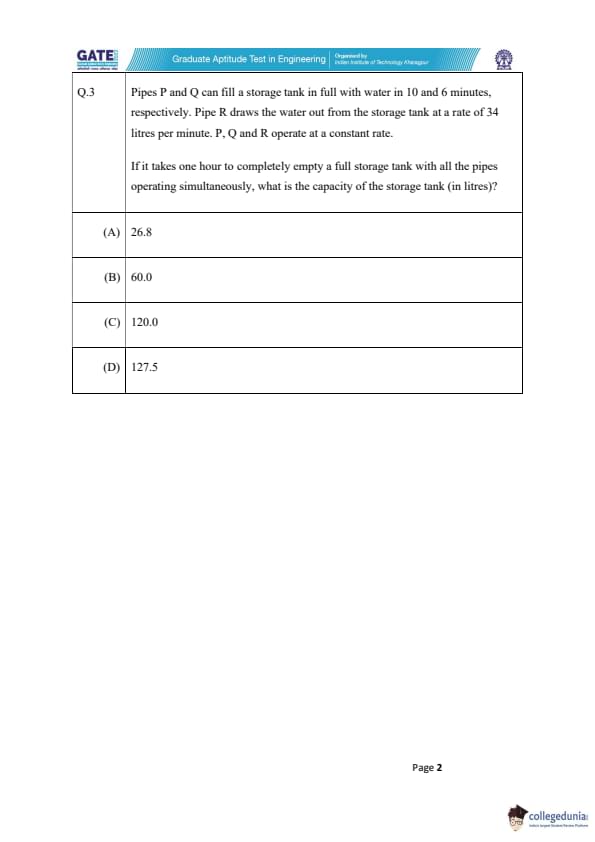
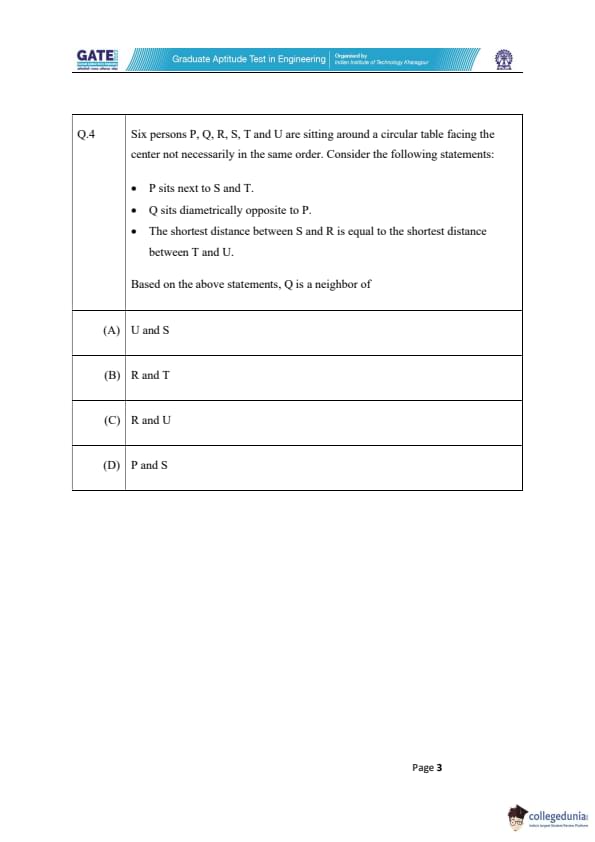
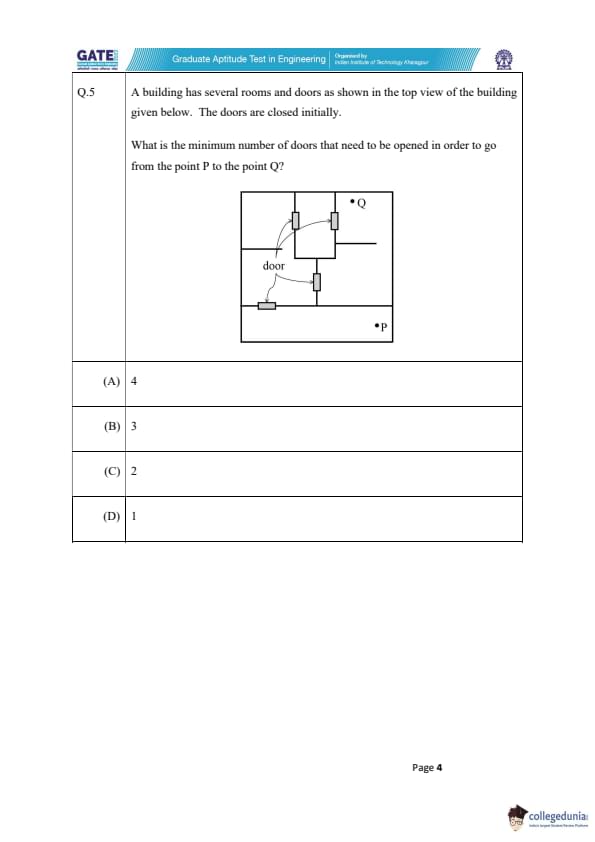
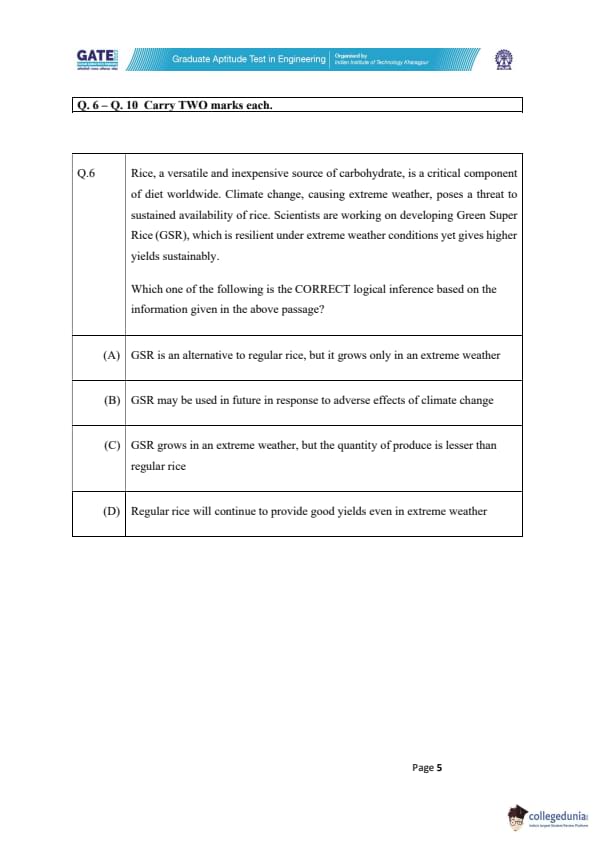
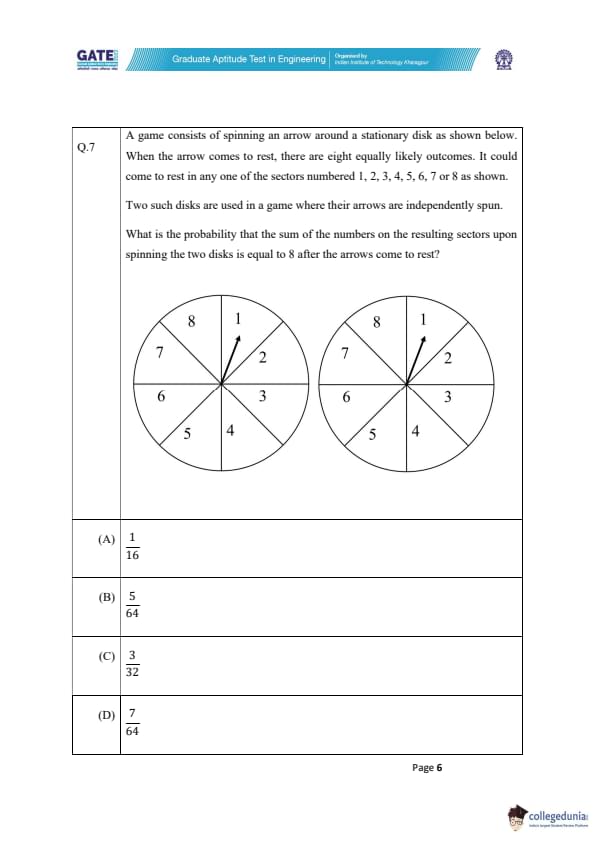
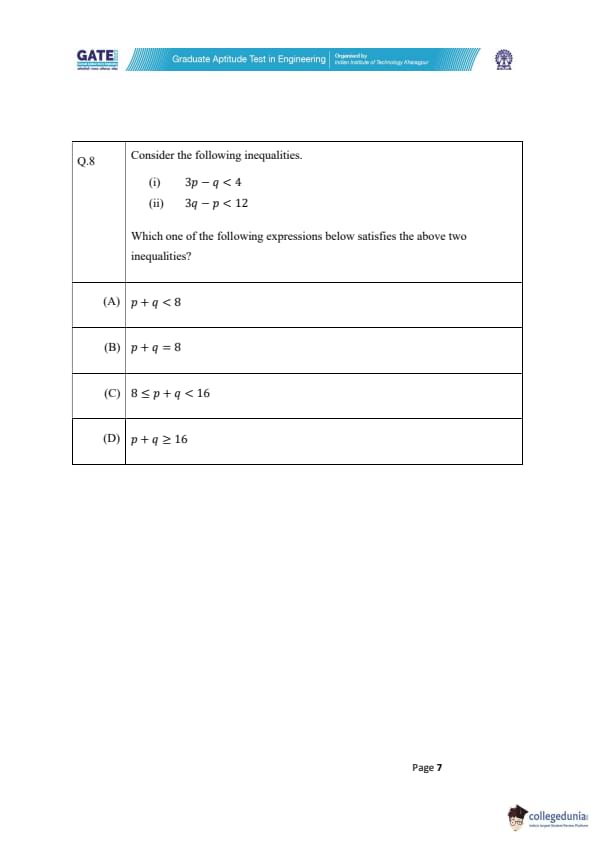
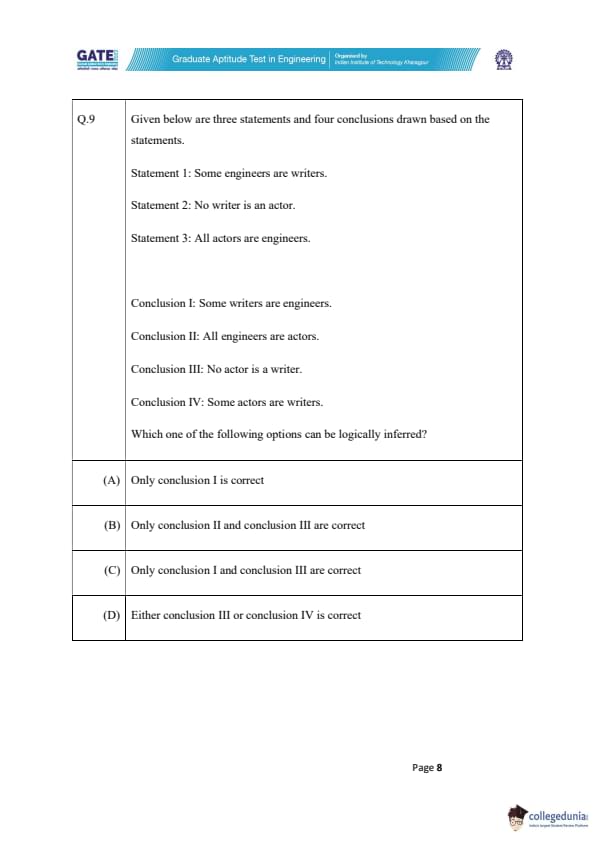
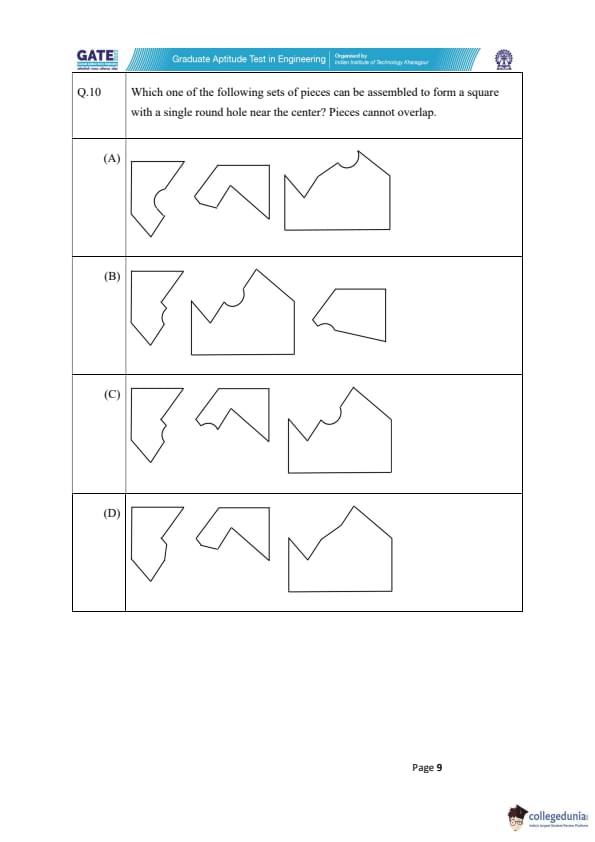
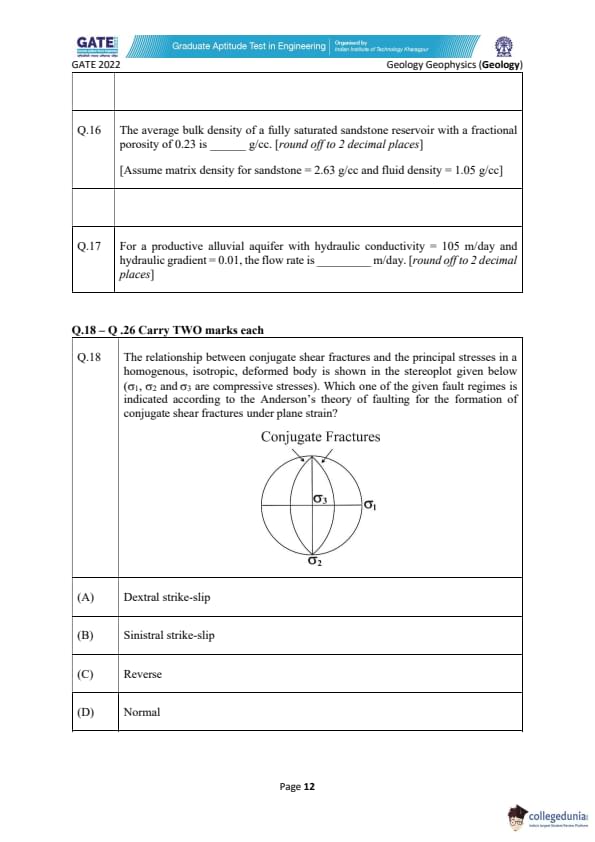
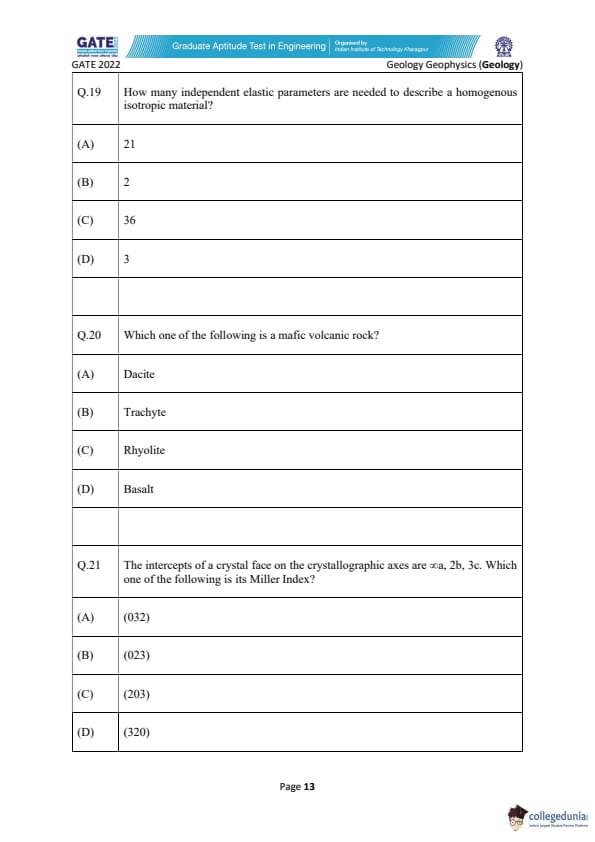
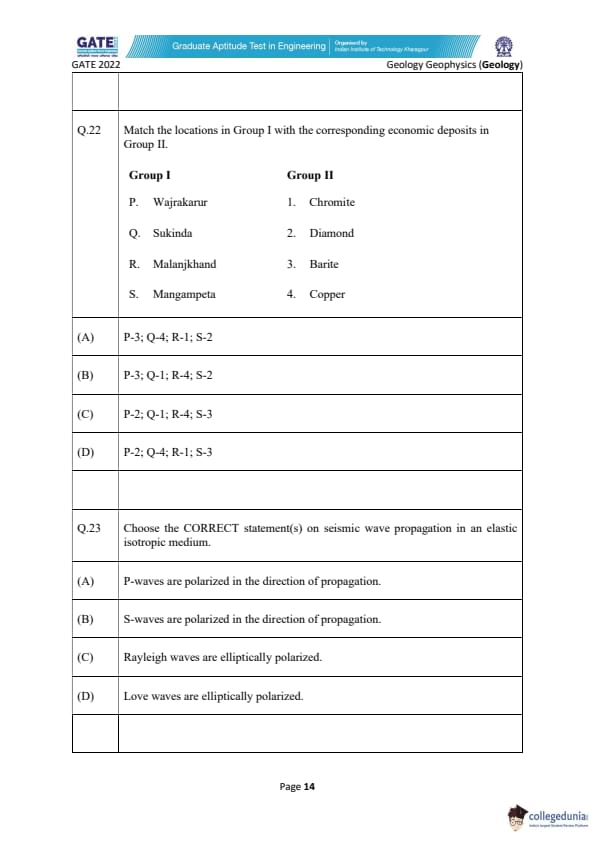
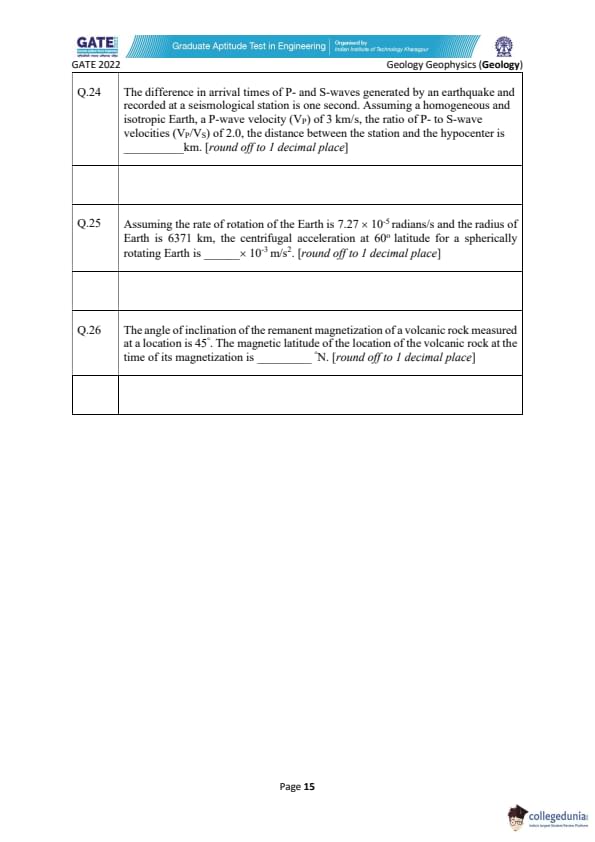
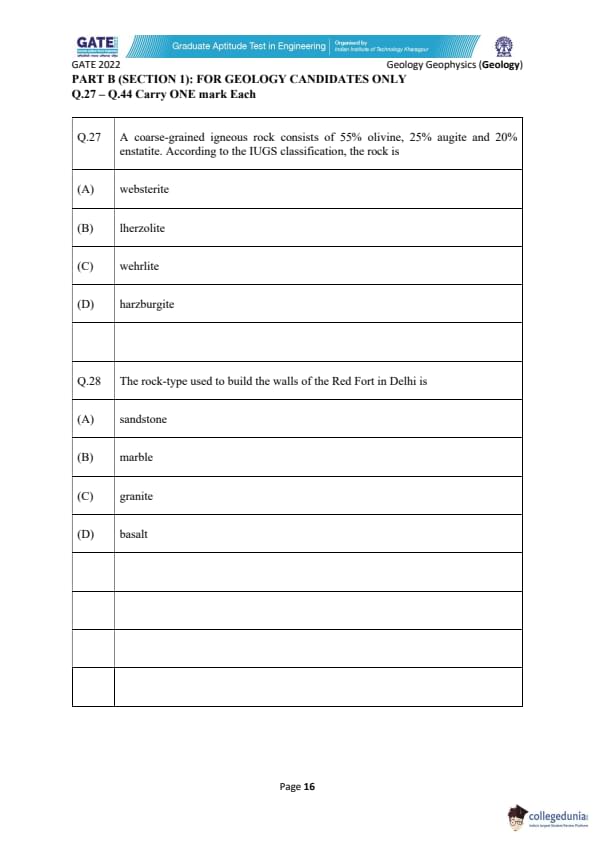
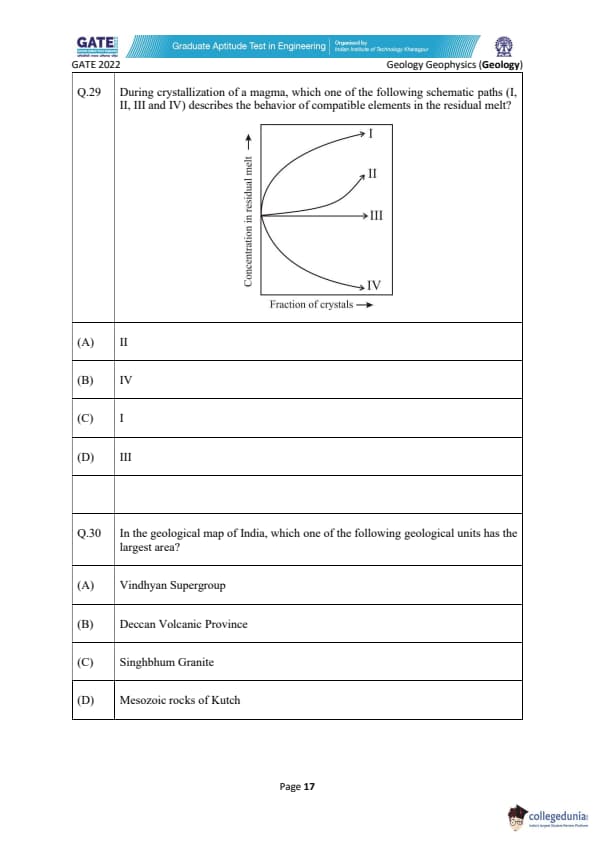

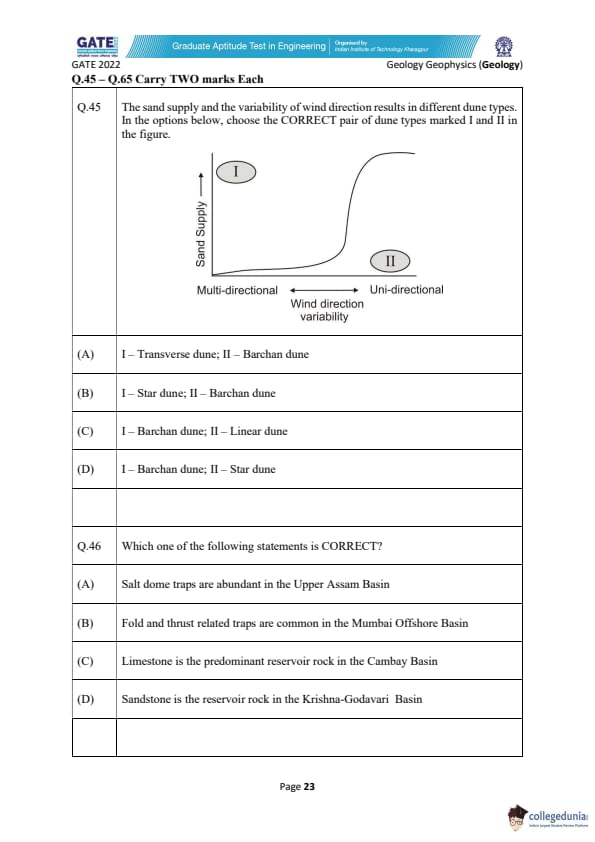
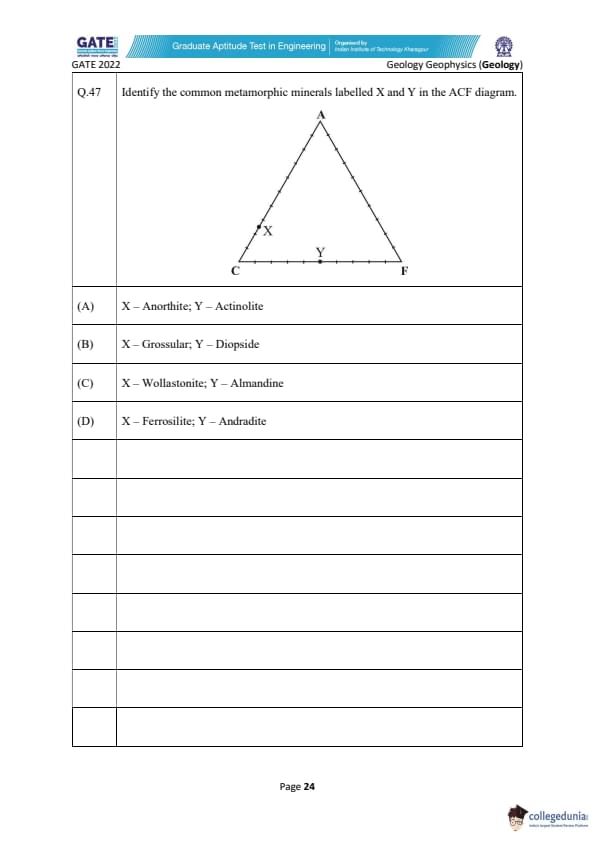
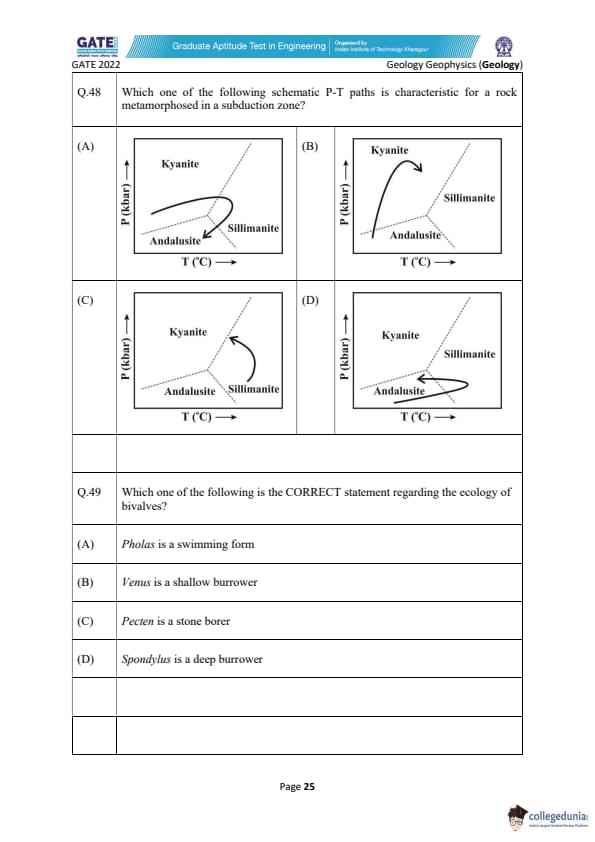
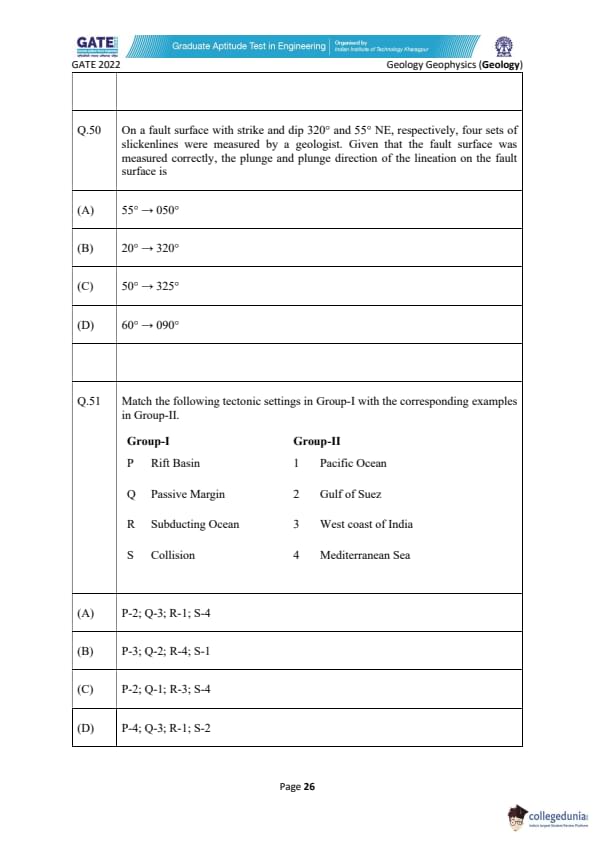
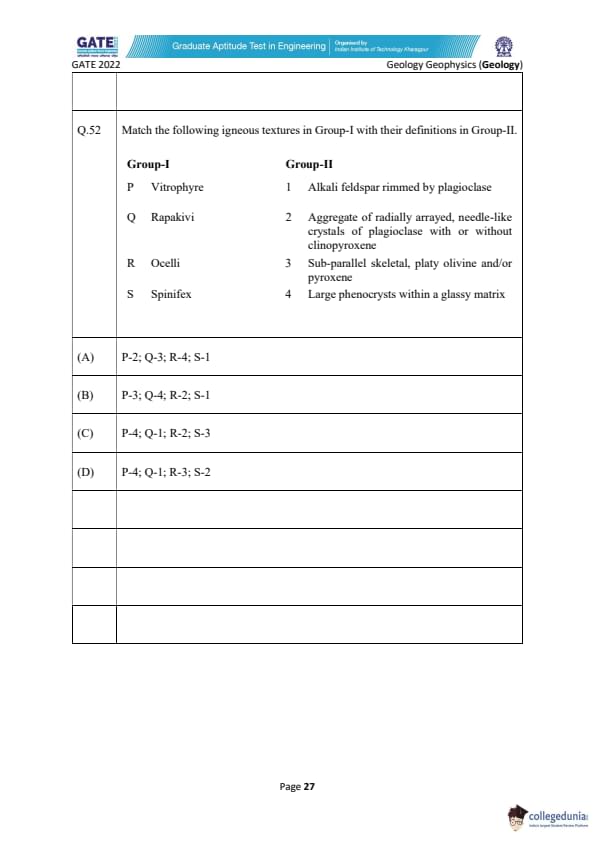
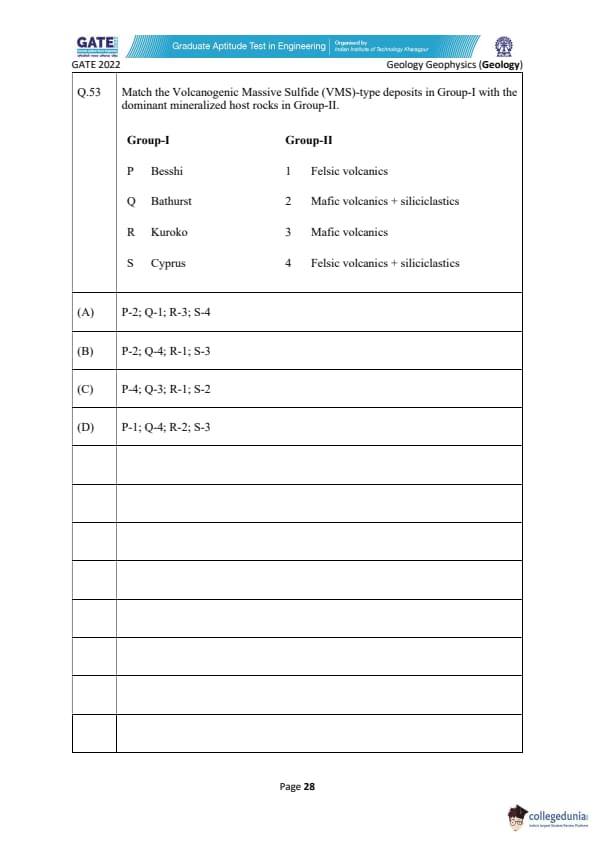
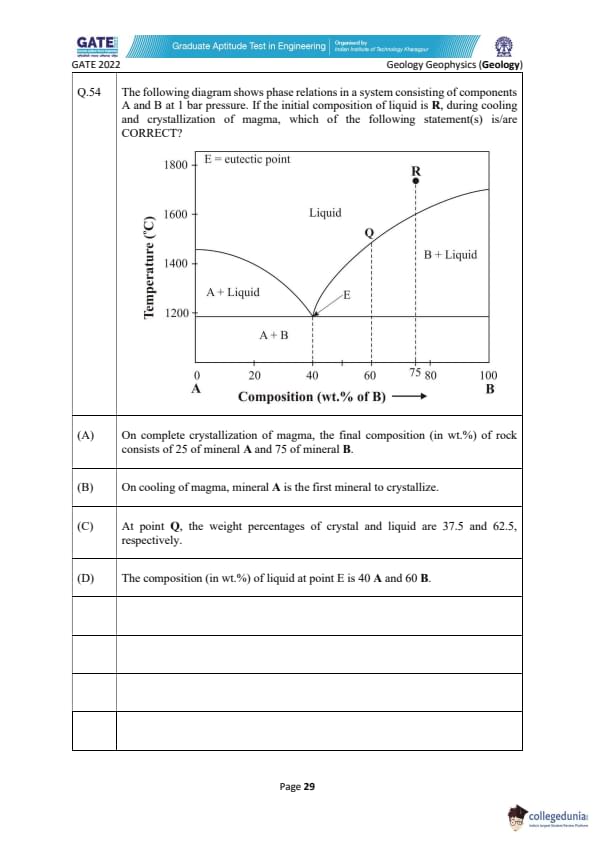
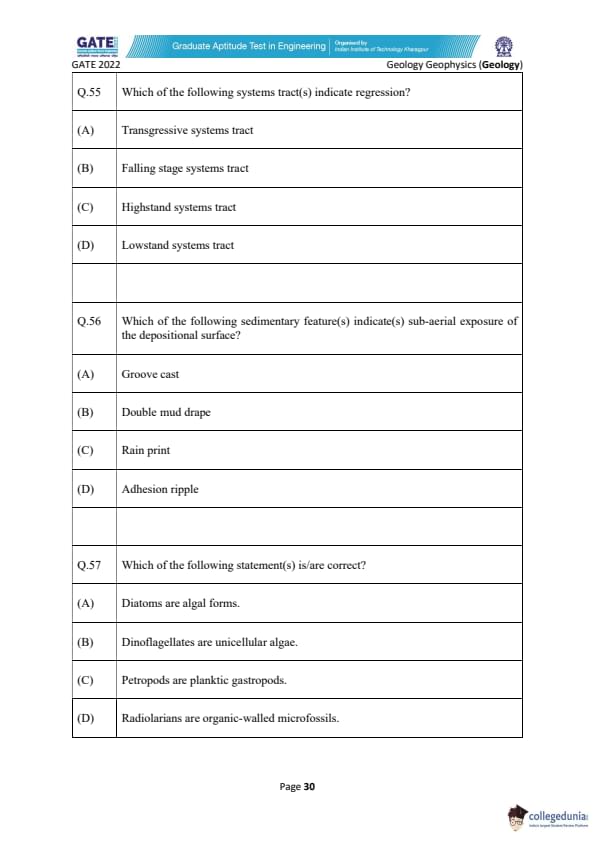
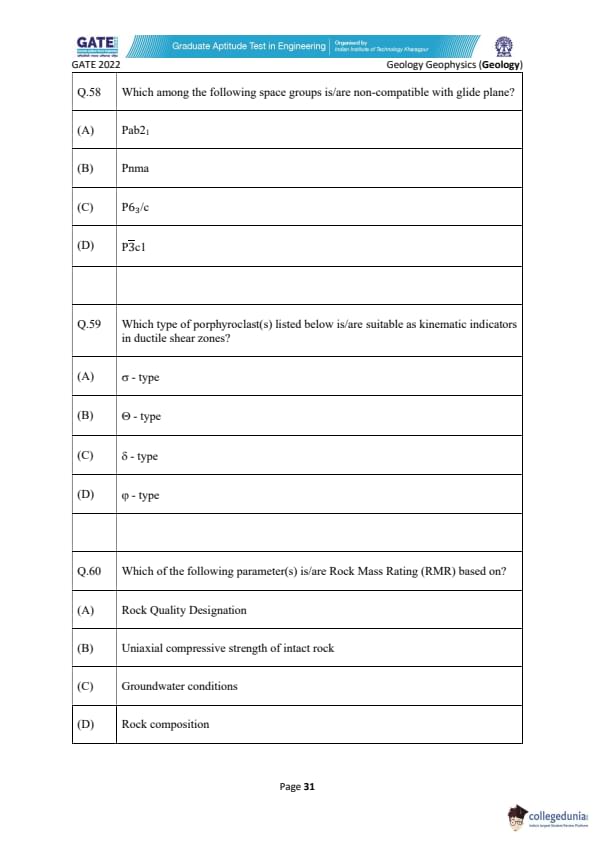
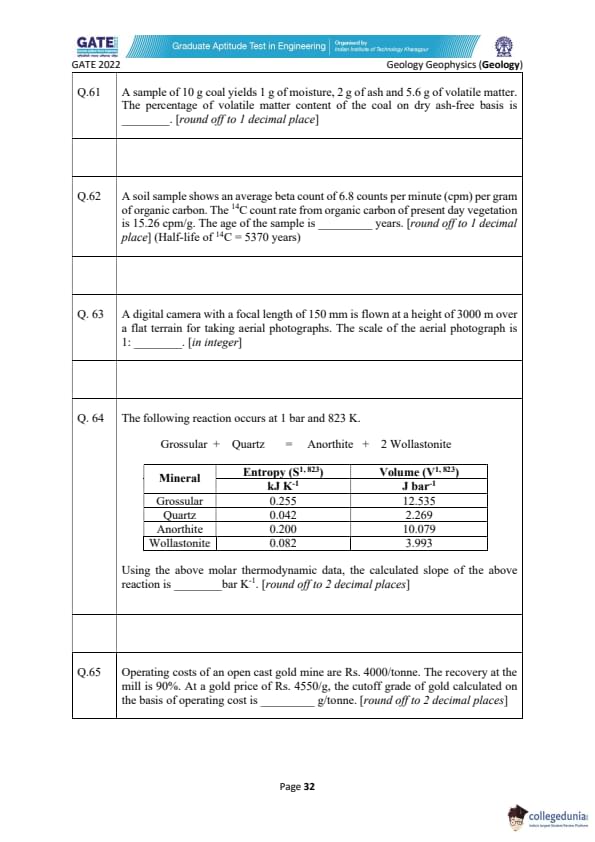
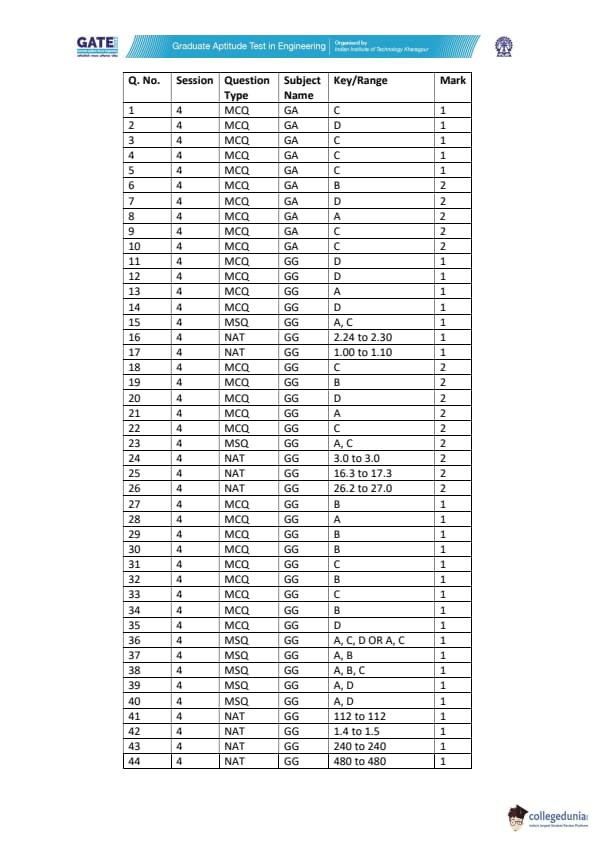
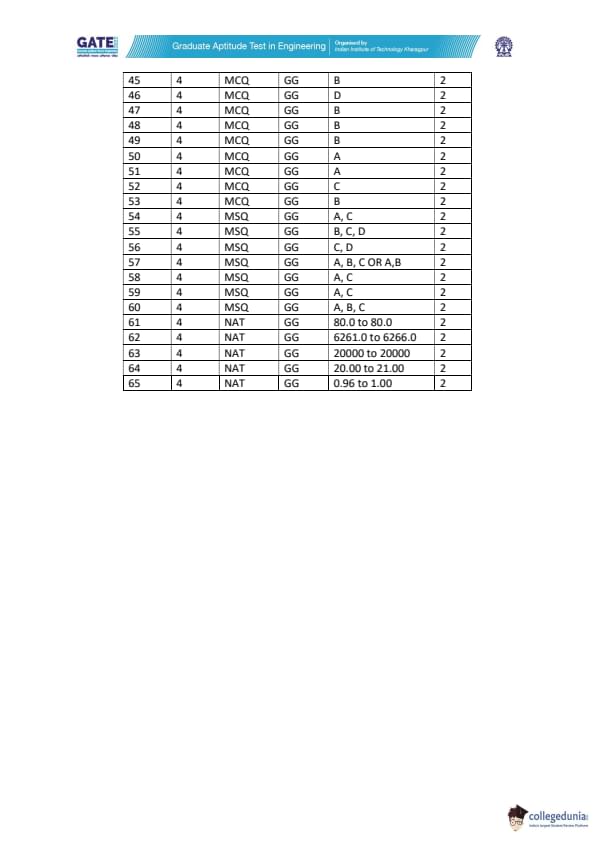

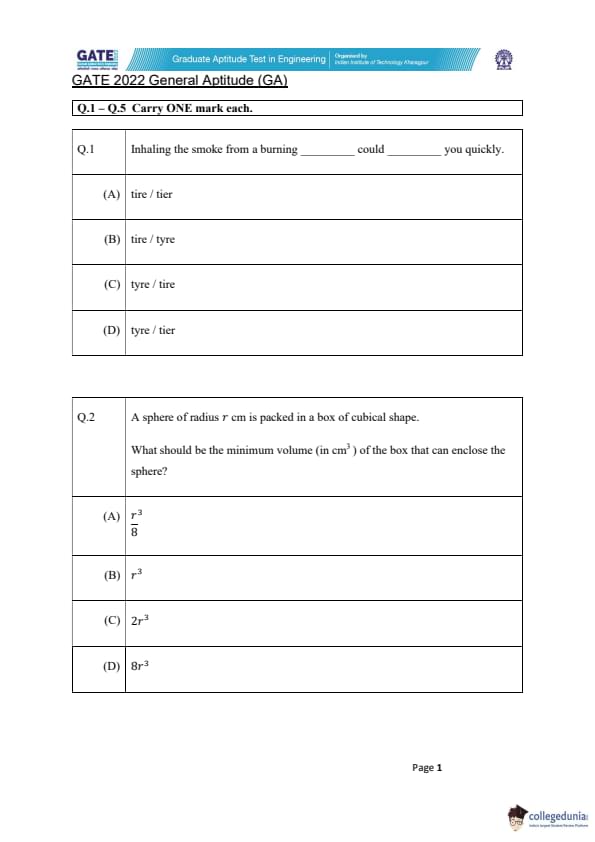
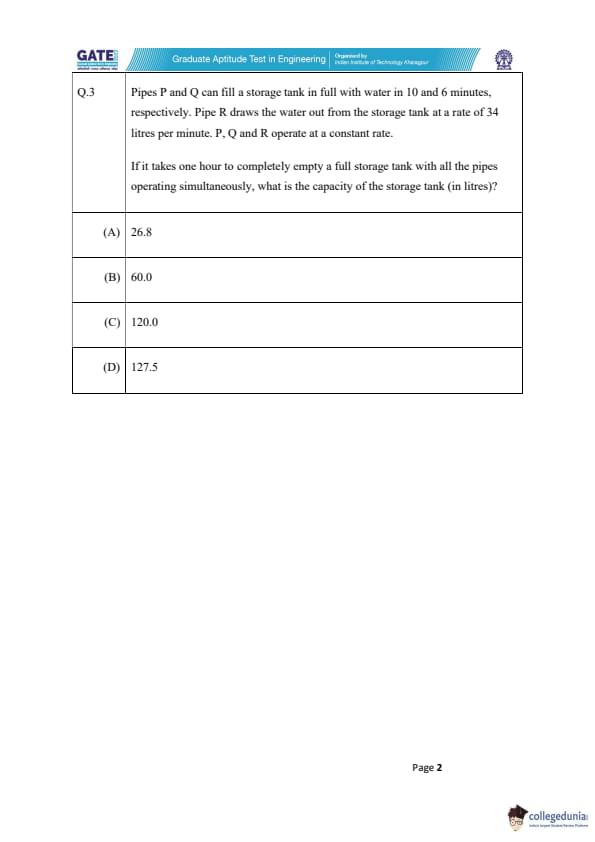
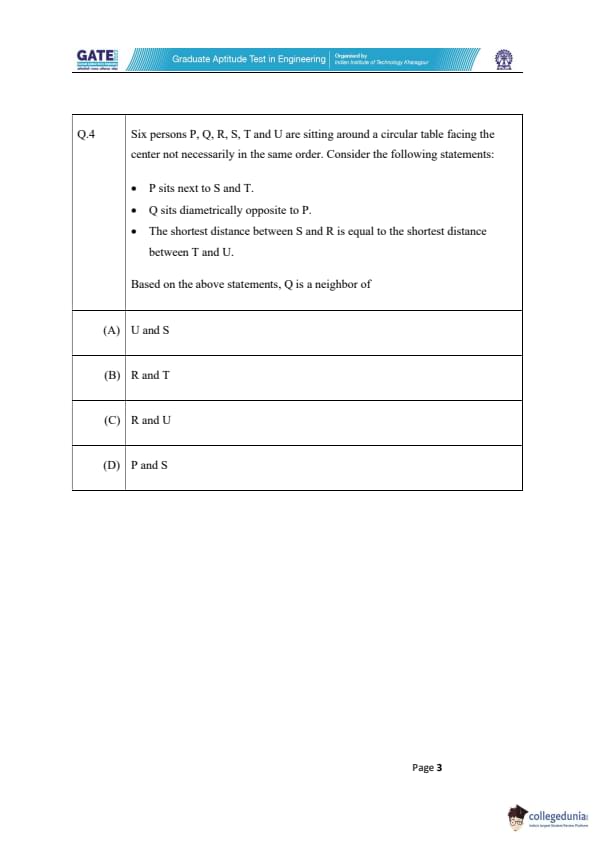
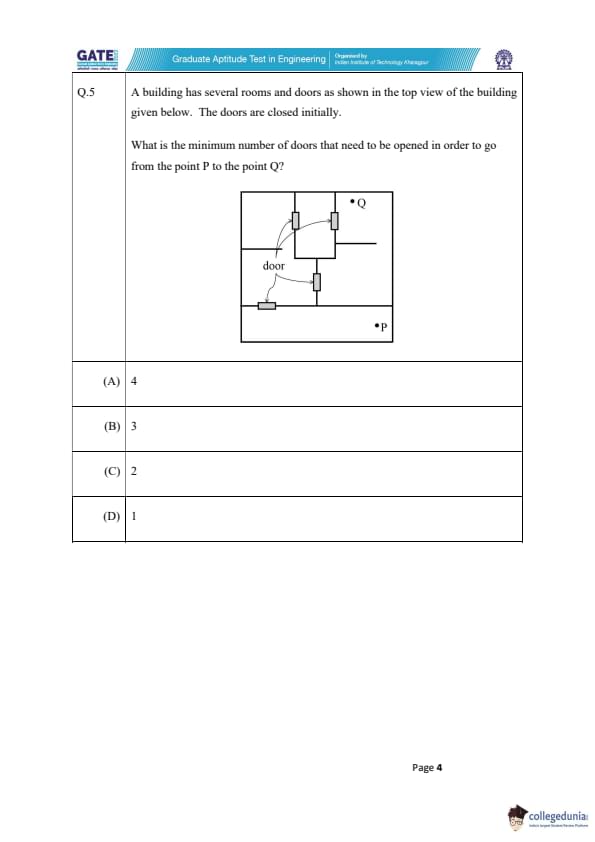
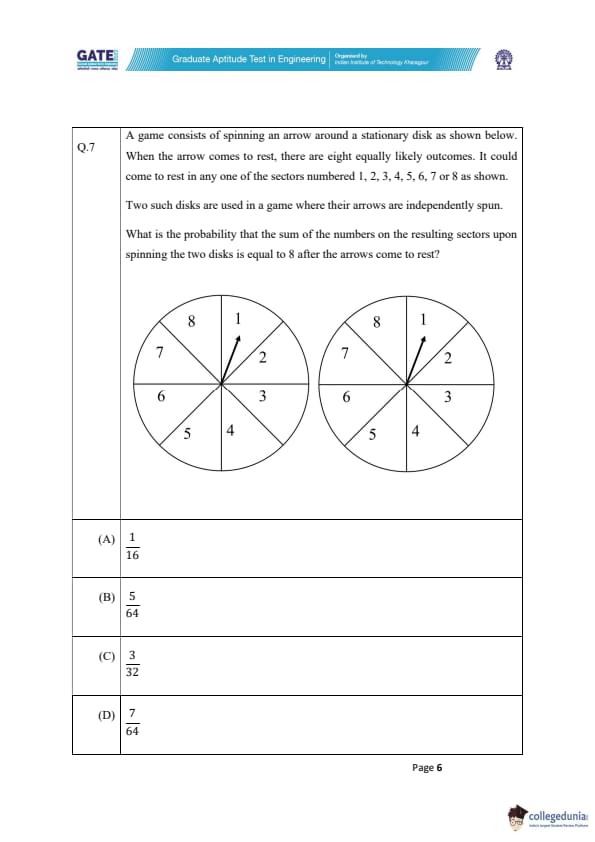
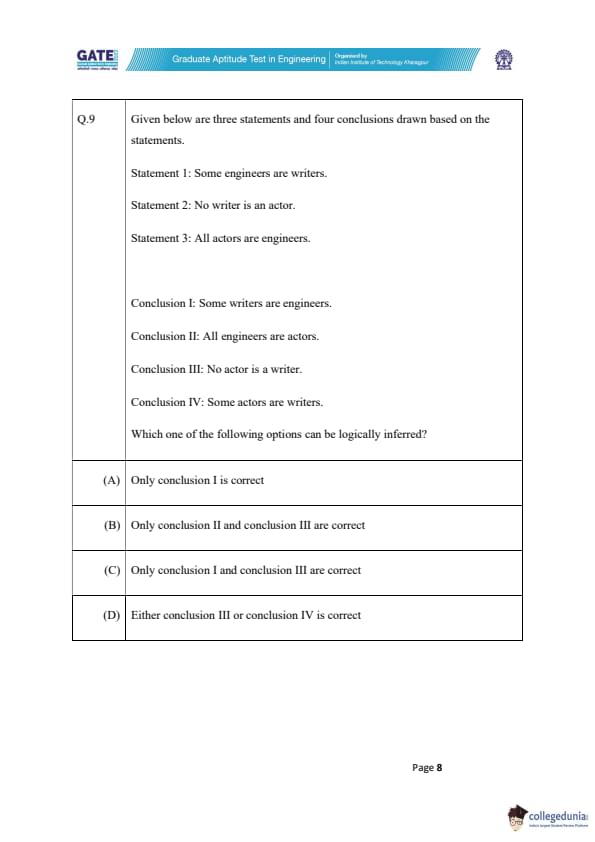
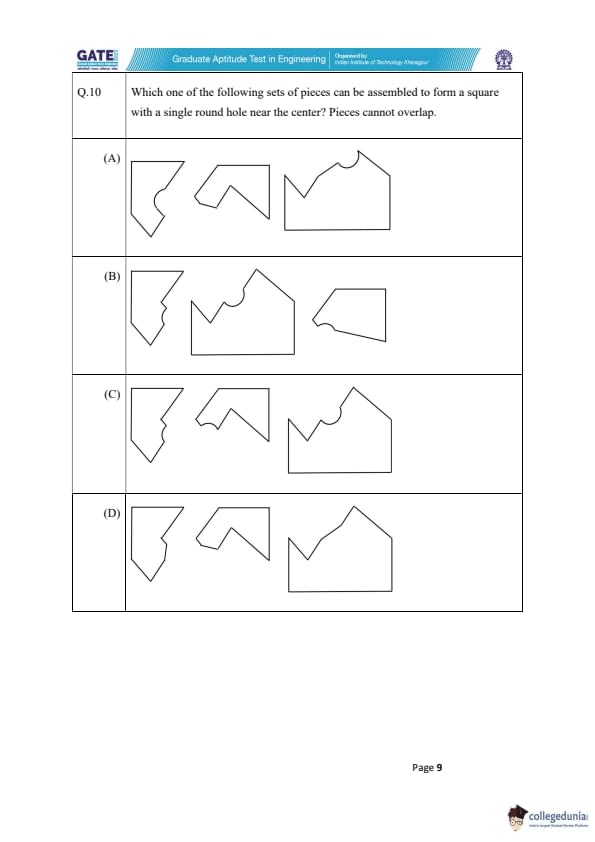
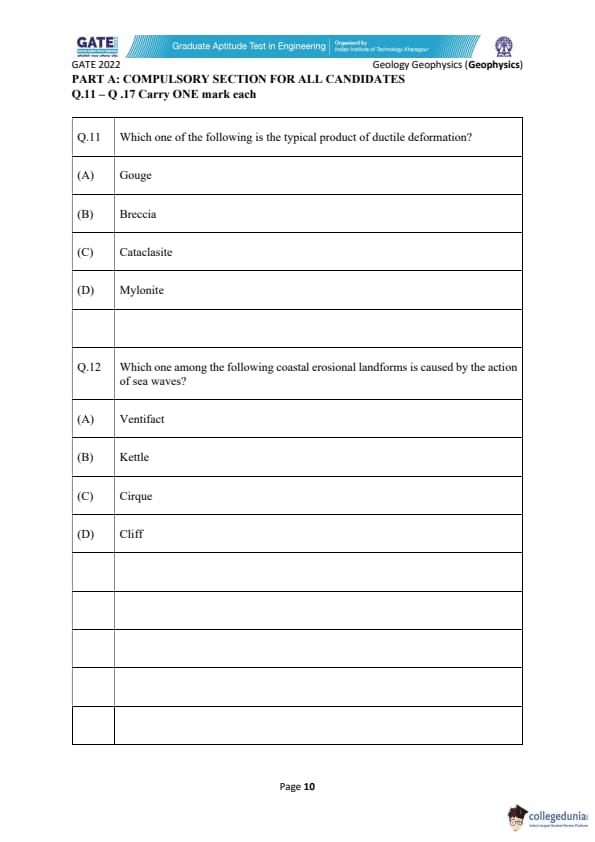
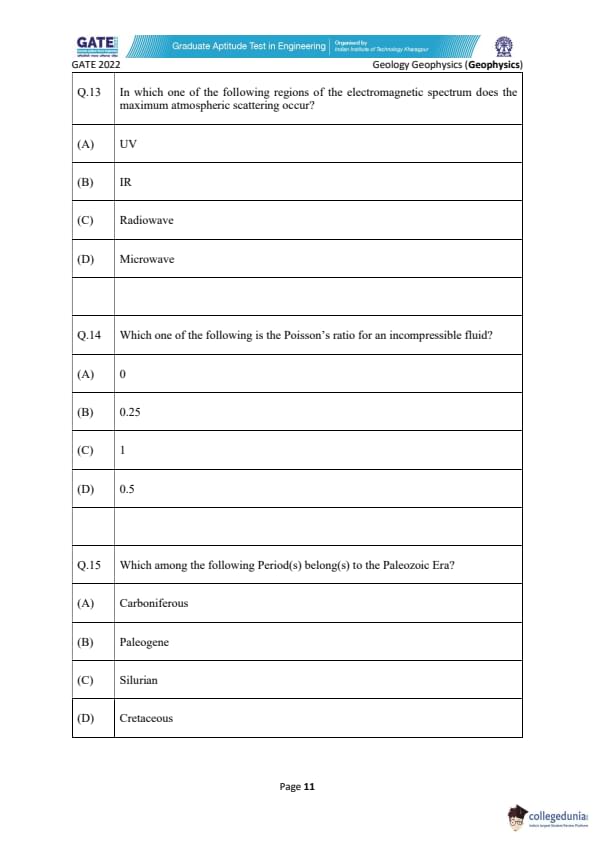
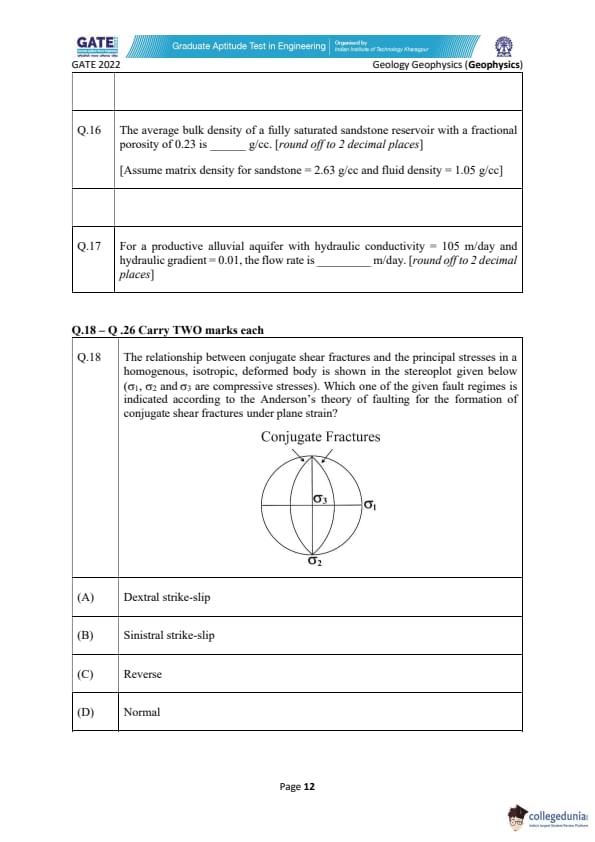
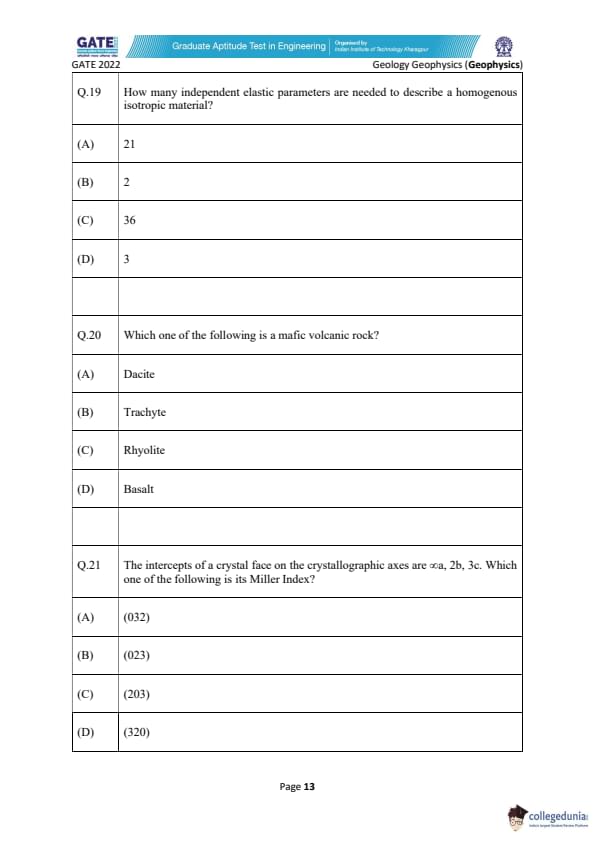
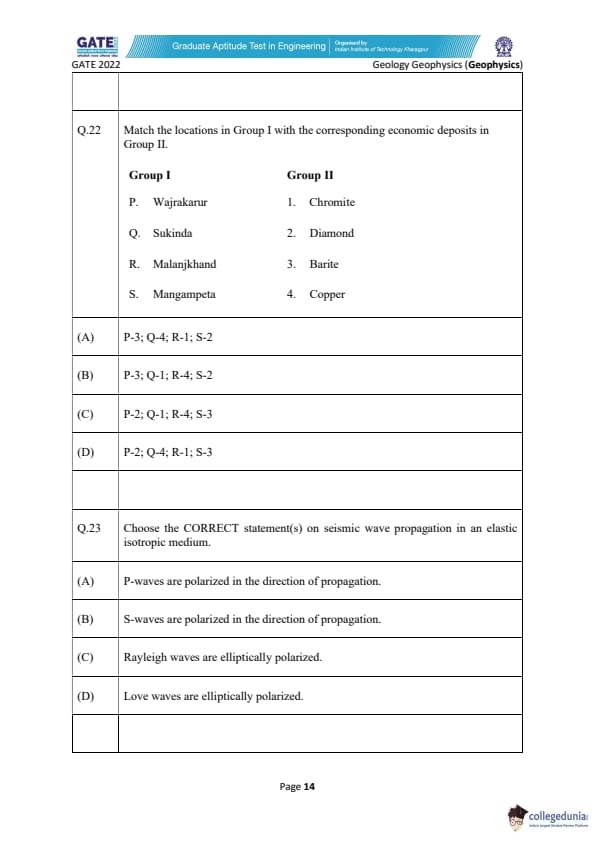

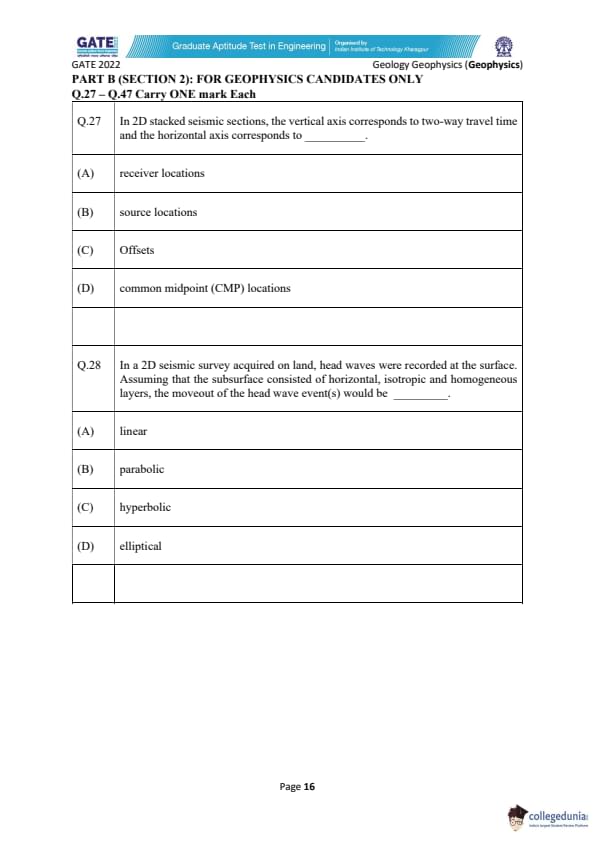
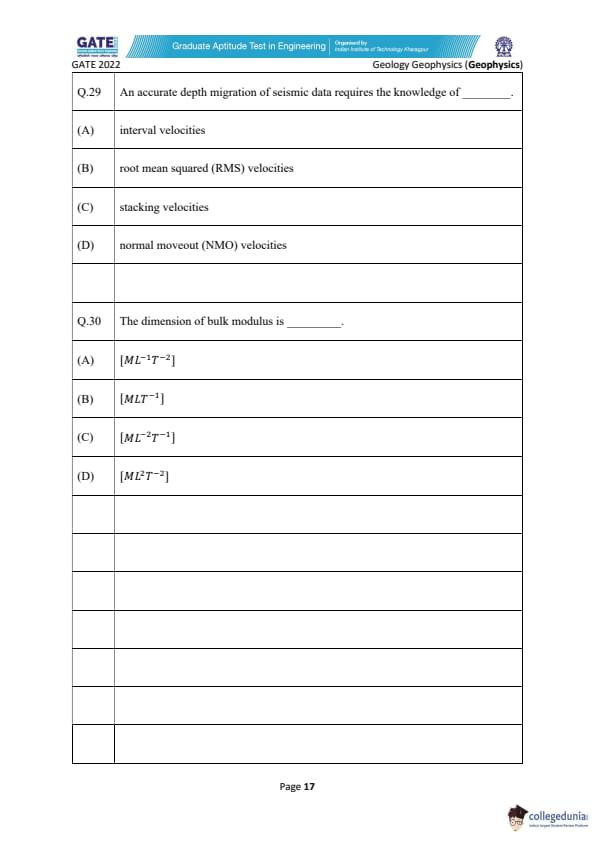
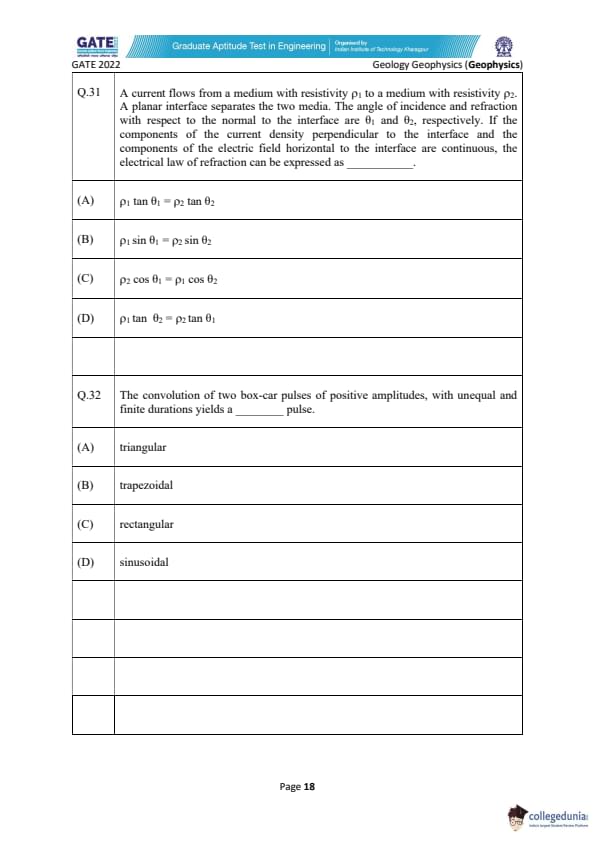
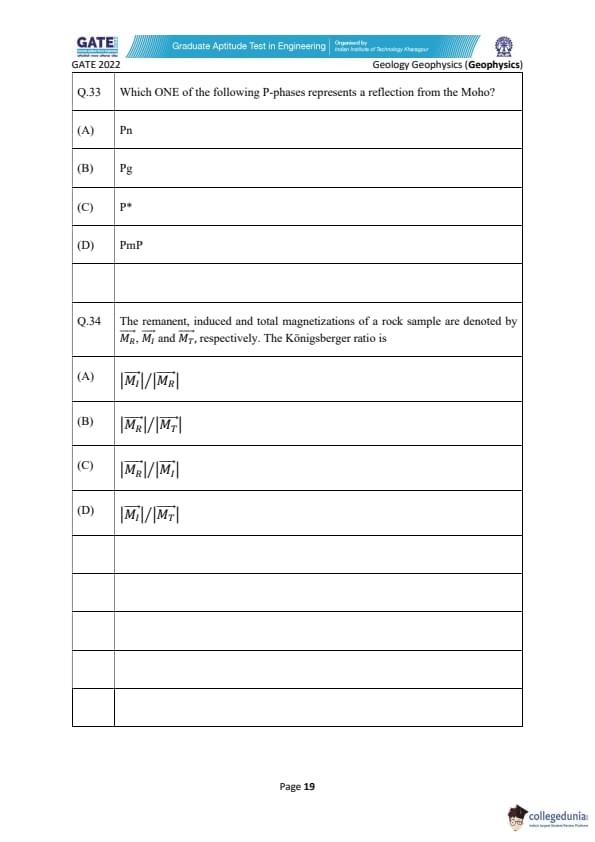
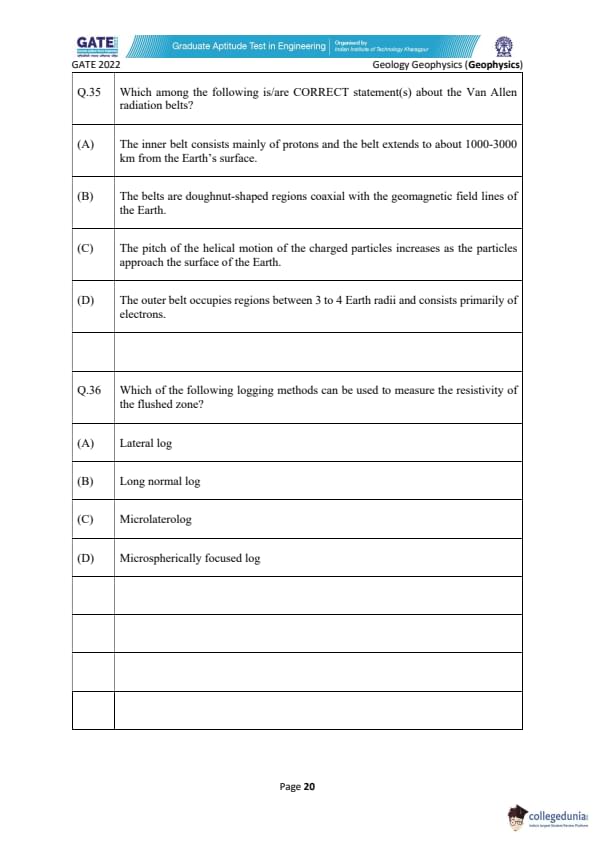
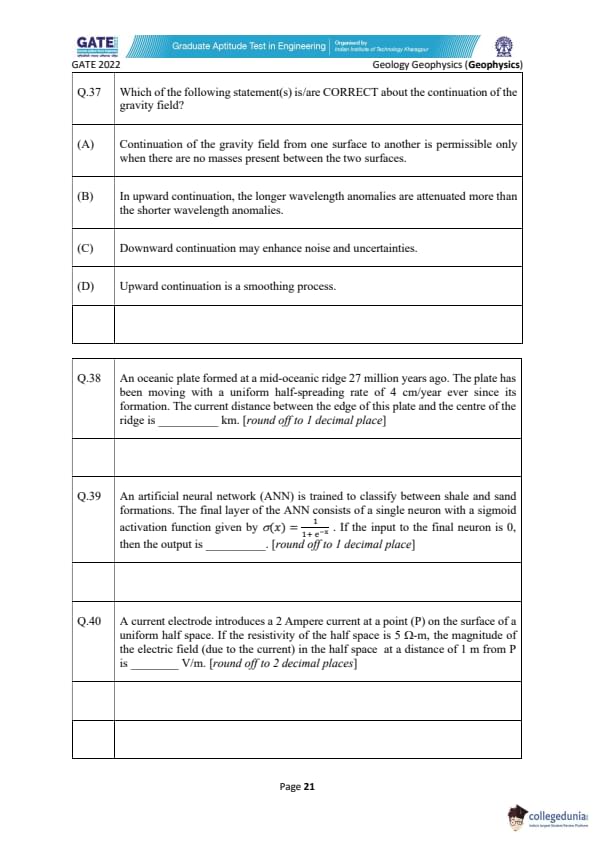
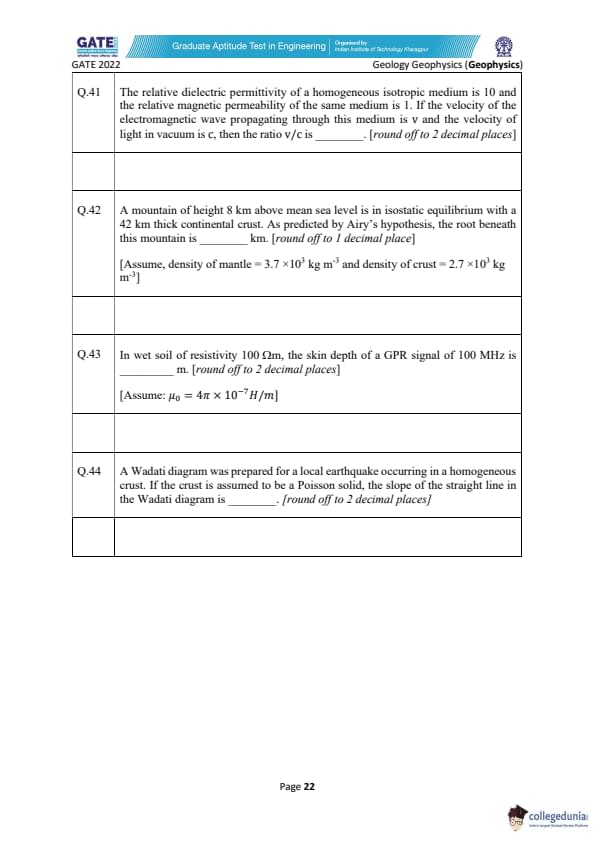
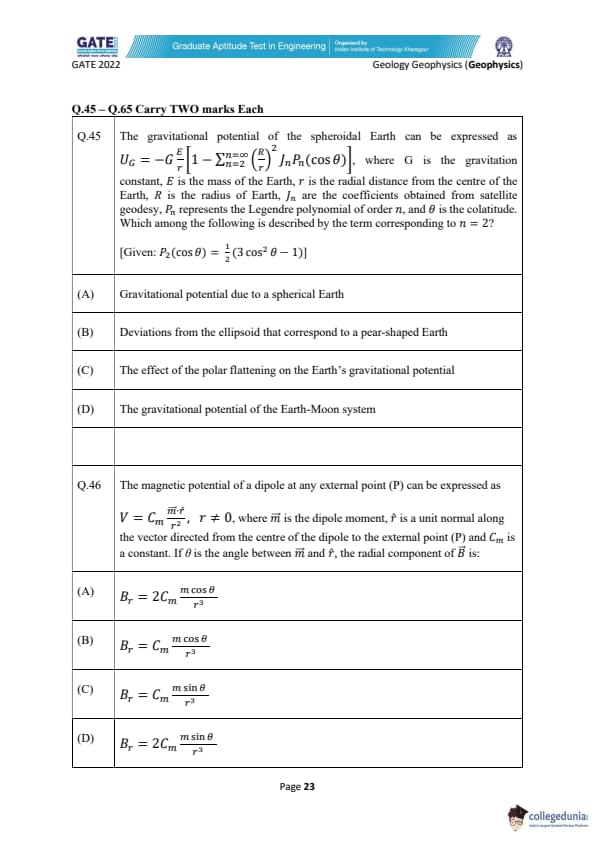
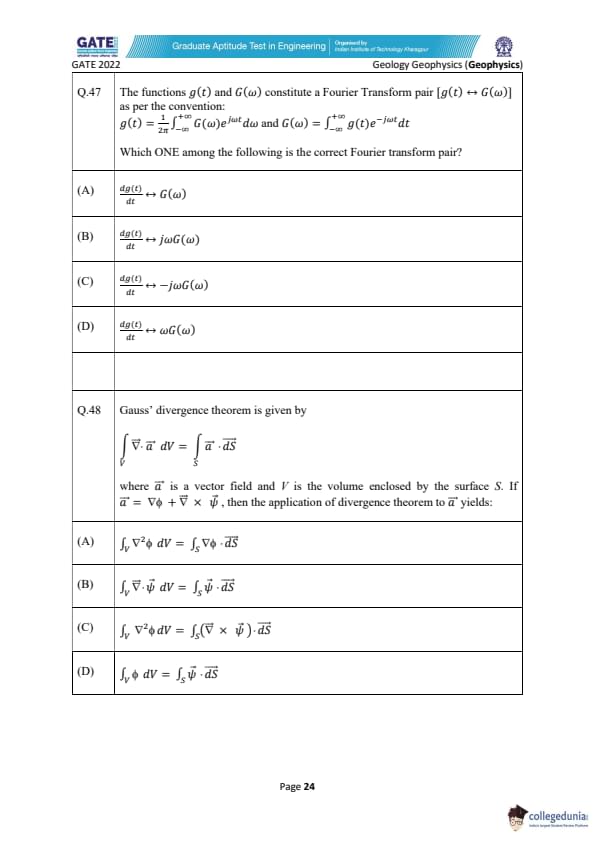
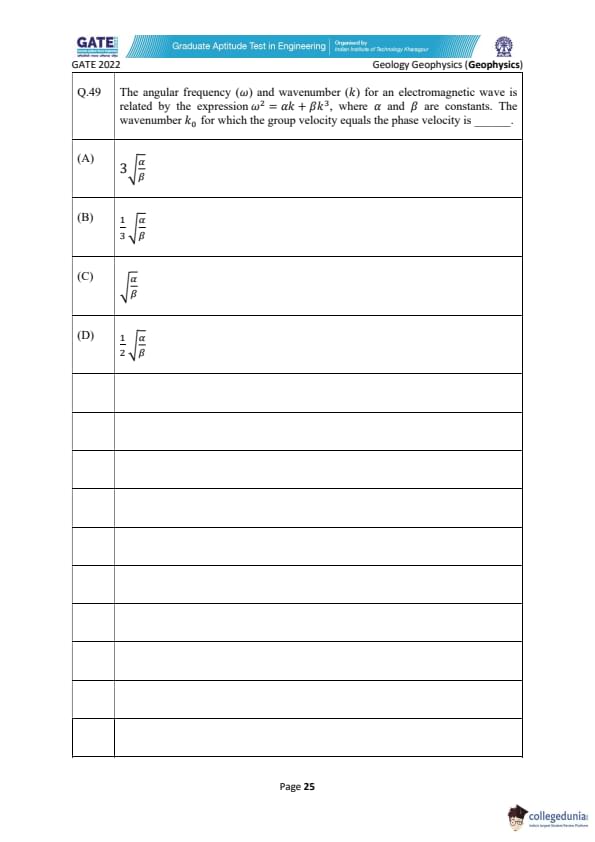

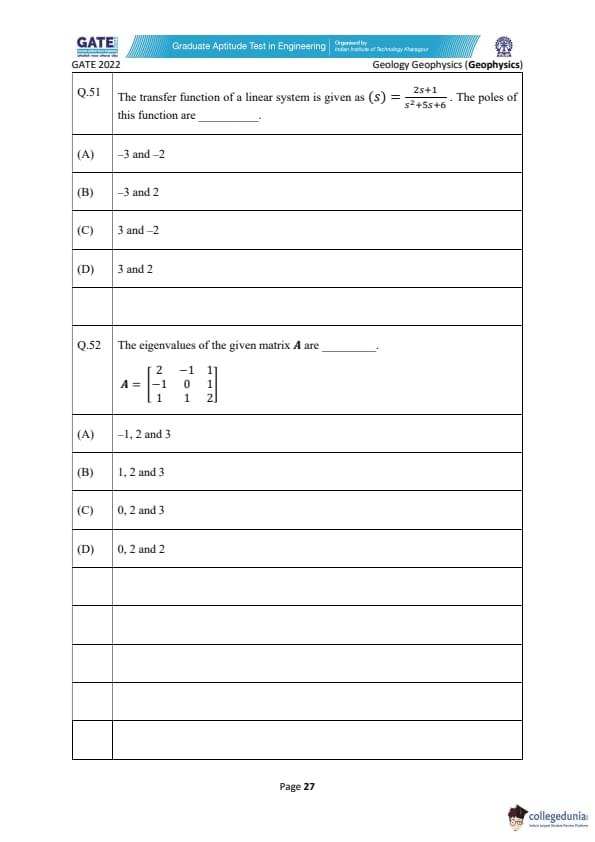
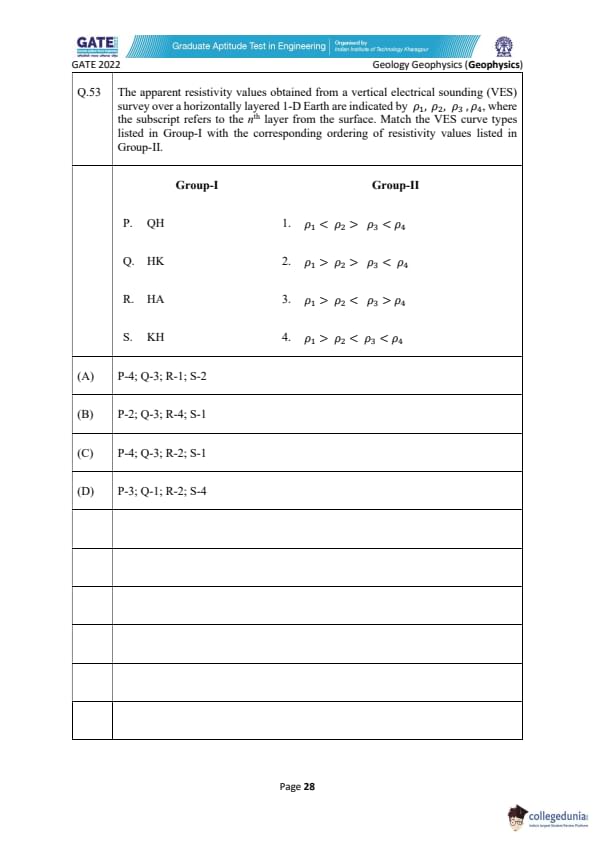
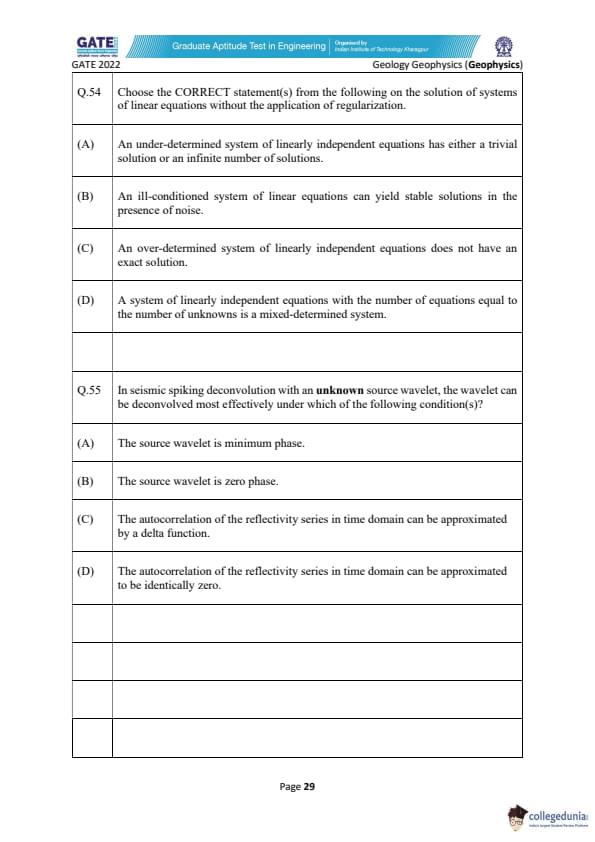
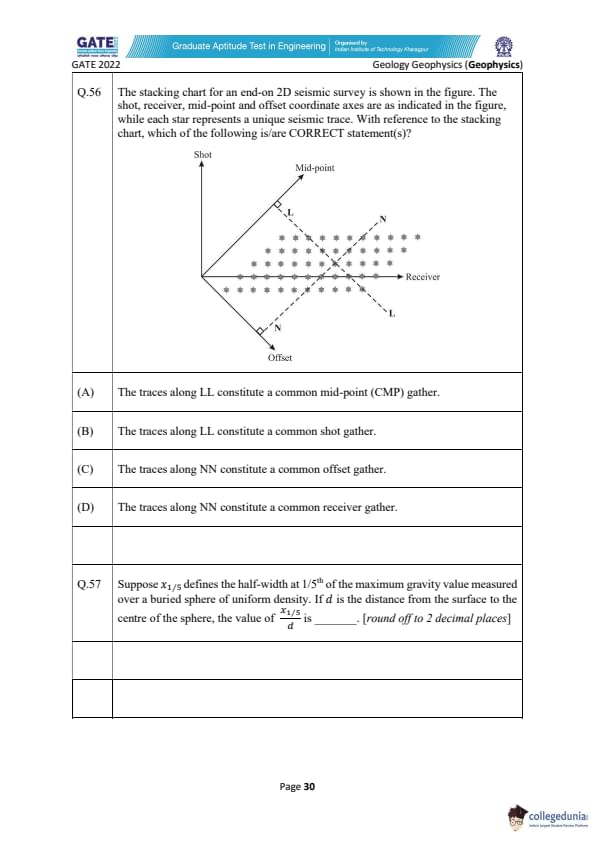
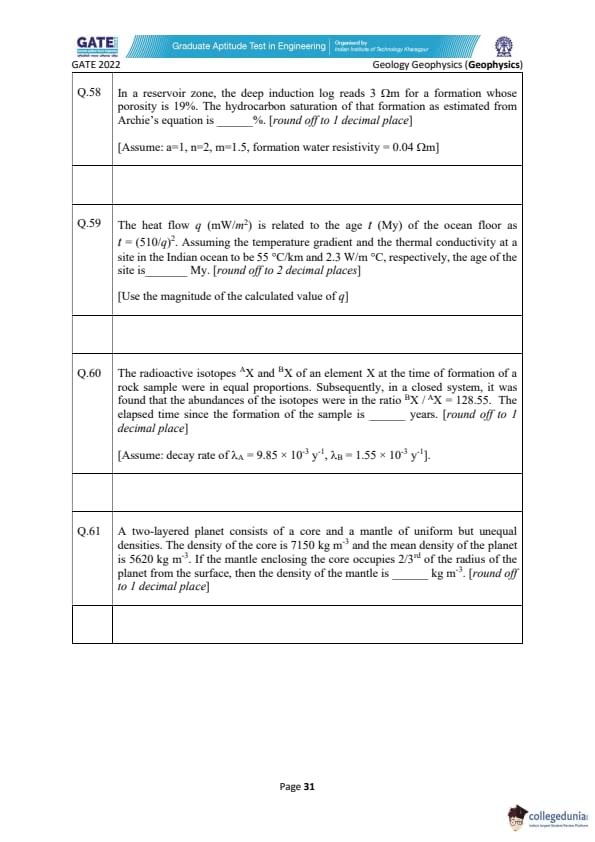
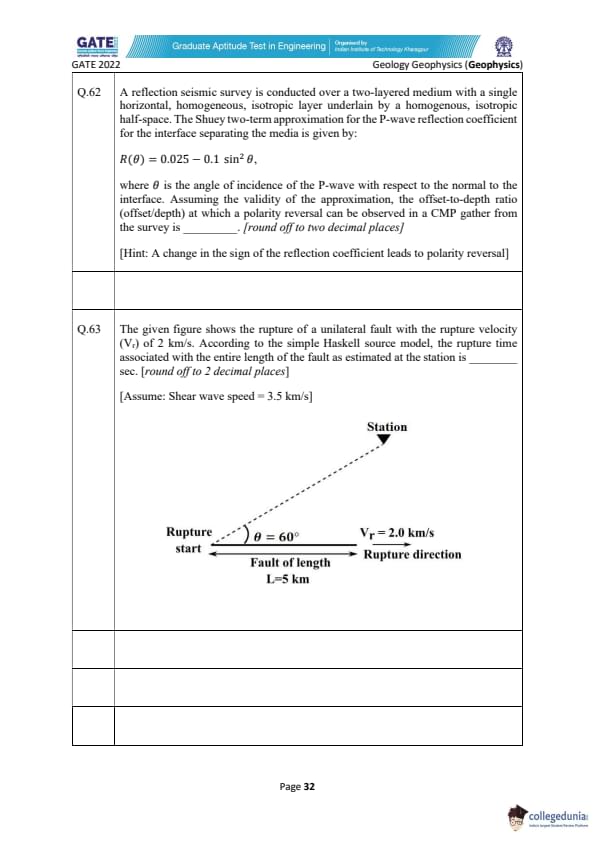

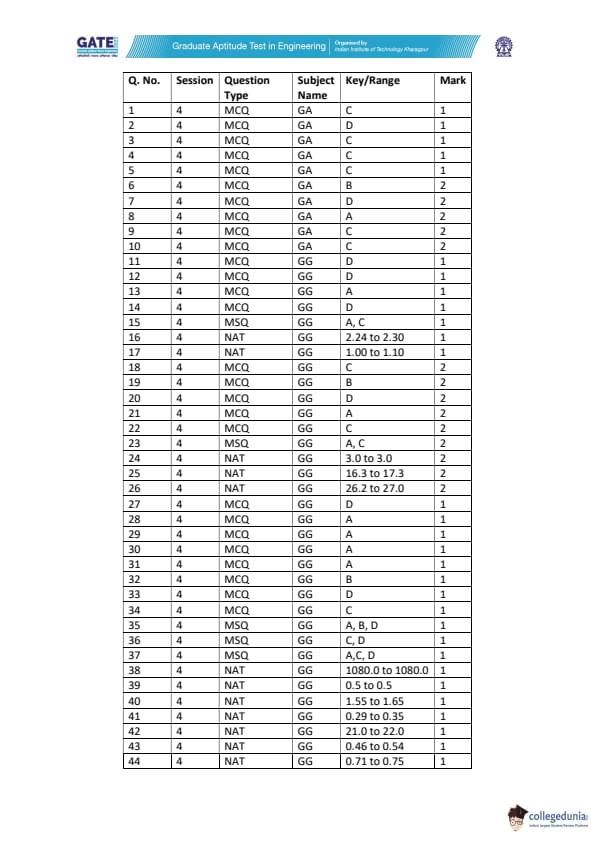
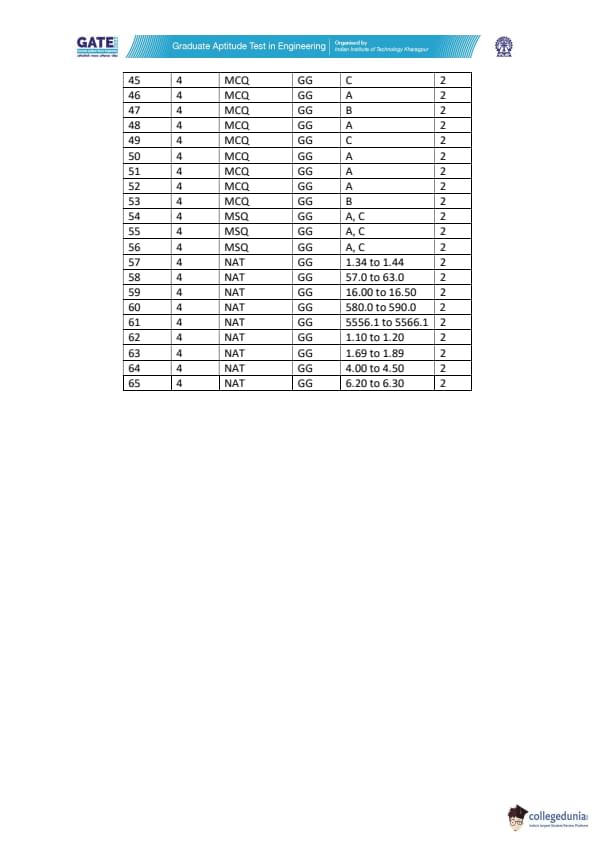


GATE 2022 GG Answer Key Details
| Question No. | Answer | Question No. | Answer |
|---|---|---|---|
| 1 | C | 34 | B |
| 2 | D | 35 | D |
| 3 | C | 36 | A, C, D OR A, C |
| 4 | C | 37 | A, B |
| 5 | C | 38 | A, B, C |
| 6 | B | 39 | A, D |
| 7 | D | 40 | A, D |
| 8 | A | 41 | 112 to 112 |
| 9 | C | 42 | 1.4 to 1.5 |
| 10 | C | 43 | 240 to 240 |
| 11 | D | 44 | 480 to 480 |
| 12 | D | 45 | B |
| 13 | A | 46 | D |
| 14 | D | 47 | B |
| 15 | A, C | 48 | B |
| 16 | 2.24 to 2.30 | 49 | B |
| 17 | 1.00 to 1.10 | 50 | A |
| 18 | C | 51 | A |
| 19 | B | 52 | C |
| 20 | D | 53 | B |
| 21 | A | 54 | A, C |
| 22 | C | 55 | B, C, D |
| 23 | A, C | 56 | C, D |
| 24 | 3.0 to 3.0 | 57 | A, B, C OR A,B |
| 25 | 16.3 to 17.3 | 58 | A, C |
| 26 | 26.2 to 27.0 | 59 | A, C |
| 27 | B | 60 | A, B, C |
| 28 | A | 61 | 80.0 to 80.0 |
| 29 | B | 62 | 6261.0 to 6266.0 |
| 30 | B | 63 | 20000 to 20000 |
| 31 | C | 64 | 20.00 to 21.00 |
| 32 | B | 65 | 0.96 to 1.00 |
| 33 | C |
GATE 2022 GG Paper Analysis
- The General Aptitude for GATE 2022 GG was moderately difficult but the core subjects were of high difficulty levels.
- As compared to 2021, GATE 2022 GG question paper was reported to be slightly difficult.
- NATs contained maximum markings and MSQs were not asked in the paper making it more scoring.
- A total of 35- 40 NATs were asked in the paper making it easier to score as there is no negative marking for Numerical Ability Type questions.
- Candidates found a lot of calculative questions making the paper a bit lengthier. However, the concepts were basic (not required in-depth analysis) and a candidate with good practice could easily meet the cut-off.
In the table mentioned below, a total of different types of questions with carried marks are tabulated for GATE 2022 GG Question Paper:
| Types of Questions | Questions Frequency | Total marks carried |
|---|---|---|
| MCQs carrying 1 mark | 20 | 20 |
| MCQs carrying 2 marks | 5 | 10 |
| NATs carrying 1 mark | 10 | 10 |
| NATs carrying 2 marks | 30 | 60 |
| Total | 65 | 100 |
GATE Previous Year Question Papers
GATE exam aspirants are advised to solve GATE previous year question papers to increase their precision level. The table given below contains the links to download GATE previous year question papers:
| GATE 2022 Question Papers | GATE 2021 Question Papers | GATE 2020 Question Papers |
| GATE 2019 Question Papers | GATE 2018 Question Papers | GATE 2017 Question Papers |



Comments