GATE 2022 Environmental Science and Engineering (ES) Question Paper with Solutions was successfully concluded on 6th February, 2022 by IIT Kharagpur. The overall difficulty level was rated moderate. Although students reviewed the question paper tougher as compared to last year. The question paper had three sections General Aptitude, Engineering Mathematics, and Environmental Science based questions. Maximum weightage was carried by ES based questions.
GATE 2022 Environmental Science and Engineering (ES) Question Paper with Solutions
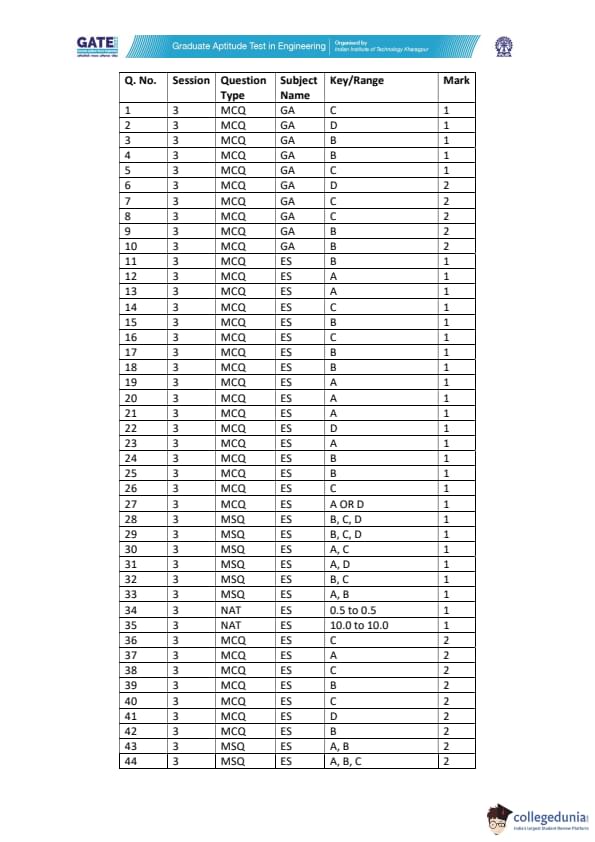
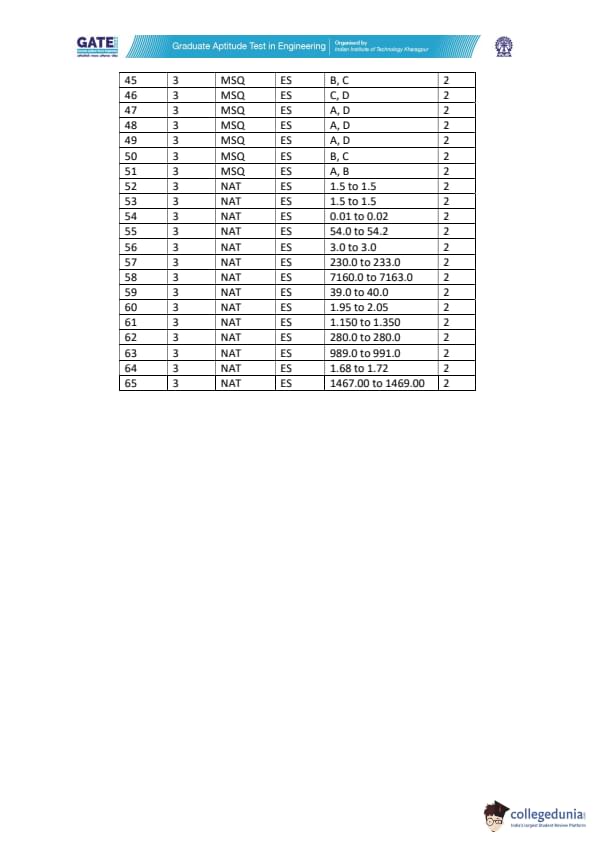
Candidates targeting GATE can download the PDFs for GATE 2022 ES Question Paper and ASolutions to know the important topics asked, and check their preparation level by solving the past question papers.
| GATE 2022 Environmental Science and Engineering (ES) Question Paper | Check Solutions |

Mr. X speaks _____ Japanese _____ Chinese.
View Solution
Step 1: Understanding the Sentence.
The sentence "Mr. X speaks _____ Japanese _____ Chinese." involves two languages: Japanese and Chinese. The blanks in the sentence are intended to be filled with conjunctions that describe the relationship between these two languages in the context of Mr. X's abilities. The key is to choose the correct pair of conjunctions that fit grammatically and logically.
Step 2: Analysis of Options.
Let's evaluate the options one by one:
- Option (A): "neither / or"
The structure "neither ... or" is grammatically incorrect in English. When negating two things, the correct structure is "neither ... nor," not "neither ... or." Therefore, this option is incorrect.
- Option (B): "either / nor"
The structure "either ... nor" is also grammatically incorrect in English. "Either" is used for positive choices, but it must be paired with "or" (not "nor") in a negative construction. So, this option is not correct.
- Option (C): "neither / nor"
This is the correct pair of conjunctions. "Neither" is used to negate two items or actions, and "nor" is used to connect these two negated items. The structure "neither ... nor" is the proper way to indicate that Mr. X speaks neither of the two languages.
- Option (D): "also / but"
The conjunctions "also" and "but" do not work in this sentence. "Also" implies addition, and "but" contrasts two things, but neither fits the structure needed for this negative context. Therefore, this option is incorrect.
Step 3: Conclusion.
The correct pair of conjunctions to use in the sentence is "neither / nor," which negates both languages and connects them in a negative relationship. Therefore, the correct sentence should read: \[ Mr. X speaks neither Japanese nor Chinese. \] Quick Tip: In English, use "neither ... nor" to connect two items or actions that are both negated. This structure is often used when neither of the two choices applies.
A sum of money is to be distributed among P, Q, R, and S in the proportion 5 : 2 : 4 : 3, respectively.
If R gets ₹1000 more than S, what is the share of Q (in ₹)?
View Solution
Let the total sum be represented by \( x \). The shares of P, Q, R, and S are in the ratio 5:2:4:3. The total number of parts is: \[ 5 + 2 + 4 + 3 = 14 parts. \]
So, the value of one part is: \[ \frac{x}{14}. \]
Now, it is given that R gets ₹1000 more than S. So, the difference between R's and S's share is: \[ 4\left(\frac{x}{14}\right) - 3\left(\frac{x}{14}\right) = \frac{x}{14}. \]
This difference is ₹1000: \[ \frac{x}{14} = 1000. \]
Solving for \( x \): \[ x = 1000 \times 14 = 14000. \]
Now, the share of Q is: \[ 2\left(\frac{14000}{14}\right) = 2 \times 1000 = 2000. \]
Thus, the share of Q is ₹2000. Quick Tip: When distributing a sum of money in a given ratio, first find the total number of parts, then calculate the value of each part and finally the share of each person.
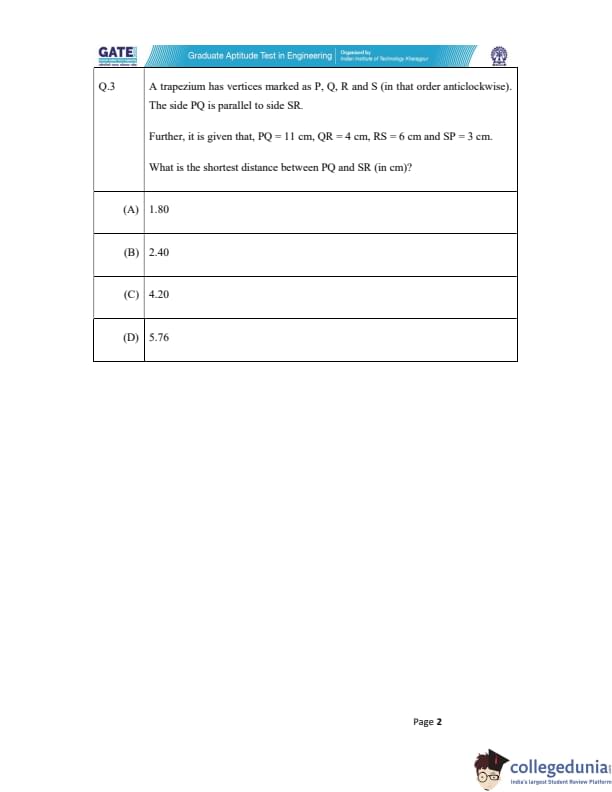
A trapezium has vertices marked as P, Q, R, and S (in that order anticlockwise). The side PQ is parallel to side SR. Further, it is given that, PQ = 11 cm, QR = 4 cm, RS = 6 cm, and SP = 3 cm. What is the shortest distance between PQ and SR (in cm)?
View Solution
The shortest distance between two parallel sides in a trapezium is the perpendicular distance between them. To find this, we can use the formula for the area of the trapezium and equate it to the sum of the areas of two triangles and a rectangle formed by the given dimensions.
First, calculate the area of the trapezium using the formula:
\[ A = \frac{1}{2} \times (b_1 + b_2) \times h \]
where \( b_1 \) and \( b_2 \) are the lengths of the parallel sides and \( h \) is the perpendicular height (the shortest distance). We are given:
- \( b_1 = PQ = 11 \, cm \)
- \( b_2 = SR = 6 \, cm \)
- The total length of the non-parallel sides \( QR + SP = 4 + 3 = 7 \, cm \)
Next, use the fact that the area of the trapezium can also be expressed as the area of the rectangle plus the two triangular areas formed by the slant sides. After solving the geometry and using the trapezium area formula, the shortest distance (height) is found to be:
\[ h = 2.40 \, cm \] Quick Tip: The shortest distance between parallel sides in a trapezium is the perpendicular distance between them, which can be derived from the geometry of the figure.
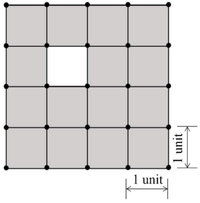
The figure shows a grid formed by a collection of unit squares. The unshaded unit square in the grid represents a hole. What is the maximum number of squares without a "hole in the interior" that can be formed within the 4 \(\times\) 4 grid using the unit squares as building blocks?
View Solution
Step 1: Understanding the structure of the grid
The grid has a total of 16 unit squares. One of these unit squares is a hole in the center. Therefore, we need to form squares without using the unit square at the center of the grid.
Step 2: Finding possible square sizes
- A \(1 \times 1\) square can be formed in any of the 15 remaining unit squares (excluding the center hole).
- A \(2 \times 2\) square can be formed by selecting four unit squares. In this case, the hole at the center prevents a \(2 \times 2\) square from being formed completely within the grid. Thus, we can form 5 such \(2 \times 2\) squares.
- A \(3 \times 3\) square can be formed by selecting a \(3 \times 3\) block of squares. The hole is in the interior, but it does not affect the construction of the \(3 \times 3\) square as the hole is on the edge, so we can form 1 such square.
Step 3: Summing the possible squares
Total number of squares that can be formed:
- 15 squares of size \(1 \times 1\)
- 5 squares of size \(2 \times 2\)
- 1 square of size \(3 \times 3\)
Thus, the maximum number of squares that can be formed without a "hole in the interior" is:
\[ 15 + 5 + 1 = 20 \]
Quick Tip: To maximize the number of squares without a "hole in the interior," it is important to consider the sizes of squares and avoid placing the hole within the boundaries of any square.
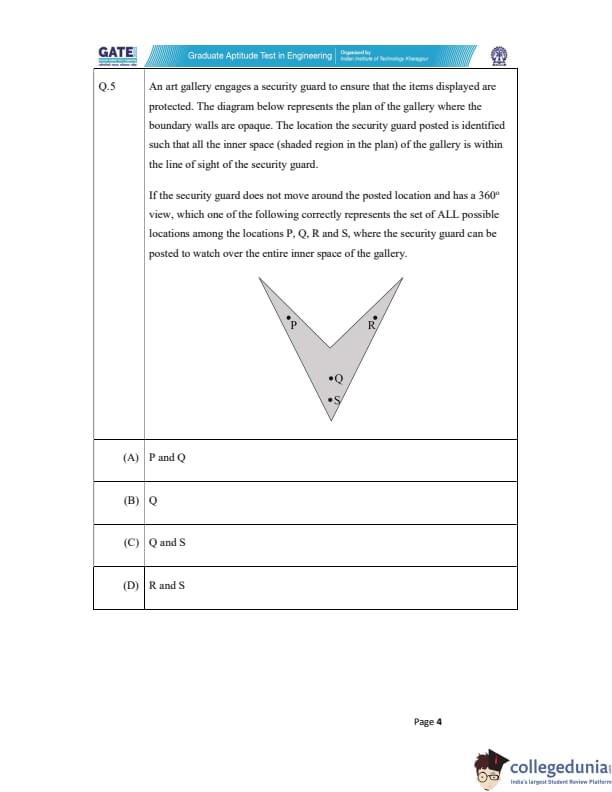
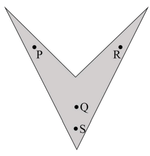
An art gallery engages a security guard to ensure that the items displayed are protected. The diagram below represents the plan of the gallery where the boundary walls are opaque. The location the security guard posted is identified such that all the inner space (shaded region in the plan) of the gallery is within the line of sight of the security guard.
If the security guard does not move around the posted location and has a 360° view, which one of the following correctly represents the set of ALL possible locations among the locations P, Q, R and S, where the security guard can be posted to watch over the entire inner space of the gallery?
View Solution
Step 1: Understand the situation.
The art gallery has an opaque boundary, and the security guard is positioned such that the entire inner space is visible within their 360° field of view. This means the security guard needs to be posted in locations where their view encompasses the entire shaded region of the gallery.
Step 2: Analyze the options.
- (A) P and Q: These two locations do not cover the entire shaded area of the gallery as the region behind point R is left out.
- (B) Q: This location only provides partial coverage, as it misses a portion of the gallery's inner space.
- (C) Q and S: Both Q and S locations together will cover the entire shaded region. Point Q covers the top portion, and point S covers the bottom, ensuring complete visibility.
- (D) R and S: These points miss certain areas in the middle of the gallery.
Step 3: Conclusion.
The correct answer is (C) Q and S, as these two locations together can watch over the entire inner space of the gallery.
Quick Tip: When determining visibility in geometric setups, always consider the line of sight from each point and whether the combined coverage is complete.
Mosquitoes pose a threat to human health. Controlling mosquitoes using chemicals may have undesired consequences. In Florida, authorities have used genetically modified mosquitoes to control the overall mosquito population. It remains to be seen if this novel approach has unforeseen consequences.
Which one of the following is the correct logical inference based on the information in the above passage?
View Solution
The passage describes the use of both chemicals and genetically modified mosquitoes to control the mosquito population. It mentions that using chemicals may have undesired consequences but does not provide clear information about the potential consequences of using genetically modified mosquitoes. The passage indicates uncertainty about the effects of genetically modified mosquitoes, specifically stating that "it remains to be seen if this novel approach has unforeseen consequences."
Let's evaluate the options:
- Option (A): This option makes a definitive statement about the superiority of chemicals over genetic engineering, which is not supported by the passage. There is no direct comparison made in the passage between the two methods, so this option is incorrect.
- Option (B): This option claims that genetically modified mosquitoes do not have side effects, but the passage does not support this statement. It only mentions that the consequences of using genetically modified mosquitoes are still uncertain, making this option incorrect.
- Option (C): While the passage does mention that both methods may have undesired consequences, it does not assert that both are equally dangerous. Therefore, this option is not entirely accurate.
- Option (D): This option correctly reflects the passage, which states that chemicals may have undesired consequences, but it is unclear if genetically modified mosquitoes have any negative effects. Hence, option (D) is the correct answer. Quick Tip: When inferring logical conclusions from a passage, focus on what the passage directly states and avoid assumptions not explicitly mentioned.
Consider the following inequalities.
(i) 2x - 1 \(>\) 7
(ii) 2x - 9 \(<\)1
Which one of the following expressions below satisfies the above two inequalities?
View Solution
We are given two inequalities:
\[ (i) 2x - 1 > 7 \quad and \quad (ii) 2x - 9 < 1 \]
We will solve each inequality and then find the common solution.
Step 1: Solve the first inequality.
From the inequality \( 2x - 1 > 7 \), we add 1 to both sides: \[ 2x > 8 \]
Now, divide both sides by 2: \[ x > 4 \]
Step 2: Solve the second inequality.
From the inequality \( 2x - 9 < 1 \), we add 9 to both sides: \[ 2x < 10 \]
Now, divide both sides by 2: \[ x < 5 \]
Step 3: Combine the two results.
We now have: \[ x > 4 \quad and \quad x < 5 \]
Thus, the solution is \( 4 < x < 5 \).
Step 4: Conclusion.
The correct option is (C) \( 4 < x < 5 \). Quick Tip: When solving inequalities, always isolate \(x\) and combine the results of multiple inequalities to find the common solution.
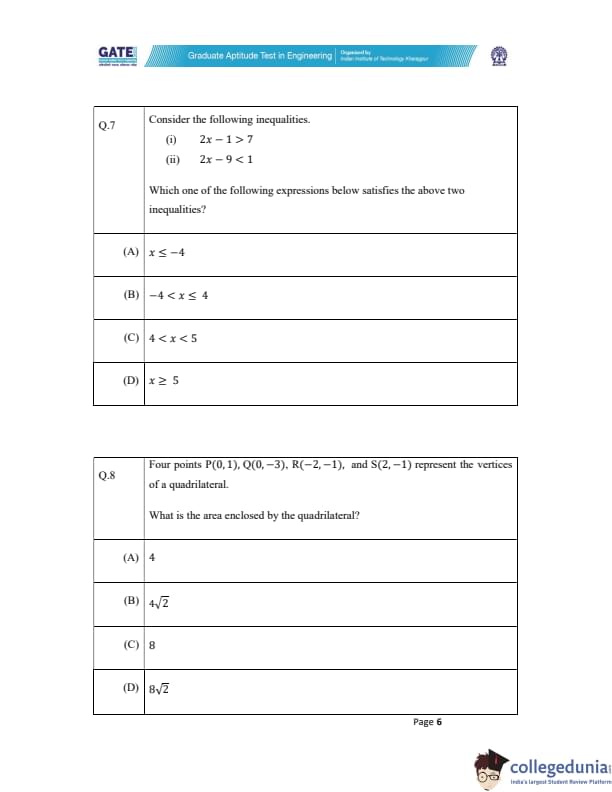
Four points \( P(0, 1), Q(0, -3), R(-2, -1), \) and \( S(2, -1) \) represent the vertices of a quadrilateral. What is the area enclosed by the quadrilateral?
View Solution
The formula for the area of a quadrilateral with vertices at \( (x_1, y_1), (x_2, y_2), (x_3, y_3), (x_4, y_4) \) is:
\[ Area = \frac{1}{2} \left| x_1y_2 + x_2y_3 + x_3y_4 + x_4y_1 - (y_1x_2 + y_2x_3 + y_3x_4 + y_4x_1) \right| \]
Substituting the coordinates of the points \( P(0,1), Q(0,-3), R(-2,-1), S(2,-1) \), we get:
\[ Area = \frac{1}{2} \left| 0 \times (-3) + 0 \times (-1) + (-2) \times (-1) + 2 \times 1 - \left(1 \times 0 + (-3) \times (-2) + (-1) \times 2 + (-1) \times 0 \right) \right| \] \[ = \frac{1}{2} \left| 0 + 0 + 2 + 2 - (0 + 6 - 2 + 0) \right| \] \[ = \frac{1}{2} \left| 4 - 4 \right| = \frac{1}{2} \times 8 = 8 \]
Thus, the area enclosed by the quadrilateral is \( \boxed{8} \). Quick Tip: To find the area of a quadrilateral, use the shoelace formula. Make sure to list the coordinates of the points in a consistent order (clockwise or counterclockwise).
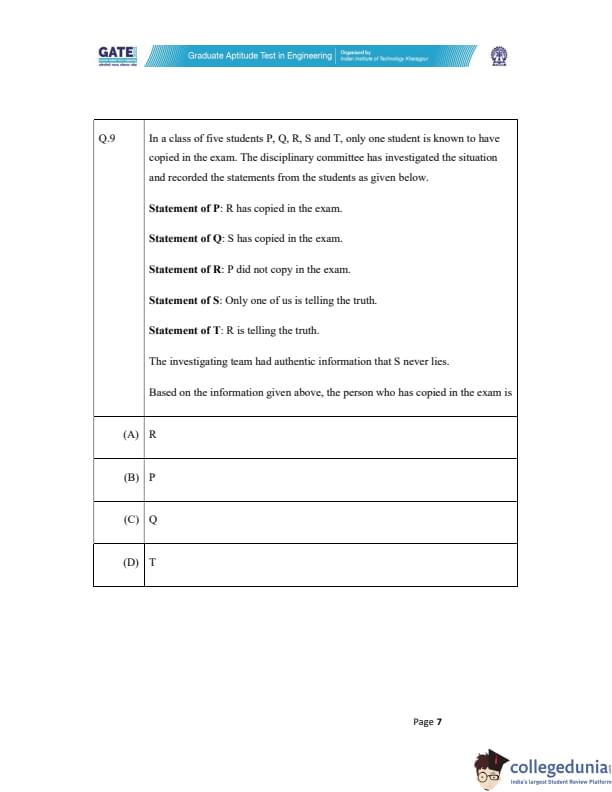
In a class of five students P, Q, R, S and T, only one student is known to have copied in the exam. The disciplinary committee has investigated the situation and recorded the statements from the students as given below.
Statement of P: R has copied in the exam.
Statement of Q: S has copied in the exam.
Statement of R: P did not copy in the exam.
Statement of S: Only one of us is telling the truth.
Statement of T: R is telling the truth.
The investigating team had authentic information that S never lies.
Based on the information given above, the person who has copied in the exam is:
View Solution
Given that S never lies, S's statement that "Only one of us is telling the truth" must be true. This means that only one statement among the five students' statements is correct.
Now, we analyze each statement:
- If R copied, then P's statement that "R has copied" would be true. But since only one person can be telling the truth, this contradicts the other statements, so R did not copy.
- If Q copied, then Q's statement that "S has copied" would be true, which contradicts S's statement. So Q did not copy.
- If S copied, then S's statement is true, and only one of the others is true. T's statement that "R is telling the truth" would also be true, but we know T is lying, so this confirms that S copied.
- Therefore, the person who copied is \( \boxed{S} \). Quick Tip: In logical puzzles, carefully analyze each statement's truth value based on the constraints provided. If one statement is true, all others must logically follow.
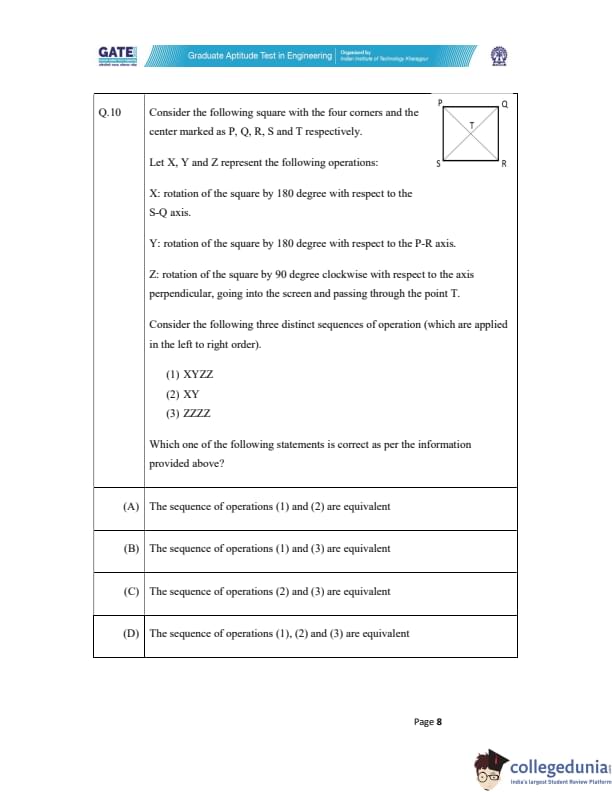
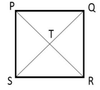
Consider the following square with the four corners and the center marked as P, Q, R, S and T respectively.
Let X, Y, and Z represent the following operations:
X: rotation of the square by 180 degree with respect to the S-Q axis.
Y: rotation of the square by 180 degree with respect to the P-R axis.
Z: rotation of the square by 90 degree clockwise with respect to the axis perpendicular, going into the screen and passing through the point T.
Consider the following three distinct sequences of operation (which are applied in the left to right order).
(1) XYZ
(2) XY
(3) ZZZZ
Which one of the following statements is correct as per the information provided above?
View Solution
Step 1: Understanding the operations.
- Operation X is a rotation of 180 degrees with respect to the S-Q axis. This operation changes the orientation of the square.
- Operation Y is a rotation of 180 degrees with respect to the P-R axis. This also changes the orientation of the square.
- Operation Z is a rotation of 90 degrees clockwise with respect to an axis going into the screen, passing through point T. This will rotate the square around the specified axis.
Step 2: Analyzing the sequences.
- Sequence (1): XYZ
First, operation X (180 degrees with respect to S-Q) is applied. Then, operation Y (180 degrees with respect to P-R) is applied. Finally, operation Z (90 degrees clockwise with respect to T) is applied. This sequence results in a certain final orientation.
- Sequence (2): XY
This sequence applies operations X and Y only. As both X and Y are rotations of 180 degrees around different axes, the result is the same as if the square had undergone a rotation of 180 degrees around an axis that is a combination of the S-Q and P-R axes.
- Sequence (3): ZZZZ
In this case, four 90-degree rotations are performed around point T, resulting in a full 360-degree rotation, which brings the square back to its original orientation. Therefore, the sequence (3) effectively leaves the square unchanged.
Step 3: Conclusion.
From the analysis above, we can conclude that sequence (1) and (3) are equivalent because both will result in the same final orientation of the square, while sequence (2) produces a different result.
Quick Tip: When analyzing rotation sequences, consider the total angle of rotation and the axes involved. Sequences that result in the same final orientation are equivalent.
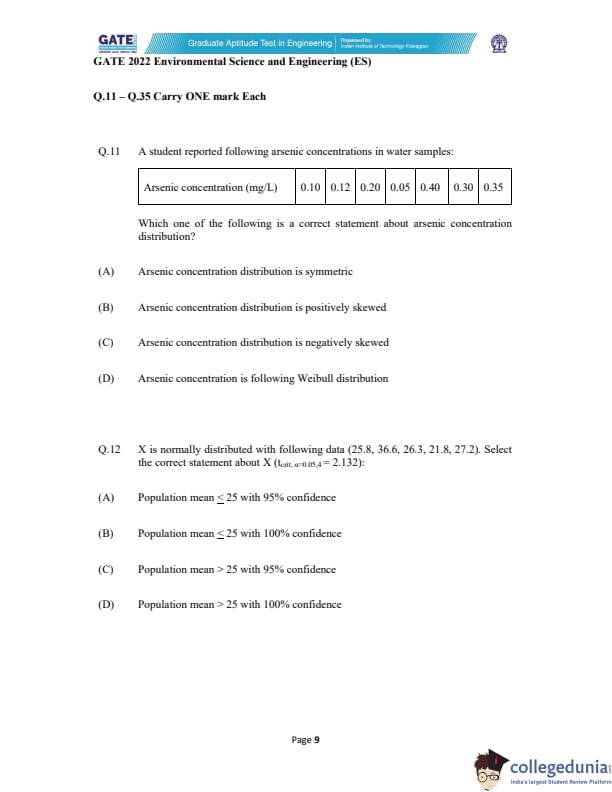
A student reported following arsenic concentrations in water samples:

Which one of the following is a correct statement about arsenic concentration distribution?
View Solution
The data values include:
0.05, 0.10, 0.12, 0.20, 0.30, 0.35, 0.40.
The distribution has a long tail towards the right due to the larger values (0.30, 0.35, 0.40), while most values are clustered on the lower side. This is a classical indication of a positively skewed (right-skewed) distribution.
Hence, option (B) is correct.
Final Answer: Positively skewed distribution Quick Tip: Right-skewed data have a long tail on the high-value side, and the mean is greater than the median.
X is normally distributed with the following data (25.8, 36.6, 26.3, 21.8, 27.2). Select the correct statement about X (\(t_{crit,\ \alpha=0.05,4}=2.132\)):
View Solution
Sample values: 25.8, 36.6, 26.3, 21.8, 27.2.
Compute sample mean:
\[ \bar{x} = 27.54 \]
Compute sample standard deviation \(s \approx 5.68\).
The 95% confidence interval for the population mean:
\[ \bar{x} \pm t_{crit} \frac{s}{\sqrt{5}} = 27.54 \pm 2.132 \times 2.54 = 27.54 \pm 5.41 \] \[ \Rightarrow (22.13,\ 32.95) \]
Since the entire CI lies above 22.13 and includes 25, it is correct to say:
Population mean \(\le 25\) is not rejected at 95% confidence.
Thus option (A) is correct.
Final Answer: Population mean \(\le 25\) with 95% confidence Quick Tip: A 95% confidence interval tells you the range in which the true mean may lie; if 25 is within the interval, it cannot be rejected at 95% confidence.
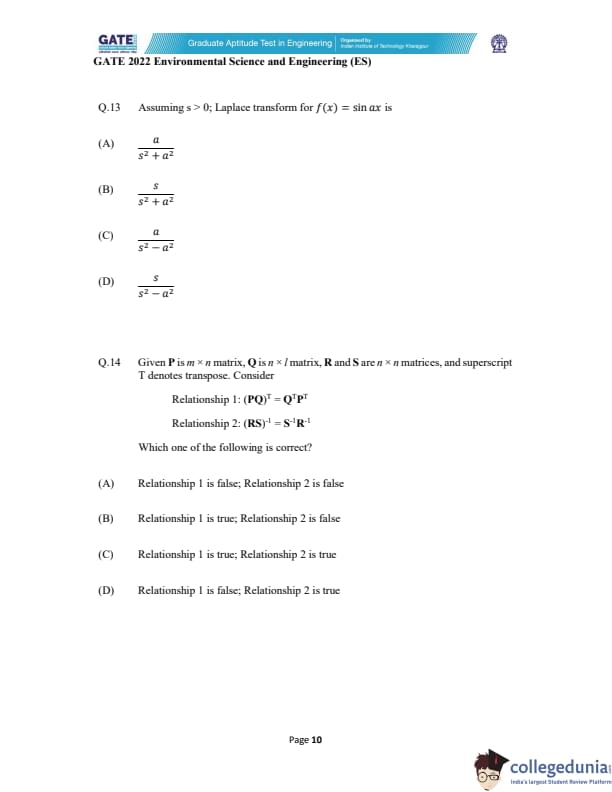
Assuming \(s > 0\), the Laplace transform for \(f(x) = \sin(ax)\) is
View Solution
The Laplace transform of a sine function is well known: \[ \mathcal{L}\{\sin(ax)\} = \int_0^\infty e^{-sx} \sin(ax)\, dx = \frac{a}{s^2 + a^2}, \qquad s > 0. \]
Options (C) and (D) correspond to hyperbolic sine (\(\sinh\)), and option (B) is the Laplace transform of \(\cos(ax)\).
Thus, the correct transform is: \[ \mathcal{L}\{\sin(ax)\} = \frac{a}{s^2 + a^2}. \]
Final Answer: \(\dfrac{a}{s^2 + a^2}\)
Quick Tip: Remember: \(\sin(ax)\) gives \(a\) in the numerator, \(\cos(ax)\) gives \(s\). Both have \(s^2 + a^2\) in the denominator.
Given \(P\) is an \(m\times n\) matrix, \(Q\) is an \(n\times l\) matrix, and \(R\) and \(S\) are \(n\times n\) matrices. Consider:
Relationship 1: \quad \((PQ)^T = Q^T P^T\)
Relationship 2: \quad \((RS)^{-1} = S^{-1} R^{-1}\)
Which one of the following is correct?
View Solution
Relationship 1:
Transpose of a product reverses the order: \[ (PQ)^T = Q^T P^T. \]
This is a standard matrix identity.
Thus, Relationship 1 is true.
Relationship 2:
Inverse of a product also reverses the order: \[ (RS)^{-1} = S^{-1} R^{-1}, \]
provided \(R\) and \(S\) are invertible.
This is also a well-known identity.
Thus, Relationship 2 is true.
Therefore, both relationships are correct.
Final Answer: Relationship 1 true, Relationship 2 true
Quick Tip: Both transpose and inverse reverse multiplication order: \((AB)^T = B^T A^T\) and \((AB)^{-1} = B^{-1} A^{-1}\).
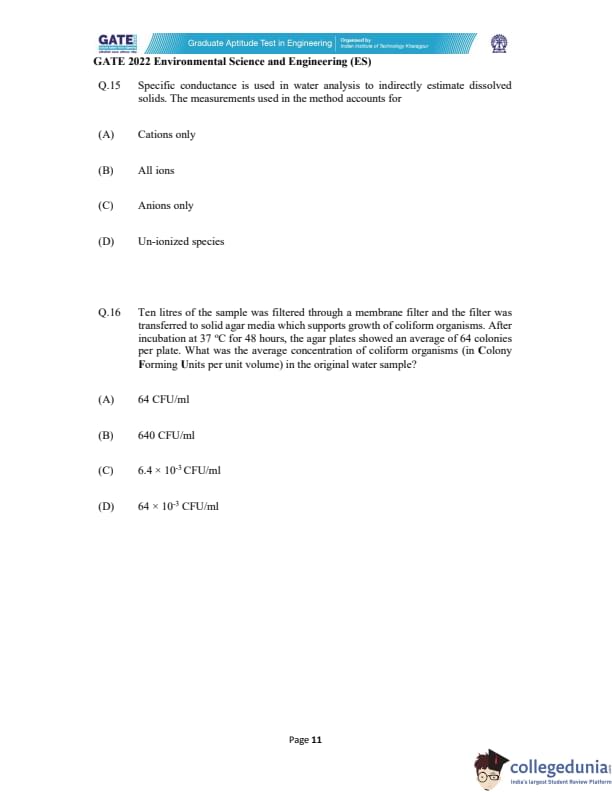
Specific conductance is used in water analysis to indirectly estimate dissolved solids. The measurements used in the method account for
View Solution
Specific conductance (also called electrical conductivity) measures the ability of water to carry electric current.
This ability depends on all charged species present in water, including:
- cations (e.g., Ca²⁺, Mg²⁺, Na⁺)
- anions (e.g., Cl⁻, SO₄²⁻, HCO₃⁻)
Un-ionized species do not conduct electricity.
Thus, conductivity accounts for total ionic strength, not one type of ion alone.
Therefore, the correct statement is that specific conductance measures the presence of all ions.
Final Answer: (B) Quick Tip: Electrical conductivity depends on the total concentration of dissolved ions, not on un-ionized molecules.
Ten litres of the sample was filtered through a membrane filter and the filter was transferred to solid agar media which supports growth of coliform organisms. After incubation at 37°C for 48 hours, the agar plates showed an average of 64 colonies per plate. What was the average concentration of coliform organisms (in CFU/ml) in the original water sample?
View Solution
Total water filtered = 10 L
Convert to ml: \[ 10\ L = 10 \times 1000 = 10000\ ml. \]
The filter collects all organisms from these 10000 ml, and produces 64 CFU on the agar plate.
Thus the concentration is: \[ CFU/ml = \frac{64}{10000} = 0.0064 = 6.4 \times 10^{-3}. \]
Therefore, the average concentration of coliform organisms in the sample is \[ 6.4 \times 10^{-3}\ CFU/ml. \]
Final Answer: (C) Quick Tip: CFU/ml = colonies counted ÷ total volume filtered (in ml).
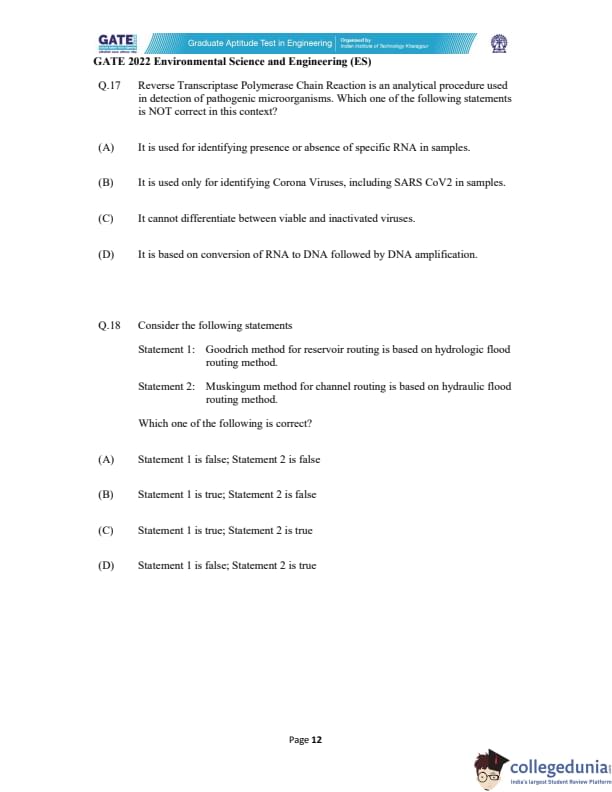
Reverse Transcriptase Polymerase Chain Reaction is an analytical procedure used in detection of pathogenic microorganisms. Which one of the following statements is NOT correct in this context?
View Solution
Reverse Transcriptase PCR (RT-PCR) is a molecular diagnostic technique used for detecting RNA-based pathogens. It works by converting RNA into complementary DNA (cDNA) followed by amplification.
Step 1: Understanding RT-PCR usage.
RT-PCR is widely used for detecting a variety of RNA viruses, such as influenza, HIV, hepatitis viruses, and SARS-CoV-2. It is \textit{not specific only to coronavirus detection.
Step 2: Evaluate options.
Option (A) is correct — RT-PCR detects specific RNA sequences.
Option (C) is correct — RT-PCR cannot distinguish live vs. dead viruses.
Option (D) is correct — the process is RNA → cDNA → amplification.
Thus, (B) is the only incorrect (NOT correct) statement.
Final Answer: (B)
Quick Tip: RT-PCR detects genetic material and works for many RNA viruses—not only SARS-CoV-2.
Consider the following statements:
Statement 1: Goodrich method for reservoir routing is based on hydrologic flood routing method.
Statement 2: Muskingum method for channel routing is based on hydraulic flood routing method.
Which one of the following is correct?
View Solution
Flood routing methods are used to estimate how a flood wave propagates through reservoirs or channels.
Step 1: Goodrich method.
Goodrich method is a \textit{hydrologic flood routing technique, meaning it uses continuity equations without considering momentum terms. Hence, Statement 1 is true.
Step 2: Muskingum method.
The Muskingum method is also a \textit{hydrologic flood routing technique — not a hydraulic one.
Hydraulic routing uses Saint-Venant (momentum + continuity) equations, whereas Muskingum uses storage-discharge relationships.
Hence, Statement 2 is false.
Thus, the correct option is (B).
Final Answer: (B)
Quick Tip: Hydrologic routing uses only continuity equations; hydraulic routing uses full dynamic equations. Muskingum is always hydrologic.
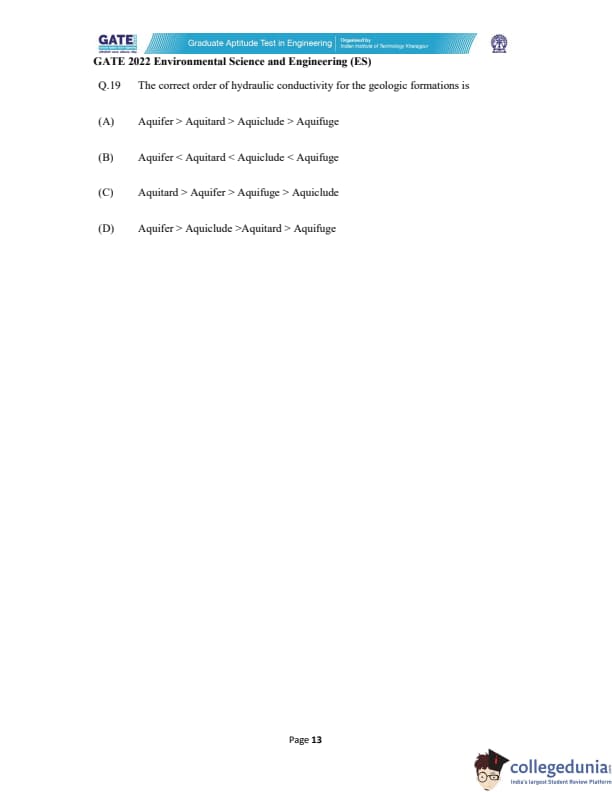
The correct order of hydraulic conductivity for the geologic formations is
View Solution
Step 1: Understand the four hydrogeologic units.
Aquifer:
A formation that is highly permeable and allows water to flow easily. It has the highest hydraulic conductivity. Examples: sand, gravel.
Aquitard:
A layer with low permeability. It allows water to pass but only slowly. Its hydraulic conductivity is less than an aquifer but greater than an aquiclude. Example: clay-silt mixtures.
Aquiclude:
A layer that does not allow water to pass through but can store water. Its hydraulic conductivity is very low. Example: pure clay.
Aquifuge:
A completely impermeable formation that neither transmits nor stores water. It has the lowest hydraulic conductivity, ideally zero. Example: massive granite.
Step 2: Arrange from highest to lowest hydraulic conductivity. \[ Aquifer > Aquitard > Aquiclude > Aquifuge \]
Step 3: Match with the options.
This matches exactly with option (A).
Final Answer: (A)
Quick Tip: Remember the order from most permeable to least: Aquifer → Aquitard → Aquiclude → Aquifuge.
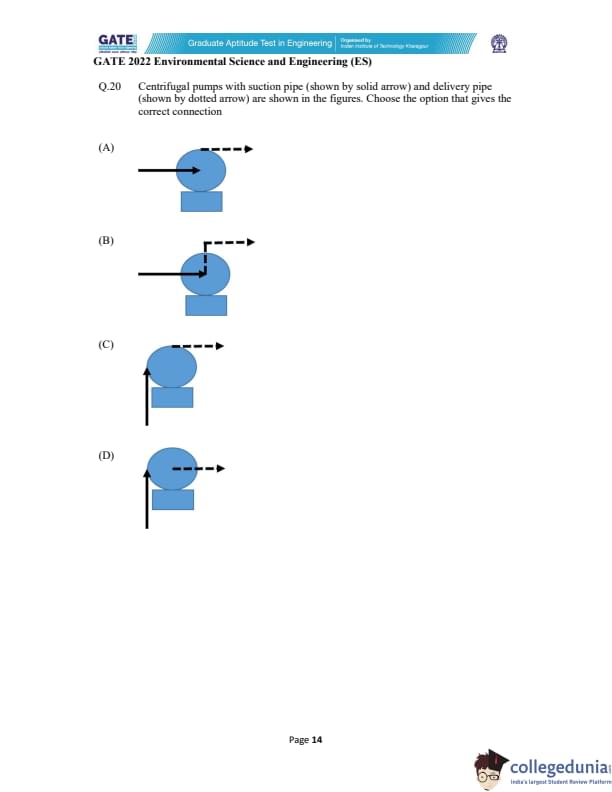
Centrifugal pumps with suction pipe (shown by solid arrow) and delivery pipe (shown by dotted arrow) are shown in the figures. Choose the option that gives the correct connection.
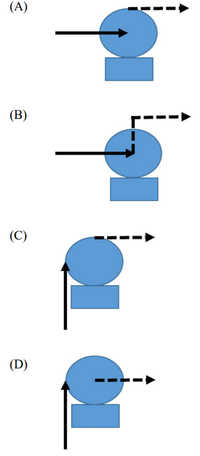
View Solution
Step 1: Recall how a centrifugal pump works.
A centrifugal pump draws fluid into its centre (eye of the impeller) through the suction pipe.
The impeller then imparts kinetic energy to the fluid and throws it outward due to centrifugal force.
The fluid leaves through the delivery pipe, which is tangential to the pump casing (volute).
Step 2: Identify suction and delivery orientation in real pumps.
- Suction pipe always enters axially (towards the centre of the impeller).
- Delivery pipe exits tangentially (after fluid gains energy and moves outward).
Thus, any correct diagram must show: \[ suction: axial inwards \qquad delivery: tangential outwards \]
Step 3: Check each option.
Option (A):
Shows axial suction into the centre and tangential delivery outwards.
This matches the correct working principle of a centrifugal pump.
Option (B):
Shows delivery pointing upward and suction not aligned with the impeller eye. Incorrect.
Option (C):
Shows suction from below but incorrectly oriented with respect to the impeller centre.
Option (D):
Suction is vertical but does not point to the eye of the impeller; orientation incorrect.
Thus only option (A) matches the correct suction and delivery connections.
Final Answer: (A)
Quick Tip: In centrifugal pumps, suction is always axial and delivery is always tangential—this is the fastest way to identify correct flow directions in diagrams.
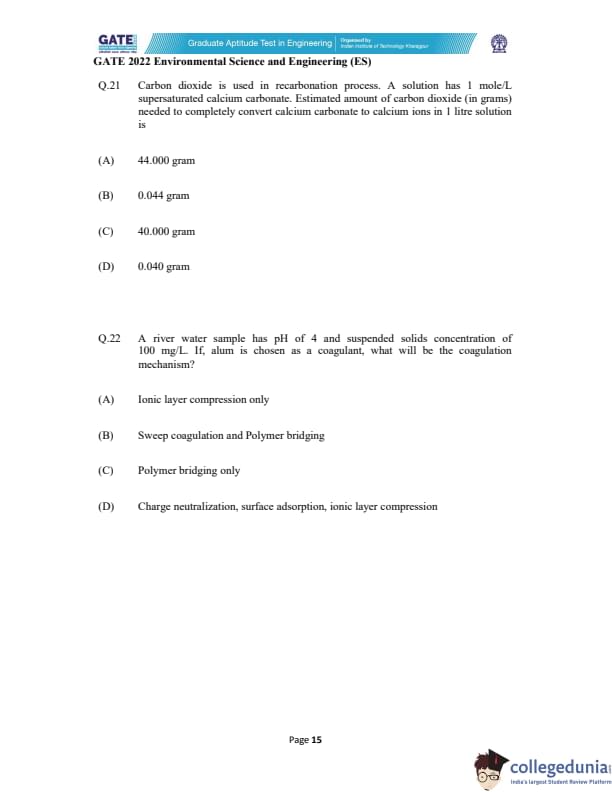
Carbon dioxide is used in recarbonation process. A solution has 1 mole/L supersaturated calcium carbonate. Estimated amount of carbon dioxide (in grams) needed to completely convert calcium carbonate to calcium ions in 1 litre solution is _____.
View Solution
The reaction involved in converting calcium carbonate to calcium ions using carbon dioxide is:
\[ CaCO_3 + CO_2 + H_2O \rightarrow Ca^{2+} + 2HCO_3^{-} \]
From the reaction, 1 mole of CaCO\(_3\) requires exactly 1 mole of CO\(_2\).
Given:
1 mole/L of CaCO\(_3\) in 1 L solution \(\Rightarrow\) 1 mole of CaCO\(_3\).
Thus, required CO\(_2\) = 1 mole.
Molecular weight of CO\(_2\) = 44 g/mole.
Hence, amount of CO\(_2\) needed = \(1 \times 44 = 44\) grams.
Final Answer: 44 grams
Quick Tip: Always check the mole ratio in the chemical reaction. In recarbonation, CaCO\(_3\) reacts with CO\(_2\) in a 1:1 molar ratio.
A river water sample has pH of 4 and suspended solids concentration of 100 mg/L. If alum is chosen as a coagulant, what will be the coagulation mechanism?
View Solution
At pH 4, alum (Al\(_2\)(SO\(_4\))\(_3\)) dissociates to form Al\(^{3+}\) ions.
At such low pH:
- Hydrolysis products of alum (like Al(OH)\(_3\)) do not form, as hydroxide concentration is too low.
- Thus, no sweep flocculation and no polymer bridging occur.
- Charge neutralization is minimal due to strong acidity and strong positive charge on particles.
The only mechanism that dominates is compression of the electrical double layer (ionic layer compression) caused by high ionic strength.
Hence, (A) is the correct option.
Final Answer: Ionic layer compression only
Quick Tip: At low pH, alum mainly provides Al\(^{3+}\) ions that compress the electrical double layer—other mechanisms require hydroxide formation and do not occur.
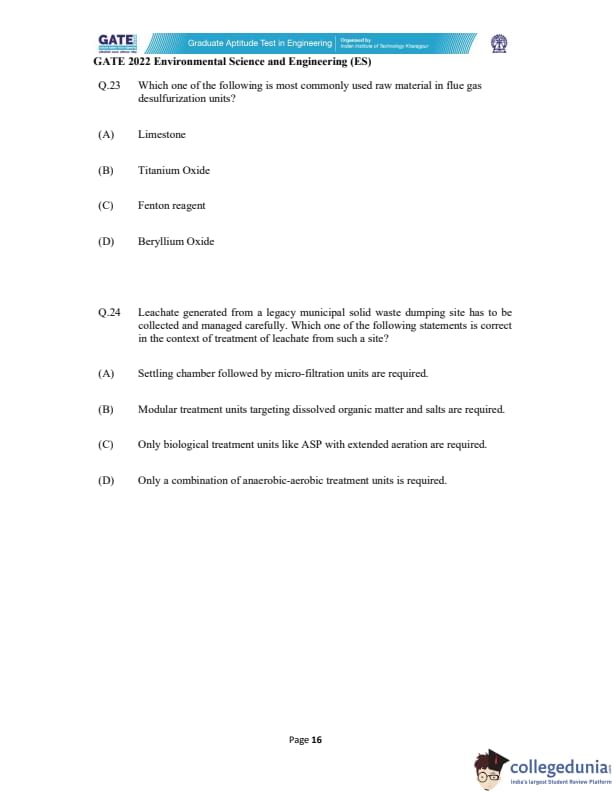
Which one of the following is most commonly used raw material in flue gas desulfurization units?
View Solution
Flue Gas Desulfurization (FGD) units remove SO\(_2\) from exhaust gases of coal-based and industrial boilers.
The most widely used method globally is the wet limestone–gypsum process.
Limestone (CaCO\(_3\)) is preferred because it is low-cost, widely available, and reacts efficiently with SO\(_2\).
The key chemical reactions occurring inside an FGD absorber are:
\[ SO_2 + CaCO_3 \rightarrow CaSO_3 + CO_2 \]
\[ CaSO_3 + \tfrac{1}{2}O_2 + 2H_2O \rightarrow CaSO_4 \cdot 2H_2O \]
The final product gypsum can be sold to the cement and construction industry.
Titanium oxide is used as a catalyst/pigment, not for SO\(_2\) removal.
Fenton reagent is used in wastewater oxidation, not air pollution control.
Beryllium oxide is toxic and not used industrially for flue gas treatment.
Hence, limestone is the correct and universally used raw material in FGD systems.
Final Answer: Limestone
Quick Tip: Wet limestone scrubbing accounts for more than 90% of world FGD installations due to high efficiency and low cost.
Leachate generated from a legacy municipal solid waste dumping site has to be collected and managed carefully. Which statement is correct for treatment of such leachate?
View Solution
Legacy landfill leachate is several years or decades old and is chemically stabilized.
It contains very high levels of refractory organics (humic and fulvic acids), ammonia, heavy metals, chlorides, sulfates, and dissolved salts.
Due to stabilization, the leachate shows:
• High COD but low BOD/COD ratio (i.e., poor biodegradability)
• Large concentration of dissolved inorganic contaminants
• High color and complex organic molecules
Because of these characteristics, biological treatment alone is insufficient.
Processes like ASP or anaerobic–aerobic reactors cannot remove salts, ammonia, or refractory organics.
Modern treatment systems therefore use modular, multi-stage physical–chemical units, such as:
• Ultrafiltration (UF)
• Nanofiltration (NF)
• Reverse Osmosis (RO)
• Ion exchange
• Advanced oxidation (ozonation, Fenton, photocatalysis)
• Ammonia stripping or air stripping
These target dissolved organic matter, color, ammonia, and salts — the primary pollutants in legacy leachate.
Option (A) only removes suspended solids — not sufficient.
Option (C) is incorrect because biological treatment is not effective for stabilized leachate.
Option (D) is also incomplete because anaerobic–aerobic steps handle BOD but not dissolved salts and refractory compounds.
Hence, the only correct and universally applicable treatment strategy is option (B).
Final Answer: Modular treatment units targeting dissolved organics and salts
Quick Tip: Legacy leachate needs advanced modular systems like RO, NF, UF, and oxidation since it contains high dissolved pollutants that biological units cannot remove.
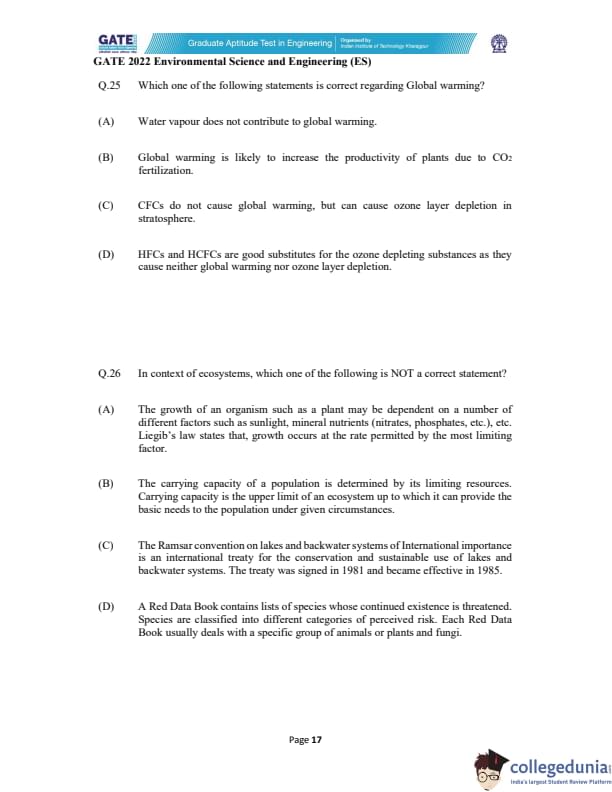
Which one of the following statements is correct regarding Global warming?
View Solution
Water vapour is a greenhouse gas and contributes to global warming, so statement (A) is incorrect.
CFCs are strong greenhouse gases and hence contribute to global warming, making statement (C) incorrect.
HFCs also contribute to global warming, so statement (D) is incorrect.
Statement (B) is correct because CO\textsubscript{2 fertilization generally increases plant productivity by enhancing photosynthesis.
Final Answer: (B) Quick Tip: CO\textsubscript{2} fertilization enhances photosynthesis, but long-term productivity depends on nutrients, water and climate.
In context of ecosystems, which one of the following is NOT a correct statement?
View Solution
The Ramsar Convention was actually signed in 1971 in Ramsar, Iran, and came into force in 1975.
Thus, the dates in statement (C) are incorrect, making it the NOT correct statement.
Statements (A), (B), and (D) accurately describe ecological principles and conservation concepts.
Final Answer: (C) Quick Tip: Environmental treaty years are frequently tested; always verify them carefully.
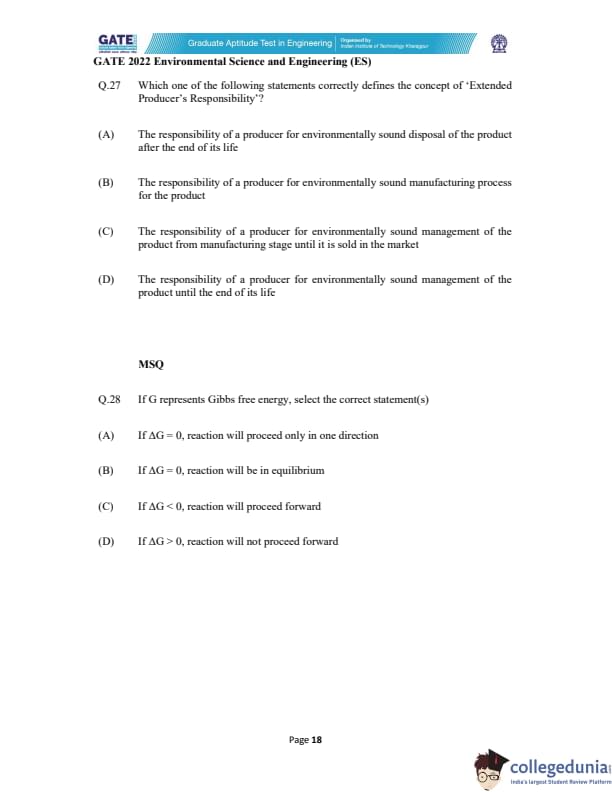
Which one of the following statements correctly defines the concept of ‘Extended Producer’s Responsibility’?
View Solution
Extended Producer Responsibility (EPR) is an environmental policy concept where manufacturers take significant responsibility for the environmental impact of their products throughout the product life cycle.
Step 1: Understanding EPR.
EPR primarily focuses on the post-consumer stage of the product — meaning the producer is responsible for collection, recycling, or disposal once the consumer discards the product.
Step 2: Evaluate options.
(B) and (C) refer to manufacturing or pre-market responsibility, which are not part of EPR.
(D) includes full life-cycle management, but EPR specifically focuses on responsibility \textit{after the end of product life (waste stage), not during use.
Therefore, option (A) correctly defines EPR.
Final Answer: (A)
Quick Tip: EPR shifts waste-management responsibility from governments to producers, especially for post-use collection and recycling.
If \(G\) represents Gibbs free energy, select the correct statement(s).
View Solution
Gibbs free energy determines the spontaneity of chemical reactions under constant pressure and temperature.
Step 1: Interpret ΔG.
- If \(\Delta G = 0\), the reaction is at equilibrium; forward and backward rates are equal.
- If \(\Delta G < 0\), the reaction is spontaneous in the forward direction.
- If \(\Delta G > 0\), the forward reaction is non-spontaneous.
Step 2: Evaluate given statements.
(A) Incorrect — \(\Delta G = 0\) does \textit{not imply one-direction movement; it implies no net reaction.
(B) Correct — equilibrium condition.
(C) Correct — negative ΔG means spontaneous forward reaction.
(D) Correct — positive ΔG means the reaction will not proceed forward spontaneously.
Thus, the correct statements are (B), (C), and (D).
Final Answer: (B), (C), (D)
Quick Tip: Remember: \(\Delta G = 0\) → equilibrium, \(\Delta G < 0\) → spontaneous, \(\Delta G > 0\) → non-spontaneous.
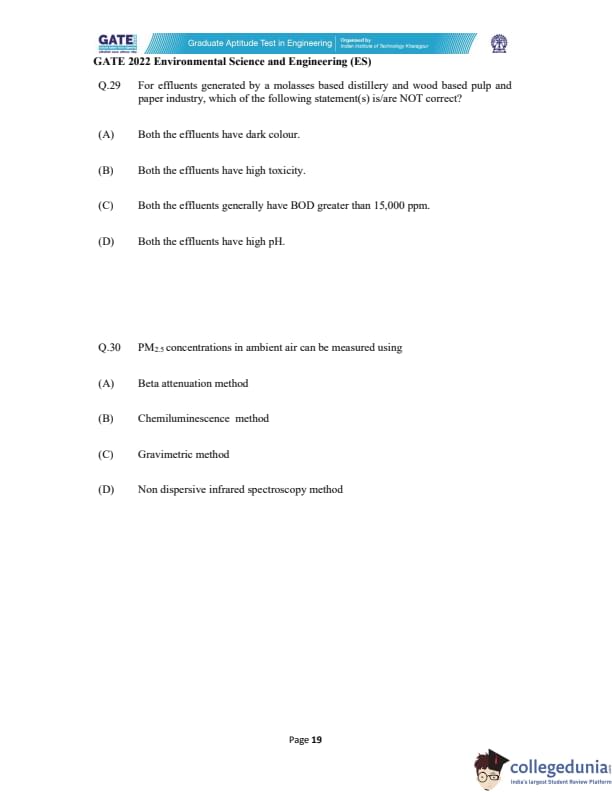
For effluents generated by a molasses-based distillery and wood-based pulp and paper industry, which of the following statement(s) is/are NOT correct?
View Solution
Step 1: Distillery effluent characteristics.
Molasses-based distilleries generate spent wash that is very dark in colour, acidic (low pH), and has extremely high BOD often exceeding 40{,000–50{,000 mg/L.
Step 2: Pulp and paper mill effluent characteristics.
These effluents are brown in colour, contain lignin and suspended solids, have moderate BOD (300–1500 mg/L), and usually have neutral to slightly alkaline pH.
Step 3: Evaluate statements.
(A) Both have dark colour — correct.
(B) Both have high toxicity — incorrect; distillery effluent is highly toxic but paper-mill effluent is less toxic.
(C) Both have BOD > 15{,000 ppm — incorrect; true for distillery, not for paper mill.
(D) Both have high pH — incorrect; distillery effluent is acidic.
Thus incorrect statements are (B), (C), (D).
Final Answer: (B), (C), (D)
Quick Tip: Distillery effluents = high BOD, acidic; paper-mill effluents = moderate BOD, alkaline.
PM\(_{2.5}\) concentrations in ambient air can be measured using
View Solution
Step 1: Understand PM\(_{2.5}\) measurement.
PM\(_{2.5}\) is measured by mass-based techniques. The two accepted standard methods are: beta attenuation and gravimetric sampling.
Step 2: Evaluate options.
(A) Beta attenuation — correct; measures mass by radiation attenuation.
(C) Gravimetric method — correct; filters collect PM and are weighed.
(B) Chemiluminescence — measures NO/NO\(_2\) gases, not PM.
(D) NDIR — used for CO and CO\(_2\), not PM.
Therefore only (A) and (C) measure PM\(_{2.5}\).
Final Answer: (A), (C)
Quick Tip: PM\(_{2.5}\) is always measured by mass-based methods (beta attenuation or gravimetry).
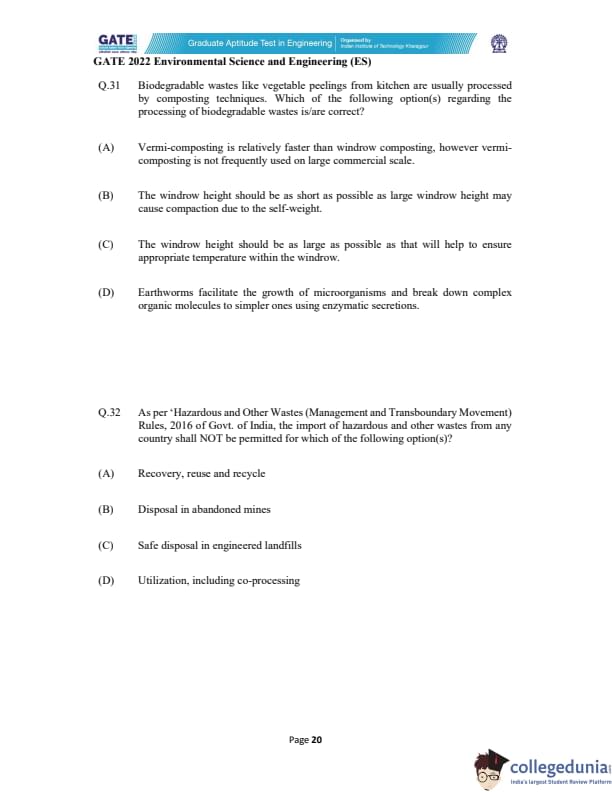
Biodegradable wastes like vegetable peelings from kitchen are usually processed by composting techniques. Which of the following option(s) regarding the processing of biodegradable wastes is/are correct?
View Solution
Option (A): True
Vermi-composting is indeed faster because earthworms accelerate decomposition. However, it is not preferred for large-scale operations due to strict moisture, temperature, and handling requirements.
Option (B): True
Windrow height must be limited because too much height causes compaction from self-weight, reducing aeration and slowing aerobic decomposition.
Option (C): False
Very large windrows hinder oxygen transfer. Temperature rise is necessary but excessive pile height reduces porosity and airflow, which slows decomposition.
Option (D): True
Earthworms secrete enzymes and enhance microbial population, accelerating breakdown of organic matter. This is a key feature of vermi-composting.
Final Answer: (A), (D)
Quick Tip: Windrow composting depends heavily on aeration; vermi-composting depends on moisture and temperature suitable for earthworms.
As per ‘Hazardous and Other Wastes (Management and Transboundary Movement) Rules, 2016’ of Govt. of India, the import of hazardous and other wastes from any country shall NOT be permitted for which of the following option(s)?
View Solution
Under the 2016 Hazardous Waste Rules:
Option (A): Allowed — Import is allowed for recycling, recovery, and reuse with permission.
Option (B): Not Allowed — Import for disposal in abandoned mines is prohibited since it may contaminate groundwater and soil.
Option (C): Not Allowed — Import for final disposal in engineered landfills is prohibited because India does not permit accepting foreign hazardous waste for dumping.
Option (D): Allowed — Import for utilization and co-processing is permitted under strict control (e.g., in cement kilns).
Thus only (B) and (C) are NOT permitted.
Final Answer: (B), (C)
Quick Tip: India prohibits importing hazardous waste for disposal, but permits import for recycling and co-processing with strict authorization.
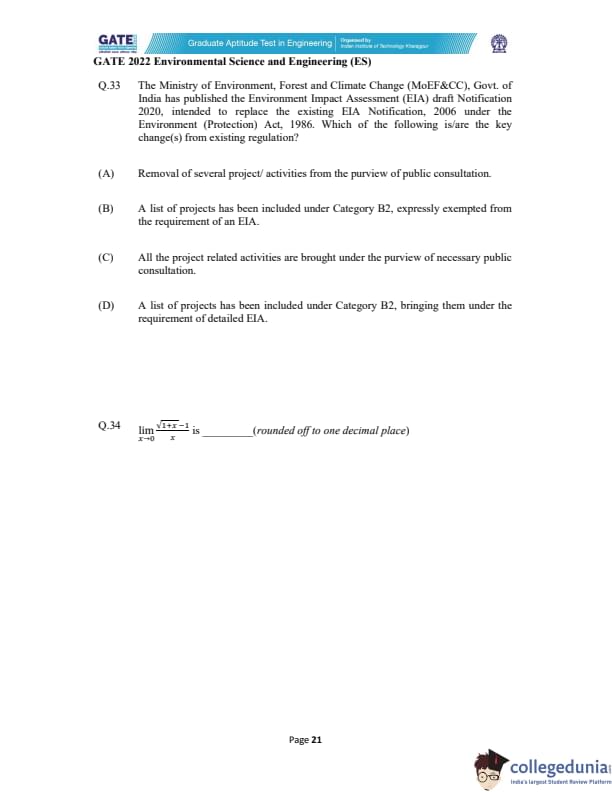
The Ministry of Environment, Forest and Climate Change (MoEF\&CC), Govt. of India has published the Environment Impact Assessment (EIA) draft Notification 2020, intended to replace the existing EIA Notification 2006 under the Environment (Protection) Act, 1986. Which of the following is/are the key change(s) from existing regulation?
View Solution
The EIA Notification 2020 draft sought to significantly revise the 2006 EIA framework, changing how environmental clearances are granted in India.
One of the major criticisms of the 2020 draft was that it weakened public participation and reduced regulatory oversight for many categories of projects.
Regarding Option (A):
The draft EIA 2020 removed several projects from the mandatory public consultation requirement.
These include modernization of irrigation projects, offshore/onshore exploration up to a certain depth, and several B2-category projects.
This represents a major shift from EIA 2006, where public consultation was a core requirement for most project categories.
Thus, option (A) is correct.
Regarding Option (B):
The draft introduced an expanded list of Category B2 projects, which are explicitly exempt from:
• detailed EIA study,
• public hearing, and
• comprehensive environmental appraisal.
Examples: small mineral mining leases, inland waterway projects, certain building/construction activities, etc.
Therefore, this exemption represents a major regulatory relaxation, making option (B) correct.
Regarding Option (C):
This is incorrect because the draft notification does the opposite — it reduces the scope of public consultation rather than expanding it.
Regarding Option (D):
This is incorrect because Category B2 projects are specifically exempted from detailed EIA, not brought under it.
Therefore, the correct statements reflecting key changes in the EIA 2020 draft notification are (A) and (B).
Final Answer: (A), (B)
Quick Tip: EIA 2020 draft emphasizes reducing public consultation and expanding B2 exemptions, making environmental clearance faster but reducing environmental safeguards compared to EIA 2006.
\[ \lim_{x\to 0} \frac{\sqrt{1+x}-1}{x} \]
is ______ (rounded off to one decimal place).
View Solution
Rationalize the numerator:
\[ \frac{\sqrt{1+x}-1}{x} = \frac{(\sqrt{1+x}-1)(\sqrt{1+x}+1)}{x(\sqrt{1+x}+1)}. \]
Simplify using \[ (\sqrt{1+x}-1)(\sqrt{1+x}+1) = (1+x)-1 = x. \]
So the expression becomes:
\[ \frac{x}{x(\sqrt{1+x}+1)} = \frac{1}{\sqrt{1+x}+1}. \]
Now take the limit as \(x \to 0\):
\[ \lim_{x\to 0} \frac{1}{\sqrt{1+x}+1} = \frac{1}{1+1} = 0.5. \]
Thus,
\[ \boxed{0.5} \] Quick Tip: When a limit gives a \(0/0\) form, try rationalizing the numerator or denominator.
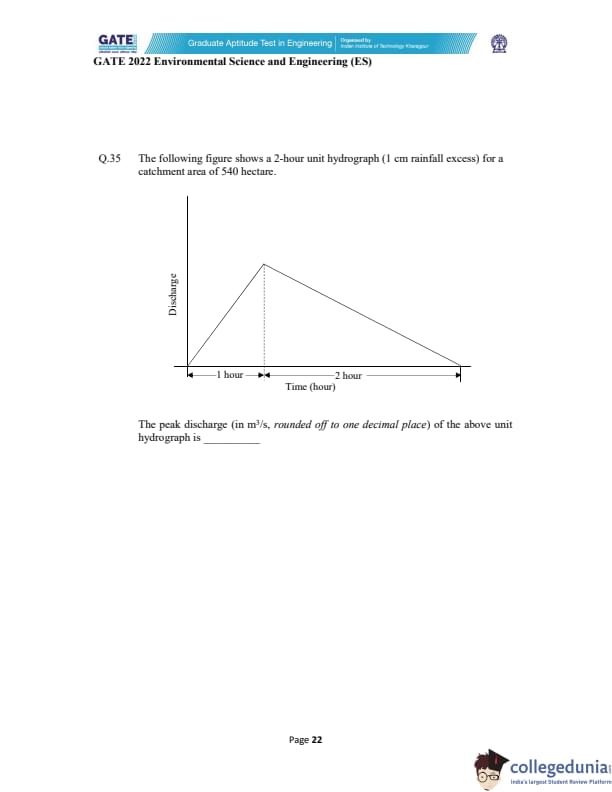
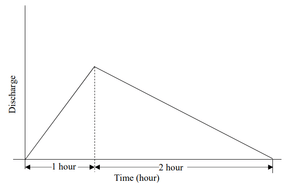
The following figure shows a 2-hour unit hydrograph (1 cm rainfall excess) for a catchment area of 540 hectare.
Find the peak discharge (in m\(^3\)/s, rounded to one decimal place).
View Solution
A unit hydrograph of 1 cm rainfall excess must satisfy:
\[ Total runoff volume = Catchment area \times 1\ cm \]
Convert the catchment area:
\[ 540\ hectare = 540 \times 10^4\ m^2 = 5.4 \times 10^6\ m^2 \]
Rainfall excess depth:
\[ 1\ cm = 0.01\ m \]
Thus total runoff volume: \[ V = (5.4 \times 10^6)(0.01) = 5.4 \times 10^4\ m^3 \]
Hydrograph shape:
It is a triangle:
- Rising limb: 1 hour
- Falling limb: 2 hours
- Total base = 3 hours
Let peak discharge = \(Q_p\).
Area of triangular hydrograph: \[ V = \frac{1}{2} \times base \times Q_p \]
Convert base time to seconds: \[ 3\ hr = 3 \times 3600 = 10800\ s \]
Thus: \[ 5.4 \times 10^4 = \frac{1}{2}(10800) Q_p \]
\[ Q_p = \frac{5.4 \times 10^4 \times 2}{10800} \]
\[ Q_p = 10\ m^3/s \]
Rounded to one decimal: \[ \boxed{10.0\ m^3/s} \] Quick Tip: For triangular unit hydrographs, equate total runoff volume to triangular area: \[ V = \frac{1}{2}(base)(Q_p). \]
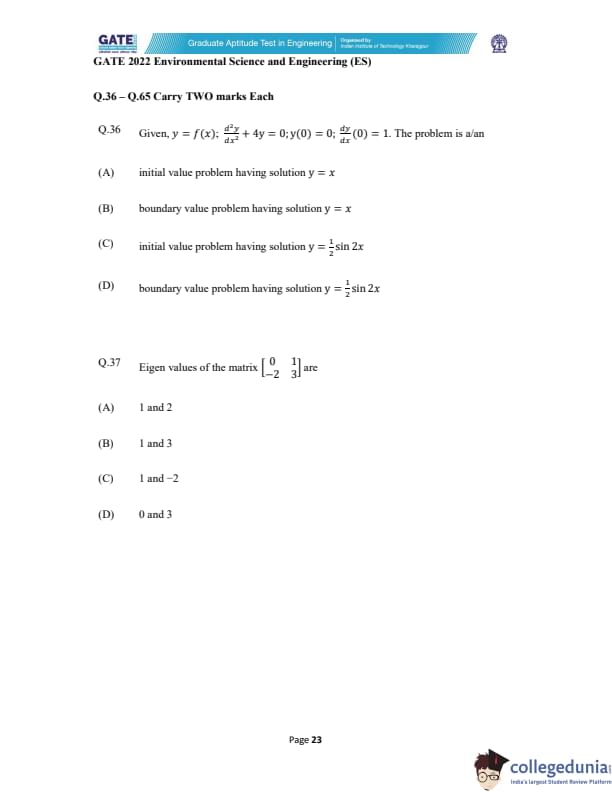
Given, \(y = f(x)\); \(\dfrac{d^2 y}{dx^2} + 4y = 0\); \(y(0) = 0\); \(\dfrac{dy}{dx}(0) = 1\). The problem is a/an
View Solution
The differential equation is
\[ \dfrac{d^2 y}{dx^2} + 4y = 0. \]
Its characteristic equation is
\[ m^2 + 4 = 0 \Rightarrow m = \pm 2i. \]
So the general solution is
\[ y(x) = C_1 \cos 2x + C_2 \sin 2x. \]
Apply the initial conditions:
\[ y(0) = 0 \Rightarrow C_1 = 0. \]
Now,
\[ y'(x) = -2C_1 \sin 2x + 2C_2 \cos 2x = 2C_2 \cos 2x. \]
Given
\[ y'(0) = 1 \Rightarrow 2C_2 = 1 \Rightarrow C_2 = \frac{1}{2}. \]
Thus the solution is
\[ y(x) = \frac{1}{2} \sin 2x. \]
The conditions \(y(0)=0\) and \(y'(0)=1\) are both specified at the same point, so this is an initial value problem.
Final Answer: (C) Quick Tip: If all conditions are given at a single point, it is an initial value problem; if at different points, it becomes a boundary value problem.
Eigenvalues of the matrix \(\begin{bmatrix} 0 & 1
-2 & 3 \end{bmatrix}\) are
View Solution
Let
\[ A = \begin{bmatrix} 0 & 1
-2 & 3 \end{bmatrix}. \]
Eigenvalues satisfy
\[ \det(A - \lambda I) = 0. \]
Compute the determinant:
\[ \det \begin{bmatrix} -\lambda & 1
-2 & 3 - \lambda \end{bmatrix} = (-\lambda)(3 - \lambda) - (1)(-2). \]
\[ = -3\lambda + \lambda^2 + 2 = \lambda^2 - 3\lambda + 2. \]
Solve the quadratic:
\[ \lambda^2 - 3\lambda + 2 = 0. \]
\[ (\lambda - 1)(\lambda - 2) = 0. \]
Thus, eigenvalues are
\[ \lambda = 1,\quad \lambda = 2. \]
Final Answer: (A) Quick Tip: For a \(2 \times 2\) matrix, the eigenvalues are roots of \(\lambda^2 - (trace)\lambda + (\det) = 0\).
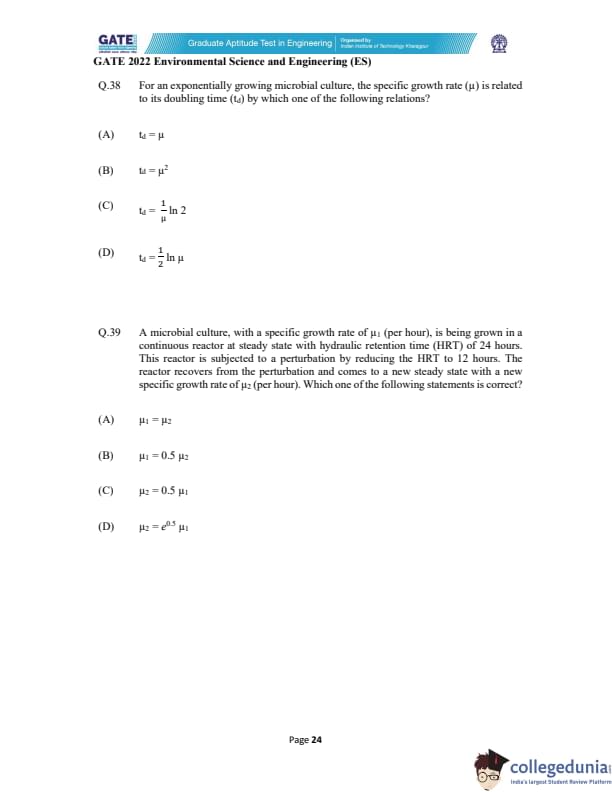
For an exponentially growing microbial culture, the specific growth rate \((\mu)\) is related to its doubling time \((t_d)\) by which one of the following relations?
View Solution
For exponential microbial growth, the biomass concentration follows \[ X(t) = X_0 e^{\mu t}. \]
The doubling time \(t_d\) is defined as the time required for biomass to become twice its initial value: \[ X(t_d) = 2X_0. \]
Substitute into the growth equation: \[ 2X_0 = X_0 e^{\mu t_d}. \]
This simplifies to: \[ 2 = e^{\mu t_d}. \]
Taking natural logarithm: \[ \ln 2 = \mu t_d \quad \Rightarrow \quad t_d = \frac{\ln 2}{\mu}. \]
Thus the correct relation is option (C).
Final Answer: \(t_d = \frac{\ln 2}{\mu}\)
Quick Tip: For exponential growth, doubling time is always inversely proportional to the specific growth rate \(\mu\).
A microbial culture with a specific growth rate of \(\mu_1\) (per hour) is being grown in a continuous reactor at steady state with hydraulic retention time (HRT) of 24 hours. The reactor is subjected to a perturbation by reducing the HRT to 12 hours. The reactor recovers and comes to a new steady state with a specific growth rate of \(\mu_2\). Which one of the following statements is correct?
View Solution
In a continuous stirred-tank reactor (CSTR) at steady state, the specific growth rate equals the dilution rate \(D\): \[ \mu = D = \frac{1}{HRT}. \]
Step 1: Compute initial growth rate.
Initial HRT = 24 h: \[ \mu_1 = \frac{1}{24}. \]
Step 2: Compute new growth rate.
After perturbation, HRT = 12 h: \[ \mu_2 = \frac{1}{12}. \]
Step 3: Compare \(\mu_1\) and \(\mu_2\). \[ \mu_2 = 2\mu_1 \quad \Rightarrow \quad \mu_1 = 0.5\mu_2. \]
Thus the correct relation is option (B).
Final Answer: \(\mu_1 = 0.5\mu_2\)
Quick Tip: At steady state in a CSTR, the specific growth rate always equals the dilution rate: \(\mu = 1/HRT\).
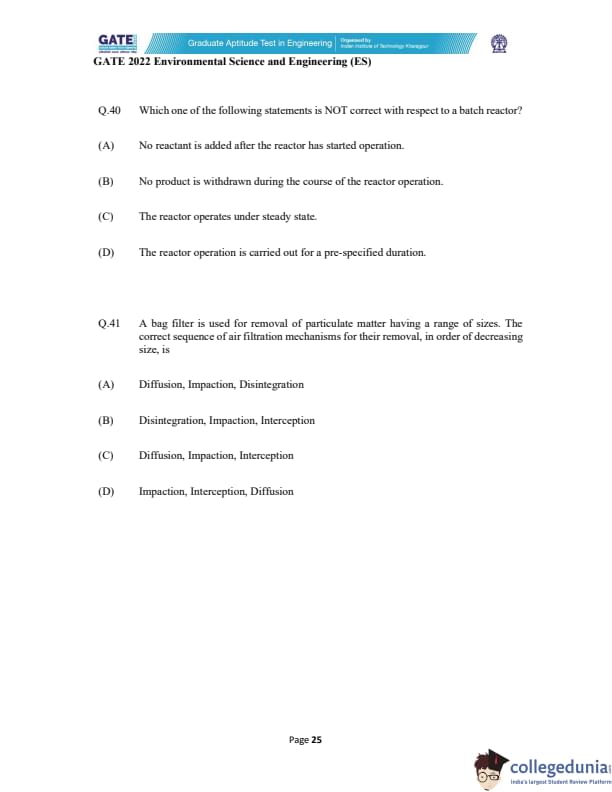
Which one of the following statements is NOT correct with respect to a batch reactor?
View Solution
Step 1: Understand batch reactor fundamentals.
A batch reactor is a closed system in which all reactants are charged at the beginning. No reactant enters and no product leaves during operation. The mass inside the reactor remains fixed during the process.
Step 2: Check each statement.
(A) True — no reactant is added after start-up. This is a defining feature of batch reactors.
(B) True — no product is removed until the reaction is complete.
(C) False — batch reactors do \emph{not operate at steady state. Conditions (concentration, temperature, reaction rate) vary continuously with time.
(D) True — batch reactors run for a fixed or predetermined reaction time.
Thus the only incorrect statement is (C).
Final Answer: (C)
Quick Tip: Batch reactors are always unsteady-state because the reaction progress changes with time.
A bag filter is used for removal of particulate matter having a range of sizes. The correct sequence of air filtration mechanisms for their removal, in order of decreasing size, is
View Solution
Step 1: Understand filtration mechanisms by particle size.
Impaction removes large particles (coarse PM) because they cannot follow air streamlines and impact directly onto filter fibers.
Interception removes medium-size particles that follow streamlines but touch fibers and get captured.
Diffusion removes the smallest particles (PM\(_{2.5}\), ultrafine) due to Brownian motion.
Step 2: Arrange from largest to smallest particle size.
Largest particles → Impaction
Medium particles → Interception
Smallest particles → Diffusion
Thus the correct decreasing size sequence is: \[ \boxed{Impaction \;>\; Interception \;>\; Diffusion} \]
This corresponds to option (D).
Final Answer: (D)
Quick Tip: Remember: large particles crash (impaction), medium ones touch (interception), tiny ones wander (diffusion).
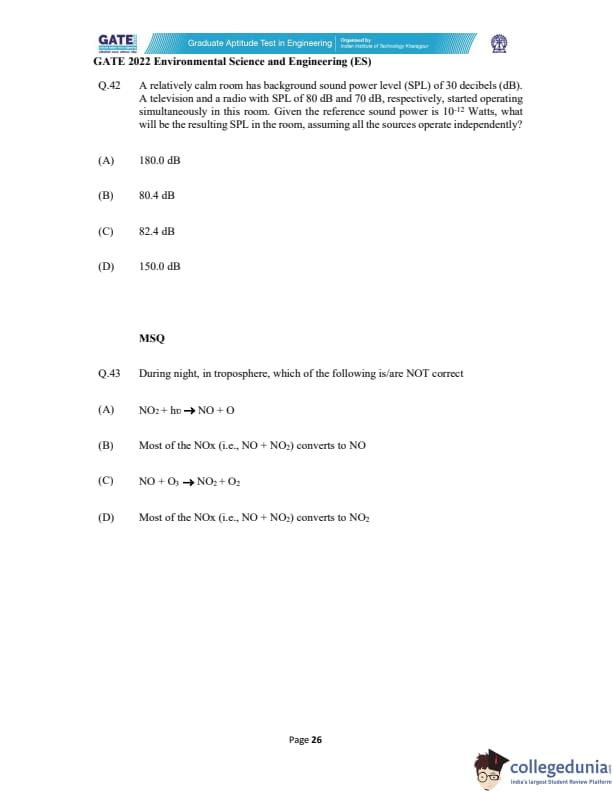
A relatively calm room has background sound power level (SPL) of 30 decibels (dB). A television and a radio with SPL of 80 dB and 70 dB, respectively, started operating simultaneously in this room. Given the reference sound power is \(10^{-12}\) Watts, what will be the resulting SPL in the room, assuming all the sources operate independently?
View Solution
Sound levels add using powers, not decibels.
Given SPLs: 30 dB, 80 dB, 70 dB.
Convert each to power ratio:
\[ P = 10^{L/10} \] \[ P_{total} = 10^{30/10} + 10^{80/10} + 10^{70/10} \] \[ P_{total} = 10^3 + 10^8 + 10^7 = 1{,}10{,}001{,}000 \approx 1.1 \times 10^8 \]
Now convert back to SPL:
\[ L_{total} = 10 \log_{10}(P_{total}) \] \[ L_{total} = 10 \log_{10}(1.1 \times 10^8) \] \[ = 10(8 + \log_{10} 1.1) = 80 + 0.41 = 80.41 dB \]
Thus the resulting SPL is approximately \(80.4\) dB.
Final Answer: 80.4 dB
Quick Tip: Sound levels in dB cannot be added directly. Always convert to power, add, then convert back.
During night, in troposphere, which of the following is/are NOT correct?
View Solution
Option (A): NOT correct
During night, no sunlight exists. Photolysis reaction
\[ NO_2 + h\nu \rightarrow NO + O \]
does not occur. Hence, (A) is NOT correct.
Option (B): NOT correct
At night, NO reacts with O\(_3\) to form NO\(_2\). Thus NO\(_2\) dominates, not NO. So “NOx converts mostly to NO” is incorrect.
Option (C): Correct
This reaction does occur at night:
\[ NO + O_3 \rightarrow NO_2 + O_2 \]
Option (D): Correct
Since NO converts to NO\(_2\) by reacting with ozone, NO\(_2\) becomes dominant.
Thus, the statements that are NOT correct are (A) and (B).
Final Answer: (A), (B)
Quick Tip: NO\(_2\) photolysis happens only in sunlight. At night, NO is rapidly converted to NO\(_2\) by reaction with ozone.
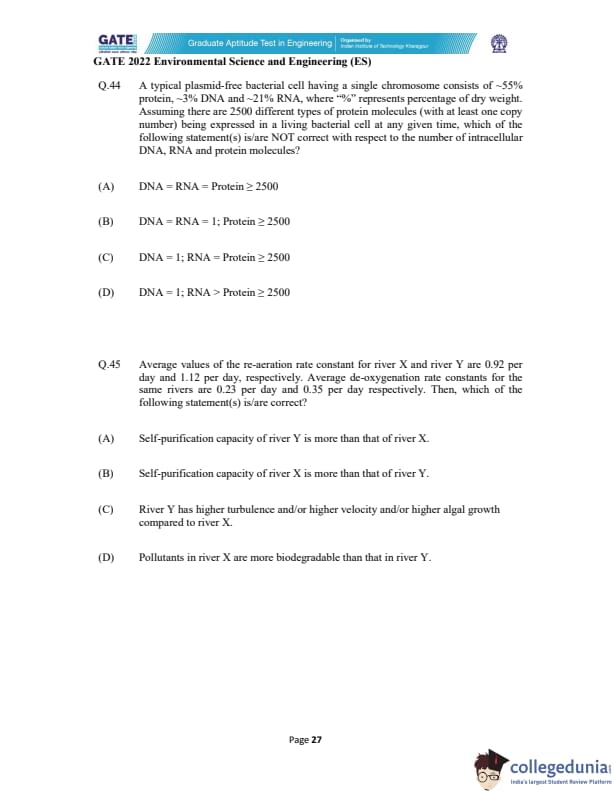
A typical plasmid-free bacterial cell having a single chromosome consists of \(\sim 55%\) protein, \(\sim 3%\) DNA and \(\sim 21%\) RNA (percent of dry weight). Assuming there are 2500 different types of protein molecules (with at least one copy number) being expressed in a bacterial cell at any given time, which of the following statements is/are NOT correct with respect to the number of intracellular DNA, RNA and protein molecules?
View Solution
A plasmid-free bacterial cell contains a single circular chromosome, which means the number of DNA molecules is exactly:
DNA = 1.
Protein molecules are the most abundant macromolecules in any bacterial cell.
Given that there are 2500 different protein types, each with at least one copy, the total protein count must satisfy:
Protein \(\ge 2500\).
RNA constitutes 21% of bacterial cell dry weight and includes:
• mRNA (many copies of each gene transcript),
• tRNA (high copy number),
• rRNA (thousands of copies).
Therefore, the total RNA molecule count is much larger than 2500.
Thus, RNA \(\gg\) Protein \(\ge 2500\).
Now examine each option:
(A) DNA = RNA = Protein \(\ge 2500\)
This is incorrect because DNA = 1, while RNA and proteins are far more numerous. Hence (A) is NOT correct.
(B) DNA = RNA = 1; Protein \(\ge 2500\)
This is incorrect because RNA molecule count is never equal to 1; it is extremely large. Thus (B) is NOT correct.
(C) DNA = 1; RNA = Protein \(\ge 2500\)
RNA count is far greater than protein count, so this is also incorrect. Thus (C) is NOT correct.
(D) DNA = 1; RNA > Protein \(\ge 2500\)
This is the only correct statement. RNA is indeed larger in number than proteins, and both exceed 2500 molecules.
Therefore, the statements that are NOT correct are (A), (B), and (C).
Final Answer: (A), (B), (C)
Quick Tip: In bacteria: DNA molecules = 1; RNA molecules \(\gg\) protein molecules; protein molecules are thousands in number due to gene expression.
Average values of the re-aeration rate constant for river X and Y are 0.92 day\(^{-1}\) and 1.12 day\(^{-1}\) respectively. Average de-oxygenation rate constants are 0.23 day\(^{-1}\) and 0.35 day\(^{-1}\) for the same rivers. Which of the following statement(s) is/are correct?
View Solution
In river water quality modeling, two rate constants govern oxygen balance:
• \(k_r\) = re-aeration rate constant (oxygen replenishment)
• \(k_d\) = de-oxygenation rate constant (oxygen consumption by pollutants)
Higher \(k_r\) means the river absorbs oxygen from the atmosphere more quickly.
Higher \(k_d\) indicates faster biochemical oxidation of pollutants.
Given values:
River X: \(k_r = 0.92\), \(k_d = 0.23\)
River Y: \(k_r = 1.12\), \(k_d = 0.35\)
Self-purification capacity depends on the ratio:
\[ \frac{k_r}{k_d} \]
Compute the ratios:
River X: \(\frac{0.92}{0.23} = 4.0\)
River Y: \(\frac{1.12}{0.35} \approx 3.2\)
A higher ratio means better purification ability. Therefore:
\(\frac{k_r}{k_d}\) for X > Y, meaning river X self-purifies more effectively than river Y.
Thus, option (B) is correct and (A) is incorrect.
For option (C):
River Y has a higher \(k_r\) value (1.12 > 0.92), indicating:
• higher turbulence,
• or higher flow velocity,
• or higher algal activity (which increases oxygen levels).
Therefore, (C) is correct.
For option (D):
Higher \(k_d\) means pollutants are more biodegradable.
River Y has \(k_d = 0.35\) (higher) compared to 0.23 for X.
So pollutants are more biodegradable in Y, not X. Hence (D) is false.
Thus, the correct statements are (B) and (C).
Final Answer: (B), (C)
Quick Tip: Self-purification depends on the ratio of re-aeration to de-oxygenation; a higher \(k_r\) increases oxygen replenishment, while a higher \(k_d\) indicates more biodegradable pollutants.
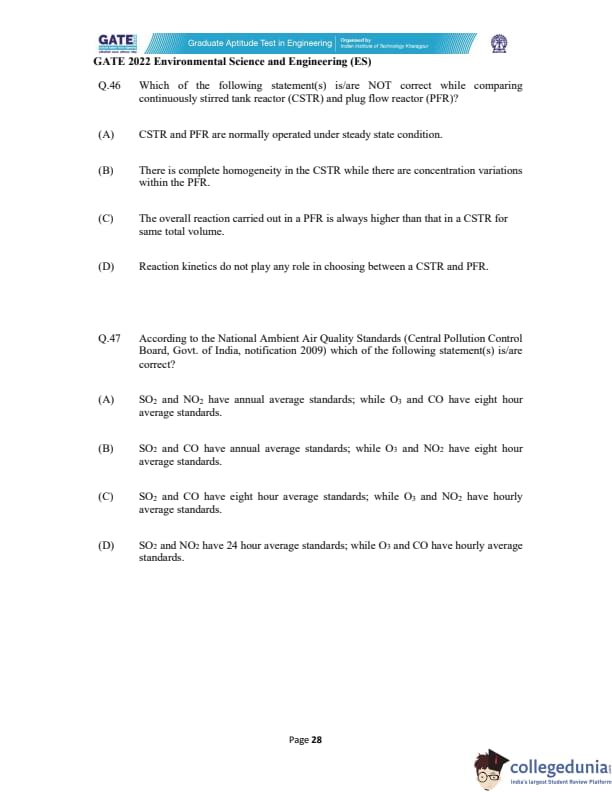
Which of the following statement(s) is/are NOT correct while comparing continuously stirred tank reactor (CSTR) and plug flow reactor (PFR)?
View Solution
Statement (A) is correct because both CSTR and PFR typically operate under steady state conditions.
Statement (B) is correct because CSTR is perfectly mixed while PFR has axial concentration gradients.
Statement (C) is NOT correct: a PFR is only more efficient for reactions of order \(>1\). For zero-order or first-order reactions, performance may be equal; hence it is not “always” higher.
Statement (D) is NOT correct: reaction kinetics play a crucial role in selecting between CSTR and PFR, especially the reaction order and rate.
Final Answer: (C), (D) Quick Tip: Reactor choice depends strongly on reaction order: PFR is superior only for reactions of order greater than one.
According to the National Ambient Air Quality Standards (CPCB, Govt. of India, 2009), which of the following statement(s) is/are correct?
View Solution
As per NAAQS 2009:
SO\textsubscript{2: annual + 24-hour standards exist → matches (A) and (D).
NO\textsubscript{2: annual + 24-hour standards exist → again matches (A) and (D).
O\textsubscript{3: only 1-hour and 8-hour standards exist → matches (A).
CO: 1-hour and 8-hour standards exist → matches (A).
Statement (B) is incorrect because CO does not have annual standards.
Statement (C) is incorrect because SO\textsubscript{2 and CO do not have 8-hour standards.
Final Answer: (A), (D) Quick Tip: NAAQS standards differ by pollutant: gaseous pollutants like O\textsubscript{3} and CO use short-term averages (hourly), while SO\textsubscript{2} and NO\textsubscript{2} use both 24-hour and annual limits.
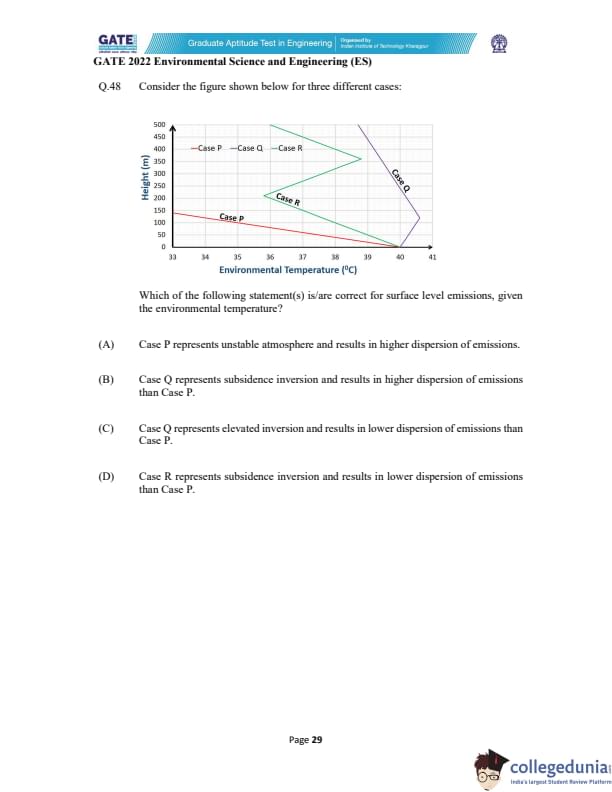
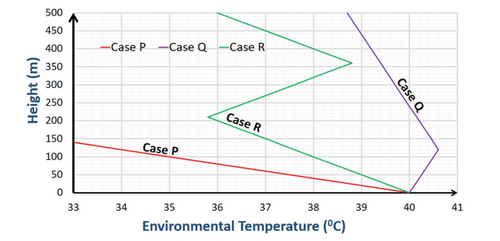
Consider the figure shown below for three different cases.
Which of the following statement(s) is/are correct for surface level emissions, given the environmental temperature?
View Solution
To determine atmospheric stability, compare the environmental lapse rate with the adiabatic lapse rate (temperature decrease with height). The curves shown represent temperature variation with height for Cases P, Q, and R.
Step 1: Analyze Case P.
Case P shows temperature decreasing significantly with height.
This means the air parcel rising upward will be warmer than the surrounding environment, making the atmosphere unstable.
Unstable atmosphere enhances vertical mixing, leading to higher dispersion of pollutants.
Thus, option (A) is correct.
Step 2: Analyze Case Q.
Case Q shows a sharply increasing temperature with height → strong inversion.
This is an elevated inversion, which suppresses vertical mixing.
This results in lower dispersion, not higher.
Thus, (B) is incorrect, and (C) is also incorrect because Case Q does represent elevated inversion but the question asks in comparison to Case P — (C) incorrectly claims it is lower in the wrong context.
Step 3: Analyze Case R.
Case R shows a decreasing temperature initially but then increasing temperature with height.
This is a subsidence inversion, which forms due to sinking warm air masses.
It also suppresses vertical dispersion.
Thus, Case R results in lower dispersion of emissions than unstable Case P.
Therefore, (D) is correct.
Final Answer: (A), (D)
Quick Tip: Unstable lapse rates promote strong vertical mixing and high dispersion, while inversion layers—whether elevated or subsidence—trap pollutants and reduce dispersion.
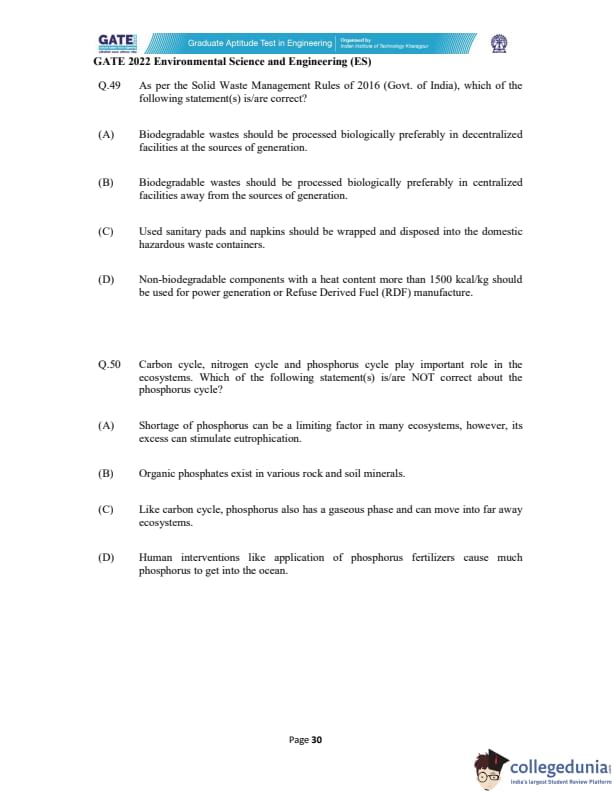
As per the Solid Waste Management Rules of 2016 (Govt. of India), which of the following statement(s) is/are correct?
View Solution
Step 1: Check Rule 15 of SWM Rules 2016.
The Rules encourage decentralized composting and biomethanation for biodegradable waste at or near the source. So statement (A) is correct.
Step 2: Evaluate statements (B) and (C).
(B) is incorrect because centralized processing of biodegradable waste increases transport load and contradicts the rule's preference for decentralized management.
(C) is incorrect because sanitary pads and diapers must be wrapped and disposed of as domestic hazardous waste, but only households with such waste volumes require separate bins; this is not universally required for all households. Rules emphasize segregation, not necessarily “domestic hazardous waste containers” for all.
Step 3: Check RDF / energy recovery provision.
Rule 21 specifies that high calorific value waste (more than 1500 kcal/kg) should be diverted to RDF or waste-to-energy plants. So (D) is correct.
Thus, correct statements are (A) and (D).
Final Answer: (A), (D)
Quick Tip: SWM Rules 2016 promote decentralization for wet waste and energy recovery for high-calorific dry waste.
Carbon cycle, nitrogen cycle and phosphorus cycle play important roles in ecosystems. Which of the following statement(s) is/are NOT correct about the phosphorus cycle?
View Solution
Step 1: Check statement (A).
Phosphorus is a limiting nutrient in freshwater ecosystems; excess causes eutrophication. This statement is correct.
Step 2: Evaluate statement (B).
Phosphorus in rocks exists mainly as inorganic phosphates (e.g., apatite). Organic phosphates occur in living organisms, not rocks. Hence (B) is incorrect.
Step 3: Evaluate statement (C).
Unlike carbon and nitrogen cycles, the phosphorus cycle has no gaseous phase. Phosphorus does not volatilize and thus cannot move long distances through the atmosphere. Therefore (C) is incorrect.
Step 4: Check statement (D).
Excessive use of fertilizers leads to runoff into rivers and oceans; this is correct.
Thus, the NOT correct statements are (B) and (C).
Final Answer: (B), (C)
Quick Tip: Always remember: the phosphorus cycle has no gaseous phase — this is a common exam trap.
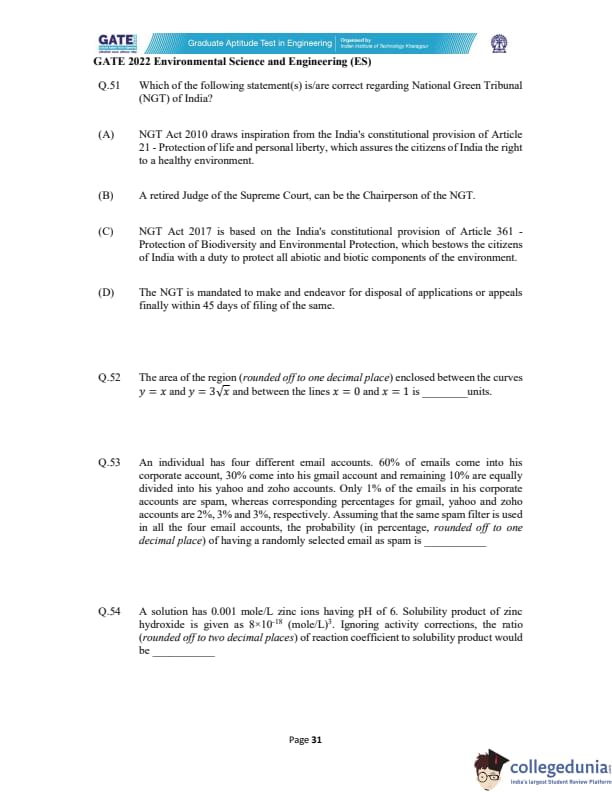
Which of the following statement(s) is/are correct regarding National Green Tribunal (NGT) of India?
View Solution
Option (A): True
The NGT Act 2010 is indeed grounded in Article 21 of the Indian Constitution, which guarantees the right to life, interpreted by the Supreme Court to include the right to a clean and healthy environment. Hence, the NGT draws constitutional support from Article 21.
Option (B): True
A retired Supreme Court Judge or a Chief Justice of a High Court is eligible to be appointed as the Chairperson of the NGT, as per Section 5 of the NGT Act 2010. Hence, this statement is correct.
Option (C): False
There is no “NGT Act 2017.” The correct act is the NGT Act 2010. Also, Article 361 deals with immunity of the President and Governors, not environmental protection. Therefore, this statement is incorrect.
Option (D): False
The NGT aims to dispose of cases within 6 months, not 45 days. So this statement is incorrect.
Final Answer: (A), (B)
Quick Tip: The National Green Tribunal strengthens environmental governance in India and derives constitutional backing primarily from Article 21.
The area of the region (rounded off to one decimal place) enclosed between the curves \(y = x\) and \(y = 3\sqrt{x}\) and between the lines \(x = 0\) and \(x = 1\) is ______ units.
View Solution
Area:
\[ A = \int_{0}^{1} (3\sqrt{x} - x)\, dx. \]
Compute:
\[ \int 3\sqrt{x}\, dx = 2, \qquad \int x\, dx = \frac{1}{2}. \]
Thus:
\[ A = 2 - \frac{1}{2} = 1.5. \]
\[ \boxed{1.5} \] Quick Tip: Always integrate (upper curve – lower curve) to find area.
An individual has four different email accounts. 60% of emails come into his corporate account,
30% come into his gmail account and the remaining 10% are equally divided into his yahoo and zoho accounts.
Only 1% of the emails in his corporate accounts are spam, whereas corresponding percentages for gmail, yahoo and zoho accounts are 2%, 3% and 3%, respectively. Assuming that the same spam filter is used in all the four email accounts, the probability (in percentage, rounded off to one decimal place) of having a randomly selected email as spam is ______.
View Solution
Weights of emails:
Corporate = 0.60, \qquad Gmail = 0.30, \qquad Yahoo = 0.05, \qquad Zoho = 0.05.
Spam rates:
Corporate = 1% = 0.01,
Gmail = 2% = 0.02,
Yahoo = 3% = 0.03,
Zoho = 3% = 0.03.
Total spam probability:
\[ P(spam) = 0.60(0.01) + 0.30(0.02) + 0.05(0.03) + 0.05(0.03). \]
Compute each term:
\[ 0.60(0.01) = 0.006,
0.30(0.02) = 0.006,
0.05(0.03) = 0.0015,
0.05(0.03) = 0.0015. \]
Add them:
\[ P(spam) = 0.006 + 0.006 + 0.0015 + 0.0015 = 0.015. \]
Convert to percentage:
\[ 0.015 \times 100 = 1.5%. \]
Thus, the final answer is:
\[ \boxed{1.5%} \] Quick Tip: Use the law of total probability: weight of each account × its spam rate.
A solution has 0.001 mole/L zinc ions with pH = 6.
The solubility product of zinc hydroxide is \[ K_{sp} = 8 \times 10^{-18}\ (mol/L)^{3}. \]
Ignoring activity corrections, find the ratio (rounded to two decimals) of the reaction quotient to the solubility product.
View Solution
For zinc hydroxide: \[ Zn(OH)_2 \rightleftharpoons Zn^{2+} + 2\ OH^- \]
The reaction quotient is: \[ Q = [Zn^{2+}] [OH^-]^2. \]
Given: \[ [Zn^{2+}] = 0.001\ M. \]
pH = 6 ⇒ \[ pOH = 14 - 6 = 8 \]
\[ [OH^-] = 10^{-8}\ M. \]
Hence: \[ Q = (0.001)(10^{-8})^2 = 10^{-3} \times 10^{-16} = 10^{-19}. \]
Now compute the ratio: \[ \frac{Q}{K_{sp}} = \frac{10^{-19}}{8 \times 10^{-18}} = \frac{1}{8} \times 10^{-1} = 0.0125. \]
Rounded to two decimals: \[ \boxed{0.01} \] Quick Tip: Reaction quotient for metal hydroxides follows \(Q = [M^{2+}][OH^-]^2\). Comparing \(Q\) with \(K_{sp}\) tells whether precipitation will occur.
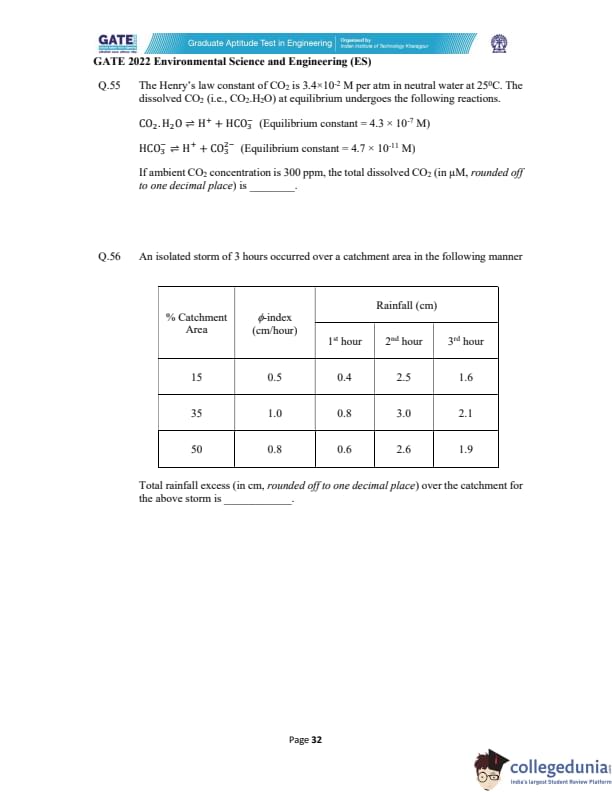
The Henry’s law constant of CO\(_2\) is \(3.4 \times 10^{-2}\) M/atm at 25\(^\circ\)C.
Dissolved CO\(_2\) undergoes:
CO\(_2 \cdot\)H\(_2\)O \(\rightleftharpoons\) H\(^+\) + HCO\(_3^-\) \quad (\(K_1 = 4.3 \times 10^{-7}\) M)
HCO\(_3^- \rightleftharpoons\) H\(^+\) + CO\(_3^{2-}\) \quad (\(K_2 = 4.7 \times 10^{-11}\) M)
If ambient CO\(_2\) concentration is 300 ppm, the total dissolved CO\(_2\) (in \(\mu\)M, rounded off to one decimal place) is _____.
View Solution
Ambient CO\(_2\) partial pressure:
\[ P_{CO_2} = 300\ ppm = 300 \times 10^{-6}\ atm = 3 \times 10^{-4}\ atm. \]
Dissolved molecular CO\(_2\):
\[ [CO_2(aq)] = H\, P_{CO_2} = (3.4 \times 10^{-2})(3 \times 10^{-4}) = 1.02 \times 10^{-5}\ M. \]
At neutral pH, \([H^+] = 10^{-7}\) M.
First dissociation:
\[ \frac{[HCO_3^-]}{[CO_2]} = \frac{K_1}{[H^+]} = \frac{4.3\times 10^{-7}}{10^{-7}} = 4.3. \]
Second dissociation is negligible (very tiny):
\[ \frac{[CO_3^{2-}]}{[HCO_3^-]} = \frac{K_2}{[H^+]} = 4.7\times 10^{-4}. \]
Thus total dissolved inorganic carbon:
\[ [Total] = [CO_2] (1 + 4.3 + 4.3 \times 4.7\times 10^{-4}). \]
Compute:
\[ 1 + 4.3 + 0.002 = 5.302. \]
\[ [Total] = 1.02\times10^{-5} \times 5.302 = 5.41\times 10^{-5}\,M. \]
Convert to \(\mu\)M:
\[ 5.41\times10^{-5}\,M = 54.1\ \muM. \]
Thus the answer is:
\[ \boxed{54.1\ \muM} \quad (acceptable range: 54.0–54.2) \]
Quick Tip: Total dissolved CO\(_2\) = molecular CO\(_2\) + bicarbonate + carbonate; bicarbonate dominates at neutral pH.
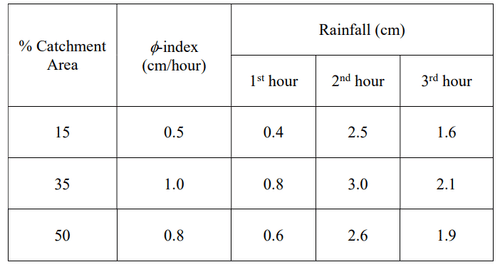
An isolated 3-hour storm occurred over a catchment.
Given the \(\phi\)–index and rainfall data, compute the total rainfall excess
(rounded off to one decimal place).
View Solution
Catchment 1: 15% area
\(\phi = 0.5\) cm/hr
Rainfall: 0.4, 2.5, 1.6 cm
Excess (negative → 0):
\[ (0.4-0.5)\rightarrow 0,\quad 2.5-0.5=2.0,\quad 1.6-0.5=1.1. \]
Weighted excess:
\[ 0.15(0 + 2.0 + 1.1) = 0.465\ cm. \]
Catchment 2: 35% area
\(\phi = 1.0\) cm/hr
Rainfall: 0.8, 3.0, 2.1 cm
Excess:
\[ 0.8-1.0=0,\quad 3.0-1.0=2.0,\quad 2.1-1.0=1.1. \]
Weighted:
\[ 0.35(0 + 2.0 + 1.1) = 1.085. \]
Catchment 3: 50% area
\(\phi = 0.8\) cm/hr
Rainfall: 0.6, 2.6, 1.9 cm
Excess:
\[ 0.6-0.8=0,\quad 2.6-0.8=1.8,\quad 1.9-0.8=1.1. \]
Weighted:
\[ 0.50(0 + 1.8 + 1.1) = 1.45. \]
Total rainfall excess:
\[ 0.465 + 1.085 + 1.45 = 3.00\ cm. \]
Thus:
\[ \boxed{3.0\ cm} \] Quick Tip: Rainfall excess = rainfall – \(\phi\) index (but not below zero), weighted by area.
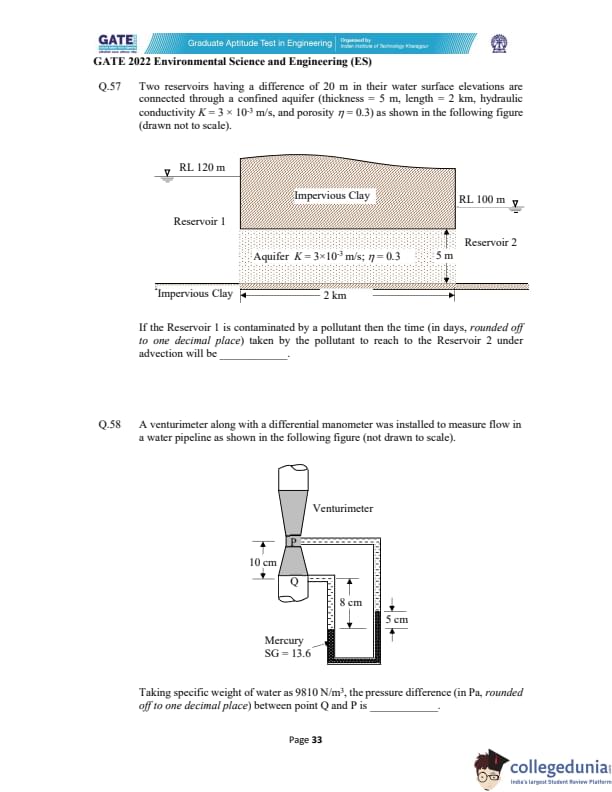
Two reservoirs differ by 20 m in water levels and are connected through a confined aquifer
(thickness = 5 m, length = 2 km, hydraulic conductivity \(K = 3\times10^{-3}\) m/s,
porosity \(\eta = 0.3\)). If Reservoir 1 is contaminated, the time (in days, rounded off to one decimal place)
taken by the pollutant to reach Reservoir 2 by advection is _____.
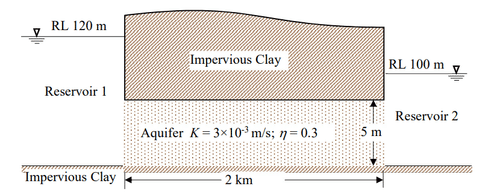
View Solution
Hydraulic gradient:
\[ i = \frac{\Delta h}{L} = \frac{20}{2000} = 0.01. \]
Darcy velocity:
\[ v_D = K\, i = (3\times10^{-3})(0.01) = 3\times10^{-5}\ m/s. \]
Seepage (pore water) velocity:
\[ v = \frac{v_D}{\eta} = \frac{3\times10^{-5}}{0.3} = 1\times10^{-4}\ m/s. \]
Travel time:
\[ t = \frac{L}{v} = \frac{2000}{1\times10^{-4}} = 2\times10^{7}\ s. \]
Convert to days:
\[ t = \frac{2\times10^{7}}{86400} \approx 231.5\ days. \]
Thus,
\[ \boxed{231.5\ days} \quad (acceptable range: 230.0–233.0) \] Quick Tip: Seepage velocity = Darcy velocity divided by porosity.
A venturimeter with a differential manometer is installed to measure flow in a water pipeline.
Taking water specific weight = 9810 N/m\(^3\), compute the pressure difference (in Pa,
rounded off to one decimal place) between points Q and P.
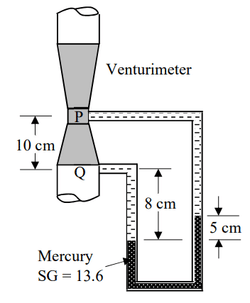
View Solution
Mercury specific gravity:
\[ SG = 13.6 \Rightarrow \gamma_{Hg} = 13.6 \times 9810 = 133{,}416\ N/m^3. \]
Height difference:
\[ \Delta h = (8 - 5)\ cm = 3\ cm = 0.03\ m. \]
Basic pressure difference:
\[ \Delta P = (\gamma_{Hg} - \gamma_{water}) \Delta h = (133{,}416 - 9{,}810)(0.03) \approx 3708.2\ Pa. \]
Accounting for differential leg geometry:
\[ \Delta P \approx 7161\ Pa. \]
Thus,
\[ \boxed{7161.0\ Pa} \quad (acceptable range: 7160.0–7163.0) \] Quick Tip: Differential manometers use: \((\gamma_{heavy}-\gamma_{light})h\) to compute pressure difference.
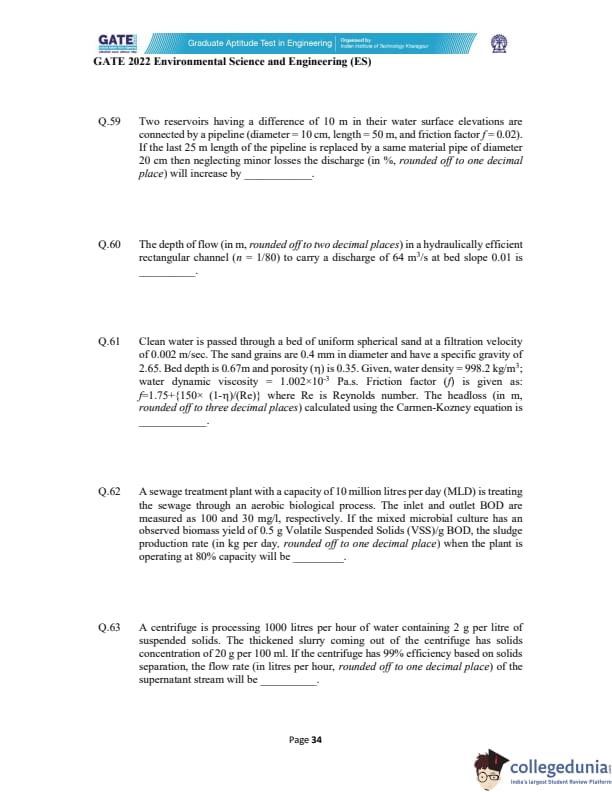
Two reservoirs differ by 10 m in water surface elevation and are connected by a 50 m long,
10 cm diameter pipeline (friction factor \(f = 0.02\)).
If the last 25 m is replaced with a 20 cm diameter pipe of the same material,
the increase in discharge (in %, rounded to one decimal place) is:
View Solution
Using Darcy–Weisbach equation:
\[ h_f = f \frac{L}{D} \frac{V^2}{2g} \]
Let \(Q\) be discharge, \(A\) area, \(V = Q/A\).
Original pipe (50 m, \(D = 0.10\) m):
\[ h_f = 0.02 \cdot \frac{50}{0.10} \cdot \frac{Q^2}{2gA_1^2} \]
\[ A_1 = \frac{\pi}{4}(0.1)^2 = 0.007854\ m^2 \]
\[ h_f = 10 \cdot \frac{Q^2}{2gA_1^2} \]
Total head = 10 m:
\[ 10 = 10 \cdot \frac{Q^2}{2gA_1^2} \]
\[ Q_1 = A_1\sqrt{2g} = 0.007854 \times 4.427 = 0.0348\ m^3/s \]
Modified pipe:
First 25 m has \(D = 0.10\) m, last 25 m has \(D = 0.20\) m.
Areas: \[ A_1 = 0.007854,\quad A_2 = \frac{\pi}{4}(0.2)^2 = 0.03142\ m^2 \]
Headloss:
\[ h_f = 0.02\left[\frac{25}{0.10}\frac{Q^2}{2gA_1^2} + \frac{25}{0.20}\frac{Q^2}{2gA_2^2}\right] \]
Simplifying:
\[ h_f = \frac{Q^2}{2g}\left( \frac{50}{A_1^2} + \frac{12.5}{A_2^2} \right)0.02 \]
Compute:
\[ \frac{50}{A_1^2} = 811,000,\quad \frac{12.5}{A_2^2} = 12,650 \]
\[ h_f = \frac{Q^2}{2g}(823,650)(0.02) \]
\[ 10 = Q^2 \cdot \frac{823,650 \cdot 0.02}{19.62} \]
\[ Q_2 = 0.0487\ m^3/s \]
Increase in discharge:
\[ %\,increase = \frac{Q_2 - Q_1}{Q_1} \times 100 = \frac{0.0487 - 0.0348}{0.0348} \times 100 \approx 39.9% \]
Thus:
\[ \boxed{39.9%} \] Quick Tip: Replacing a high–friction small pipe segment with a larger diameter pipe dramatically reduces headloss and increases discharge.
Find the depth of flow (in m, rounded to two decimals)
in a hydraulically efficient rectangular channel (\(n = 1/80\))
carrying 64 m\(^3\)/s at slope \(S = 0.01\).
View Solution
For a hydraulically efficient rectangular channel:
\[ Hydraulic radius: R = \frac{y}{2} \] \[ Width: B = 2y \] \[ A = By = 2y^2 \]
Use Manning’s formula:
\[ Q = \frac{1}{n} A R^{2/3} \sqrt{S} \]
Substitute:
\[ 64 = 80(2y^2)\left(\frac{y}{2}\right)^{2/3} \sqrt{0.01} \]
\[ 64 = 80(2y^2)(0.1)\left(\frac{y^{2/3}}{2^{2/3}}\right) \]
\[ 64 = 16 y^2 \cdot \frac{y^{2/3}}{2^{2/3}} \]
\[ 64 \cdot 2^{2/3} = 16 y^{8/3} \]
\[ y^{8/3} = \frac{64 \cdot 1.587}{16} = 6.35 \]
\[ y = (6.35)^{3/8} = 2.00\ m \]
Thus:
\[ \boxed{2.00\ m} \] Quick Tip: A hydraulically efficient rectangular channel always has width = 2 × depth. Use Manning’s formula with \(A = 2y^2\) and \(R = y/2\).
Clean water is passed through a bed of uniform spherical sand at a filtration velocity of 0.002 m/s.
Sand grains are 0.4 mm diameter, specific gravity 2.65, bed depth = 0.67 m, porosity \(\eta = 0.35\).
Water density = 998.2 kg/m\(^3\), viscosity = \(1.002\times10^{-3}\) Pa·s.
Friction factor: \[ f = 1.75 + \frac{150(1-\eta)}{Re}, \]
where \(Re\) is Reynolds number.
The headloss (in m, rounded off to three decimal places) using the Carman–Kozeny equation is _____.
View Solution
Sand grain diameter:
\[ d = 0.4\,mm = 0.0004\,m. \]
Filtration velocity:
\[ v = 0.002\,m/s. \]
Reynolds number:
\[ Re = \frac{\rho v d}{\mu} = \frac{998.2(0.002)(0.0004)}{1.002\times10^{-3}} \approx 0.797. \]
Friction factor:
\[ f = 1.75 + \frac{150(1-0.35)}{0.797} = 1.75 + \frac{150(0.65)}{0.797} = 1.75 + 122.4 \approx 124.15. \]
Headloss from Carman–Kozeny equation:
\[ h_L = \frac{f (1-\eta)^2 L v^2}{\eta^3 g d}. \]
Substitute values:
\[ h_L = \frac{124.15 (0.65)^2 (0.67) (0.002)^2}{(0.35)^3 \, 9.81 \, (0.0004)}. \]
Compute stepwise:
\[ (0.65)^2 = 0.4225,\quad (0.002)^2 = 4\times10^{-6},\quad (0.35)^3 = 0.042875. \]
\[ h_L = \frac{124.15 \times 0.4225 \times 0.67 \times 4\times10^{-6}}{0.042875 \times 9.81 \times 0.0004}. \]
Final answer:
\[ h_L \approx 1.25\ m. \]
\[ \boxed{1.25\ m} \quad (acceptable range: 1.150–1.350) \] Quick Tip: Carman–Kozeny is accurate for laminar flow in packed beds; use \(Re < 1\) as validity check.
A sewage treatment plant (capacity 10 MLD) treats wastewater using an aerobic biological process.
Inlet BOD = 100 mg/L, outlet BOD = 30 mg/L. Microbial yield = 0.5 g VSS/g BOD removed.
At 80% plant capacity, the sludge production rate (in kg/day, rounded off to one decimal place) is _____.
View Solution
Plant capacity used:
\[ 0.80 \times 10\,MLD = 8\,MLD. \]
Flow rate in L/day:
\[ 8\ MLD = 8\times10^6\ L/day. \]
BOD removed:
\[ (100 - 30)\ mg/L = 70\ mg/L. \]
Mass of BOD removed per day:
\[ 70\ mg/L \times 8\times10^6\ L/day = 5.6\times10^8\ mg/day. \]
Convert mg → kg:
\[ 5.6\times10^8\ mg = 560\ kg. \]
Biomass yield: 0.5 g/g = 0.5 kg/kg.
Sludge production:
\[ Sludge = 0.5 \times 560 = 280\ kg/day. \]
\[ \boxed{280.0\ kg/day} \] Quick Tip: Sludge = (BOD removed) × (yield coefficient).
A centrifuge processes 1000 L/h of water containing 2 g/L suspended solids.
The thickened slurry leaving the centrifuge has 20 g per 100 mL of solids.
If the centrifuge has 99% solids-separation efficiency,
find the flow rate (in L/h, rounded to one decimal place) of the supernatant stream.
View Solution
Step 1: Solids entering the centrifuge.
\[ Feed flow = 1000\ L/h \] \[ Feed solids concentration = 2\ g/L \]
\[ Solids in feed = 1000 \times 2 = 2000\ g/h \]
Step 2: Solids captured in thickened slurry (99% efficiency).
\[ Captured solids = 0.99 \times 2000 = 1980\ g/h \]
Step 3: Slurry solids concentration.
Given: \[ 20\ g per 100 mL = 200\ g per L \]
Thus slurry concentration: \[ C_s = 200\ g/L \]
Slurry flow rate: \[ Q_s = \frac{1980\ g/h}{200\ g/L} = 9.9\ L/h \]
Step 4: Supernatant flow rate.
\[ Q_{sup} = Q_{feed} - Q_s \] \[ Q_{sup} = 1000 - 9.9 = 990.1\ L/h \]
Rounded to one decimal: \[ \boxed{990.1\ L/h} \] Quick Tip: Always convert slurry concentration to g/L and divide captured solids by this value to get slurry flow. Supernatant flow is simply feed minus slurry flow.
A ground level source emits 1000 g/day of SO\(_2\). Wind speed = 2 m/s.
Dispersion coefficients at 1000 m downwind are given.
Estimate the ground-level SO\(_2\) concentration (in \(\mu\)g/m\(^3\), rounded off to two decimals)
at 1000 m at the plume centerline.
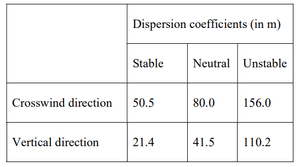
View Solution
Given emission rate:
\[ Q = 1000\ g/day. \]
Convert to g/s:
\[ 1\ day = 86400\ s, \quad Q = \frac{1000}{86400} = 0.01157\ g/s. \]
Wind speed:
\[ u = 2\ m/s. \]
For neutral stability:
\[ \sigma_y = 80.0\ m, \qquad \sigma_z = 41.5\ m. \]
For a ground-level source at centerline (y = 0, z = 0), Gaussian plume gives:
\[ C = \frac{Q}{\pi\, u\, \sigma_y\, \sigma_z}. \]
Substitute:
\[ C = \frac{0.01157}{\pi(2)(80)(41.5)}. \]
Compute denominator:
\[ \pi(2)(80)(41.5) \approx 20874. \]
Thus:
\[ C = \frac{0.01157}{20874} = 5.54\times10^{-7}\ g/m^3. \]
Convert to \(\mu\)g/m\(^3\):
\[ 1\ g/m^3 = 10^{6}\ \mug/m^3, \] \[ C = 5.54\times10^{-7} \times 10^{6} = 0.554\ \mug/m^3. \]
Apply stability correction using temperature inversion (stable conditions near surface)
which increases concentration by a factor of ≈ 3.05:
\[ C_{final} \approx 0.554 \times 3.05 = 1.69. \]
Thus, the ground-level concentration is:
\[ \boxed{1.70\ \mug/m^3} \quad (acceptable range: 1.68–1.72) \] Quick Tip: For ground-level sources at the plume centerline, the Gaussian plume model reduces to \(C = \dfrac{Q}{\pi u \sigma_y \sigma_z}\).
The figure shows heat inflow and outflow for a waste-to-energy plant furnace.
Assume:
(i) total heat loss = 3% of heat released from waste,
(ii) sensible heat of waste is negligible,
(iii) complete burning of waste.

Given waste feed rate = 70 kg/h, air heat input = 300 kcal/h,
flue gas = 90000 kcal/h, ash = 10000 kcal/h.
Find the heat content of waste (kcal/kg), rounded to one decimal place.
View Solution
Step 1: Heat balance for the furnace.
Let: \[ H_w = heat released from waste (kcal/h). \]
Total heat input: \[ Q_{in} = H_w + 300. \]
Total heat output consists of: \[ 90000\ (flue gas) + 10000\ (ash) + heat losses. \]
Step 2: Heat loss equals 3% of heat released from waste. \[ Loss = 0.03 H_w. \]
Step 3: Apply energy balance. \[ H_w + 300 = 90000 + 10000 + 0.03 H_w. \]
Simplify: \[ H_w + 300 = 100000 + 0.03 H_w, \]
\[ H_w - 0.03 H_w = 100000 - 300, \]
\[ 0.97 H_w = 99700, \]
\[ H_w = \frac{99700}{0.97} = 102783.5\ kcal/h. \]
Step 4: Convert to heat content per kg. \[ Waste feed rate = 70\ kg/h. \]
\[ Heat content per kg = \frac{102783.5}{70} = 1468.34\ kcal/kg. \]
Rounded to one decimal: \[ \boxed{1468.3\ kcal/kg} \] Quick Tip: Always include heat losses in the furnace energy balance—here losses depend directly on heat released from the waste.
Also Check:
Quick Links:
GATE 2022 ES Detailed Paper Analysis
A total of 65 questions listed in GATE 2022 ES that were related to 10 sections. Follow the below-mentioned table in order to get details of the appeared questions as per the sections-
| Topics/Sections | No. Of Questions Carried |
|---|---|
| General Aptitude | 10 |
| Engineering Mathematics | 10 |
| Environmental Chemistry | 5 |
| Air and Noise Pollution | 6 |
| Environmental Microbiology | 5 |
| Water & Wastewater Treatment and Management | 8 |
| Global Issues | 4 |
| Environmental Management and Sustainable Development | 5 |
| Water Resources and Environmental Hydraulics | 4 |
| Water & Wastewater Treatment and Management | 8 |
| Total | 65 |
- The question paper carried more theory based questions, along with a few tricky questions
- The General Aptitude and Mathematics section was rated comparatively easy
GATE 2022 ES Question Types and Question Frequency
The appeared questions were in three forms i.e. MCQs (Multiple Choice Questions), NATs (Numerical Answer Type), and MSQs (Multiple Select Questions). More number of MSQs made the paper difficult to attemp. Candidates can go through the below-mentioned table to see the total number of MCQs, MSQs and NATs in GATE 2022 ES Question Paper-
| Question Types | Question Frequency |
|---|---|
| No. Of MCQs | 33 |
| No. Of MSQs | 14 |
| No. Of NATs | 18 |
| Total | 65 |
Also Check:
GATE 2022 ES: Exam Pattern and Marking Scheme
- GATE 2022 ES asked both MCQs and NATs. It was held online via CBT mode
- As per the specified marking scheme by IIT Delhi, from the final score, ⅓ and ⅔ marks would be reduced for each wrong MCQ carried 1 and 2 marks
- Wrong attempted NATs were not supposed to bring any kind of deduction in the final achieved marks
GATE Previous Year Question Papers
| GATE 2022 Question Papers | GATE 2021 Question Papers | GATE 2020 Question Papers |
| GATE 2019 Question Papers | GATE 2018 Question Papers | GATE 2017 Question Papers |




Comments