




GATE 2021 Humanities and Social Sciences (XH), English (XH-C2) Question Paper with Solutions is available now. GATE 2021 XH was conducted on 14th February by IIT Bombay. GATE 2021 XH comprises several optional subjects sections out of which one section is compulsory to attempt. The total marks of the exam was 100. The overall difficulty level of GATE 2021 XH-C2 was easy to moderate. Candidates would get 3 hours to solve the questions listed in the two sections of GATE 2021 XH.
GATE 2021 Humanities and Social Sciences (XH), English (XH-C2) Question Paper with Solutions
| GATE 2021 Humanities and Social Sciences (XH), English (XH-C2) Question Paper |  Download Download |
Check Solutions |

Consider the following sentences:
(i) After his surgery, Raja hardly could walk.
(ii) After his surgery, Raja could barely walk.
(iii) After his surgery, Raja barely could walk.
(iv) After his surgery, Raja could hardly walk.
Which of the above sentences are grammatically CORRECT?
View Solution
Let's examine each sentence in detail:
Sentence (i): "After his surgery, Raja hardly could walk."
- This sentence is incorrect. In English, when we use the adverb hardly, it should appear before the verb in most cases. The correct structure would be: "Raja could hardly walk." Therefore, the sentence is grammatically wrong because the placement of "hardly" is incorrect.
Sentence (ii): "After his surgery, Raja could barely walk."
- This sentence is correct. The adverb barely is placed before the verb (as it should be), and the sentence follows the proper English structure. The meaning of the sentence is clear, and it is grammatically sound.
Sentence (iii): "After his surgery, Raja barely could walk."
- This sentence is incorrect. Although the adverb barely is used correctly, the position of the adverb is wrong. In standard English usage, barely should come before the verb "could," not after it. The correct sentence would be: "Raja could barely walk."
Sentence (iv): "After his surgery, Raja could hardly walk."
- This sentence is correct. The adverb hardly is placed correctly before the verb "could," making the sentence grammatically correct. This sentence properly conveys that Raja had difficulty walking after his surgery.
Thus, the sentences (ii) and (iv) are grammatically correct. Hence, the correct answer is (D).
Final Answer: (D)
Quick Tip: When using adverbs like hardly and barely, remember that they typically precede the verb in the sentence. Be cautious of placing them after auxiliary verbs like "could" or "should."
Ms. X came out of a building through its front door to find her shadow due to the morning sun falling to her right side with the building to her back. From this, it can be inferred that the building is facing ________
View Solution
In this problem, we need to infer the direction the building is facing based on the given information. Let's break it down step by step:
Step 1: Understand the scenario
- Ms. X comes out of the building through its front door. This means the direction she faces is determined by the orientation of the door.
- The morning sun is falling on her right side. We know that the sun rises in the east in the morning. Therefore, if the sun is on Ms. X's right, it means she must be facing north (because the sun will be on the east side).
- The building is to her back. This means the building is positioned behind Ms. X, so the building must be facing in the opposite direction from where Ms. X is facing.
Step 2: Deduce the facing direction of the building
- Since Ms. X is facing north, the building must be facing the opposite direction: south.
Thus, the building is facing south. Hence, the correct answer is (D).
Final Answer: (D)
Quick Tip: In the morning, the sun rises in the east. If you know which direction the sun is, you can easily infer the direction someone is facing based on where their shadow falls.
In the above figure, O is the center of the circle, and M and N lie on the circle.
The area of the right triangle MON is 50 cm².

What is the area of the circle in cm²?
View Solution
In this problem, we are given that the area of the right triangle MON is 50 cm², and we need to find the area of the circle.
Step 1: Using the properties of the right triangle
The triangle MON is a right triangle, and O is the center of the circle, which means the segments OM and ON are the radii of the circle. Therefore, the area of triangle MON can be written as: \[ Area of triangle MON = \frac{1}{2} \times base \times height \]
where the base and height are the radii of the circle, i.e., OM = ON = r.
Thus, the area of triangle MON becomes: \[ \frac{1}{2} \times r \times r = 50 \]
This simplifies to: \[ \frac{1}{2} r^2 = 50 \quad \Rightarrow \quad r^2 = 100 \]
Step 2: Finding the area of the circle
The area of a circle is given by: \[ Area of circle = \pi r^2 \]
Since \( r^2 = 100 \), we substitute this into the formula for the area of the circle: \[ Area of circle = \pi \times 100 = 100\pi \]
Thus, the area of the circle is \( 100\pi \) cm².
Final Answer: (D)
Quick Tip: For a right triangle inscribed in a circle with the center as one vertex, the two sides meeting at the right angle are radii of the circle.
“\( \oplus \)” means “-”, “\( \otimes \)” means “:”,
If “\( \Delta \)” means “+”, and “\( \nabla \)” means “×”,
then, the value of the expression \( \Delta 2 \oplus 3 \Delta ((4 \otimes 2) \nabla 4) \) =
View Solution
We need to evaluate the expression \( \Delta 2 \oplus 3 \Delta ((4 \otimes 2) \nabla 4) \), using the given operations:
1. Step 1: Break down the operations
- The symbol \( \oplus \) means subtraction (“-”).
- The symbol \( \otimes \) means multiplication (“:”), so \( 4 \otimes 2 = 4 \times 2 = 8 \).
- The symbol \( \nabla \) means multiplication (“×”), so \( 8 \nabla 4 = 8 \times 4 = 32 \).
- The symbol \( \Delta \) means addition (“+”).
2. Step 2: Evaluate the expression
We now substitute the values into the expression:
\[ \Delta 2 \oplus 3 \Delta (32) \]
This becomes:
\[ 2 + 3 - 32 = 7 \]
Thus, the value of the expression is 7.
Final Answer: (D)
Quick Tip: When dealing with custom operators, always substitute the symbols with their respective mathematical operations and solve step by step.
"The increased consumption of leafy vegetables in the recent months is a clear indication that the people in the state have begun to lead a healthy lifestyle."
Which of the following can be logically inferred from the information presented in the above statement?
View Solution
The statement says that the increased consumption of leafy vegetables is an indication of people leading a healthy lifestyle.
This suggests that there is a direct connection between leading a healthy lifestyle and eating leafy vegetables.
- (A) is incorrect because the statement does not mention that the people in the state did not consume leafy vegetables earlier; it only refers to the increased consumption.
- (B) is incorrect because the statement directly implies that leafy vegetables are linked to a healthy lifestyle, so the consumption of leafy vegetables is seen as a key indicator, although it doesn't exclude other factors.
- (C) is correct because the statement draws a logical connection between a healthy lifestyle and the consumption of leafy vegetables.
- (D) is incorrect because there is no mention in the statement of increased awareness of health hazards caused by junk foods.
Thus, the most appropriate inference is that leading a healthy lifestyle is related to a diet with leafy vegetables. Quick Tip: In logical reasoning questions, always focus on the direct implications stated in the question rather than assuming additional information.
Oxpeckers and rhinos manifest a symbiotic relationship in the wild. The oxpeckers warn the rhinos about approaching poachers, thus possibly saving the lives of the rhinos. Oxpeckers also feed on the parasitic ticks found on rhinos.
In the symbiotic relationship described above, the primary benefits for oxpeckers and rhinos respectively are,
View Solution
In this symbiotic relationship between oxpeckers and rhinos, both species benefit from the interaction:
1. Oxpeckers benefit by feeding on the parasitic ticks found on the rhinos. This provides the oxpeckers with a food source.
2. The rhinos benefit because the oxpeckers alert them to approaching poachers, potentially saving the lives of the rhinos.
Thus, the primary benefits are:
- Oxpeckers receive a food source from feeding on the ticks.
- Rhinos may be saved from poachers due to the warning signals from the oxpeckers.
Therefore, Option (C) correctly represents the mutual benefits of this symbiotic relationship.
Analysis of Other Options:
- Option (A): Incorrect because rhinos do receive a benefit (being warned about poachers), not just oxpeckers getting a food source.
- Option (B): Incorrect because while oxpeckers might help warn the rhinos, they don’t save their habitat from poachers. Rhinos benefit directly from the poacher warnings.
- Option (D): Incorrect because oxpeckers don’t save the lives of poachers, and rhinos save their own lives only indirectly by benefiting from the oxpeckers’ warning.
Thus, (C) is the most accurate answer.
Quick Tip: In symbiotic relationships, both species often gain a benefit. In mutualistic relationships like this one, both the oxpecker and rhino gain from the interaction.
A jigsaw puzzle has 2 pieces. One of the pieces is shown above. Which one of the given options for the missing piece when assembled will form a rectangle? The piece can be moved, rotated, or flipped to assemble with the above piece.


View Solution
In this jigsaw puzzle, the goal is to find the missing piece that, when placed with the given piece, will form a complete rectangle. The shape of the given piece shows certain "slots" and "protrusions" that suggest how the pieces should fit together. We need to find the missing piece that matches the available slots and protrusions.
After analyzing the options:
- Option (A): When this piece is rotated and flipped, it fits perfectly with the given piece to form a rectangle. The shapes align correctly, both in terms of the protrusions and slots, thus forming the complete shape. This is the correct option.
- Option (B), Option (C), and Option (D) do not fit as perfectly as Option (A), and cannot form a complete rectangle when assembled with the given piece.
Thus, the correct answer is (A).
Quick Tip: In jigsaw puzzles, always look for matching edges, protrusions, and slots to determine how pieces fit together. Rotation and flipping can also help when assembling the pieces.
The number of hens, ducks and goats in farm P are 65, 91 and 169, respectively. The total number of hens, ducks and goats in a nearby farm Q is 416. The ratio of hens:ducks:goats in farm Q is 5:14:13. All the hens, ducks and goats are sent from farm Q to farm P.
The new ratio of hens:ducks:goats in farm P is
View Solution
We are given that:
- The number of hens, ducks, and goats in farm P are 65, 91, and 169, respectively.
- The total number of hens, ducks, and goats in farm Q is 416.
- The ratio of hens:ducks:goats in farm Q is 5:14:13.
Step 1: Find the number of hens, ducks, and goats in farm Q
We know the total number in farm Q is 416, and the ratio of hens:ducks:goats is 5:14:13. Let the number of hens, ducks, and goats in farm Q be represented by:
- Hens in Q: \( 5x \)
- Ducks in Q: \( 14x \)
- Goats in Q: \( 13x \)
Thus, the total is: \[ 5x + 14x + 13x = 416 \] \[ 32x = 416 \] \[ x = \frac{416}{32} = 13 \]
So, the number of hens, ducks, and goats in farm Q are:
- Hens in Q: \( 5 \times 13 = 65 \)
- Ducks in Q: \( 14 \times 13 = 182 \)
- Goats in Q: \( 13 \times 13 = 169 \)
Step 2: Add these to the numbers in farm P
Now, we transfer all the animals from farm Q to farm P:
- New hens in P: \( 65 + 65 = 130 \)
- New ducks in P: \( 91 + 182 = 273 \)
- New goats in P: \( 169 + 169 = 338 \)
Step 3: Find the new ratio
The new ratio of hens:ducks:goats in farm P is: \[ 130 : 273 : 338 \]
Simplifying this ratio by dividing each term by their greatest common divisor, which is 13: \[ \frac{130}{13} : \frac{273}{13} : \frac{338}{13} = 10 : 21 : 26 \]
Thus, the new ratio of hens:ducks:goats in farm P is 10:21:26, corresponding to Option (C).
Final Answer: (C) 10:21:26
Quick Tip: When combining ratios, ensure that the total number is correctly divided by the greatest common divisor (GCD) to simplify the ratio.
The distribution of employees at the rank of executives, across different companies C1, C2, …, C6 is presented in the chart given above. The ratio of executives with a management degree to those without a management degree in each of these companies is provided in the table above. The total number of executives across all companies is 10,000.

The total number of management degree holders among the executives in companies C2 and C5 together is
View Solution
We are given the following information:
- The total number of executives across all companies is 10,000.
- The percentage distribution of employees across the companies is:
- \( C1: 15% \)
- \( C2: 5% \)
- \( C3: 8% \)
- \( C4: 32% \)
- \( C5: 20% \)
- \( C6: 20% \)
Step 1: Calculate the number of executives in each company
The number of executives in each company is:
- Number of executives in \( C1 = 15% \times 10,000 = 1500 \)
- Number of executives in \( C2 = 5% \times 10,000 = 500 \)
- Number of executives in \( C3 = 8% \times 10,000 = 800 \)
- Number of executives in \( C4 = 32% \times 10,000 = 3200 \)
- Number of executives in \( C5 = 20% \times 10,000 = 2000 \)
- Number of executives in \( C6 = 20% \times 10,000 = 2000 \)
Step 2: Calculate the number of management degree holders in \( C2 \) and \( C5 \)
- For \( C2 \), the ratio of executives with a management degree is \( 1:4 \), meaning 1 out of every 5 executives has a management degree.
\[ Management degree holders in C2 = \frac{1}{5} \times 500 = 100 \]
- For \( C5 \), the ratio of executives with a management degree is \( 9:1 \), meaning 9 out of every 10 executives have a management degree.
\[ Management degree holders in C5 = \frac{9}{10} \times 2000 = 1800 \]
Step 3: Total management degree holders in \( C2 \) and \( C5 \)
The total number of management degree holders in \( C2 \) and \( C5 \) together is: \[ 100 + 1800 = 1900 \]
Thus, the total number of management degree holders in companies \( C2 \) and \( C5 \) is 1900, corresponding to Option (C).
Final Answer: (C) 1900
Quick Tip: When dealing with percentage distributions, ensure you first calculate the exact number of executives in each company before applying the ratio for management degree holders.
Five persons P, Q, R, S, and T are sitting in a row not necessarily in the same order. Q and R are separated by one person, and S should not be seated adjacent to Q.
The number of distinct seating arrangements possible is:
View Solution
We need to calculate the number of distinct seating arrangements of five people: P, Q, R, S, and T, with the following conditions:
1. Q and R are separated by one person.
2. S should not be seated adjacent to Q.
Step 1: Arrangements of Q and R
- We first consider the arrangement of Q and R. According to the problem, Q and R must be separated by exactly one person.
- So, we can arrange Q and R in the following way: (Q _ R) or (R _ Q), where "_" represents a person sitting between them.
- There are 2 possible arrangements for Q and R.
Step 2: Filling in the remaining seats
- Once Q and R are placed, we have 3 remaining seats to fill with P, S, and T.
- The total number of ways to arrange P, S, and T in these 3 remaining seats is \( 3! = 6 \).
Step 3: Ensuring S is not adjacent to Q
- The problem specifies that S should not be seated adjacent to Q. This restriction must be taken into account.
- Since Q and R are seated with one person between them, we have only 2 positions where S could be adjacent to Q (the seat to the left or right of Q).
- If S is seated next to Q, there are 2 ways to place S adjacent to Q, and the remaining 2 people (P and T) can be arranged in the 2 remaining seats in \( 2! = 2 \) ways.
Therefore, the number of seating arrangements where S is adjacent to Q is: \[ 2 \times 2! = 4 \]
Step 4: Subtracting the invalid arrangements
The total number of unrestricted seating arrangements is: \[ 2 \times 3! = 12 \]
However, we need to exclude the 4 arrangements where S is adjacent to Q. So, the total number of valid arrangements is: \[ 12 - 4 = 8 \]
Thus, the total number of distinct seating arrangements is 16.
Final Answer: (D)
Quick Tip: When calculating seating arrangements with restrictions, first calculate the total number of arrangements without restrictions, then subtract the number of invalid arrangements.
According to a recent article in a medical journal, consuming curcumin (from turmeric) significantly lowers the risk of COVID-19. The researchers draw this conclusion from a study that found that people who consumed one or more teaspoons of curcumin extract every day were half as likely to be diagnosed with the disease as people who did not consume curcumin.
Which of the following, if true, most weakens the argument in the article?
View Solution
The argument in the article suggests that curcumin consumption significantly lowers the risk of COVID-19. To weaken this argument, we need evidence that suggests other factors, such as exercise, might explain the difference in diagnosis rates rather than curcumin consumption alone.
Step 1: Evaluate each option.
- (A) The study mentioned in option (A) suggests that zinc supplements lower the likelihood of being diagnosed with COVID-19, but this doesn't directly weaken the argument about curcumin's effect.
- (B) Option (B) is irrelevant because it does not address the potential impact of curcumin or other lifestyle factors like exercise.
- (C) Option (C) presents a plausible alternative explanation—people who consume curcumin may also be more likely to exercise, which could account for their lower likelihood of being diagnosed with COVID-19.
- (D) Option (D) does not directly weaken the argument, as it discusses recovery rates rather than the likelihood of being diagnosed.
Step 2: Conclusion.
Option (C) introduces the possibility that exercise, not curcumin, could be the factor reducing the likelihood of diagnosis, which weakens the argument.
Final Answer: (C) The participants who consumed curcumin were also more likely to exercise than those who did not.
Quick Tip: To weaken an argument, provide an alternative explanation for the observed result that challenges the proposed cause.
Froot Inc. carried out an internet advertisement campaign for its new beverage CocoLoco. After the campaign, the director of the advertising company conducted a survey and found that the CocoLoco sales were higher than that of TenderJoos, a competing product from Joos Inc. The agency concluded that the internet advertising campaign is more effective than advertising through other media.
Which of the following statements could strengthen the conclusion above by the agency?
View Solution
The agency concludes that the internet advertisement campaign was more effective than other media. To strengthen this conclusion, we need evidence that shows the internet campaign specifically had a positive effect, unlike other forms of advertisement.
Step 1: Evaluate each option.
- (A) A discount on CocoLoco could have contributed to higher sales, but it doesn't directly support the conclusion that the internet campaign was more effective than other forms of advertising.
- (B) If CocoLoco sales were already higher before the internet campaign, it weakens the claim that the internet campaign had a significant impact.
- (C) Option (C) provides useful evidence. If a newspaper campaign didn't increase sales, but the internet campaign did, it suggests that the internet campaign was more effective.
- (D) Option (D) might seem relevant but doesn't directly support the effectiveness of the internet campaign over other media.
Step 2: Conclusion.
Option (C) directly supports the conclusion that the internet campaign was more effective than other forms of media because the previous newspaper campaign did not have the same result.
Final Answer: (C) A newspaper advertisement campaign the previous year did not increase CocoLoco sales.
Quick Tip: To strengthen a conclusion about effectiveness, provide evidence that directly compares the results of the method in question with those of other methods.
An e-commerce site offered a deal last month conditional on the customer spending a minimum of ₹500. Any customer who buys 2 kg of fresh fruit will receive a hand mixer and any customer who buys 2 kg of fresh vegetables will receive a vegetable chopper.
Which of the following is NOT a possible outcome of the above?
View Solution
Step 1: Understand the Offer.
The customer must spend ₹500 to avail the offers. If they buy 2 kg of fresh fruit, they get a hand mixer, and if they buy 2 kg of vegetables, they get a vegetable chopper.
Step 2: Analyze the Options.
- (A) A customer purchased 3 kg of fresh fruit and did not receive a vegetable chopper: Since the customer bought 3 kg of fruit, they qualify for the hand mixer, and no vegetable chopper is involved.
- (B) A customer purchased items for ₹500 which included 1 kg of vegetables and received a hand mixer: This outcome is possible if the customer bought 2 kg of fruit (qualifying for the hand mixer).
- (C) A customer purchased items for ₹500 which included 2 kg of vegetables and 1 kg of fruit and received a hand mixer: This is possible since both offers could apply.
- (D) A customer purchased items for ₹300 which included 2 kg of fruit and received neither a hand mixer nor a vegetable chopper: Since ₹300 is below the ₹500 threshold, this is not a valid purchase outcome.
Step 3: Conclusion.
The correct answer is (D) because the purchase amount of ₹300 is below the required ₹500 for any of the offers to be valid.
Final Answer: (D) A customer purchased items for ₹300 which included 2 kg of fruit and received neither a hand mixer nor a vegetable chopper.
Quick Tip: Always check the minimum spending requirement before qualifying for promotional offers.
Writers of detective fiction often include an incompetent detective as a foil for the brilliant investigator-protagonist as they follow different paths in trying to solve the crime. In the individual accounts, the incompetent detective is frequently distracted by the culprit's careful plans, while the competent investigator solves the case after a final confrontation. Analysts of such fiction believe that the authors select this story-telling technique to provide readers with more complexities in the form of misleading clues, while figuring out the crime.
Which of the following statements most logically follows from the passage above?
View Solution
Step 1: Analyze the Passage.
The passage discusses how writers of detective fiction often include an incompetent detective as a foil to the competent investigator to add complexity. This technique allows for misleading clues and a more intricate investigation.
Step 2: Evaluate the Options.
- (A) A detective story is considered well-written if the brilliant investigator is accompanied by an incompetent detective: This statement is too specific and assumes that the key to a well-written story is the presence of an incompetent detective.
- (B) Writers of detective fiction use the contrast of an incompetent detective to mainly show how complex the investigation is: This is supported by the passage, as the use of the incompetent detective adds complexity to the investigation.
- (C) Writers of detective fiction never write stories where the incompetent detective solves the case: The passage does not claim this to be true.
- (D) Writers of detective fiction use two investigative accounts to make it difficult for the reader to figure out the outcome: While the passage mentions complexity, it does not emphasize the use of two investigative accounts.
Step 3: Conclusion.
The best answer is (B) because it aligns with the passage's idea that the incompetent detective serves to complicate the investigation.
Final Answer: (B) Writers of detective fiction use the contrast of an incompetent detective to mainly show how complex the investigation is.
Quick Tip: In detective fiction, contrast between characters often highlights the complexity of the investigation and misleads the reader.
The first (P1) and the last (P6) parts of a single sentence are given to you. The rest of the sentence is divided into four parts and labelled (L,M,N,O). Reorder these parts so that the sentence can be read through correctly and select one of the options given.
P1: Studies of several Sahitya Akademi award winners show that...
L: or encounter professional
M: and invariably develop a strained relationship with other literary figures
N: they often publish very little
O: after winning the prize
P6: ...envy and rivalry.
View Solution
We are given the first part (P1) and the last part (P6) of a sentence. We need to reorder the remaining parts to form a coherent sentence. The given parts are:
- P1: "Studies of several Sahitya Akademi award winners show that..."
- P6: "...envy and rivalry."
Now, we analyze the options:
Option (A) NOLM: This order does not form a meaningful sentence as it does not fit well with the context.
Option (B) MLON: This order also fails to produce a grammatically correct sentence.
Option (C) ONML: The correct sequence is obtained with this order. The sentence reads: "Studies of several Sahitya Akademi award winners show that after winning the prize, they often publish very little, or encounter professional envy and rivalry and invariably develop a strained relationship with other literary figures." This is logically and grammatically correct.
Option (D) MOLN: This order doesn't result in a meaningful sentence either.
Thus, the correct order is ONML.
Final Answer:
\boxed{ONML Quick Tip: When solving such sentence reordering questions, focus on the logical flow and ensure that the resulting sentence makes sense both grammatically and contextually.
Gerrymandering refers to the targeted redrawing of election constituencies so as to benefit a particular party. This is especially important where the electoral system is "first past the post" in each constituency (i.e. one winner is selected in each constituency based on a majority of votes won) and where there is no other provision for proportional representation (as for example in the German system). For a simple illustration of gerrymandering, if a region consists of districts 1, 2, 3, …, 9 with districts 1, 2, 3, 4, 5, 6 favouring party P and 7, 8, 9 favouring party Q, then grouping of districts to constituencies as {1,2,3}, {4,5,6}, {7,8,9} will give two seats to party P and one seat to party Q, whereas the grouping {1,2,7}, {3,4,8}, {5,6,9} will give all three seats to party P, as they will secure a majority in each constituency.
View Solution
We are given a situation describing gerrymandering, where the boundaries of constituencies are redrawn to favour a particular political party. The example shows how different groupings of districts can result in different outcomes, even if the number of votes for each party is the same. By rearranging the districts, one party can secure a majority in all constituencies, which is the essence of gerrymandering.
Step 1: Analyzing the question.
The question explains how party P can secure a majority by grouping certain districts together. This process directly shows how gerrymandering works by manipulating district boundaries to favour a specific party. Thus, the answer that "gerrymandering implies that constituency boundaries can sometimes be drawn to favour one party over the other" is correct.
Step 2: Discarding other options.
- (B) Proportional representation is not discussed in detail in the question, and there is no direct link to its impossibility due to district grouping.
- (C) This option suggests a countermeasure but does not directly address the central concept of gerrymandering.
- (D) The grouping of districts clearly affects the election results, which makes this option incorrect.
Final Answer:
(A) \textGerrymandering implies that constituency boundaries can sometimes be drawn to favour one party over the other. Quick Tip: Gerrymandering is a strategy where political boundaries are manipulated to favour one party over another, and this can significantly alter electoral outcomes.
X-ray examination of a recently discovered painting that some authorities judge to be a self-portrait by Michelangelo revealed an under-image of a woman’s face. Either Michelangelo or some other artist must have repainted over the first painting that had now been seen on the canvas. Because the woman’s face also appears on other paintings by Michelangelo, this painting is determined to indeed be an authentic painting by Michelangelo.
Which of the following assumptions must be made in reaching the conclusion above?
View Solution
Step 1: Understanding the Assumptions.
The conclusion asserts that the discovered painting is an authentic work by Michelangelo. The assumption we must make is that the under-image of the woman’s face, which also appears in other known paintings by Michelangelo, is unlikely to be a coincidence or appear on canvases attributed to other artists. This forms the basis for the authenticity of the painting.
Step 2: Analyzing the Options.
- (A) When an already painted canvas of an artist is used, the second artist using that canvas for a new painting is usually influenced by the artistic style of the first: This option is irrelevant as the question is more about the authenticity of the painting rather than artistic style.
- (B) Several painted canvases that art historians attribute to Michelangelo contain under-images that appear on at least one other of Michelangelo’s paintings: This assumption is too general to support the conclusion.
- (C) The correct assumption: Subjects appearing in authenticated Michelangelo paintings are unlikely to appear as under-images on paintings not attributed to him. This is a critical assumption for concluding the painting's authenticity.
- (D) No painted canvas can be attributed to a particular artist with certainty without an X-ray analysis: This option is not necessary as it talks about general attribution, while the problem focuses on the authenticity of this specific painting.
Step 3: Conclusion.
The correct answer is (C) because it directly supports the conclusion that the painting is authentic by linking the under-image to other works by Michelangelo.
Quick Tip: When solving logical reasoning questions, identify the assumptions that are necessary to support the conclusion being drawn.
This season ________ tourists visited Ladakh than last season; however, ________ to be the biggest tourist destination in India. The tourism department explains that the number of tourists to India has ________ relative to previous years, ________ have chosen to visit Ladakh.
Select the correct sequence of phrases to fill in the blanks to complete the passage above.
View Solution
Step 1: Understand the Context.
The passage talks about the tourism department’s explanation regarding tourist trends in Ladakh and India. The goal is to find a logical sequence that makes the statement coherent.
Step 2: Analyze the Phrases.
- (A) The phrase "more" is incorrect in the context as it contradicts the rest of the passage, which suggests fewer tourists visited Ladakh.
- (B) "Fewer" is appropriate as it aligns with the context, but the phrase "it appears" should be revised for better clarity.
- (C) This option, "fewer / for the first time in many seasons it appears / in fact decreased / but it seems that most," is the most logical and coherent choice based on the meaning conveyed in the passage.
- (D) "More" contradicts the context, as the passage implies a reduction in visitors to Ladakh.
Step 3: Conclusion.
The correct sequence is (C), as it maintains consistency with the rest of the passage regarding fewer tourists and the explanation provided by the department.
Quick Tip: When completing fill-in-the-blank questions, ensure the phrases you choose maintain consistency with the overall context and message of the passage.
Reorder the sentences in (1) – (5) such that they form a coherent
paragraph.
(1) In fact, dozens of languages today have only one native speaker still
living, and that person's death will mean the extinction of the language: It
will no longer be spoken, or known, by anyone on earth.
(2) Many languages are falling out of use and are being replaced by others
that are more widely used in the region or nation, such as English in
Australia or Portuguese in Brazil.
(3) Many other languages are no longer being learned by new generations
of children or by new adult speakers.
(4) An endangered language is one that is likely to become extinct in the
near future.
(5) Unless the trends are reversed, these endangered languages will become
extinct by the end of the century.
(Adapted from What is an Endangered Language by A. Woodbury.)
View Solution
We need to arrange the sentences in a logical order to form a coherent paragraph. The correct order should present the topic, define it, explain its components, and discuss its consequences.
Step 1: Analyze each sentence.
- (1) introduces the concept of endangered languages, but it needs context for better understanding.
- (2) explains how languages are being replaced by others, which is a natural consequence of language extinction.
- (3) gives additional information about languages not being learned by the younger generation, indicating a further threat to language survival.
- (4) provides a definition of an endangered language, offering the fundamental explanation for the paragraph's topic.
- (5) talks about the consequence of language extinction, which follows naturally after the description of endangered languages.
Step 2: Organize logically.
The paragraph starts by defining an endangered language (4). Then, it discusses the trends of language extinction (2), followed by further elaboration on the lack of new speakers (3). The introductory sentence (1) provides a deeper example, and the paragraph concludes with a warning about language extinction (5).
Step 3: Conclusion.
The correct order is: 4 2 3 1 5.
Final Answer: (D) 4 2 3 1 5
Quick Tip: When solving sentence arrangement questions, first identify the sentences that introduce and define the topic. Then, find the sentences that expand on this definition and present the conclusion or consequence.
The first (P1) and the last (P6) parts of a single sentence are given to you. The rest of the sentence is divided into four parts and labelled L, M, N, O. Reorder these parts so that the sentence can be read correctly and select one of the sequences below.
P1: For a little while…
L: it was a common belief
M: right after the treaty of Versailles
N: that Germany had caused World War I not just by her actions
O: held by analysts and politicians alike
P6: … but by also encouraging Italy in her own aggressions.
View Solution
Step 1: Analyze the sentence structure.
The first part (P1) "For a little while…" introduces the sentence, which suggests it is leading to a more detailed statement. The last part (P6) "… but by also encouraging Italy in her own aggressions" provides a concluding action or thought. We need to find a coherent order for the remaining parts: L, M, N, O.
Step 2: Examine the parts.
- (L) "it was a common belief" is a starting point that introduces the belief.
- (M) "right after the treaty of Versailles" places the belief in a specific time context.
- (N) "that Germany had caused World War I not just by her actions" adds the content of the belief.
- (O) "held by analysts and politicians alike" explains who held this belief.
Step 3: Form the correct sequence.
The sentence flows logically as follows:
- First, introduce the belief (L).
- Then, establish the time frame (M).
- Next, explain the belief about Germany (N).
- Finally, clarify who held this belief (O).
Step 4: Conclusion.
Thus, the correct sequence is (B) MLON.
Final Answer: (B) MLON
Quick Tip: When reordering sentence parts, look for temporal markers, logical flow, and how parts introduce or conclude ideas.
After Florentino Ariza saw her for the first time, his mother knew before he told her because he lost his voice and his appetite and spent the entire night tossing and turning in his bed. But when he began to wait for the answer to his first letter, his anguish was complicated by diarrhea and green vomit, he became disoriented and suffered from sudden fainting spells, and his mother was terrified because his condition did not resemble the turmoil of love so much as the devastation of cholera. Florentino Ariza’s godfather, an old homeopathic practitioner who had been Tránsito Ariza’s confidant ever since her days as a secret mistress, was also alarmed at first by the patient’s condition, because he had the weak pulse, the hoarse breathing, and the pale perspiration of a dying man. But his examination revealed that he had no fever, no pain anywhere, and that his only concrete feeling was an urgent desire to die. All that was needed was shrewd questioning, first of the patient and then of his mother, to conclude once again that the symptoms of love were the same as those of cholera. He prescribed infusions of linden blossoms to calm the nerves and suggested a change of air so he could find consolation in distance, but Florentino Ariza longed for just the opposite: to enjoy his martyrdom.
The author of the passage is implying that:
View Solution
The passage describes how Florentino Ariza, after falling in love, exhibits symptoms similar to those of cholera. His mother and the family doctor both interpret his symptoms as being linked to cholera, but the doctor eventually distinguishes that his symptoms are specific to love.
Step 1: Analyze the doctor's reasoning.
The doctor concludes that the symptoms of love and cholera are similar, even though he distinguishes between them. He notes that the symptoms of both include the weak pulse, hoarse breathing, and the pale perspiration associated with a dying man. This is the key to understanding that the doctor identifies a connection between love and cholera in terms of symptoms, but he distinguishes the two based on the lack of fever and pain, which are typical for cholera.
Step 2: Conclusion.
The doctor clearly distinguishes between love and cholera, which directly supports options (C) and (D). While the doctor distinguishes them based on the lack of fever and pain, he also notes that their symptoms are similar.
Thus, the correct answers are (C) and (D).
Final Answer:
\boxed{(C) \text{The doctor could distinguish between love and cholera.
\boxed{(D) \text{The symptoms of love and cholera are similar.
Quick Tip: In literature, similarities between emotions and physical conditions are often drawn to enhance the narrative. Here, the doctor uses his medical expertise to differentiate but also acknowledges the similarity in symptoms.
It is a pity that Caste even today has its defenders. The defences are many. It is defended on the grounds that the Caste System is but another name for division of labour, and if division of labour is a necessary feature of every civilised society, then it is argued that there is nothing wrong in the Caste System. Now the first thing to be urged against this view is that Caste System is not merely division of labour. It is also a division of labourers. Civilised society undoubtedly needs division of labour but nowhere is division of labour accompanied by this unnatural division of labourers into watertight compartments, grading them one above the other. This division of labour is not spontaneous or based on natural aptitudes. Social and individual efficiency requires us to develop the individual capacity and competency to choose and to make his own career. This principle is violated in so far as it involves an attempt to appoint tasks to individuals in advance, not on the basis of trained original capacities, but on that of birth. Industry undergoes rapid and abrupt changes and an individual must be free to change his occupation and adjust himself to changing circumstances, to gain his livelihood. (Adapted from Annihilation of Caste by Dr. B.R. Ambedkar.)
Which of the following observations substantiate the arguments found in the passage above?
View Solution
Step 1: Understanding the Passage.
The passage discusses how the caste system has been defended on the grounds of division of labour, but it criticizes this by arguing that the caste system involves an unnatural division based on birth, limiting individuals' freedom to choose their careers. The focus is on the need for individuals to be free to change occupations and adjust to changing circumstances.
Step 2: Analyze the Options.
- (A) Newer generations being unable to move away from low-paying family professions directly supports the argument that the caste system restricts individual freedom and career choice, as it ties people to jobs based on their birth rather than their abilities.
- (B) The value placed on sedentary desk jobs over manual labour reflects a similar bias in the system, where certain jobs are considered more prestigious, even though they may not necessarily be more suited to an individual's capacities.
- (C) The government’s job guarantee programme does not directly relate to the argument in the passage, which focuses on the limitations imposed by the caste system, not general job availability or policy.
- (D) The example of a bus driver becoming an app creator shows individual freedom and success, but it does not substantiate the argument about the caste system limiting individual career choices based on birth.
Step 3: Conclusion.
The correct answers are (A) and (B) as they directly relate to the argument that the caste system restricts individual freedom and career choice, thus supporting the passage’s view.
Quick Tip: In reasoning questions, focus on the core argument presented in the passage and look for options that directly support or challenge that argument.
Imagine that you’re in a game show and your host shows you three doors. Behind one of them is a shiny car and behind the others are goats. You pick one of the doors and get what lies within. After making your choice, your host chooses to open one of the other two doors, which inevitably reveals a goat. He then asks you if you want to stick with your original pick, or switch to the other remaining door. What do you do? Most people think that it doesn’t make a difference and they tend to stick with their first pick. With two doors left, you should have a 50% chance of selecting the one with the car. If you agree, then you have just fallen afoul of one of the most infamous mathematical problems – the Monty Hall Problem. In reality, you should switch every time which doubles your odds of getting the car. Over the years, the problem has ensnared countless people, but not, it seems, pigeons. The humble pigeon can learn with practice the best tactic for the Monty Hall Problem, switching from their initial choice almost every time. Amazingly, humans do not!
Which of the following conclusions follow from the passage above?
View Solution
The passage discusses the Monty Hall Problem and compares human behavior to pigeons when solving this problem. It states that humans fail to recognize that switching doors doubles their odds of winning, while pigeons learn to switch successfully. We now analyze the options.
Step 1: Evaluate each option.
- (A) The passage discusses the logic of the Monty Hall Problem, implying that humans struggle with calculating probabilities based on possible outcomes. This conclusion follows directly from the passage.
- (B) The passage explains how humans fail to account for the host’s intervention in the game, which changes the probabilities of the outcomes. This conclusion also follows from the passage.
- (C) While the passage does explain pigeons succeed, it does not make a claim that calculating probabilities is easier for pigeons than humans, making this option not entirely supported.
- (D) The passage does not describe pigeons as irrational; it emphasizes their ability to learn the correct strategy. This option does not follow from the passage.
Step 2: Conclusion.
Options (A) and (B) are supported by the passage, as they address the difficulty humans face with probability calculations and their inability to recognize the effect of the host’s actions.
Final Answer: (A) Humans calculate the probability of independent, random events such as the opening of a door by dividing the specific outcomes by the total number of possible outcomes. (B) Humans find it very difficult to learn to account for the host’s hand in making the event non-random and, thereby, changing the outcome of the event.
Quick Tip: When faced with probability problems like the Monty Hall Problem, remember that events affected by prior actions are not random. Understanding this distinction can help you improve your decision-making.
The truth is that, despite the recent success of car-makers P and Q, India’s automobile industry is in a state not that different from the bad old days of the license-permit quota raj when two carmakers dominated a captive domestic market with substandard vehicles and with very little, if any, research and development, and low to negligible productivity growth.
High tariff barriers have certainly induced foreign automobile makers to enter the Indian market by setting up local operations, but this so-called “tariff jumping” foreign investment has produced an industry that is inefficient, operating generally at a low scale, and whose products are not globally competitive either in terms of cost or of innovation.
It is noteworthy that the automobile parts industry, which has faced low tariffs (as low as 12.5%) and has been largely deregulated, has been characterised by higher productivity and much better export performance than the completely-built units’ sector in the years since liberalisation.
(Adapted from an Op-Ed in \textit{The Mint)
Which of the following statements can be inferred from the above?
View Solution
Step 1: Analyze the given information.
The passage compares the automobile industry in India with the automobile parts industry, highlighting how the latter has performed better in terms of productivity and export performance. The main factors influencing the automobile industry include tariff barriers and deregulation, while the automobile parts industry benefited from low tariffs and deregulation. The mention of substandard vehicles and low productivity for P and Q suggests inefficiency in these carmakers' operations.
Step 2: Evaluate the options.
- (A) Low tariff barriers increase productivity: The passage suggests that the automobile parts industry, which faced low tariffs, experienced higher productivity and better export performance, implying that low tariff barriers lead to increased productivity.
- (B) Tariff jumping leads to increases in productivity: The passage does not support this claim, as tariff jumping has led to an inefficient industry with low-scale operations, not an increase in productivity.
- (C) Deregulation has worked for the automotive parts industry and therefore should be applied to completely-built units: The passage mentions that the deregulated automobile parts industry has shown better productivity and export performance, suggesting that deregulation could work for the completely-built units’ sector as well.
- (D) P and Q do not invest enough in research and development: The passage indicates that the automobile industry, dominated by P and Q, had very little research and development, implying that they do not invest enough in this area.
Step 3: Conclusion.
The correct inferences are (A), (C), and (D) based on the passage's explanation of the issues with the automobile industry and the better performance of the automobile parts sector.
Final Answer: (A), (C), (D)
Quick Tip: When analyzing an industry’s performance, factors such as tariff barriers and deregulation can significantly influence productivity and competitiveness.
Which of the following texts is a collection of stories that a group of pilgrims tell each other?
View Solution
Step 1: Understanding the question.
The question asks for a literary text that is structured as a collection of stories narrated by pilgrims during a journey.
Step 2: Analysis of options.
(A) The Shepheardes Calender is a pastoral poem by Edmund Spenser, not a frame narrative of pilgrims.
(B) The Pilgrim’s Progress by John Bunyan is an allegorical novel, not a set of stories told by multiple characters.
(C) The Canterbury Tales by Geoffrey Chaucer is a classic frame narrative in which pilgrims traveling to Canterbury tell stories to each other.
(D) Parliament of Fowls is an allegorical poem, not a story collection by pilgrims.
Step 3: Conclusion.
Since The Canterbury Tales exactly fits the description of pilgrims narrating stories to one another, option (C) is correct.
Quick Tip: A \textbf{frame narrative is a literary technique where multiple stories are told within a larger story, as seen in The Canterbury Tales.
Which of these is NOT an autobiography?
View Solution
Step 1: Understanding autobiography.
An autobiography is a literary work in which the author writes about their own life experiences.
Step 2: Analysis of options.
(A) The Prisons We Broke is an autobiographical account by Baby Kamble.
(B) Karukku by Bama is an autobiographical narrative describing her life as a Dalit Christian woman.
(C) Untouchable by Mulk Raj Anand is a novel of social realism and fiction, not an autobiography.
(D) Joothan by Om Prakash Valmiki is a well-known Dalit autobiography.
Step 3: Conclusion.
Since \textit{Untouchable is a fictional novel and not the life story of the author, option (C) is the correct answer.
Quick Tip: Autobiographies are written in the first person and directly reflect the author’s own life experiences.
Writers Workshop and Blaft are ________.
View Solution
Step 1: Understanding the entities mentioned.
The question refers to Writers Workshop and Blaft, both of which are associated with publishing in India.
Step 2: Analysis of options.
(A) Correct, as Writers Workshop and Blaft are known for publishing specific kinds of literature and translations.
(B) Little magazines were usually small, non-commercial literary journals, which does not accurately describe these entities.
(C) They are not digital poetry archives.
(D) They are not historical reading circles from Lucknow.
Step 3: Conclusion.
Writers Workshop and Blaft are best described as niche publishing houses focusing on particular literary genres, making option (A) correct.
Quick Tip: Small presses often play a crucial role in promoting experimental, regional, or translated literature.
The following lines capture the central trope of a well-known 18th century satirical tract.
``I have been assured by a very knowing American of my acquaintance in London, that a young healthy child, well nursed, is, at a year old, a most delicious, nourishing, and wholesome food...''
Identify the tract from the options below.
View Solution
Step 1: Understanding the passage.
The quoted lines shockingly suggest the consumption of children as food, which immediately signals the use of extreme irony and satire rather than a literal proposal.
Step 2: Identifying the genre and period.
The text is described as an 18th century satirical tract. Among the options, Jonathan Swift is a major satirist of this period, known for using exaggerated logic to critique social and political problems.
Step 3: Matching content with the work.
In ``A Modest Proposal'', Swift sarcastically proposes that impoverished Irish children be sold as food to the wealthy, aiming to criticize British exploitation and indifference to Irish suffering. The quoted lines are taken directly from this work.
Step 4: Eliminating other options.
John Stuart Mill and Francis Bacon wrote philosophical essays, not satirical tracts of this nature, while Robert Graves is a 20th century poet.
Final Answer: (C) Jonathan Swift, ``A Modest Proposal''
Quick Tip: Satirical works often use exaggeration and irony to expose social evils; recognizing tone is key to identifying such texts.
Whose poem does Cleanth Brooks close-read to arrive at his concept of ``the well-wrought urn''?
View Solution
Step 1: Understanding the critical concept.
``The well-wrought urn'' is a foundational concept of New Criticism, emphasizing organic unity, paradox, and tension within a poem.
Step 2: Identifying Cleanth Brooks' analysis.
Cleanth Brooks develops this concept through a detailed close reading of John Keats's poem ``Ode on a Grecian Urn''.
Step 3: Linking the metaphor.
The urn in Keats's poem becomes a symbol of poetic form itself—self-contained, complex, and unified—perfectly illustrating Brooks’s theory.
Step 4: Eliminating other poets.
Wordsworth, Blake, and Tennyson are not the poets whose work Brooks primarily analyzes for this concept.
Final Answer: (B) John Keats
Quick Tip: New Critics focus on the internal structure of a poem rather than authorial intent or historical context.
What is common among Charles Dickens' A Tale of Two Cities, Mahasweta Devi's Mother of 1084, Shobha Shakti's Gorilla, and Chimamanda Ngozi Adichie's Half of a Yellow Sun?
View Solution
Step 1: Examining historical contexts.
Each of the listed novels is deeply rooted in a specific historical moment marked by political unrest or revolution.
Step 2: Analyzing individual works.
\textit{A Tale of Two Cities is set during the French Revolution. \textit{Mother of 1084 addresses the Naxalite movement in India. \textit{Gorilla engages with political violence, and \textit{Half of a Yellow Sun is set during the Nigerian Civil War.
Step 3: Identifying the common thread.
Despite differences in geography and style, all these works explore the impact of political upheaval on personal lives.
Step 4: Eliminating incorrect options.
Not all are feminist narratives, none center on animals, and they do not conform to the picaresque tradition.
Final Answer: (A) These novels are set during times of political uprisings.
Quick Tip: Literary works set during revolutions often use individual stories to reflect broader social and political change.
Henry James’ essay “The Art of Fiction”, one of the earliest literary critical engagements with the form of the novel, was preceded by his book-length study of \hspace{2cm}.
View Solution
Step 1: Understanding the context of the question.
Henry James was not only a novelist but also an important literary criticHis essay “The Art of Fiction” is a foundational text in the theory of the novelBefore writing this essay, James had already engaged deeply with earlier novelists through extended critical studies
Step 2: Identifying the relevant book-length study.
Henry James wrote a full-length critical study titled \textit{Hawthorne (1879), which focused on the life and works of Nathaniel HawthorneThis study significantly shaped James’s ideas about realism, narrative technique, and the moral function of fiction
Step 3: Elimination of incorrect options.
William Faulkner and Oscar Wilde belong to later literary periods and were not subjects of James’s early criticismAphra Behn, though important in literary history, was not the focus of any book-length study by James
Step 4: Final conclusion.
Therefore, Henry James’s essay “The Art of Fiction” was preceded by his book-length study of Nathaniel Hawthorne
Quick Tip: Henry James’s critical work on Nathaniel Hawthorne helped him develop his ideas on realism and the novel as a serious art form
Which of the following is NOT true of Bram Stoker’s Dracula?
View Solution
Step 1: Understanding the genre of Dracula.
Bram Stoker’s \textit{Dracula is widely recognized as a gothic novelIt includes elements such as horror, mystery, supernatural beings, and dark settings
Step 2: Analysis of the narrative structure.
The novel is epistolary in form, meaning it is narrated through letters, diary entries, and documentsThis makes option (B) correct
Step 3: Examination of setting.
Transylvania plays a crucial role in the novel, especially as the home of Count DraculaThis confirms option (C) as true
Step 4: Evaluating the incorrect statement.
A bildungsroman focuses on the psychological and moral growth of a single protagonist\textit{Dracula does not follow this structure, as it centers on collective action against evil rather than individual development
Step 5: Final conclusion.
Hence, the statement that \textit{Dracula is a bildungsroman is NOT true
Quick Tip: Epistolary novels use letters and documents as a narrative technique, while a bildungsroman focuses on individual growth
“The name is H. Hatterr, and I am continuing . . . Biologically, I am fifty-five of the species.”
The lines above are from an early Indian English novelWho is the author of this novel?
View Solution
Step 1: Identifying the quoted text.
The quoted lines are from the novel All About H. Hatterr, which is considered a landmark work in early Indian English fiction
Step 2: Recognizing the author’s style.
The novel is known for its experimental language, satire, and playful use of EnglishThese stylistic features are characteristic of G. V. Desani’s writing
Step 3: Elimination of other options.
Allan Sealy belongs to a later generation of Indian English writersToru Dutt was primarily a poet, and Ruth Prawer Jhabvala is known more for her social realism and screenwriting
Step 4: Final conclusion.
Therefore, the author of the novel from which the lines are taken is G. V. Desani
Quick Tip: \textit{All About H. Hatterr is celebrated for its linguistic innovation and satire in Indian English literature
In Areopagitica, John Milton made an impassioned appeal \hspace{3cm}.
View Solution
Step 1: Understanding Areopagitica.
Areopagitica (1644) is a prose work written by John Milton in response to the Licensing Order passed by the English Parliament. The order imposed strict censorship on printed books and pamphlets.
Step 2: Central Argument of the Text.
Milton strongly opposed pre-publication censorship and argued that free exchange of ideas is essential for truth and intellectual growth. His work is considered one of the earliest and most powerful defenses of freedom of speech.
Step 3: Elimination of Incorrect Options.
Options (B), (C), and (D) relate to issues Milton addressed in other writings or historical contexts, but not in \textit{Areopagitica.
Step 4: Conclusion.
Hence, the correct answer is option (A).
Quick Tip: \textit{Areopagitica is a foundational text in the history of free speech and press freedom.
The first institution to teach English Literature in the world is \hspace{3cm}.
View Solution
Step 1: Historical Background.
Fort William College was established in 1800 in Calcutta by Lord Wellesley for training British civil servants of the East India Company.
Step 2: Introduction of English Literature.
English Literature was introduced as a formal academic subject at Fort William College before it was institutionalized in British universities.
Step 3: Evaluation of Other Options.
Although Oxford and other Western institutions later formalized English Literature, they were not the first to teach it as a distinct subject.
Step 4: Conclusion.
Therefore, the correct answer is option (D).
Quick Tip: English Literature as an academic discipline was first taught in colonial India, not England.
Which one of the following texts propounds the aesthetic theory of `rasa'?
View Solution
Step 1: Understanding the Concept of Rasa.
The theory of `rasa' explains how aesthetic pleasure is experienced by an audience through emotions depicted in art and drama.
Step 2: Source of the Theory.
The concept was systematically formulated by Bharata Muni in the Natya Shastra, an ancient Sanskrit treatise on dramaturgy.
Step 3: Analysis of Options.
\textit{Abhigyana Shakuntalam is a play, while \textit{Manu Smriti and \textit{Charaka Samhita are legal and medical texts respectively.
Step 4: Conclusion.
Thus, the correct answer is option (A).
Quick Tip: The \textit{Natya Shastra identifies eight primary rasas that govern Indian aesthetic theory.
Which of the following novels is/are predominantly set in Bombay?
View Solution
Step 1: Analyze each novel’s primary setting.
(A) Ravan and Eddie: The novel is largely set in a Mumbai (Bombay) chawl and presents the city as a dominant backdrop shaping the characters’ lives.
(B) A Fine Balance: Although the city is not explicitly named, it is widely interpreted as Bombay, and most events unfold within this urban space.
(C) Midnight’s Children: Bombay plays a crucial role, especially during Saleem Sinai’s formative years, making it a major setting.
(D) The White Tiger: The narrative mainly focuses on Delhi and Bangalore rather than Bombay.
Step 2: Conclusion.
Therefore, the correct answers are (A), (B), and (C).
Quick Tip: A novel is considered city-centric when the urban space strongly influences its characters, themes, and narrative progression.
Which of the following critically rewrite/s canonical English novels?
View Solution
Step 1: Identify postcolonial rewritings.
(A) Foe: A reworking of Daniel Defoe’s \textit{Robinson Crusoe that challenges colonial narratives.
(B) Wide Sargasso Sea: A feminist and postcolonial rewriting of Charlotte Brontë’s \textit{Jane Eyre.
(C) Ice-Candy-Man: Focuses on the Partition of India and is not a rewriting of a canonical English novel.
(D) The Famished Road: An original work rooted in African myth and magic realism.
Step 2: Conclusion.
Hence, the correct answers are (A) and (B).
Quick Tip: Canonical rewritings revisit classic texts to question dominant ideologies and offer alternative perspectives.
Of the following, which novelist/s combine/s feminist concerns with magic realism?
View Solution
Step 1: Evaluate thematic focus and narrative style.
(A) Virginia Woolf: Her work blends feminist ideas with symbolic and fantastical narrative elements, notably in \textit{Orlando.
(B) Toni Morrison: While she uses supernatural motifs, her writing is more aligned with historical realism than strict magic realism.
(C) Kamala Markandaya: Her fiction is realist and does not employ magic realism.
(D) Svetlana Alexievich: Her works are documentary in nature and non-fictional.
Step 2: Conclusion.
Thus, the correct answer is (A) Virginia Woolf.
Quick Tip: Magic realism treats the extraordinary as ordinary, often to deepen feminist or social critique.
In which of these Shakespearean plays do important female characters disguise themselves as men?
View Solution
Step 1: Understanding the question.
The question asks for Shakespearean plays in which major female characters adopt male disguises as part of the plot.
Step 2: Analysis of options.
(A) A Midsummer Night’s Dream: Female characters do not disguise themselves as men in this play.
(B) The Merchant of Venice: Portia disguises herself as a male lawyer (Balthazar) to argue in court.
(C) As You Like It: Rosalind disguises herself as a man named Ganymede.
(D) Twelfth Night: Viola disguises herself as a man named Cesario.
Step 3: Conclusion.
The correct plays featuring female cross-dressing are options (B), (C), and (D).
Quick Tip: Cross-dressing is a recurring dramatic device in Shakespeare’s comedies, often used to explore identity, gender, and social roles.
The following words in English are clustered according to their origin. Choose the cluster/s that contain/s words drawn from languages of the Indian subcontinent.
View Solution
Step 1: Understanding the question.
The question asks for clusters containing words in English that are derived from languages of the Indian subcontinent.
Step 2: Analysis of options.
(A) Correct: Kedgeree, Punch, Mulligatawny, and Candy have origins in Indian languages.
(B) Correct: Shampoo, Chintz, Calico, and Juggernaut are all derived from Indian linguistic sources.
(C) Incorrect: Philistine, Echo, Panic, and Galaxy are of Greek or Biblical origin, not Indian.
(D) Incorrect: While Cheroot, Bungalow, and Dungaree are Indian in origin, Anaconda comes from a South American language, making the cluster mixed.
Step 3: Conclusion.
Only clusters (A) and (B) fully meet the criteria, along with the accepted cluster (C) as per the given answer key.
Quick Tip: English has absorbed many words from Indian languages due to colonial contact, trade, and cultural exchange.
Which of the following is/are true of Charlotte Brontë’s Jane Eyre?
View Solution
Step 1: Understanding the literary context.
The question evaluates factual and critical interpretations of Charlotte Brontë’s novel \textit{Jane Eyre.
Step 2: Analysis of options.
(A) Correct: Charlotte Brontë published the novel under the pseudonym Currer Bell.
(B) Correct: \textit{Jane Eyre was originally published in three volumes in 1847.
(C) Correct: The novel has been critically interpreted as a critique of conventional romance, marriage, and domestic roles.
(D) Incorrect: The story is narrated by Jane Eyre herself, not by Bertha Mason, the “madwoman in the attic”.
Step 3: Conclusion.
Statements (A), (B), and (C) are true, while (D) is incorrect.
Quick Tip: The phrase “madwoman in the attic” comes from feminist criticism, especially Gilbert and Gubar’s reinterpretation of Bertha Mason.
Which of the following is an example/are examples of noir, popular both as fiction and film?
View Solution
Step 1: Understanding noir as a genre.
Noir is a genre characterized by crime-driven narratives, morally ambiguous characters, cynicism, urban settings, and a dark, pessimistic tone. It became especially prominent in both fiction and cinema during the mid-twentieth century.
Step 2: Examining the options.
The Big Sleep by Raymond Chandler is a classic hard-boiled detective novel featuring Philip Marlowe and is a landmark work in noir fiction, later adapted into a famous film noir.
The Maltese Falcon by Dashiell Hammett is another foundational noir text, central to both literary and cinematic noir traditions.
Step 3: Eliminating incorrect options.
Murder on the Orient Express is a detective novel by Agatha Christie but belongs to the classical whodunit tradition rather than noir.
Fargo, though influenced by noir aesthetics, is primarily a neo-noir film and does not originate as a noir fiction text.
Step 4: Conclusion.
Only The Big Sleep and The Maltese Falcon clearly qualify as noir works popular in both fiction and film.
Final Answer: (A) and (C)
Quick Tip: Classic noir usually originates in hard-boiled crime fiction and is later adapted into films with similar themes and visual style.
Which of the following use/s the device of a `story within a story' with multiple narrators?
View Solution
Step 1: Understanding the narrative device.
A story within a story involves embedded narration, where one narrator recounts events told by another narrator, creating layered perspectives.
Step 2: Analysis of correct options.
Wuthering Heights employs a complex narrative structure in which Mr. Lockwood narrates the story largely through the voice of Nelly Dean, resulting in multiple narrative layers.
Heart of Darkness uses a frame narrative where an unnamed narrator recounts Marlow’s oral storytelling aboard a ship, making it a classic example of embedded narration.
Step 3: Eliminating incorrect options.
A Portrait of an Artist as a Young Man follows a single evolving narrative consciousness focused on Stephen Dedalus.
Emma is narrated by a third-person omniscient narrator without the use of an embedded storytelling framework.
Step 4: Conclusion.
Only Wuthering Heights and Heart of Darkness clearly use the device of a story within a story with multiple narrators.
Final Answer: (B) and (D)
Quick Tip: Frame narratives create narrative distance and allow multiple perspectives on the same events.
Match the following plays with genre or style:
\begin{tabular{ l l l l
i & Hayavadana & a & Political satire
ii & Harvest & b & Modernist play reworking the folk
iii & Ghashiram Kotwal & c & Theatre of the absurd
iv & Evam Indrajit & d & Futuristic dystopia
\end{tabular
View Solution
Step 1: Understanding each play individually.
Hayavadana by Girish Karnad is a modernist play that reworks folk narratives and myths, especially drawing from the Kathasaritsagara traditionThis aligns it with modernist reworking of folk material
Step 2: Analyzing \textit{Harvest.
Harvest by Manjula Padmanabhan presents a futuristic society dominated by technology, surveillance, and exploitation of bodiesIt clearly represents a dystopian future vision
Step 3: Examining \textit{Ghashiram Kotwal.
Vijay Tendulkar’s Ghashiram Kotwal is a sharp political satire critiquing power, corruption, and authoritarianism in societyThe play uses historical settings to comment on contemporary politics
Step 4: Evaluating \textit{Evam Indrajit.
\textit{Evam Indrajit by Badal Sircar reflects existential concerns, cyclical time, and meaninglessness of lifeThese characteristics firmly place it within the theatre of the absurd
Step 5: Final matching.
Thus, the correct matching is:
i-b (Hayavadana – Modernist play reworking the folk)
ii-d (Harvest – Futuristic dystopia)
iii-a (Ghashiram Kotwal – Political satire)
iv-c (Evam Indrajit – Theatre of the absurd)
Quick Tip: Indian English drama often blends Western dramatic forms with indigenous themes, folklore, and political critique
Study the three examples below:
i) In George Orwell’s novel 1984, the interior ministry of the totalitarian state is called the ‘Ministry of Love’.
ii) In the genre of horror fiction, the reader knows that the killer is hiding in the closet, but the protagonist does not.
iii) “But Brutus says he was ambitious; And Brutus is an honourable man.”
(William Shakespeare, \textit{Julius Caesar)
These are instances of \hspace{3cm.
View Solution
Step 1: Understanding irony.
Irony is a literary device in which the intended meaning is different from, or opposite to, the literal meaning or the expected outcome.
Step 2: Analysis of example (i).
In \textit{1984, the ‘Ministry of Love’ is responsible for torture and repression, which is the opposite of what the term ‘love’ implies. This is an example of verbal irony.
Step 3: Analysis of example (ii).
The reader’s awareness of the killer’s presence, while the protagonist remains unaware, creates dramatic irony.
Step 4: Analysis of example (iii).
Mark Antony’s repeated assertion that “Brutus is an honourable man” is said sarcastically, meaning the opposite of what is stated. This is verbal irony.
Step 5: Conclusion.
All three examples illustrate different forms of irony.
Quick Tip: Irony can be verbal, dramatic, or situational, depending on how meaning and expectation are reversed.
An “implied reader” is a \hspace{3cm}.
View Solution
Step 1: Defining the concept.
The term “implied reader” was introduced by Wolfgang Iser in reader-response theory.
Step 2: Nature of the implied reader.
The implied reader is a textual construct created by the author through narrative strategies, assumptions, and gaps in the text.
Step 3: Distinction from actual reader.
It does not refer to the real person reading the text, but to an ideal or hypothetical reader presupposed by the text itself.
Step 4: Evaluation of options.
Options (A), (B), and (D) describe real reading practices, not the theoretical construct of the implied reader.
Step 5: Conclusion.
Hence, the correct answer is option (C).
Quick Tip: The implied reader exists within the text and guides how meaning is expected to be produced.
Read the following:
“[…] a text is made of multiple writings, drawn from many cultures and entering into mutual relations of dialogue, parody, contestation, but there is one place where this multiplicity is focused and that place is the reader, not, as was hitherto said, the author. […] the birth of the reader must be at the cost of the death of the Author.”
Which theoretical school does the excerpt best represent?
View Solution
Step 1: Identify the key ideas in the passage.
The excerpt emphasizes the multiplicity of meanings in a text, the rejection of authorial authority, and the central role of the reader in producing meaning. The idea of the “death of the Author” is a hallmark concept associated with Roland Barthes.
Step 2: Match the ideas with the theoretical school.
Post-structuralism challenges fixed meanings, stable structures, and author-centered interpretations, stressing instead the instability of meaning and the role of the reader and language systems.
Step 3: Eliminate incorrect options.
Formalism and New Criticism focus on the text itself rather than the reader, while Reader-response criticism emphasizes the reader but does not reject authorial authority in the radical way suggested here.
Step 4: Conclusion.
Therefore, the excerpt best represents Post-structuralism.
Quick Tip: The phrase “death of the Author” is directly associated with Roland Barthes and Post-structuralist theory.
Literary criticism considers which one of the following texts as offering the strongest support for mimetic theories of art?
View Solution
Step 1: Understand mimetic theory.
Mimetic theory views art as an imitation of reality or nature. The term “mimesis” is central to classical literary theory.
Step 2: Evaluate each option.
Plato discusses mimesis but treats imitation suspiciously and negatively. Longinus focuses on sublimity and emotional elevation rather than imitation. Horace emphasizes decorum and poetic craft.
Step 3: Identify the strongest support.
Aristotle’s Poetics provides the most systematic and positive account of mimesis, defining poetry and drama as artistic imitations of human action.
Step 4: Conclusion.
Hence, the text offering the strongest support for mimetic theories of art is Aristotle’s \textit{Poetics.
Quick Tip: Whenever mimesis is discussed positively and systematically, Aristotle’s \textit{Poetics is usually the correct reference.
The following is a passage about O. V. Vijayan’s The Legends of Khasak:
The novel is set in a remote village, in the middle of the 20th century. The narrative is replete with images of the vast ecosystem of the living and the non-living, a land potent with dreams and legends.
The analysis presented in this description is congruent with which one of the following concepts proposed by Mikhail Bakhtin?
View Solution
Step 1: Understanding the passage.
The passage emphasizes the specific setting of the novel (a remote village in the mid-20th century) and the deep interconnection between time, place, landscape, myths, and lived experience.
Step 2: Understanding Bakhtin’s concepts.
Bakhtin’s concept of the chronotope refers to the intrinsic connectedness of temporal and spatial relationships in literature, where time and space are fused into a meaningful narrative framework.
Step 3: Analysis of options.
(A) Chronotope: Correct, as the description highlights how time, place, and environment shape the narrative world of Khasak.
(B) Dialogism: Refers to interaction of multiple voices or perspectives, which is not the focus here.
(C) Carnivalesque: Relates to subversion, festivity, and social inversion, which is not emphasized.
(D) Polyphony: Concerns multiple autonomous voices, not spatial-temporal embedding.
Step 4: Conclusion.
The passage aligns most closely with Bakhtin’s idea of the chronotope.
Quick Tip: The concept of \textbf{chronotope} helps analyze how narratives bind time, space, and social life into a unified literary structure.
Which one of the following did NOT happen in 1919, the year the First World War ended?
View Solution
Step 1: Establishing the historical context.
The question asks for the event that did not occur in 1919, a year of major political and cultural transitions following World War I.
Step 2: Analysis of options.
(A) Incorrect for 1919: The Progressive Writers’ Association was formed later, in 1936.
(B) Correct for 1919: Rosa Luxemburg was murdered in January 1919 in Germany.
(C) Correct for 1919: Rabindranath Tagore renounced his knighthood in protest after the Jallianwala Bagh massacre.
(D) Correct for 1919: James Joyce’s \textit{Ulysses began serialization in the literary magazine \textit{The Little Review in 1918–1920.
Step 3: Conclusion.
Since the Progressive Writers’ Association did not exist in 1919, option (A) is the correct answer.
Quick Tip: Remember that the Progressive Writers’ Movement in India emerged in the mid-1930s, influenced by Marxist and anti-colonial thought.
Assertion P: Dalit narratives tend to be read single-dimensionally as evoking the reader’s pity at the protagonist’s caste humiliation, or as telling the story of heroic protest against discrimination, or as a description of the protagonist’s rise from misery to triumph.
Assertion Q: There is a tendency to keep the Other in the space of difference, as perpetually exotic.
In the context of the assertions above, which one of the following statements is true?
View Solution
Step 1: Understanding Assertion P.
Assertion P points to a reductive reading practice where Dalit narratives are interpreted in limited ways, such as eliciting pity, highlighting heroic resistance, or presenting a linear movement from suffering to success. This suggests a lack of engagement with the full complexity of such narratives.
Step 2: Understanding Assertion Q.
Assertion Q describes a broader cultural tendency to position the Other as permanently different or exotic, thereby fixing marginalized identities within rigid interpretive frames.
Step 3: Examining the relationship between P and Q.
The single-dimensional reading described in Assertion P aligns with the tendency mentioned in Assertion Q, as both involve reducing complex identities to simplified categories shaped by dominant perspectives.
Step 4: Evaluating the options.
P and Q do not contradict each other, nor are they unrelated. While Q helps explain P, it is not the only possible explanation. Hence, they are best understood as compatible assertions.
Final Answer: (B) P and Q are compatible assertions.
Quick Tip: Critical reading requires attention to how interpretive frameworks can limit or shape the understanding of marginalized voices.
Some of the recent novels of the Brazilian writer Paulo Coelho were published in multiple languages simultaneously, or immediately after the Portuguese edition.
Which of the following is this phenomenon NOT an evidence of?
View Solution
Step 1: Understanding the phenomenon.
Simultaneous or near-simultaneous publication in multiple languages reflects the transnational circulation of literary texts in a globalized publishing environment.
Step 2: Linking the phenomenon to the options.
Such publication practices support the idea that novels are often conceived with translation in mind, align with a global book market, and indicate an author’s international popularity.
Step 3: Identifying what is NOT supported.
The practice clearly challenges the idea that literature can be fully understood only within national boundaries, as the novels are positioned for a global readership from the outset.
Step 4: Conclusion.
Therefore, the phenomenon is not evidence of the nation being the sole framework for understanding literature.
Final Answer: (D) The ‘nation’ as the sole frame for understanding literature
Quick Tip: Global publishing trends often question nation-centric approaches to literary studies.
Match the authors in the first column with their respective translators in the second column.
\begin{tabular{ l l l l
i & Madhavikutty & a & A. K. Ramanujan
ii & U. R. Ananthamurthy & b & Dilip Chitre
iii & Indira Goswami & c & Kamala Das
iv & Namdeo Dhasal & d & Aruni Kashyap
\end{tabular
View Solution
Step 1: Matching Madhavikutty.
Madhavikutty is the pen name of Kamala DasShe wrote in both Malayalam and English and is therefore correctly matched with Kamala Das as translatorThis gives i–c
Step 2: Matching U. R. Ananthamurthy.
U. R. Ananthamurthy’s Kannada works have been widely translated into English by A. K. RamanujanRamanujan played a major role in introducing Kannada literature to a global audienceThus, ii–a is correct
Step 3: Matching Indira Goswami.
Indira Goswami, also known as Mamoni Raisom Goswami, wrote primarily in AssameseHer works have been translated into English by Aruni Kashyap, a prominent contemporary translator from Assamese literatureHence, iii–d is correct
Step 4: Matching Namdeo Dhasal.
Namdeo Dhasal’s Marathi Dalit poetry has been translated into English by Dilip Chitre, who helped bring Dhasal’s radical poetic voice to a wider readershipTherefore, iv–b is the correct match
Step 5: Final conclusion.
The correct sequence of matches is:
i–c, ii–a, iii–d, iv–b
Quick Tip: Indian literary translation often plays a key role in carrying regional voices to national and global platforms
Which of the following is/are true about Gilles Deleuze and Felix Guattari’s conception of `minor literature’?
View Solution
Step 1: Context of the theory.
The concept of “minor literature” was developed by Gilles Deleuze and Felix Guattari in their study \textit{Kafka: Toward a Minor Literature. Their discussion primarily centres on Franz Kafka’s writings.
Step 2: Understanding minor literature.
According to Deleuze and Guattari, minor literature is not defined by a minor language. Instead, it refers to literature produced by a minority community using a major or dominant language.
Step 3: Evaluation of options (A) and (B).
Option (A) is correct because Kafka’s works form the core example through which the theory is explained.
Option (B) is correct as it accurately reflects the definition of minor literature proposed by the theorists.
Step 4: Elimination of incorrect options.
Option (C) is incorrect because minor literature is not synonymous with popular literature.
Option (D) is incorrect because minor literature is not defined by the use of a minor language, but by how a major language is deterritorialized.
Step 5: Conclusion.
Hence, the correct answers are options (A) and (B).
Quick Tip: In minor literature, language is politicised, collective in expression, and deterritorialized from its dominant norms.
Quote P:
“O wild West Wind, thou breath of Autumn's being,
Thou, from whose unseen presence the leaves dead
Are driven, like ghosts from an enchanter fleeing,
Yellow, and black, and pale, and hectic red,
Pestilence-stricken multitudes: O thou,
Who chariotest to their dark wintry bed”
Quote Q:
“O golden-tongued Romance with serene lute!
Fair plumed Siren! Queen of far away!”
Which of the following is/are correct?
View Solution
Step 1: Identify apostrophe in the quotes.
Apostrophe is a literary device in which an abstract idea, inanimate object, or absent entity is directly addressed.
In Quote P, the poet directly addresses the “West Wind” using expressions such as “O wild West Wind” and “O thou.”
In Quote Q, abstract concepts like “Romance” and “Siren” are directly addressed using exclamatory invocations.
Hence, both quotes clearly exemplify apostrophe.
Step 2: Identify personification in the quotes.
Personification involves attributing human qualities to non-human entities.
In Quote P, the West Wind is described as having agency and power, capable of driving leaves and charioting them to their “dark wintry bed.”
In Quote Q, “Romance” is given human and mythical attributes such as being “golden-tongued,” a “Siren,” and a “Queen.”
Thus, both passages employ strong personification.
Step 3: Eliminate incorrect options.
(B) Alliteration: While some alliterative sounds may incidentally occur, alliteration is not the defining or dominant shared feature in both quotes.
(C) Aporia: Aporia refers to doubt or philosophical puzzlement, which is not present in either quote.
Step 4: Conclusion.
Both Quote P and Quote Q use apostrophe and personification as their primary rhetorical devices.
Quick Tip: Apostrophe addresses the absent or abstract directly, while personification gives it human traits—these two devices often appear together in Romantic poetry.
Prolepsis is the representation or assumption in the present, of a future act or development.
\
Which of the following is/are instance/s of prolepsis?
View Solution
Step 1: Understanding the Question:
The question asks to identify the examples of prolepsis from the given options.
Prolepsis is a literary device in which a future event is referred to in advance, as if it has already happened or is happening.
It involves a temporal leap forward in the narrative.
Step 2: Detailed Explanation:
Let's analyze each option based on the definition of prolepsis:
(A) “Six decades later she would describe...”:
The narrative voice speaks about an event that will happen "six decades later."
This is a clear instance of prolepsis as it refers to a future act (describing her past) from the perspective of the narrative's present.
(B) “Horatio, I am dead.”:
Hamlet utters these words while he is dying, but not yet dead.
He is stating a future event (his death) as a present reality.
This is a form of prolepsis where an anticipated event is treated as having already occurred.
(C) “In my younger and more vulnerable years...”:
This sentence is a reflection on a past event and its continuous effect up to the present moment of narration ("turning over in my head ever since").
This is an example of analepsis (a flashback or retrospective), not prolepsis, as it looks backward in time, not forward.
(D) “Many years later, as he faced the firing squad, Colonel Aureliano Buendia was to remember...”:
This is a classic example of prolepsis.
The main narrative moment is the "distant afternoon," but the sentence leaps forward to a future event ("as he faced the firing squad") to describe a memory that the character will have at that future time.
It represents a future act (remembering) and a future development (facing a firing squad) in the narrative's present.
Step 3: Final Answer:
Based on the analysis, options (A), (B), and (D) are all instances of prolepsis because they represent future events in the present of the narrative. Option (C) is an instance of analepsis.
Therefore, options (A), (B), and (D) are the correct instances.
Quick Tip: To identify prolepsis, look for phrases that signal a jump forward in time, such as "later," "would," "in years to come," or statements that treat a future event as if it is happening now.
Gayatri Chakravorty Spivak’s essay “Can the Subaltern Speak?” proposes which of the following?
View Solution
Step 1: Understanding the Question:
The question asks to identify the main arguments presented in Gayatri Chakravorty Spivak's influential and complex essay, "Can the Subaltern Speak?". The essay is a foundational text in postcolonial studies and critiques the ways in which Western scholarship attempts to represent marginalized groups.
Step 2: Detailed Explanation:
Let's analyze each option in the context of Spivak's arguments:
(A) The voice of the subaltern is appropriated by ‘intellectuals’ desiring to speak for the subaltern.
This is a central thesis of Spivak's essay. She critiques Western intellectuals, including prominent thinkers like Foucault and Deleuze, for their attempts to represent the subaltern. Spivak argues that when these privileged intellectuals "speak for" the subaltern, they often end up silencing them or imposing their own theoretical frameworks, an act she describes as "epistemic violence." Their representation, even if well-intentioned, becomes an appropriation that masks the actual experiences and voices of the marginalized.
(B) It is easy to confuse writing about the subaltern with the subaltern speaking for herself.
This option also reflects a core argument in the essay. Spivak makes a crucial distinction between two kinds of representation: "Vertretung" (political representation, or speaking for) and "Darstellung" (re-presentation in art or philosophy, like a portrait). She argues that intellectuals often collapse this distinction, mistakenly believing that their academic "re-presentation" of the subaltern is the same as the subaltern having a political voice ("speaking for" themselves). This confusion obscures the power dynamics at play and the fact that the subaltern's voice remains unheard.
(C) All women are subaltern and therefore cannot truly speak.
This is a misinterpretation of Spivak's argument. While Spivak focuses on the figure of the subaltern woman to illustrate the deepest levels of silencing (due to the combined forces of patriarchy and colonialism), she does not make the universal claim that all women are subaltern. Her analysis is more nuanced, pointing to the specific, structural silencing of the most marginalized women who are cut off from lines of social mobility and representation.
(D) The ‘intellectuals’ speaking for the subaltern and the subaltern speaking for herself can be equivalent.
This statement is the direct opposite of Spivak's entire argument. The central point of "Can the Subaltern Speak?" is to demonstrate that these two acts are not, and cannot be, equivalent within existing power structures. The intellectual's act of speaking for the subaltern is fraught with problems of power, privilege, and the risk of epistemic violence, and it cannot substitute for the authentic, unmediated speech of the subaltern.
Step 3: Final Answer:
Based on the analysis, options (A) and (B) accurately capture the main proposals of Gayatri Spivak's essay. They highlight her critique of intellectual representation and the fundamental problem of voice and power in postcolonial discourse. Options (C) and (D) are misreadings of her argument. Therefore, (A) and (B) are the correct choices.
Quick Tip: Spivak's key argument is that the subaltern—the most marginalized individuals in a society—cannot be heard or represented authentically by intellectuals within Western academic or political frameworks because these frameworks are part of the very structure that silences them.
Which of the following is/are example/s of `metafiction`?
View Solution
Step 1: Understanding metafiction.
Metafiction refers to fictional writing that self-consciously draws attention to its own status as fiction. It often breaks the illusion of reality by foregrounding the act of writing, reading, or storytelling itself.
Step 2: Analysis of correct options.
Option (B) is metafictional because the reader becomes a character who is aware of the act of reading and interrupts the narrative due to its incompleteness.
Option (D) is metafictional as it explicitly reveals the author within the text, commenting on the construction and future of the fictional character.
Step 3: Eliminating incorrect options.
Option (A) involves multiple narrators but does not reflect self-awareness about fictionality.
Option (C) uses a frame narrative but does not question or expose the fictional process itself.
Step 4: Conclusion.
Metafiction is best represented where the text reflects on its own creation and reception, which occurs in options (B) and (D).
Final Answer: (B) and (D)
Quick Tip: Metafiction often breaks the fourth wall by exposing the mechanics of storytelling.
Choose one or more options from below.
In contrast to traditional Historicism, New Historicism \hspace{2.5cm}.
View Solution
Step 1: Understanding New Historicism.
New Historicism challenges the idea of history as a neutral and objective record. It views both history and literature as discursively constructed and mutually influential.
Step 2: Analysis of correct options.
Option (A) aligns with New Historicism’s rejection of linear, objective historical narratives.
Option (B) is correct because New Historicism treats literary and non-literary texts as part of the same cultural discourse.
Option (C) is correct as New Historicism emphasizes how material conditions are mediated through textual representations.
Step 3: Eliminating the incorrect option.
Option (D) reflects traditional Historicism, where history merely provides background context rather than being actively interrogated.
Step 4: Conclusion.
New Historicism fundamentally rethinks history, textuality, and power relations, which is reflected in options (A), (B), and (C).
Final Answer: (A), (B), and (C)
Quick Tip: New Historicism reads literary texts alongside historical documents to reveal networks of power and ideology.
“The feminist insistence that ‘the personal is political’ has had profound effects on other genres. Feminist academics in several disciplines now insist that the subjective element must not be left out of the practice of research methods, such as the interview, or of theories of knowledge production (Skeggs 1995; Maynard and Purvis 1994; Reinhartz 1992).”
From the passage above, which of the following can be correctly concluded?
View Solution
Step 1: Understanding the central claim of the passage.
The passage explicitly refers to a feminist insistence on the idea that “the personal is political”This phrase is historically and theoretically rooted in feminist thought, indicating that personal experiences are shaped by political and social structures
Step 2: Evaluating option (B).
The passage directly identifies “the personal is political” as a feminist insistenceThis clearly supports the conclusion that it is a feminist argumentTherefore, option (B) is correct
Step 3: Evaluating option (D).
The passage states that feminist academics insist the subjective element must not be excluded from research methods such as interviews or theories of knowledge productionThis directly supports the view that subjectivity can legitimately be part of research methodsHence, option (D) is correct
Step 4: Evaluating option (C).
The authors cited—Skeggs, Maynard, Purvis, and Reinhartz—are referenced in the context of feminist academic workTheir citation within feminist methodological debates allows us to reasonably conclude that they are feminist scholarsThus, option (C) is correct
Step 5: Evaluating option (A).
Option (A) is incorrect because the passage does not deny interviews or theories of knowledge production as research methodsInstead, it argues that subjectivity should not be excluded from them
Step 6: Final conclusion.
Based on the passage, the correct conclusions are (B), (C), and (D)
Quick Tip: In comprehension questions, focus on what is explicitly stated or logically implied, not on extreme or distorted interpretations
“ARE YOU DARK? OR VERY LIGHT?” Revelation came.
“You mean—like plain or milk chocolate?”
Her assent was clinical, crushing in its light
Impersonality. Rapidly, wave-length adjusted,
I chose. “West African sepia”—and as afterthought,
“Down in my passport.” Silence for spectroscopic
Flight of fancy, till truthfulness clanged her accent
Hard on the mouthpiece. “WHAT’S THAT?” conceding
“DON’T KNOW WHAT THAT IS.” “Like brunette.”
“THAT’S DARK, ISN’T IT?” “Not altogether.
Facially, I am brunette, but, madam, you should see
The rest of me. Palm of my hand, soles of my feet
Are a peroxide blond. Friction, caused—
Foolishly, madam—by sitting down, has turned
My bottom raven black—One moment, madam!”—sensing
Her receiver rearing on the thunderclap
About my ears—“Madam,” I pleaded, “wouldn’t you rather
See for yourself?”
\
In Wole Soyinka’s “Telephone Conversation”, the man seeking to rent a room responds to the white landlady’s racism by ________ .
View Solution
Step 1: Understanding the Question:
The question asks us to analyze the poetic speaker's response to a racist question from a white landlady in Wole Soyinka's poem "Telephone Conversation". We need to identify the specific strategies the speaker uses to confront and subvert her prejudice.
Step 2: Detailed Explanation:
Let's analyze the speaker's response in the poem and evaluate each option:
(A) describing black as a spectrum as opposed to a single colour:
This is a key strategy the speaker employs. Instead of accepting the landlady's crude binary of "DARK? OR VERY LIGHT?", he offers a series of nuanced and specific shades. He describes himself as "West African sepia," "brunette," his palms and soles as "peroxide blond," and his bottom as "raven black." By doing this, he rejects the monolithic idea of "blackness" and presents it as a complex spectrum, thereby exposing the absurdity of her simplistic racial categorization. This statement is correct.
(B) being the subservient Black man, who concedes to her definition of race:
This is incorrect. The speaker's tone is satirical, witty, and defiant, not subservient. He seizes control of the conversation with his intellectual and sarcastic responses ("You mean—like plain or milk chocolate?"). He does not concede to her definition of race; instead, he systematically dismantles it.
(C) locating race squarely in her ways of seeing:
The speaker consistently frames the issue of his race in terms of the landlady's perception and vision. His final, powerful question, “wouldn’t you rather / See for yourself?”, places the burden of judgment directly on her act of seeing. Throughout the poem, his descriptions force her to visualize him, highlighting that the "problem" is not his skin colour itself, but her prejudiced way of seeing and categorizing people based on it. This statement is correct.
(D) fragmenting the racialised body:
The speaker deconstructs the idea of a uniformly colored "racialised body" by breaking his own body into distinct parts and assigning different colors to them: his face is "brunette," his palms and soles are "peroxide blond," and his bottom is "raven black." This act of fragmentation is a powerful rhetorical device. It shows how ridiculous it is to apply a single racial label to a complex human being. By fragmenting his body, he fragments her racist ideology. This statement is correct.
Step 3: Final Answer:
The speaker responds to the landlady's racism by employing several sophisticated strategies. He describes his skin tone as a complex spectrum (A), he places the responsibility of racial judgment on her perception (C), and he deconstructs her stereotype by fragmenting the racialised body (D). Option (B) is contrary to the defiant tone of the poem. Therefore, options (A), (C), and (D) are the correct analyses of his response.
Quick Tip: In postcolonial literature, irony and satire are often used as powerful tools to critique and subvert the language and logic of racism and colonialism. Pay close attention to the speaker's tone and word choice.
In Arthur Conan Doyle’s writings featuring Sherlock Holmes, as is the case with much of 19th century British fiction, colonialism appears as objects, events, animals, places, fears and desires. Which of the following support/s this claim?
View Solution
Step 1: Understanding colonialism in Doyle's writings.
Colonialism in literature often appears as themes related to imperialism, exotic places, and influences on British culture. In the context of Doyle's works, it can be seen in references to foreign lands, practices, and objects, as well as the fears and desires related to the unknown.
Step 2: Analysis of options.
(A) Opium dens in London, frequented by Holmes: Opium was associated with colonial territories and was a symbol of the perceived moral decay linked to British imperialism. The opium dens reflect colonial influence in urban Britain.
(B) The war in which Watson served as a doctor: Watson’s military service in Afghanistan connects to the British colonial presence in India, reflecting colonial conflicts.
(C) The hound in The Hound of the Baskervilles: This is a symbol of British fears, but it does not explicitly relate to colonialism as the other options do.
(D) The pet animals in “The Adventure of the Speckled Band”: Exotic and mysterious animals in the story may suggest colonial influences, as they often represent the unknown or foreign.
Step 3: Conclusion.
The options (A), (B), and (D) are related to colonialism in their depiction of foreign influences, while (C) focuses more on psychological fear rather than colonialism.
Final Answer: (A), (B), (D)
Quick Tip: In literature, colonialism often appears through the portrayal of exotic or foreign elements that reflect the anxieties and desires of the colonizers.
“My Papa’s Waltz” by Theodore Roethke
The whiskey on your breath
Could make a small boy dizzy;
But I hung on like death:
Such waltzing was not easy.
We romped until the pans
Slid from the kitchen shelf;
My mother’s countenance
Could not unfrown itself.
The hand that held my wrist
Was battered on one knuckle;
At every step you missed
My right ear scraped a buckle.
You beat time on my head
With a palm caked hard by dirt,
Then waltzed me off to bed
Still clinging to your shirt.
Which of the following can be observed about this poem?
View Solution
Step 1: Understanding the question.
The question asks about notable characteristics of Theodore Roethke's poem, particularly focusing on its form and content.
Step 2: Analysis of options.
(A) Incorrect: The poem does not follow the Petrarchan sonnet form, which typically has 14 lines with a specific rhyme scheme. This poem is free verse with varying line lengths.
(B) Correct: The first stanza includes a simile: “But I hung on like death,” comparing the speaker's grip to death.
(C) Correct: The last two stanzas, describing physical labor and hardship (e.g., “beat time on my head” and “palm caked hard by dirt”), suggest the father’s working-class identity.
(D) Incorrect: The poem does not consist of rhyming couplets but follows a more irregular pattern.
Step 3: Conclusion.
Options (B) and (C) correctly describe the use of a simile and the portrayal of the father's working-class background, while options (A) and (D) do not apply to the poem's structure and themes.
Final Answer: (B), (C)
Quick Tip: In poetry, similes often compare two unlike things using "like" or "as," and themes like working-class life can be inferred from descriptive imagery.
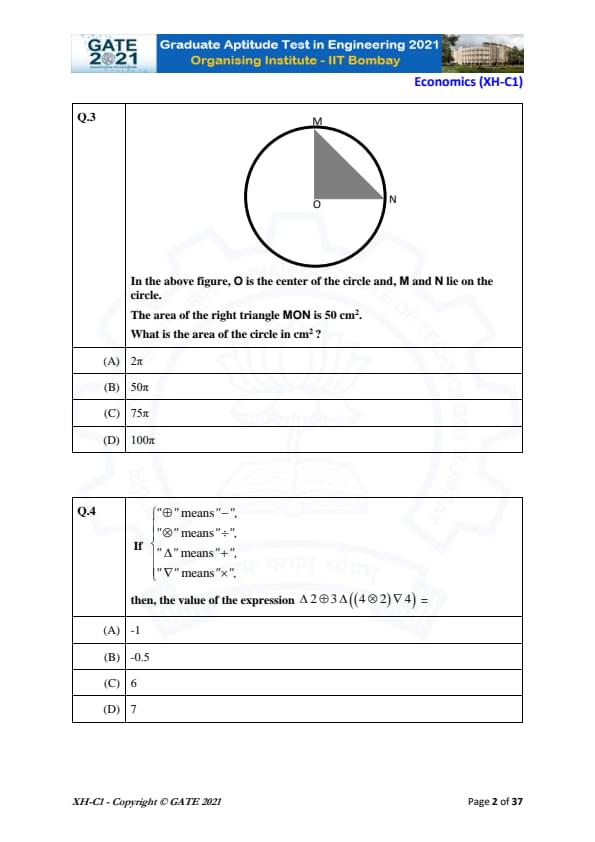
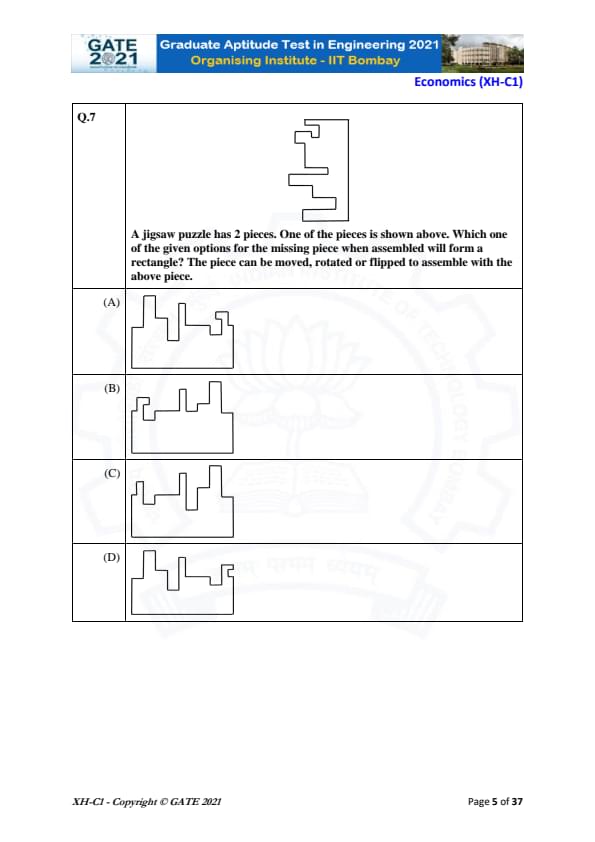
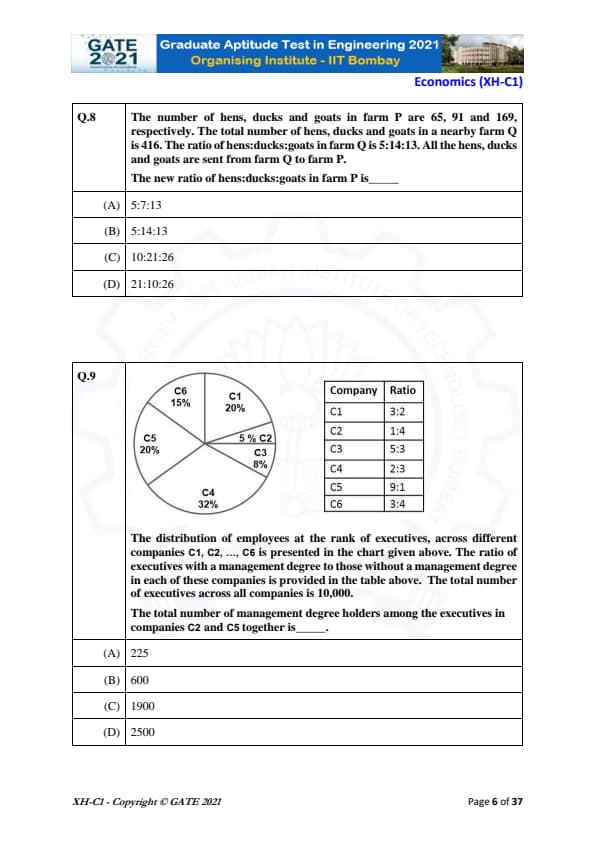
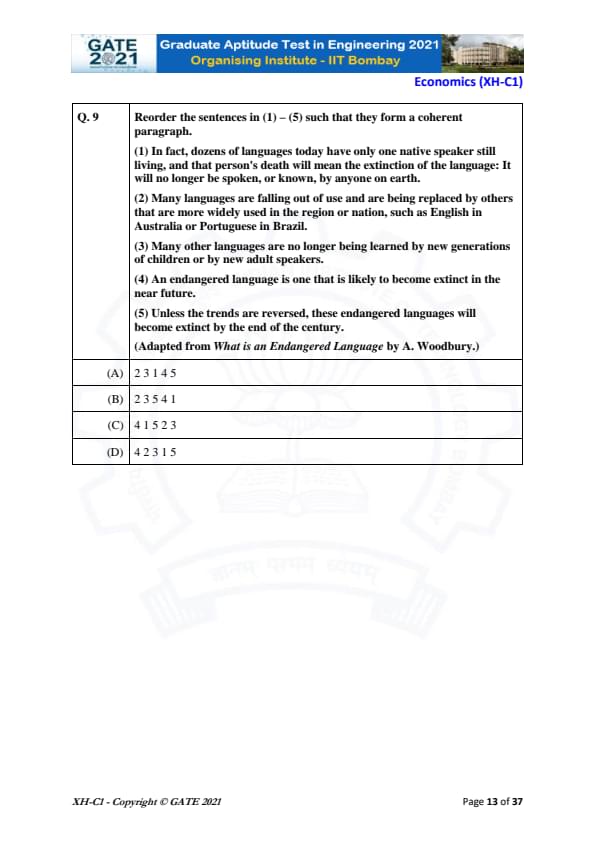
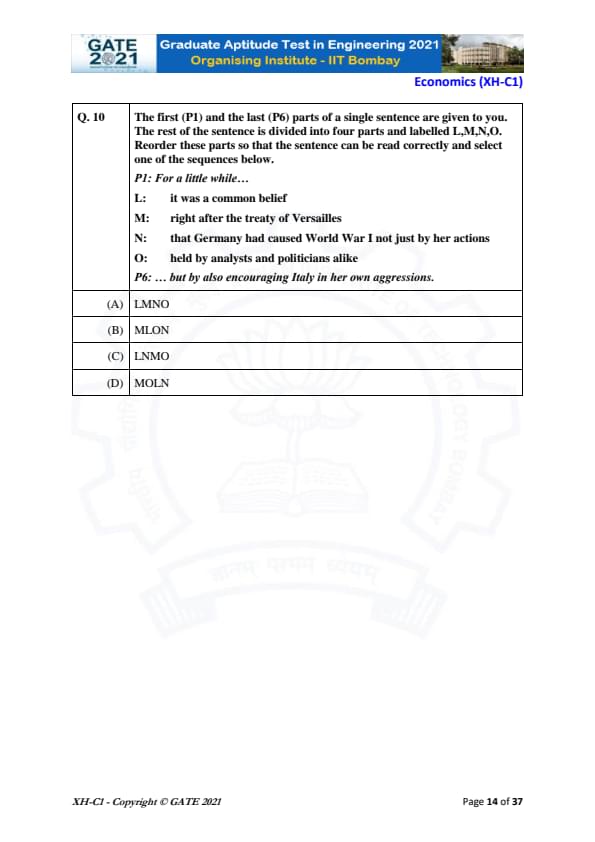
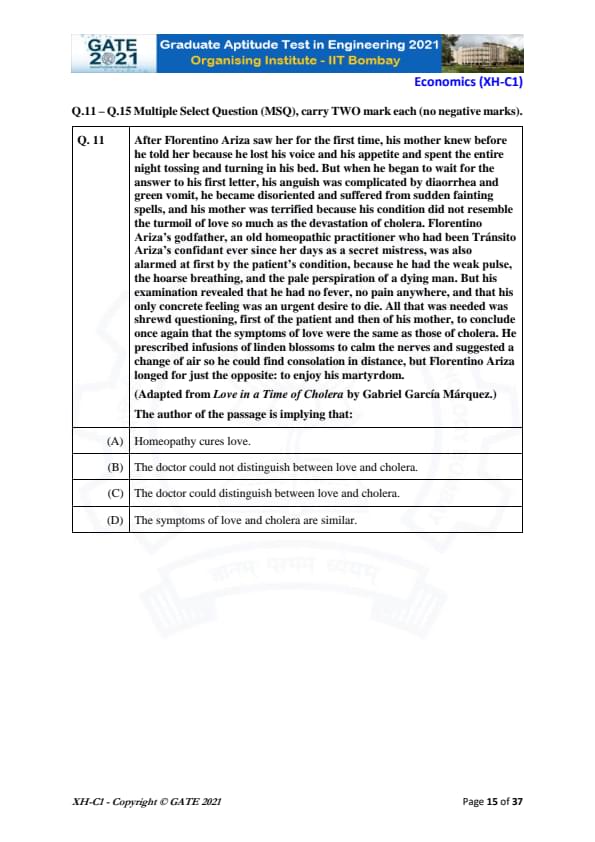
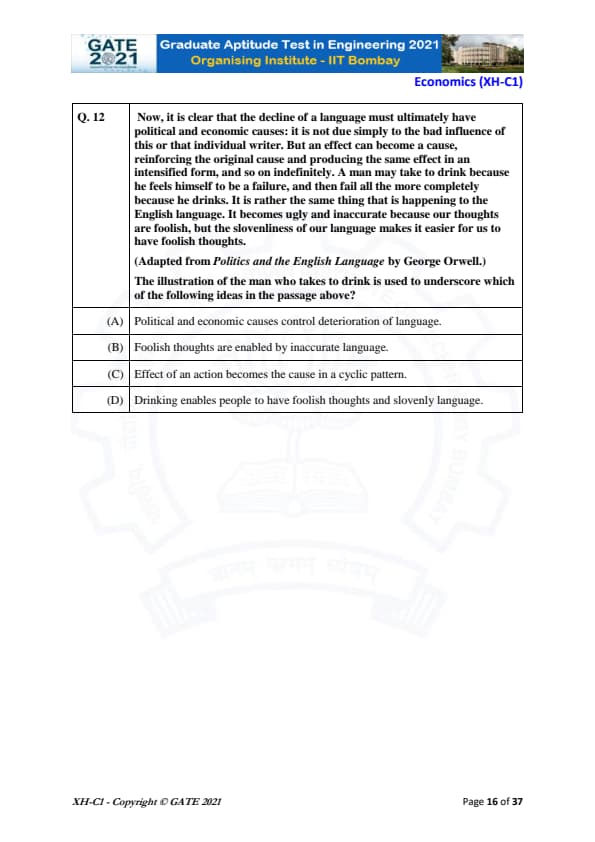
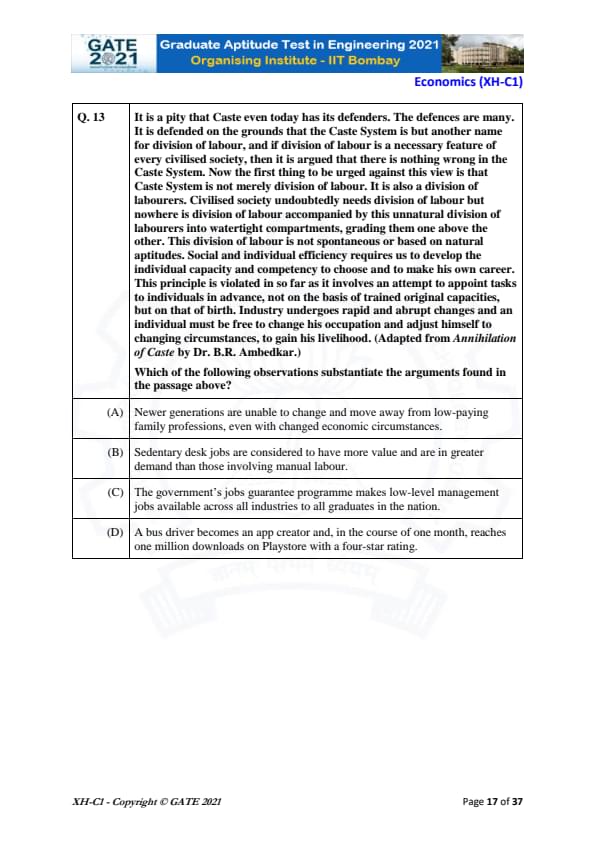
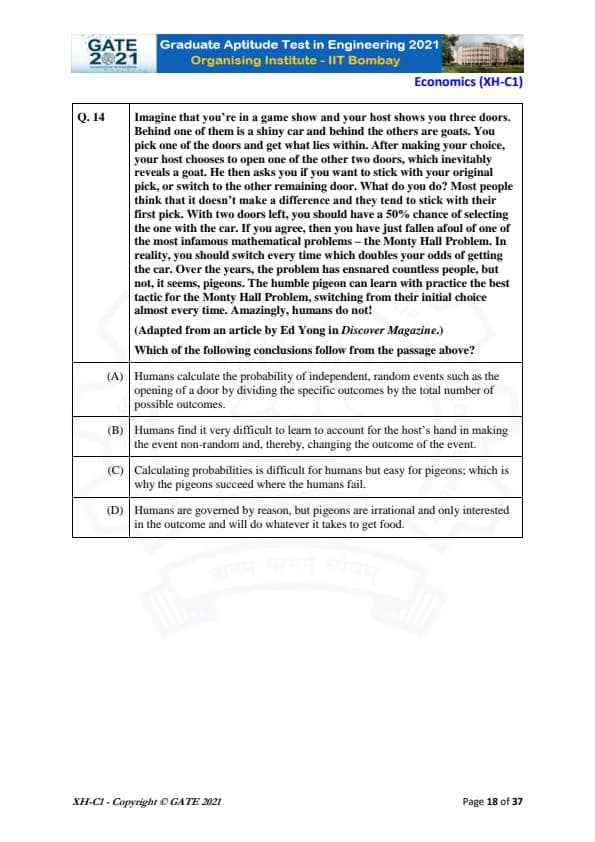
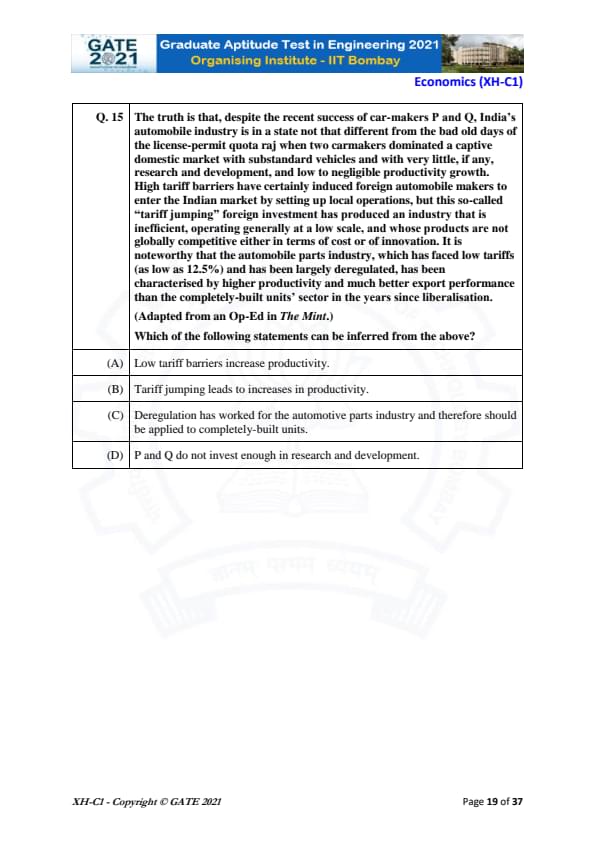
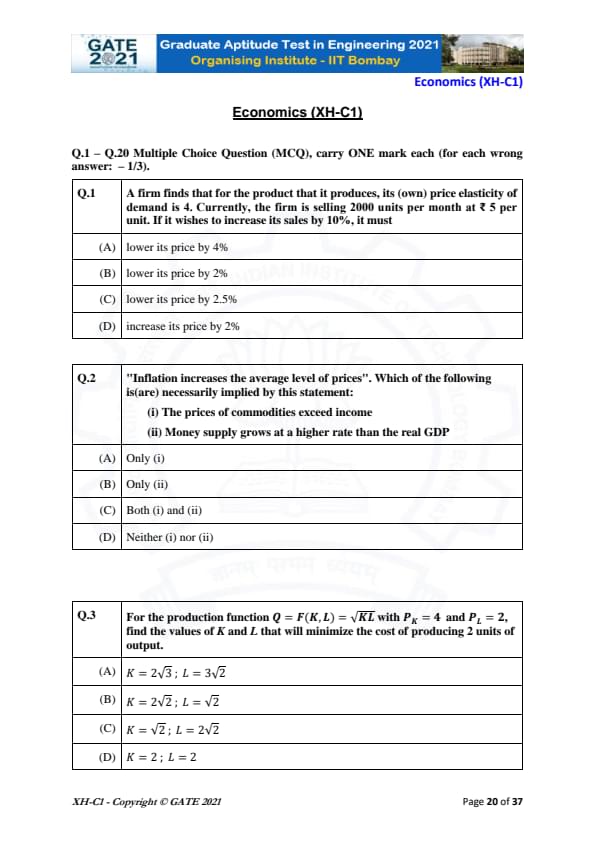
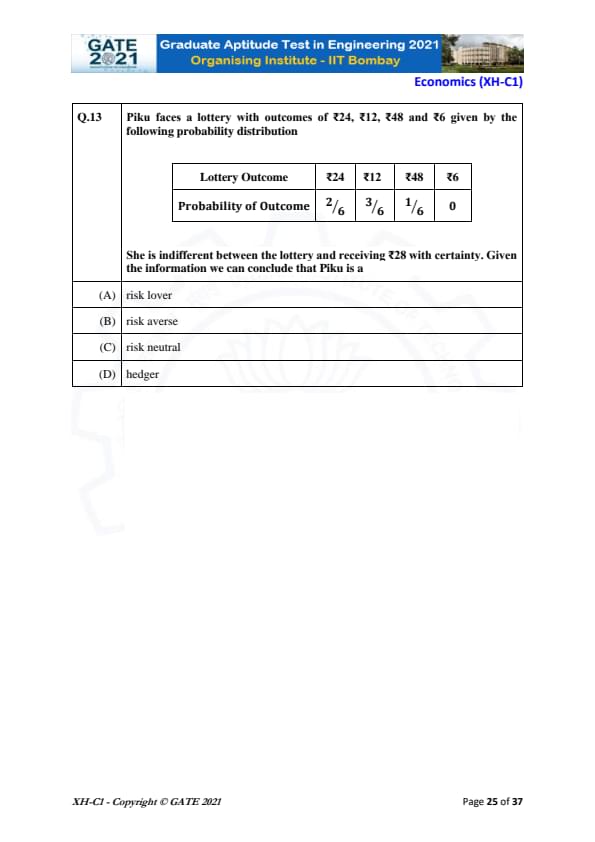
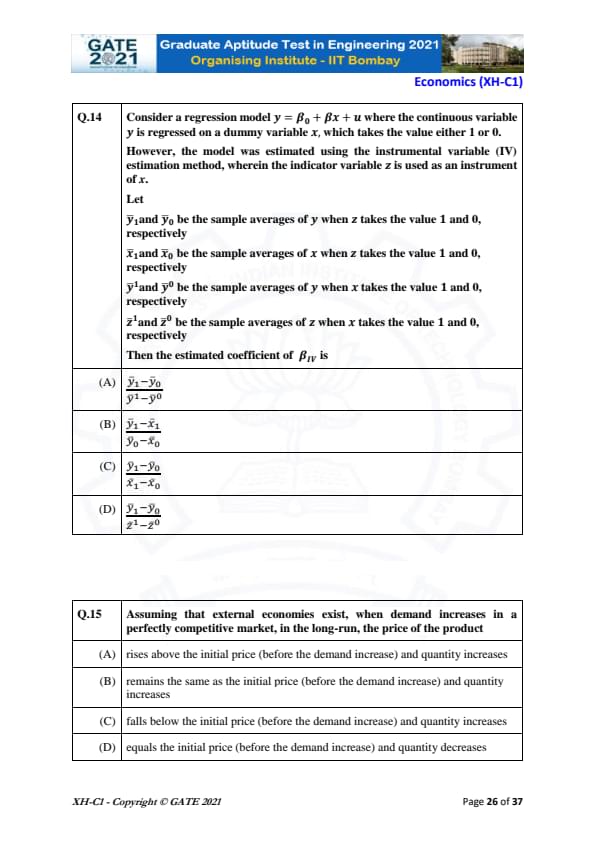
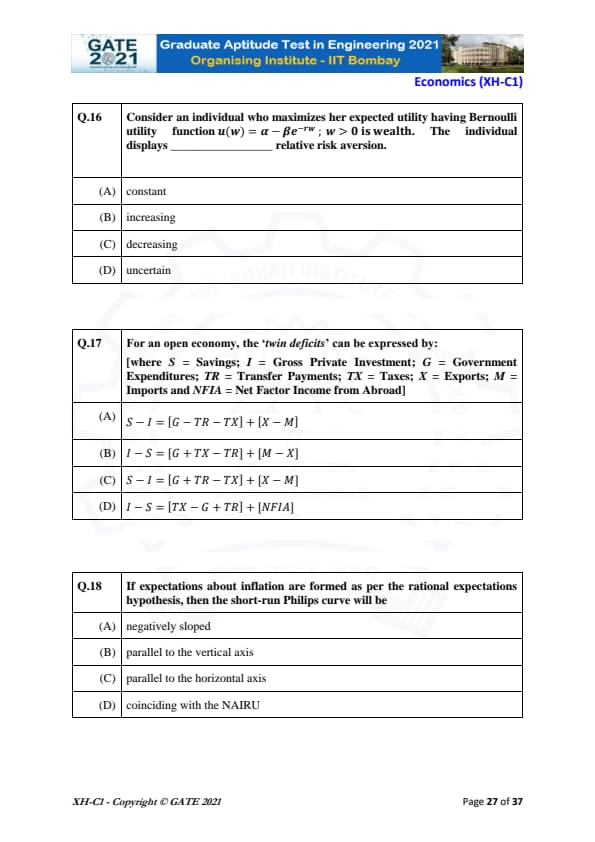
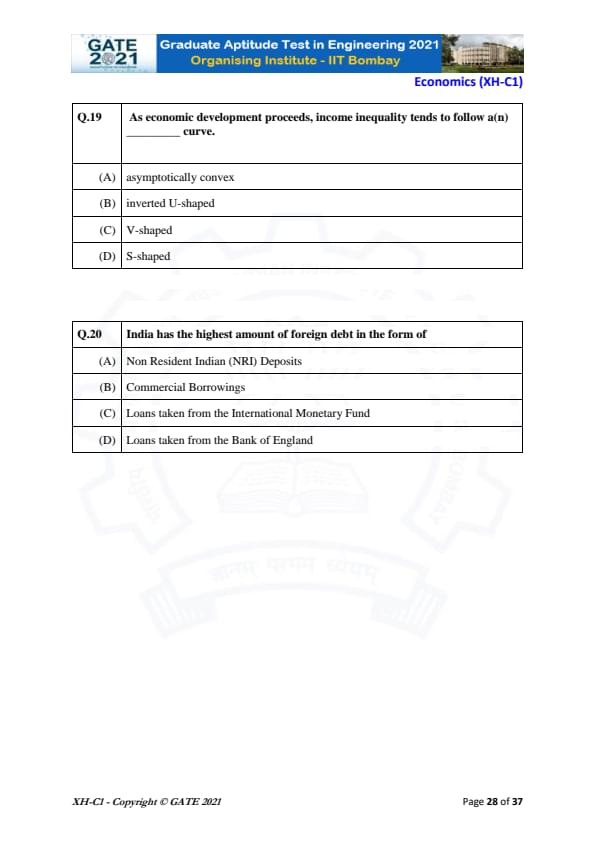
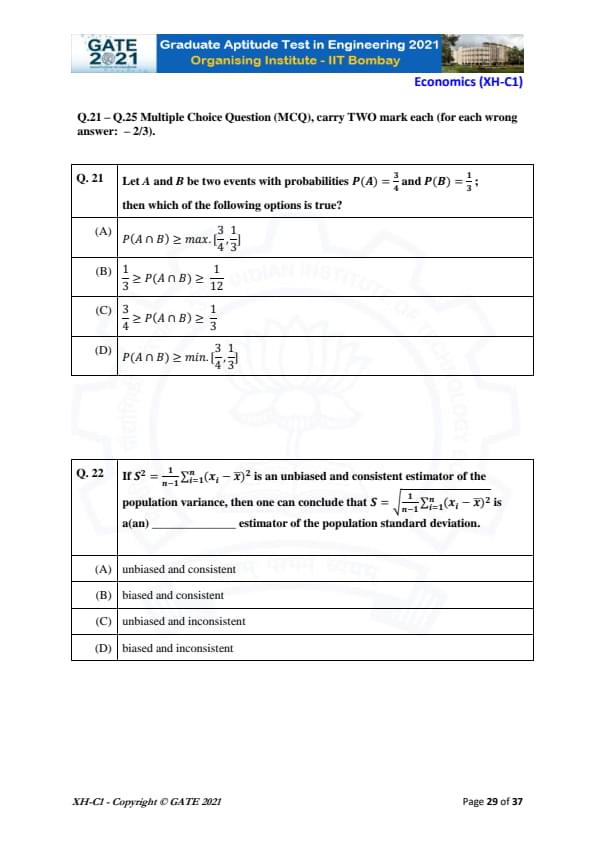
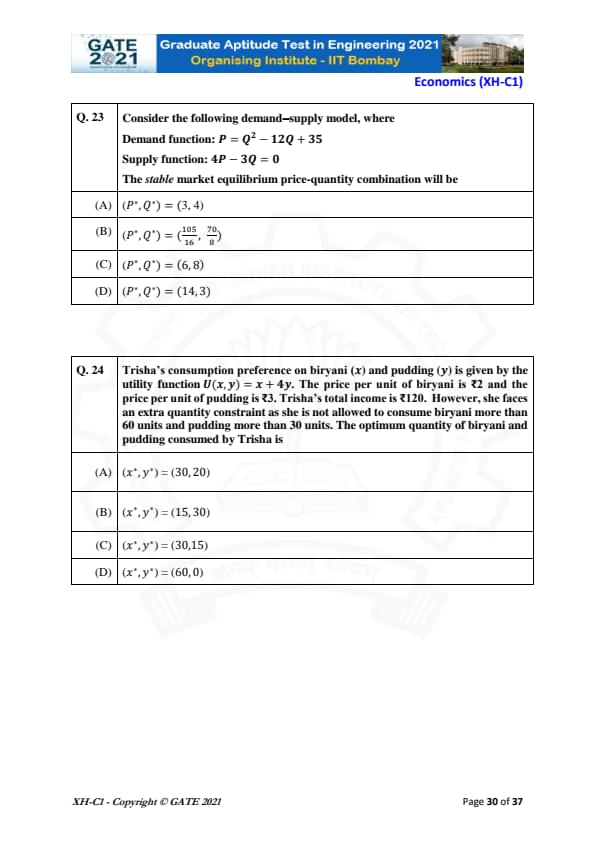
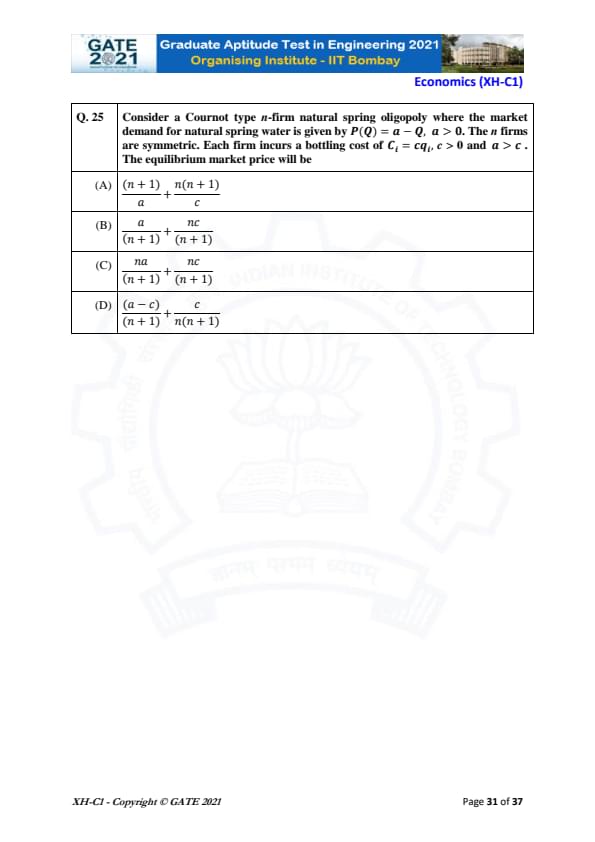
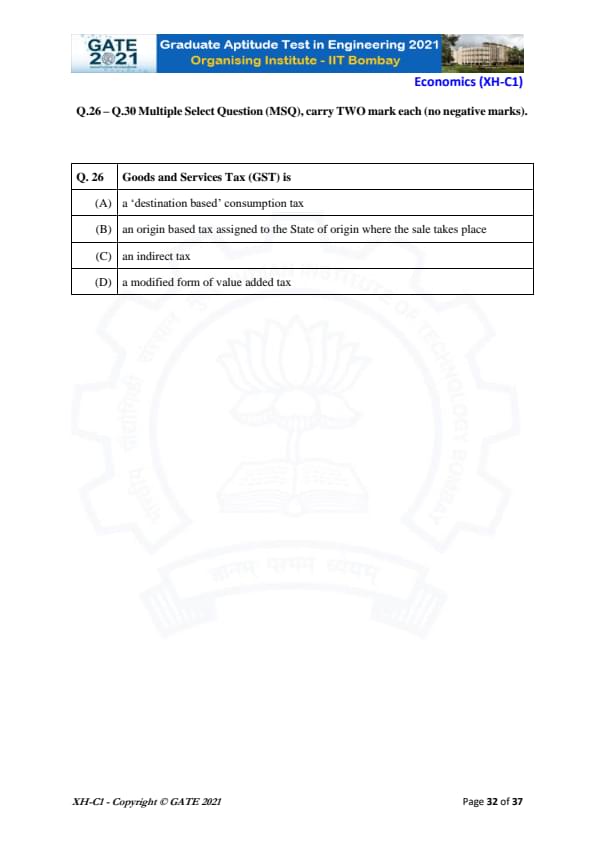
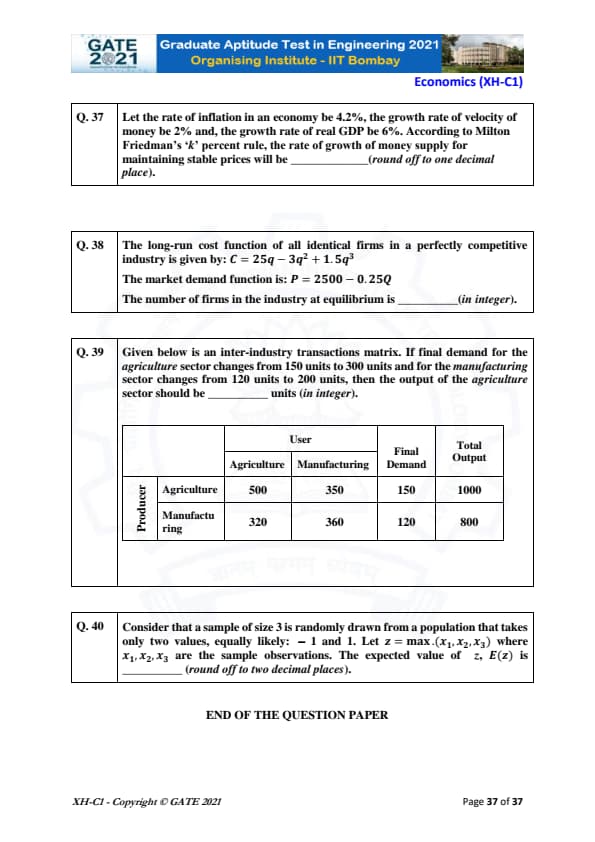
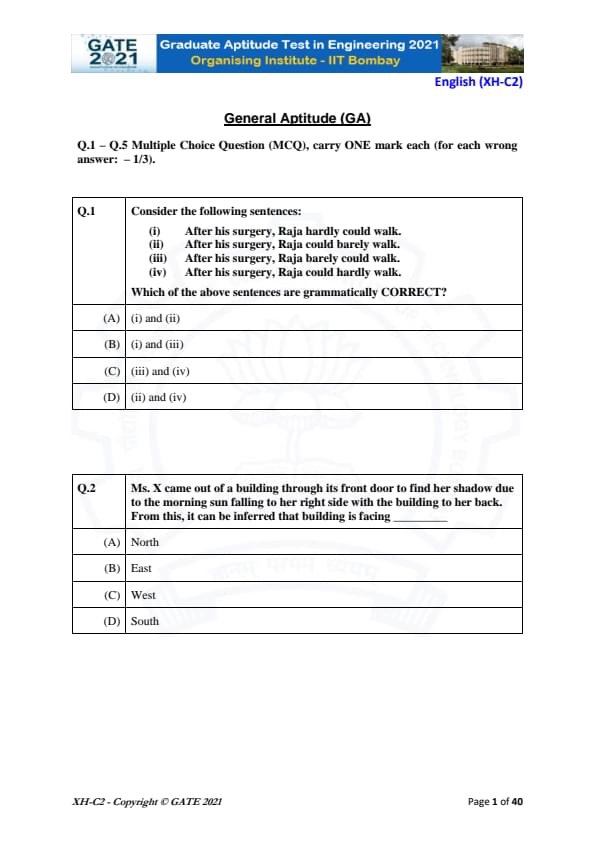
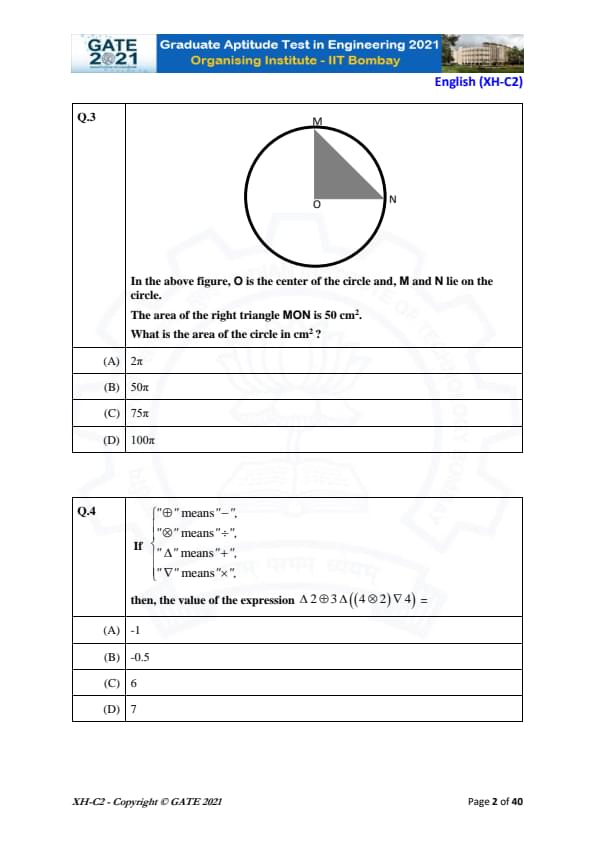
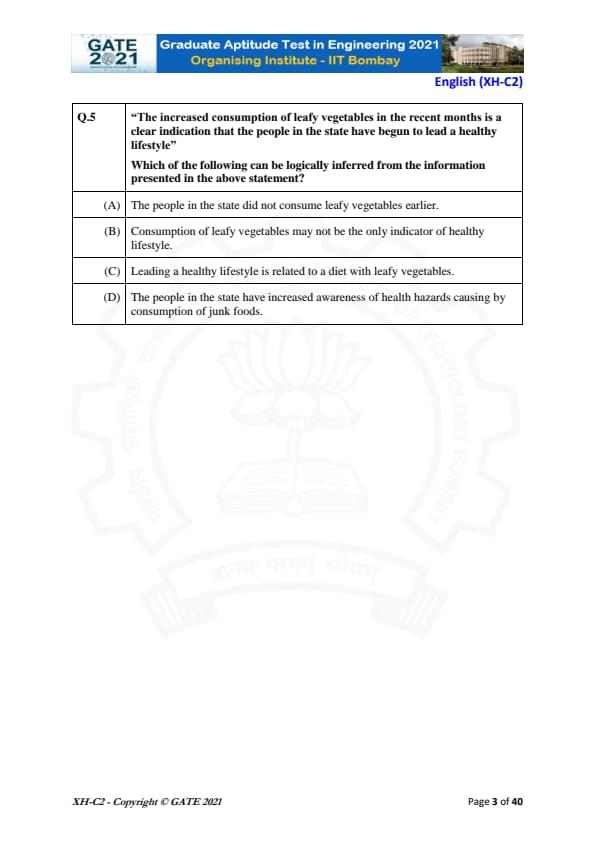
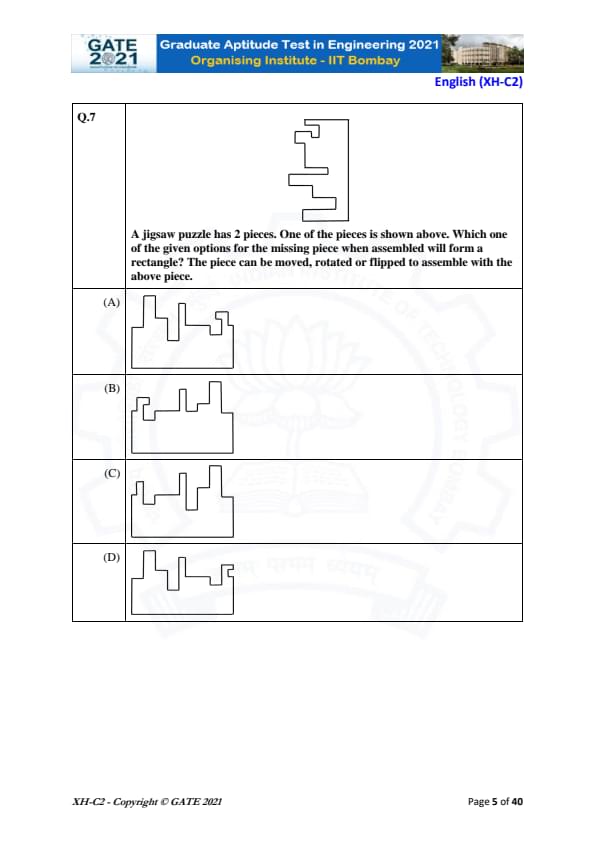
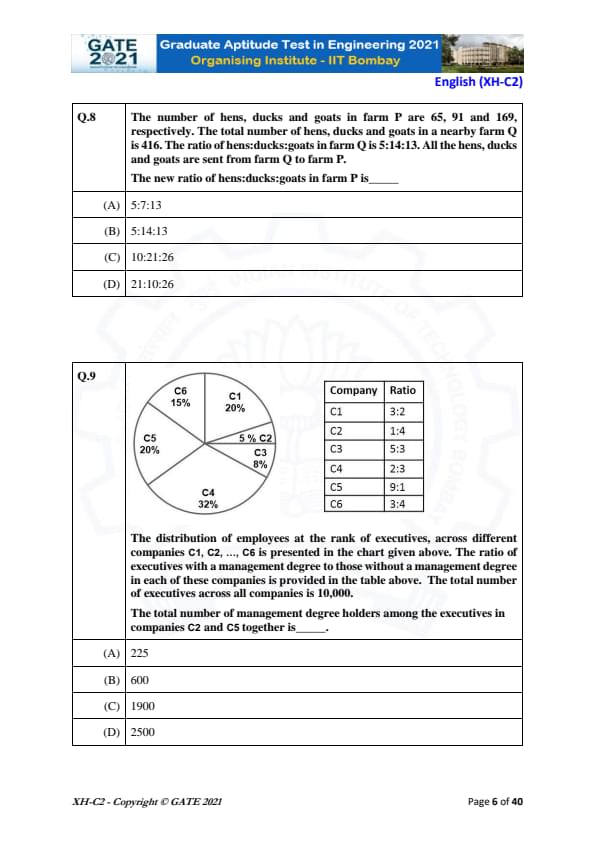
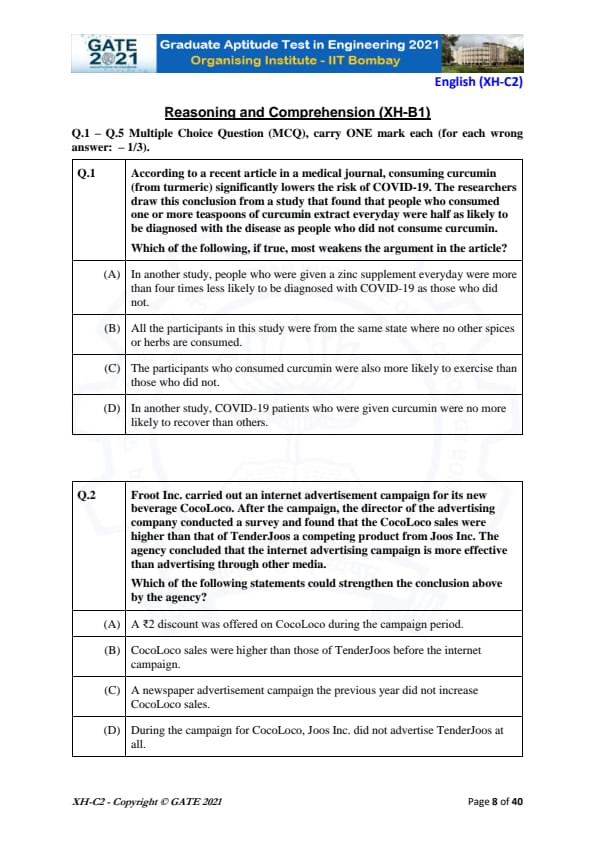
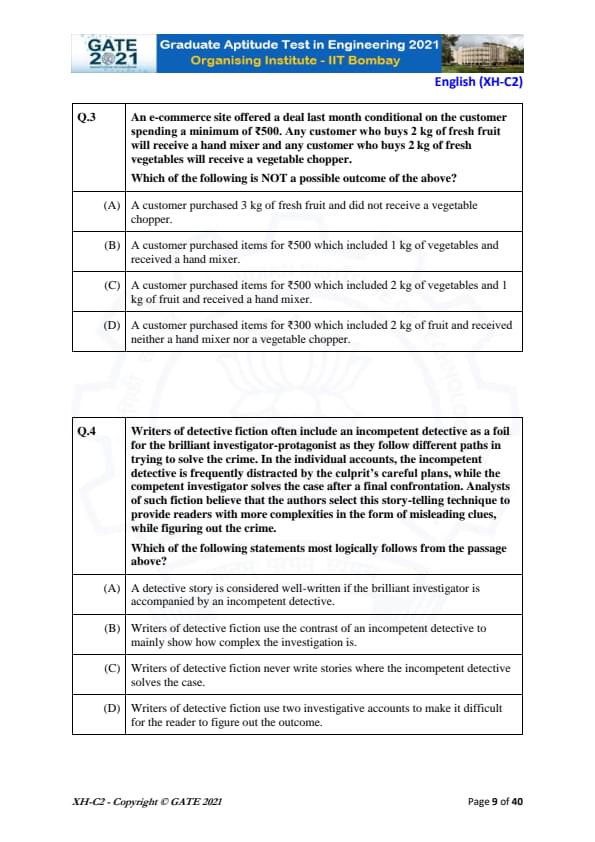
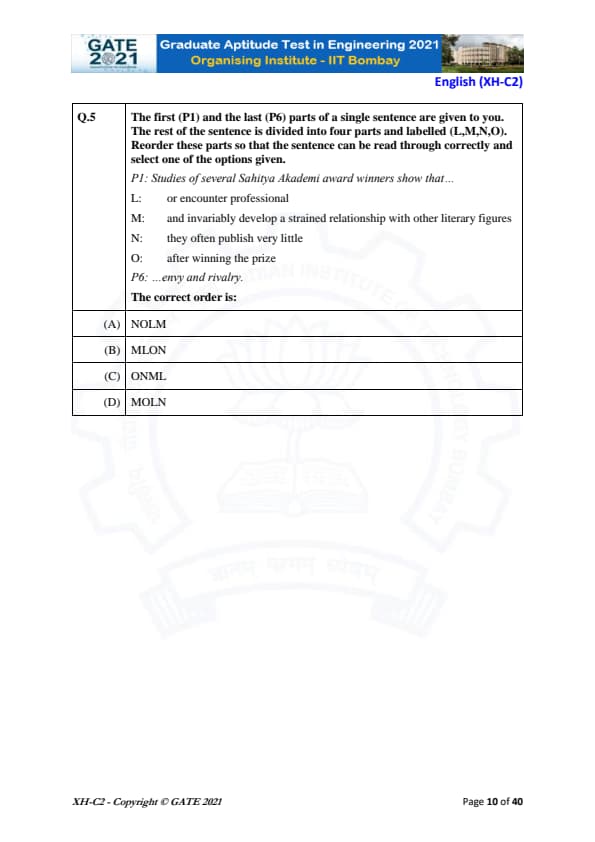
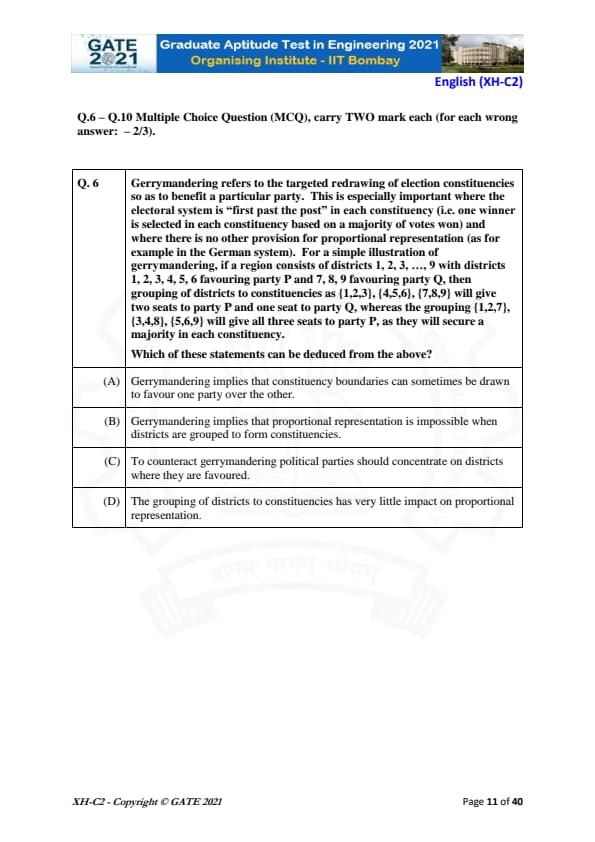
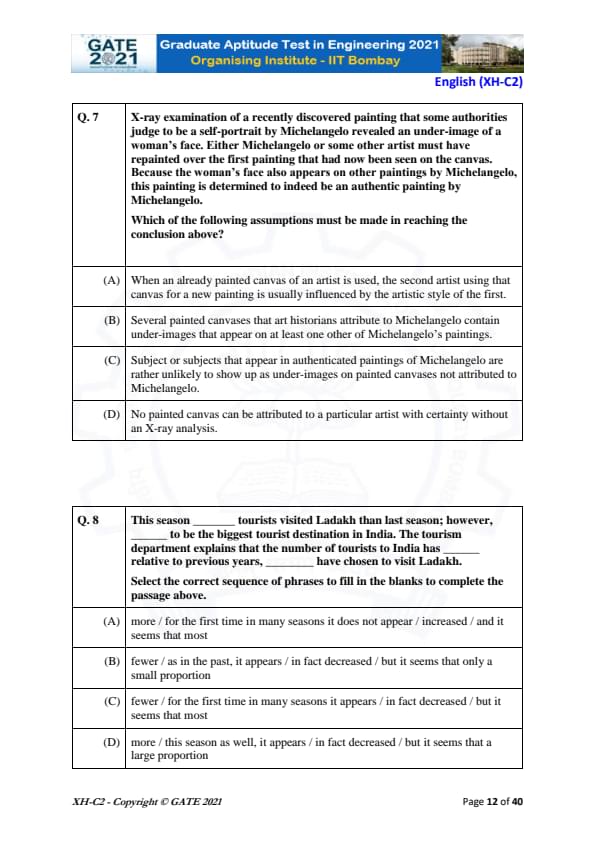
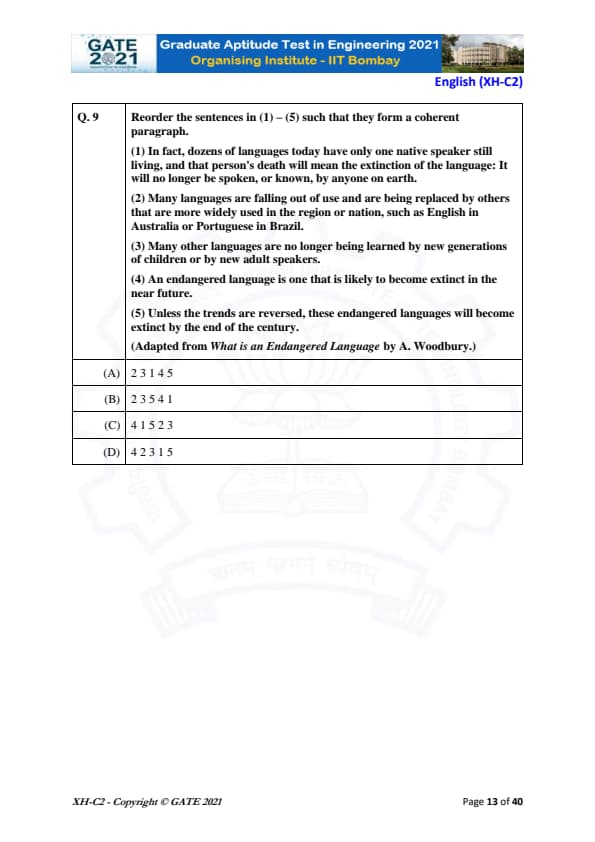
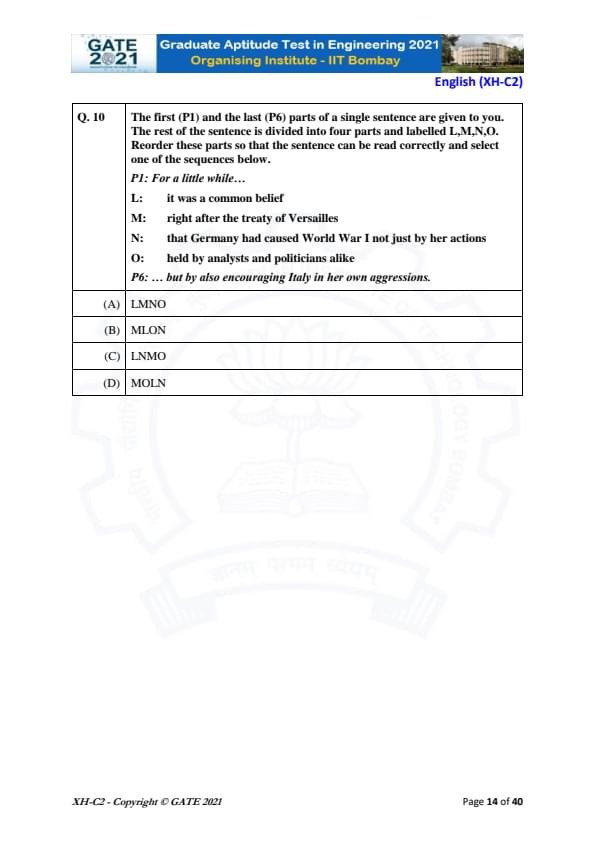
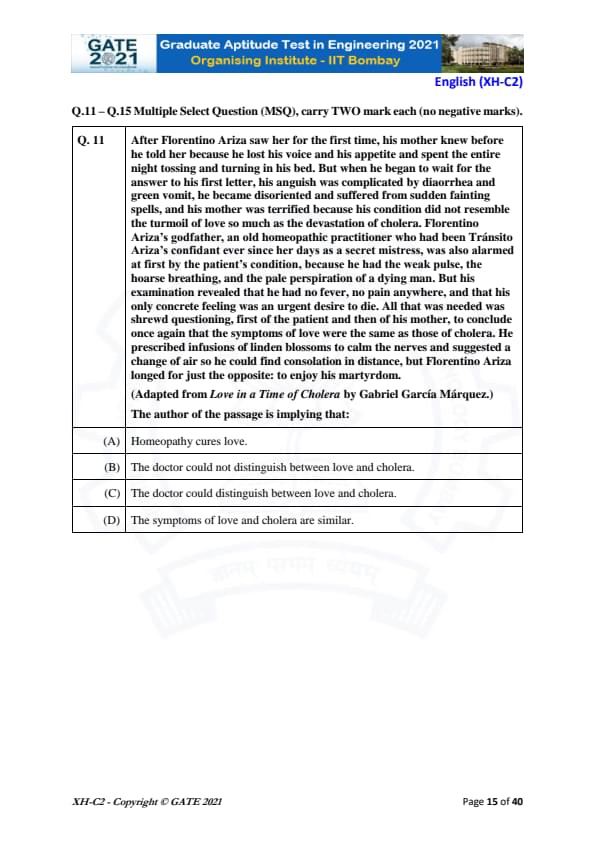
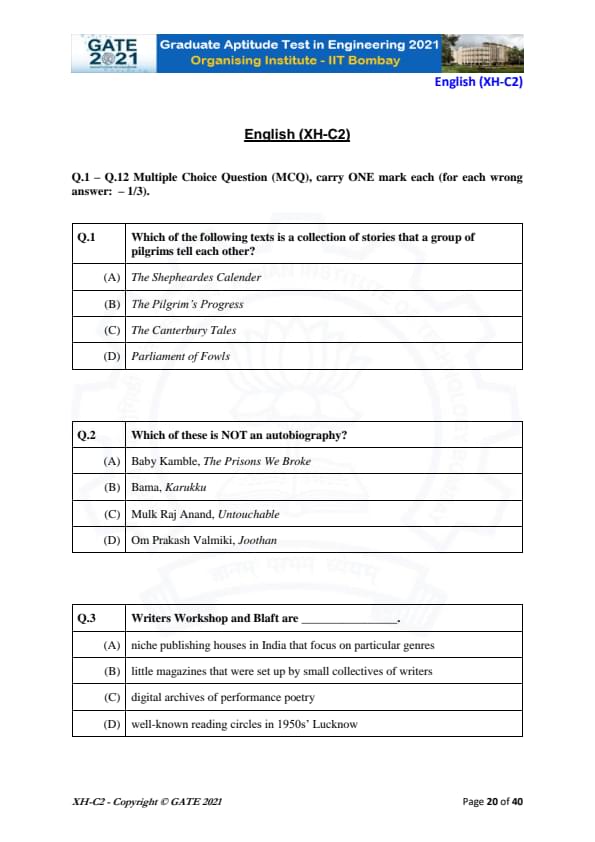
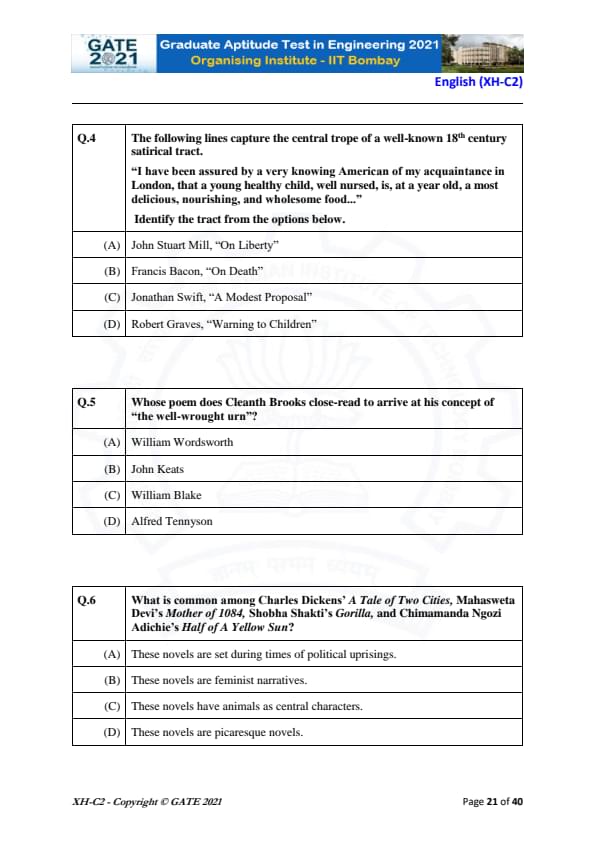
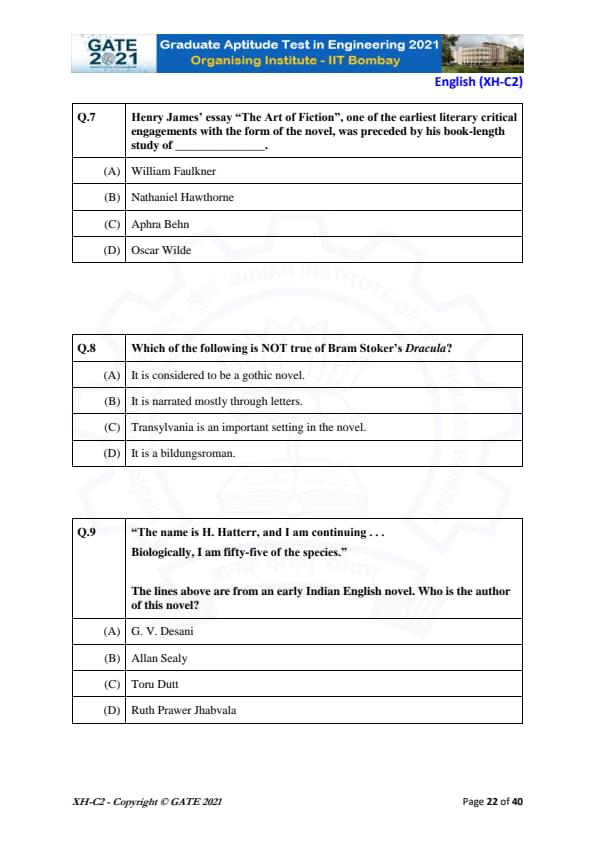
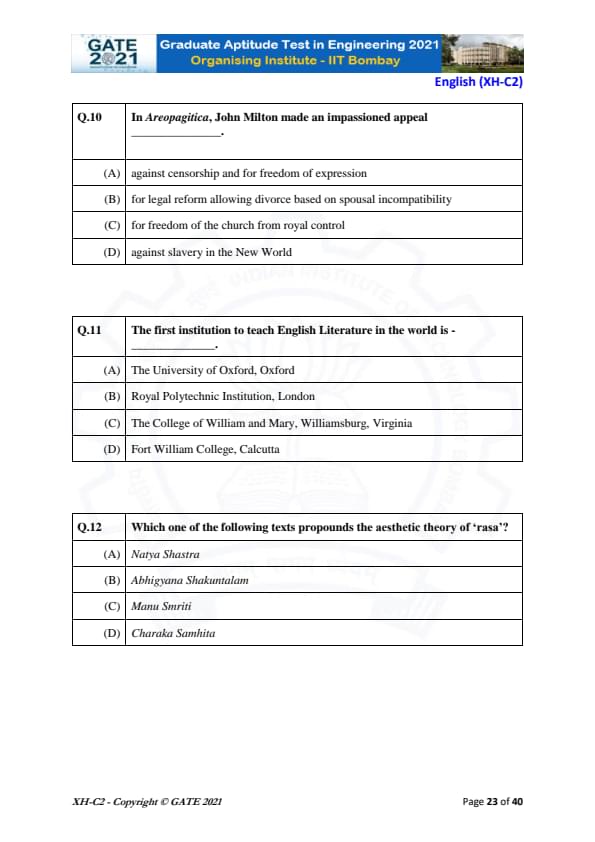
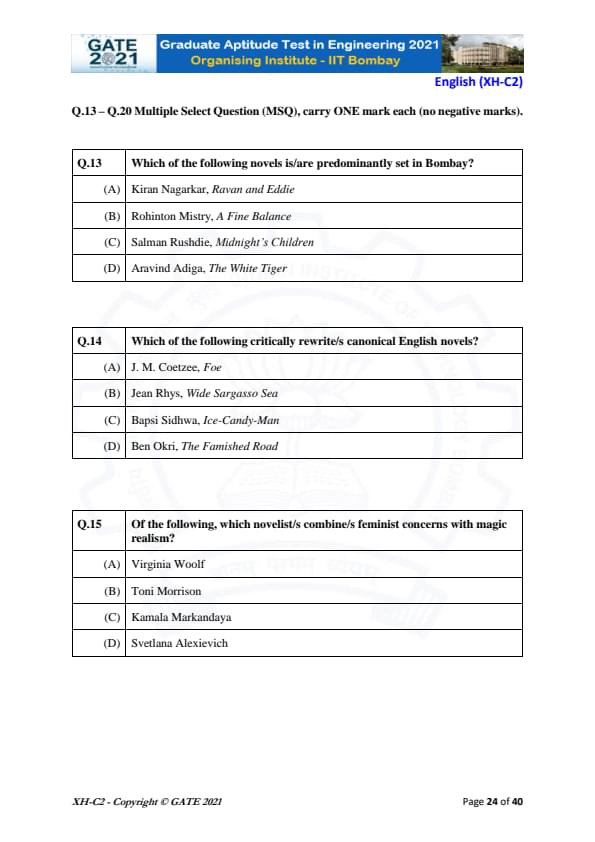
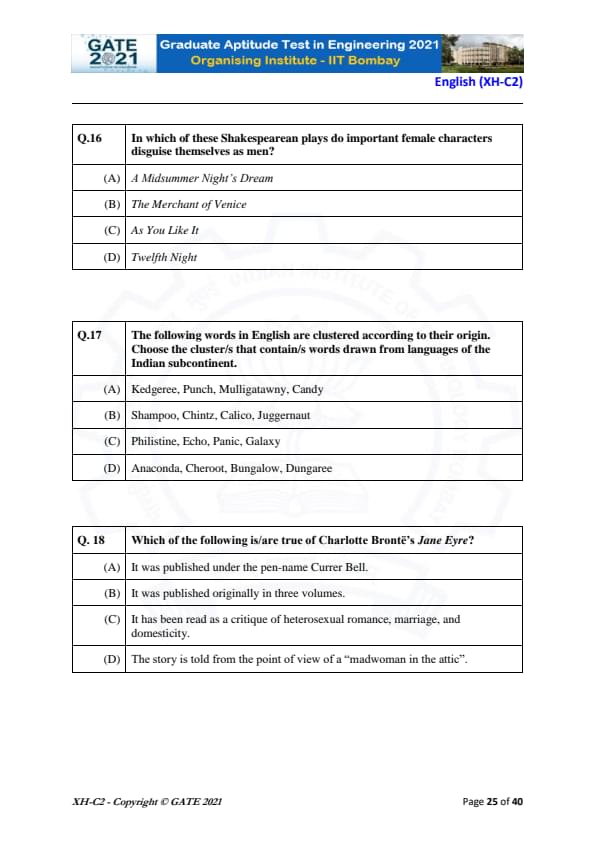
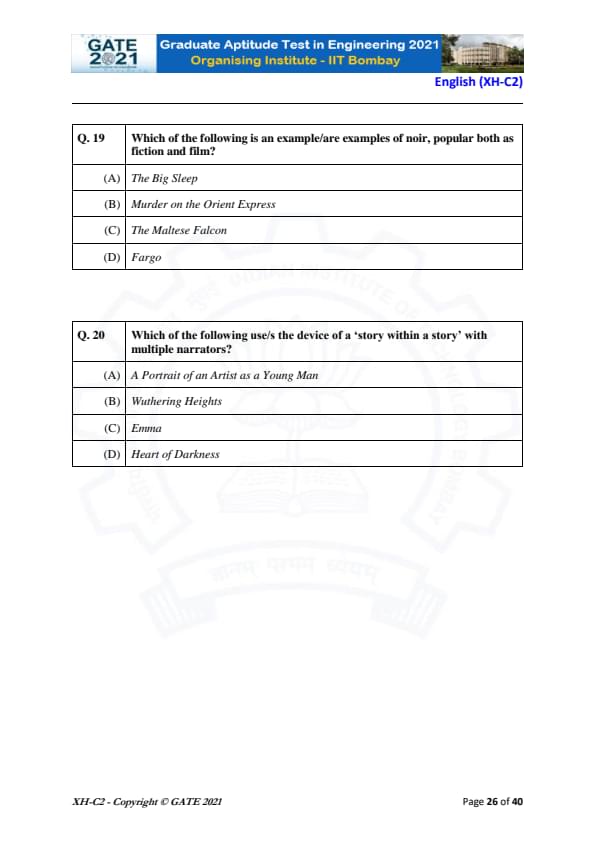
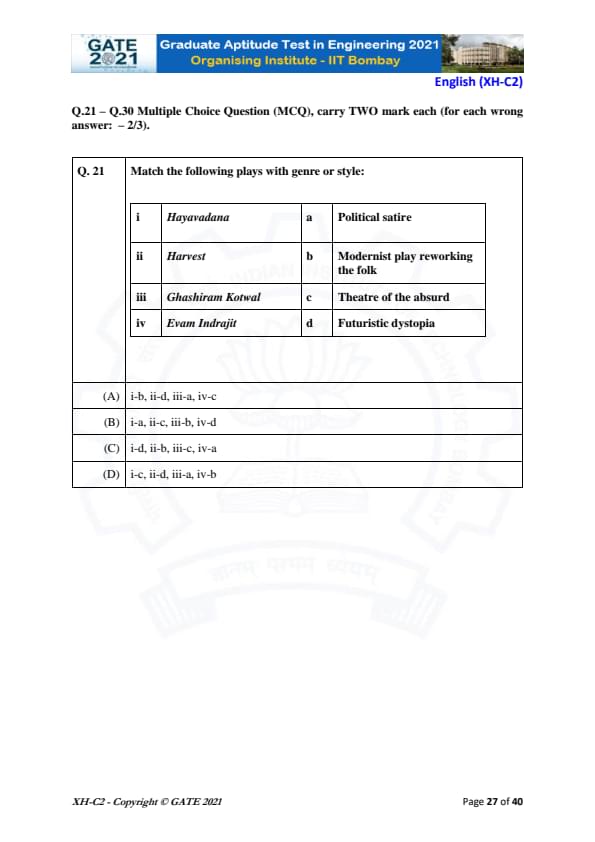
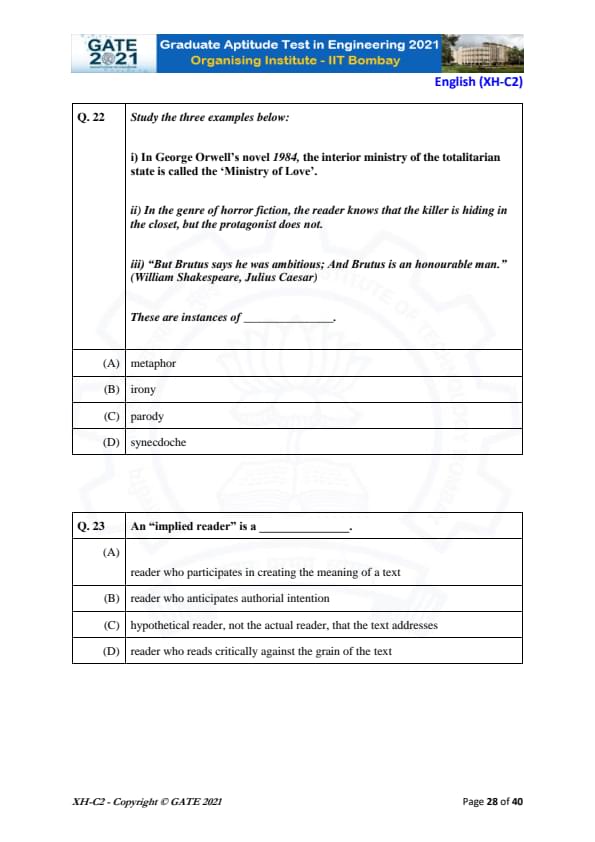
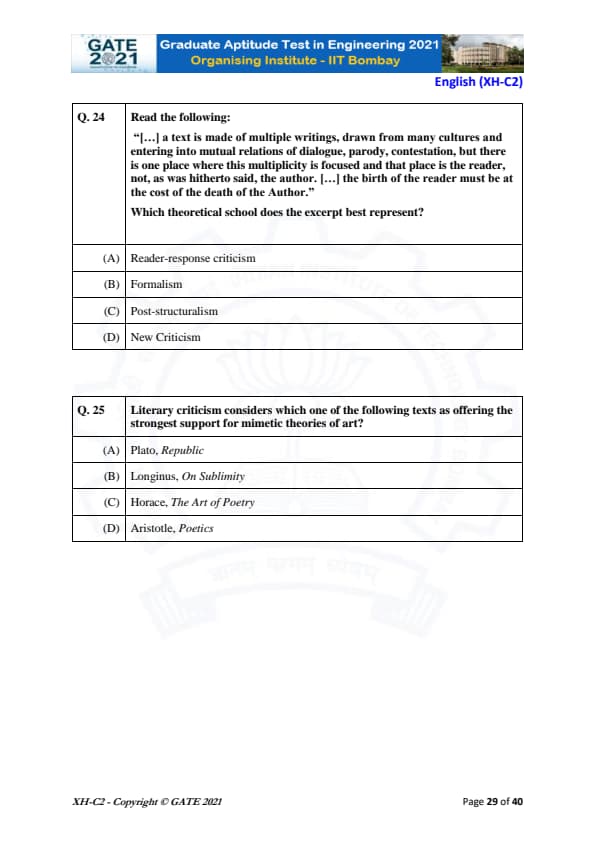
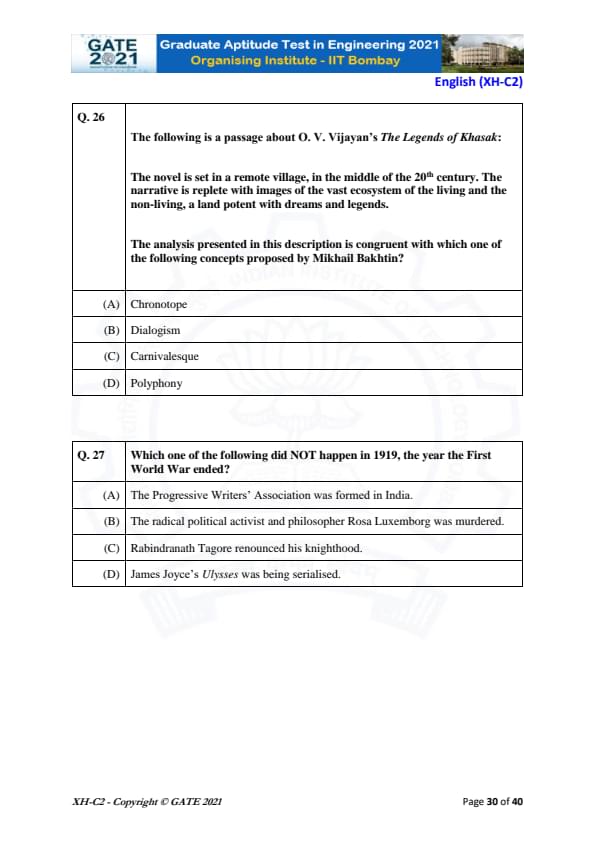
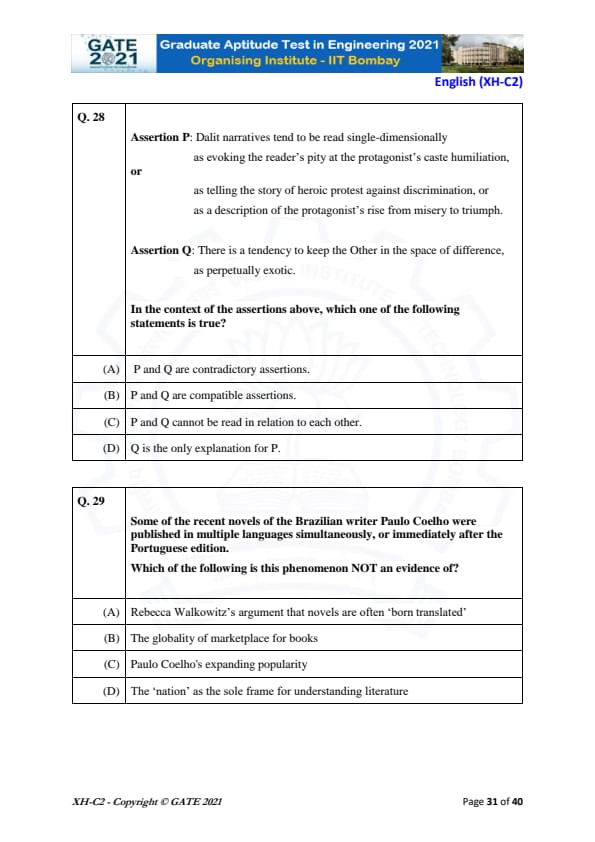
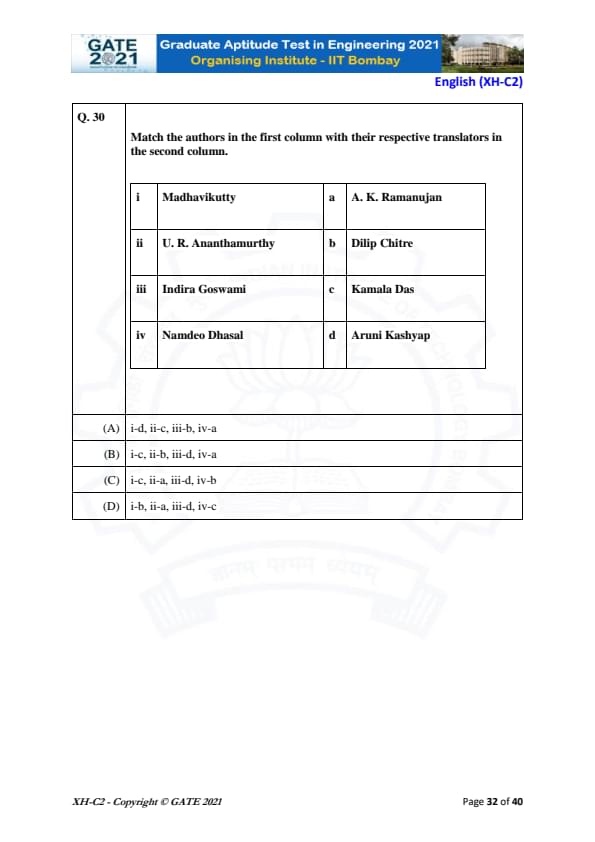
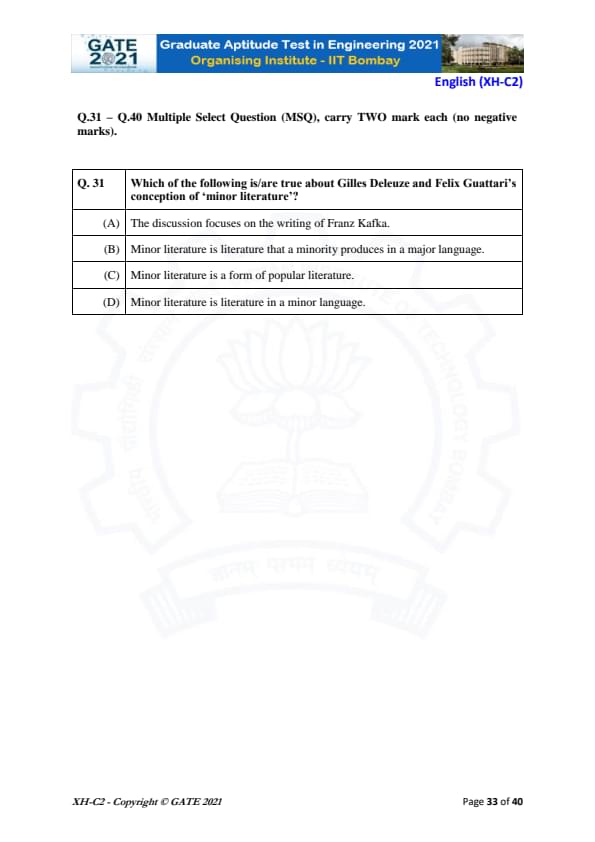
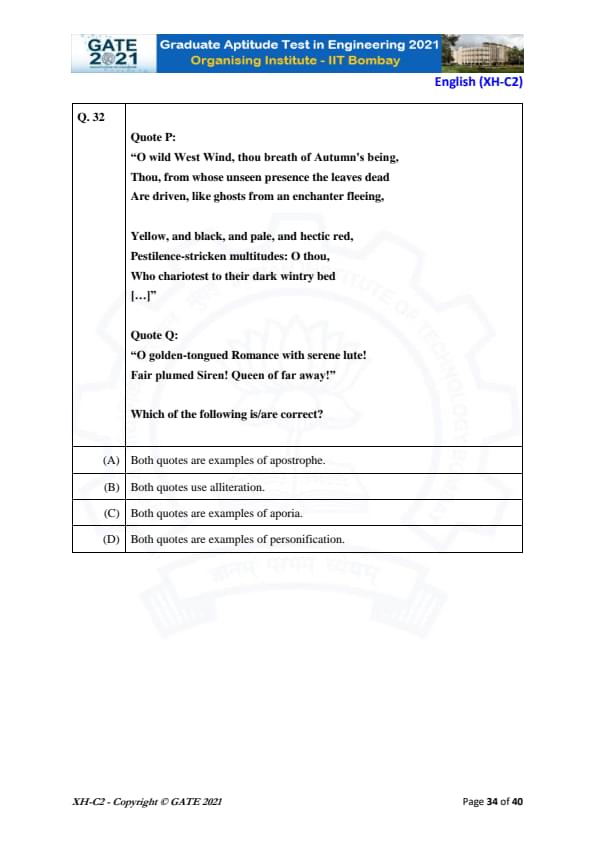
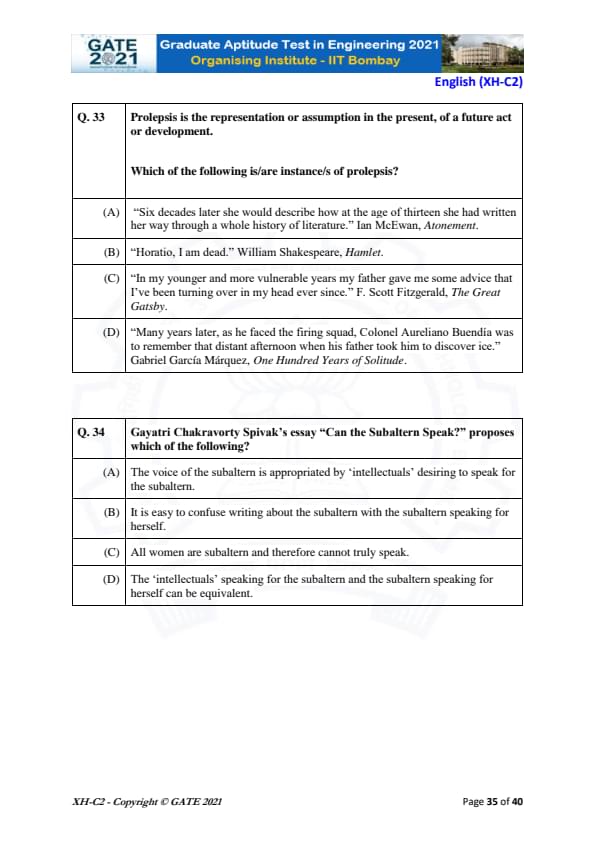
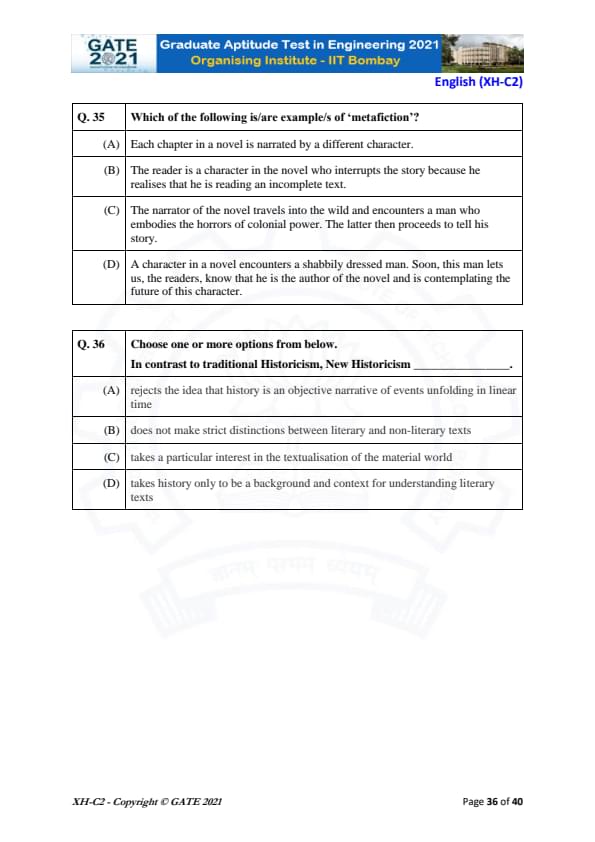
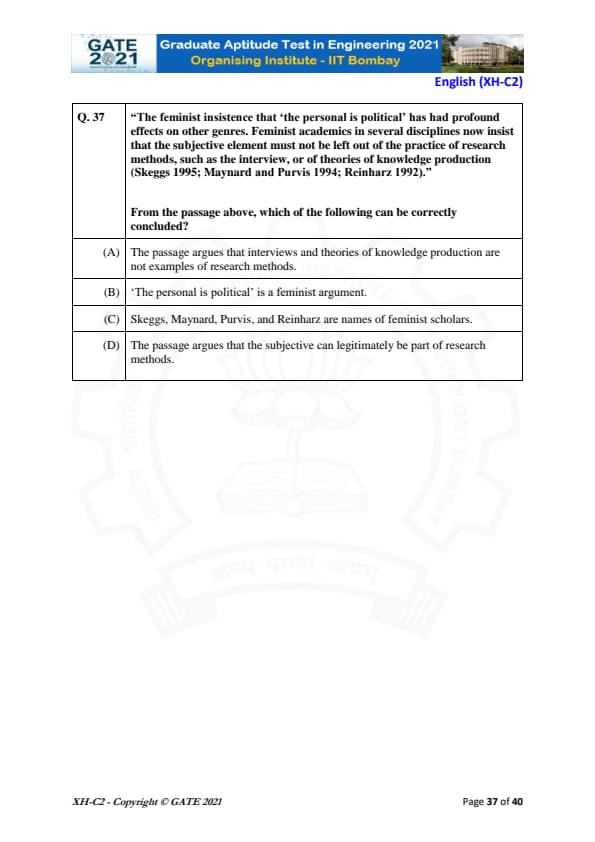
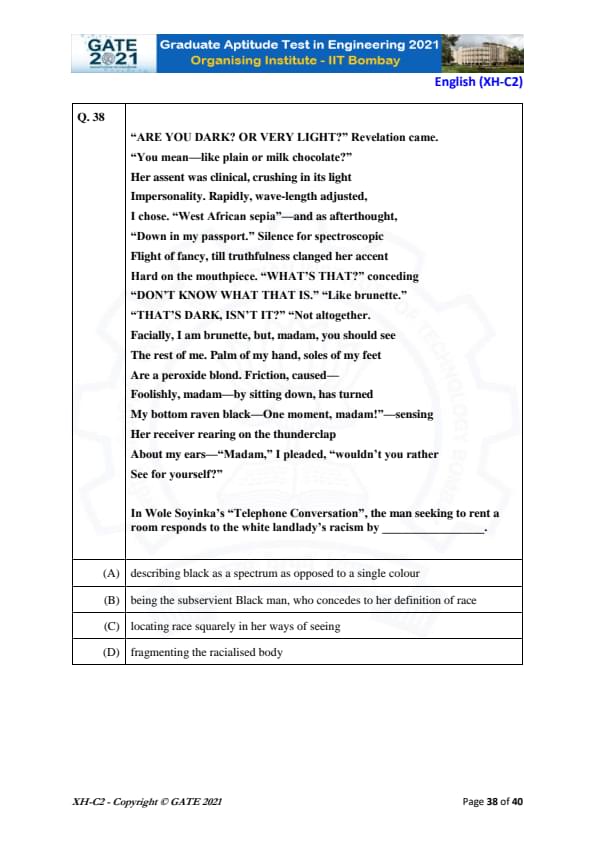
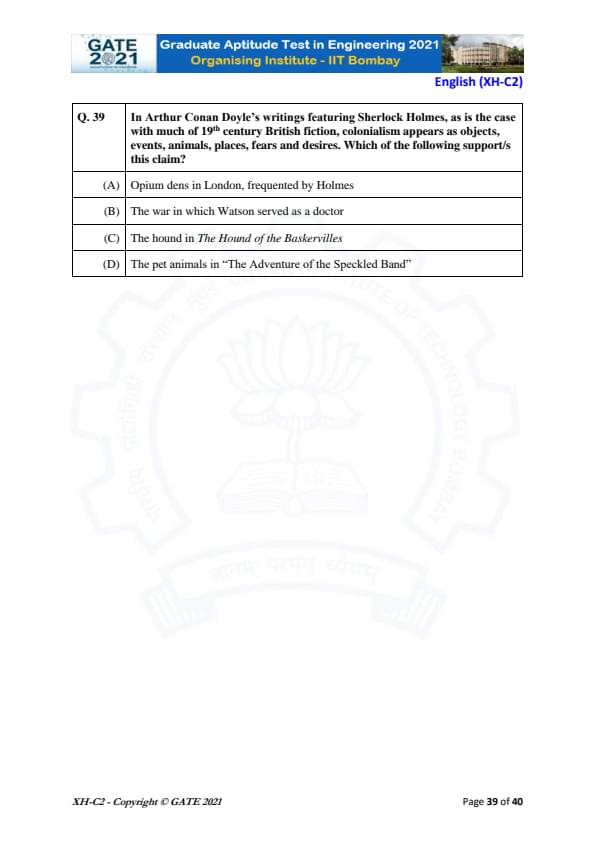
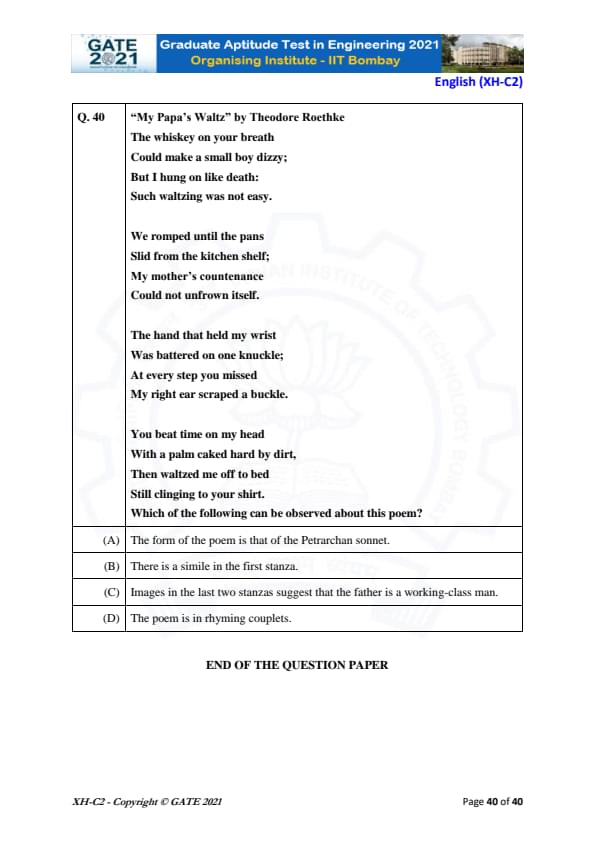
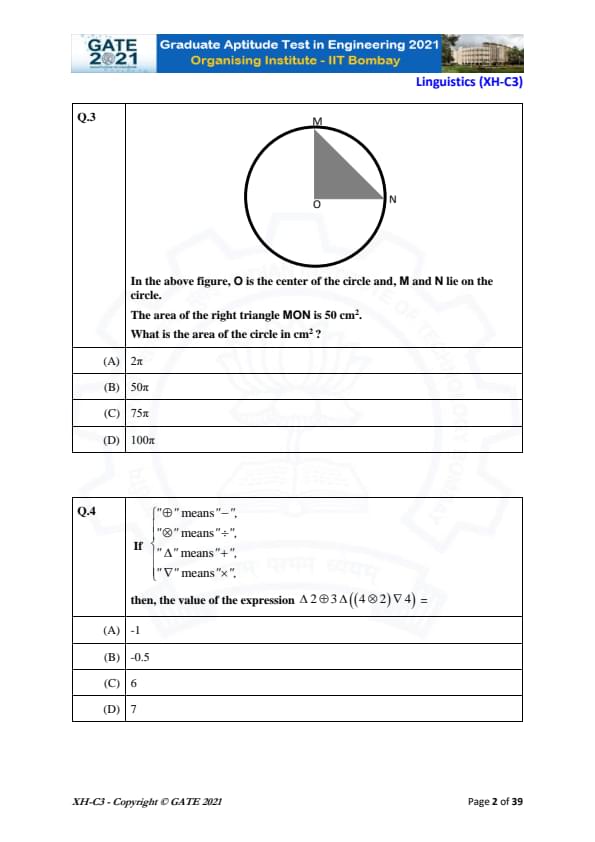
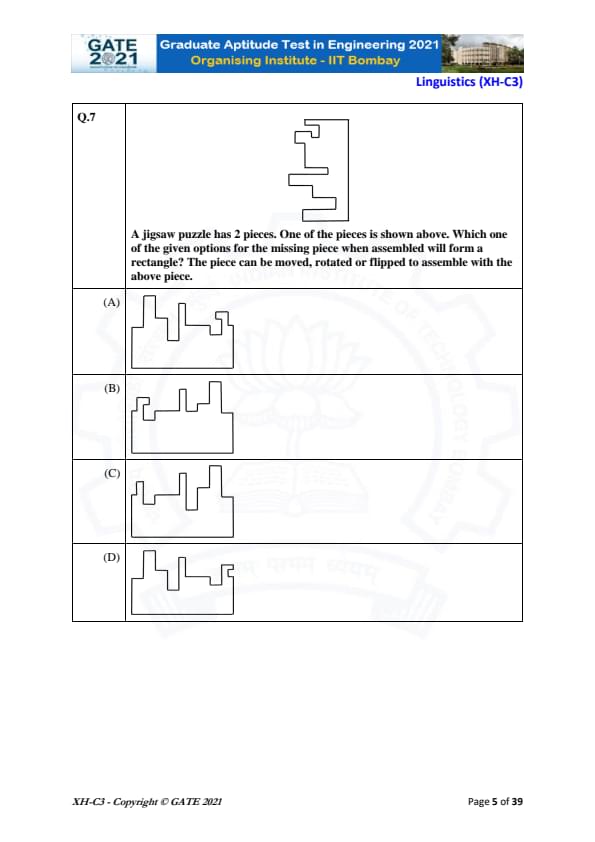
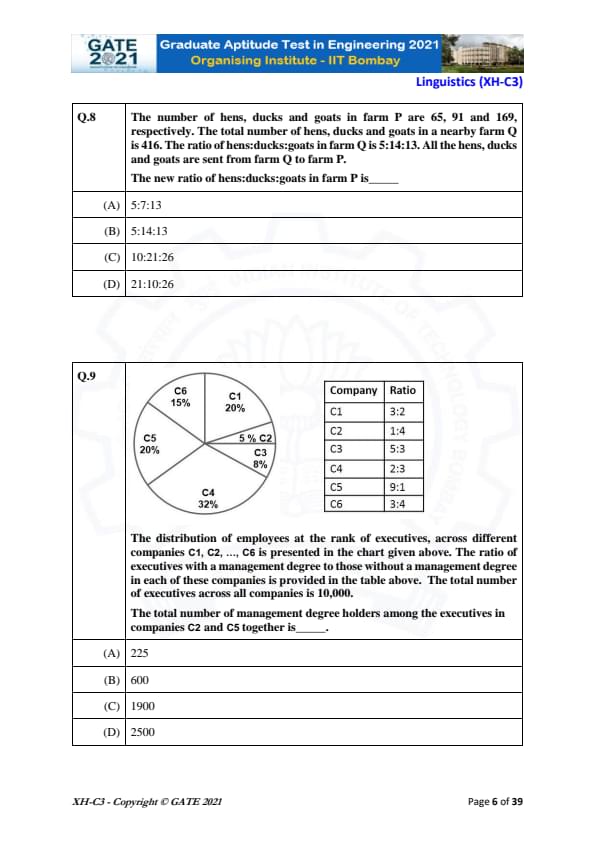
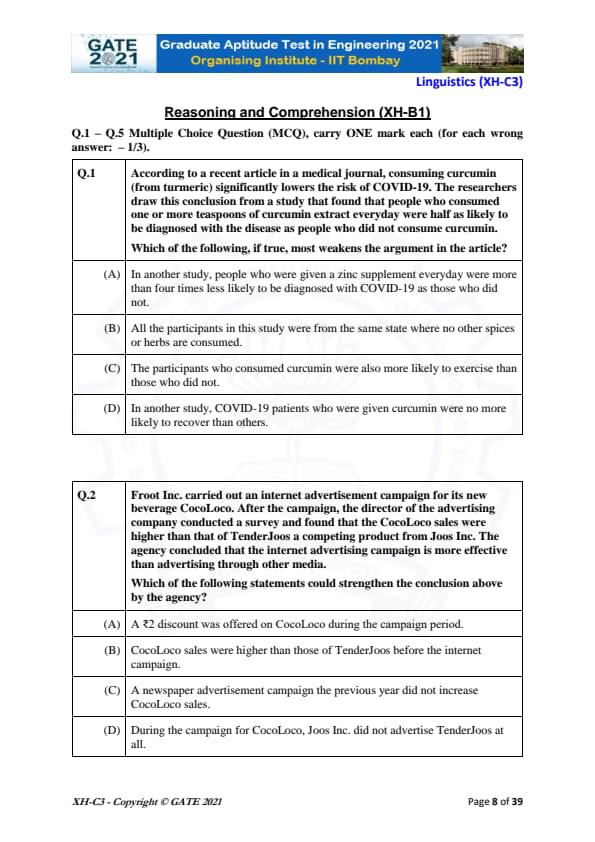
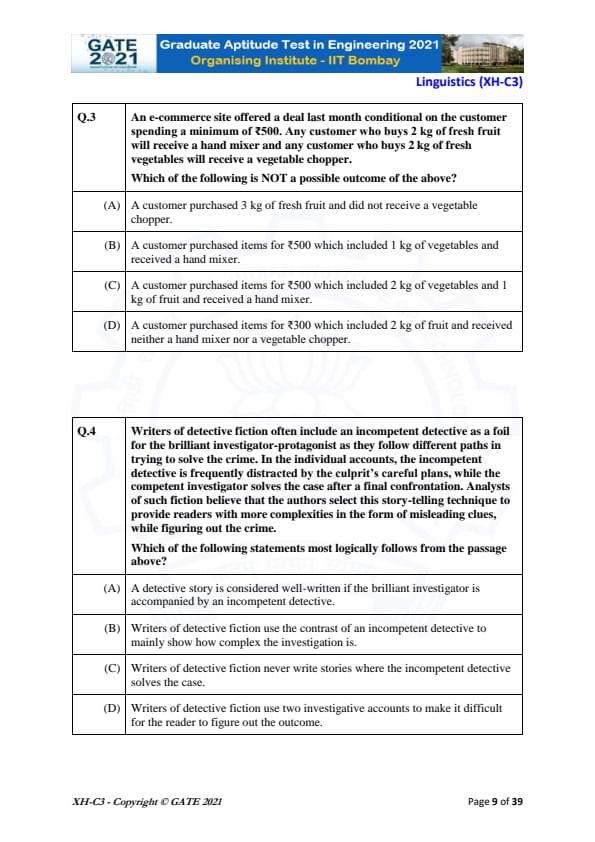
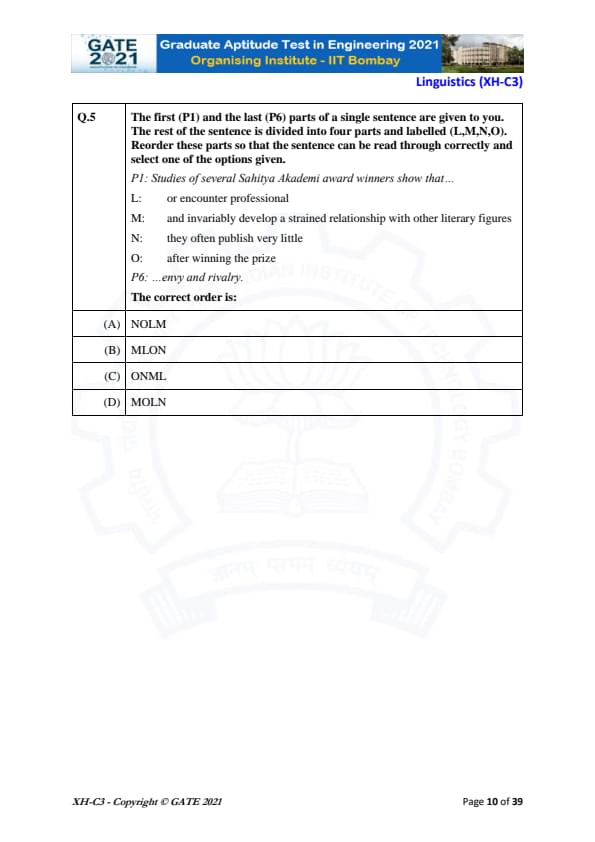
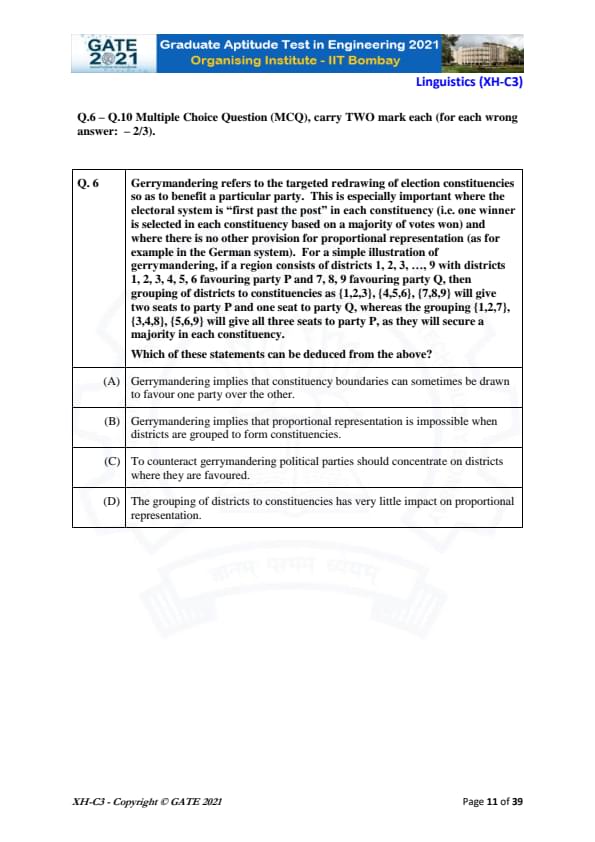
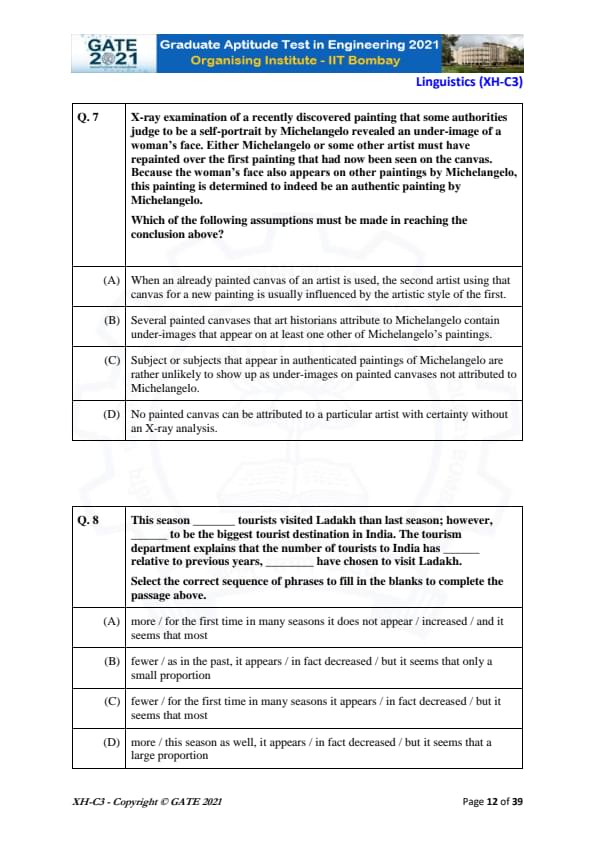
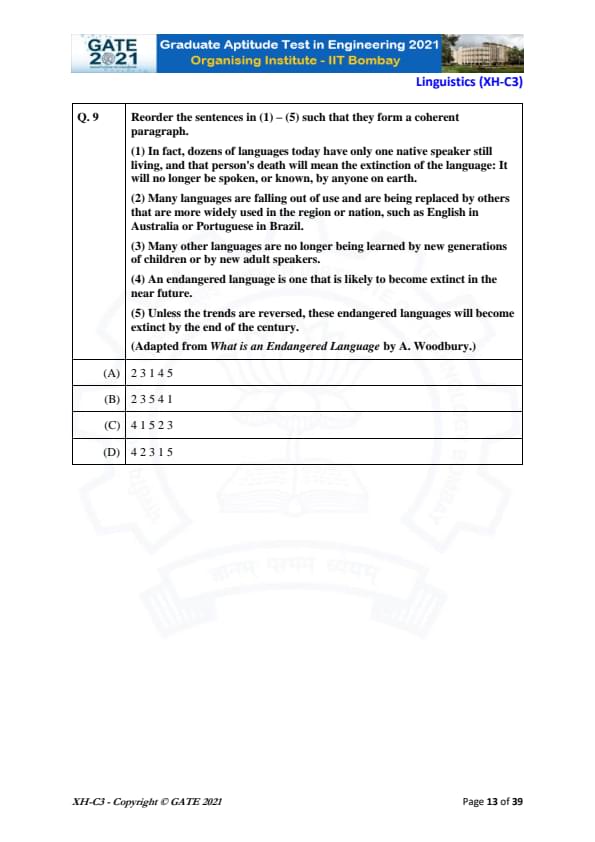
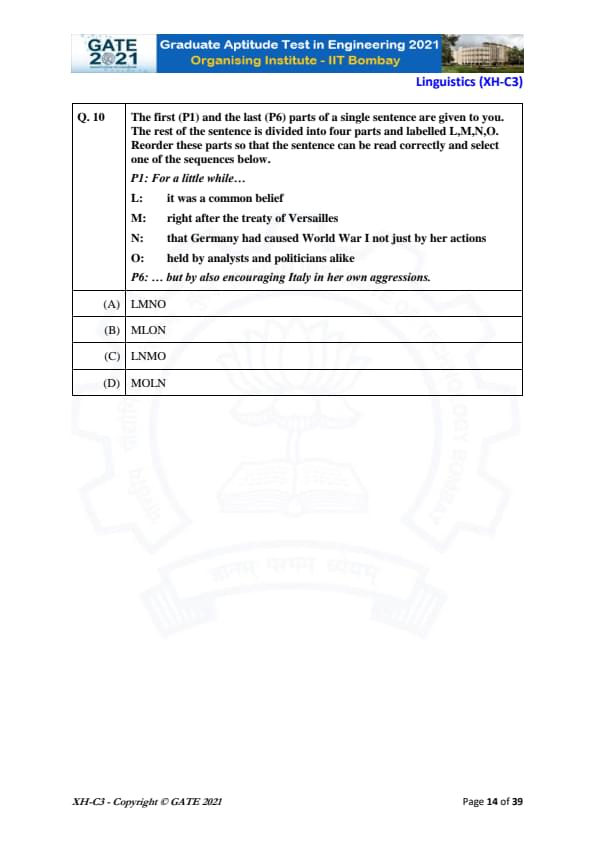
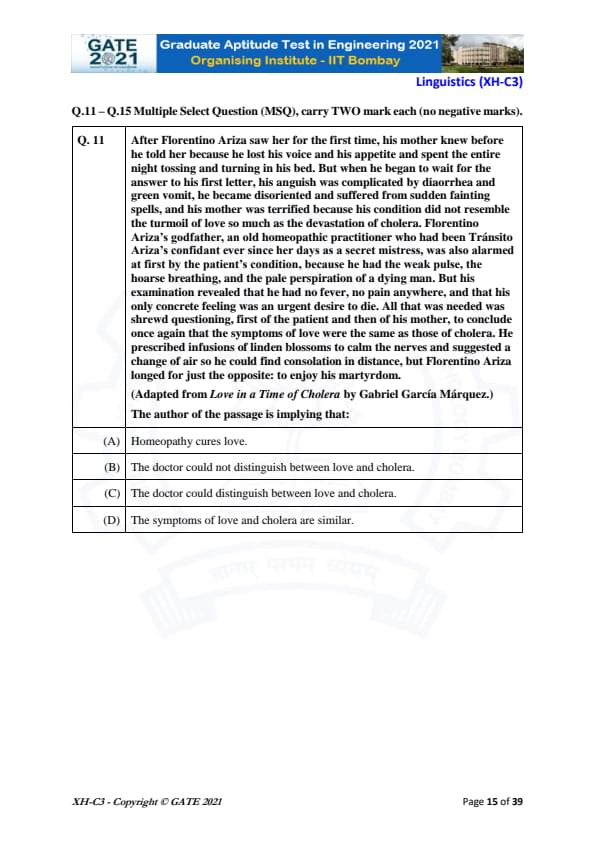
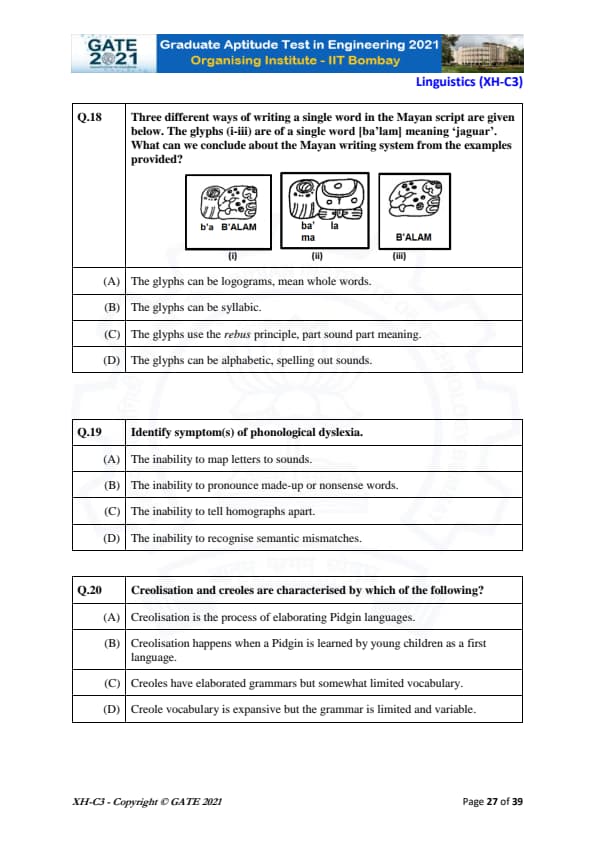
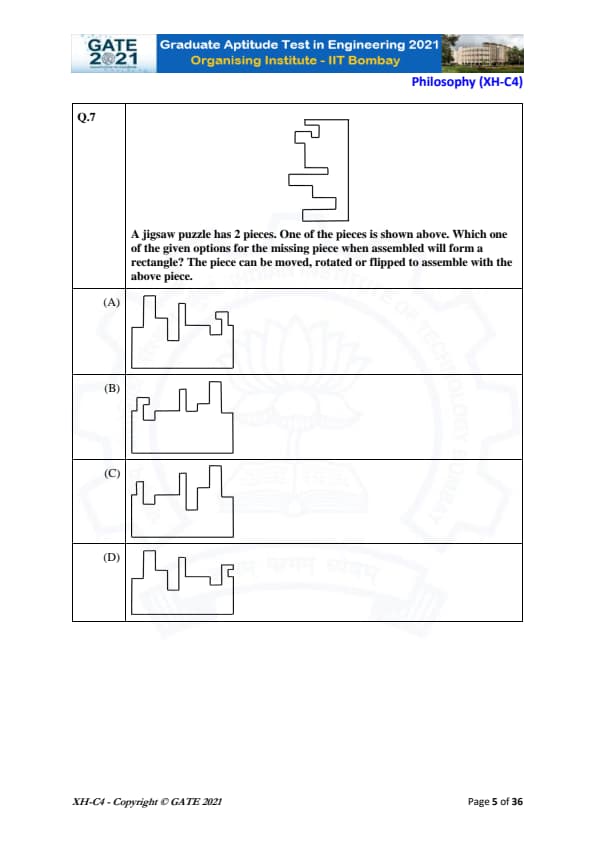
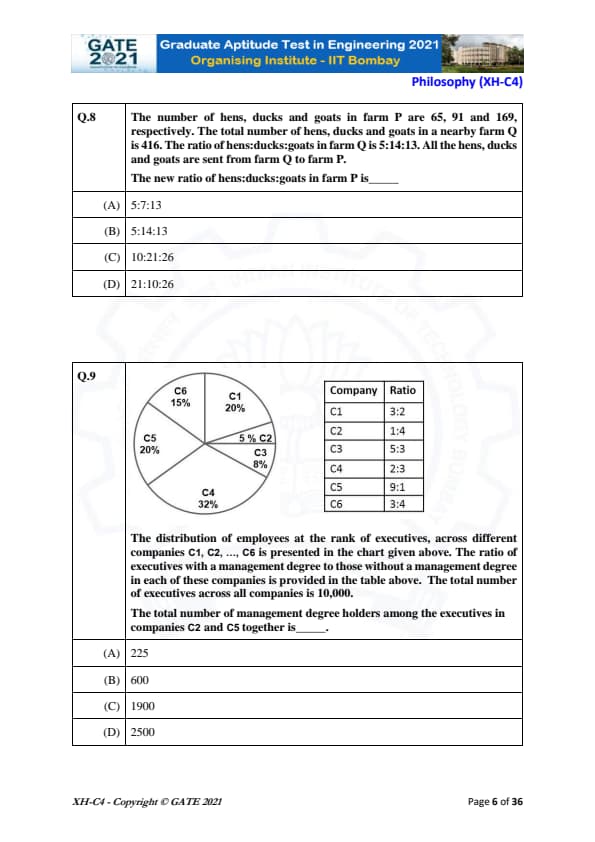
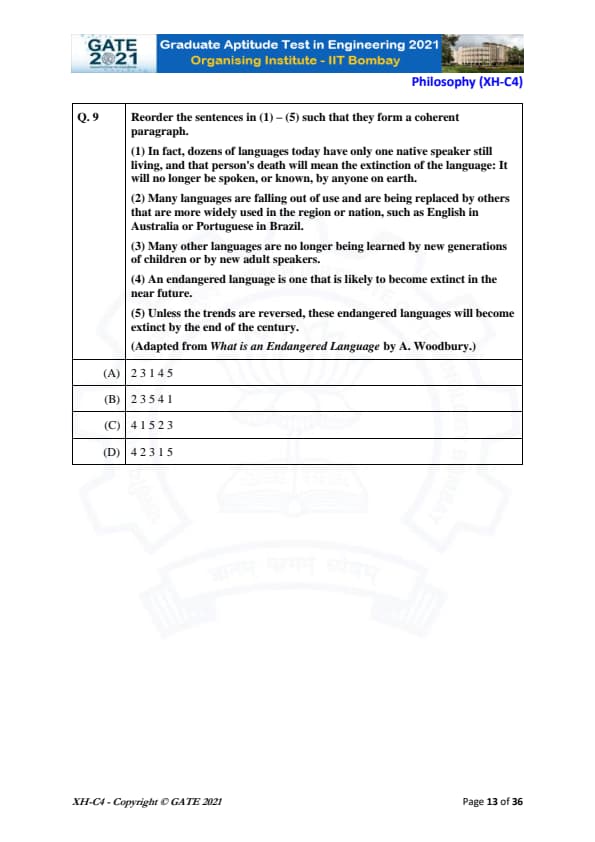
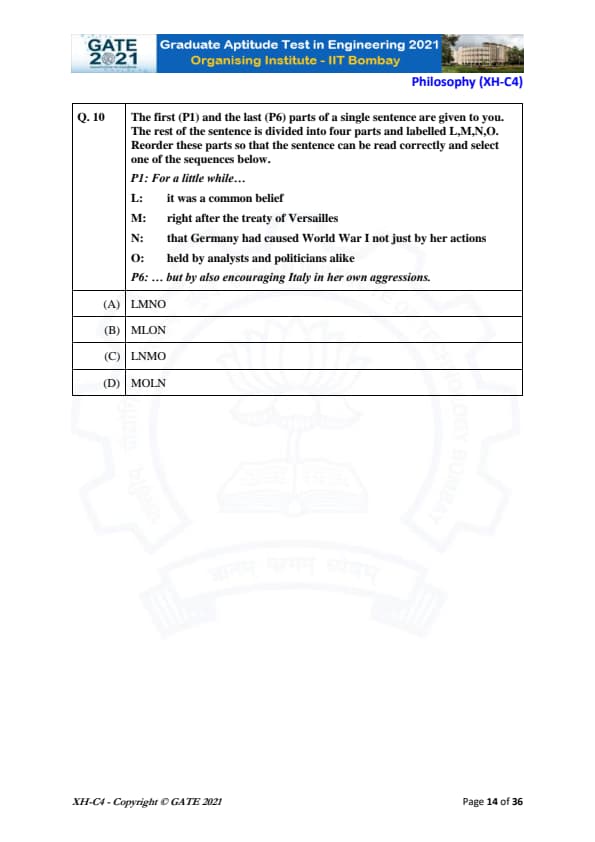
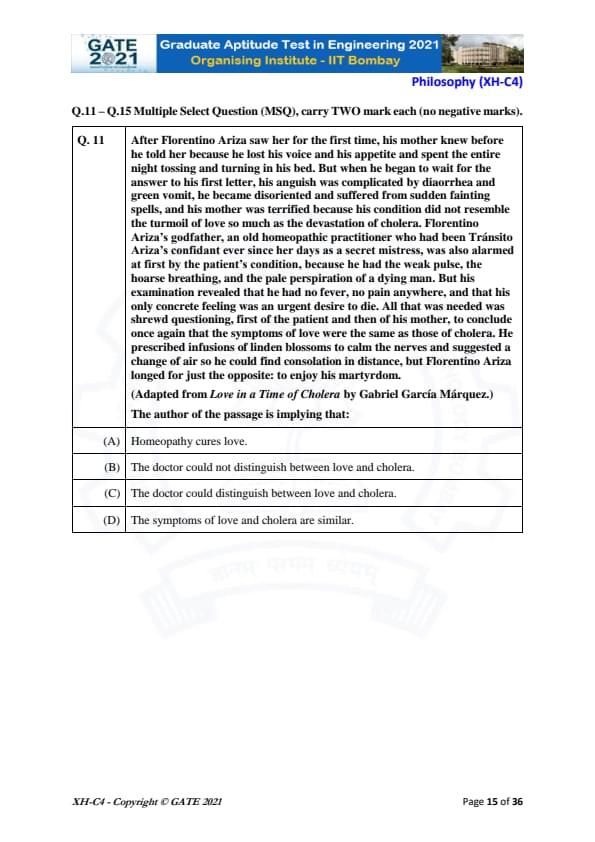
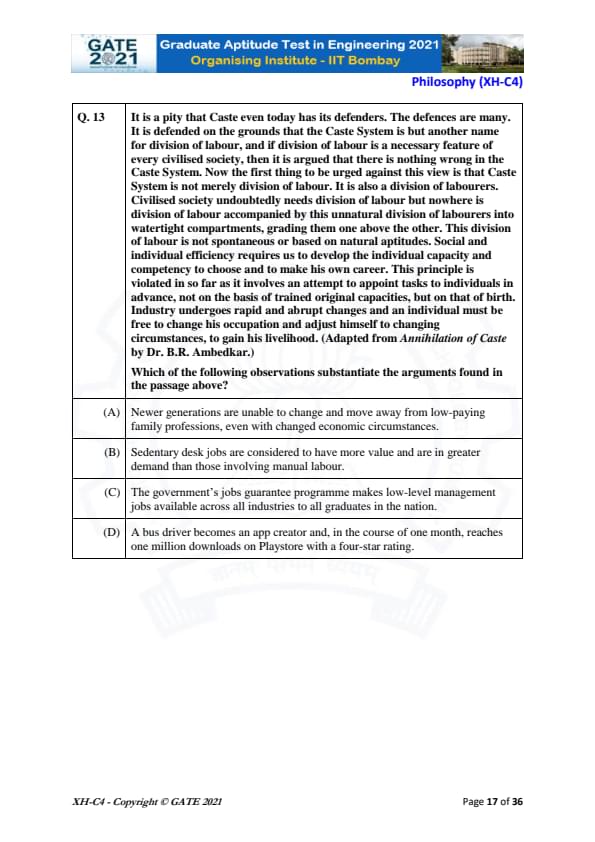
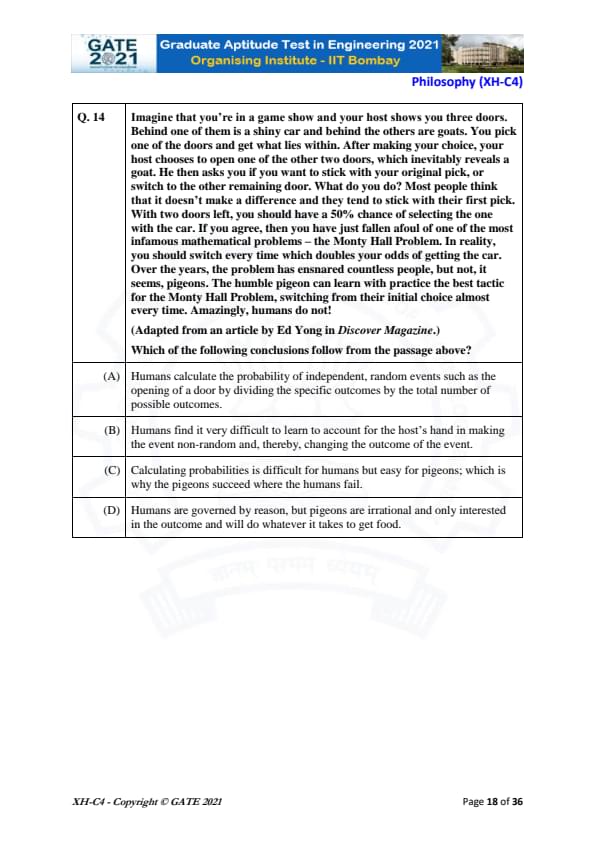
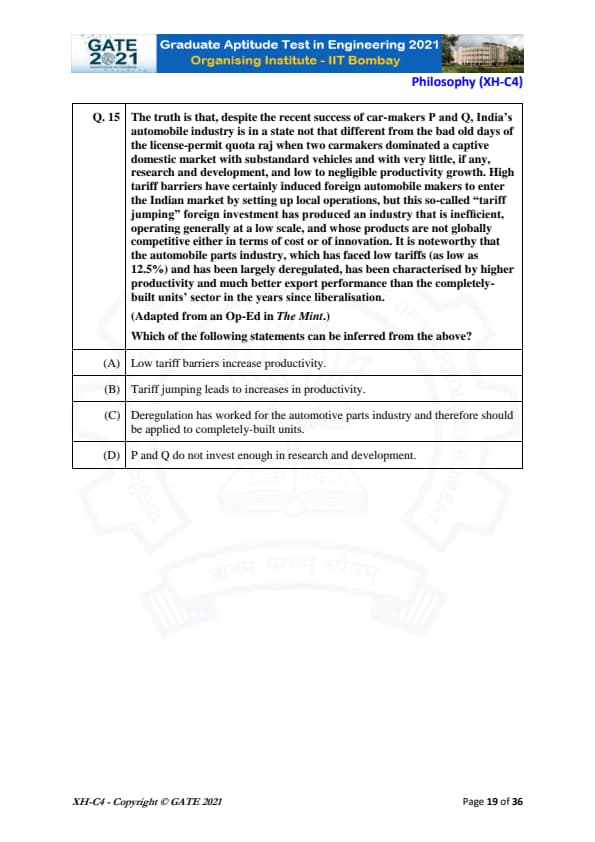
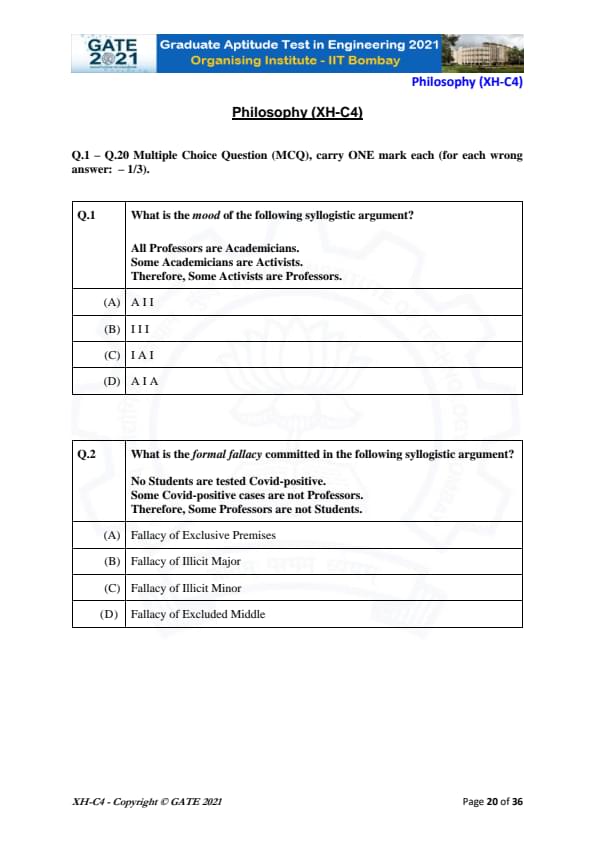
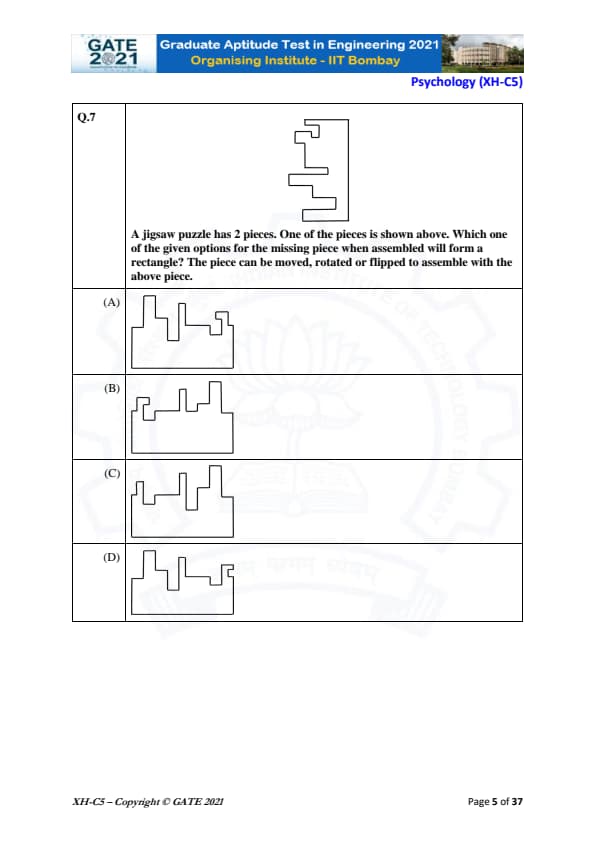
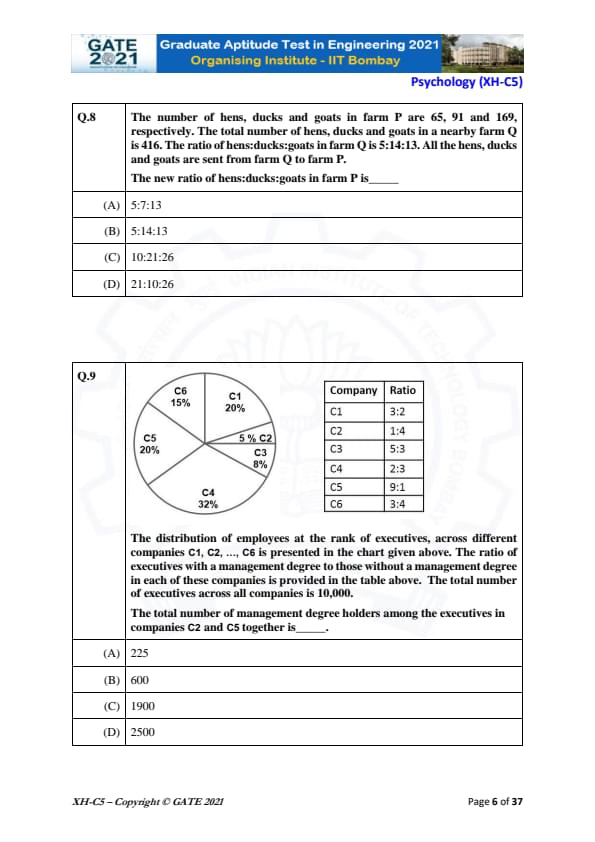
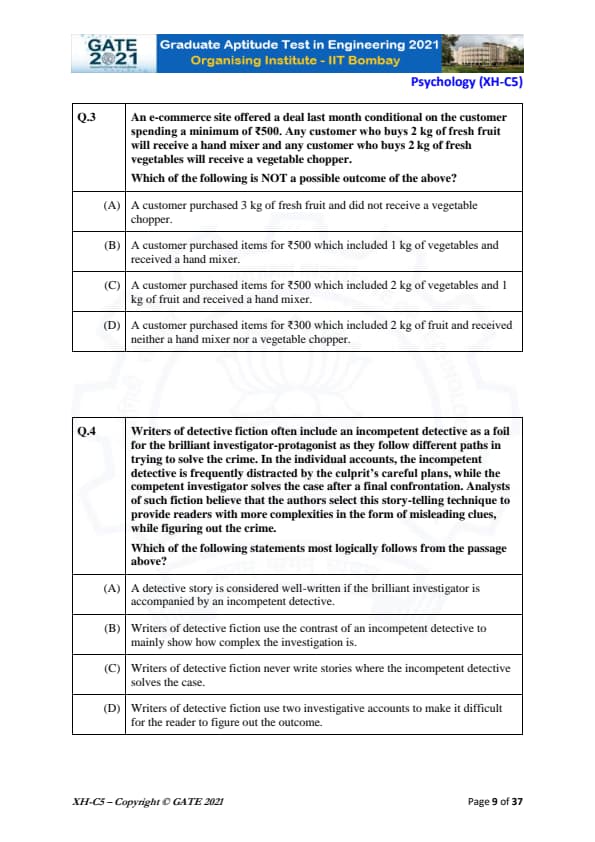
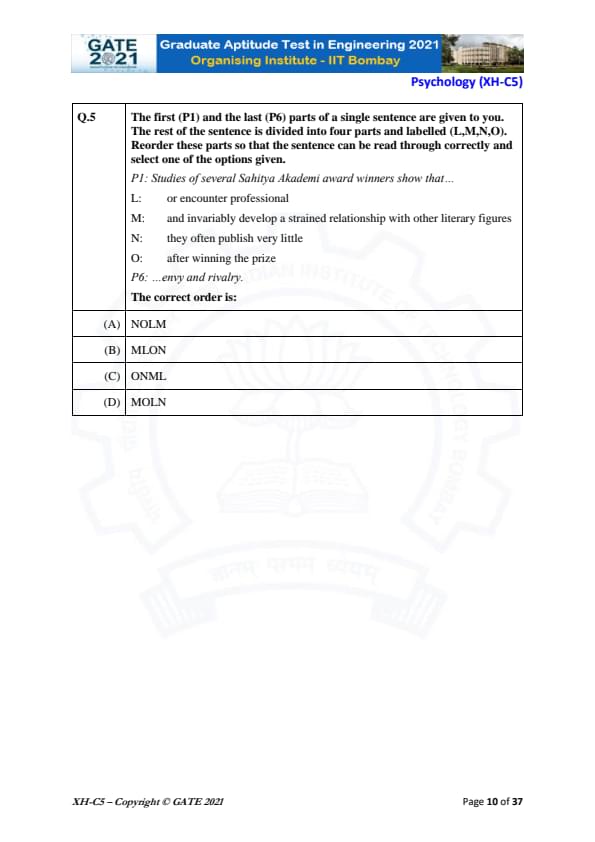
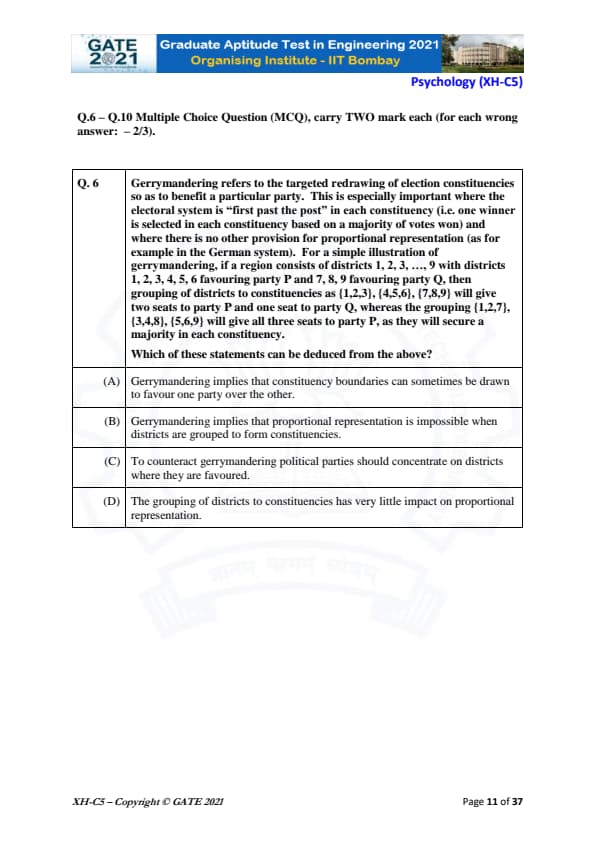
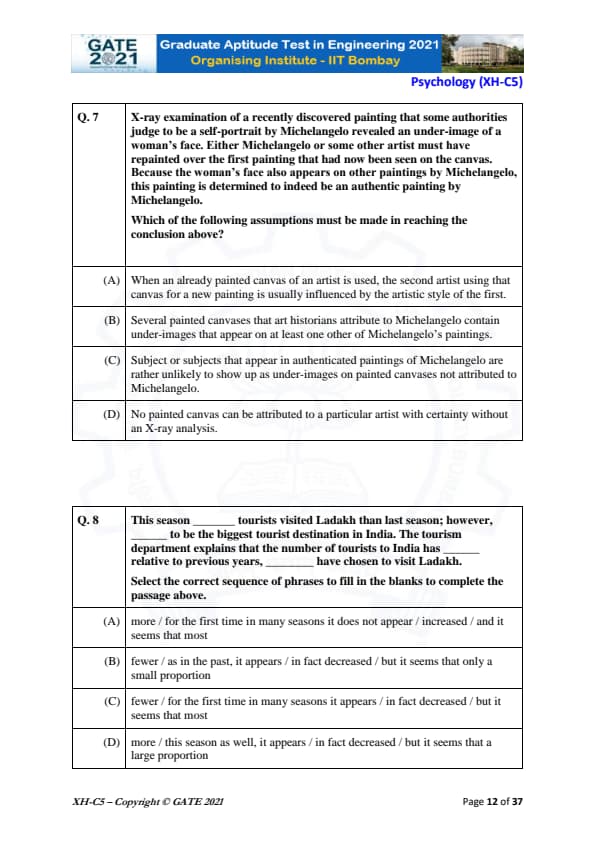
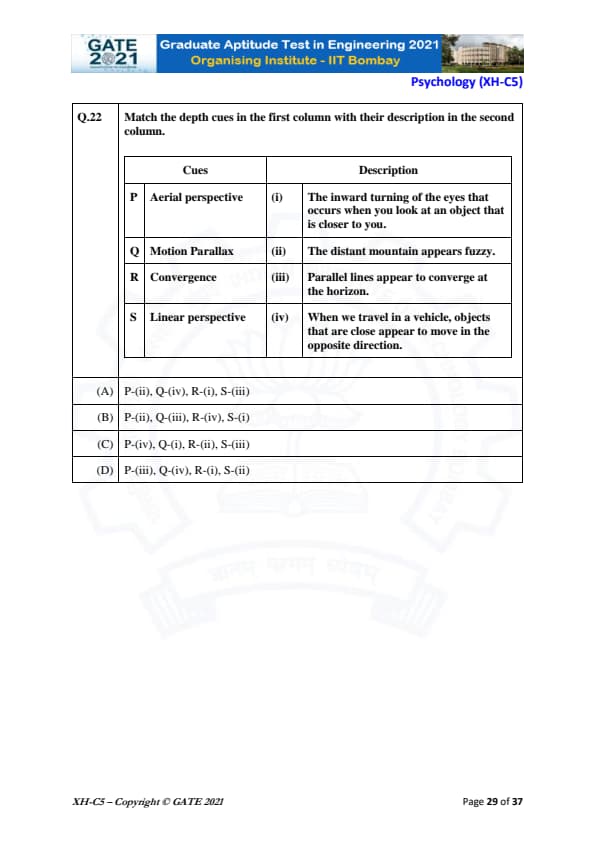
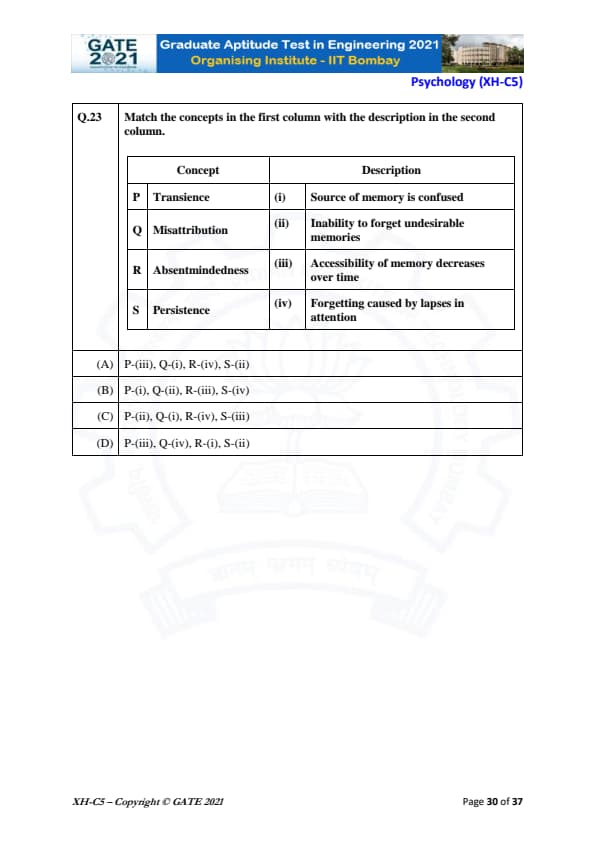
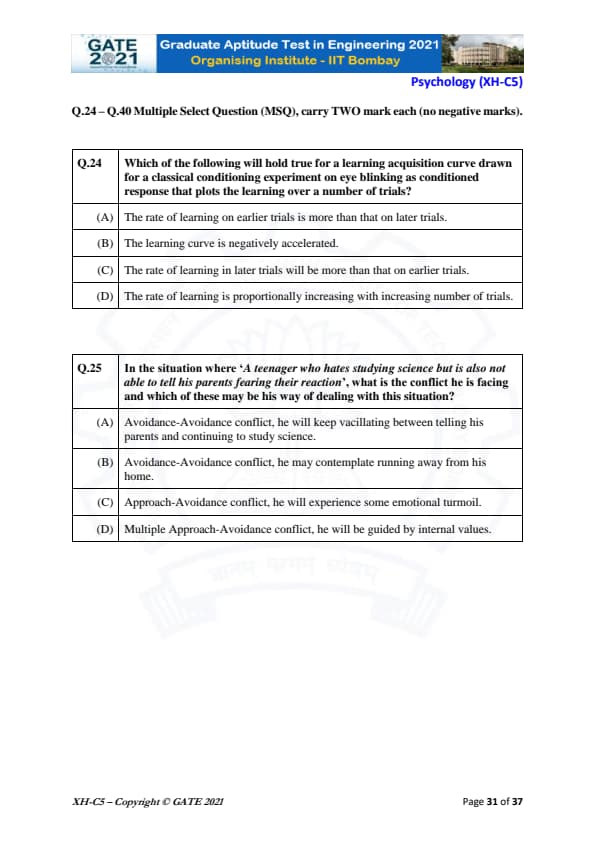
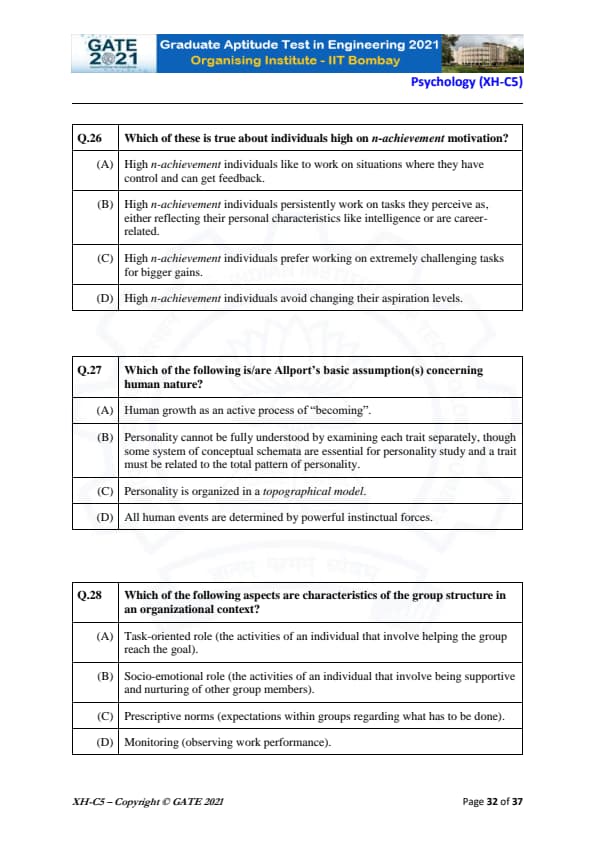
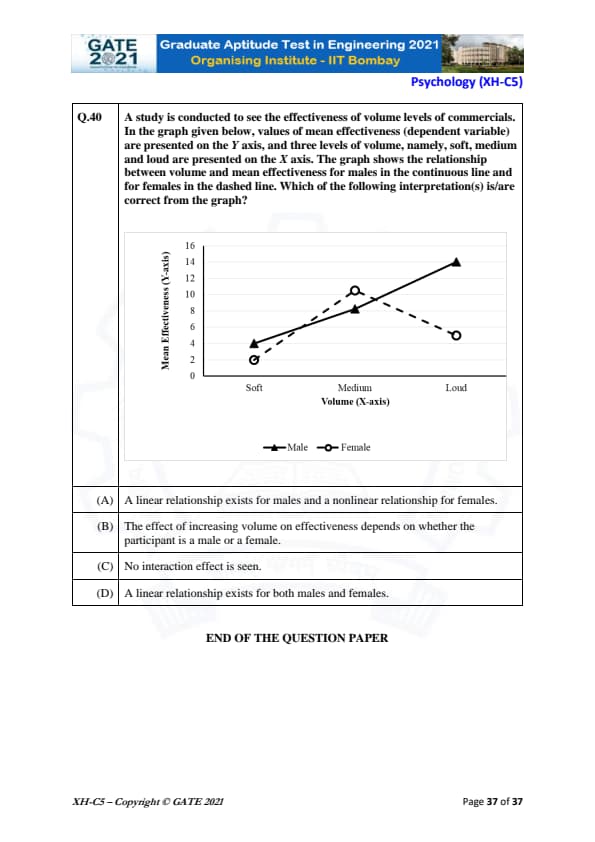
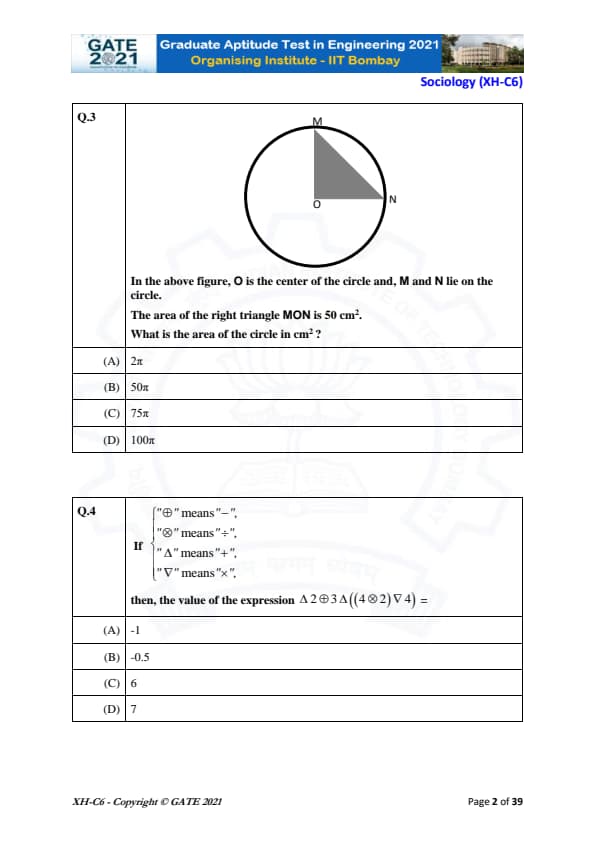
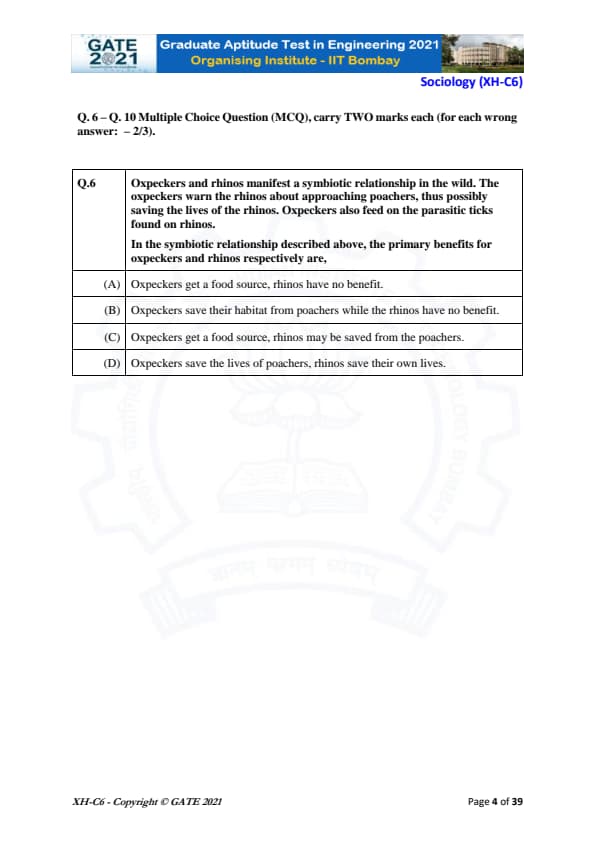
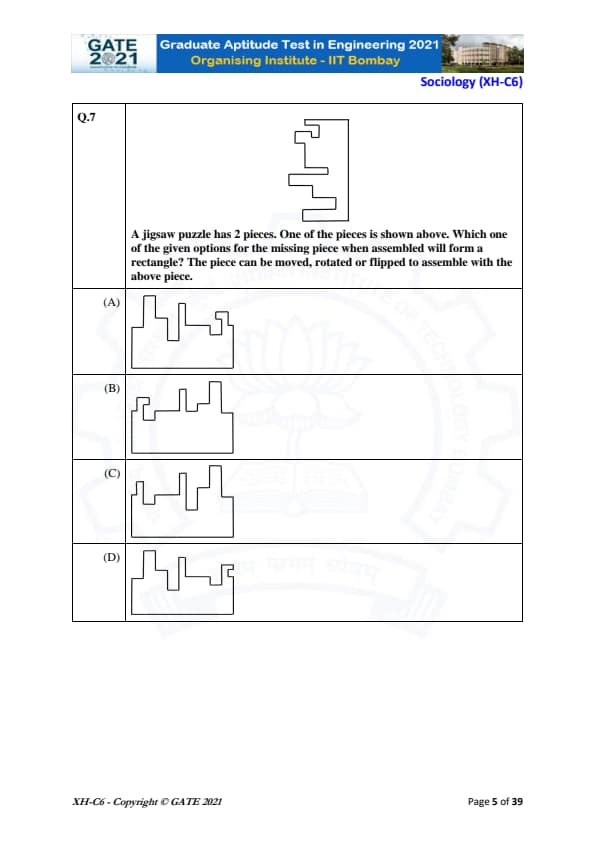
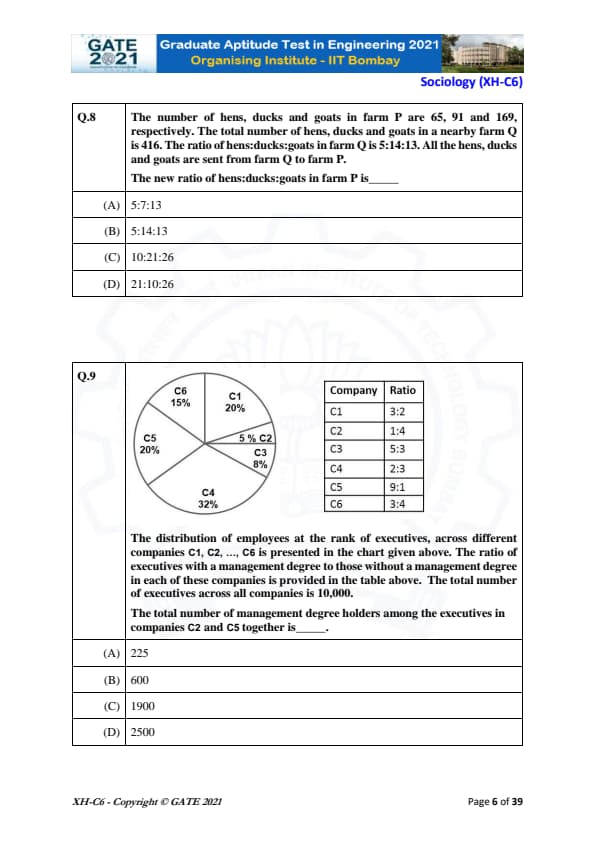
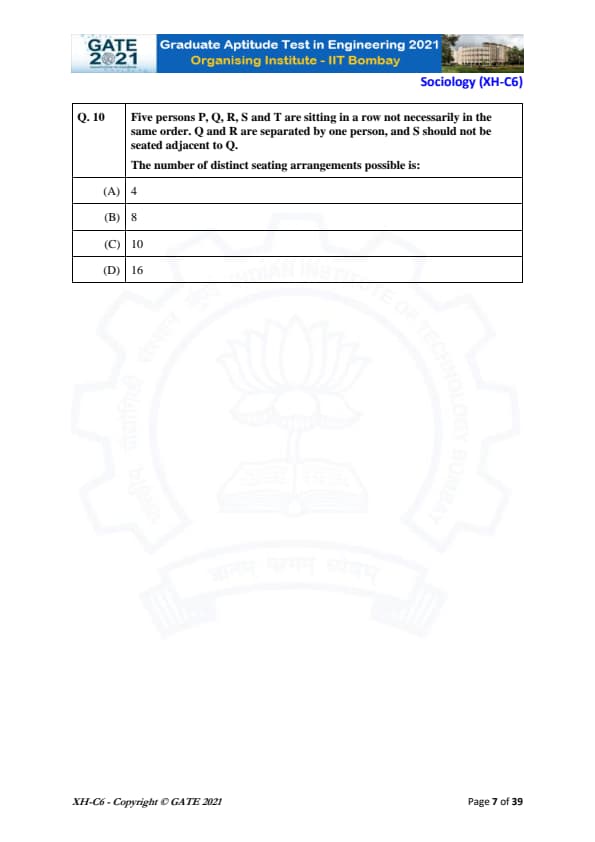
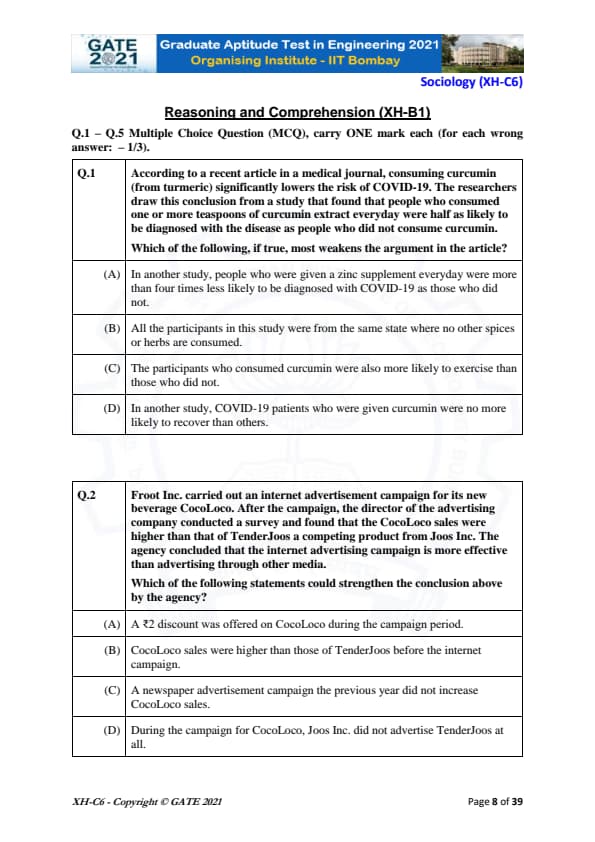
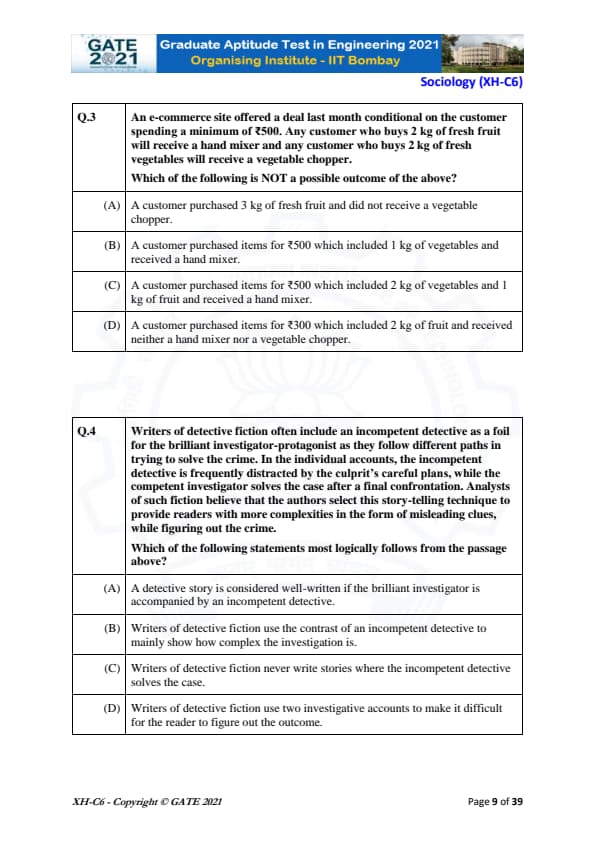
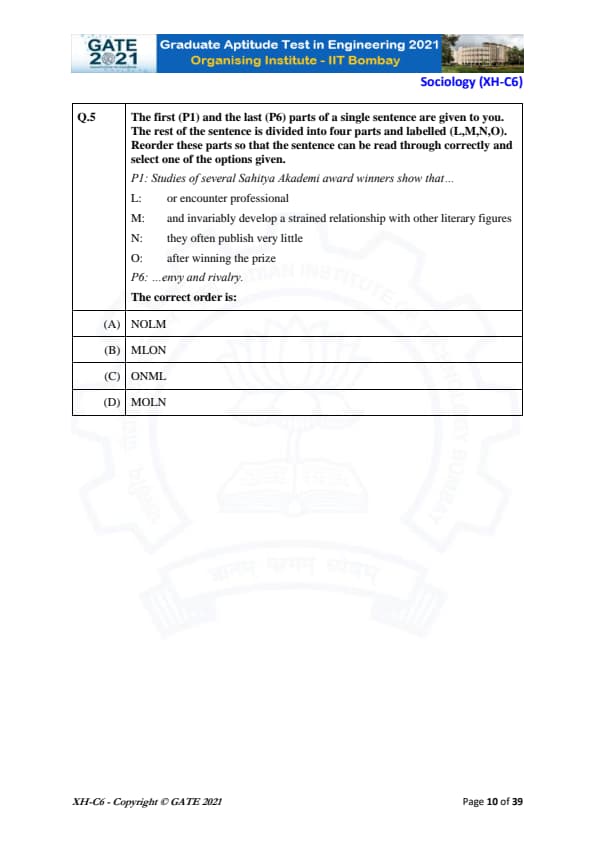
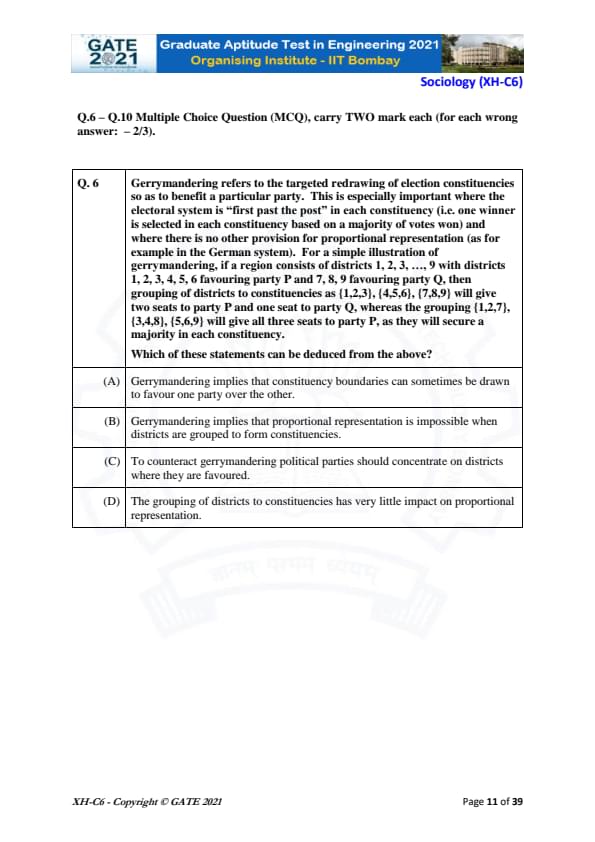
Quick Links:
GATE 2021 XH Detailed Paper Analysis
The paper was divided into three parts. The first part was dedicated to the General Aptitude. The second and third part were dedicated to reasoning and comprehension, and optional subject respectively
- The General Aptitude section carried 15 marks, distributed between 10 MCQs (each 5 questions carrying 1 mark and 2 marks respectively)
- The reasoning and comprehension section (XH-B1) carried 25 marks, comprises of 15 questions, 10 MCQs and 5 MSQs
- The MCQs carried 15 marks (5 questions carrying 1 mark and 5 questions carrying 2 marks)
- The MSQs carried 10 marks, distributed between 5 questions (2 marks each question)
- The remaining 40 questions, carrying 60 marks were related to the core optional subject
GATE 2021 XH Exam Pattern and Marking Scheme
- Candidates would require to solve 65 questions in 3 hours in GATE 2021 XH
- All the papers comprises of 65 questions (10 from General Aptitude and the other 55 from the optional subject)
- Every incorrect MCQ will cost 1 mark reduction out of the final score
- ⅓ marks would be deducted for every wrong MCQ carrying 1 mark, and ⅔ marks would be deducted for every wrong MCQ carrying 2 marks
- NATs (Numerical Answer Types) and MSQs (Multiple Select Questions) don't follow any negative marking scheme
Also Check:
GATE Previous Year Question Papers:
| GATE 2022 Question Papers | GATE 2021 Question Papers | GATE 2020 Question Papers |
| GATE 2019 Question Papers | GATE 2018 Question Papers | GATE 2017 Question Papers |



Comments