


JEE Main 2026 April 6 Shift 1 physics question paper is available here with answer key and solutions. NTA is conducting the first shift of the day on April 6, 2026, from 9:00 AM to 12:00 PM.
- The JEE Main Physics Question Paper contains a total of 25 questions.
- Each correct answer gets you 4 marks while incorrect answers gets you a negative mark of 1.
Candidates can download the JEE Main 2026 April 6 Shift 1 physics question paper along with detailed solutions to analyze their performance and understand the exam pattern better.
JEE Main 2026 April 6 Shift 1 Physics Question Paper with Solution PDF

Also Check:
Potential energy of a particle is given as \( u = \dfrac{A\sqrt{x}}{B+x} \). Find the dimensions of \(A\) and \(B\).
View Solution
Concept:
Dimensional analysis is used to determine the relationship between physical quantities.
Key ideas used here:
Dimension of potential energy: \( [U] = ML^2T^{-2} \)
Quantities added together must have the same dimensions
If \(x\) represents displacement, then \( [x] = L \)
Step 1: Determine the dimension of \(B\).
Given expression:
\[ u=\frac{A\sqrt{x}}{B+x} \]
Since \(B\) is added to \(x\),
\[ [B] = [x] \]
Because \(x\) is displacement,
\[ [B] = L \]
Step 2: Use dimensional consistency of the equation.
Dimension of potential energy:
\[ [U] = ML^2T^{-2} \]
Now taking dimensions of the given equation:
\[ [U] = \left[\frac{A\sqrt{x}}{B+x}\right] \]
Since \(B+x\) has dimension \(L\),
\[ [U] = \frac{[A][x]^{1/2}}{L} \]
Substitute \( [x]=L \):
\[ ML^2T^{-2} = \frac{[A]L^{1/2}}{L} \]
\[ ML^2T^{-2} = [A]L^{-1/2} \]
Step 3: Solve for the dimension of \(A\).
\[ [A] = ML^2T^{-2}\times L^{1/2} \]
\[ [A] = ML^{5/2}T^{-2} \]
Final Result
\[ [A] = ML^{5/2}T^{-2}, \qquad [B] = L \] Quick Tip: Whenever two quantities are added or subtracted (like \(B+x\)), they must have the same dimensions. This rule is extremely useful in dimensional analysis problems.
In an AC circuit supply voltage \( (V_{rms}) = 1000\,V \), \( R = 80\,\Omega \), \( X_L = 80\,\Omega \) and source frequency \( f = 50\,Hz \). Find the power factor.
View Solution
Concept:
In an AC circuit containing resistance and inductance (R–L circuit), the power factor is given by
\[ \cos\phi = \frac{R}{Z} \]
where
\(R\) = Resistance
\(Z\) = Impedance of the circuit
\(Z = \sqrt{R^2 + X_L^2}\)
\(X_L\) = Inductive reactance
Step 1: Find the impedance of the circuit.
\[ Z = \sqrt{R^2 + X_L^2} \]
Substituting \(R = 80\,\Omega\) and \(X_L = 80\,\Omega\):
\[ Z = \sqrt{80^2 + 80^2} \]
\[ Z = \sqrt{6400 + 6400} \]
\[ Z = \sqrt{12800} \]
\[ Z = 80\sqrt{2}\,\Omega \]
Step 2: Calculate the power factor.
\[ \cos\phi = \frac{R}{Z} \]
Substituting the values:
\[ \cos\phi = \frac{80}{80\sqrt{2}} \]
\[ \cos\phi = \frac{1}{\sqrt{2}} \]
Final Result
\[ Power factor = \frac{1}{\sqrt{2}} \] Quick Tip: For a series \(R-L\) circuit, impedance is always \(Z=\sqrt{R^2+X_L^2}\). The power factor \( \cos\phi \) becomes smaller when the inductive reactance increases.
Electric field due to a half ring at the center is \(100\,N/C\). Find the charge on the ring. Radius of the ring is \(10\,cm\).
View Solution
Concept:
For a uniformly charged semicircular ring, the electric field at the center is
\[ E=\frac{2k\lambda}{r} \]
where
\(k=\dfrac{1}{4\pi\varepsilon_0}=9\times10^9\,N m^2/C^2\)
\(\lambda\) = linear charge density
\(r\) = radius of the semicircle
Also,
\[ \lambda=\frac{q}{\pi r} \]
since the length of a semicircle is \( \pi r \).
Step 1: Substitute \( \lambda = \dfrac{q}{\pi r} \) into the electric field formula.
\[ E=\frac{2k}{r}\left(\frac{q}{\pi r}\right) \]
\[ E=\frac{2kq}{\pi r^2} \]
Step 2: Substitute the given values.
\[ E=100\,N/C, \quad k=9\times10^9, \quad r=10\,cm=10\times10^{-2}\,m \]
\[ 100=\frac{2\times 9\times10^9 \times q}{\pi (10\times10^{-2})^2} \]
\[ 100=\frac{18\times10^9 q}{\pi \times 10^{-2}} \]
Step 3: Solve for the charge \(q\).
\[ q=\frac{100 \times \pi \times 10^{-2}}{18\times10^9} \]
\[ q=\frac{\pi}{18}\times10^{-9}\,C \]
Final Result
\[ q=\frac{\pi}{18}\times10^{-9}\,C \] Quick Tip: For a uniformly charged semicircular ring, the electric field at the center is \(E=\dfrac{2k\lambda}{r}\). The horizontal components cancel due to symmetry, leaving only the vertical component.
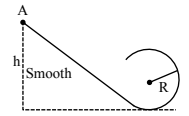
A particle is released from point \(A\) of the track as shown in the figure. Find \(h\) so that the normal reaction at the highest point is 3 times the weight of the block. The surface is smooth.
View Solution
Concept:
When a particle moves in a vertical circular path, the centripetal force at the top of the circle is provided by the sum of weight and the normal reaction.
\[ \frac{mv^2}{R} = mg + N \]
Also, since the track is smooth, mechanical energy is conserved.
\[ Loss of potential energy = Gain in kinetic energy \]
Step 1: Apply the centripetal force condition at the highest point.
Given that the normal reaction is three times the weight:
\[ N = 3mg \]
Substitute into the centripetal force equation:
\[ mg + N = \frac{mv^2}{R} \]
\[ mg + 3mg = \frac{mv^2}{R} \]
\[ 4mg = \frac{mv^2}{R} \]
\[ v^2 = 4gR \]
Step 2: Apply conservation of energy.
The particle starts from height \(h\) and reaches the highest point of the circular track which is at height \(2R\).
\[ mg(h-2R) = \frac{1}{2}mv^2 \]
Substitute \(v^2 = 4gR\):
\[ mg(h-2R) = \frac{1}{2}m(4gR) \]
\[ mg(h-2R) = 2mgR \]
Cancel \(mg\):
\[ h-2R = 2R \]
\[ h = 4R \]
Final Result
\[ h = 4R \] Quick Tip: For motion in a vertical circle, always analyze the \textbf{top point carefully}. The centripetal force there is provided by \(mg + N\). Combine this with energy conservation to solve height or velocity problems quickly.
Find transverse magnification due to curved boundary between two mediums as shown in the figure. Refractive index of second medium \(n_2 = 1.4\).
View Solution
Concept:
For refraction at a spherical surface,
\[ \frac{n_2}{v}-\frac{n_1}{u}=\frac{n_2-n_1}{R} \]
Transverse magnification is
\[ m=\frac{n_1 v}{n_2 u} \]
Step 1: Apply refraction formula at spherical surface.
Given:
\[ n_1=1, \quad n_2=1.4, \quad u=-4R \]
\[ \frac{1.4}{v}-\frac{1}{-4R}=\frac{1.4-1}{R} \]
\[ \frac{1.4}{v}+\frac{1}{4R}=\frac{0.4}{R} \]
Step 2: Solve for \(v\).
\[ \frac{1.4}{v}=\frac{0.4}{R}-\frac{1}{4R} \]
\[ \frac{1.4}{v}=\frac{4}{10R}-\frac{1}{4R} \]
\[ \frac{1.4}{v}=\frac{6}{40R} \]
\[ v=\frac{56R}{6}=\frac{28}{3}R \]
Step 3: Find transverse magnification.
\[ m=\frac{n_1 v}{n_2 u} \]
\[ m=\frac{1 \times \frac{28R}{3}}{1.4 \times (-4R)} \]
\[ m=-1.67 \]
Final Result
\[ m=-1.67 \] Quick Tip: For refraction at a spherical surface always use \( \dfrac{n_2}{v}-\dfrac{n_1}{u}=\dfrac{n_2-n_1}{R} \) and magnification \( m=\dfrac{n_1 v}{n_2 u} \).
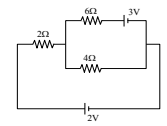
Find heat dissipated in \(6\Omega\) resistance in \(100\) seconds in the given circuit.
View Solution
Concept:
Heat produced in a resistor is given by Joule's law:
\[ H=\frac{V^2}{R}t \]
To find voltage across \(6\Omega\), node voltage method is used.
Step 1: Apply node voltage equation.
Let node potential be \(x\).
\[ \frac{x-2}{2}+\frac{x-0}{4}+\frac{x-3}{6}=0 \]
Multiply by \(12\):
\[ 6x-12+3x+2x-6=0 \]
\[ 11x-18=0 \]
\[ x=\frac{18}{11} volt \]
Step 2: Find voltage across \(6\Omega\).
\[ V_{6\Omega}=3-\frac{18}{11} \]
\[ V_{6\Omega}=\frac{33-18}{11}=\frac{15}{11} \]
Step 3: Calculate heat dissipated.
\[ H=\frac{V^2}{R}t \]
\[ H=\frac{\left(\frac{15}{11}\right)^2}{6}\times100 \]
\[ H=30.99 \approx 31\,J \]
Final Result
\[ H=31\,J \] Quick Tip: For complicated resistor circuits, the node voltage method quickly gives the potential difference across any resistor, after which Joule's law \(H=\frac{V^2}{R}t\) can be applied.
In YDSE a glass slab of thickness \(8\,\mu m\) is introduced in front of a slit. If central maxima shifts to the position of 4th minima, then find refractive index of glass slab \((\lambda = 500\,nm)\):
View Solution
Concept:
When a thin glass slab of thickness \(t\) and refractive index \(\mu\) is inserted in front of one slit in YDSE, the central fringe shifts by
\[ y_0 = (\mu - 1)t\frac{D}{d} \]
Position of minima in YDSE is
\[ y_n = \left(n+\frac{1}{2}\right)\frac{D\lambda}{d} \]
Step 1: Central maxima shifts to the position of 4th minima.
For minima,
\[ y_n=\left(n+\frac{1}{2}\right)\frac{D\lambda}{d} \]
4th minima corresponds to \(n=3\)
\[ y_1=\left(3+\frac{1}{2}\right)\frac{D\lambda}{d} \]
\[ y_1=\frac{7}{2}\frac{D\lambda}{d} \]
Since the central maxima shifts to this position,
\[ y_0 = y_1 \]
Step 2: Equate shift expression.
\[ (\mu-1)t\frac{D}{d}=\frac{7}{2}\frac{D\lambda}{d} \]
Cancel \( \frac{D}{d} \):
\[ (\mu-1)t=\frac{7}{2}\lambda \]
Step 3: Substitute given values.
\[ t=8\times10^{-6}\,m \]
\[ \lambda=500\times10^{-9}\,m \]
\[ (\mu-1)=\frac{7}{2}\times\frac{500\times10^{-9}}{8\times10^{-6}} \]
\[ (\mu-1)=3.5\times62.5\times10^{-3} \]
\[ (\mu-1)=0.218 \]
\[ \mu=1.218 \approx 1.22 \]
Final Result
\[ \mu \approx 1.22 \] Quick Tip: Insertion of a glass slab in YDSE produces a fringe shift \(y_0=(\mu-1)t\frac{D}{d}\). Equating this shift with the position of a given bright or dark fringe quickly gives the refractive index.
A particle is performing SHM of amplitude \(A\). Find the time required for particle to go from mean position to \( \dfrac{A}{\sqrt{2}} \). Time period of SHM is \(5\) sec :-
View Solution
Concept:
In Simple Harmonic Motion (SHM),
\[ x = A\sin\theta \]
where \( \theta \) is the phase angle.
Time corresponding to phase change is
\[ t = \frac{\theta}{\omega} \]
and
\[ \omega = \frac{2\pi}{T} \]
Step 1: Find phase corresponding to given positions.
At mean position,
\[ x = 0 \Rightarrow \theta = 0 \]
At \( x = \frac{A}{\sqrt{2}} \),
\[ \frac{A}{\sqrt{2}} = A\sin\theta \]
\[ \sin\theta = \frac{1}{\sqrt{2}} \]
\[ \theta = \frac{\pi}{4} \]
Thus phase covered
\[ \Delta\theta = \frac{\pi}{4} \]
Step 2: Find time taken.
\[ t=\frac{\Delta\theta}{\omega} \]
\[ t=\frac{\pi/4}{2\pi/T} \]
\[ t=\frac{\pi}{4}\times\frac{T}{2\pi} \]
\[ t=\frac{T}{8} \]
Step 3: Substitute \(T=5\) s.
\[ t=\frac{5}{8} sec \]
Final Result
\[ t=\frac{5}{8} sec \] Quick Tip: In SHM, motion from mean position to extreme takes \(T/4\). Use \(x=A\sin\theta\) or \(x=A\cos\theta\) to convert displacement into phase difference and then calculate time.
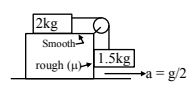
Find coefficient of friction \( \mu \) so that the blocks are at rest.
View Solution
Concept:
For a system to remain at rest in an accelerating frame, pseudo force must be considered.
Pseudo force:
\[ F_p = ma \]
Maximum friction:
\[ f = \mu N \]
Step 1: Consider forces on the larger block.
Given acceleration
\[ a=\frac{g}{2} \]
Pseudo force on \(2\,kg\) block
\[ F_p = 2 \times \frac{g}{2} = g \]
Pseudo force on \(1.5\,kg\) block
\[ F_p = 1.5 \times \frac{g}{2} \]
Normal reaction on smaller block
\[ N = \frac{1.5g}{2} \]
Step 2: Friction force.
\[ f = \mu N \]
\[ f = \mu \times \frac{1.5g}{2} \]
Step 3: Apply equilibrium condition.
\[ 1.5g = g + \mu \frac{1.5g}{2} \]
Divide by \(g\):
\[ 1.5 = 1 + \mu \frac{1.5}{2} \]
\[ 0.5 = \mu \frac{1.5}{2} \]
\[ \mu = \frac{2}{3} \]
Final Result
\[ \mu = \frac{2}{3} \] Quick Tip: In accelerating systems, always analyze motion in the non-inertial frame by adding pseudo force \(ma\) opposite to acceleration. Then apply friction and equilibrium conditions.
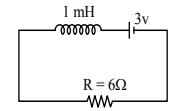
For the given circuit, find the ratio of instantaneous voltage across the inductor when current is \(2\,mA\) and when current is \(4\,mA\).
View Solution
Concept:
In an \(RL\) circuit, the applied voltage is shared between the resistor and the inductor.
\[ V = V_R + V_L \]
where
\[ V_R = iR \]
Thus,
\[ V_L = V - iR \]
Step 1: When current \(i = 2\,mA\).
\[ V_R = iR \]
\[ V_R = (2\times10^{-3})(6) \]
\[ V_R = 0.012\,V \]
Voltage across inductor:
\[ V_L = 3 - 0.012 \]
\[ V_L = 2.988\,V \]
Step 2: When current \(i = 4\,mA\).
\[ V_R = (4\times10^{-3})(6) \]
\[ V_R = 0.024\,V \]
Voltage across inductor:
\[ V_L = 3 - 0.024 \]
\[ V_L = 2.976\,V \]
Step 3: Find the ratio.
\[ Ratio = \frac{2.988}{2.976} \]
\[ Ratio \approx 1.004 \approx 1 \]
Final Result
\[ Ratio = 1 \] Quick Tip: In an \(RL\) circuit, the voltage across the inductor is obtained using \(V_L = V - iR\). Small current changes produce very small change in \(V_L\) if the resistance is small.
A sphere of mass \(5\,kg\) and radius \(4\,cm\) is rotating about a fixed axis along its diameter with \(1200\,rpm\). To stop it in \(10\,s\), a torque is applied. Find magnitude of torque required and number of revolutions made before it stops respectively :-
View Solution
Concept:
Moment of inertia of a solid sphere about diameter:
\[ I = \frac{2}{5}MR^2 \]
Torque relation:
\[ \tau = I\alpha \]
Rotational kinematics:
\[ \omega_f = \omega_i + \alpha t \]
Step 1: Convert angular speed to rad/s.
\[ \omega_i = 1200\,rpm \]
\[ \omega_i = 1200 \times \frac{2\pi}{60} \]
\[ \omega_i = 40\pi \,rad/s \]
Step 2: Find angular acceleration.
Final angular velocity
\[ \omega_f = 0 \]
\[ 0 = 40\pi + \alpha(10) \]
\[ \alpha = -4\pi \,rad/s^2 \]
Step 3: Find moment of inertia.
\[ R = 4\,cm = 0.04\,m \]
\[ I = \frac{2}{5}(5)(0.04)^2 \]
\[ I = 2 \times 0.0016 \]
\[ I = 0.0032\,kg\,m^2 \]
Step 4: Calculate torque.
\[ \tau = I\alpha \]
\[ \tau = 0.0032 \times 4\pi \]
\[ \tau \approx 0.04\,N-m \]
Step 5: Find angular displacement.
\[ \omega_f^2 = \omega_i^2 + 2\alpha\theta \]
\[ 0 = (40\pi)^2 + 2(-4\pi)\theta \]
\[ \theta = 200\pi \]
Number of revolutions:
\[ n = \frac{\theta}{2\pi} \]
\[ n = \frac{200\pi}{2\pi} \]
\[ n = 100 \]
Final Result
\[ \tau = 0.04\,N-m, \quad n = 100 \] Quick Tip: For rotational stopping problems, first convert rpm to rad/s, then find angular acceleration using \( \omega_f = \omega_i + \alpha t \). Finally apply \( \tau = I\alpha \) and rotational kinematics.
Intensity of two sources is same and path difference at point \(A\) and \(B\) are \( \frac{\lambda}{6} \) and \( \frac{\lambda}{3} \) respectively. Ratio of intensity at \(A\) and \(B\) will be.
View Solution
Concept:
Resultant intensity due to interference of two waves is
\[ I = I_1 + I_2 + 2\sqrt{I_1 I_2}\cos\phi \]
where phase difference
\[ \phi = \frac{2\pi}{\lambda}\Delta x \]
Since both sources have equal intensity
\[ I_1 = I_2 = I \]
Step 1: Intensity at point \(A\).
Path difference
\[ \Delta x_A = \frac{\lambda}{6} \]
Phase difference
\[ \phi_A = \frac{2\pi}{\lambda}\times\frac{\lambda}{6} \]
\[ \phi_A = \frac{\pi}{3} \]
Now resultant intensity
\[ I_A = I + I + 2\sqrt{I\cdot I}\cos\left(\frac{\pi}{3}\right) \]
\[ I_A = 2I + 2I\left(\frac{1}{2}\right) \]
\[ I_A = 3I \]
Step 2: Intensity at point \(B\).
Path difference
\[ \Delta x_B = \frac{\lambda}{3} \]
Phase difference
\[ \phi_B = \frac{2\pi}{\lambda}\times\frac{\lambda}{3} \]
\[ \phi_B = \frac{2\pi}{3} \]
\[ I_B = I + I + 2\sqrt{I\cdot I}\cos\left(\frac{2\pi}{3}\right) \]
\[ I_B = 2I + 2I\left(-\frac{1}{2}\right) \]
\[ I_B = I \]
Step 3: Find ratio.
\[ \frac{I_A}{I_B}=\frac{3I}{I} \]
\[ \frac{I_A}{I_B}=3 \]
Final Result
\[ \frac{I_A}{I_B}=3 \] Quick Tip: For two coherent sources with equal intensity, the interference intensity simplifies to \(I = 2I(1+\cos\phi)\). Convert path difference to phase difference using \( \phi=\frac{2\pi}{\lambda}\Delta x \).
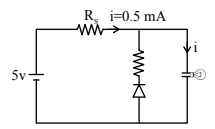
Find minimum \(R_s\) so that LED light does not get damaged (power rating of LED is \(2\,mW\)).
View Solution
Concept:
Power relation:
\[ P = VI \]
Series resistor limits current through the LED. The remaining voltage appears across the resistor.
Step 1: Find voltage across LED.
Given LED power rating
\[ P = 2\times10^{-3} \,W \]
Current through LED
\[ i = 0.5\,mA = 0.5\times10^{-3} A \]
\[ V_{LED} = \frac{P}{i} \]
\[ V_{LED} = \frac{2\times10^{-3}}{0.5\times10^{-3}} \]
\[ V_{LED} = 4V \]
Step 2: Find voltage across series resistor.
Supply voltage
\[ V = 5V \]
\[ V = V_{Rs} + V_{LED} \]
\[ 5 = V_{Rs} + 4 \]
\[ V_{Rs} = 1V \]
Step 3: Find required resistance.
\[ V_{Rs} = iR_s \]
\[ 1 = 0.5\times10^{-3} R_s \]
\[ R_s = 2\Omega \]
Final Result
\[ R_s = 2\Omega \] Quick Tip: To protect LEDs, always use a series resistor. First determine the LED voltage from \(P=VI\), then use the remaining supply voltage to calculate the required resistor using Ohm's law.
The dimensions of a solid cylinder is measured as given
Mass \(= 19.42 \pm 0.02 \,kg\)
Diameter \(= 20.20 \pm 0.02 \,cm\)
Length \(= 10.10 \pm 0.02 \,cm\)
Find out % error in density.
View Solution
Concept:
Density of a cylinder
\[ \rho = \frac{Mass}{Volume} \]
Volume of cylinder
\[ V = \pi r^2 l = \frac{\pi d^2 l}{4} \]
Thus
\[ \rho = \frac{4M}{\pi d^2 l} \]
For error propagation
\[ \frac{d\rho}{\rho} = \frac{dM}{M} + \frac{dl}{l} + \frac{2\,dd}{d} \]
Step 1: Substitute given errors.
\[ \frac{d\rho}{\rho} = \left( \frac{0.02}{19.42} + \frac{0.02}{10.10} + \frac{2\times0.02}{20.20} \right) \]
Step 2: Calculate percentage error.
\[ \frac{d\rho}{\rho} = (0.00103 + 0.00198 + 0.00198) \]
\[ \frac{d\rho}{\rho} \approx 0.005 \]
\[ % error = 0.005 \times 100 \]
\[ % error = 0.5% \]
Final Result
\[ % error in density = 0.5% \] Quick Tip: For quantities in product or division form, percentage errors add. If a quantity is squared (like \(d^2\)), its relative error is multiplied by the power.
Electric field in space is given by
\[ \vec{E} = 2x\hat{i} + 3y^2\hat{j} + 4\hat{k} \]
A charge \(q = 3\,C\) is taken from \(r_1(0,-1,-3)\) to \(r_2(5,1,2)\). Find magnitude of \( \Delta U \).
View Solution
Concept:
Change in potential energy is related to work done by electrostatic field.
\[ \Delta U = -W_{electric} \]
Work done by electric field
\[ W = q \int \vec{E}\cdot d\vec{r} \]
Step 1: Compute line integral.
\[ \vec{E}\cdot d\vec{r} = 2x\,dx + 3y^2\,dy + 4\,dz \]
\[ W = \int 2x\,dx + \int 3y^2\,dy + \int 4\,dz \]
Step 2: Integrate each term.
\[ \int 2x\,dx = x^2 \]
\[ \int 3y^2\,dy = y^3 \]
\[ \int 4\,dz = 4z \]
Thus
\[ W = (x^2 + y^3 + 4z) \]
Step 3: Evaluate between limits.
\[ W = (x^2 + y^3 + 4z)_{(0,-1,-3)}^{(5,1,2)} \]
At \( (5,1,2) \)
\[ 25 + 1 + 8 = 34 \]
At \( (0,-1,-3) \)
\[ 0 -1 -12 = -13 \]
\[ W = 34 - (-13) \]
\[ W = 47 \]
Since
\[ \Delta U = -W \]
Magnitude
\[ |\Delta U| = 47\,J \]
Final Result
\[ |\Delta U| = 47\,J \] Quick Tip: For position-dependent electric fields, compute work using the line integral \( \int \vec{E}\cdot d\vec{r} \). Then use \( \Delta U = -W \).
Bulk modulus of an ideal gas for isothermal process initially is \(B\). Gas is compressed from volume \(V_0\) to \( \frac{V_0}{3} \) isothermally. Find the work done by gas.
View Solution
Concept:
For an isothermal process in an ideal gas,
\[ W = nRT \ln\left(\frac{V_2}{V_1}\right) \]
For an ideal gas undergoing isothermal change, bulk modulus
\[ B = P \]
Thus initial pressure \(P_0 = B\).
Step 1: Use work done expression for isothermal process.
\[ W = nRT \ln\left(\frac{V_2}{V_1}\right) \]
But
\[ nRT = P_0V_0 \]
\[ W = P_0V_0 \ln\left(\frac{V_2}{V_1}\right) \]
Step 2: Substitute volume change.
\[ V_1 = V_0, \qquad V_2 = \frac{V_0}{3} \]
\[ W = P_0V_0 \ln\left(\frac{V_0/3}{V_0}\right) \]
\[ W = P_0V_0 \ln\left(\frac{1}{3}\right) \]
Step 3: Replace \(P_0\) by \(B\).
\[ W = BV_0 \ln\left(\frac{1}{3}\right) \]
Final Result
\[ W = BV_0 \ln\left(\frac{1}{3}\right) \] Quick Tip: For isothermal process of ideal gas, bulk modulus \(B = P\). Work done is \(W = P_1V_1 \ln\left(\frac{V_2}{V_1}\right)\).
A cube of side \(1\,mm\) is placed at centre of circular coil of radius \(10\,cm\). Current flowing in coil is \(2\,A\). Find magnetic field energy stored in cube. (\(\pi = 3.14\))
View Solution
Concept:
Magnetic field at centre of circular loop:
\[ B = \frac{\mu_0 I}{2R} \]
Magnetic energy density:
\[ u = \frac{B^2}{2\mu_0} \]
Total magnetic energy stored:
\[ U = uV \]
Step 1: Calculate magnetic field at centre.
\[ B = \frac{\mu_0 I}{2R} \]
\[ B = \frac{4\pi\times10^{-7}\times2}{2\times(10\times10^{-2})} \]
\[ B = \frac{8\pi\times10^{-7}}{0.2} \]
\[ B = 4\pi\times10^{-6}\,T \]
Step 2: Find magnetic energy density.
\[ u = \frac{B^2}{2\mu_0} \]
\[ u = \frac{(4\pi\times10^{-6})^2}{2\times4\pi\times10^{-7}} \]
Step 3: Find volume of cube.
\[ a = 1\,mm = 10^{-3} m \]
\[ V = a^3 = (10^{-3})^3 = 10^{-9} m^3 \]
Step 4: Calculate total energy stored.
\[ U = \frac{B^2}{2\mu_0}\times V \]
\[ U = \frac{(4\pi\times10^{-6})^2}{2\times4\pi\times10^{-7}}\times10^{-9} \]
\[ U = 2\pi\times10^{-14}\,J \]
\[ U \approx 6.28\times10^{-14}\,J \]
Final Result
\[ U = 6.28\times10^{-14}\,J \] Quick Tip: Magnetic energy stored in a region is calculated using energy density \(u = \frac{B^2}{2\mu_0}\) and multiplying it by the volume of that region.
Unpolarised light with intensity \(I_0\) is incident on a polariser. Find angle between axis of polariser and analyser such that intensity of emergent light becomes \( \frac{3I_0}{8} \).
View Solution
Concept:
When unpolarised light passes through a polariser, its intensity becomes half.
\[ I' = \frac{I_0}{2} \]
When this polarised light passes through an analyser, intensity follows Malus' law:
\[ I = I' \cos^2 \theta \]
Step 1: Apply Malus' law.
Given final intensity
\[ I = \frac{3I_0}{8} \]
Substitute \(I' = \frac{I_0}{2}\)
\[ \frac{3I_0}{8} = \frac{I_0}{2}\cos^2\theta \]
Step 2: Solve for \(\theta\).
Cancel \(I_0\):
\[ \frac{3}{8} = \frac{1}{2}\cos^2\theta \]
\[ \cos^2\theta = \frac{3}{4} \]
\[ \cos\theta = \frac{\sqrt{3}}{2} \]
\[ \theta = 30^\circ \]
Final Result
\[ \theta = 30^\circ \] Quick Tip: Unpolarised light intensity becomes \(I_0/2\) after passing through a polariser. Then apply Malus' law \(I = I_0 \cos^2\theta\) for analyser.
Shortest wavelength of Lyman series is \(x\). Find the difference of wavelengths of first Balmer and second Balmer line in terms of \(x\).
View Solution
Concept:
Rydberg formula for hydrogen spectrum:
\[ \frac{1}{\lambda} = R\left(\frac{1}{n_1^2}-\frac{1}{n_2^2}\right) \]
Shortest wavelength of Lyman series corresponds to transition
\[ n_2 = \infty \rightarrow n_1 = 1 \]
Thus
\[ x = \frac{1}{R} \]
Step 1: First Balmer line \((n_2=3 \rightarrow n_1=2)\).
\[ \frac{1}{\lambda_1} = R\left(\frac{1}{2^2}-\frac{1}{3^2}\right) \]
\[ \frac{1}{\lambda_1} = R\left(\frac{1}{4}-\frac{1}{9}\right) \]
\[ \frac{1}{\lambda_1} = R\left(\frac{5}{36}\right) \]
\[ \lambda_1 = \frac{36}{5R} \]
Since \(x = \frac{1}{R}\)
\[ \lambda_1 = \frac{36}{5}x \]
Step 2: Second Balmer line \((n_2=4 \rightarrow n_1=2)\).
\[ \frac{1}{\lambda_2} = R\left(\frac{1}{4}-\frac{1}{16}\right) \]
\[ \frac{1}{\lambda_2} = R\left(\frac{3}{16}\right) \]
\[ \lambda_2 = \frac{16}{3R} \]
\[ \lambda_2 = \frac{16}{3}x \]
Step 3: Find difference.
\[ \lambda_1 - \lambda_2 = \left(\frac{36}{5}-\frac{16}{3}\right)x \]
\[ = \left(\frac{108-80}{15}\right)x \]
\[ = \frac{28}{15}x \]
Final Result
\[ \lambda_1 - \lambda_2 = \frac{28}{15}x \] Quick Tip: Remember spectral transitions: Lyman \(n_1=1\), Balmer \(n_1=2\). Shortest wavelength occurs when \(n_2=\infty\).
A small drop of mass \(1\,g\) starts falling from rest from a height of \(1\,km\). When it reaches the ground with speed \(5\,m/s\), magnitude of work done by resistance force is \(x\times10^{-3}\,J\). Find \(x\).
View Solution
Concept:
Using work–energy theorem:
\[ W_g + W_{res} = \Delta K \]
where
\[ W_g = mgh \]
\[ \Delta K = \frac{1}{2}mv^2 \]
Step 1: Write work–energy equation.
\[ mgh + W_{res} = \frac{1}{2}mv^2 \]
Step 2: Solve for work done by resistance.
\[ W_{res} = \frac{1}{2}mv^2 - mgh \]
Step 3: Substitute given values.
\[ m = 1\,g = 10^{-3}\,kg \]
\[ h = 1\,km = 1000\,m \]
\[ v = 5\,m/s \]
\[ W_{res} = 10^{-3}\left(\frac{25}{2} - 10^4\right) \]
\[ |W_{res}| = 987.5 \times 10^{-3} J \]
Thus
\[ x = 987.5 \]
Final Result
\[ x = 987.5 \] Quick Tip: Whenever resistive forces act, mechanical energy is not conserved. Use work–energy theorem and treat work done by resistive forces as negative.
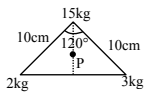
If \(P\) is the midpoint of median, find distance of COM from \(P\).
View Solution
Concept:
Centre of mass coordinates:
\[ x_{cm} = \frac{\sum m_i x_i}{\sum m_i} \]
\[ y_{cm} = \frac{\sum m_i y_i}{\sum m_i} \]
Total mass
\[ M = 2 + 15 + 3 = 20\,kg \]

Step 1: Assign coordinates.
Left mass \(2kg\)
\[ (0,0) \]
Right mass \(3kg\)
\[ (10\sqrt{3},0) \]
Top mass \(15kg\)
\[ (5\sqrt{3},5) \]
Step 2: Find \(x_{cm}\).
\[ x_{cm} = \frac{2(0) + 15(5\sqrt{3}) + 3(10\sqrt{3})}{20} \]
\[ x_{cm} = \frac{75\sqrt{3} + 30\sqrt{3}}{20} \]
\[ x_{cm} = \frac{21\sqrt{3}}{4} \]
Step 3: Find \(y_{cm}\).
\[ y_{cm} = \frac{2(0) + 15(5) + 3(0)}{20} \]
\[ y_{cm} = \frac{75}{20} \]
\[ y_{cm} = \frac{15}{4} \]
Step 4: Coordinates of midpoint of median \(P\).
\[ P = (5\sqrt{3}, 2.5) \]
Step 5: Find distance between COM and \(P\).
\[ d = \sqrt{(x_{cm}-x_P)^2 + (y_{cm}-y_P)^2} \]
\[ d = \sqrt{(5.25\sqrt{3} - 5\sqrt{3})^2 + (3.75 - 2.5)^2} \]
\[ d = \sqrt{(0.25\sqrt{3})^2 + (1.25)^2} \]
\[ d = \sqrt{1.75} \]
\[ d \approx 1.32 \]
Final Result
\[ d = 1.32 \] Quick Tip: For systems of point masses, first assign coordinates carefully. Then use COM formulas and finally apply distance formula to find separation between points.
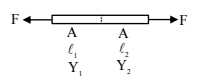
Two wires are joined together and elongated with force as shown in the figure. If \( \dfrac{Y_1}{Y_2} = \dfrac{20}{11} \), find \( \dfrac{\ell_1}{\ell_2} \) so that they have same elongation.
View Solution
Concept:
Elongation of a wire under tension is given by
\[ \Delta \ell = \frac{T\ell}{YA} \]
where
\(T\) = applied force
\(\ell\) = length of wire
\(Y\) = Young's modulus
\(A\) = cross-sectional area
Step 1: Condition for equal elongation.
Since both wires experience the same force and have same area,
\[ \Delta \ell_1 = \Delta \ell_2 \]
\[ \frac{T\ell_1}{Y_1A} = \frac{T\ell_2}{Y_2A} \]
Step 2: Simplify equation.
Cancel \(T\) and \(A\):
\[ \frac{\ell_1}{Y_1} = \frac{\ell_2}{Y_2} \]
\[ \frac{\ell_1}{\ell_2} = \frac{Y_1}{Y_2} \]
Step 3: Substitute given ratio.
\[ \frac{Y_1}{Y_2} = \frac{20}{11} \]
Thus
\[ \frac{\ell_1}{\ell_2} = \frac{20}{11} \]
Final Result
\[ \frac{\ell_1}{\ell_2} = \frac{20}{11} \] Quick Tip: For wires under the same force and area, elongation \( \Delta \ell \propto \frac{\ell}{Y} \). Equal elongation means \( \frac{\ell_1}{\ell_2} = \frac{Y_1}{Y_2} \).
Find the ratio of momentum of photons of 1st and 2nd line of Balmer series of hydrogen atom.
View Solution
Concept:
Momentum of a photon is given by
\[ p=\frac{h}{\lambda} \]
Hence
\[ p \propto \frac{1}{\lambda} \]
Using Rydberg formula for hydrogen spectrum
\[ \frac{1}{\lambda}=R\left(\frac{1}{n_1^2}-\frac{1}{n_2^2}\right) \]
For Balmer series \(n_1=2\).
Step 1: First Balmer line \((n_2=3 \rightarrow n_1=2)\).
\[ \frac{1}{\lambda_1} = R\left(\frac{1}{2^2}-\frac{1}{3^2}\right) \]
\[ = R\left(\frac{1}{4}-\frac{1}{9}\right) \]
\[ = R\left(\frac{5}{36}\right) \]
Step 2: Second Balmer line \((n_2=4 \rightarrow n_1=2)\).
\[ \frac{1}{\lambda_2} = R\left(\frac{1}{4}-\frac{1}{16}\right) \]
\[ = R\left(\frac{3}{16}\right) \]
Step 3: Find ratio of momentum.
\[ \frac{p_1}{p_2} = \frac{\lambda_2}{\lambda_1} \]
\[ = \frac{\frac{1}{(3R/16)}}{\frac{1}{(5R/36)}} = \frac{16}{3R}\times\frac{5R}{36} \]
\[ = \frac{20}{27} \]
Final Result
\[ \frac{p_1}{p_2}=\frac{20}{27} \] Quick Tip: Photon momentum \(p=h/\lambda\). Thus momentum ratio is inverse of wavelength ratio.
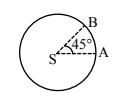
A point source is kept at centre of a sphere. The intensity of light at point \(A\) is \(I\). Find intensity at point \(B\).
View Solution
Concept:
Intensity of light from a point source is given by
\[ I=\frac{P}{4\pi r^2} \]
where \(r\) is the distance from the source.
Step 1: Analyze distances.
Points \(A\) and \(B\) lie on the same spherical surface.
Thus distance from the source to both points is the same:
\[ r_A=r_B \]
Step 2: Apply inverse square law.
\[ I=\frac{P}{4\pi r^2} \]
Since \(r\) is same for both points,
\[ I_A=I_B \]
Final Result
\[ I_B=I \] Quick Tip: For a point source, intensity depends only on distance \(r\). All points on the same spherical surface receive equal intensity.
JEE Main 2026 Physics Exam Pattern
| Particulars | Details |
|---|---|
| Exam Mode | Online (Computer-Based Test) |
| Paper | B.E./B.Tech |
| Medium of Exam | 13 languages: English, Hindi, Gujarati, Bengali, Tamil, Telugu, Kannada, Marathi, Malayalam, Odia, Punjabi, Assamese, Urdu |
| Type of Questions | Multiple Choice Questions (MCQs) + Numerical Value Questions |
| Total Marks | 100 marks |
| Marking Scheme | +4 for correct answer & -1 for incorrect MCQ and Numerical Value-based Questions |
| Total Questions | 25 Questions |





Comments