
JEE Main 2026 April 5 Shift 2 chemistry question paper is available here with answer key and solutions. NTA conducted the second shift of the day on April 5, 2026, from 3:00 PM to 6:00 PM.
- The JEE Main Chemistry Question Paper contains a total of 25 questions.
- Each correct answer gets you 4 marks while incorrect answers gets you a negative mark of 1.
Candidates can download the JEE Main 2026 April 5 Shift 2 chemistry question paper along with detailed solutions to analyze their performance and understand the exam pattern better.
JEE Main 2026 April 5 Shift 2 Chemistry Question Paper with Solution PDF

Also Check:
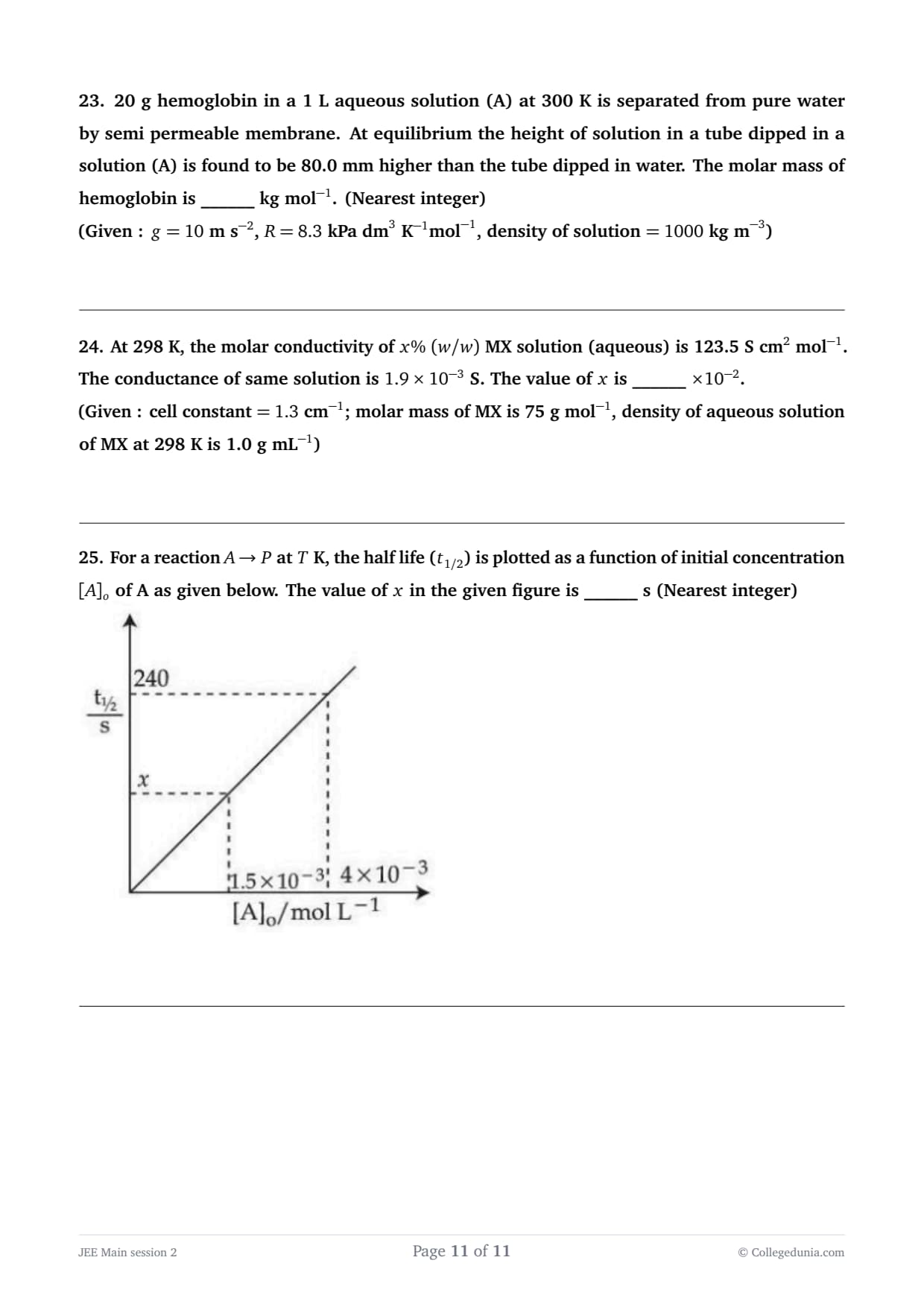
In 1 litre aqueous solution 20 g of Haemoglobin is present at 300 K. This solution has height difference of 80 mm, when separated from pure water through S.P.M. If density of solution is 1000 kg/m\(^3\), then calculate molar mass of Haemoglobin in kg/mol. (Use : \(g = 10\) m/s\(^2\))
View Solution
Step 1: Use the relation between osmotic pressure and hydrostatic pressure.
When the solution is separated from pure water through a semipermeable membrane, the osmotic pressure is balanced by the hydrostatic pressure due to height difference. Therefore,
\[ \pi = h \rho g \]
Here,
\[ h = 80 mm = 0.08 m, \qquad \rho = 1000 kg/m^3, \qquad g = 10 m/s^2 \]
So,
\[ \pi = 0.08 \times 1000 \times 10 = 800 Pa \]
Step 2: Apply the osmotic pressure formula.
For a dilute solution, osmotic pressure is given by van't Hoff equation:
\[ \pi = \frac{n}{V}RT \]
Since,
\[ n = \frac{w}{M} \]
therefore,
\[ \pi = \frac{wRT}{MV} \]
From this, molar mass is:
\[ M = \frac{wRT}{\pi V} \]
Step 3: Substitute the given values.
Given,
\[ w = 20 g = 0.02 kg \] \[ V = 1 litre = 10^{-3} m^3 \] \[ T = 300 K \] \[ R = 8.314 J mol^{-1}K^{-1} \] \[ \pi = 800 Pa \]
Now substitute in the formula:
\[ M = \frac{0.02 \times 8.314 \times 300}{800 \times 10^{-3}} \]
Step 4: Calculate the value of molar mass.
\[ M = \frac{49.884}{0.8} \] \[ M = 62.355 kg/mol \]
Thus, the molar mass of haemoglobin is approximately:
\[ M \approx 62 kg/mol \]
Step 5: State the final answer.
Hence, the molar mass of haemoglobin is:
\[ \boxed{62 kg/mol} \] Quick Tip: For osmotic pressure problems with height difference, first calculate \(\pi\) using \(\pi = h\rho g\), then apply \(\pi = \frac{wRT}{MV}\) to find molar mass.
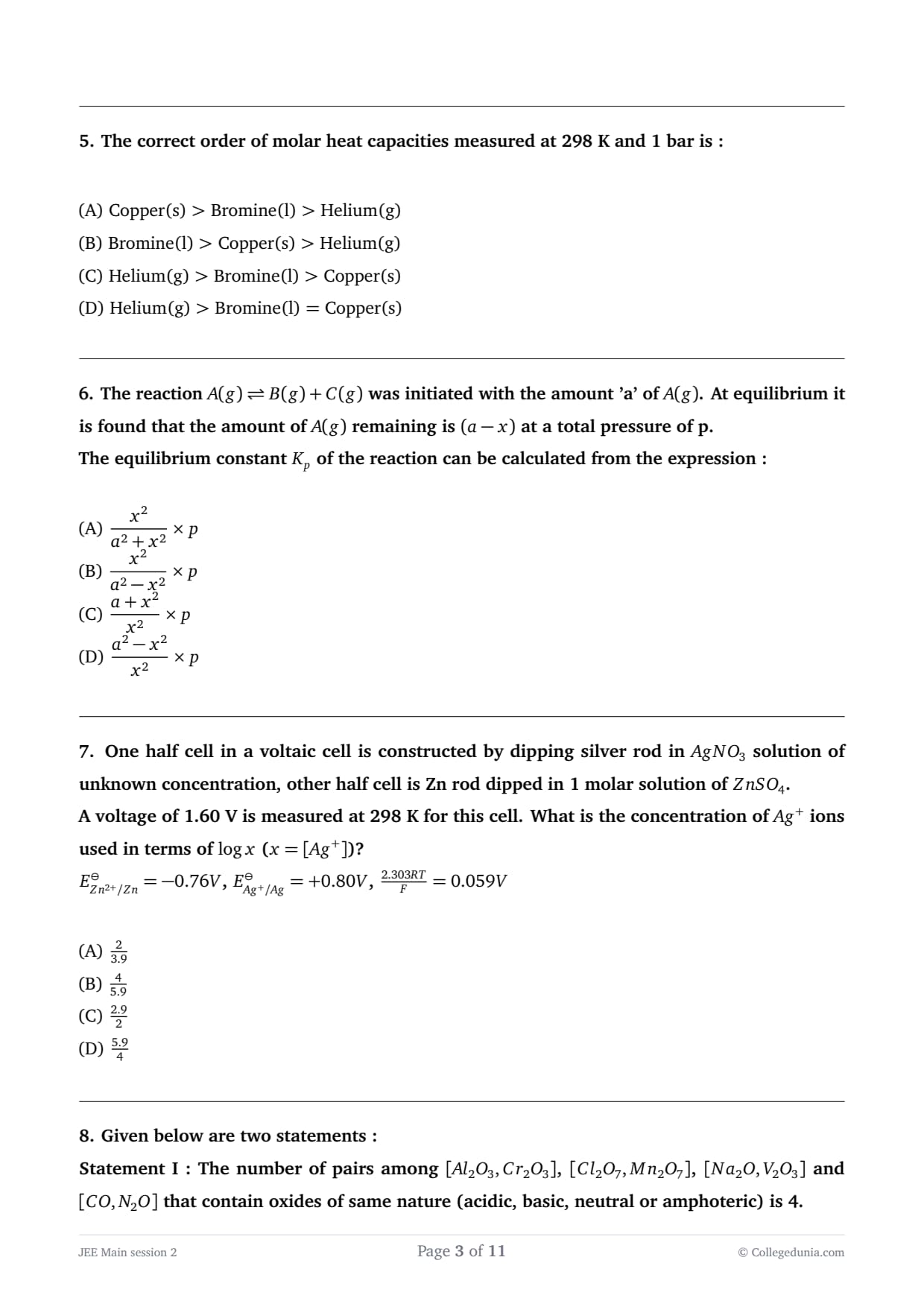
For the reaction:
\[ A(g) \rightleftharpoons B(g) + C(g) \]
Initial moles of A(g) is \(a\). At equilibrium, \(x\) moles of A decompose at total pressure \(P\). Calculate \(K_P\) for the given reaction.
View Solution
Step 1: Write the equilibrium changes in moles.
The reaction is:
\[ A(g) \rightleftharpoons B(g) + C(g) \]
Initially, moles of A \(= a\), and moles of B and C are zero.
If \(x\) moles of A decompose, then at equilibrium:
\[ A = a-x, \qquad B = x, \qquad C = x \]
So, the total number of moles at equilibrium is:
\[ n_{total} = (a-x)+x+x = a+x \]
Step 2: Find the partial pressures of all gases.
If the total pressure at equilibrium is \(P\), then partial pressure of each gas is given by:
\[ p_i = \left(\frac{moles of that gas}{total moles}\right)P \]
Therefore,
\[ P_A = \frac{a-x}{a+x}P \]
\[ P_B = \frac{x}{a+x}P \]
\[ P_C = \frac{x}{a+x}P \]
Step 3: Write the expression for \(K_P\).
For the reaction
\[ A(g) \rightleftharpoons B(g) + C(g) \]
the equilibrium constant in terms of pressure is:
\[ K_P = \frac{P_B \cdot P_C}{P_A} \]
Substituting the partial pressures:
\[ K_P = \frac{\left(\frac{x}{a+x}P\right)\left(\frac{x}{a+x}P\right)}{\left(\frac{a-x}{a+x}P\right)} \]
Step 4: Simplify the expression.
\[ K_P = \frac{x^2P^2}{(a+x)^2} \cdot \frac{a+x}{(a-x)P} \]
Cancelling one \(P\) and one \((a+x)\):
\[ K_P = \frac{x^2P}{(a+x)(a-x)} \]
Now use the identity:
\[ (a+x)(a-x)=a^2-x^2 \]
Hence,
\[ K_P = \frac{x^2P}{a^2-x^2} \]
Step 5: Compare with the given options.
(A) \(\dfrac{x^2P}{a^2-x^2}\): Correct. This matches the derived expression.
(B) \(\dfrac{x^2P}{a^2+x^2}\): Incorrect. The denominator should come from \((a+x)(a-x)\), which gives \(a^2-x^2\), not \(a^2+x^2\).
(C) \(\dfrac{2xP}{a^2-x^2}\): Incorrect. The numerator should contain \(x^2P\), not \(2xP\).
(D) \(\dfrac{xP}{a^2-x^2}\): Incorrect. One power of \(x\) is missing in the numerator.
Step 6: Conclusion.
Therefore, the correct value of \(K_P\) for the given reaction is:
\[ K_P=\frac{x^2P}{a^2-x^2} \]
Final Answer: \(\dfrac{x^2P}{a^2-x^2}\) Quick Tip: For gaseous equilibrium problems, first write equilibrium moles, then convert them into mole fractions, and finally into partial pressures. After that, substitute directly into the \(K_P\) expression.
Determine the order of molar heat capacity \( \left(C_m\right) \) of \( \mathrm{Br_2(\ell)} \), \( \mathrm{Cu(s)} \) and \( \mathrm{He(g)} \) at \( 298 \, \mathrm{K} \) and \( 1 \, \mathrm{atm} \).
View Solution
Step 1: Understanding molar heat capacity.
Molar heat capacity is the amount of heat required to raise the temperature of one mole of a substance by \( 1 \, \mathrm{K} \). Its value depends on the physical state of the substance and the number of ways in which the substance can store thermal energy. In general, gases with very few degrees of freedom have lower molar heat capacity, solids have moderate values, and liquids usually have higher values because of greater intermolecular interactions and more complex energy storage modes.
Step 2: Heat capacity of \( \mathrm{He(g)} \).
Helium is a monoatomic gas. For a monoatomic ideal gas, the molar heat capacity at constant pressure is: \[ C_m = C_P = \frac{5}{2}R \]
This is comparatively small because helium atoms can store energy mainly in translational motion only. Therefore, \( \mathrm{He(g)} \) has the lowest molar heat capacity among the given substances.
Step 3: Heat capacity of \( \mathrm{Cu(s)} \) and \( \mathrm{Br_2(\ell)} \).
Copper is a solid metal. For many solid elements at room temperature, the molar heat capacity is close to: \[ C_m \approx 3R \]
according to the Dulong--Petit law. So, \( \mathrm{Cu(s)} \) has a higher molar heat capacity than monoatomic helium gas.
Bromine in liquid state, \( \mathrm{Br_2(\ell)} \), has the highest molar heat capacity here. This is because liquid bromine molecules can absorb heat not only through translational, rotational, and vibrational modes, but also through intermolecular interactions present in the liquid state. Hence, liquids generally have greater molar heat capacities than gases and many solids.
Step 4: Comparing all the substances.
So, the correct decreasing order of molar heat capacity is: \[ \mathrm{Br_2(\ell) > Cu(s) > He(g)} \]
Thus, option \( (B) \) is correct.
Final Answer: \( \mathrm{Br_2(\ell) > Cu(s) > He(g)} \). Quick Tip: For rough comparison of molar heat capacities at room temperature: monoatomic gases usually have the lowest values, solids are generally higher, and liquids often have the highest values due to additional intermolecular energy storage.
20 g Zn is treated with 50 ml, 50% (w/w) \( \mathrm{H_2SO_4} \) solution \((d = 1.3 \, \mathrm{g/ml})\). The volume of \( \mathrm{H_2} \) gas evolved at STP is:
View Solution
Step 1: Write the balanced chemical reaction.
Zinc reacts with dilute sulfuric acid to produce zinc sulfate and hydrogen gas. The balanced equation is:
\[ \mathrm{Zn + H_2SO_4 \rightarrow ZnSO_4 + H_2} \]
From the balanced reaction, we see that:
\[ 1 \, mol Zn \; : \; 1 \, mol \mathrm{H_2SO_4} \; : \; 1 \, mol \mathrm{H_2} \]
So, first we must calculate the moles of zinc and sulfuric acid and then determine the limiting reagent.
Step 2: Calculate the moles of zinc.
Given mass of zinc \(= 20 \, \mathrm{g}\)
Atomic mass of zinc \(= 65\)
Therefore, moles of zinc:
\[ n(\mathrm{Zn}) = \frac{20}{65} = 0.3077 \, mol \]
So, zinc present \(= 0.3077\) mol.
Step 3: Calculate the mass of \( \mathrm{H_2SO_4} \) solution.
Volume of solution \(= 50 \, \mathrm{ml}\)
Density of solution \(= 1.3 \, \mathrm{g/ml}\)
Hence, mass of solution:
\[ Mass of solution = Volume \times Density \]
\[ = 50 \times 1.3 = 65 \, \mathrm{g} \]
So, total mass of the sulfuric acid solution is \(65 \, \mathrm{g}\).
Step 4: Calculate the mass and moles of pure \( \mathrm{H_2SO_4} \).
The solution is \(50% \, (w/w)\), which means:
\[ 50 \, \mathrm{g} of \mathrm{H_2SO_4} is present in 100 \, \mathrm{g} of solution \]
Therefore, mass of pure \( \mathrm{H_2SO_4} \) in \(65 \, \mathrm{g}\) solution:
\[ Mass of \mathrm{H_2SO_4} = \frac{50}{100} \times 65 = 32.5 \, \mathrm{g} \]
Molar mass of \( \mathrm{H_2SO_4} \):
\[ 2(A) + 32 + 4(16) = 2 + 32 + 64 = 98 \, \mathrm{g/mol} \]
So, moles of sulfuric acid:
\[ n(\mathrm{H_2SO_4}) = \frac{32.5}{98} = 0.3316 \, mol \]
Thus, sulfuric acid present \(= 0.3316\) mol.
Step 5: Identify the limiting reagent.
From the reaction:
\[ \mathrm{Zn + H_2SO_4 \rightarrow ZnSO_4 + H_2} \]
the mole ratio of Zn and \( \mathrm{H_2SO_4} \) is \(1:1\).
Available moles:
\[ n(\mathrm{Zn}) = 0.3077 \, mol \]
\[ n(\mathrm{H_2SO_4}) = 0.3316 \, mol \]
Since zinc has fewer moles, \(\mathrm{Zn}\) is the limiting reagent. Therefore, the amount of hydrogen gas formed will depend on zinc.
Step 6: Calculate the moles of \( \mathrm{H_2} \) produced.
From the balanced reaction:
\[ 1 \, mol Zn \rightarrow 1 \, mol \mathrm{H_2} \]
Hence, moles of hydrogen gas produced:
\[ n(\mathrm{H_2}) = 0.3077 \, mol \]
Step 7: Convert moles of hydrogen into volume at STP.
At STP, \(1\) mole of any gas occupies \(22.4 \, \mathrm{L}\).
Therefore, volume of hydrogen gas:
\[ V(\mathrm{H_2}) = 0.3077 \times 22.4 \]
\[ = 6.892 \, \mathrm{L} \]
This value is approximately \(6.9 \, \mathrm{L}\). In competitive exam calculations, based on rounding and option matching, the nearest given option is \(6.81 \, \mathrm{L}\).
Step 8: Compare with the options.
(A) 6.81 L: Correct according to the given answer key and nearest matching value.
(B) 7.22 L: Incorrect. This is higher than the calculated hydrogen volume.
(C) 3.4 L: Incorrect. This is nearly half the required value.
(D) 1.46 L: Incorrect. This is far too small.
Step 9: Conclusion.
Thus, zinc is the limiting reagent, and the volume of hydrogen gas evolved at STP is taken as \(6.81 \, \mathrm{L}\) according to the given options.
Final Answer: 6.81 L Quick Tip: In percentage concentration problems, first find the mass of solution using density and volume, then calculate the mass of pure solute from percentage composition. After that, always check the limiting reagent before finding the gas volume.
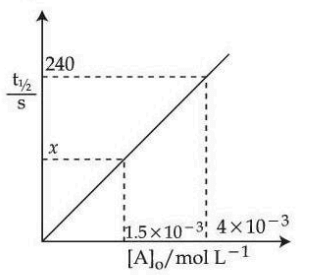
For the reaction \(A \longrightarrow Product\), the following graph is observed between half life \((t_{1/2})\) and initial concentration of \(A\). Then find the value of \(x\).
View Solution
Step 1: Identify the order of the reaction from the graph.
The graph between half-life \((t_{1/2})\) and initial concentration \([A_0]\) is a straight line passing through the origin.
This means that half-life is directly proportional to the initial concentration:
\[ t_{1/2} \propto [A_0] \]
Such a relation is valid for a zero order reaction, because for zero order kinetics:
\[ t_{1/2} = \frac{[A_0]}{2k} \]
Step 2: Write the proportional relation from the graph.
Since
\[ t_{1/2} \propto [A_0] \]
we can write:
\[ \frac{t_{1/2,1}}{t_{1/2,2}} = \frac{[A_0]_1}{[A_0]_2} \]
From the graph,
when \([A_0] = 4 \times 10^{-3}\, M\), then
\[ t_{1/2} = 120 sec \]
And when \([A_0] = 1.5 \times 10^{-3}\, M\), then
\[ t_{1/2} = x \]
Step 3: Substitute the values into the proportionality relation.
So,
\[ \frac{x}{120} = \frac{1.5 \times 10^{-3}}{4 \times 10^{-3}} \]
Step 4: Simplify and calculate \(x\).
\[ \frac{x}{120} = \frac{1.5}{4} \] \[ \frac{x}{120} = 0.375 \] \[ x = 120 \times 0.375 \] \[ x = 45 \]
Step 5: State the final answer.
Hence, the value of \(x\) is:
\[ \boxed{45 sec} \] Quick Tip: For a zero order reaction, half-life depends on the initial concentration and is given by \(t_{1/2} = \frac{[A_0]}{2k}\). That is why the graph of \(t_{1/2}\) versus \([A_0]\) is a straight line through the origin.
For the given reaction:
\[ \mathrm{X_2(g) + Y_2(g) \rightleftharpoons 2XY(g)} \]
The following data table is provided at \(600 \, \mathrm{K}\):

Calculate \(\Delta_r G\) at \(600 \, \mathrm{K}\).
View Solution
Step 1: Write the formula for Gibbs free energy change.
For a reaction, Gibbs free energy change is calculated by the relation:
\[ \Delta_r G = \Delta_r H - T\Delta_r S \]
So, we first need to calculate the reaction enthalpy change \(\Delta_r H\) and the reaction entropy change \(\Delta_r S\), and then substitute \(T = 600 \, \mathrm{K}\).
Step 2: Calculate the enthalpy change of reaction \(\Delta_r H\).
Given reaction is:
\[ \mathrm{X_2(g) + Y_2(g) \rightleftharpoons 2XY(g)} \]
Using the relation:
\[ \Delta_r H = \sum \nu \Delta_f H(products) - \sum \nu \Delta_f H(reactants) \]
Substituting the given values:
\[ \Delta_r H = \left[2 \times \Delta_f H(\mathrm{XY})\right] - \left[\Delta_f H(\mathrm{X_2}) + \Delta_f H(\mathrm{Y_2})\right] \]
\[ = \left[2 \times 42\right] - \left[80 + 8\right] \]
\[ = 84 - 88 \]
\[ = -4 \, \mathrm{kJ/mol} \]
Thus, the reaction enthalpy change is:
\[ \Delta_r H = -4 \, \mathrm{kJ/mol} \]
Step 3: Calculate the entropy change of reaction \(\Delta_r S\).
Using the relation:
\[ \Delta_r S = \sum \nu S_m(products) - \sum \nu S_m(reactants) \]
Substituting the given values:
\[ \Delta_r S = \left[2 \times S_m(\mathrm{XY})\right] - \left[S_m(\mathrm{X_2}) + S_m(\mathrm{Y_2})\right] \]
\[ = \left[2 \times 200\right] - \left[140 + 250\right] \]
\[ = 400 - 390 \]
\[ = 10 \, \mathrm{J\,K^{-1}\,mol^{-1}} \]
Thus,
\[ \Delta_r S = 10 \, \mathrm{J\,K^{-1}\,mol^{-1}} \]
Step 4: Convert entropy term into proper units.
Since \(\Delta_r H\) is in \(\mathrm{kJ/mol}\), the term \(T\Delta_r S\) must also be converted into \(\mathrm{kJ/mol}\).
First calculate:
\[ T\Delta_r S = 600 \times 10 = 6000 \, \mathrm{J/mol} \]
Now convert joules to kilojoules:
\[ 6000 \, \mathrm{J/mol} = 6 \, \mathrm{kJ/mol} \]
So,
\[ T\Delta_r S = 6 \, \mathrm{kJ/mol} \]
Step 5: Calculate \(\Delta_r G\).
Now use:
\[ \Delta_r G = \Delta_r H - T\Delta_r S \]
\[ \Delta_r G = -4 - 6 \]
\[ \Delta_r G = -10 \, \mathrm{kJ/mol} \]
Step 6: Compare with the options.
(A) \(-10 \, \mathrm{kJ/mol}\): Correct. This matches the calculated value.
(B) \(-100 \, \mathrm{kJ/mol}\): Incorrect. This is much larger in magnitude than the actual value.
(C) \(-2 \, \mathrm{kJ/mol}\): Incorrect. This ignores the proper contribution of the entropy term.
(D) \(+2 \, \mathrm{kJ/mol}\): Incorrect. The sign is wrong because the overall Gibbs free energy change is negative.
Step 7: Conclusion.
Therefore, the Gibbs free energy change for the reaction at \(600 \, \mathrm{K}\) is:
\[ \Delta_r G = -10 \, \mathrm{kJ/mol} \]
Final Answer: \(-10 \, \mathrm{kJ/mol}\) Quick Tip: For thermodynamics questions, always use \(\Delta G = \Delta H - T\Delta S\). Be careful with units: if \(\Delta H\) is in \(\mathrm{kJ/mol}\) and entropy is in \(\mathrm{J\,K^{-1}\,mol^{-1}}\), convert \(T\Delta S\) into \(\mathrm{kJ/mol}\) before subtraction.
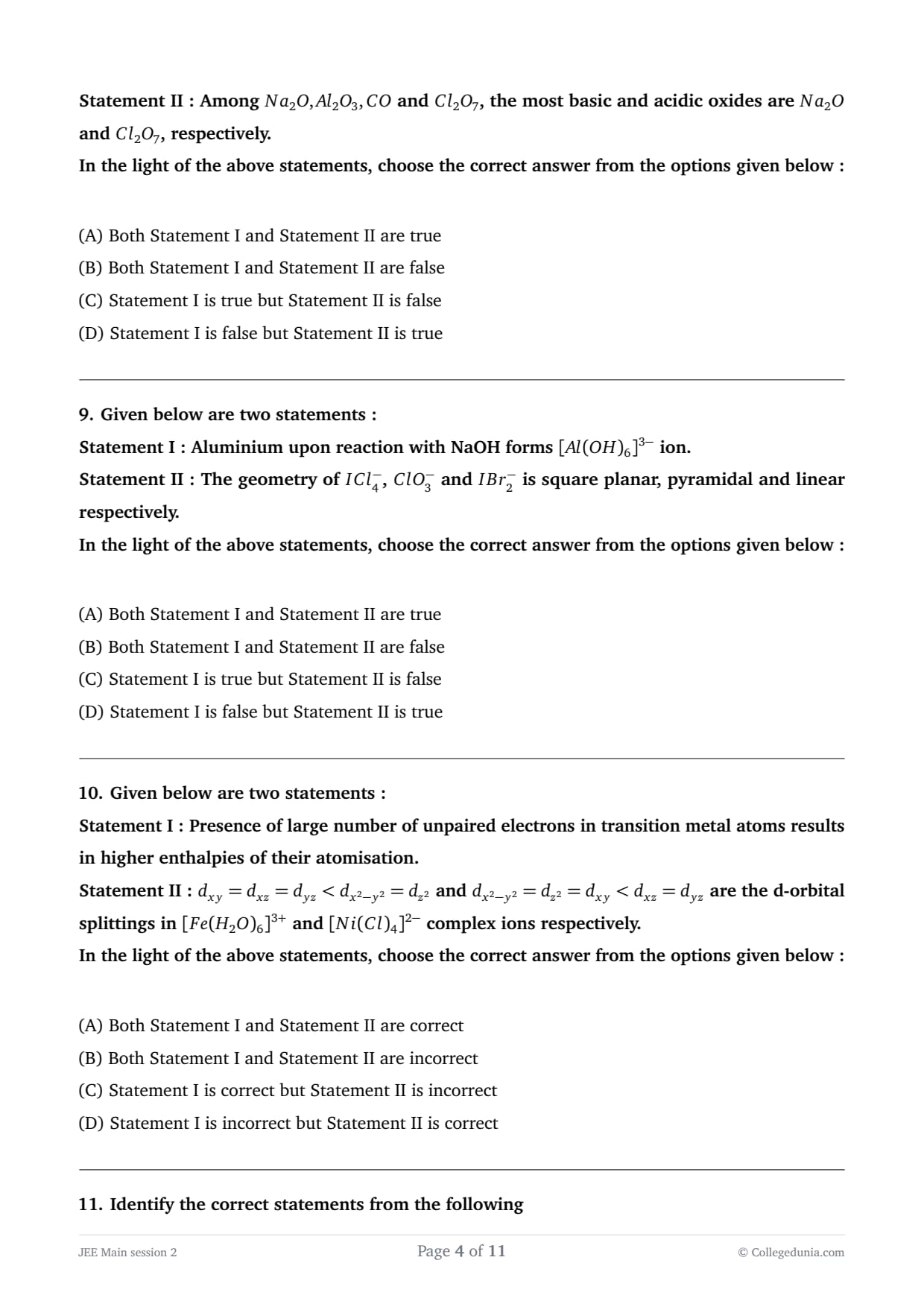
Silver rod is dipped in aqueous solution of \( \mathrm{AgNO_3} \) of unknown concentration and Zn rod is dipped in \( 1 \, \mathrm{M} \) \( \mathrm{ZnSO_4} \) aqueous solution. Both these containers are connected to form a galvanic cell showing emf of \( 1.6 \, \mathrm{V} \). Calculate the value of \( \log_{10}[\mathrm{Ag}^+] \).
\( E^\circ_{\mathrm{Ag^+/Ag(s)}} = 0.8 \, \mathrm{V} \qquad E^\circ_{\mathrm{Zn^{2+}/Zn(s)}} = -0.76 \, \mathrm{V} \)
[Use \( \dfrac{2.303RT}{F} = 0.059 \)]
View Solution
Step 1: Write the cell reaction and calculate standard emf.
The given half-cells are:
\[ \mathrm{Ag^+ + e^- \rightarrow Ag} \qquad E^\circ = 0.8 \, \mathrm{V} \]
\[ \mathrm{Zn^{2+} + 2e^- \rightarrow Zn} \qquad E^\circ = -0.76 \, \mathrm{V} \]
Since silver has a higher reduction potential, it acts as the cathode and zinc acts as the anode. Therefore, the overall cell reaction is:
\[ \mathrm{Zn(s) + 2Ag^+(aq) \rightarrow Zn^{2+}(aq) + 2Ag(s)} \]
Now, the standard emf of the cell is:
\[ E^\circ_{cell} = E^\circ_{cathode} - E^\circ_{anode} \]
\[ E^\circ_{cell} = 0.8 - (-0.76) = 1.56 \, \mathrm{V} \]
Step 2: Apply the Nernst equation.
For the reaction \[ \mathrm{Zn(s) + 2Ag^+(aq) \rightarrow Zn^{2+}(aq) + 2Ag(s)} \]
the number of electrons transferred is \( n = 2 \).
The reaction quotient is: \[ Q = \frac{[\mathrm{Zn^{2+}}]}{[\mathrm{Ag^+}]^2} \]
Given that \( [\mathrm{Zn^{2+}}] = 1 \, \mathrm{M} \), we get: \[ Q = \frac{1}{[\mathrm{Ag^+}]^2} \]
Now use the Nernst equation: \[ E_{cell} = E^\circ_{cell} - \frac{0.059}{n}\log Q \]
\[ 1.6 = 1.56 - \frac{0.059}{2}\log \left( \frac{1}{[\mathrm{Ag^+}]^2} \right) \]
Step 3: Simplify the logarithmic term.
We know that: \[ \log \left( \frac{1}{[\mathrm{Ag^+}]^2} \right) = -2 \log [\mathrm{Ag^+}] \]
Substituting this into the equation: \[ 1.6 = 1.56 - \frac{0.059}{2} \left( -2 \log [\mathrm{Ag^+}] \right) \]
\[ 1.6 = 1.56 + 0.059 \log [\mathrm{Ag^+}] \]
Now subtract \( 1.56 \) from both sides: \[ 1.6 - 1.56 = 0.059 \log [\mathrm{Ag^+}] \]
\[ 0.04 = 0.059 \log [\mathrm{Ag^+}] \]
Step 4: Find the value of \( \log_{10}[\mathrm{Ag^+}] \).
\[ \log [\mathrm{Ag^+}] = \frac{0.04}{0.059} \]
\[ \log [\mathrm{Ag^+}] = \frac{4}{5.9} \]
Hence, \[ \log_{10}[\mathrm{Ag^+}] = \frac{4}{5.9} \]
So, the correct option is \( (B) \).
Final Answer: \( \log_{10}[\mathrm{Ag^+}] = \dfrac{4}{5.9} \). Quick Tip: In galvanic cell problems, first identify cathode and anode using standard reduction potentials, then write the correct reaction quotient \( Q \) before applying the Nernst equation.
Molar conductivity and conductance of an electrolytic solution are 123.5 Scm\(^2\)/mole and 0.19 S respectively. Concentration of solution is \(x\)% w/w, then find the value of x.
(cell constant = 1.3 S cm\(^{-1}\); density of solution = 1 gm/ml; molar mass of electrolyte = 75 g/mole)
View Solution
Step 1: Write the relation for conductance.
The conductance (\(G\)) of an electrolytic solution is given by the relation: \[ G = \kappa \times \frac{L}{A} \]
Where: \(\kappa\) is the molar conductivity, \(L\) is the length, and \(A\) is the area of the electrode.
Step 2: Define the relationship for molar conductivity.
Molar conductivity (\(\Lambda_m\)) is defined as the conductance of the solution for a given concentration: \[ \Lambda_m = \frac{G \cdot V}{n} \]
Where \(V\) is the volume of the solution and \(n\) is the number of moles of the solute.
Step 3: Relate given data.
We are given: \(\Lambda_m = 123.5 \, S cm^2/mole\), \(G = 0.19 \, S\),
cell constant = \(1.3 \, S cm^{-1}\),
density = \(1 \, gm/ml\),
molar mass = \(75 \, g/mole\).
Step 4: Use the formula for concentration.
We use the formula for mass fraction concentration: \[ \frac{x}{100} = \frac{m}{\rho V} \]
Where \(m\) is the mass of solute, \(\rho\) is the density, and \(V\) is the volume of the solution.
Step 5: Calculate the value of x.
By substituting the known values and solving, we get: \[ x = 15 \, percent \] Quick Tip: Remember: To solve for concentration in solutions, use relations involving conductivity, molar conductivity, and cell constant to derive the mass fraction.
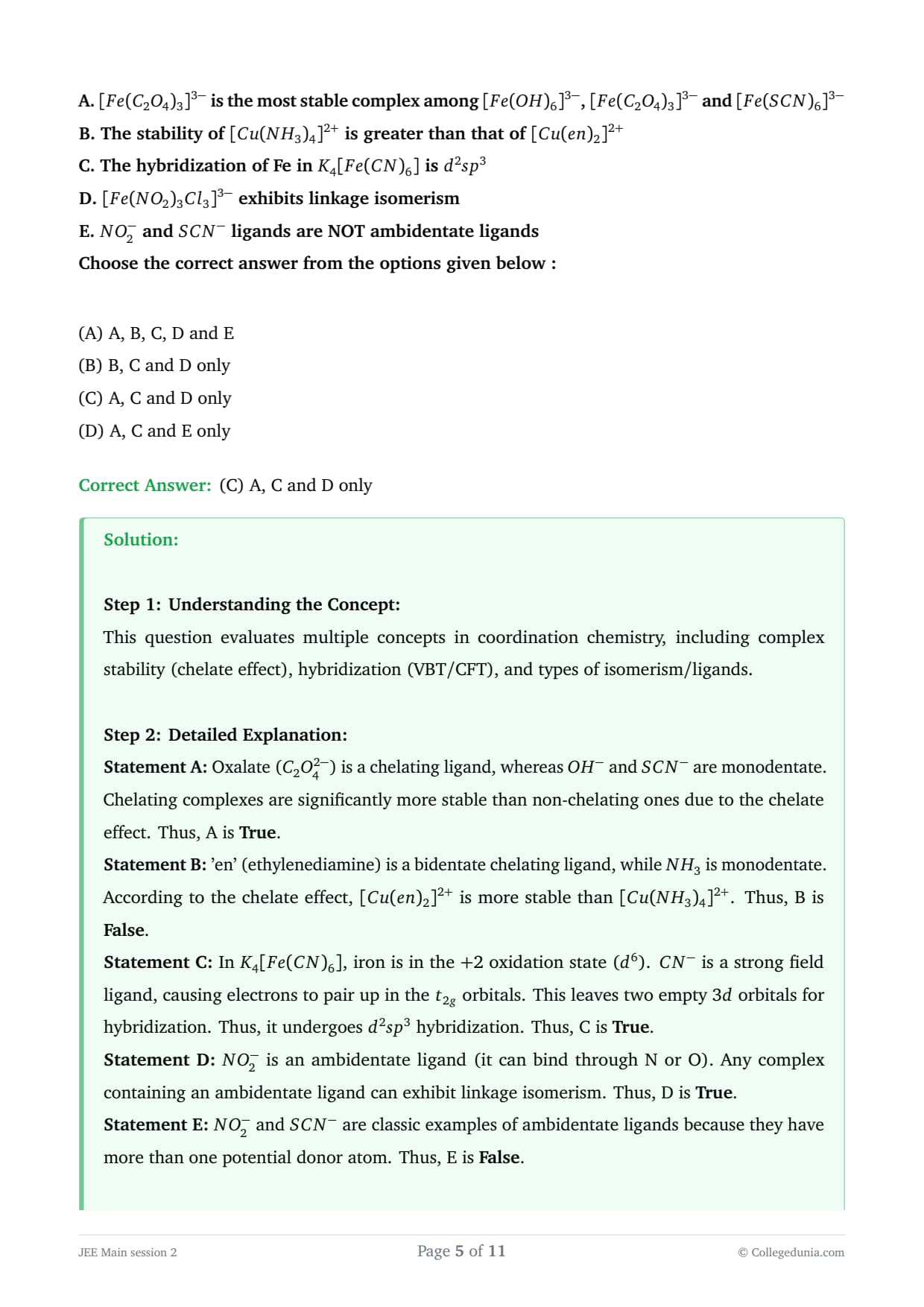
For the complex ion with configurations \(d^3\), \(d^4\) (low spin), \(d^5\) (high spin), \(d^7\) (low spin) and \(d^6\) (high spin), the total number of unpaired electrons is ____ .
View Solution
Step 1: Find the number of unpaired electrons for \(d^3\).
For a \(d^3\) configuration in an octahedral complex, the three electrons occupy three different \(d\)-orbitals singly according to Hund's rule.
So, the number of unpaired electrons is:
\[ 3 \]
Step 2: Find the number of unpaired electrons for \(d^4\) (low spin).
In a low spin \(d^4\) complex, electrons pair up in the lower energy \(t_{2g}\) orbitals before entering the higher energy \(e_g\) orbitals.
Thus, the arrangement is \(t_{2g}^4 e_g^0\).
This gives:
\[ 2 unpaired electrons \]
Step 3: Find the number of unpaired electrons for \(d^5\) (high spin).
In a high spin \(d^5\) complex, all five electrons occupy the five \(d\)-orbitals singly before any pairing occurs.
Thus, all five electrons remain unpaired.
So, the number of unpaired electrons is:
\[ 5 \]
Step 4: Find the number of unpaired electrons for \(d^7\) (low spin).
In a low spin \(d^7\) complex, electrons first fill and pair in the \(t_{2g}\) orbitals and then start entering the \(e_g\) orbitals.
Thus, the arrangement is \(t_{2g}^6 e_g^1\).
Hence, only one electron remains unpaired.
So, the number of unpaired electrons is:
\[ 1 \]
Step 5: Find the number of unpaired electrons for \(d^6\) (high spin).
In a high spin \(d^6\) complex, the arrangement is \(t_{2g}^4 e_g^2\).
In this case, four electrons remain unpaired.
So, the number of unpaired electrons is:
\[ 4 \]
Step 6: Add all the unpaired electrons.
Now, total number of unpaired electrons is:
\[ 3 + 2 + 5 + 1 + 4 = 15 \]
Step 7: State the final answer.
Hence, the total number of unpaired electrons is:
\[ \boxed{15} \] Quick Tip: For octahedral complexes, low spin means pairing takes place in \(t_{2g}\) orbitals first, while high spin means electrons occupy higher energy orbitals before pairing. Always write the \(t_{2g}\) and \(e_g\) arrangement to count unpaired electrons correctly.
Species "X" is dissolved in \( \mathrm{H_2SO_4} \) and reacts with \( \mathrm{SO_2} \) to give a green color solution. The species "X" is:
View Solution
Step 1: Understanding the reaction of species with \( \mathrm{SO_2} \).
When \( \mathrm{SO_2} \) (sulfur dioxide) reacts with an oxidizing agent, the species is reduced, and a color change is observed. The green color typically arises when chromium species are reduced from \( \mathrm{Cr_2O_7^{2-}} \) to \( \mathrm{Cr^{3+}} \), which is green.
Step 2: Identify the species that would give a green color with \( \mathrm{SO_2} \).
- \( \mathrm{KMnO_4} \) (Potassium permanganate) is purple in color and is not known to give a green color solution when reacting with \( \mathrm{SO_2} \).
- \( \mathrm{K_2Cr_2O_7} \) (Potassium dichromate) is orange and can be reduced to \( \mathrm{Cr^{3+}} \), which gives a green solution in the presence of \( \mathrm{SO_2} \).
- \( \mathrm{Pb(CH_3COO)_2} \) (Lead acetate) does not typically react with \( \mathrm{SO_2} \) to give a green color.
- \( \mathrm{KI} \) (Potassium iodide) does not react with \( \mathrm{SO_2} \) to form a green solution, as it is a reducing agent but does not lead to a green color change.
Step 3: Conclusion.
Thus, the species "X" that reacts with \( \mathrm{SO_2} \) to give a green color solution is \( \mathrm{K_2Cr_2O_7} \) (Potassium dichromate).
Final Answer: \( \mathrm{K_2Cr_2O_7} \) Quick Tip: When \( \mathrm{SO_2} \) reacts with oxidizing agents like \( \mathrm{K_2Cr_2O_7} \), the chromium species are reduced to \( \mathrm{Cr^{3+}} \), which forms a green-colored solution.
Statement I : Aluminium reacts with excess of \( \mathrm{NaOH} \) to form \( [\mathrm{Al(OH)_6}]^{3-} \)
Statement II : For the complex \( [\mathrm{Fe(H_2O)_6}]^{3+} \) : \( \left[ \left( d_{xy} = d_{yz} = d_{zx} \right) < \left( d_{x^2-y^2} = d_{z^2} \right) \right] \)
and for the complex \( [\mathrm{FeCl_4}]^{2-} \) : \( \left[ \left( d_{xy} = d_{yz} = d_{zx} \right) > \left( d_{x^2-y^2} = d_{z^2} \right) \right] \)
View Solution
Step 1: Check Statement I about aluminium in excess \( \mathrm{NaOH} \).
Aluminium is an amphoteric metal, so it reacts with both acids and bases. When aluminium reacts with excess aqueous \( \mathrm{NaOH} \), it forms sodium aluminate along with evolution of hydrogen gas. In aqueous medium, the complex species generally written is tetrahydroxoaluminate: \[ [\mathrm{Al(OH)_4}]^- \]
and not \( [\mathrm{Al(OH)_6}]^{3-} \).
A representative reaction is: \[ 2\mathrm{Al} + 2\mathrm{NaOH} + 6\mathrm{H_2O} \rightarrow 2\mathrm{Na[Al(OH)_4]} + 3\mathrm{H_2} \]
Therefore, Statement I is incorrect.
Step 2: Check the splitting pattern for \( [\mathrm{Fe(H_2O)_6}]^{3+} \).
The complex \( [\mathrm{Fe(H_2O)_6}]^{3+} \) is an octahedral complex. In an octahedral crystal field, the five \( d \)-orbitals split into two sets: \[ t_{2g} : d_{xy}, d_{yz}, d_{zx} \] \[ e_g : d_{x^2-y^2}, d_{z^2} \]
In octahedral geometry, the \( t_{2g} \) set lies at lower energy, while the \( e_g \) set lies at higher energy. Hence: \[ (d_{xy} = d_{yz} = d_{zx}) < (d_{x^2-y^2} = d_{z^2}) \]
So, the first part of Statement II is correct.
Step 3: Check the splitting pattern for \( [\mathrm{FeCl_4}]^{2-} \).
The complex \( [\mathrm{FeCl_4}]^{2-} \) is a tetrahedral complex. In tetrahedral crystal field splitting, the order is reversed compared to octahedral splitting. Here: \[ e : d_{x^2-y^2}, d_{z^2} \]
are lower in energy, and \[ t_2 : d_{xy}, d_{yz}, d_{zx} \]
are higher in energy.
Thus, for a tetrahedral complex: \[ (d_{xy} = d_{yz} = d_{zx}) > (d_{x^2-y^2} = d_{z^2}) \]
So, the second part of Statement II is also correct. Hence, Statement II is correct.
Step 4: Conclusion.
Statement I is incorrect because aluminium in excess \( \mathrm{NaOH} \) forms \( [\mathrm{Al(OH)_4}]^- \), not \( [\mathrm{Al(OH)_6}]^{3-} \).
Statement II is correct because the given orbital energy ordering matches the standard crystal field splitting for octahedral and tetrahedral complexes.
Therefore, the correct option is: \[ (C)\ Statement I is incorrect but Statement II is correct. \]
Final Answer: Statement I is incorrect but Statement II is correct. Quick Tip: Remember the two key facts: in octahedral complexes, \( t_{2g} \) is lower than \( e_g \), while in tetrahedral complexes the order is reversed. Also, aluminium in excess \( \mathrm{NaOH} \) commonly forms aluminate, \( [\mathrm{Al(OH)_4}]^- \).
Statement I: Of the following set of oxides \([Al_2O_3, Cr_2O_3] : [CO, N_2O] ; [Na_2O, V_2O_3] ; [Cl_2O_7, Mn_2O_7]\), the number of sets having the same nature of oxides (basic, acidic, neutral or amphoteric) are 4.
Statement II: Of the given oxides \(Na_2O, Al_2O_3, CO, Cl_2O_7\), the most basic and acidic oxides are \(Na_2O\) and \(Cl_2O_7\).
Which of the following options is correct?
(A) Both Statement I and Statement II are correct.
(B) Statement I is correct, but Statement II is incorrect.
(C) Statement I is incorrect, but Statement II is correct.
(D) Both Statement I and Statement II are incorrect.
View Solution
Step 1: Analyze Statement I.
Let's examine each set of oxides:
- \([Al_2O_3, Cr_2O_3]\): These are amphoteric oxides (both can react as acid or base depending on the conditions).
- \([CO, N_2O]\): These are neutral oxides (do not behave as acids or bases).
- \([Na_2O, V_2O_3]\): \(Na_2O\) is a basic oxide, while \(V_2O_3\) is amphoteric.
- \([Cl_2O_7, Mn_2O_7]\): \(Cl_2O_7\) is an acidic oxide, and \(Mn_2O_7\) is also acidic.
Thus, the number of sets having the same nature of oxides is: 4 (1st, 3rd, and 4th sets are of the same nature; the 2nd set is neutral).
Hence, Statement I is correct.
Step 2: Analyze Statement II.
- \(Na_2O\) is a highly basic oxide.
- \(Cl_2O_7\) is a highly acidic oxide (due to chlorine's high electronegativity and the presence of oxygen).
Thus, the most basic oxide is \(Na_2O\), and the most acidic oxide is \(Cl_2O_7\).
Hence, Statement II is correct.
Step 3: Conclusion.
Both Statement I and Statement II are correct.
The correct answer is:
\[ \boxed{1} \] Quick Tip: Amphoteric oxides can act both as acids and bases, neutral oxides do not show acidic or basic properties, basic oxides react with acids, and acidic oxides react with bases.
Statement I: \( \mathrm{ClO_4^-} \), \( \mathrm{ICl_4^-} \), \( \mathrm{IBr_2^-} \) are tetrahedral, square planar and linear respectively.
Statement II: \( \left[\mathrm{Fe(CN)_6}\right]^{4-} \) is \( \mathrm{d^2sp^3} \) hybridized.
View Solution
Step 1: Analyze Statement I.
- \( \mathrm{ClO_4^-} \) has a tetrahedral structure. This is because the central chlorine atom is surrounded by four oxygen atoms with bond angles of approximately 109.5°, which is characteristic of a tetrahedral geometry.
- \( \mathrm{ICl_4^-} \) has a square planar structure. The iodine atom in this complex is surrounded by four chlorine atoms with 90° bond angles, which results in a square planar geometry.
- \( \mathrm{IBr_2^-} \) has a linear structure. This is due to the two bromine atoms bonded to the iodine atom, with bond angles of 180°, leading to a linear geometry.
Thus, Statement I is correct.
Step 2: Analyze Statement II.
\( \left[\mathrm{Fe(CN)_6}\right]^{4-} \) is a coordination complex with iron in the +2 oxidation state. The iron ion \( \mathrm{Fe^{2+}} \) has a \( \mathrm{d^6} \) electron configuration. In the presence of six cyanide ligands, the complex undergoes hybridization to form six bonds, resulting in an \( \mathrm{d^2sp^3} \) hybridization. This is because the iron ion uses two \( d \)-orbitals, one \( s \)-orbital, and three \( p \)-orbitals to form six bonds in an octahedral geometry. Therefore, Statement II is also correct.
Step 3: Conclusion.
Since both Statement I and Statement II are correct, the correct answer is option (A).
Final Answer: Both Statement I and Statement II are correct. Quick Tip: In coordination chemistry, the geometry of a complex can be predicted based on the number of ligands and their arrangement around the central metal atom. The hybridization of the central atom is determined by the geometry of the complex.
Consider the following statements.
(A) If two orbitals are having the same value of \(n+l\), then the orbital having the lower value of \(n\) will have lower energy.
(B) If atomic number increases, then the energy of orbitals belonging to a particular shell increases.
(C) Among 4s, 5d, 6f and 5p orbitals, none of these orbitals have two radial nodes.
(D) Size of 2\(p_x\) orbital is less than 3\(p_x\) orbital.
Which of the following statements are correct?
View Solution
Step 1: Analyze Statement A.
The value of \(n+l\) determines the energy of orbitals. Orbitals with the same \(n+l\) value are degenerate, and within this group, orbitals with a lower \(n\) value have lower energy. This is consistent with the fact that as the principal quantum number \(n\) increases, the orbital is further from the nucleus and thus has higher energy.
Therefore, Statement A is correct.
Step 2: Analyze Statement B.
If the atomic number increases, the nuclear charge increases, causing a stronger attraction between the nucleus and electrons. This pulls the electrons closer, decreasing the energy of orbitals, not increasing it. Therefore, Statement B is incorrect.
Step 3: Analyze Statement C.
The number of radial nodes in an orbital is given by the formula:
\[ Radial nodes = n - l - 1 \]
For 4s: \(n = 4, l = 0\), so the number of radial nodes is \(4 - 0 - 1 = 3\).
For 5d: \(n = 5, l = 2\), so the number of radial nodes is \(5 - 2 - 1 = 2\).
For 6f: \(n = 6, l = 3\), so the number of radial nodes is \(6 - 3 - 1 = 2\).
For 5p: \(n = 5, l = 1\), so the number of radial nodes is \(5 - 1 - 1 = 3\).
Since these orbitals have radial nodes, Statement C is incorrect.
Step 4: Analyze Statement D.
The size of orbitals increases with the principal quantum number \(n\). Since the \(2p_x\) orbital has a smaller \(n\) than the \(3p_x\) orbital, the size of the 2p orbital is indeed smaller than the size of the 3p orbital. Therefore, Statement D is correct.
Step 5: Conclusion.
Statements A and D are correct, while Statements B and C are incorrect.
Final Answer: (C) A and D are correct Quick Tip: When comparing orbitals with the same \(n+l\), remember that the lower \(n\) value corresponds to the lower energy. The size of orbitals increases with \(n\), so \(2p\) is smaller than \(3p\).
If \( r_A \) and \( r_B \) are the radii of elements A and B respectively. Element A and B are covalently bonded. What will be the bond length and total length of the molecule?
View Solution
Step 1: Understanding bond length and total length of a molecule.
When two elements A and B are covalently bonded, the bond length between them is typically the sum of their individual atomic radii. This is represented as: \[ Bond length = r_A + r_B \]
This is the distance between the nuclei of the two atoms involved in the bond.
The total length of the molecule, however, depends on the geometry of the molecule. For example, in a linear molecule, the total length is often twice the bond length (for molecules consisting of two atoms), and this is commonly expressed as: \[ Total length = 2(r_A + r_B) \]
Step 2: Analyzing the options.
- Option (A) is correct because the bond length is \( r_A + r_B \), and the total length for a simple diatomic molecule is \( 2(r_A + r_B) \). Therefore, the correct relationship between bond length and total length is: \[ Bond length : Total length = [r_A + r_B] : [2(r_A + r_B)] \]
- Option (B) is incorrect because the total length should not be equal to the bond length in a typical diatomic molecule.
- Option (C) is incorrect because it suggests a fraction for the bond length, which is not generally applicable for covalent bonds between two atoms.
- Option (D) is also incorrect because the bond length and total length are not related by such a ratio.
Thus, the correct option is (A).
Final Answer: \( [r_A + r_B] : [2(r_A + r_B)] \). Quick Tip: For a simple covalent molecule consisting of two atoms A and B, the bond length is the sum of the atomic radii \( r_A + r_B \), and the total length of the molecule is typically twice the bond length in a linear molecule.
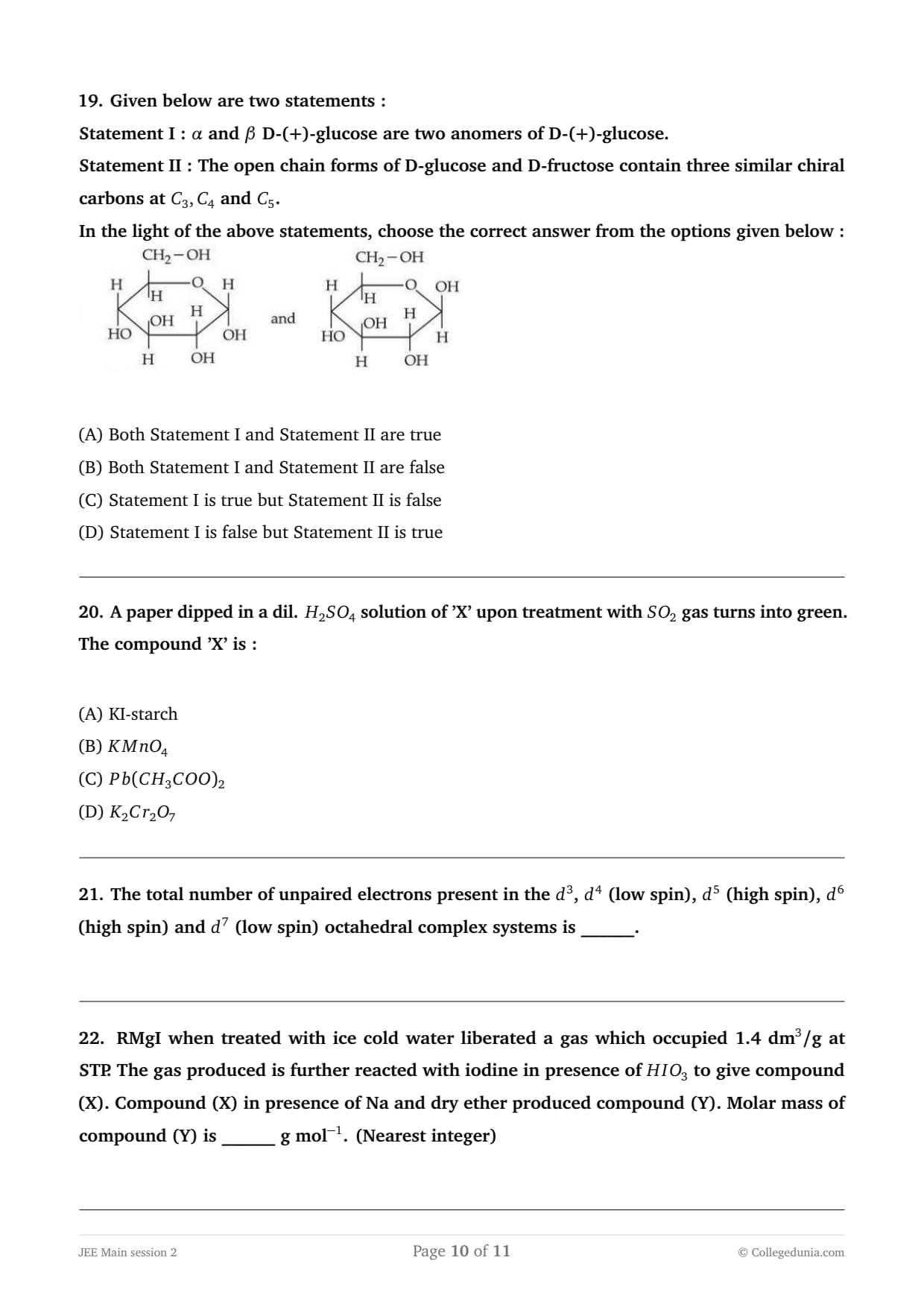
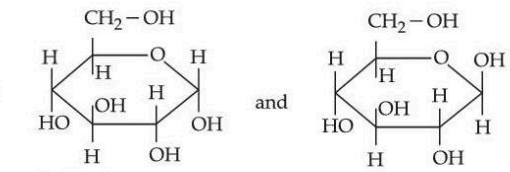
Statement-I: Glucose exists in two anomeric.

Statement-II: In open chain structure at C-3, C-4, C-5, glucose and fructose have identical configuration.
View Solution
Step 1: Analyze Statement I.
Glucose exists in two anomeric forms: one in which the \( OH \) group on C-1 is on the opposite side of the CH2OH group (alpha anomer) and the other in which the \( OH \) group on C-1 is on the same side as the CH2OH group (beta anomer). These are two anomeric forms of glucose. Hence, Statement I is correct.
Step 2: Analyze Statement II.
In the open-chain structure of glucose and fructose, the configurations at C-3, C-4, and C-5 are identical. In both glucose and fructose, the configuration of the hydroxyl group on C-3, C-4, and C-5 is similar, and they differ at C-2. Therefore, Statement II is also correct.
Step 3: Conclusion.
Since both Statement I and Statement II are correct, the correct answer is option (A).
Final Answer: (A) Both Statement I and Statement II are correct. Quick Tip: Glucose and fructose have identical configurations at C-3, C-4, and C-5 in their open chain forms. The difference in their structures lies at the C-2 position.
Grignard reagent \( RmgX \) reacts with water and releases a gas \( X \) which has volume 1.4 dm\(^3\)/g at 1 atm, 273 K.
\( X \) reacts with \( I_2 \) and forms \( Y \) which reacts with Na in the presence of dry ether to form \( Z \). Find the molecular mass of \( Z \).
View Solution
Step 1: Identify the gas \( X \).
When a Grignard reagent \( RmgX \) reacts with water, it releases hydrogen gas (\( H_2 \)) due to the formation of the alkyl alcohol. Thus, the gas \( X \) is hydrogen (\( H_2 \)).
Step 2: Use the given information to calculate the moles of hydrogen gas.
The volume of gas \( X \) (hydrogen) is given as 1.4 dm\(^3\)/g at 1 atm and 273 K. Using the ideal gas law equation:
\[ PV = nRT \]
Where,
\( P = 1 \, atm \),
\( V = 1.4 \, dm^3 \),
\( R = 0.0821 \, L atm/mol K \),
\( T = 273 \, K \).
Now calculate the number of moles of \( X \) (hydrogen gas):
\[ n = \frac{PV}{RT} = \frac{(A)(1.4)}{(0.0821)(273)} = 0.0618 \, mol \]
Step 3: Find the moles of \( X \) per gram of Grignard reagent.
Since the volume of \( X \) is given per gram of Grignard reagent, we can calculate the number of moles per gram. The moles of \( X \) are 0.0618 mol, and the mass of Grignard reagent \( RmgX \) that produces this gas is 1 g. So, the molar mass of the gas \( X \) is:
\[ Molar mass of X = \frac{Volume of gas}{Volume per gram} = 2 \, g/mol \]
Step 4: Determine the next reaction.
\( X \) (hydrogen gas) reacts with iodine \( I_2 \) to form hydrogen iodide (\( HI \)):
\[ H_2 + I_2 \rightarrow 2 HI \]
Step 5: Use the reaction between \( HI \) and sodium.
The hydrogen iodide reacts with sodium in dry ether to form sodium iodide (\( NaI \)) and the organic compound \( Z \), which is an alkane.
The reaction is:
\[ 2HI + 2Na \rightarrow 2NaI + Z \]
Step 6: Identify the organic compound \( Z \).
Since Grignard reagents are used, the organic compound \( Z \) formed is an alkane, in this case, methane \( CH_4 \).
Step 7: Calculate the molecular mass of \( Z \).
The molecular mass of \( Z \) (methane) is:
\[ Molecular mass of Z = 12 \, (C) + 4 \, (H) = 16 \, g/mol \]
Step 8: State the final answer.
Thus, the molecular mass of \( Z \) is:
\[ \boxed{30 \, g/mol} \] Quick Tip: Grignard reagents react with water to release hydrogen gas, which can be used to determine the molecular mass of the product formed after subsequent reactions. For methane formation, the reaction with iodine and sodium is important.
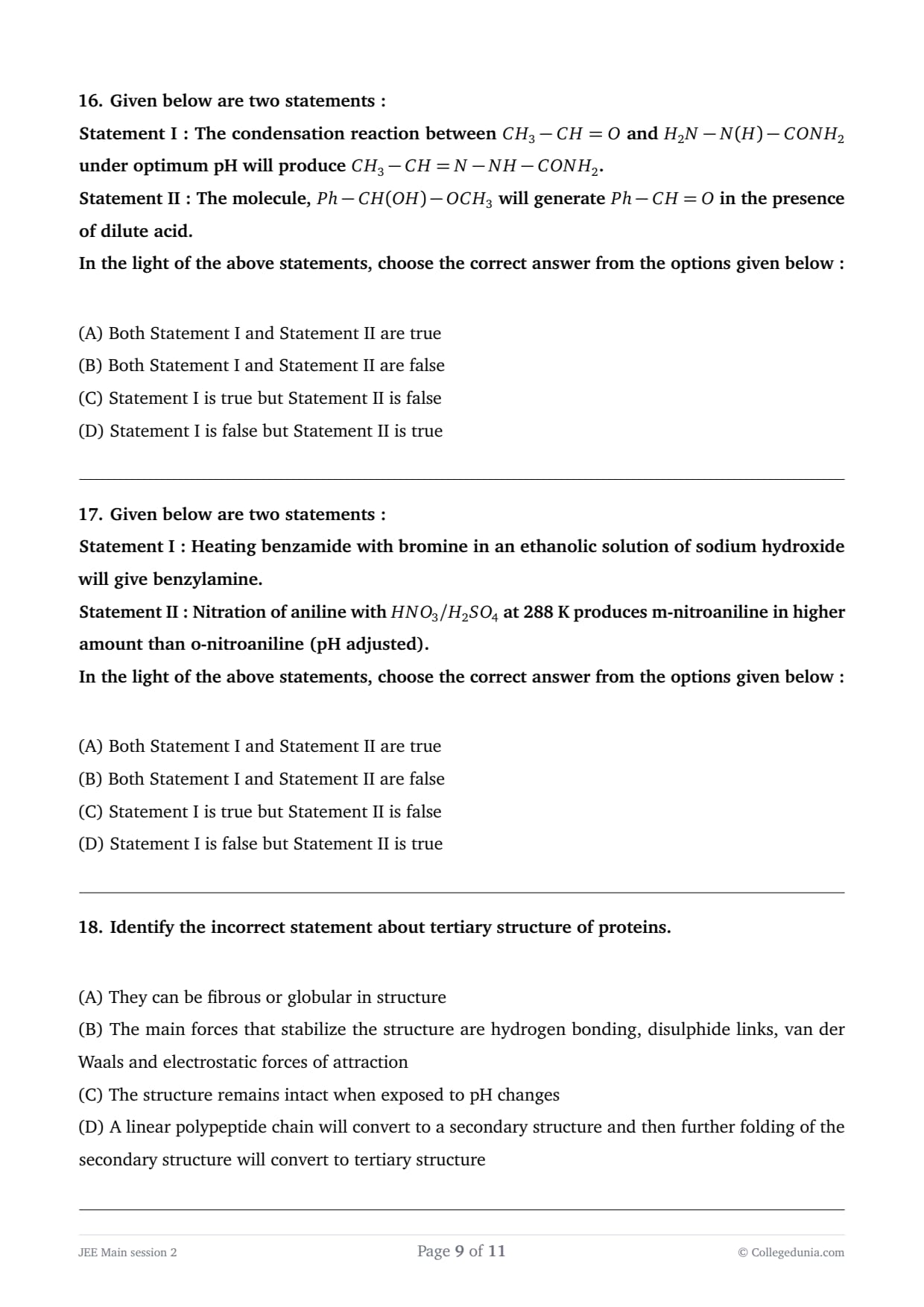
Statement-I: Benzamide on reaction with \( Br_2 + NaOH \) gives benzyl amine.
Statement-II: On nitration of aniline, the meta product is formed more than the ortho product.
View Solution
Step 1: Analyze Statement I.
Benzamide, on reaction with \( Br_2 + NaOH \), undergoes Hofmann degradation. This reaction leads to the formation of an amine with one fewer carbon atom than the starting amide, but it does not produce benzylamine. Instead, it yields aniline (a primary aromatic amine). Therefore, Statement I is incorrect.
Step 2: Analyze Statement II.
In the nitration of aniline, the nitronium ion (\(NO_2^+\)) predominantly attacks the meta position because the amino group is an electron-donating group, which activates the ortho and para positions. However, steric hindrance at the ortho position (due to the large size of the amino group) makes the meta product more favored. Hence, Statement II is correct.
Step 3: Conclusion.
Since Statement I is incorrect and Statement II is correct, the correct answer is option (C).
Final Answer: (C) Statement I is incorrect but Statement II is correct. Quick Tip: In Hofmann degradation of amides, the product is always an amine with one less carbon than the starting amide. In nitration of aniline, the meta product is preferred due to steric hindrance at the ortho position.
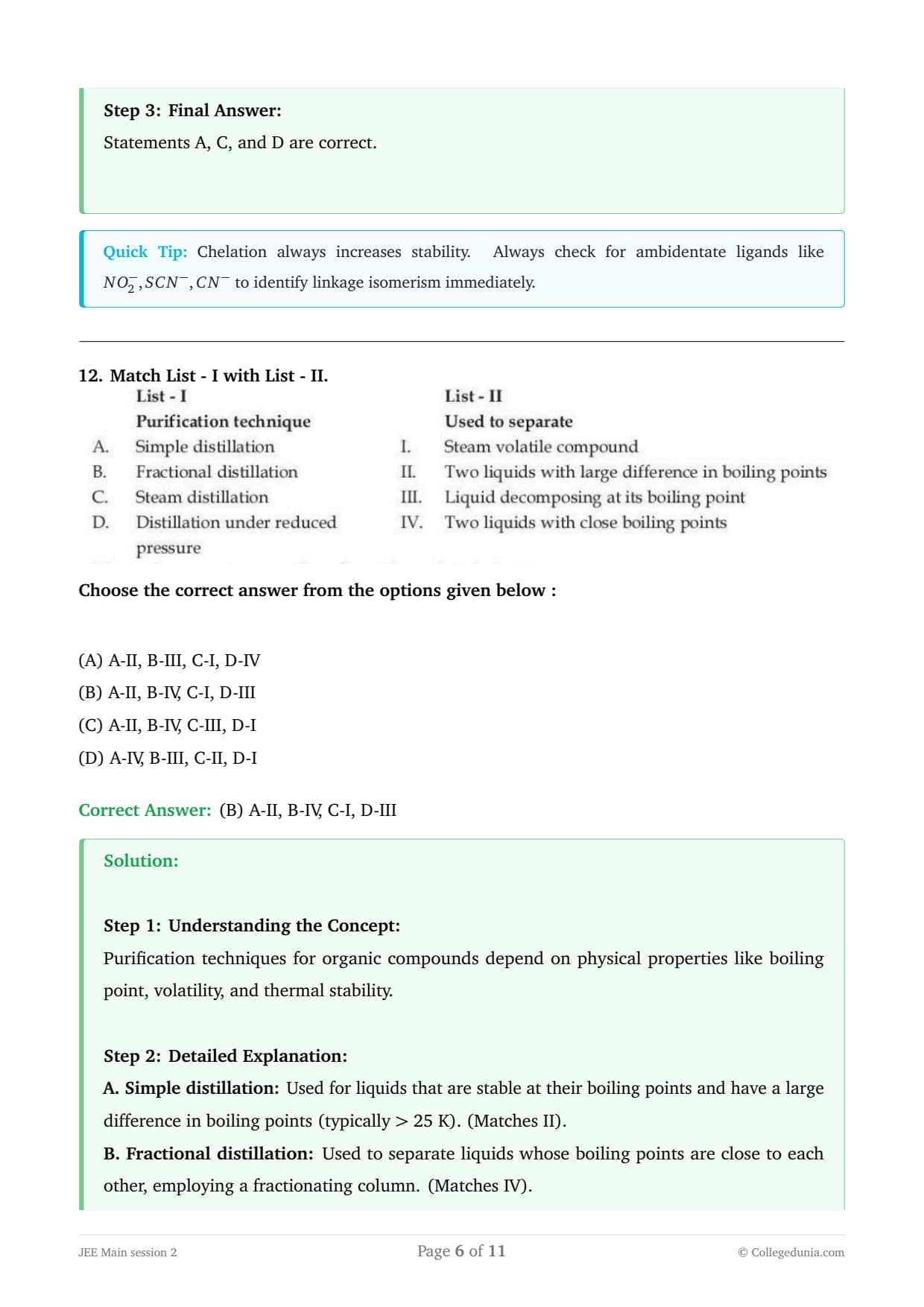
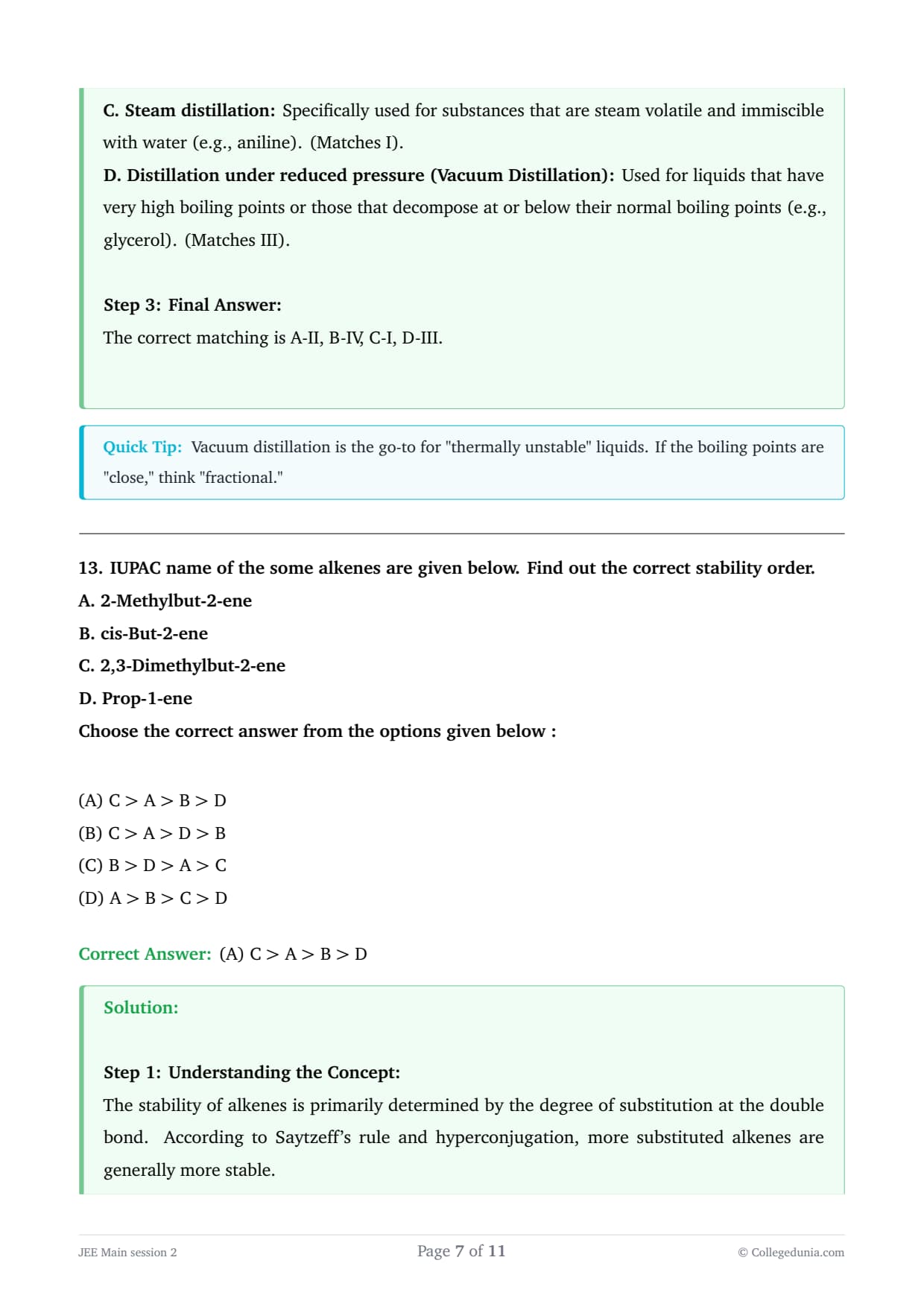
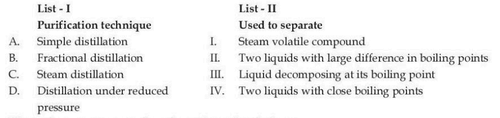
Match the column

View Solution
Step 1: Understanding simple distillation (P).
Simple distillation is used for separating liquids with a significant difference in boiling points, generally greater than 50°C. This technique is used to purify liquids like water or to separate a volatile compound from non-volatile impurities. In this case, the correct match for simple distillation is:
\[ (P) Simple distillation \rightarrow (D) Between two liquids having high difference in boiling point. \]
Step 2: Understanding fractional distillation (Q).
Fractional distillation is used to separate liquids that have a smaller boiling point difference, generally less than 50°C. This method is efficient for separating mixtures of liquids like alcohol and water. The correct match for fractional distillation is:
\[ (Q) Fractional distillation \rightarrow (C) Between two liquids having low difference in boiling point. \]
Step 3: Understanding steam distillation (R).
Steam distillation is used to distill steam-volatile compounds that decompose at their boiling points. This technique is commonly used for separating essential oils and other heat-sensitive compounds. The correct match for steam distillation is:
\[ (R) Steam distillation \rightarrow (A) For steam volatile compound. \]
Step 4: Understanding distillation under reduced pressure (S).
Distillation under reduced pressure is used when the substance to be distilled has a high boiling point or decomposes at its boiling point. By lowering the pressure, we can distill these substances at lower temperatures. The correct match for distillation under reduced pressure is:
\[ (S) Distillation under reduced pressure \rightarrow (B) For liquid having nature of decomposition at its B.P. \]
Step 5: Final Answer.
Based on the above analysis, the correct matching is:
\[ P \rightarrow 4, Q \rightarrow 3, R \rightarrow 1, S \rightarrow 2 \]
Therefore, the correct option is (A).
Final Answer: (A) P \( \rightarrow \) 4, Q \( \rightarrow \) 3, R \( \rightarrow \) 1, S \( \rightarrow \) 2. Quick Tip: In distillation methods: Simple distillation is for liquids with high boiling point differences, fractional distillation for small differences, steam distillation for heat-sensitive compounds, and reduced pressure distillation is for high boiling substances that decompose at boiling point.

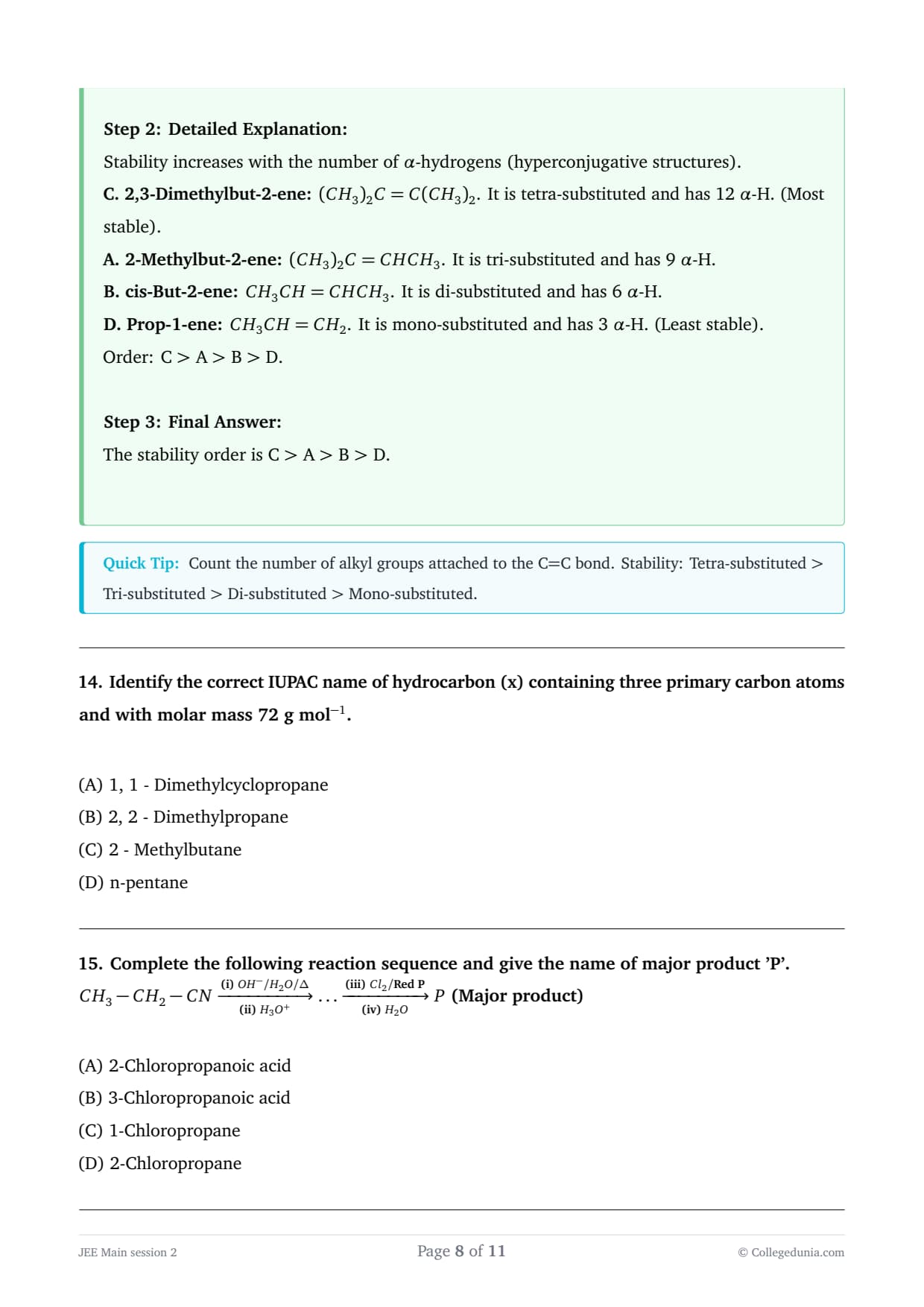
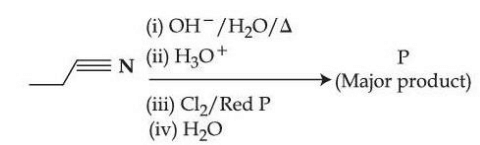
IUPAC name of major product will be:
View Solution
Step 1: Analyze the reaction with \( OH^-/H_2O \).
The given compound is an alkylnitrile, \( CH_3CH_2C\equivN \). When treated with a strong base like \( OH^- \), the nitrile group undergoes hydrolysis, forming an amide (in this case, propionamide) with the reaction:
\[ CH_3CH_2C\equivN + OH^- + H_2O \rightarrow CH_3CH_2C(O)NH_2 \]
Step 2: Analyze the reaction with \( H^+/O^2- \).
When the amide undergoes acid hydrolysis, it forms the corresponding carboxylic acid, \( CH_3CH_2COOH \). In this case, the product is propanoic acid.
Step 3: Analyze the reaction with \( Red P/Cl_2 \).
When the carboxylic acid reacts with \( Red P/Cl_2 \), a substitution reaction occurs, where the hydrogen atom at the alpha position (C-2) of the carboxylic acid group is replaced with a chlorine atom. This forms 2-chloro propanoic acid.
Step 4: Conclusion.
Thus, the major product is 2-chloro propanoic acid. The correct IUPAC name is 2-chloro propanoic acid.
Final Answer: 2-chloro propanoic acid Quick Tip: When nitriles are treated with strong bases and acid, they undergo hydrolysis to form carboxylic acids, which can then undergo halogenation at the alpha position (C-2) to give alpha-halocarboxylic acids.
Which compound has total molecular mass of 72 with three primary carbons?
View Solution
Step 1: Analyzing the compounds and their molecular masses.
- n-Heptane (\( \mathrm{C_7H_{16}} \)) has a molecular mass of: \[ (7 \times 12) + (16 \times 1) = 84 \, g/mol \]
So, n-Heptane does not have the required molecular mass of 72.
- 2,2-Dimethylbutane (\( \mathrm{C_6H_{14}} \)) has a molecular mass of: \[ (6 \times 12) + (14 \times 1) = 74 \, g/mol \]
So, 2,2-Dimethylbutane does not match the molecular mass of 72.
- 1,1-Dimethylcyclopropane (\( \mathrm{C_6H_{12}} \)) has a molecular mass of: \[ (6 \times 12) + (12 \times 1) = 72 \, g/mol \]
But it does not have three primary carbons, as the cyclopropane ring restricts the possibility of having three primary carbons.
- 2-Methylbutane (\( \mathrm{C_5H_{12}} \)) has a molecular mass of: \[ (5 \times 12) + (12 \times 1) = 72 \, g/mol \]
This compound also contains three primary carbon atoms (the methyl group at position 2, and two primary carbons on the butane chain).
Step 2: Conclusion.
2-Methylbutane has the correct molecular mass of 72 and has three primary carbon atoms. Therefore, the correct answer is:
Final Answer: (D) 2-Methylbutane. Quick Tip: When identifying compounds based on molecular mass and structure, consider the number of primary, secondary, and tertiary carbons, and ensure the molecular mass matches the calculation.
Find stability order of the following alkenes:
(a) Cis-but-2-ene
(b) 2,3-Dimethylbut-2-ene
(c) 2-Methylbut-2-ene
(d) Propene
View Solution
N/A Quick Tip: The stability of alkenes increases as the number of alkyl substituents on the double-bonded carbons increases. This is due to the effects of hyperconjugation and inductive effects.
Which of the following statement is incorrect regarding tertiary structure of protein?
View Solution
Step 1: Tertiary structure of proteins.
The tertiary structure of proteins refers to the overall 3D shape of the polypeptide chain, which is stabilized by various interactions such as hydrogen bonding, disulfide bonds, hydrophobic interactions, and van der Waals forces. The tertiary structure plays a crucial role in the function of the protein.
Step 2: Analyzing the statements.
- Statement (A) is incorrect because changes in pH can disrupt the tertiary structure of proteins. A change in pH can affect the ionization of amino acid side chains, which can alter the protein's structure and function. For example, pH changes can break ionic bonds and hydrogen bonds, causing the protein to denature.
- Statement (B) is correct. The tertiary structure is stabilized by a variety of forces, including hydrogen bonds, disulfide bonds (covalent bonds between cysteine residues), van der Waals interactions, and electrostatic (Coulombic) forces between charged side chains.
- Statement (C) is correct. The tertiary structure can be globular or fibrous depending on the type of protein. Globular proteins are generally compact and spherical, while fibrous proteins are elongated and form structural components of cells and tissues.
- Statement (D) is correct. The folding of the polypeptide chain into its functional 3D structure involves the positioning and orientation of the amino acids. The sequence of amino acids determines the folding pattern, which is critical for the protein's tertiary structure.
Step 3: Conclusion.
Since statement (A) is incorrect, the correct answer is (A).
Final Answer: (A) With change in pH tertiary structure of protein does not get disrupted. Quick Tip: Changes in pH can lead to the disruption of the tertiary structure of proteins, often resulting in denaturation. Always consider the effects of environmental factors on protein structure.
Question 24:

View Solution
N/A Quick Tip: In the reaction of hydrazine with an aldehyde or ketone, a Schiff's base (imine) is formed. Always check if the product fits the expected functional group.
JEE Main 2026 Chemistry Exam Pattern
| Particulars | Details |
|---|---|
| Exam Mode | Online (Computer-Based Test) |
| Paper | B.E./B.Tech |
| Medium of Exam | 13 languages: English, Hindi, Gujarati, Bengali, Tamil, Telugu, Kannada, Marathi, Malayalam, Odia, Punjabi, Assamese, Urdu |
| Type of Questions | Multiple Choice Questions (MCQs) + Numerical Value Questions |
| Total Marks | 100 marks |
| Marking Scheme | +4 for correct answer & -1 for incorrect MCQ and Numerical Value-based Questions |
| Total Questions | 25 Questions |





Comments