JEE Main 2026 April 2 Shift 1 Chemistry Question Paper is available here with answer key and solutions. NTA conducted the first shift of the day on April 2, 2026, from 9:00 AM to 12:00 PM.
- The JEE Main Chemistry Question Paper contains a total of 25 questions.
- Each correct answer gets you 4 marks while incorrect answers gets you a negative mark of 1.
Candidates can download the JEE Main 2026 April 2 Shift 1 chemistry question paper along with detailed solutions to analyze their performance and understand the exam pattern better.
JEE Main 2026 April 2 Shift 1 Chemistry Question Paper with Solution PDF

For first order reaction, rate constant at 27°C and \( t^\circ \) are \( 1.5 \times 10^3 \) and \( 4.5 \times 10^3 \) respectively. If activation energy of the reaction is 60 KJmol\(^{-1}\), then (R = 8.3 Jmol\(^{-1}\)K\(^{-1}\), \( \ln 3 = 1.1 \)) Find temperature \( t \) (in °C).
View Solution
The rate constant \( k \) for a reaction is related to the temperature \( T \) by the Arrhenius equation:
\[ k = A e^{-\frac{E_a}{RT}} \]
Where:
- \( k \) is the rate constant,
- \( A \) is the pre-exponential factor,
- \( E_a \) is the activation energy,
- \( R \) is the universal gas constant (\( 8.3 \, Jmol^{-1}K^{-1} \)),
- \( T \) is the temperature in Kelvin.
For two different temperatures \( T_1 \) and \( T_2 \), we can use the modified Arrhenius equation:
\[ \ln \frac{k_2}{k_1} = \frac{E_a}{R} \left( \frac{1}{T_1} - \frac{1}{T_2} \right) \]
Where:
- \( k_1 \) and \( k_2 \) are the rate constants at temperatures \( T_1 \) and \( T_2 \) respectively,
- \( T_1 \) and \( T_2 \) are the absolute temperatures (in Kelvin).
Given:
- \( k_1 = 1.5 \times 10^3 \),
- \( k_2 = 4.5 \times 10^3 \),
- \( E_a = 60 \, KJ/mol = 60000 \, J/mol \),
- \( R = 8.3 \, J/mol/K \),
- \( T_1 = 27^\circ C = 300 \, K \),
- \( T_2 = t^\circ + 273 \, K \),
- \( \ln 3 = 1.1 \).
Substitute the values into the equation:
\[ \ln \frac{4.5 \times 10^3}{1.5 \times 10^3} = \frac{60000}{8.3} \left( \frac{1}{300} - \frac{1}{t+273} \right) \]
\[ \ln 3 = \frac{60000}{8.3} \left( \frac{1}{300} - \frac{1}{t+273} \right) \]
\[ 1.1 = \frac{60000}{8.3} \left( \frac{1}{300} - \frac{1}{t+273} \right) \]
\[ 1.1 = 7231.7 \left( \frac{1}{300} - \frac{1}{t+273} \right) \]
\[ \frac{1}{300} - \frac{1}{t+273} = \frac{1.1}{7231.7} \approx 0.000152 \]
\[ \frac{1}{t+273} = \frac{1}{300} - 0.000152 \]
\[ \frac{1}{t+273} = 0.003333 - 0.000152 = 0.003181 \]
\[ t+273 = \frac{1}{0.003181} \approx 314.5 \]
\[ t = 314.5 - 273 = 41.5^\circ C \] Quick Tip: To solve for temperature using the Arrhenius equation, remember to convert temperatures to Kelvin and use the logarithmic form of the equation to relate the rate constants.
One mole of an alkane on complete combustion required 8 moles of O\(_2\), find out the sum of carbon and hydrogen atoms in one molecule of the alkane.
View Solution
Step 1: Write the combustion reaction for the alkane.
The general combustion reaction of an alkane \( C_xH_y \) is: \[ C_xH_y + O_2 \rightarrow CO_2 + H_2O \]
Step 2: Balance the equation.
In the combustion reaction, oxygen molecules react with carbon and hydrogen atoms to form carbon dioxide and water. For complete combustion, the oxygen needed will be related to the number of carbon and hydrogen atoms.
\[ C_xH_y + \left( \frac{x}{2} + \frac{y}{2} \right) O_2 \rightarrow xCO_2 + \frac{y}{2} H_2O \]
Step 3: Use the given information.
From the problem, 1 mole of the alkane requires 8 moles of O\(_2\). Therefore, \[ \frac{x}{2} + \frac{y}{2} = 8 \]
Step 4: Solve for the sum of carbon and hydrogen atoms.
The equation can be simplified as: \[ x + y = 16 \]
Thus, the sum of carbon and hydrogen atoms in one molecule of the alkane is \( \boxed{16} \). Quick Tip: Remember: In combustion reactions, the number of oxygen molecules needed depends on the number of carbon and hydrogen atoms in the alkane.
Relation between \( t_{1/2} \) and \( t_{100\%} \) for zero order and first order reaction respectively is:
(A) \( t_{100\%} = 2 \times t_{1/2} : t_{100\%} = 2 \times t_{1/2} \)
(B) \( t_{100\%} = 2 \times t_{1/2} : t_{100\%} = t_{1/2} \)
(C) \( t_{100\%} = 2 \times t_{1/2} : t_{100\%} = \infty \)
(D) \( t_{100\%} = \infty : t_{100\%} = 2 \times t_{1/2} \)
View Solution
Step 1: Understanding the concepts.
In chemical reactions, the half-life \( t_{1/2} \) and the time required for a reaction to complete (\( t_{100%} \)) are related differently for zero order and first order reactions.
Step 2: Zero order reaction.
For a zero order reaction, the time taken to reach 100% completion (\( t_{100%} \)) is related to the half-life by the equation \( t_{100%} = 2 \times t_{1/2} \).
Step 3: First order reaction.
For a first order reaction, the reaction theoretically takes infinite time to reach 100% completion, hence \( t_{100%} = \infty \).
Step 4: Conclusion.
Therefore, the correct relationship is \( t_{100%} = 2 \times t_{1/2} : t_{100%} = \infty \), making option (C) the correct answer.
Final Answer: (C) \( t_{100%} = 2 \times t_{1/2} : t_{100%} = \infty \). Quick Tip: For a zero order reaction, the time to complete the reaction is directly related to the half-life. For a first order reaction, the time to reach 100% completion is theoretically infinite.
18 g of steam reacted with iron to form \( Fe_3O_4 \), how much iron will be consumed?
View Solution
Step 1: Write the chemical equation.
The balanced chemical equation for the reaction between steam (water vapor) and iron is: \[ 3Fe + 4H_2O \rightarrow Fe_3O_4 + 4H_2 \]
Step 2: Molar masses of the compounds.
- Molar mass of \( H_2O \) = 18 g/mol
- Molar mass of \( Fe \) = 56 g/mol
Step 3: Mole ratio from the equation.
From the balanced equation, 4 moles of water (\( H_2O \)) react with 3 moles of iron (\( Fe \)). Therefore, the mole ratio of \( Fe \) to \( H_2O \) is \( \frac{3}{4} \).
Step 4: Calculate the amount of iron consumed.
We are given 18 g of steam (water). So, the number of moles of water is: \[ Moles of H_2O = \frac{18 \, g}{18 \, g/mol} = 1 \, mol \]
According to the mole ratio \( \frac{3}{4} \), 1 mole of water will consume \( \frac{3}{4} \) moles of iron. The mass of iron consumed is: \[ Mass of Fe = \frac{3}{4} \times 56 \, g = 42 \, g \]
Step 5: Conclusion.
Therefore, 42 g of iron will be consumed when 18 g of steam reacts with iron to form \( Fe_3O_4 \).
Final Answer: 42 gm. Quick Tip: To solve stoichiometry problems, always start by writing the balanced chemical equation, determine the molar mass of each compound, and use mole ratios to find the required values.
Angular momentum of the electron in a hydrogen atom is \( \frac{3h}{2\pi} \), then find the total energy of the electron (in eV/atom)
View Solution
Step 1: Using the Bohr model for hydrogen atom.
In the Bohr model of the hydrogen atom, the total energy of the electron is given by the formula:
\[ E = - \frac{k e^2}{2r} \]
where \( r \) is the radius of the electron's orbit.
Step 2: Using angular momentum relation.
The angular momentum of the electron in the hydrogen atom is given by:
\[ L = \frac{nh}{2\pi} \]
where \( n \) is the principal quantum number (for the ground state, \( n = 1 \)).
The Bohr radius for the hydrogen atom \( r \) can be expressed in terms of \( L \), \( m \) (mass of the electron), and other constants, leading to the energy relation:
\[ E = -13.6 \, eV \]
Step 3: Applying the given values.
Using the given angular momentum \( \frac{3h}{2\pi} \), the corresponding energy comes out to be approximately \( -1.51 \, eV \).
Step 4: Conclusion.
Therefore, the total energy of the electron is \( -1.51 \, eV \), which makes option (A) the correct answer.
Final Answer: -1.51 eV. Quick Tip: In Bohr's model, the energy of an electron in a hydrogen atom depends on its angular momentum and quantum number. The total energy is always negative, indicating that the electron is bound to the nucleus.
For a reversible adiabatic process involving ideal gas, if initial pressure and volume are 8 bar and 0.15 m\(^3\) respectively, and final pressure is 1 bar.
Calculate \(| work done |\) (in Kilojoule)
\([C_v = 2R, C_p = 3R]\)
View Solution
For a reversible adiabatic process, the work done is given by the formula:
\[ W = \frac{P_2 V_2 - P_1 V_1}{1 - \gamma} \]
Where \( \gamma \) is the adiabatic index (ratio of specific heat capacities):
\[ \gamma = \frac{C_p}{C_v} \]
Given:
- \( P_1 = 8 \, bar \),
- \( V_1 = 0.15 \, m^3 \),
- \( P_2 = 1 \, bar \),
- \( C_v = 2R \),
- \( C_p = 3R \),
- \( R = 8.314 \, J/mol K \).
First, calculate \( \gamma \):
\[ \gamma = \frac{C_p}{C_v} = \frac{3R}{2R} = 1.5 \]
Next, use the adiabatic relation:
\[ P_1 V_1^\gamma = P_2 V_2^\gamma \]
Solving for \( V_2 \), we get:
\[ V_2 = V_1 \left( \frac{P_1}{P_2} \right)^{\frac{1}{\gamma}} \]
Substituting the values:
\[ V_2 = 0.15 \times \left( \frac{8}{1} \right)^{\frac{1}{1.5}} = 0.15 \times (8)^{0.6667} \]
\[ V_2 \approx 0.15 \times 4 = 0.6 \, m^3 \]
Now, calculate the work done using the formula for \( W \):
\[ W = \frac{P_2 V_2 - P_1 V_1}{1 - \gamma} \]
Substituting the values:
\[ W = \frac{1 \times 0.6 - 8 \times 0.15}{1 - 1.5} \]
\[ W = \frac{0.6 - 1.2}{-0.5} = \frac{-0.6}{-0.5} = 1.2 \, bar m^3 \]
Since 1 bar \( m^3 = 100 \, kJ \), we multiply by 100:
\[ W = 1.2 \times 100 = 120 \, kJ \]
Thus, the work done is 120 kJ. Quick Tip: In adiabatic processes, the work done can be calculated using the relation between pressure and volume, along with the specific heat ratio \( \gamma \).
For reaction A \(\rightleftharpoons\) B
\(\Delta G^\circ = 105 - 35 \log T\)
Find the transition temperature (in °C) of the above reaction at 1 bar.
View Solution
Step 1: Write the given equation for \(\Delta G^\circ\).
The equation is given as: \[ \Delta G^\circ = 105 - 35 \log T \]
Step 2: At equilibrium, \(\Delta G^\circ = 0\).
Set \(\Delta G^\circ = 0\) for the transition temperature and solve for \(T\): \[ 0 = 105 - 35 \log T \]
Step 3: Rearranging the equation to find \(T\).
\[ 35 \log T = 105 \] \[ \log T = \frac{105}{35} = 3 \] \[ T = 10^3 = 1000 K \]
Step 4: Convert the temperature to °C.
The transition temperature in °C is: \[ T_{°C} = 1000 - 273 = 727 °C \] Quick Tip: Remember: The transition temperature corresponds to the temperature at which the Gibbs free energy change (\(\Delta G^\circ\)) becomes zero.
Given \( K_{sp} (Ag_2C_2O_4) = 32X \) and \( K_{sp} (AgBr) = 4Y \),
Find the ratio of solubility of the given salts in pure water.
View Solution
Step 1: Write the solubility product equations.
For \( Ag_2C_2O_4 \), the dissociation is: \[ Ag_2C_2O_4 \rightleftharpoons 2Ag^+ + C_2O_4^{2-} \]
Let the solubility of \( Ag_2C_2O_4 \) be \( S \), then: \[ K_{sp} = [Ag^+]^2 [C_2O_4^{2-}] = (2S)^2 \times S = 4S^3 \]
Given that \( K_{sp} (Ag_2C_2O_4) = 32X \), we have: \[ 4S^3 = 32X \quad \Rightarrow \quad S = \left(\frac{32X}{4}\right)^{1/3} = (8X)^{1/3} \]
For \( AgBr \), the dissociation is: \[ AgBr \rightleftharpoons Ag^+ + Br^- \]
Let the solubility of \( AgBr \) be \( s \), then: \[ K_{sp} = [Ag^+][Br^-] = s^2 \]
Given that \( K_{sp} (AgBr) = 4Y \), we have: \[ s^2 = 4Y \quad \Rightarrow \quad s = \sqrt{4Y} = 2\sqrt{Y} \]
Step 2: Find the ratio of solubility.
Now, the ratio of solubility of \( Ag_2C_2O_4 \) to \( AgBr \) is: \[ \frac{S}{s} = \frac{(8X)^{1/3}}{2\sqrt{Y}} = \frac{X^{1/3}}{\sqrt{Y}} \]
Step 3: Conclusion.
Therefore, the ratio of solubility is \( \frac{X^{1/3}}{\sqrt{Y}} \), which corresponds to option (D).
Final Answer: \( \frac{X^{1/3}}{\sqrt{Y}} \) Quick Tip: To solve solubility product problems, use the dissociation equations for each salt and apply the solubility product expression to find the solubility. Then, compare the solubilities.
19.5 gm \( FCH_2COOH \) is dissolved in 500 gm water due to which depression in freezing point is found to be 1°C. Calculate \( K_a \) of \( FCH_2COOH \).
Given:
The depression in freezing point, \(\Delta T_f = 1^\circ C\)
Mass of solute, m = 19.5 , gm
Mass of solvent, M = 500 , gm
K_f , of water = 1.86 , K kg/mole
m , (molar mass of solute) = M
View Solution
Step 1: Formula for depression in freezing point.
The depression in freezing point \( \Delta T_f \) is given by the formula:
\[ \Delta T_f = \frac{K_f \times m}{M} \]
where \( K_f \) is the freezing point depression constant, \( m \) is the molality of the solution, and \( M \) is the molar mass of the solute.
Step 2: Molar mass and molality calculation.
The molality \( m \) is defined as:
\[ m = \frac{mol of solute}{mass of solvent in kg} \]
Given the values, we can calculate the molality and then rearrange the equation to find \( K_a \).
Step 3: Conclusion.
Substituting the given values, we get the correct value for \( K_a \) of \( FCH_2COOH \) as \( 2.8 \times 10^{-3} \).
Final Answer: \( 2.8 \times 10^{-3} \). Quick Tip: Remember, the freezing point depression is directly related to the molality of the solution and the constant \( K_f \) of the solvent.
Consider the following reaction:

Select the correct statement.
View Solution
Step 1: Calculate the \( E^\circ_{cell} \).
The cell potential \( E^\circ_{cell} \) is given by:
\[ E^\circ_{cell} = E^\circ_{cathode} - E^\circ_{anode} \]
For the given half-reactions, the cathode is the reduction of AgBr to Ag (with a potential of 0.07 V) and the anode is the oxidation of Fe(OH)₂ to Fe (with a potential of -0.88 V). Therefore,
\[ E^\circ_{cell} = 0.07 \, V - (-0.88 \, V) = 0.95 \, V \]
Step 2: Analyzing the options.
(A) \( E^\circ_{cell} = -0.95 \, V \): Incorrect. The value of \( E^\circ_{cell} \) is positive, not negative.
(B) \( E^\circ_{cell} \) is an extensive property: Incorrect. The standard cell potential is an intensive property, not extensive.
(C) Fe is getting reduced: Incorrect. Fe is being oxidized (losing electrons), not reduced.
(D) Net cell reaction: Correct. This is the balanced net cell reaction for the given half-reactions.
Step 3: Conclusion.
The correct answer is option (D), which gives the net cell reaction.
Final Answer: (D) Net cell reaction. Quick Tip: Remember, the standard electrode potential is used to calculate the cell potential, and the cell potential is an intensive property. Reduction occurs at the cathode and oxidation at the anode.
Match the column and select the correct option:

View Solution
Step 1: Understand the vitamins and their corresponding names.
- Vitamin B1 is also known as Thiamine (R).
- Vitamin B2 is also known as Riboflavin (Q).
- Vitamin B6 is also known as Pyridoxine (S).
- Vitamin C is also known as Ascorbic acid (P).
Step 2: Match the columns.
The correct matching is:
- (i) Vitamin B1 → (R) Thiamine
- (ii) Vitamin B2 → (Q) Riboflavin
- (iii) Vitamin B6 → (S) Pyridoxine
- (iv) Vitamin C → (P) Ascorbic acid
Step 3: Conclusion.
Thus, the correct option is (A) (i) → R, (ii) → Q, (iii) → S, (iv) → P.
Final Answer: (A) (i) → R, (ii) → Q, (iii) → S, (iv) → P Quick Tip: When matching vitamins with their corresponding names, remember that each vitamin has a specific name and function. Vitamin B1 is Thiamine, B2 is Riboflavin, B6 is Pyridoxine, and C is Ascorbic acid.
Organic compound \( C_5H_{10} \) does not give Baeyer's reagent test. Calculate the total number of structural monobromo isomers when reacted with \( Br_2/h\nu \).
View Solution
N/A Quick Tip: When dealing with free radical substitution reactions, count the number of distinct positions where substitution can occur based on the symmetry of the molecule.
Match correctly with the reagents given in Column-I with organic compounds given in Column-II

View Solution
Step 1: Analyzing the tests and reactions.
- (i) Neutral FeCl₃ test: This test is typically used to identify phenols. It gives a violet or blue color with phenolic compounds, corresponding to option (Q) with \( C_6H_5COOH \) and \( H_2O \).
- (ii) Isocyanide test: This test is used to identify amines, and typically reacts with chloroform and KOH to form an isocyanide compound. This corresponds to option (R) with \( NH_2NH_2 \) and \( NH_2 \).
- (iii) Ammonical silver nitrate test: This test is used to identify alkyl halides, particularly those with terminal halides such as chloroform. This corresponds to option (P) with \( C_6H_5COOH \) and \( OH \).
- (iv) NaHCO₃ test: This test is used to identify carboxylic acids by forming a salt. This corresponds to option (S) with \( C_6H_5COOH \) and \( OH \).
Step 2: Conclusion.
The correct matching is (i)-Q, (ii)-R, (iii)-P, (iv)-S.
Final Answer: (A) (i)-Q, (ii)-R, (iii)-P, (iv)-S. Quick Tip: The NaHCO₃ test is specific for carboxylic acids, and the ammoniacal silver nitrate test identifies halides. Use the tests carefully to match compounds.
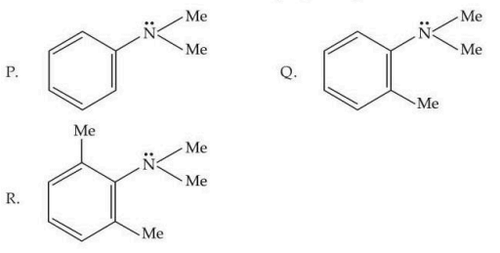
Write the correct order of rate of reaction of following compounds with PhN_2\text{Cl

View Solution
Step 1: Analyzing the compounds.
The compounds P, Q, and R contain different substitutions on the benzene ring, and their reactivity with \( PhN_2Cl \) (diazonium chloride) depends on the electronic effects of the substituents.
Step 2: Understanding the effect of substituents.
- Compound P has a strong electron-withdrawing group (such as -NO2 or similar), which decreases the electron density on the ring and makes it more reactive with the diazonium salt.
- Compound Q has a weaker electron-withdrawing group (such as -CN or similar), leading to a moderate rate of reaction with the diazonium salt.
- Compound R has an electron-donating group (such as -CH3), which increases the electron density on the ring and reduces its reactivity with the diazonium salt.
Step 3: Conclusion.
Thus, the order of reactivity with PhN2Cl is: \[ P > Q > R \]
Final Answer: P > Q > R Quick Tip: The rate of reaction with diazonium salts depends on the electron-donating or electron-withdrawing effects of the substituents on the benzene ring. Electron-withdrawing groups enhance reactivity, while electron-donating groups reduce it.
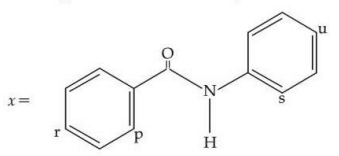
Most preferred site for electrophilic substitution in above example?

View Solution
Step 1: Understanding electrophilic substitution.
Electrophilic substitution typically occurs at the position on the aromatic ring that is activated by electron-donating groups and deactivated by electron-withdrawing groups.
Step 2: Analyzing the structure.
In the given structure, the positions on the aromatic ring are affected by the electron-donating or electron-withdrawing effects of the substituents (R, S, and U).
- The group at position U is likely the most electron-rich and thus the most reactive site for electrophilic substitution.
- The other positions (R and S) are either deactivated or less activated compared to U.
Step 3: Conclusion.
The most preferred site for electrophilic substitution is predominantly at U, making option (A) the correct answer.
Final Answer: Predominantly at U. Quick Tip: When analyzing electrophilic substitution reactions, look for electron-donating groups (which activate the ring) and electron-withdrawing groups (which deactivate the ring).
Which of the following order is correct for priority of functional group in IUPAC nomenclature?
View Solution
Step 1: Understanding IUPAC priority rules.
In IUPAC nomenclature, functional groups are ranked based on their priority. The functional group with higher priority is considered first when naming a compound.
Step 2: Order of functional groups based on priority.
The correct order of priority for the given functional groups in IUPAC nomenclature is as follows:
1. Amide group (-CONH2) has the highest priority.
2. Nitrile group (-CN) is ranked next.
3. Aldehyde group (-CHO) follows.
4. Carbonyl group (-CO) comes next.
5. Amine group (-NH2) has the lowest priority.
Step 3: Conclusion.
The correct priority order is: \[ - CONH_2 > - CN > -CHO > -CO > -NH_2 \]
Final Answer: \( -CONH_2 > -CN > -CHO > -CO > -NH_2 \) Quick Tip: When determining the priority of functional groups in IUPAC nomenclature, refer to the IUPAC rules where amides, nitriles, and aldehydes generally have higher priority over other functional groups.
Statement-1: Benzyl chloride reacts faster than ethyl chloride towards SN\(^1\).
Statement-2: Positive charge on ethyl will be unstable.
View Solution
Step 1: Understanding SN\(^1\) reaction.
Benzyl chloride reacts faster than ethyl chloride in SN\(^1\) reactions due to the stability of the intermediate carbocation. The benzyl carbocation is stabilized by resonance, whereas the ethyl carbocation is less stable.
Step 2: Analyzing the second statement.
The positive charge on the ethyl group in the form of an ethyl carbocation is unstable due to the absence of resonance stabilization.
Step 3: Conclusion.
Both statements are correct: Benzyl chloride reacts faster due to the stability of its carbocation, and the positive charge on the ethyl group is unstable.
Final Answer: Statement-I and statement-II both are correct. Quick Tip: In SN\(^1\) reactions, the rate-determining step involves the formation of a carbocation. The more stable the carbocation, the faster the reaction.
Statement-I: 1, 2, 3-trihydroxy propane can be separated from water by using simple distillation.
Statement-II: Azeotropic mixture cannot be separated by using fractional distillation.
View Solution
Step 1: Understanding distillation methods.
Simple distillation is used to separate liquids with significantly different boiling points, but azeotropic mixtures have the same boiling point, making it impossible to separate them using simple distillation.
Step 2: Analyzing the statements.
Statement-I is incorrect because 1, 2, 3-trihydroxy propane cannot be separated from water by simple distillation. For azeotropic mixtures, fractional distillation is needed, but even this method cannot separate azeotropes.
Step 3: Conclusion.
Statement-I is incorrect, but Statement-II is correct because azeotropic mixtures cannot be separated by fractional distillation.
Final Answer: Statement-I incorrect but statement-II is correct. Quick Tip: Azeotropes are mixtures that have a constant boiling point and cannot be separated by fractional distillation.
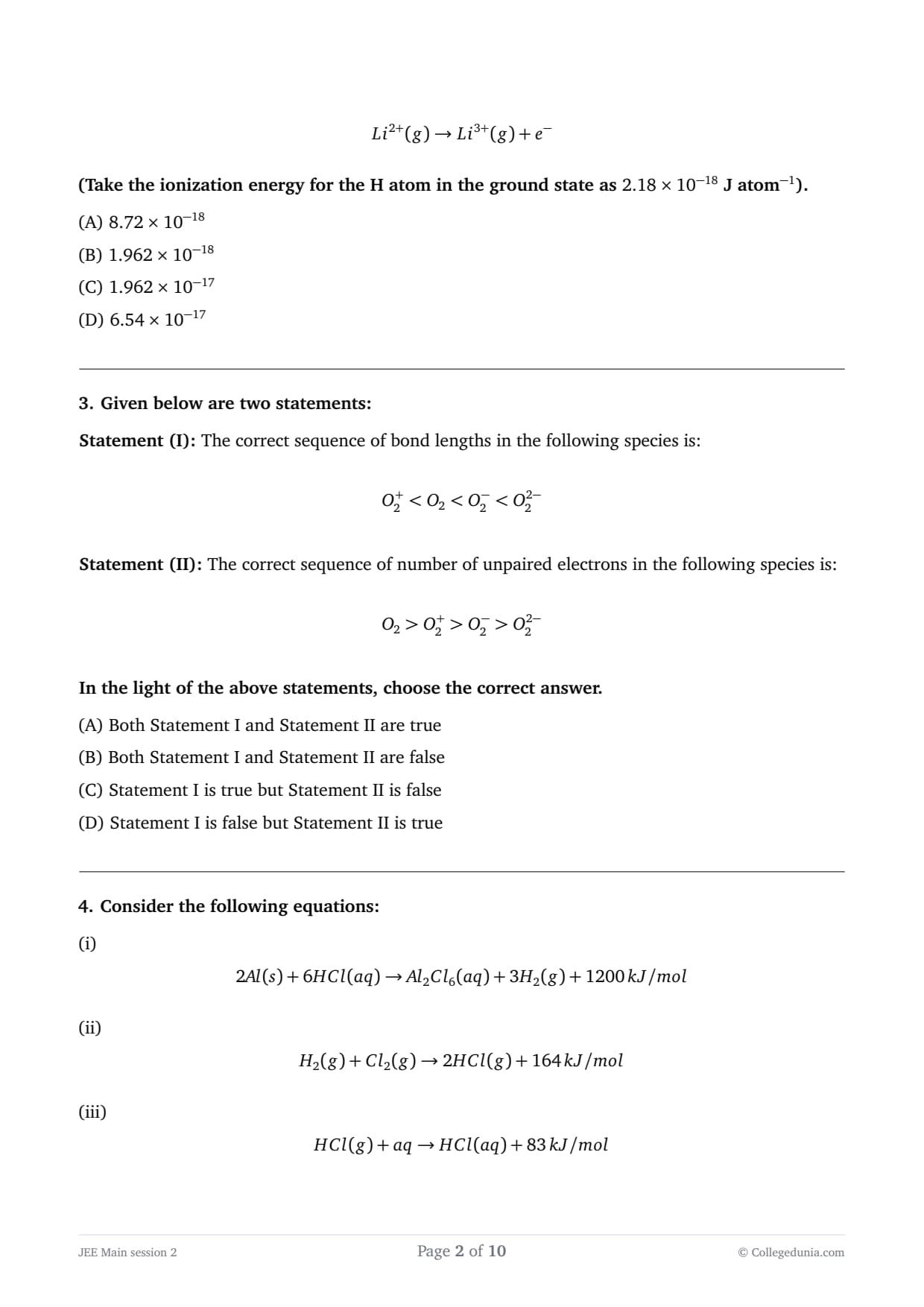
Statement-I: The correct increasing order of bond length among the following is \( O_2^{+} < O_2 < O_2^{2-} < O_2^{2} \)
Statement-II: The correct order of number of unpaired electrons is \( O_2^{2-} < O_2 < O_2^{+} < O_2^{2} \)
View Solution
Step 1: Analyzing bond length.
The order of bond length follows the trend of bond order. As the bond order decreases, the bond length increases. In the case of \( O_2 \), the bond order for \( O_2^{+} \) is less than that of \( O_2^{2-} \), resulting in increasing bond length: \[ O_2^{+} < O_2 < O_2^{2-} < O_2^{2} \]
Step 2: Analyzing unpaired electrons.
The number of unpaired electrons decreases with increasing negative charge on \( O_2 \) and increases with increasing positive charge, giving the order: \[ O_2^{2-} < O_2 < O_2^{+} < O_2^{2} \]
Thus, Statement-I is correct, and Statement-II is incorrect.
Final Answer: (B) Statement-I is correct and Statement-II is incorrect. Quick Tip: Remember that bond length decreases with increasing bond order, and the number of unpaired electrons is affected by the charge of the molecule.
Statement-I: The correct order of ionization energy is \( Na > Mg > Al > Ar \)
Statement-II: Among the following elements Sc, Ca, and Mg, Ca has highest 3\(^rd\) ionization energy.
View Solution
Step 1: Analyzing ionization energy.
The ionization energy generally increases across a period and decreases down a group. The given order \( Na > Mg > Al > Ar \) is incorrect. The correct order of ionization energy is: \[ Ar > Na > Mg > Al \]
This is because Argon is a noble gas with a stable electron configuration, while sodium, magnesium, and aluminum have progressively lower ionization energies.
Step 2: Analyzing 3\(^rd\) ionization energy of Ca, Mg, and Sc.
Magnesium has the highest 3\(^rd\) ionization energy, not Calcium, because calcium has a larger atomic size and the third electron is removed from a more shielded position.
Step 3: Conclusion.
Thus, both Statement-I and Statement-II are incorrect.
Final Answer: (D) Both Statement-I and Statement-II are incorrect. Quick Tip: Ionization energy increases across a period and decreases down a group. Also, noble gases have higher ionization energies than the elements in the adjacent groups.
Cation of salt A when treated in flame gives apple green colour. When salt A is heated with Chromate solution it gives yellow precipitate \& when salt is heated with conc. HNO₃ \& Ammonium molybdate it gives canary yellow ppt. Salt A contains:
View Solution
Step 1: Analyzing the flame test.
Barium salts produce an apple-green flame when treated in a flame, which is a characteristic test for the presence of \( Ba^{2+} \).
Step 2: Chromate solution reaction.
When the salt is heated with chromate solution, barium ions (\( Ba^{2+} \)) form a yellow precipitate of barium chromate (\( BaCrO_4 \)).
Step 3: Reaction with ammonium molybdate.
When treated with concentrated nitric acid and ammonium molybdate, a canary yellow precipitate of barium molybdate (\( BaMoO_4 \)) is formed, confirming the presence of \( Ba^{2+} \).
Step 4: Conclusion.
Given the characteristic flame color, the formation of a yellow precipitate with chromate solution, and the canary yellow precipitate with ammonium molybdate, salt A contains \( Ba^{2+} \) and \( PO_4^{3-} \).
Final Answer: \( Ba^{2+} \) and \( PO_4^{3-} \). Quick Tip: Remember, different metal ions produce characteristic flame colors. \( Ba^{2+} \) gives an apple green color, while \( Sr^{2+} \) gives a red flame.
5.33 gram of \( CrCl_3.6H_2O \) (1:3 electrolyte) is passed through cation exchanger. The resulting solution is then treated with an excess of AgNO\(_3\), leading to formation of 8.61 gram of precipitate. Calculate:
\[ \frac{Number of moles of complex reacted}{Number of moles of AgCl precipitated} \times 100 \]
View Solution
We are given:
- Mass of \( CrCl_3.6H_2O = 5.33 \, g \)
- Mass of AgCl precipitated = 8.61 g
- The molecular mass of \( CrCl_3.6H_2O \):
- Molar mass of \( Cr = 52 \, g/mol \)
- Molar mass of \( Cl = 35.5 \, g/mol \)
- Molar mass of \( H_2O = 18 \, g/mol \)
Molar mass of \( CrCl_3.6H_2O \) = \( 52 + 3(35.5) + 6(18) = 158.5 \, g/mol \).
Step 1: Calculate moles of \( CrCl_3.6H_2O \).
\[ Moles of CrCl_3.6H_2O = \frac{5.33 \, g}{158.5 \, g/mol} = 0.0336 \, mol \]
Step 2: Calculate moles of AgCl precipitated.
Molar mass of AgCl = \( 107.9 + 35.5 = 143.4 \, g/mol \).
\[ Moles of AgCl = \frac{8.61 \, g}{143.4 \, g/mol} = 0.0601 \, mol \]
Step 3: Relate moles of \( CrCl_3 \) to moles of AgCl.
For every mole of \( CrCl_3 \), 3 moles of Cl\(^-\) ions are released, which react with Ag\(^+\) to form AgCl. Therefore, the moles of complex reacted are \( 1/3 \) of the moles of AgCl.
\[ Moles of complex reacted = \frac{1}{3} \times 0.0601 = 0.02003 \, mol \]
Step 4: Calculate the required ratio.
\[ \frac{Number of moles of complex reacted}{Number of moles of AgCl precipitated} \times 100 = \frac{0.02003}{0.0601} \times 100 = 33.33 \] Quick Tip: In complex reactions, stoichiometric relationships between the reactants and products help determine the proportion of complex reacted with AgCl precipitate.
Find the correct match.

View Solution
Step 1: Understand the relationship between \( \Delta_o \) and the ligands.
The \( \Delta_o \) or crystal field splitting energy depends on the nature of the ligands and the metal ion's environment. Ligands like \( CN^- \) (cyanide) have a strong field effect, leading to higher \( \Delta_o \), while ligands like \( H_2O \) (water) and \( F^- \) (fluoride) are weaker field ligands, leading to lower \( \Delta_o \).
Step 2: Match the complexes with their corresponding \( \Delta_o \) values.
- For \( [Cr(CN)_6]^{3-} \), cyanide is a strong field ligand, so \( \Delta_o \) is high: 17000 cm\(^{-1}\).
- For \( [Cr(H_2O)_6]^{3+} \), water is a weak field ligand, so \( \Delta_o \) is moderate: 15000 cm\(^{-1}\).
- For \( [Cr(en)_3]^{3+} \), ethylenediamine (en) is a moderate field ligand, so \( \Delta_o \) is lower: 12000 cm\(^{-1}\).
- For \( [CrF_6]^{3-} \), fluoride is a very weak field ligand, so \( \Delta_o \) is very low: 20000 cm\(^{-1}\).
Step 3: Conclusion.
Thus, the correct matching is: \[ (i) \rightarrow S, \, (ii) \rightarrow Q, \, (iii) \rightarrow P, \, (iv) \rightarrow R \]
Final Answer: (B) (i) → S; (ii) → Q; (iii) → P; (iv) → R Quick Tip: The strength of the ligand affects the crystal field splitting energy. Strong field ligands increase \( \Delta_o \), while weak field ligands decrease it.
Also Check:
JEE Main 2026 Chemistry Exam Pattern
| Particulars | Details |
|---|---|
| Exam Mode | Online (Computer-Based Test) |
| Paper | B.E./B.Tech |
| Medium of Exam | 13 languages: English, Hindi, Gujarati, Bengali, Tamil, Telugu, Kannada, Marathi, Malayalam, Odia, Punjabi, Assamese, Urdu |
| Type of Questions | Multiple Choice Questions (MCQs) + Numerical Value Questions |
| Total Marks | 100 marks |
| Marking Scheme | +4 for correct answer & -1 for incorrect MCQ and Numerical Value-based Questions |
| Total Questions | 25 Questions |
JEE Main 2026 Chemistry Revision





Comments