




JEE Main 2026 April 2 Shift 2 physics question paper is available here with answer key and solutions. NTA conducted the second shift of the day on April 2, 2026, from 3:00 PM to 6:00 PM.
- The JEE Main Physics Question Paper contains a total of 25 questions.
- Each correct answer gets you 4 marks while incorrect answers gets you a negative mark of 1.
Candidates can download the JEE Main 2026 April 2 Shift 2 physics question paper along with detailed solutions to analyze their performance and understand the exam pattern better.
Also Check:
- JEE Main 2026 April 4 Shift 1 Question Paper with Solutions
- Download JEE Main 2026 Session 2 Question Paper for all Shifts
JEE Main 2026 April 2 Shift 2 Physics Question Paper with Solution PDF
Also Check:


Question 1:
Dimensions of universal gravitational constant (G) in terms of Planck's constant (h), distance (L), mass (M) and time (T) are:
A 0.5 kg mass is in contact against the inner wall of a cylindrical drum of radius 4 m rotating about its vertical axis. The minimum rotational speed of the drum to enable the mass to remain stuck to the wall (without falling) is 5 rad/s. The coefficient of friction between the drum's inner wall surface and mass is _______. (Take \( g = 10 \, m/s^2 \))
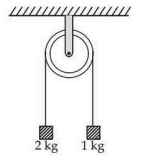
Two blocks of masses 2 kg and 1 kg respectively are tied to the ends of a string which passes over a light frictionless pulley as shown in the figure below. The masses are held at rest at the same horizontal level and then released. The distance traversed by the centre of mass in 2 s is _______ m.
A particle having charge \( 10^{-9} \, C \) moving in \( x \)-\( y \) plane in fields of \( 0.4 \hat{j} \, N/C \) and \( 4 \times 10^{-3} \hat{k} \, T \) experiences a force of \( \left( 4 \hat{i} + 2 \hat{j} \right) \times 10^{-10} \, N \). The velocity of the particle at that instant is _______ m/s.
If X and Y are the inputs, the given circuit works as _______.

If a body of mass 1 kg falls on the earth from infinity, it attains velocity \( v \) and kinetic energy \( k \) on reaching the surface of the earth. The values of \( v \) and \( k \) respectively are _____ .
In a screw gauge the zero of main scale reference line coincides with the fifth division of the circular scale when two studs are in contact. There are 100 divisions in circular scale and pitch of screw gauge is 0.1 mm. When diameter of a sphere is measured, the reading of main scale is 5 mm and 50th division of circular scale coincides with the reference line of main scale. The diameter of sphere is _____ mm.
The surface tension of a soap bubble is 0.03 N/m. The work done in increasing the diameter of bubble from 2 cm to 6 cm is \( \alpha \times 10^{-4} \) J. The value of \( \alpha \) is _____ . (Take \( \pi = 3.14 \))
A mixture of carbon dioxide and oxygen has volume 8310 cm³, temperature 300 K, pressure 100 kPa and mass 13.2 g. The number of moles of carbon dioxide and oxygen gases in the mixture respectively are _____ .
If an air bubble of diameter 2 mm rises steadily through a liquid of density 2000 kg/m³ at a rate of 0.5 cm/s, then the coefficient of viscosity of the liquid is _____ Poise.
A spherical ball of mass 2 kg falls from a height of 10 m and is brought to rest after penetrating 10 cm into sand. The average force exerted by sand on the ball is ______ N.
An electromagnetic wave travels in free space along the x-direction. At a particular point in space and time, \( B = 2 \times 10^{-7} \hat{j} \) T is associated with this wave. The value of the corresponding electric field \( E \) at this point is _______ V/m.
Two resistors of 200 \( \Omega \) and 400 \( \Omega \) are connected in series with a battery of 100 V. A bulb rated at 200 W, 100 V is connected across the 400 \( \Omega \) resistance. The potential drop across the bulb is _______ V.
Two metal plates (A, B) are kept horizontally with separation of \( \frac{12}{\pi} \) cm, with plate A on the top.
An atomizer jet sprays oil (density \( 1.5 \, g/cm^3 \)) droplets of radius 1 mm horizontally. All oil droplets carry a charge 5 nC. The potentials \( V_A \) and \( V_B \) are required on plates A and B respectively in order to ensure the droplets do not descend. The values of \( V_A \) and \( V_B \) are _______. (Neglect the air resistance to the droplets and take \( g = 10 \, m/s^2 \))
Two point charges \( 8 \, \mu C \) and \( -2 \, \mu C \) are located at \( x = 2 \, cm \) and \( x = 4 \, cm \), respectively on the x-axis. The ratio of electric flux due to these charges through two spheres of radii 3 cm and 5 cm with their centers at the origin is _______.
One side of an equilateral prism is painted by a transparent material of refractive index \( n_2 \). The refractive index of prism is 1.6. The minimum value of \( n_2 \) required for total internal reflection from the painted face is ______ .

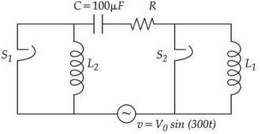
The figure given below shows an LCR series circuit with two switches \( S_1 \) and \( S_2 \). When switch \( S_1 \) is closed keeping \( S_2 \) open, the phase difference \( \phi \) between the current and source voltage is 30° and phase difference is 60° when \( S_2 \) is closed keeping \( S_1 \) open. The value of \( (3L_1 - L_2) \) is _______ H.
A circular current loop of radius \( R \) is placed inside square loop of side length \( L \) (where \( L \gg R \)) such that they are co-planar and their centers coincide. The permeability of free space is \( \mu_0 \). The mutual inductance between the circular loop and square loop is _____ .
The binding energy per nucleon of \( \,^{209} Bi \) is ______ MeV.
\[ Take m(^{209} Bi) = 208.98038 \, u, \, m_p = 1.007825 \, u, \, m_n = 1.008665 \, u, \, 1 \, u = 931 \, MeV/c^2. \]
The equation of motion of a particle is given by \( x = a \sin \left( 50t + \frac{\pi}{3} \right) \, cm. \) The particle will come to rest at time \( t_1 \) and it will have zero acceleration at time \( t_2 \). The \( t_1 \) and \( t_2 \) respectively are _______.
In a Young's double slit experiment, the intensity at some point on the screen is found to be \( \frac{3}{4} \) times of the maximum of the interference pattern. The path difference between the interfering waves at this point is \( \frac{\lambda}{x} \), where \( \lambda \) is the wavelength of the incident light. The value of \( x \) is _____ .
Using Bohr's model, calculate the ratio of the magnetic fields generated due to the motion of the electrons in the 2nd and 4th orbits of a hydrogen atom.
5 moles of unknown gas is heated at constant volume from 10°C to 20°C. The molar specific heat of this gas at constant pressure \( c_p = 8 \) cal/mol·°C and \( R = 8.36 \) J/mol·°C. The change in the internal energy of the gas is _____ calorie.
If sunlight is focused on a paper using a convex lens, it starts burning the paper in the shortest time when the lens is kept at 30 cm above the paper. If the radius of curvature of the lens is 60 cm, then the refractive index of the lens material is \( \frac{\alpha}{10} \). The value of \( \alpha \) is _____ .
Moment of inertia about an axis \( AB \) for a rod of mass 40 kg and length 3 m is same as that of a solid sphere of mass 10 kg and radius \( R \) about an axis parallel to \( AB \) axis with separation of 3 m as shown in the figure below. The value of \( R \) is given as \( \sqrt{\frac{\alpha}{2}} \). The value of \( \alpha \) is _____ .

JEE Main 2026 Physics Exam Pattern
| Particulars | Details |
|---|---|
| Exam Mode | Online (Computer-Based Test) |
| Paper | B.E./B.Tech |
| Medium of Exam | 13 languages: English, Hindi, Gujarati, Bengali, Tamil, Telugu, Kannada, Marathi, Malayalam, Odia, Punjabi, Assamese, Urdu |
| Type of Questions | Multiple Choice Questions (MCQs) + Numerical Value Questions |
| Total Marks | 100 marks |
| Marking Scheme | +4 for correct answer & -1 for incorrect MCQ and Numerical Value-based Questions |
| Total Questions | 25 Questions |
JEE Main 2026 Physics Revision



Comments