

![Delhi University - [DU]](https://image-static.collegedunia.com/public/college_data/images/logos/1491817267UniversityofDelhi.png?h=71.7&w=71.7&mode=stretch)

DU MBA and equivalent management programs are offered through major departments and institutes such as FMS Delhi, DFS Delhi, DBE Delhi, DSE Delhi, and SRCC GBO. Collectively, these programs offer 600+ seats across various management specialisations. Depending on the program, admission cutoffs are released either as CAT percentiles or as composite scores calculated using CAT performance, academic records, and interview-related parameters.
- CAT percentile range: General category shortlisting cutoffs across DU MBA programs span from 91+ to 97+ percentiles, with the highest cutoff recorded at MBA (IB), DSE DU, i.e., around 96.84 percentile.
- Low conversion rate: At DFS Delhi, only 21 out of 1,304 General category applicants secured final admission in the 2024–26 batch, a conversion rate of just 7.67% and at FMS Delhi, only 297 out of 3070 General category candidates secured final admission in 2024-26 batch, a conversion rate of just 10.33%.
- Selection process: Most DU programs shortlist candidates for GD and PI rounds after the cutoff stage. FMS final admission is weighted as CAT Composite Score (50%), PI (25%), Academics (20%), and Extempore (5%).
Related Articles:
- Delhi University Cutoff 2026 for Commerce
- Delhi University Cut off for Arts
- Delhi University BA Economics Cutoff 2026
- Delhi University Cutoff 2026 for B.Sc Computer Science
DU MBA Cutoff 2025–26: Overview
Delhi University MBA admissions across premier institutes such as the Faculty of Management Studies, the Delhi School of Economics, and the Department of Financial Studies continue to witness significant competition owing to their strong placement outcomes and comparatively high ROI. In the latest admission cycle, the General category cutoff across leading DU MBA institutions ranged approximately between 91 and 98+ percentile.
| Department | program | Entrance | Gen. Cutoff (2025–26) | Seats | Total Fees (Approx.) |
|---|---|---|---|---|---|
| FMS Delhi | MBA | CAT (CS: 51.103) | 98+ %ile | ~230 | Rs. 2 Lakh |
| DFS, DU | MBA (Finance) | CAT | 95 %ile | ~56 | Rs. 98,000 |
| DSE, DU | MBA (IB/HRD/BA) | CAT | 95–97 %ile | ~180 | Rs. 97,540 |
| DBE, DU | MBA (Business Econ.) | CAT | 94 %ile | 129 | Rs. 97,000 |
| SRCC GBO | PGDM (Global Business) | GBO Exam | 93.13 %ile | 94 | Rs. 82,000/sem |
FMS Delhi MBA Cutoff 2025–27
FMS Delhi provides approximately 230 seats and an applicant pool exceeding two lakh CAT-appearing candidates; it maintains one of the tightest shortlisting ratios in the country.
How FMS Delhi Calculates the Composite Score?
FMS Delhi does not rely on the overall CAT percentile alone for shortlisting. Instead, it calculates a Composite Score based on the raw sectional marks secured in the CAT examination. The formula assigns differential weights to each section as follows:
- Verbal Ability and Reading Comprehension (VARC): 40%
- Data Interpretation and Logical Reasoning (DILR): 30%
- Quantitative Ability (QA): 30%
- Score formula: Sum of (Sectional Score × Weightage) ÷ Max Section Marks, across all three sections.
- Female candidates receive an additional 5 marks in the composite score.
- Minimum 50th percentile required in each CAT section individually; failing any single section disqualifies the candidate regardless of overall score.
FMS Delhi PI Shortlist 2025–27: Category-Wise Cutoff
The following table presents the official composite score cutoffs for shortlisting candidates to the Personal Interview (PI) round, for the 2025–27 batch.
- The General category cutoff of 51.103 represents the minimum composite score required for interview consideration.
- EWS and OBC cutoffs were 40.796 and 39.154, respectively.
- Only 2 seats remained vacant after the final admission closure, indicating near-complete acceptance among the candidates offered admission.
| Category | PI Shortlist Cutoff (Composite Score) |
|---|---|
| General (AI) | 51.103 |
| EWS | 40.796 |
| OBC-NCL | 39.154 |
| SC | 31.887 |
| ST | 23.424 |
| PwD | 22.422 |
FMS Delhi Composite Score Cutoff Trends (2022–2027)
The General category composite score cutoff has risen sharply from 46.739 in 2024–26 to 51.103 in 2025–27, a jump of over 4 points. The OBC cutoff similarly increased from 35.189 to 39.154, and EWS from 37.031 to 40.796.
| Category | 2025–27 | 2024–26 | 2023–25 | 2022–24 |
|---|---|---|---|---|
| General | 51.103 | 46.739 | 44.715 | 53.851 |
| EWS | 40.796 | 37.031 | 35.625 | 40.576 |
| OBC-NCL | 39.154 | 35.189 | 33.875 | 39.991 |
| SC | 31.887 | 29.423 | 27.646 | 32.452 |
| ST | 23.424 | 22.796 | 21.580 | 24.257 |
| PwD | 27.3040 | 24.247 | 22.422 | 20.943 |
ALSO READ - FMS DELHI FULL CUTOFF DETAILS
DBE DU MBA Cutoff 2025–27
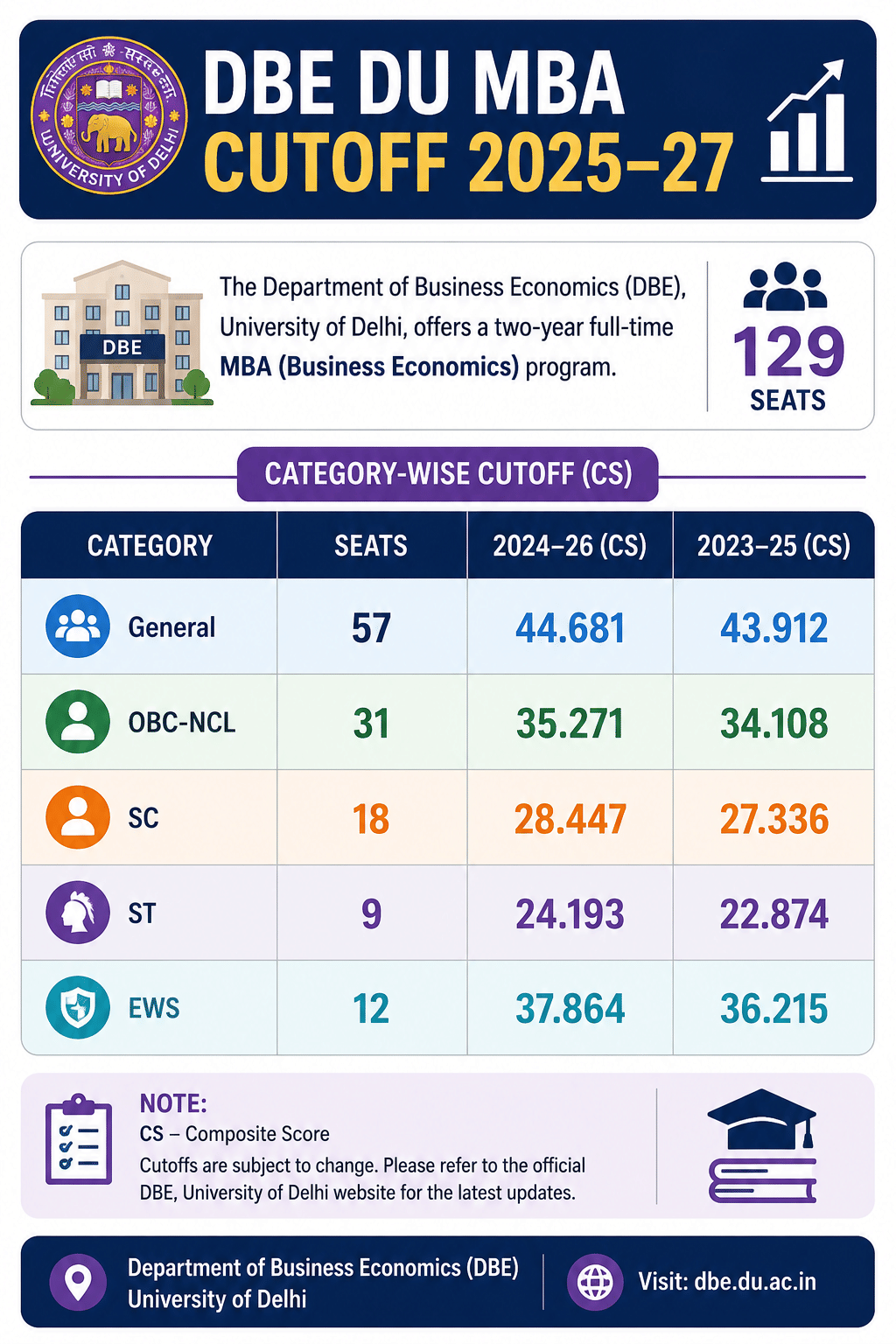
The Department of Business Economics (DBE), University of Delhi, offers a two-year full-time MBA (Business Economics) program with 129 seats.
- For both 2023–25 and 2024–26, batches were conducted without a PI round, and final selection was based directly on composite scores.
- The General category cutoff increased slightly from 43.912 to 44.681, indicating a marginal rise in competition across most categories.
| Category | Seats | 2024-26(CS) | 2023–25(CS) |
|---|---|---|---|
| General | 57 | 44.681 | 43.912 |
| OBC-NCL | 31 | 35.271 | 34.108 |
| SC | 18 | 28.447 | 27.336 |
| ST | 9 | 24.193 | 22.874 |
| EWS | 12 | 37.864 | 36.215 |
DBE DU MBA Seat Intake
The MBA (Business Economics) program at DBE Delhi offers seats across multiple reservation and supernumerary categories, including PwD, CW, ward quota, orphan quota, and foreign student categories, in accordance with University of Delhi reservation policies.
| Category | No. Of Seats |
|---|---|
| UR | 41 |
| SC | 15 |
| ST | 8 |
| OBC | 28 |
| EWS | 10 |
| PC | 6 |
| CW | 5 |
| Ward Quota (Teaching) | 2 |
| Ward Quota (Non-teaching) | 2 |
| Orphans Ouota | 2 |
| Foreign Students | 10 |
DSE DU MBA Cutoff 2025–27
Among the three DSE MBA programs, MBA (IB) records the highest cutoff at 96+ percentile for General category candidates. MBA (HRD) follows at 94+ percentile, and MBA (BA), being relatively newer, has a marginally lower cutoff of 91+ percentile for General candidates.
| Category | MBA (IB) | MBA (HRD) | MBA (BA) |
|---|---|---|---|
| General | 96+ | 94+ | 91+ |
| OBC-NCL | 94+ | 91+ | 90+ |
| SC | 75+ | 65–70+ | 65+ |
| ST | 45+ | 35+ | 55+ |
| CW (Def. Personnel) | 40+ | 65+ | 40+ |
| PwBD | 70+ | 50+ | 25+ |
DSE DU, Year-wise Overall CAT Cutoff Trend
Delhi School of Economics (DSE) overall cutoff has remained in the 92–94 percentile range for General candidates across the past three cycles.
- The lowest percentile accepted for MBA (IB) in the 2025–27 batch was 96.84 percentile, while MBA (HRD) accepted as low as 94.65 percentile.
- MBA (BA) saw acceptance at 91.53 percentile.
| Batch | MBA (IB) | MBA (HRD) | MBA (BA) |
|---|---|---|---|
| 2025–27 | 96.84 | 94.65 | 91.53 |
| 2024–26 | 97.10 | 94.82 | 92.04 |
| 2023–25 | 96.32 | 93.74 | 90.88 |
| 2022–24 | 95.94 | 92.61 | 89.75 |
| 2021–23 | 94.88 | 91.47 | 88.90 |
DFS DU MBA Cutoff 2025–27
Admissions in DFS Delhi are CAT-based and use the same composite score methodology as FMS and DBE. For the 2024–26 batch, 1,304 General category candidates filled the CAT form, the highest among all categories, yet only 21 General seats were filled in the final class, making the actual conversion rate just 7.67%.
DFS DU Category-Wise Composite Score Cutoff (2024–26)
The final offer cutoff for the General category stood at 41.62, with the highest composite score among admitted candidates reaching 57.65. This gap between the lowest and highest score indicates significant variance within the admitted batch.
| Category | 2024–26 (CS) | 2023–25 (CS) |
|---|---|---|
| General | 41.62 | 43.912 |
| EWS | 37.864 | 36.215 |
| OBC-NCL | 35.271 | 34.108 |
| SC | 28.447 | 27.336 |
| ST | 24.193 | 22.874 |
Also check: Delhi University Commerce Department MBA GDPI Shortlist 2026 Released; Interviews to Begin From May 4
SRCC GBO Cutoff 2025–27
SRCC GBO is the only program in this list that does not use CAT. Admission is through a dedicated national-level entrance exam conducted by SRCC, followed by GD and PI rounds. The 2026–28 batch is currently in the GDPI stage, with interviews scheduled from May 5–9, 2026.
Key Note: Apart from the 94 regular seats offered under SRCC GBO, an additional 16 supernumerary seats are available across special categories, including PwBD (4), Armed Forces Ward/CW (4), Foreign Nationals (4), DU Ward Quota (2), and Orphan quota (2).
SRCC GBO CUTOFF: Previous Years' Cutoff
Looking at the past 4 years cutoff, you can see that the cutoff fluctuates a lot depending upon the difficulty level of the exam, making it obvious that a “good” score is all about how difficult the exam was.
| Category | 2025 | 2024 | 2023 | 2022 |
| General | 270 | 280 | 209 | 325 |
| OBC | 200 | 200 | 178 | 280 |
| EWS | 245 | 250 | 200 | 300 |
| SC | 155 | 160 | 147 | 222 |
| ST | 115 | 120 | 103 | 135 |
| PwD | 90 | 100 | 54 | 107 |
Key Note: SRCC GBO admissions are not based on CAT scores. Selection is conducted through the SRCC GBO entrance examination, followed by Group Discussion and Personal Interview rounds.
Frequently Asked Questions
Ques: Can strong academics actually compensate for a slightly lower CAT percentile in DU MBA colleges?
Ans: Yes, students constantly discuss profiles like 9/9/9 with 93–94 percentile outperforming profiles like 7/7/7 with 96 percentile during final merit preparation. Institutes such as the FMS and DFS still value academic consistency heavily alongside CAT performance.
Ques: Does scoring 99 percentile automatically guarantee FMS final conversion?
Ans: Not necessarily. Students with 99+ percentiles have still missed the FMS because of weak interviews, poor academics, like 7/7/6 profiles, or low sectional balance. Meanwhile, some 98.5 percentile candidates with strong PI performance and better academics have successfully converted final admission offers.
Ques: My CAT score is around 78 marks. Do I realistically stand a chance at FMS Delhi?
Ans: Students usually compare this score with previous trends at FMS Delhi before deciding. In a relatively easier CAT paper, the same 78 marks may correspond to only 95–96 percentile because more candidates achieve higher scores. But after the General composite cutoff increased from 46.739 to 51.103 recently, even high percentiles started feeling less secure without strong sectionals.
Ques: Why are DU MBA cutoffs increasing faster than many newer IIMs recently?
Ans: Students usually blame the extreme ROI advantage. Paying around two lakh rupees at the FMS while securing placements comparable to expensive MBA colleges naturally pushes CAT competition and cutoffs upward every single year.
Ques: Is the DSE MBA cutoff actually lower than people exaggerate online?
Ans: Students say MBA IB at Delhi School of Economics genuinely remains highly competitive in 96–97 percentile. However, MBA, BA and HRD programs have historically converted candidates at comparatively lower composite scores and percentile ranges than social media discussions suggest.






.png?h=16&w=16&mode=stretch)


.png?h=16&w=16&mode=stretch)

















.png?h=72&w=72&mode=stretch)





Comments