

![School of Open Learning, University of Delhi - [SOLDU]](https://img.collegedunia.com/public/college_data/images/logos/1559890399logo2.jpg?h=71.7&w=71.7&mode=stretch)

DU SOL, also known as the School of Open Learning, Delhi University, was established in 1962. It is recognised by UGC-DEB (Distance Education Bureau) and is a constituent body of Delhi University. It has been accredited by NAAC Grade A++. Candidates can register for the 2026-27 session starting in June.
- Popular Courses: The most popular courses offered at DU SOL are BA (Hons.), B.Com, BBA
- Admission Cycle: Admission to DU SOL is conducted once a year, and the admission process begins in the month of June.
- Admission Criteria:
- UG Admissions: Admission to the UG program is based on 10+2 marks
- PG Admissions: Admission to the UG program is based on CUET-PG.
- CUET UG is not mandatory for admission to the UG Program, while admission to the PG program is based on CUET PG.
- Seat Limit: There is no seat limit, and Candidates can take Direct Admission.
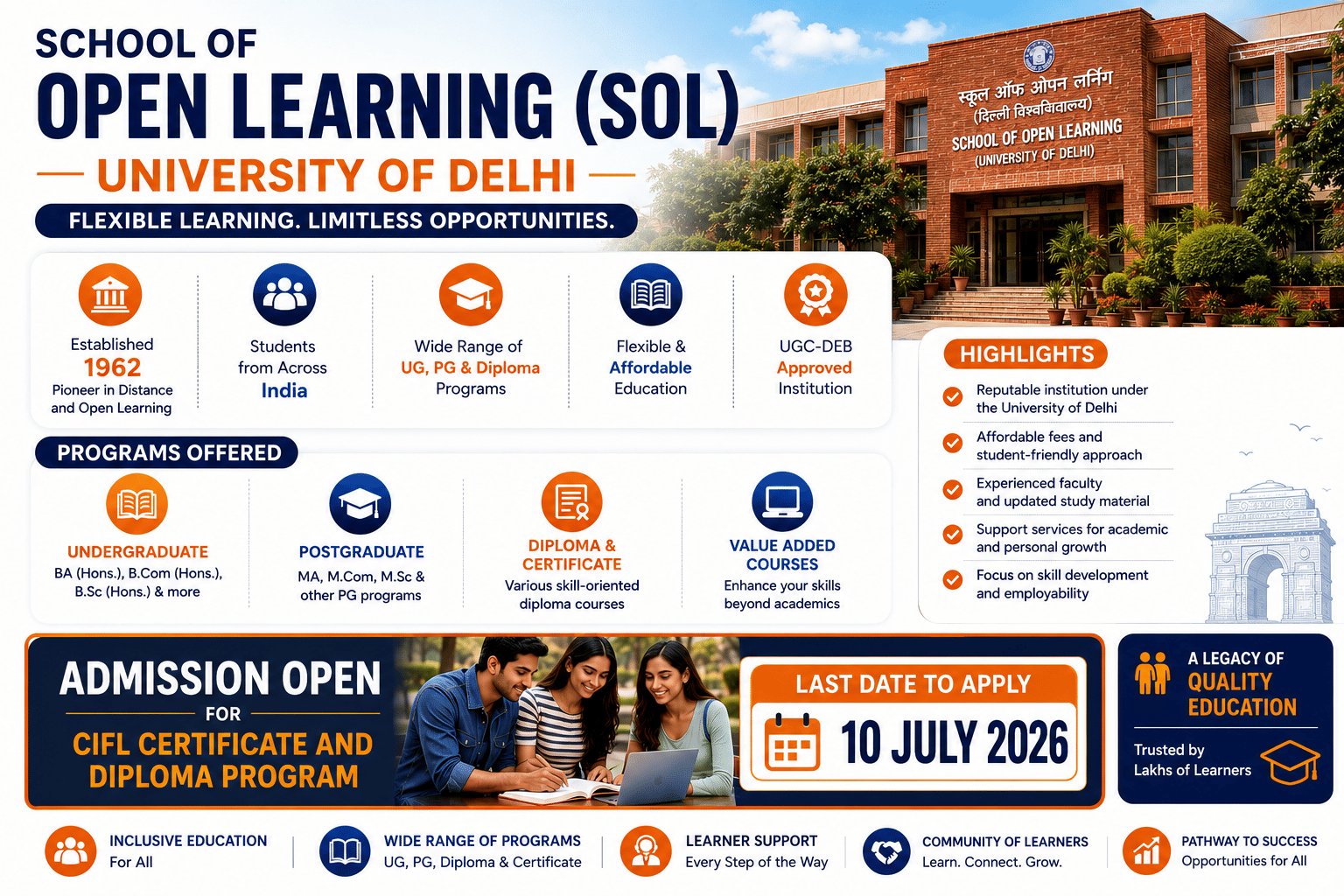
Admission for the CIFL Certificate and Diploma Program has begun. Students can apply till 10 July 2026. Direct Link to Apply.
DU SOL Important Dates 2026
DU SOL registrations typically start in June and continue until mid-September. The table below provides a complete overview of the important admission dates for the SOL.
DU SOL UG Admission Important Dates
| Event | Tentative Dates |
|---|---|
| Commencement of Online Registration Process | June, 2026 |
| Commencement of Online Admission Process | June, 2026 |
| Last date of Admission | September 2026 |
DU SOL MBA Admission Dates
| Event | Tentative Dates Dates |
|---|---|
| Start of Registration | June 2026 |
| Last Date of Registration | July 2026 |
| Display of First Merit List | July 2026 |
| Fee Submission for First Merit List Applicants | July 2026 |
| Last date of Admission | September 2026 |
DU SOL CIFL Important Dates
| Event | Important Dates |
|---|---|
| Commencement of Online Admission Process | 11 June 2026 |
| Last date of Admission | 10 July 2026 |
| Last Date for Fee Payment | 14 July 2026 |
Check the DU SOL CIFL Program Prospectus to know more about the course.
CUET PG 2026
Important Points for DU SOL
- Registration: June-mid-September.
- Eligibility: Check the criteria for your course.
- Application: Online via the DU SOL portal.
- Documents: Mark sheets, certificates, photos, signatures.
- Courses: UG, PG, and diploma programs.
- Fees: Paid online during registration.
- Study Materials: Provided in print or online.
- Flexibility: Suitable for working students or distance learners.
DU SOL Course & Fees 2026
DU SOL offers UG, PG, and other courses across various specialisations. With generally affordable fees, DU SOL is accessible to a wide range of students. DU SOL Course & Fee details are provided below:
| Course | Details | Total Academic Fees |
|---|---|---|
| BA (Hons.) | Duration: 3 Years Specialisation: English, Political Science, Psychology |
INR 31,860 (English) |
| B.Com | Duration: 3 Years | INR 30,360 |
| BBA | Duration: 3 Years | INR 63,360 |
| BA | Duration: 3 Years Specialisation: Computer Application, Psychology, Economics, Education, English, and Hindi |
INR 39,360 (Computer Application) |
| B.Com (Hons.) | Duration: 3 Years | INR 31,860 |
| MBA | Duration: 2 Years | INR 1.1 Lakhs |
| MA | Duration: 2 Years Specialisation: Political Science, History, Hindi, and Sanskrit |
INR 21,740 (Political Science) |
| BMS | Duration: 2 Years | INR 63,360 |
| B.Lib.I.Sc | Duration: 1 Year | INR 35,460 |
| M.Com | Duration: 2 Years | INR 22,340 |
Source: DU SOL Fee Structure
As per Vinayak, a BA (Hons.) English student, “He appreciates the affordable fees and flexibility, making it ideal for those pursuing other goals or preparing for government jobs. However, he points out that the limited interaction with faculty, minimal campus life, and self-study-heavy system are drawbacks. Overall, it is convenient and reliable for earning a degree but lacks the full college experience.” - Read the detailed review.
DU SOL Admission 2026
DU SOL admissions are open for UG, PG, and other courses. Admissions are generally merit-based, depending on the eligibility criteria for each course. Registration is done online through the DU SOL official portal.
Key Details:
- Registration Start: First week of June 2026
- Application Mode: Online
- Application Fee: Varies by course.
- Eligibility: Depends on the course.
- Foreign Students: Can apply with a valid student visa; some courses may have restrictions
Read More: DU SOL Admission
How to Apply for DU SOL Admission?
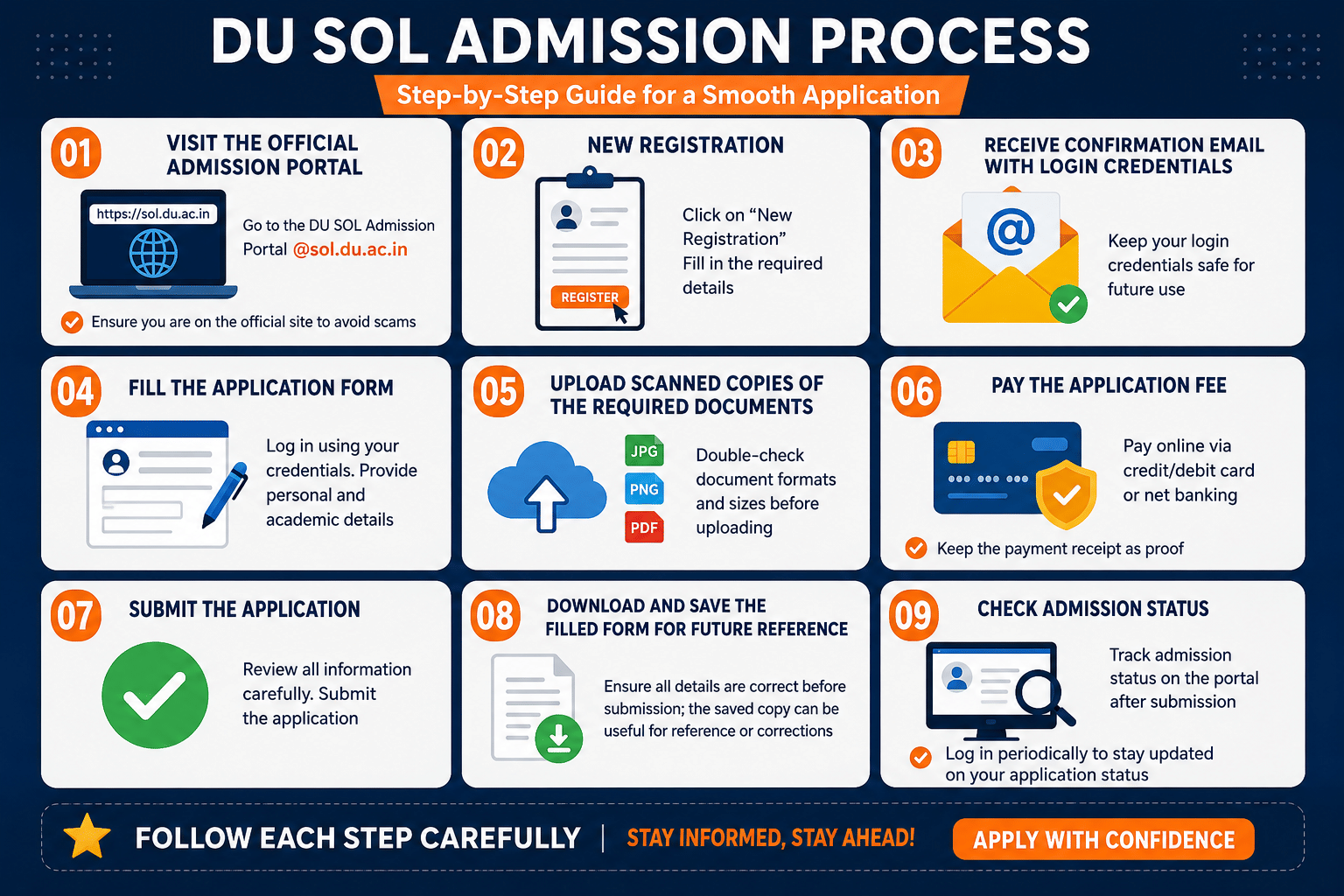
Here is the step-by-step admission process for admission to DU SOL:
Important Documents for DU SOL Admission
Candidates must upload scanned copies of documents to verify identity, eligibility, and academic qualifications. All documents should be original or self-attested.
Required Documents:
- Passport-sized photograph
- Signature
- Proof of Date of Birth
- Educational Certificates (10th, 12th, Graduation as applicable)
- Category Certificate (if applicable)
- Aadhar Card
DU SOL Study Material 2026
DU SOL offers a blend of printed and digital resources to support flexible, self-paced learning. In 2026, it continues to strengthen this system through textbooks, online platforms, and portal-based academic support, making it comparable to IGNOU’s established self-learning model.
- Printed Study Material: Well-structured, syllabus-based books written in simple language for self-study and exam preparation.
- Online Resources (E-content): PDFs, recorded lectures, and supplementary materials available anytime for easy revision.
- Student Portal Access: Download materials, view academic updates, submit assignments, and receive exam and result notifications in one place.
IGNOU vs DU SOL: Comparison of Self-Learning Material Model
Compared to IGNOU, DU SOL offers study material that is more syllabus-focused and exam-oriented, making it easier for quick preparation.
- IGNOU’s self-learning material is more detailed, with in-text activities and self-assessment questions.
- IGNOU follows a fully distance-learning model, DU SOL blends open learning with the academic support of Delhi University.
As per the students' discussion on Reddit, DU SOL is better than IGNOU. Students say that at DU SOL, understanding courses and obtaining good marks is quite easy compared to IGNOU. Here, students can get a B+ and an A grade easily. Read more
DU SOL Examination Pattern 2026
DU SOL follows a structured examination pattern to evaluate students’ learning outcomes effectively. For 2026, the assessment framework includes a mix of annual/semester systems, assignment evaluation, term-end exams, and provisions for re-evaluation and improvement, aiming to maintain academic standards while accommodating the needs of distance learners.
- Assignment Weightage: Term-end assignments form an essential part of DU SOL’s continuous assessment, contributing to the final grade and promoting regular study and understanding of the course.
- Passing Criteria: Students must achieve minimum qualifying marks in both assignments and term-end exams, with a combined score meeting the university’s passing threshold.
- Re-evaluation / Improvement Exams: DU SOL allows students to apply for re-evaluation of answer scripts if they believe their marks do not reflect their performance. Additionally, improvement exams are available for students who wish to raise their scores in specific papers, subject to university rules and schedules.
DU SOL Examination 2026
DU SOL conducts the semester-wise exams for UG and PG programs. Examination for the even semester is scheduled in May 2026 and June 2026.
- Students are required to register, submit their admit cards, and fulfil eligibility criteria such as valid enrollment and course requirements before appearing.
- These exams assess academic progress and are essential for completing program requirements.
- To check the exact dates and timings of the course, students must check the official DU SOL date sheet on the exam portal. @ sol.du.ac.in
DU SOL Assignments 2026
Assignments at DU SOL are a crucial part of your evaluation, designed to ensure continuous learning and preparation alongside final exams. For 2026, the assignment component involves a clear process for submission, contributes significant weightage to your final result, and is evaluated according to university guidelines.
- Submission Process: Students must complete and submit assignments before the deadline. Submissions can be online via the student portal (PDF format) or offline at designated study centres with an acknowledgement slip. Always check the portal for updated deadlines and instructions.
- Weightage in Final Result: Assignments form a key part of internal assessment, often around 30% of the total score, with the final exam contributing the rest. Completing assignments well can improve grades and is typically required to appear for term-end exams.
- Evaluation Method: Assignments are assessed on relevance, clarity, presentation, originality, and adherence to guidelines. Students can track status on the portal, and keeping proof of submission is recommended for any discrepancies.
DU SOL Results 2026
DU SOL releases student results online after the term‑end examinations. The results include detailed marks/grades for each subject, overall performance status, and cumulative grade statistics. Students can access this information through the official DU SOL result portals once the evaluation process is complete.
Read More: DU SOL Result
Result Declaration Process
After exams conclude, DU SOL evaluates answer sheets and compiles results for various undergraduate and postgraduate programmes.
- The university publishes the results on official websites such as sol.du.ac.in and exam.du.ac.in, often with a notification specifying the date of declaration.
- Students are advised to regularly check official announcements for the exact release timing.
Online Result Checking
Students can view their DU SOL results online by visiting the official result page:
- Select your course, year/semester, and entering their Roll Number/Enrollment details.
- The result appears on screen as a marksheet or grade card, which can be downloaded or printed for reference.
Note:
- SGPA (Semester Grade Point Average) and CGPA (Cumulative Grade Point Average) are calculated using these grade points.
- Students must score at least P (4 GP) or above in each subject to pass.
DU SOL Student Support Services 2026
DU SOL prioritises student success with extensive support tailored for distance learners. These services operate year-round, blending digital tools, physical centres, and personalised guidance.
Helpdesk Services
The Helpdesk is your first stop for quick resolutions on admissions, fees, exams, results, and technical glitches.
Contact Channels:
| Channel | Details | Timings |
|---|---|---|
| Phone | 011-27008300, 011-27008195 (Ext. 200) | Mon-Sat: 9:30 AM - 5:30 PM |
| solhelp@du.ac.in & admissions@sol.du.ac.in | Response: 24-48 hours | |
| Live Chat | DU SOL Student Portal (sol.du.ac.in) | 24/7 automated + agent support (10 AM-6 PM) |
| +91-8828134076 | Mon-Sat: 10 AM - 6 PM | |
| Ticket System | Login to portal → "Support Ticket" → Track via ID | Instant acknowledgment |
- Common Queries Handled: Re-registration, ID card issues, assignment submission, exam hall tickets.
- Tip: Use the AI-powered chatbot on the portal for FAQs before escalating.
Regional & Study Centres
DU SOL's Regional/Study Centres provide hands-on support with libraries, counselling, practical classes, and exam venues.
Key Features:
- Weekend classes, self-study spaces, and computer labs.
- Free access to journals, e-resources, and DU library privileges.
- Exam facilitation for theory/practicals.
Major Centres:
| Regional Centre | Address | Notes |
|---|---|---|
| North Campus (Main SOL HQ) | 5, Cavalry Lane, University of Delhi, Delhi – 110007 | Main administrative and student support hub |
| South Campus (South Study Centre) | South Moti Bagh, (Old Motilal Nehru College Building), New Delhi | South Delhi support |
| West Campus (COL – Keshav Puram) | C-2, Keshav Puram, University of Delhi, Delhi – 110035 | West Delhi |
| East Campus (Tahirpur) | Plot No-4, FC-10, Tahirpur Village, Delhi – 110095 | Listed as East Regional Centre |
Grievance Redressal System
- Primary Portal: COL-GRAM (Campus of Open Learning Grievance Redressal) – Log academic/administrative complaints online at the portal linked on sol.du.ac.in.
- Time-bound resolution via call centre support.
- For specific issues (e.g., harassment): Contact the Internal Complaints Committee at icchelp@sol-du.ac.in.
DU SOL vs IGNOU vs IDOL Mumbai University
Here’s a comparison table between DU SOL, IGNOU, and IDOL Mumbai University across key aspects:
| Paramenter | DU SOL | IGNOU | IDOL Mumbai University |
|---|---|---|---|
| Study Material | Printed + Online | Printed + Online | Digital LMS + Recorded |
| Examination Pattern | Held annually / Semester-wise through Offline Mode | Held Twice a Year through Offline Mode | Held annually / Semester-wise through Online Mode |
| Mode of Study | ODL | ODL + Online | ODL |
| Regional / Study Centres | Primarily in Delhi, offering local academic support. | Wide network of Regional Centres in India and abroad for academic counselling and exam coordination. | Primarily in Mumbai, offering local academic support |
| Best For | Affordable with a Delhi University degree | Nationwide Reach | Affordable with a Mumbai University Degree |
| Admission Process | Merit and Entrance-based | Merit and Entrance-based | Merit and Entrance-based |
| Entrance Exam | CUET PG | University Entrance Exam for B.Ed, B.Sc Nursing, and PhD | MAH CET, MAH MCA CET |
| Popular Program | BA Hons, B.Com, BBA, BA | MA, M.Sc, BA, BCA, MBA | MA, BA, MCA, B.Sc, M.Sc |
| BA Hons Program Fees | INR 31,860 - INR 39,360 | INR 15,100 - INR 28,300 | INR 34,315 |
| MA Admission Process | Direct Admission | Direct Admission | Direct Admission |
Key difference highlights
- IGNOU has a wider course portfolio, a larger national/international reach, and an extensive network of support centres
- DU SOL offers DU-affiliated degrees with the same recognition as regular DU programmes, primarily focused on humanities, commerce and arts streams.
- IDOL Mumbai University is ideal for learners wanting an affordable education in Maharashtra.
Why Choose DU SOL?
DU SOL is a strong choice for students wanting affordable and flexible education with a nationally recognised degree. Students preparing for government jobs or wanting low-cost education can choose DU SOL.
Key reasons to choose DU SOL
- It is backed by Delhi University. It is approved by UGC-DEB and is accredited by NAAC with Grade A++.
- It offers a total of 10 UG and 8 PG programs in art, commerce, and management.
- Follow the curriculum of Delhi University. The study materials are available in printed form with online classes.
DU SOL FAQs
Ques. Which colleges are allotted in DU SOL?
Ans. DU SOL students are not "admitted" to any specific college or faculty of Delhi University. They are inducted into the DU School of Open Learning and attached to one or more Study Centres and Learner Support Centres across Delhi. Classes and other forms of counselling and support are provided by several DU colleges, as SOL has signed an MoU with them. These colleges will act as Learner Support Centres for SOL students on Sundays/holidays and provide access to the course materials.
Ques. Do DU colleges conduct offline DU SOL classes?
Ans. Delhi University’s SOL has signed MoUs with about 40–50 affiliated DU colleges to conduct offline Personal Contact Program (PCP) / support classes for its distance-learning students. These offline SOL classes are not fixed to a small set of colleges; different DU colleges are notified as PCP centres each session, and the exact list (with allotted centre for each student) is published on the official DU SOL website and in the PCP/exam schedule on the student dashboard.
Ques. Is migration possible from DU SOL to the DU regular college in the second year?
Ans. Yes, moving from DU SOL to a regular DU college in the second year is allowed on paper, but in real life, it rarely happens. Earlier, DU allowed SOL/NCWEB students to shift to regular colleges in the second year if seats were vacant, the student had good marks (around 60% or more), and both colleges gave permission (NOC). But now, most DU colleges and helpdesks clearly say that SOL to regular college migration is not being done. So if a student wants to study in a regular DU college, they usually have to give CUET again and take fresh admission in the first year.
Ques. What is the difference between DU SOL and a regular college in DU?
Ans. DU SOL and regular DU colleges both award a valid University of Delhi degree, but the study mode is different. Regular DU is full-time, campus-based with daily classes, strict attendance, societies, fests and full college life. DU SOL is open/distance learning with flexible study, mainly self-study, plus limited weekend/online classes and fewer on-campus activities. Regular colleges usually have higher cut-offs and higher fees with full facilities, while DU SOL has easier entry, much lower fees, but limited facilities and campus placements.



Comments
Found 229 Comments
DU SOL has released the Fee Structure 2025-26 for various M.A. Hindi programs. The total academic fee is INR 22,340. The fees for the MA in Hindi are mentioned below:
The School of Open Learning (SOL), University of Delhi, currently does not offer a dedicated undergraduate or postgraduate program in Psychology. Students seeking to study Psychology can apply to regular colleges of DU under BA (Hons) Psychology or Applied Psychology, as SOL mainly provides arts, commerce, and management courses
As a final-year Sociology student from Amity University Online, you can pursue B.Ed after graduation through DU SOL only if you meet NCTE norms. DU SOL itself does not offer B.Ed; admission is through DU-affiliated colleges via entrance exams and eligibility criteria
The fee structure for Bachelor of Journalism (BJ) at the School of Open Learning (SOL), University of Delhi School of Open Learning varies each year. Generally, annual fees range between INR 8,000 and INR 12,000, approximately. Fees include tuition, university charges, and study materials. Students should check the official SOL website for updated details.
The School of Open Learning (SOL) at Delhi University does offer a Bachelor of Science (B.Sc.) degree via distance education, and it follows the same UG curriculum framework as DU regular programs, fully recognized by the UGC and equivalent to regular DU degrees. Annual tuition for B.Sc. at SOL ranges from approximately INR 8,820 to INR 11,870, depending on the subject stream
Yes, with 53% marks, you may get admission in B.Com (Hons) at the Delhi University School of Open Learning. Admission is merit-based, and cut-offs vary yearly. While chances are moderate, applying early and meeting eligibility criteria improves your chances.
Delhi University School of Open Learning (DU SOL) requires passing Class 12 from a recognized board. For some courses like B.Com (Hons.) or BA (Hons.), around 45% marks in Class 12 are needed. The yearly fee for UG courses is approximately INR 10,000 to INR 13,000, depending on the course and category. Fees may change every year. You can check the official website for the latest admission details and fee structure.
DU Sol admission to all courses is done through the online mode. Candidates seeking admission can follow the steps to apply for admission at DU SOL:
You can check here for the List of B.Com Colleges in India Based on the 2025 Ranking
DU SOL offers admission to more than 25 courses at the UG and PG levels. Delhi University, School of Opening Learning (DU SOL) offers direct admission to all programs, candidates are not required to appear for the CUET examination. The institute has added 6 new programs, namely BMS, BBA (FIA), BA (Hons.) Economics, Library and Information Science, and MBA. Apart from these new courses, it offers various UG and PG courses including BA, BA (Hons), B.Com (Hons.), MA, and M.Com in various specializations. The basic eligibility criteria for admission at the college is to pass 10+2 for UG courses and a bachelor’s degree in the relevant field for PG admissions.
DU SOL admission process usually begins in the month of June or July, every year. Interested and eligible candidates can apply for DU SOL courses by visiting the official website
The basic eligibility criteria for admission at DU SOL is to pass 10+2 for UG courses and a bachelor’s degree in the relevant field is required for PG admissions. DU SOL admission process usually begins in the month of June or July, every year. Interested and eligible candidates can apply for DU SOL courses by visiting the official website – sol.du.ac.in.
School of Opening Learning, Delhi University, popularly known as DU SOL or SOL DU, is one of the largest distance education institutes in India. Established in 1962 by Delhi University, DU SOL has an enrollment of more than 5 lakh students. It is recognized by the DEB-UGC and has 4 regional centers in the North, South, West, and East districts of Delhi.
The second-year fees vary depending on the course. For most of the courses, the tuition fee is the same as the first year’s tuition fee.
The School of Open Learning (SOL) at the University of Delhi does not offer a Bachelor of Arts (Honours) in Urdu. The programs typically offered by SOL include BA (Program), BA (Honours) in English, BA (Honours) in Political Science, B.Com, and B.Com (Honours), among others.
The fee for the BBA course is mentioned below:
The admissions of Delhi University School of Open Learning will start on 3rd June 2024. The last date of admissions in Delhi University School of Open Learning will be 31st August 2024.
Admission to the Delhi University Bachelor of Arts Psychology (or any other specialisation) is solely based on CUET (Common University Entrance Test) UG scores.
Mentioned below is the first year fee of Delhi University School of Open Learning courses:
For full courses fees details, click on the below link
Link: DU SOL Courses Fees
The first year fee of Delhi University School of Open Learning BA is INR 10,820. The second and third year fees of the course are the same INR 10,820. The admissions will start from 3rd June 2024.