

![Delhi University - [DU]](https://img.collegedunia.com/public/college_data/images/logos/1491817267UniversityofDelhi.png?h=71.7&w=71.7&mode=stretch)
.png?h=18&w=18&mode=stretch)
Delhi University (DU) BSc (Hons) Physics cutoff 2026 is expected to remain highly competitive across leading DU colleges such as St. Stephen’s College, Hindu College, and Hansraj College. For General category candidates, the expected CUET cutoff may remain around 520–580+ marks during the initial CSAS allocation rounds.
Mid-tier colleges such as Ramjas College, Sri Venkateswara College, and Kirori Mal College are expected to record cutoffs in the 430 - 500 range, while several off-campus colleges are expected to remain accessible below 380 marks, depending on category and seat availability.
The final DU BSc (Hons) Physics cutoff 2026 will depend on factors such as CUET normalisation, exam difficulty level, seat intake, reservation policies, and student preference trends during the counselling process.
Also Read:
- Delhi University Cutoff 2026 for Science
- Delhi University Admission 2026
- CUET Normalisation Explained
Delhi University Cutoff Trends 2026 for BSc (Hons) Physics
- St. Stephen's College, Hindu College, and Hansraj College are expected to remain among the highest cutoff colleges for Physics Honours in DU.
- Colleges such as Ramjas College, Kirori Mal College, and Sri Venkateswara College may continue witnessing strong mid-range cutoff trends in 2026.
- Several DU colleges, including Dyal Singh College, Deshbandhu College, and Shivaji College, may remain comparatively accessible.
Delhi University Expected Cutoff 2026 for BSc (Hons) Physics
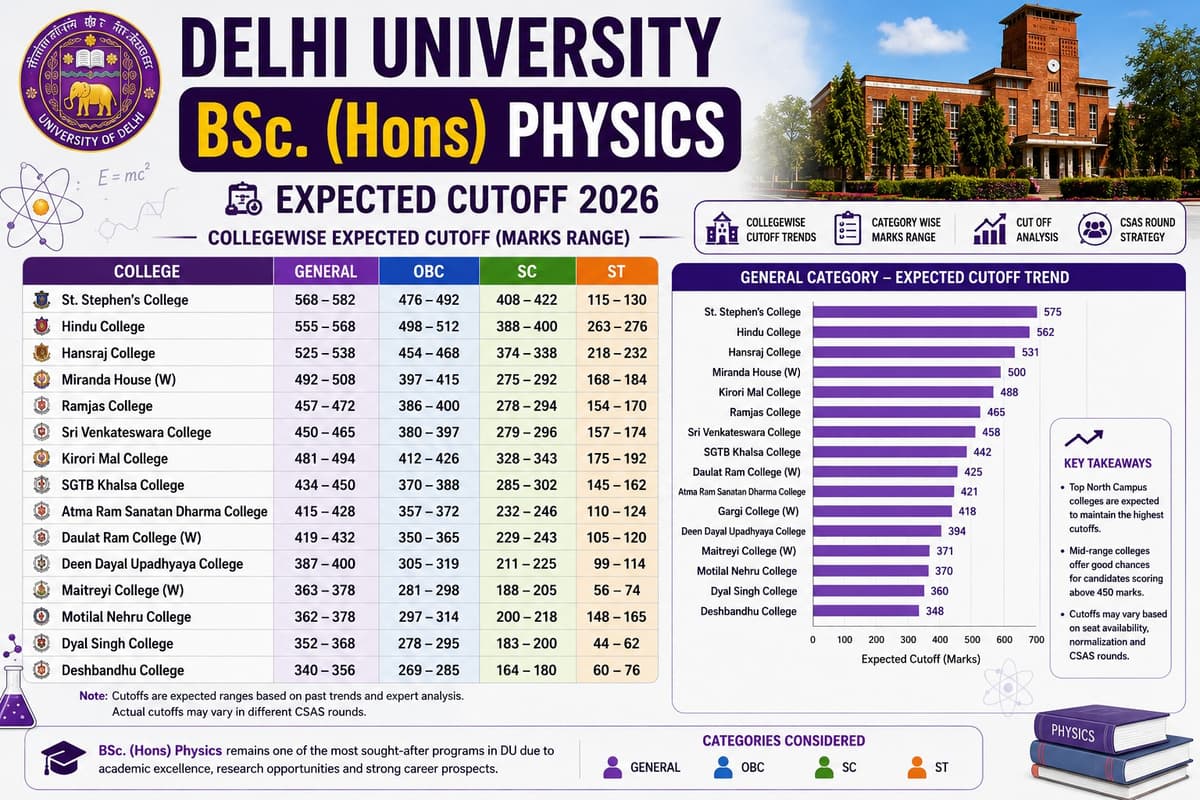
Top DU colleges are expected to maintain high BSc (Hons) Physics cutoff scores in 2026. Colleges like St. Stephen’s College, Hindu College, Hansraj College, and Miranda House may continue recording competitive DU Physics cutoffs across categories. SC and ST cutoff scores may vary depending on seat availability and later CSAS allocation rounds.
| College | General | OBC | SC | ST |
|---|---|---|---|---|
| St. Stephen's College | 568–582 | 476–492 | 408–422 | 115–130 |
| Hindu College | 555–568 | 498–512 | 388–400 | 263–276 |
| Hansraj College | 525–538 | 454–468 | 374–388 | 218–232 |
| Miranda House (W) | 492–508 | 397–415 | 275–292 | 168–184 |
| Ramjas College | 457–472 | 386–400 | 278–294 | 154–170 |
| Sri Venkateswara College | 450–465 | 380–397 | 279–296 | 157–174 |
| Kirori Mal College | 481–494 | 412–426 | 328–343 | 175–192 |
| SGTB Khalsa College | 434–450 | 370–388 | 285–302 | 145–162 |
| Gargi College (W) | 412–424 | 327–341 | 215–229 | 143–158 |
| Atma Ram Sanatan Dharma College | 415–428 | 357–372 | 232–246 | 110–124 |
| Daulat Ram College (W) | 419–432 | 350–365 | 229–243 | 105–120 |
| Deen Dayal Upadhyaya College | 387–400 | 305–319 | 211–225 | 99–114 |
| Maitreyi College (W) | 363–378 | 281–298 | 188–205 | 56–74 |
| Motilal Nehru College | 362–378 | 297–314 | 200–218 | 148–165 |
| Dyal Singh College | 352–368 | 278–295 | 183–200 | 44–62 |
| Deshbandhu College | 340–356 | 269–285 | 164–180 | 60–76 |
| Bhaskaracharya College of Applied Sciences | 347–362 | 262–278 | 174–190 | — |
| Acharya Narendra Dev College | 355–369 | 288–304 | 188–204 | 118–133 |
| Keshav Mahavidyalaya | 335–350 | 252–270 | 172–188 | 70–88 |
| Shivaji College | 330–346 | 246–264 | 163–180 | — |
| Rajdhani College | 321–337 | 246–263 | 157–174 | 45–63 |
| Kalindi College (W) | 317–333 | 242–260 | 139–156 | 81–98 |
| Swami Shraddhanand College | 314–330 | 244–262 | 155–172 | 47–65 |
| Shaheed Rajguru College of Applied Sciences for Women (W) | 270–288 | 210–228 | 128–147 | 25–45 |
| Bhagini Nivedita College (W) | 291–306 | 210–227 | 102–118 | — |
Delhi University First Round Cutoff 2025 for BSc (Hons) Physics
The 2025 first-round cutoff trends clearly show that St. Stephen's College crossed 578 marks and Hindu College remains above 557 marks for the General category. Colleges such as Ramjas College and Sri Venkateswara College also witnessed competitive cutoffs in the 450–470 range, reflecting strong preference among science aspirants. Meanwhile, several off-campus colleges remained comparatively more accessible within the 330–380 mark range.
| College | UR | OBC | SC | ST |
|---|---|---|---|---|
| St. Stephen's College | 578.76 | 486.49 | 418.64 | 124.00 |
| Hindu College | 557.26 | 501.92 | 391.00 | 266.50 |
| Hansraj College | 528.57 | 457.59 | 377.07 | 220.24 |
| Miranda House (W) | 503.67 | 407.08 | 284.14 | 176.45 |
| Ramjas College | 467.04 | 395.85 | 287.65 | 162.98 |
| Sri Venkateswara College | 460.00 | 390.10 | 288.74 | 166.24 |
| Kirori Mal College | 483.60 | 415.03 | 302.82 | 98.28 |
| SGTB Khalsa College | 444.17 | — | — | — |
| Gargi College (W) | 415.10 | 330.20 | 217.20 | 146.10 |
| Atma Ram Sanatan Dharma College | 417.70 | 360.00 | 235.20 | 113.60 |
| Daulat Ram College (W) | 421.40 | 353.10 | 232.30 | 108.00 |
| Deen Dayal Upadhyaya College | 389.08 | 308.21 | 214.05 | 102.55 |
| Maitreyi College (W) | 372.96 | 289.89 | 196.88 | 63.96 |
| Motilal Nehru College | 370.84 | 305.95 | 209.00 | 155.54 |
| Dyal Singh College | 361.92 | 286.72 | 191.61 | 52.48 |
| Deshbandhu College | 349.84 | 278.36 | 173.47 | 68.34 |
| Bhaskaracharya College of Applied Sciences | 349.00 | 265.00 | 177.10 | — |
| Acharya Narendra Dev College | 357.40 | 291.10 | 191.70 | 120.90 |
| Keshav Mahavidyalaya | 343.69 | 260.66 | 180.84 | 78.87 |
| Shivaji College | 339.64 | 255.31 | 172.11 | 11.93 |
| Rajdhani College | 330.61 | 254.97 | 165.54 | 53.39 |
| Kalindi College (W) | 326.69 | 251.27 | 147.67 | 89.12 |
| Swami Shraddhanand College | 323.68 | 253.47 | 164.17 | 55.19 |
| Shaheed Rajguru College of Applied Sciences for Women (W) | 317.06 | 232.97 | 128.82 | — |
| Bhagini Nivedita College (W) | 293.30 | 213.50 | 105.50 | — |
Note: Extremely low cutoffs at Shivaji College ST cutoff of 11.93 marks and Dyal Singh College ST cutoff at 52.48 marks were mainly recorded due to vacant category-specific seats in later allocation rounds.
Delhi University Final Round Cutoff 2025 for BSc (Hons) Physics
The final allocation data for BSc (Hons) Physics at DU shows that top colleges continued to have high cutoffs even in the last CSAS rounds. Hindu College recorded one of the highest UR closing scores at 547.44 marks, while several mid-tier colleges closed between 340–440 marks. Lower closing scores in colleges like Bhagini Nivedita College reflected vacant seats and seat reshuffling during later rounds.
| College | UR | OBC | SC | ST |
|---|---|---|---|---|
| St. Stephen's College | 522.19 | — | — | — |
| Hindu College | 547.44 | 404.63 | — | — |
| Kirori Mal College | 438.05 | 372.54 | 306.89 | 66.50 |
| Kalindi College (W) | 401.73 | 173.99 | 79.40 | 160.28 |
| Bhaskaracharya College of Applied Sciences | 435.90 | 237.30 | 98.40 | — |
| Atma Ram Sanatan Dharma College | 415.10 | — | — | — |
| Deshbandhu College | 389.78 | 295.04 | 132.50 | — |
| Sri Venkateswara College | 368.92 | — | — | — |
| Dyal Singh College | 369.80 | 230.38 | — | — |
| Deen Dayal Upadhyaya College | 357.47 | — | — | — |
| Acharya Narendra Dev College | 352.50 | 309.10 | 213.40 | — |
| Swami Shraddhanand College | 348.10 | 237.41 | 135.31 | — |
| Daulat Ram College (W) | 364.70 | 280.90 | — | — |
| Gargi College (W) | 341.38 | — | — | 160.86 |
| SGTB Khalsa College | 328.90 | — | — | — |
| Keshav Mahavidyalaya | 317.86 | 126.91 | 307.43 | — |
| Shaheed Rajguru College of Applied Sciences for Women (W) | 276.32 | 144.01 | — | — |
| Motilal Nehru College | 277.39 | — | — | — |
| Bhagini Nivedita College (W) | 234.50 | 130.80 | 117.50 | 119.30 |
What About the Spot Round?
The Spot Round is conducted after the final CSAS allocation round to fill vacant seats across DU colleges. In B.Sc. (Hons.) Physics Spot Round 2025, Acharya Narendra Dev College recorded comparatively lower cutoff scores, with the OBC cutoff dropping to nearly 158.6 marks due to limited seat demand and vacant category-wise seats. Spot Round cutoffs are usually independent of earlier rounds and may vary significantly depending on seat availability across colleges. However, top DU colleges usually have limited or no vacant seats available during the Spot Round process.
More information: Delhi University Spot Round Cutoff PDF 2025
What is a Safe CUET Score for Delhi University BSc (Hons) Physics Admission?
A safe CUET score depends on your target college tier:
| CUET Score Range | Expected Colleges for BSc (Hons) Physics Admission |
| 500+ marks | St. Stephen's College, Hindu College, Hansraj College |
| 420–500 marks | Miranda House, Kirori Mal College, Sri Venkateswara College, Ramjas College, Gargi College |
| 330–420 marks | Maitreyi College, Motilal Nehru College, Deshbandhu College |
| Below 330 marks | Kalindi College, Swami Shraddhanand College, Shaheed Rajguru College of Applied Sciences for Women |
CUET Subject Combination Required in Delhi University for BSc (Hons) Physics 2026
To apply for BSc (Hons) Physics at Delhi University, candidates must appear in:
- One Language paper (any from CUET List A)
- Physics (Compulsory)
- Chemistry (Compulsory)
- Mathematics / Applied Mathematics (Compulsory)
Merit is calculated based on the Physics, Chemistry, and Mathematics/Applied Mathematics scores in CUET UG (total out of 750 marks), after normalisation, where applicable.
Delhi University Admission & Cutoff Resources
- Delhi University Round 1 Cutoff PDF 2025
- Delhi University Final Round Cutoff PDF 2025
- DU CSAS Portal
- DU Admission Portal
- CUET UG Official Website
Frequently Asked Questions
Ques. Is getting admission in DU for BSc (Hons) Physics difficult?
Ans. Yes, admission to BSc (Hons) Physics at University of Delhi is competitive, especially in top colleges. Students usually need a high CUET score for admission in the first CSAS rounds. However, some colleges may have slightly lower cutoffs in later rounds.
Ques. What is the minimum CUET score required for Delhi University BSc (Hons) Physics?
Ans. For Delhi University BSc (Hons) Physics, a score above 500 is required for top colleges such as Hindu College and Hansraj. Mid-tier colleges like Daulat Ram and Deen Dayal Upadhyaya typically accept scores in the 380–420 range for General category students.
Ques. Does the Delhi University BSc (Hons) Physics cutoff decrease in later CSAS rounds?
Ans. For lower-tier Delhi University colleges, Physics cutoffs can drop modestly in Round 3 due to seat reshuffling. However, top colleges like Hindu and Hansraj fill their Physics seats in Round 1, with little or no carryover to later rounds.
Ques. Is board percentage considered for Delhi University BSc (Hons) Physics admission alongside CUET?
Ans. No. For Delhi University BSc (Hons) Physics admission, only CUET UG scores are considered for merit-based allocation. Class 12 board marks are referred to only in rare cases of a tie between two candidates with identical CUET scores.
Ques. Can candidates secure admission to the BSc (Hons) Physics at Delhi University with a CUET score of 350 - 380?
Ans. Yes, a CUET score of 350–380 can still secure BSc (Hons) Physics admission at Delhi University colleges like Deshbandhu, Acharya Narendra Dev, and Bhagini Nivedita, particularly for OBC, SC, and ST category students, in the later counselling rounds.
Ques. What happens to the Delhi University BSc (Hons) Physics cutoff if the CUET paper is difficult?
Ans. If the CUET paper is tougher in a given year, raw scores across all students fall, which generally lowers the Delhi University BSc (Hons) Physics cutoff. Normalisation also plays a role in adjusting scores across different exam shifts fairly.







Comments