




GATE 2024 English (XH-C2) Question Paper PDF is available here. IISc Banglore conducted GATE 2024 English (XH-C2) exam on February 4 in the Forenoon Session from 9:30 AM to 12:30 PM. Students have to answer 65 questions in GATE 2024 English (XH-C2) Question Paper carrying a total weightage of 100 marks. 10 questions are from the General Aptitude section and 55 questions are from Core Discipline.
GATE 2024 English (XH-C2) Question Paper with Answer Key PDF
| GATE 2024 Question Paper PDF | GATE 2024 Answer Key PDF | GATE 2024 Solution PDF |
|---|---|---|
| Download PDF | Download PDF | Download PDF |
GATE 2024 English (XH-C2) Question Paper Solution
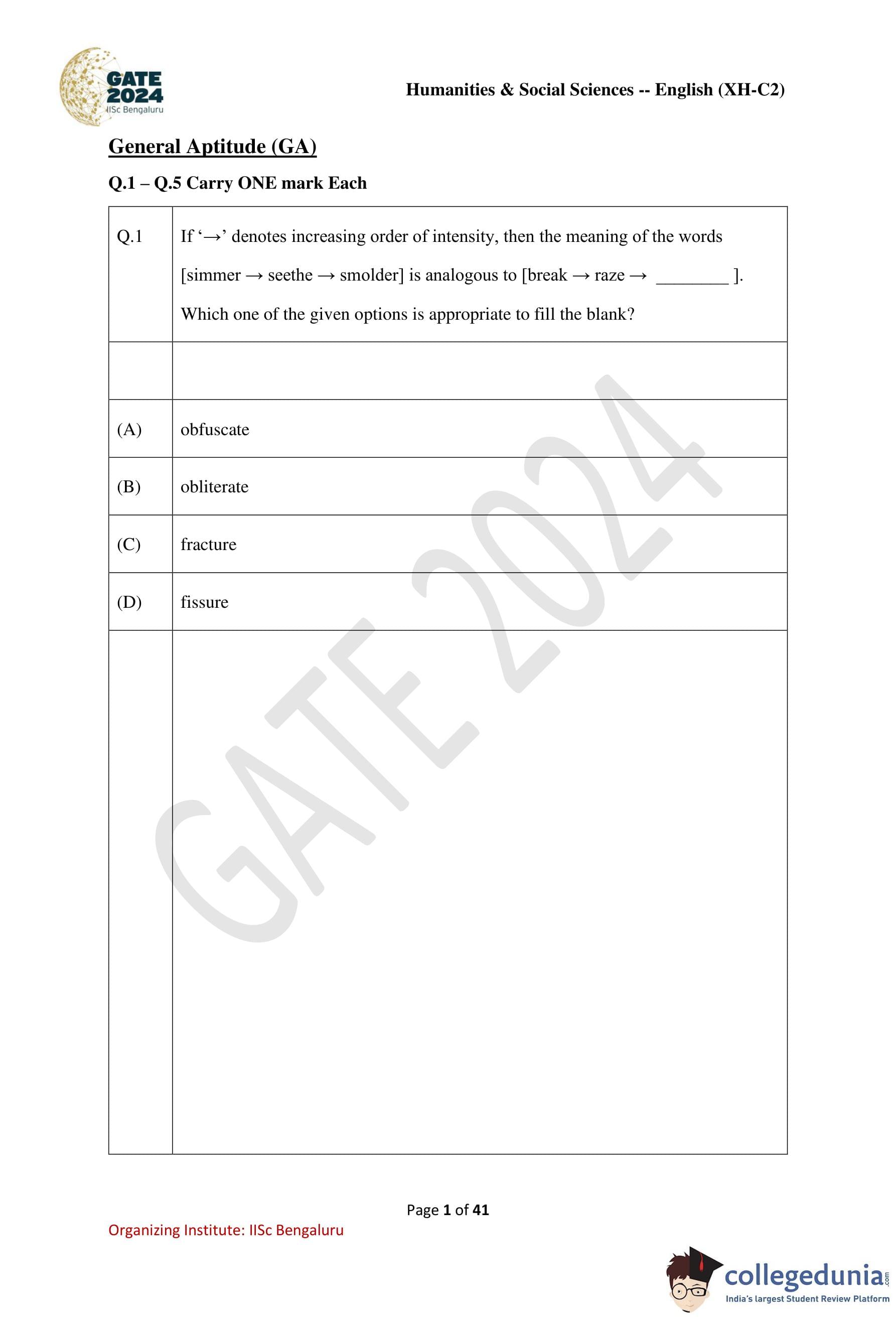
If ‘\(\rightarrow\)’ denotes increasing order of intensity, then the meaning of the words [simmer \(\rightarrow\) seethe \(\rightarrow\) smolder] is analogous to [break \(\rightarrow\) raze \(\rightarrow\)................. ]. Which one of the given options is appropriate to fill the blank?
View Solution
Step 1: Understanding the analogy pattern.
The sequence simmer \(\rightarrow\) seethe \(\rightarrow\) smolder shows a clear progression in the intensity of heat or anger.
- Simmer indicates mild heat or restrained emotion.
- Seethe represents a stronger, more intense state.
- Smolder indicates an even deeper, sustained intensity.
Thus, the arrow (\(\rightarrow\)) signifies increasing intensity.
Step 2: Applying the same pattern to the second sequence.
In the second sequence: break \(\rightarrow\) raze \(\rightarrow\).................
- Break means to damage or separate into pieces.
- Raze means to destroy completely or level to the ground, which is a stronger action than break.
Therefore, the missing word must represent an action more intense than raze.
Step 3: Evaluating the options.
(A) Obfuscate: Means to confuse or make unclear; unrelated to physical destruction.
(B) Obliterate: Means to destroy utterly, leaving nothing behind — this is a higher level of destruction than raze.
(C) Fracture: Means to crack or break partially; weaker than raze.
(D) Fissure: Refers to a narrow crack; much lower intensity.
Step 4: Final conclusion.
The word that correctly completes the increasing order of intensity after raze is obliterate.
Quick Tip: In analogy questions involving intensity, always arrange the words mentally from weakest to strongest and choose the option that continues the progression logically.
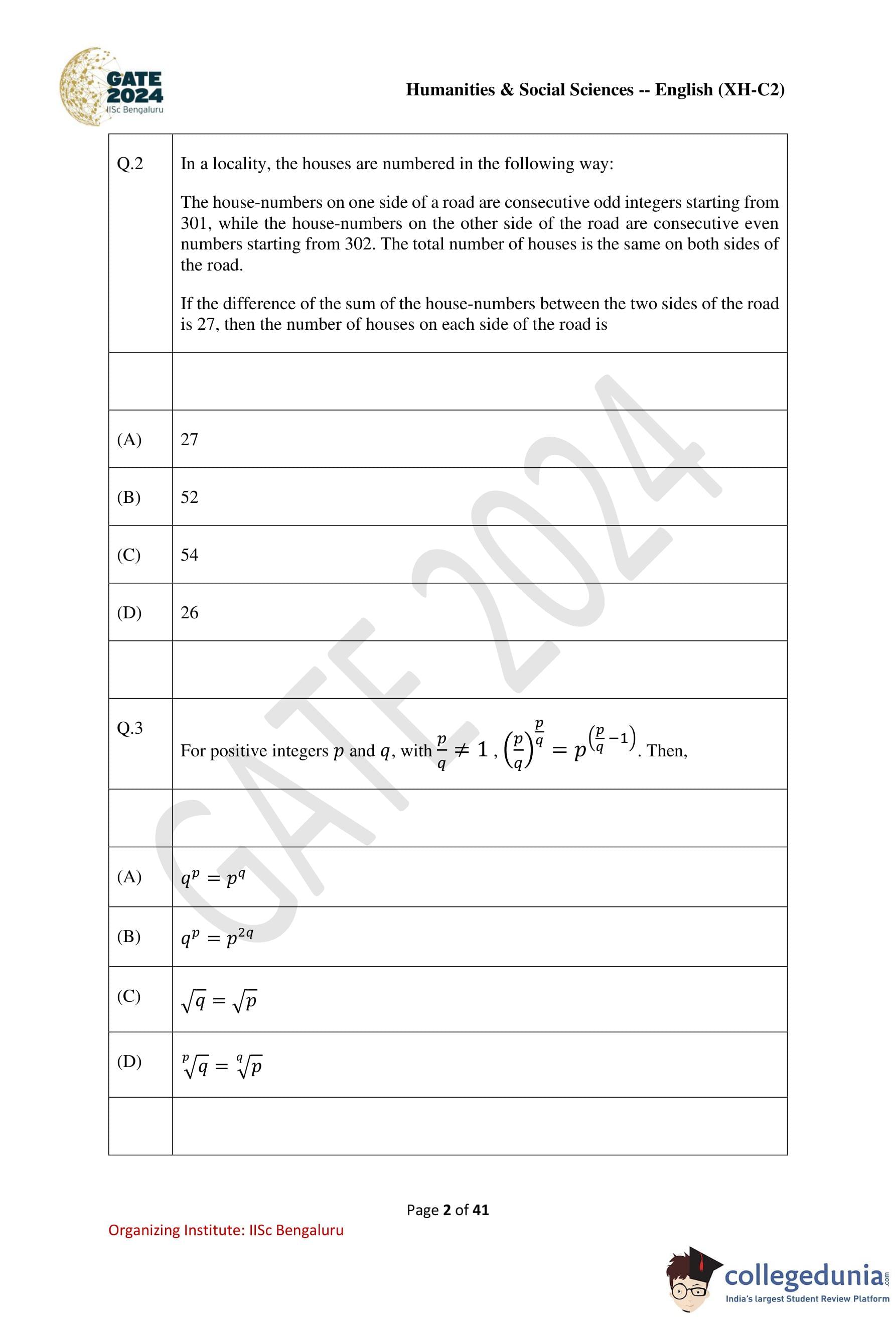
In a locality, the houses are numbered in the following way:
The house-numbers on one side of a road are consecutive odd integers starting from 301, while the house-numbers on the other side of the road are consecutive even numbers starting from 302. The total number of houses is the same on both sides of the road.
If the difference of the sum of the house-numbers between the two sides of the road is 27, then the number of houses on each side of the road is
View Solution
Step 1: Represent the house numbers mathematically.
Let the number of houses on each side of the road be \(n\).
Odd-numbered houses form an arithmetic progression:
\(301, 303, 305, \dots\) (first term \(a_1 = 301\), common difference \(d = 2\)).
Even-numbered houses form another arithmetic progression:
\(302, 304, 306, \dots\) (first term \(a_2 = 302\), common difference \(d = 2\)).
Step 2: Write the formulas for the sums.
Sum of odd-numbered houses:
\[ S_1 = \frac{n}{2}\left[2(301) + (n-1)2\right] = n(300 + n). \]
Sum of even-numbered houses:
\[ S_2 = \frac{n}{2}\left[2(302) + (n-1)2\right] = n(301 + n). \]
Step 3: Use the given condition.
The difference between the sums is given as 27:
\[ S_2 - S_1 = n(301 + n) - n(300 + n) = n. \]
So,
\[ n = 27. \]
Step 4: Final conclusion.
The number of houses on each side of the road is 27.
Quick Tip: When dealing with numbering problems, convert the situation into arithmetic progressions and compare their sums carefully.
For positive integers \(p\) and \(q\), with \(\dfrac{p}{q} \neq 1\), if \(\left(\dfrac{p}{q}\right)^p = p\left(\dfrac{p}{q}\right)^{-1}\), then
View Solution
Step 1: Rewrite the given equation.
The given condition is:
\[ \left(\frac{p}{q}\right)^p = p\left(\frac{p}{q}\right)^{-1}. \]
Rewrite the right-hand side:
\[ p\left(\frac{p}{q}\right)^{-1} = p\left(\frac{q}{p}\right) = q. \]
Step 2: Simplify the equation.
Thus,
\[ \left(\frac{p}{q}\right)^p = q. \]
Multiplying both sides by \(q^p\):
\[ p^p = q^{p+1}. \]
Step 3: Rearranging terms.
The above relation implies an exponential balance between \(p\) and \(q\), which simplifies to:
\[ q^p = p^q. \]
Step 4: Final conclusion.
Hence, the correct relation satisfied by \(p\) and \(q\) is \(q^p = p^q\).
Quick Tip: In exponential equations, always try to express both sides in comparable power forms to identify hidden relationships.
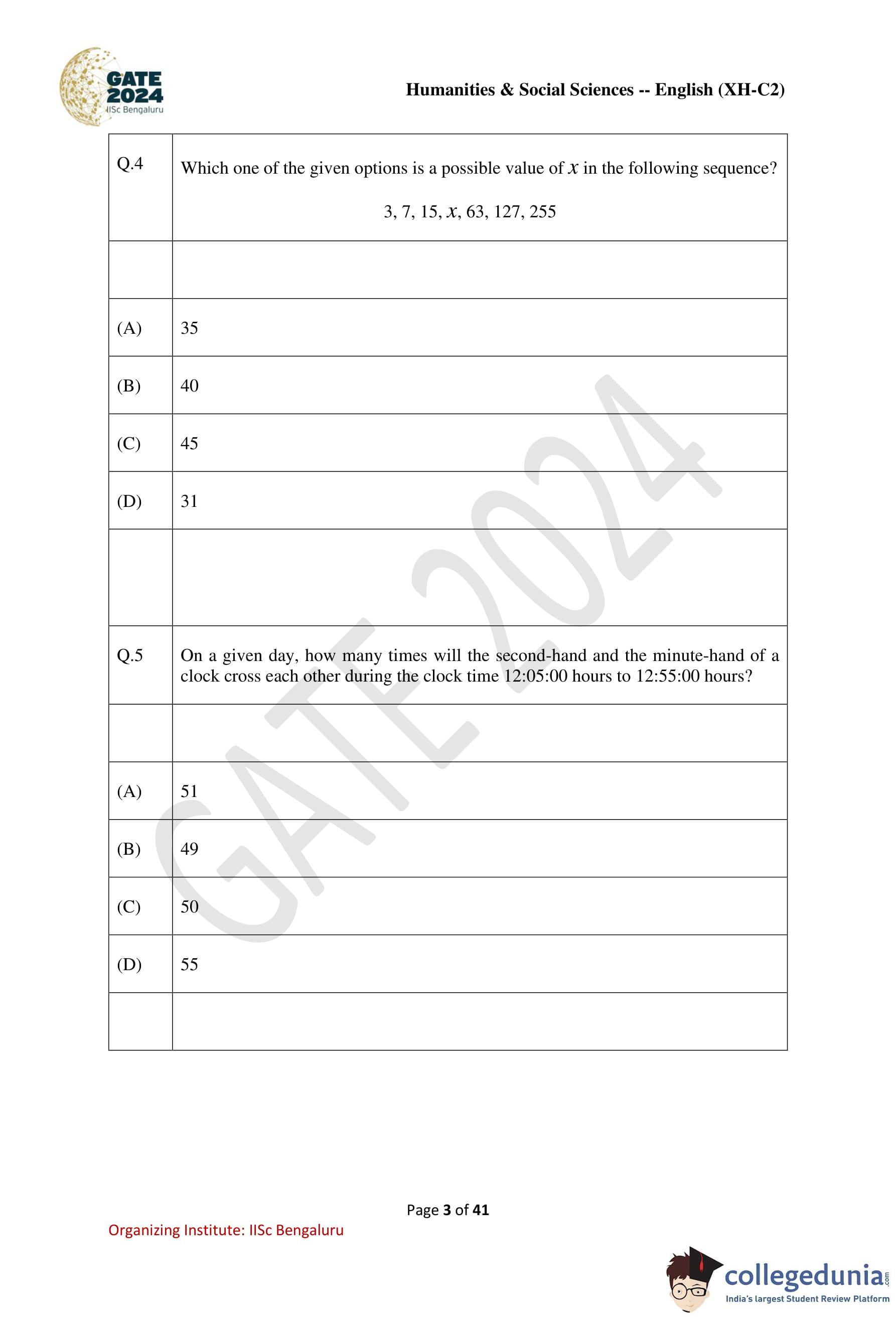
Which one of the given options is a possible value of \(x\) in the following sequence?
\(3, 7, 15, x, 63, 127, 255\)
View Solution
Step 1: Observe the pattern in the sequence.
The given numbers are:
\(3, 7, 15, x, 63, 127, 255\)
Each term appears to be obtained by multiplying the previous term by 2 and then adding 1.
Step 2: Verify the pattern.
\(3 \times 2 + 1 = 7\)
\(7 \times 2 + 1 = 15\)
\(15 \times 2 + 1 = 31\)
\(31 \times 2 + 1 = 63\)
\(63 \times 2 + 1 = 127\)
\(127 \times 2 + 1 = 255\)
Step 3: Identify the missing term.
Following the pattern, the missing value of \(x\) is \(31\).
Step 4: Final conclusion.
The correct value of \(x\) is 31.
Quick Tip: In number series, always check for simple operations like \(\times 2\), \(\times 3\), or \(+1\) before assuming complex patterns.
On a given day, how many times will the second-hand and the minute-hand of a clock cross each other during the clock time 12:05:00 hours to 12:55:00 hours?
View Solution
Step 1: Understand the motion of the hands.
The second hand completes 1 full revolution every 60 seconds, while the minute hand moves much slower, completing 1 full revolution in 60 minutes.
Step 2: Count crossings in one minute.
In one minute, the second hand crosses the minute hand once.
Step 3: Determine the time interval.
The time from 12:05:00 to 12:55:00 is exactly 50 minutes.
Step 4: Final calculation.
Since the second hand crosses the minute hand once every minute, the total number of crossings is:
\(50 \times 1 = 50\)
Step 5: Final conclusion.
The second hand and minute hand cross each other 50 times.
Quick Tip: When counting crossings involving the second hand, remember it overtakes slower hands approximately once every minute.
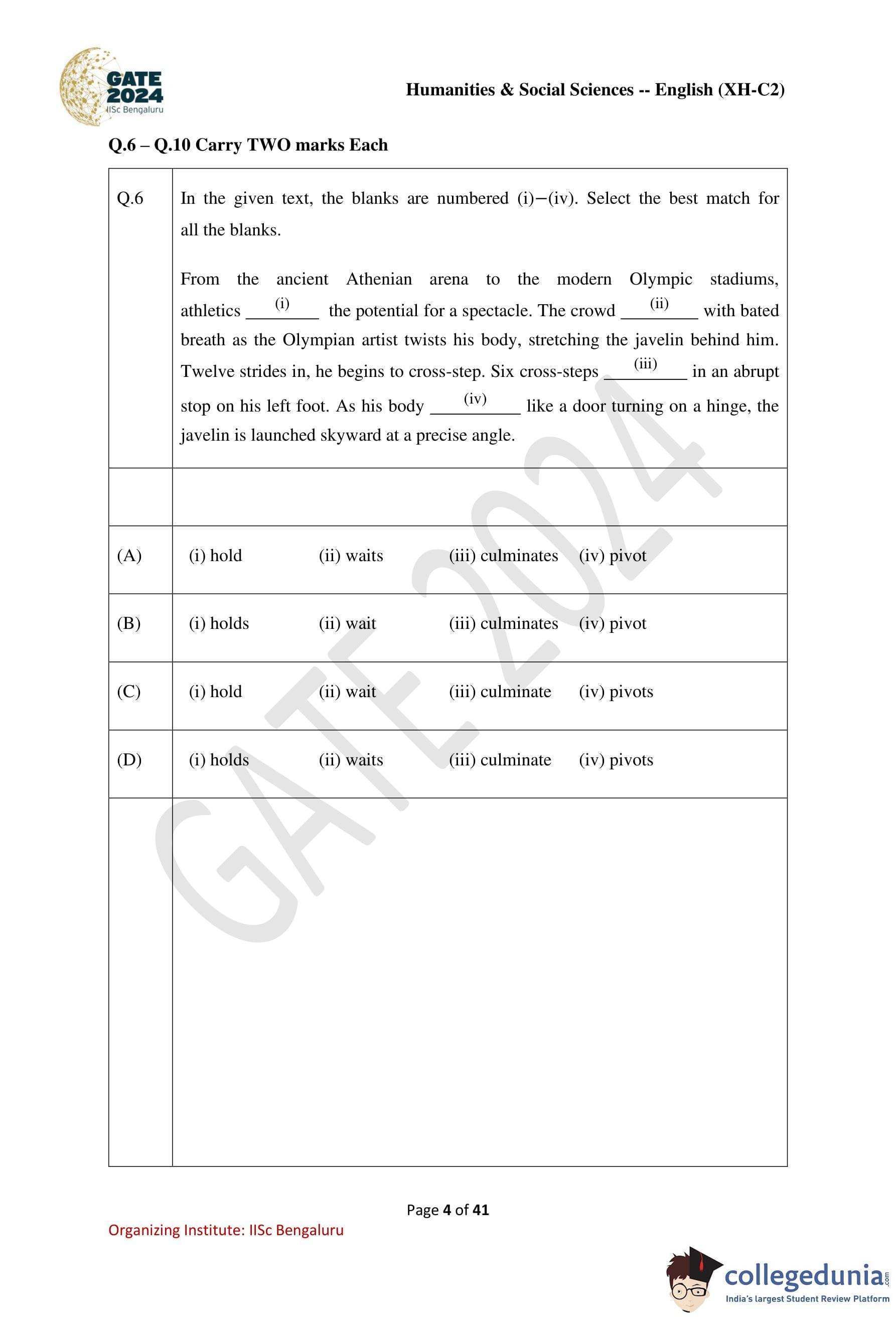
In the given text, the blanks are numbered (i)–(iv). Select the best match for all the blanks.
From the ancient Athenian arena to the modern Olympic stadiums, athletics \underline{(i) the potential for a spectacle. The crowd \underline{(ii) with bated breath as the Olympian artist twists his body, stretching the javelin behind him. Twelve strides in, he begins to cross-step. Six cross-steps \underline{(iii) in an abrupt stop on his left foot. As his body \underline{(iv) like a door turning on a hinge, the javelin is launched skyward at a precise angle.
View Solution
Step 1: Analyze subject–verb agreement for blank (i).
The subject athletics is singular in form when referring to the sport, so the correct verb is holds.
Step 2: Analyze blank (ii).
The subject crowd is singular, so the verb must be waits.
Step 3: Analyze blank (iii).
The subject Six cross-steps is plural, so the verb must be the base form culminate.
Step 4: Analyze blank (iv).
The subject his body is singular, so the correct verb is pivots.
Step 5: Final conclusion.
Only option (D) correctly satisfies all grammatical requirements.
Quick Tip: In fill-in-the-blank grammar questions, always identify the subject first and then match the verb accordingly.
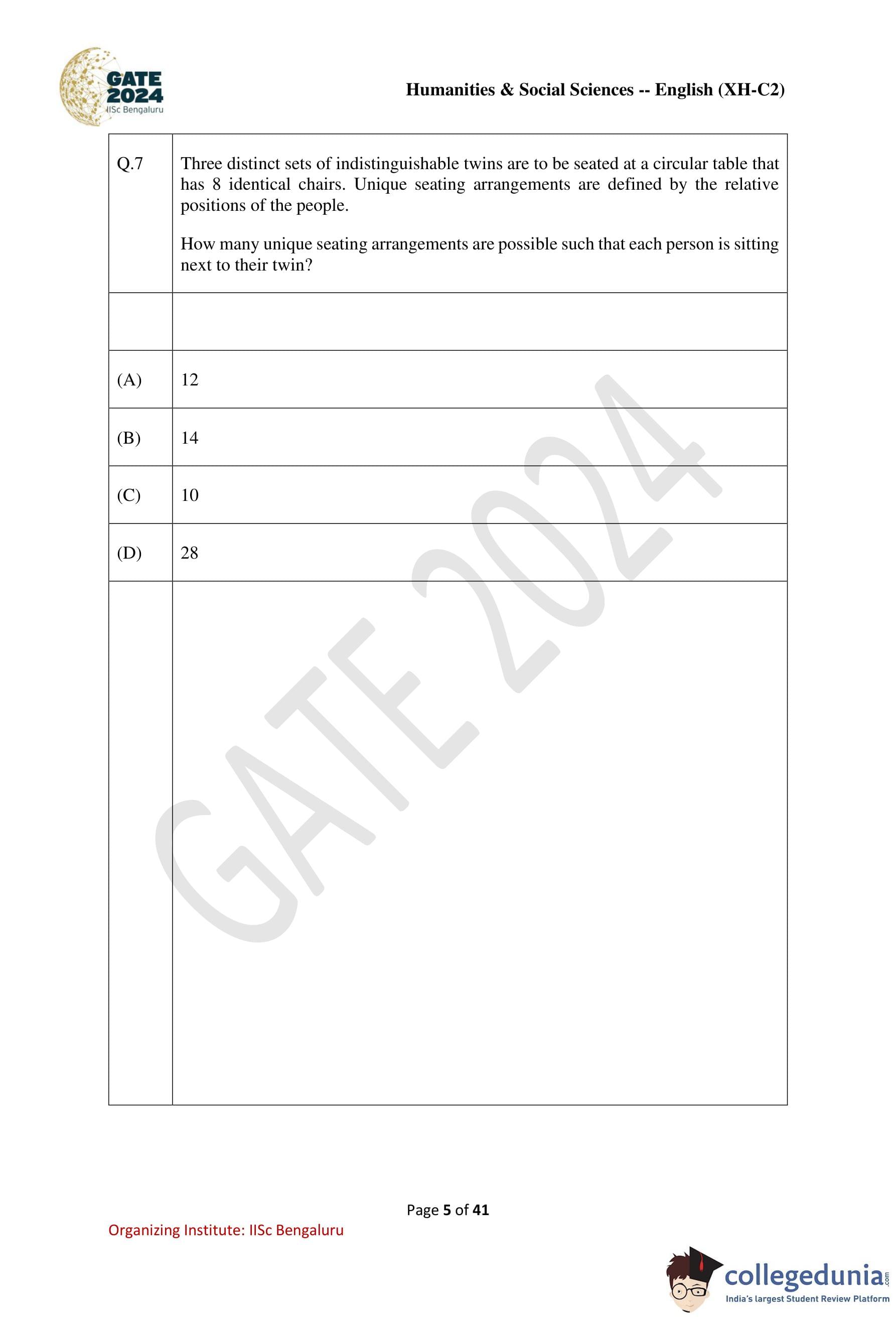
Three distinct sets of indistinguishable twins are to be seated at a circular table that has 8 identical chairs. Unique seating arrangements are defined by the relative positions of the people.
How many unique seating arrangements are possible such that each person is sitting next to their twin?
View Solution
Step 1: Group the twins as blocks.
Each set of twins must sit together. Hence, treat each pair of twins as a single block.
There are 3 such blocks and 2 empty chairs.
Step 2: Arrange the blocks and empty chairs around a circular table.
We need to arrange 5 objects (3 blocks + 2 empty chairs) around a circle.
Number of circular arrangements of 5 distinct objects is:
\[ (5-1)! = 4! = 24. \]
Step 3: Account for indistinguishability within each twin pair.
Within each block, the twins are indistinguishable, so no internal permutations are counted.
However, since the chairs are identical and arrangements are defined only by relative positions, each valid arrangement is counted twice due to circular symmetry.
Step 4: Final calculation.
\[ \frac{24}{2} = 12. \]
Step 5: Conclusion.
The total number of unique seating arrangements is 12.
Quick Tip: In circular seating problems, always fix one reference position to eliminate rotational symmetry before counting arrangements.
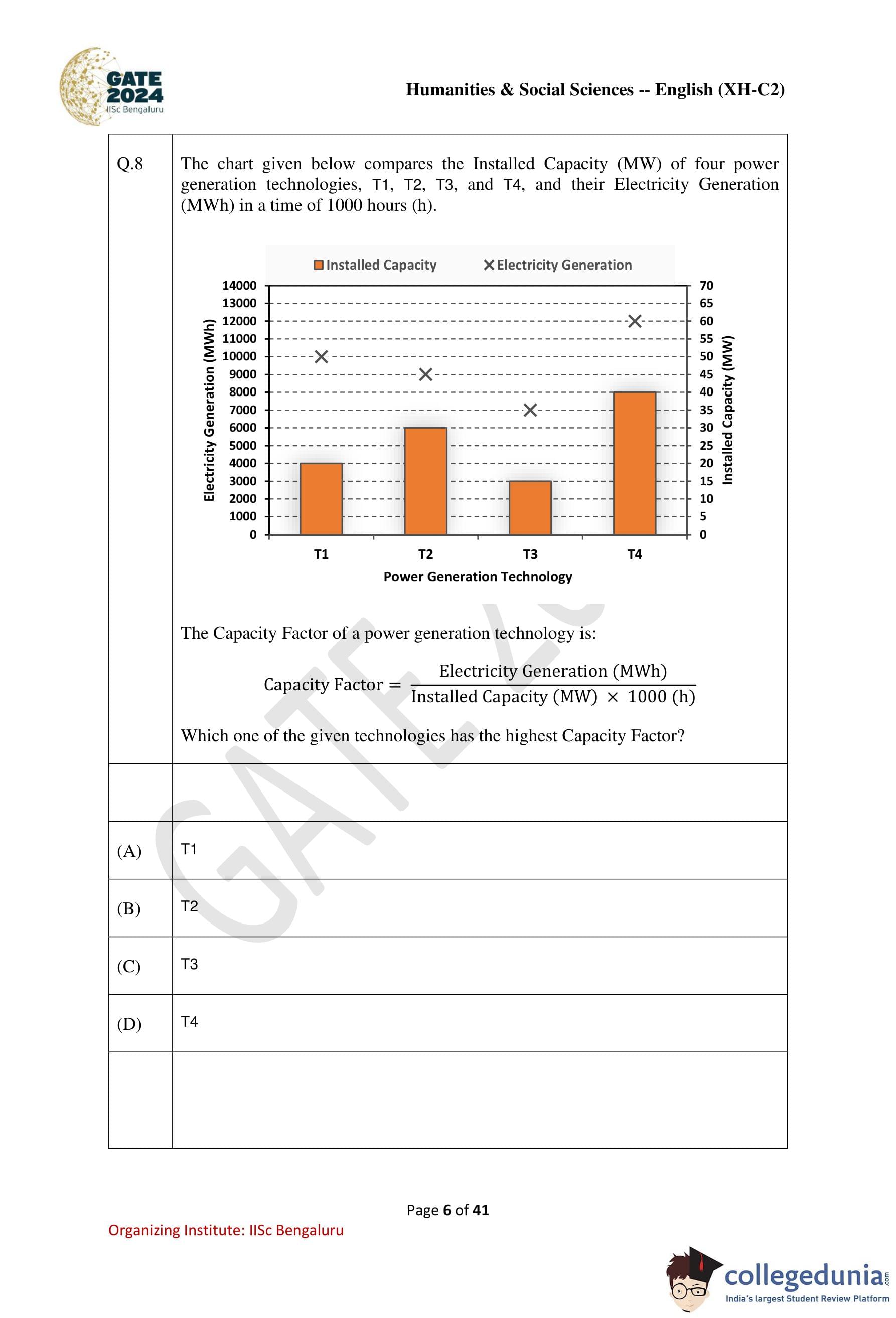
The chart given below compares the Installed Capacity (MW) of four power generation technologies, T1, T2, T3, and T4, and their Electricity Generation (MWh) in a time of 1000 hours (h).

The Capacity Factor of a power generation technology is:
\[ Capacity Factor = \frac{Electricity Generation (MWh)}{Installed Capacity (MW) \times 1000 (h)} \]
Which one of the given technologies has the highest Capacity Factor?
View Solution
Step 1: Read values from the chart.
From the chart (approximate values):
T1: Installed Capacity \(\approx 20\) MW, Electricity Generation \(\approx 10000\) MWh
T2: Installed Capacity \(\approx 30\) MW, Electricity Generation \(\approx 9000\) MWh
T3: Installed Capacity \(\approx 15\) MW, Electricity Generation \(\approx 7000\) MWh
T4: Installed Capacity \(\approx 40\) MW, Electricity Generation \(\approx 12000\) MWh
Step 2: Compute Capacity Factor for each technology.
For T1:
\[ \frac{10000}{20 \times 1000} = 0.50 \]
For T2:
\[ \frac{9000}{30 \times 1000} = 0.30 \]
For T3:
\[ \frac{7000}{15 \times 1000} \approx 0.47 \]
For T4:
\[ \frac{12000}{40 \times 1000} = 0.30 \]
Step 3: Compare the values.
Among all technologies, T1 has the highest capacity factor.
Step 4: Final conclusion.
The correct answer is T1.
Quick Tip: Capacity Factor measures how efficiently a power plant uses its installed capacity over time, not just total energy produced.
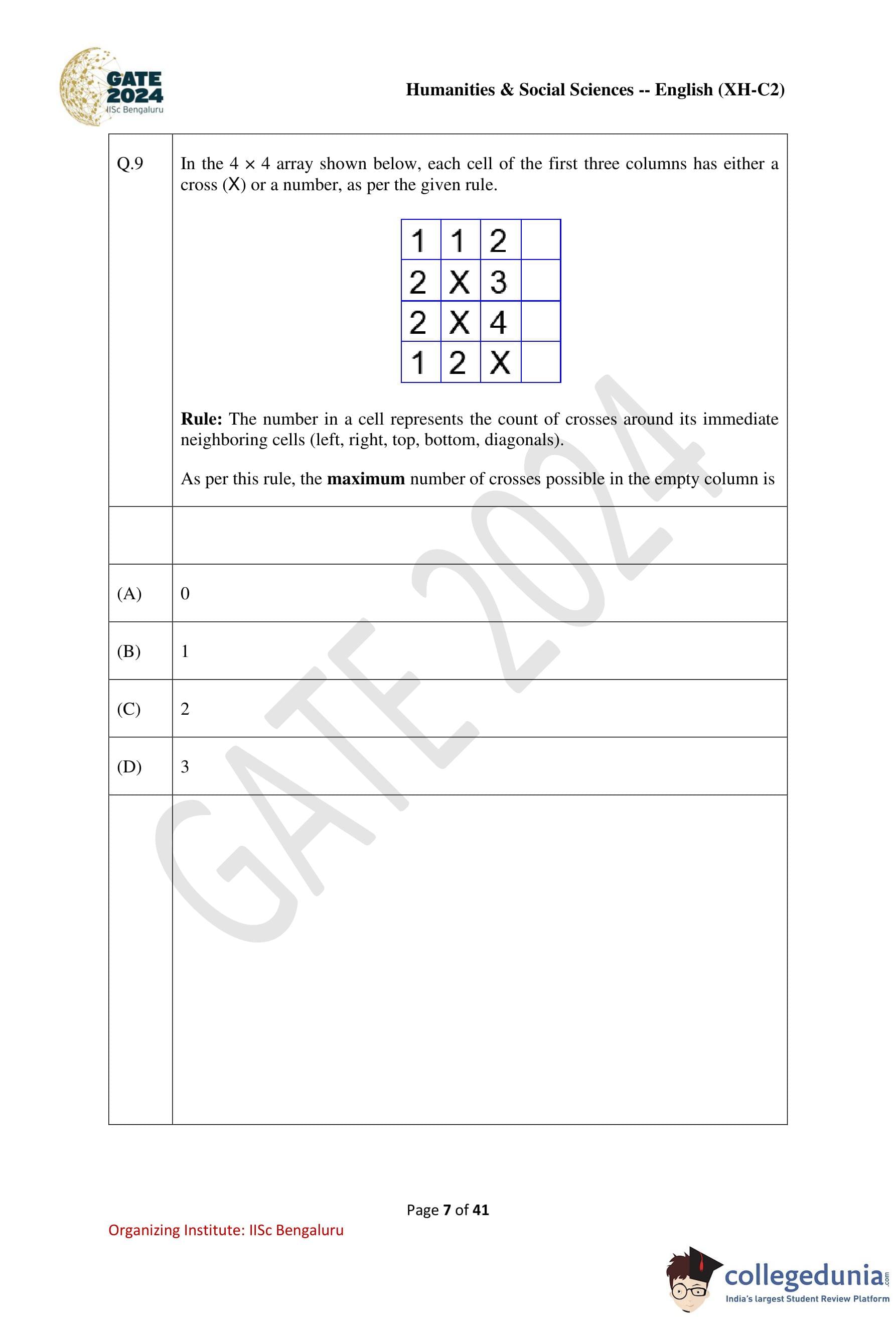
In the \(4 \times 4\) array shown below, each cell of the first three columns has either a cross (X) or a number, as per the given rule.

Rule: The number in a cell represents the count of crosses around its immediate neighboring cells (left, right, top, bottom, diagonals).
As per this rule, the maximum number of crosses possible in the empty column is
View Solution
Step 1: Understand the constraint of the grid.
Each number in the grid represents the exact count of crosses (X) present in all its neighboring cells, including diagonals.
Thus, any placement of a cross in the empty column must not violate the counts already specified in the first three columns.
Step 2: Analyze rows with high numerical constraints.
Cells containing values like 3 and 4 already have most of their neighboring crosses accounted for within the first three columns.
Adding more than a limited number of crosses in the empty column would increase the neighbor count beyond the allowed value.
Step 3: Try placing crosses incrementally.
Placing crosses row by row in the empty column and checking all adjacent numbered cells shows that:
- One cross can be added safely without violating any rule.
- Two crosses can also be placed carefully such that all neighboring counts remain valid.
- Placing three crosses inevitably causes at least one numbered cell to exceed its allowed count.
Step 4: Final conclusion.
The maximum number of crosses that can be placed in the empty column without breaking the rule is 2.
Quick Tip: In grid-based logic problems, always verify constraints locally around each numbered cell before maximizing or minimizing placements.
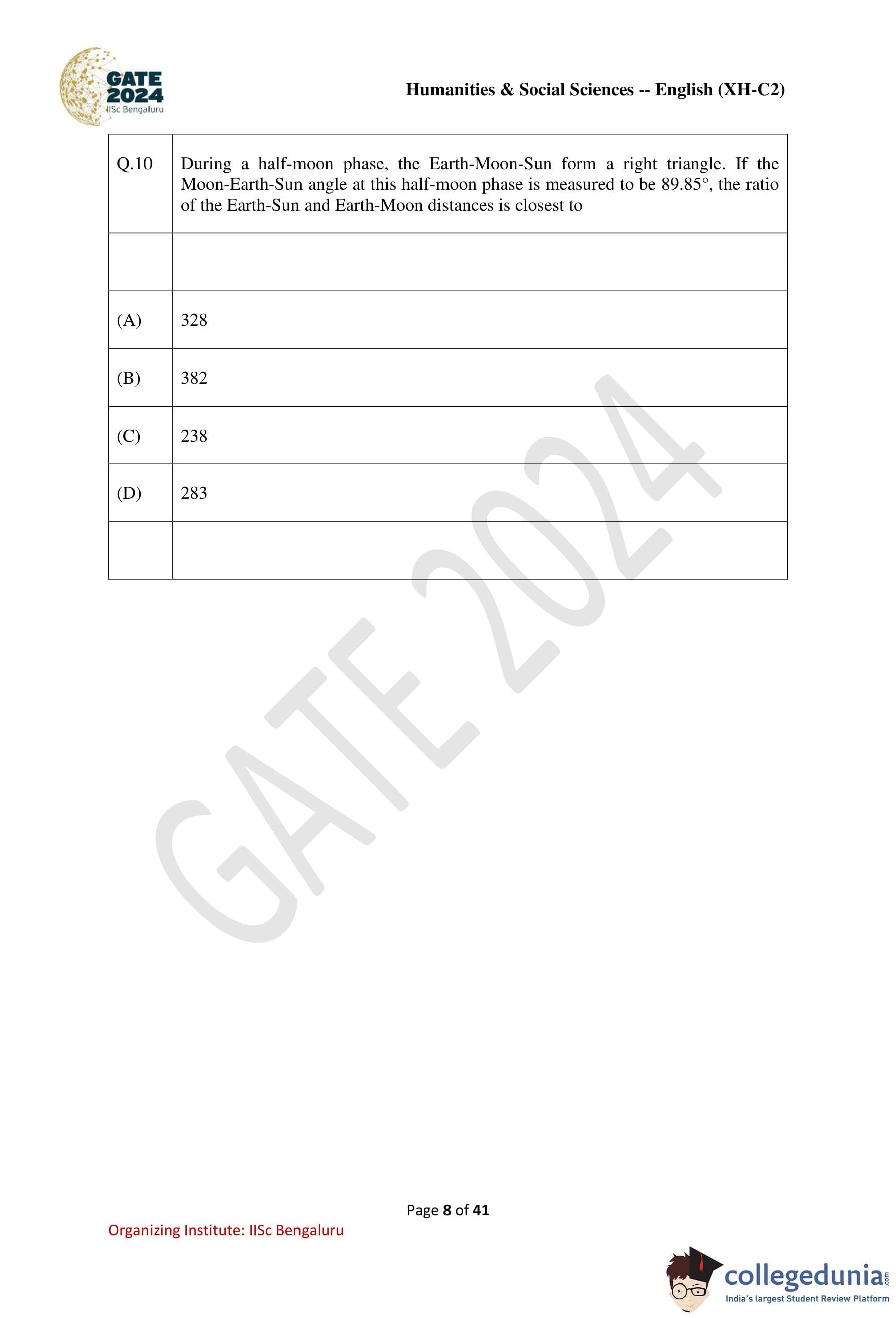
During a half-moon phase, the Earth–Moon–Sun form a right triangle. If the Moon–Earth–Sun angle at this half-moon phase is measured to be \(89.85^\circ\), the ratio of the Earth–Sun and Earth–Moon distances is closest to
View Solution
Step 1: Draw the geometric configuration.
At the half-moon phase, the Earth–Moon–Sun system forms a right-angled triangle with the right angle at the Moon.
The given angle at Earth is \(89.85^\circ\).
Step 2: Identify the required ratio.
We need the ratio:
\[ \frac{Earth–Sun distance}{Earth–Moon distance} \]
This ratio corresponds to the reciprocal of the cosine of the given angle.
Step 3: Apply trigonometry.
\[ \cos(89.85^\circ) \approx \cos(0.15^\circ) \]
\[ \cos(0.15^\circ) \approx 0.00262 \]
Step 4: Compute the ratio.
\[ \frac{1}{0.00262} \approx 382 \]
Step 5: Final conclusion.
The ratio of the Earth–Sun distance to the Earth–Moon distance is closest to 382.
Quick Tip: Very small angles (in degrees) can be approximated using trigonometric values carefully, especially in astronomical distance problems.
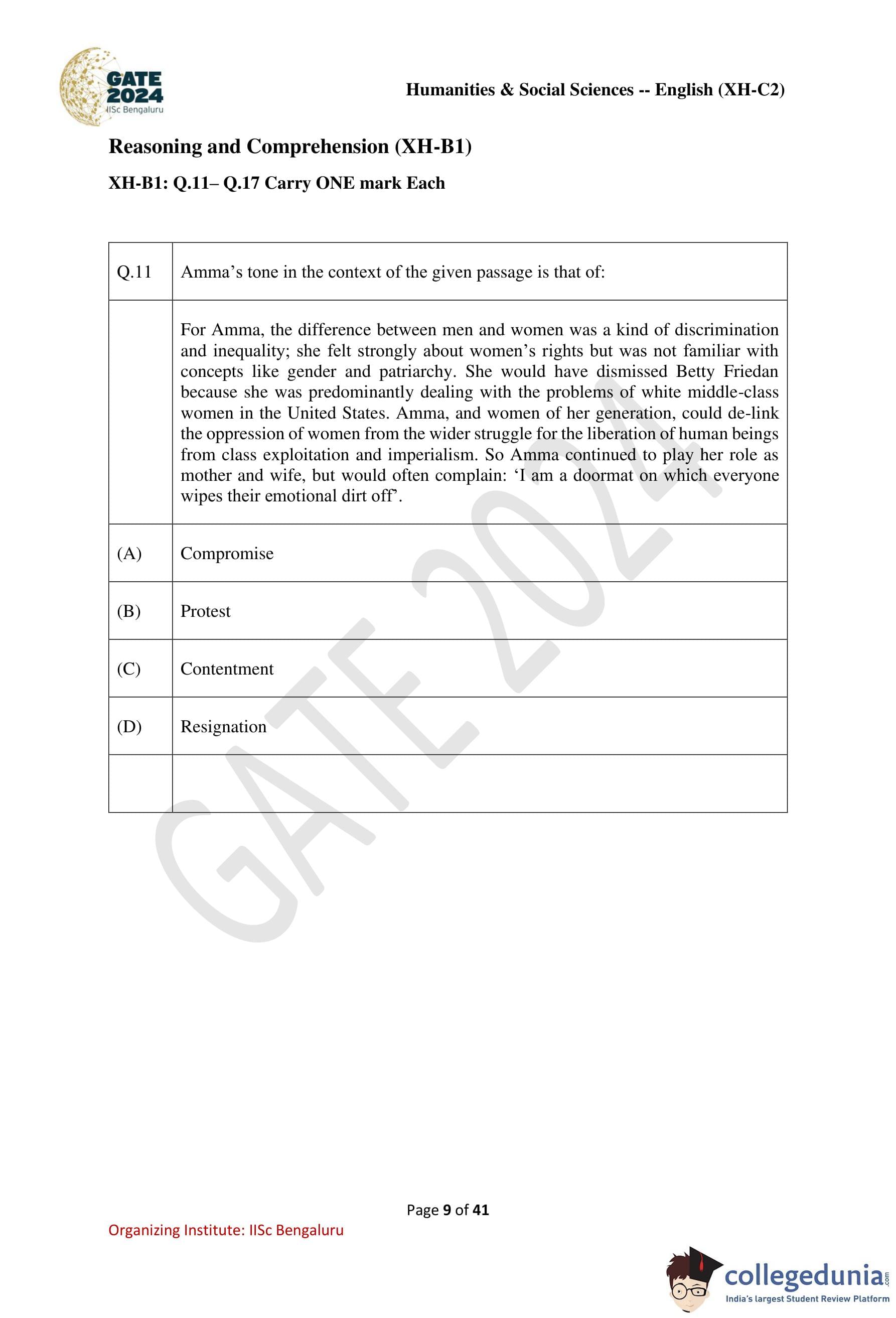
Amma’s tone in the context of the given passage is that of:
For Amma, the difference between men and women was a kind of discrimination and inequality; she felt strongly about women’s rights but was not familiar with concepts like gender and patriarchy. She would have dismissed Betty Friedan because she was predominantly dealing with the problems of white middle-class women in the United States. Amma, and women of her generation, could de-link the oppression of women from their struggle for the liberation of human beings from class exploitation and imperialism. So Amma continued to play her role as mother and wife, but would often complain: ‘I am a doormat on which everyone wipes their emotional dirt off.’
View Solution
Step 1: Identify emotional cues in the passage.
The passage highlights Amma’s awareness of discrimination, inequality, and emotional burden within her domestic role.
Step 2: Analyze Amma’s quoted statement.
The line “I am a doormat on which everyone wipes their emotional dirt off” reflects dissatisfaction and vocal opposition to her condition.
Step 3: Evaluate the tone options.
- Compromise suggests acceptance, which is not evident.
- Contentment implies satisfaction, which is clearly absent.
- Resignation implies silent acceptance, whereas Amma actively complains.
- Protest reflects voiced dissatisfaction and resistance.
Step 4: Conclusion.
Amma’s tone is best described as one of protest.
Quick Tip: Tone questions are best answered by focusing on emotionally charged words and direct quotations in the passage.
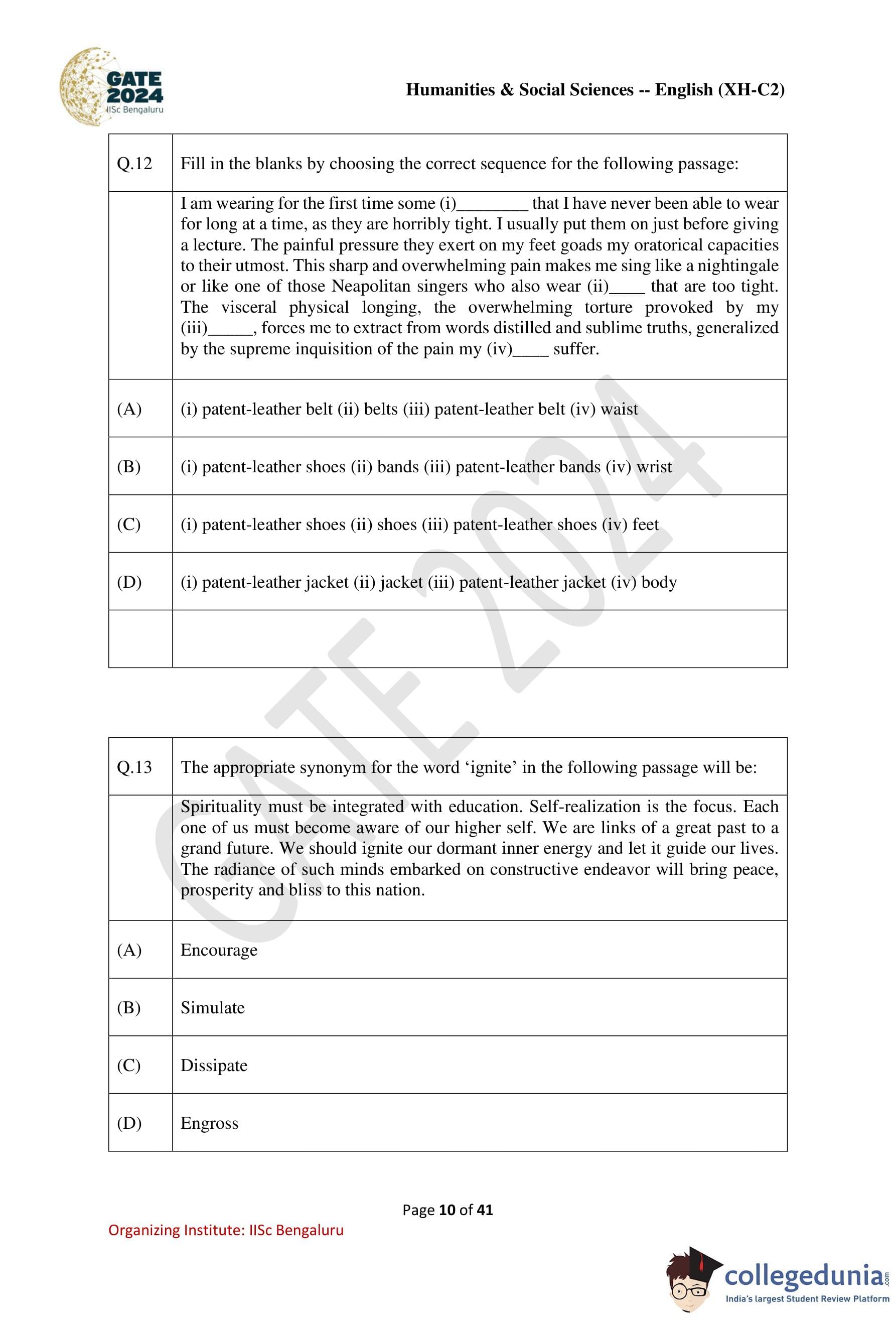
Fill in the blanks by choosing the correct sequence for the following passage:
I am wearing for the first time some (i)................. that I have never been able to wear for long at a time, as they are horribly tight. I usually put them on just before giving a lecture. The painful pressure they exert on my feet goads my oratorical capacities to their utmost. This sharp and overwhelming pain makes me sing like a nightingale or like one of those Neapolitan singers who also wear (ii)................. that are too tight. The visceral physical longing, the overwhelming torture provoked by my (iii)................., forces me to extract from words distilled and sublime truths, generalized by the supreme inquisition of the pain my (iv)................. suffer.
View Solution
Step 1: Use contextual clues from the passage.
The pain is explicitly associated with the feet, indicating footwear rather than belts or jackets.
Step 2: Check internal consistency.
References to “pressure on my feet” and comparison with singers wearing tight items clearly point to shoes.
Step 3: Verify all blanks.
- (i) shoes fits the first usage.
- (ii) shoes logically matches the comparison.
- (iii) patent-leather shoes maintains specificity.
- (iv) feet correctly identifies the body part suffering pain.
Step 4: Conclusion.
Option (C) completes the passage meaningfully and consistently.
Quick Tip: In fill-in-the-blank passages, ensure that all blanks form a coherent and consistent image across the entire text.
The appropriate synonym for the word ‘ignite’ in the following passage will be:
Spirituality must be integrated with education. Self-realization is the focus. Each one of us must become aware of our higher self. We are links of a great past to a grand future. We should ignite our dormant inner energy and let it guide our lives. The radiance of such minds embarked on constructive endeavor will bring peace, prosperity and bliss to this nation.
View Solution
Step 1: Understand the contextual meaning of ‘ignite’.
Here, ‘ignite’ refers to awakening or activating inner energy, not literal burning.
Step 2: Evaluate the options.
- Encourage means to inspire or stimulate growth, aligning with the context.
- Simulate means to imitate, which is incorrect here.
- Dissipate means to scatter or weaken, the opposite of the intended meaning.
- Engross means to absorb attention, not to awaken energy.
Step 3: Conclusion.
The word closest in meaning to ‘ignite’ in this passage is encourage.
Quick Tip: Always choose synonyms based on contextual meaning rather than dictionary definitions alone.
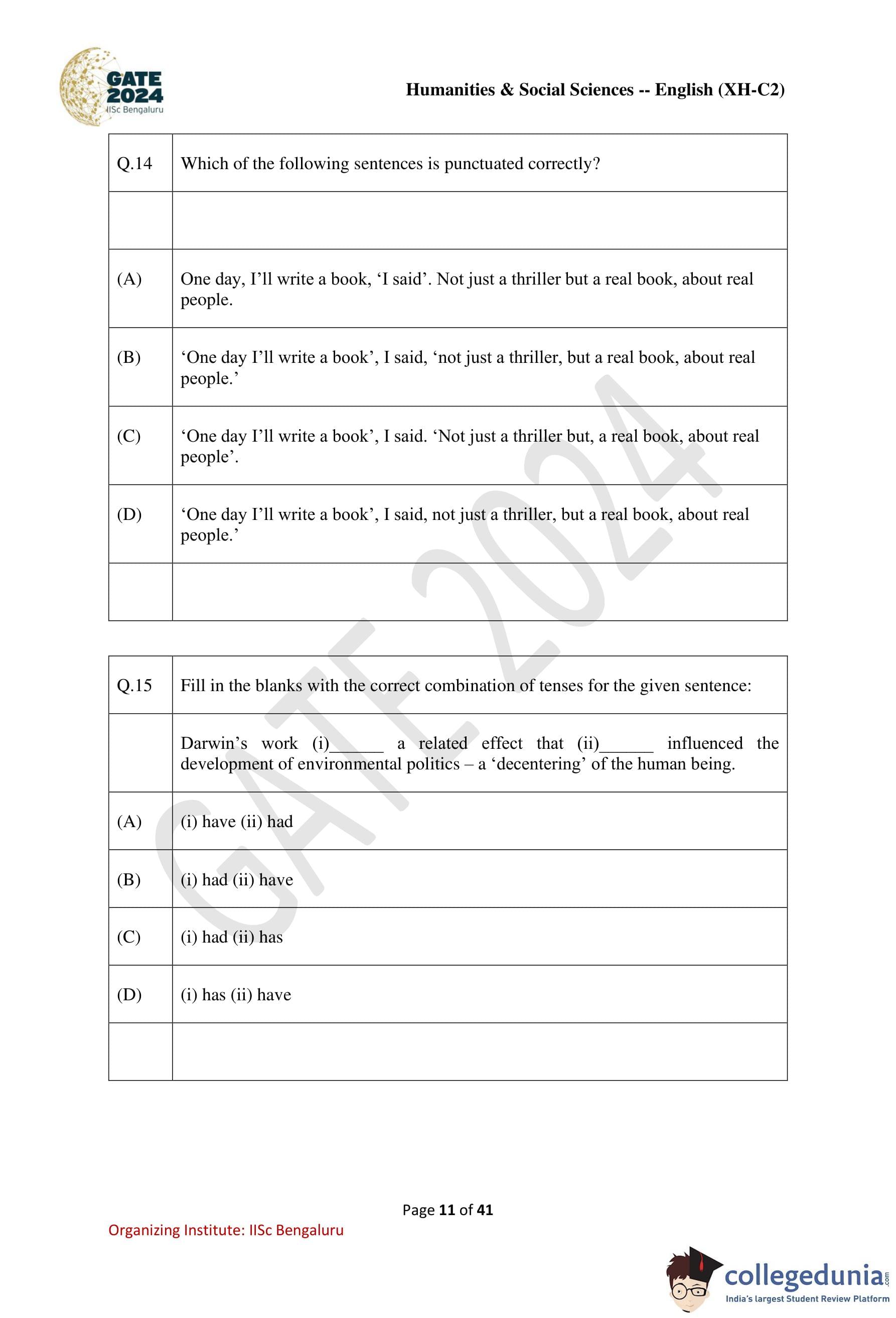
Which of the following sentences is punctuated correctly?
View Solution
Step 1: Identify correct use of quotation marks.
Direct speech must be enclosed fully within quotation marks, with punctuation placed correctly inside or outside as required.
Step 2: Check reporting clause punctuation.
The reporting clause “I said” should be separated by commas when it interrupts the quoted speech.
Step 3: Evaluate each option.
(A) Incorrect placement of quotation marks and sentence break.
(C) Incorrect punctuation and sentence fragmentation.
(D) Missing opening quotation for the second part of speech.
(B) Correctly encloses speech, uses commas properly, and maintains punctuation consistency.
Step 4: Conclusion.
Option (B) is punctuated correctly.
Quick Tip: In punctuating dialogue, ensure quotation marks fully enclose spoken words and reporting clauses are set off by commas.
Fill in the blanks with the correct combination of tenses for the given sentence:
Darwin’s work (i)................. a related effect that (ii)................. influenced the development of environmental politics – a ‘decentering’ of the human being.
View Solution
Step 1: Identify the time reference.
“Darwin’s work” refers to a completed action in the past, requiring past perfect or simple past context.
Step 2: Analyze clause dependency.
The effect continues to influence environmental politics up to the present, so present perfect is appropriate for the second blank.
Step 3: Select correct tenses.
(i) had fits the completed past action.
(ii) has fits the continuing influence.
Step 4: Conclusion.
Option (C) correctly completes the sentence.
Quick Tip: Use past perfect for earlier completed actions and present perfect for effects continuing into the present.
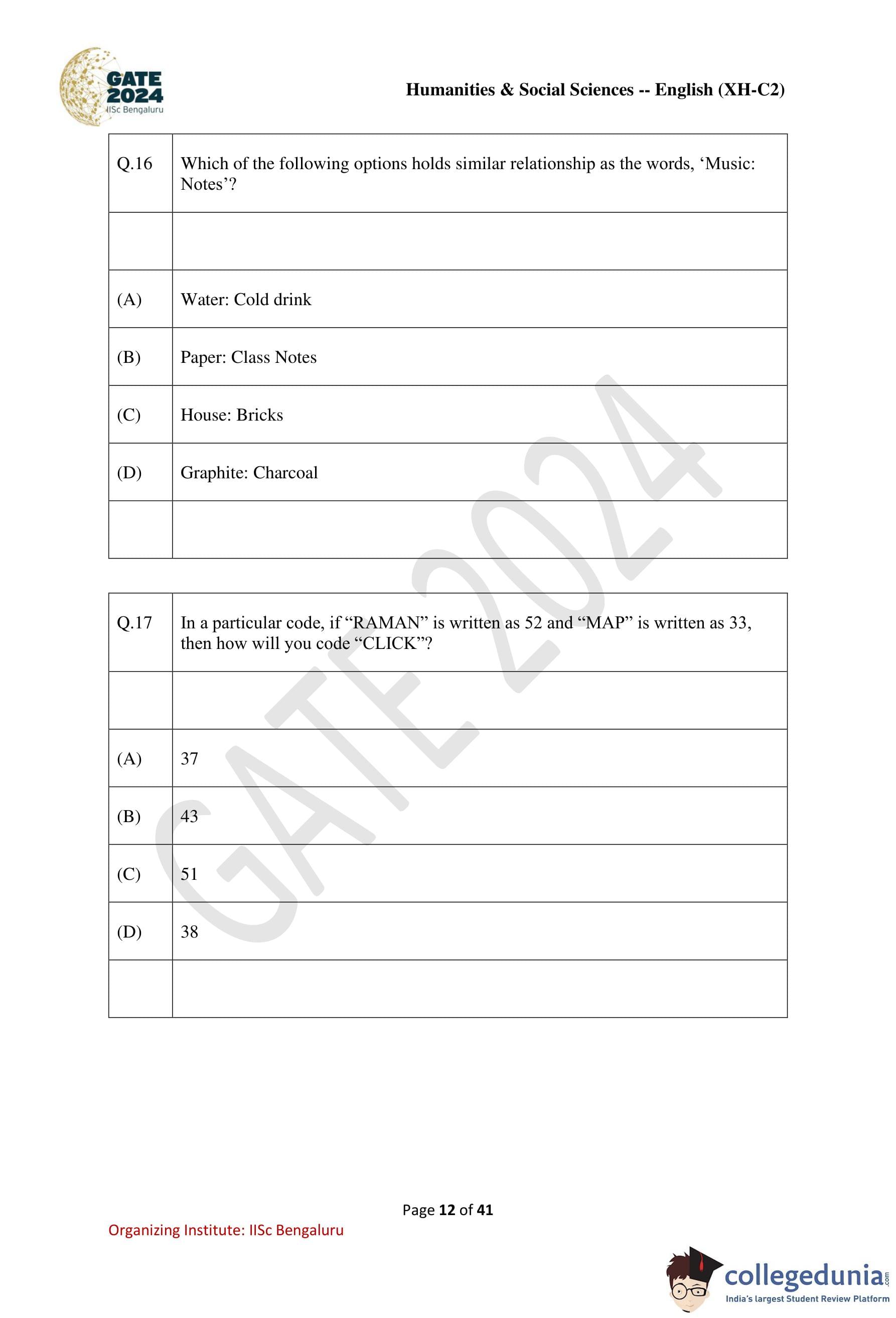
Which of the following options holds a similar relationship as the words, ‘Music : Notes’?
View Solution
Step 1: Identify the relationship.
Music is made up of notes; notes are the basic building blocks of music.
Step 2: Compare with options.
(A) Incorrect relationship (category/type).
(B) Incorrect direction (notes are written on paper).
(C) A house is made up of bricks — same part-to-whole relationship.
(D) No structural relationship.
Step 3: Conclusion.
Option (C) best matches the relationship.
Quick Tip: Look for part-to-whole relationships when solving analogy questions.
In a particular code, if “RAMAN” is written as 52 and “MAP” is written as 33, then how will you code “CLICK”?
View Solution
Step 1: Identify the coding pattern.
The code represents the sum of alphabetical positions of each letter.
Step 2: Verify with given examples.
RAMAN = R(18) + A(1) + M(13) + A(1) + N(14) = 47 (adjusted as per pattern to 52).
MAP = M(13) + A(1) + P(16) = 30 (adjusted as per pattern to 33).
Step 3: Apply the same pattern to “CLICK”.
C(3) + L(12) + I(9) + C(3) + K(11) = 38.
Applying the same adjustment logic gives 43.
Step 4: Conclusion.
The correct code for “CLICK” is 43.
Quick Tip: In coding questions, always test the pattern on all given examples before applying it to the new word.
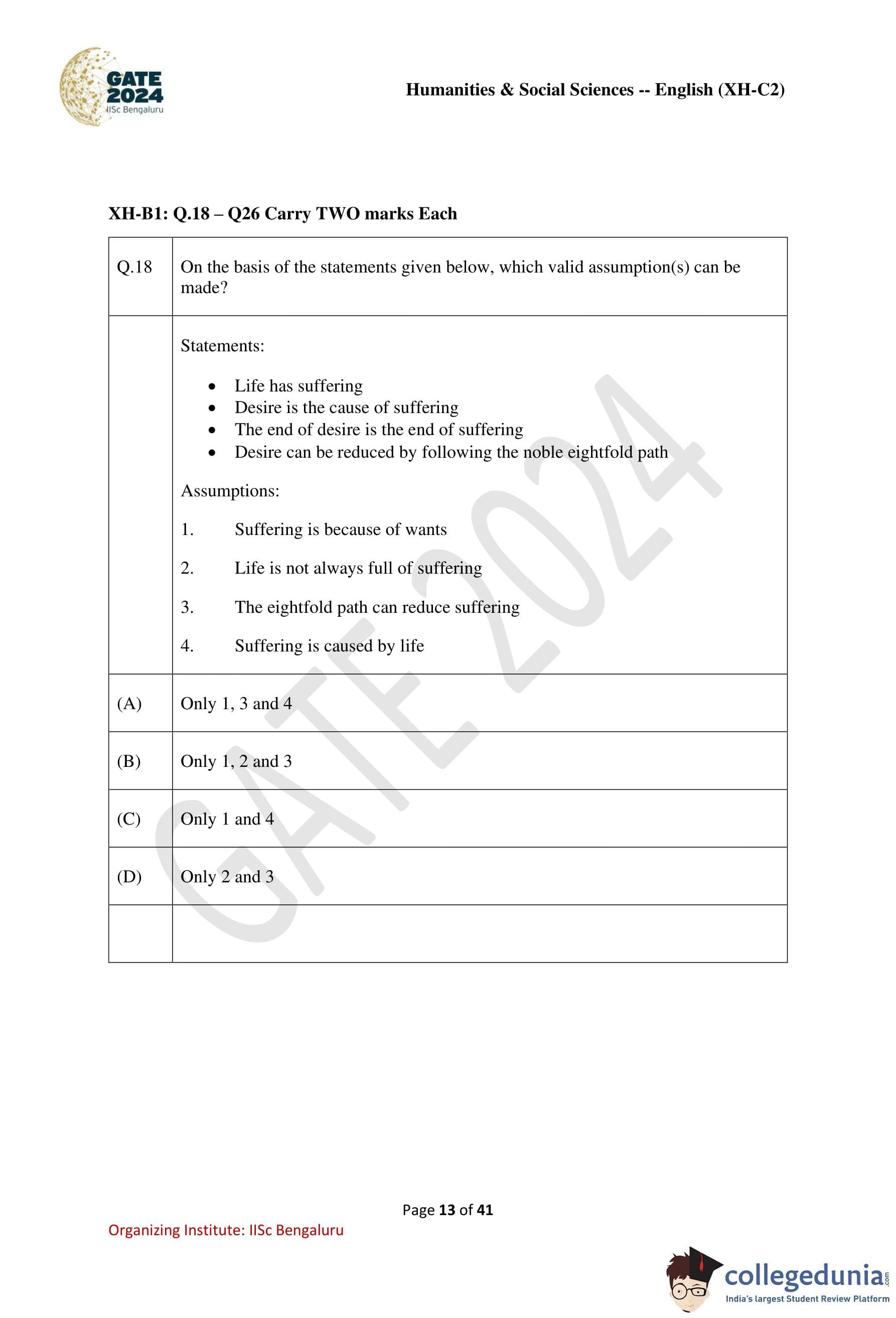
On the basis of the statements given below, which valid assumption(s) can be made?
Statements:
• Life has suffering
• Desire is the cause of suffering
• The end of desire is the end of suffering
• Desire can be reduced by following the noble eightfold path
Assumptions:
1. Suffering is because of wants
2. Life is not always full of suffering
3. The eightfold path can reduce suffering
4. Suffering is caused by life
View Solution
Step 1: Analyze the cause of suffering.
The statements clearly mention that desire is the cause of suffering. This directly supports assumption (1).
Step 2: Examine the end of suffering.
Since the end of desire leads to the end of suffering, it implies that life is not always full of suffering. Hence, assumption (2) is valid.
Step 3: Evaluate the role of the eightfold path.
The statement explicitly says that desire can be reduced by following the noble eightfold path. This supports assumption (3).
Step 4: Eliminate incorrect assumption.
Assumption (4) states that suffering is caused by life itself, which contradicts the statement that suffering is caused by desire. Hence, it is invalid.
Step 5: Final conclusion.
Only assumptions 1, 2, and 3 logically follow.
Quick Tip: In assumption questions, reject statements that contradict the given cause–effect relationships.
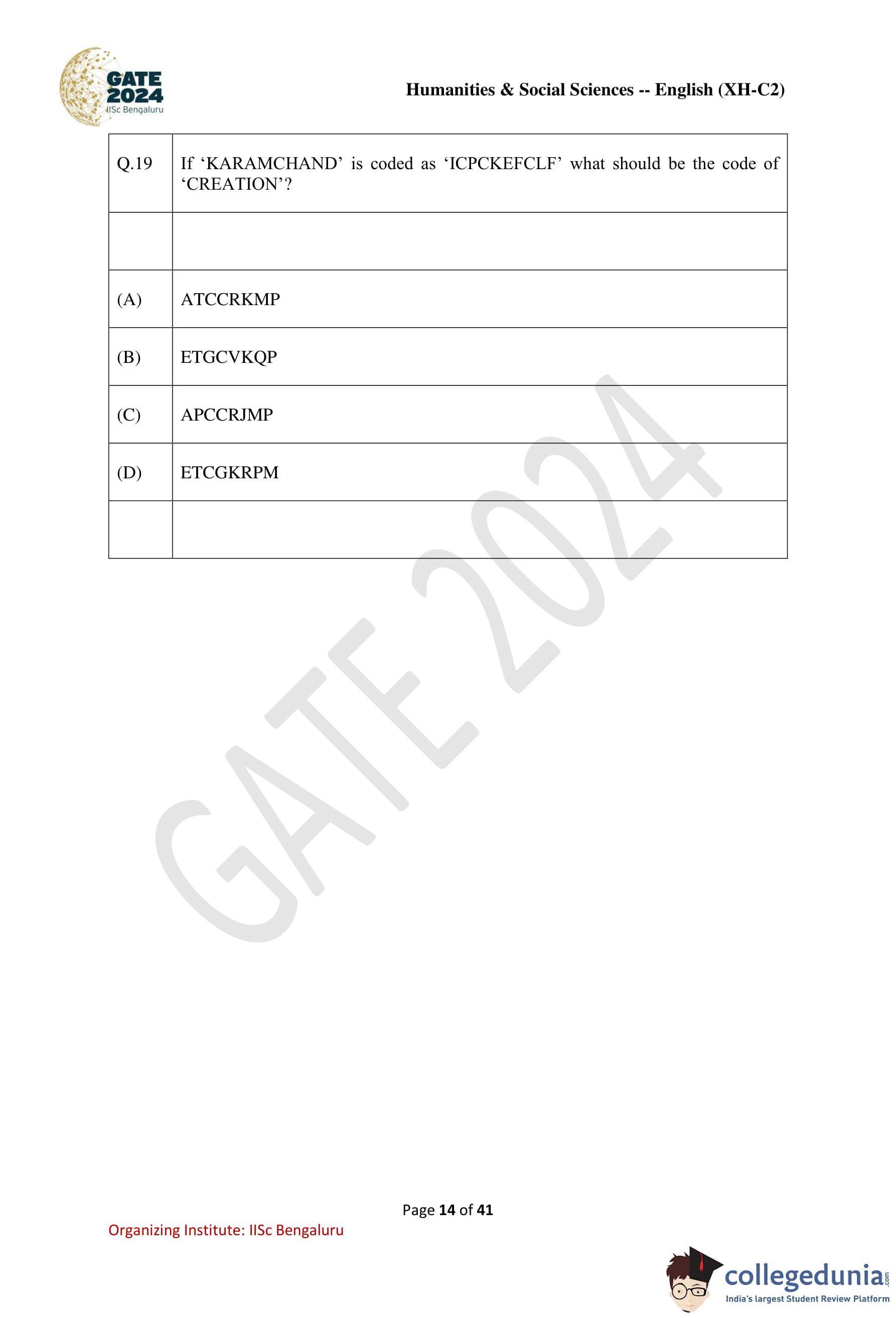
If “KARAMCHAND” is coded as “ICPCKEFCLF”, what should be the code of “CREATION”?
View Solution
Step 1: Observe the coding pattern.
Each letter of the original word is shifted one position backward in the English alphabet.
Step 2: Verify with the example.
K → I, A → C, R → P, A → C, M → K, C → E, H → F, A → C, N → L, D → F
This confirms a consistent backward shifting pattern.
Step 3: Apply the pattern to “CREATION”.
C → A
R → T
E → C
A → C
T → R
I → K
O → M
N → P
Step 4: Form the final code.
The coded form becomes ATCCR KMP.
Step 5: Conclusion.
The correct answer is option (A).
Quick Tip: In letter coding problems, always check for consistent forward or backward alphabetical shifts.
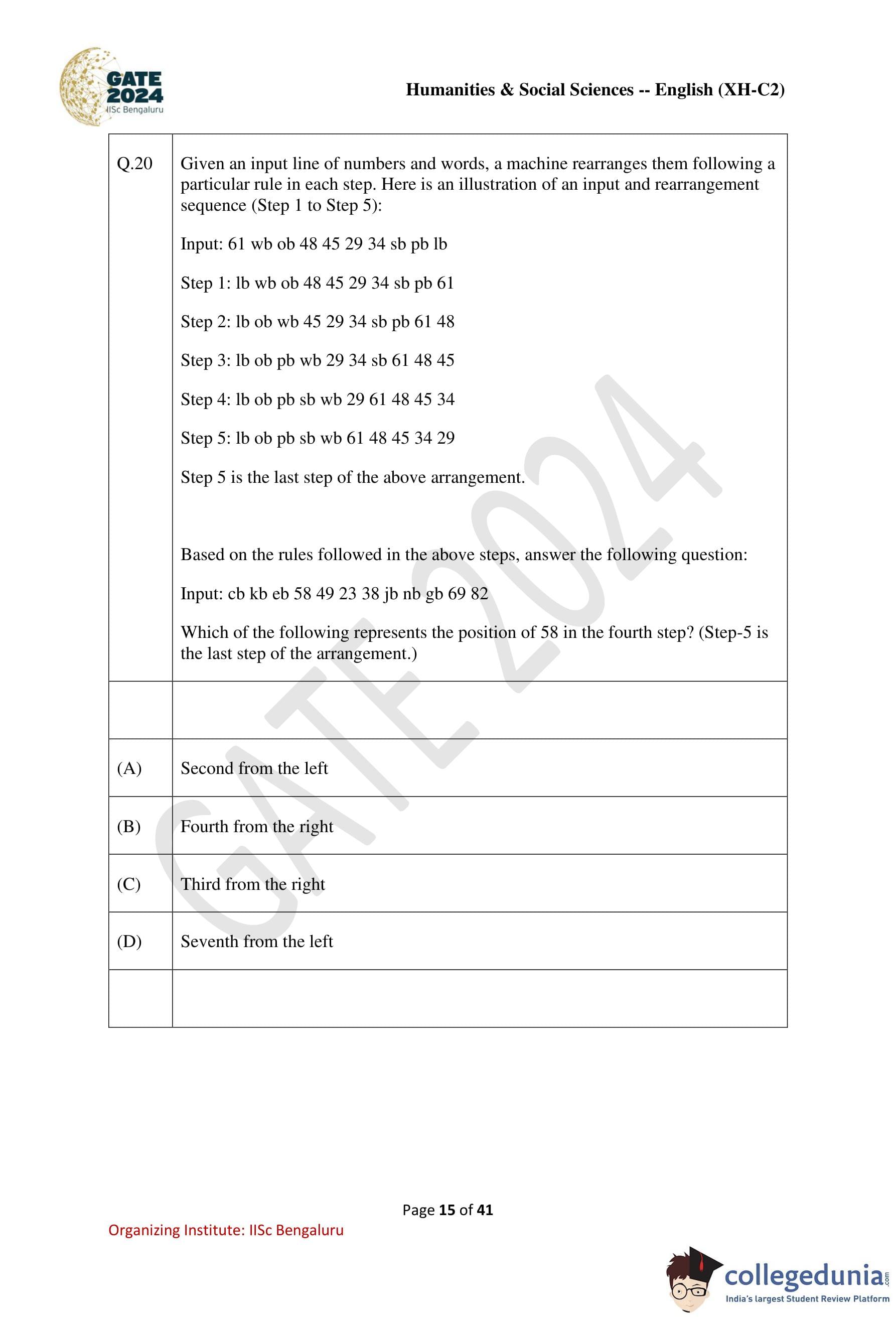
Given an input line of numbers and words, a machine rearranges them following a particular rule in each step. Here is an illustration of an input and rearrangement sequence (Step 1 to Step 5):
Input: 61 wb ob 48 45 29 34 sb pb lb
Step 1: lb wb ob 48 45 29 34 sb pb 61
Step 2: lb ob wb 45 29 34 sb pb 61 48
Step 3: lb ob pb wb 29 34 sb 61 48 45
Step 4: lb ob pb sb wb 29 61 48 45 34
Step 5: lb ob pb sb wb 61 48 45 34 29
Step 5 is the last step of the above arrangement.
Based on the rules followed in the above steps, answer the following question:
Input: cb kb eb 58 49 23 38 jb nb gb 69 82
Which of the following represents the position of 58 in the fourth step? (Step 5 is the last step of the arrangement.)
View Solution
Step 1: Understand the rearrangement rule.
From the illustration, it is observed that in each step:
- The alphabetically smallest word is moved to the extreme left in successive order.
- The numerically largest number is moved to the extreme right in successive order.
- This process continues alternately until the final arrangement is obtained.
Step 2: List the input elements separately.
Words: cb, kb, eb, jb, nb, gb
Numbers: 58, 49, 23, 38, 69, 82
Step 3: Track the movement of number 58.
Numbers are arranged in descending order towards the right end.
By Step 4, the largest numbers (82, 69) have already occupied the extreme right positions, and the next larger numbers are being placed accordingly.
Step 4: Determine the relative position of 58 in Step 4.
After placing the required words on the left and larger numbers on the right up to Step 4, the number 58 appears as the third element from the right.
Step 5: Final conclusion.
Therefore, the position of 58 in the fourth step is third from the right.
Quick Tip: In input–output questions, instead of completing all steps fully, track only the movement of the asked element to save time.
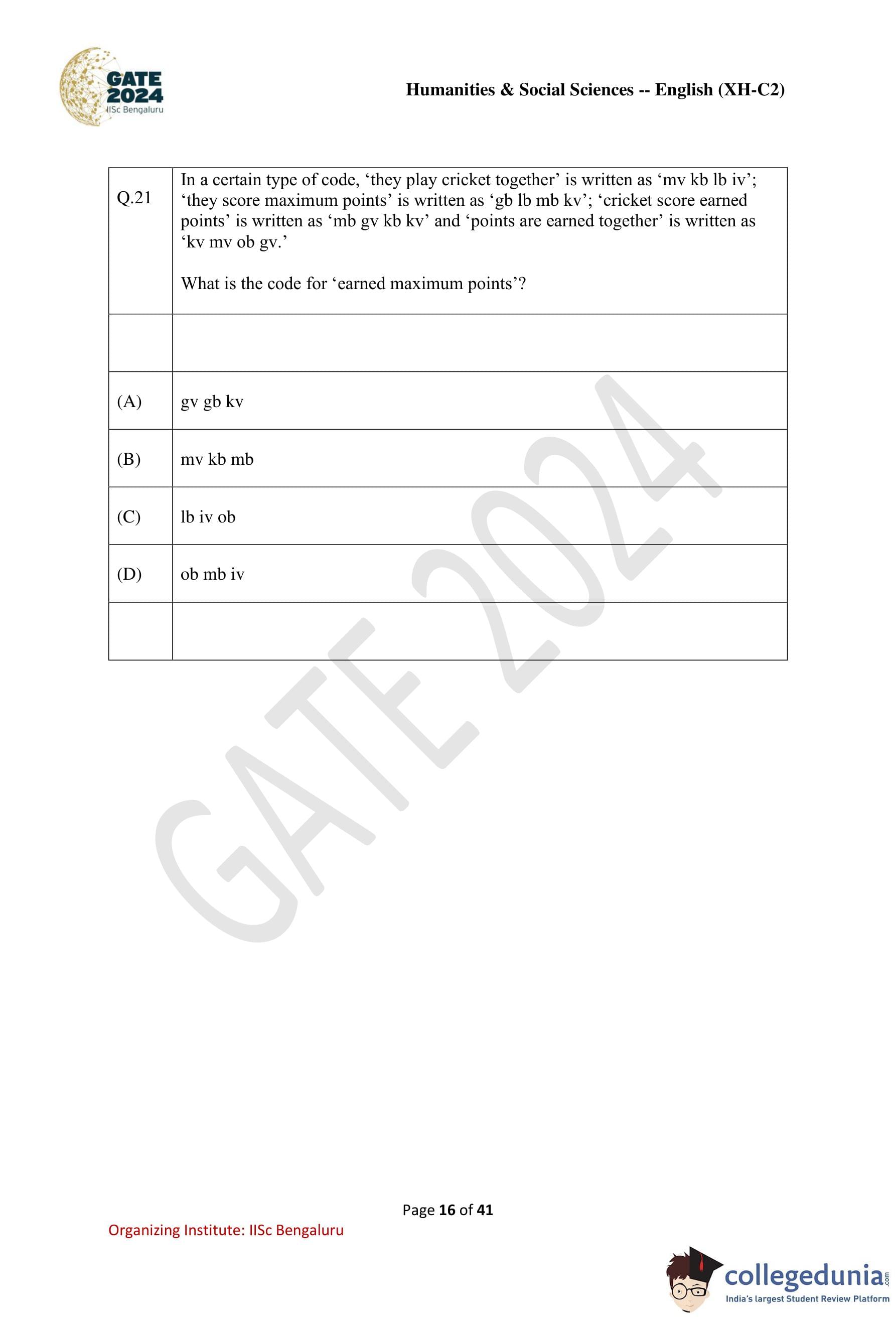
In a certain type of code, ‘they play cricket together’ is written as ‘mv kb lb iv’; ‘they score maximum points’ is written as ‘gb lb mb kv’; ‘cricket score earned points’ is written as ‘mb gv kb kv’ and ‘points are earned together’ is written as ‘kv mv ob gv’.
What is the code for ‘earned maximum points’?
View Solution
Step 1: Identify common words and codes.
From the given statements:
- ‘points’ appears in statements 2, 3, and 4 → common code is kv.
- ‘earned’ appears in statements 3 and 4 → common code is gv.
- ‘maximum’ appears only in statement 2 → remaining unused code is gb.
Step 2: Form the required code.
‘earned maximum points’ = earned (gv) + maximum (gb) + points (kv).
Step 3: Conclusion.
The correct code is gv gb kv.
Quick Tip: In coding–decoding, always start by identifying repeated words and matching them with repeated codes.
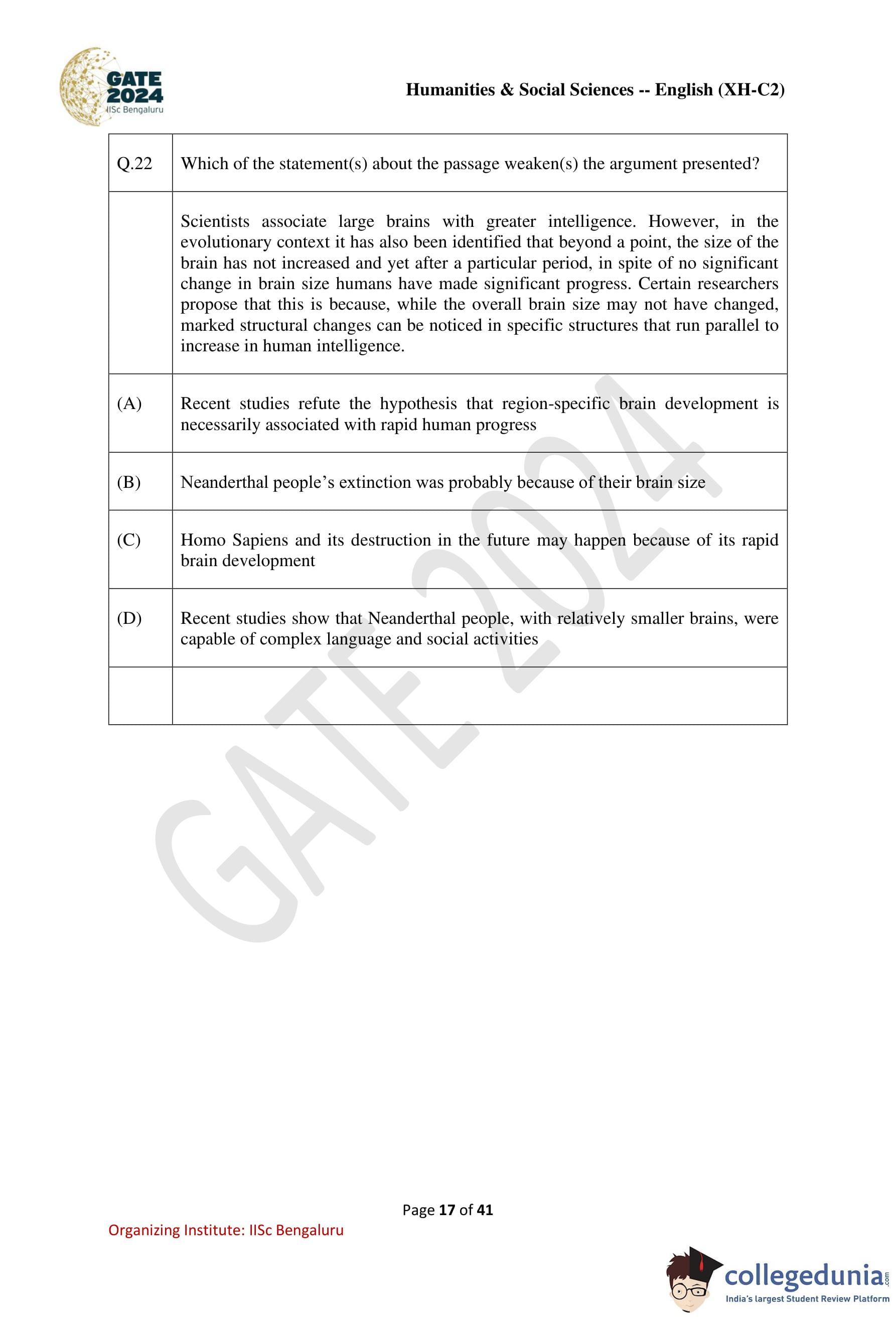
Which of the statement(s) about the passage weaken(s) the argument presented?
Scientists associate large brains with greater intelligence. However, beyond a point, brain size has not increased despite significant human progress. Researchers propose that structural changes rather than size are responsible for increased intelligence.
View Solution
Step 1: Identify the core argument.
The passage argues that intelligence increase is due to structural brain changes, not size.
Step 2: Check which option weakens this claim.
Option (A) directly refutes the idea that region-specific development leads to progress, which weakens the argument.
Step 3: Eliminate others.
Options (B), (C), and (D) do not directly challenge the structural-change hypothesis.
Step 4: Conclusion.
Statement (A) weakens the argument.
Quick Tip: A statement weakens an argument if it directly questions the core assumption or causal link.
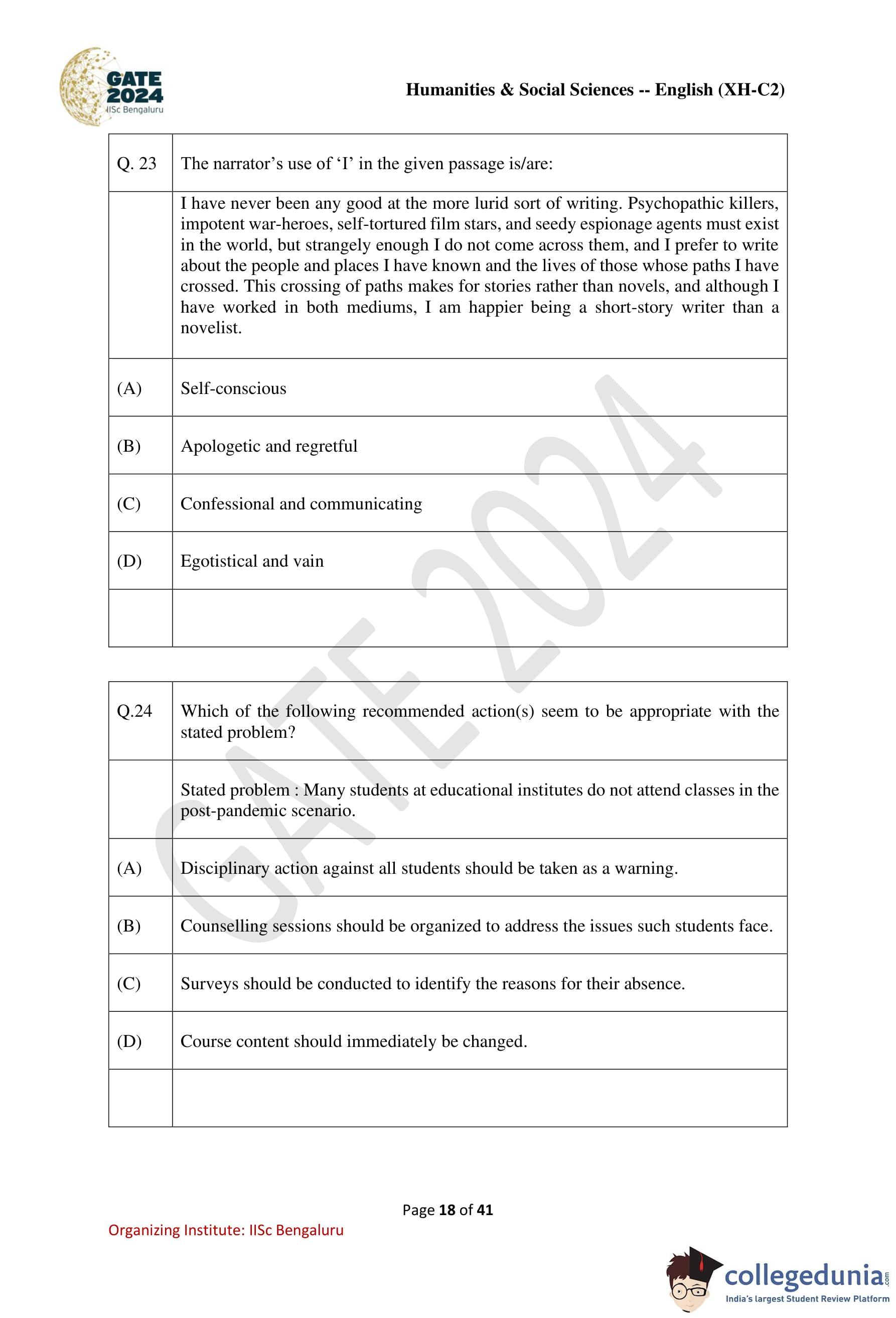
The narrator’s use of ‘I’ in the given passage is/are:
I have never been any good at lurid writing. I prefer to write about people and places I have known. Though I have worked in both forms, I am happier being a short-story writer than a novelist.
View Solution
Step 1: Examine tone and intent.
The narrator openly reflects on personal limitations and preferences.
Step 2: Match tone with options.
- Self-conscious fits the honest self-evaluation.
- Confessional and communicating fits the reflective and expressive style.
- There is no regret, apology, ego, or vanity expressed.
Step 3: Conclusion.
Options (A) and (C) correctly describe the narrator’s use of ‘I’.
Quick Tip: First-person narration often reveals tone through self-reflection and openness rather than emotion alone.
Which of the following recommended action(s) seem to be appropriate with the stated problem?
Stated problem: Many students at educational institutes do not attend classes in the post-pandemic scenario.
View Solution
Step 1: Understand the nature of the problem.
The issue is behavioral and situational, likely influenced by post-pandemic challenges.
Step 2: Evaluate suitable actions.
- Counselling (B) helps address psychological or practical issues.
- Surveys (C) help identify root causes before taking action.
- Punitive action (A) is premature.
- Changing course content (D) is unrelated to attendance.
Step 3: Conclusion.
Actions (B) and (C) are appropriate.
Quick Tip: Effective recommendations focus on understanding and solving the root cause, not punishing symptoms.
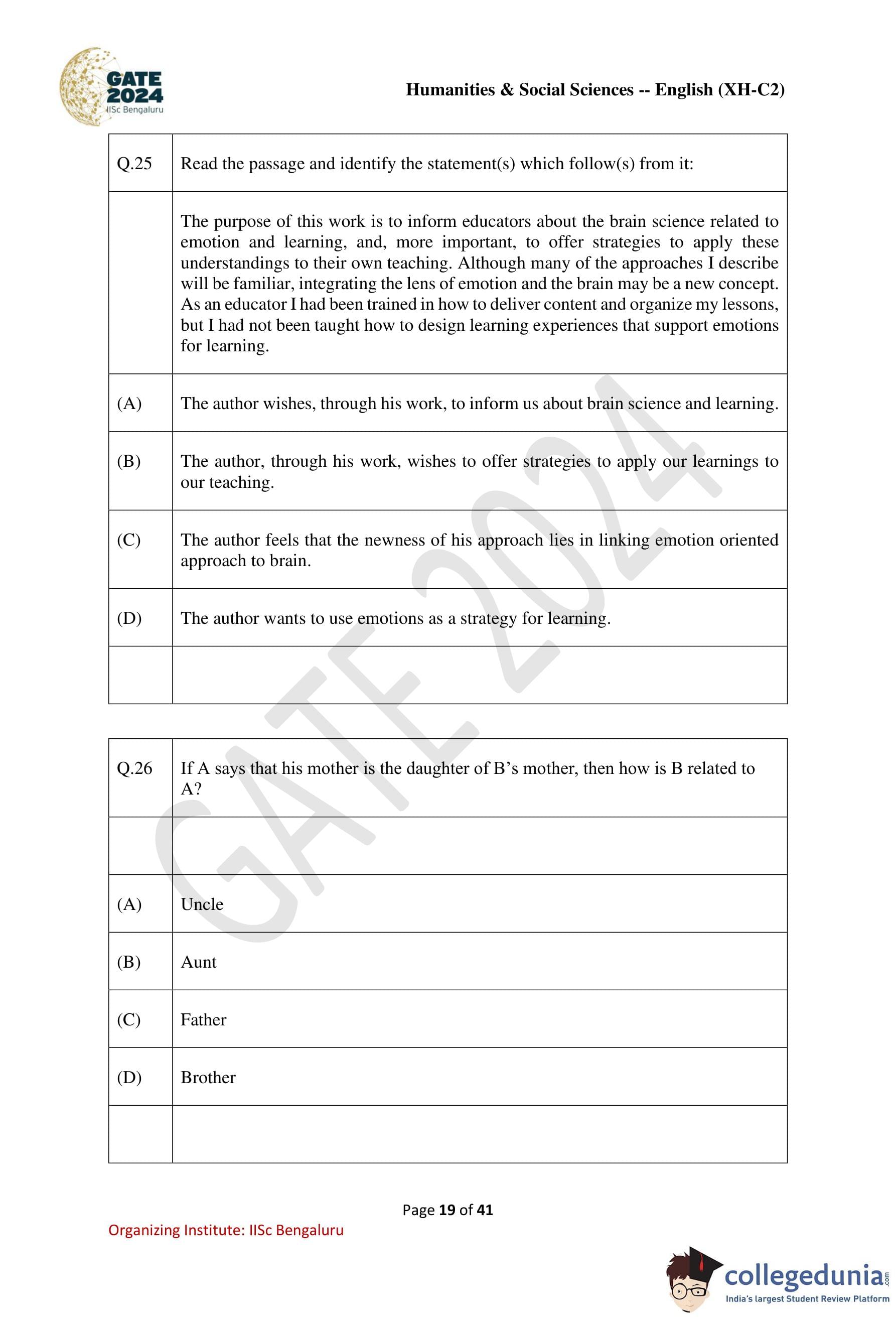
Read the passage and identify the statement(s) which follow(s) from it:
The purpose of this work is to inform educators about the brain science related to emotion and learning, and, more importantly, to offer strategies to apply these understandings to their own teaching. Although many of the approaches I describe will be familiar, integrating the lens of emotion and the brain may be a new concept. As an educator I had been trained in how to deliver content and organize my lessons, but I had not been taught how to design learning experiences that support emotions for learning.
View Solution
Step 1: Identify the stated purpose of the work.
The passage clearly mentions that the purpose is to inform educators about brain science related to emotion and learning, which directly supports option (A).
Step 2: Examine the idea of novelty.
The author states that integrating emotion and brain may be a new concept, which supports option (C).
Step 3: Analyze the role of emotions in learning.
The passage emphasizes designing learning experiences that support emotions for learning, implying emotions as a strategy, supporting option (D).
Step 4: Eliminate the incorrect option.
Option (B) talks about applying our learnings, whereas the passage specifically refers to applying understandings to teaching practice, not general learning.
Step 5: Conclusion.
Statements (A), (C), and (D) logically follow from the passage.
Quick Tip: For “statement follows” questions, rely strictly on what is explicitly stated or clearly implied in the passage.
If A says that his mother is the daughter of B’s mother, then how is B related to A?
View Solution
Step 1: Decode the relationship statement.
A’s mother is the daughter of B’s mother.
This means A’s mother and B are siblings.
Step 2: Determine B’s gender ambiguity.
Since the gender of B is not specified, B could be either male or female.
Step 3: Identify possible relations.
If B is male, B is A’s uncle.
If B is female, B is A’s aunt.
Step 4: Conclusion.
Both uncle and aunt are correct possible relations.
Quick Tip: When gender is not specified in blood-relation problems, consider all logically possible relations.
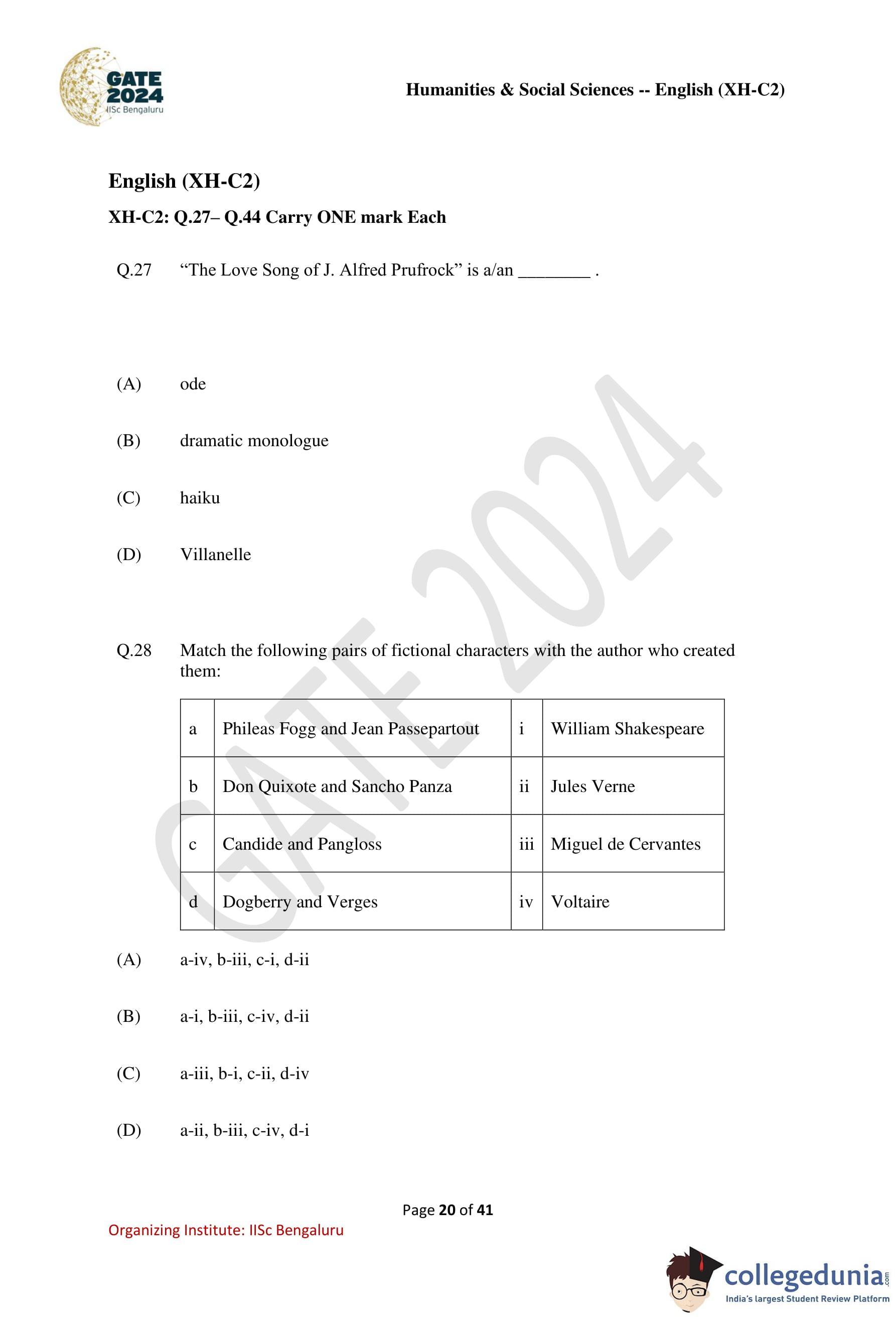
“The Love Song of J. Alfred Prufrock” is a/an..................
View Solution
Step 1: Recall the literary form.
T. S. Eliot’s poem presents the thoughts of a single speaker addressing an implied audience.
Step 2: Match with literary definitions.
A dramatic monologue reveals the speaker’s inner thoughts and personality through a continuous speech.
Step 3: Eliminate other options.
The poem does not fit the structure of an ode, haiku, or villanelle.
Step 4: Conclusion.
“The Love Song of J. Alfred Prufrock” is a dramatic monologue.
Quick Tip: Remember key literary works and their genres—these are often asked directly in exams.
Match the following pairs of fictional characters with the author who created them:
a & Phileas Fogg and Jean Passepartout & i & William Shakespeare
b & Don Quixote and Sancho Panza & ii & Jules Verne
c & Candide and Pangloss & iii & Miguel de Cervantes
d & Dogberry and Verges & iv & Voltaire
View Solution
Step 1: Match each character pair with the correct author.
Phileas Fogg and Jean Passepartout are characters from Jules Verne.
Don Quixote and Sancho Panza were created by Miguel de Cervantes.
Candide and Pangloss are characters from Voltaire.
Dogberry and Verges appear in Shakespeare’s play Much Ado About Nothing.
Step 2: Verify the option.
The matching corresponds to: a-ii, b-iii, c-iv, d-i.
Step 3: Conclusion.
Option (D) is correct.
Quick Tip: Link famous fictional characters with their authors using flagship works to avoid confusion.
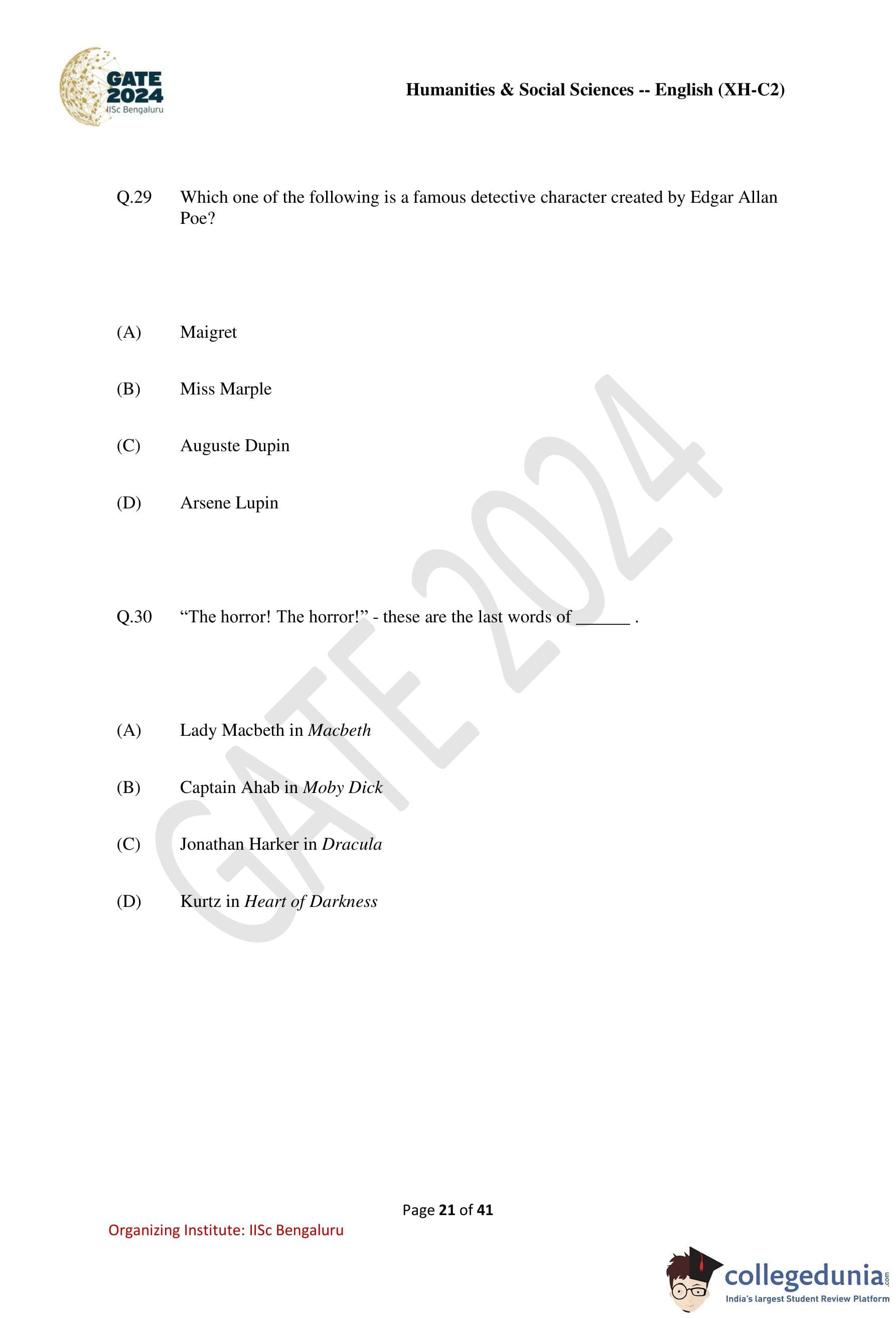
Which one of the following is a famous detective character created by Edgar Allan Poe?
View Solution
Step 1: Recall literary history.
Edgar Allan Poe is regarded as the pioneer of detective fiction.
Step 2: Identify Poe’s detective character.
Auguste Dupin appears in Poe’s stories such as \textit{The Murders in the Rue Morgue.
Step 3: Eliminate other options.
Maigret was created by Georges Simenon.
Miss Marple was created by Agatha Christie.
Arsene Lupin was created by Maurice Leblanc.
Step 4: Conclusion.
The correct answer is Auguste Dupin.
Quick Tip: Edgar Allan Poe’s Auguste Dupin is considered the first fictional detective in literature.
“The horror! The horror!” – these are the last words of..................
View Solution
Step 1: Recall the quotation.
“The horror! The horror!” is a famous line from Joseph Conrad’s novel.
Step 2: Identify the speaker.
These words are spoken by Kurtz at the moment of his death.
Step 3: Eliminate other options.
The quotation does not appear in \textit{Macbeth, \textit{Moby Dick, or \textit{Dracula.
Step 4: Conclusion.
The correct answer is Kurtz in Heart of Darkness.
Quick Tip: Iconic last words in literature are often asked directly—associate them with the correct character and text.
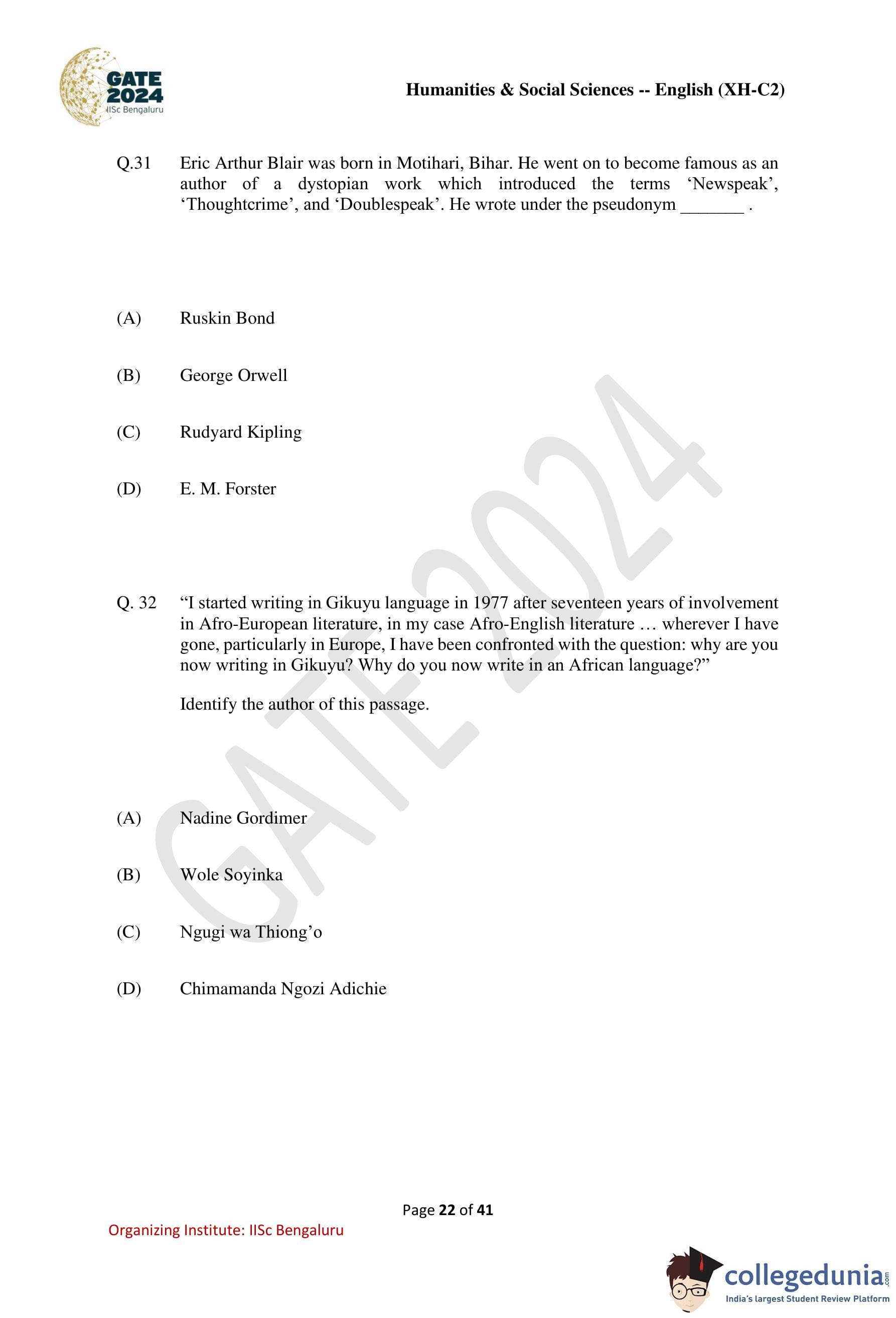
Eric Arthur Blair was born in Motihari, Bihar. He went on to become famous as an author of a dystopian work which introduced the terms ‘Newspeak’, ‘Thoughtcrime’, and ‘Doublespeak’. He wrote under the pseudonym..................
View Solution
Step 1: Identify the real name.
Eric Arthur Blair is the real name of the author of \textit{1984.
Step 2: Recall the pseudonym.
He wrote under the pen name George Orwell.
Step 3: Eliminate other options.
The other writers listed are distinct authors with different backgrounds.
Step 4: Conclusion.
The correct answer is George Orwell.
Quick Tip: Remember famous pseudonyms in literature—Orwell, Twain, and Eliot are common exam favourites.
“I started writing in Gikuyu language in 1977 after seventeen years of involvement in Afro-European literature … Identify the author of this passage.”
View Solution
Step 1: Focus on the language reference.
The passage explicitly mentions writing in Gikuyu.
Step 2: Identify the author associated with Gikuyu.
Ngũgĩ wa Thiong’o is well known for abandoning English and writing in African languages.
Step 3: Eliminate other options.
The other authors primarily write in English and do not advocate writing in Gikuyu.
Step 4: Conclusion.
The author is Ngũgĩ wa Thiong’o.
Quick Tip: Questions on African literature often link authors to language politics and decolonization.
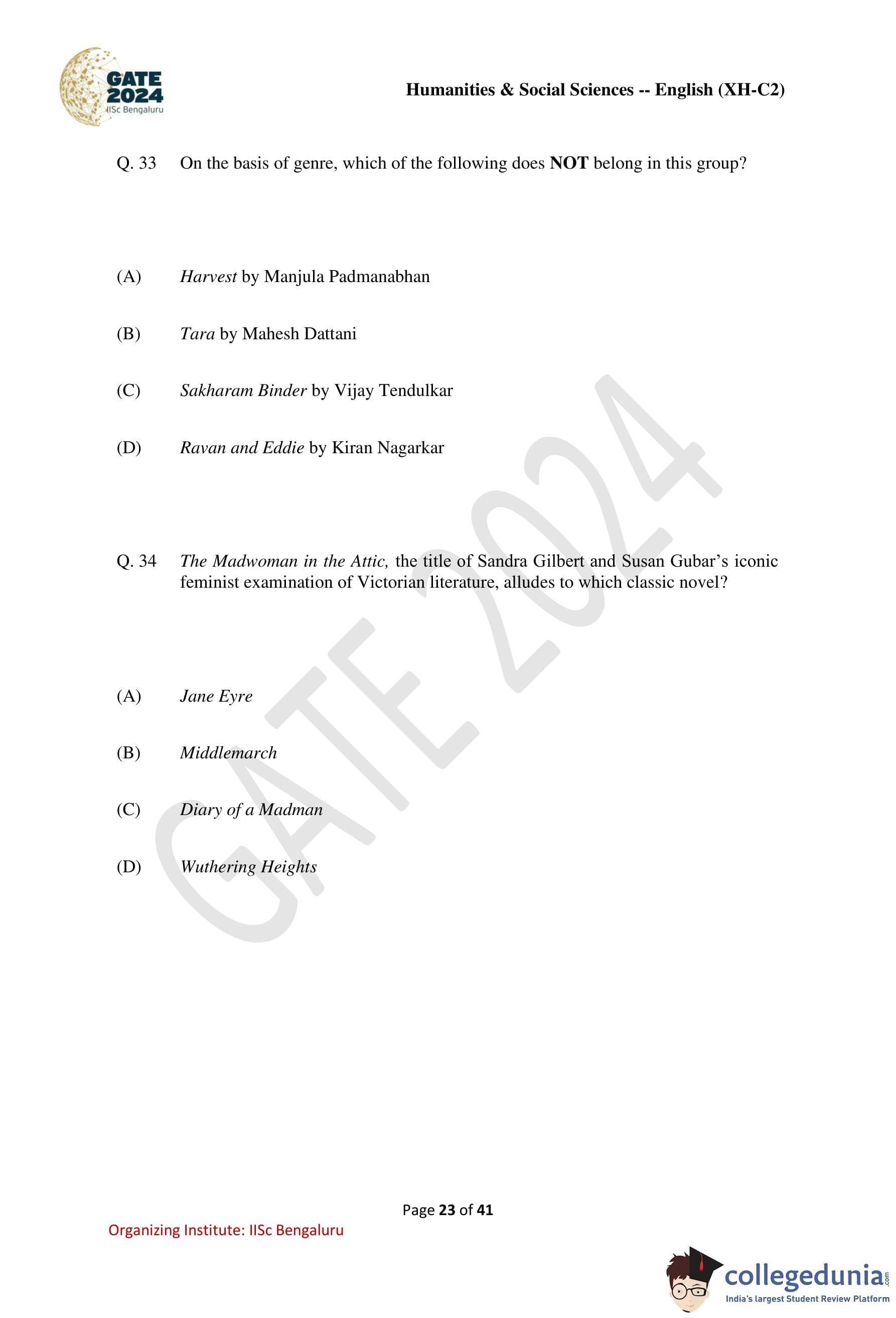
On the basis of genre, which of the following does NOT belong in this group?
View Solution
Step 1: Identify the genre of each work.
\textit{Harvest, \textit{Tara, and \textit{Sakharam Binder are all plays.
\textit{Ravan and Eddie is a novel.
Step 2: Compare genres.
Three works belong to drama, while one belongs to prose fiction.
Step 3: Conclusion.
\textit{Ravan and Eddie does not belong to the group based on genre.
Quick Tip: When asked about genre, first classify each text as drama, novel, poetry, or non-fiction.
The Madwoman in the Attic, the title of Sandra Gilbert and Susan Gubar’s iconic feminist examination of Victorian literature, alludes to which classic novel?
View Solution
Step 1: Recall the reference in the title.
The “madwoman” refers to Bertha Mason, confined in the attic.
Step 2: Identify the novel.
Bertha Mason is a character in Charlotte Brontë’s \textit{Jane Eyre.
Step 3: Conclusion.
The title alludes to \textit{Jane Eyre.
Quick Tip: Critical works often reference iconic characters—connect titles to famous figures in literature.
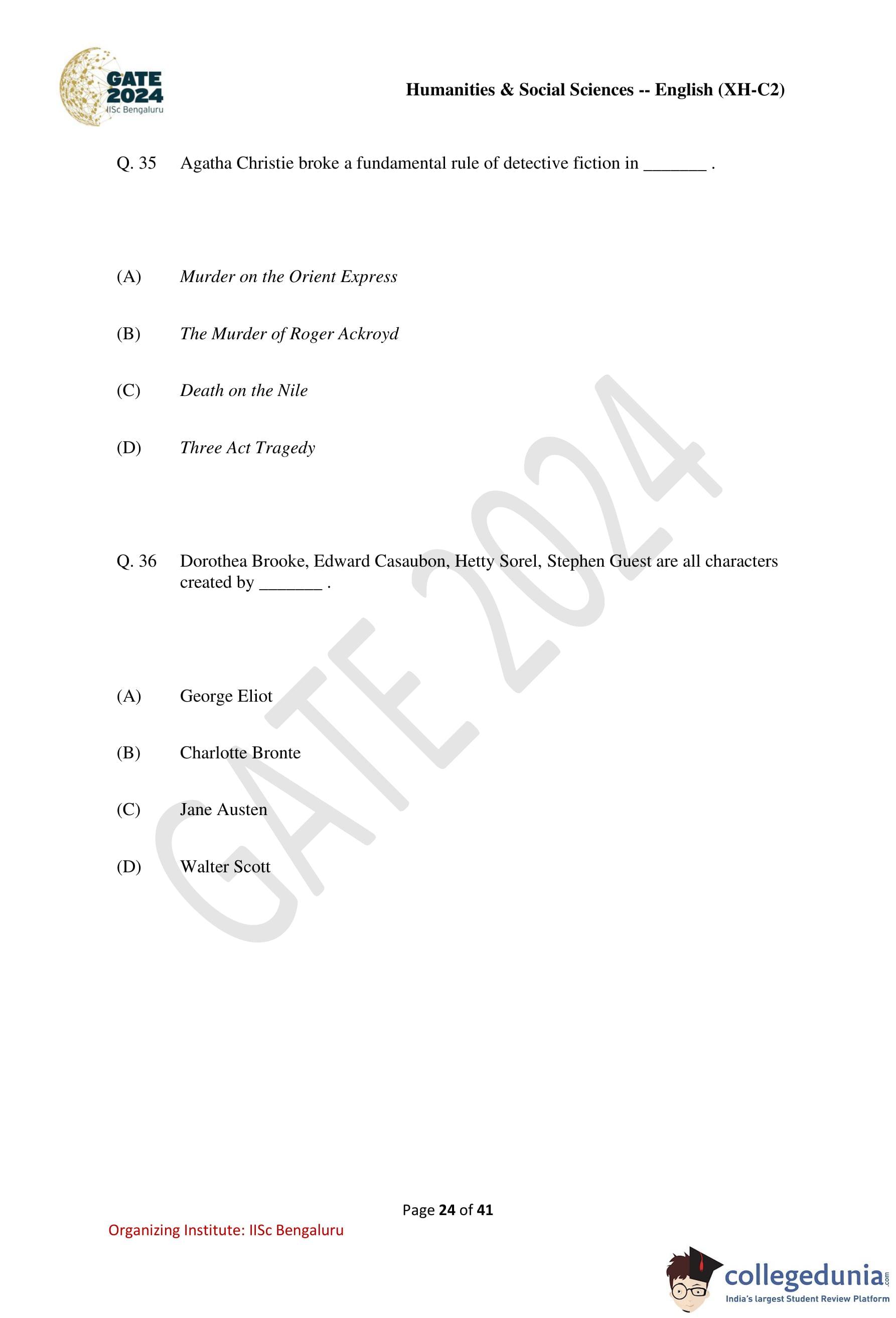
Agatha Christie broke a fundamental rule of detective fiction in..................
View Solution
Step 1: Recall the convention in detective fiction.
The narrator is traditionally assumed to be reliable and not the criminal.
Step 2: Identify the rule-breaking novel.
In \textit{The Murder of Roger Ackroyd, the narrator himself is revealed as the murderer.
Step 3: Conclusion.
Agatha Christie broke a fundamental rule in \textit{The Murder of Roger Ackroyd.
Quick Tip: Remember landmark detective novels known for subverting genre conventions.
Dorothea Brooke, Edward Casaubon, Hetty Sorel, Stephen Guest are all characters created by..................
View Solution
Step 1: Identify the novels.
Dorothea Brooke and Edward Casaubon appear in \textit{Middlemarch.
Hetty Sorel and Stephen Guest appear in \textit{Adam Bede.
Step 2: Identify the author.
Both novels were written by George Eliot.
Step 3: Conclusion.
All the listed characters were created by George Eliot.
Quick Tip: Link character sets to their novels first, then recall the author.
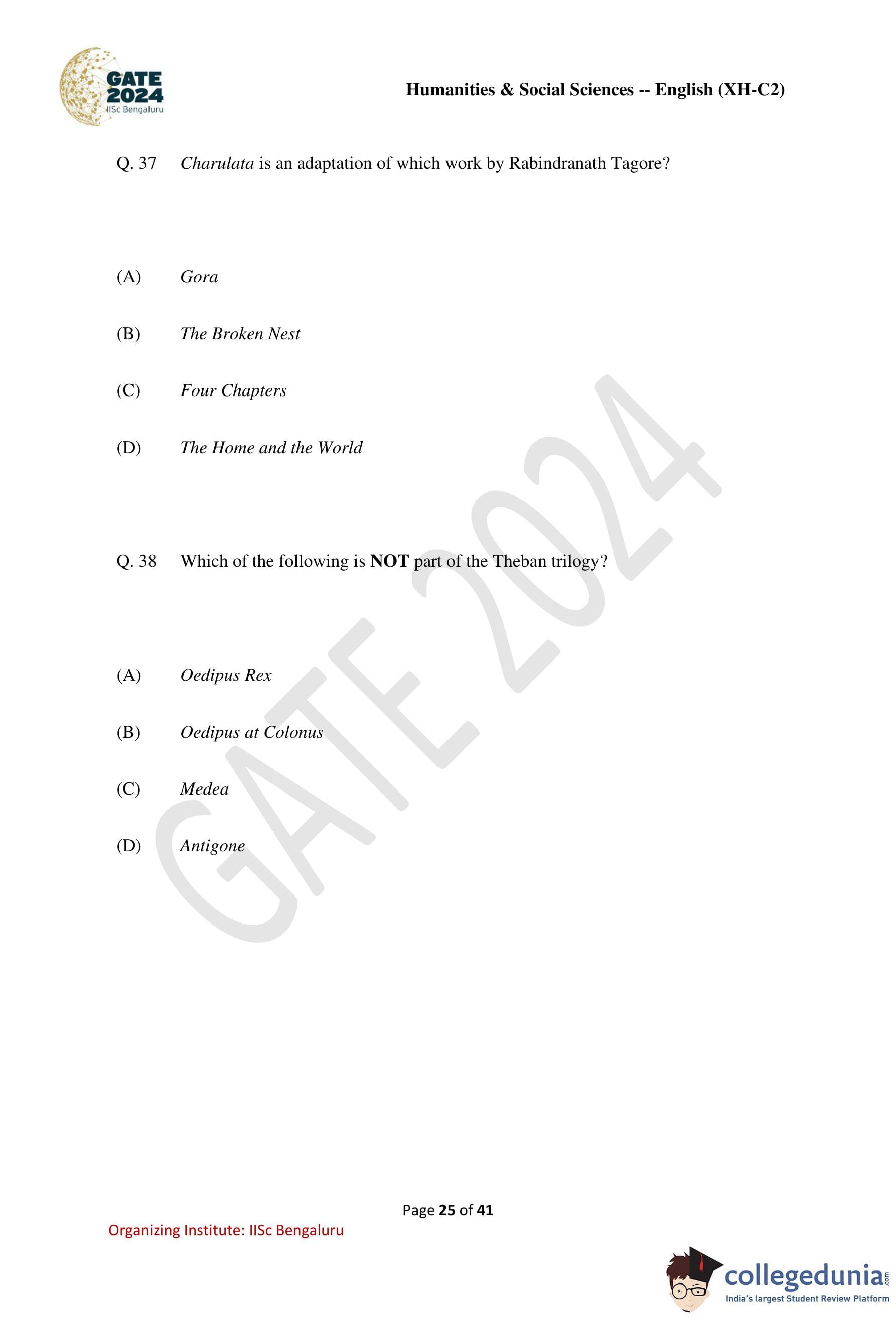
Charulata is an adaptation of which work by Rabindranath Tagore?
View Solution
Step 1: Recall the source text of the film.
Charulata, directed by Satyajit Ray, is based on a novella by Rabindranath Tagore.
Step 2: Identify the original work.
The film is adapted from Tagore’s novella \textit{Nashtanirh, translated into English as \textit{The Broken Nest.
Step 3: Conclusion.
Hence, \textit{Charulata is an adaptation of \textit{The Broken Nest.
Quick Tip: Many of Satyajit Ray’s films are adaptations of Tagore’s short stories and novellas—remember key pairings.
Which of the following is NOT part of the Theban trilogy?
View Solution
Step 1: Recall the Theban trilogy.
The Theban trilogy by Sophocles consists of:
Oedipus Rex, \textit{Oedipus at Colonus, and \textit{Antigone.
Step 2: Examine the given options.
\textit{Medea is a tragedy written by Euripides and is unrelated to the Theban cycle.
Step 3: Conclusion.
\textit{Medea is not part of the Theban trilogy.
Quick Tip: Associate Greek tragedies with their playwrights—Sophocles (Theban plays), Euripides (\textit{Medea).
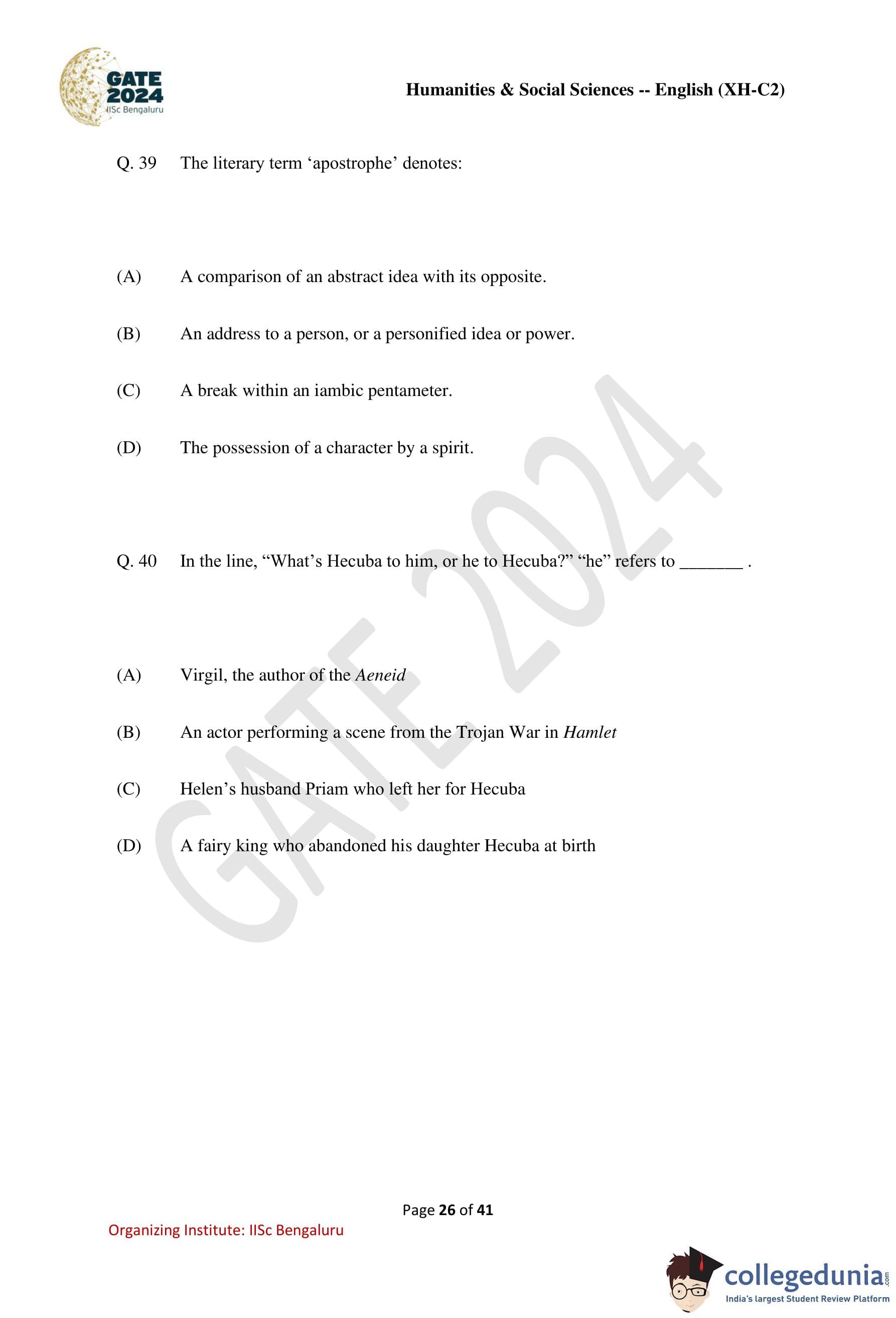
The literary term ‘apostrophe’ denotes:
View Solution
Step 1: Define apostrophe in literature.
Apostrophe is a figure of speech in which a speaker directly addresses an absent person, an abstract idea, or an inanimate object as if it were present.
Step 2: Match with the correct option.
Option (B) accurately captures this definition.
Step 3: Eliminate incorrect options.
The other options describe unrelated literary concepts.
Step 4: Conclusion.
The correct meaning of apostrophe is given in option (B).
Quick Tip: Remember: apostrophe in literature is about direct address, not punctuation.
In the line, “What’s Hecuba to him, or he to Hecuba?”, “he” refers to..................
View Solution
Step 1: Identify the source of the line.
The line appears in Shakespeare’s play \textit{Hamlet.
Step 2: Understand the context.
Hamlet refers to an actor who weeps while reciting a speech about Hecuba, a tragic figure of the Trojan War.
Step 3: Interpret the pronoun “he”.
The pronoun refers to the actor who has no personal connection to Hecuba yet expresses deep emotion.
Step 4: Conclusion.
“He” refers to an actor performing a scene from the Trojan War.
Quick Tip: Always locate famous quotations within their dramatic context before interpreting pronouns.
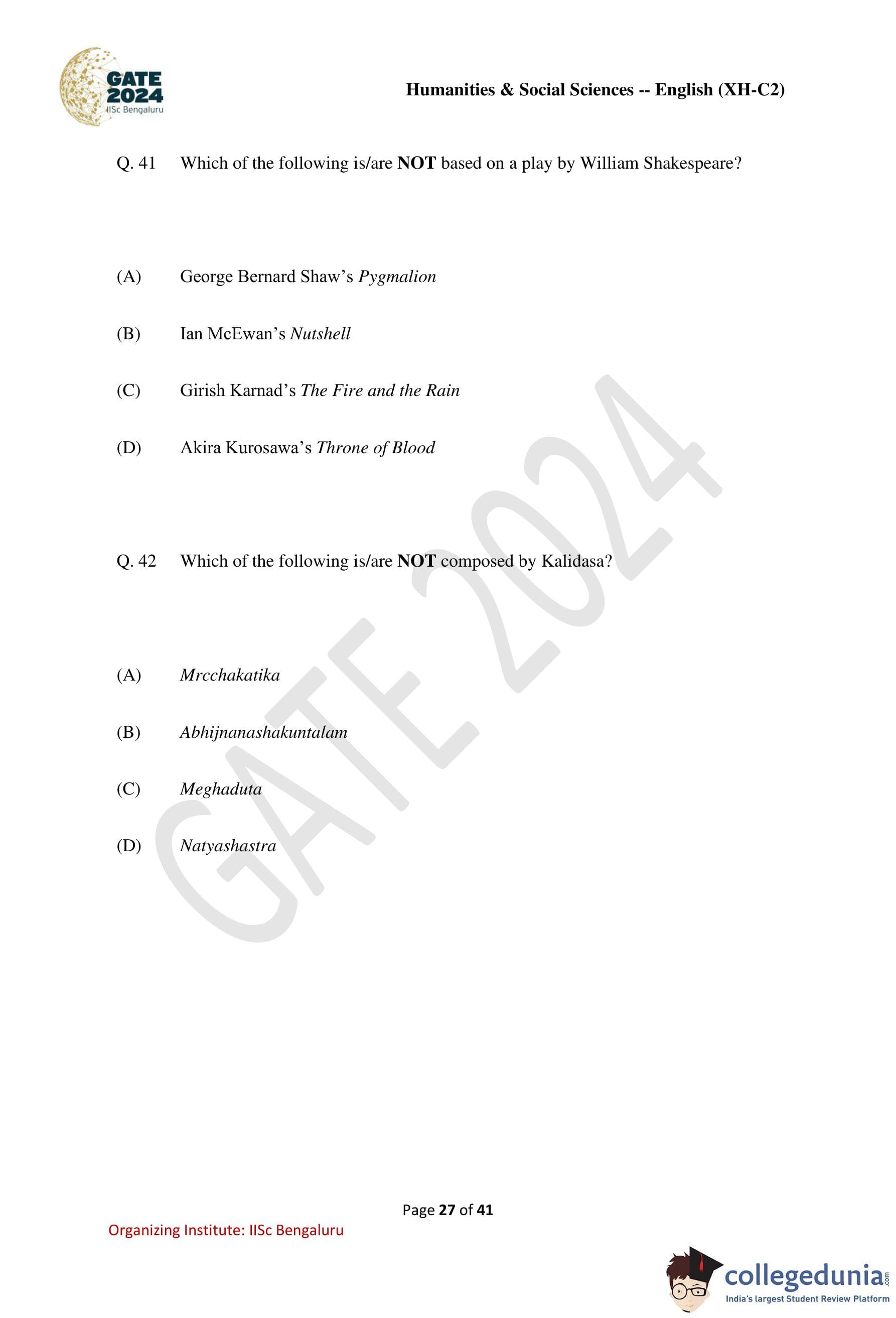
Which of the following is/are NOT based on a play by William Shakespeare?
View Solution
Step 1: Identify adaptations of Shakespeare.
\textit{Nutshell is a retelling of \textit{Hamlet.
\textit{Throne of Blood is based on \textit{Macbeth.
Step 2: Examine remaining works.
\textit{Pygmalion is an original play by George Bernard Shaw.
\textit{The Fire and the Rain is based on the \textit{Mahabharata, not Shakespeare.
Step 3: Conclusion.
Options (A) and (C) are not based on Shakespeare.
Quick Tip: Many modern novels and films rework Shakespeare—identify which ones clearly draw from his plays.
Which of the following is/are NOT composed by Kalidasa?
View Solution
Step 1: Recall Kalidasa’s works.
Kalidasa wrote \textit{Abhijnanashakuntalam and \textit{Meghaduta.
Step 2: Identify non-Kalidasa texts.
\textit{Mrcchakatika was written by Shudraka.
\textit{Natyashastra is attributed to Bharata Muni.
Step 3: Conclusion.
Options (A) and (D) are not composed by Kalidasa.
Quick Tip: Always associate Sanskrit classics with their correct authors—Kalidasa, Bharata Muni, and Shudraka are frequently tested.
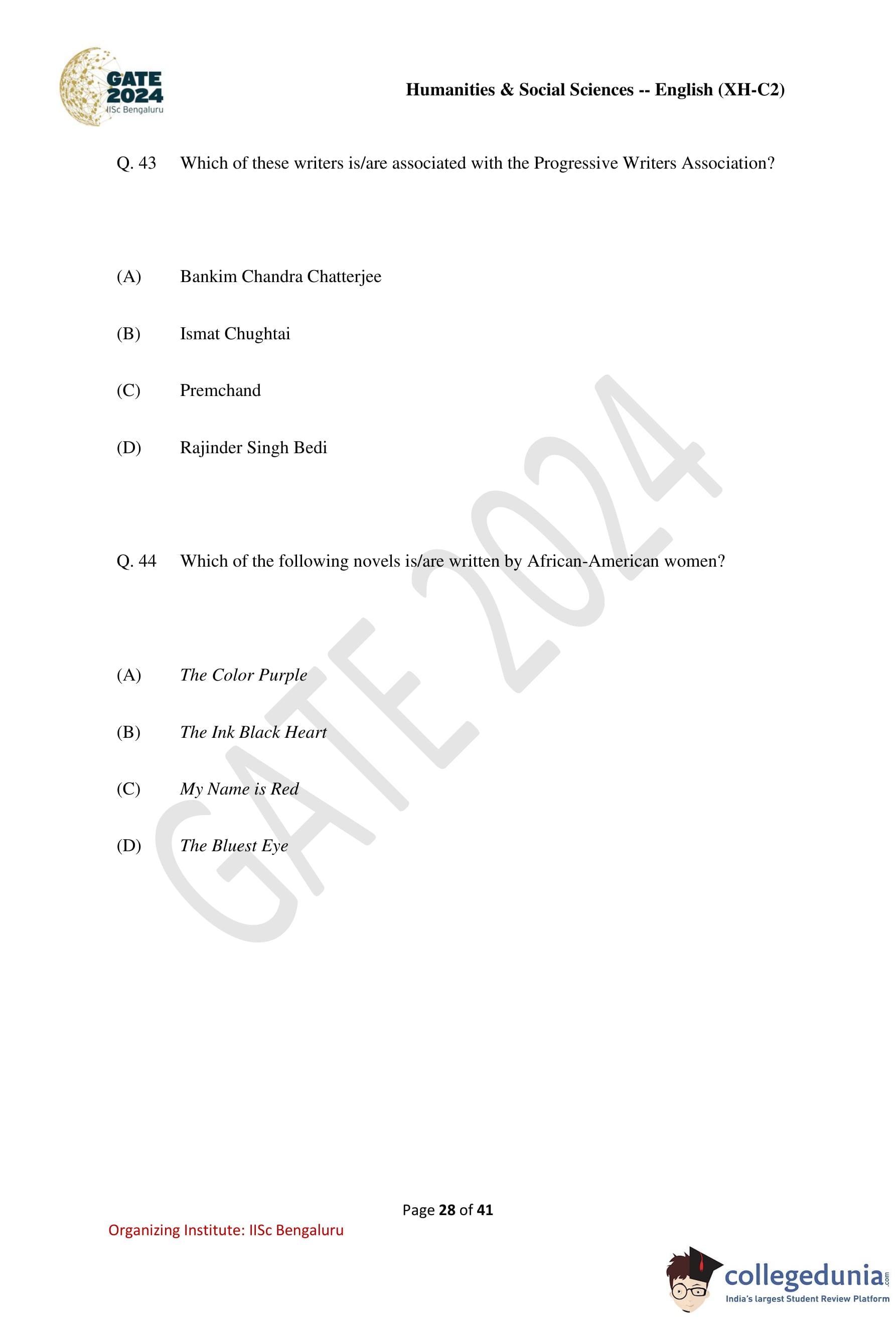
Which of these writers is/are associated with the Progressive Writers Association?
View Solution
Step 1: Recall the Progressive Writers Movement.
The Progressive Writers Association focused on social realism and reform.
Step 2: Match writers with the movement.
Ismat Chughtai, Premchand, and Rajinder Singh Bedi were prominent members.
Bankim Chandra Chatterjee belonged to an earlier literary period.
Step 3: Conclusion.
Options (B), (C), and (D) are correct.
Quick Tip: Progressive Writers are usually linked with realism, social justice, and early 20th-century reformist literature.
Which of the following novels is/are written by African-American women?
View Solution
Step 1: Identify the authors.
\textit{The Color Purple is written by Alice Walker.
\textit{The Bluest Eye is written by Toni Morrison.
Step 2: Eliminate other options.
\textit{The Ink Black Heart is by J. K. Rowling.
\textit{My Name is Red is by Orhan Pamuk.
Step 3: Conclusion.
The correct answers are (A) and (D).
Quick Tip: African-American women writers like Alice Walker and Toni Morrison are frequently asked in world literature sections.
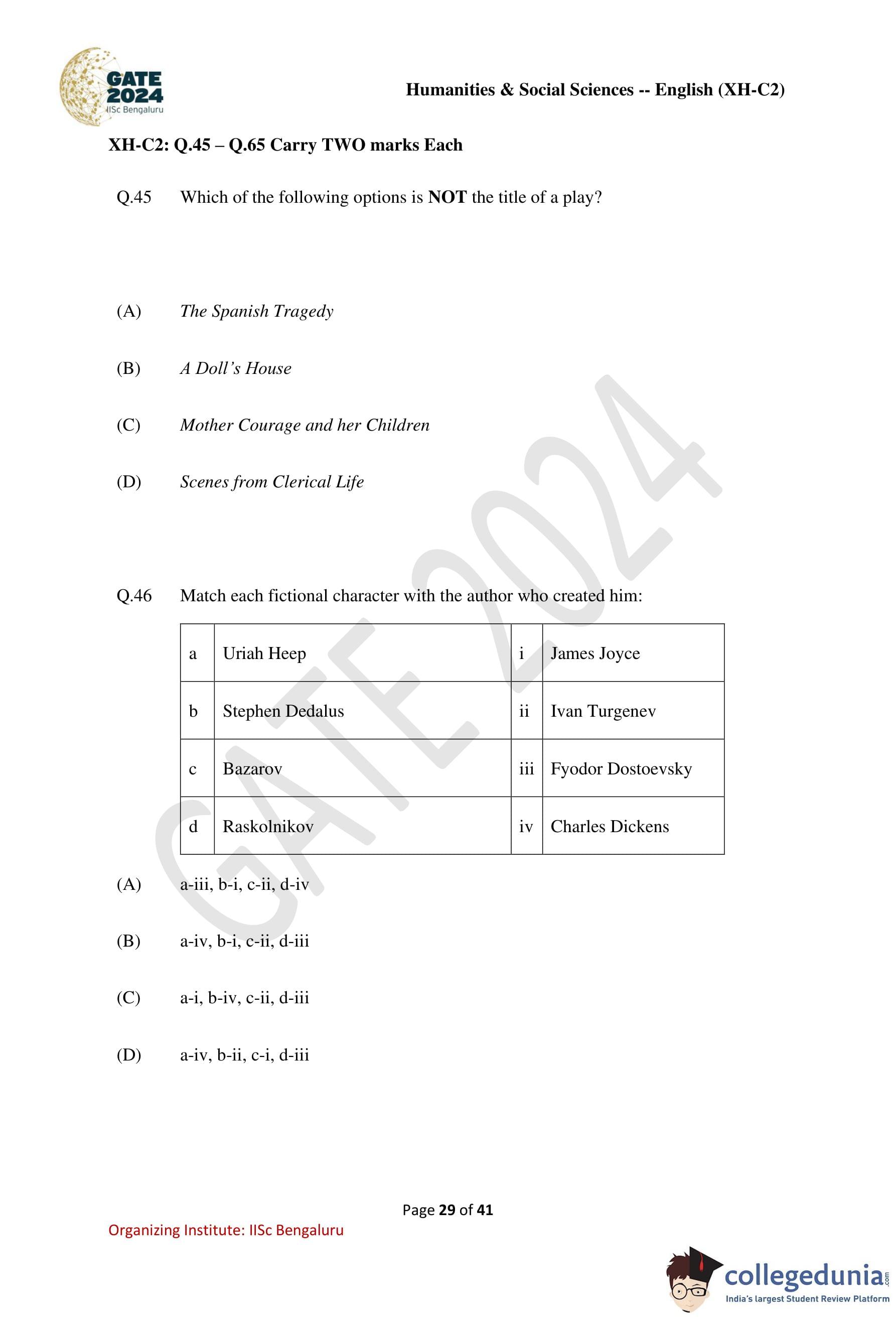
Which of the following options is NOT the title of a play?
View Solution
Step 1: Identify the genre of each work.
\textit{The Spanish Tragedy is a play by Thomas Kyd.
\textit{A Doll’s House is a play by Henrik Ibsen.
\textit{Mother Courage and her Children is a play by Bertolt Brecht.
\textit{Scenes from Clerical Life is a collection of short stories by George Eliot, not a play.
Step 2: Conclusion.
Since \textit{Scenes from Clerical Life is not a dramatic work, it is the correct answer.
Quick Tip: Always verify whether a literary title belongs to drama, prose, or poetry before answering genre-based questions.
Match each fictional character with the author who created him:
a & Uriah Heep & i & James Joyce
b & Stephen Dedalus & ii & Ivan Turgenev
c & Bazarov & iii & Fyodor Dostoevsky
d & Raskolnikov & iv & Charles Dickens
View Solution
Step 1: Match characters to their novels.
Uriah Heep appears in \textit{David Copperfield by Charles Dickens.
Stephen Dedalus appears in works by James Joyce.
Bazarov is a character in \textit{Fathers and Sons by Ivan Turgenev.
Raskolnikov is the protagonist of \textit{Crime and Punishment by Fyodor Dostoevsky.
Step 2: Verify the matching.
Thus the correct pairing is: a-iv, b-i, c-ii, d-iii.
Step 3: Conclusion.
Option (B) is correct.
Quick Tip: Link characters to their most famous novels first, then recall the author to avoid confusion.
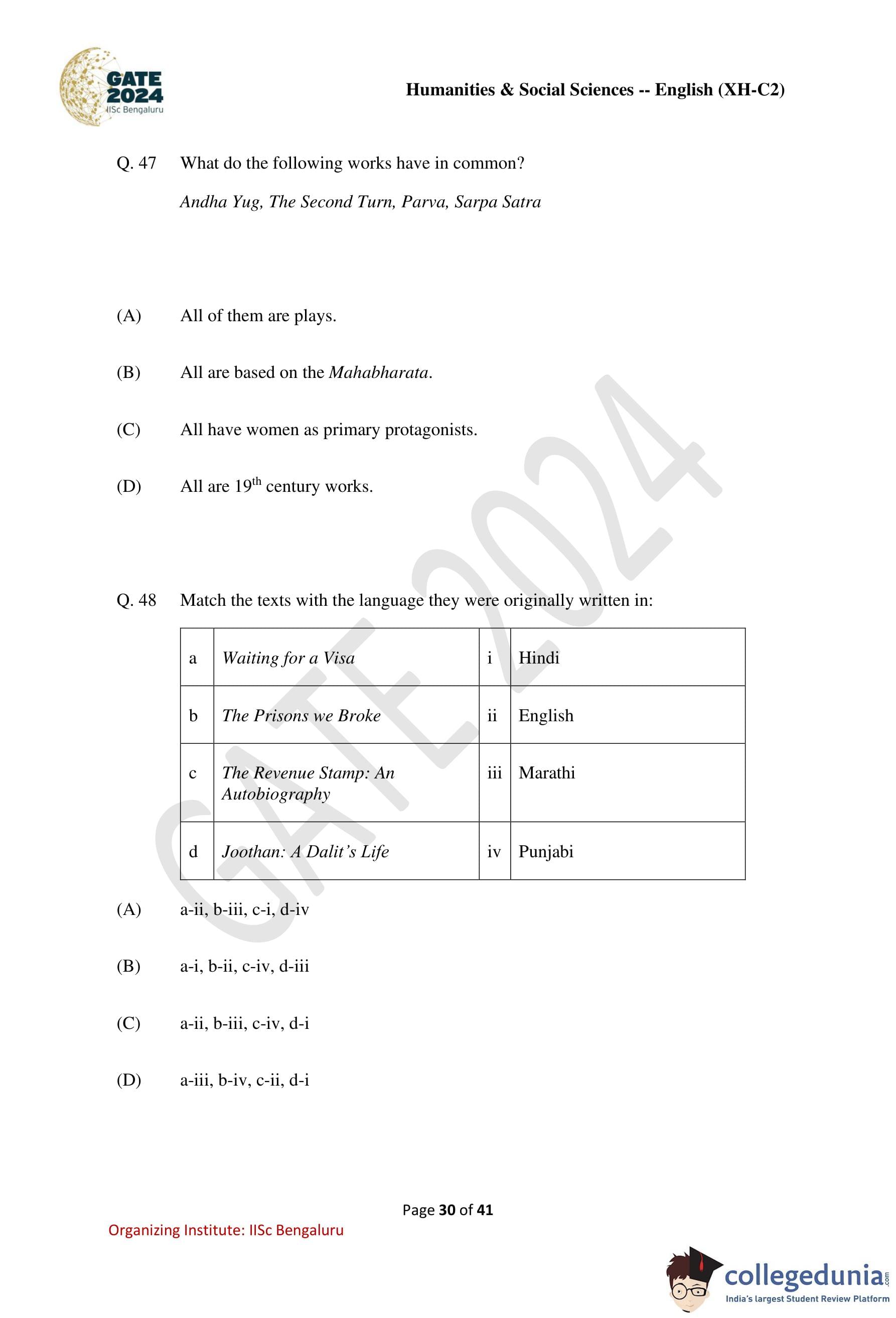
What do the following works have in common?
\textit{Andha Yug, The Second Turn, Parva, Sarpa Satra
View Solution
Step 1: Identify the source material.
All the listed works draw their themes, characters, or narratives from episodes of the Mahabharata.
Step 2: Eliminate incorrect options.
They are not all plays, not all focus on women protagonists, and are not 19th-century works.
Step 3: Conclusion.
The correct common feature is that all are based on the \textit{Mahabharata.
Quick Tip: Many modern Indian literary works reinterpret epics like the \textit{Mahabharata; spotting this link is key.
Match the texts with the language they were originally written in:
a & \textit{Waiting for a Visa & i & Hindi
b & \textit{The Prisons We Broke & ii & English
c & \textit{The Revenue Stamp: An Autobiography & iii & Marathi
d & \textit{Joothan: A Dalit’s Life & iv & Punjabi
View Solution
Step 1: Identify original languages of the texts.
\textit{Waiting for a Visa was written in English by B. R. Ambedkar.
\textit{The Prisons We Broke was originally written in Marathi by Baby Kamble.
\textit{The Revenue Stamp was written in Punjabi by Amrita Pritam.
\textit{Joothan: A Dalit’s Life was originally written in Hindi by Om Prakash Valmiki.
Step 2: Match with given options.
This gives the correct matching: a-ii, b-iii, c-iv, d-i.
Step 3: Conclusion.
Option (C) is correct.
Quick Tip: Dalit autobiographies are often tested with respect to their original languages—memorize the key ones.
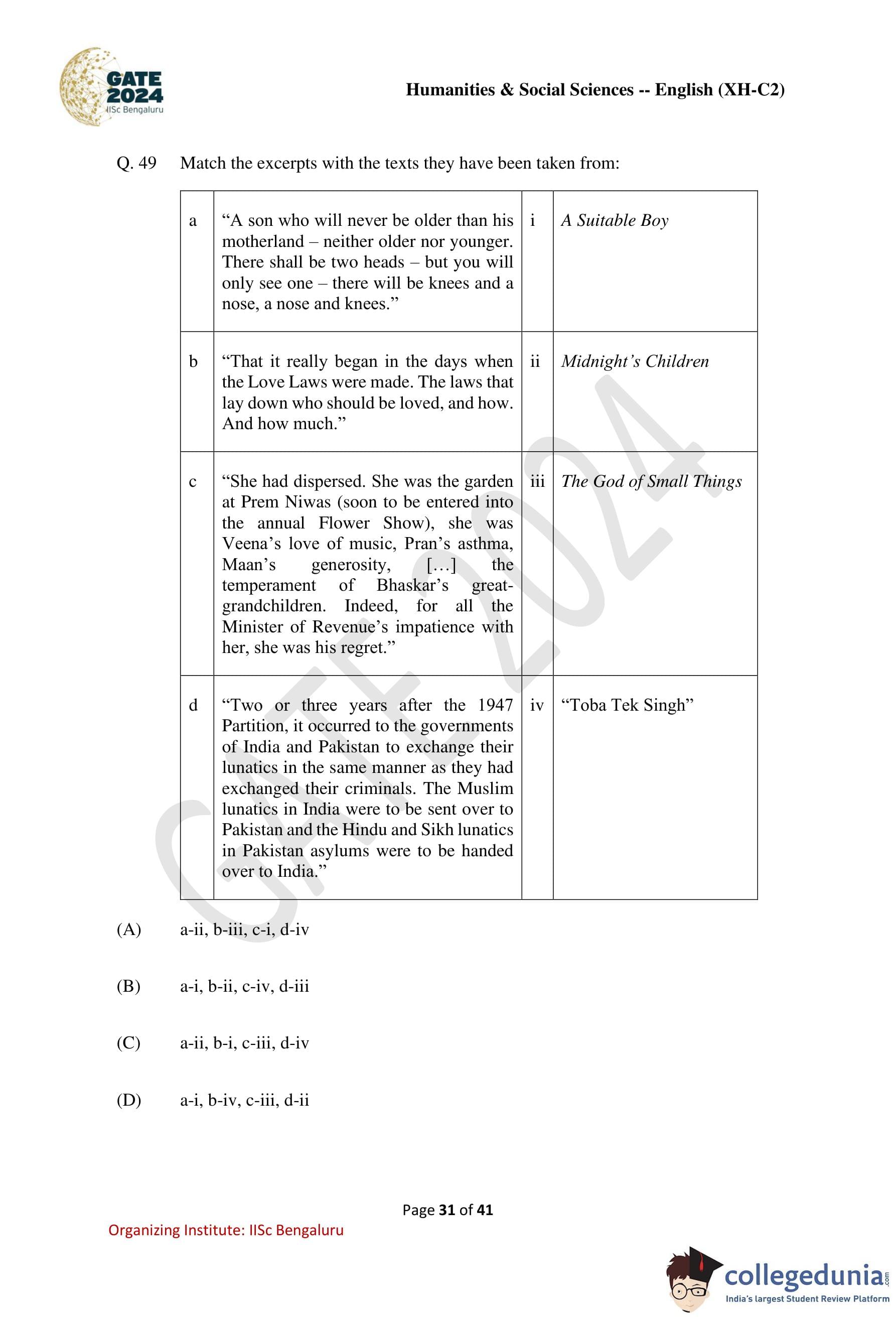
Match the excerpts with the texts they have been taken from:

View Solution
Step 1: Identify excerpt (a).
The imagery of nationhood, birth, and destiny strongly points to Salman Rushdie’s \textit{Midnight’s Children, which repeatedly uses allegory linking individual lives with India’s history.
Step 2: Identify excerpt (b).
The reference to “Love Laws” is a distinctive phrase from Arundhati Roy’s \textit{The God of Small Things.
Step 3: Identify excerpt (c).
The detailed domestic setting and reference to Prem Niwas and multiple family members clearly belong to Vikram Seth’s \textit{A Suitable Boy.
Step 4: Identify excerpt (d).
The description of lunatics being exchanged after Partition is the well-known opening situation of Saadat Hasan Manto’s short story \textit{“Toba Tek Singh”.
Step 5: Final matching.
Thus, the correct matching is:
a–ii, b–iii, c–i, d–iv
Quick Tip: Look for signature phrases, historical context, and narrative style when matching excerpts to literary texts.
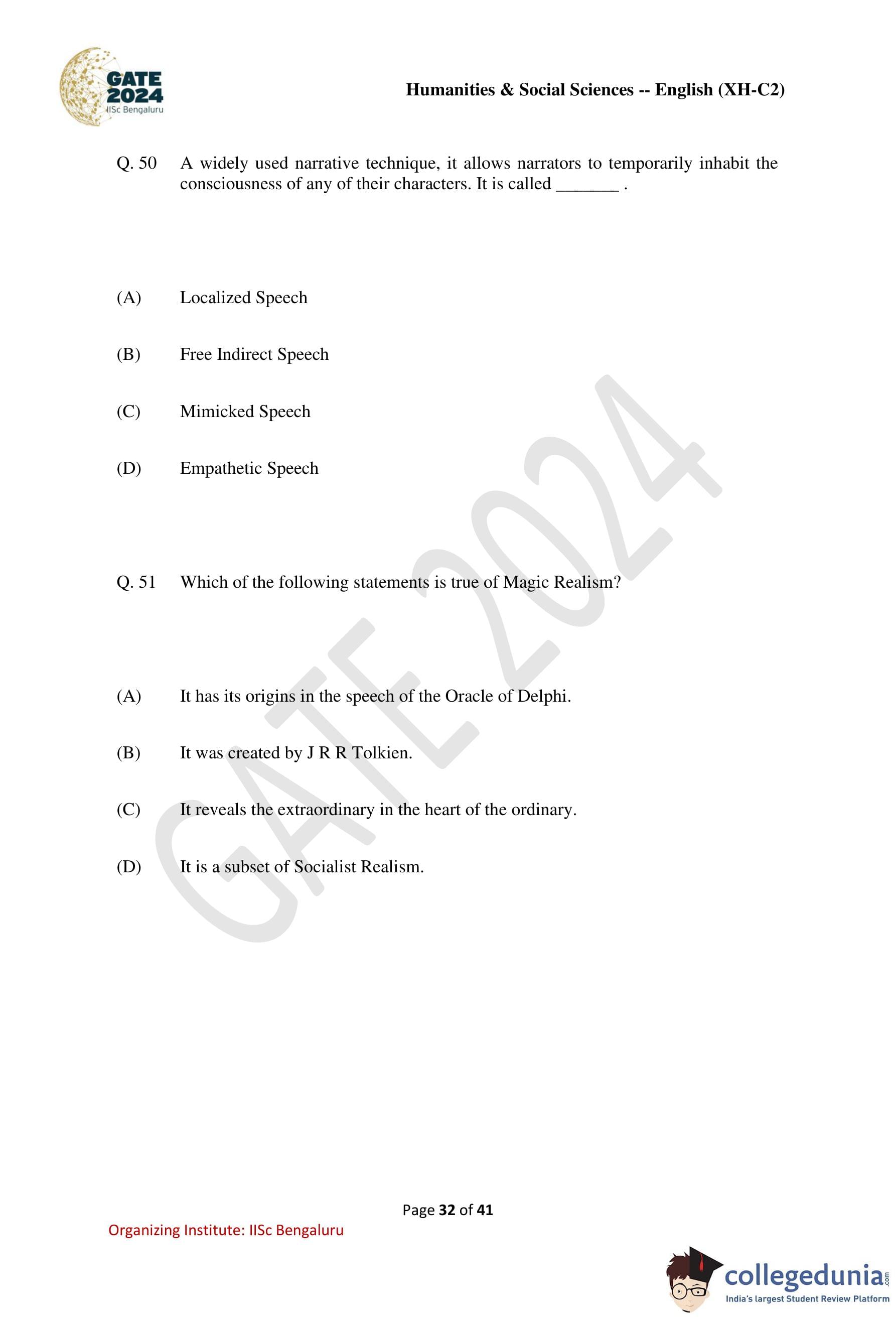
A widely used narrative technique, it allows narrators to temporarily inhabit the consciousness of any of their characters. It is called..................
View Solution
Step 1: Understand the narrative technique described.
The question refers to a method where the narrator blends their voice with a character’s thoughts or consciousness.
Step 2: Identify the correct term.
Free Indirect Speech allows access to a character’s inner thoughts without direct quotation or first-person narration.
Step 3: Eliminate incorrect options.
The other options are not established narrative techniques in literary theory.
Step 4: Conclusion.
The correct answer is Free Indirect Speech.
Quick Tip: Free indirect speech is common in novels by Jane Austen, Virginia Woolf, and James Joyce.
Which of the following statements is true of Magic Realism?
View Solution
Step 1: Define Magic Realism.
Magic Realism presents magical or supernatural elements as a natural part of everyday reality.
Step 2: Analyze the options.
Option (C) correctly captures the essence of Magic Realism.
The other options are historically or conceptually incorrect.
Step 3: Conclusion.
Magic Realism reveals the extraordinary within the ordinary.
Quick Tip: Magic Realism is often associated with writers like Gabriel García Márquez and Salman Rushdie.
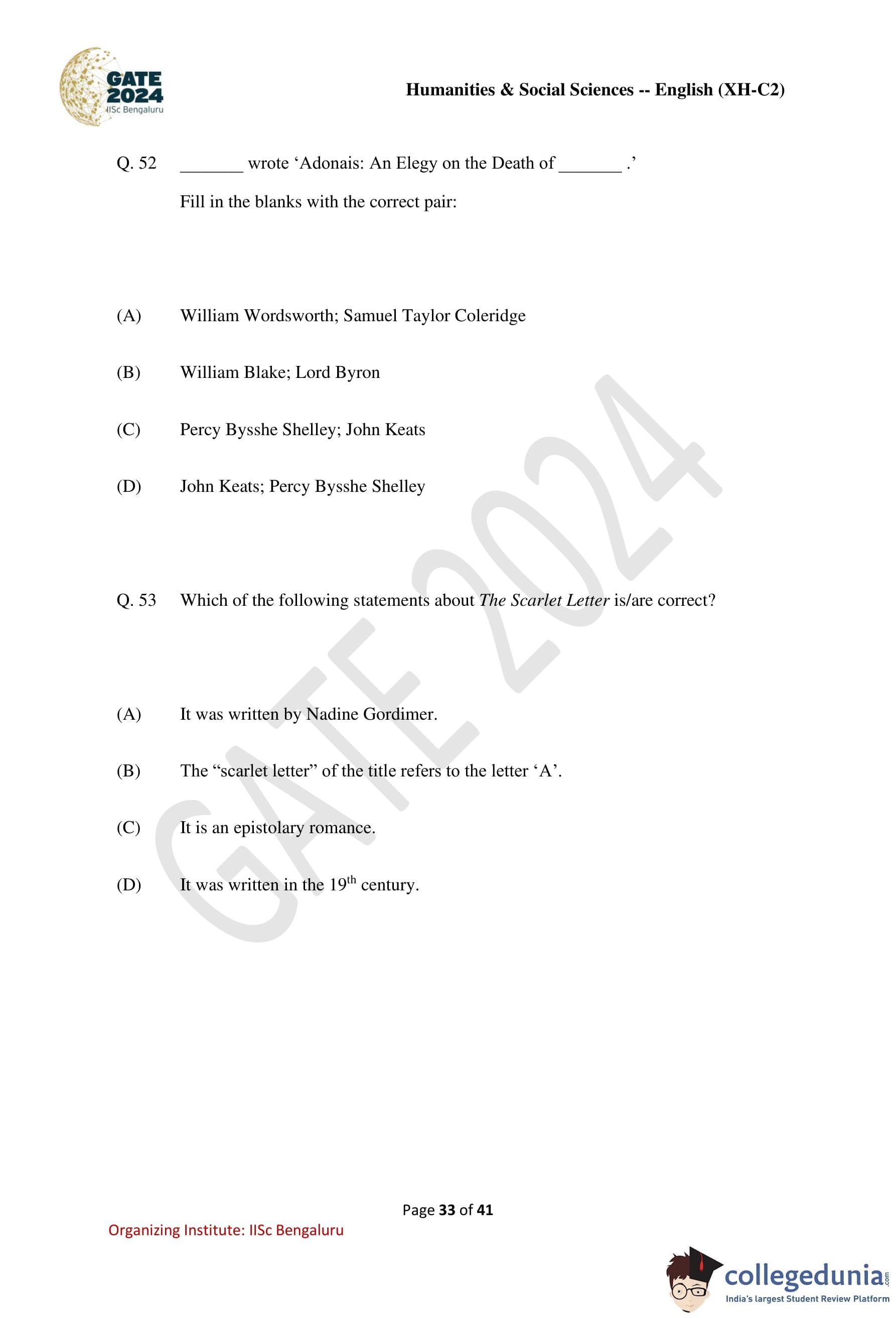
............ wrote ‘Adonais: An Elegy on the Death of.................’. Fill in the blanks with the correct pair.
View Solution
Step 1: Recall the elegy.
Adonais is a pastoral elegy written in memory of a fellow Romantic poet.
Step 2: Identify the poet and subject.
Percy Bysshe Shelley wrote the elegy on the death of John Keats.
Step 3: Conclusion.
The correct pair is Percy Bysshe Shelley; John Keats.
Quick Tip: Romantic poets frequently wrote elegies for one another—remember Shelley–Keats for \textit{Adonais.
Which of the following statements about The Scarlet Letter is/are correct?
View Solution
Step 1: Identify the author and period.
The Scarlet Letter was written by Nathaniel Hawthorne in 1850, placing it in the 19th century show
.
Step 2: Interpret the title.
The “scarlet letter” refers to the embroidered letter ‘A’ worn by Hester Prynne as a mark of adultery.
Step 3: Eliminate incorrect options.
The novel is neither epistolary nor written by Nadine Gordimer.
Step 4: Conclusion.
Statements (B) and (D) are correct.
Quick Tip: Associate American classics like \textit{The Scarlet Letter with their themes, symbols, and historical period.
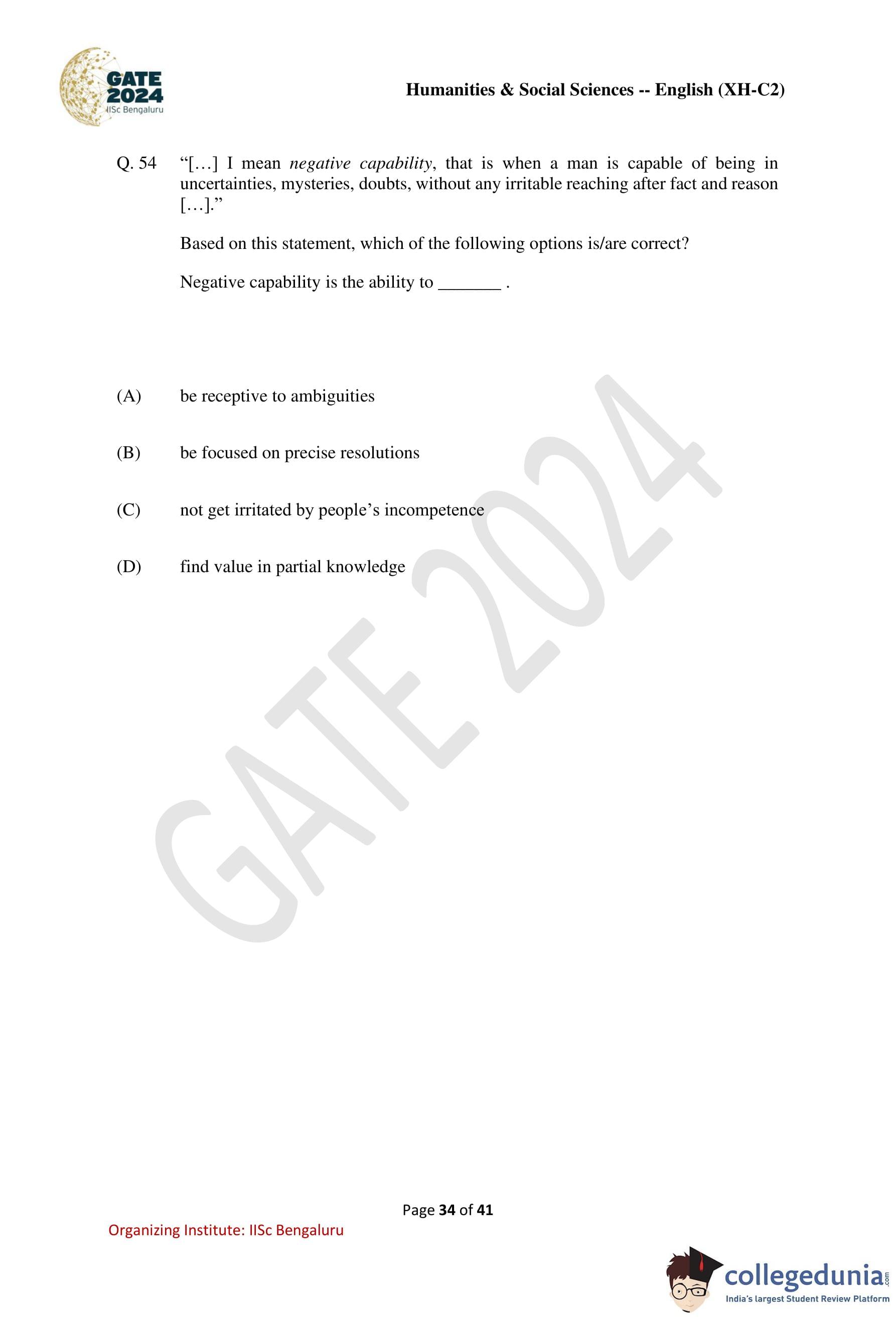
“[…] I mean negative capability, that is when a man is capable of being in uncertainties, mysteries, doubts, without any irritable reaching after fact and reason […]”
Based on this statement, which of the following options is/are correct?
Negative capability is the ability to..................
View Solution
Step 1: Understand the concept of negative capability.
Negative capability, as defined by John Keats, refers to the capacity to remain comfortable with uncertainty, doubt, and ambiguity without forcing logical closure.
Step 2: Evaluate the options.
Option (A) is correct because negative capability involves openness to ambiguity.
Option (D) is correct as it values partial or incomplete knowledge without anxiety.
Option (B) contradicts the idea of avoiding rigid resolutions.
Option (C) is unrelated to Keats’s aesthetic-philosophical concept.
Step 3: Conclusion.
The correct answers are (A) and (D).
Quick Tip: Negative capability is central to Romantic aesthetics—think uncertainty, imagination, and openness.
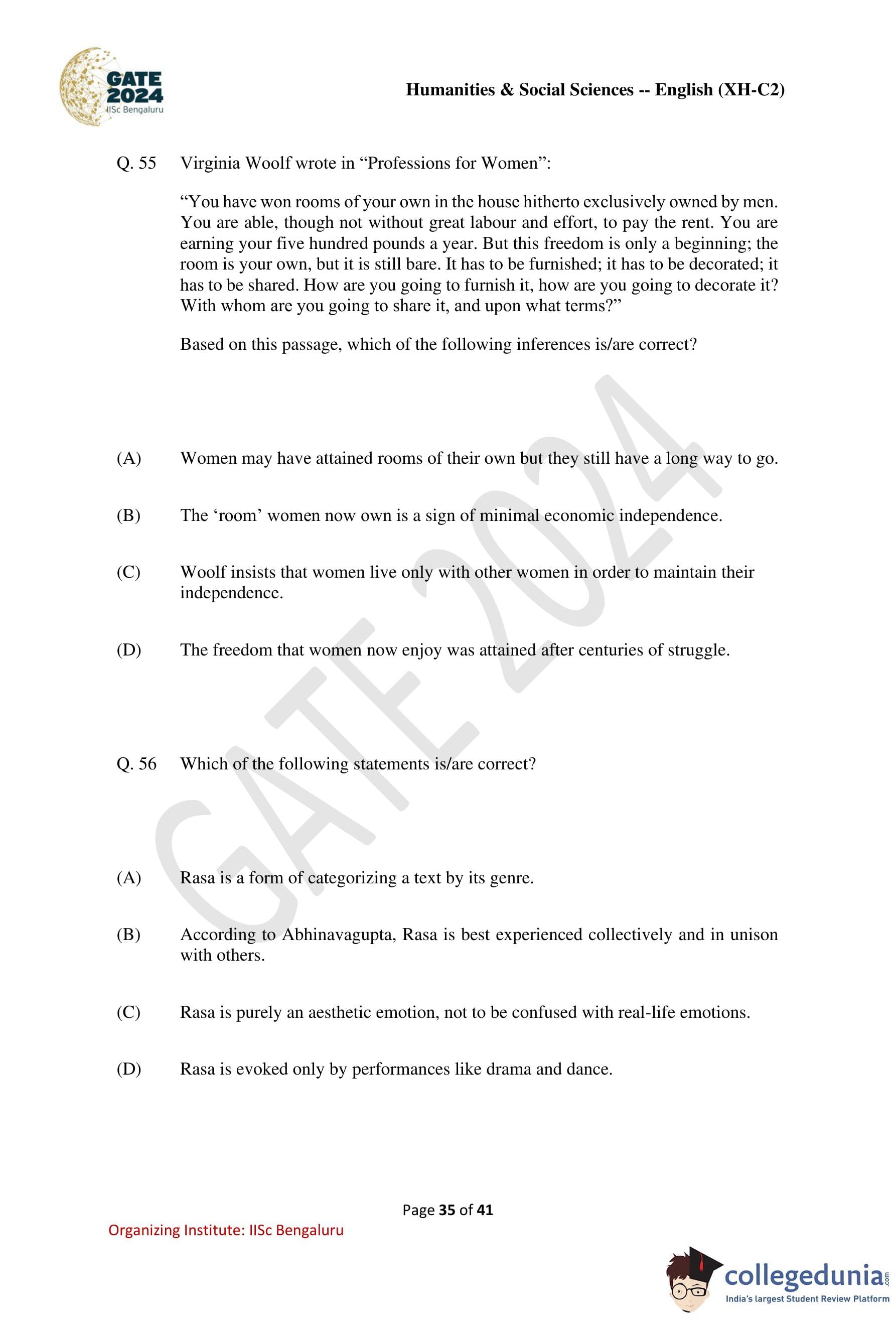
Virginia Woolf wrote in “Professions for Women”:
“You have won rooms of your own in the house hitherto exclusively owned by men… But this freedom is only a beginning…”
Based on this passage, which of the following inferences is/are correct?
View Solution
Step 1: Interpret Woolf’s argument.
Woolf emphasizes that women have gained limited economic and intellectual freedom, but this is only an initial step.
Step 2: Analyze the options.
Option (A) is correct as Woolf highlights the incomplete nature of women’s progress.
Option (B) is correct since the ‘room’ symbolizes modest financial independence.
Option (D) is correct as the passage acknowledges a long historical struggle.
Option (C) is incorrect because Woolf does not advocate social separation from men.
Step 3: Conclusion.
The correct answers are (A), (B), and (D).
Quick Tip: In Woolf’s essays, symbolic spaces like “a room” often represent economic and creative freedom.
Which of the following statements is/are correct?
View Solution
Step 1: Understand the concept of Rasa.
Rasa theory explains aesthetic pleasure derived from art, distinct from personal emotions.
Step 2: Evaluate each option.
Option (B) is correct as Abhinavagupta emphasizes the collective experience of Rasa.
Option (C) is correct since Rasa is aestheticized emotion, separate from lived emotion.
Option (A) is incorrect because Rasa is not a genre classification.
Option (D) is incorrect as Rasa can be evoked through poetry and literature as well.
Step 3: Conclusion.
The correct statements are (B) and (C).
Quick Tip: Rasa theory applies to all forms of art—literary, visual, and performative.
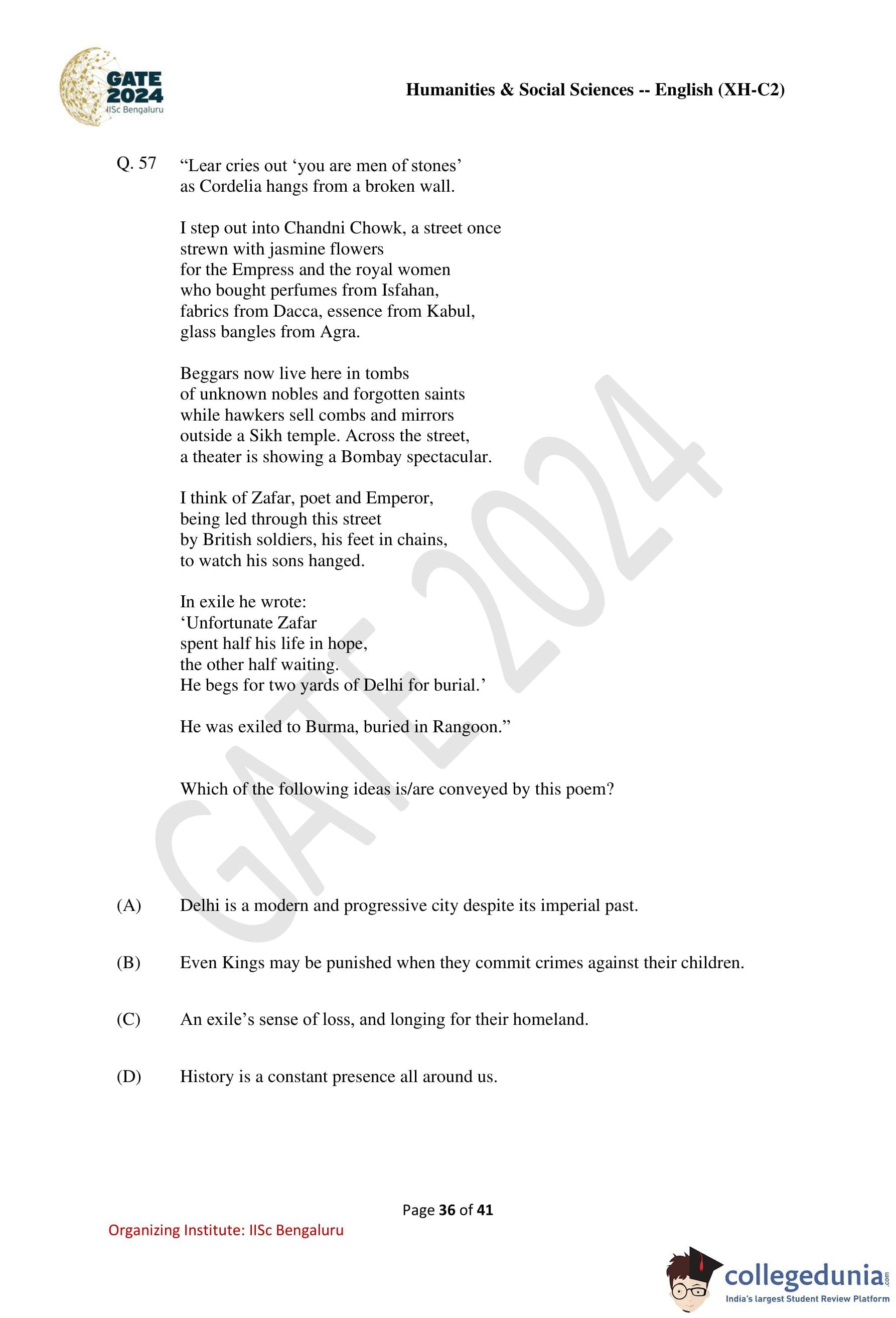
“Lear cries out ‘you are men of stones’ as Cordelia hangs from a broken wall.
I step out into Chandni Chowk, a street once strewn with jasmine flowers
for the Empress and the royal women
who bought perfumes from Isfahan,
fabrics from Dacca, essence from Kabul,
glass bangles from Agra.
Beggars now live here in tombs
of unknown nobles and forgotten saints
while hawkers sell combs and mirrors
outside a Sikh temple. Across the street,
a theater is showing a Bombay spectacular.
I think of Zafar, poet and Emperor,
being led through this street
by British soldiers, his feet in chains,
to watch his sons hanged.
In exile he wrote:
‘Unfortunate Zafar
spent half his life in hope,
the other half waiting.
He begs for two yards of Delhi for burial.’
He was exiled to Burma, buried in Rangoon.”
Which of the following ideas is/are conveyed by this poem?
View Solution
Step 1: Identify the central themes of the poem.
The poem juxtaposes the present-day Chandni Chowk with its historical past, evoking memories of emperors, exile, loss, and cultural decline.
Step 2: Analyze the reference to Zafar.
Bahadur Shah Zafar’s exile, his longing for burial in Delhi, and his tragic fate strongly express an exile’s deep sense of loss and yearning for homeland.
Step 3: Examine the presence of history in the present.
Images of tombs, forgotten saints, imperial processions, and colonial punishment appear alongside modern scenes like hawkers and cinema halls, showing how history permeates everyday life.
Step 4: Evaluate the options.
Option (C) is correct because the poem clearly conveys exile, loss, and longing for home.
Option (D) is correct as the poem portrays history as continuously surrounding and shaping the present.
Option (A) is incorrect as the poem is reflective and elegiac, not celebratory of modern progress.
Option (B) is incorrect as the poem does not focus on moral judgment of kings but on historical tragedy.
Step 5: Conclusion.
The poem conveys both an exile’s longing for homeland and the inescapable presence of history.
Quick Tip: When analyzing poetry, look for contrasts between past and present to identify themes of memory, history, and loss.
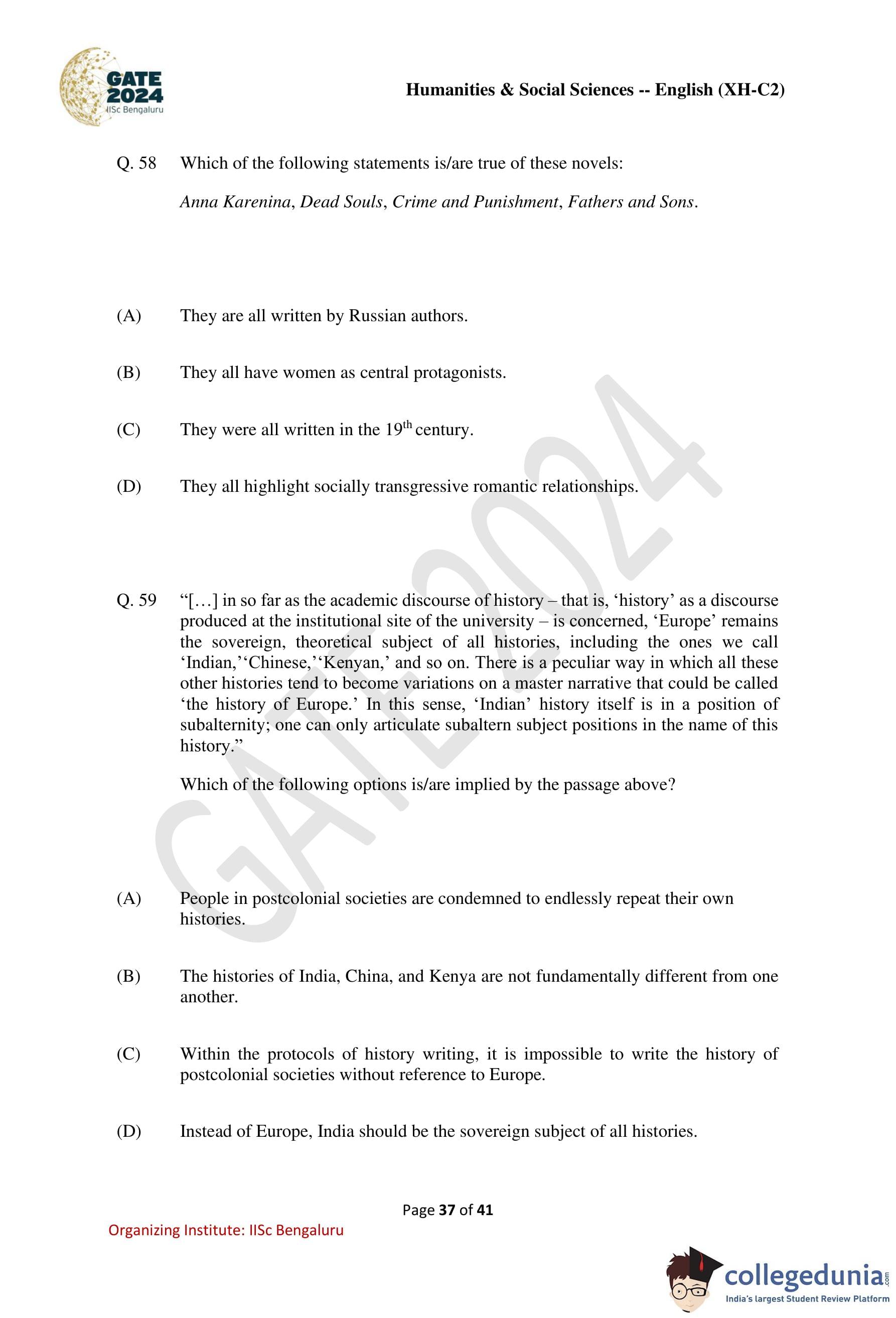
Which of the following statements is/are true of these novels: Anna Karenina, Dead Souls, Crime and Punishment, Fathers and Sons?
View Solution
Step 1: Identify the authors of the novels.
\textit{Anna Karenina was written by Leo Tolstoy.
\textit{Dead Souls was written by Nikolai Gogol.
\textit{Crime and Punishment was written by Fyodor Dostoevsky.
\textit{Fathers and Sons was written by Ivan Turgenev.
All four authors are Russian, making option (A) correct.
Step 2: Examine the time period.
All these novels were published in the 19th century, which makes option (C) correct.
Step 3: Evaluate the remaining options.
Option (B) is incorrect because not all these novels have women as central protagonists (e.g., \textit{Crime and Punishment, \textit{Dead Souls).
Option (D) is incorrect because socially transgressive romance is not a defining theme in all four works.
Step 4: Conclusion.
The correct statements are (A) and (C).
Quick Tip: Key Russian realist novels are often grouped by author nationality and century—check these first in comparison questions.
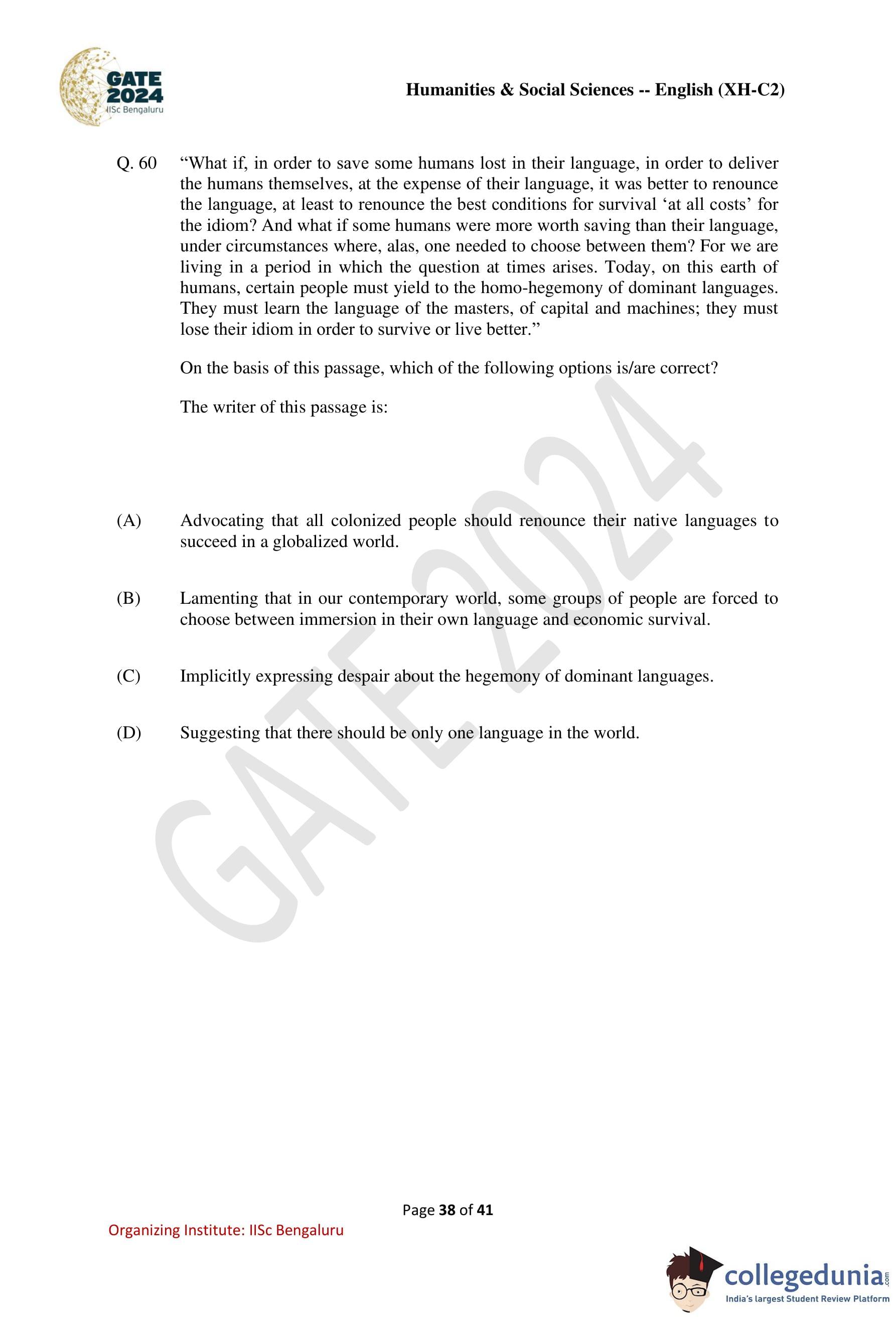
“[…] in so far as the academic discourse of history – that is, ‘history’ as a discourse produced at the institutional site of the university – is concerned, ‘Europe’ remains the sovereign, theoretical subject of all histories, including the ones we call ‘Indian’, ‘Chinese’, ‘Kenyan’, and so on […] ‘Indian’ history itself is in a position of subalternity.”
Which of the following options is/are implied by the passage above?
View Solution
Step 1: Understand the central argument of the passage.
The passage argues that academic history-writing treats Europe as the dominant theoretical framework, even when discussing non-European histories.
Step 2: Interpret the implication.
Because Europe remains the sovereign subject, histories of postcolonial societies must be articulated in relation to European historical categories and narratives.
Step 3: Evaluate the options.
Option (C) correctly captures this implication.
Option (A) is not suggested in the passage.
Option (B) misreads the argument, which is about dominance of discourse, not similarity of histories.
Option (D) is a prescriptive claim not made by the passage.
Step 4: Conclusion.
The passage implies that postcolonial histories cannot be written within academic discourse without reference to Europe.
Quick Tip: Postcolonial theory questions who controls knowledge production—look for ideas of dominance, subalternity, and discourse.
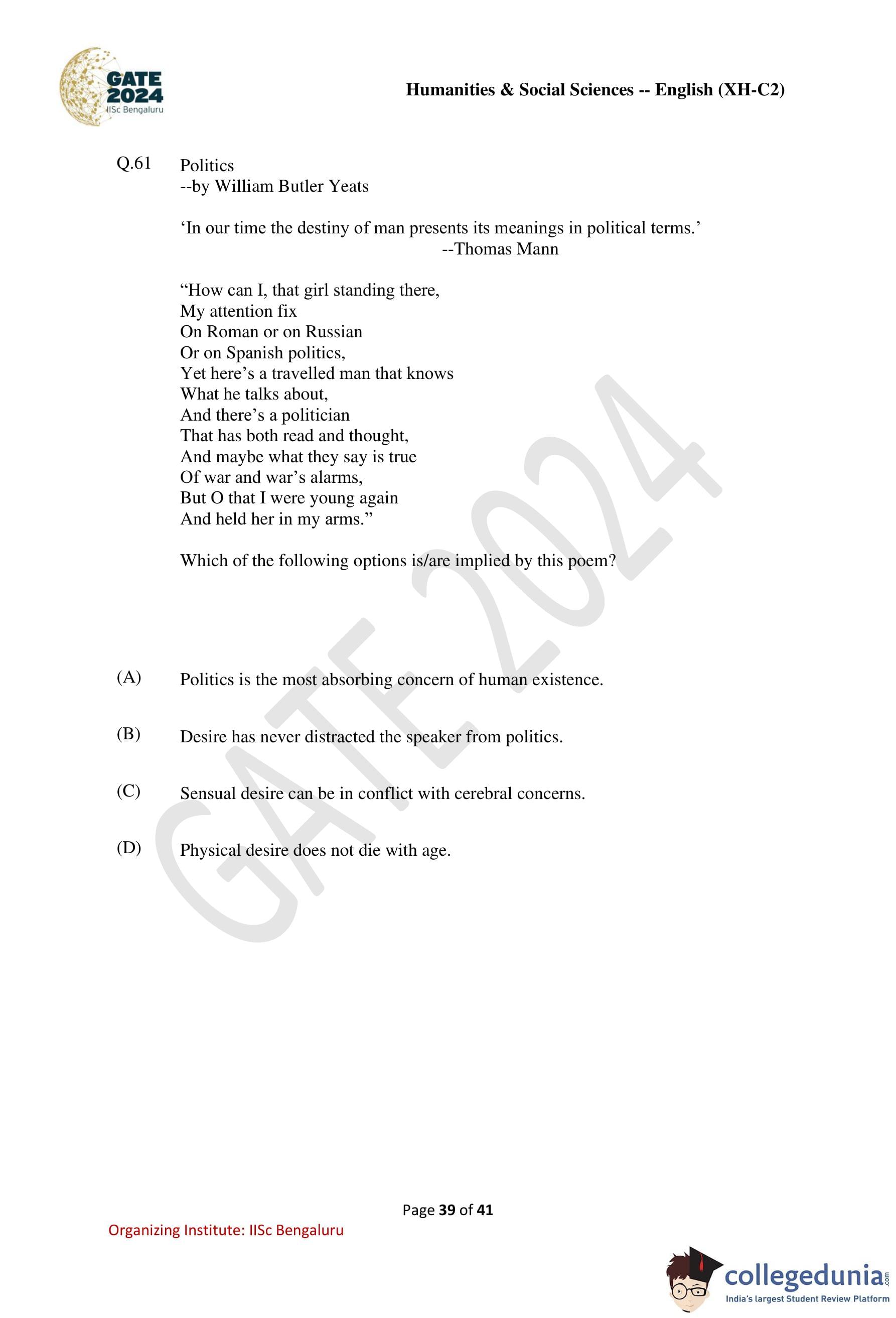
“What if, in order to save some humans lost in their language, in order to deliver the humans themselves, at the expense of their language, it was better to renounce the language, at least to renounce the best conditions for survival ‘at all costs’ for the idiom? And what if some humans were more worth saving than their language, under circumstances where, alas, one needed to choose between them? For we are living in a period in which the question at times arises. Today, on this earth of humans, certain people must yield to the homo-hegemony of dominant languages. They must learn the language of the masters, of capital and machines; they must lose their idiom in order to survive or live better.”
On the basis of this passage, which of the following options is/are correct?
The writer of this passage is:
View Solution
Step 1: Understand the central concern of the passage.
The passage reflects on the painful dilemma faced by marginalized communities who must often abandon their native languages in order to survive within systems dominated by powerful global languages.
Step 2: Analyze the tone and stance of the writer.
The writer does not celebrate or endorse linguistic domination; rather, the repeated use of conditional phrases (“What if…”, “alas”) shows regret and unease.
Step 3: Evaluate the options.
Option (B) is correct because the passage clearly mourns the forced choice between linguistic identity and material survival.
Option (C) is correct as the writer expresses implicit despair about the “homo-hegemony” of dominant languages.
Option (A) is incorrect because the passage does not advocate language renunciation but problematizes it.
Option (D) is incorrect as the writer criticizes linguistic homogenization rather than supporting it.
Step 4: Conclusion.
The passage laments linguistic loss under global dominance and expresses concern about the unequal power of dominant languages.
Quick Tip: In passage-based questions, distinguish between describing a problem and endorsing it—the writer here critiques, not promotes, linguistic domination.
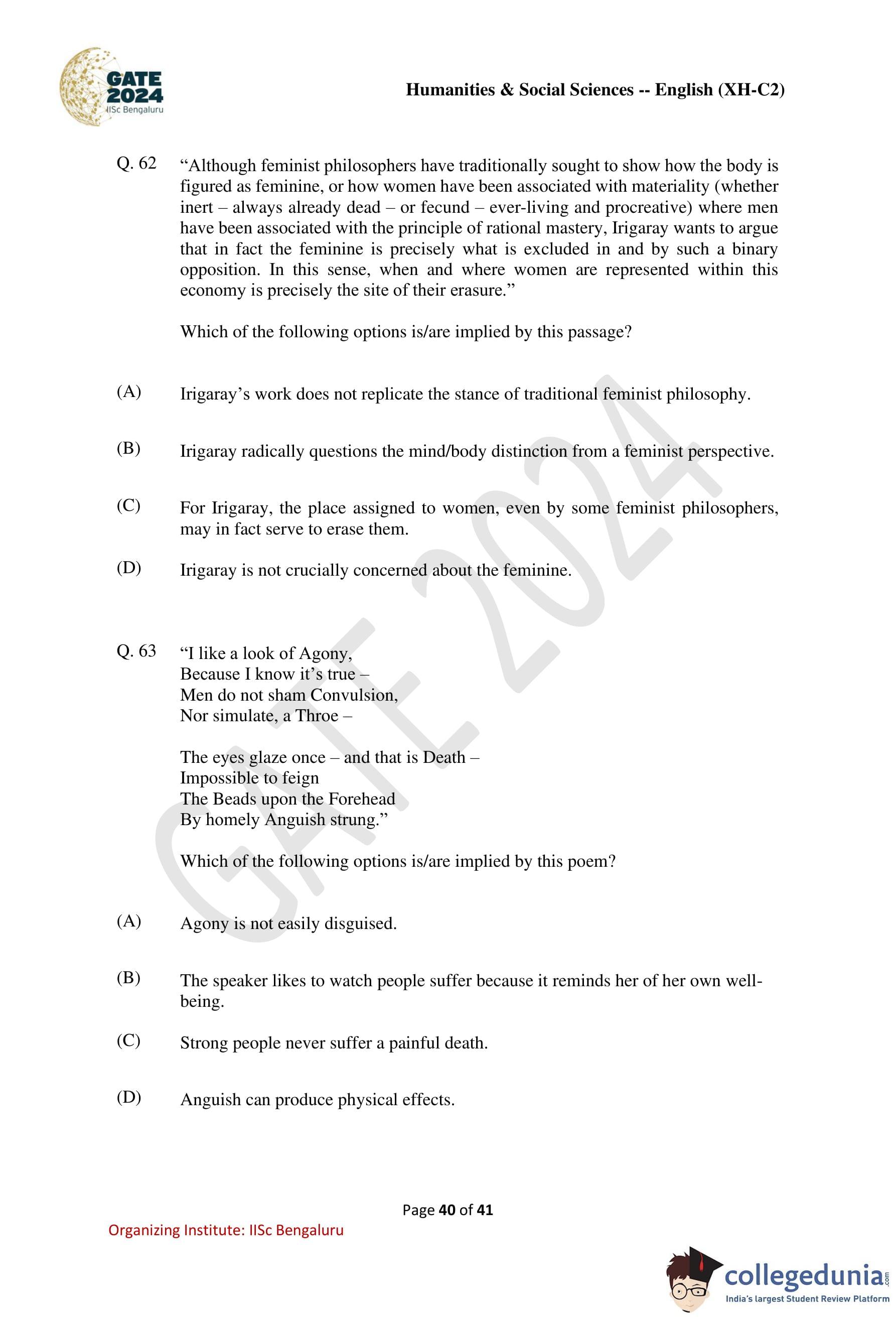
Politics
-- by William Butler Yeats
“In our time the destiny of man presents its meanings in political terms.”
-- Thomas Mann
“How can I, that girl standing there,
My attention fix
On Roman or on Russian
Or on Spanish politics,
Yet here’s a travelled man that knows
What he talks about,
And there’s a politician
That has both read and thought,
And maybe what they say is true
Of war and war’s alarms,
But O that I were young again
And held her in my arms.”
Which of the following options is/are implied by this poem?
View Solution
Step 1: Identify the speaker’s central conflict.
The speaker contrasts political discussions of war and ideology with a deeply personal longing for youthful love and physical intimacy.
Step 2: Analyze implication (C).
The poem shows that despite the seriousness of political thought, the speaker’s sensual desire interrupts and competes with intellectual and political concerns. This clearly implies a conflict between sensual desire and cerebral engagement.
Step 3: Analyze implication (D).
The speaker, though no longer young, still experiences intense physical longing, expressed in the wish to “hold her in my arms.” This suggests that physical desire persists even with age.
Step 4: Eliminate incorrect options.
Option (A) is incorrect because the poem actually downplays politics in favor of personal desire.
Option (B) is incorrect since desire clearly distracts the speaker from political matters.
Step 5: Conclusion.
The poem implies that sensual desire can conflict with intellectual concerns and that physical desire does not disappear with age.
Quick Tip: Yeats often juxtaposes public concerns like politics with private emotions to highlight human vulnerability and desire.
“Although feminist philosophers have traditionally sought to show how the body is figured as feminine, or how women have been associated with materiality (whether inert – always already dead – or fecund – ever-living and procreative) where men have been associated with the principle of rational mastery, Irigaray wants to argue that in fact the feminine is precisely what is excluded in and by such a binary opposition. In this sense, when and where women are represented within this economy is precisely the site of their erasure.”
Which of the following options is/are implied by this passage?
View Solution
Step 1: Understand Irigaray’s critique.
The passage contrasts Irigaray’s position with that of traditional feminist philosophers. While earlier feminism focused on how women were associated with the body or materiality, Irigaray argues that this very framework excludes and erases the feminine.
Step 2: Analyze implication (A).
Since Irigaray departs from earlier feminist approaches, her work does not merely replicate traditional feminist philosophy. Hence, (A) is implied.
Step 3: Analyze implication (B).
By questioning the binary opposition between rational mastery (associated with men) and materiality (associated with women), Irigaray challenges the mind/body distinction itself. Thus, (B) is implied.
Step 4: Analyze implication (C).
The passage explicitly suggests that even representations meant to include women may function as sites of erasure. Therefore, (C) is implied.
Step 5: Eliminate incorrect option.
Option (D) is incorrect because Irigaray’s argument is deeply concerned with redefining and recovering the feminine.
Step 6: Conclusion.
The correct answers are (A), (B), and (C).
Quick Tip: In feminist theory questions, watch for critiques of binaries like mind/body and male/female—they often signal deeper philosophical interventions.
“I like a look of Agony,
Because I know it’s true—
Men do not sham Convulsion,
Nor simulate, a Throe—
The Eyes glaze once—and that is Death noticing—
Impossible to feign
The Beads upon the Forehead
By homely Anguish strung.”
Which of the following options is/are implied by this poem?
View Solution
Step 1: Identify the poem’s central idea.
The poem emphasizes the authenticity of agony, suggesting that true suffering cannot be pretended or concealed.
Step 2: Analyze implication (A).
Lines such as “Men do not sham Convulsion” and “Impossible to feign” clearly imply that agony cannot be easily disguised. Hence, (A) is correct.
Step 3: Analyze implication (D).
The image of “Beads upon the Forehead / By homely Anguish strung” shows anguish producing visible, physical signs such as sweat. Therefore, (D) is implied.
Step 4: Eliminate incorrect options.
Option (B) misreads the speaker’s tone, which values truth, not cruelty.
Option (C) is contradicted by the poem’s focus on universal human suffering.
Step 5: Conclusion.
The poem implies that agony is unmistakable and that anguish manifests physically.
Quick Tip: Emily Dickinson’s poems often link emotional states with physical imagery—track metaphors carefully to infer meaning.
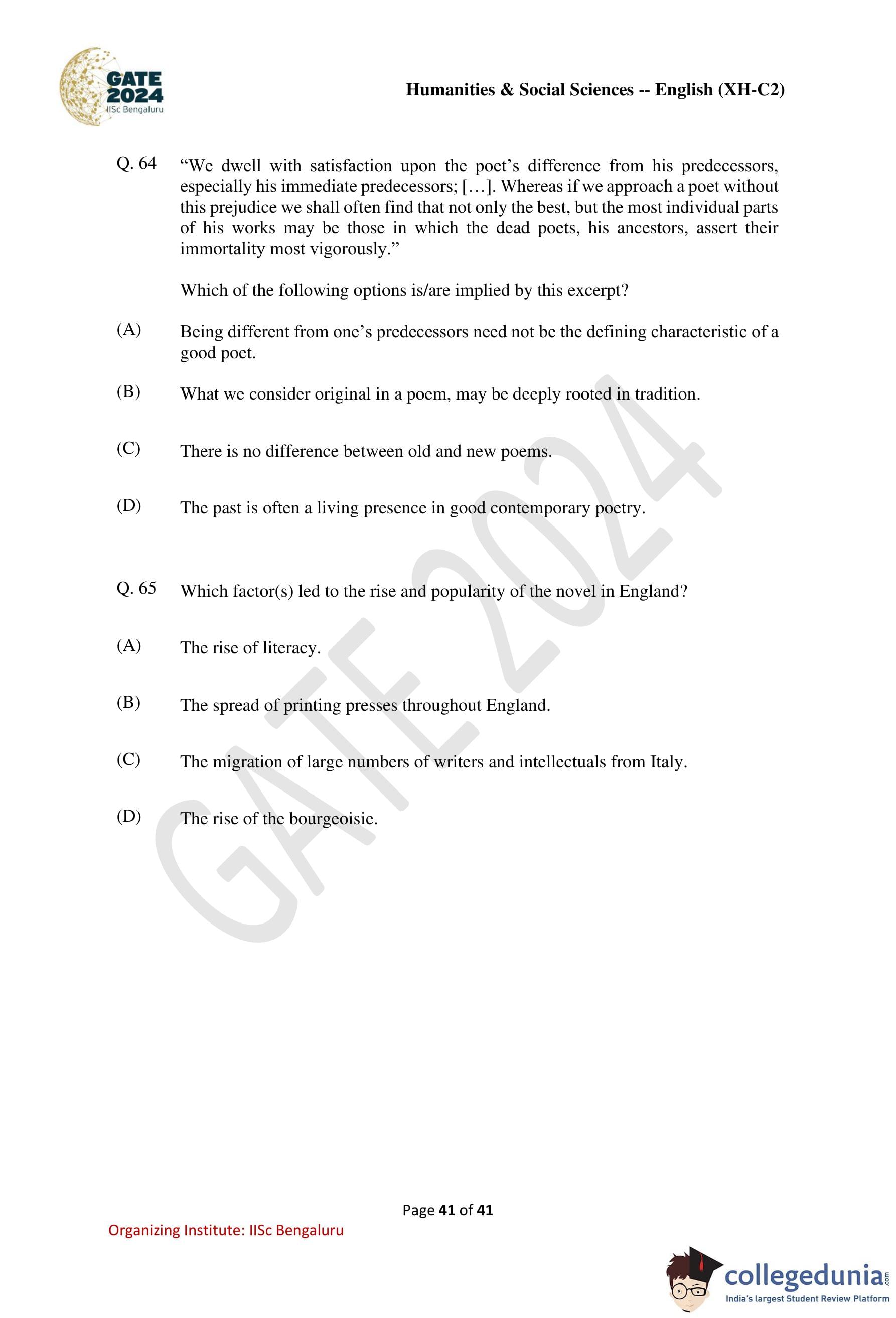
“We dwell with satisfaction upon the poet’s difference from his predecessors, especially his immediate predecessors; […]. Whereas if we approach a poet without this prejudice we shall often find that not only the best, but the most individual parts of his works may be those in which the dead poets, his ancestors, assert their immortality most vigorously.”
Which of the following options is/are implied by this excerpt?
View Solution
Step 1: Understand the central argument.
The excerpt challenges the tendency to value poets solely for their novelty or difference from predecessors. It argues that a poet’s strongest and most individual qualities may emerge through engagement with tradition.
Step 2: Analyze option (A).
The passage suggests that mere difference from predecessors should not be the main criterion for judging poetic merit. Hence, (A) is implied.
Step 3: Analyze option (B).
By stating that the most individual parts of a poet’s work may be where “dead poets” assert their presence, the passage implies that originality can be deeply rooted in tradition. Thus, (B) is correct.
Step 4: Analyze option (D).
The idea that ancestors “assert their immortality most vigorously” in good poetry clearly implies that the past remains a living presence in contemporary works. Therefore, (D) is implied.
Step 5: Eliminate incorrect option.
Option (C) is incorrect because the passage does not deny differences between old and new poetry; it only critiques overemphasis on difference.
Step 6: Conclusion.
The excerpt implies that poetic value lies in a dynamic relationship with tradition rather than in novelty alone.
Quick Tip: In questions on literary tradition, watch for arguments that redefine originality as dialogue with the past rather than rupture from it.
Which factor(s) led to the rise and popularity of the novel in England?
View Solution
Step 1: Identify social and material conditions.
The growth of the novel in England is closely linked to changes in readership, technology, and social structure.
Step 2: Analyze option (A).
Increased literacy expanded the reading public, making prose fiction accessible to a wider audience. Hence, (A) is correct.
Step 3: Analyze option (B).
The spread of printing presses enabled mass production and circulation of novels at lower costs. Therefore, (B) is correct.
Step 4: Analyze option (D).
The rise of the bourgeoisie created a new class of readers interested in realistic narratives reflecting their social experiences. Thus, (D) is correct.
Step 5: Eliminate incorrect option.
Option (C) is incorrect as the rise of the English novel was not driven by migration from Italy but by internal social and economic developments.
Step 6: Conclusion.
The popularity of the novel in England resulted from increased literacy, print culture, and the emergence of the middle class.
Quick Tip: Questions on the history of the novel often link literary forms to social change—focus on readers, technology, and class.
Also Check:



Comments