




After the JEE Main 2026 exam, download your response sheet and calculate your score immediately. The Response Sheet and Provisional Answer key will be released on April 11, 2026. Based on your scores and rank, your actions can be determined.
- You can apply for a challenging window if you find any errors in the Provisional Answer key.
- If you have a significantly higher percentile and rank, start your preparations for JEE Advanced 2026.
- If your score is certainly lower and the possibilities of you applying and getting selected for JEE Advanced 2026 is lower, then search for other engineering colleges' entrance exams.
- You can also apply for JoSAA counselling which will begin by early June 2026, and can help you get into NITs, IIITs and GFTIs.
Related Links:
- Download JEE Main 2026 Session 2 Response Sheet
- Download JEE Main 2026 Session 2 Result
- Download JEE Main 2026 Session 2 Question Papers

Key Summary
- The first step a student who has given his/ her JEE Mains 2026 must calculate his/ her percentile and ranking based on their response sheet and answer key.
- Students with higher percentile and estimated or given AIR by the NTA can prepare for the JEE Advanced 2026 exam.
- If the student has a cutoff that is eligible for JEE Advanced 2026 can apply and give the exam.
- Students can also start applying for JoSAA counselling as they might get into NITs or at least in top state-level government or private engineering colleges.
- Students can check other state-level engineering examinations, prepare and attempt the exams.
- If a student is very serious about getting admission only in IIT, then he/ she can take a drop year and prepare for JEE Mains and Advanced 2027.
Immediate Actions
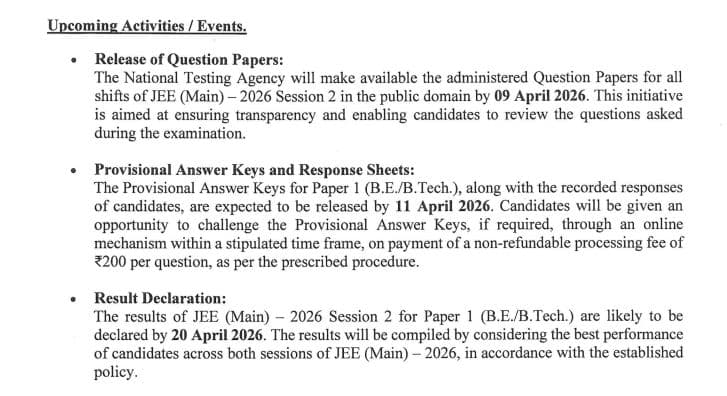
NTA will be releasing the Provisional Answer Keys and the Response sheets for JEE Mains 2026 on April 11, 2026. The first and immediate step that a student who has given his/ her JEE Mains 2026 is expected to do is to download the Provisional Answer Key and their Response Sheet.
- After downloading the answer key and their respective response sheets, there are high chances for a challenging window as the answer key for Session 1 JEE Mains 2026 was flagged with 17 errors.
Source: India Today - If a student challenges the NTA released Provisional Answer key, he/ she should submit a proper explanation and pay a non-refundable fee of INR 200, through an online mechanism at the earliest.
- Then, the Final Answer key will be released 2-3 days after the release of the Provisional Answer key with the errors being corrected.
- After the release of the Final Answer key, students should calculate their normalised percentile and an estimation of their All India Rank (AIR) to proceed forward.
Source: nta.ac.in
Ques. How many students attempt the JEE Main exam 2026?
Ans. Around 13 lakh students attempted for Session 1 JEE Mains 2026 with an attendance of around 96%. For Session 2 of JEE Mains 2026, there were around 10-11 lakh registrations, with a sum 92% percentile of candidates appearing for the exam. The percentile of participation qualifies JEE Mains 2026 to be one of the most competitive engineering entrance exams conducted in India.
Ques. Is negative marking removed in JEE Mains 2026?
Ans. No. Negative marking has not been removed in JEE Mains 2026. Any news suggesting that the negative marking has been removed is to be taken as false information. For each correct answer 4 marks are added, zero marks for unanswered/ unattempted questions, and one mark is deducted for each wrong answer.
How to Challenge the Provisional Answer Key
To challenge the Provisional Answer key visit the official website of NTA JEE Main exam (JEE Main 2026), and login with your “Application number” and “Date of Birth.”
- Click on the link for “Provisional Answer Key” and view the answer key.
- Select the question(s) you want to “Challenge”
- Provide a valid explanation or attach a supporting document as a reasoning for the “Challenge”.
- Pay the prescribed non-refundable amount for challenging the question(s), which is INR 200 for each question.
- Submit your challenge and save/ download the confirmation page for your reference.
After the release of the Final Result key, no challenges can be submitted and no changes will be made.
How to download your JEE Mains Result
A student must visit the official website of JEE Mains 2026 (JEE Main 2026) to download the final results and check the rank.
- Login using your “Application number”, “Date of Birth”, and a security pin/ password.
- Check for the JEE Main 2026 result link, find it and click on that link.
- Check for your details like name, roll number and exam session to cross-verify that it's your result.
- Click on download scorecard/ result to save the document in your device.
- Take a printout of the result so that you can take it for admissions and counselling.
Your final result, i.e., your JEE Mains percentile and AIR, not only depends on your performance, but also, on the difficulty level of the sessions, difference in the difficulty level and number of participants, performance of fellow candidates, and category.
Result/ Rank-based Actions
You can predict your result and rank even before the release of the official result from NTA. You can have an estimated guess of your rank based on the answer key and your response sheet.
Similarly you can determine the cutoff rank for JEE Advanced 2026 by checking out JEE Main 2026 Cutoff: Check Expected Cutoff, Qualifying Marks, etc.
- If you have a higher percentile and an estimated or NTA released good ranking in AIR for JEE Mains, you can start preparing for JEE Advanced 2026.
- There are high possibilities that you can get into IITs or NITs.
- If you have a relatively lower percentile and a higher AIR than the cutoff rank, it’s better that you start looking for other government and private colleges that accept JEE Mains 2026.
- Even if you are eligible and planning to give JEE Advanced 2026, it is better that you look for other colleges as not everyone who gives the exam will get a seat in IITs and NITs.
- If you are very keen on getting admission in IITs, then you can take a drop year and prepare for JEE Mains and Advanced 2027.
| General Cutoff for JEE Mains 2026 | OBC Cutoff for JEE Mains 2026 |
| SC Cutoff for JEE Mains 2026 | ST Cutoff for JEE Mains 2026 |
Alternative Actions
Students who are unsure about their ranking and eligibility for JEE Advanced 2026, and students who want to explore more options can look for the below suggestion options.
- Any student who has given his/ her JEE Mains 2026 exam can appear for JoSAA counselling.
- It helps you find good engineering colleges and also provides you a leverage of getting into NITs if you are qualified for the HS quota system.
- You can also consider giving state-level engineering entrance exams to secure admissions in good state-level government and private institutions.
- Apart from that there are other government colleges that accept JEE Mains results with a certain percentile, you can consider that if you have a relatively good score but not enough to be qualified for JEE Advanced 2026.
JoSAA Counselling and CSAB Special Round
What is JoSAA?
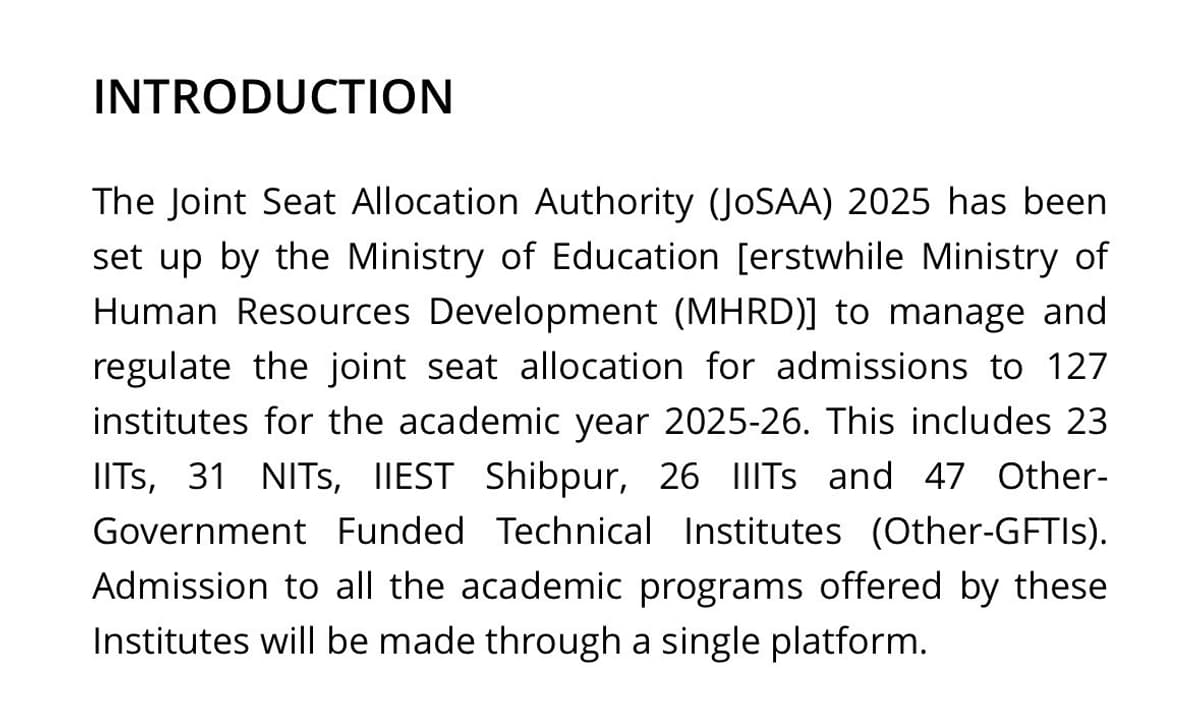
The Joint Seat Allocation Authority (JoSAA) takes care of the seat allocation for the engineering admissions of 127 institutes that include IITs, NITs and GFTIs (Government- funded Technical Institutes).
- This includes 23 IITs, 31 NITs, 26 IIITs, IIEST Shibpur, and more than 47 GFTIs.
- Based on JEE Mains and Advanced, it functions as a single and centralised counselling platform.
- The process of counselling involves online registration, choice filling and seat allocation.
- The seat allocation is conducted in five to six rounds of counselling sessions.
- After allocation, students can either select Freeze (accept the college and branch and exit out of the counselling), Float (accept but seek better options) or Slide (accept but seek better branch in the same institute).
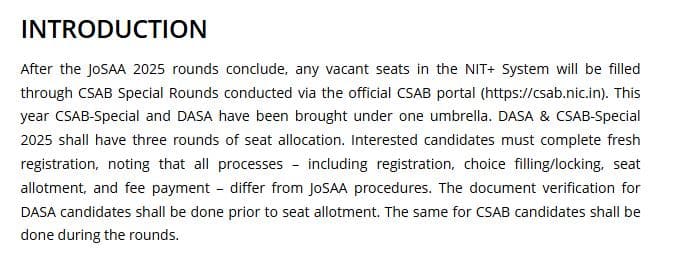
- Once the JoSAA counselling is completed, the remaining vacant seats are filled by CSAB.
- The JoSAA Counselling for the year 2026 is expected to begin by early June 2026.
What is CSAB?
The DASA and CSAB Special Round is a special counselling process that is conducted to fill the remaining vacant seats after the JoSAA counselling.
- It is conducted by the Central Seat Allocation Board (CSAB).
- It fills the unfilled seats of NITs, IIITs and GFTIs.
- The CSAB special round has three rounds of seat allocation with the process of registration, choice filling, seat allotment and fee payment.
- The DASA and CSAB Special counselling is expected to begin in August 2026.
Source: Joint Seat Allocation Authority (JOSAA)
Ques. Does JoSAA consider Home State Quota?
Ans. Yes. JoSAA considers both Home State (HS) quota and Other State (OS) quota during counselling for NITs. Around 50% of the seats allocated are reserved for HS quota students.
Also Check:



Comments