




Based on the experts' JEE Main 2026 Paper analysis for January and April sessions, a score of 220+ is expected to be around the 99.5+ percentile, with an expected JEE Main rank in the range of 50-2500.
- The 98+ percentile requires 160-175+ marks, while 150+ marks generally aim for the 98+ percentile and a 13,000-18,000 rank range.
- NTA uses a normalised method to calculate the percentile due to varying difficulty levels across the shifts. This means 160 marks in session 1 may be different from 160 marks in JEE Main Session 2.
- Difficult shifts are usually converted to a higher percentile. For example, 170+ marks might secure a 99+ percentile in difficult shifts.
To get admission to top NITs, you need to have 99+ percentile, which is equivalent to 180+ marks with 5000-10000 JEE Main rank.
Related Links:
- How Many Candidates applied for the JEE Mains 2026 Session 2 Exam
- Use collegedunia’s college predictor to check IIT and NIT chances
- JEE Main 2026 Session 2 Result Date Out: Download Scorecard (Soon)
- JEE Main 2026 Session 2 Category-wise Cutoff
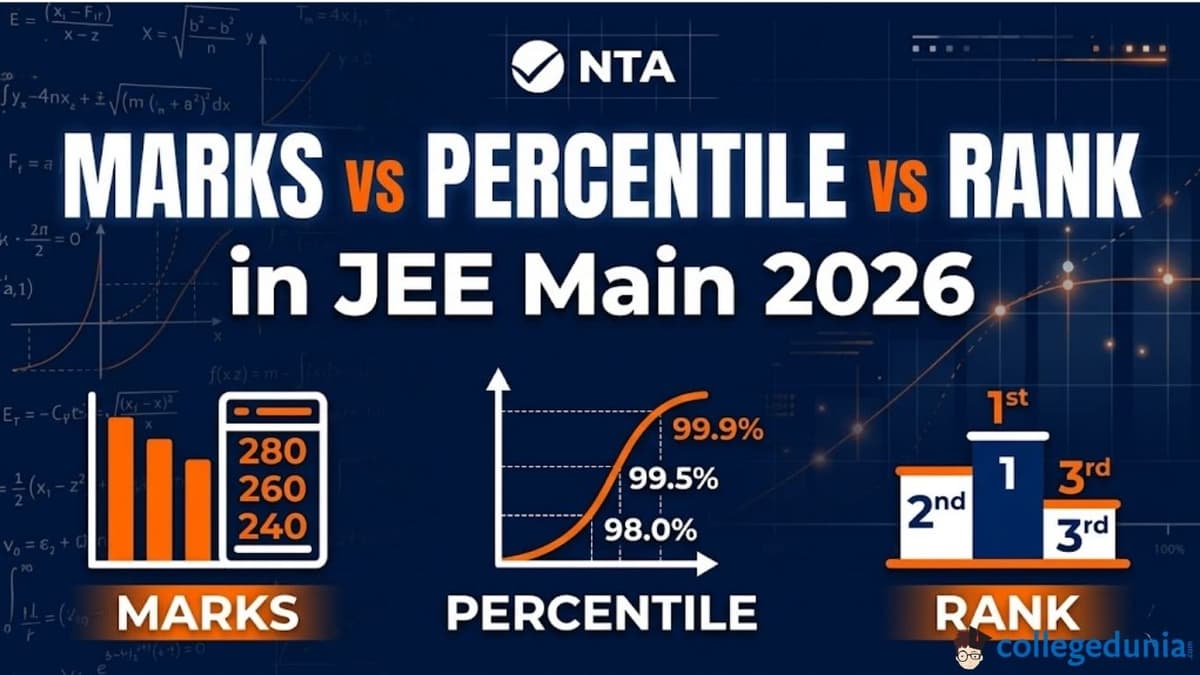
JEE Main 2026 Marks vs Percentile vs Rank
- The jump from 150 marks to 200 marks may increase the percentile to 2-3 points, but there will be huge increase the rank range of around 25,000 to 10,000. This is because large number of students fall in this score range making the competition very high.
- Scores above 240+ will be in 99 percentile because very few students score this high. For example, moving from 240 to 260 marks can push your percentile from around 99.6 to 99.9+, and your rank can improve from roughly 3,000-5,000 to within the top 1,000.
- A one-percentile difference near the 99 percentile mark can make a 2000 rank difference.
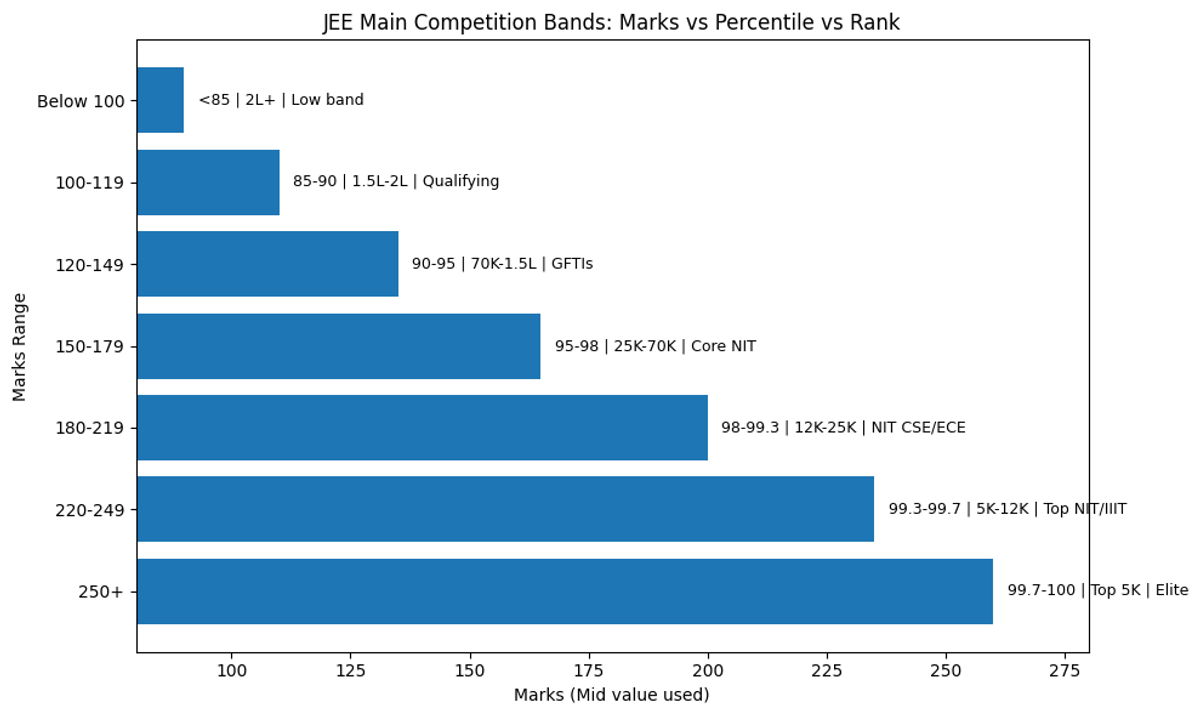
| Raw Marks (out of 300) | Expected Percentile | Approx AIR Range | Competition Band |
|---|---|---|---|
| 250+ | 99.7 - 100 | Top 5,000 | Top 0.3% (Elite zone) |
| 220 - 249 | 99.3 - 99.7 | 5,000 - 12,000 | Top NIT / IIIT CSE |
| 180 - 219 | 98 - 99.3 | 12,000 - 25,000 | NIT CSE / ECE range |
| 150 - 179 | 95 - 98 | 25,000 - 70,000 | Core NIT branches |
| 120 - 149 | 90 - 95 | 70,000 - 1.5 lakh | GFTIs / Mid-tier colleges |
| 100 - 119 | 85 - 90 | 1.5 - 2 lakh | Qualifying range |
| Below 100 | Below 85 | 2 lakh+ | Low percentile band |
Also Read: How to Calculate JEE Mains Percentile from Marks?
Check Out:
- Check JEE Main 2026 Shift-wise Marks and Rank Prediction
- JEE Main Category-wise Rank Predictor
- How to Calculate JEE Main Rank?
Ques. What is the difference between marks, percentile, and rank in JEE Main 2026?
Ans. Marks are the raw score calculated as (correct × 4) − (wrong × 1) out of 300. Percentile is a normalised score showing the percentage of candidates who scored equal to or below you in your session. JEE Main Rank (AIR) is your position in the national merit list calculated from the best percentile across both sessions, and it is the metric colleges actually use for admission.
Category-Wise Expected Cutoff Percentile vs Marks vs Number of Qualified for JEE Advanced 2026
- General category has the highest cutoff (94-95 percentile) and the largest share of qualifiers, showing intense competition.
- OBC-NCL and EWS cutoffs stay around 80 percentile, while SC/ST drop to 50-65 percentile due to reservation benefits.
- Despite different cutoffs, only 2.5 lakh candidates qualify for JEE Advanced.
| Category | Expected Percentile Range | Approx. Qualified Candidates | Notes |
|---|---|---|---|
| General | 93.5 - 95.0% | 1,45,000 - 1,55,000 | Majority of qualified candidates |
| OBC-NCL | 79.5 - 81.5% | 35,000 - 40,000 | Represents 27% of seats |
| EWS | 80.5 - 82.5% | 8,000 - 10,000 | Represents 10% of seats |
| SC | 61.5 - 64.0% | 45,000 - 50,000 | Represents 15% of seats |
| ST | 48.0 - 50.5% | 15,000 - 18,000 | Represents 7.5% of seats |
| PwD | 0.01%+ | 2,000 - 3,000 | Represents 1% of seats (horizontal) |
Also Read:
- How All India Rank Calculated in JEE Main 2026?
- NIT Colleges Under 98 Percentile in JEE Main 2026
- List of Colleges with 97 Percentile in JEE Main 2026
Ques. What percentile is needed for JEE Advanced?
Ans. General category usually needs around 93–95 percentile, while reserved categories have lower cutoffs. Around 2.5 lakh students qualify overall.
Ques. Why do marks change for the same percentile?
Ans. Because paper difficulty is different in each shift. Tough shifts need fewer marks, while easy shifts need higher marks for the same percentile.
Shift-Wise Marks vs Percentile - January & April Sessions 2026
- The marks vs percentile in JEE Main 2026 vary across shifts due to differences in paper difficulty.
- NTA uses a normalisation process to ensure fairness, so students in tougher shifts are not at a disadvantage.
Below is the shift-wise analysis for both January and April sessions based on expert estimates.
January 2026 Session - Shift-Wise Estimated Marks for Key Percentiles
- Easier shifts (like Jan 21 Shift 2) required higher marks for the same percentile.
- Tough shifts (like Jan 22 Shift 2) had lower marks due to normalisation.
- Overall, 99 percentile ranged between 153 to 186 marks, depending on shift difficulty.
| Date & Shift (2026) | 99 %ile | 98.5 %ile | 98 %ile | 97.5%ile | 97 %ile |
|---|---|---|---|---|---|
| JEE Main Marks vs Percentile 21 Jan Shift 1 | 167 | 154 | 144 | 137 | 130 |
| JEE Main Marks vs Percentile 21 Jan Shift 2 | 171 | 157 | 147 | 139 | 132 |
| JEE Main Marks vs Percentile 22 Jan Shift 1 | 158 | 144 | 134 | 126 | 120 |
| JEE Main Marks vs Percentile 22 Jan Shift 2 | 155 | 143 | 131 | 126 | 120 |
| JEE Main Marks vs Percentile 23 Jan Shift 1 | 158 | 145 | 135 | 127 | 121 |
| JEE Main Marks vs Percentile 23 Jan Shift 2 | 163 | 150 | 139 | 132 | 126 |
| JEE Main Marks vs Percentile 24 Jan Shift 1 | 162 | 150 | 141 | 134 | 127 |
| JEE Main Marks vs Percentile 24 Jan Shift 2 | 160 | 146 | 137 | 128 | 121 |
| JEE Main Marks vs Percentile 28 Jan Shift 1 | 161 | 149 | 138 | 132 | 126 |
| JEE Main Marks vs Percentile 28 Jan Shift 2 | 162 | 150 | 140 | 133 | 126 |
Source: JEE Main 2026: Safe Score for 9X Percentile | MathonGo | Anup Sir
Also Read:
- List of Colleges with 99 Percentile in JEE Main 2026
- Home State NIT Options Under 90 Percentile in JEE Main 2026
April 2026 Session - Shift-Wise Estimated Marks for Key Percentiles
- Tough shifts (Apr 8 S2, Apr 2 S2, Apr 6 S1) required lower marks for the same percentile, for example, 158-162 for 99%ile, showing tougher papers.
- Moderate shifts (Apr 2 S1, Apr 5 S1, Apr 4 S1) will have balanced cutoffs, with 99%ile around 170-174 marks.
- Easiest shifts (Apr 5 S2, Apr 6 S2) will require a higher mark to secure the 99th percentile, maybe around 187-189
- Overall trend: As difficulty decreases, marks required for the same percentile increase sharply, especially above 95 percentile due to higher competition at the top.
| Percentile | Apr 8 S2 | Apr 2 S2 | Apr 6 S1 | Apr 2 S1 | Apr 5 S1 | Apr 4 S1 | Apr 4 S2 | Apr 5 S2 | Apr 6 S2 |
|---|---|---|---|---|---|---|---|---|---|
| 99 | 158 | 160 | 162 | 170 | 172 | 174 | 175 | 187 | 189 |
| 98 | 145 | 148 | 148 | 158 | 160 | 162 | 155 | 167 | 170 |
| 97 | 132 | 136 | 138 | 142 | 145 | 147 | 148 | 157 | 160 |
| 96 | 125 | 128 | 128 | 132 | 135 | 137 | 140 | 141 | 145 |
| 95 | 115 | 118 | 118 | 122 | 125 | 128 | 130 | 131 | 135 |
| 94 | 104 | 105 | 110 | 112 | 117 | 118 | 120 | 124 | 125 |
| 90 | 85 | 89 | 92 | 94 | 97 | 98 | 100 | 104 | 105 |
| 80 | 58 | 61 | 63 | 64 | 67 | 68 | 71 | 74 | 75 |
| 70 | 40 | 41 | 43 | 44 | 47 | 48 | 51 | 54 | 55 |
| Difficulty | Tough | Tough | Tough | Moderate | Moderate | Moderate | Easy to Moderate | Easy | Easy |
Source: Marks vs Percetile Apr YouTube Video
Check: JEE Main 2026 April Easiest Shift Marks vs Rank
Ques. Which shift is best in JEE Main?
Ans. There is no “best” shift. Normalisation ensures all shifts are treated fairly.
Ques. Should I worry about getting a tough shift?
Ans. No, tough shifts usually get higher percentile for lower marks, so it balances out.
What is a good score in JEE Main session 2 2026?
- A “good score” in JEE Main isn’t the same for everyone; it depends on your goal, whether you want to qualify for JEE Advanced or get into top NITs/IIITs.
- After Session 2, your best percentile from both sessions is used to decide your final rank.
Based on expert analysis, here’s what can be considered a good score in JEE Main Session 2:
| Score Range (Marks) | Expected Percentile | Approx. AIR (Rank) | What It Means / Admission Prospects (General Category) |
|---|---|---|---|
| 250+ | 99.9+ | Top 1–2,000 | Excellent – Top IITs via Advanced, premium NIT CSE |
| 220–249 | 99.7 – 99.89 | 2,000 – 5,000 | Very Good – Good NITs/IIITs (CSE/ECE possible) |
| 200–219 | 99.0 – 99.69 | 5,000 – 12,000 | Good – Core branches in top NITs, strong IIITs |
| 180–199 | 98.0 – 98.99 | 12,000 – 25,000 | Decent – Mid-tier NITs, many IIITs/GFTIs |
| 160–179 | 96.5 – 97.99 | 25,000 – 45,000 | Average – Newer NITs, lower branches |
| 140–159 | 94.0 – 96.49 | 45,000 – 70,000 | Safe for lower NITs/GFTIs |
| 120–139 | 90.0 – 93.99 | 70,000 – 1,20,000 | Basic qualification, private/state colleges |
| 100–119 | ~85 – 90 | 1,20,000+ | Minimum for many private options |
Also Read:
- Colleges for 75000 - 1 Lakh Rank in JEE Mains 2025
- List of Colleges Accepting 1,00,000 - 2,50,000 Ranks in JEE Mains 2026
Ques. What is considered a good score in JEE Main?
Ans. A score above 200 is generally good and can get you into top NITs or IIITs. Higher scores improve your chances for better branches
Related News:



Comments