




JEE Main 2014 April 12 Question Paper is available here with solutions PDF and detailed solutions for every question. CBSE conducted the computer-based test (CBT) Paper 1 on April 12, 2014. The JEE Main 2014 Paper 1 (B.E./B.Tech) question paper includes the following:
- 90 questions in a 3-hour CBT Mode: 30 each from Mathematics, Physics and Chemistry
- Question type: all multiple choice questions (MCQs) with a single correct option, 4 marks each
- Sections: Mathematics (30), Physics (30) and Chemistry (30), all questions compulsory
- Marking: +4 for a correct answer, -1 for an incorrect answer, 0 for an unattempted question
- Maximum marks: 360 (120 per subject)
JEE Main 2014 April 12 Question Paper with Solution PDF
| NTA Official PDF | CD PDF | CD PDF with Solutions |
|---|---|---|
| Download official PDF 2.66 MB | Download Collegedunia PDF 3.78 MB | Download solutions PDF 1.63 MB |
Also Check:
JEE Main 2014 April 12 Questions with Solutions
Mathematics (Q1 - Q30)
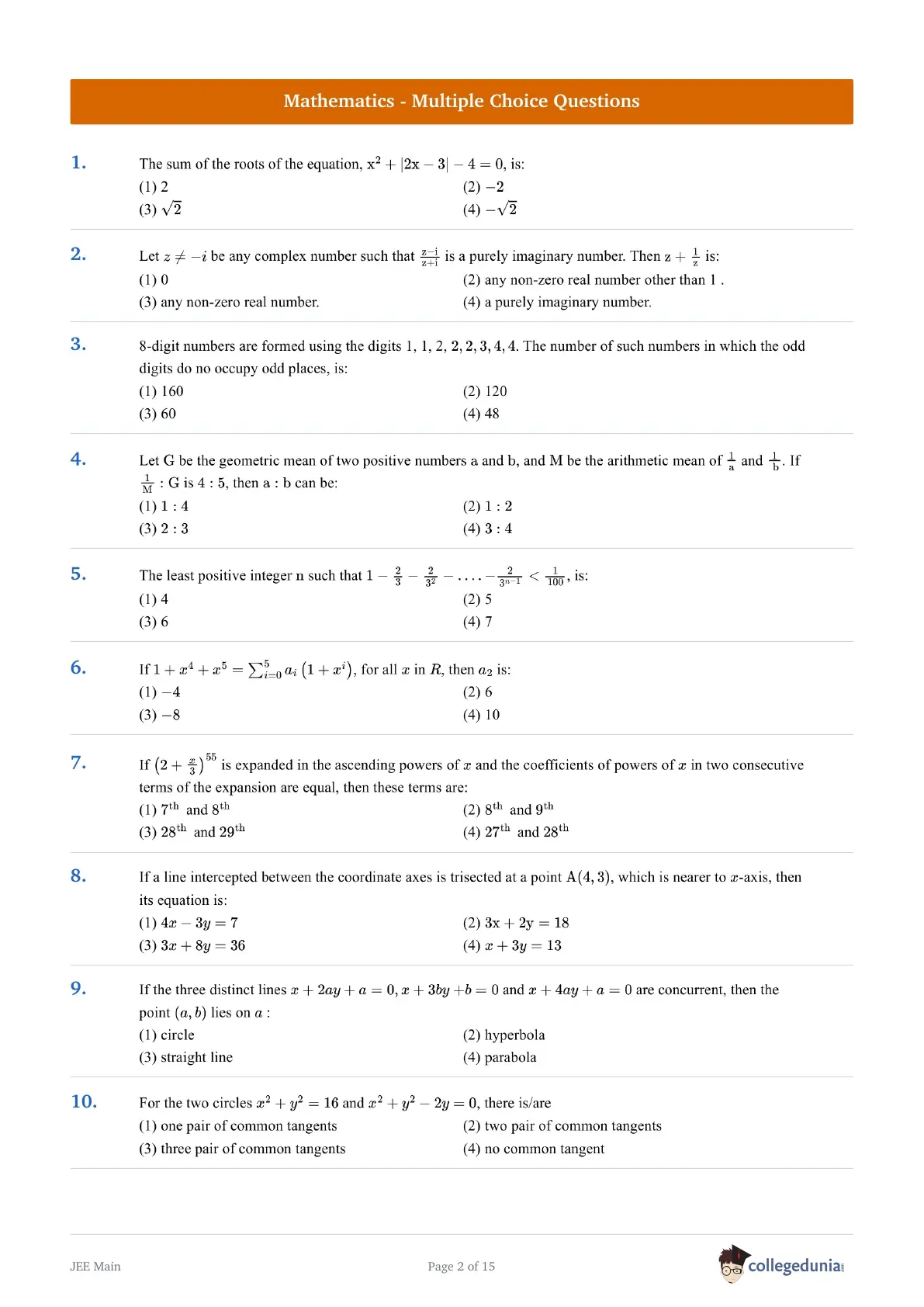
The sum of the roots of the equation, \(x^2 + |2x - 3| - 4 = 0\), is:
Let \(z\ne-i\) be any complex number such that \(\frac{z-i}{z+i}\) is a purely imaginary number. Then \(z+\frac{1}{z}\) is :
8-digit numbers are formed using the digits \(1, 1, 2, 2, 2, 3, 4, 4\). The number of such numbers in which the odd digits do not occupy odd places, is:
Let \(G\) be the geometric mean of two positive numbers \(a\) and \(b\), and \(M\) be the arithmetic mean of \(\frac{1}{a}\) and \(\frac{1}{b}\). If \(\frac{1}{M} : G\) is \(4 : 5\), then \(a : b\) can be:
The least positive integer n such that \(1-\frac{2}{3}-\frac{2}{3^{2}}-.......-\frac{2}{3^{n-1}} < \frac{1}{100},\) is :
If \( 1 + x^4 + x^5 = \sum\limits^{5}_{i =0} a_i\) \((1 + x)^i\) , for all \(x\) in \(R\), then \(a_2\) is:
If \(\left(2 + \frac{x}{3}\right)^{55}\) is expanded in the ascending powers of \(x\) and the coefficients of powers of \(x\) in two consecutive terms of the expansion are equal, then these terms are:
If a line intercepted between the coordinate axes is trisected at a point \(A(4, 3)\), which is nearer to \(x\)-axis, then its equation is :
If the three distinct lines \(x + 2ay + a = 0\), \(x + 3by + b = 0\) and \(x + 4ay + a = 0\) are concurrent, then the point \((a, b)\) lies on a:
For the two circles \(x^2 + y^2 = 16\) and \(x^2 + y^2 - 2y = 0\), there is/are
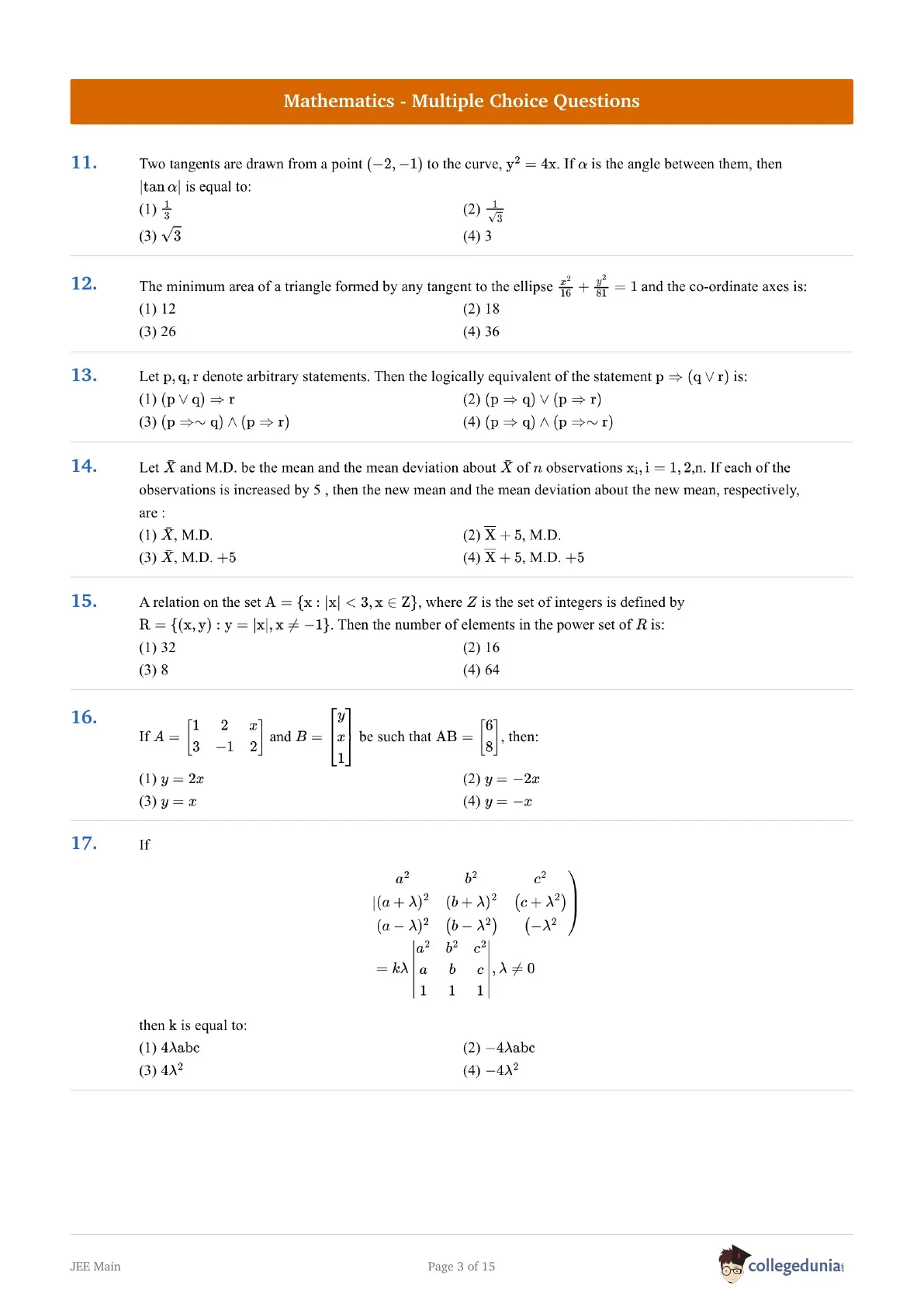
Two tangents are drawn from a point \((- 2, -1)\) to the curve, \(y^{2}=4x.\) If \(\alpha\) is the angle between them, then \(|\tan \alpha|\) is equal to :
The minimum area of a triangle formed by any tangent to the ellipse \(\frac{x^{2}}{16}+\frac{y^{2}}{81}=1\) and the co-ordinate axes is :
Let \(p, q, r\) denote arbitrary statements. Then the logically equivalent of the statement \(p \Rightarrow (q \vee r)\) is:
Let \(\bar{X}\) and M.D. be the mean and the mean deviation about \(\bar{X}\) of \(n\) observations \(x_i, i = 1, 2, n\). If each of the observations is increased by 5, then the new mean and the mean deviation about the new mean, respectively, are:
A relation on the set \(A = \{x : |x| \lt 3, x \in Z\}\), where \(Z\) is the set of integers is defined by \(R = \{(x, y) : y = |x|, x \ne -1\}\). Then the number of elements in the power set of \(R\) is:
If \(A = \begin{bmatrix} 1 & 2 & x \\ 3 & -1 & 2 \end{bmatrix}\) and \(B = \begin{bmatrix} y \\ x \\ 1 \end{bmatrix}\) be such that \(AB = \begin{bmatrix} 6 \\ 8 \end{bmatrix}\), then:
If \(\begin{vmatrix} a^2 & b^2 & c^2 \\ (a+\lambda)^2 & (b+\lambda)^2 & (c+\lambda)^2 \\ (a-\lambda)^2 & (b-\lambda)^2 & (c-\lambda)^2 \end{vmatrix} = k\lambda \begin{vmatrix} a^2 & b^2 & c^2 \\ a & b & c \\ 1 & 1 & 1 \end{vmatrix}, \lambda \ne 0\), then \(k\) is equal to:
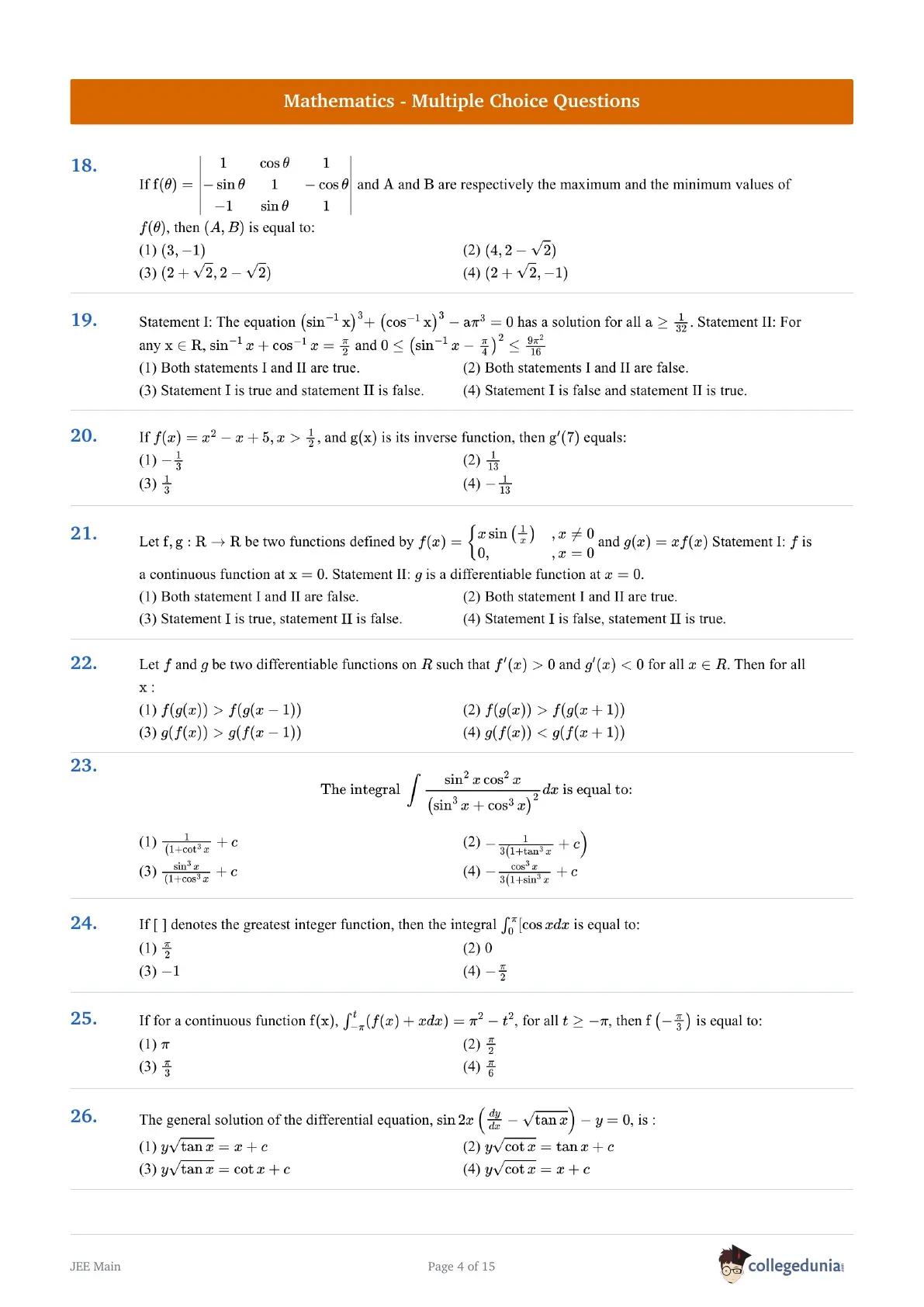
If \(f(\theta) = \begin{vmatrix} 1 & \cos\theta & 1 \\ -\sin\theta & 1 & -\cos\theta \\ -1 & \sin\theta & 1 \end{vmatrix}\) and \(A\) and \(B\) are respectively the maximum and the minimum values of \(f(\theta)\), then \((A, B)\) is equal to:
Statement I: The equation \((\sin^{-1}x)^3+(\cos^{-1}x)^3-a\pi^3=0\) has a solution for all \(a\ge\frac{1}{32}\).
Statement II: For any \(x\in\mathbb{R}\), \(\sin^{-1}x+\cos^{-1}x=\frac{\pi}{2}\) and \(0\le\left(\sin^{-1}x-\frac{\pi}{4}\right)^2\le\frac{9\pi^2}{16}\).
If \(f(x)=x^2-x+5,\ x>\frac{1}{2}\), and \(g(x)\) is its inverse function, then \(g'(7)\) equals:
Let \(f,g:\mathbb{R}\to\mathbb{R}\) be two functions defined by \(f(x)=\begin{cases}x\sin\left(\frac{1}{x}\right), & x\ne0\\ 0, & x=0\end{cases}\) and \(g(x)=xf(x)\).
Statement I: \(f\) is a continuous function at \(x=0\).
Statement II: \(g\) is a differentiable function at \(x=0\).
Let \(f\) and \(g\) be two differentiable functions on \(R\) such that \(f'(x)>0\) and \(g'(x)<0\) for all \(x\in R\). Then for all \(x\):
The integral \(\int\frac{\sin^2x\cos^2x}{(\sin^3x+\cos^3x)^2}\,dx\) is equal to:
If [ ] denotes the greatest integer function, then the integral \(\int_0^{\pi}[\cos x]\,dx\) is equal to:
If for a continuous function \(f(x)\), \(\int_{-\pi}^{t}(f(x)+x)\,dx=\pi^2-t^2\), for all \(t\ge-\pi\), then \(f\left(-\frac{\pi}{3}\right)\) is equal to:
The general solution of the differential equation, \(\sin2x\left(\frac{dy}{dx}-\sqrt{\tan x}\right)-y=0\), is:
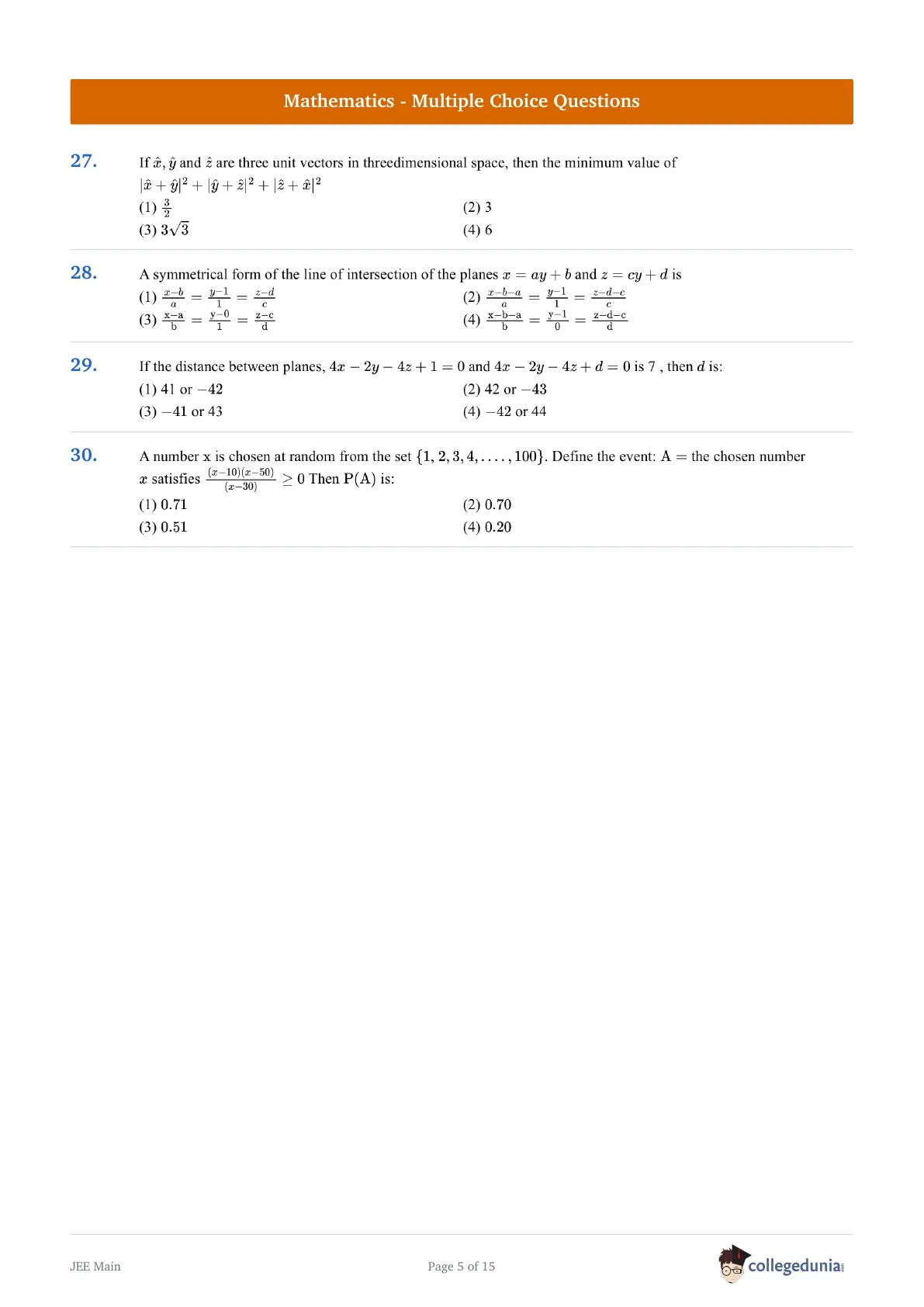
If \(\hat{x},\hat{y}\) and \(\hat{z}\) are three unit vectors in three-dimensional space, then the minimum value of \(|\hat{x}+\hat{y}|^2+|\hat{y}+\hat{z}|^2+|\hat{z}+\hat{x}|^2\) is:
A symmetrical form of the line of intersection of the planes \(x=ay+b\) and \(z=cy+d\) is
If the distance between planes, \(4x-2y-4z+1=0\) and \(4x-2y-4z+d=0\) is 7, then \(d\) is:
A number \(x\) is chosen at random from the set \(\{1, 2, 3, 4, ....., 100\}\). Define the event: \(A =\) the chosen number \(x\) satisfies \(\frac{\left(x-10\right)\left(x-50\right)}{\left(x-30\right)}\ge0\) Then \(P(A)\) is :
Physics (Q31 - Q60)
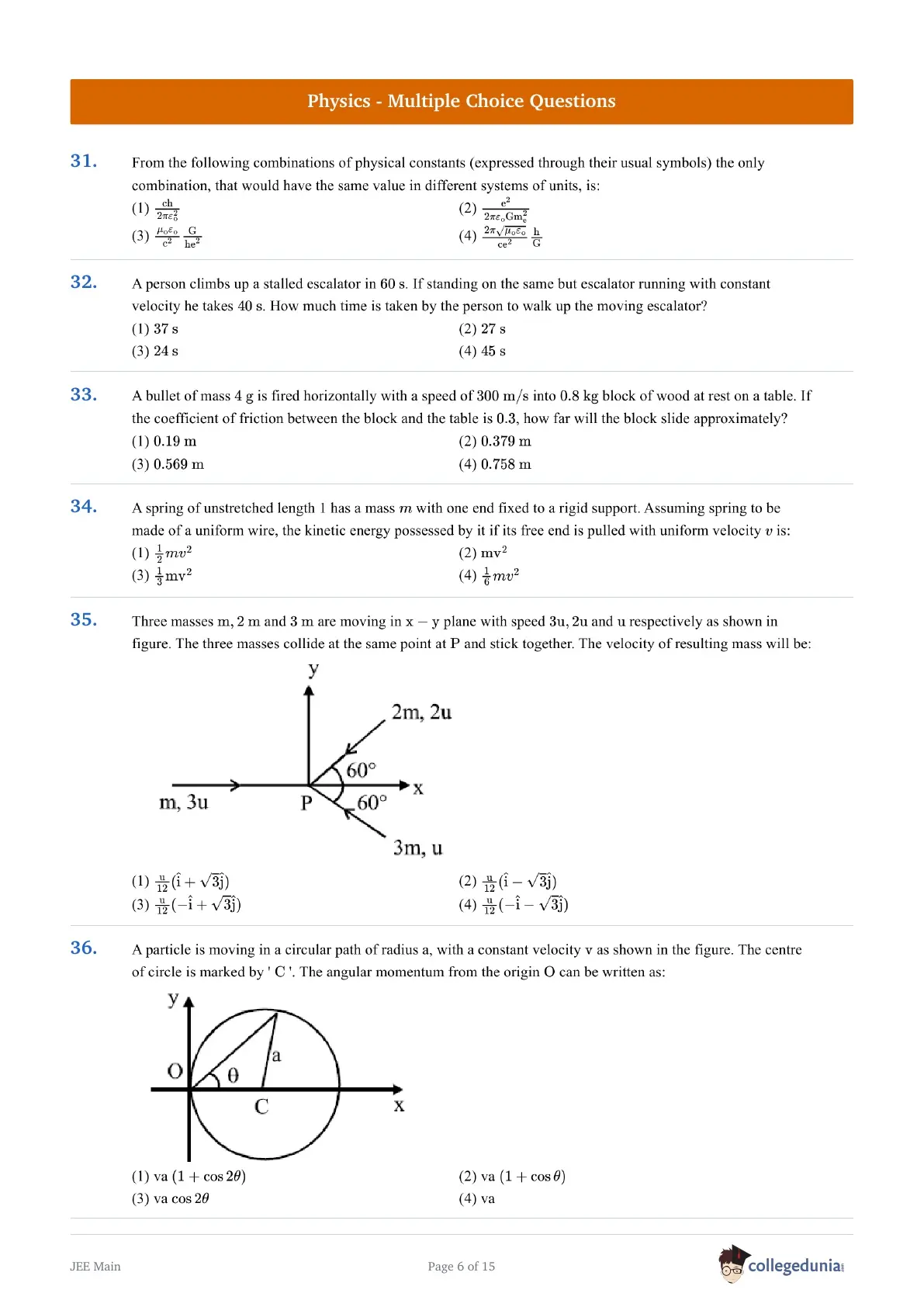
From the following combinations of physical constants (expressed through their usual symbols) the only combination, that would have the same value in different systems of units, is :
A person climbs up a stalled escalator in \(60\, s\) . If standing on the same but escalator running with constant velocity he takes \(40\, s\). How much time is taken by the person to walk up the moving escalator ?
A bullet of mass 4 g is fired horizontally with a speed of 300 m/s into 0.8 kg block of wood at rest on a table. If the coefficient of friction between the block and the table is 0.3, how far will the block slide approximately?
A spring of unstretched length \(\ell\) has a mass m with one end fixed to a rigid support. Assuming spring to be made of a uniform wire, the kinetic energy possessed by it if it's free end is pulled with uniform velocity \(\upsilon\) is :
Three masses \(m\), \(2m\) and \(3m\) are moving in \(x-y\) plane with speed \(3u\), \(2u\) and \(u\) respectively as shown in figure. The three masses collide at the same point at P and stick together. The velocity of resulting mass will be:
A particle is moving in a circular path of radius \(a\), with a constant velocity \(v\) as shown in the figure. The centre of circle is marked by '\(C\)'. The angular momentum from the origin \(O\) can be written as: 
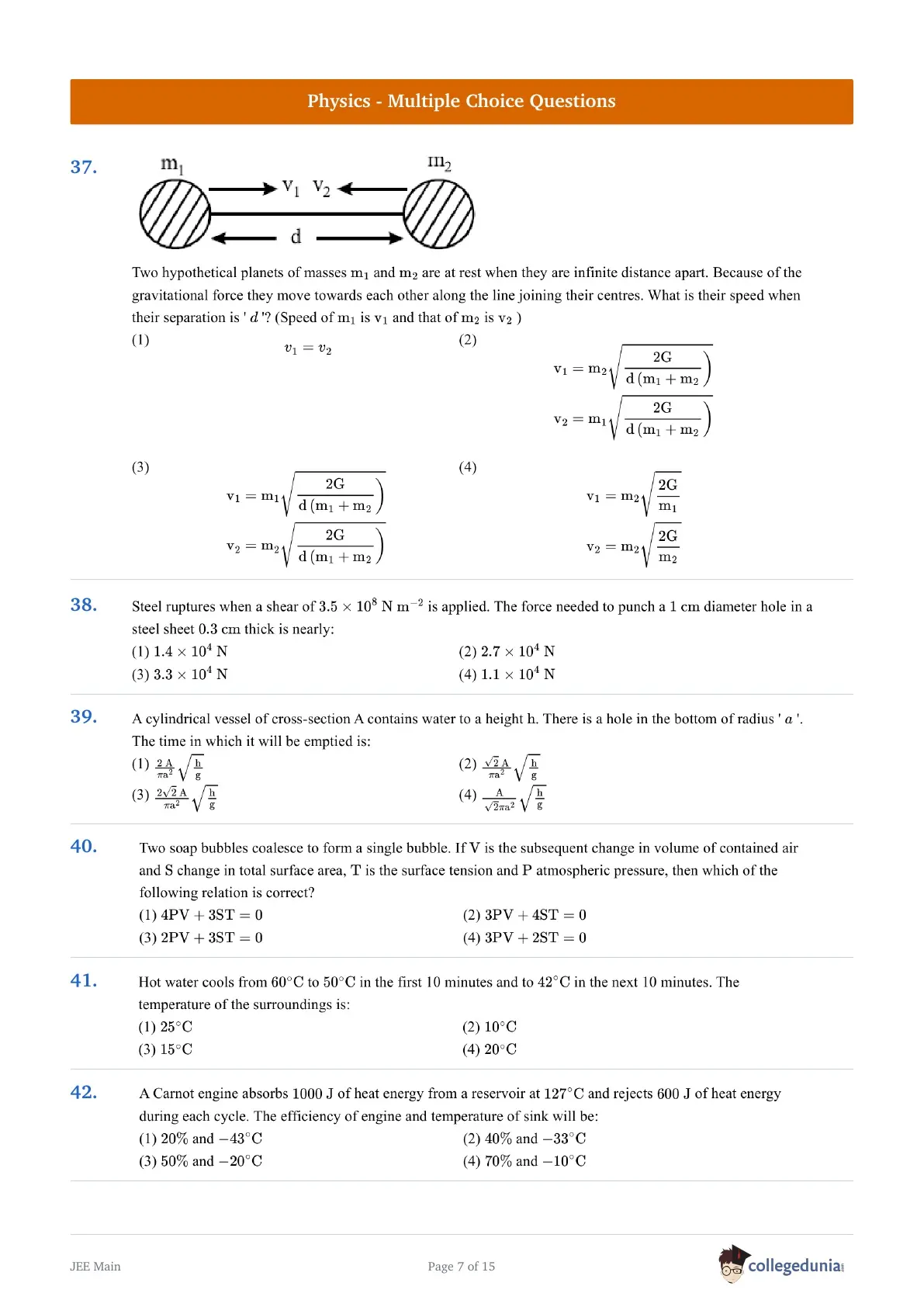
 Two hypothetical planets of masses \(m_1\) and \(m_2\) are at rest when they are infinite distance apart. Because of the gravitational force they move towards each other along the line joining their centres. What is their speed when their separation is '\(d\)'? (Speed of \(m_1\) is \(v_1\) and that of \(m_2\) is \(v_2\))
Steel ruptures when a shear of \( 3.5 \times 10^8 \,Nm^{-2}\) is applied. The force needed to punch a \(1\, cm\) diameter hole in a steel sheet \(0.3\, cm\) thick is nearly :
A cylindrical vessel of cross-section \(A\) contains water to a height \(h\). There is a hole in the bottom of radius '\(a\)'. The time in which it will be emptied is:
Two soap bubbles coalesce to form a single bubble. If \(V\) is the subsequent change in volume of contained air and \(S\) the change in total surface area, \(T\) is the surface tension and \(P\) atmospheric pressure, which of the following relation is correct ?
Hot water cools from \(60^\circ\mathrm{C}\) to \(50^\circ\mathrm{C}\) in the first 10 minutes and to \(42^\circ\mathrm{C}\) in the next 10 minutes. The temperature of the surroundings is:
A Carnot engine absorbs \(1000\ \mathrm{J}\) of heat energy from a reservoir at \(127^\circ\mathrm{C}\) and rejects \(600\ \mathrm{J}\) of heat energy during each cycle. The efficiency of engine and temperature of sink will be:
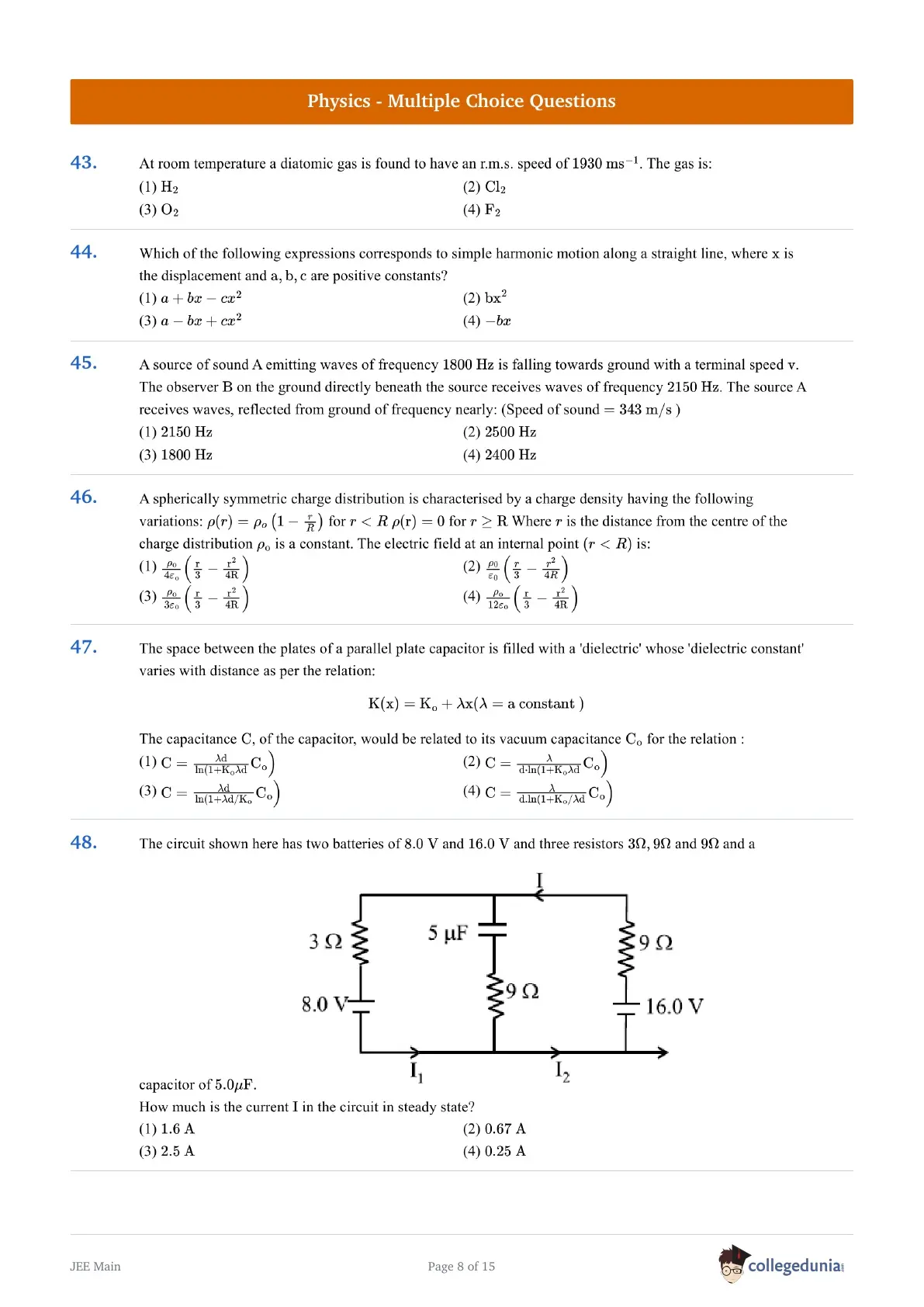
At room temperature a diatomic gas is found to have an r.m.s. speed of \(1930\ \mathrm{ms^{-1}}\). The gas is:
Which of the following expressions corresponds to simple harmonic motion along a straight line, where \(x\) is the displacement and \(a, b, c\) are positive constants?
A source of sound A emitting waves of frequency \(1800\ \mathrm{Hz}\) is falling towards ground with a terminal speed \(v\). The observer B on the ground directly beneath the source receives waves of frequency \(2150\ \mathrm{Hz}\). The source A receives waves, reflected from ground of frequency nearly: (Speed of sound \(= 343\ \mathrm{m/s}\))
A spherically symmetric charge distribution is characterised by a charge density having the following variation : \(\rho\left(r\right)=\rho_{0}\left(1-\frac{r}{R}\right)\) for \(r < R\) \(\rho \left(r\right)=0 \,\) for \(r\ge R\) Where \(r\) is the distance from the centre of the charge distribution and \(\rho_{0}\) is a constant. The electric field at an internal point \((r < R)\) is
The space between the plates of a parallel plate capacitor is filled with a 'dielectric' whose 'dielectric constant' varies with distance as per the relation : \(K\left(x\right)=K_{0}+\lambda x\left(\lambda=a\,\text{constant}\right)\) The capacitance \(C\), of this capacitor, would be related to its 'vacuum' capacitance \(C_o\) as per the relation :
The circuit shown here has two batteries of \(8.0\, V\) and \(16.0\, V\) and three resistors \(3 \Omega , 9 \Omega\) and \(9 \Omega\) and a capacitor \(5.0 \mu F\).
 How much is the current \(I\) in the circuit in steady state ?
In the experiment of calibration of voltmeter, a standard cell of e.m.f. \(1.1\) volt is balanced against \(440\ \mathrm{cm}\) of potential wire. The potential difference across the ends of resistance is found to balance against \(220\ \mathrm{cm}\) of the wire. The corresponding reading of voltmeter is \(0.5\) volt. The error in the reading of volmeter will be:
A positive charge '\(q\)' of mass '\(m\)' is moving along the \(+x\) axis. We wish to apply a uniform magnetic field \(B\) for time \(\Delta t\) so that the charge reverses its direction crossing the \(y\) axis at a distance \(d\). Then:
Consider two thin identical conducting wires covered with very thin insulating material. One of the wires is bent into a loop and produces magnetic field \(B_1\), at its centre when a current \(I\) passes through it. The ratio \(B_1 : B_2\) is:
A sinusoidal voltage \(V(t) = 100\sin(500t)\) is applied across a pure inductance of \(L = 0.02\mathrm{H}\). The current through the coil is:
A lamp emits monochromatic green light uniformly in all directions. The lamp is \(3\%\) efficient in converting electrical power to electromagnetic waves and consumes \(100 \,W\) of power. The amplitude of the electric field associated with the electromagnetic radiation at a distance of \(5 \,m\) from the lamp will be nearly :
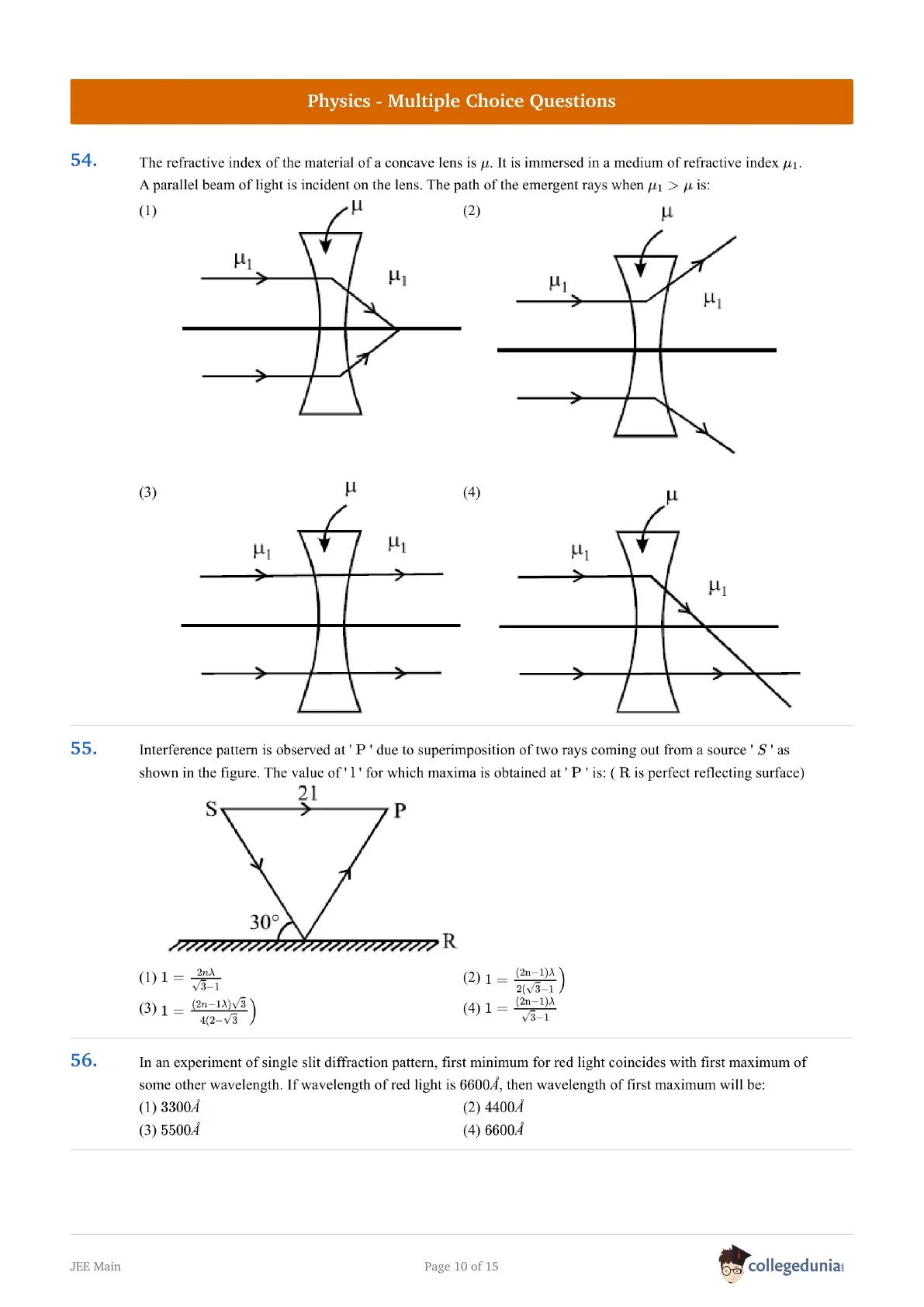
The refractive index of the material of a concave lens is \(\mu\). It is immersed in a medium of refractive index \(\mu_1\). A parallel beam of light is incident on the lens. The path of the emergent rays when \(\mu_1 \gt \mu\) is:
- (1)
![]()
- (2)
![]()
- (3)
![]()
- (4)
![]()


Interference pattern is observed at 'P' due to superposition of two rays coming out from a source 'S' as shown in the figure. The value of 'l' for which maxima is obtained at 'P' is: (R is perfect reflecting surface)
In an experiment of single slit diffraction pattern, first minimum for red light coincides with first maximum of some other wavelength. If wavelength of red light is \(6600\,\mathrm{\AA}\), then wavelength of first maximum will be:
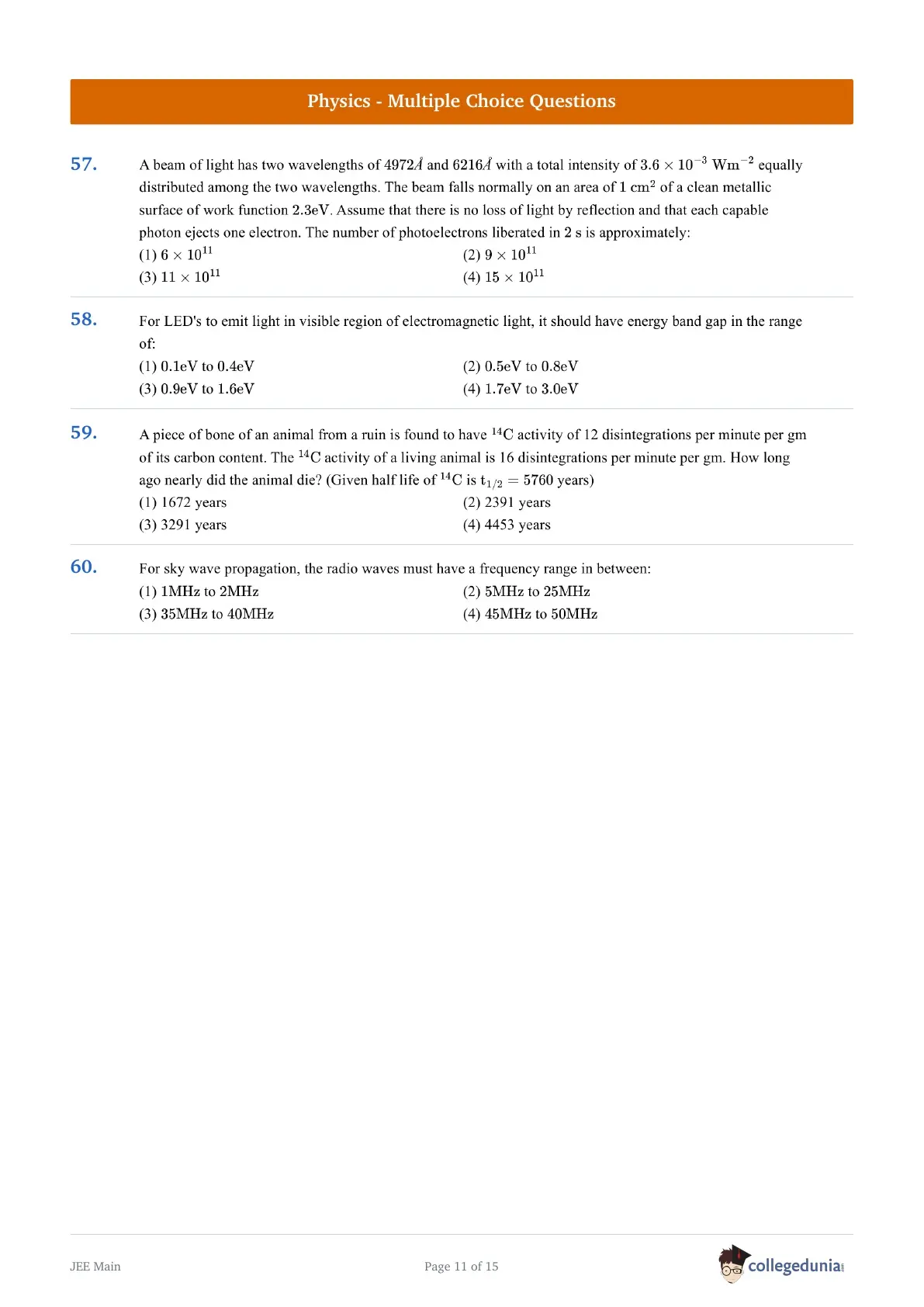
A beam of light has two wavelengths of \(4972\,\mathrm{\AA}\) and \(6216\,\mathrm{\AA}\) with a total intensity of \(3.6\times10^{-3}\,\mathrm{Wm^{-2}}\) equally distributed among the two wavelengths. The beam falls normally on an area of \(1\,\mathrm{cm^2}\) of a clean metallic surface of work function \(2.3\,\mathrm{eV}\). Assume that there is no loss of light by reflection and that each capable photon ejects one electron. The number of photoelectrons liberated in 2 s is approximately:
For LED's to emit light in visible region of electromagnetic light, it should have energy band gap in the range of:
A piece of bone of an animal from a ruin is found to have \({}^{14}\mathrm{C}\) activity of 12 disintegrations per minute per gm of its carbon content. The \({}^{14}\mathrm{C}\) activity of a living animal is 16 disintegrations per minute per gm. How long ago nearly did the animal die? (Given half life of \({}^{14}\mathrm{C}\) is \(t_{1/2}=5760\) years)
For sky wave propagation, the radio waves must have a frequency range in between :
Chemistry (Q61 - Q90)
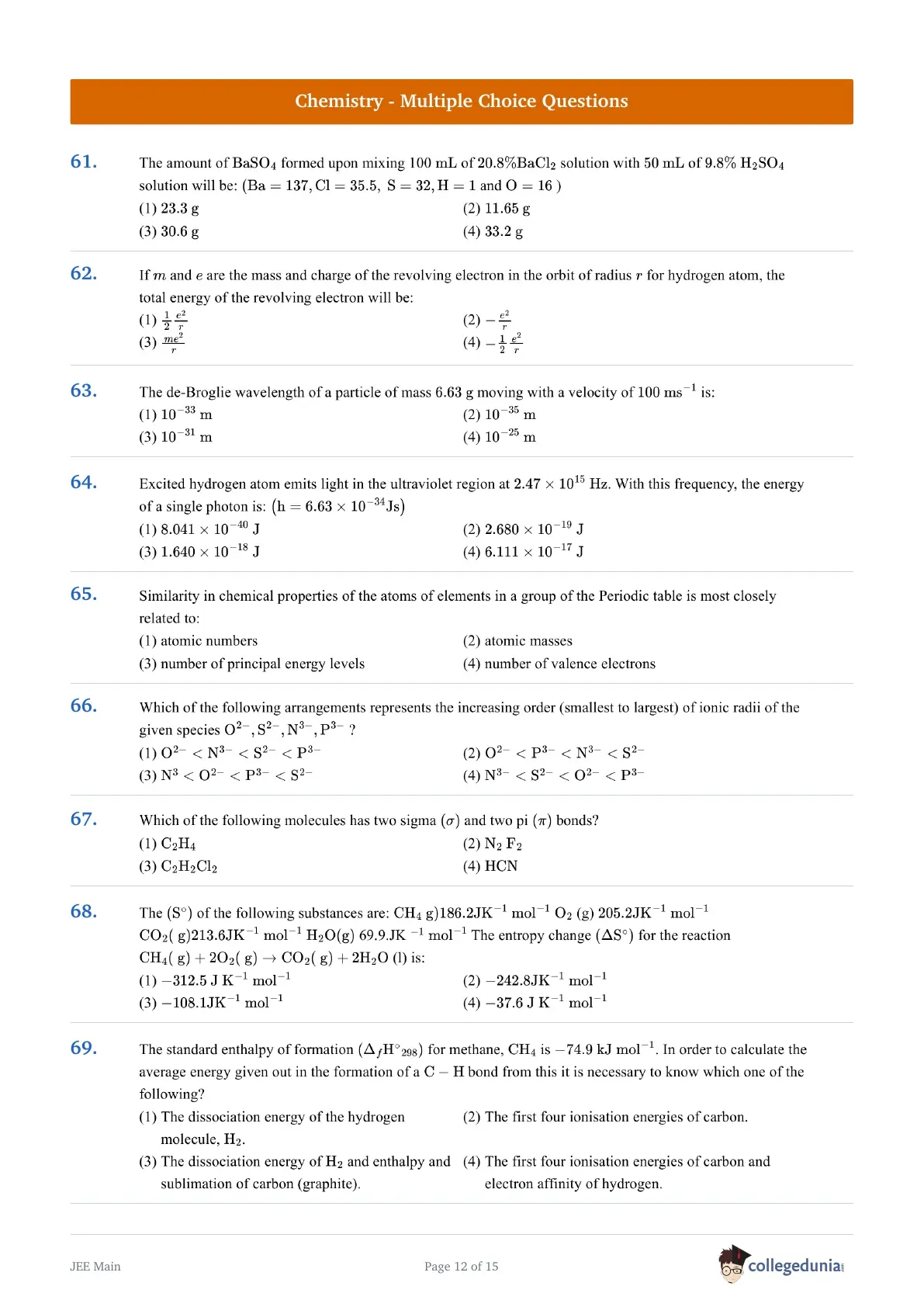
The amount of \(BaSO _{4}\) formed upon mixing \(100 \,mL\) of \(20.8 \% BaCl _{2}\) solution with \(50 \,mL\) of \(9.8 \% H _{2} SO _{4}\) solution will be : \(( Ba =137, Cl =35.5, S =32, H =1\) and \(O =16)\)
If \(m\) and \(e\) are the mass and charge of the revolving electron in the orbit of radius \(r\) for hydrogen atom, the total energy of the revolving electron will be :
The de-Broglie wavelength of a particle of mass \(6.63\) g moving with a velocity of \(100\,\mathrm{ms^{-1}}\) is:
Excited hydrogen atom emits light in the ultraviolet region at \(2.47 \times 10^{15}\, Hz\). With this frequency, the energy of a single photon is : \((h = 6.63 \times 10^{-34}\, Js)\)
Similarity in chemical properties of the atoms of elements in a group of the Periodic table is most closely related to :
Which of the following arrangements represents the increasing order (smallest to largest) of ionic radii of the given species \(O^{2-}, S^{2-}, N^{3-}, P^{3-} ?\)
Which of the following molecules has two sigma (\(\sigma\)) and two pi (\(\pi\)) bonds?
The (\(\mathrm{S^\circ}\)) of the following substances are: \(\mathrm{CH_4}\)(g) \(186.2\,\mathrm{JK^{-1}mol^{-1}}\), \(\mathrm{O_2}\)(g) \(205.2\,\mathrm{JK^{-1}mol^{-1}}\), \(\mathrm{CO_2}\)(g) \(213.6\,\mathrm{JK^{-1}mol^{-1}}\), \(\mathrm{H_2O}\)(g) \(69.9\,\mathrm{JK^{-1}mol^{-1}}\). The entropy change (\(\Delta S^\circ\)) for the reaction \(\mathrm{CH_4(g)+2O_2(g)\to CO_2(g)+2H_2O(l)}\) is:
The standard enthalpy of formation (\(\Delta_f H^\circ_{298}\)) for methane, \(\mathrm{CH_4}\) is \(-74.9\,\mathrm{kJ\,mol^{-1}}\). In order to calculate the average energy given out in the formation of a C - H bond from this it is necessary to know which one of the following?
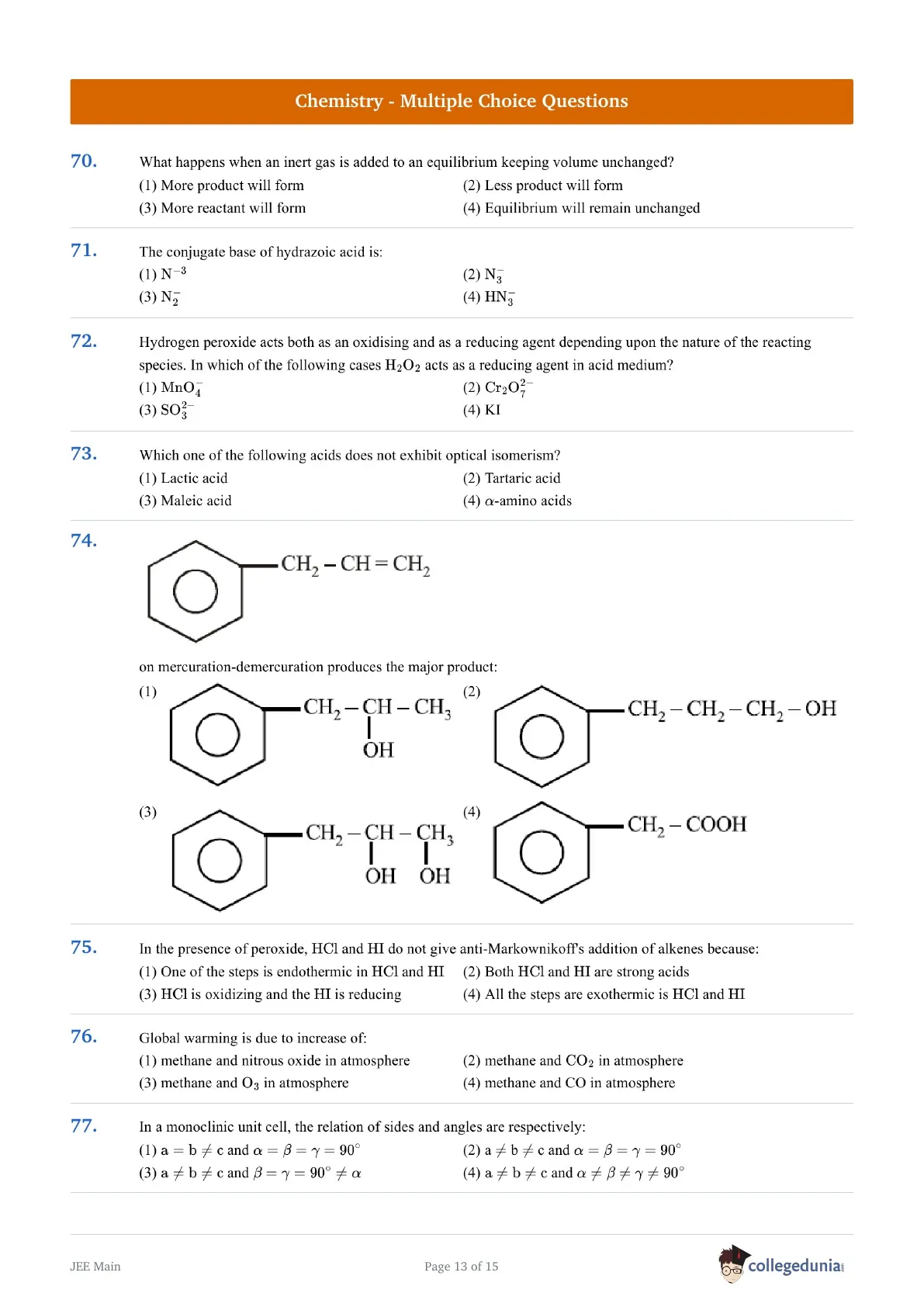
What happens when an inert gas is added to an equilibrium keeping volume unchanged ?
The conjugate base of hydrazoic acid is :
Hydrogen peroxide acts both as an oxidising and as a reducing agent depending upon the nature of the reacting species. In which of the following cases \(H_2O_2\) acts as a reducing agent in acid medium ?
Which one of the following acids does not exhibit optical isomerism?
 on mercuration-demercuration produces the major product:
- (1)
![]()
- (2)
![]()
- (3)
![]()
- (4)
![]()


In the presence of peroxide, \(HCl\) and \(HI\) do not give anti-Markownikoff' s addition to alkenes because :
Global warming is due to increase of:
In a monoclinic unit cell, the relation of sides and angles are respectively :
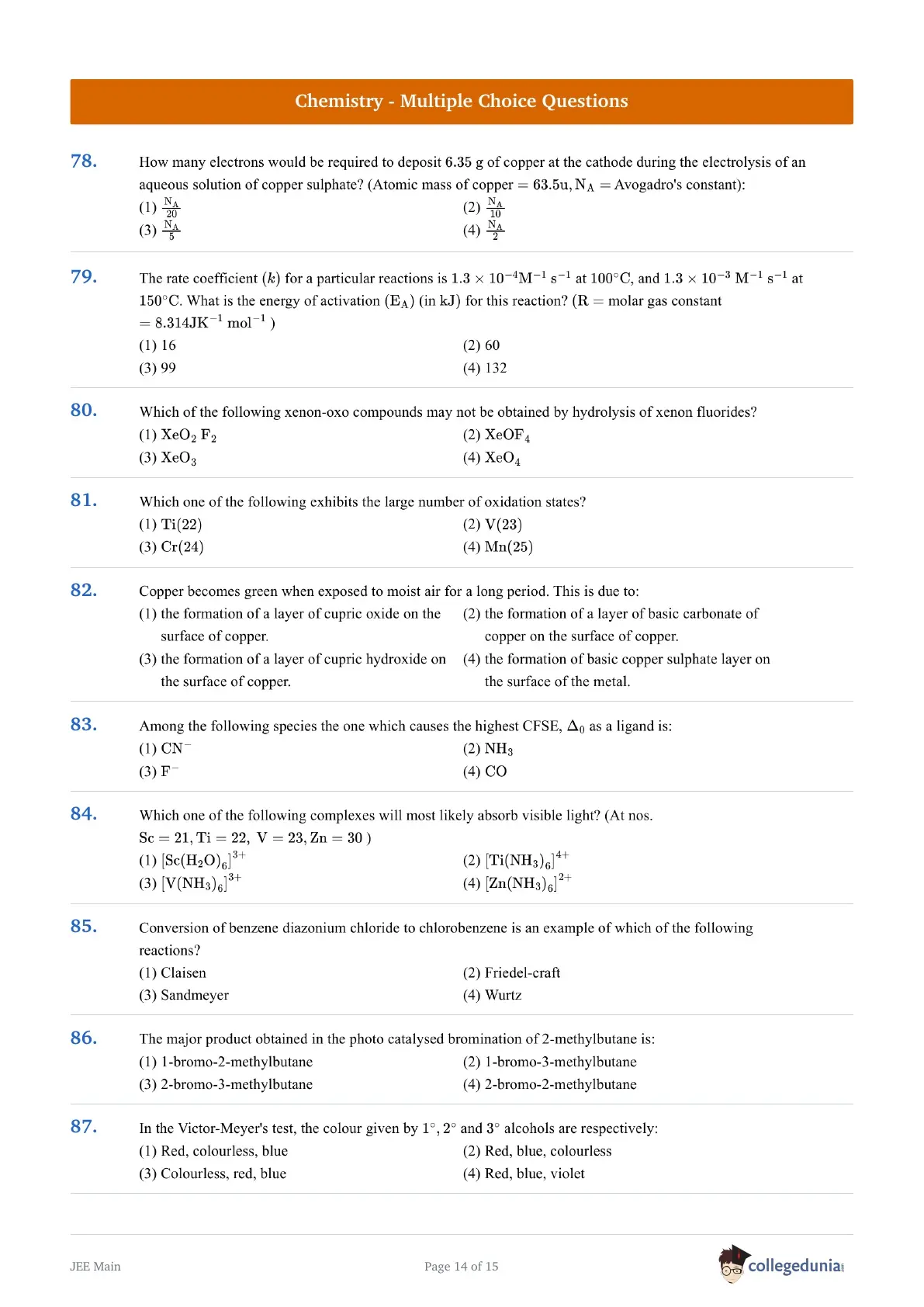
How many electrons would be required to deposit \(6.35 \,g\) of copper at the cathode during the electrolysis of an aqueous solution of copper sulphate ? (Atomic mass of copper \(= 63.5\, u, N_A =\) Avogadro's constant) :
The rate coefficient \((k)\) for a particular reactions is \(1.3 \times 10^{-4}\, M^{-1}\, s^{-1}\) at \(100^{\circ}C\), and \(1.3 \times 10^{-3}\,M^{-1}s^{-1}\) at \(150^{\circ}C\) What is the energy of activation \((E_{a})\) (in \(kJ\)) for this reaction ? (\(R =\) molar gas constant \(= 8.314 \,JK^{-1}\,mol^{-1})\)
Which of the following xenon-oxo compounds may not be obtained by hydrolysis of xenon fluorides?
Which one of the following exhibits the large number of oxidation states?
Copper becomes green when exposed to moist air for a long period. This is due to:
Among the following species the one which causes the highest CFSE, \(\Delta_0\) as a ligand is:
Which one of the following complexes will most likely absorb visible light? (At nos. Sc = 21, Ti = 22, V = 23, Zn = 30)
Conversion of benzene diazonium chloride to chloro benzene is an example of which of the following reactions ?
The major product obtained in the photo catalysed bromination of 2-methylbutane is:
In the Victor-Meyer's test, the colour given by \(1^{\circ}\), \(2^{\circ}\)and \(3^{\circ}\) alcohols are respectively :
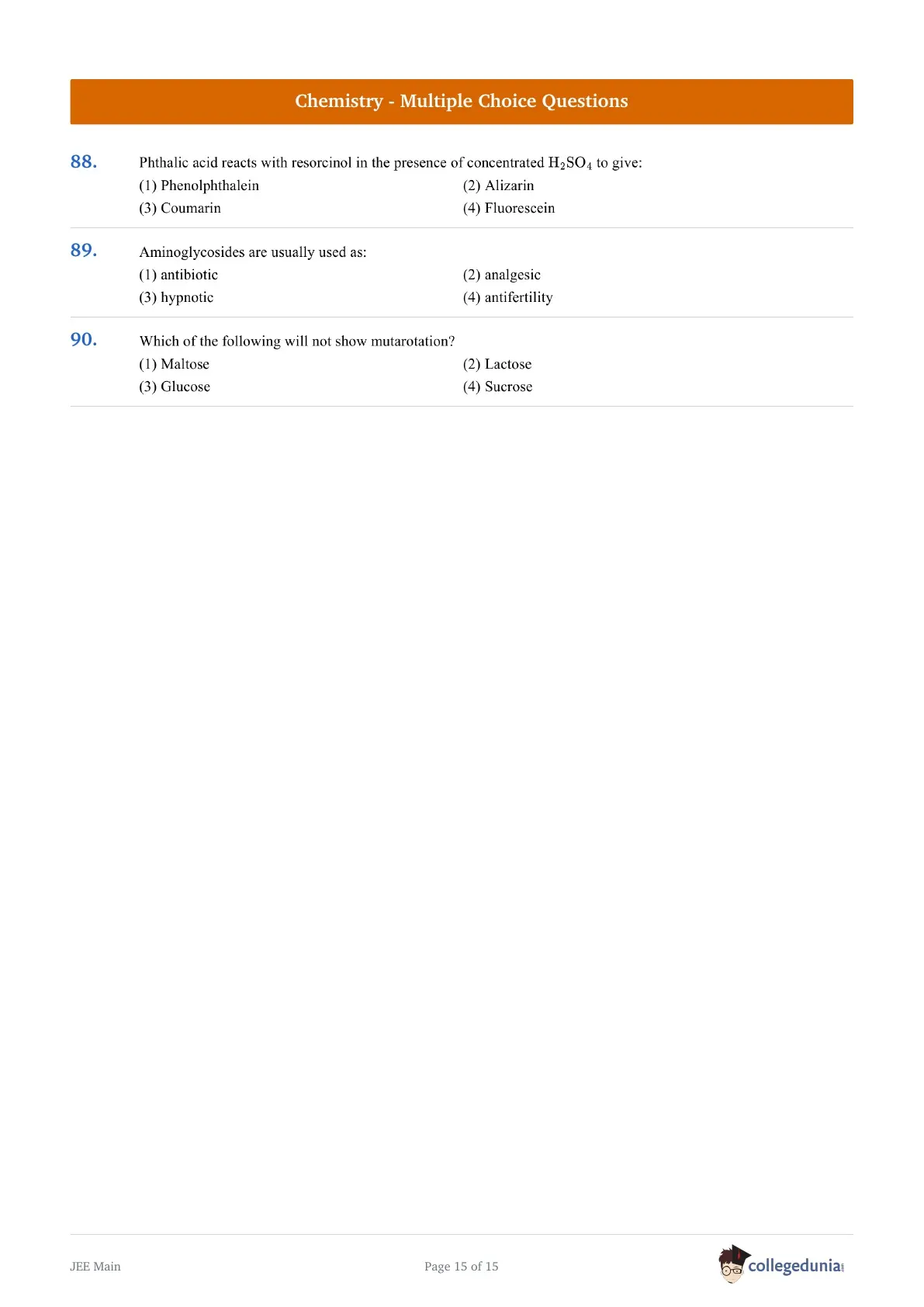
Phthalic acid reacts with resorcinol in the presence of concentrated \(\mathrm{H_2SO_4}\) to give:
Aminoglycosides are usually used as :
Which of the following will not show mutarotation?
JEE Main 2014 Exam Pattern and Marking Scheme
| Particulars | Details |
|---|---|
| Exam Mode | Online (Computer-Based Test) |
| Paper | B.E./B.Tech (Paper 1) |
| Duration | 3 hours (180 minutes) |
| Type of Questions | Multiple Choice Questions (MCQs) |
| Subjects | Mathematics, Physics, Chemistry |
| Total Questions | 90 questions |
| Total Marks | 360 marks |
| Marking Scheme | +4 for correct answer & -1 for incorrect answer; 0 for unattempted |
JEE Main 2014 April 12 Difficulty Level
In terms of difficulty level, B.E/B.Tech was of moderate to difficult level.
JEE Main 2014 Question Paper Analysis
- The question paper comprised a total of 90 questions divided among 3 sections i.e, Physics, Chemistry and Maths. Each section consists of 30 questions
- Physics Paper was moderate to difficult level
- Chemistry Paper was easy
- Maths Paper was Lengthy but not tough
For every correct answer, candidates got 4 and for each wrong attempt -1 marks were deducted.



Comments