




JEE Main 2024 April 4 Shift 1 Question Paper is available here with answer key and solution pdf. NTA conducted the first shift on April 4, 2024, from 9:00 AM to 12:00 PM. The JEE Main 2024 Paper 1 (B.E./B.Tech) question paper includes the following:
- 90 questions in a 3-hour CBT Mode: 30 each from Mathematics, Physics and Chemistry (75 to be attempted)
- Section A: 20 multiple choice questions (MCQs) per subject, 4 marks each
- Section B: 10 numerical value questions per subject, attempt any 5, 4 marks each (integer answer)
- Marking: +4 for a correct answer, -1 for an incorrect answer, 0 for an unattempted question
JEE Main 2024 April 4 Shift 1 Question Paper with Solution PDF
| NTA Official PDF | CD PDF | CD PDF with Solutions |
|---|---|---|
| Download official PDF 4.86 MB | Download Collegedunia PDF 1.28 MB | Download solutions PDF 1.36 MB |
Also Check:
JEE Main 2024 April 4 Shift 1 Questions with Solutions
Mathematics - Section A (Q1 - Q20)
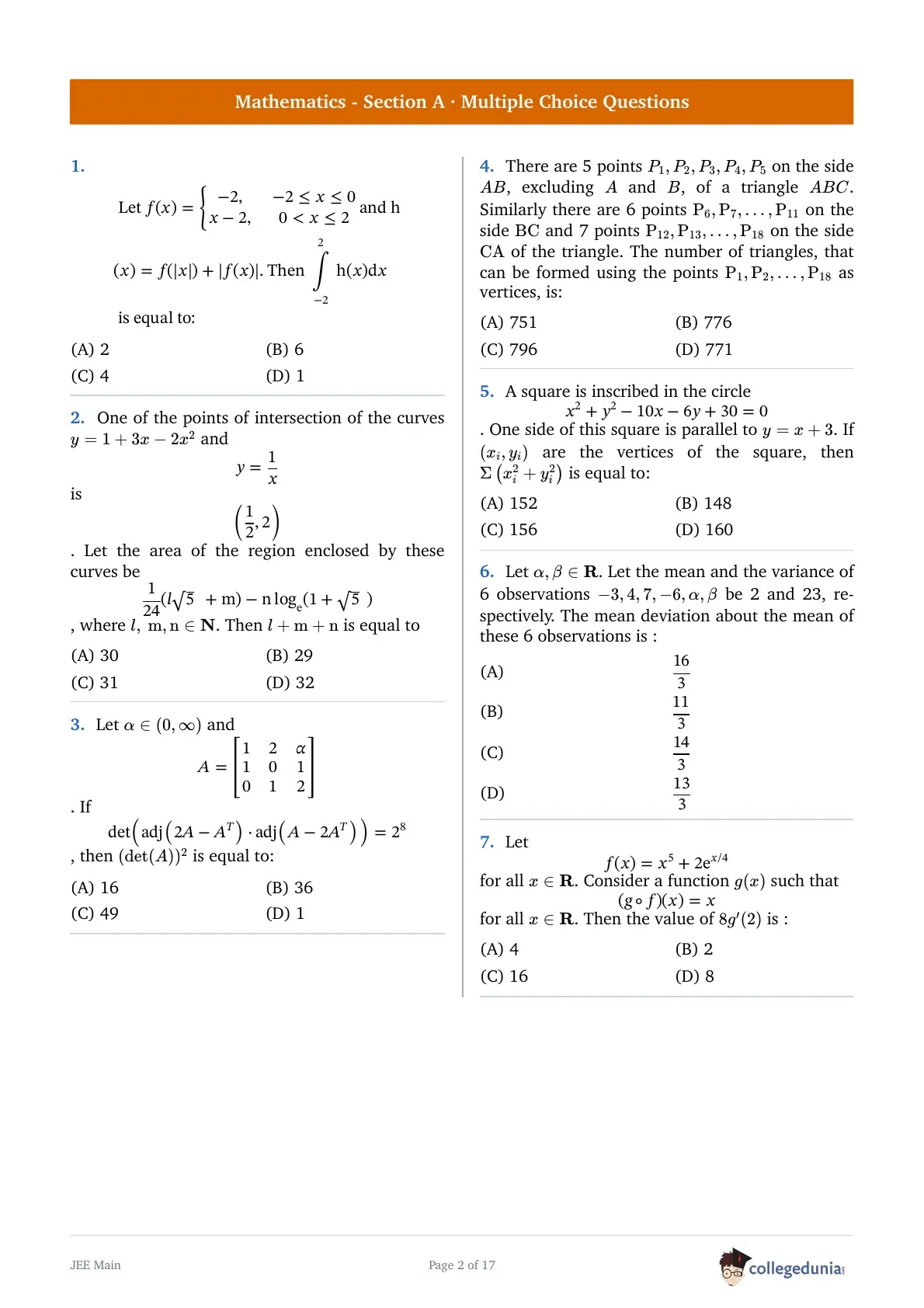
Let \( f(x) = \begin{cases} -2, & -2 \leq x \leq 0 \\ x - 2, & 0 < x \leq 2 \end{cases} \) and \( h(x) = f(|x|) + |f(x)| \). Then \(\int_{-2}^{2} h(x) \, dx\) is equal to:
One of the points of intersection of the curves \( y = 1 + 3x - 2x^2 \) and \( y = \frac{1}{x} \) is \( \left( \frac{1}{2}, 2 \right) \). Let the area of the region enclosed by these curves be \[\frac{1}{24} \left( \ell \sqrt{5} + m \right) - n \log_e \left( 1 + \sqrt{5} \right),\] where \( \ell, m, n \in \mathbb{N} \). Then \( \ell + m + n \) is equal to:
Let \( \alpha \in (0, \infty) \) and \( A = \begin{bmatrix} 1 & 2 & \alpha \\ 1 & 0 & 1 \\ 0 & 1 & 2 \end{bmatrix} \). If \( \det(\text{adj}(2A - A^\top) \cdot \text{adj}(A - 2A^\top)) = 2^8 \), then \( (\det(A))^2 \) is equal to:
There are 5 points \( P_1, P_2, P_3, P_4, P_5 \) on the side \( AB \), excluding \( A \) and \( B \), of a triangle \( \triangle ABC \). Similarly, there are 6 points \( P_6, P_7, \dots, P_{11} \) on the side \( BC \) and 7 points \( P_{12}, P_{13}, \dots, P_{18} \) on the side \( CA \) of the triangle.The number of triangles that can be formed using the points \( P_1, P_2, \dots, P_{18} \) as vertices, is:
A square is inscribed in the circle \( x^2 + y^2 - 10x - 6y + 30 = 0 \). One side of this square is parallel to \( y = x + 3 \). If \( (x_i, y_i) \) are the vertices of the square, then \( \sum (x_i^2 + y_i^2) \) is equal to:
Let \( a, b \in \mathbb{R} \). Let the mean and the variance of 6 observations \(-3, 4, 7, -6, a, b\) be 2 and 23, respectively. The mean deviation about the mean of these 6 observations is:
Let \( f(x) = x^5 + 2e^{x/4} \) for all \( x \in \mathbb{R} \). Consider a function \( g(x) \) such that \( (g \circ f)(x) = x \) for all \( x \in \mathbb{R} \). Then the value of \( 8g'(2) \) is:
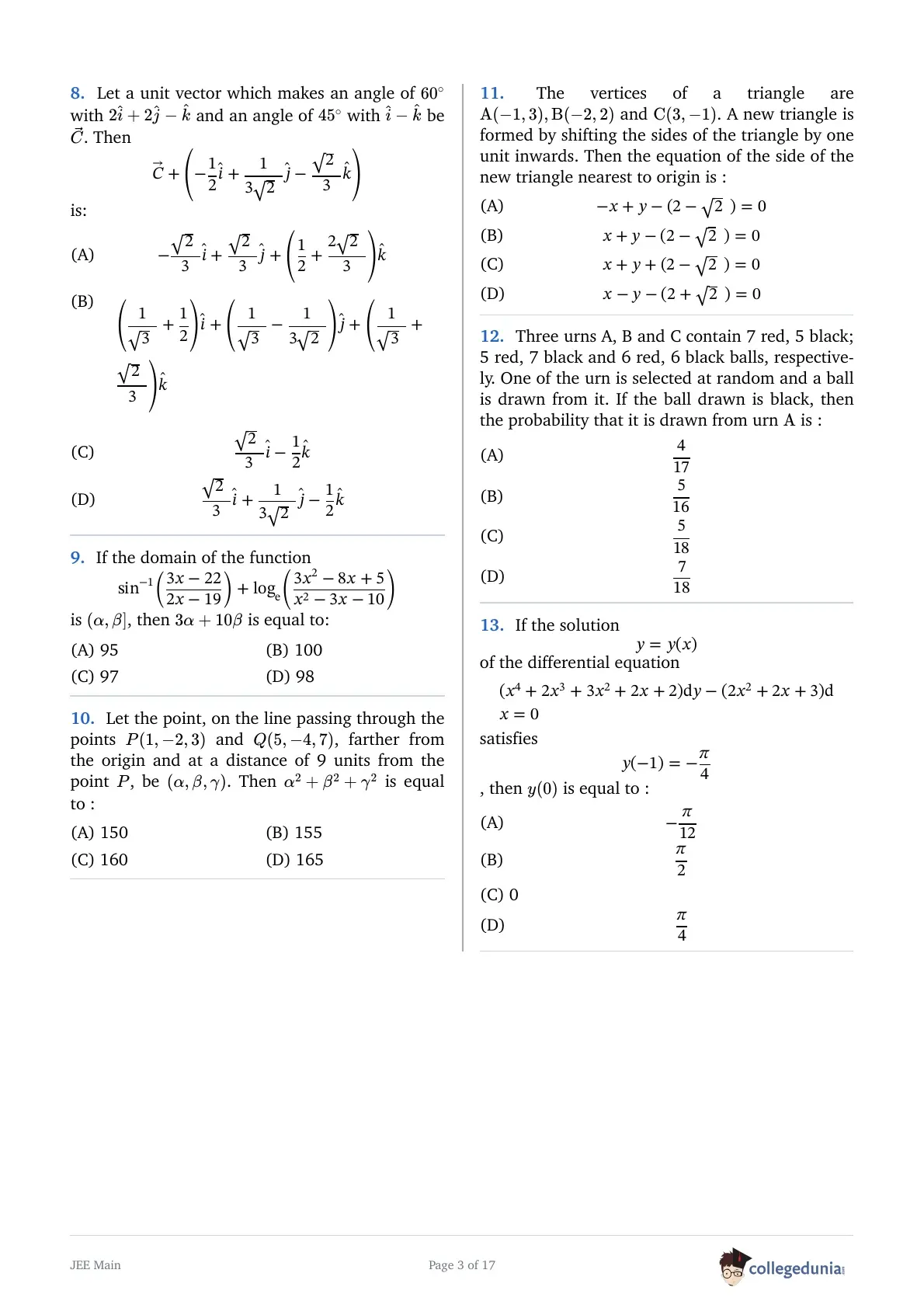
Let a unit vector which makes an angle of \(60^\circ\) with \( 2\hat{i} + 2\hat{j} - \hat{k} \) and an angle of \(45^\circ\) with \( \hat{i} - \hat{k} \) be \( \vec{C} \). Then \( \vec{C} + \left( -\frac{1}{2} \hat{i} + \frac{1}{3\sqrt{2}} \hat{j} - \frac{\sqrt{2}}{3} \hat{k} \right) \) is:
If the domain of the function \[\sin^{-1} \left( \frac{3x - 22}{2x - 19} \right) + \log_e \left( \frac{3x^2 - 8x + 5}{x^2 - 3x - 10} \right)\] is \( (\alpha, \beta] \), then \( 3\alpha + 10\beta \) is equal to:
Let the point, on the line passing through the points \( P(1, -2, 3) \) and \( Q(5, -4, 7) \), farther from the origin and at a distance of 9 units from the point \( P \), be \( (\alpha, \beta, \gamma) \). Then \( \alpha^2 + \beta^2 + \gamma^2 \) is equal to:
The vertices of a triangle are A(–1, 3), B(–2, 2) and C(3, –1). A new triangle is formed by shifting the sides of the triangle by one unit inwards. Then the equation of the side of the new triangle nearest to origin is :
Three urns A, B and C contain 7 red, 5 black; 5 red, 7 black and 6 red, 6 black balls, respectively. One of the urn is selected at random and a ball is drawn from it. If the ball drawn is black, then then probability that it is drawn from urn A is :
If the solution \( y = y(x) \) of the differential equation \( \left( x^4 + 2x^3 + 3x^2 + 2x + 2 \right) dy - \left( 2x^2 + 2x + 3 \right) dx = 0 \)
satisfies \( y(-1) = -\frac{\pi}{4} \), then \( y(0) \) is equal to:
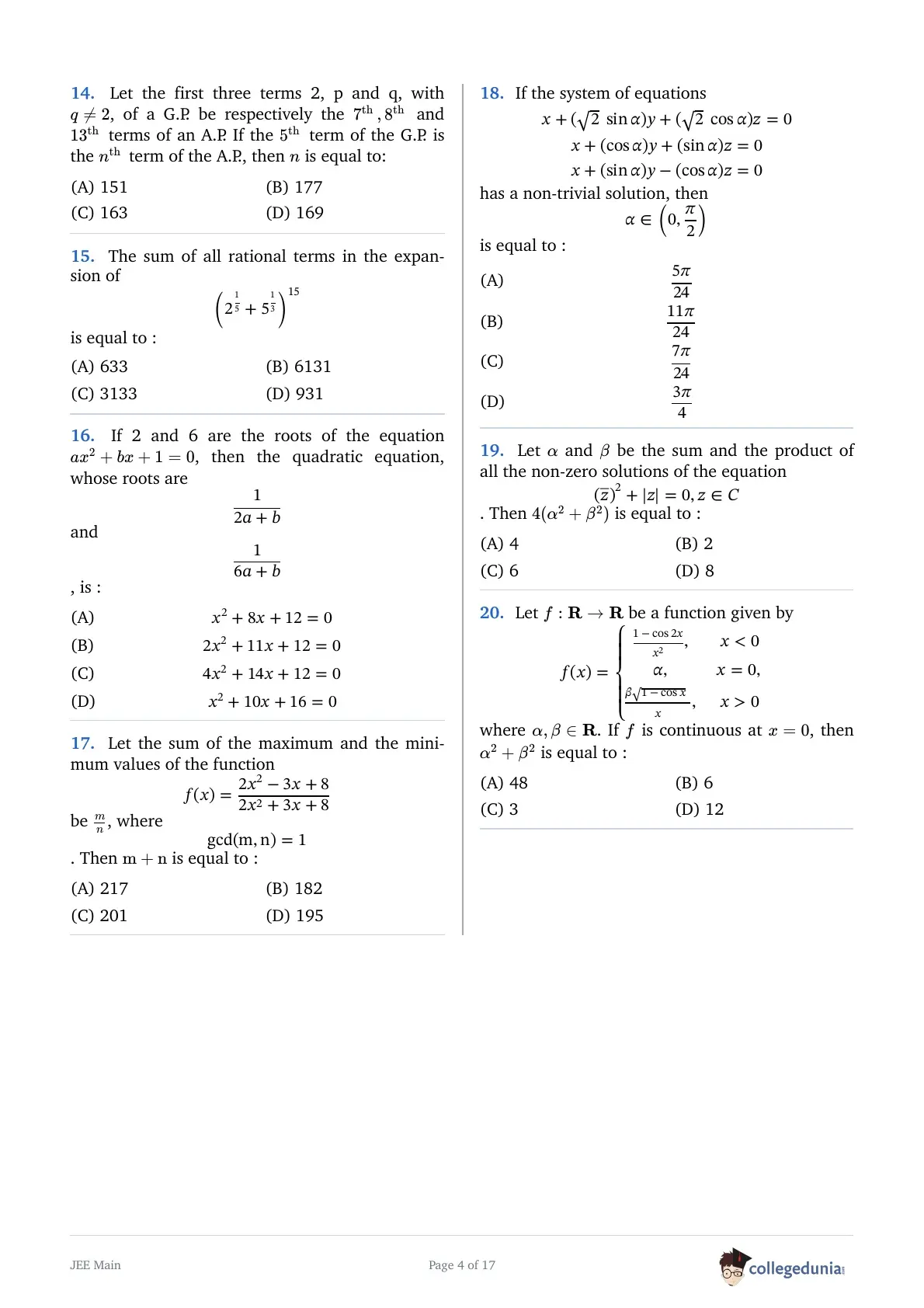
Let the first three terms \(2\), \(p\), and \(q\), with \(q \neq 2\), of a G.P. be respectively the \(7^\text{th}\), \(8^\text{th}\), and \(13^\text{th}\) terms of an A.P. If the \(5^\text{th}\) term of the G.P. is the \(n^\text{th}\) term of the A.P., then \(n\) is equal to:
The sum of all rational terms in the expansion of \[ \left( \frac{1}{2^5} + \frac{1}{5^3} \right)^{15} \] is equal to:
If 2 and 6 are the roots of the equation \( ax^2 + bx + 1 = 0 \), then the quadratic equation, whose roots are \( \frac{1}{2a + b} \) and \( \frac{1}{6a + b} \), is:
Let the sum of the maximum and the minimum values of the function \( f(x) = \frac{2x^2 - 3x + 8}{2x^2 + 3x + 8} \) be \( \frac{m}{n} \), where \( \text{gcd}(m, n) = 1 \). Then \( m + n \) is equal to:
If the system of equations
\( x + \left( \sqrt{2} \sin \alpha \right) y + \left( \sqrt{2} \cos \alpha \right) z = 0 \)
\( x + \left( \cos \alpha \right) y + \left( \sin \alpha \right) z = 0 \)
\( x + \left( \sin \alpha \right) y - \left( \cos \alpha \right) z = 0 \)
has a non-trivial solution, then \( \alpha \in \left( 0, \frac{\pi}{2} \right) \) is equal to:
Let \( \alpha \) and \( \beta \) be the sum and the product of all the non-zero solutions of the equation \[(\bar{z})^2 + |z| = 0, \quad z \in \mathbb{C}.\] Then \( 4(\alpha^2 + \beta^2) \) is equal to:
Let \( f : \mathbb{R} \to \mathbb{R} \) be a function given by
\[f(x) = \begin{cases} \frac{1 - \cos 2x}{x^2}, & x < 0 \\\alpha, & x = 0, \text{ where } \alpha, \beta \in \mathbb{R}. \\\beta \sqrt{1 - \cos x} / x, & x > 0 \end{cases} \]
If \( f \) is continuous at \( x = 0 \), then \( \alpha^2 + \beta^2 \) is equal to:
Mathematics - Section B (Q21 - Q30)
Let the solution \( y = y(x) \) of the differential equation \[\frac{dy}{dx} - y = 1 + 4 \sin x\] satisfy \( y(\pi) = 1 \). Then \( y\left( \frac{\pi}{2} \right) + 10 \) is equal to _____
If the shortest distance between the lines \[ \frac{x+2}{2} = \frac{y+3}{3} = \frac{z-5}{4} \quad \text{and} \quad \frac{x-3}{1} = \frac{y-2}{-3} = \frac{z+4}{2}\] is \(\frac{38}{3\sqrt{5}} k\) and \[\int_{0}^{k} \lfloor x^2 \rfloor dx = \alpha - \sqrt{\alpha}, \]where \([x]\) denotes the greatest integer function, then \( 6\alpha^3 \) is equal to _____
Let \( A \) be a square matrix of order 2 such that \( |A| = 2 \) and the sum of its diagonal elements is \(-3\). If the points \((x, y)\) satisfying \( A^2 + xA + yI = 0 \) lie on a hyperbola, whose transverse axis is parallel to the x-axis, eccentricity is \( e \) and the length of the latus rectum is \( \ell \), then \( e^4 + \ell^4 \) is equal to _____
If \[ \lim_{x \to 1} \frac{(5x+1)^{1/3} - (x+5)^{1/3}}{(2x+3)^{1/2} - (x+4)^{1/2}} = \frac{m \sqrt{5}}{n (2n)^{2/3}}, \] where \( \text{gcd}(m, n) = 1 \), then \( 8m + 12n \) is equal to _____
Let \( A \) be a \( 3 \times 3 \) matrix of non-negative real elements such that \[A \begin{bmatrix} 1 \\ 1 \\ 1 \end{bmatrix} = 3 \begin{bmatrix} 1 \\ 1 \\ 1 \end{bmatrix}.\]Then the maximum value of \( \det(A) \) is _____
If \[\int_{0}^{\pi/4} \frac{\sin^2 x}{1 + \sin x \cos x} \, dx = \frac{1}{a} \log_e \left( \frac{a}{3} \right) + \frac{\pi}{b\sqrt{3}},\]where \( a, b \in \mathbb{N} \), then \( a + b \) is equal to _____
In a survey of 220 students of a higher secondary school, it was found that at least 125 and at most 130 students studied Mathematics; at least 85 and at most 95 studied Physics; at least 75 and at most 90 studied Chemistry; 30 studied both Physics and Chemistry; 50 studied both Chemistry and Mathematics; 40 studied both Mathematics and Physics and 10 studied none of these subjects. Let m and n respectively be the least and the most number of students who studied all the three subjects. Then m + n is equal to _____
Let the length of the focal chord \( PQ \) of the parabola \( y^2 = 12x \) be 15 units. If the distance of \( PQ \) from the origin is \( p \), then \( 10p^2 \) is equal to _____
Let \( \triangle ABC \) be a triangle of area \( 15\sqrt{2} \) and the vectors \[ \overrightarrow{AB} = \hat{i} + 2\hat{j} - 7\hat{k}, \quad \overrightarrow{BC} = a\hat{i} + b\hat{j} + c\hat{k}, \quad \text{and} \quad \overrightarrow{AC} = 6\hat{i} + d\hat{j} - 2\hat{k}, \, d > 0.\]Then the square of the length of the largest side of the triangle \( \triangle ABC \) is
Let \[ a = 1 + \frac{{^2C_2}}{3!} + \frac{{^3C_2}}{4!} + \frac{{^4C_2}}{5!} + \dots,\]
\[ b = 1 + \frac{{^1C_0 + ^1C_1}}{1!} + \frac{{^2C_0 + ^2C_1 + ^2C_2}}{2!} + \frac{{^3C_0 + ^3C_1 + ^3C_2 + ^3C_3}}{3!} + \dots \]Then \( \frac{2b}{a^2} \) is equal to _____
Physics - Section A (Q31 - Q50)
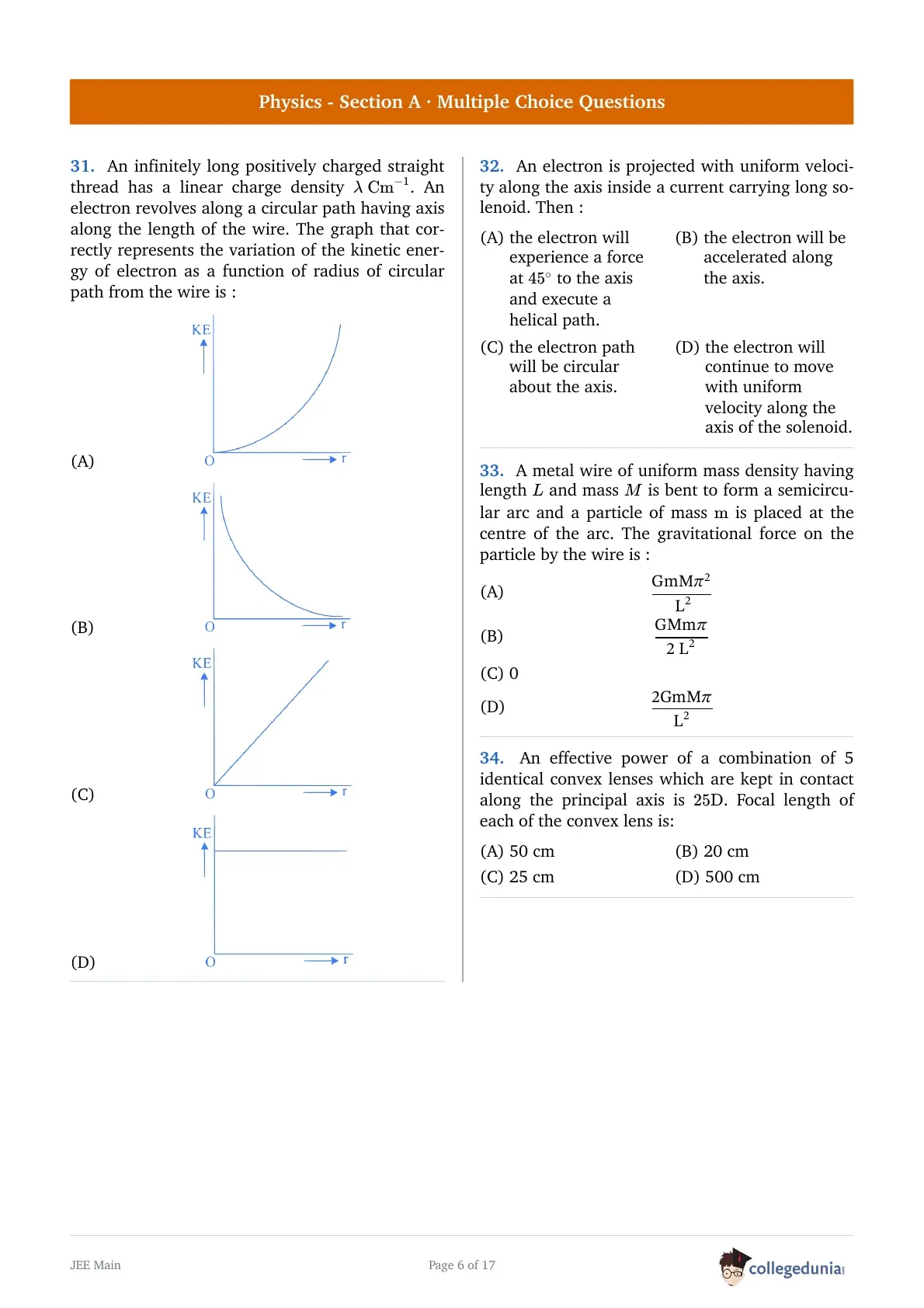
An infinitely long positively charged straight thread has a linear charge density \( \lambda \, \text{Cm}^{-1} \). An electron revolves along a circular path having its axis along the length of the wire. The graph that correctly represents the variation of the kinetic energy of the electron as a function of the radius of the circular path from the wire is:
- (1)
![]()
- (2)
![]()
- (3)
![]()
- (4)
![]()


An electron is projected with uniform velocity along the axis inside a current carrying long solenoid. Then :
A metal wire of uniform mass density having length L and mass M is bent to form a semicircular arc and a particle of mass m is placed at the centre of the arc. The gravitational force on the particle by the wire is:
An effective power of a combination of 5 identical convex lenses which are kept in contact along the principal axis is 25 D. Focal length of each of the convex lens is :
Given below are two statements:
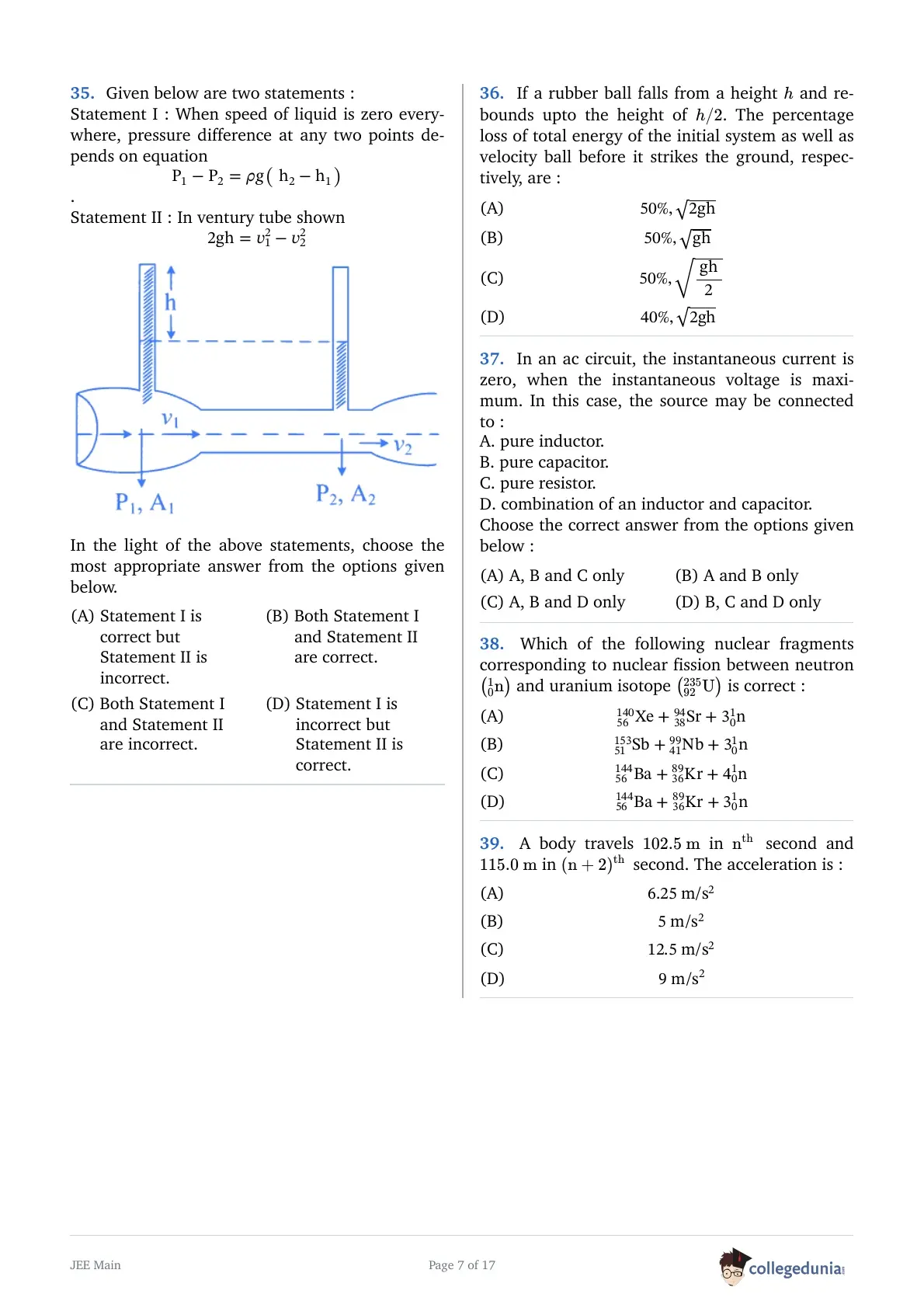
Statement I: When the speed of liquid is zero everywhere, the pressure difference at any two points depends on the equation \[ P_1 - P_2 = \rho g (h_2 - h_1). \] Statement II: In the ventury tube shown, \[ 2gh = v_1^2 - v_2^2. \]

In the light of the above statements, choose the most appropriate answer from the options given below.
If a rubber ball falls from a height h and rebounds upto the height of h/2. The percentage loss of total energy of the initial system as well as velocity ball before it strikes the ground, respectively, are :
In an ac circuit, the instantaneous current is zero,when the instantaneous voltage is maximum. In this case, the source may be connected to :
A. pure inductor.
B. pure capacitor.
C. pure resistor.
D. combination of an inductor and capacitor.
Choose the correct answer from the options given below :
Which of the following nuclear fragments corresponding to nuclear fission between neutron \[\left( ^1_0 n \right) \, \text{and uranium isotope} \, \left( ^{235}_{92} \text{U} \right) \, \text{is correct:}\]
A body travels \( 102.5 \, \text{m} \) in \( n^\text{th} \) second and \( 115.0 \, \text{m} \) in \( (n+2)^\text{th} \) second. The acceleration is:
In an experiment to measure focal length (\(f\)) of a convex lens, the least counts of the measuring scales for the position of the object (\(u\)) and for the position of the image (\(v\)) are \( \Delta u \) and \( \Delta v \), respectively. The error in the measurement of the focal length of the convex lens will be:
The coordinates of a particle moving in the \( x \)-\( y \) plane are given by: \[x = 2 + 4t, \quad y = 3t + 8t^2.\]The motion of the particle is:
The equation of a stationary wave is:
\[y = 2a \sin\left(\frac{2\pi nt}{\lambda}\right) \cos\left(\frac{2\pi x}{\lambda}\right)\]Which of the following is NOT correct:
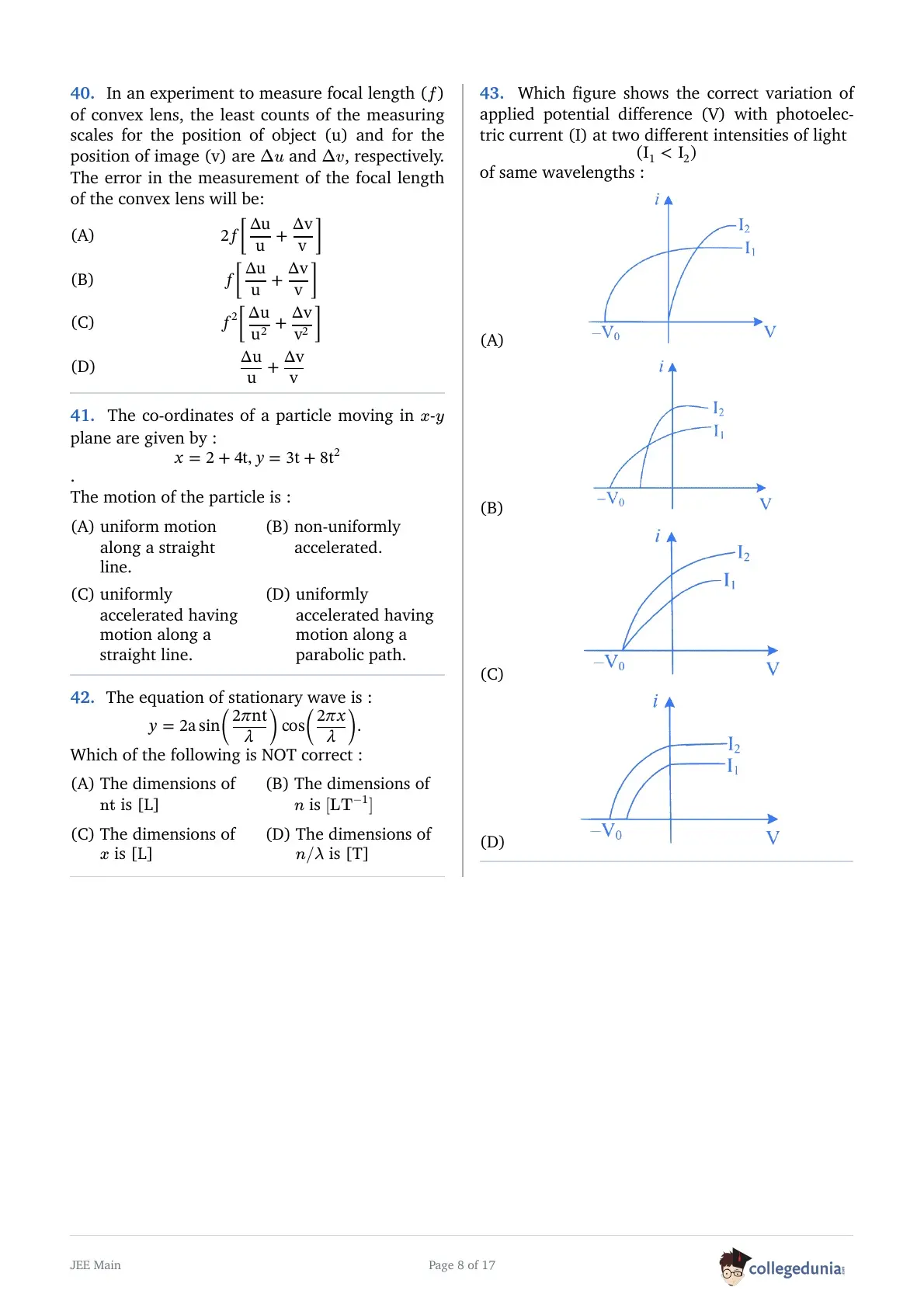
Which figure shows the correct variation of applied potential difference (\(V\)) with photoelectric current (\(I\)) at two different intensities of light (\(I_1 < I_2\)) of same wavelengths:
- (1)
![]()
- (2)
![]()
- (3)
![]()
- (4)
![]()


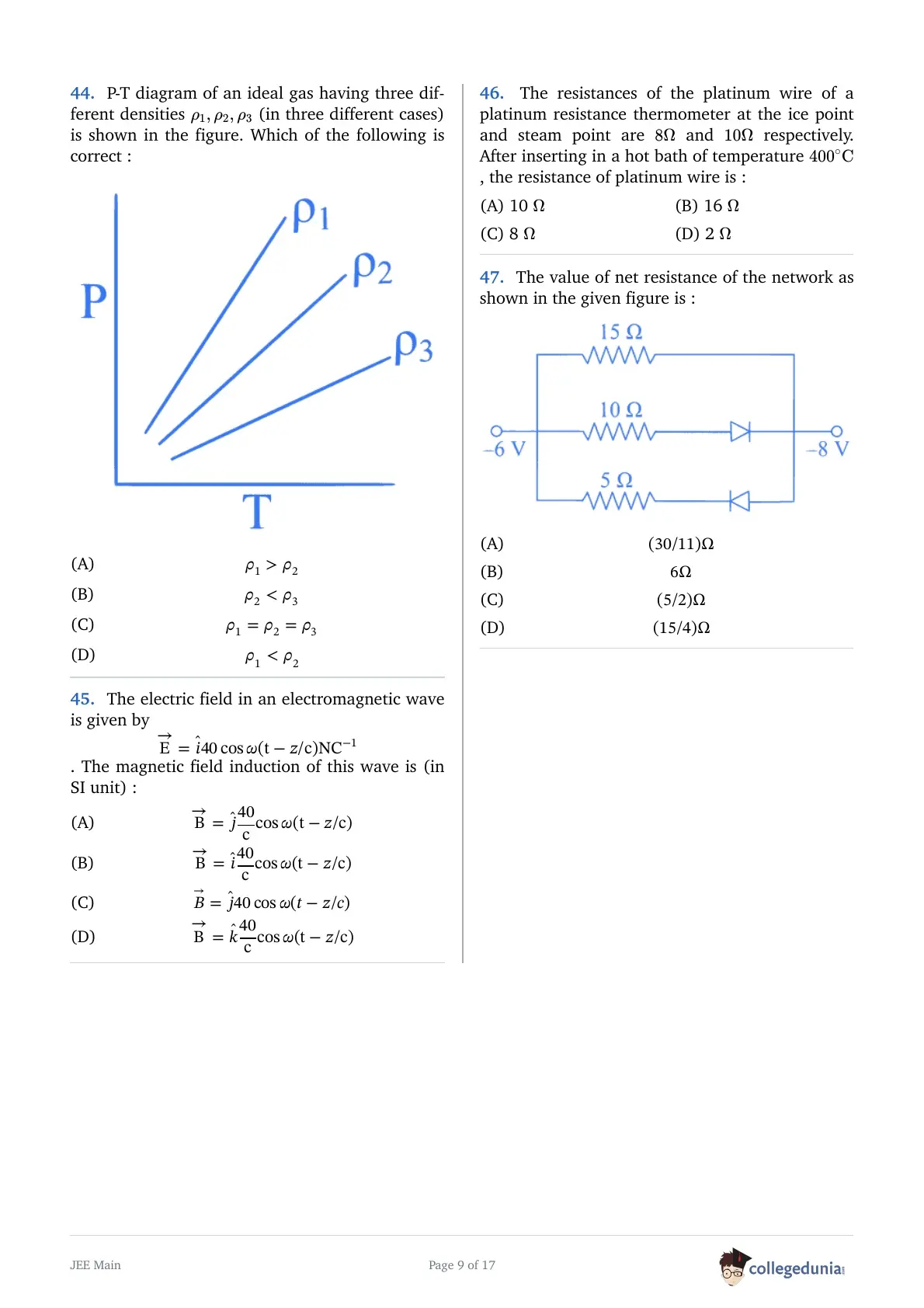
P-T diagram of an ideal gas having three different densities \( \rho_1, \rho_2, \rho_3 \) (in three different cases) is shown in the figure. Which of the following is correct:

The electric field in an electromagnetic wave is given by \[ \vec{E} = \hat{i} 40 \cos \omega \left( t - \frac{z}{c} \right) \, \text{NC}^{-1}.\]The magnetic field induction of this wave is (in SI unit):
The resistances of the platinum wire of a platinum resistance thermometer at the ice point and steam point are \( 8 \, \Omega \) and \( 10 \, \Omega \) respectively. After inserting in a hot bath of temperature \( 400^\circ \text{C} \), the resistance of the platinum wire is:
The value of net resistance of the network as shown in the given figure is :

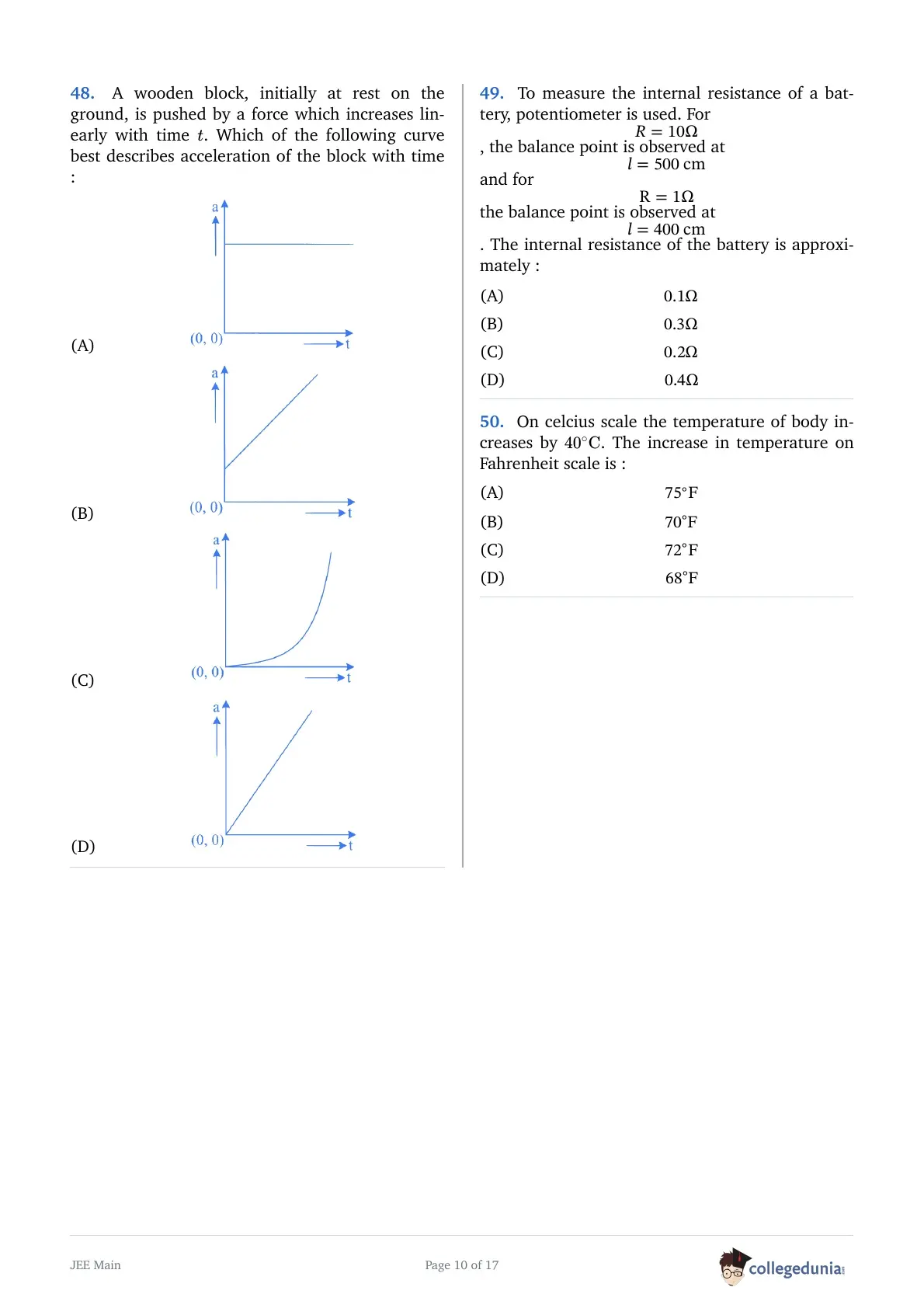
A wooden block, initially at rest on the ground, is pushed by a force which increases linearly with time t. Which of the following curve best describes acceleration of the block with time :
- (1)
![]()
- (2)
![]()
- (3)
![]()
- (4)
![]()


To measure the internal resistance of a battery, a potentiometer is used. For \( R = 10 \, \Omega \), the balance point is observed at \( \ell = 500 \, \text{cm} \) and for \( R = 1 \, \Omega \), the balance point is observed at \( \ell = 400 \, \text{cm} \). The internal resistance of the battery is approximately:
On Celsius scale, the temperature of a body increases by \( 40^\circ \text{C} \). The increase in temperature on Fahrenheit scale is:
Physics - Section B (Q51 - Q60)
A solid sphere and a hollow cylinder roll up without slipping on the same inclined plane with the same initial speed \( v \). The sphere and the cylinder reach up to maximum heights \( h_1 \) and \( h_2 \), respectively, above the initial level. The ratio \( h_1 : h_2 \) is \( \frac{n}{10} \). The value of \( n \) is ______.
An infinite plane sheet of charge having uniform surface charge density \( +\sigma_s \, \text{C/m}^2 \) is placed on the \( x \)-\( y \) plane. Another infinitely long line charge having uniform linear charge density \( +\lambda_e \, \text{C/m} \) is placed at \( z = 4 \, \text{m} \) plane and parallel to the \( y \)-axis. If the magnitude values \( |\sigma_s| = 2 |\lambda_e| \), then at point \( (0, 0, 2) \), the ratio of magnitudes of electric field values due to sheet charge to that of line charge is \( \pi \sqrt{n} : 1 \).The value of \( n \) is ______.
A hydrogen atom changes its state from \( n = 3 \) to \( n = 2 \). Due to recoil, the percentage change in the wavelength of emitted light is approximately \( 1 \times 10^{-n} \). The value of \( n \) is ______. \([ \text{Given: } Rhc = 13.6 \, \text{eV}, \, hc = 1242 \, \text{eV nm}, \, h = 6.6 \times 10^{-34} \, \text{J s}, \, \text{mass of the hydrogen atom} = 1.6 \times 10^{-27} \, \text{kg} ]\)
A soap bubble is blown to a diameter of \( 7 \, \text{cm} \). \( 36960 \, \text{erg} \) of work is done in blowing it further. If the surface tension of the soap solution is \( 40 \, \text{dyne/cm} \), then the new radius is ______ \( \text{cm} \). Take: \( \left( \pi = \frac{22}{7} \right) \).
An elastic spring under tension of 3 N has a length a. Its length is b under tension 2 N. For its length (3a – 2b), the value of tension will be_____ N.
The magnetic field existing in a region is given by \[\vec{B} = 0.2(1 + 2x)\hat{k} \, \text{T}.\]A square loop of edge \( 50 \, \text{cm} \) carrying \( 0.5 \, \text{A} \) current is placed in the \( x \)-\( y \) plane with its edges parallel to the \( x \)- and \( y \)-axes, as shown in the figure. The magnitude of the net magnetic force experienced by the loop is ______ \( \text{mN} \).

Two forces \( \vec{F}_1 \) and \( \vec{F}_2 \) are acting on a body. One force has magnitude thrice that of the other force, and the resultant of the two forces is equal to the force of larger magnitude. The angle between \( \vec{F}_1 \) and \( \vec{F}_2 \) is \( \cos^{-1}\left(\frac{1}{n}\right) \). The value of \( |n| \) is _____.
An alternating current at any instant is given by \[ i = \left[ 6 + \sqrt{56} \sin\left(100 \pi t + \frac{\pi}{3}\right) \right] \, \text{A}.\] The RMS value of the current is ______ A.
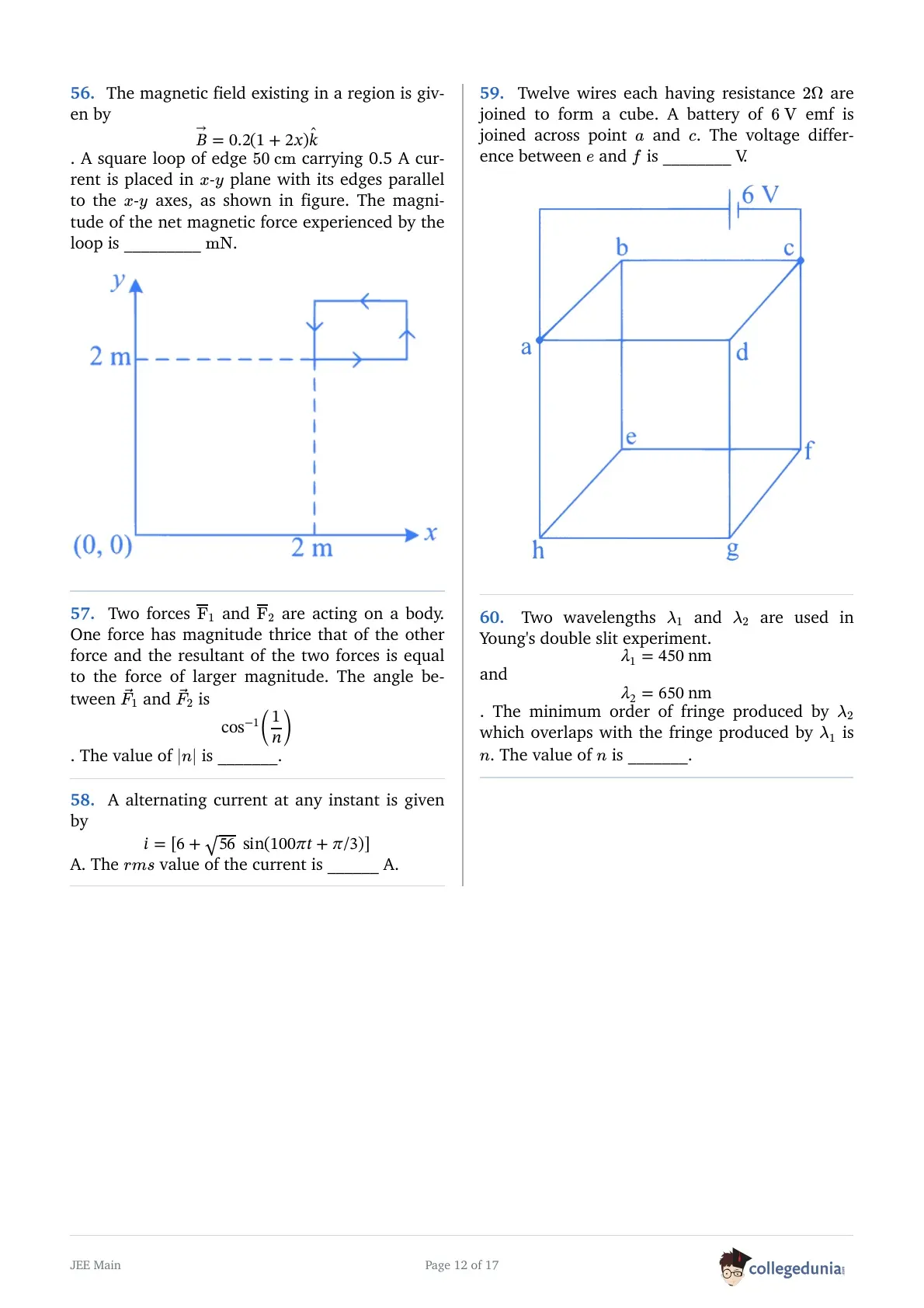
Twelve wires, each having resistance \( 2 \, \Omega \), are joined to form a cube. A battery of \( 6 \, \text{V} \) emf is joined across points \( a \) and \( c \). The voltage difference between \( e \) and \( f \) is ______ \( \text{V} \).

Two wavelengths \( \lambda_1 \) and \( \lambda_2 \) are used in Young's double slit experiment. \( \lambda_1 = 450 \, \text{nm} \) and \( \lambda_2 = 650 \, \text{nm} \). The minimum order of fringe produced by \( \lambda_2 \), which overlaps with the fringe produced by \( \lambda_1 \), is \( n \). The value of \( n \) is _____.
Chemistry - Section A (Q61 - Q80)
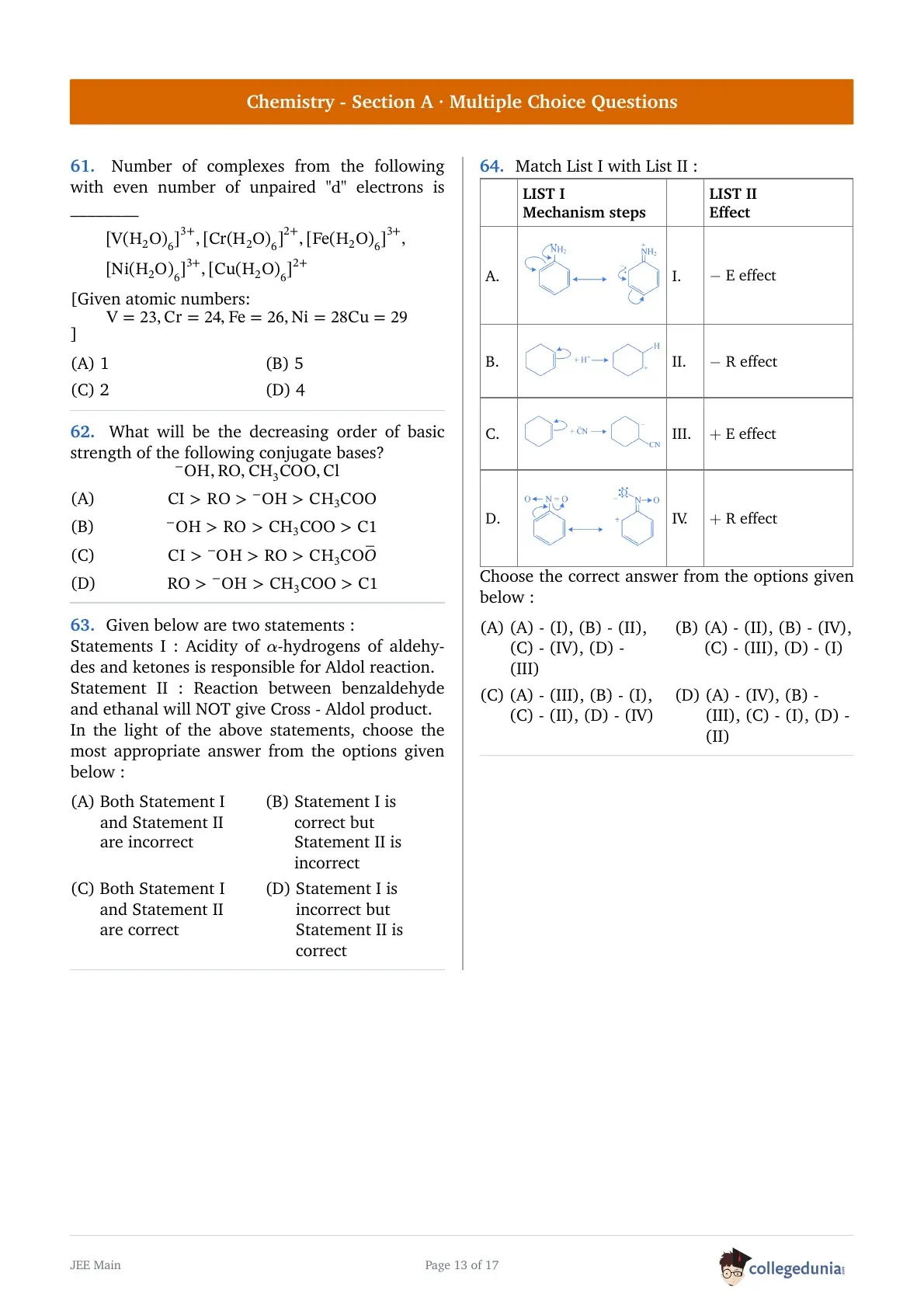
Number of complexes from the following with even number of unpaired "d" electrons is _____. \[ [\text{V}(\text{H}_2\text{O})_6]^{3+}, \, [\text{Cr}(\text{H}_2\text{O})_6]^{2+}, \, [\text{Fe}(\text{H}_2\text{O})_6]^{3+}, \, [\text{Ni}(\text{H}_2\text{O})_6]^{3+}, \, [\text{Cu}(\text{H}_2\text{O})_6]^{2+}\] [Given atomic numbers: \( \text{V} = 23, \, \text{Cr} = 24, \, \text{Fe} = 26, \, \text{Ni} = 28, \, \text{Cu} = 29 \)]
What will be the decreasing order of basic strength of the following conjugate bases?
\( \text{OH}^-, \, \text{R}^-, \, \text{CH}_3\text{COO}^-, \, \text{Cl}^- \)
Given below are two statements :
Statement I : Acidity of -hydrogens of aldehydes and ketones is responsible for Aldol reaction.
Statement II : Reaction between benzaldehyde and ethanal will NOT give Cross – Aldol product.In the light of above statements, choose the most appropriate answer from the options given below.
Match List -I with List II:

Choose the correct answer from the options given below :


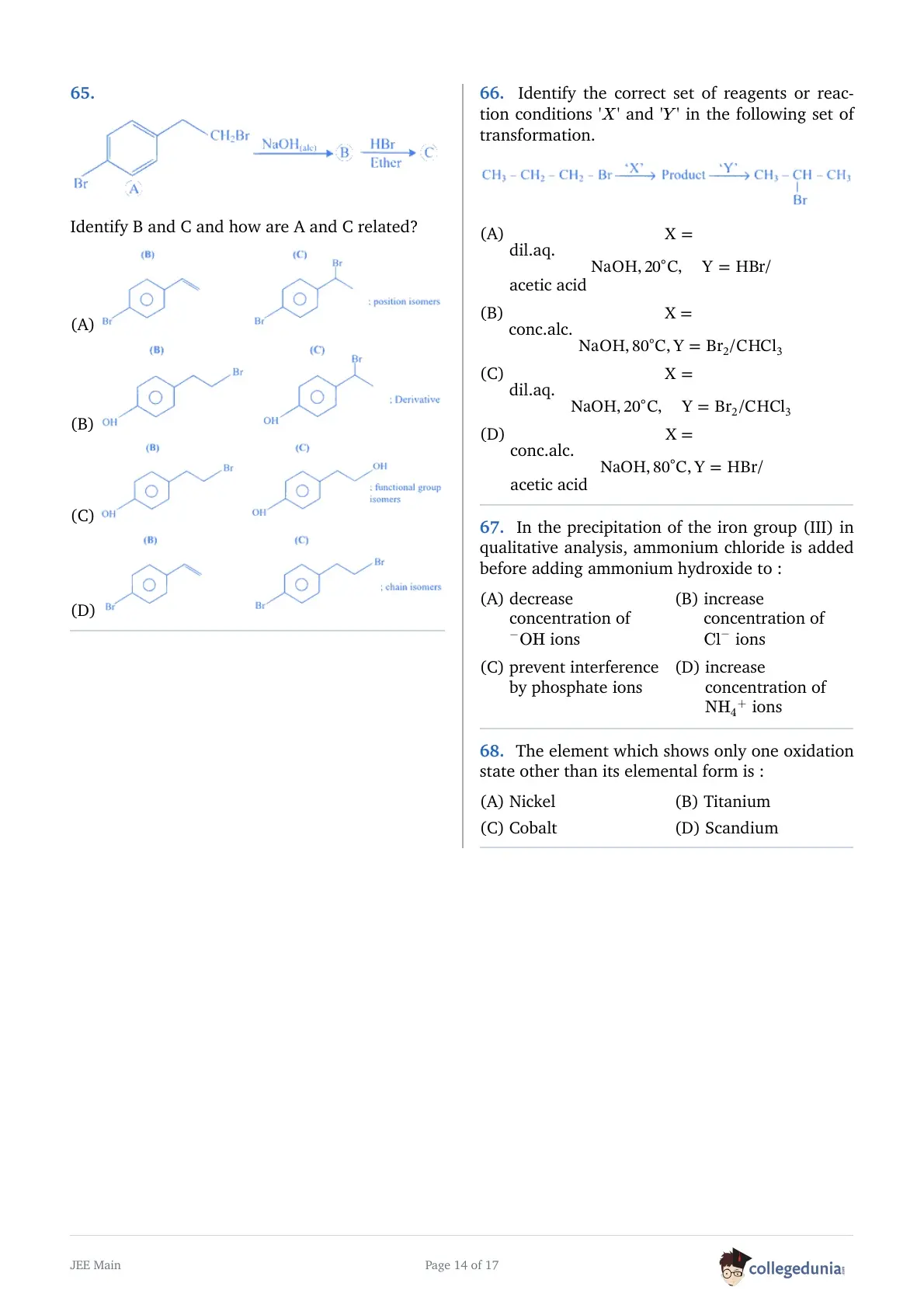
Identify the correct set of reagents or reaction conditions ‘X’ and ‘Y’ in the following set of transformation.

In the precipitation of the iron group (III) in qualitative analysis, ammonium chloride is added before adding ammonium hydroxide to :
The element which shows only one oxidation state other than its elemental form is :
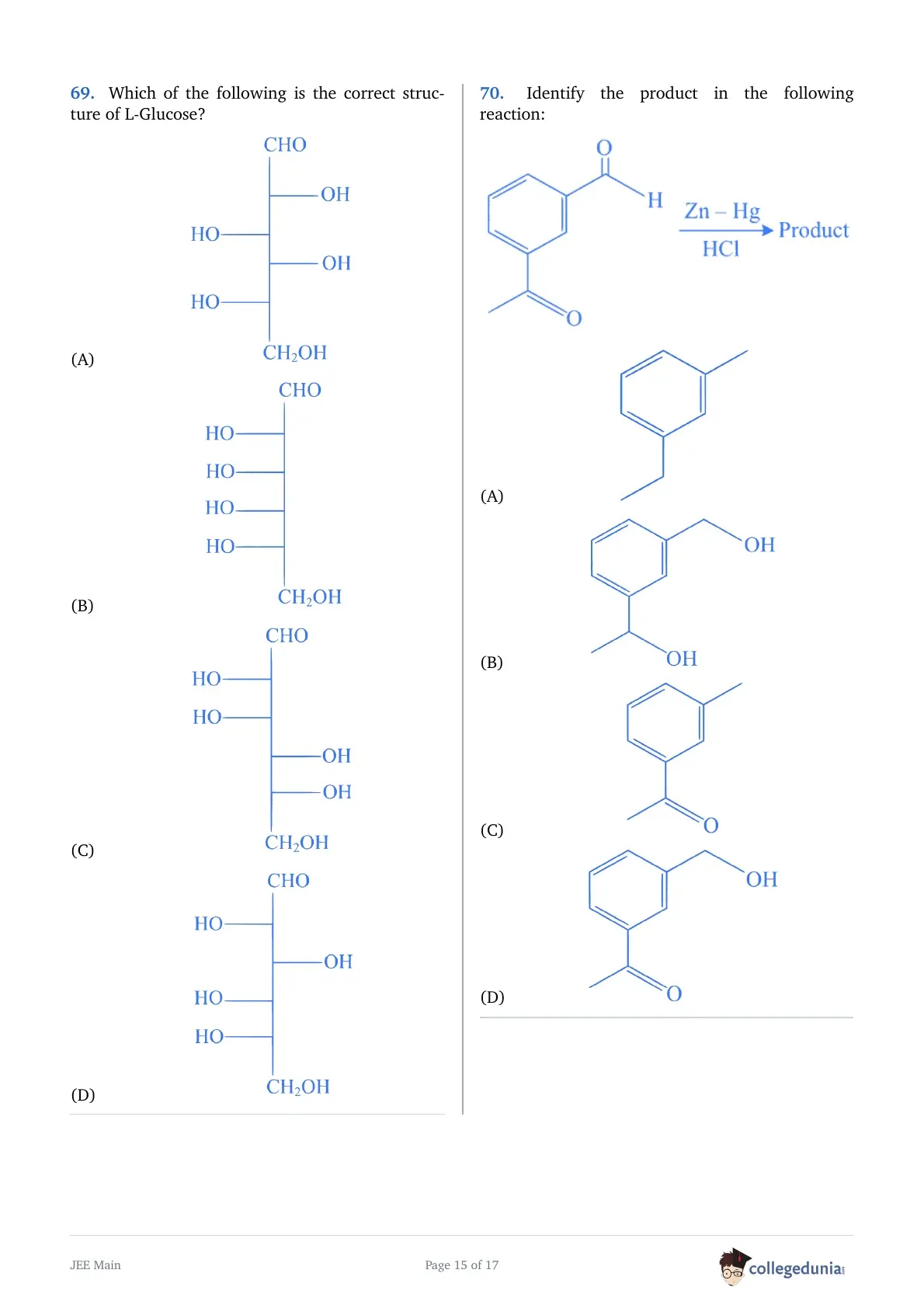
Which of the following is the correct structure of L-Glucose ?
- (1)
![]()
- (2)
![]()
- (3)
![]()
- (4)
![]()


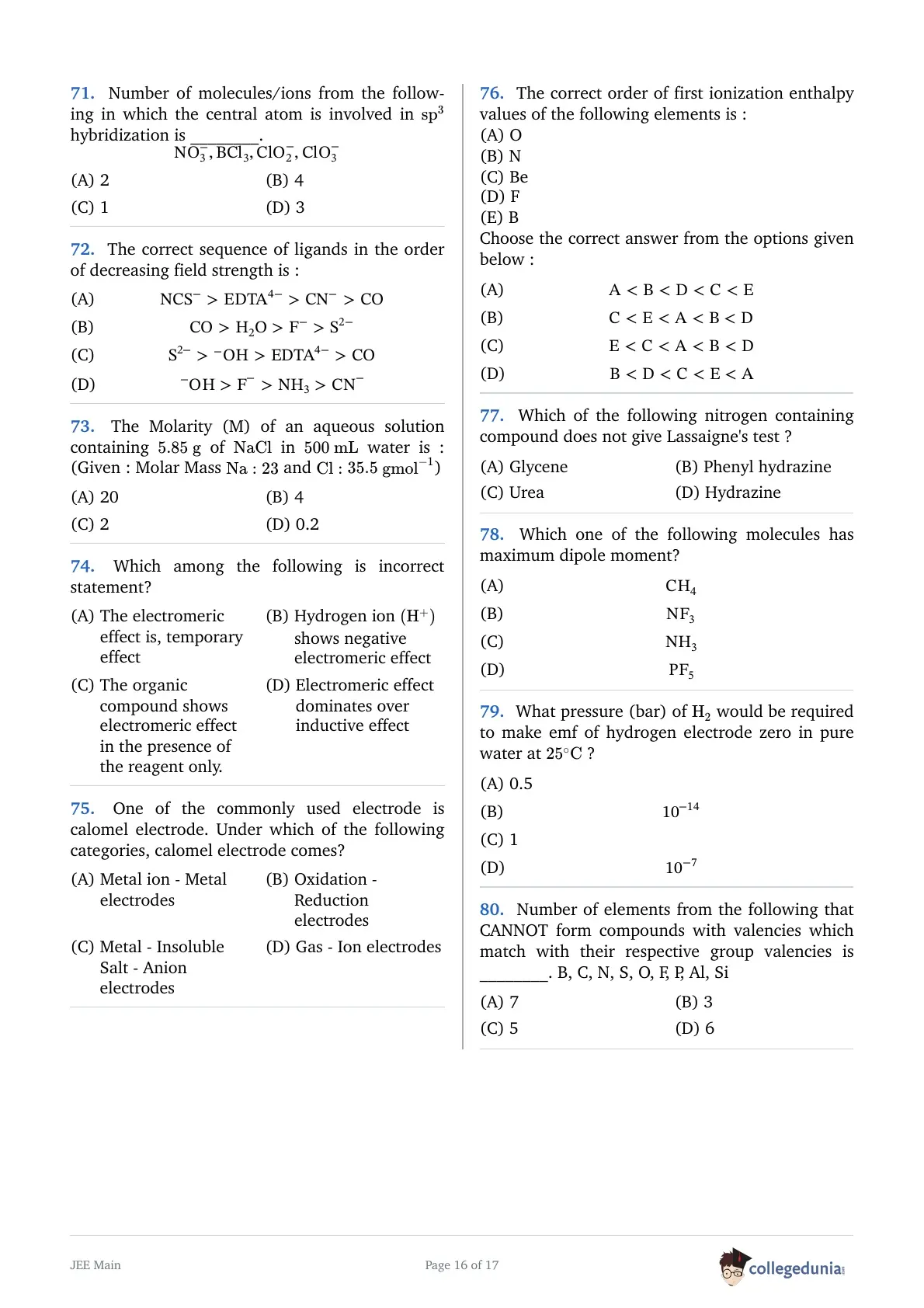
Number of molecules/ions from the following in which the central atom is involved in sp3 hybridization is ________.\( \text{NO}_3^-, \, \text{BCl}_3, \, \text{ClO}_2^-, \, \text{ClO}_3 \)
The correct sequence of ligands in the order of decreasing field strength is :
The Molarity (M) of an aqueous solution containing \( 5.85 \, \text{g} \) of \( \text{NaCl} \) in \( 500 \, \text{mL} \) water is:
(Given: Molar Mass \( \text{Na} = 23 \) and \( \text{Cl} = 35.5 \, \text{g mol}^{-1} \))
Which among the following is incorrect statement?
One of the commonly used electrode is calomel electrode. Under which of the following categories calomel electrode comes ?
The correct order of first ionization enthalpy values of the following elements is :
(A) O (B) N (C) Be (D) F (E) B
Choose the correct answer from the options given below :
Which of the following nitrogen containing compound does not give Lassaigne’s test ?
Which one of the following molecules has maximum dipole moment ?
What pressure (bar) of \( \text{H}_2 \) would be required to make the emf of a hydrogen electrode zero in pure water at \( 25^\circ \text{C} \)?
Number of elements from the following that CANNOT form compounds with valencies which match with their respective group valencies is ______.
B, C, N, S, O, F, P, Al, Si
Chemistry - Section B (Q81 - Q90)
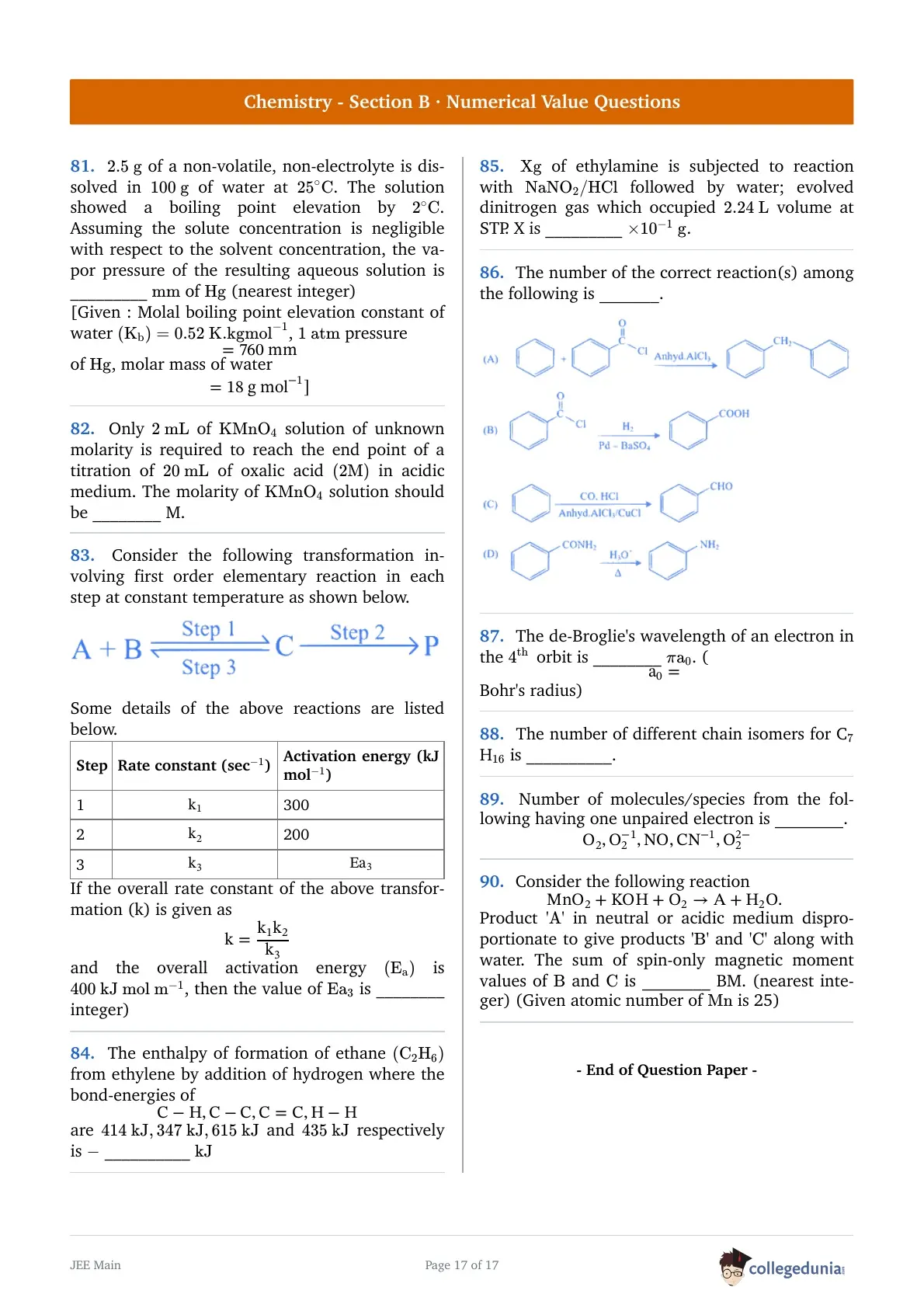
\( 2.5 \, \text{g} \) of a non-volatile, non-electrolyte is dissolved in \( 100 \, \text{g} \) of water at \( 25^\circ \text{C} \). The solution showed a boiling point elevation by \( 2^\circ \text{C} \). Assuming the solute concentration is negligible with respect to the solvent concentration, the vapour pressure of the resulting aqueous solution is ______ mm of Hg (nearest integer).
(Given: Molal boiling point elevation constant of water (\( K_b \)) = \( 0.52 \, \text{K} \cdot \text{kg} \cdot \text{mol}^{-1} \),1 atm pressure = \( 760 \, \text{mm of Hg} \), molar mass of water = \( 18 \, \text{g mol}^{-1} \))
Only \( 2 \, \text{mL} \) of \( \text{KMnO}_4 \) solution of unknown molarity is required to reach the end point of a titration of \( 20 \, \text{mL} \) of oxalic acid (\( 2 \, \text{M} \)) in acidic medium. The molarity of \( \text{KMnO}_4 \) solution should be ______ \( \text{M} \).
Consider the following transformation involving first-order elementary reaction in each step at constant temperature as shown below: \[ \text{A} + \text{B} \xrightarrow{\text{Step 1}} \text{C} \xrightarrow{\text{Step 2}} \text{P}\] Some details of the above reaction are listed below:

The enthalpy of formation of ethane (\( \text{C}_2\text{H}_6 \)) from ethylene by addition of hydrogen,
where the bond energies of \( \text{C} - \text{H} \), \( \text{C} - \text{C} \), \( \text{H} - \text{H} \) are \( 414 \, \text{kJ} \), \( 347 \, \text{kJ} \), \( 615 \, \text{kJ} \), and \( 435 \, \text{kJ} \) respectively, is _________ \( \text{kJ} \).
\( X \, \text{g} \) of ethylamine is subjected to reaction with \( \text{NaNO}_2/\text{HCl} \) followed by water; evolved dinitrogen gas which occupied \( 2.24 \, \text{L} \) volume at STP. \( X \) is ______ \( \times 10^{-1} \, \text{g} \).
The number of correct reaction(s) among the following is ________.
The de-Broglie's wavelength of an electron in the \( 4^{\text{th}} \) orbit is ______ \( \pi a_0 \). (\( a_0 = \text{Bohr's radius} \))
The number of different chain isomers for \( \text{C}_7\text{H}_{16} \) is ______.
Number of molecules/species from the following having one unpaired electron is ________.
\( \text{O}_2, \, \text{O}_2^{1-}, \, \text{NO}, \, \text{CN}^{1-}, \, \text{O}_2^{2-} \)
Consider the following reaction: \( \text{MnO}_2 + \text{KOH} + \text{O}_2 \rightarrow \text{A} + \text{H}_2\text{O} \). Product ‘A’ in neutral or acidic medium disproportionates to give products ‘B’ and ‘C’ along with water. The sum of spin-only magnetic moment values of B and C is _________ BM (nearest integer).
(Given atomic number of Mn is 25)
JEE Main 2024 Exam Pattern and Marking Scheme
| Particulars | Details |
|---|---|
| Exam Mode | Online (Computer-Based Test) |
| Paper | B.E./B.Tech |
| Medium of Exam | 13 languages: English, Hindi, Gujarati, Bengali, Tamil, Telugu, Kannada, Marathi, Malayalam, Odia, Punjabi, Assamese, Urdu |
| Duration | 3 hours (180 minutes) |
| Type of Questions | Multiple Choice Questions (MCQs) + Numerical Value Questions (attempt any 5 of 10 per subject) |
| Total Marks | 300 marks |
| Subjects | Mathematics, Physics, Chemistry |
| Marking Scheme | +4 for correct answer & -1 for incorrect MCQ and Numerical Value-based Questions |
| Total Questions | 90 Questions (30 per subject), 75 to be attempted |
| Eligibility | Passed or appearing in Class 12 with Physics, Chemistry, and Mathematics |
JEE Main 2024 Question Paper Session 1 (January)
Those appearing for JEE Main 2024 can use the links below to practice and keep track of their exam preparation level by attempting the shift-wise JEE Main 2024 question paper provided below.
| Exam Date and Shift | Question Paper PDF |
|---|---|
| JEE Main 27 Jan Shift 1 2024 Question Paper | Check Here |
| JEE Main 27 Jan Shift 2 2024 Question Paper | Check Here |
| JEE Main 29 Jan Shift 1 2024 Question Paper | Check Here |
| JEE Main 29 Jan Shift 2 2024 Question Paper | Check Here |
| JEE Main 30 Jan Shift 1 2024 Question Paper | Check Here |
| JEE Main 30 Jan Shift 2 2024 Question Paper | Check Here |
| JEE Main 31 Jan Shift 1 2024 Question Paper | Check Here |
| JEE Main 31 Jan Shift 2 2024 Question Paper | Check Here |
| JEE Main 1 Feb Shift 1 2024 Question Paper | Check Here |
| JEE Main 1 Feb Shift 2 2024 Question Paper | Check Here |
Also Check:
| JEE Main 2024 Paper Analysis | JEE Main 2024 Answer Key |
| JEE Main 2024 Cutoff | JEE Main 2024 Marks vs Rank |
JEE Main 2024 4 April Shift 1 Question Paper by Coaching Institute
| Coaching Institutes | Question Paper with Solutions PDF |
|---|---|
| Aakash BYJUs | Download PDF |
| Reliable Institute | To be updated |
| Resonance | To be updated |
| Vedantu | Download PDF |
| Sri Chaitanya | To be updated |
| FIIT JEE | To be updated |
JEE Main 2024 4 April Shift 1 Paper Analysis
JEE Main 2024 4 April Shift 1 paper analysis for B.E./ B.Tech is updated here with details on the difficulty level of the exam, topics with the highest weightage in the exam, section-wise difficulty level, etc.
JEE Main 2024 Question Paper Pattern
| Feature | Question Paper Pattern |
|---|---|
| Examination Mode | Computer-based Test |
| Exam Language | 13 languages (English, Hindi, Assamese, Bengali, Gujarati, Kannada, Malayalam, Marathi, Odia, Punjabi, Tamil, Telugu, and Urdu) |
| Number of Sections | Three- Physics, Chemistry, Mathematics |
| Exam Duration | 3 hours |
| Sectional Time Limit | None |
| Total Marks | 300 marks |
| Total Number of Questions Asked | 90 Questions |
| Total Number of Questions to be Answered | 75 questions |
| Type of Questions | MCQs and Numerical Answer Type Questions |
| Section-wise Number of Questions | Physics- 20 MCQs and 10 numerical type, Chemistry- 20 MCQs and 10 numerical type, Mathematics- 20 MCQs and 10 numerical type |
| Marking Scheme | +4 for each correct answer |
| Negative Marking | -1 for each incorrect answer |
Read More:
- JEE Main 2024 question paper pattern and marking scheme
- Most important chapters in JEE Mains 2024, Check chapter wise weightage here



Comments