




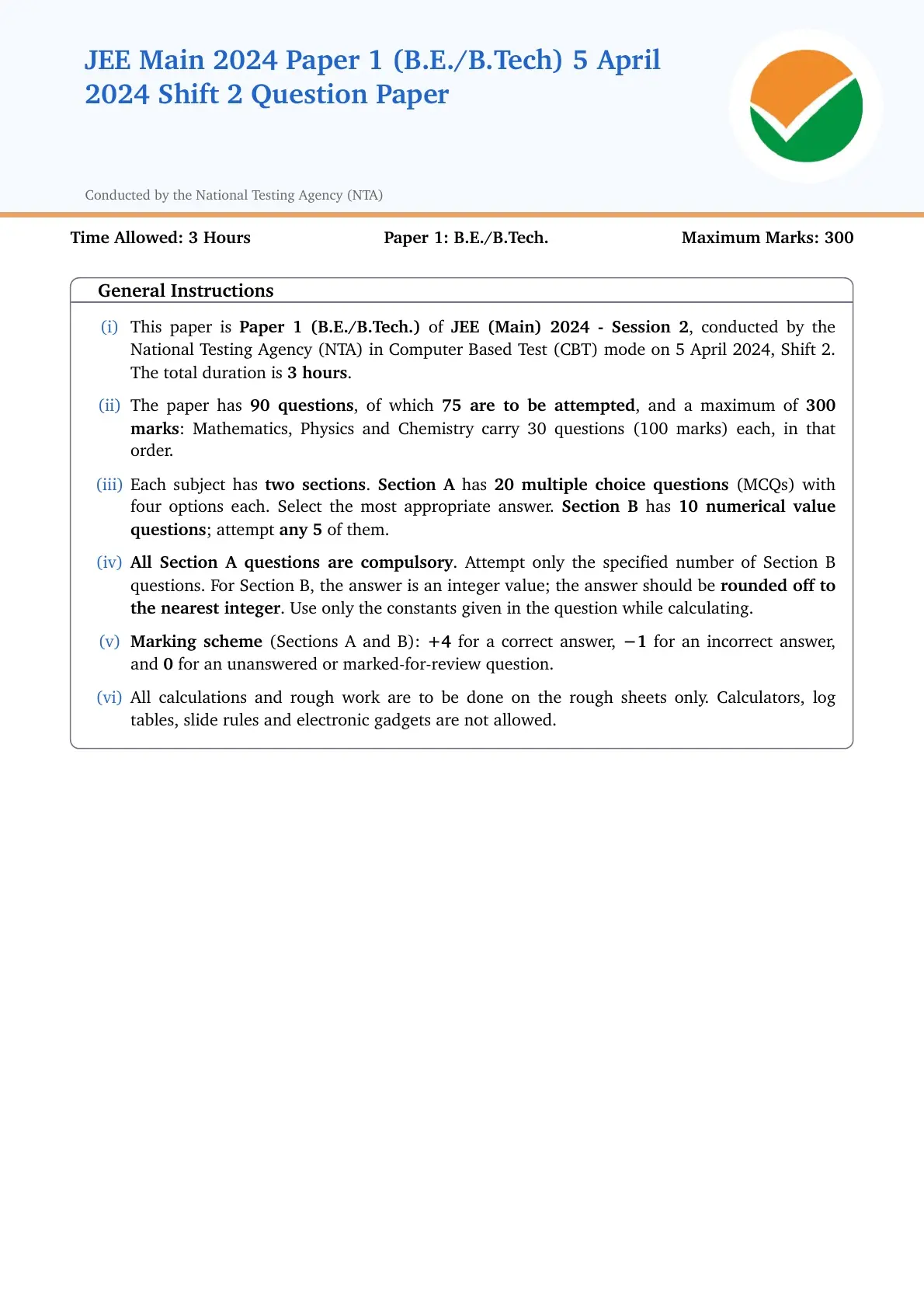
JEE Main 2024 April 5 Shift 2 Question Paper is available here with answer key and solution pdf. NTA conducted the second shift on April 5, 2024, from 3:00 PM to 6:00 PM. The JEE Main 2024 Paper 1 (B.E./B.Tech) question paper includes the following:
- 90 questions in a 3-hour CBT Mode: 30 each from Mathematics, Physics and Chemistry (75 to be attempted)
- Section A: 20 multiple choice questions (MCQs) per subject, 4 marks each
- Section B: 10 numerical value questions per subject, attempt any 5, 4 marks each (integer answer)
- Marking: +4 for a correct answer, -1 for an incorrect answer, 0 for an unattempted question
JEE Main 2024 April 5 Shift 2 Question Paper with Solution PDF
| NTA Official PDF | CD PDF | CD PDF with Solutions |
|---|---|---|
| Download official PDF 4.64 MB | Download Collegedunia PDF 1.12 MB | Download solutions PDF 1.42 MB |
Also Check:
JEE Main 2024 April 5 Shift 2 Questions with Solutions
Mathematics - Section A (Q1 - Q20)
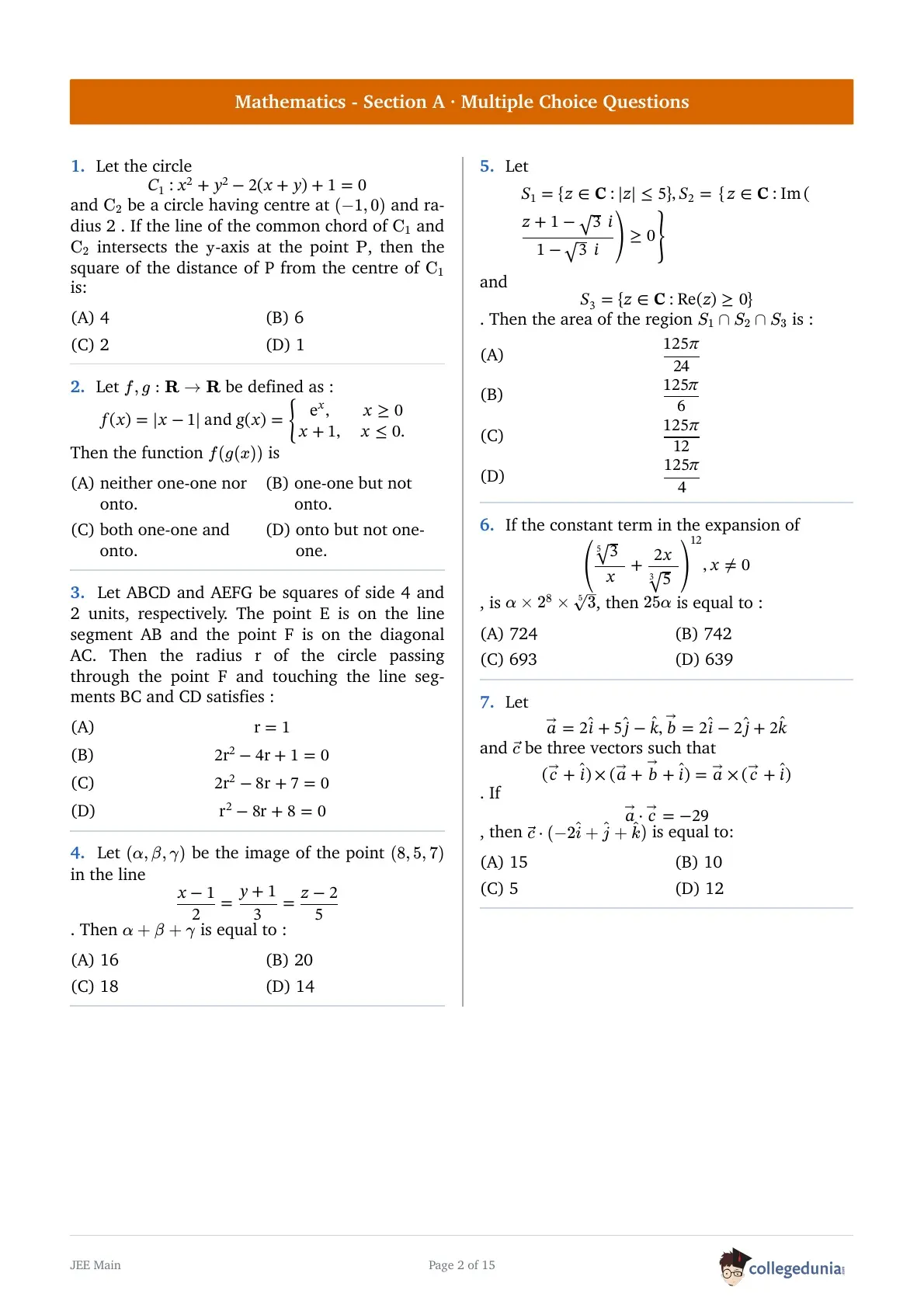
Let the circle \(C_{1}: x^{2}+y^{2}-2(x+y)+1=0\) and \(C_{2}\) be a circle having centre at \((-1, 0)\) and radius 2. If the line of the common chord of \(C_{1}\) and \(C_{2}\) intersects the y-axis at the point P, then the square of the distance of P from the centre of \(C_{1}\) is:
Let \(f, g: \mathbb{R} \rightarrow \mathbb{R}\) be defined as: \(f(x) = |x - 1|\) and \(g(x) = \begin{cases} e^x, & x \geq 0 \\ x + 1, & x \leq 0 \end{cases}\) Then the function \(f(g(x))\) is
Let ABCD and AEFG be squares of side 4 and 2 units, respectively. The point E is on the line segment AB and the point F is on the diagonal AC. Then the radius r of the circle passing through the point F and touching the line segments BC and CD satisfies :
Let \((\alpha, \beta, \gamma)\) be the point \((8, 5, 7)\) in the line \(\frac{x-1}{2} = \frac{y+1}{3} = \frac{z-2}{5}\). Then \(\alpha + \beta + \gamma\) is equal to
Let \(S_1 = \{z \in \mathbb{C} : |z| \leq 5\}\),
\(S_2 = \left\{z \in \mathbb{C} : \text{Im}\left(\frac{z + 1 - \sqrt{3}i}{1 - \sqrt{3}i}\right) \geq 0\right\}\) and
\(S_3 = \{z \in \mathbb{C} : \text{Re}(z) \geq 0\}\). Then
If the constant term in the expansion of \(\left(\frac{\sqrt[5]{3}}{x}+\frac{2x}{\sqrt[3]{5}}\right)^{12}\), \(x \neq 0\), is \(\alpha \times 2^8 \times \sqrt[5]{3}\), then \(25\alpha\) is
Let \(\vec{a}\) = 2\(\hat{i}\) + 5\(\hat{j}\) - \(\hat{k}\), \(\vec{b}\) = 2\(\hat{i}\) - 2\(\hat{j}\) + 2\(\hat{k}\)
and \(\vec{c}\) be three vectors such that
(\(\vec{c}\) + \(\hat{i}\)) \(\times\) (\(\vec{a}\) + \(\vec{b}\) + \(\hat{i}\)) = \(\vec{a}\) \(\times\) (\(\vec{c}\) + \(\hat{i})\) . \(\vec{a}\).\(\vec{c}\) = -29,)
then \(\vec{c}\).(-2\(\hat{i}\) + \(\hat{j}\) + \(\hat{k}\)) is equal to :
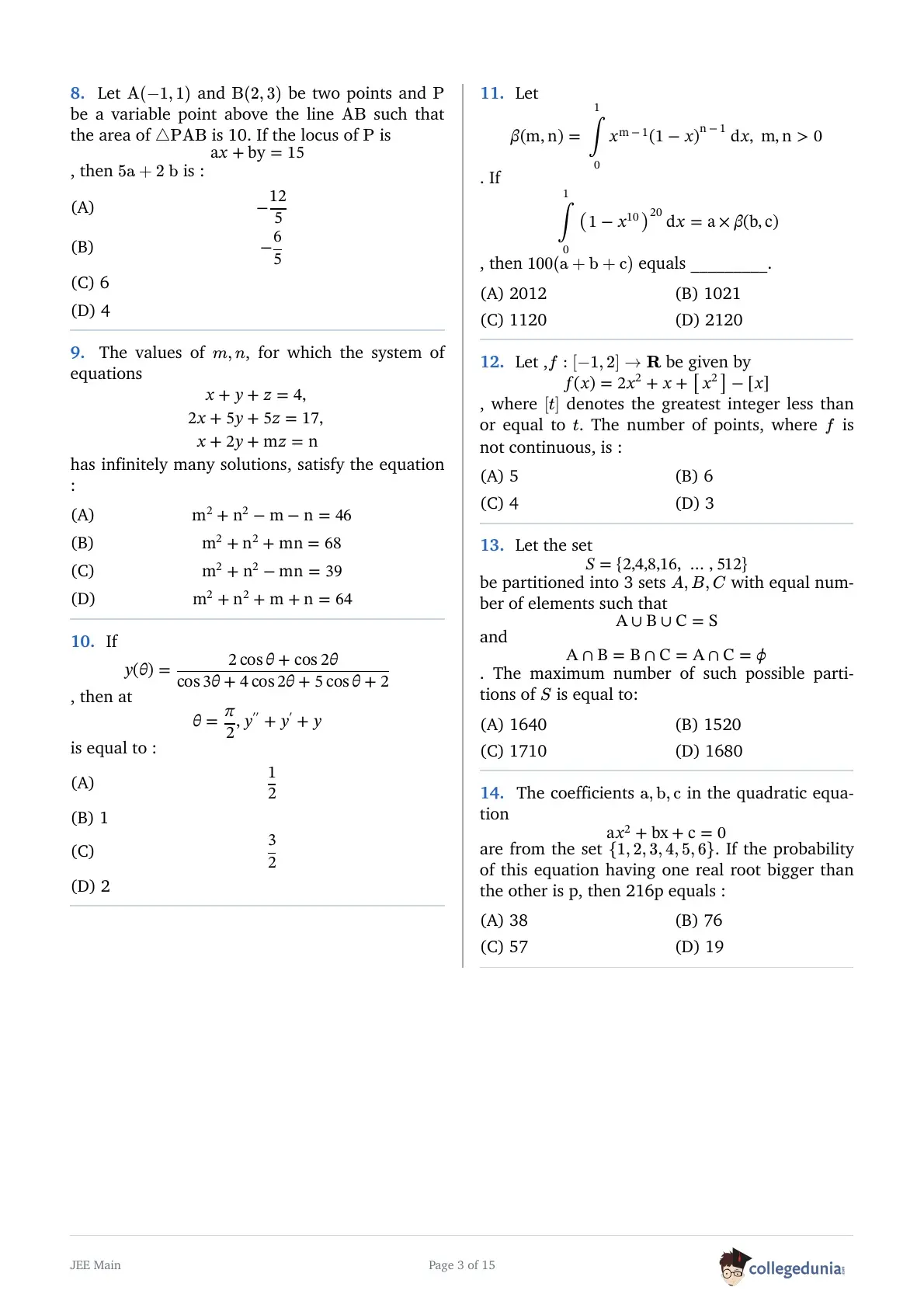
Let A(-1, 1) and B(2, 3) be two points and P be a variable point above the line AB such that the area of \(\triangle APB\) is 10. If the locus of P is \(ax + by = 15\), then \(5a + 2b\) is:
The values of \(m, n\), for which the system of equations
\(x + y + z = 4,\)
\(2x + 5y + 5z = 17,\)
\(x + 2y + mz = n\)
has infinitely many solutions, satisfy the equation :
If \(y(\theta) = \frac{2\cos\theta + \cos2\theta}{\cos3\theta + 4\cos2\theta + 5\cos\theta + 2}\), then at \(\theta = \frac{\pi}{2}, y'' + y' + y\) is equal to:
Let \(\beta(m, n) = \int_{0}^{1}x^{m-1}(1-x)^{n-1}dx\), \(m, n > 0\). If \(\int_{0}^{1}(1-x^{10})^{20}dx = a\beta(b,c)\), then \(100(a+b+x)\) equals
Let \(f: [-1, 2] \rightarrow \mathbb{R}\) be given by \(f(x) = 2x^2 + x + [x^2] - [x]\), where \([t]\) denotes the greatest integer less than or equal to \(t\). The number of points, where \(f\) is not continuous, is:
Let the set \(S = \{2, 4, 8, 16, ..., 512\}\) be partitioned into 3 sets \(A, B, C\) with equal number of elements such that \(A \cup B \cup C = S\) and \(A \cap B = B \cap C = A \cap C = \phi\). The maximum number of such possible partitions of \(S\) is equal to:
The coefficients a, b, c in the quadratic equation ax2 + bx + c = 0 are from the set {1, 2, 3, 4, 5, 6}. If the probability of this equation having one real root bigger than the other is p, then 216p equals :
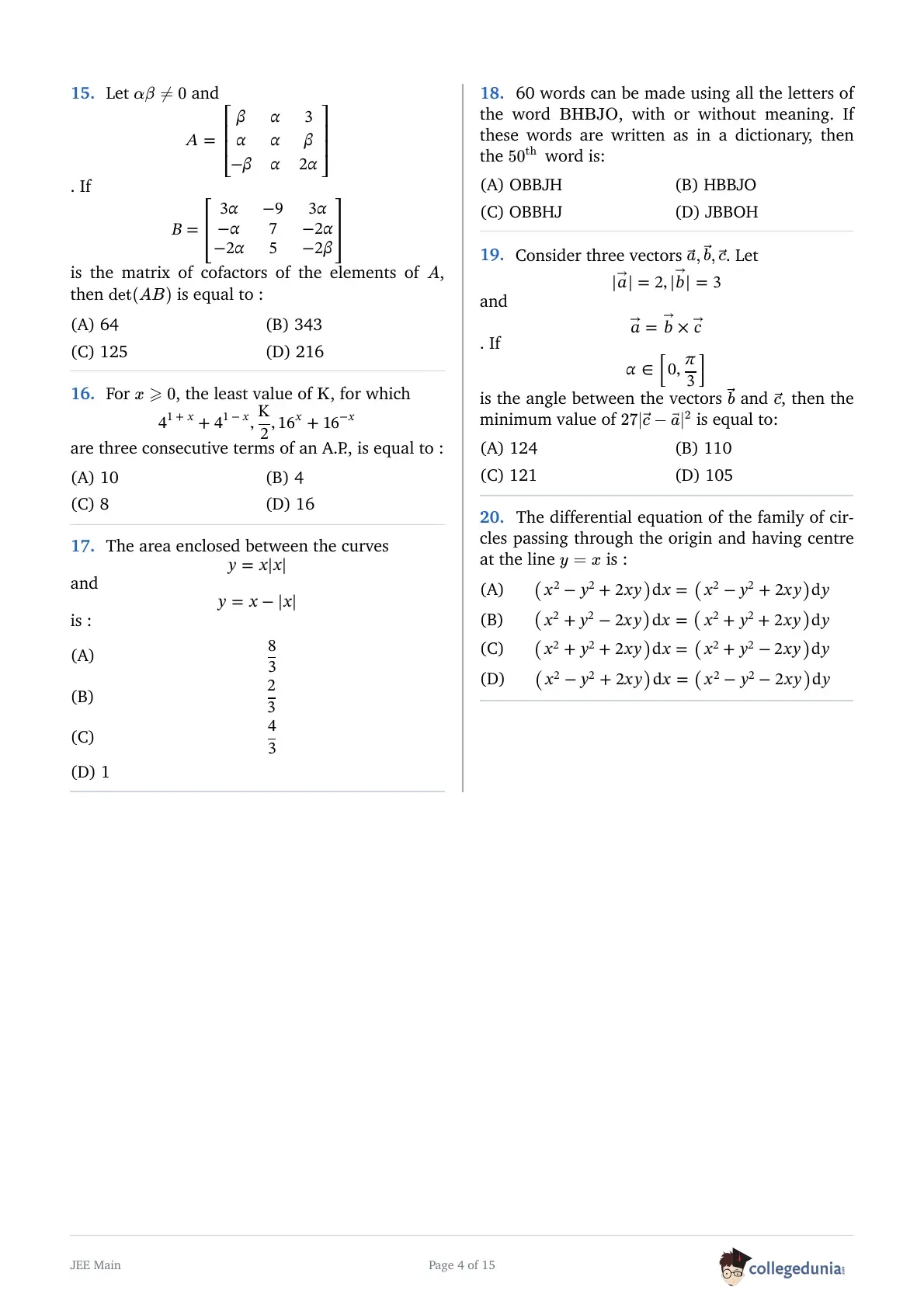
Let \(\alpha \beta \neq 0\) and \(A = \begin{bmatrix} \beta & \alpha & 3 \\ \alpha & \alpha & \beta \\ -\beta & \alpha & 2\alpha \end{bmatrix}\). If \(B = \begin{bmatrix} 3\alpha & -9 & 3\alpha \\ -\alpha & 7 & -2\alpha \\ -2\alpha & 5 & -2\beta \end{bmatrix}\) is the matrix of cofactors of the elements of A, then det(AB) is equal to:
For \(x \geq 0\), the least value of \(K\), for which \(4^{1+x}, 4^{1-x}, \frac{K}{2}, 16^{x}, 16^{-x}\) are three consecutive terms of an A.P. is equal to:
The area enclosed between the curves \(y = x|x|\) and \(y = x - |x|\) is:
60 words can be made using all the letters of the word BHBJO, with or without meaning. If these words are written as in a dictionary, then the 50th word is :
Consider three vectors \(\vec{a}, \vec{b}, \vec{c}\). Let \(|\vec{a}| = 2, |\vec{b}| = 3\) and \(\vec{a} = \vec{b} \times \vec{c}\). If \(\alpha \in [0, \frac{\pi}{3}]\) is the angle between the vectors \(\vec{b}\) and \(\vec{c}\), then the minimum value of \(27|\vec{c}| - |\vec{a}|^2\) is equal to:
The differential equation of the family of circles passing the origin and having center at the line y = x is:
Mathematics - Section B (Q21 - Q30)
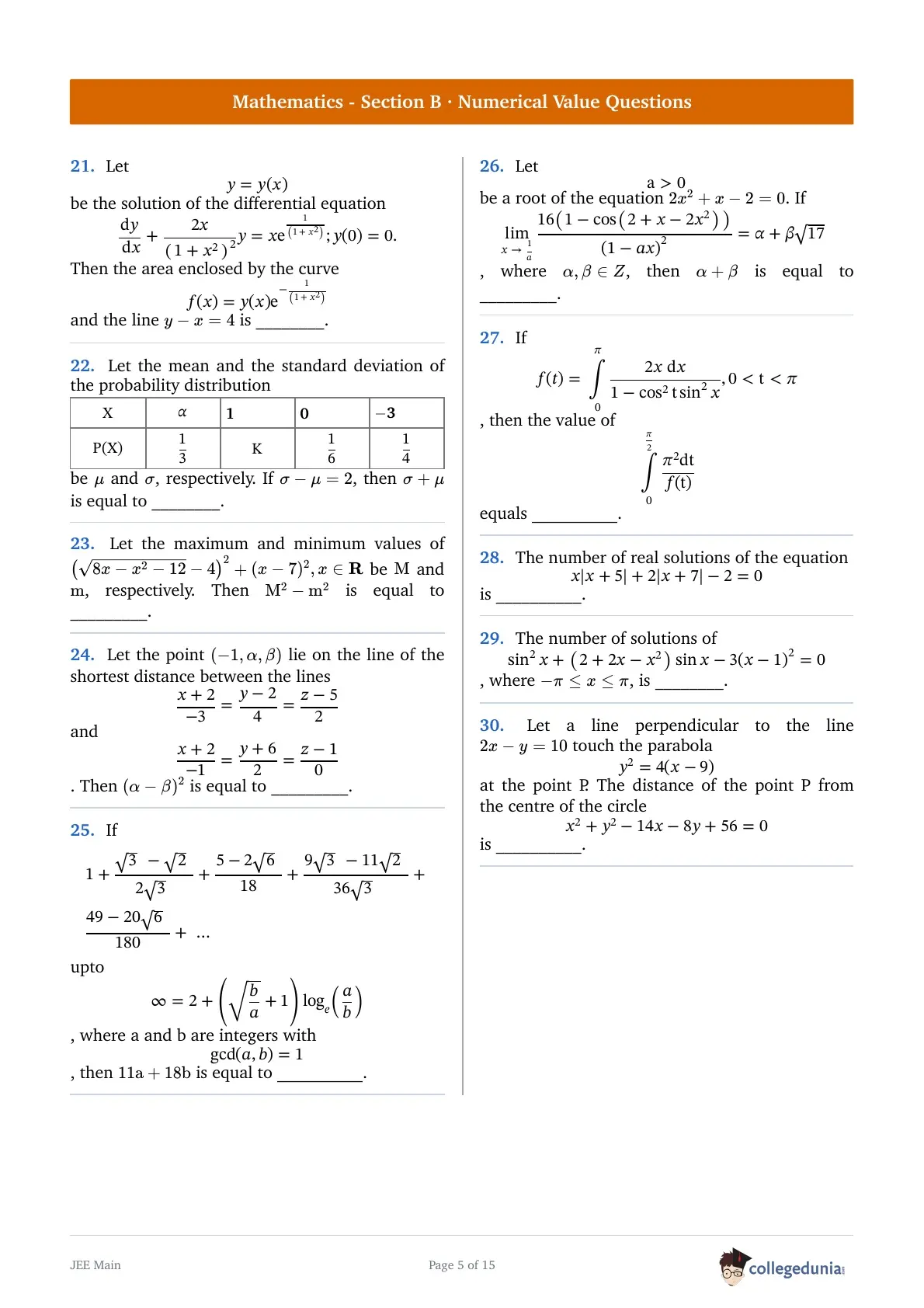
Let \( y = y(x) \) be the solution of the differential equation\[\frac{dy}{dx} + \frac{2x}{\left( 1 + x^2 \right)^2} y = x e^{\frac{1}{1+x^2}}, \quad y(0) = 0. \] Then the area enclosed by the curve \[ f(x) = y(x) e^{\frac{1}{1+x^2}} \]and the line \( y - x = 4 \) is _______.
Let the mean and the standard deviation of the probability distribution be  be \(\mu\) and \(\sigma\), respectively. If \(\sigma - \mu = 2\), then \(\sigma + \mu\) is equal to ________.
Let the maximum and minimum values of \[\left( \sqrt{8x - x^2 - 12 - 4} \right)^2 + (x - 7)^2, \quad x \in \mathbb{R} \text{ be } M \text{ and } m \text{ respectively}.\] Then \( M^2 - m^2 \) is equal to _____.
Let the point \((-1, \alpha, \beta)\) lie on the line of the shortest distance between the lines \[\frac{x + 2}{-3} = \frac{y - 2}{4} = \frac{z - 5}{2} \quad \text{and} \quad \frac{x + 2}{-1} = \frac{y + 6}{2} = \frac{z - 1}{0}.\] Then \((\alpha - \beta)^2\) is equal to ______.
If \[1 + \frac{\sqrt{3} - \sqrt{2}}{2\sqrt{3}} + \frac{5 - 2\sqrt{6}}{18} + \frac{9\sqrt{3} - 11\sqrt{2}}{36\sqrt{3}} + \frac{49 - 20\sqrt{6}}{180} + \cdots\] up to \(\infty = 2 \left( \sqrt{\frac{b}{a}} + 1 \right) \log_e \left( \frac{a}{b} \right)\), where \(a\) and \(b\) are integers with \(\gcd(a, b) = 1\), then \(11a + 18b\) is equal to _________.
Let \( a > 0 \) be a root of the equation \( 2x^2 + x - 2 = 0 \). If \[ \lim_{x \to \frac{1}{a}} \frac{16 \left( 1 - \cos(2 + x - 2x^2) \right)}{1 - ax^2} = \alpha + \beta \sqrt{17}, \] where \( \alpha, \beta \in \mathbb{Z} \), then \( \alpha + \beta \) is equal to _____.
If \( f(t) = \int_0^{\pi} \frac{2x \, dx}{1 - \cos^2 t \sin^2 x} \), \( 0 < t < \pi \), then the value of \[ \int_0^{\frac{\pi}{2}} \frac{\pi^2 \, dt}{f(t)} \] equals _____.
The number of real solutions of the equation x |x + 5| + 2|x + 7| – 2 = 0 is _____.
The number of solutions of \[\sin^2 x + (2 + 2x - x^2) \sin x - 3(x - 1)^2 = 0, \quad \text{where } -\pi \leq x \leq \pi,\] is
Let a line perpendicular to the line \( 2x - y = 10 \) touch the parabola \( y^2 = 4(x - 9) \) at the point \( P \). The distance of the point \( P \) from the centre of the circle \[ x^2 + y^2 - 14x - 8y + 56 = 0 \] is _____.
Physics - Section A (Q31 - Q50)
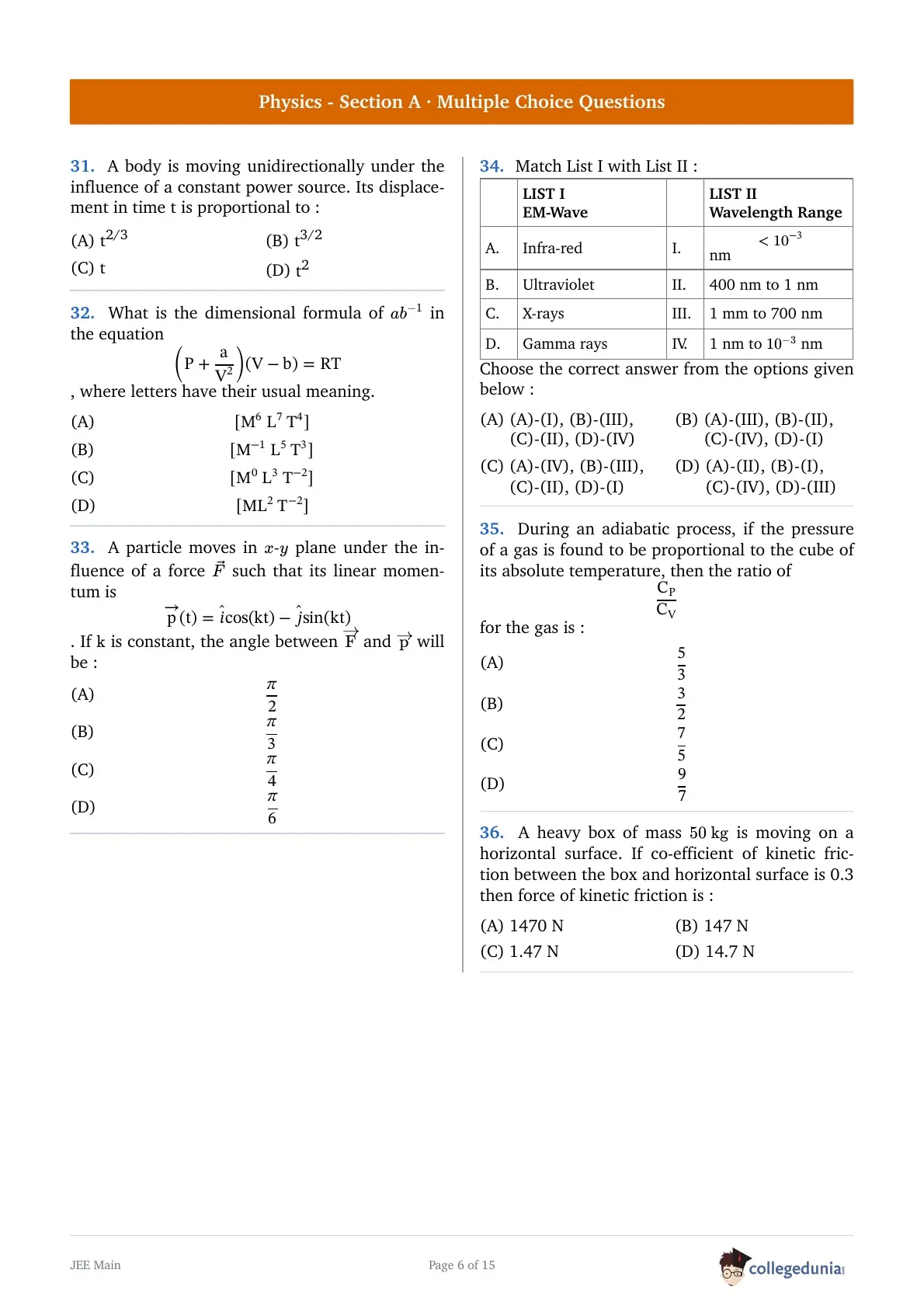
A body is moving unidirectionally under the influence of a constant power source. Its displacement in time t is proportional to :
What is the dimensional formula of \( ab^{-1} \) in the equation \[ \left( P + \frac{a}{V^2} \right) (V - b) = RT, \] where letters have their usual meaning.
A particle moves in the x-y plane under the influence of a force \( \vec{F} \) such that its linear momentum is \[ \vec{P}(t) = \hat{i} \cos(kt) - \hat{j} \sin(kt). \] If \( k \) is constant, the angle between \( \vec{F} \) and \( \vec{P} \) will be:
| List-I EM-Wave | List-II Wavelength Range |
|---|---|
| (A) Infra-red | (III) 1 mm to 700 nm |
| (B) Ultraviolet | (II) 400 nm to 1 nm |
| (C) X-rays | (IV) 1 nm to \(10^{-3}\) nm |
| (D) Gamma rays | (I) \(<10^{-3}\) nm |
During an adiabatic process, if the pressure of a gas is found to be proportional to the cube of its absolute temperature, then the ratio of \(\frac{C_p}{C_v}\) for the gas is :
A heavy box of mass 50 kg is moving on a horizontal surface. If co-efficient of kinetic friction between the box and horizontal surface is 0.3 then force of kinetic friction is :
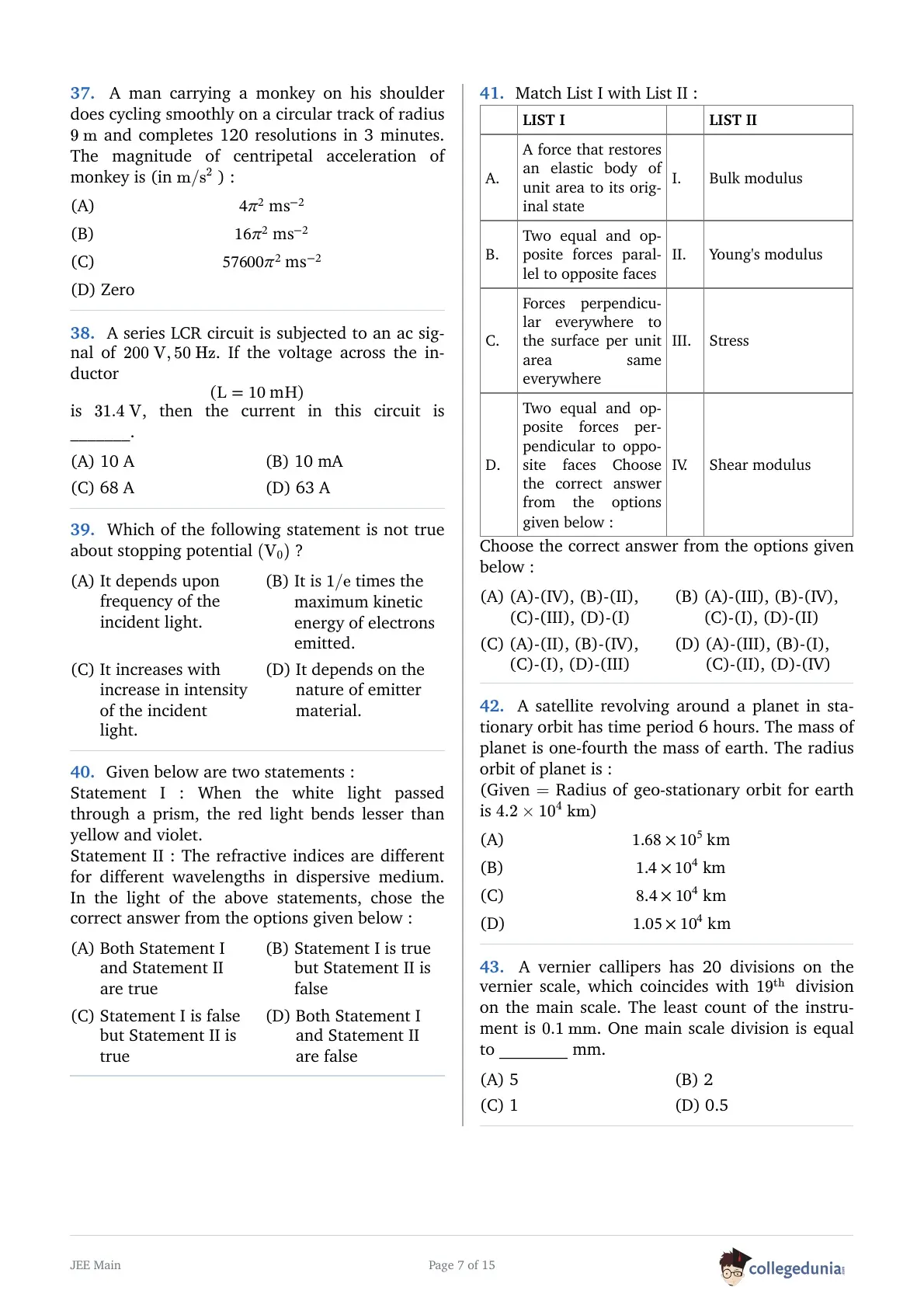
A man carrying a monkey on his shoulder does cycling smoothly on a circular track of radius \( 9 \, \text{m} \) and completes \( 120 \) revolutions in \( 3 \) minutes. The magnitude of centripetal acceleration of the monkey is (in \( \text{m/s}^2 \)):
A series LCR circuit is subjected to an AC signal of 200 V, 50 Hz. If the voltage across the inductor (L = 10 mH) is 31.4 V, then the current in this circuit is ________ :
Which of the following statement is not true about stopping potential (\( V_0 \))?
Given below are two statements :
Statement I : When the white light passed through a prism, the red light bends lesser than yellow and violet.
Statement II : The refractive indices are different for different wavelengths in dispersive medium.
In the light of the above statements, choose the correct answer from the options given below :
| List-I | List-II |
|---|---|
| (A) A force that restores an elastic body of unit area to its original state | (I) Bulk modulus |
| (B) Two equal and opposite forces parallel to opposite faces | (IV) Shear modulus |
| (C) Forces perpendicular everywhere to the surface per unit area same everywhere | (III) Stress |
| (D) Two equal and opposite forces perpendicular to opposite faces | (II) Young's modulus |
Choose the correct answer from the options given below :
A satellite revolving around a planet in stationary orbit has time period 6 hours. The mass of planet is one-fourth the mass of earth. The radius orbit of planet is: (Given = Radius of geostationary orbit for earth is \(4.2 \times 10^4\) km
A vernier callipers has 20 divisions on the vernier scale, which coincides with 19th division on the main scale. The least count of the instrument is 0.1 mm. One main scale division is equal to ____mm.
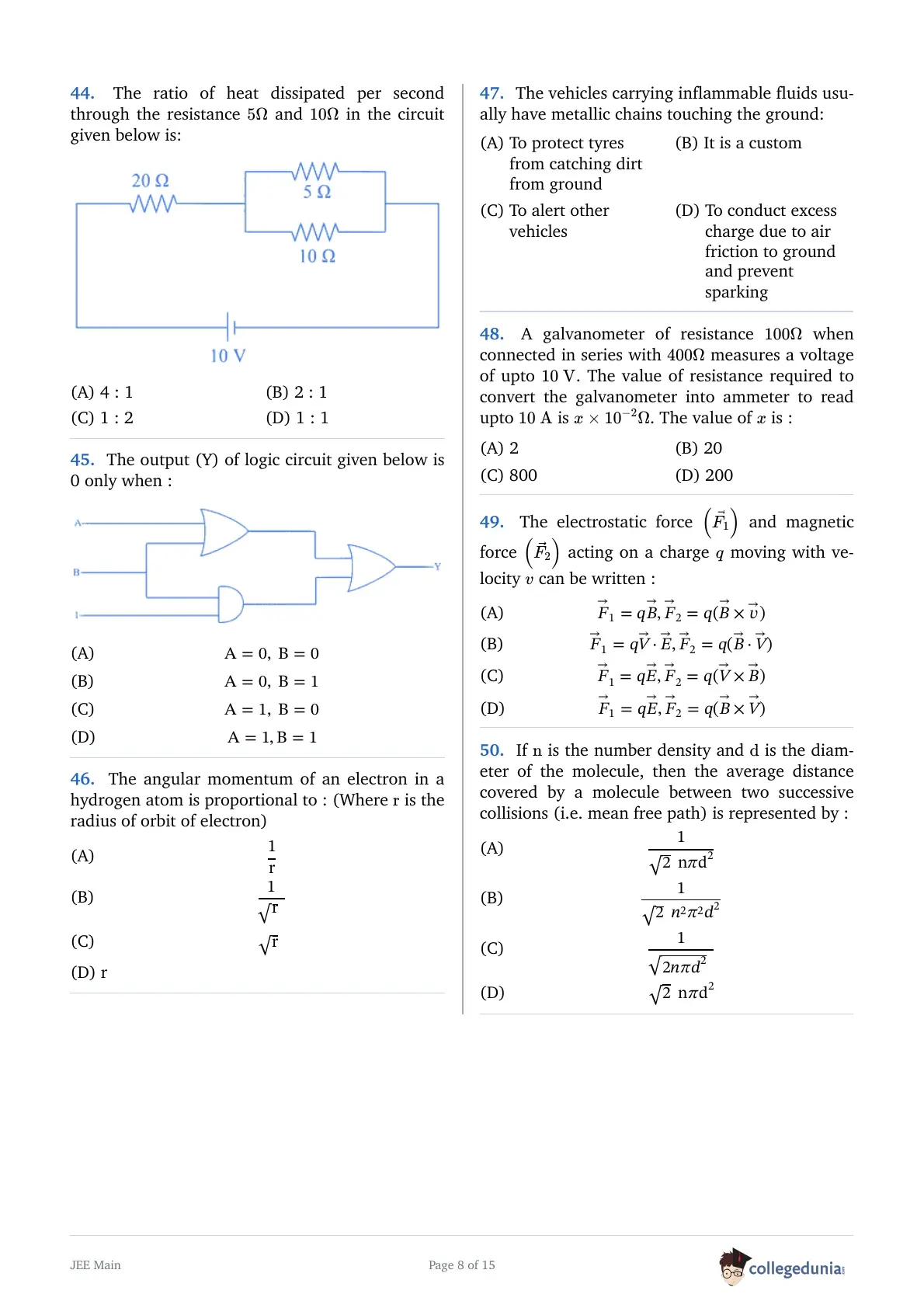
The ratio of heat dissipated per second through the resistance 5 ohm and 10 ohm in the circuit given below is :

The angular momentum of an electron in a hydrogen atom is proportional to: (Where \( r \) is the radius of the orbit of the electron)
The vehicles carrying inflammable fluids usually have metallic chains touching the ground :
A galvanometer of resistance \( 100 \, \Omega \) when connected in series with \( 400 \, \Omega \) measures a voltage of up to \( 10 \, V \). The value of resistance required to convert the galvanometer into an ammeter to read up to \( 10 \, A \) is \( x \times 10^{-2} \, \Omega \). The value of \( x \) is:
The electrostatic force (\( \vec{F_1} \)) and magnetic force (\( \vec{F_2} \)) acting on a charge \( q \) moving with velocity \( \vec{v} \) can be written:
If n is the number density and d is the diameter of the molecule, then the average distance covered by a molecule between two successive collisions (i.e. mean free path) is represented by :
Physics - Section B (Q51 - Q60)
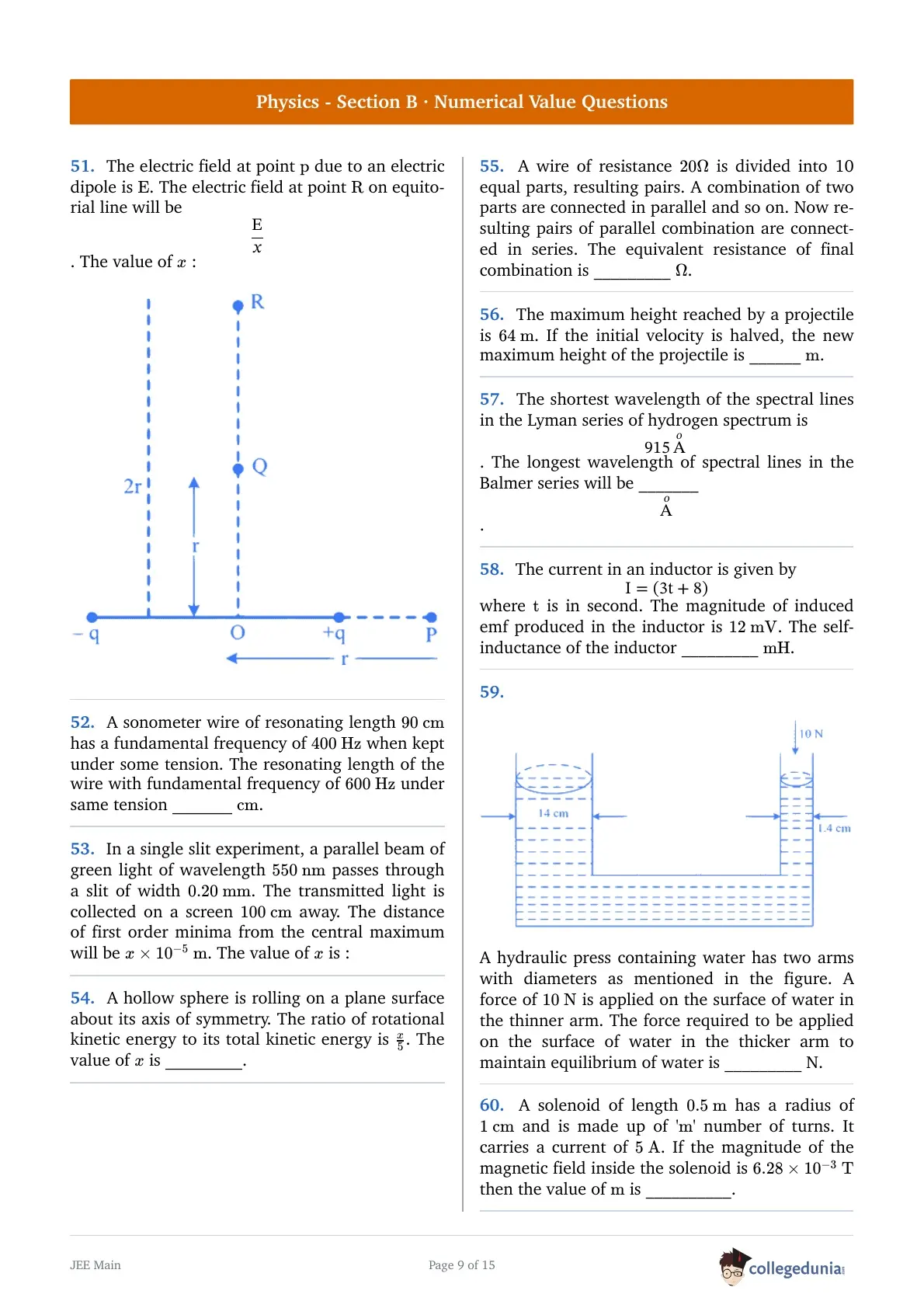
The electric field at point p due to an electric dipole is E. The electric field at point R on equitorial line will be\(\frac{E}{x}\). The value of x :
A sonometer wire of resonating length 90 cm has a fundamental frequency of 400 Hz when kept under some tension. The resonating length of the wire with fundamental frequency of 600 Hz under same tension _______ cm.
In a single slit experiment, a parallel beam of green light of wavelength 550 nm passes through a slit of width 0.20 mm. The transmitted light is collected on a screen 100 cm away. The distance of first order minima from the central maximum will be\(x \times 10^{–5}\)m. The value of x is :
A hollow sphere is rolling on a plane surface about its axis of symmetry. The ratio of rotational kinetic energy to its total kinetic energy is \(\frac{x}{5}\). The value of x is ________.
A wire of resistance 20 \(\Omega\) is divided into 10 equal parts. A combination of two parts are connected in parallel and so on. Now resulting pairs of parallel combination are connected in series. The equivalent resistance of final combination is _______ \(\Omega\).
The maximum height reached by a projectile is 64 m. If the initial velocity is halved, the new maximum height of the projectile is ______ m.
The shortest wavelength of the spectral lines in the Lyman series of hydrogen spectrum is 915 Å. The longest wavelength of spectral lines in the Balmer series will be _______ Å.
The current in an inductor is given by I = (3t + 8) where t is in second. The magnitude of induced emf produced in the inductor is 12 mV. The self inductance of the inductor _______ mH.
A hydraulic press containing water has two arms with diameters as mentioned in the figure. A force of 10 N is applied on the surface of water in the thinner arm. The force required to be applied on the surface of water in the thicker arm to maintain equilibrium of water is _______ N.
A solenoid of length 0.5 m has a radius of 1 cm and is made up of 'm' number of turns. It carries a current of 5 A. If the magnitude of the magnetic field inside the solenoid is \(6.28 \times 10^{-3}\) T, then the value of m is:
Chemistry - Section A (Q61 - Q80)
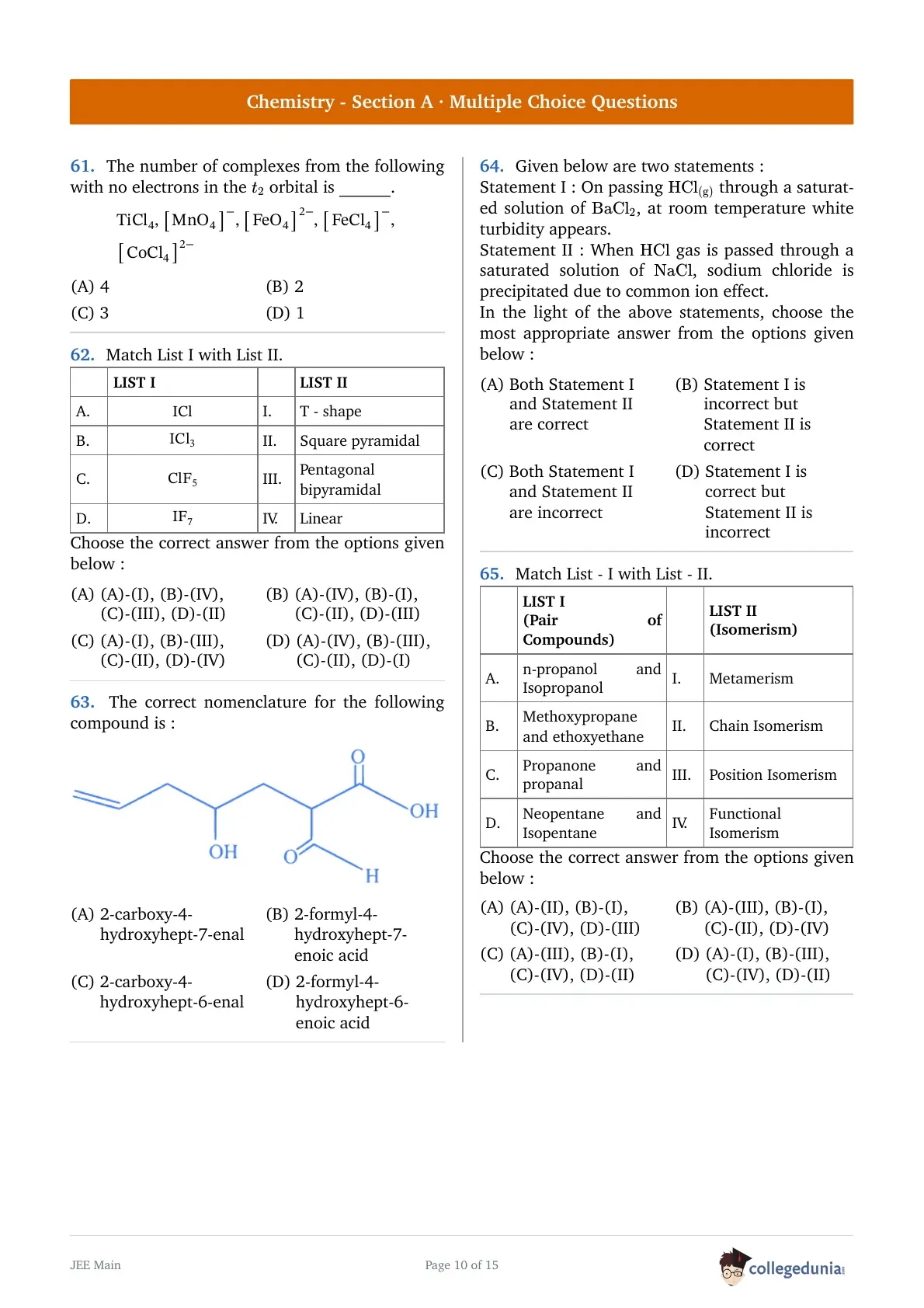
The number of complexes from the following with no electrons in the t\(_{2g}\) orbital is _______.
TiCl\(_4\), [MnO\(_4\)]\(^{-}\), [FeO\(_4\)]\(^{2-}\), [FeCl\(_4\)]\(^{-}\), [CoCl\(_4\)]\(^{2-}\)
| List - I | List - II |
|---|---|
| (A) ICl | (IV) Linear |
| (B) ICl3 | (I) T-Shape |
| (C) ClF5 | (II) Square pyramidal |
| (D) IF7 | (III) Pentagonal bipyramidal |
The correct nomenclature for the following compound is:
Given below are two statements:
Statement I: On passing HCl\(_{(g)}\) through a saturated solution of BaCl\(_2\), at room temperature white turbidity appears.
Statement II: When HCl gas is passed through a saturated solution of NaCl, sodium chloride is precipitated due to common ion effect.
In the light of the above statements, choose the most appropriate answer from the options given below:
| List - I (Pair of Compounds) | List - II (Isomerism) |
|---|---|
| (A) n-propanol and Isopropanol | (I) Metamerism |
| (B) Methoxypropane and ethoxyethane | (IV) Functional Isomerism |
| (C) Propanone and propanal | (III) Position Isomerism |
| (D) Neopentane and Isopentane | (II) Chain Isomerism |
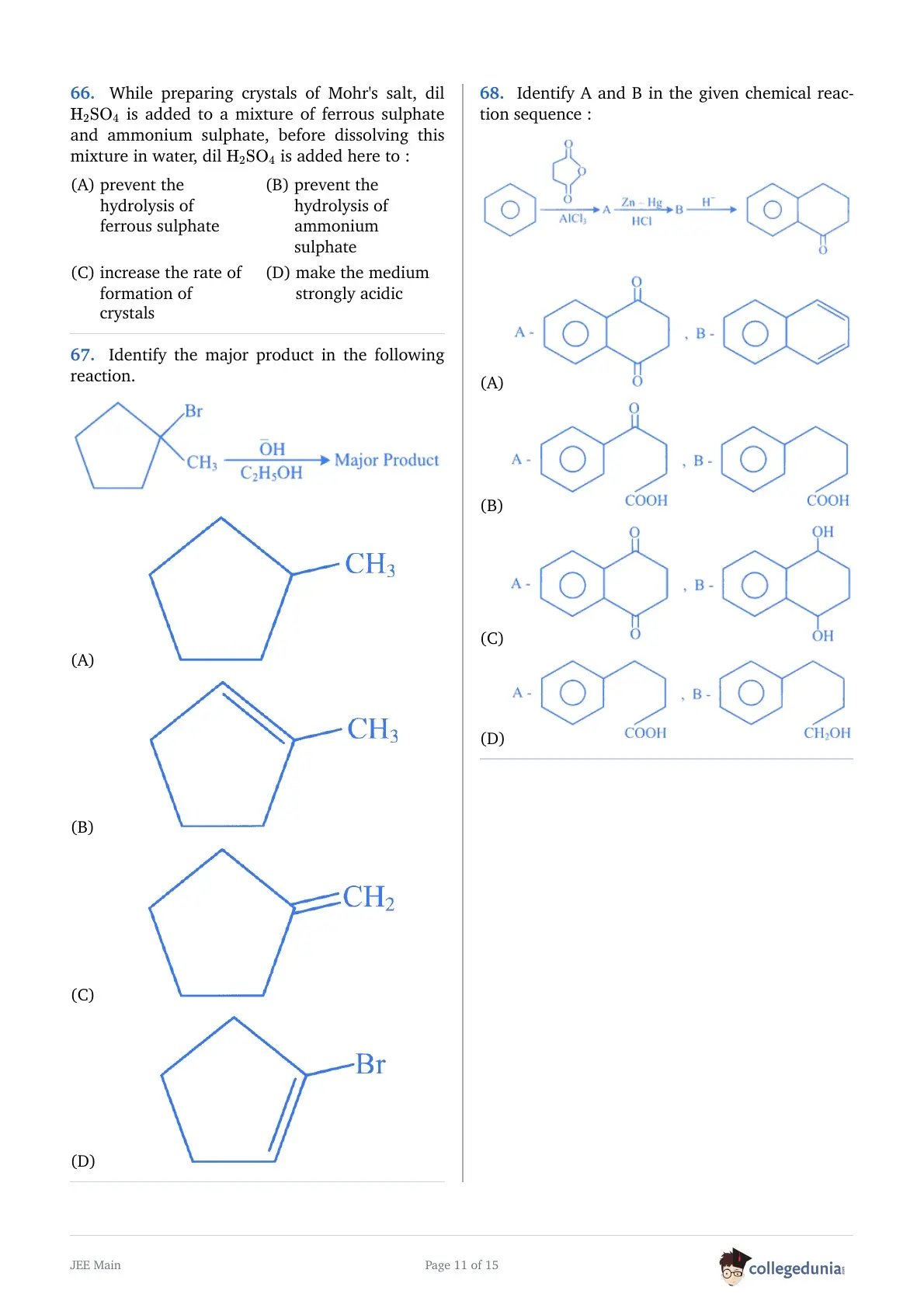
While preparing crystals of Mohr's salt, dil. \(H_2SO_4\) is added to a mixture of ferrous sulphate and ammonium sulphate, before dissolving this mixture in water, dil. \(H_2SO_4\) is added here to:
Identify the major product in the following reaction.
- (1)
![Product 1]()
- (2)
![Product 2]()
- (3)
![Product 3]()
- (4)
![Product 4]()


Identify A and B in the given chemical reaction sequence : -
- (1)
![Product 1]()
- (2)
![Product 2]()
- (3)
![Product 3]()
- (4)
![Product 4]()


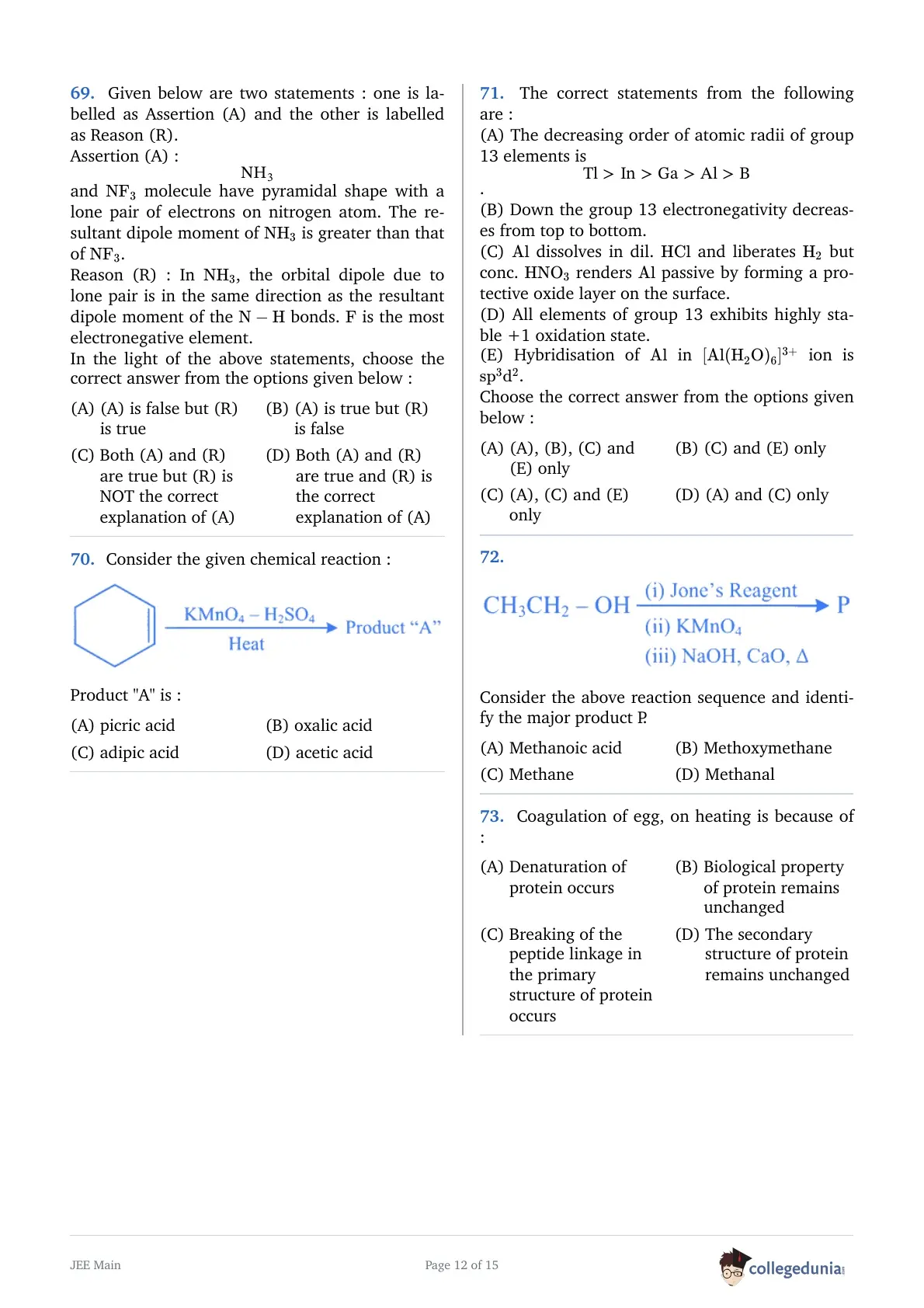
Given below are two statements: one is labelled as Assertion (A) and the other is labelled as Reason (R).
Assertion (A): NH\(_3\) and NF\(_3\) molecule have pyramidal shape with a lone pair of electrons on nitrogen atom. The resultant dipole moment of NH\(_3\) is greater than that of NF\(_3\).
Reason (R): In NH\(_3\), the orbital dipole due to lone pair is in the same direction as the resultant dipole moment of the N\(-\)H bonds. F is the most electronegative element.
In the light of the above statements, choose the correct answer from the options given below:
Consider the given chemical reaction :
Product ''A'' is :
The correct statements from the following are:
(A) The decreasing order of atomic radii of group 13 elements is Tl \(>\) In \(>\) Ga \(>\) Al \(>\) B.
(B) Down the group 13 electronegativity decreases from top to bottom.
(C) Al dissolves in dil. HCl and liberate H\(_2\), but conc. HNO\(_3\) renders Al passive by forming a protective oxide layer on the surface.
(D) All elements of group 13 exhibits highly stable +1 oxidation state.
(E) Hybridisation of Al in [Al(H\(_2\)O)\(_6\)]\(^{3+}\) ion is sp\(^3\)d\(^2\).
Choose the correct answer from the options given below.

Consider the above reaction sequence and identify the major product P.
Coagulation of egg, on heating is because of :
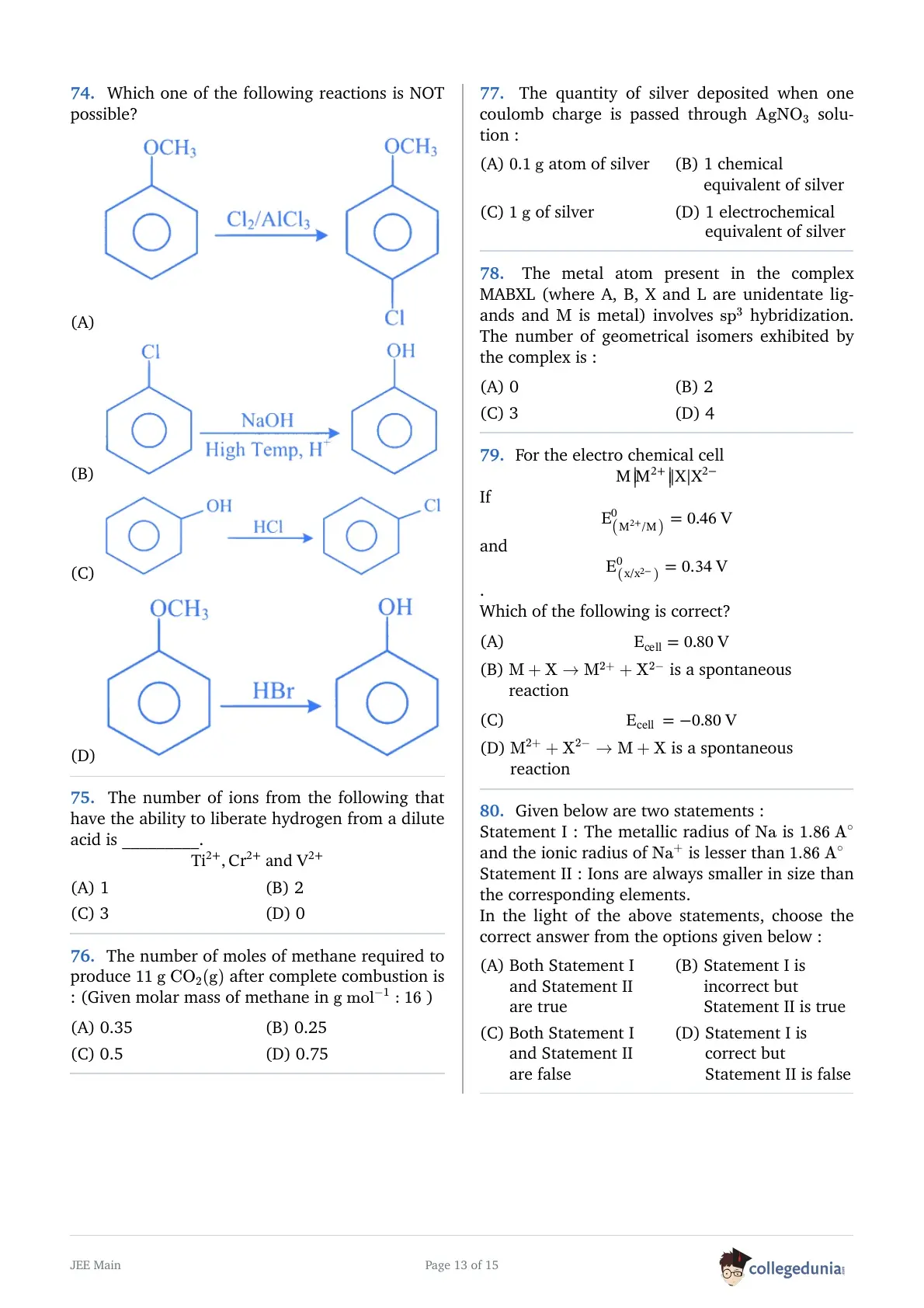
Which one of the following reactions is NOT possible?
- (1)
![Reaction 1]()
- (2)
![Reaction 2]()
- (3)
![Reaction 3]()
- (4)
![Reaction 4]()


The number of ions from the following that have the ability to liberate hydrogen from a dilute acid is _______. Ti2+, Cr2+ and V2+.
The number of moles of methane required to produce 11g \(CO_2\) (g) after complete combustion is:
(Given molar mass of methane in g mol–1 : 16)
The quantity of silver deposited when one coulomb charge is passed through\(AgNO_3\)solution:
The metal atom present in the complex MABXL (where A, B, X and L are unidentate ligands and M is metal) involves sp3 hybridization. The number of geometrical isomers exhibited by the complex is:
For the electrochemical cell
M|M\(^{2+}\)||X\(^{2-}\)|X
If \(E^0_{(M^{2+}/M)} = 0.46\) V and \(E^0_{(X/X^{2-})} = 0.34\) V.
Which of the following is correct?
Given below are two statements:
Statement I: The metallic radius of Na is 1.86 Å and the ionic radius of Na\(^+\) is lesser than 1.86 Å.
Statement II: Ions are always smaller in size than the corresponding elements.
In the light of the above statements, choose the correct answer from the options given below:
Chemistry - Section B (Q81 - Q90)
In an atom, total number of electrons having quantum numbers n = 4, \(|m_l|\) = 1 and \(m_s\) = \(-\frac{1}{2}\) is ________.
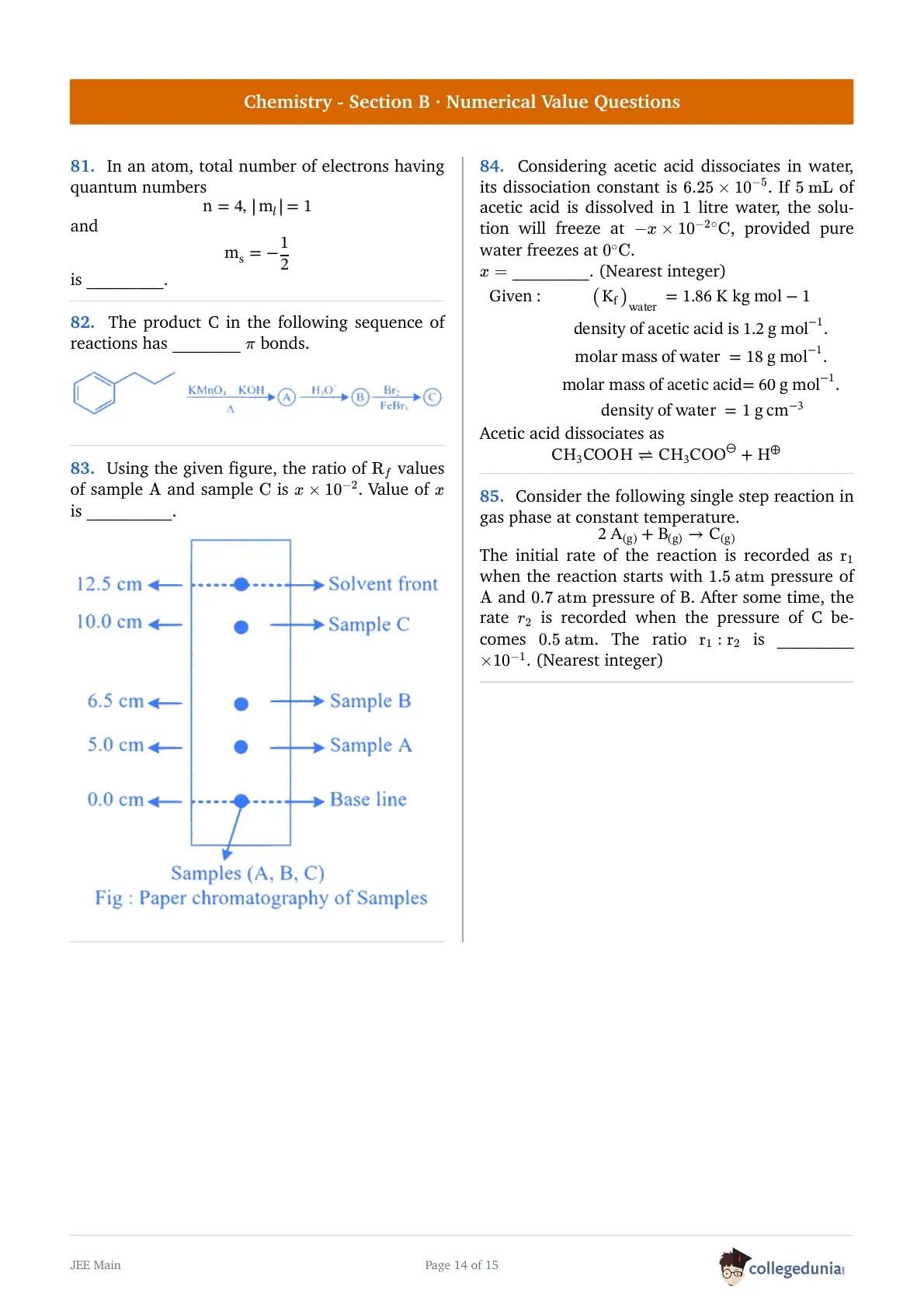
The product Ⓒ in the following sequence of reactions has _______ π bonds.
Using the given figure, the ratio of \(R_f\) values of sample A and sample C is x × 10–2. Value of x is __________.
Considering acetic acid dissociates in water, its dissociation constant is \(6.25 \times 10^{-5}\). If 5 mL of acetic acid is dissolved in 1 litre water, the solution will freeze at \(-x \times 10^{-1}\) °C, provided pure water freezes at 0 °C. \(x = \) _____ (Nearest integer)
Given: \((K_f)_{water} = 1.86\) K kg mol\(^{-1}\)
density of acetic acid is 1.2 g mol\(^{-1}\)
molar mass of water = 18 g mol\(^{-1}\)
molar mass of acetic acid = 60 g mol\(^{-1}\)
density of water = 1 g cm\(^{-3}\)
Acetic acid dissociates as CH\(_3\)COOH \(\rightleftharpoons\) CH\(_3\)COO\(^-\) + H\(^+\)
Consider the following single step reaction in gas phase at constant temperature.
\(2A_{(g)} + B_{(g)} → C_{(g)}\)
The initial rate of the reaction is recorded as \(r_1\) when the reaction starts with 1.5 atm pressure of A and 0.7 atm pressure of B. After some time, the rate \(r_2\) is recorded when the pressure of C becomes 0.5 atm. The ratio \(r_1 : r_2\) is _______ \(\times 10^1\). (Nearest integer)
The fusion of chromite ore with sodium carbonate in the presence of air leads to the formation of products A and B along with the evolution of CO\(_2\). The sum of spin-only magnetic moment values of A and B is ______ B.M. (Nearest integer)
(Given atomic number: C : 6, Na : 11, O : 8, Fe : 26, Cr : 24)
In the Claisen-Schmidt reaction to prepare 351 g of dibenzalacetone using 87 g of acetone, the amount of benzaldehyde required is _________g. (Nearest integer)
Combustion of 1 mole of benzene is expressed as C\(_6\)H\(_6\)(l) + \(\frac{15}{2}\)O\(_2\)(g) → 6CO\(_2\)(g) + 3H\(_2\)O(l). The standard enthalpy of combustion of 2 mol of benzene is x kJ. x = __________
(1) standard Enthalpy of formation of 1 mol of C\(_6\)H\(_6\)(l), for the reaction 6C(graphite) + 3H\(_2\)(g) → C\(_6\)H\(_6\)(l) is 48.5 kJ mol\(^{-1}\).
(2) Standard Enthalpy of formation of 1 mol of \(CO_2\)(g), for the reaction 6(graphite) + \(O_2(g)\) → CO\(_2\)(g) is -393.5 kJ mol\(^{-1}\).
(3) Standard Enthalpy of formation of 1 mol of H\(_2\)O(l), for the reaction H\(_2\)(g) + \(\frac{1}{2}\)O\(_2\)(g) → H\(_2\)O(l) is -286 kJ mol\(^{-1}\).
X of enthanamine was subjected to reaction with \(NaNO_2/HCl\) followed by hydrolysis to liberate \(N_2\) and HCl. The HCl generated was completely neutralised by 0.2 moles of NaOH. X is ____ g.
Number of compounds from the following with zero dipole moment is _______.
HF, H\(_2\), H\(_2\)S, CO\(_2\), NH\(_3\), BF\(_3\), CH\(_4\), CHCl\(_3\), SiF\(_4\), H\(_2\)O, BeF\(_2\)
JEE Main 2024 Exam Pattern and Marking Scheme
| Particulars | Details |
|---|---|
| Exam Mode | Online (Computer-Based Test) |
| Paper | B.E./B.Tech |
| Medium of Exam | 13 languages: English, Hindi, Gujarati, Bengali, Tamil, Telugu, Kannada, Marathi, Malayalam, Odia, Punjabi, Assamese, Urdu |
| Duration | 3 hours (180 minutes) |
| Type of Questions | Multiple Choice Questions (MCQs) + Numerical Value Questions (attempt any 5 of 10 per subject) |
| Total Marks | 300 marks |
| Subjects | Mathematics, Physics, Chemistry |
| Marking Scheme | +4 for correct answer & -1 for incorrect MCQ and Numerical Value-based Questions |
| Total Questions | 90 Questions (30 per subject), 75 to be attempted |
| Eligibility | Passed or appearing in Class 12 with Physics, Chemistry, and Mathematics |
JEE Main 2024 Question Paper Session 2 (April)
Check JEE Main 2024 Question Paper Session 2 for other shifts.
JEE Main 2024 Question Paper Session 1 (January)
Those appearing for JEE Main 2024 can use the links below to practice and keep track of their exam preparation level by attempting the shift-wise JEE Main 2024 question paper provided below.
| Exam Date and Shift | Question Paper PDF |
|---|---|
| JEE Main 27 Jan Shift 1 2024 Question Paper | Check Here |
| JEE Main 27 Jan Shift 2 2024 Question Paper | Check Here |
| JEE Main 29 Jan Shift 1 2024 Question Paper | Check Here |
| JEE Main 29 Jan Shift 2 2024 Question Paper | Check Here |
| JEE Main 30 Jan Shift 1 2024 Question Paper | Check Here |
| JEE Main 30 Jan Shift 2 2024 Question Paper | Check Here |
| JEE Main 31 Jan Shift 1 2024 Question Paper | Check Here |
| JEE Main 31 Jan Shift 2 2024 Question Paper | Check Here |
| JEE Main 1 Feb Shift 1 2024 Question Paper | Check Here |
| JEE Main 1 Feb Shift 2 2024 Question Paper | Check Here |
Also Check:
| JEE Main 2024 Paper Analysis | JEE Main 2024 Answer Key |
| JEE Main 2024 Cutoff | JEE Main 2024 Marks vs Rank |
JEE Main 2024 5 April Shift 2 Question Paper by Coaching Institute
| Coaching Institutes | Question Paper with Solutions PDF |
|---|---|
| Aakash BYJUs | Download PDF |
| Vedantu | Download PDF |
| Reliable Institute | To be updated |
| Resonance | To be updated |
| Sri Chaitanya | To be updated |
| FIIT JEE | To be updated |
JEE Main 2024 5 April Shift 2 Paper Analysis
JEE Main 2024 5 April Shift 2 paper analysis for B.E./ B.Tech is updated here with details on the difficulty level of the exam, topics with the highest weightage in the exam, section-wise difficulty level, etc.
JEE Main 2024 Question Paper Pattern
| Feature | Question Paper Pattern |
|---|---|
| Examination Mode | Computer-based Test |
| Exam Language | 13 languages (English, Hindi, Assamese, Bengali, Gujarati, Kannada, Malayalam, Marathi, Odia, Punjabi, Tamil, Telugu, and Urdu) |
| Number of Sections | Three- Physics, Chemistry, Mathematics |
| Exam Duration | 3 hours |
| Sectional Time Limit | None |
| Total Marks | 300 marks |
| Total Number of Questions Asked | 90 Questions |
| Total Number of Questions to be Answered | 75 questions |
| Type of Questions | MCQs and Numerical Answer Type Questions |
| Section-wise Number of Questions | Physics- 20 MCQs and 10 numerical type, Chemistry- 20 MCQs and 10 numerical type, Mathematics- 20 MCQs and 10 numerical type |
| Marking Scheme | +4 for each correct answer |
| Negative Marking | -1 for each incorrect answer |
Read More:
- JEE Main 2024 question paper pattern and marking scheme
- Most important chapters in JEE Mains 2024, Check chapter wise weightage here



Comments