




JEE Main 2024 April 8 Shift 2 Question Paper is available here with answer key and solution pdf. NTA conducted the second shift on April 8, 2024, from 3:00 PM to 6:00 PM. The JEE Main 2024 Paper 1 (B.E./B.Tech) question paper includes the following:
- 90 questions in a 3-hour CBT Mode: 30 each from Mathematics, Physics and Chemistry (75 to be attempted)
- Section A: 20 multiple choice questions (MCQs) per subject, 4 marks each
- Section B: 10 numerical value questions per subject, attempt any 5, 4 marks each (integer answer)
- Marking: +4 for a correct answer, -1 for an incorrect answer, 0 for an unattempted question
JEE Main 2024 April 8 Shift 2 Question Paper with Solution PDF
| NTA Official PDF | CD PDF | CD PDF with Solutions |
|---|---|---|
| Download official PDF 4.35 MB | Download Collegedunia PDF 1.00 MB | Download solutions PDF 1.03 MB |
Also Check:
JEE Main 2024 April 8 Shift 2 Questions with Solutions
Mathematics - Section A (Q1 - Q20)
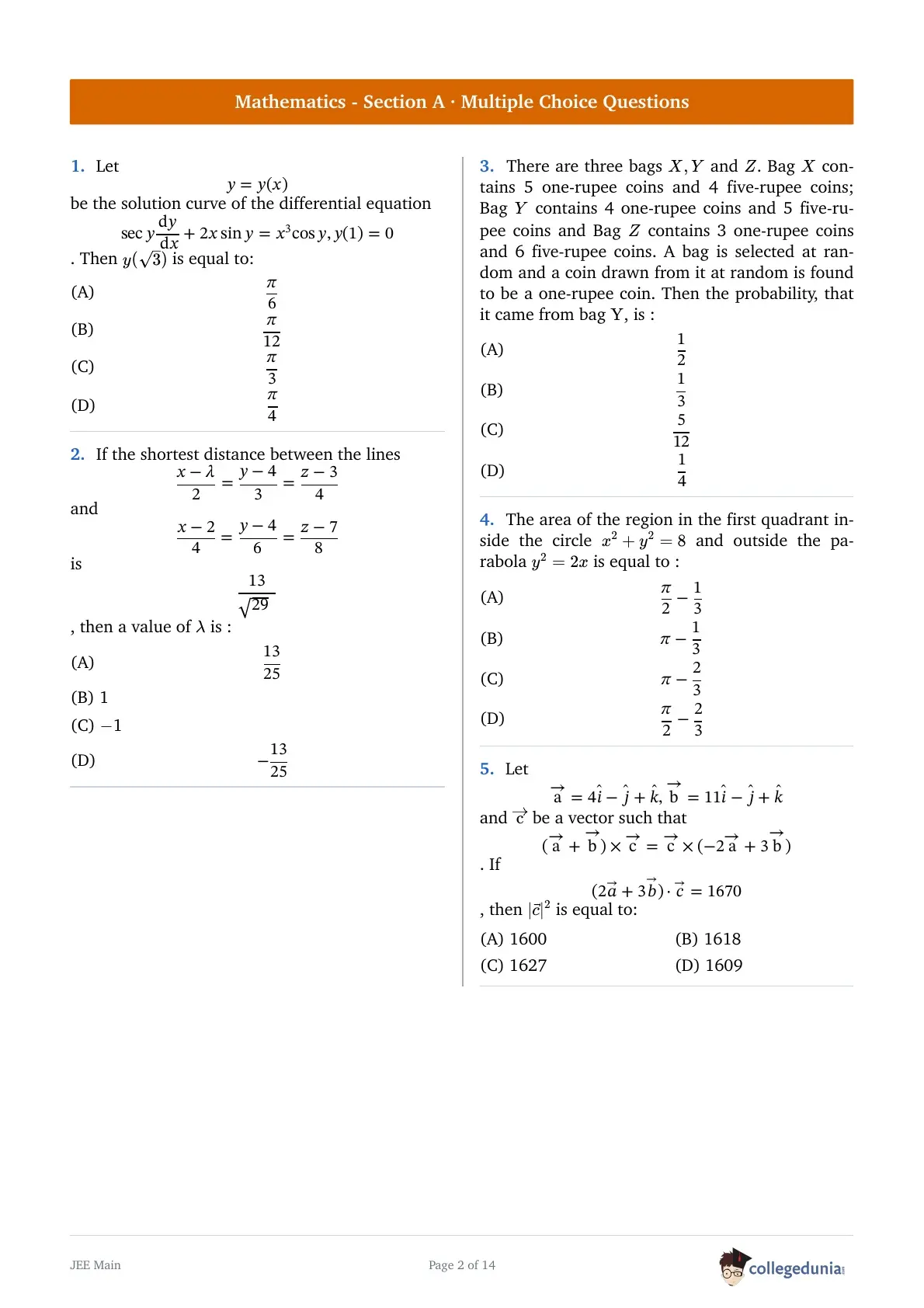
Let \(y = y(x)\) be the solution curve of the differential equation \[ \sec y \frac{dy}{dx} + 2x \sin y = x^3 \cos y, \] \(y(1) = 0\). Then \(y\left(\sqrt{3}\right)\) is equal to:
If the shortest distance between the lines \[ \frac{x - \lambda}{2} = \frac{y - 4}{3} = \frac{z - 3}{4} \] and \[ \frac{x - 2}{4} = \frac{y - 4}{6} = \frac{z - 7}{8} \] is \(\frac{13}{\sqrt{29}}\), then a value of \(\lambda\) is:
There are three bags \(X\), \(Y\), and \(Z\). Bag \(X\) contains 5 one-rupee coins and 4 five-rupee coins; Bag \(Y\) contains 4 one-rupee coins and 5 five-rupee coins, and Bag \(Z\) contains 3 one-rupee coins and 6 five-rupee coins. A bag is selected at random and a coin drawn from it at random is found to be a one-rupee coin. Then the probability, that it came from bag \(Y\), is:
The area of the region in the first quadrant inside the circle \(x^2 + y^2 = 8\) and outside the parabola \(y^2 = 2x\) is equal to:
Let \(\vec{a} = 4\hat{i} - \hat{j} + \hat{k}\), \(\vec{b} = 11\hat{i} - \hat{j} + \hat{k}\), and \(\vec{c}\) be a vector such that \[ (\vec{a} + \vec{b}) \times \vec{c} = \vec{c} \times (-2\vec{a} + 3\vec{b}). \] If \((2\vec{a} + 3\vec{b}) \cdot \vec{c} = 1670\), then \(|\vec{c}|^2\) is equal to:
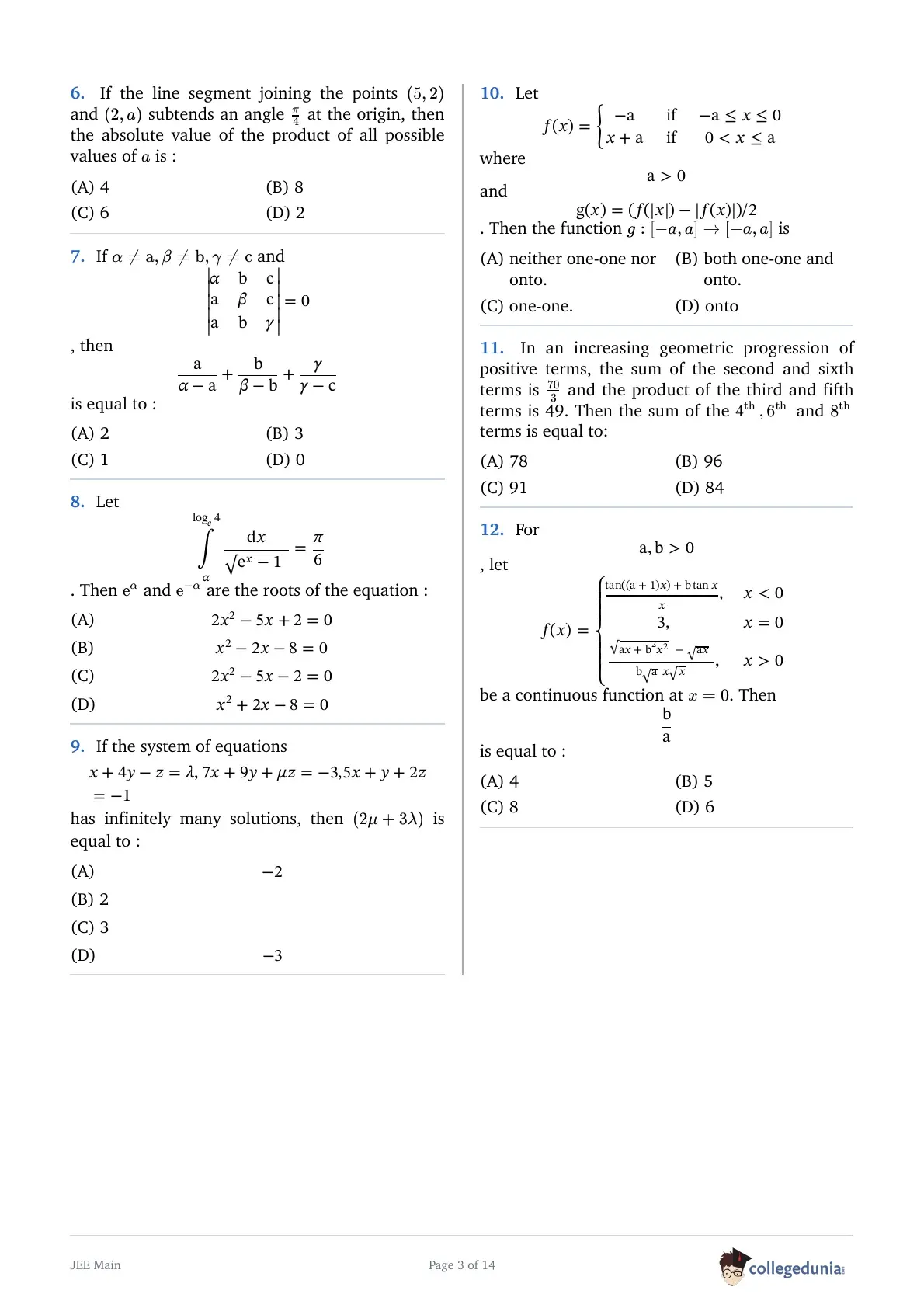
If the line segment joining the points \((5, 2)\) and \((2, a)\) subtends an angle \(\frac{\pi}{4}\) at the origin, then the absolute value of the product of all possible values of \(a\) is:
If \(\alpha \neq a\), \(\beta \neq b\), \(\gamma \neq c\) and \[ \begin{vmatrix} \alpha & b & c \\ a & \beta & c \\ a & b & \gamma \end{vmatrix} = 0,\] then \[ \frac{a}{\alpha - a} + \frac{b}{\beta - b} + \frac{\gamma}{\gamma - c} \] is equal to:
Let \[ \int_{\log_e a}^{4} \frac{dx}{\sqrt{e^x - 1}} = \frac{\pi}{6}. \] Then \(e^\alpha\) and \(e^{-\alpha}\) are the roots of the equation:
If the system of equations \(x + 4y - z = \lambda\), \(7x + 9y + \mu z = -3\), \(5x + y + 2z = -1\) has infinitely many solutions, then \((2\mu + 3\lambda)\) is equal to:
Let \(f(x) = \begin{cases} -a & \text{if } -a \leq x \leq 0, \\ x + a & \text{if } 0<x \leq a \end{cases} \) where \(a>0\) and \(g(x) = (f(|x|) - |f(x)|)/2\). Then the function \(g : [-a, a] \to [-a, a]\) is:
In an increasing geometric progression of positive terms, the sum of the second and sixth terms is \[ \frac{70}{3} \] and the product of the third and fifth terms is 49. Then the sum of the \(4^\text{th}, 6^\text{th}\), and \(8^\text{th}\) terms is:
For \(a, b > 0\), let \( f(x) = \begin{cases} \frac{\tan((a+1)x) + b \tan x}{x}, & x < 0, \\ \frac{x}{3}, & x = 0, \\ \frac{\sqrt{ax + b^2x^2} - \sqrt{ax}}{b\sqrt{a x \sqrt{x}}}, & x > 0 \end{cases} \) be a continuous function at \(x = 0\). Then \(\frac{b}{a}\) is equal to:
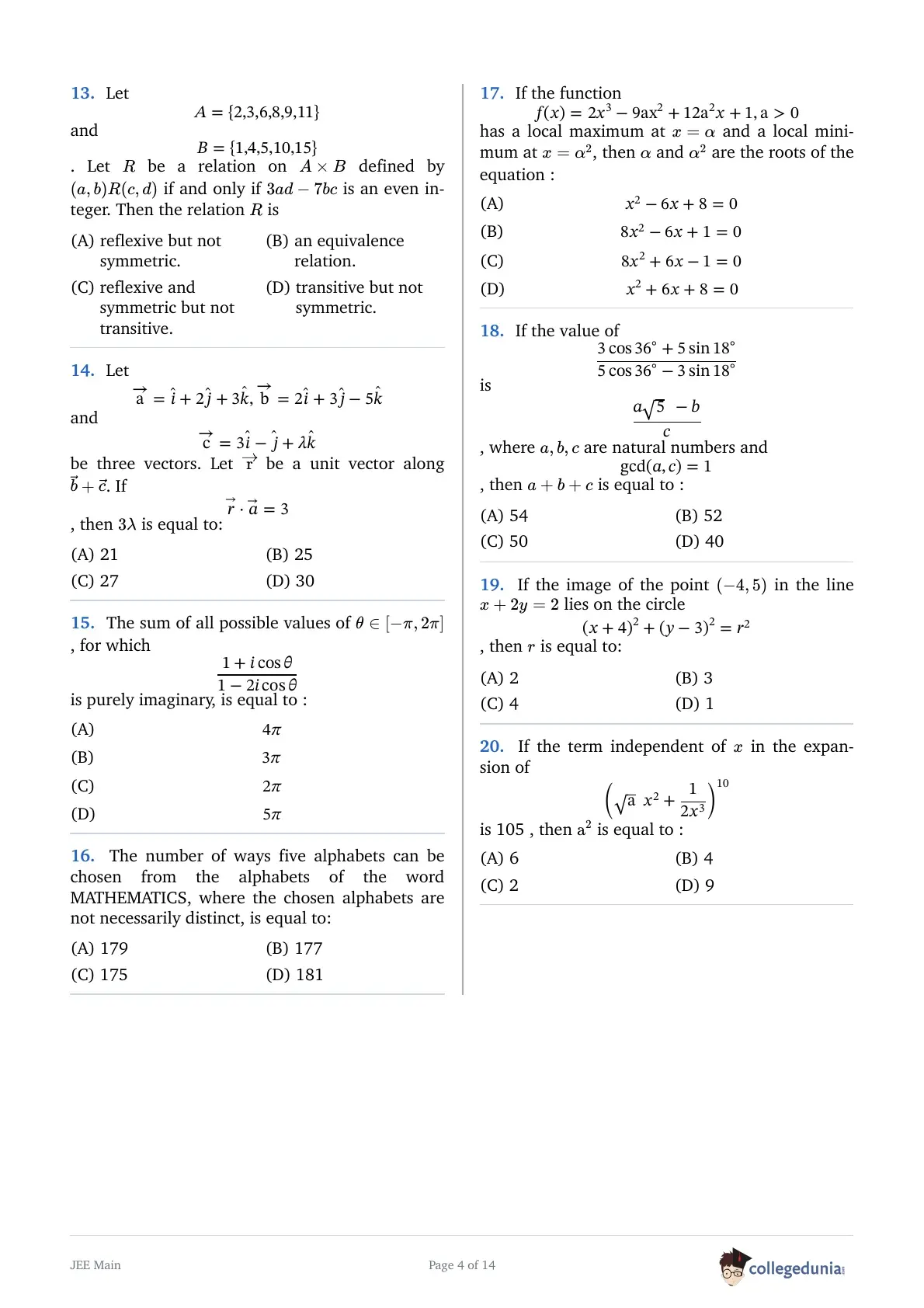
Let A= {2, 3, 6, 8, 9, 11} and B = {1, 4, 5, 10, 15} Let R be a relation on A × B define by (a, b)R(c, d) if and only if 3ad – 7bc is an even integer. Then the relation R is
Let \(\vec{a} = \hat{i} + 2\hat{j} + 3\hat{k}\), \(\vec{b} = 2\hat{i} + 3\hat{j} - 5\hat{k}\), and \(\vec{c} = 3\hat{i} - \hat{j} + \lambda\hat{k}\) be three vectors. Let \(\vec{r}\) be a unit vector along \(\vec{b} + \vec{c}\). If \(\vec{r} \cdot \vec{a} = 3\), then \(3\lambda\) is equal to:
The sum of all possible values of \(\theta \in [-\pi, 2\pi]\), for which \[ \frac{1 + i \cos\theta}{1 - 2i \cos\theta} \] is purely imaginary, is equal to:
The number of ways five alphabets can be chosen from the alphabets of the word MATHEMATICS, where the chosen alphabets are not necessarily distinct, is equal to :
If the function \(f(x) = 2x^3 - 9ax^2 + 12a^2x + 1, \, a>0\) has a local maximum at \(x = \alpha\) and a local minimum at \(x = \alpha^2\), then \(\alpha\) and \(\alpha^2\) are the roots of the equation:
If the value of \[ \frac{3 \cos 36^\circ + 5 \sin 18^\circ}{5 \cos 36^\circ - 3 \sin 18^\circ} = \frac{a\sqrt{5} - b}{c}, \] where \(a, b, c\) are natural numbers and \(\text{gcd}(a, c) = 1\), then \(a + b + c\) is equal to:
If the image of the point \((-4, 5)\) in the line \(x + 2y = 2\) lies on the circle \((x + 4)^2 + (y - 3)^2 = r^2\), then \(r\) is equal to:
If the term independent of \(x\) in the expansion of \[ \left( \sqrt{ax^2} + \frac{1}{2x^3} \right)^{10} \] is 105, then \(a^2\) is equal to:
Mathematics - Section B (Q21 - Q30)
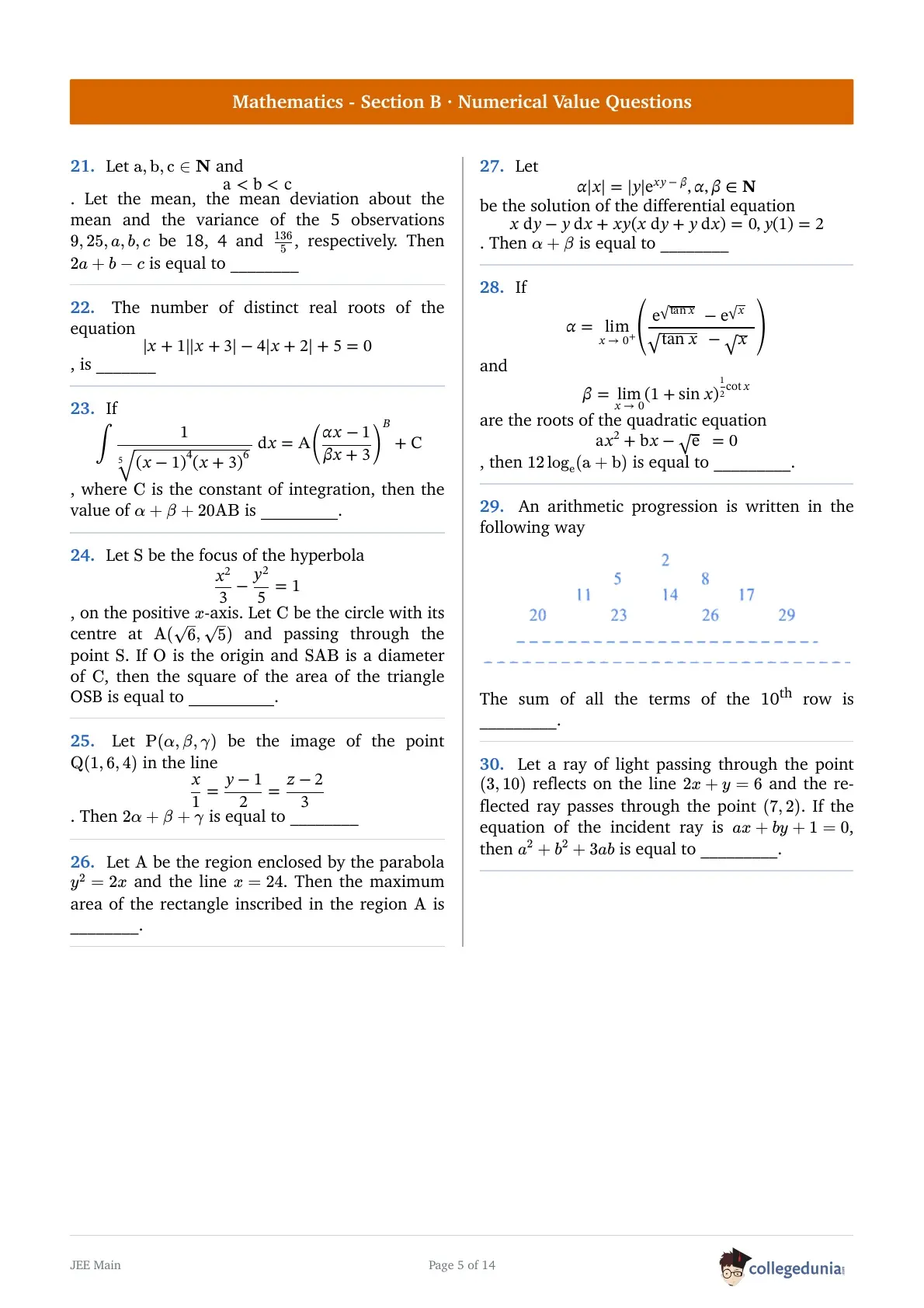
Let \(a, b, c \in \mathbb{N}\) and \(a<b<c\). Let the mean, the mean deviation about the mean and the variance of the 5 observations \(9, 25, a, b, c\) be \(18, 4\) and \(\frac{136}{5}\), respectively. Then \(2a + b - c\) is equal to _______.
The number of distinct real roots of the equation \[ |x + 1| |x + 3| - 4|x + 2| + 5 = 0, \] is _______.
If \[ \int \frac{1}{\sqrt[5]{(x - 1)^4}(x + 3)^6} \, dx = A \left( \frac{\alpha x - 1}{\beta x + 3} \right)^B + C, \] where \(C\) is the constant of integration, then the value of \(\alpha + \beta + 20AB\) is _______.
Let \(S\) be the focus of the hyperbola \(\frac{x^2}{3} - \frac{y^2}{5} = 1\), on the positive x-axis. Let \(C\) be the circle with its centre at \(A\left(\sqrt{6}, \sqrt{5}\right)\) and passing through the point \(S\). If \(O\) is the origin and \(SAB\) is a diameter of \(C\), then the square of the area of the triangle \(OSB\) is equal to -
Let \(P(\alpha, \beta, \gamma)\) be the image of the point \(Q(1, 6, 4)\) in the line \[ \frac{x}{1} = \frac{y - 1}{2} = \frac{z - 2}{3}. \] Then \(2\alpha + \beta + \gamma\) is equal to _______.
Let \(A\) be the region enclosed by the parabola \(y^2 = 2x\) and the line \(x = 24\). Then the maximum area of the rectangle inscribed in the region \(A\) is ________.
Let \(\alpha |x| = |y| e^{xy - \beta}\), \(\alpha, \beta \in \mathbb{N}\) be the solution of the differential equation \[ xdy - ydx + xy(xdy + ydx) = 0, \quad y(1) = 2. \] Then \(\alpha + \beta\) is equal to _.
If \[ \alpha = \lim_{x \to 0^+} \left( \frac{e^{\sqrt{\tan x}} - e^{\sqrt{x}}}{\sqrt{\tan x} - \sqrt{x}} \right) \] \[ \beta = \lim_{x \to 0} (1 + \sin x)^{\frac{1}{2\cot x}} \] are the roots of the quadratic equation \(ax^2 + bx - \sqrt{e} = 0\), then \(12 \log_e (a + b)\) is equal to _________.
An arithmetic progression is written in the following way

Let a ray of light passing through the point \((3, 10)\) reflects on the line \(2x + y = 6\) and the reflected ray passes through the point \((7, 2)\). If the equation of the incident ray is \(ax + by + 1 = 0\), then \(a^2 + b^2 + 3ab\) is equal to _.
Physics - Section A (Q31 - Q50)
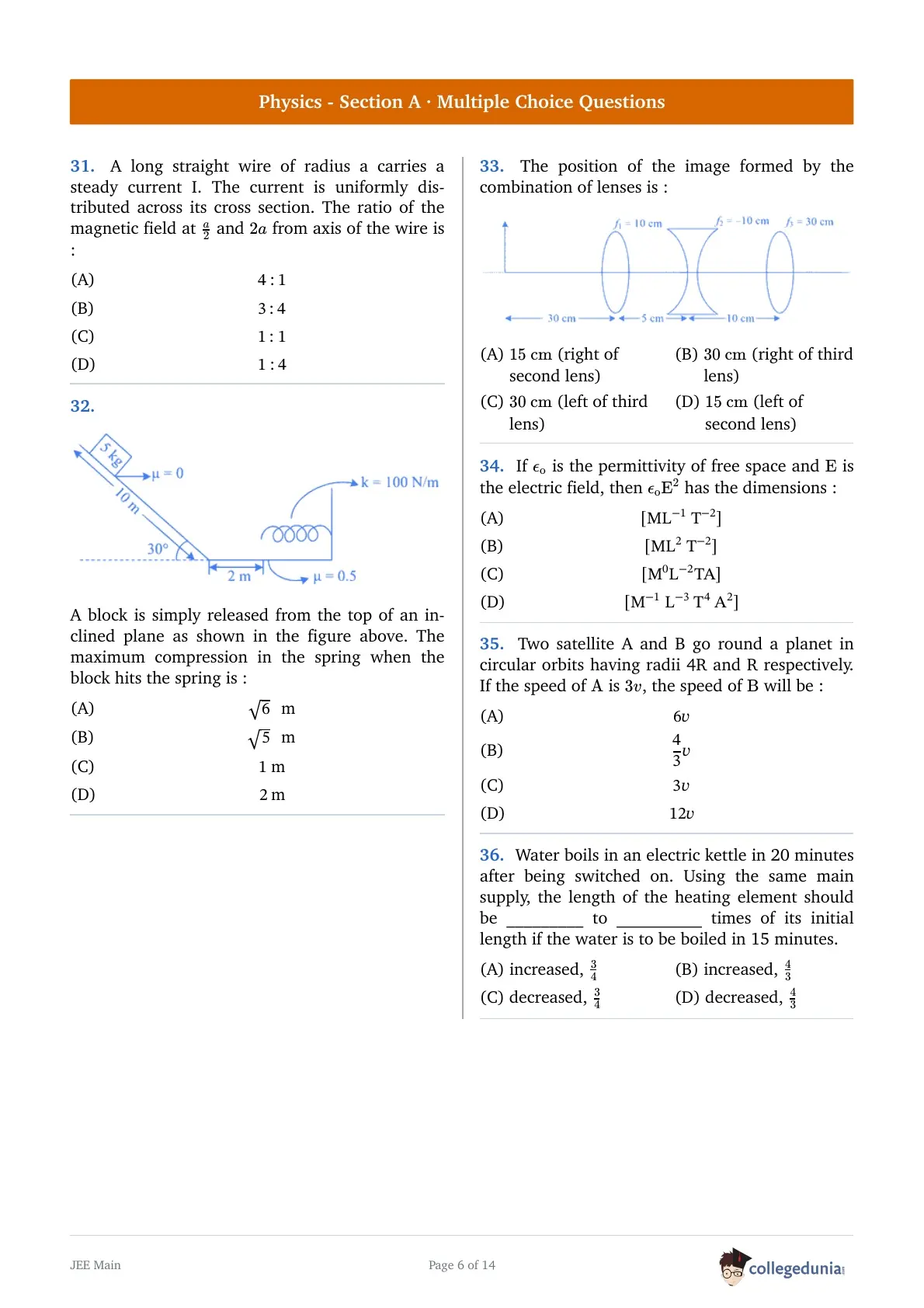
A long straight wire of radius \(a\) carries a steady current \(I\). The current is uniformly distributed across its cross section. The ratio of the magnetic field at \(\frac{a}{2}\) and \(2a\) from axis of the wire is:


If \( \epsilon_0 \) is the permittivity of free space and \( E \) is the electric field, then \( \epsilon_0 E^2 \) has the dimensions:
Two satellites \(A\) and \(B\) go round a planet in circular orbits having radii \(4R\) and \(R\) respectively. If the speed of \(A\) is \(3v\), the speed of \(B\) will be:
Water boils in an electric kettle in 20 minutes after being switched on. Using the same main supply, the length of the heating element should be ………….. to …………. times of its initial length if the water is to be boiled in 15 minutes.
A diatomic gas (\( \gamma = 1.4 \)) does 100 J of work in an isobaric expansion. The heat given to the gas is:
If \(M_0\) is the mass of isotope \(^{{12}}_{{5}}B\), \(M_p\) and \(M_n\) are the masses of proton and neutron, then nuclear binding energy of isotope is:
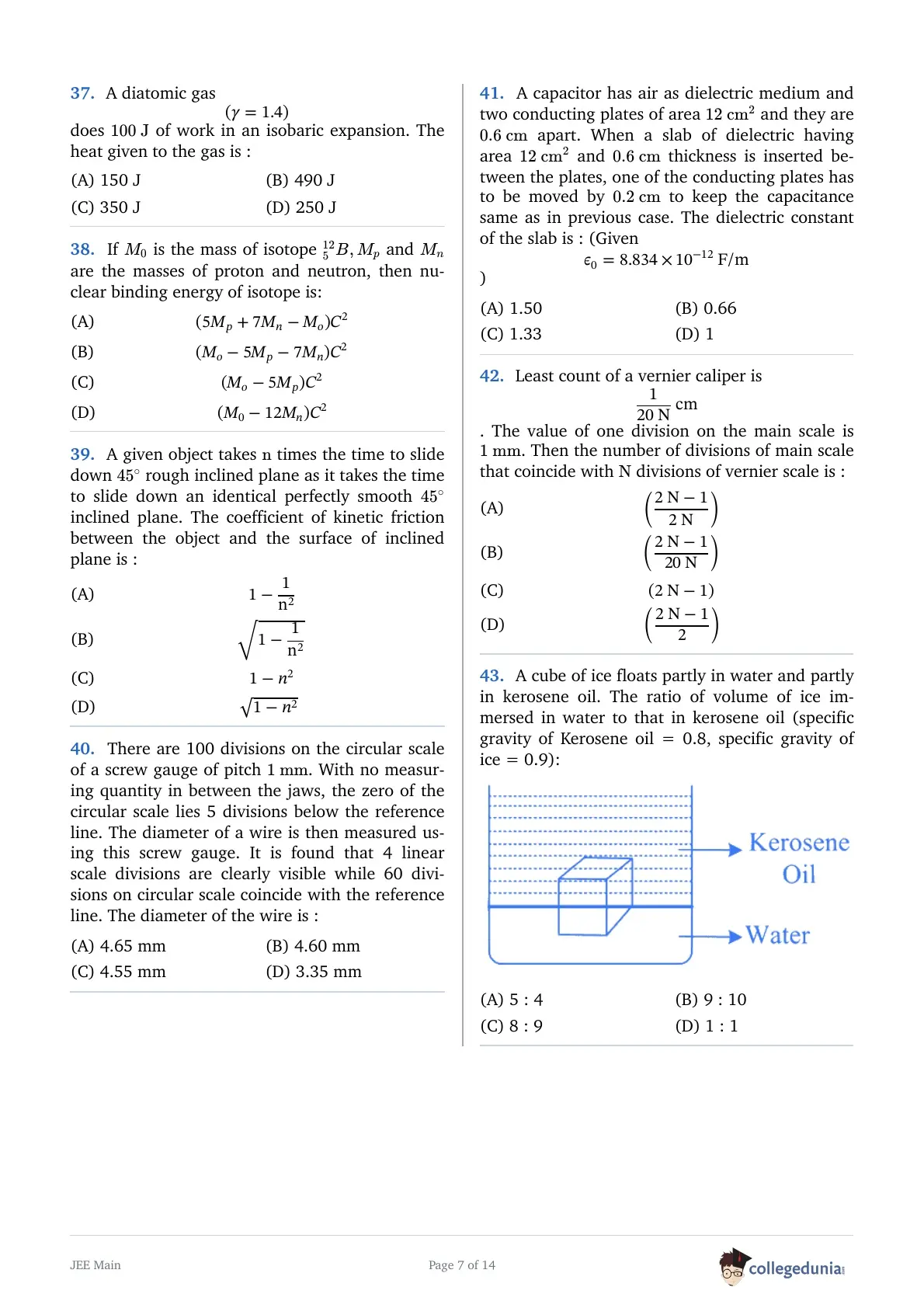
A given object takes \(n\) times the time to slide down \(45^\circ\) rough inclined plane as it takes the time to slide down an identical perfectly smooth \(45^\circ\) inclined plane. The coefficient of kinetic friction between the object and the surface of inclined plane is:
There are 100 divisions on the circular scale of a screw gauge of pitch 1 mm. With no measuring quantity in between the jaws, the zero of the circular scale lies 5 divisions below the reference line. The diameter of a wire is then measured using this screw gauge. It is found the 4 linear scale divisions are clearly visible while 60 divisions on circular scale coincide with the reference line. The diameter of the wire is :
A capacitor has air as dielectric medium and two conducting plates of area \(12 \, \text{cm}^2\) and they are \(0.6 \, \text{cm}\) apart. When a slab of dielectric having area \(12 \, \text{cm}^2\) and \(0.6 \, \text{cm}\) thickness is inserted between the plates, one of the conducting plates has to be moved by \(0.2 \, \text{cm}\) to keep the capacitance same as in previous case. The dielectric constant of the slab is:
\((\text{Given } \epsilon_0 = 8.834 \times 10^{-12} \, \text{F/m})\)
Least count of a vernier caliper is \( \frac{1}{20N} \, \text{cm} \).The value of one division on the main scale is \(1 \, \text{mm}\). Then the number of divisions of the main scale that coincide with \(N\) divisions of the vernier scale is:
A cube of ice floats partly in water and partly in kerosene oil. The radio of volume of ice immersed in water to that in kerosene oil (specific gravity of Kerosene oil = 0.8, specific gravity of ice = 0.9)

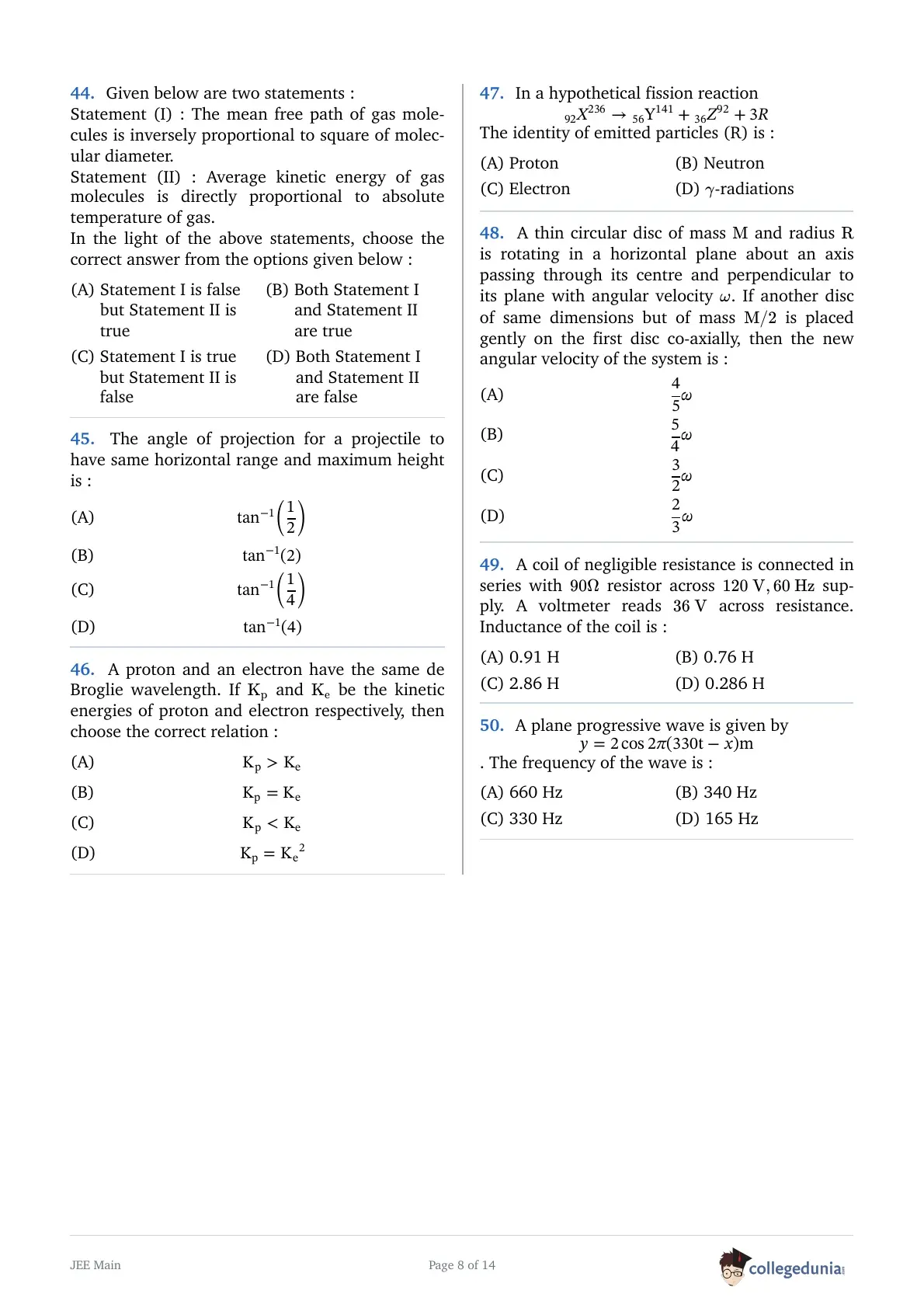
Given below are two statements :
Statement (I) : The mean free path of gas molecules is inversely proportional to square of molecular diameter.
Statement (II) : Average kinetic energy of gas molecules is directly proportional to absolute temperature of gas.
In the light of the above statements, choose the correct answer from the option given below:
The angle of projection for a projectile to have same horizontal range and maximum height is :
A proton and an electron have the same de Broglie wavelength. If \(K_p\) and \(K_e\) be the kinetic energies of proton and electron respectively. Then choose the correct relation:
In a hypothetical fission reaction
\(^{92}X^{236} \rightarrow ^{56}Y^{141} + ^{36}Z^{92} + 3R\) The identity of emitted particles (R) is:
A thin circular disc of mass \(M\) and radius \(R\) is rotating in a horizontal plane about an axis passing through its centre and perpendicular to its plane with angular velocity \(\omega\). If another disc of same dimensions but of mass \(\frac{M}{2}\) is placed gently on the first disc co-axially, then the new angular velocity of the system is:
A coil of negligible resistance is connected in series with \(90 \, \Omega\) resistor across \(120 \, \text{V}, \, 60 \, \text{Hz}\) supply. A voltmeter reads \(36 \, \text{V}\) across resistance. Inductance of the coil is:
A plane progressive wave is given by \( y = 2 \cos 2\pi(330t - x) \, \text{m} \). The frequency of the wave is:
Physics - Section B (Q51 - Q60)
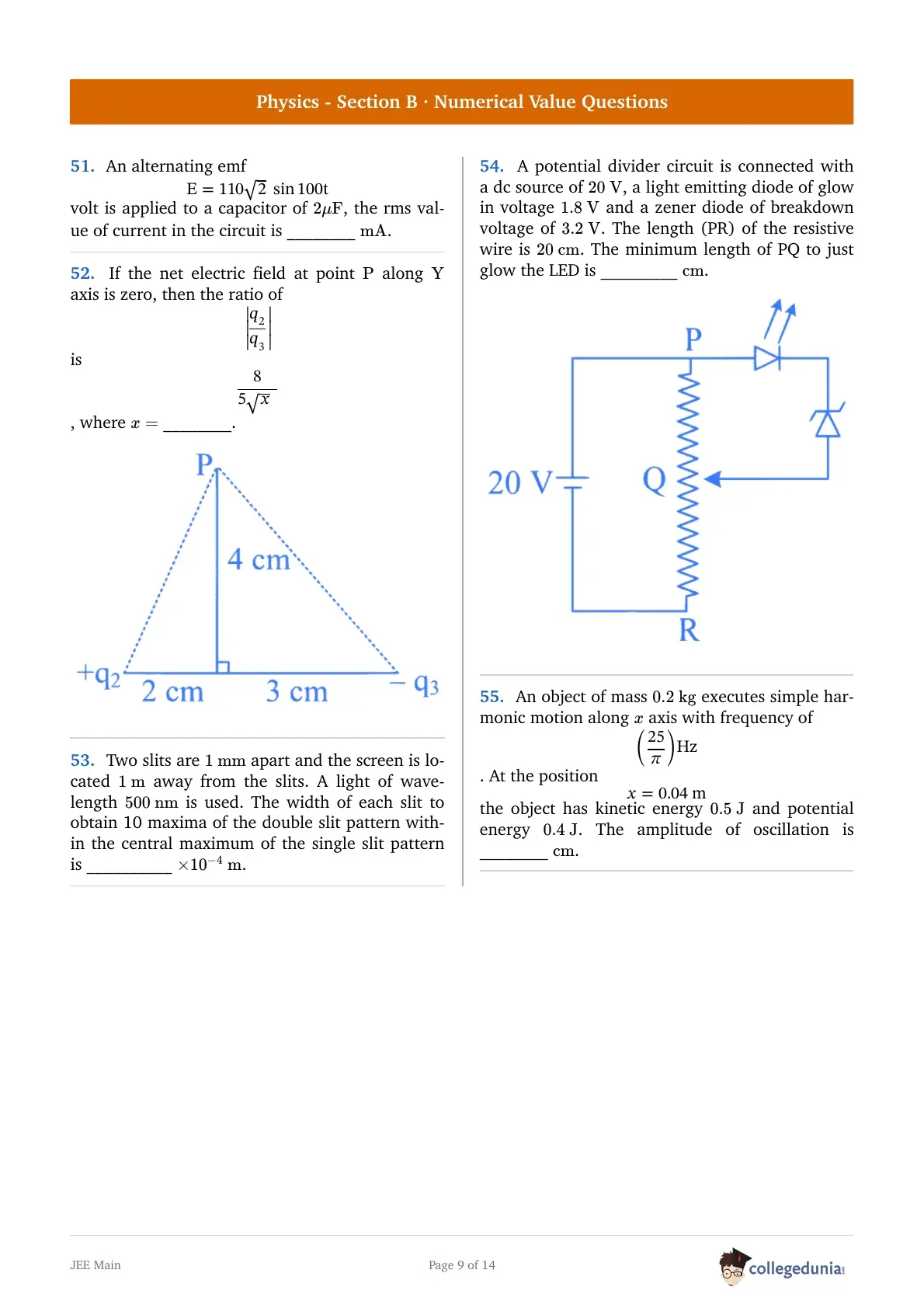
An alternating emf \( E = 110\sqrt{2} \sin 100t \, \text{volt} \) is applied to a capacitor of \( 2\mu\text{F} \), the rms value of current in the circuit is \(\dots\) \(\text{mA}\).
If the net electric field at point \( P \) along \( Y \)-axis is zero, then the ratio of \[ \left| \frac{q_2}{q_3} \right| \] is \[\frac{8}{5\sqrt{x}},\] where \( x = \dots \dots \dots \dots \dots \).

Two slits are 1 mm apart and the screen is located 1 m away from the slits. A light wavelength \( 500 \, \text{nm} \) is used. The width of each slit to obtain 10 maxima of the double slit pattern within the central maximum of the single slit pattern is \(\dots\) \(\times \, 10^{-4} \, \text{m}\).
A potential divider circuit is connected with a dc source of 20 V, a light emitting diode of glow in voltage 1.8 V and a zener diode of breakdown voltage of 3.2 V. The length (PR) of the resistive wire is 20 cm. The minimum length of PQ to just glow the LED is …………. cm.

An object of mass \( 0.2 \, \text{kg} \) executes simple harmonic motion along the \( x \)-axis with a frequency of \( \left( \frac{25}{\pi} \right) \, \text{Hz} \). At the position \( x = 0.04 \, \text{m} \), the object has kinetic energy \( 0.5 \, \text{J} \) and potential energy \( 0.4 \, \text{J} \). The amplitude of oscillation is \(\dots\) \(\text{cm}\).
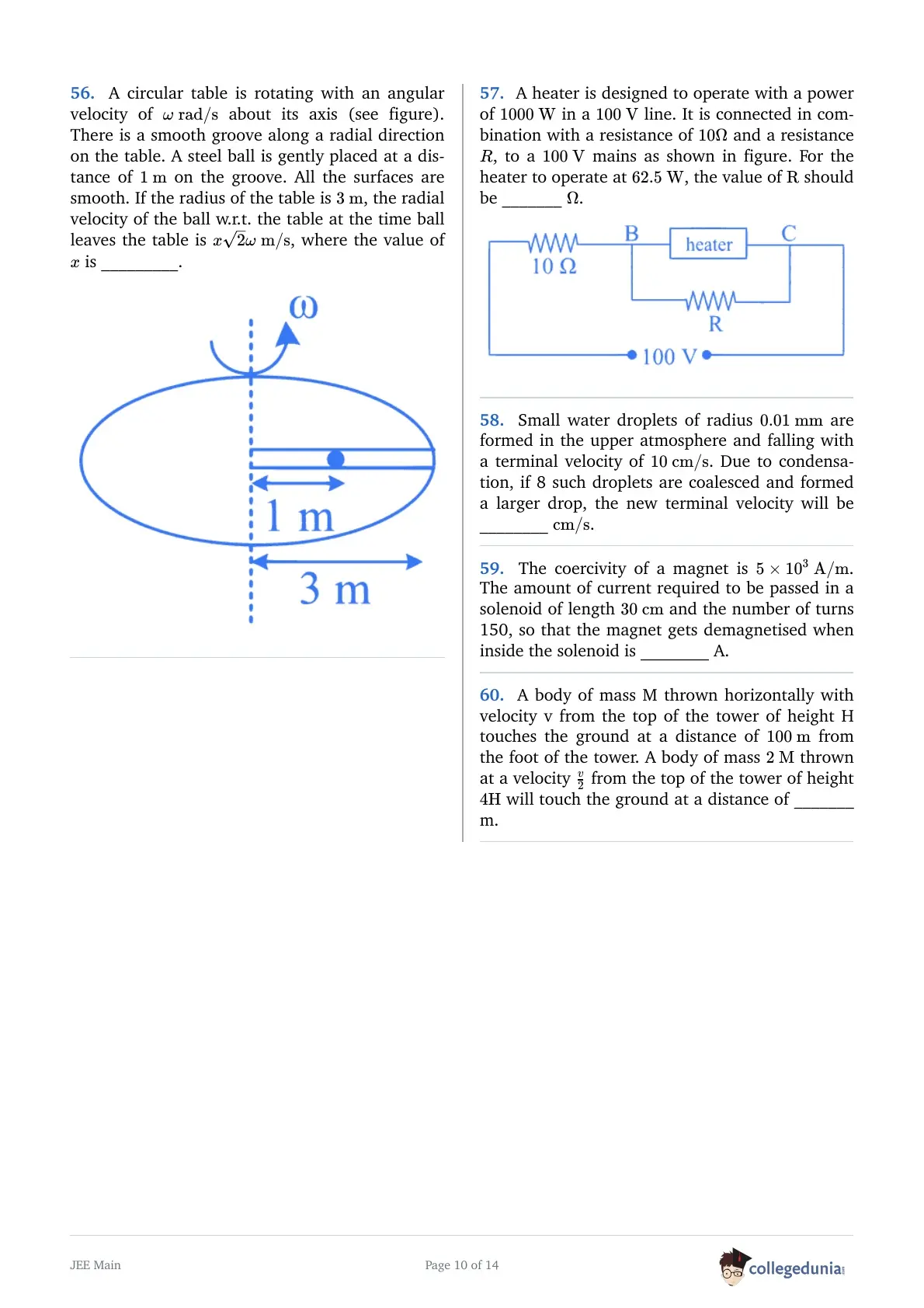
A circular table is rotating with an angular velocity of \( \omega \, \text{rad/s} \) about its axis (see figure). There is a smooth groove along a radial direction on the table. A steel ball is gently placed at a distance of \( 1 \, \text{m} \) on the groove. All the surfaces are smooth. If the radius of the table is \( 3 \, \text{m} \), the radial velocity of the ball with respect to the table at the time the ball leaves the table is \( x\sqrt{2}\omega \, \text{m/s} \), where the value of \( x \) is \(\dots\).
A heater is designed to operate with a power of 1000 W in a 100 V line. It is connected in combination with a resistance of 10 \(\Omega\) and a resistance \(R\), to a 100 V mains as shown in the figure. For the heater to operate at 62.5 W, the value of \(R\) should be \(\dots\) \(\Omega\).

Small water droplets of radius 0.01 mm are formed in the upper atmosphere and falling with a terminal velocity of 10 cm/s. Due to condensation, if 8 such droplets are coalesced and formed a larger drop, the new terminal velocity will be ………..cm/s.
The coercivity of a magnet is 5 × 10³ A/m. The amount of current required to be passed in a solenoid of length 30 cm and the number of turns 150, so that the magnet gets demagnetised when inside the solenoid is ………A.
A body of mass \( M \) thrown horizontally with velocity \( v \) from the top of the tower of height \( H \) touches the ground at a distance of \( 100 \, \text{m} \) from the foot of the tower. A body of mass \( 2M \) thrown at a velocity \( \frac{v}{2} \) from the top of the tower of height \( 4H \) will touch the ground at a distance of \(\dots\) \(\text{m}\).
Chemistry - Section A (Q61 - Q80)
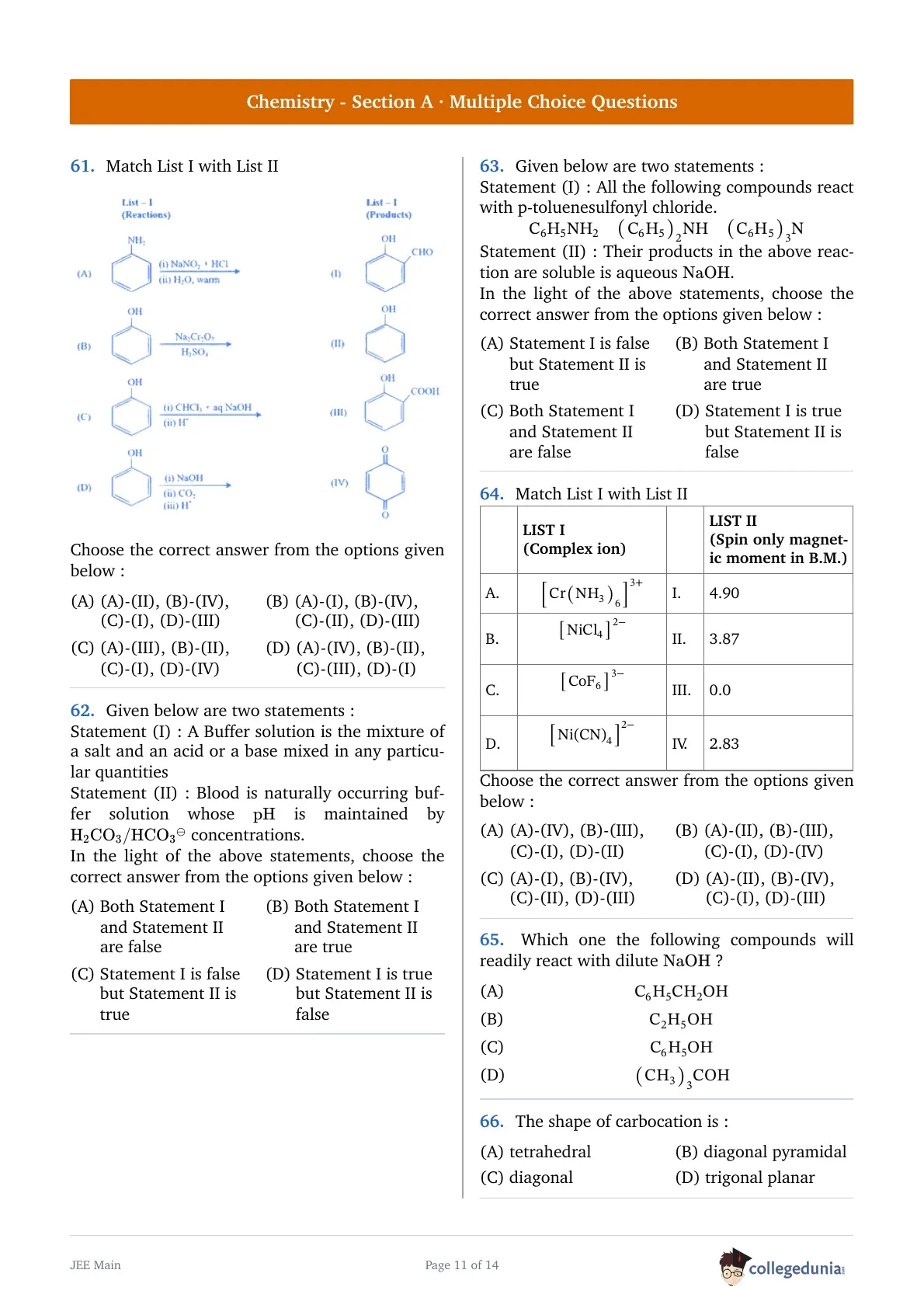
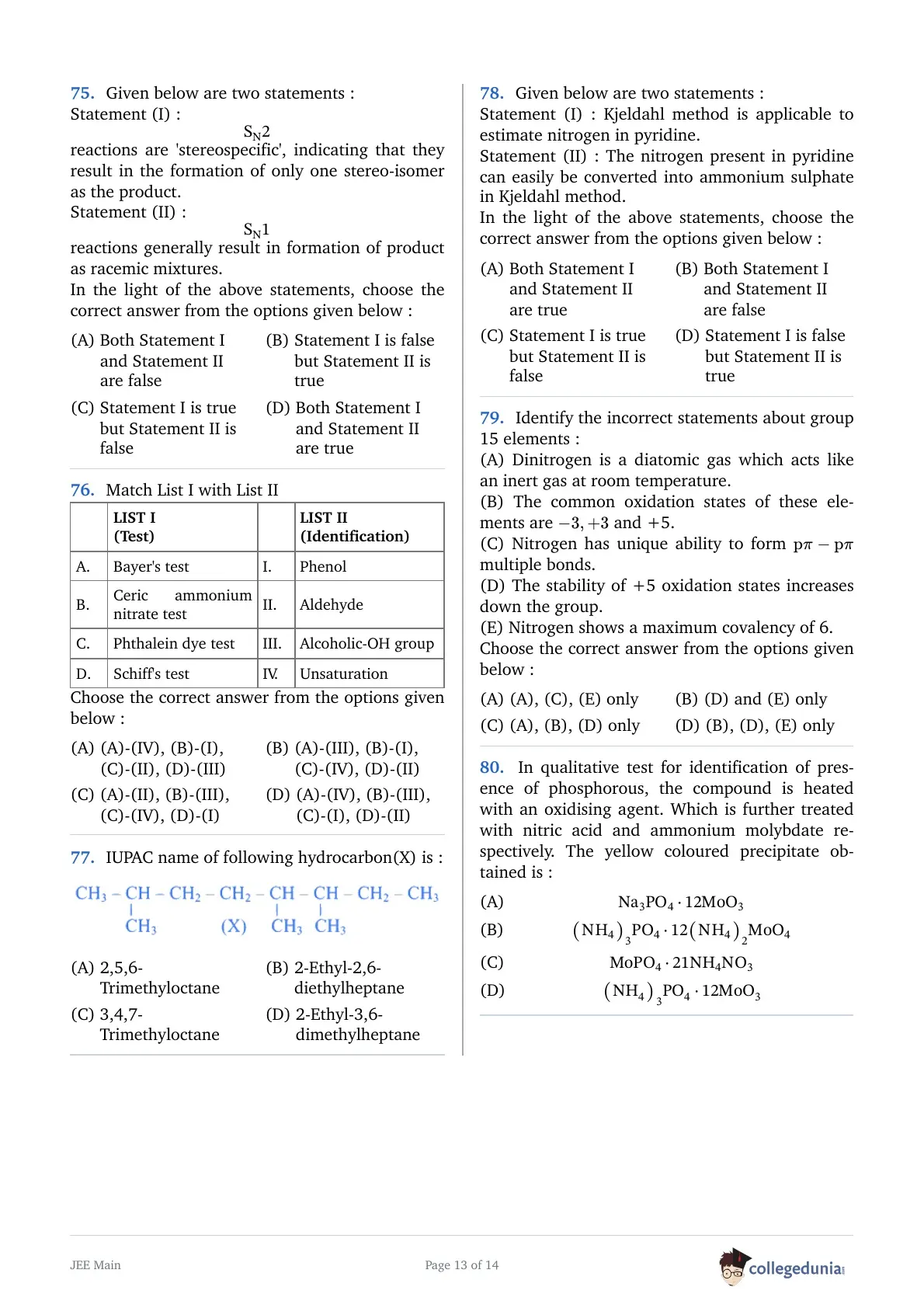
Match List-I with List-II.

Given below are two statements:
Statement (I) : A Buffer solution is the mixture of a salt and an acid or a base mixed in any particular quantities.
Statement (II) : Blood is naturally occurring buffer solution whose pH is maintained by \(H_2CO_3/HCO_3^-\) concentrations.
In the light of the above statements, choose the correct answer from the options given below.
Given below are two statements:
Statement (I) : All the following compounds react with p-toluenesulfonyl chloride.
\(C_6H_5NH_2 \quad (C_6H_5)_2NH \quad (C_6H_5)_3N\)
Statement (II) : Their products in the above reaction are soluble in aqueous NaOH.
In the light of the above statements, choose the correct answer from the options given below.
| List-I (Complex ion) | List-II (Spin only magnetic moment in B.M.) |
|---|---|
| (A) [Cr(NH\(_3\))\(_6\)]\(^{3+}\) | (I) 4.90 |
| (B) [NiCl\(_4\)]\(^{2-}\) | (II) 3.87 |
| (C) [CoF\(_6\)]\(^{3-}\) | (III) 0.0 |
| (D) [Ni(CN)\(_4\)]\(^{2-}\) | (IV) 2.83 |
Choose the correct answer from the options given below:
Which one the following compounds will readily react with dilute NaOH?
The shape of carbocation is :
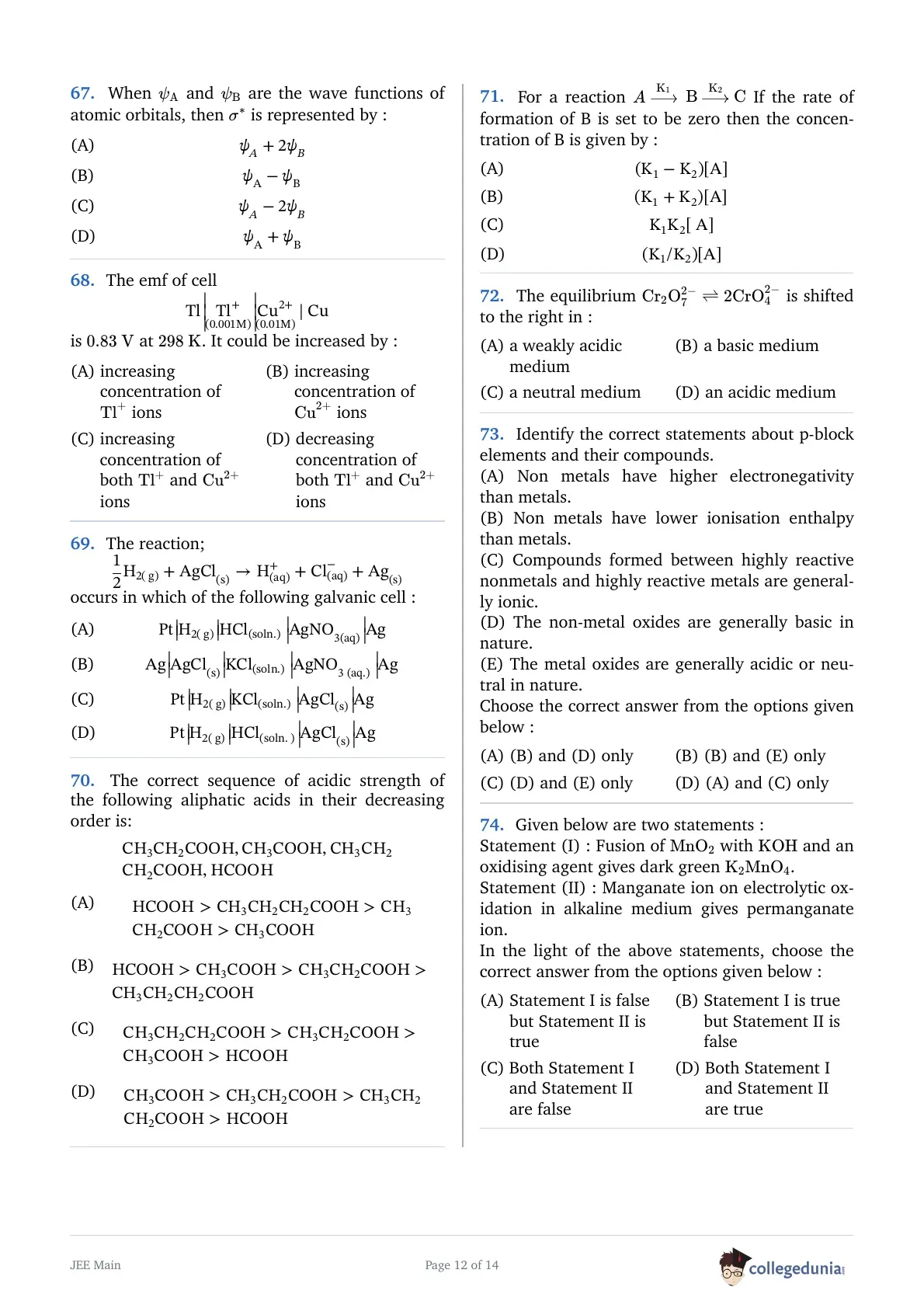
When \(\psi_A\) and \(\psi_B\) are the wave functions of atomic orbitals, then \(\sigma^*\) is represented by :
The emf of cell Tl\(\vert^{Tl^+}_{_{(0.001M)}}\vert^{Cu^{2+}}_{_{(0.01M)}}\)Cu is 0.83 V at 298 K. It could be increased by:
The reaction;\(\frac{1}{2}H_{2(g)} + AgCl_{(s)} \rightarrow H^+_{(aq)} + Cl^-_{(aq)} + Ag_{(s)}\) occurs in which of the following galvanic cell:
The correct sequence of acidic strength of the following aliphatic acids in their decreasing order is: \(CH_3CH_2COOH\), \(CH_3COOH\), \(CH_3CH_2CH_2COOH\), \(HCOOH\)
For a reaction \(A \xrightarrow{K_1} B \xrightarrow{K_2} C\) If the rate of formation of B is set to be zero then the concentration of B is given by:
The equilibrium \(\mathrm{Cr_2O_7^{2-}} \rightleftharpoons 2\mathrm{CrO_4^{2-}}\) is shifted to the right in:
Identify the correct statements about p-block elements and their compounds.
(A) Non metals have higher electronegativity than metals.
(B) Non metals have lower ionisation enthalpy than metals.
(C) Compounds formed between highly reactive nonmetals and highly reactive metals are generally ionic.
(D) The non-metal oxides are generally basic in nature.
(E) The metal oxides are generally acidic or neutral in nature.
Given below are two statements:
Statement (I) : Fusion of MnO\(_2\) with KOH and an oxidising agent gives dark green K\(_2\)MnO\(_4\).
Statement (II) : Manganate ion on electrolytic oxidation in alkaline medium gives permanganate ion.
In the light of the above statements, choose the correct answer from the options given below.
Given below are two statements:
Statement (I) : S\(_N\)2 reactions are 'stereospecific', indicating that they result in the formation only one stereo-isomers as the product.
Statement (II) : S\(_N\)1 reactions generally result in formation of product as racemic mixtures.
In the light of the above statements, choose the correct answer from the options given below :
| List-I (Test) | List-II (Identification) |
|---|---|
| (A) Bayer's test | (I) Phenol |
| (B) Ceric ammonium nitrate test | (II) Aldehyde |
| (C) Phthalein dye test | (III) Alcoholic-OH group |
| (D) Schiff's test | (IV) Unsaturation |
Choose the correct answer from the options given below:

Given below are two statements :
Statement (I) : Kjeldahl method is applicable to estimate nitrogen in pyridine.
Statement (II) : The nitrogen present in pyridine can easily be converted into ammonium sulphate in Kjeldahl method.
In the light of the above statements, choose the correct answer from the options given below.
Identify the incorrect statements about group 15 elements:
(A) Dinitrogen is a diatomic gas which acts like an inert gas at room temperature.
(B) The common oxidation states of these elements are −3, +3 and +5.
(C) Nitrogen has unique ability to form p\(\pi\)-p\(\pi\) multiple bonds.
(D) The stability of +5 oxidation states increases down the group.
(E) Nitrogen shows a maximum covalency of 6.
Choose the correct answer from the options given below.
In qualitative test for identification of presence of phosphorous, the compound is heated with an oxidising agent. Which is further treated with nitric acid and ammonium molybdate respectively. The yellow coloured precipitate obtained is :
Chemistry - Section B (Q81 - Q90)
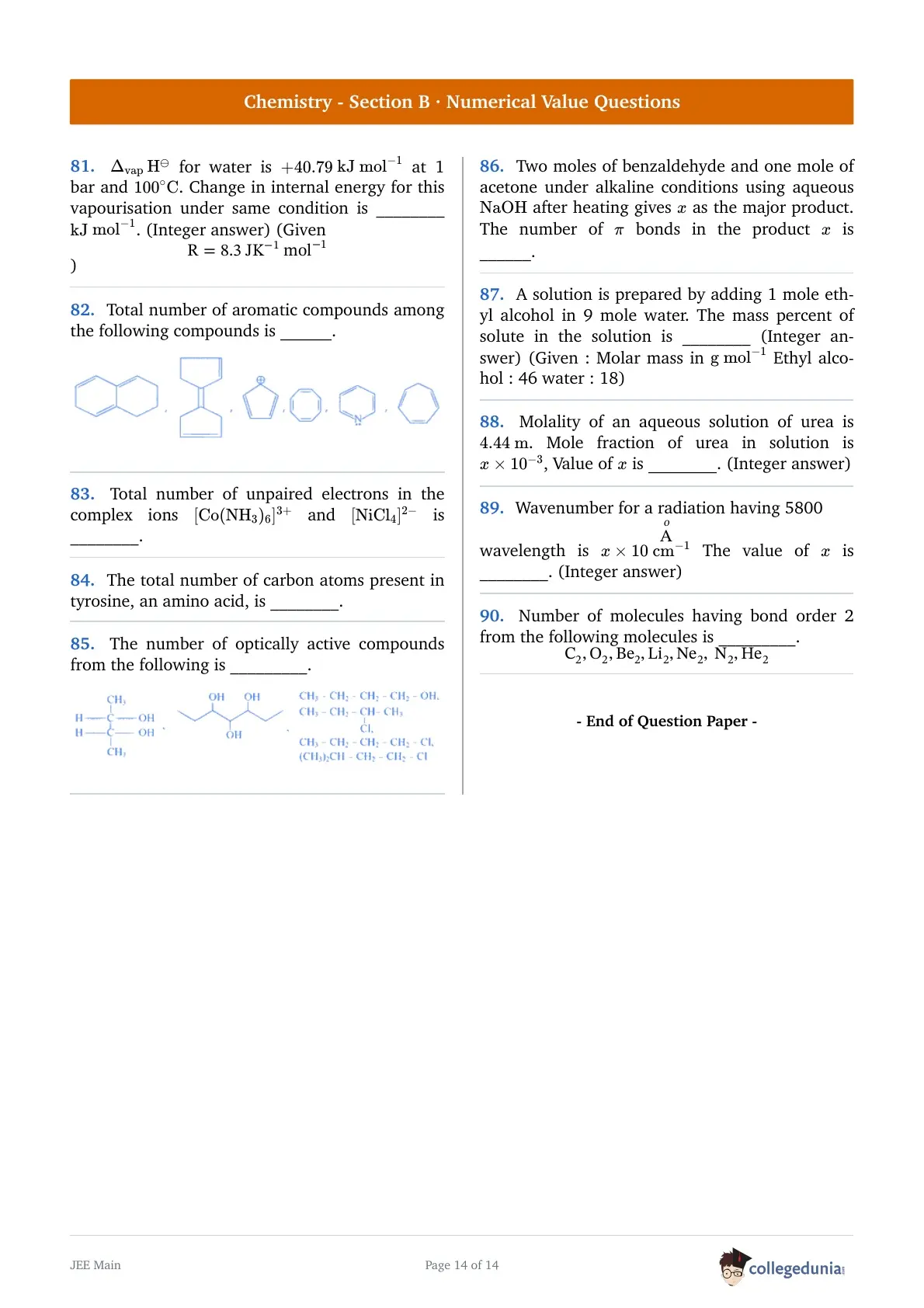
\(\Delta_{vap}H^\circ\) for water is \(+40.49 \, \text{kJ mol}^{-1}\) at 1 bar and \(100^\circ\text{C}\). Change in internal energy for this vaporisation under same condition is .............. kJ mol\(^{-1}\). (Integer answer)
(Given R = 8.3 J K\(^{-1}\) mol\(^{-1}\))
Total number of aromatic compounds among the following compounds is _______.

Total number of unpaired electrons in the complex ion [Co(NH\(_3\))\(_6\)]\(^{3+}\) and [NiCl\(_4\)]\(^{2-}\) is
The total number of carbon atoms present in tyrosine, an amino acid, is _______.
Total number of optically active compounds from the following is _______.

Two moles of benzaldehyde and one mole of acetone under alkaline conditions using aqueous NaOH after heating gives \(x\) as the major product. The number of \(\pi\) bonds in the product \(x\) is ................
A solution is prepared by adding 1 mole ethyl alcohol in 9 mole water. The mass percent of solute in the solution is ___________ (Integer Answer)
(Given : Molar mass in g mol\(^{-1}\) Ethyl alcohol : 46, water : 18)
Molality of an aqueous solution of urea is 4.44 m. Mole fraction of urea in solution is x × 10–3. Value of x is _______. (integer answer)
Wavenumber for a radiation having \(5800 \, \mathring{A}\) wavelength is \(x \times 10 \, \text{cm}^{-1}\). The value of \(x\) is _________
Number of molecules having bond order 2 from the following molecule is ...................
\(C_2, O_2, Be_2, Li_2, Ne_2, N_2, He_2\)
JEE Main 2024 Exam Pattern and Marking Scheme
| Particulars | Details |
|---|---|
| Exam Mode | Online (Computer-Based Test) |
| Paper | B.E./B.Tech |
| Medium of Exam | 13 languages: English, Hindi, Gujarati, Bengali, Tamil, Telugu, Kannada, Marathi, Malayalam, Odia, Punjabi, Assamese, Urdu |
| Duration | 3 hours (180 minutes) |
| Type of Questions | Multiple Choice Questions (MCQs) + Numerical Value Questions (attempt any 5 of 10 per subject) |
| Total Marks | 300 marks |
| Subjects | Mathematics, Physics, Chemistry |
| Marking Scheme | +4 for correct answer & -1 for incorrect MCQ and Numerical Value-based Questions |
| Total Questions | 90 Questions (30 per subject), 75 to be attempted |
| Eligibility | Passed or appearing in Class 12 with Physics, Chemistry, and Mathematics |
JEE Main 2024 Question Paper Session 2 (April)
Check JEE Main 2024 Question Paper Session 2 for other shifts.
JEE Main 2024 Question Paper Session 1 (January)
Those appearing for JEE Main 2024 can use the links below to practice and keep track of their exam preparation level by attempting the shift-wise JEE Main 2024 question paper provided below.
| Exam Date and Shift | Question Paper PDF |
|---|---|
| JEE Main 27 Jan Shift 1 2024 Question Paper | Check Here |
| JEE Main 27 Jan Shift 2 2024 Question Paper | Check Here |
| JEE Main 29 Jan Shift 1 2024 Question Paper | Check Here |
| JEE Main 29 Jan Shift 2 2024 Question Paper | Check Here |
| JEE Main 30 Jan Shift 1 2024 Question Paper | Check Here |
| JEE Main 30 Jan Shift 2 2024 Question Paper | Check Here |
| JEE Main 31 Jan Shift 1 2024 Question Paper | Check Here |
| JEE Main 31 Jan Shift 2 2024 Question Paper | Check Here |
| JEE Main 1 Feb Shift 1 2024 Question Paper | Check Here |
| JEE Main 1 Feb Shift 2 2024 Question Paper | Check Here |
Also Check:
| JEE Main 2024 Paper Analysis | JEE Main 2024 Answer Key |
| JEE Main 2024 Cutoff | JEE Main 2024 Marks vs Rank |
JEE Main 2024 8 April Shift 2 Question Paper by Coaching Institute
| Coaching Institutes | Question Paper with Solutions PDF |
|---|---|
| Aakash BYJUs | Download PDF |
| Vedantu | Download PDF |
| Reliable Institute | To be updated |
| Resonance | To be updated |
| Sri Chaitanya | To be updated |
| FIIT JEE | To be updated |
JEE Main 2024 8 April Shift 2 Paper Analysis
JEE Main 2024 8 April Shift 2 paper analysis for B.E./ B.Tech is updated here with details on the difficulty level of the exam, topics with the highest weightage in the exam, section-wise difficulty level, etc.
JEE Main 2024 Question Paper Pattern
| Feature | Question Paper Pattern |
|---|---|
| Examination Mode | Computer-based Test |
| Exam Language | 13 languages (English, Hindi, Assamese, Bengali, Gujarati, Kannada, Malayalam, Marathi, Odia, Punjabi, Tamil, Telugu, and Urdu) |
| Number of Sections | Three- Physics, Chemistry, Mathematics |
| Exam Duration | 3 hours |
| Sectional Time Limit | None |
| Total Marks | 300 marks |
| Total Number of Questions Asked | 90 Questions |
| Total Number of Questions to be Answered | 75 questions |
| Type of Questions | MCQs and Numerical Answer Type Questions |
| Section-wise Number of Questions | Physics- 20 MCQs and 10 numerical type, Chemistry- 20 MCQs and 10 numerical type, Mathematics- 20 MCQs and 10 numerical type |
| Marking Scheme | +4 for each correct answer |
| Negative Marking | -1 for each incorrect answer |
Read More:
- JEE Main 2024 question paper pattern and marking scheme
- Most important chapters in JEE Mains 2024, Check chapter wise weightage here



Comments