




JEE Main 2023 January 31 Shift 1 Question Paper is available here with answer key and solution pdf. NTA conducted the first shift on January 31, 2023, from 9:00 AM to 12:00 PM. The JEE Main 2023 Paper 1 (B.E./B.Tech) question paper includes the following:
- 90 questions in a 3-hour CBT Mode: 30 each from Mathematics, Physics and Chemistry (75 to be attempted)
- Section A: 20 multiple choice questions (MCQs) per subject, 4 marks each
- Section B: 10 numerical value questions per subject, attempt any 5, 4 marks each (integer answer)
- Marking: +4 for a correct answer, -1 for an incorrect answer, 0 for an unattempted question
JEE Main 2023 January 31 Shift 1 Question Paper with Solution PDF
| NTA Official PDF | CD PDF | CD PDF with Solutions |
|---|---|---|
| Download official PDF 4.87 MB | Download Collegedunia PDF 1.25 MB | Download solutions PDF 0.76 MB |
Also Check:
JEE Main 2023 January 31 Shift 1 Questions with Solutions
Mathematics - Section A (Q1 - Q20)
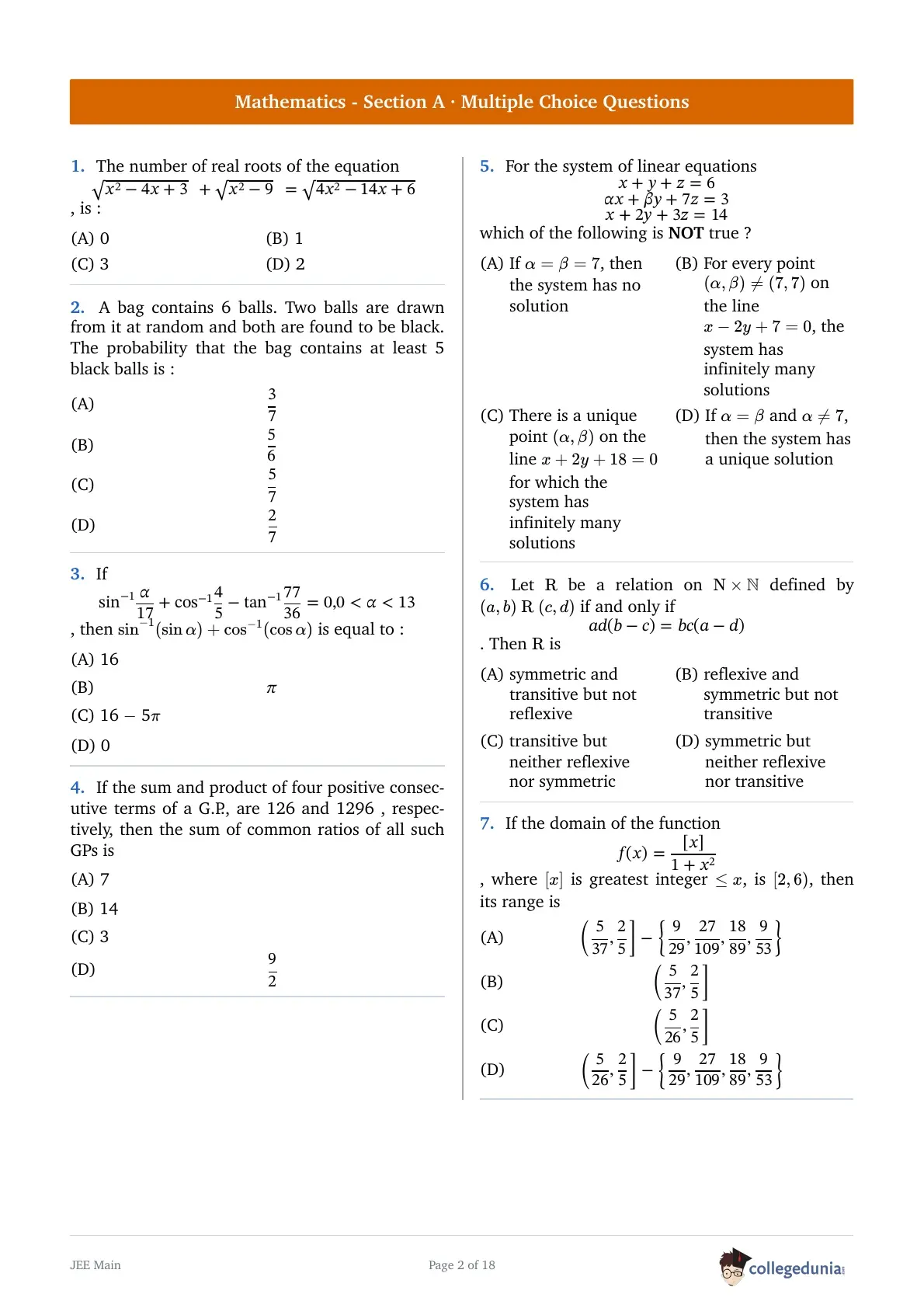
The number of real roots of the equation \(\sqrt{x^2-4 x+3}+\sqrt{x^2-9}=\sqrt{4 x^2-14 x+6}\), is:
A bag contains 6 balls Two balls are drawn from it at random and both are found to be black The probability that the bag contains at least 5 black balls is
If \(\sin ^{-1} \frac{\alpha}{17}+\cos ^{-1} \frac{4}{5}-\tan ^{-1} \frac{77}{36}=0,0<\alpha<13\), then \(\sin ^{-1}(\sin \alpha)+\cos ^{-1}(\cos \alpha)\) is equal to
If the sum and product of four positive consecutive terms of a GP, are 126 and 1296, respectively, then the sum of common ratios of all such GPs is
For the system of linear equations
\(x+y+z=6\)
\(\alpha x+\beta y+7 z=3\)
\(x+2 y+3 z=14\).
which of the following is NOT true ?
Let \(R\) be a relation on \(N \times N\) defined by \((a, b) R (c, d)\) if and only if \(a d(b-c)=b c(a-d)\) Then \(R\) is
If the domain of the function \(f(x)=\frac{[x]}{1+x^2}\), where \([x]\) is greatest integer \(\leq x\), is \([2,6)\), then its range is
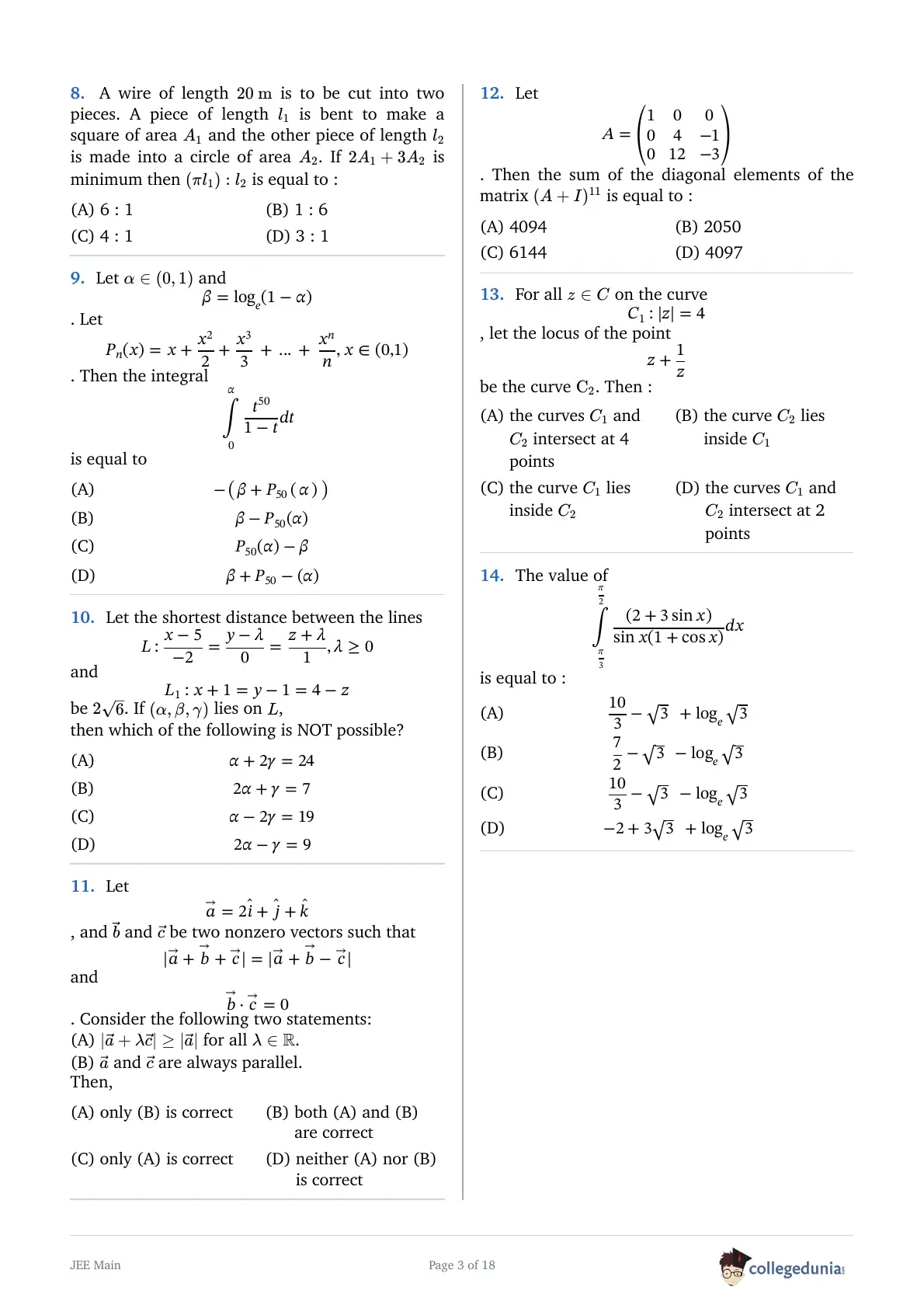
A wire of length \(20 m\) is to be cut into two pieces A piece of length \(l_1\) is bent to make a square of area \(A_1\) and the other piece of length \(l_2\) is made into a circle of area \(A_2\) If \(2 A_1+3 A_2\) is minimum then \(\left(\pi l_1\right): l_2\) is equal to:
Let \(\alpha \in(0,1)\) and \(\beta=\log _e(1-\alpha)\) Let \(P_n(x)=x+\frac{x^2}{2}+\frac{x^3}{3}+\ldots+\frac{x^n}{n}, x \in(0,1)\) Then the integral \(\int\limits_0^\alpha \frac{t^{50}}{1-t} d t\) is equal to
Let the shortest distance between the lines \(L: \frac{x-5}{-2}=\frac{y-\lambda}{0}=\frac{z+\lambda}{1}, \lambda \geq 0\) and \(L_1: x+1=y-1=4-z\) be \(2 \sqrt{6}\) If \((\alpha, \beta, \gamma)\) lies on \(L\), then which of the following is NOT possible?
Let \(\vec{a}=2 \hat{i}+\hat{j}+\hat{k}\), and \(\vec{b}\) and \(\vec{c}\) be two nonzero vectors such that \(|\vec{a}+\vec{b}+\vec{c}|=|\vec{a}+\vec{b}-\vec{c}|\) and \(\vec{b} \cdot \vec{c}=0\). Consider the following two statements:
(A) \(|\vec{a}+\lambda \vec{c}| \geq|\vec{a}|\) for all \(\lambda \in R\)
(B) \(\vec{a}\) and \(\vec{c}\) are always parallel. Then. is
Let \(A=\begin{pmatrix}1 & 0 & 0 \\ 0 & 4 & -1 \\ 0 & 12 & -3\end{pmatrix}\) Then the sum of the diagonal elements of the matrix \((A+I)^{11}\) is equal to :
For all \(z \in C\) on the curve \(C_1:|z|=4\), let the locus of the point \(z+\frac{1}{z}\) be the curve \(C_2\) Then:
The value of \(\int\limits_{\frac{\pi}{3}}^{\frac{\pi}{2}} \frac{(2+3 \sin x)}{\sin x(1+\cos x)} d x\) is equal to
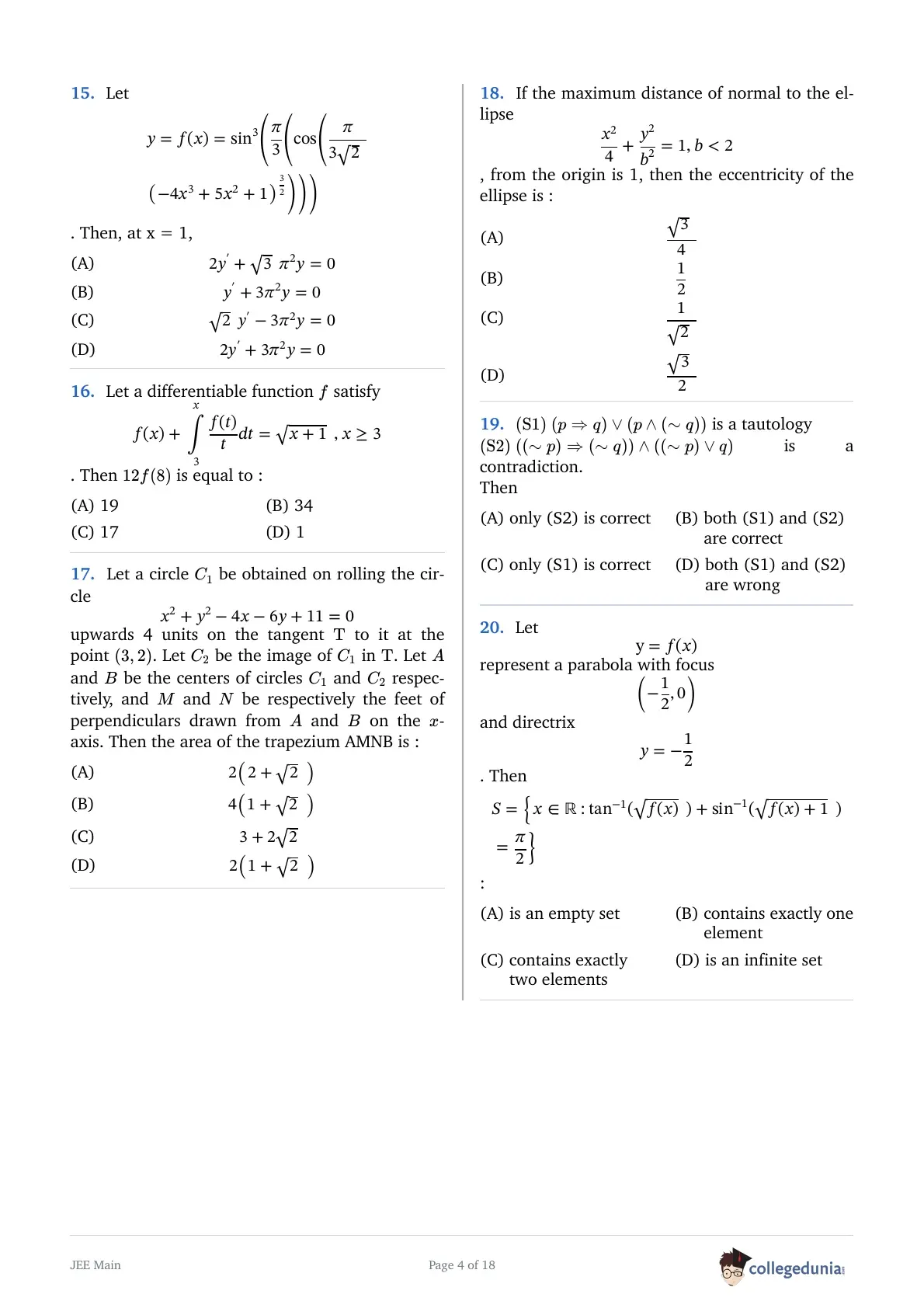
Let \(y=f(x)=\sin ^3\left(\frac{\pi}{3}\left(\cos \left(\frac{\pi}{3 \sqrt{2}}\left(-4 x^3+5 x^2+1\right)^{\frac{3}{2}}\right)\right)\right)\) Then, at \(x=1\)
Let a differentiable function \(f\) satisfy \(f(x)+\int\limits_3^x \frac{f(t)}{t} d t=\sqrt{x+1}, x \geq 3\) Then \(12 f(8)\) is equal to :
Let a circle \(C_1\) be obtained on rolling the circle \(x^2+y^2-4 x-6 y+11=0\) upwards 4 units on the tangent \(T\) to it at the point \((3,2)\) Let \(C_2\) be the image of \(C_1\) in \(T\) Let \(A\) and \(B\) be the centers of circles \(C_1\) and \(C_2\) respectively, and \(M\) and \(N\) be respectively the feet of perpendiculars drawn from \(A\) and \(B\) on the \(x\)-axis. Then the area of the trapezium AMNB is:
If the maximum distance of normal to the ellipse \(\frac{x^2}{4}+\frac{y^2}{b^2}=1, b<2\), from the origin is 1 , then the eccentricity of the ellipse is
\(( S 1)(p \Rightarrow q) \vee(p \wedge(\sim q))\) is a tautology(S2) \(((\sim p) \Rightarrow(\sim q)) \wedge((\sim p) \vee q)\) is a contradictionThen
Let \(y=f(x)\) represent a parabola with focus \(\left(-\frac{1}{2}, 0\right)\) and directrix \(y=-\frac{1}{2}\) Then \(S=\left\{x \in R : \tan ^{-1}(\sqrt{f(x)})+\sin ^{-1}(\sqrt{f(x)+1})=\frac{\pi}{2}\right\}\) :
Mathematics - Section B (Q21 - Q30)
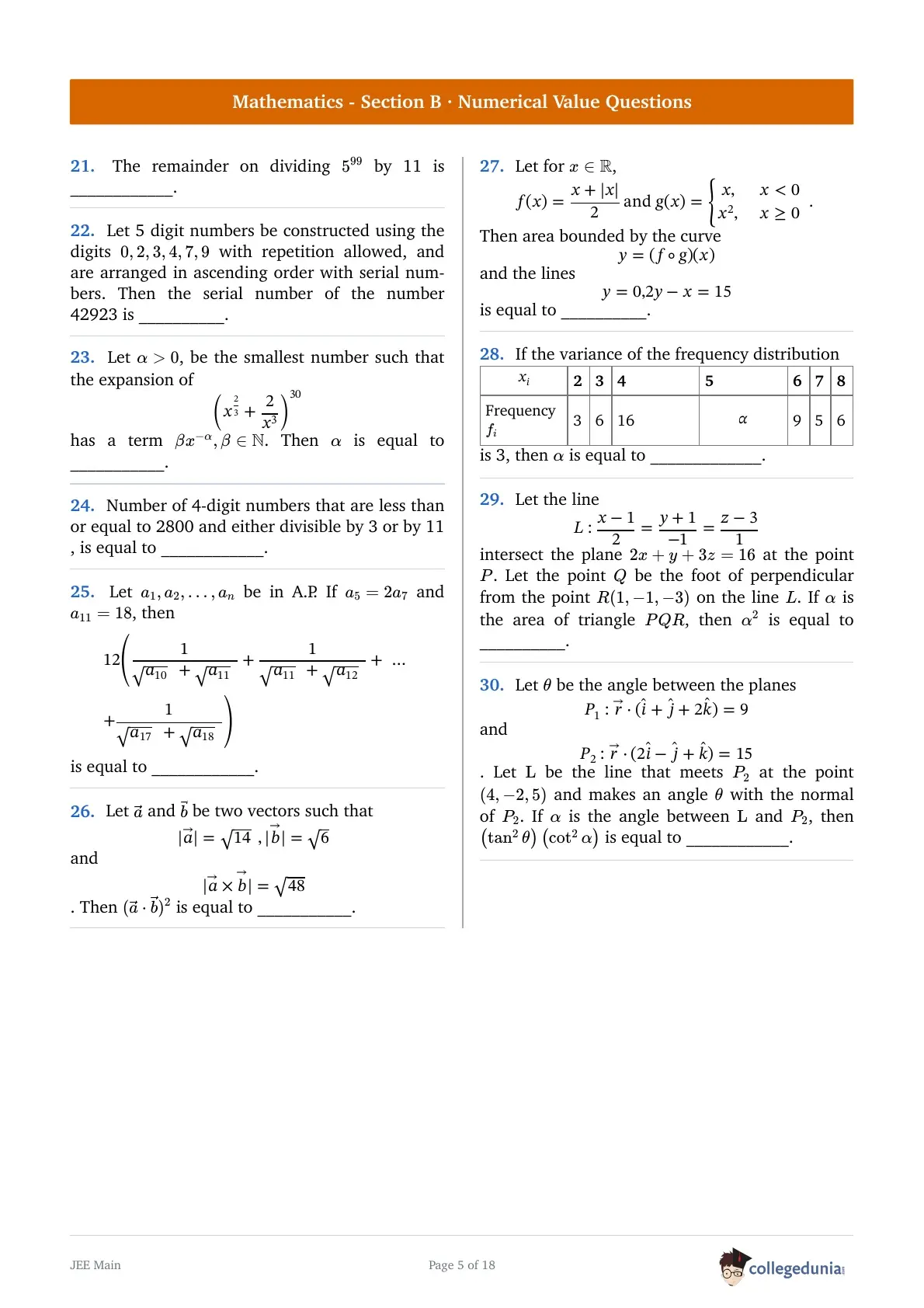
The remainder on dividing \(5^{99}\) by 11 is
Let 5 digit numbers be constructed using the digits \(0,2,3,4,7,9\) with repetition allowed, and are arranged in ascending order with serial numbers Then the serial number of the number 42923 is
Let \(\alpha>0\), be the smallest number such that the expansion of \(\left(x^{\frac{2}{3}}+\frac{2}{x^3}\right)^{30}\) has a term \(\beta x^{-a}, \beta \in N\).
Then \(α\) is equal to _________.
Number of 4-digit numbers that are less than or equal to 2800 and either divisible by 3 or by 11 , is equal to

Let \(a_1, a_2, \ldots, a_n\) be in AP If \(a_5=2 a_7\) and \(a_{11}=18\), then \(12\left(\frac{1}{\sqrt{a_{10}}+\sqrt{a_{11}}}+\frac{1}{\sqrt{a_{11}}+\sqrt{a_{12}}}+\ldots+\frac{1}{\sqrt{a_{17}}+\sqrt{a_{18}}}\right)\) is equal to
Let \(\vec{a}\) and \(\vec{b}\) be two vectors such that \(|\vec{a}|=\sqrt{14},|\vec{b}|=\sqrt{6}\) and \(|\vec{a} \times \vec{b}|=\sqrt{48}\) Then \((\vec{a} \cdot \vec{b})^2\) is equal to
Let for \(x \in R\) \(f(x)=\frac{x+|x|}{2} \text { and } g(x)=\begin{cases}x, & x<0 \\x^2, & x \geq 0\end{cases} \)
Then area bounded by the curve \(y=(f \circ g)(x)\) and the lines \(y=0,2 y-x=15\) is equal to
If the variance of the frequency distribution
| xi | Frequency ft |
| 2 | 3 |
| 3 | 6 |
| 4 | 16 |
| 5 | \(\alpha\) |
| 6 | 9 |
| 7 | 5 |
| 8 | 6 |
is 3 , then \(\alpha\) is equal to
Let the line \(L: \frac{x-1}{2}=\frac{y+1}{-1}=\frac{z-3}{1}\) intersect the plane \(2 x+y+3 z=16\) at the point \(P\) Let the point \(Q\) be the foot of perpendicular from the point \(R(1,-1,-3)\) on the line \(L\) If \(\alpha\) is the area of triangle \(P Q R\), then \(\alpha^2\) is equal to
Let \(\theta\) be the angle between the planes \(P_1: \vec{r} \cdot(\hat{i}+\hat{j}+2 \hat{k})=9\) and \(P_2: \hat{r} \cdot(2 \hat{i}-\hat{j}+\hat{k})=15\) Let \(L\) be the line that meets \(P_2\) at the point \((4,-2,5)\) and makes an angle \(\theta\) with the normal of \(P_4\) If \(\alpha\) is the angle between \(L\) and \(P_2\), then \(\left(\tan ^2 \theta\right)\left(\cot ^2 \alpha\right)\) is equal to
Physics - Section A (Q31 - Q50)
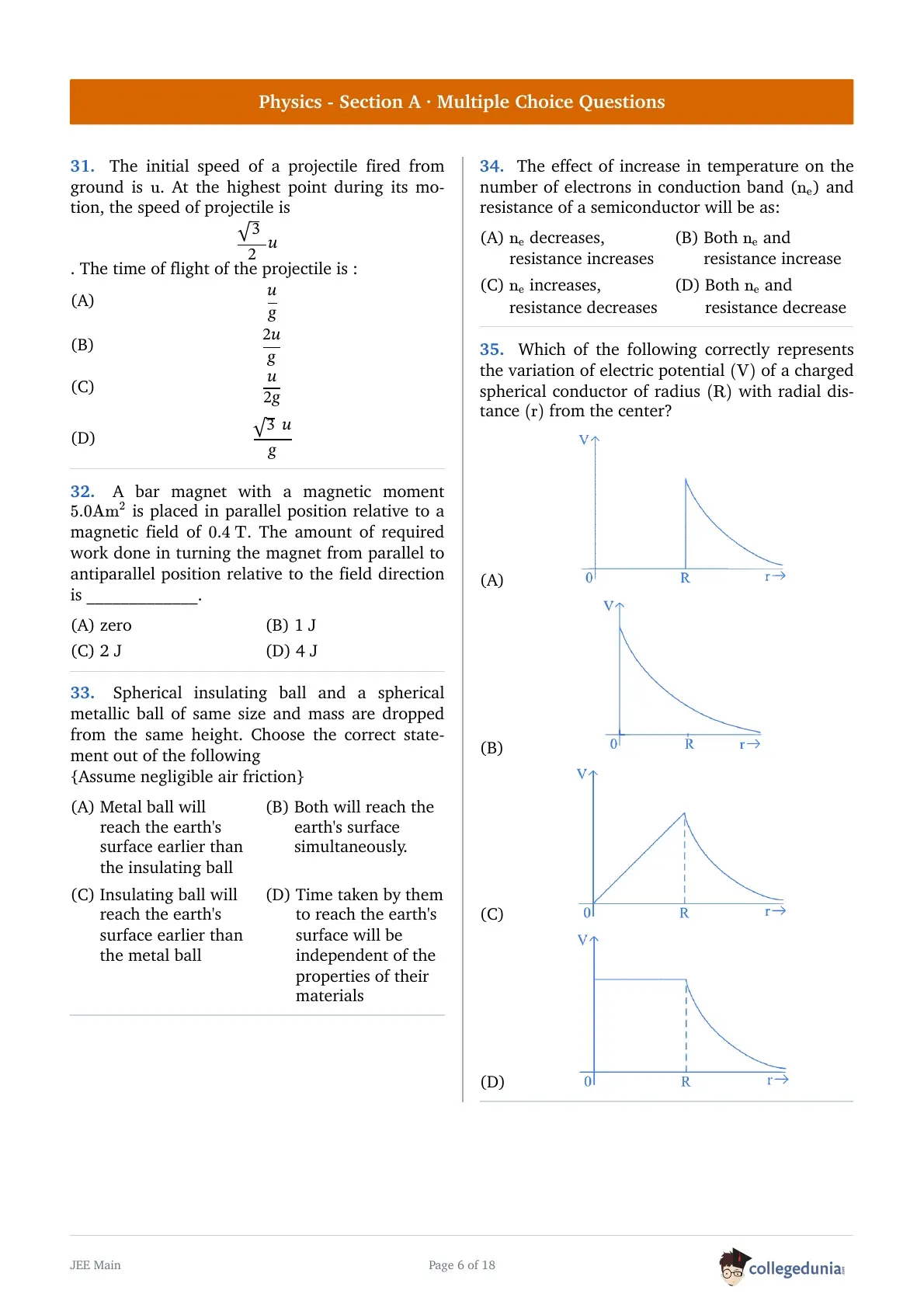
The initial speed of a projectile fired from ground is \(u\) At the highest point during its motion, the speed of projectile is \(\frac{\sqrt{3}}{2} u\) The time of flight of the projectile is :
A bar magnet with a magnetic moment 50 \(Am ^2\) is placed in parallel position relative to a magnetic field of 0.4T. The amount of required work done in turning the magnet from parallel to antiparallel position relative to the field direction is
Spherical insulating ball and a spherical metallic ball of same size and mass are dropped from the same height Choose the correct statement out of the following (Assume negligible air friction)
The effect of increase in temperature on the number of electrons in conduction band \(\left( n _{ e }\right)\) and resistance of a semiconductor will be as:
Which of the following correctly represents the variation of electric potential (V) of a charged spherical conductor of radius (R) with radial distance (r) from the center?
- (1)
![variation of electric potential (V) of a charged spherical conductor of radius (R) with radial distance (r)]()
- (2)
![variation of electric potential (V) of a charged spherical conductor of radius (R) with radial distance (r)]()
- (3)
![variation of electric potential (V) of a charged spherical conductor of radius (R) with radial distance (r)]()
- (4)
![variation of electric potential (V) of a charged spherical conductor of radius (R) with radial distance (r)]()


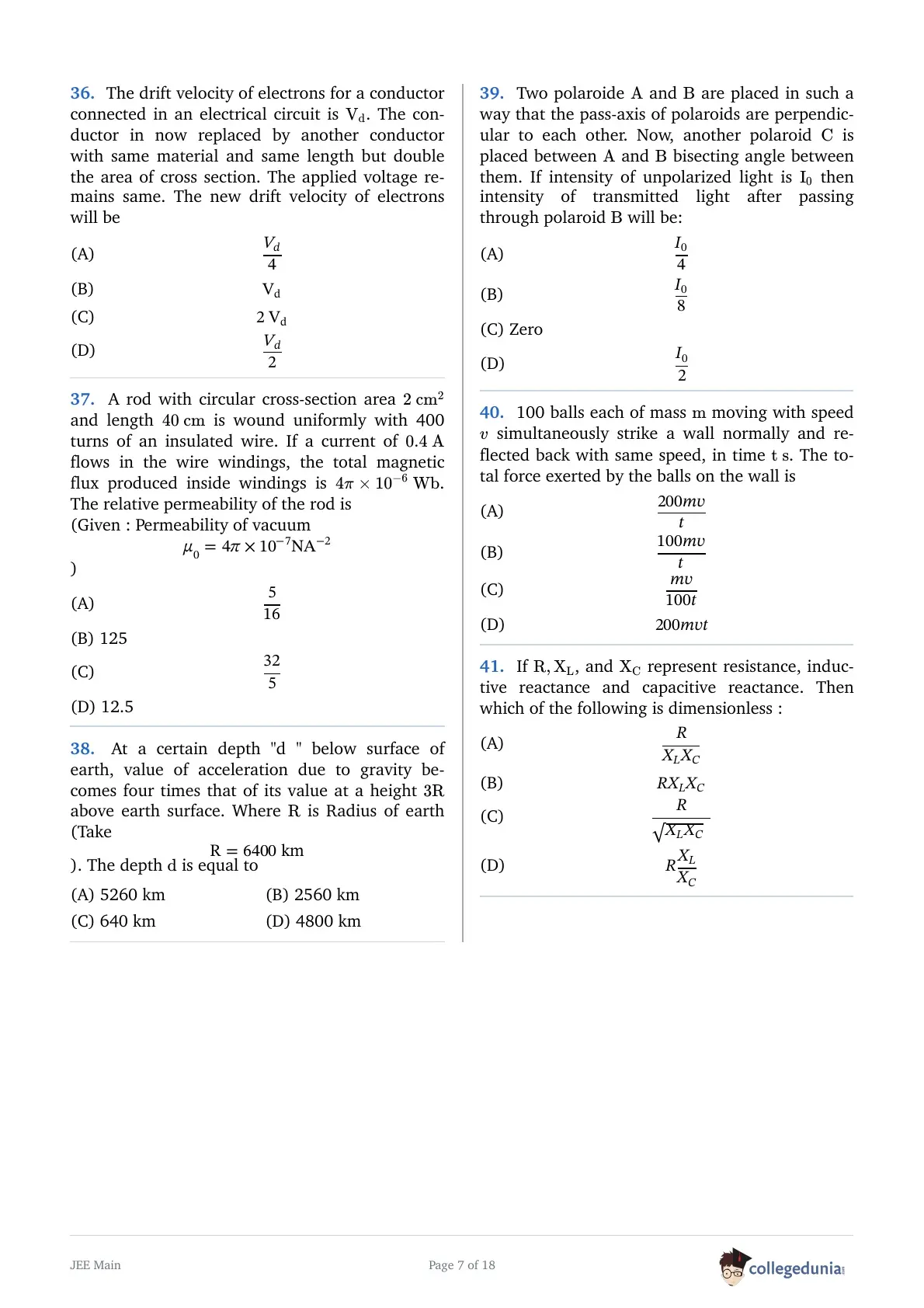
The drift velocity of electrons for a conductor connected in an electrical circuit is \(V _{ d }\) The conductor in now replaced by another conductor with same material and same length but double the area of cross section The applied voltage remains same The new drift velocity of electrons will be
A rod with circular cross-section area \(2\, cm ^2\) and length \(40 cm\) is wound uniformly with \(400\) turns of an insulated wire If a current of 0.4 A flows in the wire windings, the total magnetic flux produced inside windings is \(4 \pi \times 10^{-6}\, Wb\) The relative permeability of the rod is(Given : Permeability of vacuum \(\mu_0=4 \pi \times 10^{-7}\, NA ^{-2}\) )
At a certain depth "\(d\)" below surface of earth, value of acceleration due to gravity becomes four times that of its value at a height \(3 R\) above earth surface Where \(R\) is Radius of earth (Take \(R =6400\, km\) ) The depth \(d\) is equal to
Two polaroide \(A\) and \(B\) are placed in such a way that the pass-axis of polaroids are perpendicular to each other Now, another polaroid \(C\) is placed between \(A\) and \(B\) bisecting angle between them If intensity of unpolarized light is \(I _0\) then intensity of transmitted light after passing through polaroid \(B\) will be:
100 balls each of mass \(m\) moving with speed \(v\) simultaneously strike a wall normally and reflected back with same speed, in time \(t s\) The total force exerted by the balls on the wall is
If \(R , X _{ L }\), and \(X _{ C }\) represent resistance, inductive reactance and capacitive reactance Then which of the following is dimensionless :
The maximum potential energy of a block executing simple harmonic motion is \(25 J\) A is amplitude of oscillation At \(A / 2\), the kinetic energy of the block is
If 1000 droplets of water of surface tension 0.07 N/m, having same radius 1 mm each, combine to from a single drop In the process the released surface energy is - (Take π=\(\frac {22}{7}\))
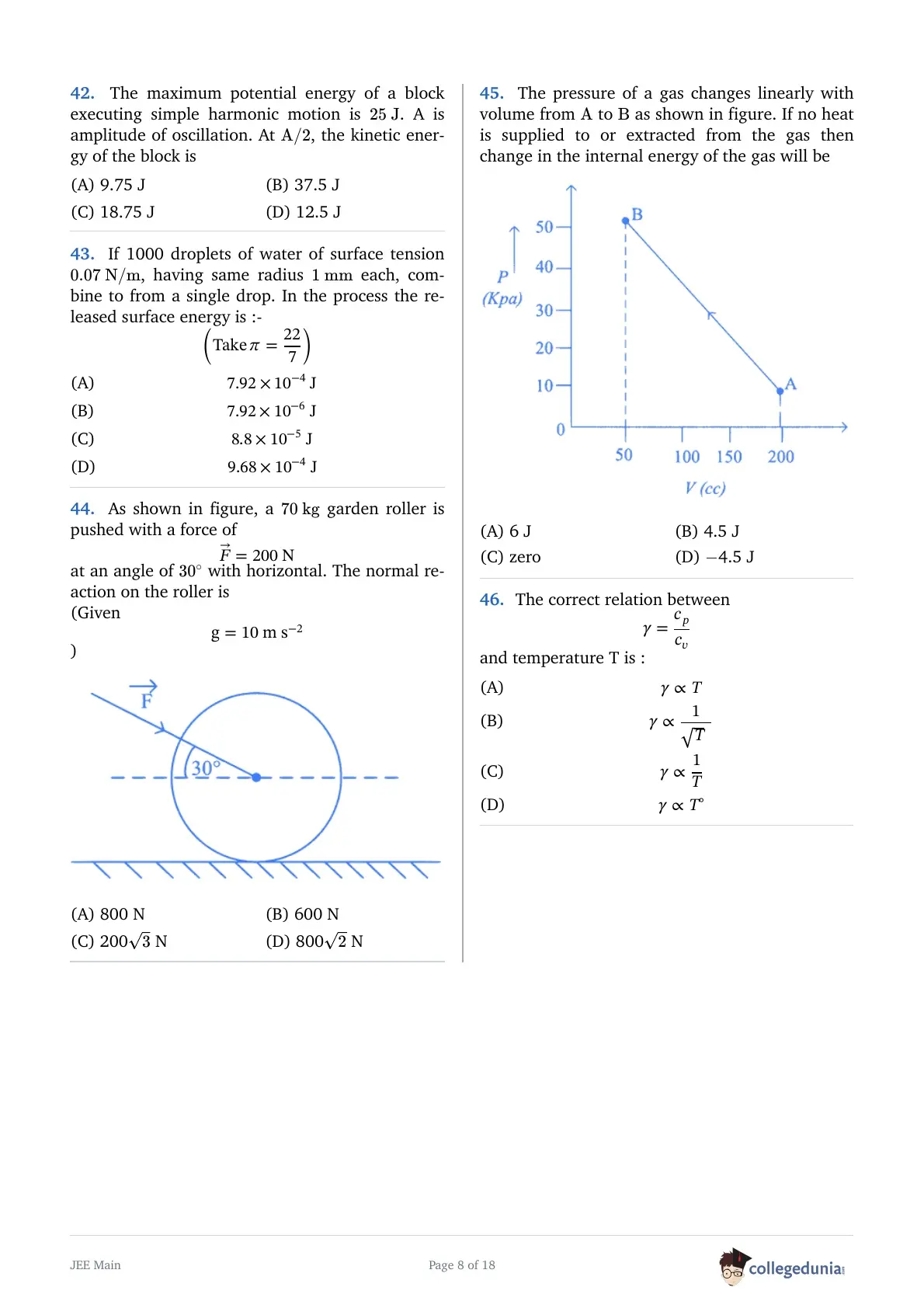
As shown in figure, a \(70 kg\) garden roller is pushed with a force of \(\vec{F}=200 N\) at an angle of \(30^{\circ}\) with horizontal. The normal reaction on the roller is (Given \(g=10 m s ^{-2}\) )

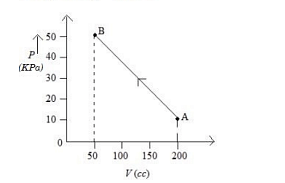
The pressure of a gas changes linearly with volume from \(A\) to \(B\) as shown in figure If no heat is supplied to or extracted from the gas then change in the internal energy of the gas will be Is
The correct relation between \(\gamma=\frac{ c _{ p }}{ c _{ v }}\) and temperature \(T\) is :
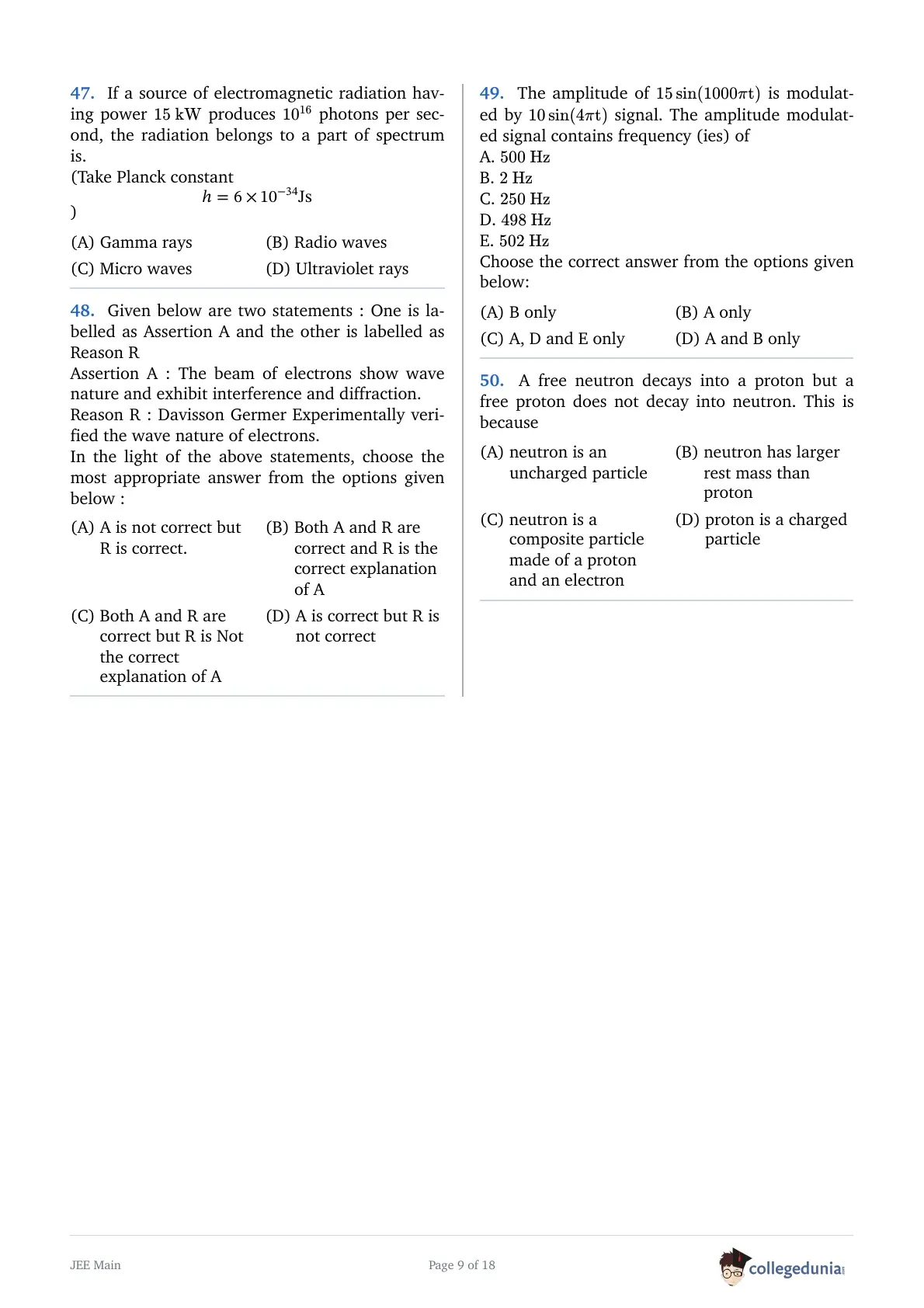
If a source of electromagnetic radiation having power \(15 kW\) produces \(10^{16}\) photons per second, the radiation belongs to a part of spectrum is(Take Planck constant \(h =6 \times 10^{-34} Js\) )
Given below are two statements: One is labelled as Assertion \(A\) and the other is labelled as Reason \(R\)
Assertion (A) : The beam of electrons show wave nature and exhibit interference and diffraction
Reason (R) : Davisson Germer Experimentally verified the wave nature of electrons
In the light of the above statements, choose the most appropriate answer from the options given below :
The amplitude of \(15 \sin (1000 \pi t )\) is modulated by \(10 \sin (4 \pi t )\) signal The amplitude modulated signal contains frequency (ies) of
A \(500\,Hz\)
B \(2\, Hz\)
C \(250\, Hz\)
D \(498\, Hz\)
E \(502\, Hz\)
Choose the correct answer from the options given below:
A free neutron decays into a proton but a free proton does not decay into neutron. This is because
Physics - Section B (Q51 - Q60)
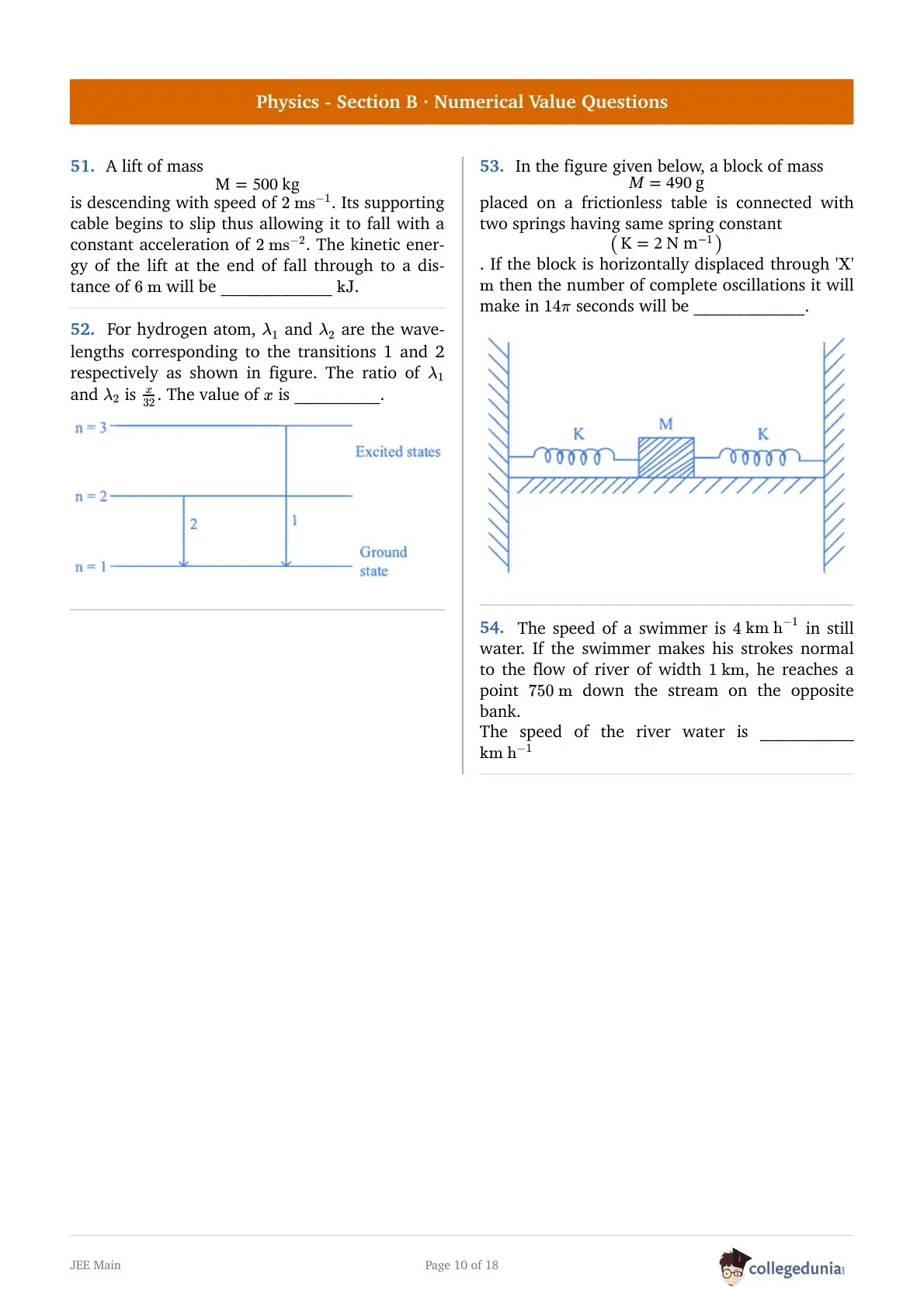
A lift of mass \(M =500 kg\) is descending with speed of \(2 ms ^{-1}\) Its supporting cable begins to slip thus allowing it to fall with a constant acceleration of \(2 ms ^{-2}\) The kinetic energy of the lift at the end of fall through to a distance of \(6 m\) will be ___ \(kJ\)
For hydrogen atom, \(\lambda_1\) and \(\lambda_2\) are the wavelengths corresponding to the transitions 1 and 2 respectively as shown in figure The ratio of \(\lambda_1\) and \(\lambda_2\) is \(\frac{x}{32}\) The value of \(x\) is
In the figure given below, a block of mass \(M=490 g\) placed on a frictionless table is connected with two springs having same spring constant \(\left( K =2 N m ^{-1}\right)\) If the block is horizontally displaced through ' \(X\) ' \(m\) then the number of complete oscillations it will make in \(14 \pi\) seconds will be

The speed of a swimmer is \(4 km h ^{-1}\) in still water If the swimmer makes his strokes normal to the flow of river of width \(1 km\), he reaches a point \(750 m\) down the stream on the opposite bank.The speed of the river water is ___ \(km h ^{-1}\)
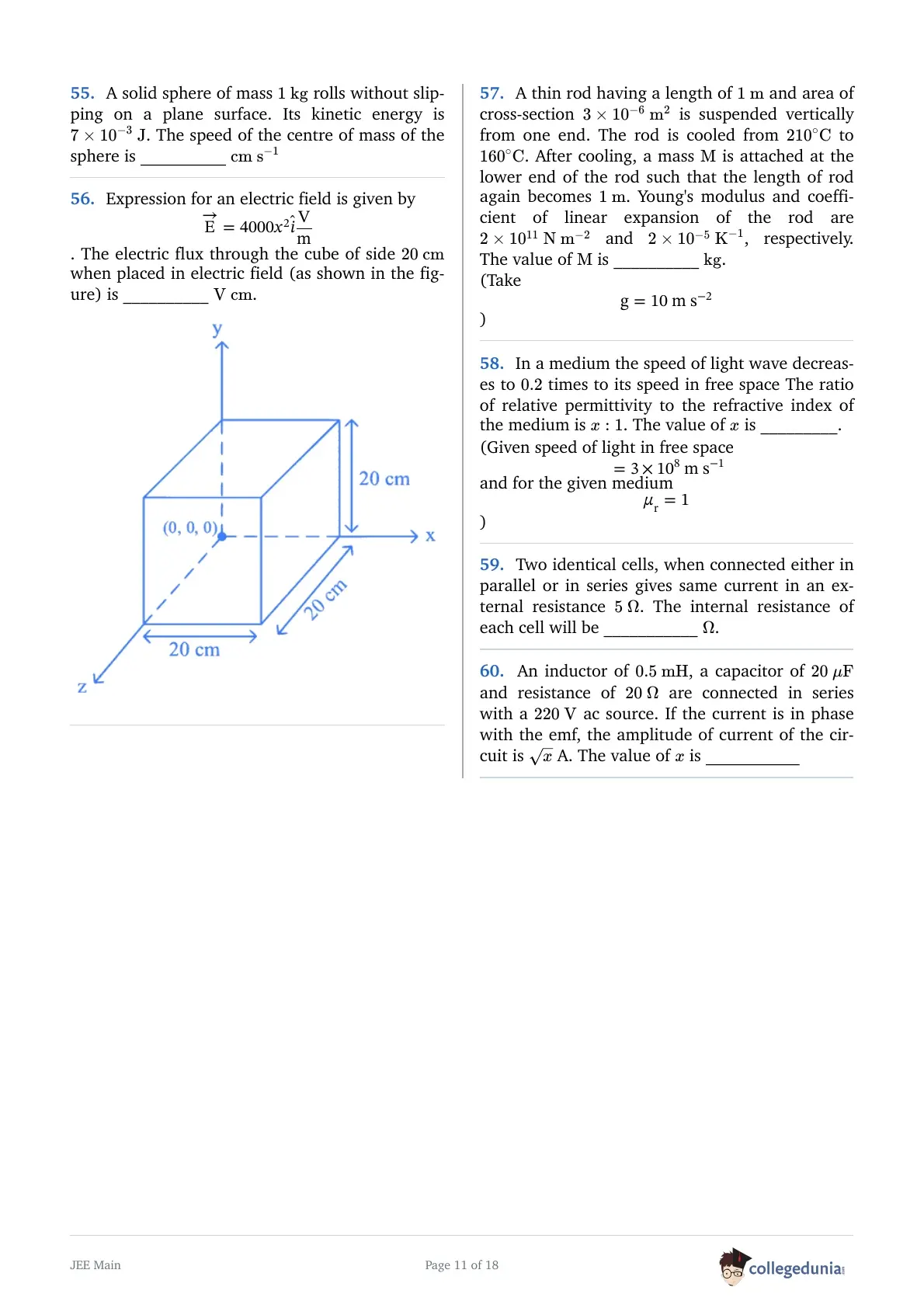
A solid sphere of mass \(1 \,kg\) rolls without slipping on a plane surface Its kinetic energy is \(7 \times 10^{-3} J\). The speed of the centre of mass of the sphere is ___\(cm s ^{-1}\).
Expression for an electric field is given by \(\overrightarrow{ E }=4000 x^2 i \frac{ V }{ m }\) The electric flux through the cube of side \(20 cm\) when placed in electric field (as shown in the figure) is ___\(V cm\)
A thin rod having a length of \(1 m\) and area of cross-section \(3 \times 10^{-6} m ^2\) is suspended vertically from one end. The rod is cooled from \(210^{\circ} C\) to \(160^{\circ} C\) After cooling, a mass \(M\) is attached at the lower end of the rod such that the length of rod again becomes \(1m\). Young's modulus and coefficient of linear expansion of the rod are \(2 \times 10^{11} N m ^{-2}\) and \(2 \times 10^{-5} K ^{-1}\), respectively. The value of \(M\) is ____ \(kg\). (Take \(g =10 \ m s ^{-2}\))
In a medium the speed of light wave decreases to \(0.2\) times to its speed in free space The ratio of relative permittivity to the refractive index of the medium is \(x: 1\) The value of \(x\) is(Given speed of light in free space \(=3 \times 10^8 m s ^{-1}\) and for the given medium \(\mu =1\))
Two identical cells, when connected either in parallel or in series gives same current in an external resistance \(5 \Omega\) The internal resistance of each cell will be__ \(\Omega\)
An inductor of \(0.5 mH\), a capacitor of \(20 \mu F\) and resistance of \(20 \Omega\) are connected in series with a \(220 V\) ac source If the current is in phase with the emf, the amplitude of current of the circuit is \(\sqrt{x}\) A The value of \(x\) is -
Chemistry - Section A (Q61 - Q80)
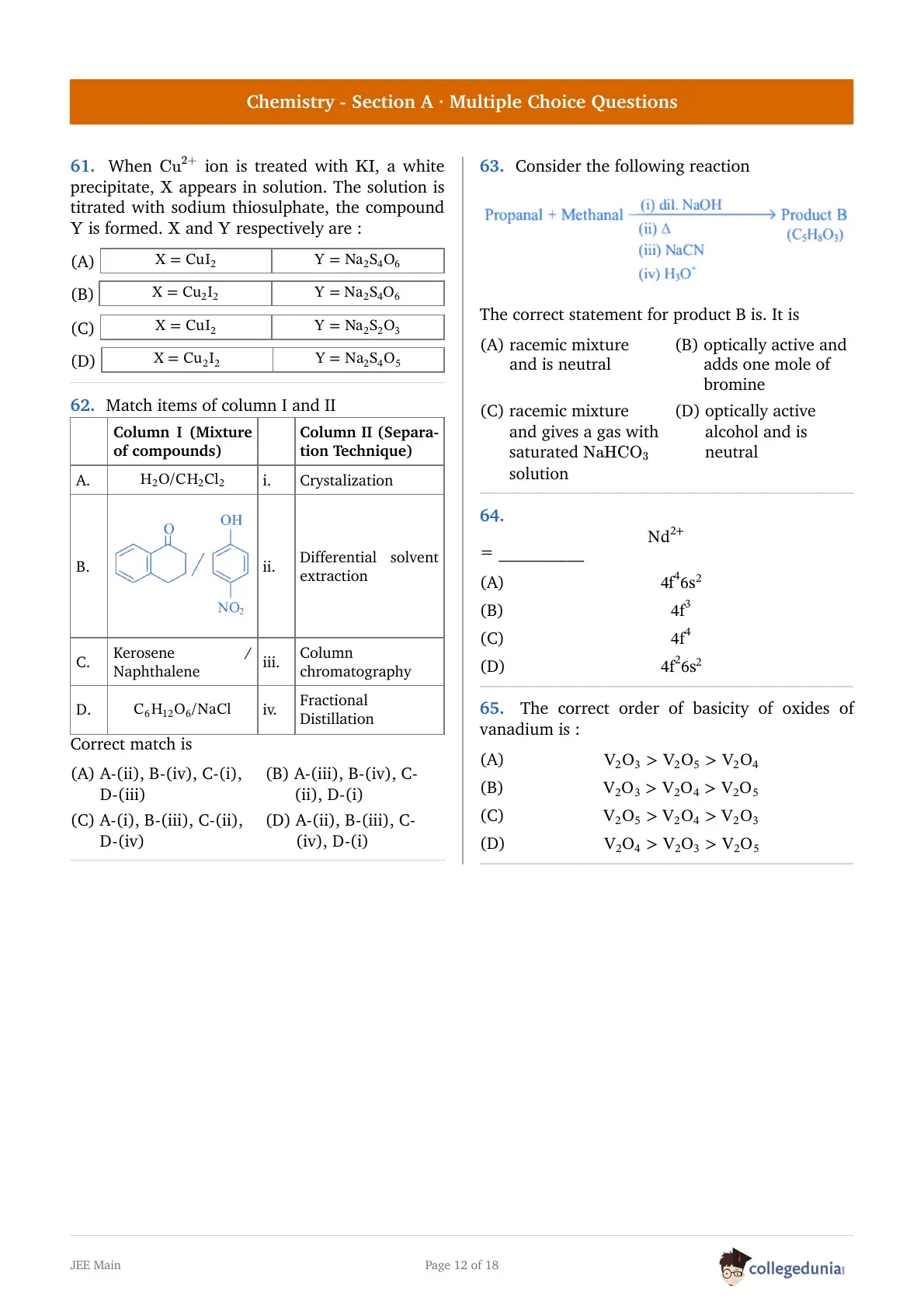
When \(Cu ^{2+}\) ion is treated with \(KI\), a white precipitate, \(X\) appears in solution The solution is titrated with sodium thiosulphate, the compound \(Y\) is formed \(X\) and \(Y\) respectively are
Match items of column I and II
| Column I (Mixture of compounds) | Column II (Separation Technique) | ||
| A | H2O/CH2Cl2 | i | Crystallization |
| B |  | ii | Differential solvent extraction |
| C | Kerosene/Naphthalene | iii | Column chromatography |
| D | C6H12O6/NaCl | iv | Fractional Distillation |
Consider the following reaction

The correct statement for product \(B\) is It is
\(Nd ^{2+}=\) ___________
The correct order of basicity of oxides of vanadium is
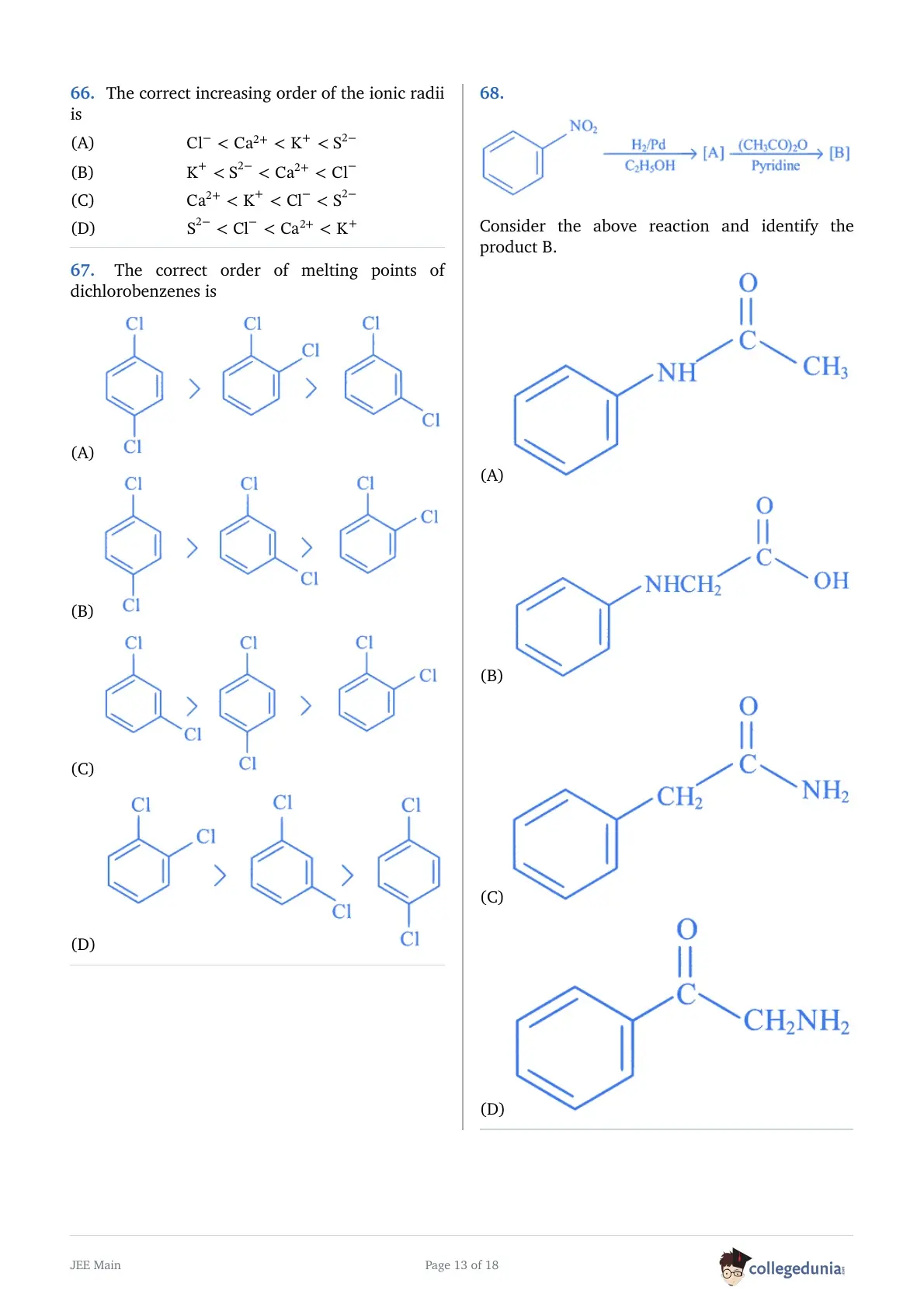
The correct increasing order of the ionic radii is
The correct order of melting points of dichlorobenzenes is
- (1)
![]()
- (2)
![]()
- (3)
![]()
- (4)
![]()


Consider the above reaction and identify the product B.
- (1)
![Consider the above reaction and identify the product B.]()
- (2)
![Consider the above reaction and identify the product B.]()
- (3)
![Consider the above reaction and identify the product B.]()
- (4)
![Consider the above reaction and identify the product B.]()


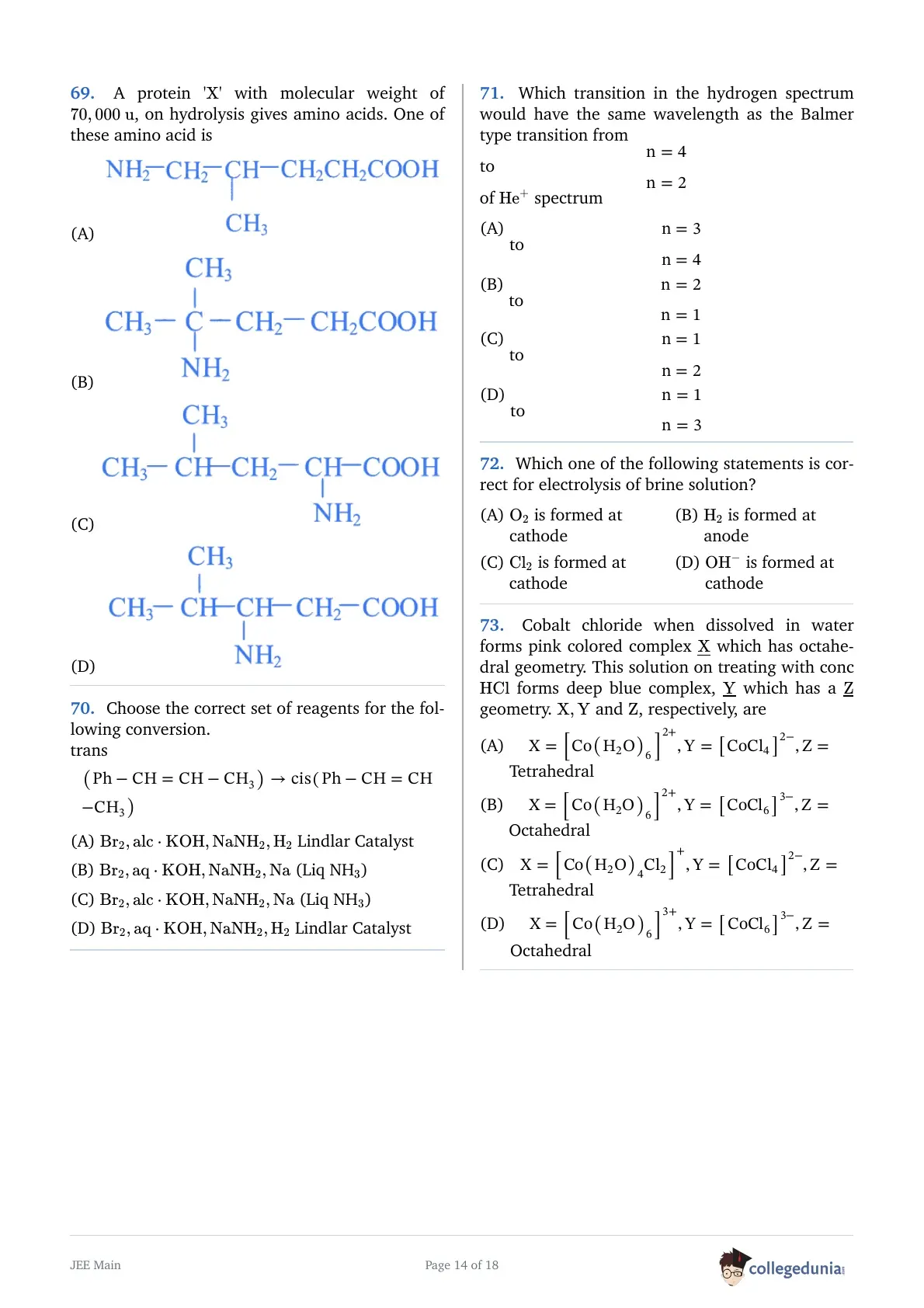
A protein ' \(X\) ' with molecular weight of \(70,000 u\), on hydrolysis gives amino acids One of these amino acid is
- (1)
![]()
- (2)
![]()
- (3)
![]()
- (4)
![]()


Choose the correct set of reagents for the following conversion trans \(\left( Ph - CH = CH - CH _3\right) \rightarrow \operatorname{cis}\left( Ph - CH = CH - CH _3\right)\)
Which transition in the hydrogen spectrum would have the same wavelength as the Balmer type transition from \(n =4\) to \(n =2\) of \(He ^{+}\)spectrum
Which one of the following statements is correct for electrolysis of brine solution?
Cobalt chloride when dissolved in water forms pink colored complex \(X\) which has octahedral geometry. This solution on treating with cone \(HCl\) forms deep blue complex, \(\underline{Y}\) which has a \(\underline{Z}\) geometry \(X, Y\) and \(Z\), respectively, are
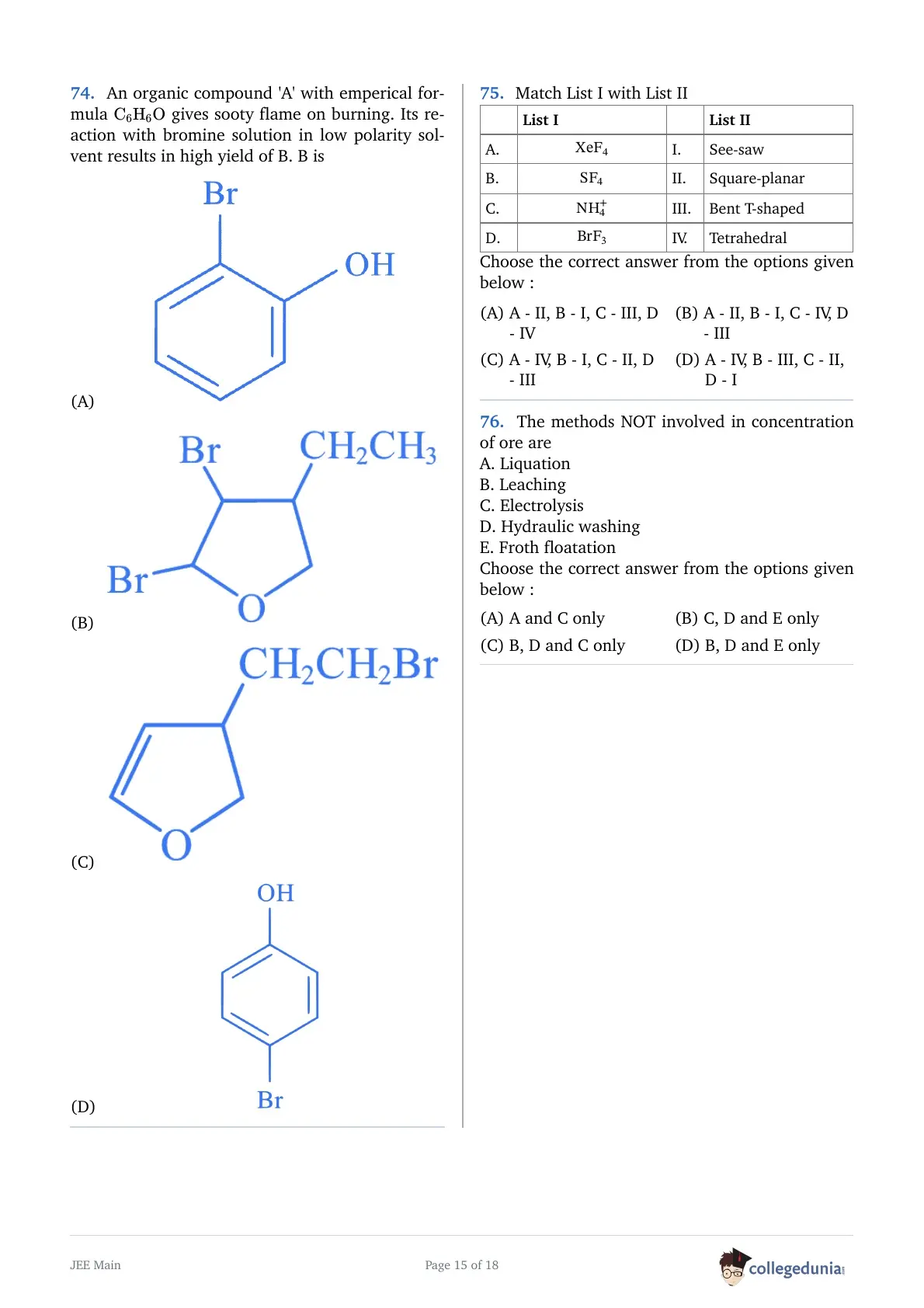
An organic compound 'A' with emperical formula \(C _6 H _6 O\) gives sooty flame on burning Its reaction with bromine solution in low polarity solvent results in high yield of \(B .B\) is
- (1)
![]()
- (2)
![]()
- (3)
![]()
- (4)
![]()


Match List I with List II
| LIST I | LIST II | ||
| A | XeF4 | I | See-saw |
| B | SF4 | II | Square planar |
| C | NH4+ | III | Bent T-shaped |
| D | BrF3 | IV | Tetrahedral |
Choose the correct answer from the options given below :
The methods NOT involved in concentration of ore are
A Liquation
B Leaching
C Electrolysis
D Hydraulic washing
E Froth floatation
Choose the correct answer from the options given below :
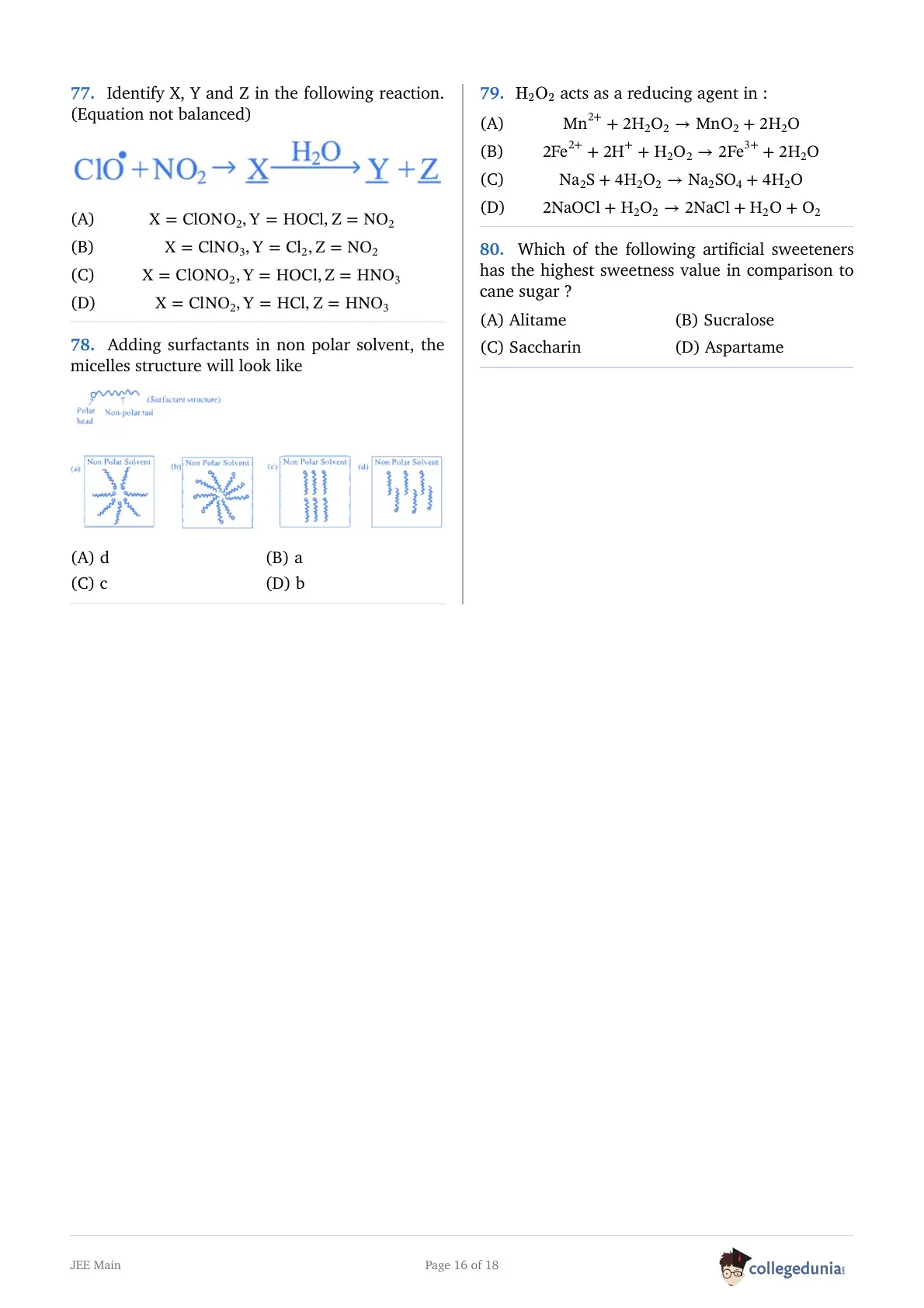
Identify \(X , Y\) and \(Z\) in the following reaction (Equation not balanced) \(ClO + NO _2 \rightarrow \underline{ X } \stackrel{ H _2 O }{\longrightarrow} \underline{ Y }+\underline{Z}\)
Adding surfactants in non polar solvent, the micelles structure will look like

\(H _2 O _2\) acts as a reducing agent in
Which of the following artificial sweeteners has the highest sweetness value in comparison to cane sugar?
Chemistry - Section B (Q81 - Q90)
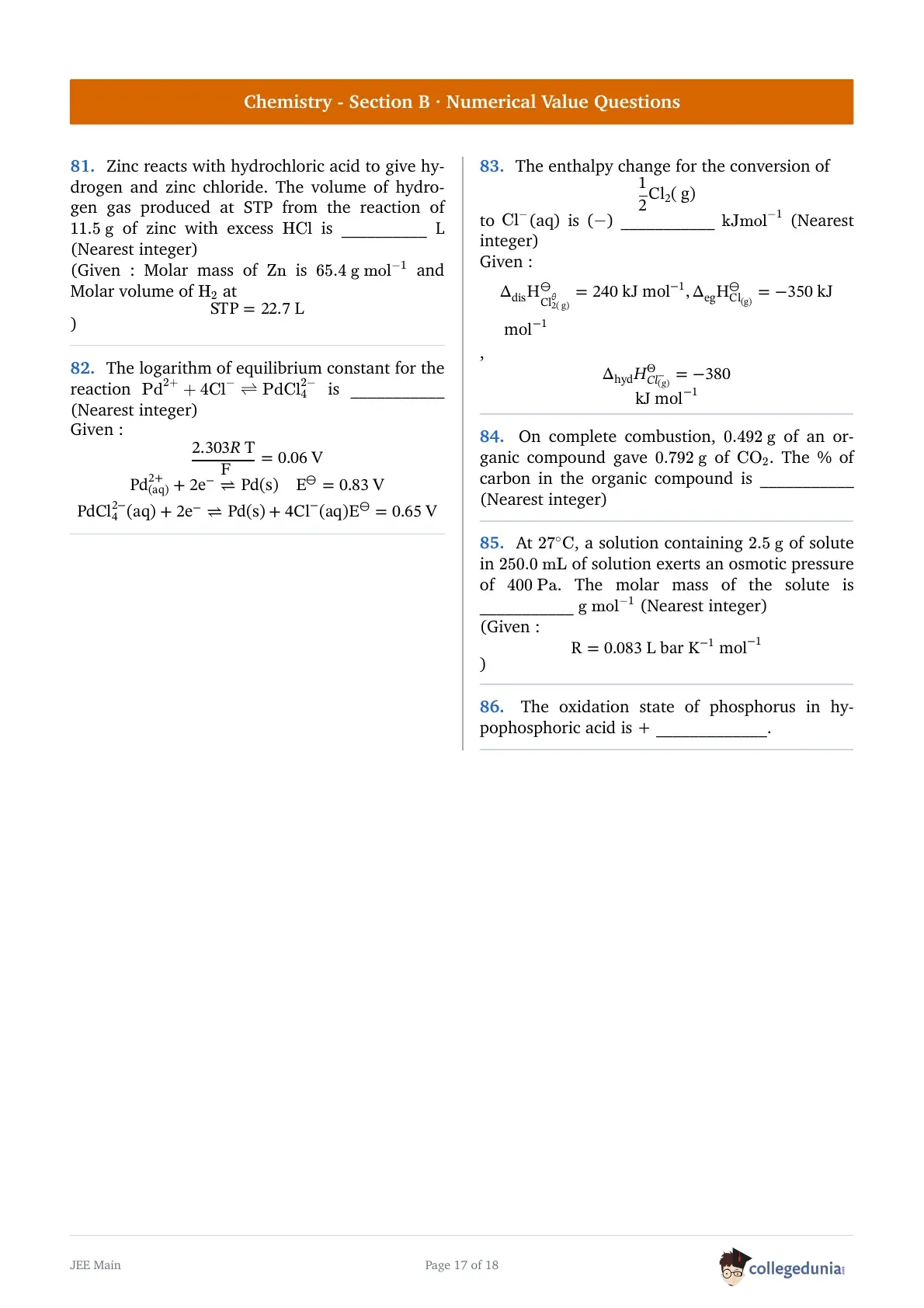
Zinc reacts with hydrochloric acid to give hydrogen and zinc chloride The volume of hydrogen gas produced at STP from the reaction of \(115 \, g\) of zine with excess \(HCl\) is ___\(L\) (Nearest integer)
(Given: Molar mass of \(Zn\) is \(654 \,g \,mol ^{-1}\) and Molar volume of \(H _2\) at \(STP =227 \,L\) )
The logarithm of equilibrium constant for the reaction \(Pd ^{2+}+4 Cl ^{-} \rightleftharpoons PdCl _4^{2-}\) is (Nearest integer) Given : \(\frac{230RT }{ F }=006 V\) \(Pd _{\text {(aq) }}^{2+}+2 e ^{-} \rightleftharpoons Pd ( s ) \quad E ^{\ominus}=083 V\) \(PdCl _4^{2-} \text { (aq) }+2 e ^{-} \rightleftharpoons Pd ( s )+4 Cl ^{-} \text {(aq) } E ^{\ominus}=065 V\)
The enthalpy change for the conversion of \(\frac{1}{2} Cl_2(g)\) to \(Cl^{-}(aq)\) is (-)_____________ \(KJ mol^{-1}\) (Nearest integer)
Given : \(\Delta_{\text {dis }} H _{ Cl _{2( g )}}^{\ominus}=240\, kJ \,mol ^{-1}\), \(\Delta_{ eg } H _{ Cl }^{\ominus}=-350\, kJ \,mol ^{-1}\), \(\Delta_{\text {hyd }} H ^\theta Cl _{( g )}^{-}=-380 \,kJ \,mol ^{-1}\)
On complete combustion, \(0.492\, g\) of an organic compound gave \(0.792 \,g\) of \(CO _2\) The \(\%\) of carbon in the organic compound is(Nearest integer)
At \(27^{\circ} C\), a solution containing \(25 \,g\) of solute in \(2500 \,mL\) of solution exerts an osmotic pressure of \(400 \,Pa\). The molar mass of the solute is ____ \(g\,mol ^{-1}\). (Nearest integer)
(Given : \(R =0.083 \,L\,bar\, K ^{-1} \,mol ^{-1}\) )
The oxidation state of phosphorus in hypophosphoric acid is + _____
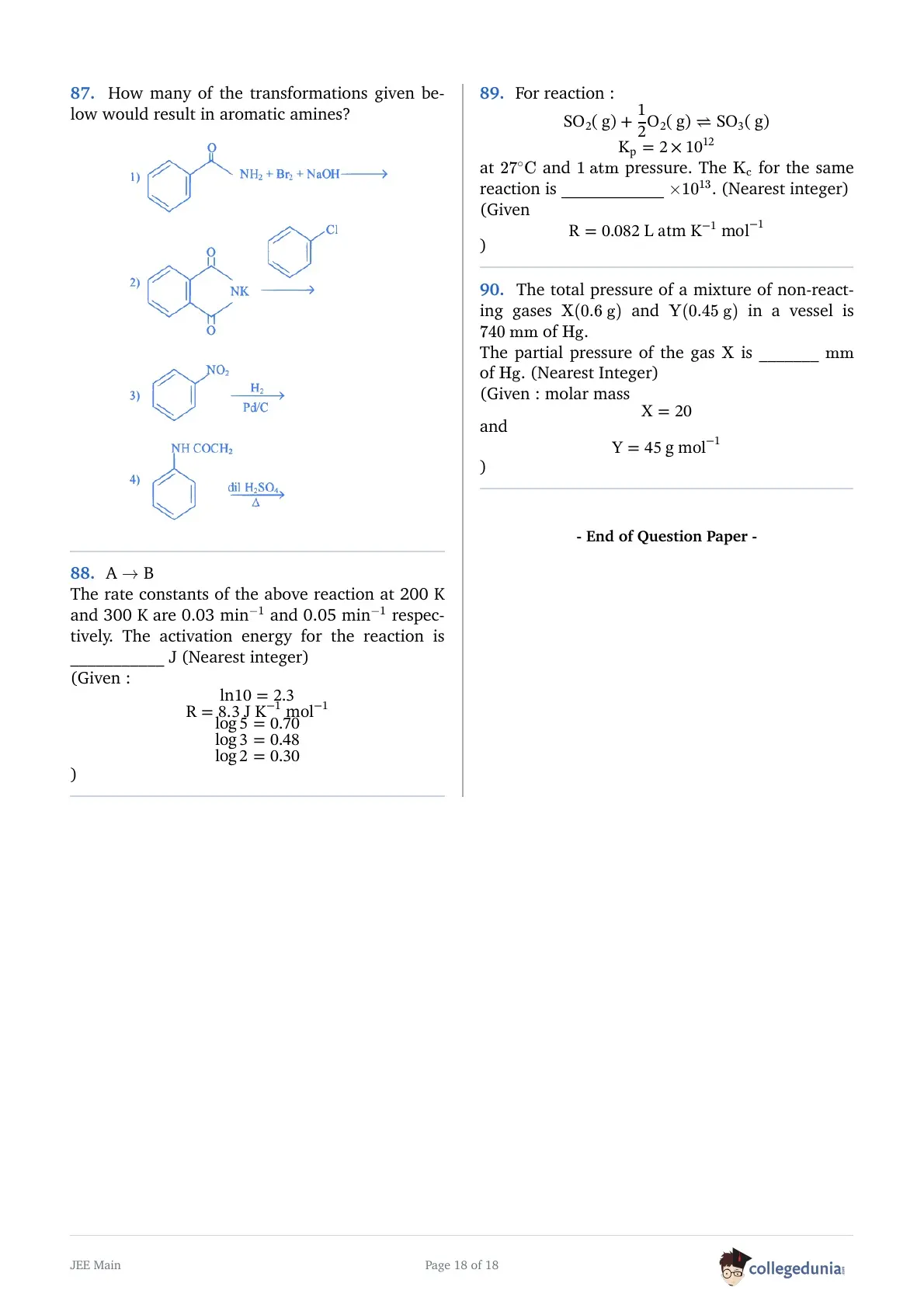
How many of the transformations given below would result in aromatic amines?

\(A \rightarrow B\) The rate constants of the above reaction at \(200 K\) and \(300 K\) are \(0.03 \min ^{-1}\) and \(0.05 \min ^{-1}\) respectively The activation energy for the reaction is __\(J\) (Nearest integer) (Given \(: \ln 10=2.3\)
\(R =8.3 \,JK ^{-1} \,mol ^{-1}\)
\(\log 5=0.70\)
\(\log 3=0.48\)
\(\log 2=0.30)\)
For reaction : \(SO _2( g )+\frac{1}{2} O _2( g )= SO _3( g )\)\(K _{ p }=2 \times 10^{12}\) at \(27^{\circ} C\) and 1 atm pressure The \(K _{ c }\) for the same reaction is ____\(\times 10^{13}\) (Nearest integer)(Given \(R =0.082 \,L \,atm \,K ^{-1} \,mol ^{-1}\) )
The total pressure of a mixture of non-reacting gases \(X (0.6 \,g )\) and \(Y (0.45 \, g )\) in a vessel is \(740 mm\) of \(Hg\) The partial pressure of the gas \(X\) is ____\(mm\) of \(Hg\)(Nearest Integer)(Given : molar mass \(X =20\) and \(Y =45 \, g \, mol ^{-1}\) )
JEE Main 2023 Exam Pattern and Marking Scheme
| Particulars | Details |
|---|---|
| Exam Mode | Online (Computer-Based Test) |
| Paper | B.E./B.Tech |
| Medium of Exam | 13 languages: English, Hindi, Gujarati, Bengali, Tamil, Telugu, Kannada, Marathi, Malayalam, Odia, Punjabi, Assamese, Urdu |
| Duration | 3 hours (180 minutes) |
| Type of Questions | Multiple Choice Questions (MCQs) + Numerical Value Questions (attempt any 5 of 10 per subject) |
| Total Marks | 300 marks |
| Subjects | Mathematics, Physics, Chemistry |
| Marking Scheme | +4 for correct answer & -1 for incorrect MCQ and Numerical Value-based Questions |
| Total Questions | 90 Questions (30 per subject), 75 to be attempted |
| Eligibility | Passed or appearing in Class 12 with Physics, Chemistry, and Mathematics |
JEE Main 2023 Jan 31 Shift 1 Question Paper by Coaching Institute
| Coaching Institutes | Question Paper with Answer Key PDF |
|---|---|
| Vedantu | Check Here |
JEE Main 2023 Paper Analysis Jan 31 Shift 1
JEE Main 2023 Paper Analysis for the exam scheduled on January 31 Shift 1 has been updated here. Candidates can check subject-wise paper analysis for the exam scheduled on January 31 Shift 1 here along with the topics with the highest weightage.



Comments