




JEE Main 2023 January 29 Shift 1 Question Paper is available here with answer key and solution pdf. NTA conducted the first shift on January 29, 2023, from 9:00 AM to 12:00 PM. The JEE Main 2023 Paper 1 (B.E./B.Tech) question paper includes the following:
- 90 questions in a 3-hour CBT Mode: 30 each from Mathematics, Physics and Chemistry (75 to be attempted)
- Section A: 20 multiple choice questions (MCQs) per subject, 4 marks each
- Section B: 10 numerical value questions per subject, attempt any 5, 4 marks each (integer answer)
- Marking: +4 for a correct answer, -1 for an incorrect answer, 0 for an unattempted question
JEE Main 2023 January 29 Shift 1 Question Paper with Solution PDF
| NTA Official PDF | CD PDF | CD PDF with Solutions |
|---|---|---|
| Download official PDF 4.83 MB | Download Collegedunia PDF 1.08 MB | Download solutions PDF 0.52 MB |
Also Check:
JEE Main 2023 January 29 Shift 1 Questions with Solutions
Mathematics - Section A (Q1 - Q20)
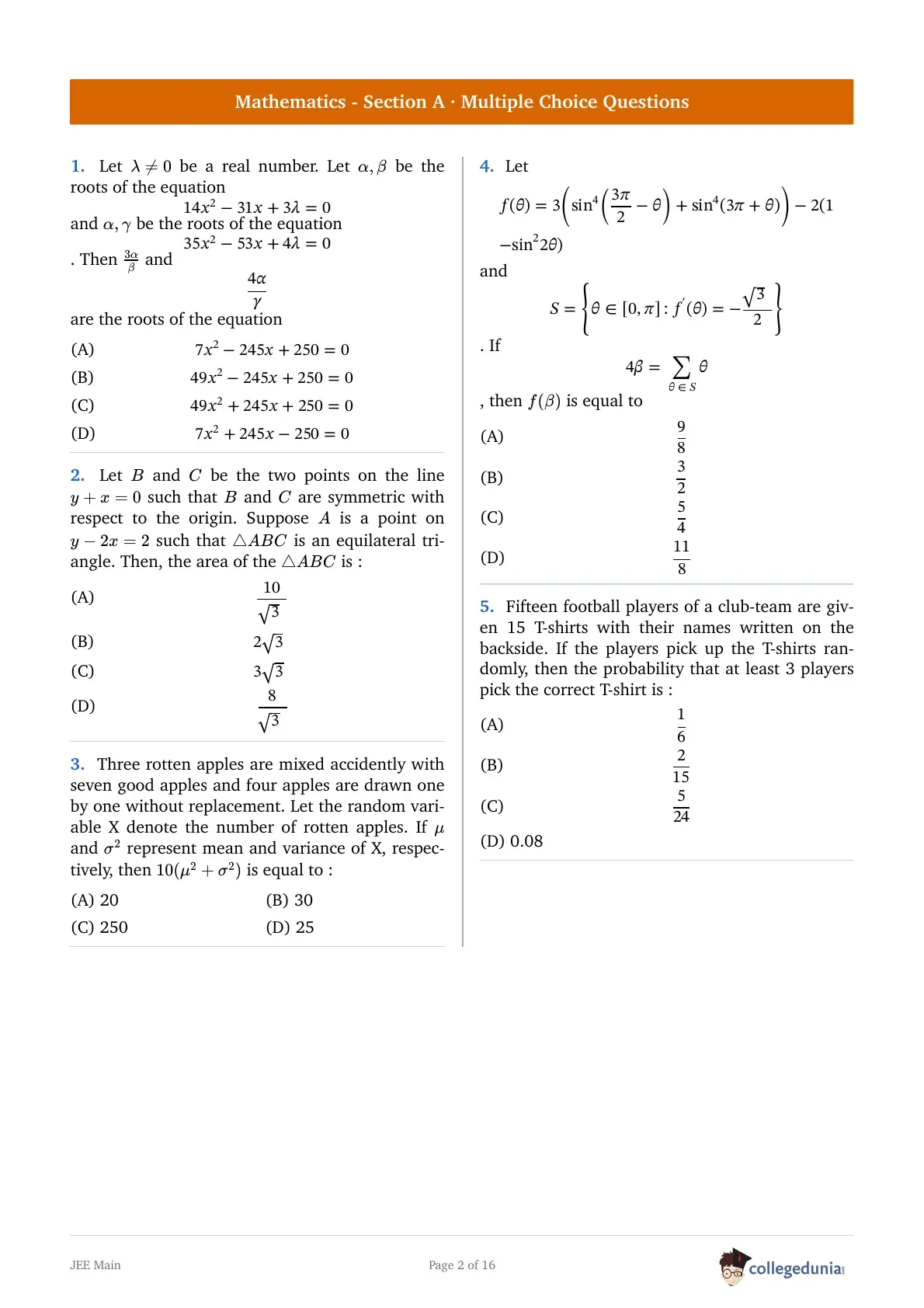
Let \(λ ≠ 0\) be a real number. Let α, β be the roots of the equation \(14x^2 – 31x + 3λ = 0\) and α, γ be the roots of the equation \(35x^2 – 53x + 4λ = 0\). Then \(\frac{3\alpha}{\beta}\) and \(\frac{4\alpha}{\lambda}\) are the roots of the equation
Let B and C be the two points on the line \(y + x = 0\) such that B and C are symmetric with respect to the origin. Suppose A is a point on \(y – 2x = 2\) such that \(\Delta ABC\) is an equilateral triangle. Then, the area of the \(\Delta ABC\) is
Three rotten apples are mixed accidently with seven good apples and four apples are drawn one by one without replacement. Let the random variable X denote the number of rotten apples. If μ and σ2 represent mean and variance of X, respectively, then 10(μ2+σ2) is equal to
Let \(f(\theta)=3[sin^4(\frac{3\pi}{2}-\theta)+sin^4(3\pi+θ)]-2(1-sin^22\theta)\) and \(S=\{\theta∈[0,\pi]:f'(\theta)=-\frac{\sqrt3}{2}\}\). If \(4\beta \sum_{\theta∈S}\theta\), then \(f(\beta)\) is equal to
Fifteen football players of a club-team are given 15 T-shirts with their names written on the backside. If the players pick up the T-shirts randomly, then the probability that at least 3 players pick the correct T-shirt is
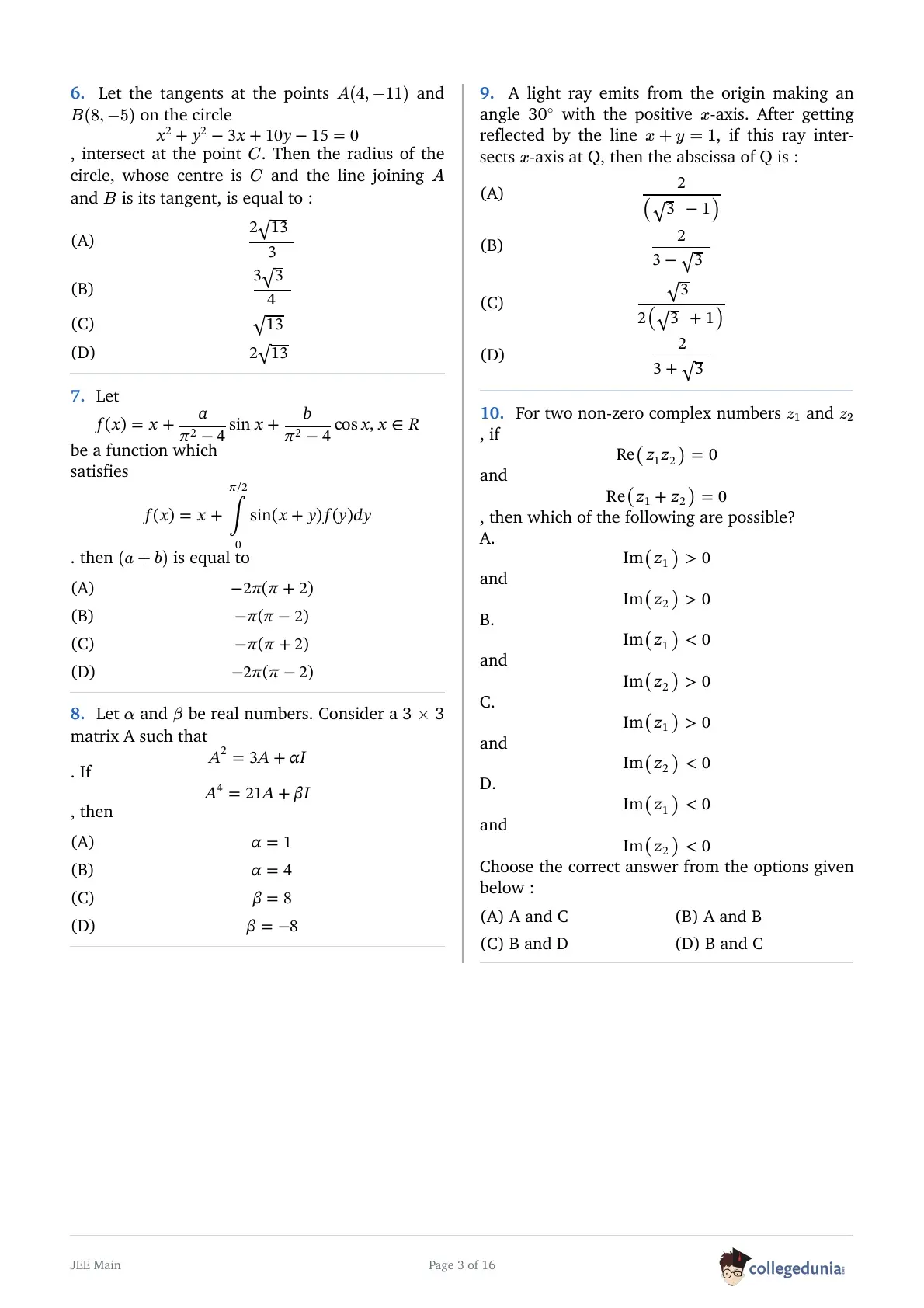
Let the tangents at the points A(4, –11) and B(8, –5) on the circle \(x^2+y^2-3x+10y-15=0\), intersect at the point C. Then the radius of the circle, whose centre is C and the line joining A and B is its tangent, is equal to
Let \(f(x)=x+\frac{a}{\pi^2-4} sinx+\frac{b}{\pi^2-4} cos x\), \(x∈R\) be a function which satisfies \(f(x)=x+∫_0^{\frac{\pi}{2}} sin(x+y) f(y)dy\). Then (a+b) equal to
Let α and β be real numbers. Consider a \(3 \times 3\) matrix A such that \(A^2 = 3A + \alpha I\). If \(A^4 = 21A + \beta I\), then
A light ray emits from the origin making an angle \(30\degree\) with the positive x-axis. After getting reflected by the line \(x + y = 1\), if this ray intersects x-axis at Q, then the abscissa of Q is
For two non-zero complex numbers z1 and z2, if Re(z1z2) = 0 and Re(z1 + z2), then which of the following are possible?
A. Im(z1) > 0 and Im(z2) > 0 |
B. Im(z1) < 0 and Im(z2) > 0
C. Im(z1) > 0 and Im(z2) < 0
D. Im(z1) < 0 and Im(z2) < 0
Choose the correct answer from the options given below
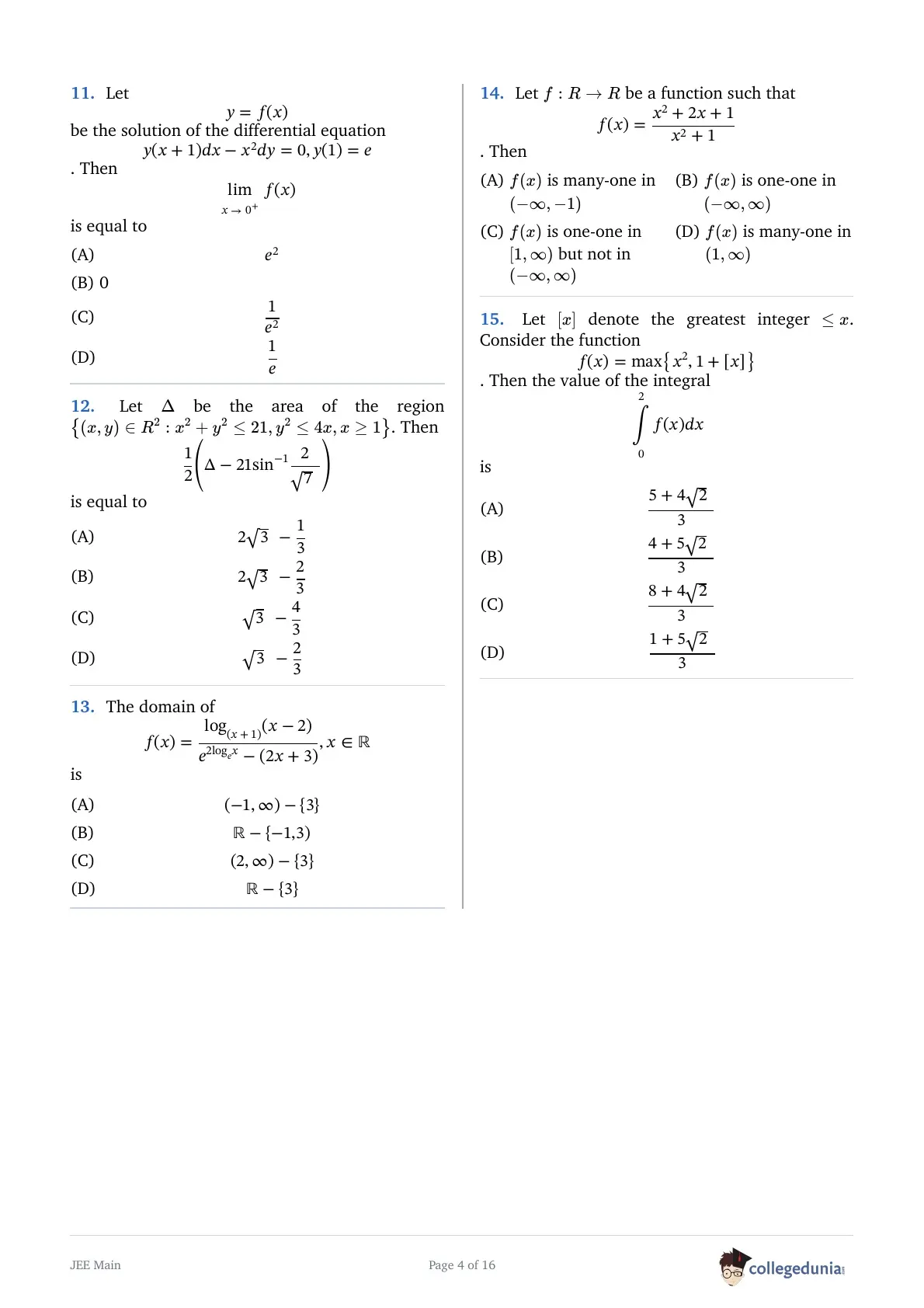
Let \(y = f(x)\) be the solution of the differential equation \(y(x + 1)dx - x^2dy = 0\), \(y(1) = e\). Then \(lim_{x→0^-} f (x)\) is equal to
Let \(\Delta\) be the area of the region \(\{(x,y)∈R^2:x^2+y^2≤21,y^2≤4x,x≥1\}\). Then \(\frac{1}{2}(\Delta-21\text{ sin}^{-1} (\frac{2}{\sqrt7}))\) is equal to
The domain of \(f(x)=\frac{log_{x+1}(x-2)}{e^{2logx}-(2x+3)}\), \(x∈R\) is
Let f: R→R be a function such that \(f(x)=\frac{x^2+2x+1}{x^2+1}\). Then
Let [x] denote the greatest integer ≤ x. Consider the function \(f(x)=max \{x^2,1+[x] \}\). Then the value of the integral \(∫_0^2 f(x)dx\) is
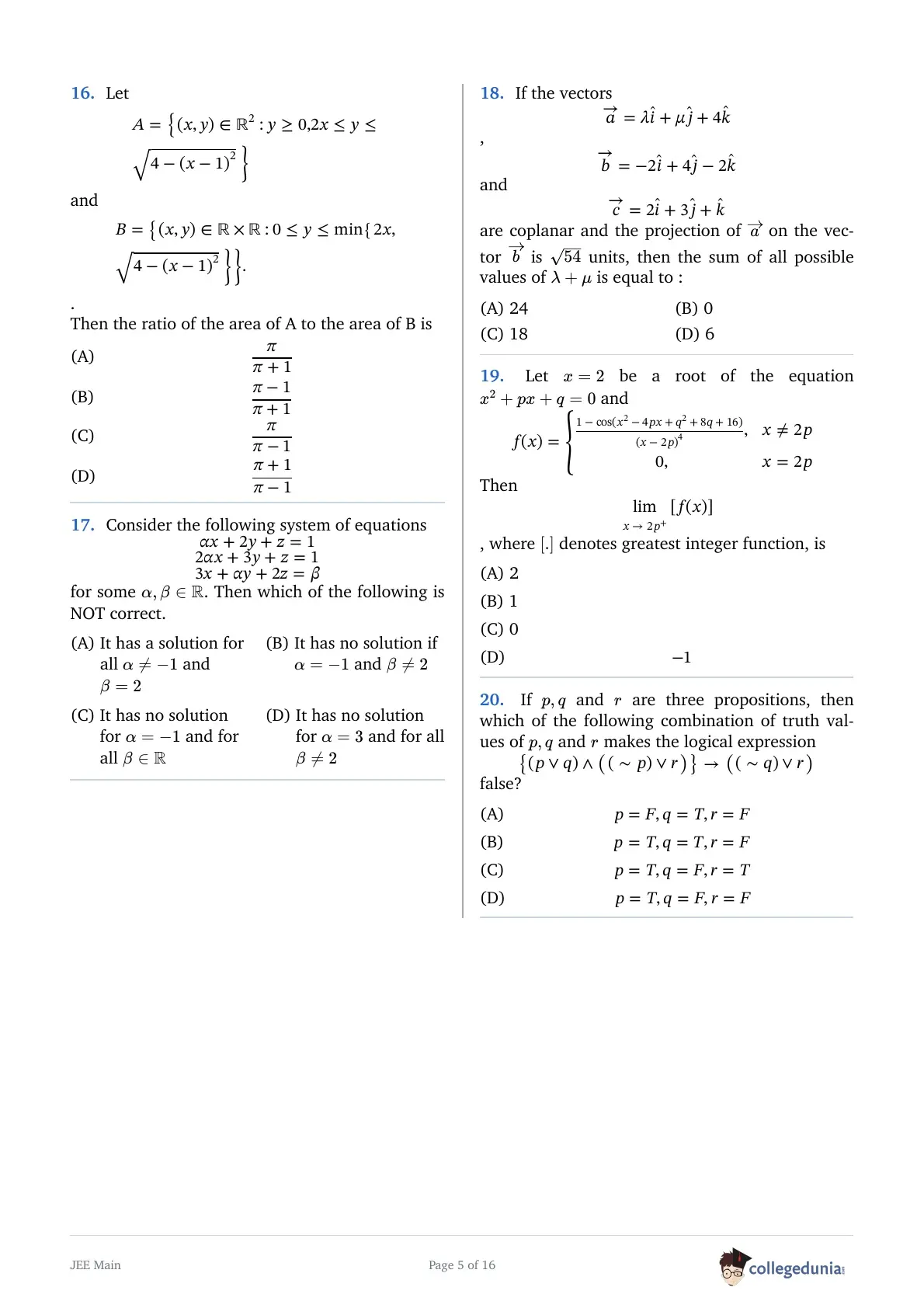
Let
\(A=\{(x,y) ∈R^2:y≥0,2x≤y≤\sqrt{4-(x-1)^2} \}\)
and
\(B=\{(x,y) ∈R\times R:0≤y≤min \{2x,\sqrt{4-(x-1)^2}\}\}\)
Then the ratio of the area of A to the area of B is
Consider the following system of equations
\(\alpha x + 2y + z = 1\)
\(2\alpha x + 3y + z = 1\)
\(3x + \alpha y + 2z = b\)
For some \(\alpha,\beta∈R\) then which of the following is NOT correct?
If the vectors \(\overrightarrow{a} =\lambda \hat{i}+\mu\hat{j}+4\hat{k}\), \(\overrightarrow{b}=-2\hat{i}+4\hat{j}-2\hat{k}\) and \(\overrightarrow{c}=2\hat{i}+3\hat{j}+\hat{k}\) are coplanar and the projection of \(\overrightarrow{a}\) on the vector \(\overrightarrow{b}\) is \(\sqrt{54}\) units, then the sum of all possible values of \(\lambda + \mu\) is equal to
Let \(x = 2\) be a root of the equation \(x^2 + px + q = 0\) and \(f(x)=\begin{cases}\frac{1-cos(x^2-4px+q^2+8q+16)}{(x-2p)^4} & x≠2p\\0 & x=2p\end{cases}\).
Then \(lim_{x \rightarrow 2p}[f(x)]\), where [·] denotes greatest integer function, is
If p, q and r are three propositions, then which of the following combination of truth values of p, q and r makes the logical expression \({(p∨q)∧((∼p)∨r)}🡢((∼q)∨r)\) false?
Mathematics - Section B (Q21 - Q30)
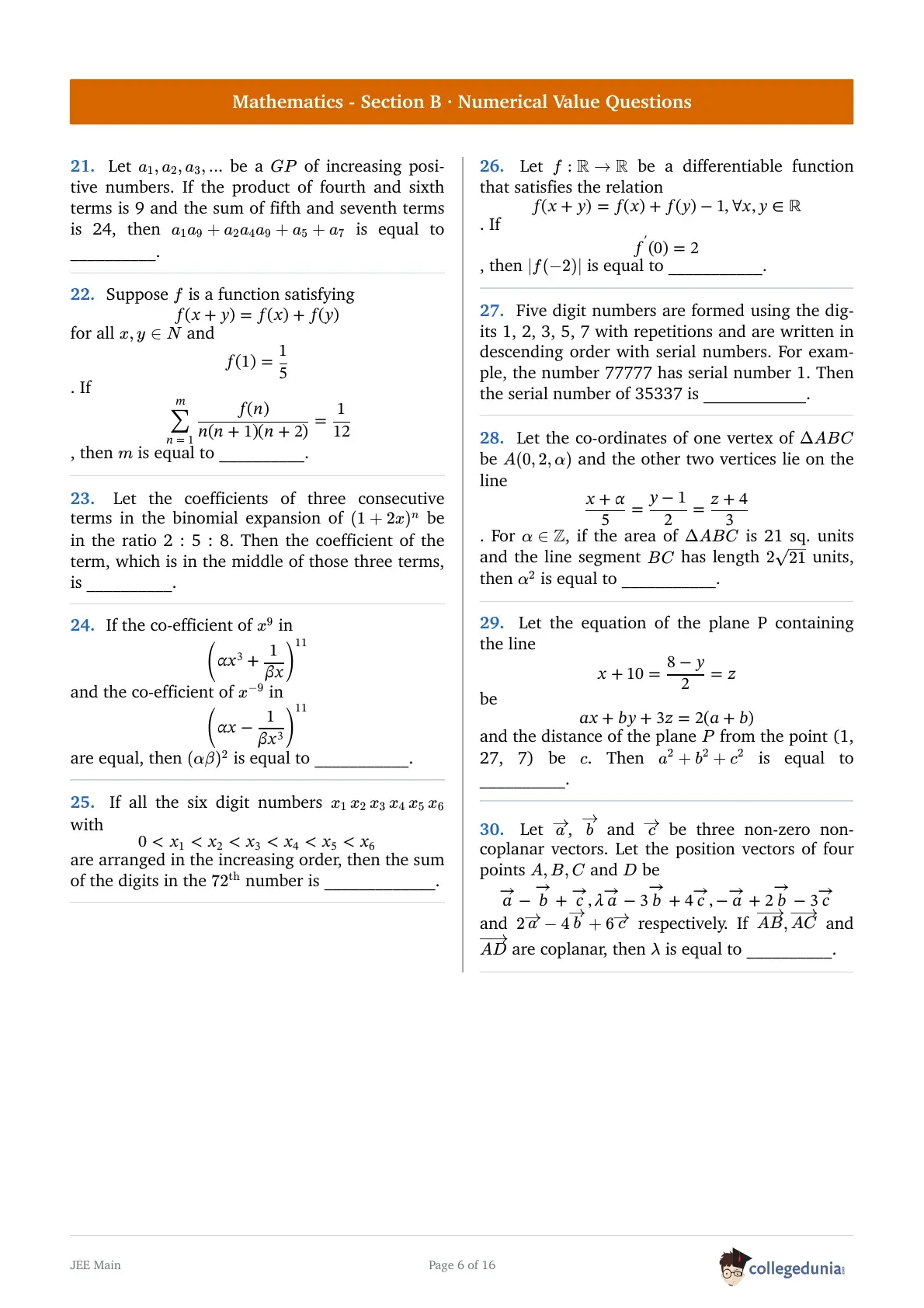
Let a1, a2, a3, … be a G.P of increasing positive numbers. If the product of fourth and sixth terms is 9 and the sum of fifth and seventh terms is 24, then a1 a9+a2 a4 a9+a5+a7 is equal to __________.
Suppose f is a function satisfying \(f(x + y) + f(x) + f(y)\) for all \(x, y ∈N\) and \(f(1)=\frac{1}{5}\). If \(∑_{n=1}^{m} \frac{f(n)}{n(n+1)(n+2)}=\frac{1}{2}\), then m is equal to _______.
Let the coefficients of three consecutive terms in the binomial expansion of (1 + 2x)n be the ratio 2 : 5 : 8. Then the coefficient of the term, which is in the middle of these three terms, is _______.
If the co-efficient of x9 in \((αx^3+\frac{1}{βx})^{11}\) and the co-efficient of x-9 in \((αx-\frac{1}{βx^3})^{11}\) are equal, then \((αβ)^2\) is equal to ________.
If all the six digit numbers x1 x2 x3 x4 x5 x6 with \(0<x_1<x_2<x_3<x_4<x_5<x_6\) are arranged in the increasing order, then the sum of the digits in the 72th number is _____________.
Let \(f : R → R\) be a differentiable function that satisfies the relation \(f(x + y) = f(x) + f(y) – 1, ∀x, y ∈R\). If \(f'(0) = 2\), then \(|f(–2)|\) is equal to ___________.
Five digit numbers are formed using the digits 1, 2, 3, 5, 7 with repetitions and are written in descending order with serial number. For example, the number 77777 has serial number 1. Then the serial number of 35337 is _________
Let the co-ordinates of one vertex of \(\Delta ABC\) be \(A(0, 2, \alpha)\) and the other two vertices lie on the line \(x+\frac{\alpha}{5}=y-\frac{1}{2}=z+\frac{4}{3}\) For \(\alpha∈Z\), if the area of \(\Delta ABC\) is 21 sq. units and the line segment BC has length \(2\sqrt{21}\) units, then α2 is equal to ___________.
Let the equation of the plane P containing the line \(x+10=\frac{8-y}{2}=z\) be \(ax + by + 3z = 2(a + b)\) and the distance of the plane P from the point (1, 27, 7) be c. Then a2+b2+c2 is equal to ____________.
Let a b, and c be three non-zero non-coplanar vectors. Let the position vectors of four points A, B, C and D be \(a-b+c\), \(λa-3b+4c\), \(-a+2b-3c\) and \(2a-4b+6c\) respectively. If AB AC , and AD are coplanar, then λ is equal to ____.
Physics - Section A (Q31 - Q50)
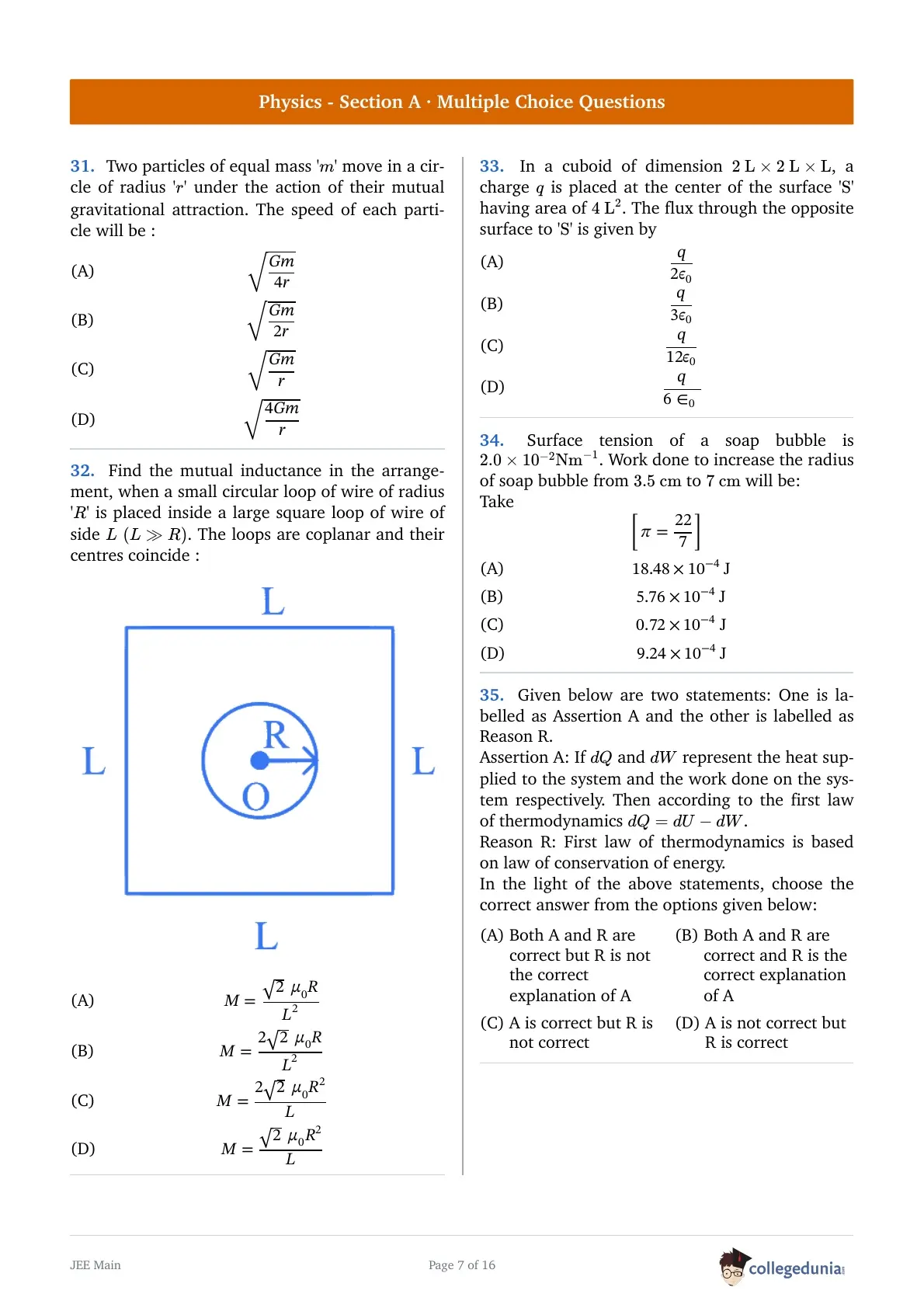
Two particles of equal mass ‘m’ move in a circle of radius ‘r’ under the action of their mutual gravitational attraction. The speed of each particle will be :
Find the mutual inductance in the arrangement, when a small circular loop of radius R is placed inside a large square loop of side \(L\) (\(L \gg R\)). The loops are coplanar and their centers coincide:
In a cuboid of dimension \(2L \times 2L \times L\), a charge q is placed at the center of the surface ‘S’ having area of 4 L2. The flux through the opposite surface to ‘S’ is:
The surface tension of a soap bubble is \(2 \times 10^{-2} \, \text{N/m}\). Work done to increase the radius of the bubble from 3.5 cm to 7 cm will be:
Assertion A: If \( dQ \) and \( dW \) represent the heat supplied to the system and the work done on the system respectively, then according to the first law of thermodynamics: \[ dQ = dU - dW. \]
Reason R: First law of thermodynamics is based on the law of conservation of energy.
In the light of the above statements, choose the correct answer from the options given below:
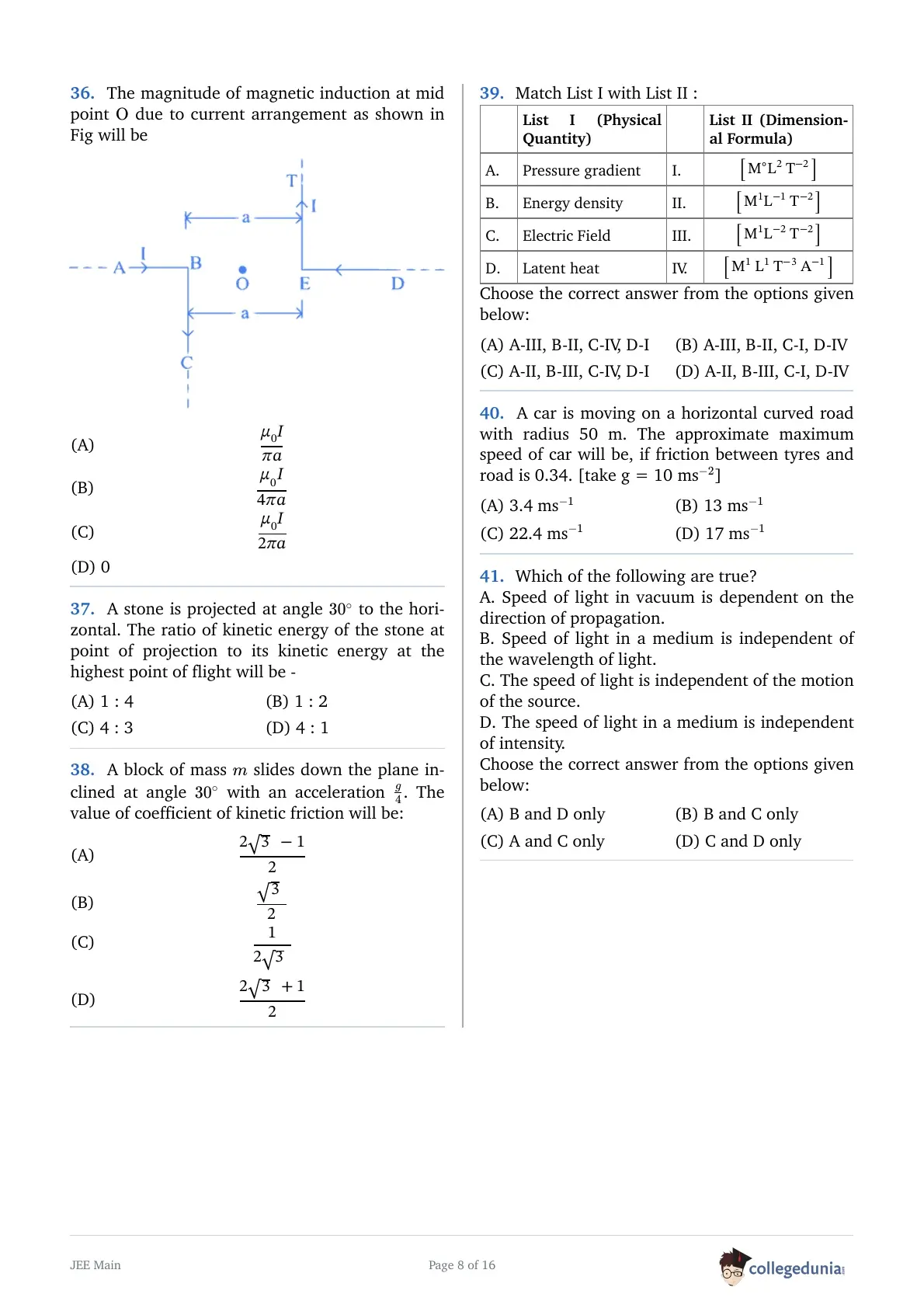
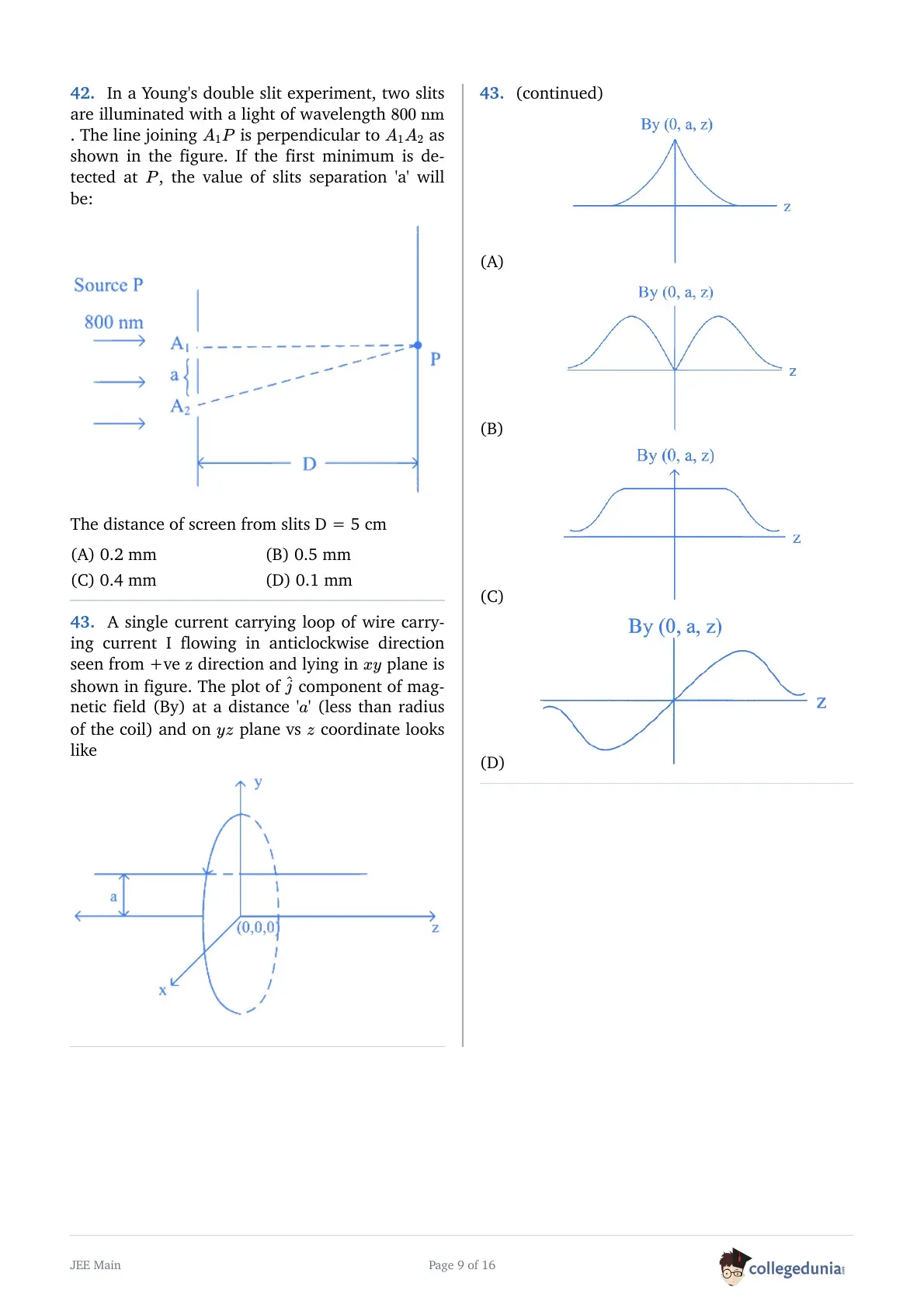
The magnitude of magnetic induction at the mid-point O due to the current arrangement shown in the figure is:
A stone is projected at an angle of \(30\degree\) to the horizontal. The ratio of kinetic energy at projection to its kinetic energy at the highest point is:
A block of mass m slides down the plane inclined at angle \(30\degree\) with an acceleration \(\frac{g}{4}\). The value of the coefficient of kinetic friction will be:
| List-I (Physical Quantity) | List-II (Dimensional Formula) | ||
| (A) | Pressure Gradient | (I) | \([M^0L^2T^{–2}]\) |
| (B) | Energy density | (II) | \([M^1L^{–1}T^{–2}]\) |
| (C) | Electric field | (III) | \([M^1L^{–2}T^{–2}]\) |
| (D) | Latent heat | (IV) | \([M^1L^1T^{–3}A^{–1}]\) |
Choose the correct answer from the options given below:
A car is moving on a horizontal curved road with radius 50 m. The approximate maximum speed of the car will be, if the friction coefficient between tyres and road is 0.34. (Take g = 10 m/s2):
Which of the following are true?
A. Speed of light in vacuum is dependent on the direction of propagation.
B. Speed of light in a medium is independent of the wavelength of light.
C. The speed of light is independent of the motion of the source.
D. The speed of light in a medium is independent of intensity.
Choose the correct answer from the options given below:
In a Young’s double slit experiment, two slits are illuminated with light of wavelength \(800 \, \text{nm}\). The first minimum is detected at \(P\). The value of slit separation \(a\) is:
A single current-carrying loop of wire carrying current I flows in the anticlockwise direction (seen from the +z direction) and lies in the xy plane. The plot of \(\hat{j}\) component of magnetic field (\(B_y\)) at a distance a (less than radius of the coil) and on the yz plane vs z coordinate looks like:
- (1)
![Fig 1]()
- (2)
![Fig 2]()
- (3)
![Fig 3]()
- (4)
![Fig 4]()


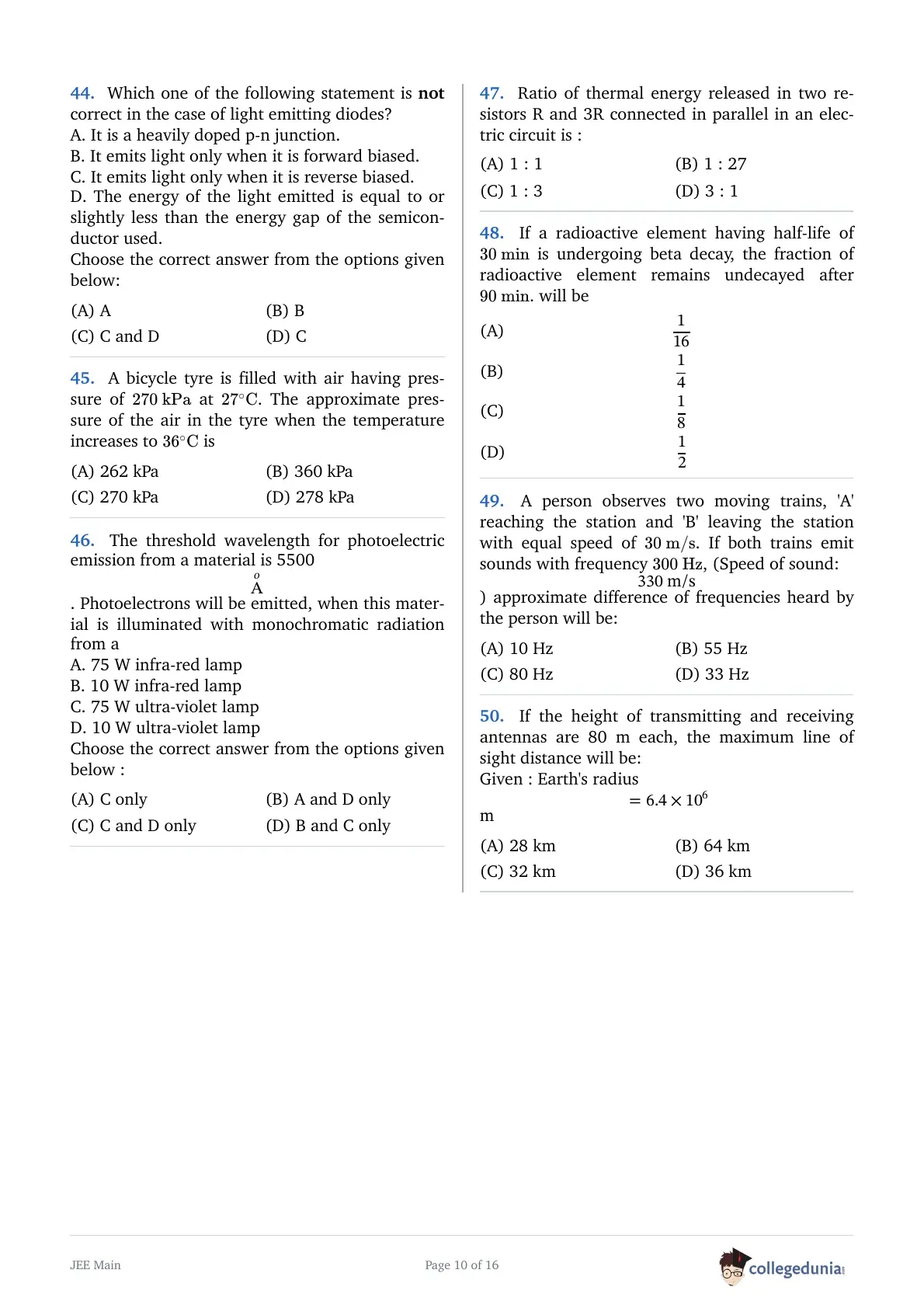
Which of the following statements is not correct in the case of light emitting diodes (LEDs)?
A. It is a heavily doped p-n junction.
B. It emits light only when it is forward-biased.
C. It emits light only when it is reverse-biased.
D. The energy of the light emitted is equal to or slightly less then the energy gap of the semiconductor used.
Choose the correct answer from the options given below:
A bicycle tyre is filled with air having pressure of 270 kPa at \(27\degree C\). The approximate pressure of the air in the tyre when the temperature increases to \(36\degree C\) is:
The threshold wavelength for photoelectric emission from a material is \(5500Å\). Photoelectrons will be emitted, when this material is illuminated with monochromatic radiation from a
A. 75 W infra-red lamp
B. 10 W infra-red lamp
C. 75 W ultra-violet lamp
D. 10 W ultra-violet lamp
Choose the correct answer from the options given below:
Ratio of thermal energy released in two resistors R and 3R connected in parallel in an electric circuit is:
If a radioactive element with a half-life of 30 min undergoes beta decay. The fraction of the radioactive element that remains undecayed after 90 min is:
A person observes two moving trains, ‘A’ reaching the station and ‘B’ leaving the station with equal speed of 30 m/s. If both trains emit sounds with frequency 300 Hz, (Speed of sound: 330 m/s) approximate difference of frequencies heard by the person will be:
If the height of transmitting and receiving antennas are 80 m each, the maximum line of sight distance will be:
Given: Earth’s radius = \(6.4 \times 106\text{ m}\)
Physics - Section B (Q51 - Q60)
Two simple harmonic waves having equal amplitudes of 8 cm and equal frequency of 10 Hz are moving along the same direction. The resultant amplitude is also 8 cm. The phase difference between the individual waves is _____ degree.
A solid sphere of mass 2 kg is making pure rolling on a horizontal surface with kinetic energy 2240 J. The velocity of centre of mass of the sphere will be ____ ms–1.
In a metre bridge experiment, the balance point is obtained if the gaps are closed by \(2 \Omega\) and \(3 \Omega\). A shunt of \(X \Omega\) is added to \(3 \Omega\) resistor to shift the balancing point by 22.5 cm. The value of X is _______ .
A point charge \(q_1 = 4q_0\) is placed at origin. Another point charge \(q_2 = –q_0\) is placed at \(x = 12\text{ cm}\). Charge of proton is q0. The proton is placed on x axis so that the electrostatic force on the proton is zero. In this situation, the position of the proton from the origin is _____ cm.
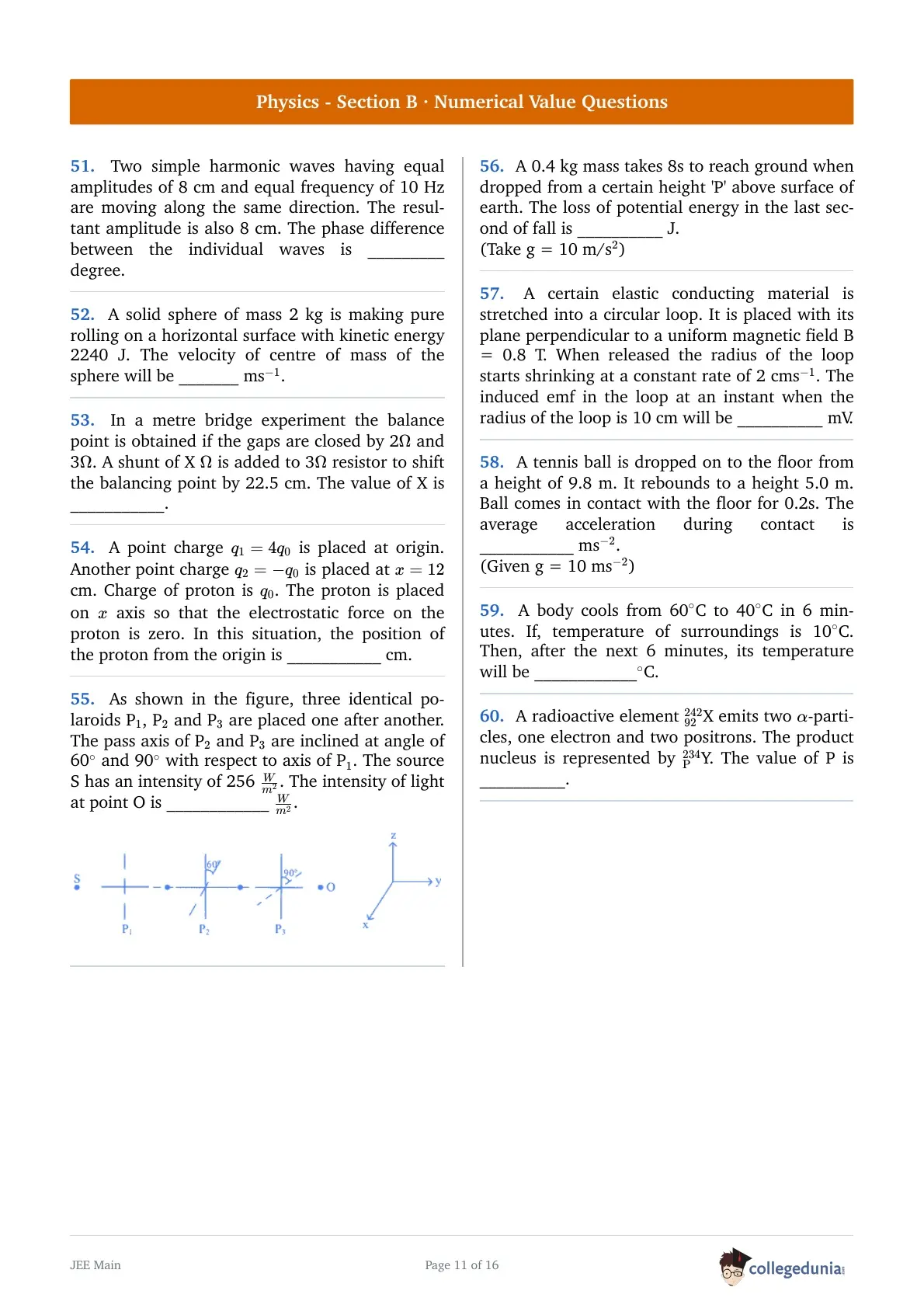
Three identical polaroids \(P_1\), \(P_2\), and \(P_3\) are placed one after another. The pass axis of \(P_2\) and \(P_3\) are inclined at angles of \(60^\circ\) and \(90^\circ\) with respect to the axis of \(P_1\). The source \(S\) has an intensity of \(\frac{256 \, \text{W}}{\text{m}^2}\). The intensity of light at point \(O\) is _____ \(\frac{\text{W}}{\text{m}^2}\).
A 0.4 kg mass takes 8 s to reach ground when dropped from a certain height ‘P’ above surface of earth. The loss of potential energy in the last second of fall is ____ J. (Take g = 10 m/s2)
A certain elastic conducting material is stretched into a circular loop. It is placed with its plane perpendicular to a uniform magnetic field B = 0.8 T. When released the radius of the loop starts shrinking at a constant rate of 2 cm/s. The induced emf in the loop at an instant when the radius of the loop is 10 cm will be _____ mV.
A tennis ball is dropped on to the floor from a height of 9.8 m. It rebounds to a height 5.0 m. Ball comes in contact with the floor for 0.2 s. The average acceleration during contact is_____ m/s2. (Given g =10 m/s2)
A body cools from \(60\degree C\) to \(40\degree C\) in 6 minutes. If, temperature of surroundings is \(10\degree C\). Then, after the next 6 minutes, its temperature will be ______\(\degree C\).
A radioactive element \({}^{242}_{92}X\) emits two \(\alpha\)-particles, one electron, and two positrons. The product nucleus is represented by \({}^{234}_{P}Y.\) The value of \(P\) is _______.
Chemistry - Section A (Q61 - Q80)
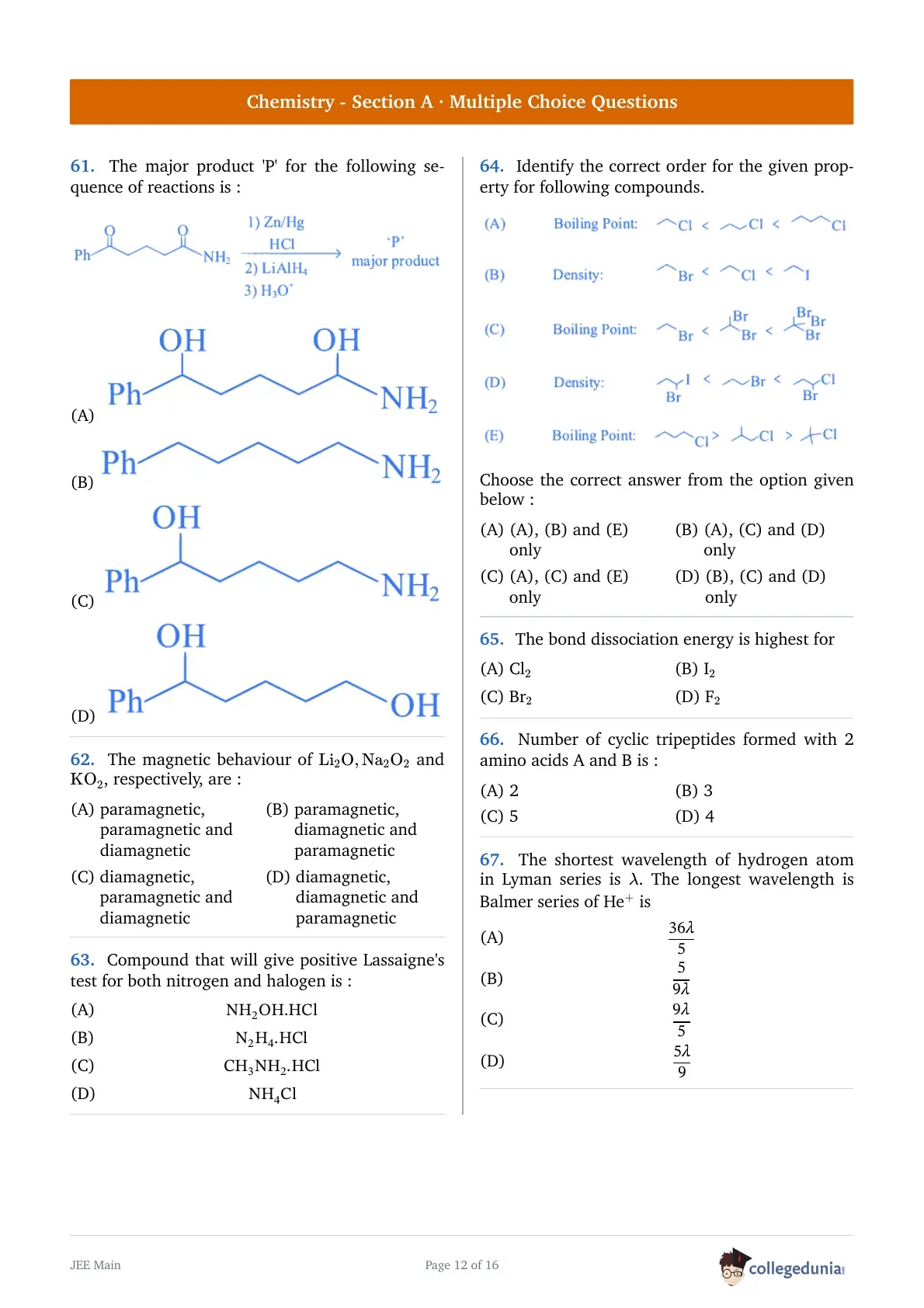
The major product ‘P’ for the following sequence of reactions is :
- (1)
![product 1]()
- (2)
![Product 2]()
- (3)
![Product 3]()
- (4)
![Product 4]()


The magnetic behavior of Li2O, Na2O2 and KO2, respectively, are
Compound that will give positive Lassaigne’s test for both nitrogen and halogen is
Identify the correct order for the given property for following compounds. 
Choose the correct answer from the option given below :
The bond dissociation energy is highest for
Number of cyclic tripeptides formed with 2 amino acids A and B is:
The shortest wavelength of hydrogen atom in Lyman series is λ. The longest wavelength in Balmer series of He+ is
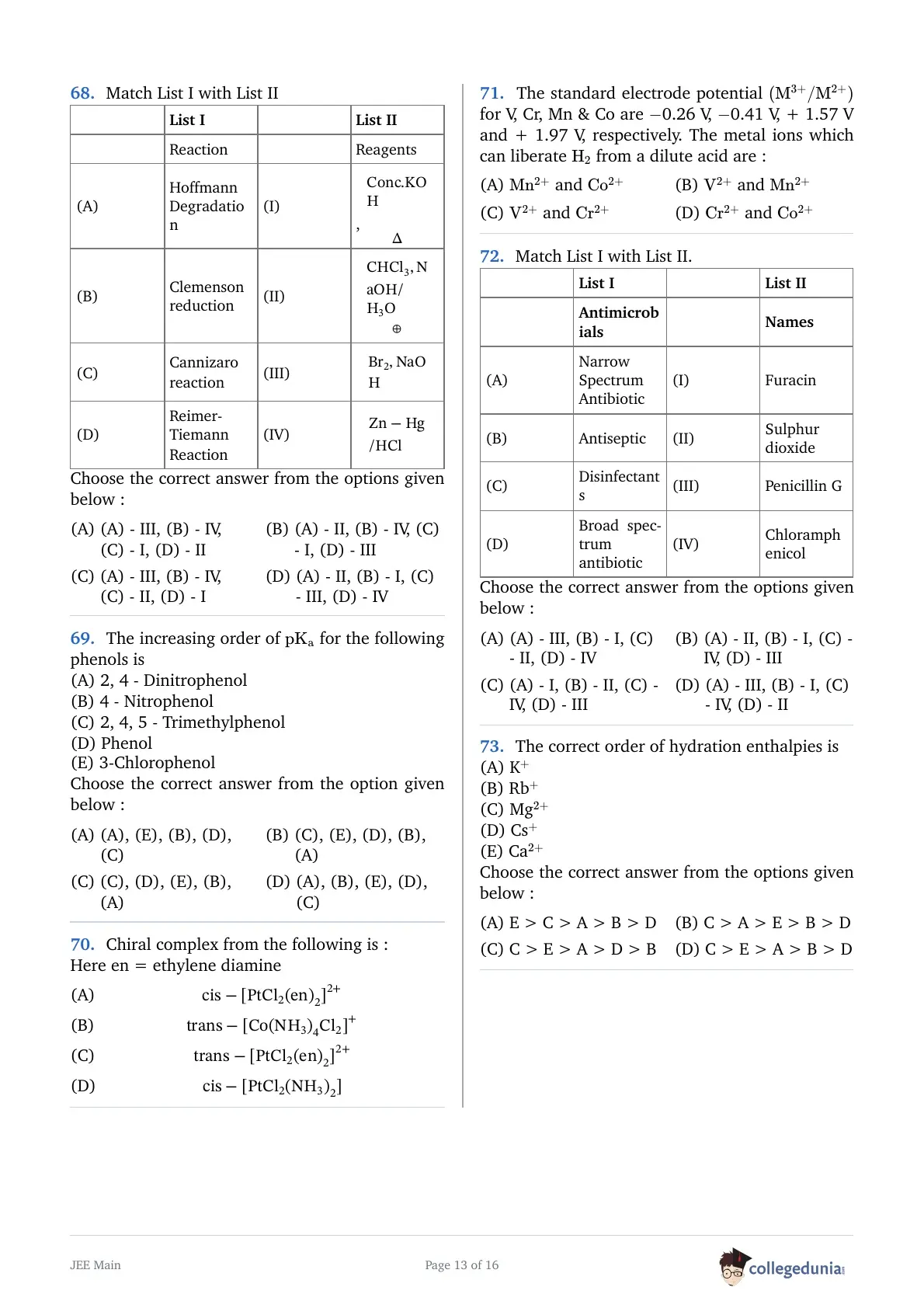
Match List I with List II
| List-I | Reaction | List-II | Reagents |
| (A) | Hoffmann Degradation | (I) | Conc.KOH,\(\triangle\) |
| (B) | Clemenson reduction | (II) | CHCl3, NaOH/H3O+ |
| (C) | Cannizaro reaction | (III) | Br2, NaOH |
| (D) | Reimer-Tiemann Reaction | (IV) | Zn-Hg/HCl |
Choose the correct answer from the option given below:
The increasing order of pKa for the following phenols is
(A) 2,4-Dinitrophenol
(B) 4-Nitrophenol
(C) 2,4,5-Trimethylphenol
(D) Phenol
(E) 3-Chlorophenol
Choose the correct answer from the option given below :
Chiral complex from the following is
The standard electrode potential \((\frac{M^{3+}}{M^{2+}})\) for V, Cr, Mn & Co are –0.26 V, –0.41 V, +1.57 V and +1.97 V, respectively. The metal ions which can liberate H2 from a dilute acid are
Match List I with List II.
| List I | Antimicrobials Names | List II | Names |
| (A) | Narrow spectrum antibiotic | (I) | Furacin |
| (B) | Antiseptic | (II) | Sulphur dioxide |
| (C) | Disinfectants | (III) | Penicillin-G |
| (D) | Broad spectrum antibiotic | (IV) | Chloramphenicol |
Choose the correct answer from the options given below:
The correct order of hydration enthalpies is
(A) K+
(B) Rb2+
(C) Mg2+
(D) Cs+
(E) Ca2+
Choose the correct answer from the options given below:
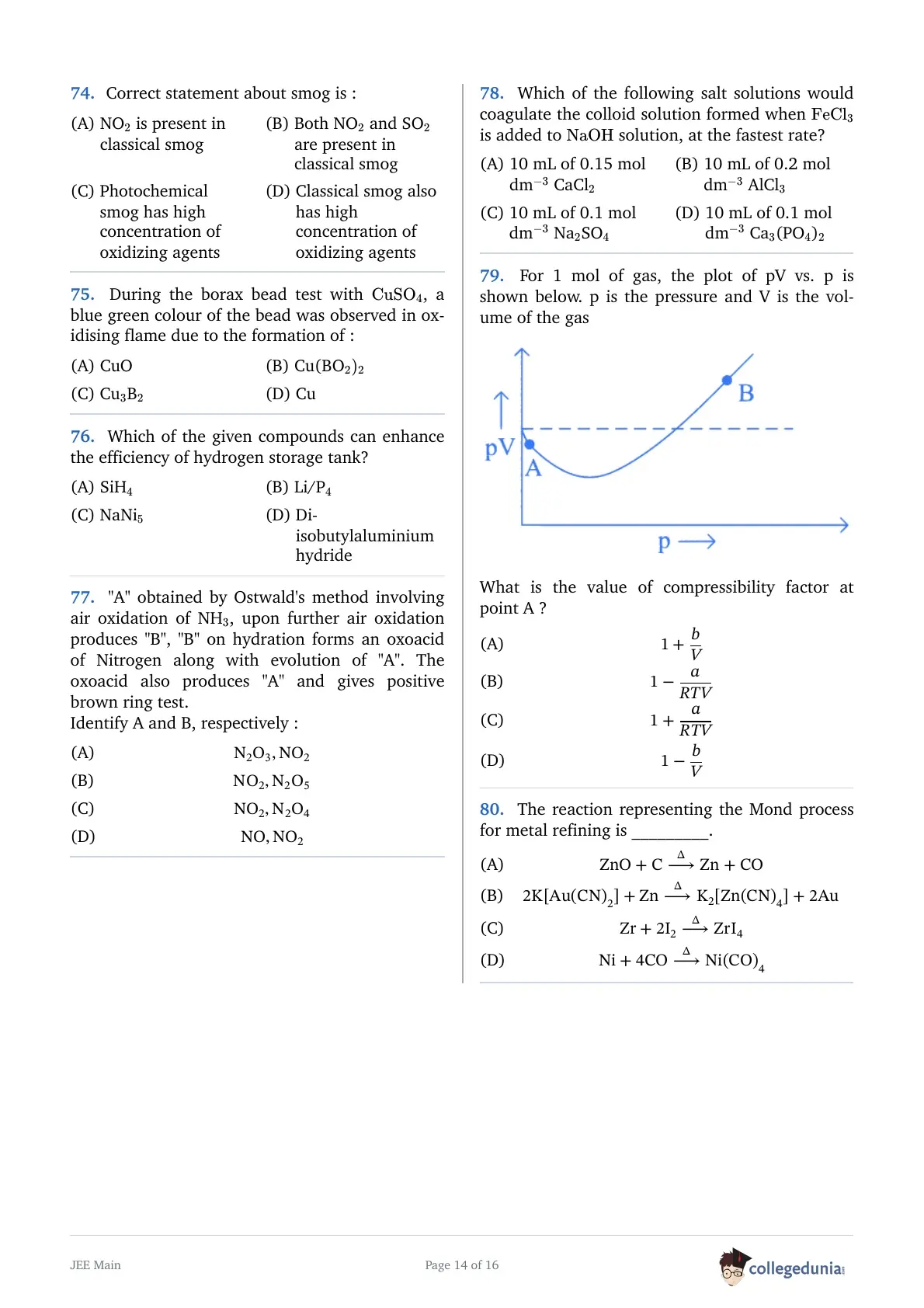
Correct statement about smog is
During the borax bead test with CuSO4, a blue-green colour of the bead was observed in oxidizing flame due to the formation of
Which of the given compounds can enhance the efficiency of hydrogen storage tank?
“A” obtained by Ostwald’s method involving air oxidation of\( NH_3\), upon further air oxidation produces “B”. “B” on hydration forms an oxoacid of Nitrogen along with evolution of “A”. The oxoacid also produces “A” and gives positive brown ring test.
Which of the following salt solutions would coagulate the colloid solution formed when FeCl3 is added to NaOH solution, at the fastest rate?
For 1 mol of gas, the plot of pV vs. p is shown below. p is the pressure and V is the volume of the gas. What is the value of compressibility factor at point A?
The reaction representing the Mond process for metal refining is _________.
Chemistry - Section B (Q81 - Q90)
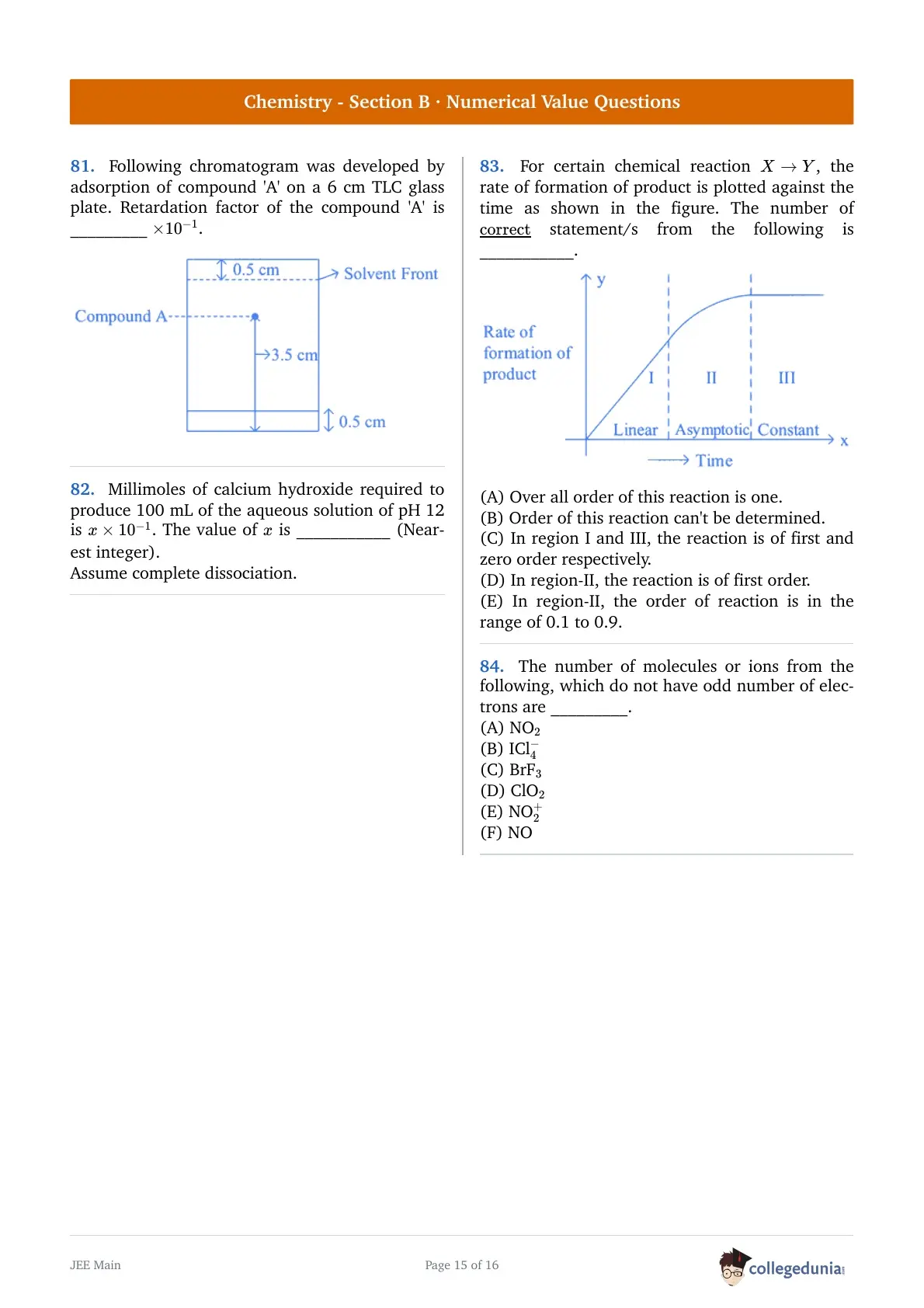
Following chromatogram was developed by adsorption of compound 'A' on a 6 cm TLC glass plate. Retardation factor of the compound 'A' is_____ \(\times 10^{–1}\).
Millimoles of calcium hydroxide required to produce 100 mL of the aqueous solution of pH 12 is \(x \times 10^{-1}\). The value of \(x\) is — (Nearest integer).
For certain chemical reaction X 🡢 Y, the rate of formation of product is plotted against the time as shown in the figure. The number of correct statement/s from the following is______.
(A) Over all order of this reaction is one
(B) Order of this reaction can't be determined
(C) In region I and III, the reaction is of first and zero order respectively
(D) In region-II, the reaction is of first order
(E) In region-II, the order of reaction is in the range of 0.1 to 0.9.
The number of molecules or ions from the following, which do not have odd number of electrons are ______.
(A) NO2
(B) ICI4-
(C) BrF3
(D) CIO2
(E) NO22+
(F) NO
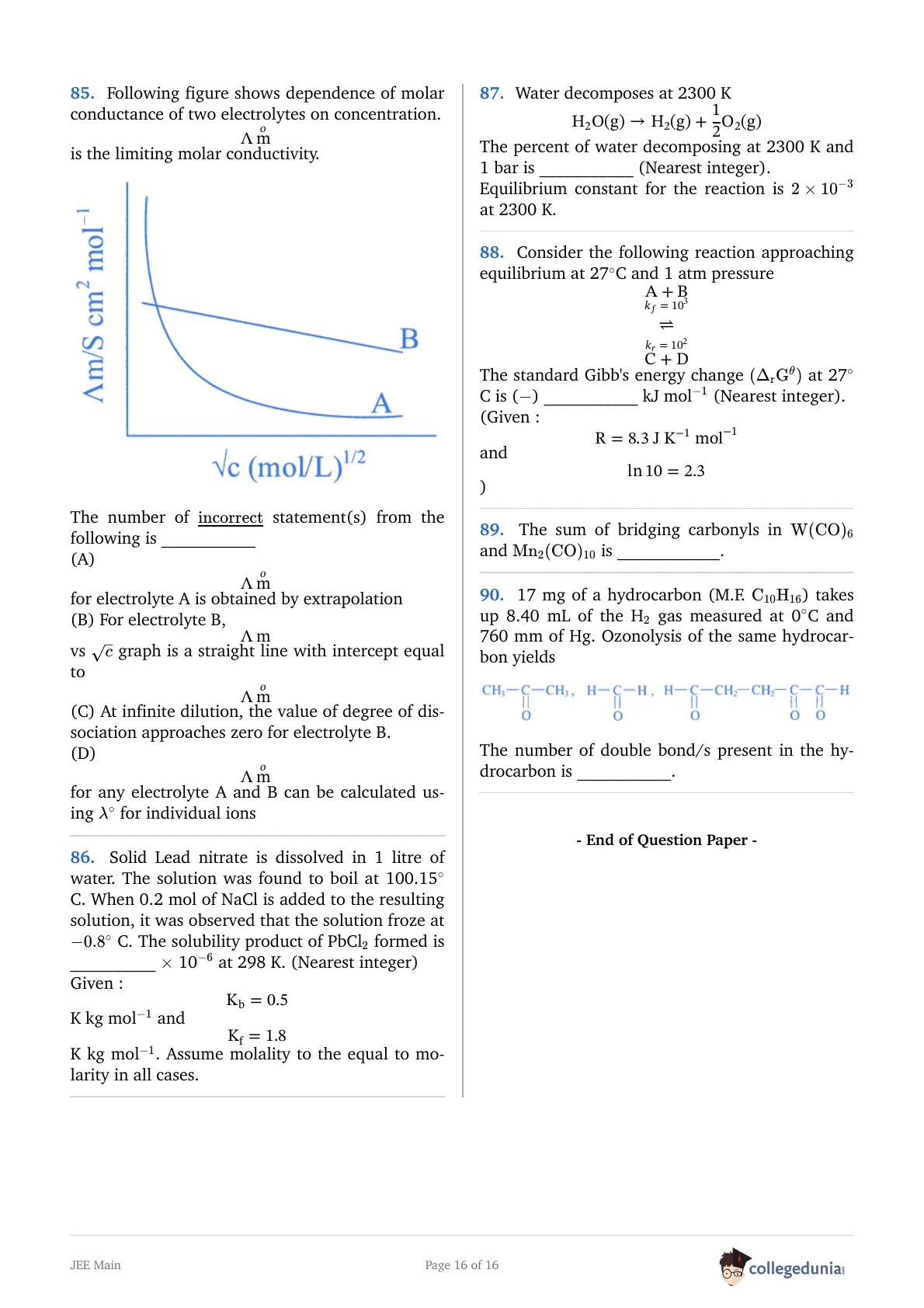
Following figure shows dependence of molar conductance of two electrolytes on concentration. Λo m is the limiting molar conductivity. The number of incorrect statement(s) from the following is ________ 
(A) \(\Lambda \text{o m}\) for electrolyte A is obtained by extrapolation.
(B) For electrolyte B, \(\Lambda \text{m}\) vs \(\sqrt c\) graph is a straight line with intercept equal to o \(\Lambda \text{m}\)
(C) At infinite dilution, the value of degree of dissociation approaches zero for electrolyte B.
(D) Λo m for any electrolyte A or B can be calculated using \(\lambda0\) for individual ions.
Solid Lead nitrate is dissolved in 1 litre of water. The solution was found to boil at \(100.15\degree C\). When 0.2 mol of NaCl is added to the resulting solution, it was observed that the solution froze at \(–0.8\degree C\). The solubility product of PbCl2 formed is ________ \(\times 10^{–6}\) at 298 K. (Nearest integer) Given: \(Kb = 0.5 K \text{ kg mol}^{–1}\) and \(Kf = 1.8 K \text{ kg mol}^{–1}\).
Assume molality to be equal to molarity in all cases.
Water decomposes at 2300 K
\(H_2O(g)\longrightarrow H (g)+(\frac{1}{2})O_2(g)\)
The percent of water decomposing at 2300 K and 1 bar is ________ (Nearest integer). Equilibrium constant for the reaction is \(2 \times 10^{–3}\) at 2300 K.
Consider the following reaction approaching equilibrium at \(27\degree C\) and 1 atm pressure
The standard Gibb's energy change \((\Delta rG\degree)\) at \(27\degree C\) is (–)_____ kJ mol–1 (Nearest integer).
(Given: R = 8.3 J K–1 mol–1 and In 10 = 2.3)
The sum of bridging carbonyls in W(CO)6 and Mn2(CO)10 is_____.
17 mg of a hydrocarbon (M.F. C10H16) takes up 8.40 mL of the H2 gas measured at \(0\degree C\) and 760 mm of Hg. Ozonolysis of the same hydrocarbon yields
The number of double bond/s present in the hydrocarbon is_______.
JEE Main 2023 Exam Pattern and Marking Scheme
| Particulars | Details |
|---|---|
| Exam Mode | Online (Computer-Based Test) |
| Paper | B.E./B.Tech |
| Medium of Exam | 13 languages: English, Hindi, Gujarati, Bengali, Tamil, Telugu, Kannada, Marathi, Malayalam, Odia, Punjabi, Assamese, Urdu |
| Duration | 3 hours (180 minutes) |
| Type of Questions | Multiple Choice Questions (MCQs) + Numerical Value Questions (attempt any 5 of 10 per subject) |
| Total Marks | 300 marks |
| Subjects | Mathematics, Physics, Chemistry |
| Marking Scheme | +4 for correct answer & -1 for incorrect MCQ and Numerical Value-based Questions |
| Total Questions | 90 Questions (30 per subject), 75 to be attempted |
| Eligibility | Passed or appearing in Class 12 with Physics, Chemistry, and Mathematics |
Question 90:
17 mg of a hydrocarbon (Molecular Formula: C10H16) takes up 8.40 mL of H2 gas measured at 0°C and 760 mmHg. Ozonolysis of the hydrocarbon yields certain products. The number of double bonds present in the hydrocarbon is ——.
Answer: 3
View Solution


Also Check: JEE Main 2024 Question Paper with Solution PDF Download
JEE Main 2023 Jan 29 Shift 1 Question Paper by Coaching Institute
| Coaching Institutes | Question Paper with Answer Key PDF |
|---|---|
| Aakash BYJUs | Check Here |
| Vedantu | Check Here |
JEE Main 2023 Paper Analysis Jan 29 Shift 1
JEE Main 2023 Paper Analysis for the exam scheduled on January 29 Shift 1 has been updated here. Candidates can check subject-wise paper analysis for the exam scheduled on January 29 Shift 1 here along with the topics with the highest weightage.



Comments