




JEE Main 2023 February 1 Shift 2 Question Paper is available here with answer key and solution pdf. NTA conducted the second shift on February 1, 2023, from 3:00 PM to 6:00 PM. The JEE Main 2023 Paper 1 (B.E./B.Tech) question paper includes the following:
- 90 questions in a 3-hour CBT Mode: 30 each from Mathematics, Physics and Chemistry (75 to be attempted)
- Section A: 20 multiple choice questions (MCQs) per subject, 4 marks each
- Section B: 10 numerical value questions per subject, attempt any 5, 4 marks each (integer answer)
- Marking: +4 for a correct answer, -1 for an incorrect answer, 0 for an unattempted question
JEE Main 2023 February 1 Shift 2 Question Paper with Solution PDF
| NTA Official PDF | CD PDF | CD PDF with Solutions |
|---|---|---|
| Download official PDF 5.20 MB | Download Collegedunia PDF 1.18 MB | Download solutions PDF 0.61 MB |
Also Check:
JEE Main 2023 February 1 Shift 2 Questions with Solutions
Mathematics - Section A (Q1 - Q20)
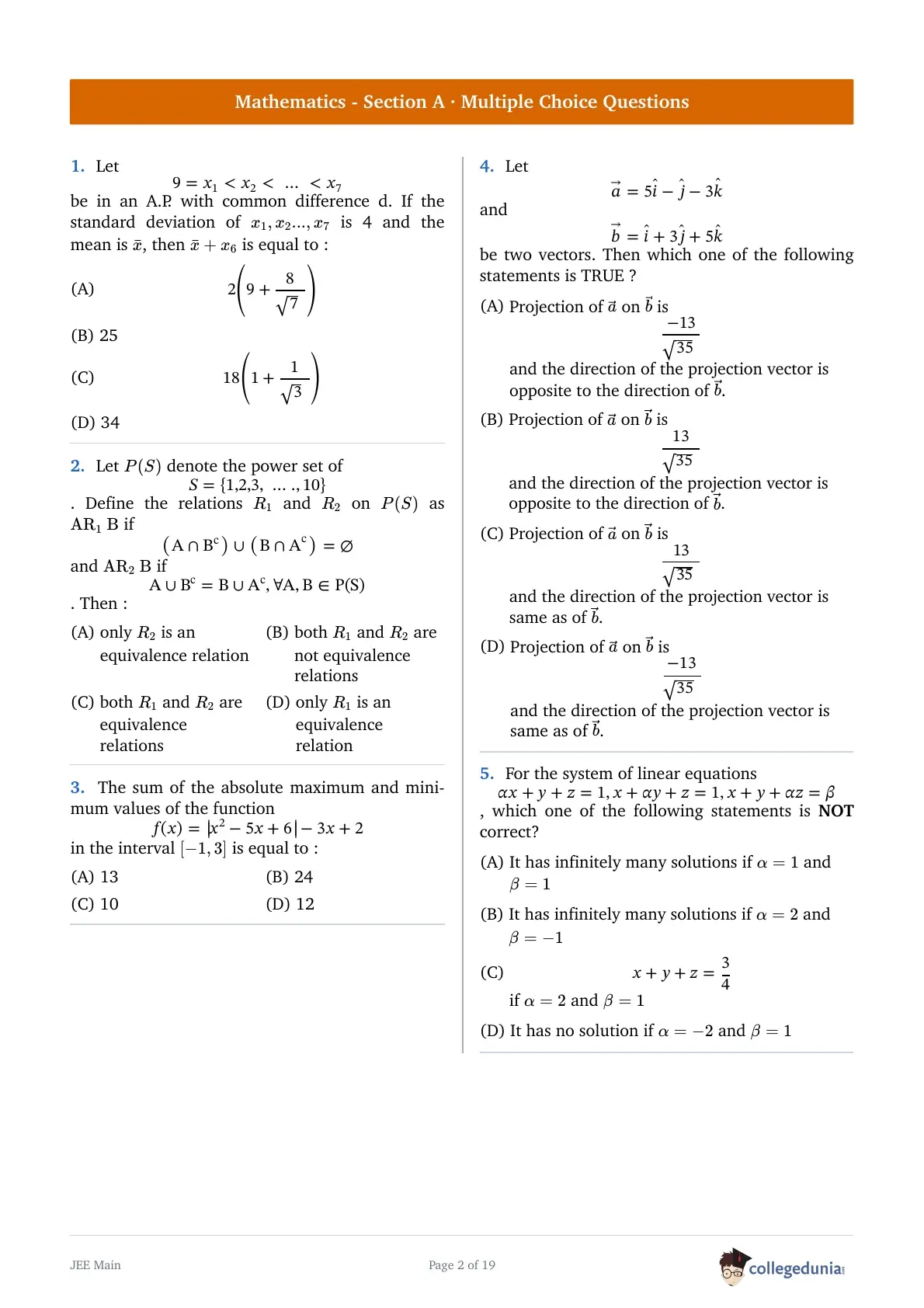
Let \(9 =\) \(x_1<x_2<…<x_7\) be in an A.P. with common difference d. If the standard deviation of \(x_1,x_2 …,x_7\) is 4 and the mean is \(\bar x\), then \(\bar x+x_6\) is equal to :
Let \(P(S)\) denote the power set of \(S = \{1, 2, 3, \ldots, 10\}\). Define the relations \(R_1\) and \(R_2\) on \(P(S)\) as \(A R_1 B\) if \[(A \cap B^c) \cup (B \cap A^c) = ,\]and \(A R_2 B\) if\[A \cup B^c = B \cup A^c,\]for all \(A, B \in P(S)\). Then:
The sum of the absolute maximum and minimum values of the function \(f(x)=\left|x^2-5 x+6\right|-3 x+2\)in the interval \([-1,3]\) is equal to :
Let \(\vec{a}=5 \hat{i}-\hat{j}-3 \hat{k}\) and \(\vec{b}=\hat{i}+3 \hat{j}+5 \hat{k}\) be two vectors Then which one of the following statements is TRUE ?
For the system of linear equations\(\alpha x+y+z=1, x+\alpha y+z=1, x+y+\alpha z=\beta\) which one of the following statements is NOT correct ?
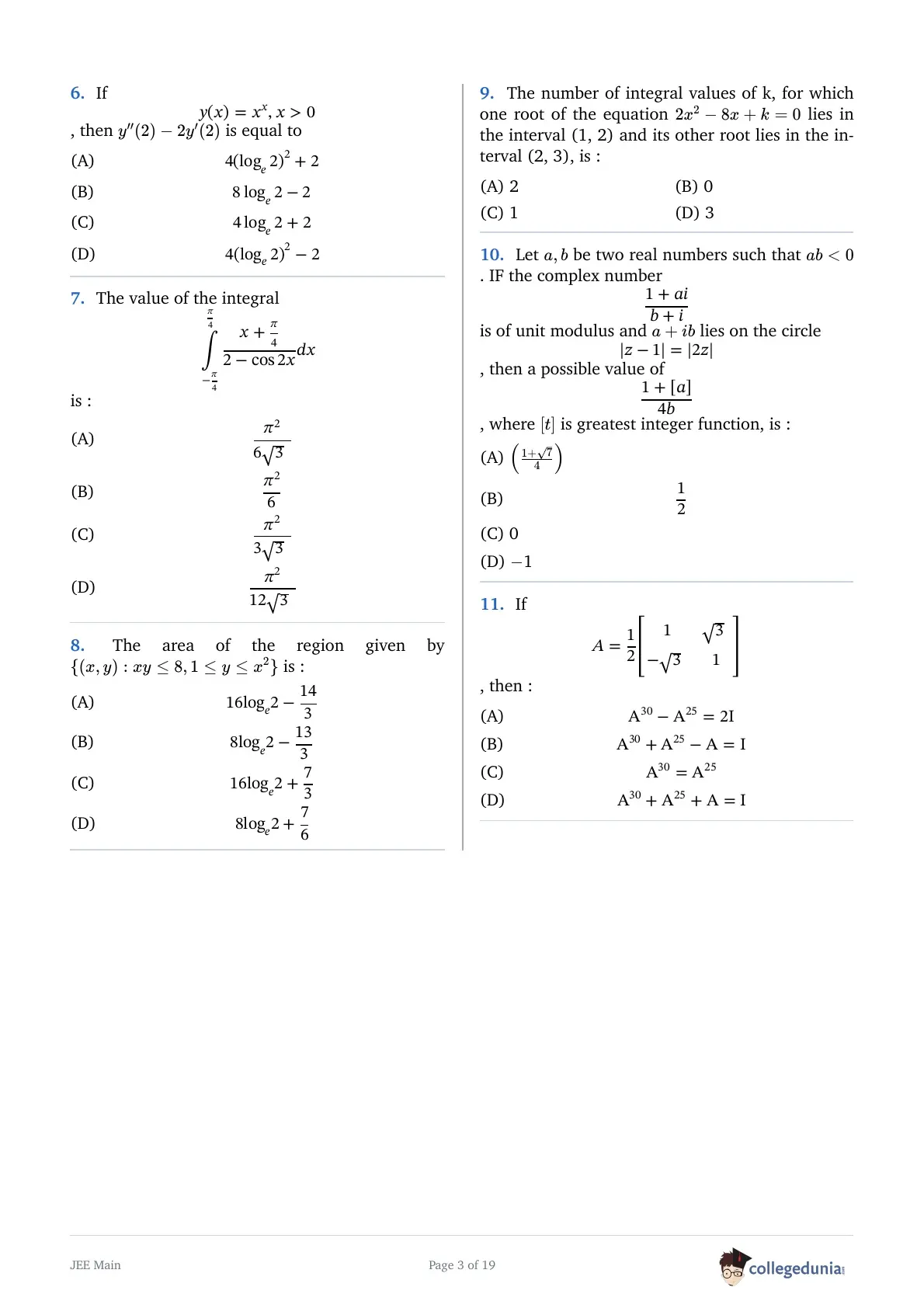
If \( y(x) = x^x, \, x > 0 \), then \( y''(2) - 2y'(2) \) is equal to:
The value of the integral \(\int \limits_{-\frac{\pi}{4}}^{\frac{\pi}{4}} \frac{x+\frac{\pi}{4}}{2-\cos 2 x} d x\)is :
The area of the region given by \(\left\{(x, y): x y \leq 8,1 \leq y \leq x^2\right\}\) is :
The number of integral values of \(k\), for which one root of the equation \[2x^2 - 8x + k = 0\] lies in the interval \((1, 2)\) and its other root lies in the interval \((2, 3)\), is:
Let \(a, b\) be two real numbers such that \(a b<\) If the complex number \(\frac{1+ai}{b+i}\) is of unit modulus and \(a\) \(+i b\) lies on the circle \(|z-I|=|2 z|\), then a possible value of \(\frac{1+[a ]}{4 b}\), where \([t]\) is greatest integer function, is :
If \(A=\frac{1}{2}\begin{bmatrix}1 & \sqrt{3} \\ -\sqrt{3} & 1\end{bmatrix}\), then :
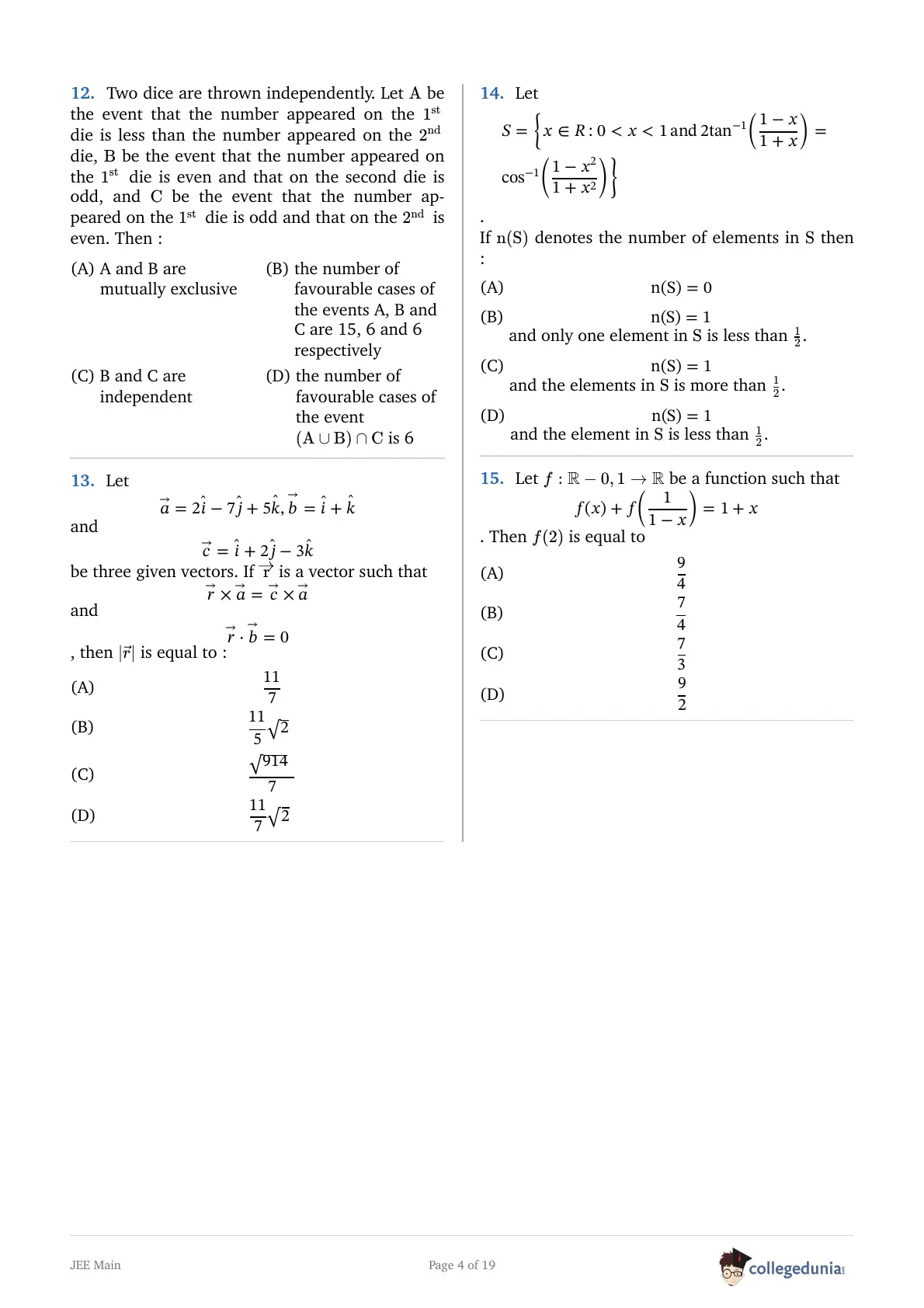
Two dice are thrown independently Let\(A\) be the event that the number appeared on the \(1^{\text {st }}\) die is less than the number appeared on the \(2^{\text {nd }}\) die, \(B\) be the event that the number appeared on the \(1^{\text {st }}\) die is even and that on the second die is odd, and \(C\) be the event that the number appeared on the \(1^{\text {st }}\) die is odd and that on the \(2^{\text {nd }}\) is even Then :
Let\(\overrightarrow{ a }=2 \hat{i}-7 \hat{j}+5 \hat{k}, \overrightarrow{ b }=\hat{i}+\hat{k} and \overrightarrow{ c }=\hat{i}+2 \hat{j}-3 \hat{k}\) be three given vectors If \(\overrightarrow{ r }\) is a vector such that\( \vec{r} \times \vec{a}=\vec{c} \times \vec{a} \ and \ \vec{r} \cdot \vec{b}=0,\) then \(|\vec{r}|\) is equal to :
Let\( S={x∈R:0<x<1 and\ 2 tan−1\frac{(1+x)}{(1−x)}=cos^{−1}\frac{(1-x^2)}{(1+x^2)}}\). If n(S) denotes the number of elements in S then :
Let \(f: R -\{0,1\} \rightarrow R\)be a function such that \(f(x)+f\left(\frac{1}{1-x}\right)=1+x\) Then \(f(2)\) is equal to
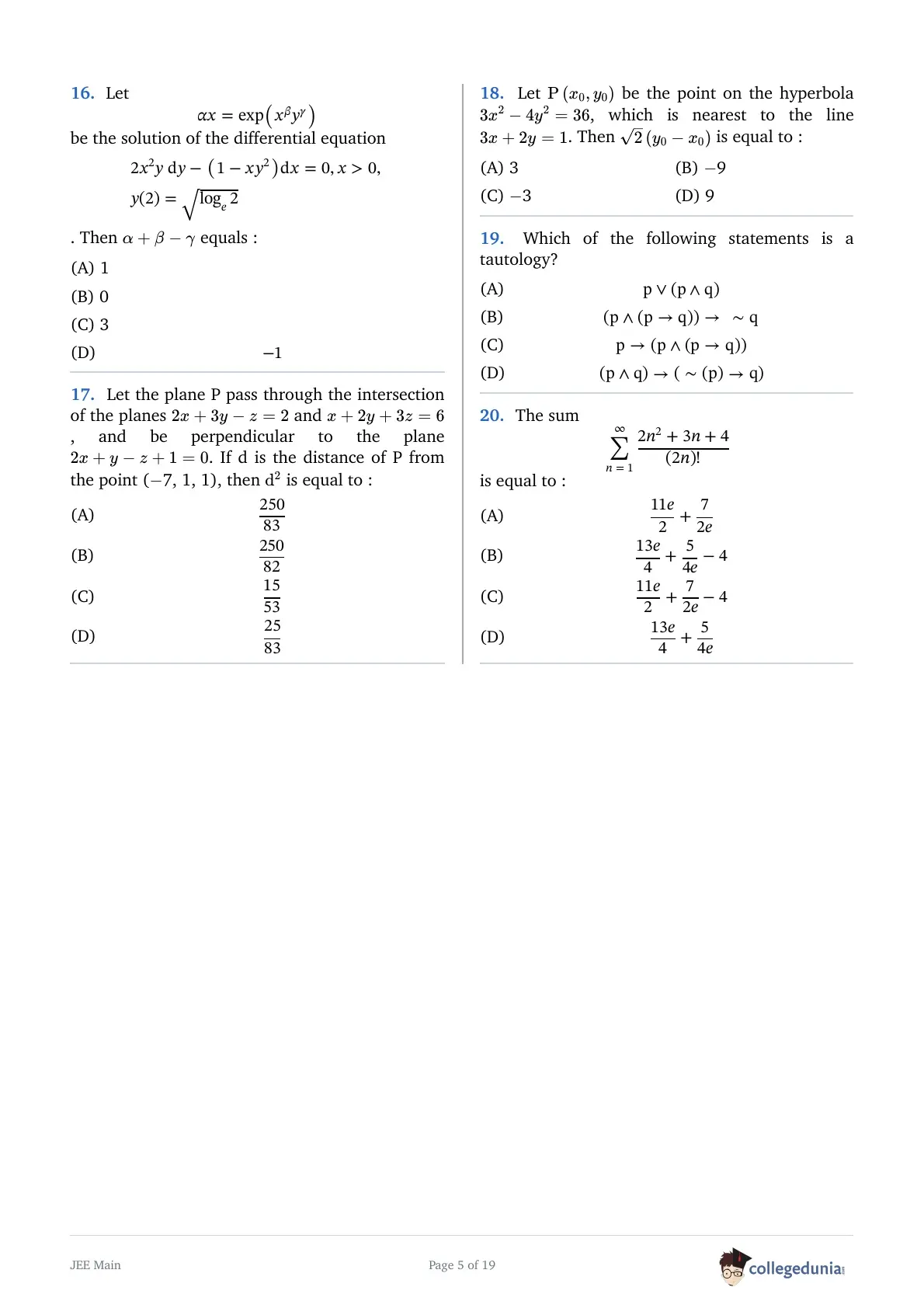
Let αx=exp(xβyγ) be the solution of the differential equation 2x2ydy−(1−xy2) dx = 0, x>0 , y(2)=\(\sqrt {log_e2}\). Then α+β−γ equals :
Let the plane P pass through the intersection of the planes \(2 x+3 y-z=2\)and \(x+2 y+3 z=6,\) and be perpendicular to the plane \(2 x+y-z+1=0\)If d is the distance of P from the point (-7,1,1), then \(d^2\) is equal to :
Let \(P(x_0, y_0)\) be the point on the hyperbola \(3x^2 - 4y^2 = 36\), which is nearest to the line \(3x + 2y = 1\). Then \(\sqrt{2}(y_0 - x_0)\) is equal to:
Which of the following statements is a tautology?
The sum\(\displaystyle\sum_{n=1}^{\infty} \frac{2 n^2+3 n+4}{(2 n) !}\) is equal to:
Mathematics - Section B (Q21 - Q30)
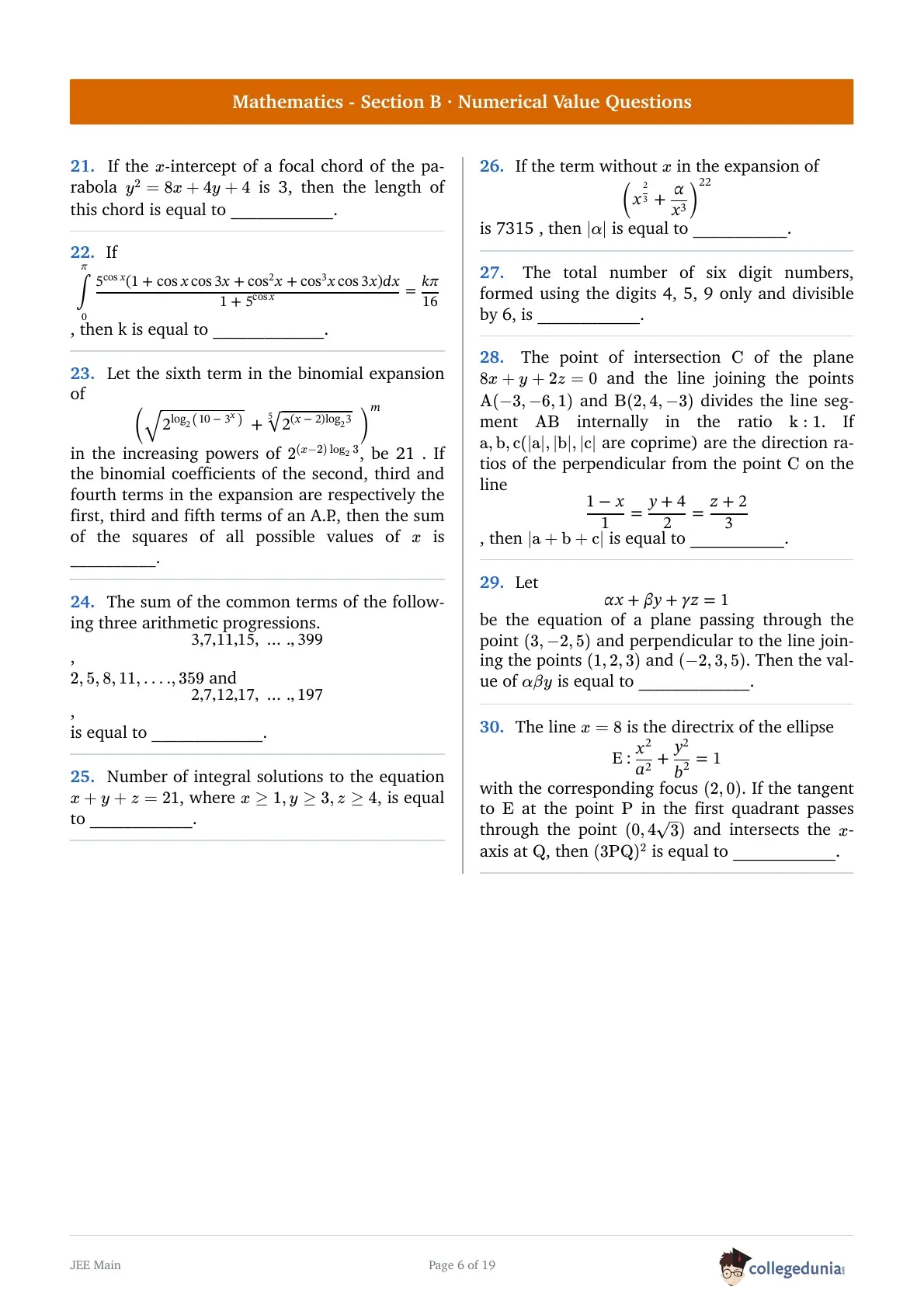
If the x-intercept of a focal chord of the parabola \(y^2=8 x+4 y+4\) is 3 , then the length of this chord is equal to ___
If \(\int \limits_0^\pi \frac{5^{\cos x}\left(1+\cos x \cos 3 x+\cos ^2 x+\cos ^3 x \cos 3 x\right) d x}{1+5^{\cos x}}=\frac{ k \pi}{16}\), then \(k\) is equal to
Let the sixth term in the binomial expansion of \(({\sqrt{2}^{log_{2}}(10-3^{x})+\sqrt[5]{2^{(x-2)log_{2}{3}}}})^{m}\), in the increasing powers of \(2^{(x-2)log_{2}3}\), be 21 If the binomial coefficients of the second, third and fourth terms in the expansion are respectively the first, third and fifth terms of an AP, then the sum of the squares of all possible values of x is
The sum of the common terms of the following three arithmetic progressions\(3,7,11,15, \ldots , 399\), \(2,5,8,11, \ldots , 359\)and \(2,7,12,17, \ldots , 197,\) is equal to _____
Number of integral solutions to the equation \(x+y+z=21\), where \(x \geq 1\), \(y \geq 3\), \(z \geq 4\), is equal to ___
If the term without \(x\) in the expansion of \(\left(x^{\frac{2}{3}}+\frac{\alpha}{x^3}\right)^{22}\)is 7315 , then \(|\alpha|\) is equal to ___
The total number of six digit numbers, formed using the digits 4,5,9 only and divisible by 6 , is __
The point of intersection \(C\) of the plane \(8 x+y+2 z=0\) and the line joining the points \(A (-3,-6,1)\) and \(B (2,4,-3)\)divides the line segment \(AB\) internally in the ratio\(k : 1 \ If a , b , c (| a |,| b |, | c |\)are coprime) are the direction ratios of the perpendicular from the point \(C\)on the line \(\frac{1-x}{1}=\frac{y+4}{2}=\frac{z+2}{3}\), then \(| a + b + c |\)is equal to ___
Let \(\alpha x+\beta y+y z=1\) be the equation of a plane passing through the point\((3,-2,5)\)and perpendicular to the line joining the points \((1,2,3)\) and \((-2,3,5)\) Then the value of \(\alpha \beta y\)is equal to ____
The line \(x=8\) is the directrix of the ellipse \(E : \frac{x^2}{ a ^2}+\frac{y^2}{b^2}=1\)with the corresponding focus \((2,0)\) If the tangent to \(E\)at the point \(P\) in the first quadrant passes through the point \((0,4 \sqrt{3})\)and intersects the\(x\)-axis at \(Q\), then \((3 PQ )^2\)is equal to ____
Physics - Section A (Q31 - Q50)
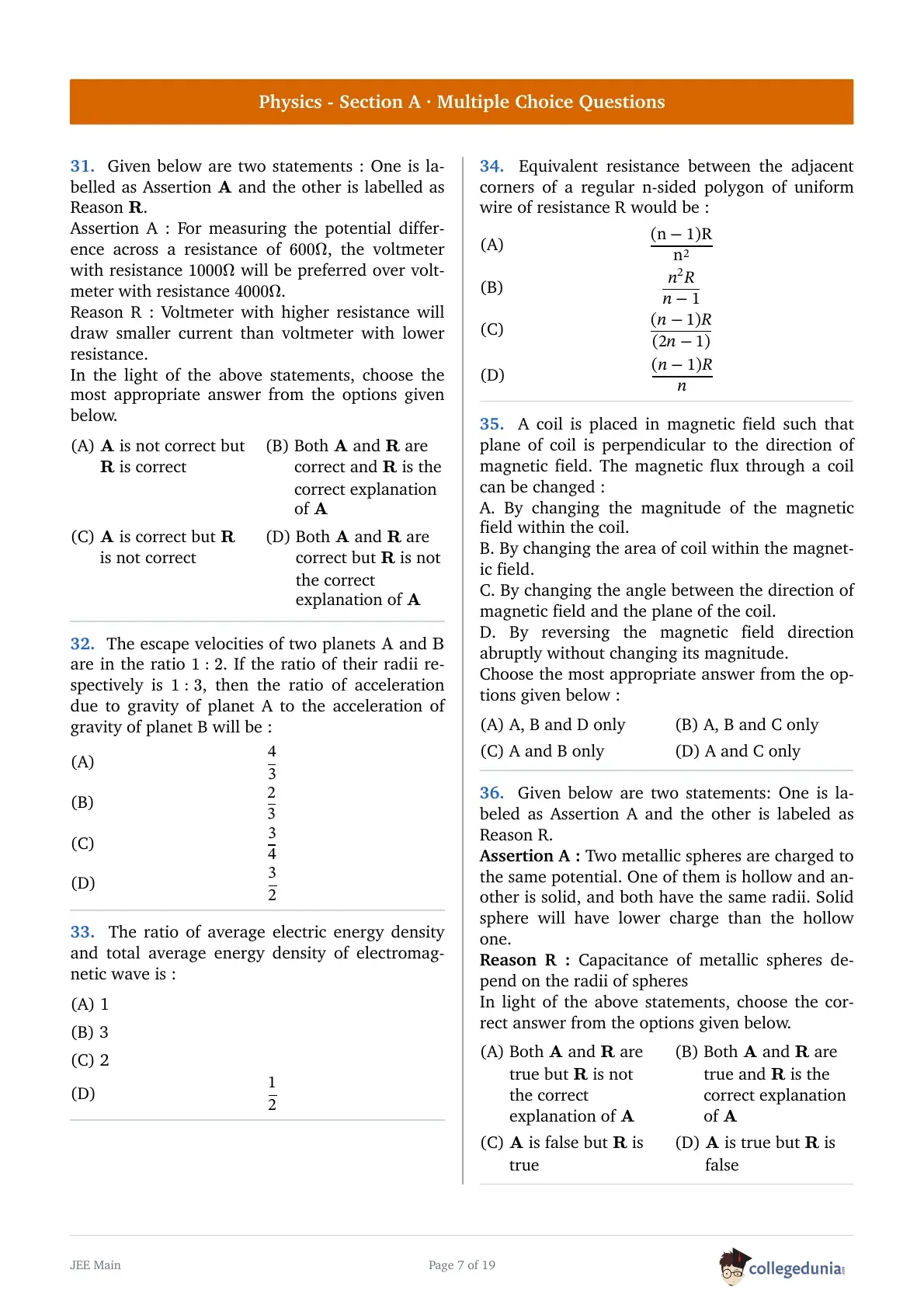
Given below are two statements : One is labelled as Assertion \(A\) and the other is labelled as Reason R
Assertion A : For measuring the potential difference across a resistance of \(600 \Omega\), the voltmeter with resistance \(1000 \Omega\) will be preferred over voltmeter with resistance \(4000 \Omega\).
Reason R : Voltmeter with higher resistance will draw smaller current than voltmeter with lower resistance.
In the light of the above statements, choose the most appropriate answer from the options given below
The escape velocities of two planets \(A\) and \(B\) are in the ratio \(1: 2\) If the ratio of their radii respectively is\(1: 3\), then the ratio of acceleration due to gravity of planet \(A\) to the acceleration of gravity of planet B will be :
The ratio of average electric energy density and total average energy density of electromagnetic wave is:
Equivalent resistance between the adjacent corners of a regular \(n\)-sided polygon of uniform wire of resistance \(R\) would be :
A coil is placed in magnetic field such that plane of coil is perpendicular to the direction of magnetic field. The magnetic flux through a coil can be changed :
A. By changing the magnitude of the magnetic field within the coil
B. By changing the area of coil within the magnetic field
C. By changing the angle between the direction of magnetic field and the plane of the coil
D. By reversing the magnetic field direction abruptly without changing its magnitude.
Choose the most appropriate answer from the options given below :
Given below are two statements : One is labelled as Assertion \(A\) and the other is labelled as Reason R
Assertion A : Two metallic spheres are charged to the same potential One of them is hollow and another is solid, and both have the same radii Solid sphere will have lower charge than the hollow one.
Reason R : Capacitance of metallic spheres depend on the radii of spheres.
In the light of the above statements, choose the correct answer from the options given below.
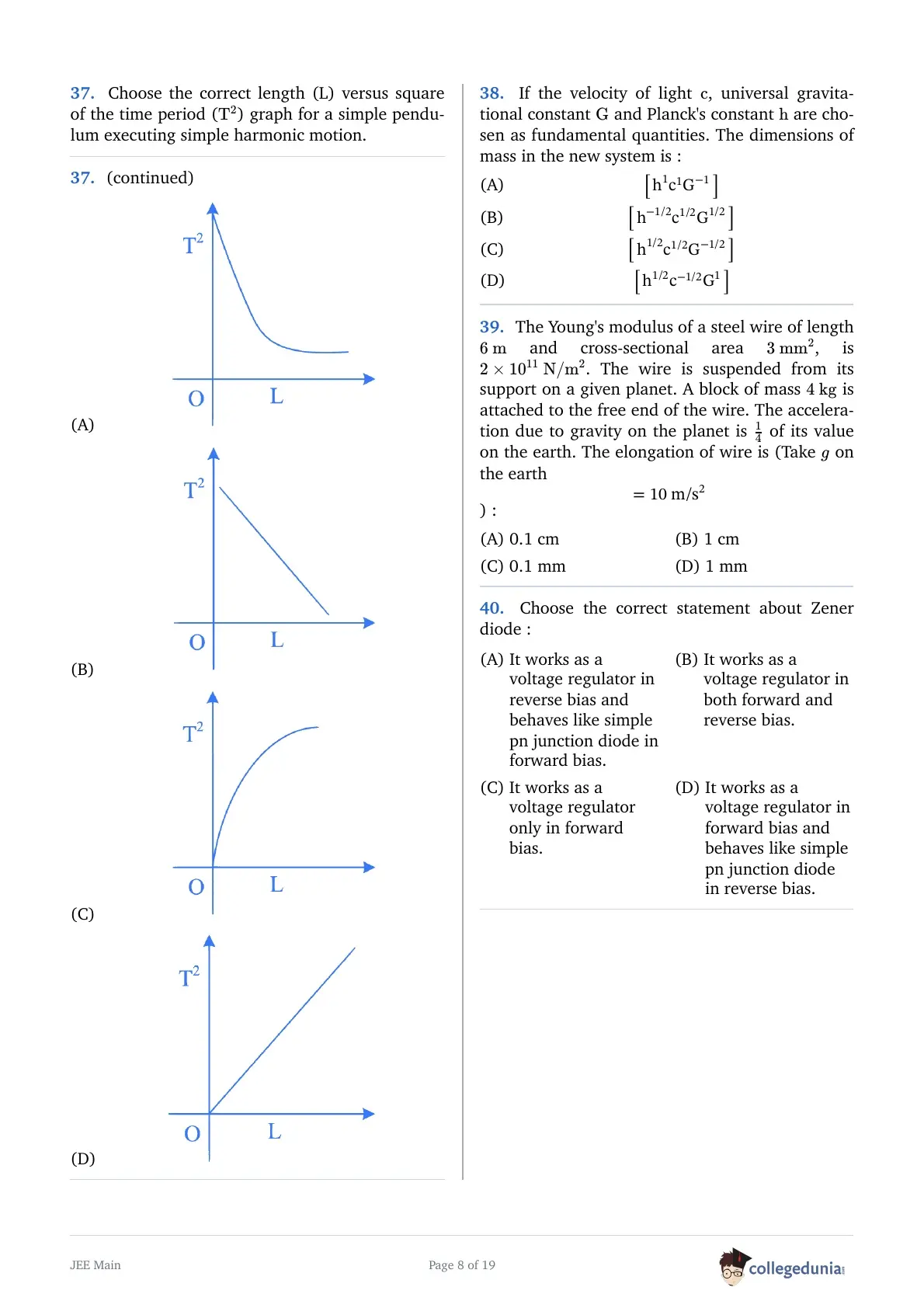
Choose the correct length \(( L )\) versus square of time period (T2) graph for a simple pendulum executing simple harmonic motion
- (1)
![]()
- (2)
![]()
- (3)
![]()
- (4)
![]()


If the velocity of light \(c\), universal gravitational constant \(G\) and Planck's constant \(h\) are chosen as fundamental quantities The dimensions of mass in the new system is :
The Young's modulus of a steel wire of length \(6 m\) and cross-sectional area \(3 \,mm ^2\), is \(2 \times 10^{11}\) \(N / m ^2\). The wire is suspended from its support on a given planet A block of mass \(4 kg\) is attached to the free end of the wire. The acceleration due to gravity on the planet is \(\frac{1}{4}\) of its value on the earth The elongation of wire is (Take \(g\) on the earth \(=10\, m / s ^2\)) :
Choose the correct statement about Zener diode :
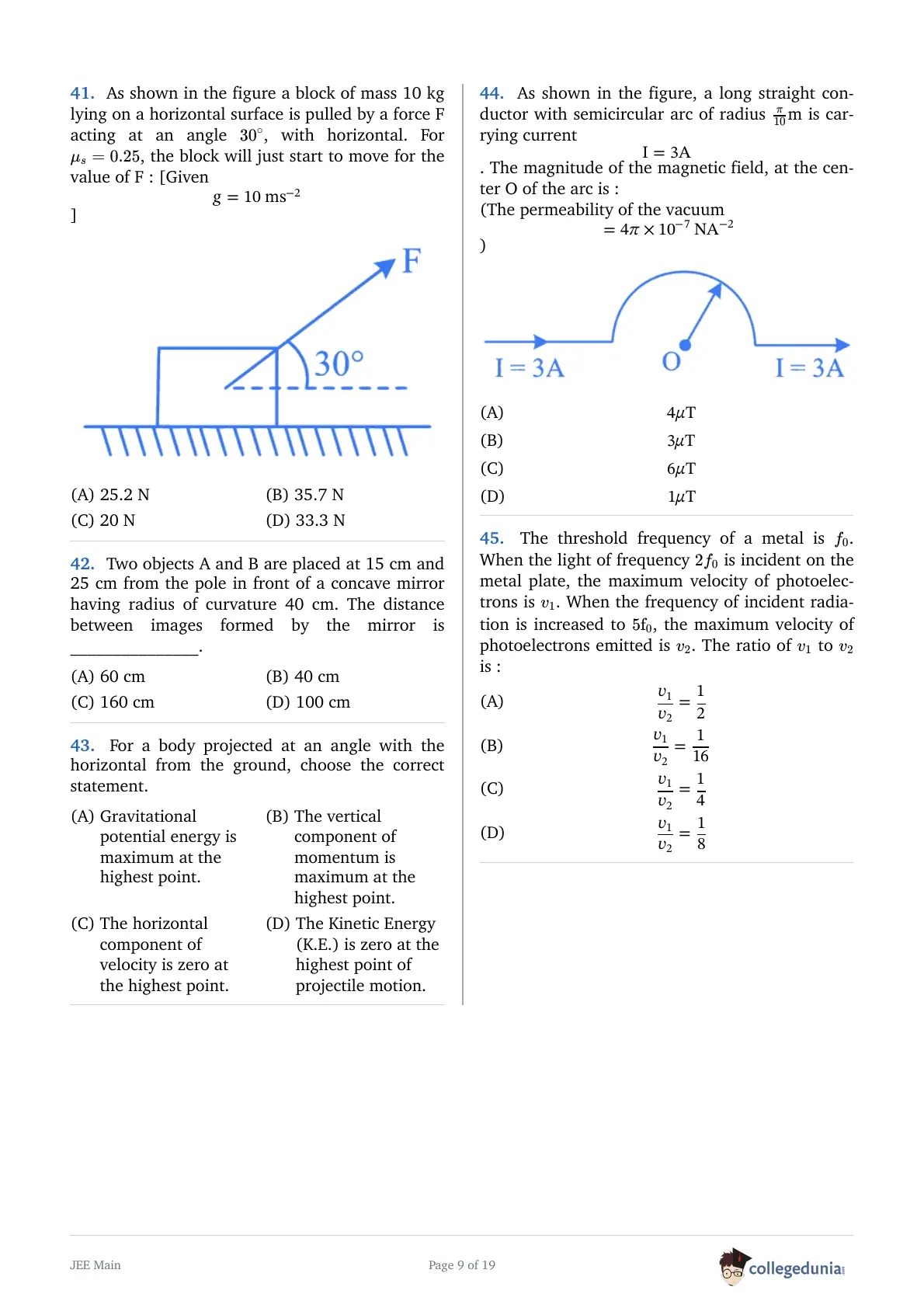
As shown in the figure a block of mass \(10\, kg\) lying on a horizontal surface is pulled by a force \(F\)acting at an angle \(30^{\circ}\), with horizontal For \(\mu_{ s }=0.25\), the block will just start to move for the value of \(F\) : [Given g=10ms-2]

Two objects \(A\) and \(B\)are placed at \(15\, cm\) and \(25\, cm\) from the pole in front of a concave mirros having radius of curvature \(40\, cm\). The distance between images formed by the mirror is:
For a body projected at an angle with the horizontal from the ground, choose the correct statement.
As shown in the figure, a long straight conductor with semi-circular are of radius \(\frac{\pi}{10} m\) is carrying current \(I =3 A\). The magnitude of the magnetic field at the center \(O\) of the arc is :(The permeability of the vacuum \(=4 \pi \times 10^{-7} NA ^{-2}\) )

The threshold frequency of a metal is \(f _0\) When the light of frequency \(2 f _0\) is incident on the metal plate, the maximum velocity of photoelectrons is \(v_1\) When the frequency of incident radiation is increased to \(5 f _0\), the maximum velocity of photoelectrons emitted is \(v_2\) The ratio of \(v_1\) to \(v_2\) is :
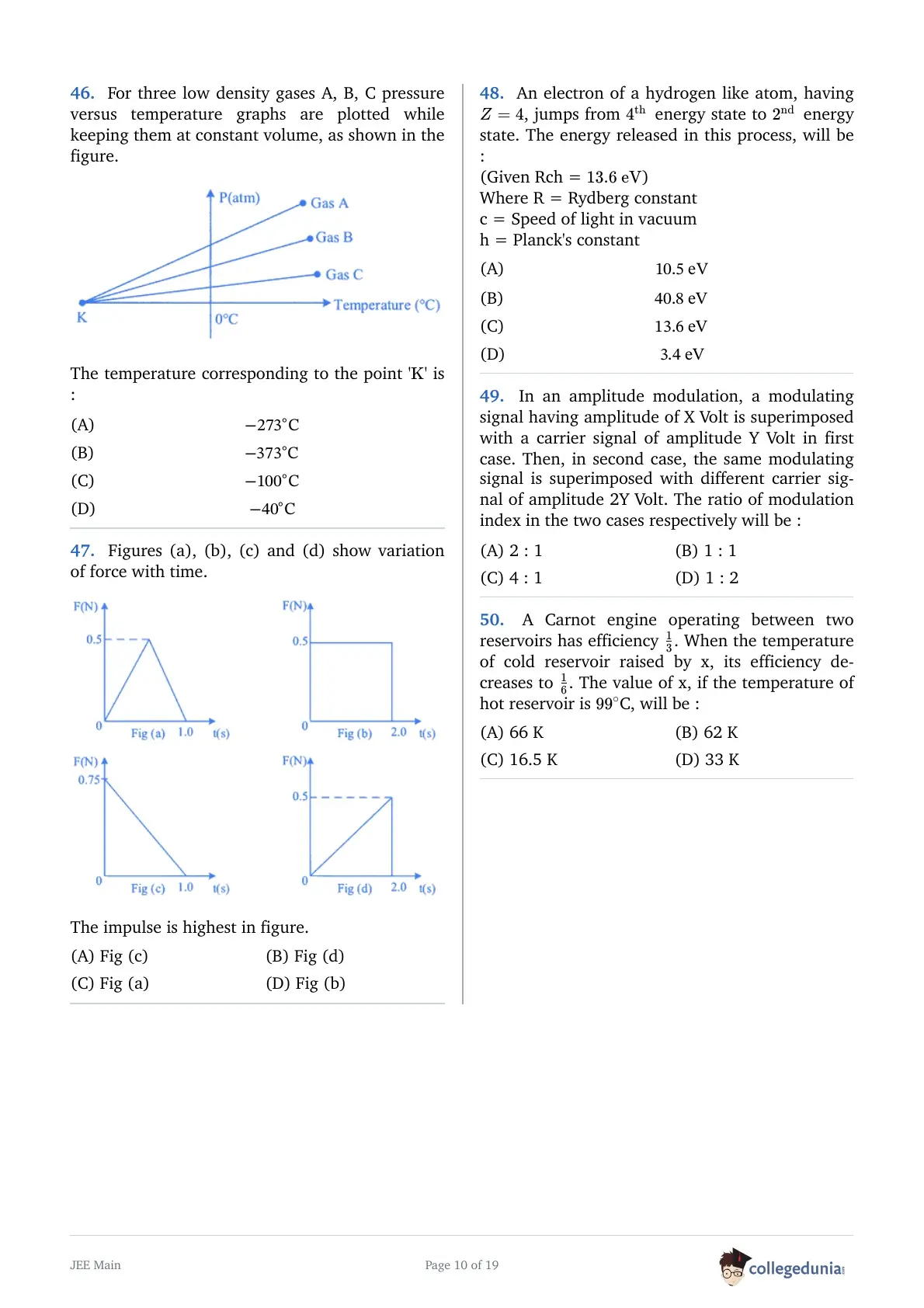
For three low density gases \(A , B , C\) pressure versus temperature graphs are plotted while keeping them at constant volume, as shown in the figure.

Figures (a), (b), (c) and (d) show variation of force with time The impulse is highest in figure

An electron of a hydrogen like atom, having \(Z=4\), jumps from \(4^{\text {th }}\) energy state to \(2^{\text {nd }}\) energy state. The energy released in this process, will be :
\((\) Given Rch \(=136 eV )\)
Where \(R =\) Rydberg constant
\(c =\) Speed of light in vacuum
\(h =\) Planck's constant
In an amplitude modulation, a modulating signal having amplitude of \(X V\) is superimposed with a carrier signal of amplitude \(Y V\) in first case. Then, in second case, the same modulating signal is superimposed with different carrier signal of amplitude \(2 YV\). The ratio of modulation index in the two cases respectively will be :
A Carnot engine operating between two reservoirs has efficiency \(\frac{1}{3}\) When the temperature of cold reservoir raised by \(x\), its efficiency decreases to \(\frac{1}{6}\) The value of \(x\), if the temperature of hot reservoir is \(99^{\circ} C\), will be :
Physics - Section B (Q51 - Q60)
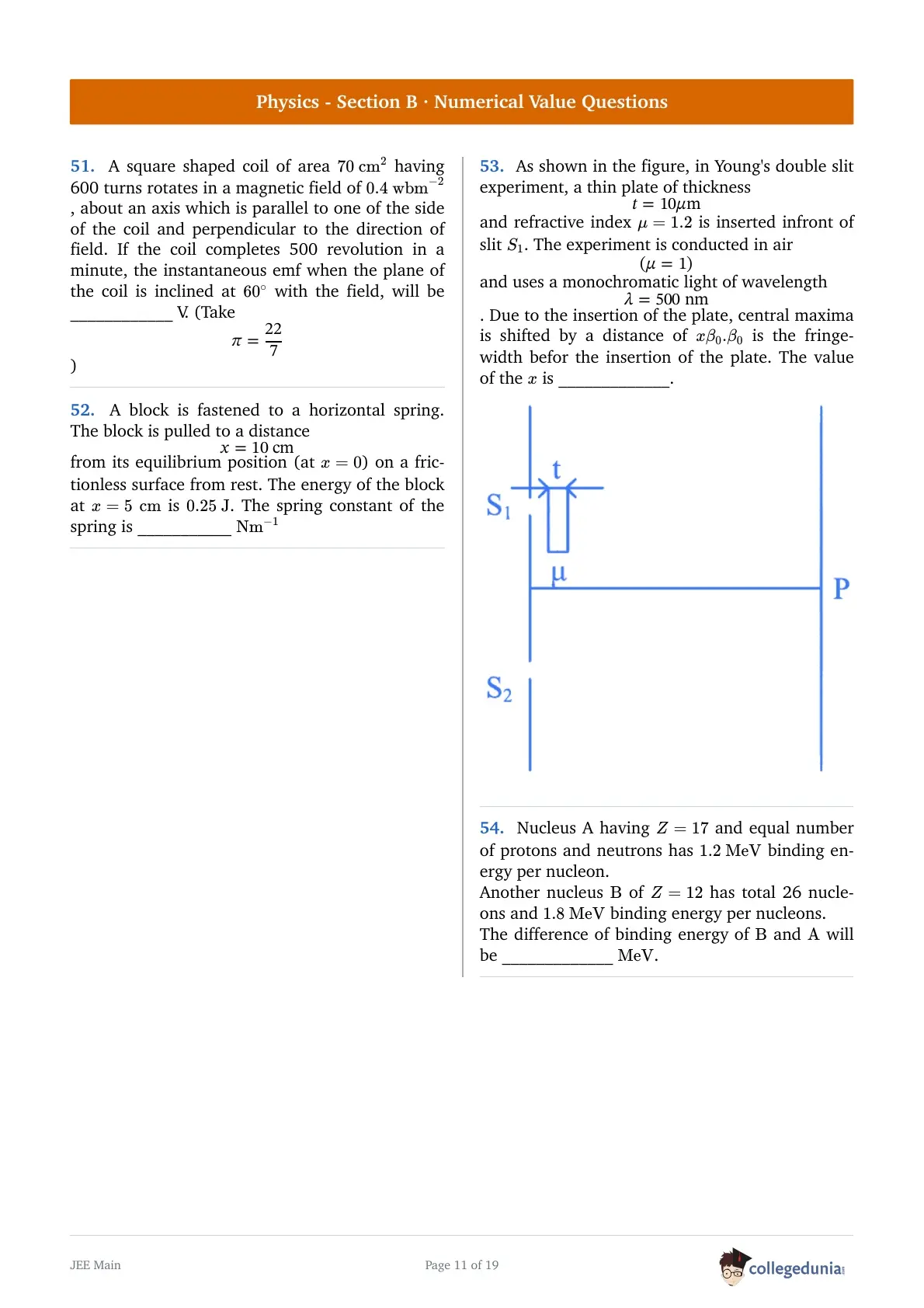
A square-shaped coil of area \(70 \, \text{cm}^2\) having 600 turns rotates in a magnetic field of \(0.4 \, \text{wbm}^{-2}\), about an axis which is parallel to one of the sides of the coil and perpendicular to the direction of the field. If the coil completes 500 revolutions in a minute, the instantaneous emf when the plane of the coil is inclined at \(60^\circ\) with the field, will be ________ V. (Take \(\pi = \frac{22}{7}\))
A block is fastened to a horizontal spring. The block is pulled to a distance \(x=10\ cm\) from its equilibrium position (at \(x=0\) ) on a frictionless surface from rest. The energy of the block at \(x=5\) \(cm\) is \(025 J\). The spring constant of the spring is _____\(Nm ^{-1}\).
As shown in the figure, in Young’s double slit experiment, a thin plate of thickness \(t = 10 \, \mu\text{m}\) and refractive index \(\mu = 1.2\) is inserted in front of slit \(S_1\). The experiment is conducted in air (\(\mu = 1\)) and uses a monochromatic light of wavelength \(\lambda = 500 \, \text{nm}\). Due to the insertion of the plate, central maxima is shifted by a distance of \(x \beta_0\). \(\beta_0\) is the fringe-width before the insertion of the plate. The value of \(x\) is _________.
Nucleus \(A\) having \(Z=17\) and equal number of protons and neutrons has \(12 MeV\) binding energy per nucleonAnother nucleus \(B\) of \(Z=12\) has total 26 nucleons and \(18 MeV\) binding energy per nucleons The difference of binding energy of \(B\) and \(A\) will be ___\(MeV\)
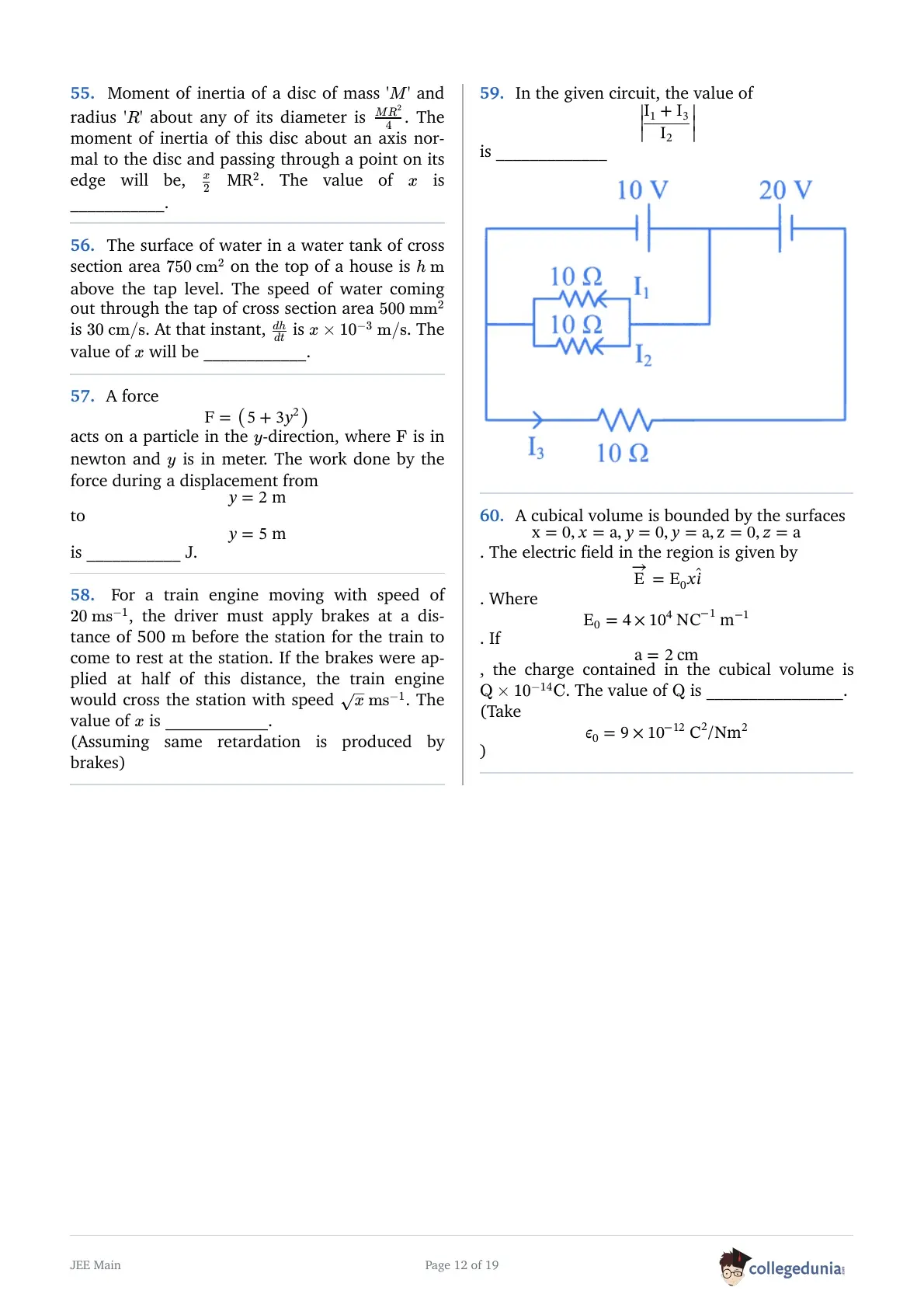
Moment of inertia of a disc of mass \(M\) and radius \(R\) about any of its diameters is \(\frac{MR^2}{4}\). The moment of inertia of this disc about an axis normal to the disc and passing through a point on its edge will be, \(\frac{x}{2}MR^2\). The value of \(x\) is _________.
The surface of water in a water tank of cross section area \(750 \, \text{cm}^2\) on the top of a house is \(h \, \text{m}\) above the tap level. The speed of water coming out through the tap of cross section area \(500 \, \text{mm}^2\) is \(30 \, \text{cm/s}\). At that instant, \(\frac{dh}{dt}\) is \(x \times 10^{-3} \, \text{m/s}\). The value of \(x\) will be _________.
A force \(F =\left(5+3 y^2\right)\) acts on a particle in the \(y\)-direction, where \(F\) is in newton and \(y\) is in meter The work done by the force during a displacement from \(y=2 m\) to \(y=5 m\) is___ \(J\).
For a train engine moving with speed of \(20\, ms ^{-1}\), the driver must apply brakes at a distance of 500 \(m\)before the station for the train to come to rest at the station. If the brakes were applied at half of this distance, the train engine would cross the station with speed \(\sqrt{x} ms ^{-1}\). The value of \(x\) is ________ . (Assuming same retardation is produced by brakes)
In the given circuit, the value of \(\left|\frac{I_1+I_3}{I_2}\right|\) is ___.

A cubical volume is bounded by the surfaces \( x = 0 \), \( x = a \), \( y = 0 \), \( y = a \), \( z = 0 \), \( z = a \). The electric field in the region is given by: \[ \vec{E} = E_0 x \hat{i} \]
Where \( E_0 = 4 \times 10^4 \, \text{NC}^{-1} \, \text{m}^{-1} \). If \( a = 2 \, \text{cm} \), the charge contained in the cubical volume is \( Q \times 10^{-14} \, \text{C} \). The value of \( Q \) is ______. (Take \( \epsilon_0 = 9 \times 10^{-12} \, \text{C}^2/\text{Nm}^2 \))
Chemistry - Section A (Q61 - Q80)
\(O - O\) bond length in \(H _2 O _2\) is X than the \(O - O\) bond length in \(F _2 O _2\)The \(O - H\) bond length in \(H _2 O _2\)is Y than that of the\(O - F\) bond in \(F _2 O _2\)Choose the correct option for \(\underline{X} and \underline{Y}\) from those given below :
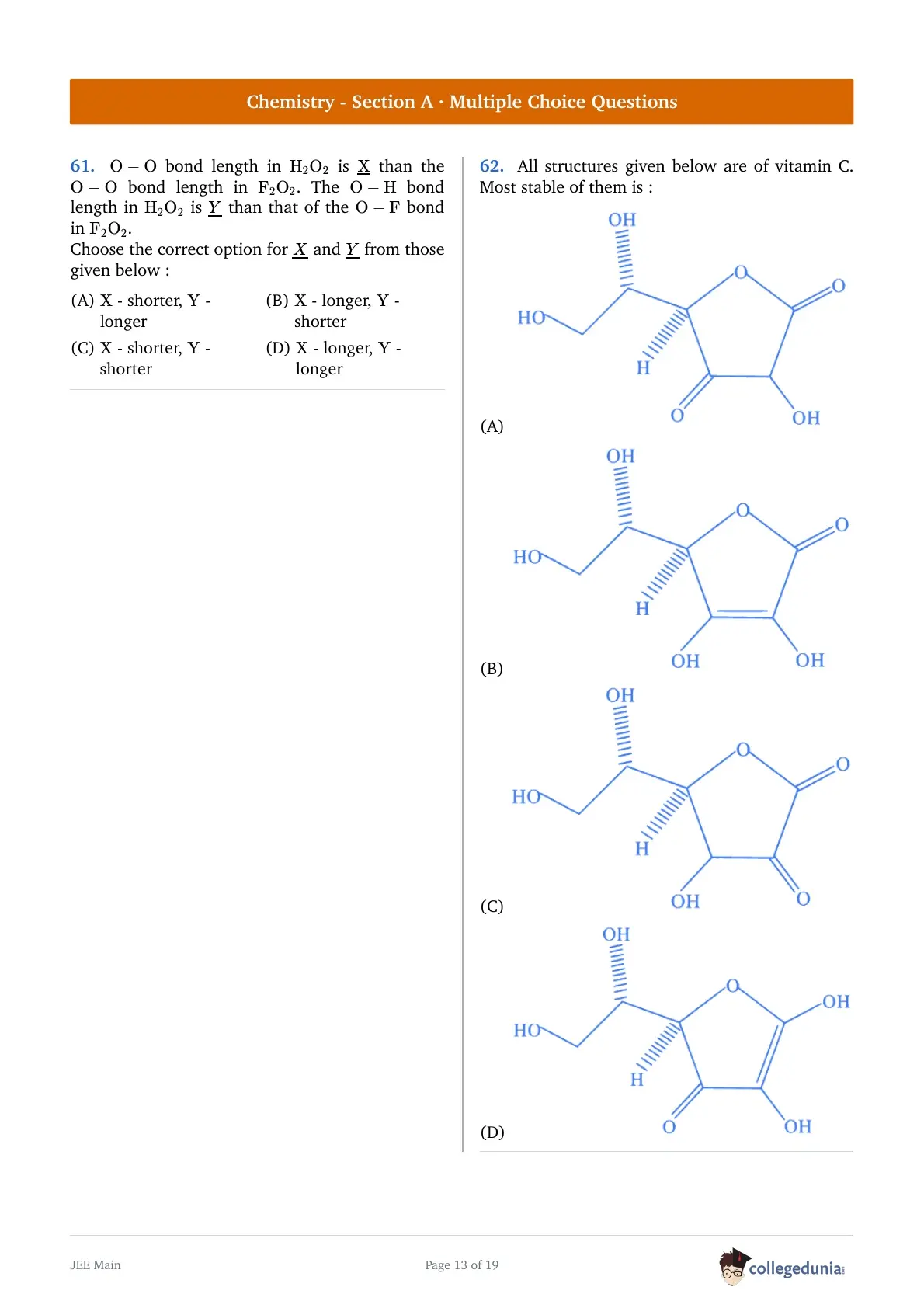
All structures given below are of vitamin \(C\) Most stable of them is :
- (1)
![]()
- (2)
![]()
- (3)
![]()
- (4)
![]()




Given below are two statements :
Statement I : Sulphanilic acid gives esterification test for carboxyl group
Statement II : Sulphanilic acid gives red colour in Lassigne's test for extra element detection In the light of the above statements, choose the most appropriate answer from the options given below :
Which element is not present in Nessler's reagent?
Given below are two statements : one is labelled as Assertion (A) and the other is labelled as Reason (R)
Assertion (A): \(\alpha\)-halocarboxylic acid on reaction with dil \(NH _3\) gives good yield of \(\alpha\)-aminocarboxylic acid whereas the yield of amines is very low when prepared from alkyl halides
Reason (R): Amino acids exist in zwitter ion form in aqueous medium
In the light of the above statements, choose the correct answer from the options given below :
Given below are two statements : one is labelled as Assertion (A) and the other is labelled as Reason (R)
Assertion (A): \(Cu ^{2+}\) in water is more stable than \(Cu ^{+}\)
Reason (R): Enthalpy of hydration for \(Cu ^{2+}\) is much less than that of \(Cu ^{+}\)
In the light of the above statements, choose the correct answer from the options given below :
The effect of addition of helium gas to the following reaction in equilibrium state, is : \(PCl _5( g ) \rightleftharpoons PCl _3( g )+ Cl _2( g )\)
Which one of the following sets of ions represents a collection of isoelectronic species ?
(Given : Atomic Number : \(F : 9, Cl : 17, Na =11, Mg =12, Al =13, K =19, Ca =20, Sc =21\))
For electron gain enthalpies of the elements denoted as\(\Delta_{ eg } H\), the incorrect option is :
Given below are two statements : one is labelled as Assertion (A) and the other is labelled as Reason (R)
Assertion (A) : An aqueous solution of \(KOH\) when used for volumetric analysis, its concentration should be checked before the use
Reason (R) : On aging,\(KOH\) solution absorbs atmospheric \(CO _2\)
In the light of the above statements, choose the correct answer from the options given below :
The complex cation which has two isomers is :
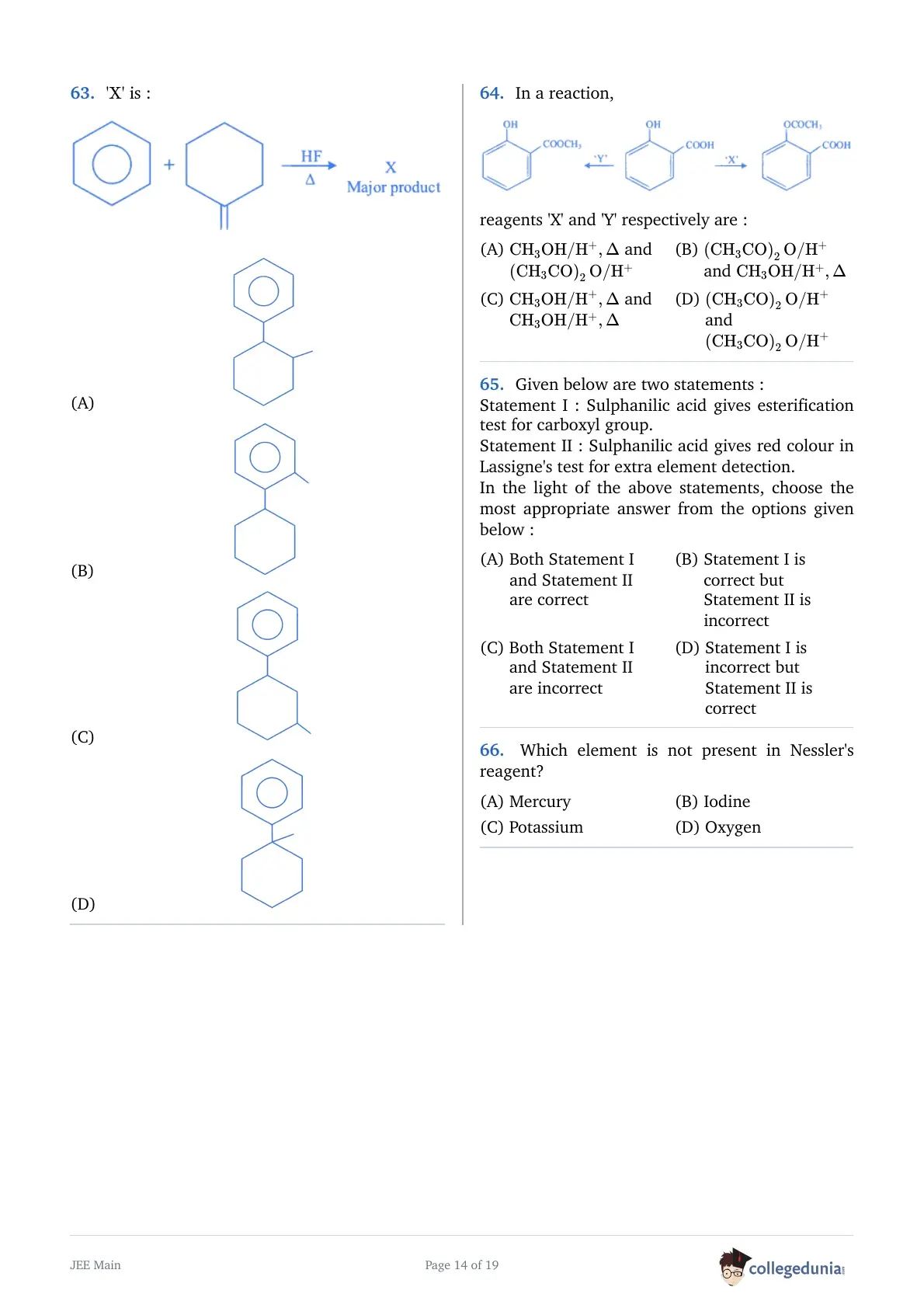
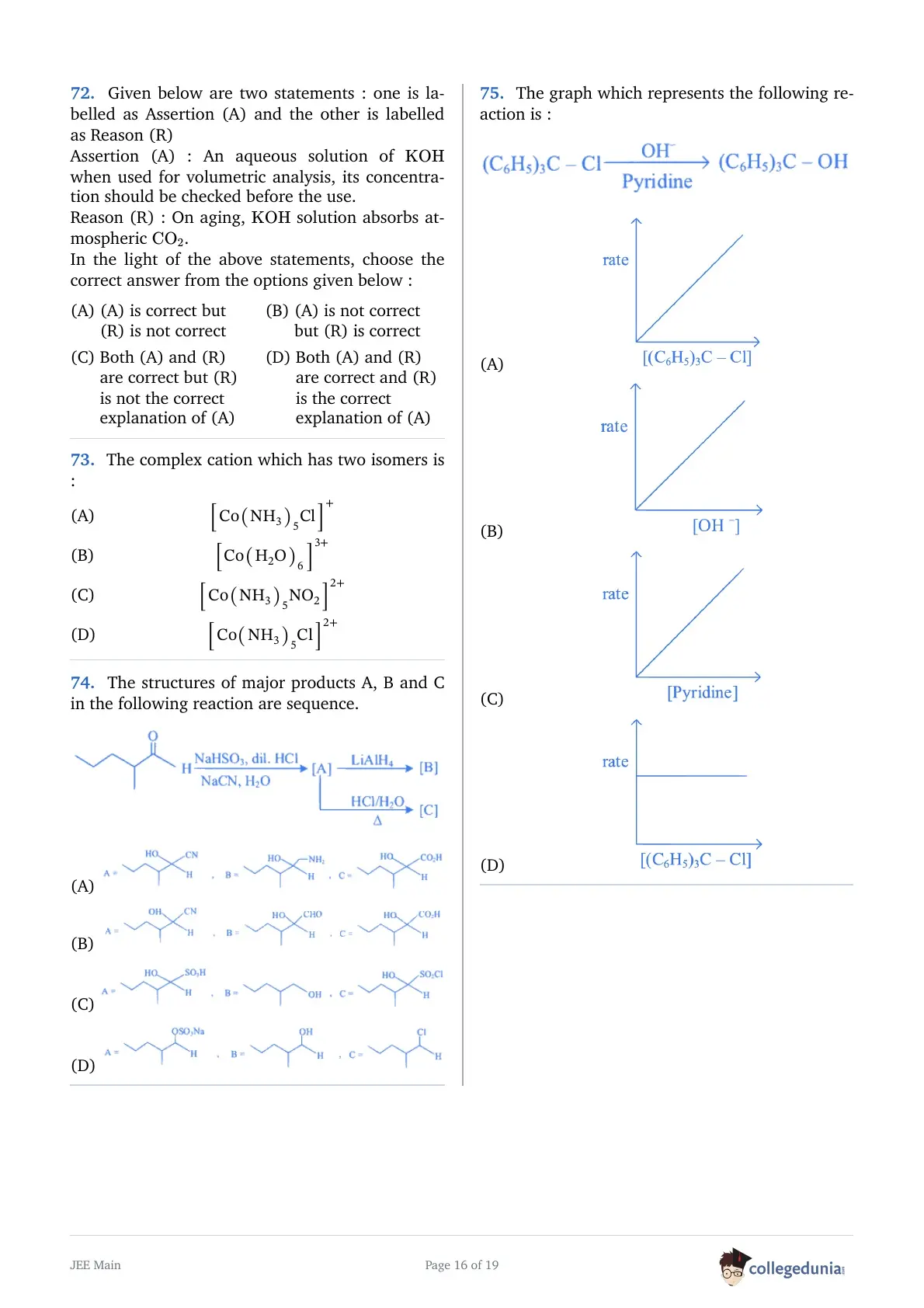
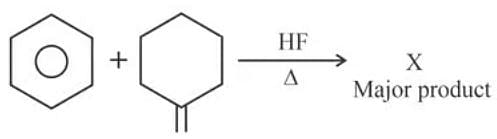
The structures of major products A , B and C in the following reaction are sequence

- (1)
![]()
- (2)
![]()
- (3)
![]()
- (4)
![]()


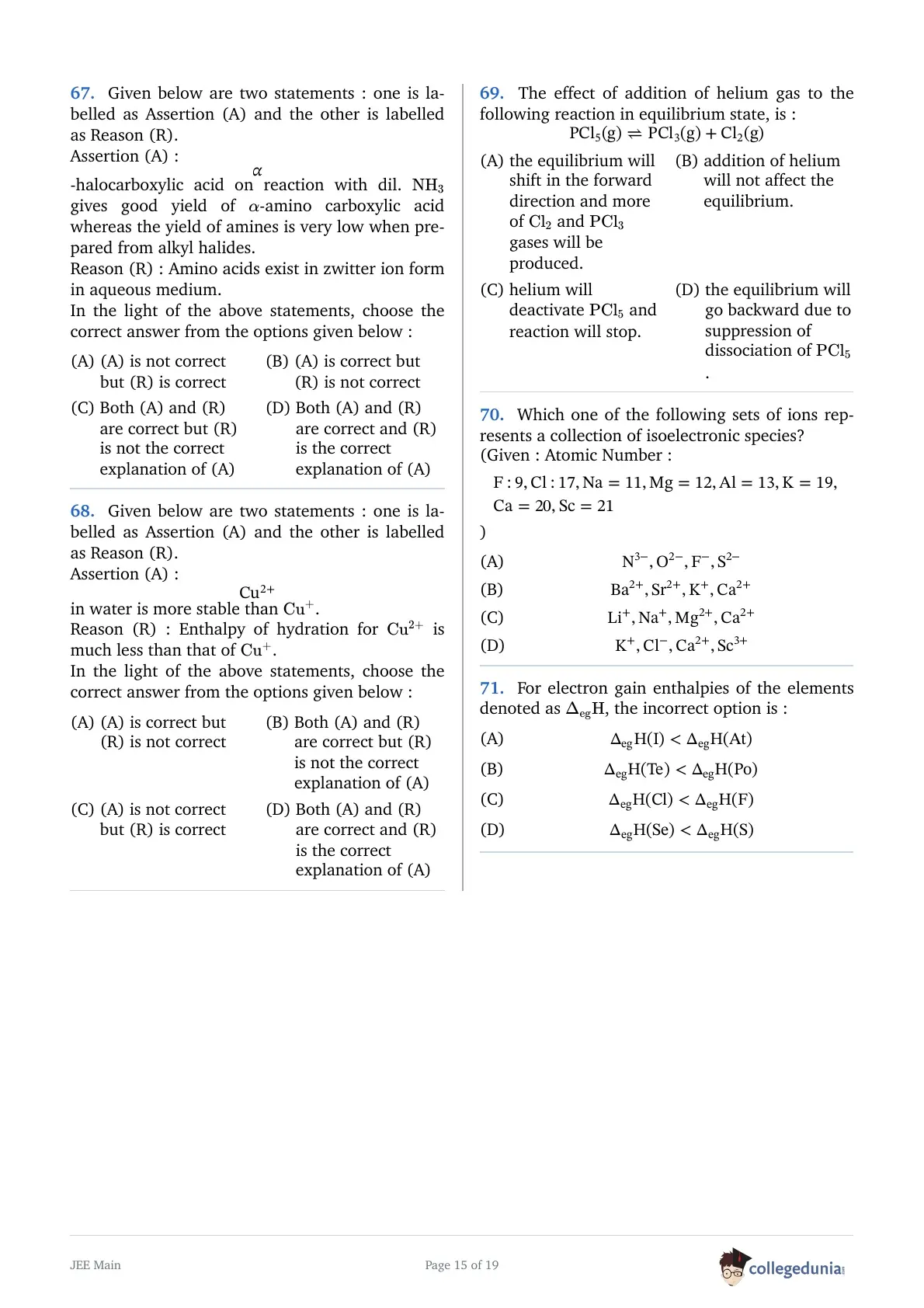
The graph which represents the following reaction is :

- (1)
![]()
- (2)
![]()
- (3)
![]()
- (4)
![]()


The industrial activity held least responsible for global warming is :
The starting material for convenient preparation of deuterated hydrogen peroxide \(\left(D_2 O _2\right)\) in laboratory is :
The correct order of bond enthalpy \(\left( kJ mol ^{-1}\right)\) is :
Given below are two statements : one is labelled as Assertion (A) and the other is labelled as Reason (R)
Assertion (A): Gypsum is used for making fireproof wall boards
Reason (R): Gypsum is unstable at high temperatures
In the light of the above statements, choose the correct answer from the options given below :
In figure, a straight line is given for Freundrich Adsorption\((y=3 x+2505)\) The value of \(\frac{1}{ n }\)and\(\log K\)are respectively
Chemistry - Section B (Q81 - Q90)
Among following compounds, the number of those present in copper matte is ___ .
\(CuCO _3\)
\(Cu _2 S\)
\(Cu _2 O\)
\(FeO\)
\(1 \times 10^{-5} M \,AgNO _3\)is added to \(1\, L\) of saturated solution of\(AgBr\) The conductivity of this solution at \(298 \,K\) is ___ [Given : \(K _{\text {SP }}( AgBr )=49 \times 10^{-13} at 298\, K\)\(\lambda_{ Ag ^{+}}^0=6 \times 10^{-3} S\, m ^2\, mol ^{-1}\) \(\lambda_{ Br ^{-}}^0=8 \times 10^{-3} S\, m ^2\, mol ^{-1}\) \(\lambda_{ NO _3^{-}}^0=7 \times 10^{-3} \,S\, m ^2 \,mol ^{-1}\) ]
Testosterone, which is a steroidal hormone, has the following structure

The total number of asymmetric carbon atoms in testosterone is ___
\(20 \%\) of acetic acid is dissociated when its \(5\, g\) is added to \(500 \, mL\) of water The depression in freezing point of such water is ____ \(\times 10^{-3}{ }^{\circ} C\)Atomic mass of \(C , H\) and \(O\) are 12,1 and 16 amu respectively [Given : Molal depression constant and density of water are \(186 \,K \,kg\, mol ^{-1} and \ 1 \,g \,cm ^{-3}\)respectively
\(0.3\, g\) of ethane undergoes combustion at \(27^{\circ} C\) in a bomb calorimeter The temperature of calorimeter system (including the water) is found to rise by \(05^{\circ} C\) The heat evolved during combustion of ethane at constant pressure is ___\(kJ \, mol ^{-1}\) (Nearest integer) [Given : The heat capacity of the calorimeter system is \(20 \, kJ\, K ^{-1}, R =83 \, JK ^{-1}\, mol ^{-1}\) Assume ideal gas behaviour Atomic mass of \(C\) and \(H\) are 12 and \(1\, g\, mol ^{-1}\) respectively]
The molality of a 10% (v/v) solution of di-bromine solution in \(\text{CCl}_4\) (carbon tetrachloride) is \(x\). \(x = \, \_\_\_\_\ \times 10^{-2} \, \text{M}\). (Nearest integer)
Given:
Molar mass of \(\text{Br}_2 = 160 \, \text{g mol}^{-1}\)
Atomic mass of \(\text{C} = 12 \, \text{g mol}^{-1}\)
Atomic mass of \(\text{Cl} = 35.5 \, \text{g mol}^{-1}\)
Density of dibromine = \(3.2 \, \text{g cm}^{-3}\)
Density of \(\text{CCl}_4 = 1.6 \, \text{g cm}^{-3}\)
The spin only magnetic moment of\(\left[ Mn \left( H _2 O \right)_6\right]^{2+}\) complexes is ____ BM (Nearest integer) (Given: Atomic no of \(Mn\) is 25 )
A → B The above reaction is of zero order Half life of this reaction is 50 min The time taken for the concentration of A to reduce to one-fourth of its initial value is ____ min (Nearest integer)
Among the following, the number of tranquilizer/s is/are ___
A. Chloroliazepoxide
B. Veronal
C. Valium
D. Salvarsan
A metal M crystallizes into two lattices :- face centred cubic (fcc) and body centred cubic (bcc) with unit cell edge length of 20 and \(25 \,\mathring{A}\) respectively The ratio of densities of lattices fcc to bcc for the metal M is ___(Nearest integer)
JEE Main 2023 Exam Pattern and Marking Scheme
| Particulars | Details |
|---|---|
| Exam Mode | Online (Computer-Based Test) |
| Paper | B.E./B.Tech |
| Medium of Exam | 13 languages: English, Hindi, Gujarati, Bengali, Tamil, Telugu, Kannada, Marathi, Malayalam, Odia, Punjabi, Assamese, Urdu |
| Duration | 3 hours (180 minutes) |
| Type of Questions | Multiple Choice Questions (MCQs) + Numerical Value Questions (attempt any 5 of 10 per subject) |
| Total Marks | 300 marks |
| Subjects | Mathematics, Physics, Chemistry |
| Marking Scheme | +4 for correct answer & -1 for incorrect MCQ and Numerical Value-based Questions |
| Total Questions | 90 Questions (30 per subject), 75 to be attempted |
| Eligibility | Passed or appearing in Class 12 with Physics, Chemistry, and Mathematics |
JEE Main 2023 Feb 1 Shift 2 Question Paper by Coaching Institute
| Coaching Institutes | Question Paper with Answer Key PDF |
|---|---|
| Aakash BYJUs | Check Here |
JEE Main 2023 Paper Analysis Feb 1 Shift 2
JEE Main 2023 Paper Analysis for the exam scheduled on February 1 Shift 2 has been updated here. Candidates can check subject-wise paper analysis for the exam scheduled on February 1 Shift 2 here along with the topics with the highest weightage.
Also Check:



Comments