




In case you are wondering how to calculate JEE Mains marks from NTA score, then you must know that it is not possible to convert the NTA score to raw marks.
The NTA score is a normalised figure (0-100 scale) relating to the relative performance of candidates within shifts, not real marks out of 300.
- The NTA percentile is determined by means of normalisation; so your NTA score is calculated based on the number of candidates in your session who scored equally or less than you. So this makes it impossible to directly translate it into JEE Mains marks.

- As the difficulty of various shifts can vary, the same percentile (e.g. 99) can be associated with different marks range (usually around 250 and 270 according to historical trends).
- Due to this relative ranking system, even within the same percentile, there can still be some slight differences between the marks of two students. This is why you will not get an actual raw score using NTA score.
- Your actual marks can be calculated from the official answer key and your response sheet using the mark scheme +4 for right, -1 for wrong.
Related Links:
- Check JEE Main 2026 marks vs NTA percentile analysis
- Check NTA JEE Main 2026 Session 2 Answer Key, Response Sheet Out Soon@ jeemain.nta.nic.in
- How Many Candidates applied for the JEE Mains 2026 Session 2 Exam
What is NTA Score in JEE Main?
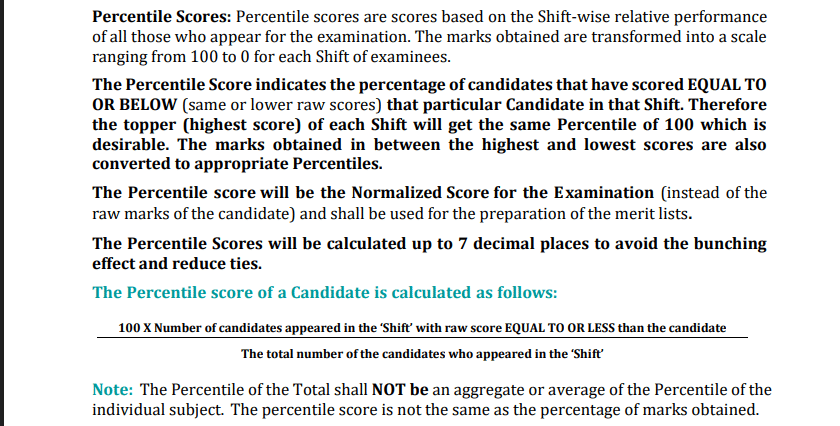
The NTA score indicates the relative performance, that is, with fewer marks, a candidate may achieve higher percentile in a more difficult shift.
Source: JEE Main 2026 official information bulletin
Read More: What is the NTA Score in JEE Mains?
Ques. Is NTA score same as marks in JEE Main?
Ans. No, NTA score is a percentile, and the marks are real scores (out of 300).
Ques. Why does NTA use percentile instead of marks?
Ans. To balance the differences in the difficulty between different shifts.
How NTA Score Works in JEE Main 2026
- NTA scores make JEE Main 2026 fair by adjusting for different difficulty levels across shifts.
- They convert your raw marks into a percentile using a normalization process.
Raw Score vs NTA Score in JEE Main 2026
| Parameter | Raw Score | NTA Score (Percentile) |
|---|---|---|
| Definition | Actual marks obtained | Normalized percentile score |
| Range | 0-300 | 0-100 |
| Basis | Correct & incorrect answers | Relative performance |
| Use | Performance analysis | Ranking & merit list |
Also Read: JEE Main Scorecard Explained: Percentile, NTA Score, Rank & Category-Wise AIR
How to Calculate JEE Mains NTA Score?
- To know how to calculate JEE Mains marks from NTA score, you need to first understand that percentile cannot be converted directly into raw marks.
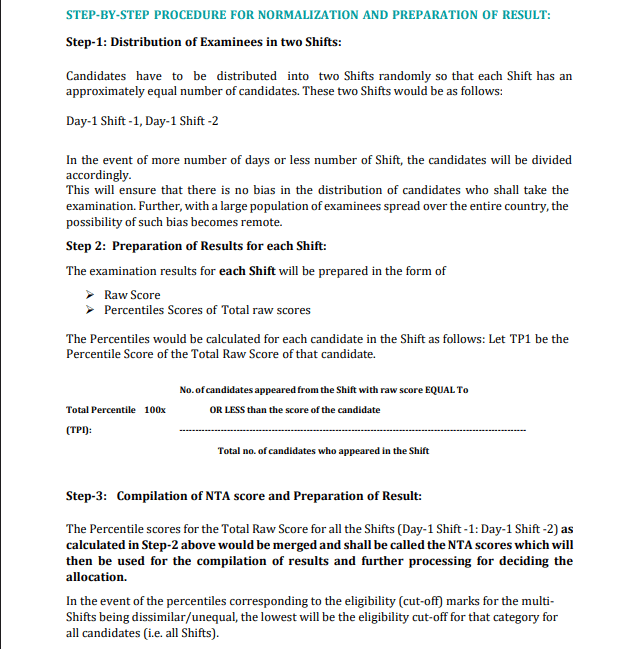
- As the NTA score is in a normalized form, all candidates have to find first their raw score by using the answer key and response sheet once released by NTA.
- It is expected that NTA is going to release the JEE Main 2026 session 2 provisional answer key and response on 11th April,2026
Check:
Once you calculate the JEE Main raw mark, you can use the following table to calculate your total percentile.
| Percentile Type | Formula |
|---|---|
| Total Percentile (T1P) | (100 × Number of candidates in the session with raw score ≤ your total score) / Total number of candidates in the session |
| Mathematics Percentile (M1P) | (100 × Number of candidates in the session with raw score ≤ your Maths score) / Total number of candidates in the session |
| Physics Percentile (P1P) | (100 × Number of candidates in the session with raw score ≤ your Physics score) / Total number of candidates in the session |
| Chemistry Percentile (C1P) | (100 × Number of candidates in the session with raw score ≤ your Chemistry score) / Total number of candidates in the session |
- Percentile for each section is calculated separately, depending on performance in subjects, whereas overall ranking is done by the total percentile.
- This systematic procedure makes sure that there is a fair comparison for all candidates within a session.
Source: JEE Main 2026 official information bulletin
Importance of NTA Score in JEE Main 2026
| Benefit | Explanation |
|---|---|
| Equal & Unbiased Result | Normalization ensures candidates across different shifts are evaluated on the same scale despite varying difficulty levels |
| Standardized Ranking | Converts raw marks into percentile, making comparison fair across lakhs of candidates |
| Fair Competition | Eliminates advantage/disadvantage due to easier or tougher question papers |
| Transparent System | Clearly defined percentile-based evaluation improves result credibility |
Tie-Breaking Criteria in JEE Main 2026
If candidates for same NTA score, the ranking is decided by using the below tie-breaking criteria:
| Priority Order | Criteria |
|---|---|
| 1 | Higher NTA score in Mathematics |
| 2 | Higher NTA score in Physics |
| 3 | Higher NTA score in Chemistry |
| 4 | Lower ratio of incorrect to correct answers (overall) |
| 5 | Lower ratio of incorrect to correct answers in Mathematics |
| 6 | Lower ratio of incorrect to correct answers in Physics |
| 7 | Lower ratio of incorrect to correct answers in Chemistry |
| 8 | If tie persists, same rank is assigned |
How to Calculate JEE Main Rank from NTA Percentile?
There is a very simple formula that can be utilized by the candidates to estimate your rank, which is based on your percentile. Although the National Testing Agency does not give the rank based on the NTA score, students can adjust the approximate rank using their NTA percentile.
Formula to Calculate Rank from NTA Score
| Component | Details |
|---|---|
| Formula | Rank = (100 - NTA Percentile) × (Total Candidates ÷ 100) |
| Total Candidates | 11,30,000 in JEE Main 2026 Session 2 |
| Nature | Gives approximate rank, not exact AIR |
Example Calculation
| Parameter | Value |
|---|---|
| NTA Percentile | 98.5 |
| Total Candidates | 10,00,000 |
| Calculation | (100 - 98.5) × 10,00,000 ÷ 100 |
| Estimated Rank | 15,000 |
Check: JEE Main 2026 Marks Vs Percentile for all Session 2 Apr Shifts
JEE Main Marks vs Percentile vs Rank (Expected)
- The JEE Main AIR is prepared based on the normalised percentile, rather than your raw marks.
- The candidates are able to get up to 99 percentile with a score of 190-210 marks.
- Between 120 and 160 marks, 5-10 marks can result in a considerable percentile change
| Raw Marks (out of 300) | Expected Percentile | Approx AIR Range | Competition Band |
|---|---|---|---|
| 260+ | 99.8 - 100 | Top 1,000 | Top 0.1% |
| 240 - 259 | 99.6 - 99.8 | 1,000 - 3,500 | Elite NIT/IIT zone |
| 220 - 239 | 99.3 - 99.6 | 3,500 - 7,000 | Top NIT CSE |
| 200 - 219 | 99 - 99.3 | 7,000 - 12,000 | NIT CSE/ECE |
| 170 - 199 | 97.5 - 99 | 12,000 - 25,000 | Core NIT branches |
| 140 - 169 | 96 - 97.5 | 25,000 - 45,000 | Mid NIT/IIIT |
| 120 - 139 | 94 - 96 | 45,000 - 70,000 | JEE Adv cutoff zone |
| 100 - 119 | 90 - 94 | 70,000 - 1,00,000 | Qualifying range |
| Below 100 | Below 90 | 1,00,000+ | Low percentile band |
Check:
Ques. Can I calculate exact marks from NTA percentile?
Ans. No, it is impossible to derive precise marks since the NTA score is normalized, and depends on performance per session.
Ques. What is the best way to calculate JEE Main marks?
Ans. Compare the official answer key and response sheet and use +4/-1 marking scheme to calculate raw marks.
Ques. How accurate is rank prediction using NTA score?
Ans. It provides a close estimate, yet the real ranking might be a little lower or higher as a result of normalisation and total candidates.
Ques. Does the same percentile mean same marks for all students?
Ans. No, because there are varying levels of shift difficulty, the same percentile can end up with varying marks.
Related News:



Comments