CBSE Class 12 Chemistry Question Paper 2026 Set-3 is now available for download along with detailed solutions. CBSE conducted the Class 12 Chemistry examination on February 28, 2026, from 10:30 AM to 1:30 PM. The question paper consists of 33 questions carrying a total of 70 marks. The paper is divided into five sections: Section A contains MCQs, Section B contains very short answer questions, Section C contains short answer questions, Section D contains case-based questions, and Section E contains long answer questions. All sections are compulsory. The Chemistry question paper 2026 was rated moderate but slightly lengthy by students, with a significant focus on NCERT-based organic reactions and physical chemistry numericals.

CBSE Class 12 Chemistry Question Paper 2026 Set-3 with Solution PDF

CBSE Class 12 Chemistry Question Paper 2026 Set-3 with Solution PDF Download PDF Check Solutions

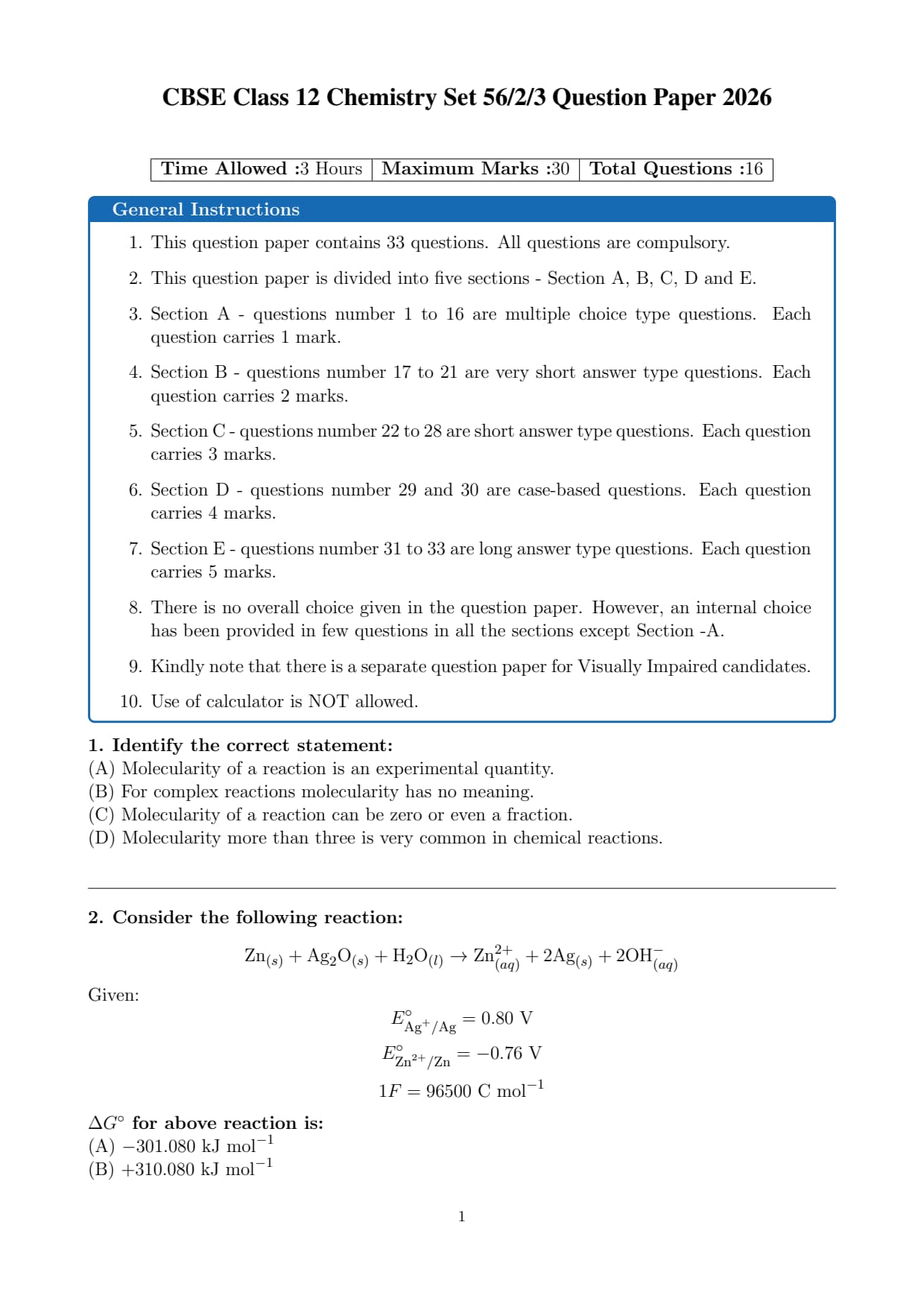
Question 1:

Identify the correct statement:

  • (A) Molecularity of a reaction is an experimental quantity.
  • (B) For complex reactions molecularity has no meaning.
  • (C) Molecularity of a reaction can be zero or even a fraction.
  • (D) Molecularity more than three is very common in chemical reactions.

Question 2:

Consider the following reaction: \[ Zn_{(s)} + Ag_2O_{(s)} + H_2O_{(l)} \rightarrow Zn^{2+}_{(aq)} + 2Ag_{(s)} + 2OH^-_{(aq)} \]

Given: \[ E^\circ_{Ag^+/Ag} = 0.80 V \] \[ E^\circ_{Zn^{2+}/Zn} = -0.76 V \] \[ 1F = 96500 C mol^{-1} \]

\(\Delta G^\circ\) for above reaction is:

  • (A) \(-301.080 kJ mol^{-1}\)
  • (B) \(+310.080 kJ mol^{-1}\)
  • (C) \(-326.070 kJ mol^{-1}\)
  • (D) \(375.060 kJ mol^{-1}\)

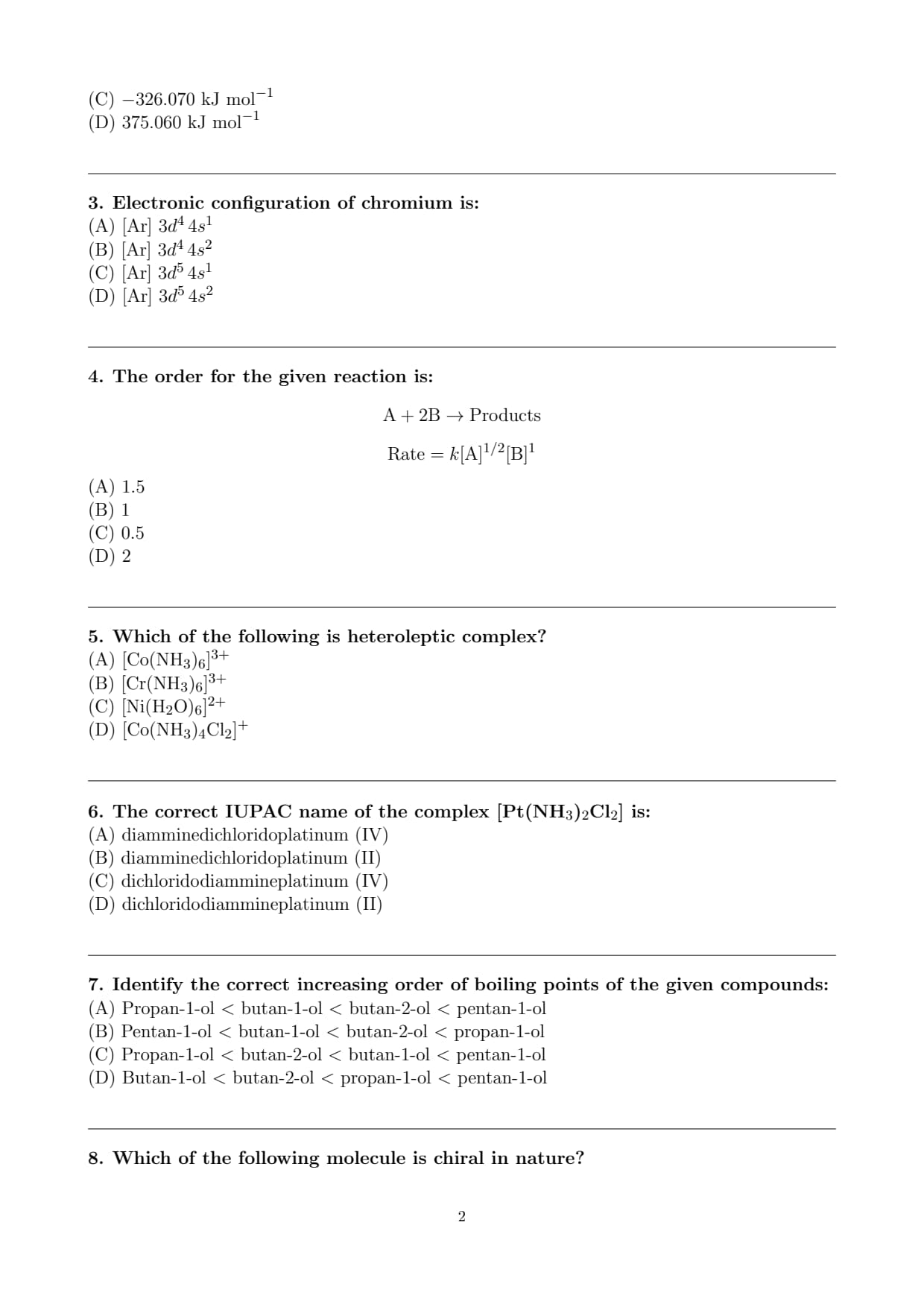
Question 3:

Electronic configuration of chromium is:

  • (A) [Ar] \(3d^4\,4s^1\)
  • (B) [Ar] \(3d^4\,4s^2\)
  • (C) [Ar] \(3d^5\,4s^1\)
  • (D) [Ar] \(3d^5\,4s^2\)

Question 4:

The order for the given reaction is: \[ A + 2B \rightarrow Products \] \[ Rate = k[A]^{1/2}[B]^{1} \]

  • (A) 1.5
  • (B) 1
  • (C) 0.5
  • (D) 2

Question 5:

Which of the following is heteroleptic complex?

  • (A) [Co(NH\(_3\))\(_6\)]\(^{3+}\)
  • (B) [Cr(NH\(_3\))\(_6\)]\(^{3+}\)
  • (C) [Ni(H\(_2\)O)\(_6\)]\(^{2+}\)
  • (D) [Co(NH\(_3\))\(_4\)Cl\(_2\)]\(^{+}\)

Question 6:

The correct IUPAC name of the complex [Pt(NH\(_3\))\(_2\)Cl\(_2\)] is:

  • (A) diamminedichloridoplatinum (IV)
  • (B) diamminedichloridoplatinum (II)
  • (C) dichloridodiammineplatinum (IV)
  • (D) dichloridodiammineplatinum (II)

Question 7:

Identify the correct increasing order of boiling points of the given compounds:

  • (A) Propan-1-ol \(<\) butan-1-ol \(<\) butan-2-ol \(<\) pentan-1-ol
  • (B) Pentan-1-ol \(<\) butan-1-ol \(<\) butan-2-ol \(<\) propan-1-ol
  • (C) Propan-1-ol \(<\) butan-2-ol \(<\) butan-1-ol \(<\) pentan-1-ol
  • (D) Butan-1-ol \(<\) butan-2-ol \(<\) propan-1-ol \(<\) pentan-1-ol

Question 8:

Which of the following molecule is chiral in nature?

  • (A) Propan-2-ol
  • (B) Butan-2-ol
  • (C) 1-Bromobutane
  • (D) 2-Bromopropane

Question 9:

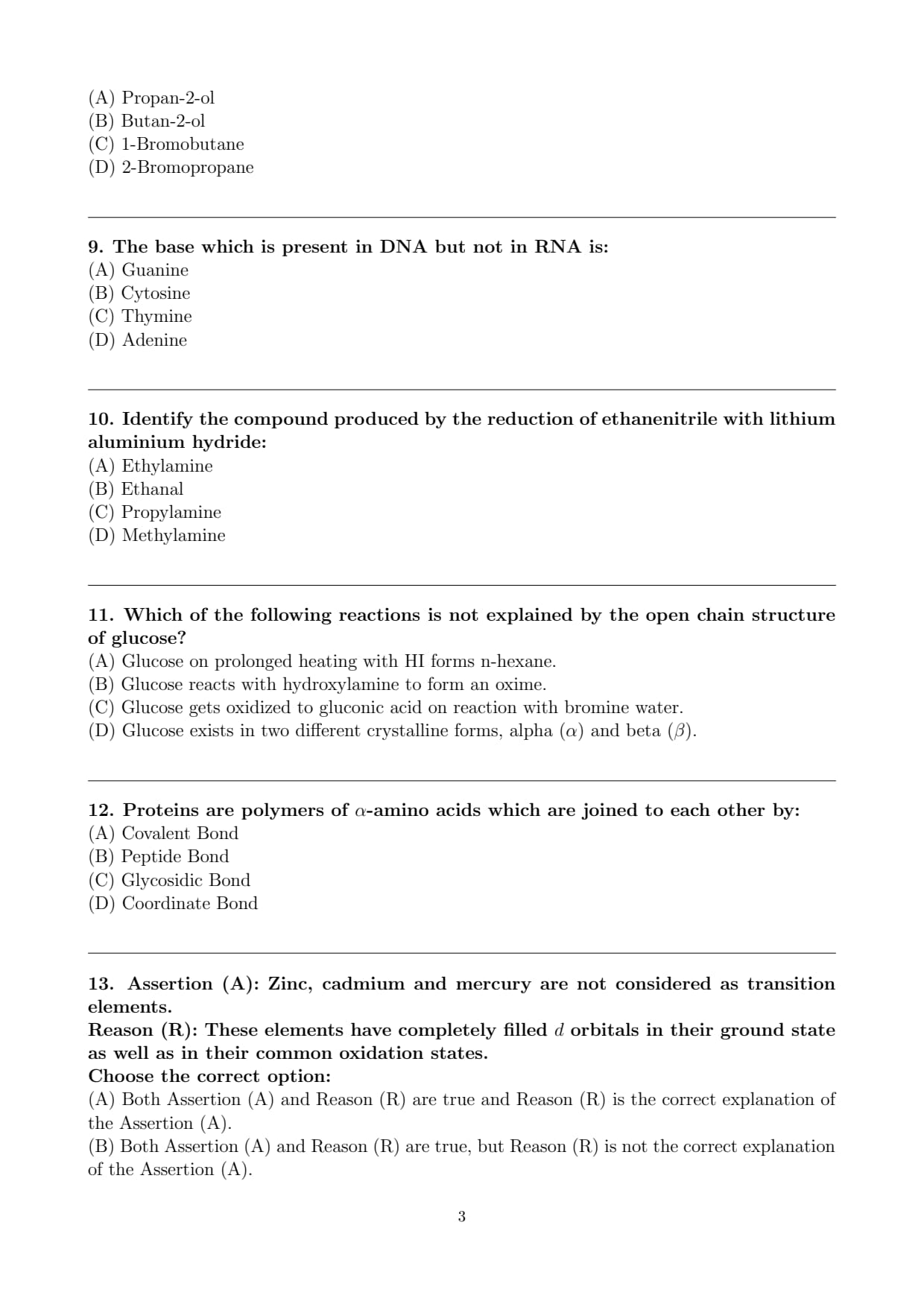
The base which is present in DNA but not in RNA is:

  • (A) Guanine
  • (B) Cytosine
  • (C) Thymine
  • (D) Adenine

Question 10:

Identify the compound produced by the reduction of ethanenitrile with lithium aluminium hydride:

  • (A) Ethylamine
  • (B) Ethanal
  • (C) Propylamine
  • (D) Methylamine

Question 11:

Which of the following reactions is not explained by the open chain structure of glucose?

  • (A) Glucose on prolonged heating with HI forms n-hexane.
  • (B) Glucose reacts with hydroxylamine to form an oxime.
  • (C) Glucose gets oxidized to gluconic acid on reaction with bromine water.
  • (D) Glucose exists in two different crystalline forms, alpha (\(\alpha\)) and beta (\(\beta\)).

Question 12:

Proteins are polymers of \(\alpha\)-amino acids which are joined to each other by:

  • (A) Covalent Bond
  • (B) Peptide Bond
  • (C) Glycosidic Bond
  • (D) Coordinate Bond

Question 13:

Assertion (A): Zinc, cadmium and mercury are not considered as transition elements.

Reason (R): These elements have completely filled \(d\) orbitals in their ground state as well as in their common oxidation states.

Choose the correct option:

  • (A) Both Assertion (A) and Reason (R) are true and Reason (R) is the correct explanation of the Assertion (A).
  • (B) Both Assertion (A) and Reason (R) are true, but Reason (R) is not the correct explanation of the Assertion (A).
  • (C) Assertion (A) is true, but Reason (R) is false.
  • (D) Assertion (A) is false, but Reason (R) is true.

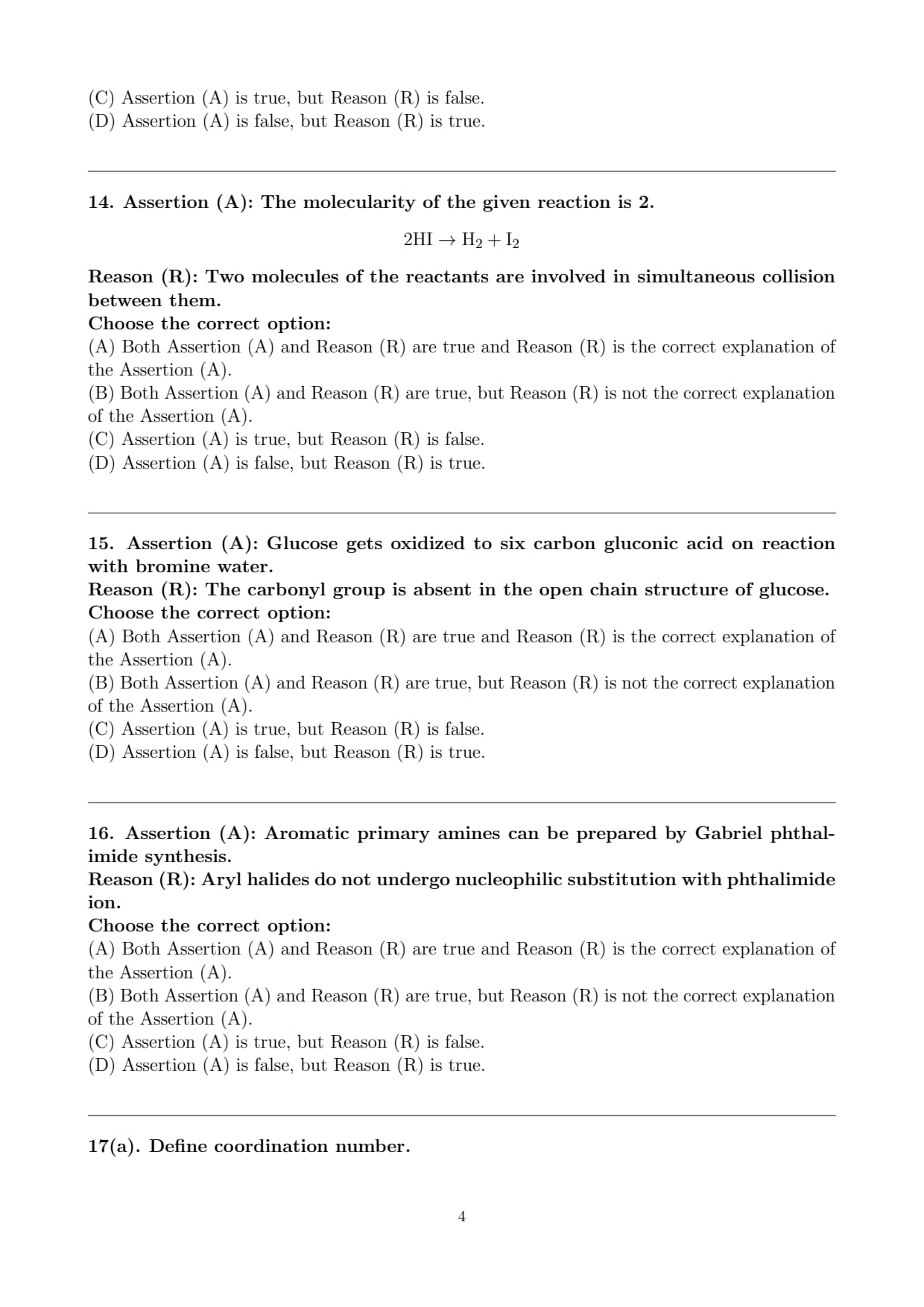
Question 14:

Assertion (A): The molecularity of the given reaction is 2. \[ 2HI \rightarrow H_2 + I_2 \]

Reason (R): Two molecules of the reactants are involved in simultaneous collision between them.

Choose the correct option:

  • (A) Both Assertion (A) and Reason (R) are true and Reason (R) is the correct explanation of the Assertion (A).
  • (B) Both Assertion (A) and Reason (R) are true, but Reason (R) is not the correct explanation of the Assertion (A).
  • (C) Assertion (A) is true, but Reason (R) is false.
  • (D) Assertion (A) is false, but Reason (R) is true.

Question 15:

Assertion (A): Glucose gets oxidized to six carbon gluconic acid on reaction with bromine water.

Reason (R): The carbonyl group is absent in the open chain structure of glucose.

Choose the correct option:

  • (A) Both Assertion (A) and Reason (R) are true and Reason (R) is the correct explanation of the Assertion (A).
  • (B) Both Assertion (A) and Reason (R) are true, but Reason (R) is not the correct explanation of the Assertion (A).
  • (C) Assertion (A) is true, but Reason (R) is false.
  • (D) Assertion (A) is false, but Reason (R) is true.

Question 16:

Assertion (A): Aromatic primary amines can be prepared by Gabriel phthalimide synthesis.

Reason (R): Aryl halides do not undergo nucleophilic substitution with phthalimide ion.

Choose the correct option:

  • (A) Both Assertion (A) and Reason (R) are true and Reason (R) is the correct explanation of the Assertion (A).
  • (B) Both Assertion (A) and Reason (R) are true, but Reason (R) is not the correct explanation of the Assertion (A).
  • (C) Assertion (A) is true, but Reason (R) is false.
  • (D) Assertion (A) is false, but Reason (R) is true.

Question 17(a):

Define coordination number.


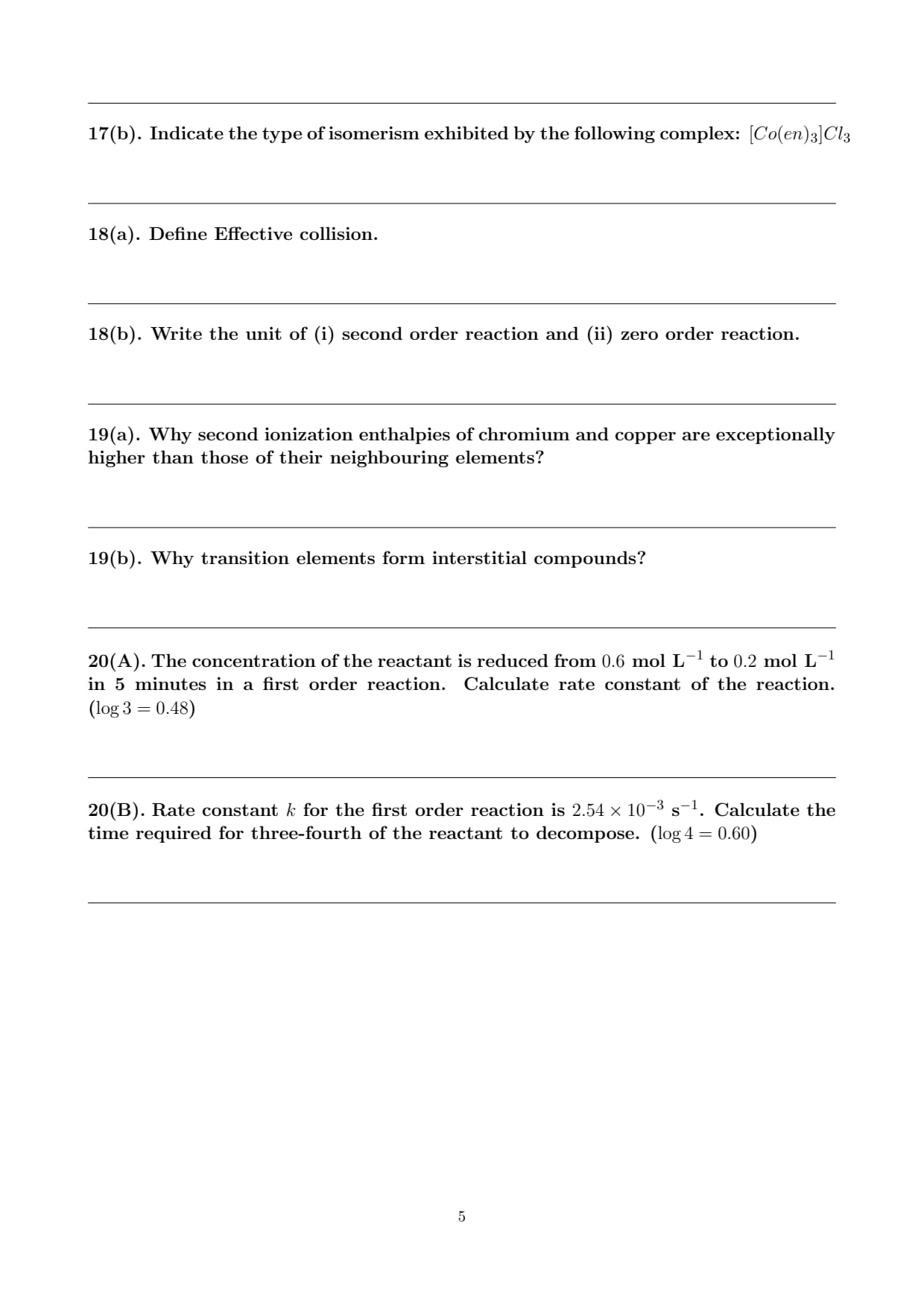
Question 17(b):

Indicate the type of isomerism exhibited by the following complex: \([Co(en)_3]Cl_3\)


Question 18(a):

Define Effective collision.


Question 18(b):

Write the unit of (i) second order reaction and (ii) zero order reaction.


Question 19(a):

Why second ionization enthalpies of chromium and copper are exceptionally higher than those of their neighbouring elements?


Question 19(b):

Why transition elements form interstitial compounds?


Question 20(a):

The concentration of the reactant is reduced from \(0.6 mol L^{-1}\) to \(0.2 mol L^{-1}\) in 5 minutes in a first order reaction. Calculate rate constant of the reaction. (\(\log 3 = 0.48\))


Question 20(b):

Rate constant \(k\) for the first order reaction is \(2.54 \times 10^{-3} s^{-1}\). Calculate the time required for three-fourth of the reactant to decompose. (\(\log 4 = 0.60\))
CBSE Class 12 Preparation Tips | Must Watch Before Exam